Ken Burns and the Vietnam War: Ten Items to Watch For

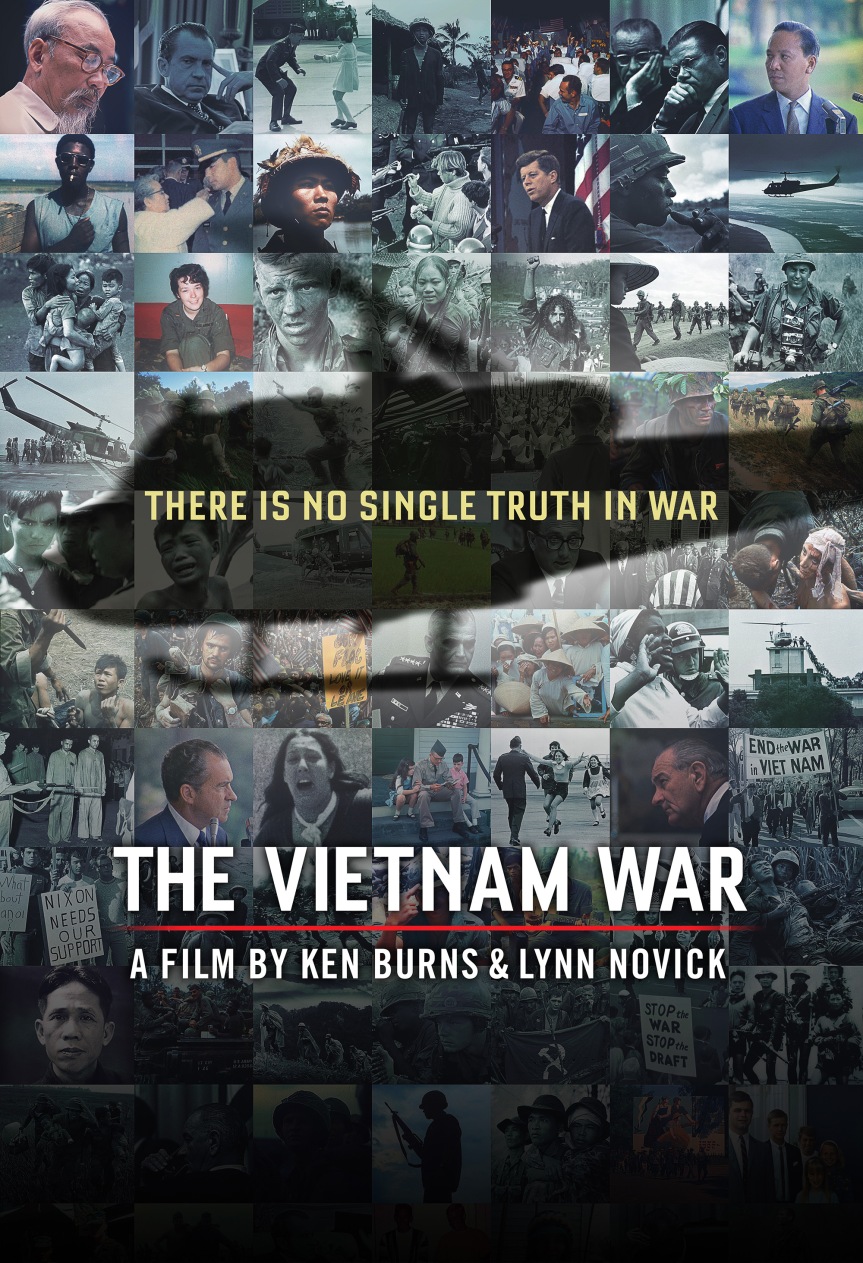
Helicopter_Poster_promoV2

W.J. Astore

On September 17th, a new TV documentary series on the Vietnam War by Ken Burns (famous for past series on the U.S. Civil War, Baseball, and Jazz, among others) and Lynn Novick begins its run on PBS.  Airing in ten parts over 18 hours, the series promises a comprehensive look at the war from all sides, with the catchphrase “There is no single truth in war” serving as a guiding light.  Initial excerpts suggest the series isn’t looking to provide definitive answers, perhaps as a way of avoiding political controversy in the Age of Trump.

I’ll be watching the series, but I have ten points of my own to make about America’s war in Vietnam.  As a preamble, the Vietnam War (American version) was both mistake and crime. What’s disconcerting in the U.S. media is the emphasis on the war as an American tragedy, when it was truly a horrific tragedy inflicted upon the peoples of Southeast Asia (Vietnamese, Laotians, Cambodians). Yes, American troops suffered and died in large numbers, yet Southeast Asian casualties were perhaps 50 times as great. Along with wanton killing came the poisoning of the environment with defoliants like Agent Orange; meanwhile, mines and unexploded ordnance from the war continue to kill people today in Southeast Asia. In a sense, the killing from that war still isn’t over.

With the caveat that we should reserve judgment until we’ve seen the series, let’s keep these ten points in mind as we watch:

1. To most Americans, Vietnam is a war. And war is a distorting and limiting lens through which to view cultures and peoples. Will Burns recognize this distortion?

2. The series talks about hearing voices from all sides of the conflict. But will the Vietnamese people, together with Laotians and Cambodians, really have as much say as Americans?

3. The U.S. suffered nearly 60,000 troops killed. But Vietnamese killed numbered in the millions. And the destruction to SE Asia — the spread of the war to Laos and Cambodia — was on a scale that rivaled or surpassed the destruction to the American South during the U.S. Civil War. Will that destruction be thoroughly documented and explained?

4. Whose point of view will prevail in the documentary? What will be the main thread of the narrative? Will the war be presented as a tragedy? A misunderstanding? A mistake? A crime? Will the “noble cause” and “stabbed in the back” myths (the ideas that the U.S. fought for freedom and democracy and against communism, and that the U.S. military could have won but was prevented from doing so by unpatriotic forces at home) be given equal time in the interests of a “fair and balanced” presentation? Will these myths be presented as alternative truths of the war?

5. Which American war in Vietnam will be presented? Even when we talk of the American part of the Vietnam War, there were at least four wars. The U.S. Army under General William Westmoreland fought a conventional, search and destroy, war. The Air Force wanted to prove that airpower alone, specifically bombing, could win the war. The Marines were more interested in counterinsurgency and pacification. The CIA and special ops types were engaged in psychological warfare, assassinations, torture, and god-knows-what-else.

6. The American presence in Vietnam became so overwhelming that by 1967-68 the Vietnamese economy was completely distorted. We brought American materialism and profligacy to a nation that was, by comparison, impoverished and “backwards” (from our perspective, of course). Material superiority bred and fed cockiness.

Consider Meredith Lair’s book, “Armed with Abundance: Consumerism and Soldiering in the Vietnam War” (2011).  It details the non-combat experiences of U.S. troops in Vietnam.  Here’s a telling book blurb written by historian Christian Appy: “Meredith Lair’s fascinating analysis of rear-echelon life among American G.I.s dramatically challenges our most common conceptions of U.S. military experiences in Vietnam. From steaks to steambaths, swimming pools to giant PXs, the amenities provided on large bases not only belie conventional images of that war, but also stand as dramatic testimony to the desperate and unsuccessful effort of American officials to bolster flagging troop morale as the war lurched toward its final failure.”

Will this orgy of American-driven materialism be documented?

7. Anti-war protests and serious unrest within the U.S. military led to the end of the draft and the creation of an “all-volunteer” military. Has this decision contributed to a more imperial U.S. foreign policy facilitated by a much more tractable military of “volunteers”?

8. Short of nuclear weapons, the U.S. military used virtually every weapon in its arsenal in SE Asia. The region became a test/proving ground for all sorts of weapons and concepts, from “smart” weapons and electronic fences and sensors to horrendous pounding by conventional bombs to war on the environment using defoliants and massive bulldozers to … well … everything. All sorts of pacification theories were tested as well, along with COIN and “small wars” and unconventional tactics to search and destroy to Vietnamization to … well … again, everything. SE Asia became a laboratory and its peoples became lab rats. Will this reality be fully documented?

9. It’s essential that people realize President Richard Nixon and his National Security Adviser, Henry Kissinger, knew the war was a lost cause no later than 1969. (Their conversations on tape prove this.) All they were looking for was a “decent interval” between a peace treaty (“peace with honor”) and what they saw as the inevitable collapse. They got that (in)decent interval of roughly 2.5 years. The Congressional decision to cut off funding to South Vietnam was convenient for the Nixon/Kissinger acolytes, since it allowed them to shift the blame for South Vietnam’s collapse in 1975 to Congress as well as to the usual “suspect” elements in American society, i.e. the peace movement.

Will the duplicity and hypocrisy of Nixon/Kissinger be adequately documented?

10. Finally, an important aspect of the Vietnam War was the breakdown in discipline within the U.S. military, which helped to drive the eventual elimination of the draft. Part of this breakdown was driven by drugs, a trade in which the CIA was implicated. At The Intercept, Jeremy Scahill interviewed Alfred McCoy, who wrote the book on this drug trade. Here’s an excerpt from their recent interview:

Alfred McCoy: And in 1970 and ’71, there were rumors that started coming back from Vietnam, particularly 1971, that heroin was spreading rapidly in the ranks of the U.S. forces fighting in South Vietnam. And in later research, done by the White House, [it was] determined that in 1971, 34 percent, one-third of all the American combat troops fighting in South Vietnam were heavy heroin users. There were, if that statistic is accurate, more addicts in the ranks of the U.S. Army in South Vietnam than there were in the United States.

And so what I did was I set out to investigate: Where was the opium coming from? Where was the heroin coming from? Who was trafficking it? How is it getting to the troops in their barracks and bunkers across the length and breadth of South Vietnam? Nobody was asking this question. Everyone was reporting on the high level of abuse, but nobody was figuring out where and who.

So I started interviewing. I went to Paris. I interviewed the head of the French equivalent of the CIA in Indochina, who was then head of a major French helicopter manufacturing company, and he explained to me how during the French Indochina war from 1946 to 1954, they were short of money for covert operations, so the hill tribes in Laos produced the opium, the aircraft picked it up, they turned it over to the netherworld, the gangsters that controlled Saigon and secured it for the French and that paid for their covert operations. And I said, “What about now?” And he said, “Well I don’t think the pattern’s changed. I think it’s still there. You should go and look.”

So I did. I went to Saigon. I got some top sources in the Vietnamese military. I went to Laos. I hiked into the mountains. I was ambushed by CIA mercenaries and what I discovered was that the CIA’s contract airline, Air America, was flying into the villages of the Hmong people in Northern Laos, whose main cash crop was opium and they were picking up the opium and flying it out of the hills and there were heroin labs — one of the heroin labs, the biggest heroin lab in the world, was run by the commander-in-chief of the Royal Laotian Army, a man whose military budget came entirely from the United States. And they were transforming, in those labs, the opium into heroin. It was being smuggled into South Vietnam by three cliques controlled by the president, the vice president, and the premier of South Vietnam, and their military allies and distributed to U.S. forces in South Vietnam.

And the CIA wasn’t directly involved, but they turned a blind eye to the role of their allies’ involvement in the traffic. And so this heroin epidemic swept the U.S. Army in Vietnam. The Defense Department invented mass urine analysis testing, so when those troops left they were tested and given treatment. And what I discovered was the complexities, the complicity, of the CIA in this traffic and that was a pattern that was repeated in Central America when the Contras became involved in the traffic.

These ten items highlight just some of the complexities of the Vietnam War and its effects throughout Southeast Asia.  How many of these will be tackled honestly in Ken Burns’s new series?  We shall see, beginning in two weeks.

With the Pentagon, Trump Has Morphed Into Hillary Clinton

trump-clinton
More alike than we knew?

W.J. Astore

Candidate Trump occasionally said unconventional things about the Pentagon and America’s wars.  He attacked the Pentagon for wasteful spending; cost overruns on the F-35 jet fighter were a favorite target.  He attacked the Iraq and Afghan wars as wasteful, asserting they’d cost trillions of dollars without aiding the U.S. in any measurable way.  He argued for friendlier relations with Russia, a détente of sort compared to the policies followed by the Obama administration.  Naturally, even as he declaimed against America’s wasteful wars and costly weaponry, he promised to fund the military generously.  Finally, he wasn’t afraid to take America’s generals to task, asserting he knew more than they did about war and foreign policy.

President Trump is a different man.  “His” generals have brought him under control.  Criticism of the F-35 has gone away.  Trump, even if reluctantly, has embraced the Afghan war and the Pentagon’s open-ended commitment to it.  Russian détente has taken a back seat to tough talk and sanctions (not that Trump had much of a choice, considering his campaign is under investigation for possible collusion with Russia).  More than anything, Trump has tacitly admitted “his” generals know far more than he does.  Mattis controls the Pentagon and the National Security State.  Kelly, as White House Chief of Staff, does his best to control Trump.  McMaster, as National Security Adviser, increasingly controls what Trump knows and when he knows it with respect to security policy.

In short, the generals have won.  Consider the fates of Steve Bannon, Sebastian Gorka, and John Bolton.  Bannon was eased out; Gorka was fired; and Bolton, according to today’s FP: Foreign Policy report, “has been shut out of the White House under the new leadership of chief of staff John Kelly. FP’s Dan De Luce writes that several sources confirm Bolton’s regular meetings with Trump are a thing of the past, and he has been unable to deliver a plan he devised to get Washington out of the deal it signed with Tehran to halt that country’s nuclear program.”

I’m no fan of Bannon-Gorka-Bolton, but they did represent a challenge to the U.S. military and the neo-con orthodoxy that rules Washington.

Trump is now firmly under the U.S. military’s control, even as he continues to feed the beast with more money and influence.  His only way out is to starve the beast — to cut its funding by cutting its mission.  Fat chance of that happening anytime soon, with generals like Mattis, Kelly, and McMaster in charge.

Most in the mainstream media see this in a positive light.  We read about how Trump’s generals are the adults in the room, a moderating influence on Trump’s ill-informed impetuosity.  There may even be some truth to this.  But here’s the rub: President Trump, at least on national security policy, has ironically morphed into Hillary Clinton.  He’s become a conventional hawk with no new ideas, when as a candidate he had the temerity to criticize America’s wasteful weaponry and disastrous imperial policies.

As Trump himself might tweet, “Sad.”

Trump’s Afghan War Speech: More of the Same, With More Killing

download
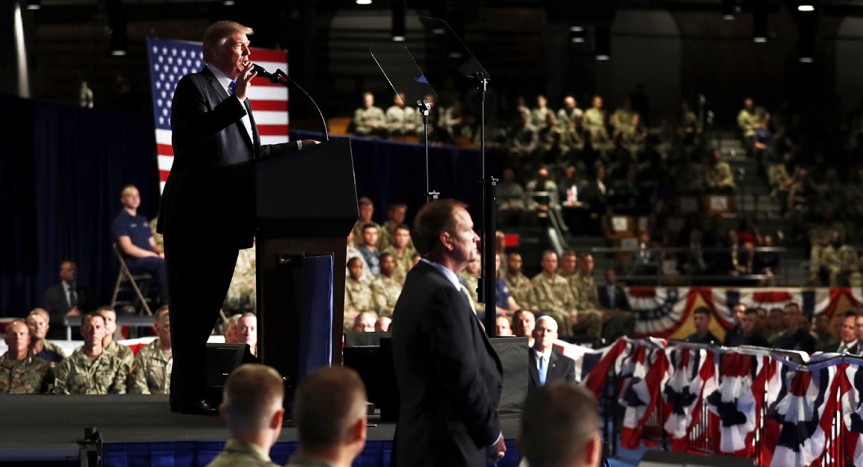
Trump, surrounded by troops and patriotic bunting, defines his “new” Afghan strategy (Carolyn Kaster/AP)

W.J. Astore

As a private citizen and presidential candidate, Donald Trump railed against the Afghan war.  A waste, he said.  Americans should withdraw, he said.  But in last night’s speech, Trump went against his own instincts (so he said) and went with the failed policies of his predecessors.  The war will continue, no timetable set, no troop levels determined, with conditions on the ground dictating America’s actions, according to the president.

What caught my attention, beyond the usual paeans of praise to America’s “warriors” and “warfighters,” was the specious reasoning to justify the continuation of the war.  Trump gave three reasons, so let’s take them one at a time:

  1. “First, our nation must seek an honorable and enduring outcome worthy of the tremendous sacrifices that have been made, especially the sacrifices of lives …”

It’s piss-poor reasoning to argue that, because a lot of people have sacrificed and died in a war, the war should continue (with more people dying) to justify those previous sacrifices.  By this logic, the more who die, the more we should keep fighting, meaning more dead, meaning more fighting, and so on.  Where is the honor and “worthy” outcome here?

  1. “Second, the consequences of a rapid exit are both predictable and unacceptable. 9/11, the worst terrorist attack in our history, was planned and directed from Afghanistan because that country was ruled by a government that gave comfort and shelter to terrorists. A hasty withdrawal would create a vacuum that terrorists, including ISIS and al Qaeda, would instantly fill, just as happened before September 11th.”

Actually, the consequences of an American withdrawal are both unpredictable and (most probably) acceptable.  Sure, terrorist organizations may gain impetus from an American withdrawal.  It’s also possible that a notoriously corrupt Afghan government might finally negotiate with the Taliban and other organizations, and that regional power brokers like Pakistan and Iran, who have their own interests in regional stability, might broker a settlement that Americans could live with.

Trump further argued that a rapid U.S. withdrawal from Iraq in 2011 led to “hard-won gains slip[ping] back into the hands of terrorist enemies. Our soldiers watched as cities they had fought for, and bled to liberate, and won, were occupied by a terrorist group called ISIS.”  The truth is far more complex.  The prolonged U.S. occupation of Iraq helped to create ISIS in the first place, and failed American efforts to create and train reliable Iraqi security forces contributed to easy ISIS victories after U.S. forces left in 2011.

  1. “Third and finally, I concluded that the security threats we face in Afghanistan and the broader region are immense. Today, 20 U.S.-designated foreign terrorist organizations are active in Afghanistan and Pakistan — the highest concentration in any region anywhere in the world.”

Isn’t it remarkable that, after sixteen years of sustained effort by the U.S. military, the Af-Pak region is now home to 20+ terrorist organizations?  The “highest concentration” in the world?  Is this not an admission of the utter failure of U.S. policy and actions since 2001?  How is this failure to be rectified by yet more U.S. attacks?

Trump said the new American goal is to kill terrorists.  This is not a strategy.  It’s a perpetual and deadly game of Whac-A-Mole.  That’s what Trump’s vaunted new strategy boils down to, despite the talk of economic pressure and working with Pakistan and India and other regional powers.

On Afghanistan, Trump should have listened to his instincts and withdrawn.  Instead, he listened to “his” generals.  With Trump, the generals won this round.  What they can’t win, however, is the war.

Military Control of the Civilian: It’s Opposite Day in America

mattis
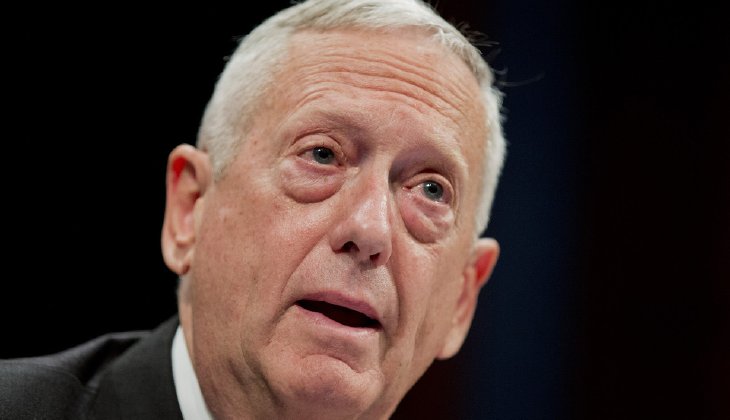
General Mattis: Celebrated as a moderating influence on Trump

W.J. Astore

It’s becoming increasingly difficult for Americans to recall that civilian leaders are supposed to command and control the military, not vice-versa.  Consider an article posted yesterday at Newsweek with the title, TRUMP’S GENERALS CAN SAVE THE WORLD FROM WAR—AND STOP THE CRAZY.  The article extols the virtues of “Trump’s generals”: James Mattis as Secretary of Defense, John Kelly as White House Chief of Staff, and H.R. McMaster as National Security Adviser.  The article presents them as the adults in the room, the voices of calm and reason, a moderating force on a bombastic and bellicose president.

I’ve written about Trump’s generals already at TomDispatch.com and elsewhere.  The latest gushing tribute to America’s generals at Newsweek illustrates a couple of points that bear repeating.  First, you don’t hire generals to rein in a civilian leader, or at least you shouldn’t if you care to keep a semblance of democracy in America.  Second, lifelong military officers favor military solutions to problems.  That’s precisely why you want civilians to control them, and to counterbalance their military advice.  Only in a democracy that is already crippled by creeping militarism can the rise of generals to positions of power be celebrated as a positive force for good.

Speaking of creeping militarism in the USA, I caught another headline the other day that referenced General Kelly’s appointment as Chief of Staff.  This headline came from the “liberal” New York Times:

John Kelly Quickly Moves to Impose Military Discipline on White House


Note that headline.  Not that Kelly was to impose discipline, but rather military discipline. What, exactly, is military discipline?  Well, having made my first career in the military, I can describe its features. Obedience.  Deference to authority.  Respect for the chain of command.  A climate that sometimes degenerates to “a put up and shut up” mentality. Such a climate may be needed in certain military settings, but do we want it to rule the White House?

Here is what I wrote back in December about Trump and “his” generals:

In all of this, Trump represents just the next (giant) step in an ongoing process.  His warrior-steeds, his “dream team” of generals, highlight America’s striking twenty-first-century embrace of militarism. At the same time, the future of U.S. foreign policy seems increasingly clear: more violent interventionism against what these men see as the existential threat of radical Islam. 

Of course, now the threat of nuclear war looms with North Korea.  For a moderating influence, America places its faith in military generals controlling the civilian commander-in-chief, and that’s something to draw comfort from, at least according to Newsweek.

When military control of the civilian is celebrated, you know it’s truly opposite day in America.

Trump: Much “Fire and Fury,” Signifying Something Vital


fat man
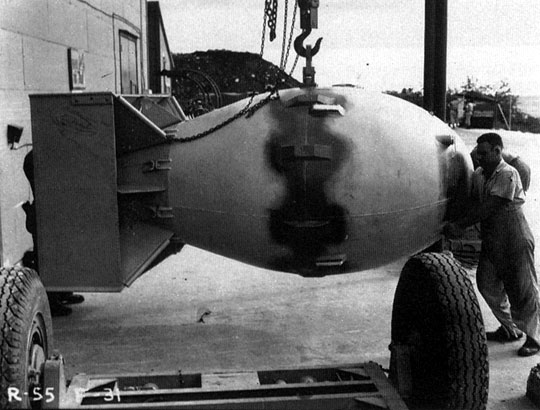
Fat Man, the atomic bomb that devastated Nagasaki on August 9, 1945

W.J. Astore

The big story today is Trump’s threat to North Korea about “fire and fury like the world has never seen” in response to any aggression against the U.S. and its allies.  The world witnessed American “fire and fury” in August of 1945 when Hiroshima and Nagasaki were obliterated by atomic bombs (indeed, today is the 72nd anniversary of the Nagasaki bombing).  Roughly 250,000 people were killed in those two bombings, and Trump is apparently promising a worst form of fury against North Korea (“like the world has never seen”).

Back in October 2016, I wrote a piece at this site with the title: “On nuclear weapons, Trump is nightmarishly scary,” and that nightmare is beginning to take shape.  As I wrote back then, Trump’s worst attribute is his “sweeping ignorance to the point of recklessness when it comes to matters of national defense, and specifically America’s nuclear arsenal.”  I further wrote that:

Back in March … Trump boasted at a debate that the U.S. military would follow his orders irrespective of their legality.  In this latest debate, he yet again revealed that he has no real knowledge of America’s nuclear capability and how modern and powerful (and scary) it truly is.

Sure, Trump is crude, lewd, and sexist, but those qualities won’t destroy the world as we know it.  Ignorance about nuclear weapons, combined with impetuosity and an avowed affection for he-man wild-card generals like George S. Patton and Douglas MacArthur, is a recipe for utter disaster.

A man of Trump’s vanity and impetuosity — a man of raging grievances who lives in his own reality of alternative facts — is hardly a reassuring figure to have at the top of America’s “fire and fury” nuclear arsenal.  Is it all just bluster?  It’s impossible to know, and that’s truly the scary part.

All this fire and fury, even if it remains only bluster, should teach the world a critical lesson: the necessity of nuclear disarmament. Holding millions of people hostage to nuclear terror (as we’ve been doing since the Cold War) has long been immoral, inhumane, and unconscionable.

Instead of making nightmarish threats, a sober and mature U.S. president might actually lead the world in serious efforts to reduce and ultimately to eliminate nuclear weapons. That would be real moral leadership,  That would be real guts.

Trump’s easy boasts of “fire and fury” do signify something vital — the need for global nuclear disarmament, no matter how long it takes.

Update (8/10/17): There’s been a lot of talk, more or less sensible, that Trump’s “fire and fury” rhetoric is just that: rhetoric.  That it will not become reality because North Korean leaders are sensible and rational actors, and that U.S. leaders like Tillerson and Mattis provide a counterbalance to Trump.  Well, maybe.  But escalatory rhetoric can become reality, i.e. it serves to exacerbate tensions that can lead to miscalculation and war.

Think of North Korea’s latest threat to shoot missiles in the direction of Guam.  If that threat is carried out, a U.S. attack on North Korean missile sites is quite likely, and where that would lead is impossible to say.

Reckless rhetoric is not harmless; words can and do box nations as well as people in, often leading to unexpected actions.  Just think of hateful words flung by people in domestic disputes that escalate into something far worse.  Rationality does not always win out.

Update 2 (8/10/17): Trump recently boasted that, during his short presidency, his actions have led to a U.S. nuclear arsenal that is “now far stronger and more powerful” than it was under President Obama.  The truth is that this arsenal hasn’t measurably changed at all.  The Washington Post gives Trump “four Pinocchios” for his latest lie, but surely big lies about nuclear weapons deserve a different rating system.  Should we call it a four megaton lie?  Lie-mageddon?

On Afghanistan, Trump is Right to be Skeptical

trump mattis
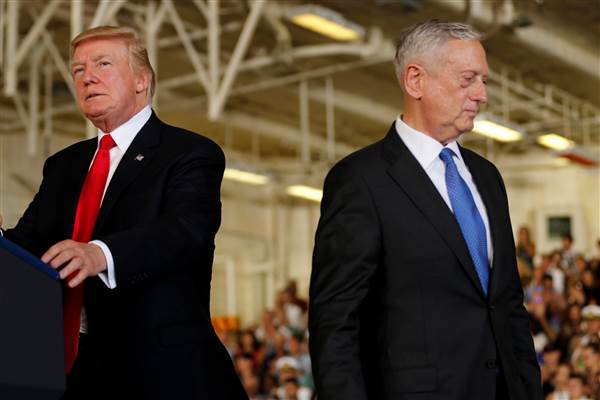
Not seeing eye-to-eye: Trump and Mattis (Jonathan Ernst / Reuters)

W.J. Astore

NBC news reports that President Trump is skeptical about the U.S. military’s prospects in Afghanistan.  The military is losing, not winning, Trump said, and he further suggested the U.S. commander on the scene should be fired.  Meanwhile, China is cleaning up with mineral rights (such as copper mining), even as America’s generals continue with a “stay the course” policy, a policy that’s led to sixteen years of “stalemate” (the U.S. military’s word) at a cost of roughly a trillion dollars.

I highly recommend reading the NBC article for at least two reasons. First, Trump is right to question his advisers’ stale advice.  He’s right to question the generals.  Indeed, that’s his job as president and commander-in-chief.  If sixteen years of effort and a trillion dollars has produced “stalemate” (at best) in Afghanistan, can one blame the president for seeking a new strategy?  Perhaps even a withdrawal?

Second, and most interesting, is the push-back from NBC News and its hired guns: the retired generals and admirals who work for NBC as “consultants.”  Let’s look closely at their comments.

Retired Admiral James Stavridis, a former head of NATO and an NBC News analyst, basically blames the Trump administration, not the military, for the Afghan stalemate.  In his words:

“The situation in Afghanistan is not improving, but I think it’s hardly irretrievable at this point, and what the president needs to be doing is deciding on the strategy.” 

“What is hurting the process at the moment is this back and forth about do we stay or do we go, how many troops,” he added. “Any commander is going to be incredibly handicapped in an environment like that. So I think the fundamental problem here is lack of decisiveness in Washington, specifically in the White House.”

Now, let’s turn to retired General Barry McCaffrey.  President Trump had the audacity to ask experienced combat veterans in Afghanistan (i.e., not only the generals) for advice on the war. and McCaffrey is having none of that:

“One of the last things you necessarily want to do is form policy advice based on what the current combatants think about something in a war zone,” said Gen. McCaffrey, an MSNBC military analyst. “They’re qualified totally to talk about tactics and things like that and what they’re seeing, but the president’s job is to formulate strategy and policy not to do tactical decisions.”

In short, a retired admiral and general at NBC News are taking the President to task for (1) Not being quick enough to rubber-stamp the military’s latest call for more troops in Afghanistan; (2) Daring to listen to the advice of lower-level U.S. combat veterans of the Afghan war, veterans who are rightly critical of the war.

Tell me again: Where’s that “liberal” media bias we’re always hearing about?

Trump is right to question his generals, and he’s right to seek advice from those who don’t wear stars on their shoulders.  And he’s certainly right in not making a hasty decision.

Finally, to NBC News: Can’t you find military experts who aren’t retired generals and admirals?  And with critical perspectives?  Your article essentially supports the generals and their strategy (if that’s the right word) for endless war in Afghanistan.  Is that really the best and only course for America and Afghanistan?  Where’s the talk of negotiation? Withdrawal? An end to America’s seemingly endless commitment to Afghanistan?

Trump is more skeptical of the Afghan war than NBC News and its team of “starry” experts.  Advantage, Trump.

Who needs a military coup?

MPW-100679

W.J. Astore

With the swearing in of John Kelly as White House Chief of Staff, a retired four-star Marine general now controls the White House. Another retired four-star Marine general, James Mattis, controls the Department of Defense (DoD) and much of the National Security State. Meanwhile, a serving three-star Army general, H.R. McMaster, controls the National Security Council.

Who needs a military coup?  Remember when the U.S. was founded on civilian control of a citizen-soldier military?  Those were the days.  The point is not that Kelly-Mattis-McMaster constitute a military cabal; it’s that there’s no rival civilian authority at the upper regions of Trump’s government.  Is Steve Bannon going to rein in the generals?  He fancies himself a military strategist in his own right.  Should we place our faith in Congress?  How about Jared and Ivanka?  Prospects for less bellicose policies are indeed looking grim.

Our clueless president, after all, professes love for “his” generals while acclaiming the WWII generals George Patton and Douglas MacArthur, two soldiers who were not known for their deference to civilian authority.

Again, who needs a military coup?  As the real U.S. military budget soars above a trillion dollars a year and as the U.S. State Department is sidelined and gutted, the future of U.S. foreign policy seems clear: More and more “kinetic” operations, together with more and more brinksmanship with Iran, North Korea, and possibly Russia and China as well.

With generals in the White House and the DoD running the show, advised by another general on the National Security Council, enabling a president whose patience and knowledge base are as thin as his skin, the prospects for catastrophic miscalculation and war loom ever larger.

Update (8/2/17): Speaking of Congress, here’s Senator Lindsey Graham on the appointment of retired Marine General John Kelly as White House Chief of Staff: “The Marines can do almost anything,” Senator Graham said. “The Marines have landed at the White House. They have a beachhead.”

And that’s a good thing, Senator?  In a military dictatorship, perhaps …

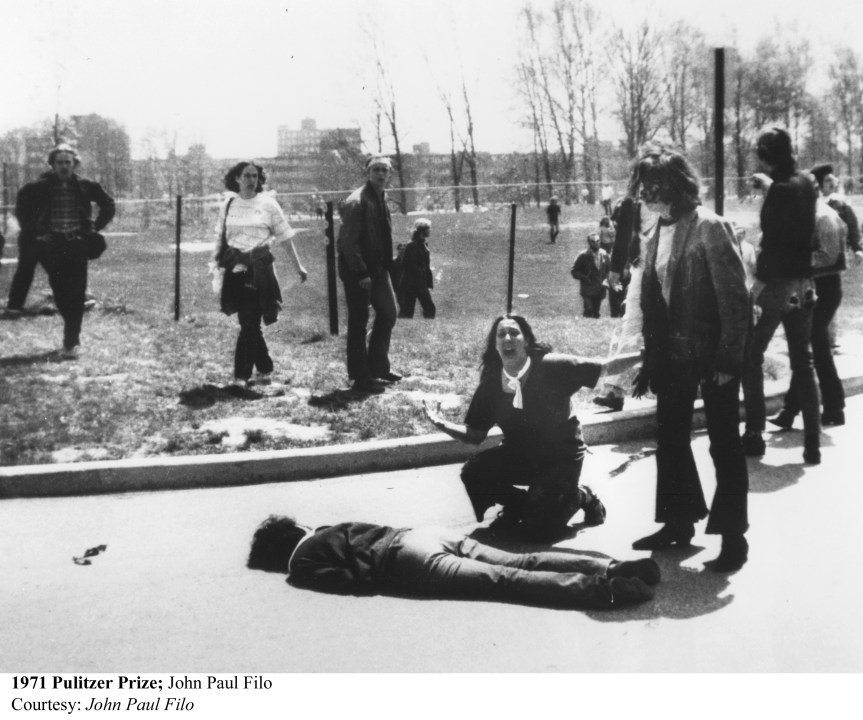
Collateral Damage: A Terrifying Euphemism

kent state
What if you knew her and found her dead on the ground — would she be simply “collateral damage”?

W.J. Astore

The term “collateral damage” is a terrifying euphemism.  The U.S. military didn’t invent it, but it sure has embraced it.  The dictionary definition is “unintended civilian casualties or damage in a war,” which is about as anodyne a description as one could imagine.

In common usage, “collateral” is something we put up to secure a loan, so it often has a positive meaning.  (No worries: I have lots of collateral.) “Damage” is a neutral-sounding word: the book was damaged in shipping. Storm damage. And we also speak of “damages” when we sue someone. In sum, “collateral” and “damage” are impersonal and imprecise words.

Let’s think personally and precisely.  What is “collateral damage” in the “war on terror”? Bodies blown to bits. Blood everywhere. Skin burnt and melted by Willy Peter (White Phosphorous). Eviscerated children. Rotting corpses.

The military has a colorful saying: “Don’t piss on my leg and tell me it’s raining.” Maybe we need a new saying: “Don’t murder my child and tell me it’s collateral damage.”

In his latest mini-essay introduction at TomDispatch.com, Tom Engelhardt notes how “collateral damage” has become a central and defining reality of America’s endless war on terror.  The main article (Burning Raqqa) by Laura Gottesdiener details U.S.-led air strikes in Syria that go horribly wrong:

By the beginning of May, the Abdos’ neighborhood was under almost daily bombardment by the U.S.-led coalition forces. On May 3rd, coalition warplanes reportedly launched up to 30 airstrikes across Tabqa’s first, second, and third neighborhoods, striking homes and a fruit market and reportedly killing at least six civilians. The following night, another round of coalition airstrikes battered the first and third neighborhoods, reportedly killing at least seven civilians, including women and children. Separate airstrikes that same night near the city’s center reportedly killed another six to 12 civilians. 

On May 7th, multiple bombs reportedly dropped by the U.S.-led coalition struck the building where Muhammed and Salam had taken shelter, killing them and their 12-year-old grandson. Three days later, the Syrian Democratic Forces announced that they had fully seized control of Tabqa and the dam. The militia and its U.S. advisers quickly set their sights east to the upcoming offensive in Raqqa.

But for the Abdo family, the tragedy continued. Muhammed and Salam’s bodies were buried beneath the collapsed apartment building. It took 15 days before Wassim’s brother Rashid could secure the heavy machinery required to extract them.

“Nobody could approach the corpses because of the disfigurement that had occurred and the smell emanating from them as a result of being left under the rubble for such a long period of time in the hot weather,” Wassim told me in a recent interview. 

That same day their bodies were finally recovered.  On May 23rd, his parents and nephew were buried in the Tabqa cemetery.

Specifics such as these are generally not reported by the U.S. military or in the U.S. media.  Instead, we get headlines about militants or terrorists being killed, along with snippets about collateral damage, “regrettable” but framed as unavoidable.

Tell that to the families of the dead.

George Orwell famously noted the political uses of language and the insidiousness of euphemisms.  As I wrote a year ago, words about war matter.  Dishonest words contribute to dishonest wars.  They lead to death, dismemberment, and devastation. That’s not “collateral” — that’s a defining and terrifying reality.

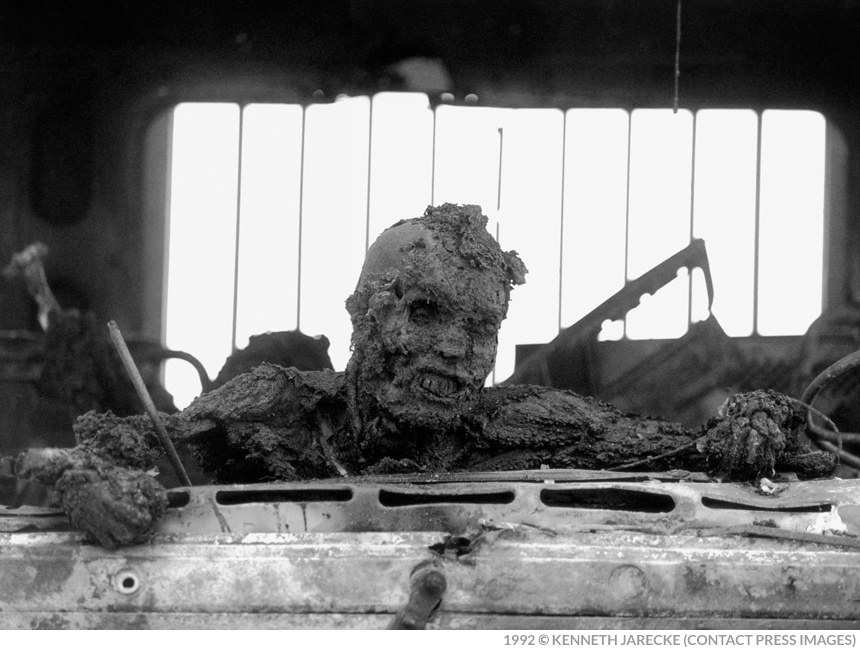
Silencing War Criticism

dead
Grisly photos that show war as it is, in this case a dead Iraqi from Desert Storm, are not shown by the U.S. media

Silencing War Criticism: The Iraq Invasion of 2003

W.J. Astore

Update (7/19/17): I posted this article at HuffPost, and the site added a video that shows the mainstream media gushing over Trump’s strike against Syria.  The video is well worth watching.  http://www.huffingtonpost.com/entry/596df7a3e4b07f87578e6bd7 or follow this link.

Jesse Ventura, former governor of Minnesota (1999-2003), was a hot media commodity as the Bush/Cheney administration was preparing for its invasion of Iraq in 2003.  Ventura, a U.S. Navy veteran who gained notoriety as a professional wrestler before he entered politics, was both popular and outspoken.  MSNBC won the bidding war for his services in 2003, signing him to a lucrative three-year contract to create his own show – until, that is, the network learned he was against the Iraq war.  Ventura’s show quickly went away, even as the network paid him for three years to do nothing.

I heard this revealing story from a new podcast, the TARFU Report, hosted by Matt Taibbi and Alex Pareene.  By his own account, Jesse Ventura was bought off by the network, which back then was owned by General Electric, a major defense contractor that was due to make billions of dollars off the war.

Of course, Ventura was hardly the only war critic to run afoul of GE/NBC.  Phil Donahue, the famous talk show host, saw his highly rated show cancelled when he gave dissenters and anti-war voices a fair hearing.  Ashleigh Banfield, a reporter who covered the Iraq war, gave a speech in late April 2003 that criticized the antiseptic coverage of the war (extracts to follow below).  For her perceptiveness and her honesty, she was reassigned and marginalized, demoted and silenced.

So much for freedom of speech, as well as the press.

As Phil Donahue said, his show “wasn’t good for business.”  NBC didn’t want to lose ratings by being associated with “unpatriotic” elements when the other networks were waving the flag in support of the Iraq war.  In sidelining Ventura and Donahue, NBC acted to squelch any serious dissent from the push for war, and punished Ashleigh Banfield in the immediate aftermath of the war for her honesty in criticizing the coverage shown (and constructed) by the mainstream media, coverage that was facilitated by the U.S. military and rubber-stamped by corporate ownership.

Speaking of Banfield’s critique, here are some excerpts from her speech on Iraq war coverage in April 2003.  Note that her critique remains telling for all U.S. media war coverage since then:

That said, what didn’t you see [in U.S. media coverage of the Iraq war]? You didn’t see where those bullets landed. You didn’t see what happened when the mortar landed. A puff of smoke is not what a mortar looks like when it explodes, believe me. There are horrors that were completely left out of this war. So was this journalism or was this coverage? There is a grand difference between journalism and coverage, and getting access does not mean you’re getting the story, it just means you’re getting one more arm or leg of the story. And that’s what we got, and it was a glorious, wonderful picture that had a lot of people watching and a lot of advertisers excited about cable news. But it wasn’t journalism, because I’m not so sure that we in America are hesitant to do this again, to fight another war, because it looked like a glorious and courageous and so successful terrific endeavor, and we got rid of a horrible leader: We got rid of a dictator, we got rid of a monster, but we didn’t see what it took to do that.

I can’t tell you how bad the civilian casualties were. I saw a couple of pictures. I saw French television pictures, I saw a few things here and there, but to truly understand what war is all about you’ve got to be on both sides.

….

Some of the soldiers, according to our embeds had never seen a dead body throughout the entire three-week campaign. It was like Game Boy. I think that’s amazing in two different ways. It makes you a far more successful warrior because you can just barrel right along but it takes away a lot of what war is all about, which is what I mentioned earlier. The TV technology took that away too. We couldn’t see where the bullets landed. Nobody could see the horrors of this so that we seriously revisit the concept of warfare the next time we have to deal with it.

I think there were a lot of dissenting voices before this war about the horrors of war, but I’m very concerned about this three-week TV show and how it may have changed people’s opinions. It was very sanitized. [emphasis added]

….

This TV show [Iraq invasion coverage] that we just gave you was extraordinarily entertaining, and I really hope that the legacy that it leaves behind is not one that shows war as glorious, because there’s nothing more dangerous than a democracy that thinks this is a glorious thing to do. [emphasis added]

War is ugly and it’s dangerous, and in this world the way we are discussed on the Arab street, it feeds and fuels their hatred and their desire to kill themselves to take out Americans. It’s a dangerous thing to propagate.

….

I’m hoping that I will have a future in news in cable, but not the way some cable news operators wrap themselves in the American flag and patriotism and go after a certain target demographic, which is very lucrative. You can already see the effects, you can already see the big hires on other networks, right wing hires to chase after this effect, and you can already see that flag waving in the corners of those cable news stations where they have exciting American music to go along with their war coverage.

Nothing has changed since Banfield’s powerful critique.  Indeed, the networks have only hired more retired generals and admirals to give “unbiased” coverage of America’s military actions.  And reporters and “journalists” like Brian Williams have learned too.  Recall how Williams cheered the “beautiful” U.S. Tomahawk cruise missiles as they were launched against Syria earlier this year.

It’s not just that U.S. media coverage actively suppresses dissent of America’s wars: it passively does so as well, which is arguably more insidious.  Any young journalist with smarts recognizes the way to get ahead is to be a cheerleader for U.S. military action, a stenographer to the powerful.  Being a critic leads to getting fired (like Donahue); demoted and exiled (like Banfield); and, in Ventura’s case, if you can’t be fired or demoted or otherwise punished, you can simply be denied air time.

When you consider that billions and billions of dollars are at stake, whether in weapons sales or in advertising revenue tied to ratings, none of this is that surprising.  What’s surprising is that so few Americans know about how pro-authority and uncritical U.S. media coverage of war and its makers is.  If anything, the narrative is often that the U.S. media is too critical of the military to the detriment of the generals.  Talk about false narratives and alternative facts!

America’s greed-wars persist for many reasons, but certainly a big one is the lack of critical voices in the mainstream media.  Today’s journalists, thinking about their career prospects and their salaries (and who is ultimately their boss at corporate HQ), learn to censor themselves, assuming they have any radical thoughts to begin with. Some, like Brian Williams, even learn how to stop worrying and love the beautiful bombs.

And so it goes …

Preventing Doomsday

cmc
I well recall walking in and out of this tunnel.  (You could take a bus too.)

W.J. Astore

It’s hard to think of a higher priority than the prevention of doomsday. Global catastrophe could strike in quick-time via nuclear war, or in slow-motion via global warming. Yet our leaders persist in rattling and sharpening the nuclear saber while denying the very reality of global warming (even as state-size chunks of ice break off from the polar ice caps).

Global catastrophe: What, me worry? It’s a MAD world indeed.

alfred_e_neuman_thumb

Today at TomDispatch.com, I return to my days working in Cheyenne Mountain, America’s nuclear command and control center, tunneled out of a massive granite mountain in Colorado. I argue that it’s time to overcome our lockdown, shelter-in-place, mentality, before that fear-filled mindset leads us all to catastrophe. You can read the entire article here. What follows is an excerpt:

Duck and Cover, America!

Remember those old American Express card commercials with the tag line “Don’t leave home without it”?  If America’s Department of Homeland Security had its own card, its tag would be: “Don’t leave home.”

Consider the words of retired General John Kelly, the head of that department, who recently suggested that if Americans knew what he knew about the nasty terror threats facing this country, they’d “never leave the house.”  General Kelly, a big bad Marine, is a man who — one would think — does not frighten easily.  It’s unclear, however, whether he considers it best for us to “shelter in place” just for now (until he sends the all-clear signal) or for all eternity.

One thing is clear, however: Islamic terrorism, an exceedingly modest danger to Americans, has in these years become the excuse for the endless construction and funding of an increasingly powerful national security state (the Department of Homeland Security included), complete with a global surveillance system for the ages.  And with that, of course, goes the urge to demobilize the American people and put them in an eternal lockdown mode, while the warrior pros go about the business of keeping them “safe” and “secure.”

I have a few questions for General Kelly: Is closing our personal blast doors the answer to keeping our enemies and especially our fears at bay?  What does security really mean?  With respect to nuclear Armageddon, should the rich among us indeed start building personal bomb shelters again, while our government continues to perfect our nuclear arsenal by endlessly updating and “modernizing” it?  (Think: smart nukes and next generation delivery systems.)  Or should we work toward locking down and in the end eliminating our doomsday weaponry?  With respect to both terrorism and immigration, should we really hunker down in Homeland U.S.A., slamming shut our Trumpian blast door with Mexico (actually long under construction) and our immigration system, or should we be working to reduce the tensions of poverty and violence that generate both desperate immigrants and terrorist acts?

President Trump and “his” generals are plainly in favor of you and yours just hunkering down, even as they continue to lash out militarily around the globe.  The result so far: the worst of both worlds — a fortress America mentality of fear and passivity domestically and a kinetic, manic urge to surge, weapons in hand, across significant parts of the planet.

Call it a passive-aggressive policy.  We the people are told to remain passive, huddling in our respective home bunkers, sheltering in place, even as America’s finest aggressively strike out at those we fear most.  The common denominator of such a project is fear — a fear that breeds compliance at home and passivity before uniformed, if often uninformed, experts, even as it generates repetitive, seemingly endless, violence abroad.  In short, it’s the doomsday mentality applied every day in every way.

Returning to Cheyenne Mountain

Thirty years ago, as a young Air Force officer, Cheyenne Mountain played a memorable role in my life.  In 1988 I left that mountain redoubt behind, though I carried with me a small slab of granite from it with a souvenir pen attached.  Today, with greying hair and my very own time machine (my memories), I find myself returning regularly to Cheyenne Mountain, thinking over where we went wrong as a country in allowing a doomsday-lockdown mentality to get such a hold on us.

Amazingly, Barack Obama, the president who made high-minded pleas to put an end to nuclear weapons (and won a Nobel Prize for them), pleas supported by hard-headed realists like former Secretaries of State Henry Kissinger and George Shultz, gave his approval to a trillion-dollar renovation of America’s nuclear triad before leaving office.  That military-industrial boondoggle will now be carried forward by the Trump administration.  Though revealing complete ignorance about America’s nuclear triad during the 2016 election campaign, President Trump has nevertheless boasted that the U.S. will always be “at the top of the pack” when it comes to doomsday weaponry.  And whether with Iran or North Korea, he foolishly favors policies that rattle the nuclear saber.

In addition, recent reports indicate that America’s nuclear arsenal may be less than secure.  In fact, as of this March, inspection results for nuclear weapons safety and security, which had been shared freely with the American public, are now classified in what the Associated Press calls a “lockdown of information.”  Naturally, the Pentagon claims greater secrecy is needed to protect us against terrorism, but it serves another purpose: shielding incompetence and failing grades.  Given the U.S. military’s nightmarish history of major accidents with nuclear weapons, more secrecy and less accountability doesn’t exactly inspire greater confidence.

Today, the Cheyenne complex sits deactivated, buried inside its mountain, awaiting fresh purpose.  And I have one.  Let’s bring our collective fears there, America.  Let’s bury them under all that granite.  Let’s close the blast doors behind us as we walk out of that dark tunnel toward the light.  For sheltering in place shouldn’t be the American way.  Nor should we lock ourselves down for life.  It would be so much better to lockdown instead what should be truly unthinkable: doomsday itself, the mass murder of ourselves and the destruction of our planet.