Retrograde Trump

And An Unconditional Congressional Surrender

BILL ASTORE

JUL 22, 2026

Odds and ends from my notebook:

  • Donald Trump’s vision as president is aggressively retrograde. He wants to make America more white, less diverse, more violent, less tolerant, more fearful, less accepting, again. In short, he wants to make America far less great.
  • When it comes to the U.S. Constitution, the Trump administration is assertively renegade.
  • The U.S. government has become something of a moral midget with a distastefully large military hammer. Under such conditions, what could possibly go wrong?
  • Authorizing war is supposed to be a Congressional act, an exercise of the people’s will. While Trump can’t get Iran’s unconditional surrender, he has certainly gained the unconditional surrender of Congress.
  • Maybe the Biden and Trump administrations’ blank-check support of Israel’s genocide in Gaza has something to do with the fact that America knows something about being a genocidal expansionist state that sees indigenous people as “savages.”
  • Data, data, everywhere, but intelligence, empathy, judgment and compassion are increasingly difficult to find.
  • Two or three times a year, I buy a couple of lottery tickets for fun. They are of course a regressive tax on the working classes. They represent the selling of (largely) false hope. And my state of Massachusetts has something like 100 or so lottery tickets you can buy with a face value from $1 to $50. Yes — $50 lottery tickets! Something about this is so wrong and exploitative. And of course now you have “Draft Kings” and all the “legal” betting on sports. It’s a system designed to impoverish workers and enrich the already rich, the reverse of what we should have. And it’s the working classes who get sent to die in America’s various illegal wars, also for the benefit of the rich, as the latter stay home with heel spurs and “other priorities.”
  • It’s fascinating that as oil and gas prices soar due to the Trump administration’s warmongering policies, there’s been absolutely no talk of conservation or cutting back on consumption of fossil fuels. It’s “drill, baby, drill” or even steal, baby, steal (as in commandeering oil tankers on the high seas).
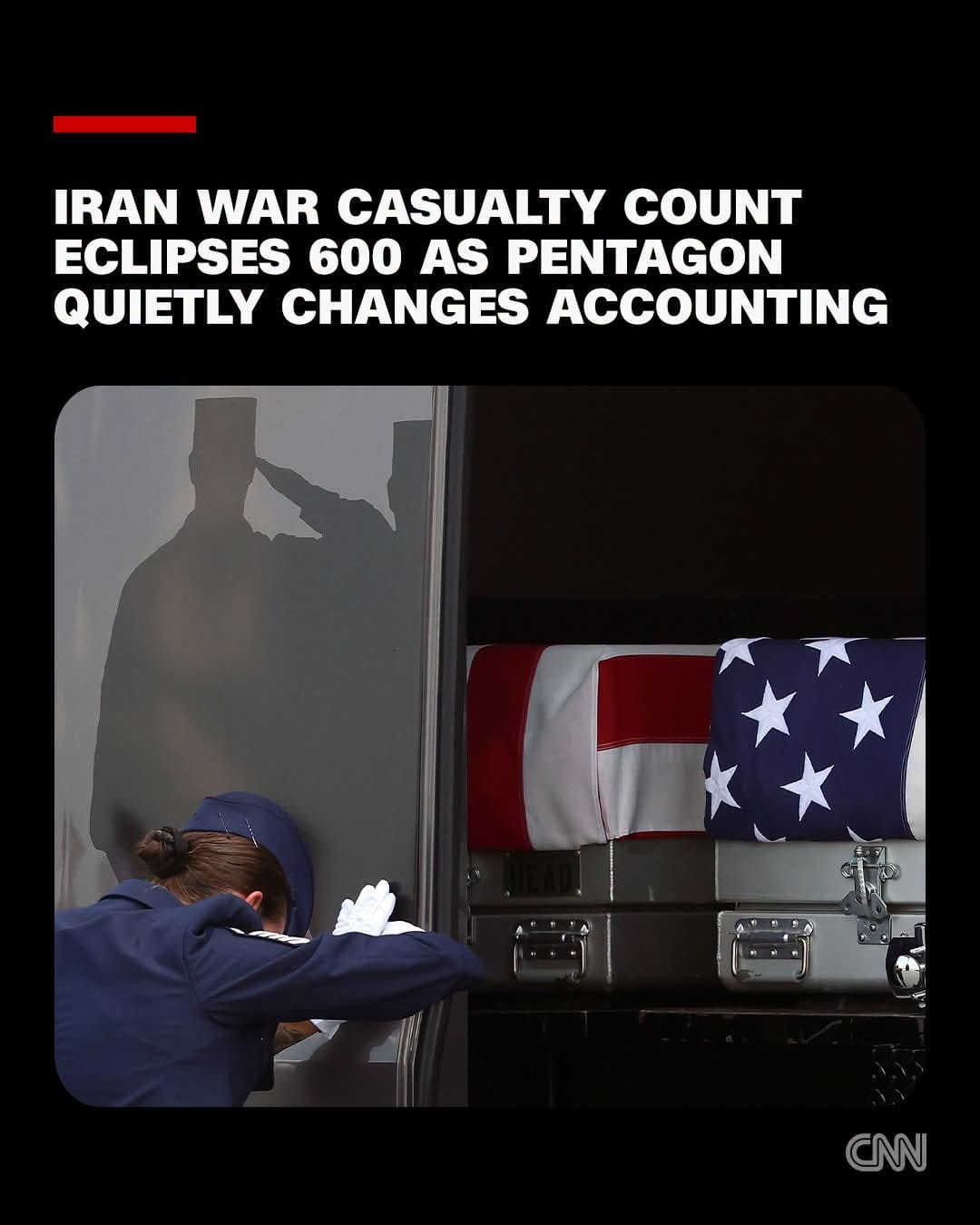
  • I find it shameful that dead American troops are used to justify further attacks on Iran that might lead to yet more dead American troops. For what, exactly?
  • The proposed merger of the Israeli and U.S. militaries (Section 224, now 219, of the NDAA, and Section 1217 in the Senate) includes an Executive Agent who’d report directly to the Secretary of Defense, in this case Pete Hegseth, with no Congressional oversight. Once again, Congress willingly abdicates its responsibilities, this time to a foreign power. The U.S. military and intelligence agencies should not be intermingled with those of any foreign power, yet Congress is preparing to do exactly that with Israel.
  • Pete Hegseth testified the Iran War has cost roughly $38 billion so far. The true figure is closer to $100 billion. The self-styled Secretary of War can’t do basic math.
  • When escalation is seen as a way to end wars, whether with Iran or between Russia and Ukraine, my mind goes back to the Yom Kippur War of 1973 and the Israeli warning: An eye for an eye, a tooth for a tooth. Deep penetrations will be met with deep penetrations. (That was the Israeli response to Egyptian incursions in the Sinai Peninsula.) Which brings me to an eye for an eye and pretty soon we’ll all be blind. 
  • Put differently, as David Bowie sang for the movie “Cat People,” it’s like putting out fire with gasoline. Or with Tomahawk and Hellfire missiles. It doesn’t work.

Not Another Article about the Military-Industrial Complex

1.5 Trillion Reasons to Focus on the MICC–the Blob that Ate Washington

BILL ASTORE

JUL 20, 2026

Last week, I was chatting with an old friend, fellow veteran, and loyal reader when he suggested I should write less about the military-industrial complex. I laughed. I wish I could, I replied, but I’ve got 1.5 trillion reasons to write about it.

The MICC (we must add Congress to the mix) won’t leave me and America alone. If a trillion dollar military wasn’t bad enough, we’re now approaching $1.5 trillion for the Pentagon’s war and weapons budget, an absurd amount that represents roughly 75% of federal discretionary spending. (Estimates vary from 63% to as high as 81% of federal discretionary spending.) Meanwhile, as the Pentagon gobbles up even more money, it still can’t pass Congressionally-mandated audits. Talk about absurdity! Eight failed audits and the reward is more money—much more.

To modify an old saying, Americans may not be interested in the MICC, but the MICC is interested in them. It’s most certainly interested in their money. And their obedience.

I remember a time, 40-50 years ago, when you’d see informed and critical articles about the MICC in the mainstream media (MSM). I grew up reading them in newspapers like the Boston Globe. Such articles have just about vanished in the MSM today, and we know why: the newspapers are owned by billionaires and corporations that profit from that same MICC. They are not about to bite the hand that feeds them. 

There’s a sense of resignation today (I think) where the average American just goes along to get along, or, worse, Americans who simply don’t have the time and who also believe national security issues are beyond them. Thus they wave the flag and defer to the “experts” they see on TV and cable, all those retired generals and admirals who shill for the arms makers (and takers of our tax dollars), who repeat talking points they get from the Pentagon.

That’s why America needs a “big tent” movement of “alert and knowledgeable” citizens that incorporates critical voices from the left, right, and center. Instead, “hot button” cultural issues are used to divide and distract us. Somehow we must come together and resist wanton and wasteful spending on wars and weapons before the U.S. empire collapses under the weight of its own folly and greed.

We must fight the good fight against wars and ultra-expensive preparations for the same while we can.

I’d like to see a U.S. military focused on true national defense, and maybe we once had one in World War II, but of course it’s morphed into a global Goliath where naked aggression is twisted as “preemptive defense.”

Thirty-five years ago, when I was a young captain, there was a fleeting opportunity for “peace dividends” with the collapse of the Soviet Union. We had a precious opportunity, as Jeanne Kirkpatrick said back then, of becoming “a normal country in normal times.” But the vested interests and the pursuit of wealth triumphed over peace dividends and greater economic equity. Under Bill Clinton, the Democrats happily shifted to the right and adopted much of Reaganism. U.S. workers were abandoned for the pursuit of profit. Anger at this treachery helped to strengthen the BS populism of men like Donald Trump and his ilk.

Hope is dying, as is our trust in government. After all, why should we trust the government? It gave us the Pentagon Papers, the Afghan War Papers, the missing WMD in Iraq, and now we’re engaged in another disastrous war with Iran, basically for Israel.

And that’s not all. Congress is bought by AIPAC and major corporations. Members of Congress are selected, not elected, with big-money donors doing the selecting. SCOTUS said money is speech so those with lots of money control things and those with very little have no say at all. That’s not democracy, it’s plutocracy, and the plutocrats often double as kleptocrats (Trump and Pelosi, for example, using their offices to get richer, though Pelosi is a piker compared to Trump).

Run for your lives … before it’s too late!

We’ve drifted a bit from the MICC, but then again cutting the MICC’s budget and influence is a big part of the solution to America’s problems. For FY2027, the proposed Pentagon budget is the blob that ate Washington. We’ll never free ourselves of wasteful weapons and even more wasteful wars if we keep feeding that same blob.

Trump, running in 2024, complained about the MICC’s greed and sold himself as anti-war. As president, he’s worked to enlarge and engorge the blob while feverishly fighting new wars. In that sense, he’s much like other U.S. presidents, only more so. He’s become increasingly consumed by war, so much so that he’s reinforcing failure in Iran. The MICC, naturally, is happy to reap the benefits in more money, never mind the troops dying for no defensible or sensible reason.

So, despite my friend’s well-intended advice, I find myself once again writing about the MICC, the blob that ate Washington. And I guess I will continue to do so until the blob consumes me—or until we combine to put a stop to it.

War Is Too Easy

We’ll End the War by Escalating It?

BILL ASTORE

JUL 18, 2026

War is too easy in America today. We’ve come to accept it as normal. Peace is now aberrant. As war grows ever easier, peace becomes ever harder.

“Escalation,” not diplomacy, is touted as the smart way to end wars. Logic doesn’t seem to matter. How do you end a war by launching more damaging and deadly strikes? How is killing even more people a way to peace?

President Trump now seems to believe that climbing the “escalation ladder” in the Iran War and in the Russia-Ukraine War is the best way to resolve these deadly conflicts. It reminds me of that Vietnam-era quip that waging war for peace is like screwing for virginity.

Journalist Aaron Maté’s piece today also cites Washington’s belief in escalation:

Shortly before returning to the White House for a second term, Donald Trump criticized the exiting president, Joe Biden, for letting Ukraine fire long-range US missiles into Russia. “Why are we doing that?” Trump complained. “We’re just escalating this war and making it worse.”

Just as his campaign pledge of “no new wars” gave way to a regime-change war on Iran, Trump’s professed aversion to a US-fueled escalation in Ukraine is no more. At this month’s NATO summit in Turkey, Trump and Secretary of State Marco Rubio endorsed Ukraine’s drone attacks deep inside Russia. With the Russians “finding it more difficult to defend their own airspace,” Rubio explained, this will “create the space now to negotiate the end of this war.” Added Trump: “It’s an escalation, but it’s also an escalation that could help lead to an end.”

How often do “escalations” help to end wars? Does anyone remember how escalation in Vietnam turned out?

Maybe if we truly seek to end a war, we should deescalate attacks, then engage in diplomacy. No, that makes too much sense.

Spock learns that logic often doesn’t apply to murder or war

There’s a great line in an old Star Trek episode, “Journey to Babel,” where Spock is advised he’d do well to “forget logic and devote yourself to motivations of passion and gain,” for “those are the reasons for murder” — and often for war as well.

Of course, these aren’t the only reasons for war, but logic often has little to do with how and why wars are waged. That much is obvious as “climbing the escalation ladder” is seen or sold by Washington as the best way to deescalate in Iran and in Russia and Ukraine.

18 Intelligence Agencies!

So Much Intel, So Little Insight

JUL 15, 2026

Yes, it’s staggering. The U.S. government has eighteen intelligence agencies—euphemistically known as the IC or the intelligence community. Interestingly, the infamous DOGE, searching for government efficiency, never challenged that “community.” 

And that “community” doesn’t come cheap. Courtesy of my AI friends, here’s a rough budget breakdown:

National Intelligence Program (NIP) $81.9 billion, Director of National Intelligence (DNI)

Military Intelligence Program (MIP) $33.6 billion, Department of Defense (DoD)

Total Requested Funding $115.5 billion

The true figure is probably higher and also classified. So many “black ops” and black op sites. Nothing screams transparency like black programs.

I won’t bore you with the list of all 18 agencies. I wonder if there might be some overlap, redundancies, inefficiencies, and bloat? Of course not. Even if there was, surely it would be classified.

I once worked a bit with AIA, the air intelligence agency, but that’s the extent of my limited exposure to the IC. Lucky me.

The IC generates an enormous amount of intel but insight remains limited. You don’t always get what you pay for.

And, let’s be honest. As international lawyer John Whitbeck put it: “I often wonder why the United States needs 18 hugely expensive and massively staffed ‘intelligence’ agencies when all of the country’s most important decisions are made at the unconstrained whim of a single individual of no intelligence whatsoever.”

(I do like the rumors that President Trump only pays attention to intelligence briefings when his name is featured prominently. It’s Trump in a nutshell.)

In keeping with a five-sided Pentagon, America should probably have five intelligence agencies, as follows: the CIA, NSA, DIA, DOJ/FBI, and DHS. All others could be folded under those five.

Not that I’m a fan of the CIA etc. These agencies have far too much power (and resources) in our society.

Efficiency is less important than effectiveness, and based on recent events (e.g. disastrous wars in Iraq, Afghanistan, and now Iran) the IC doesn’t seem that effective. Unless you define “effective” as enlarging its own power. In that sense, the IC is superb at protecting and enlarging its own turf.

The whole IC is antithetical to democracy and the idea of oversight being exercised by the people. The “community” should be as small as possible and as focused as possible on protecting Americans from real threats, rather than protecting itself from budgetary cuts.

Amazingly, something like 1.3 million Americans hold a “top secret” clearance, and the IC itself taps into a far-flung network of private contractors and related organizations. To say that it’s everywhere may be only a slight exaggeration.

As Chuck Schumer once said, the IC has “six ways from Sunday” of screwing with anyone who gets in their way. So I’d like to conclude by saying I love the IC. I really do!

America’s Dilemma at 250

A Budget of the Pentagon, By the Congress and For the War Profiteers

BILL ASTORE

JUL 13, 2026

Note to Readers: The short essay below represents a joint effort of the Eisenhower Media Network, or EMN, an organization of former military and government officials who seek a wiser course for America and a more peaceful world. I’ve been a member since EMN’s founding.

In Common Sense, Thomas Paine challenged Americans to question an institution that had long seemed beyond challenge. He wrote, “A long habit of not thinking a thing wrong gives it a superficial appearance of being right.” Two hundred and fifty years later, those words apply just as well to America’s defense budget. What has become accepted through habit is neither sustainable nor accountable. Only the American people can change it.

The “defense of custom” now comes from the Military-Industrial-Congressional Complex that President Dwight Eisenhower warned against in his farewell address. Years earlier, in his famous “Cross of Iron” speech, Eisenhower observed: “Every gun that is made, every warship launched, every rocket fired signifies, in the final sense, a theft from those who hunger and are not fed… Under the cloud of threatening war, it is humanity hanging from a cross of iron.”

More than seventy years later, Eisenhower’s warning has become reality. The United States spends more on its military than the next eight countries combined, most of them allies, while millions of Americans struggle with the costs of health care, child care, education, and housing.

The Military-Industrial-Congressional Complex thrives by portraying every international challenge as justification for ever-larger Pentagon budgets. Defense contractors finance political campaigns and employ armies of lobbyists who help shape the annual National Defense Authorization Act. Taxpayer dollars then flow back into executive compensation, shareholder dividends, stock buybacks, and continued political influence, creating a self-perpetuating cycle that rewards corporate profits rather than national security. Even maintenance contracts are often structured so that only the original contractor can repair the equipment, locking taxpayers into decades of additional costs. The troubled F-35 fighter program—billions over budget, years behind schedule, and only partially mission capable—has become a symbol of this dysfunction.

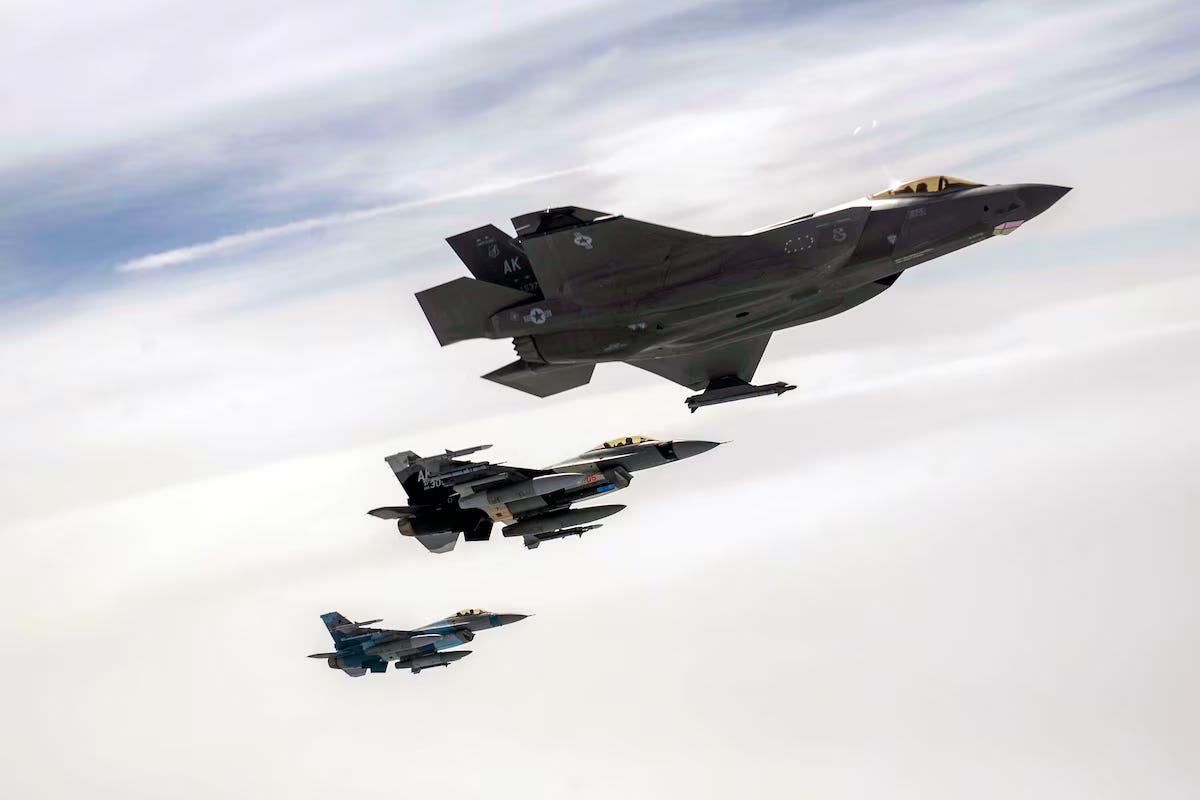
An Air Force general described the F-35 (top) as a Ferrari, meaning it’s ultra-expensive, less than reliable, and overall less effective than the two F-16s also shown in the photo (Official AF photo)

Yet despite these enormous expenditures, America’s recent military record raises serious questions about whether ever-increasing budgets produce better outcomes. Since World War II, the United States has rarely achieved the political objectives it set out to accomplish in major conflicts, despite possessing the world’s largest military establishment and one of the most geographically secure nations on Earth.

Even more troubling, the Pentagon remains unable to account for how it spends taxpayer money. It has repeatedly failed the financial audits required by law, something every other federal department has managed to complete. Nevertheless, it is now requesting a budget approaching $1.5 trillion. Asking taxpayers to approve such an increase before explaining where previous funding went reflects a level of fiscal irresponsibility that would be unacceptable anywhere else in government—or in any American household.

Thomas Paine understood that institutions derive their power not only from force but from unquestioned assumptions. Britain’s empire appeared invincible in 1776 until Americans decided its authority no longer deserved their consent. Today, questioning the continual expansion of military spending may seem equally unfashionable, but history reminds us that accepted practices are not always wise ones.

A $1.5 trillion Pentagon budget represents more than $9,000 per taxpayer. As America marks its 250th anniversary, we should ask whether endless increases in military spending truly make us more secure, or whether they come at the expense of the investments that strengthen our nation at home. The courage required today is not to defeat an empire abroad, but to confront the entrenched interests of the Military-Industrial-Congressional Complex and reclaim a government that serves the American people rather than the economics of perpetual war.

Why Does War Always Win in America?

Answering a Question from a Reader

BILL ASTORE

JUL 10, 2026

Hello Readers: I thought I’d highlight an excellent question from a reader and my attempt to answer it succinctly. Please use the comments section to chime in.

Dear William, starting from the assumption that you are substantially right in your arguments, what I ask myself is why, from 1945 to the present day, there has never been a lasting reversal of course in the history of the United States, but only brief anti-war flare-ups against the foolish and bloody choices of military interventions abroad? I mean, what is it that we don’t know about the American people that justifies the MICC [military-industrial-congressional complex] always managing to assert its kleptocratic, racist, colonialist, supremacist, and megalomaniacal designs? I believe that the American people are mostly made up of good people, willing, respectful of family and clan values, and lovers of cooperative living together. There are totally different groups, but to my knowledge, they are strongly in the minority and substantially ghettoized. It is the presidents or politicians of the moment who open the doors to these groups of rowdies. So I ask myself: what are the main factors that determine the success of the MICC? I await your reflections to delve deeper into the topic. WR Rocco Santoro

Answer by Bill Astore

Hello Rocco: that is a very big question. Threat inflation by the MICC is part of the answer. So too is the fact that both political parties, Democratic and Republican, are right-wing, pro-war parties. See this recent article by Caitlin Johnstone: 

Caitlin’s Newsletter

It’s Been Ten Years. It’s Time To Admit Bernie Sanders Was Wrong.

Reading by Tim Foley…

Read more

a day ago · 318 likes · 249 comments · Caitlin Johnstone

The power of propaganda is strong. Americans are told “our” troops are freedom-bringers. We’re taught we’re the exceptional nation, inherently good. We’re taught we’re not imperial.

As Ike said, only an alert and knowledgeable citizenry can compel and control the MICC, and we are neither. The MICC is shrouded in secrecy, and Americans in general are not knowledgeable about our own history, let alone what the MICC has been up to for the last eighty years (since the end of World War II).

Those who seriously question it, and especially those who seriously resist it, are denounced as misguided, or unpatriotic, and in some cases they are arrested and put in prison.

Perhaps the biggest reason is that Americans no longer think of themselves as citizens with a right to knowledge. We’ve been reduced to passive consumers. Meanwhile, we’ve been sold the idea “our” troops are warriors and warfighters. We’ve come to believe and accept that being constantly at war is normal, the health of the state, when it’s actually the death of democracy and liberty.

The other part of this is that Americans are kept divided, distracted, and downtrodden, making it very difficult to act en masse against an entity as powerful and wide-reaching as the MICC.

*****

That was my initial answer. I must add the enormous amount of “legal” corruption in the U.S. government. Effectively, money equals speech in America, meaning that most Americans have no say in their government.

Obviously, powerful corporations have deep pockets and thus plenty of say. Weapons makers like Lockheed Martin, Boeing, and Northrop Grumman also help to determine policy, exercising influence over Congress and also through propaganda. Corporations control what is shown on our mass media. The mainstream media in America is almost entirely pro-military and pro-war.

The Pentagon has so much money that even academe in America is highly cooperative with the national security state, even as Americans are told to fear a Marxist, “radical left” academic establishment! Consent has been manufactured in America to support a state that’s constantly in a state of war or in preparations for the same.

Perhaps the best source for understanding how and why this has happened is George Orwell’s “1984,” and especially his book within a book that details how a permanent state of war can be maintained in what is ostensibly a republic but which is actually a militaristic empire.

Within the U.S., militarism is a form of cancer, and we are at Stage 4. That cancer is represented by the MICIMATT(SHV) and the penetration of most sectors of society by military imperatives and war. So, to define the awkward acronym: military-industrial-congressional-intelligence-media-academia-think-tank, plus sport, Hollywood, and video gaming. All these are throughly invested in, infested by, militarism.

The Trump administration’s answer to Stage 4 militarism is to give the Pentagon and the national security state another $500 billion, accelerating the cancer further.

The “cure” is deep cuts to the Pentagon’s budget, a dramatic downsizing of empire, and a return to being “a normal country in normal times.” It’s Stage 4 cancer, so radical surgery, chemotherapy, and radiation will take their toll. The cure will hurt. But the alternative is death. Death of the republic, and perhaps of the world in the case of widespread nuclear war.

Back in 1963, Senator George McGovern put together a sound plan to return America to a saner path, a less militarized one, citing Ike’s military-industrial complex speech in 1961. McGovern’s plan included the conversion of military production back to civilian purposes. But his ideas, supported by many prominent democrats back then, were dismissed as a major war with Vietnam was ginned up in the stated cause of curbing communist aggression.

The MICC will always have a war, a reason, to continue to expand. War on terror. War on Iran. Chinese expansion. Russia. Even communism again. Even a war within against “radical leftists.” Against “illegal” immigrants.

More than anything, the American people need to reject this fear-mongering. We must remember that “fear is the only darkness.” That “fear is the mind-killer.” We must reject the mindset of war and embrace the possibilities of peace. But that is very difficult when the drums of war sound so loudly, and when America’s leaders are so eager to buy even more war drums and to amplify them yet further.

Readers, what do you think?

Nuclear Mass Death

Dyin’ Ain’t Much of a Living

BILL ASTORE

JUL 08, 2026

Mark Twain was right when he said history may not repeat itself, but it often rhymes.

Consider America’s approach to nuclear weapons. Under Ronald Reagan in the early 1980s, America’s strategic nuclear triad was modernized at immense cost. One hundred B-1 bombers were built. The stealthy B-2 bomber followed. MX “Peacekeeper” ICBMs were deployed. New Ohio-class nuclear subs armed with Trident missiles were launched. Pershing II and GLCMs (ground-launched cruise missiles) were fielded in Europe. And Reagan presented his idea of a missile defense shield, known as the strategic defense initiative (SDI) or informally as “Star Wars.” All this cost enormous sums of money.

Fortunately, the Pershing IIs and GLCMs were retired under talks that eliminated intermediate-range nuclear missiles. The Peacekeeper missiles are already gone. The B-1s are due to be retired over the next decade and no longer fly nuclear missions. And the Ohio-class submarine force, the most survivable leg of the nuclear triad, remains on station, with just one submarine capable of destroying much of the world.

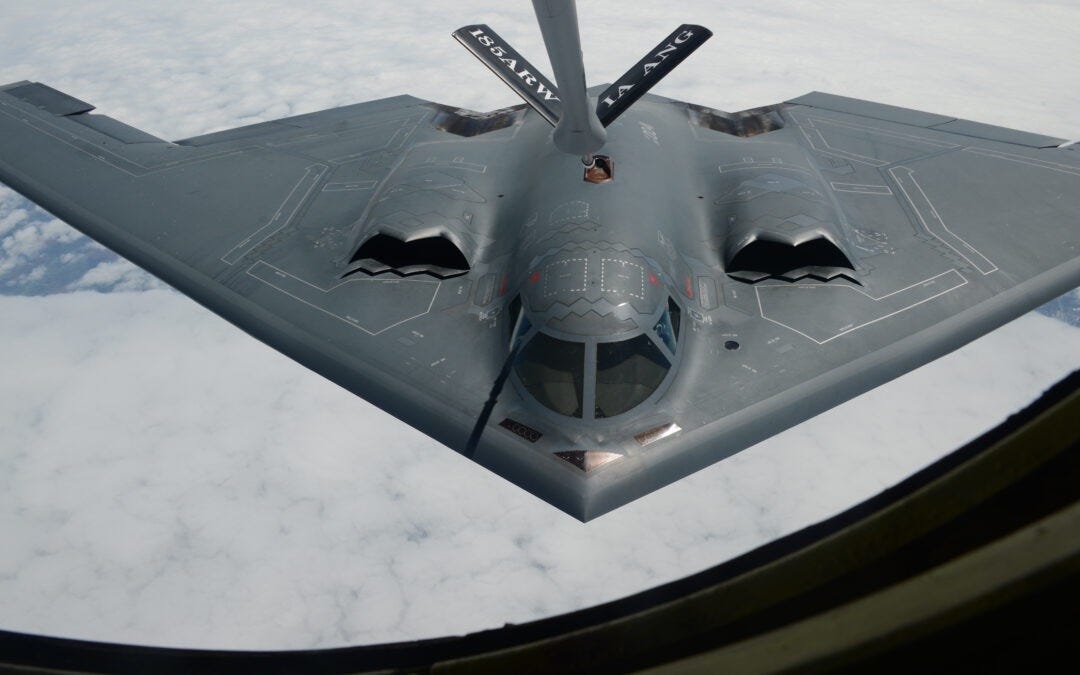
Air Force B-2 bomber being refueled

The U.S. today possesses an enormous nuclear overkill capacity. The arsenal consists of roughly 5000 nuclear bombs and warheads. Again, just one submarine carries up to 20 Trident II D5 missiles with multiple nuclear warheads, each warhead being far more powerful than the bombs used against Hiroshima and Nagasaki in 1945. To borrow a line from Daniel Ellsberg, each submarine is capable of 100 Holocausts. They are genocidal weapons to a degree that is unimaginable. By the way, the U.S. has fourteen Ohio-class “boomer” submarines.

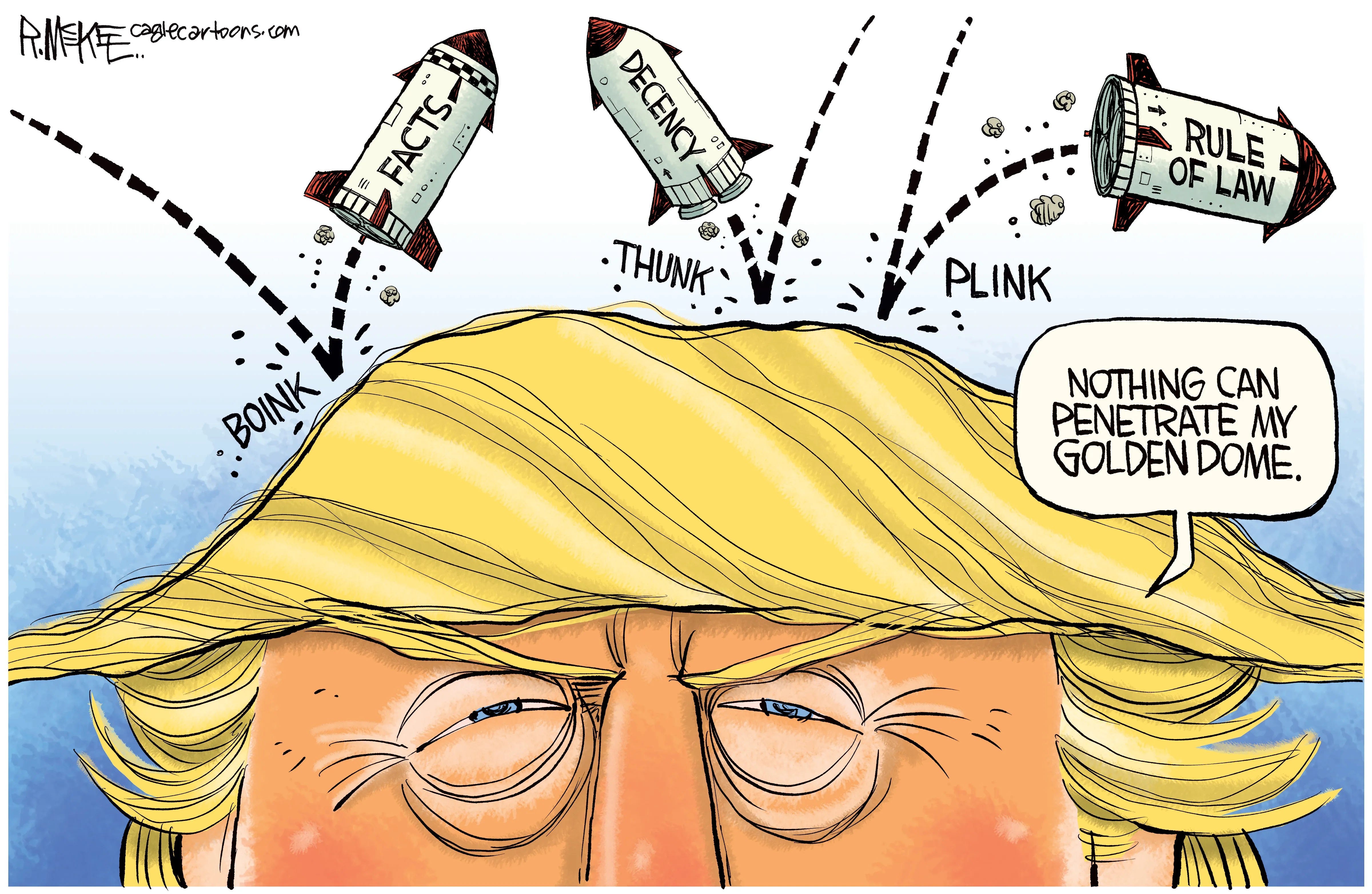
Here is where history rhymes. Under yet another tough-talking Republican president, the U.S. today is yet again “modernizing” its nuclear triad while imagining a missile defense shield (now known as “Golden Dome”). The Air Force wants a new nuclear bomber (the B-21 Raider) and ICBM (the Sentinel), and the Navy wants a new ballistic-missile-firing submarine, the Columbia-class.

None of this is really necessary. ICBMs are obsolete; they are static targets and destabilizing ones at that. Bombers are superfluous and besides, the Air Force still has B-52s and B-2s for nuclear missions. Missile shields like “Golden Dome” are easy to conceptualize but impossible to build. They can be fooled by decoys and overwhelmed by an enemy with sufficient warheads (Russia). 

But logic doesn’t matter here. Nor does morality. What matters is money, power, jobs, and the military-industrial-Congressional complex. That’s why history is rhyming here. The MICC will always fight for more ICBMs, more bombers, more submarines because that is its health, its wealth, its reason for being. To the MICC, the nuclear triad really is the holy trinity. It is something to be worshipped and preserved irrespective of cost and logic.

The U.S. should lead the world in reducing the deployment of nuclear weapons. Instead, the U.S. leads in nuclear escalation. And it does so always in the stated cause of “deterrence” when the real reason is the health and wealth of the MICC.

No one really knows how much nuclear triad modernization and the “Golden Dome” will cost; estimates for both reach $3 trillion over the next thirty years. But it’s not just the cost in dollars that matters — it’s the cost to our collective existence. These weapons systems are making the U.S. and the world less safe, less stable, rather than more so. They are possibly the very worst examples of human folly, and that’s truly saying something.

I very much doubt the average American wants more nuclear bombs and missiles, but what we want doesn’t seem to matter. The MICC wants — and it gets what it wants. It does so by scaring us about Russia or China or Iran while selling these genocidal weapons as job-creators. It’s a living, they might say. But as the Outlaw Josey Wales once said, “Dyin’ ain’t much of a living,” especially when you’re talking about murdering most of humanity in a genocidal nuclear war.

We must put a stop to this madness while we still can.

Declaring America’s Independence From the Tyranny of Militarism and War

Beware the Termites of War 

BILL ASTORE

JUL 03, 2026

In July 1776, courageous colonists came together to declare their independence from the perceived tyranny of King George III. “Rebels” like Thomas Jefferson urged the colonists to start down a new path, one of independence from the Crown, one that put life, liberty, and the pursuit of happiness before fealty to a king. It was a long-shot effort, but the rebels somehow pulled it off.

Today, America has a new “king.” It’s the national security state, with all its threat inflation, its wars, and its appetite for more, always more. Combine that with President Trump and self-styled Secretary of War Pete Hegseth and their reckless pursuit of war irrespective of the Constitution and of international law, let alone Christian concepts of morality, and you have a form of tyranny that Americans must declare their independence from.

So, consistent with Jefferson, we need a new American revolution, or if you prefer a restoration of the republic, one that recognizes that immense imperial militaries are corrosive to democracy and individual liberty.

2026 can be a new 1776 if America rejects the tyranny of war and ever-higher Pentagon spending. America needs new sons and daughters of liberty, committed to diplomacy and peace, as fostered in a true participatory democracy that puts the needs of U.S. citizens first.

America’s Founders knew that persistent war is a most insidious and pernicious enemy to our freedoms. America today is a structure infested by the termites of war. If we fail to get rid of them, our house will collapse in a pile of dust.

Since 1776, many patriotic Americans have warned of the dangers of persistent warfare and steroidal military spending. Perhaps most famously, President Dwight D. Eisenhower in 1953 spoke of the immense waste of weapons spending: how humanity would crucify itself on a cross of iron if wars endured and war budgets kept rising. He spoke again in 1961 of how America’s military-industrial complex was threatening the fundamental freedoms and liberty of Americans, especially if that complex was allowed to spread and grow. Ike’s warning went unheeded as America fought disastrous and unnecessary wars in Vietnam, Afghanistan, Iraq, Iran and elsewhere.

Ike came to recognize the astonishing waste and dangers of militarism and war. So should we all. Let us on our nation’s 250th birthday declare our independence from persistent and pernicious militarism and warfare.

Weapons Are Us

More Guns, Please, Never Mind the Reason

BILL ASTORE

JUN 30, 2026

Almost fifteen years ago, I wrote an article for TomDispatch with the title, “Weapons ‘R’ Us.” It was a play, of course, on Toys ‘R’ Us, echoing the old saw about the difference between men and boys being the price of their toys. Nowadays, I guess “real men” play with F-35s, Ford-class aircraft carriers, Sentinel ICBMs, and the like, to the tune of hundreds of billions of dollars each year. And if that’s not enough, Americans can always spend billions of dollars more on private weaponry like assault- and sniper rifles. Rather amazingly, there are more firearms than people in America, with the only amendment SCOTUS won’t dare abridge being the Second Amendment.

Back in 2012 I gave a Tomcast interview with Timothy MacBain about my own weapons “addiction”; it started the usual way with toy soldiers, GI Joes, and cap pistols and escalated from there. As a teenager, I built a lot of model military planes, tanks, warships, and the like. All gone now, though I kept and used a few when I was teaching a course on “technology and warfare.”

The military loves to speak of weapons as “investments,” but President Dwight D. Eisenhower was far more honest in calling them a form of theft from those who hunger, from those who need health care, from those who want a better education. Weapons, I think Ike would agree, have a very narrow band of winners, specifically those who profit from making and selling them. They are the real band of (gun-running) brothers, with a few sisters thrown in as well.

If wars were won purely by weapons, America would never lose, such is our commitment to winning through “superior firepower.” But they’re not, so losing has become an American habit.

Speaking of losing, I recently read a terrific article by Patrick Lawrence that argues it’s high time for America to embrace defeat and to learn from it. He’s right about that, but how to tell “winner” Trump that his war against Iran has been a big loser?

Thinking about that led me to make this comment in response to Lawrence’s article:

Yes, but this is America, where the worst insult is to be called a “loser,” and where to criticize even the stupidest war is to be labeled a “defeatist.”

Meanwhile, management gurus speak of “win-win” scenarios, because talk of losing must be avoided at all costs. Even compromise is suspect.

To modify an old expression, if not he who dies with most toys, wins, it seems we in America believe that he who dies with the most weapons, wins.

So, we’ll embrace our weapons–very tightly indeed–before we [ever] embrace defeat.

Bill Astore

4d

Yes, but this is America, where the worst insult is to be called a “loser,” and where to criticize even the stupidest war is to be labeled a “defeatist.”

Meanwhile, management gurus speak of “win-win” scenarios, because talk of losing must be avoided at all costs. Even compromise is suspect.

To modify an old expression, if not he who dies …52

So, no matter how poorly America’s wars go, the demand for weapons continues to rocket upwards. That old “arsenal of democracy” of World War II fame has for the last sixty years or so mutated into merely an arsenal, ever-growing in cost if not in effectiveness.

The F-35, often unavailable to fly, and still very expensive (USAF Photo)

Today’s big-ticket weapons like the F-35 are becoming so expensive, and often so unreliable, that America is almost disarming itself by accident. All the more reason, weapons proponents will say, for America to spend even more on weapons!

Abandon all logic, ye who wish to curb America’s “investment” in more weaponry.