“Thou shalt not kill” is a commandment with many exceptions.
Pete Hegseth and the Pentagon want to livestream a military execution by firing squad. We can all watch! Even some Republicans are aghast and Trump says he’ll make the final determination. But Trump is no opponent of capital punishment.
Some moral clarity can be seen from the Catholic Church, as with this statement:
Archbishop Paul S. Coakley, the president of the U.S. Conference of Catholic Bishops, called the planned livestream “a barbaric promotion of a culture of death” and warned it would harm the country.
“The public execution even of one who has done grave harm will only further undermine the moral fabric of our nation and be a blight on the conscience of its people,” he said.
A culture of death, indeed. The United States leads the world in mass shootings, weapons exports (“the merchants of death”), and threats of annihilation (Trump has threatened Iranian civilization with obliteration at least six times).
So much for “Thou shalt not kill”!
Seriously, there was a whole lot of killing in the Old Testament, where God was often quite wrathful and his “chosen” people were encouraged to smite their enemies. As a boy I learned the saying that “the beginning of wisdom is the fear of God.” You never knew when God might demand a human sacrifice (a son?) or encourage you to smite the Amalekites.
1 Samuel 15:3 King James Version
Now go and smite Amalek, and utterly destroy all that they have, and spare them not; but slay both man and woman, infant and suckling, ox and sheep, camel and ass.
God was kind of a dick here. What did he have against camels and donkeys?
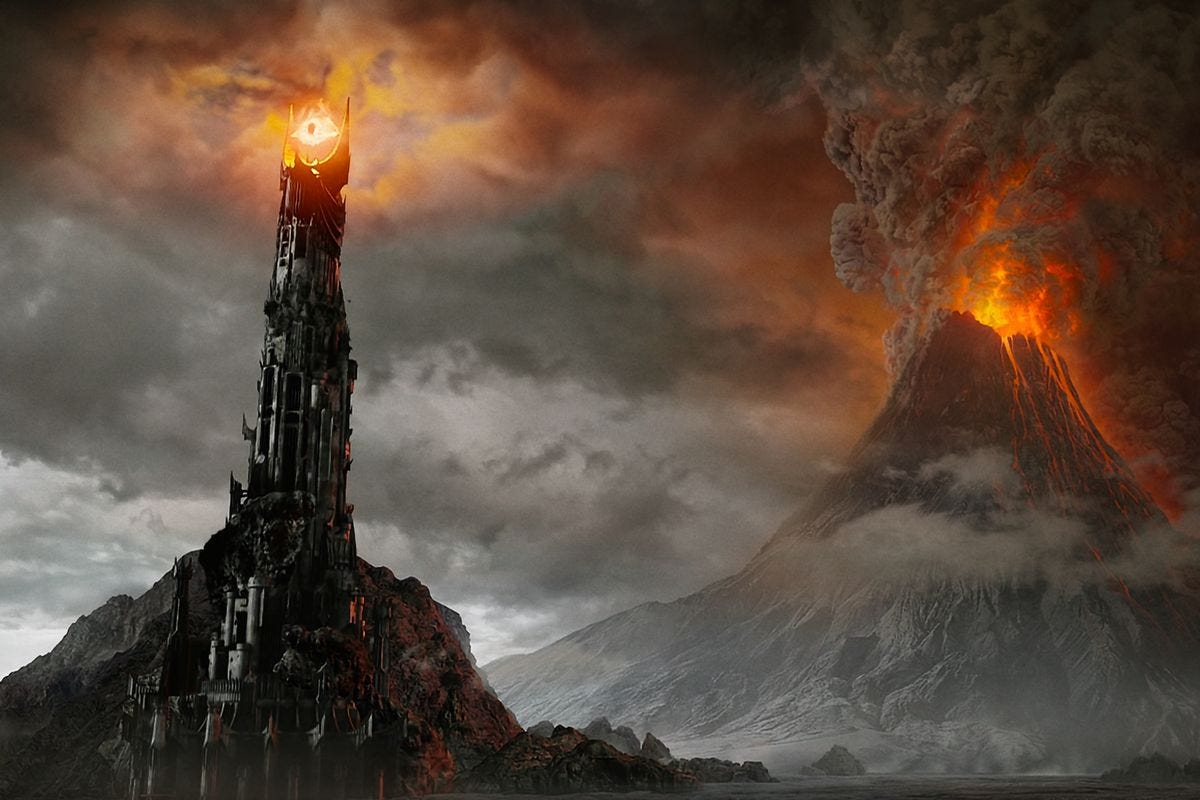
With Jesus Christ a New Testament came along that encouraged tolerance, turning the other cheek, putting down swords, and blessing peacemakers as children of God. Those pacific pleas didn’t bother many Americans who prefer instead to think of Jesus as loving warriors armed with guns or flaming swords, looking something like the Dark Lord Sauron in Tolkien’s “Lord of the Rings.”
That is an image very much at odds with “Thou shalt not kill.”
If one murderous death is bad, surely weapons with the ability to murder millions are infinitely worse. Yet the U.S. military is once again embracing genocidal nuclear weapons. Of course, the Pentagon doesn’t speak openly of murdering millions or possibly billions of people. It speaks of “investing” in nukes, of “modernizing” them, of “recapitalizing” the nuclear arsenal.
I must say I prefer the honesty of the King James Version of the Bible about smiting and killing. God didn’t obfuscate that his chosen people should modernize their spears or recapitalize their knives or invest in more swords before annihilating Amalek.
Just as Americans are exceptional at violating the sixth commandment against killing, so too was the god of the Old Testament. He was a jealous god, the superpower of his day, THE exceptional one, with global reach and global power over life and death.
We’ve learned a few lessons from the Bible, but not the wisest ones.
Today, I talked about the decline and fall of the citizen-soldier ideal in America with Judge Napolitano on “Judging Freedom.”
The judge asked me a powerful question about “Thou shalt not kill” and the pursuit of killing in war. Is killing ever truly justified by wartime imperatives? There are no easy answers to that question, nor should there be.
You can fall back on Just War theory, but I wasn’t mentally prepared to discuss that complex subject in detail.
There are times, I believe, when killing in war is justifiable, such as a defensive war against implacable enemies bent on destruction. Nazi Germany and Imperial Japan come to mind from World War II. Of course, war is always awful, always barbarous, and those caught up in war are degraded by it. Nevertheless, U.S. citizen-soldiers of World War II behaved less atrociously and generally stood for higher ideals than their counterparts in Nazi Germany and Imperial Japan.
Again, when you read combat accounts written by U.S. troops, such as E.B. Sledge’s “With the Old Breed” about his service in the Marine Corps fighting the Japanese, you quickly realize both sides fought viciously, both sides committed atrocities, because that is the nature of brutal combat. But the Japanese were more fanatical and more prone to barbarous actions than U.S. troops, though Americans learned quickly to return the favor.
All war is awful, all war is murderous, therefore it should be avoided whenever possible. Still, no one need submit to a dictatorship like that of Nazi Germany or the militaristic rule of imperial Japan. There is nobility in defending kith and kin and for defending as well ideals that serve liberty, freedom, and justice.
High-minded displays of non-violent resistance are admirable, as are mindful appeals to compassion, but they would not have stopped the work of Hitler’s Panzers or his death camps.
The problem is that since World War II, America hasn’t waged defensive or just wars. Its wars, whether in Southeast Asia or the Middle East, have been undeclared wars driven by imperial designs and reasons that do not in any way justify deadly use of force, especially the wanton use of such force. The American people increasingly recognize this. So too do those in command, which is why they’re working so hard to recruit obedient “warriors” to the ranks today, instead of citizen-soldiers capable of thinking for themselves.
Today’s leaders, men like Pete Hegseth, want to turn war into a guiltless exercise in killing, as if victory always goes to the most ruthless and brutal side in war. History teaches us the opposite is often true. And, assuming that America “won” by being utterly ruthless and annihilatory, would we not have lost our humanity in the process?
The bottom line is that we in America must work for peace while resisting our “leaders” who are so eager to embroil this nation in immoral, incessant, and murderous wars.
Pete Hegseth, self-styled Secretary of War, doesn’t think of himself as a civilian. No—a warrior-chieftain is his preferred identity. A macho tough guy. An alpha male and a crusader. He is the culmination of mindless militarism and warfighter nonsense that has infected the U.S. military beginning in the Reagan years and associated often with fictional avatars like Sylvester Stallone’s John Rambo. (Interestingly, at the age of 80, Stallone recently disavowed his warrior-Rambo archetype and confessed he now hates war, a change of heart that is better late than never, I suppose.)
Civilians may still exercise nominal control over the U.S. military, but in practice Hegseth and Trump are wildly enthusiastic about killing, bombing, even threatening civilizational annihilation again and again. Meanwhile, U.S. troops are encouraged to think of themselves as mindless warriors, obedient to the dictates of their fanatical leaders. N weirdos or beardos or woke-types need apply to this macho man’s military.
Back in 2008, now almost 20 years ago, I wrote about this exaltation of “warfighters” within the U.S. military. Here’s that article, posted originally at TomDispatch.com.
Having the “Best Military” Is Not Always a Good Thing Reclaiming Our Citizen-Soldier Heritage By William J. Astore
When did American troops become “warfighters” — members of “Generation Kill” — instead of citizen-soldiers? And when did we become so proud of declaring our military to be “the world’s best”? These are neither frivolous nor rhetorical questions. Open up any national defense publication today and you can’t miss the ads from defense contractors, all eagerly touting the ways they “serve” America’s “warfighters.” Listen to the politicians, and you’ll hear the obligatory incantation about our military being “the world’s best.”
All this is, by now, so often repeated — so eagerly accepted — that few of us seem to recall how against the American grain it really is. If anything — and I saw this in studying German military history — it’s far more in keeping with the bellicose traditions and bumptious rhetoric of Imperial Germany under Kaiser Wilhelm II than of an American republic that began its march to independence with patriotic Minutemen in revolt against King George.
So consider this a modest proposal from a retired citizen-airman: A small but meaningful act against the creeping militarism of the Bush years would be to collectively repudiate our “world’s best warfighter” rhetoric and re-embrace instead a tradition of reluctant but resolute citizen-soldiers.
Becoming Warfighters
I first noticed the term “warfighter” in 2002. Like many a field-grade staff officer, I spent a lot of time crafting PowerPoint briefings, trying to sell senior officers and the Pentagon on my particular unit’s importance to the President’s new Global War on Terrorism. The more briefings I saw, the more often I came across references to “serving the warfighter.” It was, I suppose, an obvious selling point, once we were at war in Afghanistan and gearing up for “regime-change” in Iraq. And I was probably typical in that I, too, grabbed the term for my briefings. After all, who wants to be left behind when it comes to supporting the troops “at the pointy end of the spear” (to borrow another military trope)?
But I wasn’t comfortable with the term then, and today it tastes bitter in my mouth. Until recent times, the American military was justly proud of being a force of citizen-soldiers. It didn’t matter whether you were talking about those famed Revolutionary War Minutemen, courageous Civil War volunteers, or the “Greatest Generation” conscripts of World War II. After all, Americans had a long tradition of being distrustful of the very idea of a large, permanent army, as well as of giving potentially disruptive authority to generals.
Our tradition of citizen-soldiery was (and could still be) one of the great strengths of this country. Let me give you two examples of such citizen-soldiers, well known within military circles because they wrote especially powerful memoirs. Eugene B. Sledge served in the U.S. Marines during World War II, surviving two unimaginably brutal campaigns on the islands of Peleliu and Okinawa. His memoir With the Old Breed is arguably the best account of ground warfare in the Pacific. After three years of selfless, heroic service to his country, Sledge gladly returned to civilian life, eventually becoming a professor of biology. His conclusion — that “war is brutish, inglorious, and a terrible waste” — is one seconded by many a combat veteran.
Richard (Dick) Winters is better known because his exploits were captured in the HBO series Band of Brothers. He rose from platoon commander to battalion commander, serving in the elite 101st Airborne Division during World War II. A hero beloved by his men, Winters wanted nothing more than to quit the military and return to the civilian world. After the war, he lived a quiet life as a businessman in Pennsylvania, rarely mentioning his service and refusing to use his military rank for personal gratification. In Beyond Band of Brothers, he recounts both his service and his ideas on leadership. It’s a book to put in the hands of any young American who wishes to understand the noble ideas of service and sacrifice.
Sledge and Winters were regular guys who answered their country’s call. What comes across in their memoirs, as well as in the many letters I’ve read from World War II soldiers, was the desire of the average dogface to win the war, return home, hang up the uniform, and never again fire a shot in anger. These men were war-enders, not warfighters. Indeed, they would’ve been sickened by the very idea of being “warfighters.”
The term “warfighter” — a combination, I suppose, of “warrior” and “war fighting” — suggests a person who lives for war, who spoils for a fight. Certainly, the United States has fought its share of ruthless wars. But traditionally our soldiers have thought of themselves as civilians first, soldiers second. Equally as important, the American people thought of their troops that way.
Why are we now, with so little debate, casting aside an ethos that served us well for two centuries for one that straightforwardly embraces war and killing? Possibly because we’ve invented a distinctly American product: sanitized militarism. I bumped into it last week at a most unlikely place.
Visiting Gettysburg
Last week, I finally made it to Gettysburg, site of the great three-day battle between Union and Confederate forces in July 1863 that ended with the defeat of General Robert E. Lee’s army. Walking the battlefield was a sobering experience. I found myself on Little Round Topat 5:00 PM, just about the time of day that Union generals rushed men to reinforce the hill against a determined Confederate assault at the close of the battle’s second day. Earlier, I was at the Angle, just when, almost a century and a half ago, Pickett’s Charge failed to pierce the Union center, sealing Lee’s fate on the third day.
As these events played through my mind, I marveled that I had the battlefield largely to myself. Not that I was alone, mind you. Tour buses circled; cars, trucks, and SUVs whizzed about, but many, perhaps most, Americans who visit Gettysburg get surprisingly little tactile or sensory experience of its difficult topography. Yes, a few kids (and fewer adults) joined me in clambering about the huge, claustrophobically placed boulders of Devil’s Den, and I did spy a couple of guided tour groups on foot. But at the site of a bloodcurdling, distinctly septic nineteenth century battle, most visitors were clearly having a distinctly bloodless, even antiseptic, twenty-first century experience.
That day, I learned a lot about Gettysburg the battle — and maybe a little about us as well. As surely as my fellow tourists were staying in their cars and buses, we, as a people, are distancing ourselves from the realities of war. As we seal ourselves away from war’s horrors, we’re correspondingly finding it easier to speak of “warfighters” and to boast of having the world’s best military.
As we catch a glimpse, from the comfort of our living rooms, of a suicide bombing in Iraq or an American outpost attacked, then abandoned, in Afghanistan, are we not like those tourists in buses at Gettysburg, listening to sanitized recordings telling us what to see and think about the (expurgated) reality in front of us? And who dares challenge the “expert” commentary? Who dares turn off the canned talking heads and stare into the face of war?
But if we are to end our militaristic, yet curiously sanitized, “warfighter” moment, if we are ever to return to our citizen-soldier ethos and heritage, this is just what we must do.
After all, it’s later than you think. Our military now relies not only on a volunteer (if, at times, “stop-lossed”) Army, but increasingly on tens of thousands of hired guns, consultants, interrogators, interpreters, and other paramilitary camp followers. Private, for-profit “security contractors” — companies like Blackwater and Triple Canopy — give a disturbing new meaning to our “warfighter” terminology and the rhetoric that marches in step with it. As even casual students of history will recall, a clear sign of the Roman Empire’s decline was its shift from citizen-soldiers motivated by duty to mercenaries motivated by profit.
Replacing “warfighters” with true citizen-soldiers in the mold of Sledge and Winters would hardly be a solve-all solution at this late date, but it might be a step in the right direction — however unlikely it is to happen. For when we look at our troops, if we don’t see ourselves, then we see aliens or, worse yet, superiors (“warfighters”) in need of “support.” And that’s a clear sign of trouble for the republic.
Want to Be in the “World’s Best Military”? Ask German Veterans
It may come as a shock to some, but the American army wasn’t the best in the field in World War I, or World War II either. And thank heavens for that.
The distinction falls to the Kaiser Wilhelm’s army in 1914, and to Hitler’s Wehrmacht in 1941. Even toward the end of World War II, the American army was still often outmaneuvered and outclassed by its German foe. Because victory has a way of papering over faults and altering memories, few but professional historians today recall the many shortcomings of our military in both world wars.
But that’s precisely the point: The American military made mistakes because it was often ill-trained, rushed into combat too quickly, and handled by officers lacking in experience. Put simply, in both World Wars it lacked the tactical virtuosity of its German counterpart.
But here’s the question to ponder: At what price virtuosity? In World War I and World War II, the Germans were the best soldiers because they had trained and fought the most, because their societies were geared, mentally and in most other ways, for war, because they celebrated and valued feats of arms above all other contributions one could make to society and culture.
Being “the best soldiers” meant that senior German leaders — whether the Kaiser, Field Marshal Paul von Hindenburg, that Teutonic titan of World War I, or Hitler — always expected them to prevail. The mentality was: “We’re number one. How can we possibly lose unless we quit — or those [fill in your civilian quislings of choice] stab us in the back?”
If this mentality sounds increasingly familiar, it’s because it’s the one we ourselves have internalized in these last years. German warfighters and their leaders knew no limitations until it was too late for them to recover from ceaseless combat, imperial overstretch, and economic collapse.
Today, the U.S. military, and by extension American culture, is caught in a similar bind. After all, if we truly believe ours to be “the world’s best military” (and, judging by how often the claim is repeated in the echo chamber of our media, we evidently do), how can we possibly be losing in Iraq or Afghanistan? And, if the “impossible” somehow happens, how can our military be to blame? If our “warfighters” are indeed “the best,” someone else must have betrayed them — appeasing politicians, lily-livered liberals, duplicitous and weak-willed allies like the increasingly recalcitrant Iraqis, you name it.
Today, our military is arguably the world’s best. Certainly, it’s the world’s most powerful in its advanced armaments and its ability to destroy. But what does it say about our leaders that they are so taken with this form of power? And why exactly is it so good to be the “best” at this? Just ask a German military veteran — among the few who survived, that is — in a warrior-state that went berserk in a febrile quest for “full spectrum dominance.”
Fighting to End Wars
Words matter. Let’s start by banishing the word “warfighter,” and, while we’re at it, let’s toss out that “world’s best” boast as well. Boasting about military prowess is more Spartan than Athenian, more Second and Third Reich Germany than republican and democratic America.
Indeed, imagine, for a moment, a world in which the U.S. is no longer “number one” in military might (and, at the same time, no longer fighting endless wars in the Middle East and Central Asia). Would we then be weak and vulnerable? Or would we become stronger precisely because we stopped boasting about our ability as “warfighters” to dominate far from our shores and instead redirected our resources to developing alternative energy, bolstering our education system, reviving American industry, and focusing on other “soft power” alternatives to weapons and warriors? In other words, alternatives we can actually boast about with the pride of accomplishment.
Think about it: Must our military forever remain “second to none” for you to feel safe? Our national traditions suggest otherwise. In fact, if we no longer had the world’s strongest military, perhaps we would be more reluctant to tap its strength — and more hesitant to send our citizen-soldiers into harm’s way. And while we’re at it, perhaps we’d also learn to boast about a new kind of “warfighter” — not one who fights our wars, but one who fights against them.
Postscript (2026): Sadly, the warrior cult is even stronger today, led as it is by enthusiasts like Hegseth and promoted by people who should really know better (but who prefer “to go along to get along” in their bid for promotions and power).
It’s amazing the enormous sums of money the U.S. government spends on destructive weaponry in the stated cause of deterring massive destruction. It’s MAD, of course, this notion that peace is only attainable via the promise of annihilating another people. And now we know that annihilation won’t be limited to Russia or China or Iran: that a “general” nuclear strike would likely produce a nuclear winter that would end most life on our planet. Yet the Pentagon persists in nuclear “modernization” and further “investments” in the Triad.
In the early 1960s, the Air Force wanted 10,000 ICBMs but “settled” for 1000 Minuteman missiles. To preserve “the American way,” they built a nuclear command center (Cheyenne Mountain) under 2000 feet of granite, which was rendered obsolete soon after it was built by more accurate Soviet ICBMs with warheads in the megatons.
As a young Air Force officer, I hunkered down in the 1980s in Cheyenne Mountain. I visited Los Alamos. I’ve walked the Trinity Test Site in Alamogordo, New Mexico, site of the first atomic test in 1945. Friends of mine have sat in ICBM silos, ready and able to unleash Armageddon. Imagine young lieutenants and captains in their twenties, sitting underground, waiting for the president’s command to launch missiles that will unleash a nuclear holocaust to kill millions, if not the planet itself.
All this fresh talk of “investment” in “modernized” nuclear weapons is sheer madness–a collective death wish–a “strange love” for world-destroying nukes. Yet again, we’ve come to love the bomb.
Recently, the Chief of Staff of the Air Force (CSAF) spoke of nuclear weapon “recapitalization”: truly an abomination of the English language. You don’t “recapitalize” genocidal weaponry. Both the Sentinel ICBM missile program and the B-21 bomber are unneeded weapons systems that will likely cost $500 billion or more over the next 20 years. Sadly, he isn’t the only general who’s positively gleeful about all the money being thrown at nuclear weapons, the Golden Dome, and weapons in space.
This mad (MAD) glee for money in the cause of mass destruction and madcap militarism is destroying not just our democracy. It’s like our “leaders” are out of Mordor, searching for the One Ring of Power, with AI data centers and surveillance the equivalent to Sauron’s eye that sees all.
Maybe Mordor isn’t the best model for our future?
I wonder if Sauron spoke of “modernization” and “recapitalization” in Orcs and Nazgûl and Balrogs?
The current CSAF promises to “advocate relentlessly” for new weaponry like the Sentinel ICBM and B-21 Raider. He says “readiness” to fight is an airman’s “first responsibility.” Actually, that first responsibility is to support and defend the U.S. Constitution. We must be guided by the law of the land, not by the beauty of our weapons (Brian Williams) or a warrior’s urge to use them (Pete Hegseth)
America, stop the MADness. A policy of Mutually Assured Destruction means we’re all dead. As the Outlaw Josey Wales said: “Dyin’ ain’t much of a living.” Nor is deterring our way to Doomsday.
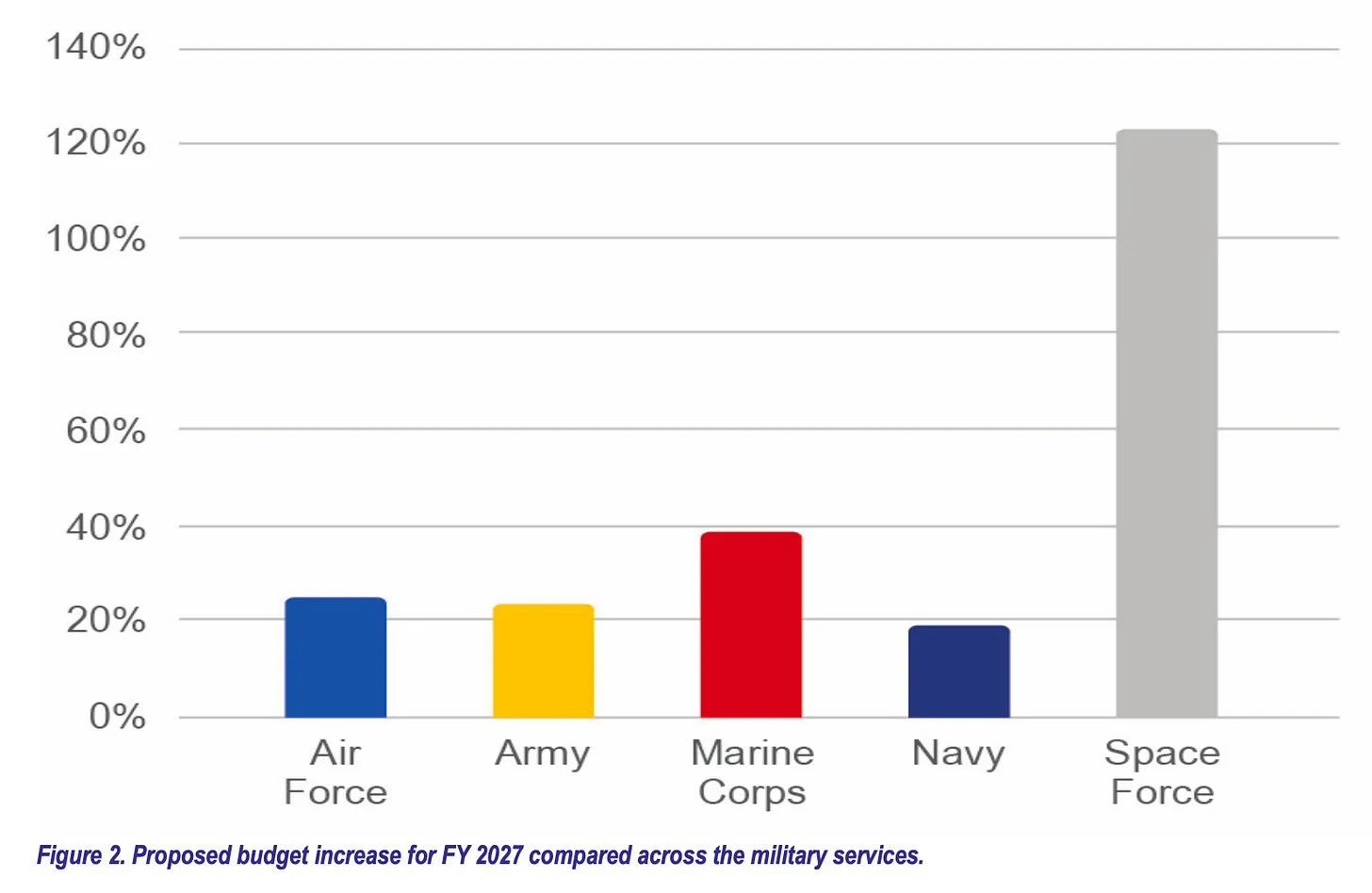
Last week, the Secretary of the Air Force announced the U.S. has weapons in space. As Ken Klippenstein has noted, the announcement was in effect a bid for more mega-billions for the U.S. Space Force. Here’s a helpful chart, courtesy of Klippenstein:
Aerospace Center for Space Policy and Strategy
Greater than 120%: now that’s a budget increase!
Zealots and opportunists are ruling us. The zealots actually believe that America’s security is best attained through full-spectrum dominance, including space dominance. The opportunists don’t care one way or the other–they’re just pursuing the golden flow of money emanating in a steady stream from the Trump administration in the cause of that dominance.
Greed and bellicosity are the fundamental problems. These men (I’d wager they’re all men) define everything in terms of conflict and dominance. They are Klingons, proudly so, without a Klingon sense of honor. To mix movie references, they are imperial stormtroopers seeking their own Death Star wonder weapons.
Space should be a realm for exploration and inspiration, a place for humans to grow further in knowledge and wisdom. These morally impoverished souls are ruining space even as they poison the earth.
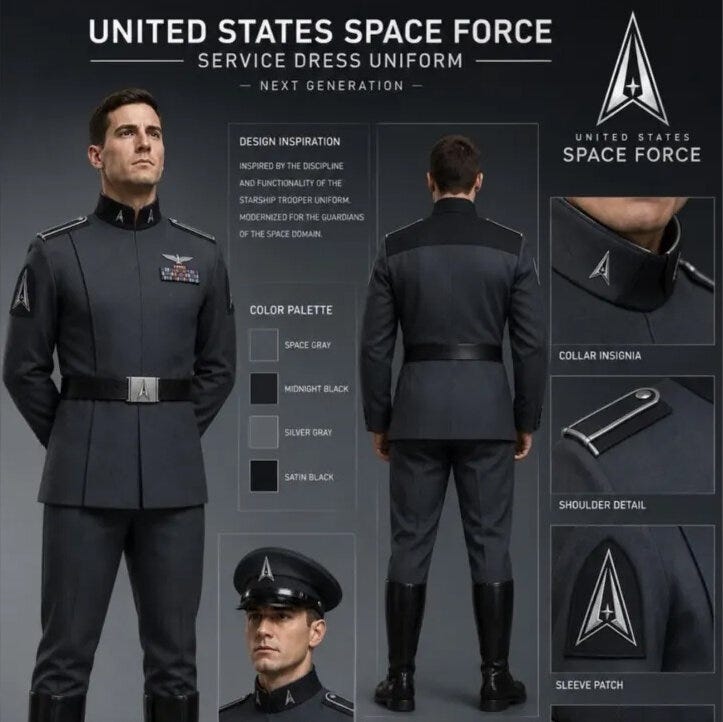
Again, it’s not just about space weapons. It’s a major money- and power play by America’s youngest service, the U.S. Space Force, complete with proposed fascistic uniforms for its “guardians” based on the movie “Starship Troopers.”
Love the jackboots
There just wasn’t enough money/influence for U.S. Space Force in its primary mission of defense and deterrence, so now it’s all about war fighting and weapons. That’s where the real money is at, and the Space Force wants a bigger slice of the fiscal pie, irrespective of the risk of a war in space.
We’re clearly entering a new “space race,” not a quest as in the 1960s to put a man on the Moon to upstage the Soviets, but one where the U.S. attempts to occupy and dominate space while projecting power, i.e. killing people, from orbit. U.S. weapons in space will provoke other countries like Russia and China to respond in kind; the proliferation of weapons, some likely controlled by AI, will greatly increase the likelihood of major disruptions in vital satellite communications here on earth–and that may be the least of our problems if satellites monitoring nuclear forces are disrupted.
Pete Hegseth’s “Department of War” is creating an escalatory dynamic that makes a war in space much more likely and the U.S. far less safe–yet another “war of choice” inflicted on the world. As the saying goes, it’s worse than a crime, it’s a mistake, a most grievous one for humanity.
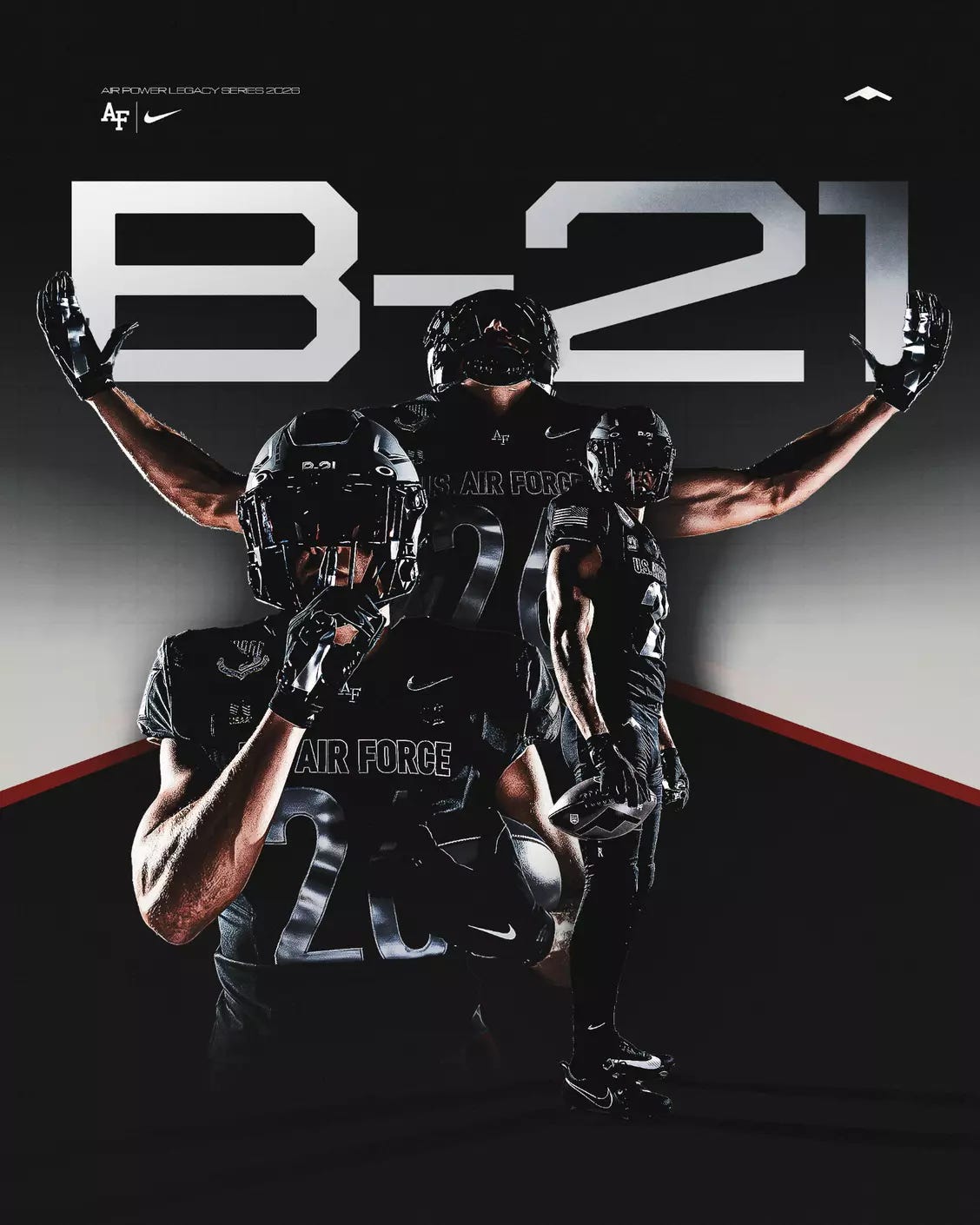
Incredibly, the Air Force Academy football program is honoring a weapon system, the new B-21 Raider bomber, which is surely music to the ears of Northrop Grumman, the lead contractor.
Here’s the announcement from the Air Force:
The Air Force football team will honor the B-21 Raider with the 2026 edition of the Air Power Legacy Series uniform. The Falcons will wear the special uniform for the Navy game scheduled for Saturday, Oct. 3, at 10 a.m. MT at Falcon Stadium on the campus of the United States Air Force Academy. The game will be nationally televised on CBS.
The idea of preventing conflict by maintaining a force so capable, ready, and credible that no adversary will ever risk war. It is the promise that peace is preserved through unmatched strength and readiness 24/7/365.
Power Projection is ability to rapidly fly, fight, and deliver decisive airpower anywhere on the globe, anytime, through any contested airspace. It ensures America’s reach has no limits.
Ah, “America’s reach” may have no limits, but recent events surely prove that our reach has greatly exceeded our grasp, whether in Vietnam, Iraq, Afghanistan, or most recently in Iran.
And how is “preventing conflict” working for America’s massively steroidal military?
Perhaps one shouldn’t think too much about this. Focus on the cool uniforms and the sleek jets, am I right?
Here’s a slick Air Force PR image—if you can stand it.
Look at those gridiron warriors, embracing the new B-21 bomber! Truly inspiring.
The mixture of sports and militarism in America is increasingly deadly, especially for those people on the receiving end of America’s “projected” power.
A special sports uniform for a plane that isn’t even fielded yet, let alone combat-proven. What insanity.
By the way, if you go to the Northrop Grumman website, you see this proud statement:
Air Power Legacy Series
Northrop Grumman and the U.S. Air Force Academy partnered on the 10th‑anniversary Air Power Legacy Series, unveiling a B‑21 Raider inspired football uniform that connects Air Force heritage to the future of American air power. The uniforms debut October 3 vs. Navy at Falcon Stadium.
No better illustration of Ike’s military-industrial complex can possibly exist.
P.S. The projected cost of each B-21 bomber is roughly $700 million, a “conservative” estimate. Given the usual cost overruns, it’s likely the B-21 will cost $1 billion per plane. Total program cost is just over $200 billion, but that’s in Fiscal Year 2019 dollars. Again, given the usual cost overruns, that cost will likely double over the next 10-20 years, assuming Congress continues to fund the plane. And, guess what? America doesn’t even need the B-21. The Air Force already has more than enough planes, bombs, and missiles to end most life on earth.
Talk about unlimited “reach”!
P.P.S. By happy coincidence, today is the Air Force’s 79th birthday. Why don’t you chip in a few hundred dollars for the new B-21? Not that you have any choice in the matter.
The Trump administration plans to give 40 kilotons of “conventional” bombs to Israel. Put differently, that’s 40,000 bombs, each with a ton of HE or high explosive. Naturally, it’s the American taxpayer who foots the bill as it’s labeled as aid to Israel.
Forty kilotons is a little more than the combined yield of the atomic bombs dropped on Hiroshima (15 kilotons) and Nagasaki (21 kilotons) in 1945.
2000-pound bombs are not precision weapons. They flatten entire city blocks. Israel doesn’t need them for self-defense; it “needs” them to erase Gaza and its people from the map. (Or perhaps to attack Iran with in conjunction with U.S. forces. Or both.)
The other “Made in America” product that Israel orders in bulk is giant bulldozers. They’re in high demand to move the rubble around and entomb the bodies of the dead. A few of these bulldozers are now driverless or robodozers.
Mega-bombs and giant robodozers: all this death and destruction is explained away as “Israel’s right to exist.”
I went on “Judging Freedom” today to discuss the many dark legacies of 9/11. This video is especially worth watching for Judge Napolitano’s summary of the PATRIOT Act and how it degraded our fourth amendment protections under the U.S. Constitution. Unlike him, I have not read all of the PATRIOT Act.
I had many thoughts both before and after my interview with the Judge. Perhaps the most disturbing to me is the sense of how much my country has embraced war as a creative act, as a force for good, as equivalent to freedom. Hence names like “Operation Iraqi Freedom” and “Operation Enduring Freedom” for the Iraqi and Afghan Wars. Barack Obama had his “good” war (Afghanistan) and his “bad” one (Iraq), even as Hillary Clinton chortled and gloated over the death of Gaddafi in Libya when she was Obama’s Secretary of State.
There was a time when Americans saw war as corruption—as the most insidious threat to democracy (James Madison), as brutal, stupid, and often futile (General Dwight D. Eisenhower). Ever since 9/11, if not before, too many Americans (especially those who don’t have to fight) have come to embrace war as positive, even “good.” This is among the most worrisome signs of creeping fascism—the identification of war with freedom, with patriotism, openly adopted and supported by both political parties in America.
Militarized madness, if left uncorrected and unopposed, will destroy freedom and liberty.
The Judge and I also briefly discussed Islamophobia and the death toll in countries like Iraq, Afghanistan, Libya, and Syria. The harsh reality of hundreds of thousands killed, and millions displaced, during the War on Terror is rarely mentioned in the mainstream media here, and usually goes unacknowledged in 9/11 memorial ceremonies.
The chief legacy of 9/11 is as obvious as it is tragic: a state of permanent warfare in the United States, both abroad and in the “homeland” (a term not used in normal discourse before the 9/11 attacks), with millions dead and displaced for no defensible reason.
If you’re 25 years old or younger in America, you’ve never known a time when your country wasn’t at war. “Peace” is no longer seen as desirable, let alone possible. War is seen as America’s natural state; a land of warriors are we, imbued with a “warrior ethos” that applauds kicking other countries when their down and beating the snot out of them just because we can.
Meanwhile, in the “homeland,” surveillance grows ever more intrusive by the day as agents of ICE kick down doors and haul people away to detention centers that are being rapidly expanded. Personal privacy is increasingly a thing of the past as the government wraps itself in a shroud of secrecy that makes oversight and accountability well-nigh impossible.
The global war on terror has become a war of terror. War begets more war, with no end in sight.
Re-reading the Atlantic Monthly 150th anniversary issue from November 2007, I came across this gem of a quote from America’s 9/11 mayor, Rudolph Giuliani:
We’ve got to be patient and committed [in Iraq], but we’ve got to multitask … We’ve got to talk about Iran—Iran is more dangerous than Iraq—and we have got to get the job done in Afghanistan and in Pakistan.
That was Giuliani in July of 2007 when he ran as a Republican presidential candidate. In America, that’s how you get treated as a “serious” candidate for the presidency—by urging for war not just with Iraq and Afghanistan but with Pakistan and Iran as well. We can “multitask” our wars! Truly a sign of American greatness.
Well, Giuliani’s dream has come true—we are talking a lot about Iran today.
Back in 2007, Ron Paul had a different take on 9/11 and America’s state of forever war, but he was roundly booed for asking Americans to exercise just a bit of empathy by asking why “they” hate us:
That “crazy” Ron Paul, talking about blowback for America’s wars in the Middle East. He obviously didn’t know about America’s peace-making bombs and freedom-bringing missiles. Didn’t he know as well that “they” hate us for our freedoms?
Wars are protean and dangerous beasts. Even when necessary, which is rare, it is well that we remember the horrifying costs of them.
The Russia-Ukraine War is in its fifth year with no clear end in sight. Suffering on both sides has been extreme. Trump’s war with Iran is in its sixth month with no clear end in sight. Hopes of a quick and low-cost regime-change war, encouraged by Israeli propaganda directed at Trump, have proven illusory. With Trump refusing to admit defeat, further escalation and dramatic economic consequences seem likely.
Certainly, Ukraine could not have sustained its military efforts without massive support from the U.S., NATO, and the EU. From the Russian perspective, they likely see this as a Ukraine/US/NATO/EU effort to weaken Russia. I blame Russia for invading. I blame the USA for exploiting that invasion for its own purposes (the Nordstream pipelines didn’t blow themselves up). I continue to worry that this war could widen leading to the use of nuclear weapons. I favor diplomatic efforts to end the war on terms Ukraine and Russia can accept.
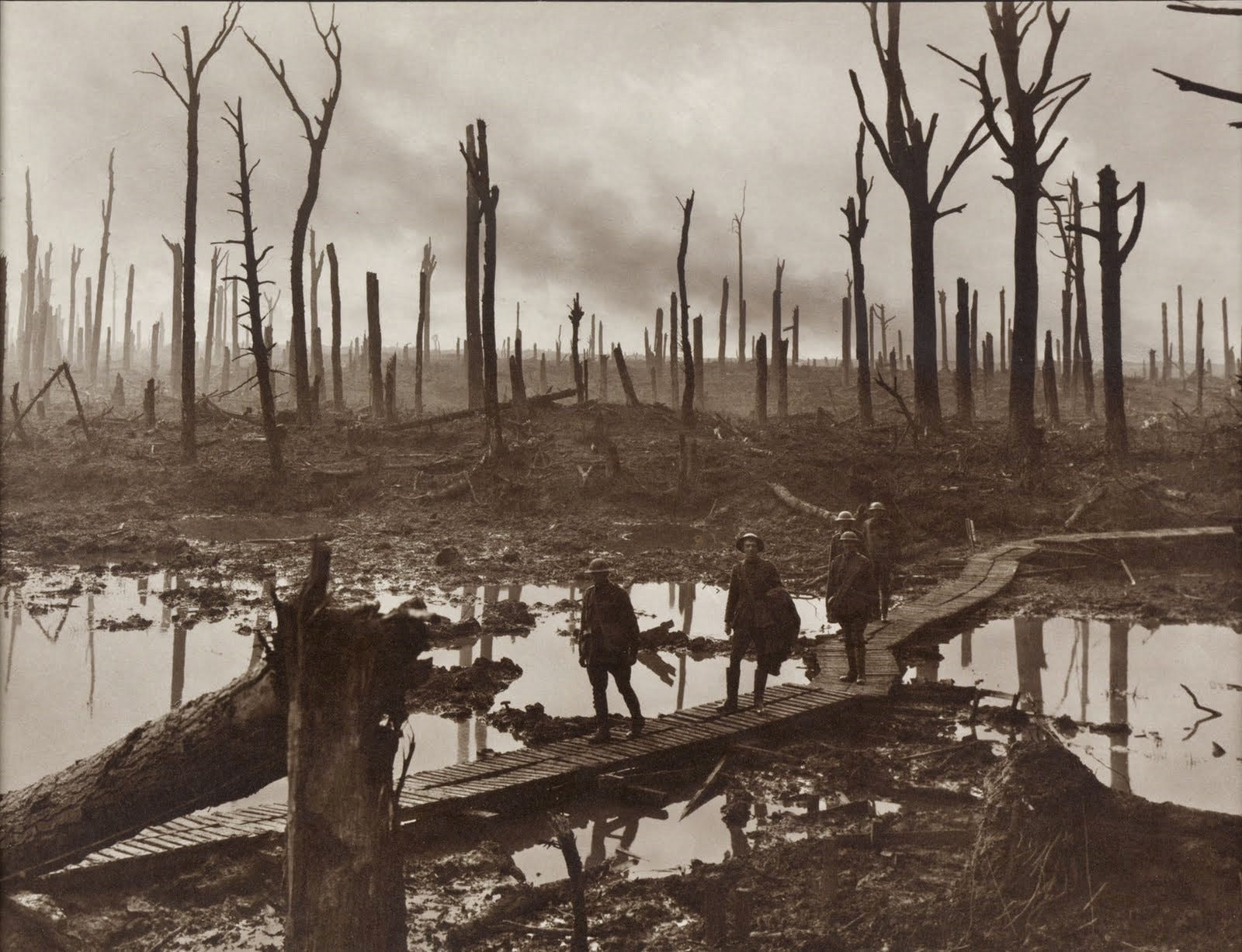
The costs of war (Western Front, 1917)
I lament the costs of war, all the dead and wounded on both sides, and the continued destruction of Ukraine’s environment. I lament the damage war does to liberty, freedom, and truth. War always exacts a toll.
Whether the toll of the war is “worth it” for Ukraine or Russia to pay is not my decision. Only the people of Ukraine and Russia can say. Many have voted with their feet, leaving their respective countries, or the affluent pay bribes to avoid military service. This is hardly surprising. Affluent Americans paid bribes in the U.S. Civil War to avoid military service, or they hired substitutes to serve in their place.
Too often, wars are fought by the poor for the rich. Inequities in demands are obscured when wars are glorified as national wars of liberation.
Though not a pacifist, I’m strongly antiwar and very skeptical of justifications for the same, especially by “our” government. Just think of Vietnam, Iraq, Afghanistan, Iran, and so on. I’m not an isolationist (an impossibility given how the world is interlinked, along with America’s 750-800 foreign military bases). But we’ve got to downsize the empire and make major cuts to Pentagon spending.
A major problem with war is that it fosters authoritarianism and abridgments of liberty. Even wars allegedly for liberation can be contrary to liberty. War also fosters the most Orwellian language. I’ve run across “justifiable repression” to explain away the authoritarianism of the Zelensky government in Ukraine. Forced conscription in Ukraine is explained away as “a regrettable but justifiable limitation of personal freedom.”
War is intoxicating and a powerful disturber of clear thinking. It corrodes intellectual honesty — while killing lots of people and destroying the earth.
As a retired military officer, I come back to Ike and his charge that we must be alert and knowledgeable citizens committed to democracy and individual liberties. Yet we seem immersed in a system designed to keep us somnolent and ignorant, or, put more plainly, lazy and dumb.
Ike said he hated war as only a soldier could hate it with all its waste and brutality. We would all do well to hate war and find ways to settle differences through diplomacy. The problem is that too many powerful entities actually love war because it makes them money and because it supports authoritarian agendas and because there are always megalomaniacs willing to sacrifice others for power.