How Much Is Enough for National Defense?

$600 Billion Seems Reasonable

BILL ASTORE

APR 26, 2026

What is the right amount of money to spend on national defense?

It’s not an easy question because answers depend on goals. On commitments.

So, for example, I’m committed to the ideal of the American republic. That republic should focus on defense of the nation. I don’t support the American empire. I don’t favor an offensive military. I don’t believe defense is about global domination. Offense is enabled by full-spectrum dominance; defense doesn’t require it.

So much of what America spends on “defense” goes to weapons makers like Lockheed Martin, Boeing, and RTX. It’s advertised as military Keynesianism but it’s more like corporate welfare for what used to be called the merchants of death.

I don’t value weapons as “investments.” I see weapons as Ike saw them in 1953. They are a form of theft. They steal funding from schools, hospitals, libraries, fire stations, and other much-needed improvements to national services and infrastructure.

Yes, America has to defend itself, but an imperial military that is vastly overfunded is an albatross around the neck of a declining republic.

A wildly offensive military that seeks global dominance—the budget for that military is almost boundless. It’s not surprising, then, that this is the vision we’re sold. The idea that the U.S. military must be second to none and dominate everywhere at almost any cost. And what a cost!

An essential part of this imperial vision is that diplomacy is best done with bombs, as Pete Hegseth boasted. That diplomacy isn’t even needed, really, because as Trump says, America holds all the (military) cards. If countries like Iran keep resisting, threaten them with extermination.
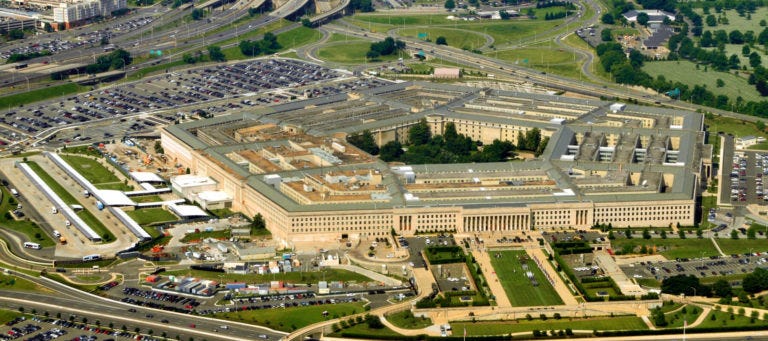
A black hole for money

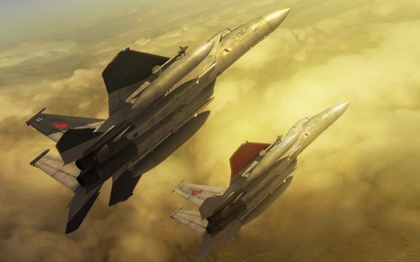
An imperial military of global dominance based on massively expensive weapons systems and exterminatory threats drives a “defense” budget of $1 trillion or more. Trump, of course, is asking for $1.5 trillion for FY2027, a staggering 50% increase. This insane vision of exterminatory war is enabled by colossal spending on Death Star-like weaponry.

Meanwhile, Members of Congress fight for their share of a rapidly expanding military procurement pie. Shrink the pie? Forget it! They only want their fair share of the pie (or the pork) for their district. Lobbyists from those imperial merchants of death ensure that Congress stays the military (and militarized) course.

To return to my question: Assuming we’re talking about national defense in a republic that believes in diplomacy and that isn’t forever seeking dragons overseas to slay, I’m guessing that roughly $600 billion a year would suffice for the Pentagon. That is still an enormous sum of money. That healthy amount assumes America can avoid fighting wars of choice and stop its various foolhardy military interventions across the globe.

Ten years ago, $600 billion was roughly the baseline for the Pentagon budget even as America was still in Afghanistan and waging a “global war on terror.” Sure, there’s been some inflation, a weakening of the dollar, but that ballpark figure seems reasonable for a military focused on true national defense rather than one based on total global dominance.

One axiom that should always rule: A republic should not spend one more dollar than necessary on military might. If $600 billion is too high, I’d be happy to see a lower amount.

One coda: No more money for the Pentagon until it’s able to pass an audit.

Making America Divided Again

trump
Rise above the pettiness, don’t be the pettiness

W.J. Astore

Trump’s latest press conference is worrisome for so many reasons.  He seems to live in his own reality (e.g. his administration is “a fine-tuned machine“).  He’s still obsessed with Hillary Clinton and the margin of his victory.  He seems only recently to have learned how serious the prospects of a nuclear holocaust could and would be.  He continues to defend General Michael Flynn, saying that even though Flynn undermined the Obama administration and lied to Vice President Mike Pence, his rapprochement to Russia was laudable (with Trump suggesting that, even though he hadn’t approved Flynn’s actions, he might have).  He even tasked a Black reporter to set up a meeting with the Congressional Black Caucus for him!

What to make of The Donald?  Trump seems to thrive on creating animosity, then exploiting it.  Special targets for him include the U.S. intelligence community and the media, both of which he sees as implacable enemies.  But is animosity and chaos any way to run a country or to represent a people?

I can see how calling out your perceived enemies might work in business, especially a personal one, though Trump’s bankruptcies suggest otherwise.  But Trump is no longer a free-wheeling real estate tycoon.  He’s president now, a symbol (like it or not) of America. Generating animosity and discord as a public servant is divisive, fractious, selfish, and unwise.

A united America is much stronger than a disunited America, but since Trump thrives on division, his personal style is weakening our country. You might say he’s the opposite of Abraham Lincoln, who appealed to the better angels of our nature in a noble but ultimately failed attempt to unite a disunited country. Whatever else Trump is about, it’s not better angels.

Instead of making America great again, Trump is making it divided and uncivil again.

Mister President: Please stop blaming the media, or Hillary, or the intelligence community, or judges, or anyone else for that matter.  Get on with the job of being a public servant.  America needs inspired leadership, not self-serving rhetoric.  We need a uniter, not a divider.

Rise above the pettiness, Mister President.  For the nation’s sake, don’t be the pettiness.

Why We Celebrate July 4th

Long may it wave as a symbol of freedom.  Photo in Maine, 2006, by the author
Long may it wave as a symbol of freedom. Photo in Maine, 2006, by the author

We celebrate July 4th with a lot of hoopla.  Flag-waving parades.  Backyard barbecues with beer and laughter.  Fireworks.  Good times.

We celebrate the creation of a new country, a new ideal, in 1776.  It was a country that rejected hereditary aristocracies, that called for equal rights for (most) men, that endeavored to create a new and better order for the ages.

Naturally, in an effort this ambitious, involving so many men with differing ideas and ideals, the end result was flawed.  Native Americans were ruthlessly killed or shunted aside.  Slavery remained the original sin of the young republic, a stain partially erased by the Civil War but one whose legacy still dims the brightness of America’s lamp of liberty.

Today the USA remains decidedly imperfect.  That is why we must continue to strive to form a more perfect union, one which protects the rights of the weak against the depredations of the strong.  In this sense the revolution is never over.

As we reflect on the meaning of July 4th, our day of independence, we should recognize that independence is not a day simply to be celebrated.  Rather, it is a legacy that others have fought and died for, one we must continue to earn — and one we must continue to cherish and protect.

Just as the founders of this country fought against the tyrants of the 18th century, we must be on guard against the tyrants of the 21st century.  They may not be kings named George sending their mercenaries to quarter among and fight against us.  Today’s tyrants–today’s power-seekers and liberty-limiters–may even claim to be super-patriots who are protecting us from harm, even as they work to limit our rights while feasting on the plenty that still defines America.

But we know better.  We know what is best about America.  And on July 4th, we celebrate it.

America’s thirst for freedom — may it never be quenched.  May it always endure.

W.J. Astore

Asymmetrical Warfare: Its Real Meaning

Don't worry, it's just a game, and we have the best toys
Don’t worry, it’s just a game, and we have the best toys

When U.S. military theorists talk about asymmetrical warfare, they nearly always mean that the enemy has a diabolical advantage against us (They use human shields!  They have no qualms about endangering women and children!).  Rarely do these theorists recognize our own asymmetries, the enormous advantages they convey, and the seemingly irresistible temptation to use those advantages to smite our enemies, real or imagined.

Our enormous military capability and virtual invulnerability to direct attack combine to actuate “proactive” and “kinetic” aggressiveness whose means are entirely out of proportion to the ends.  We “shock and awe” because we can, and because the targets on the receiving end of American firepower have little recourse and no ability to reply in kind.

How likely would it be that we’d meddle in Afghanistan or Iraq or Libya or Syria if these countries could strike with equal fury against the U.S.?

As the U.S. military responds with “urgent fury” in the name of “enduring freedom,” ordinary Americans are reduced to spectators at a bloodless video game, watching on American TV stock footage of missiles being launched, jet aircraft taking off, etc.  We’re supposed to gaze, with pride, at our arsenal in action, and applaud when U.S. missiles, at a cost of $50 million plus, slam into their targets.  It’s all bloodless (to us), just explosions from a distance blossoming on our TV screens in our living rooms.

So, when we talk of asymmetrical war, let’s remember our own asymmetries: the asymmetry of enormous American firepower, and the asymmetry of seeing war as a bloodless video game even as various enemies (or innocents) get vaporized by remotely-launched American missiles.

Our government has worked tirelessly to insulate the American people from the true costs of making war, which makes it far more likely that our war on terror, in one form or another, will continue indefinitely.

Let us recall, once again, the words of James Madison: No nation can preserve its freedom in the midst of continual warfare.

W.J. Astore