When it comes to war (and more war), the USA is a dictatorship.
Consider Trump’s words that he will make “the final determination” whether the Iran War will persist. Roughly 342 million Americans and 93 million Iranians await Trump’s decision. The decision of an egotistical narcissist who’s convinced he must always be seen to be “winning”—that all that really matters is his own self-image.
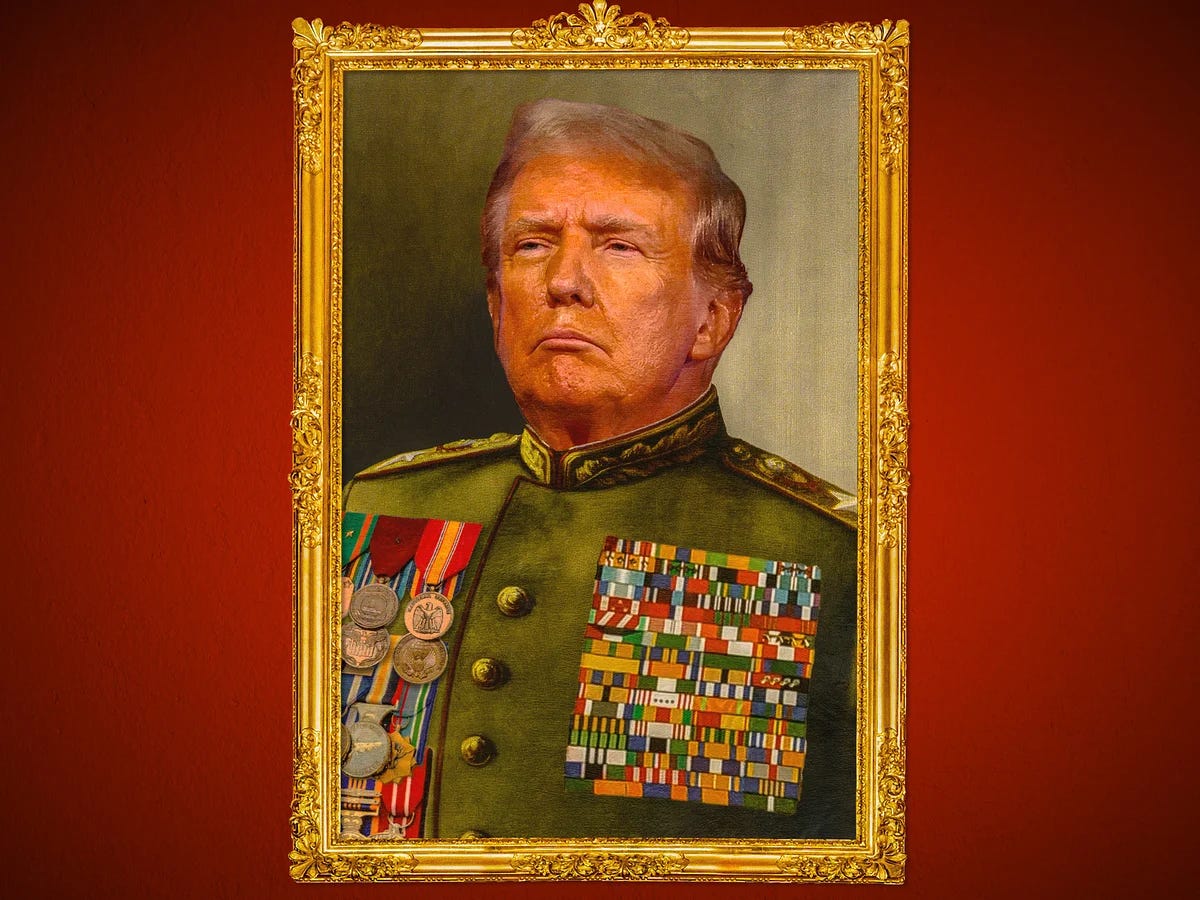
How Trump sees himself (courtesy of the Guardian)
Trump, America’s de facto dictator, if not yet de jure, recently told the American people he didn’t care if the war was hurting their finances or making life more difficult for them. As Dick Cheney once said about American opposition to the Iraq War: “So?” So what? Who cares what the people think. What matters is what the dictators think.
What’s especially shameful here is mainstream media coverage, which presents Trump’s absolute power over war as completely normal—even legal.
Remember when wars were supposed to be declared only by Congress in the name of the people?
Saying when to fight, when to go to war, when to send U.S. troops into harm’s way, is the ultimate power, literally the power over life and death, and we the people, as much as I hate to say this, have accepted with little protest that Trump has total power here.
Meanwhile, the Democrats mutter something about affordability. And there’s always a Democrat or two (“the rotating villain”) in Congress who prevents any curb to Trump’s war-making authority.
Welcome to America’s shamocracy. We might be able to remove Trump’s name from the JFK Center for the Performing Arts, but we can’t remove Trump from sending U.S. troops to their deaths in an illegal war. Where’s Congress? Where’s SCOTUS? Why do they leave war-making to the whims of one greedy and power-driven man?
I was reading an old Atlantic Monthly from November 2007 and came across this quote:
We’ve got to be patient and committed [in Iraq], but we’ve got to multitask … We’ve got to talk about Iran—Iran is more dangerous than Iraq—and we have got to get the job done in Afghanistan and in Pakistan.
That was Rudolph Giuliani, speaking as a Republican presidential candidate in July 2007.
Back then, the saying was that everyone wants to go to Baghdad but that real men want to go to Tehran. Weirdly, neither Iran nor Iraq had anything to do with the 9/11 attacks in 2001. What those countries did have was oil—and lots of it.
The Iran obsession persists, of course, and it’s shared by both political parties. When she ran for president in 2024, Kamala Harris identified Iran as the greatest adversarythe United States faced in the world.
The truth is that neither Iran nor Iraq posed a direct or imminent threat to the USA. What each country possessed was an enormous amount of oil and political leaders who didn’t want to kowtow to U.S. economic imperatives.
A joke I learned circa 1975 involving calculators (fairly new back then) remains revealing of what drives the American obsession with the Middle East. It goes like this: 142 Israelis fight 154 Arabs over 69 oil wells for 5 years. Who wins? Punch 14215469 into your calculator, multiply by 5, then invert your calculator.
The result, which was amusing when I was about twelve years old:
Shell Oil!
Of course, U.S. and British meddling in Iran dates back to 1953 with the overthrow of its democratically elected leader Mohammad Mosaddegh so that British oil interests wouldn’t be threatened by efforts to nationalize Iran’s huge oil reserves.
Which brings me back to 1975 and one of my favorite movies, Three Days of the Condor, and a little honesty about what Americans expect from the CIA. I’ve always loved the speech near the end by CIA deputy director Higgins, played memorably by Cliff Robertson:
Higgins: It’s simple economics. Today it’s oil, right? In ten or fifteen years, food. Plutonium. Maybe even sooner. Now, what do you think the people are gonna want us to do then?
Higgins: Not now – then! Ask ‘em when they’re running out. Ask ‘em when there’s no heat in their homes and they’re cold. Ask ‘em when their engines stop. Ask ‘em when people who have never known hunger start going hungry. You wanna know something? They won’t want us to ask ‘em. They’ll just want us to get it for ‘em!
*****
And yet, despite what Higgins says, today the US government isn’t even that effective at stealing the oil, though it is true that Shell Oil and other fossil fuel conglomerates are making a killing as oil and gas prices soar.
Addendum: Shell Oil is now Shell plc or Shell Global. Judging by the Shell quarterly dividend report from the first quarter of this year, things are looking very bright indeed:
Shell delivered strong results enabled by our relentless focus on operational performance in a quarter marked by unprecedented disruption in global energy markets… Last week we announced the acquisition of ARC Resources, accelerating our strategy by adding complementary, high-quality, low-cost liquids and gas assets that we believe will deliver value for decades to come. Today, consistent with our value driven capital allocation philosophy, we are rebalancing our shareholder distributions, with a $3 billion share buyback programme for the next 3 months and a 5% increase in the dividend, in line with our existing 40-50% of CFFO distribution policy.
Excuse the snark, but the real green energy surge, “green” as in money, remains dirty fossil fuels.
Several hundred people (428 people from 40 nations, to be precise) concerned about the plight of Palestinians in Gaza organized a flotilla to bring humanitarian aid to the region. Israel illegally intercepted that flotilla and is now abusing today’s equivalent to righteous gentiles.
The “righteous gentiles” (or “the righteous among the nations”) who helped Jews escape the Holocaust during World War II are celebrated and honored at Yad Vashem in Israel. Perhaps the most famous (because Steven Spielberg made a movie about him) was Oskar Schindler.
It is one of history’s great ironies that Israel is abusing and punishing today’s version of the righteous gentiles who sacrificed so much to help Jews being persecuted and murdered by the Nazis in World War II.
The Israeli government naturally insists the flotilla is aiding “terrorists,” pretty much the same sentiment of the Nazis who punished and often killed those who helped the Jews during the Holocaust.
It’s all so profoundly sad and tragic because “never again” (never another Holocaust) has been shown yet again to be an empty sentiment.
It’s increasingly hard to remember how and why America is supposed to go to war. First, war is supposed to be a last resort, not a knee-jerk reaction to Israeli actions. Second, war is supposed to be a deliberative process, a constitutional one, involving Congress and needing its approval since war is declared in the name of the American people and only in response to America itself being directly threatened. Of course, presidents are expected to take the lead here, but prosecuting wars is supposed to be a national act of will requiring the mobilization of consent.
Yet when it comes to Iran today war just seemingly happens based on the whims of President Trump, a small network of loyal advisers, and the wishes of Bibi Netanyahu and Israel. The American people aren’t even asked if they approve. Little effort is made to mobilize national will. We’re simply told by the POTUS that “Iran can’t have a nuclear weapon.” Never mind that the DNI, Tulsi Gabbard, testified that Iran wasn’t actively pursuing such a weapon. Never mind that America has thousands of nukes and Israel a hundred or more. Iran simply can’t have one, apparently because that country can’t be trusted. America and Israel, of course, can have all the nukes they want.
The Iran War, put bluntly, might be the dumbest war ever for America. It has strengthened hardliners in Iran, weakened America’s economy and moral stature (what’s left of it), and arguably revived and accelerated Iran’s nuclear ambitions. It’s done the exact opposite of what the Trump administration claimed it was supposed to do and at enormous cost.
Nevertheless, despite this dumbass war (to put it in Trumpian terms), a frustrated U.S. president seems determined to double down on more war. If only those pesky Arab allies would stop getting in the way, what with all their concerns about getting hit by Iranian drones and missiles in retaliation for U.S. and Israeli attacks. How dare Iran defend itself!
War is the first refuge of the brain dead, to coin a phrase, which led me back to a book I read as a teenager, Isaac Asimov’s Foundation Trilogy. Asimov wrote that Violence is the last refuge of the incompetent. Springing into action, blowing things up, kicking and punching people when they’re down (to cite the noble sentiment of Pete Hegseth), is surely the refuge of the incompetents in the Trump administration.
If only we could put this confederacy of very unstable dunces in time out until they grew up and smartened up.
I’ve been thinking about the power of belief, of faith, its ability to inspire us, to bring us together for collective action. Of course, belief, faith, or ideology can easily be used to inspire or justify murderous collective action. Still, just because belief and faith can be misused doesn’t mean it has no use.
I was raised Catholic and though I no longer attend church, I still consider myself to be a Christian. By that I mean I believe in the Beatitudes, I believe in Christ as a man of peace, I remain inspired by the Gospels and by Christ’s parables. I don’t concern myself with the intricacies of dogma and doctrine, debates about the right time and form of baptism, whether it’s transubstantiation or consubstantiation. Those debates don’t worry me, and indeed I find them distractions from the central message of peace, charity, love.
In the bad old days, I was taught salvation outside the Catholic Church was unattainable. This strikes me today as nonsense. Whatever salvation exists in this world of ours is available to anyone with a kind, loving, and generous heart. Even Protestants! (Just kidding, my Protestant friends.)
My opposition to war is based in part on its murderous waste but it’s also grounded in my sense of right and wrong, which in itself is based on what I learned reading the Gospels. Anyone who finds support for aggressive warfare and killing in the New Testament is preaching heresy of the worst kind.
You have to admire Jesus the man, who came to help beggars, to heal the sick, to comfort the afflicted. Jesus in his day hung out with workers, fishermen, and the like, and he was remarkably open to giving women from all walks of life a place at the table. (Not an openness that was adopted by the Roman Catholic Church, mind you.)
What concerns me is the extent to which the power of faith and belief is being twisted and almost monopolized by so-called christians who are thirsty for war, power, and money. There is far too much emphasis on apocalyptic visions and end-times prophecy and not nearly enough on core tenets such as loving thy neighbor.
I don’t think it’s wise to cede Christianity to the zealots who use it as a kind of sanction for men like Donald Trump. Again, the misuse of religion doesn’t mean that religion has no use.
I’ve never tried to proselytize, never tried to convert anyone. To me the efficacy in any system of faith or belief is the good works it inspires. Many people throughout history have drawn deeply from a well of faith and belief to change the world for the better. Think here of Martin Luther King Jr. or Mother Teresa or Dorothy Day, among so many others.
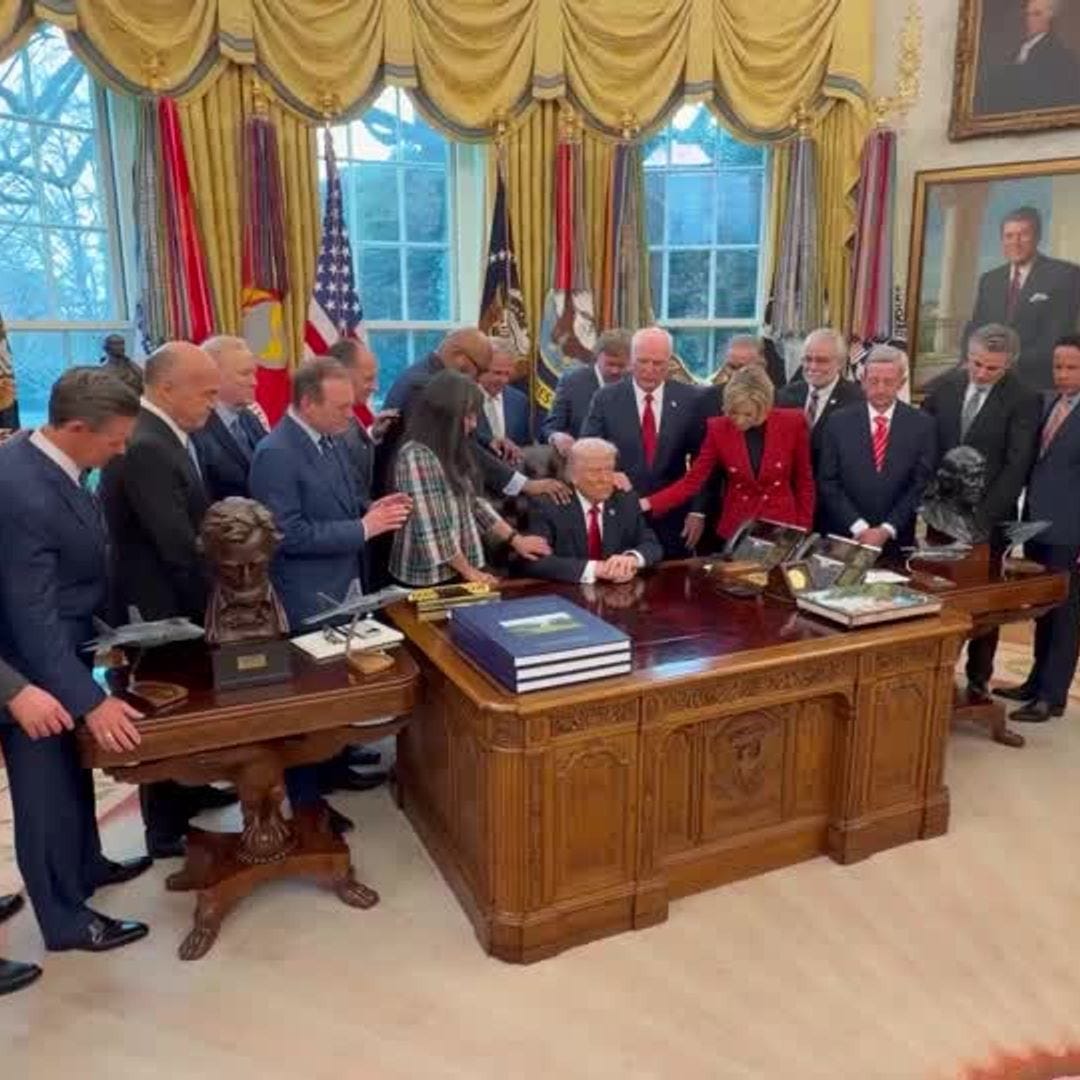
Ministers Pray Over Trump in the Oval Office (Reuters)
It pains me to see evangelical ministers praying over Trump in the White House because I believe in the separation of church and state. I also believe religion and faith should not be tied to any one nation or political party. Those who misuse religion — well, let us judge not, lest we be judged. But I’m not going to turn away from the New Testament because it’s being cited and misused by fools, the power-hungry, and heretics.
Christ’s Beatitudes are easy to understand and should form the core of any faith that labels itself as Christian. Getting back to that core should concern all Christians everywhere.
The Beatitudes
And seeing the multitudes, he went up into a mountain: and when he was set, his disciples came unto him:
2 And he opened his mouth, and taught them, saying,
3 Blessed are the poor in spirit: for theirs is the kingdom of heaven.
4 Blessed are they that mourn: for they shall be comforted.
5 Blessed are the meek: for they shall inherit the earth.
6 Blessed are they which do hunger and thirst after righteousness: for they shall be filled.
7 Blessed are the merciful: for they shall obtain mercy.
8 Blessed are the pure in heart: for they shall see God.
9 Blessed are the peacemakers: for they shall be called the children of God.
10 Blessed are they which are persecuted for righteousness’ sake: for theirs is the kingdom of heaven.
11 Blessed are ye, when men shall revile you, and persecute you, and shall say all manner of evil against you falsely, for my sake.
12 Rejoice, and be exceeding glad: for great is your reward in heaven: for so persecuted they the prophets which were before you.
Along with this bonus passage:
43 Ye have heard that it hath been said, Thou shalt love thy neighbour, and hate thine enemy.
44 But I say unto you, Love your enemies, bless them that curse you, do good to them that hate you, and pray for them which despitefully use you, and persecute you;
45 That ye may be the children of your Father which is in heaven: for he maketh his sun to rise on the evil and on the good, and sendeth rain on the just and on the unjust.
46 For if ye love them which love you, what reward have ye? do not even the publicans the same?
47 And if ye salute your brethren only, what do ye more than others? do not even the publicans so?
48 Be ye therefore perfect, even as your Father which is in heaven is perfect.
Of course, Christ’s teachings here are incredibly demanding; no human can be perfect. They are meant to be aspirational—they are meant to be arduous, in fact unattainable, and that is their point. We must strive to be better, we must believe we can be better, we must have faith in ourselves and our ability to do better, knowing we’ll fall far short of perfection.
The idea or the belief in a better, more humane, more compassionate, world is fundamental to making it so, however imperfectly or incrementally we achieve it.
Faith can help move mountains; a twisted faith may remove mountains, as in an apocalyptic nuclear war. A faith based on love of neighbor, a humble faith, a faith built on respect for life and that celebrates peacemakers as the children of god is surely a faith that is worth celebrating. Or so I believe.
And if you think religion is gibberish, or if you believe it is insidious and harmful, I take no offense. It’s not organized religion itself that motivates me: it’s the basic teachings of love, tolerance, compassion, and the rejection of hatred, murder, greed, and war. Plenty of people who reject the idea of a higher power are guided by morals and ideals that are consistent with the better angels of our nature.
It’s not about being a holy roller, and it’s certainly not about being holier than thou. It’s about reverence for life—a love of life in all its forms. For if we truly embraced a love of life, how could we possibly justify the pursuit of mass death that is so painfully manifested in America’s incessant imperial warmongering?
In God We Trust? A warmongering state makes a mockery of that motto. Yet why do the self-avowed Christians connected to Trump embrace war so tightly to their chests? Some would say this is why religious faith is so dangerous. But just because someone says they’re born again doesn’t make them children of God. Make peace and then I’ll call you a Child of God. Make war and I’ll call you a warmonger.
With some trepidation, I welcome your comments. (Wouldn’t it be something if comment sections showed compassion and generosity of spirit?)
Can you win a war that isn’t really about the country you’re fighting? Where the aims keep shifting and the motivations are dishonest? We know from Secretary of State Marco Rubio that Israel more or less forced the Trump administration’s hand in attacking Iran. We know from Joe Kent’s testimony that Iran posed no imminent threat to the U.S. We know from President Trump himself that Iran’s nuclear program had been “obliterated” in previous strikes. So why wage war on Iran?
The way we label wars is illustrative of our confusion and dishonesty. “The Vietnam War”: more accurately, it was the U.S. government’s war on Vietnam. “The Iraq War”: again, the U.S. government’s war on Iraq. Same with Afghanistan. Same with Iran. America wages constant wars against other nations and peoples; these wars are really variations on a theme of militarism, imperialism, and profiteering.
Cui bono, who benefits, is always the question to ask. The answer is usually some combination of the military-industrial complex, U.S. oligarchical corporate interests, and, in the case of wars in the Middle East, Zionist Israel and fossil fuel interests.
By its nature, a constant state of warfare feeds authoritarianism and stifles freedom and democracy. Wars favor oligarchs and dictators and feed fascist tendencies. No nation can preserve its freedom in the midst of continual warfare, James Madison warned.
There is no “victory” to be had in these wars, not for the American people. This was true of the Vietnam War and it’s also true of the current war on Iran. America is losing and will lose because these wars weaken freedom and democracy while reinforcing authoritarian and fascistic elements.
America, as in people like us, can only “win” when these wars are ended.
All this has been on my mind as I recalled this review that I wrote (see below) on why the U.S. lost the Vietnam War.
*****
American Reckoning: Why the U.S. Lost the Vietnam War
Written in 2015.
Christian G. Appy, professor of history at U-Mass Amherst, has written a new and telling book on the Vietnam War: American Reckoning: The Vietnam War and Our National Identity (New York, Viking Press). Reading his book made me realize a key reason why the U.S. lost the war: for U.S. leaders it was never about Vietnam and the Vietnamese people. Rather, for these men the war was always about something else, a “something else” that constantly shifted and changed. Whereas for North Vietnam and its leaders, the goal was simple and unchanging: expel the foreign intruder, whether it was the Japanese or the French or the Americans, and unify Vietnam, no matter the cost.
Appy’s account is outstanding in showing the shifting goals of U.S. foreign policy vis-à-vis Vietnam. In the aftermath of World War II, the U.S. first supported the French in their attempts to reassert control over their former colony. When the French failed, the U.S. saw Vietnam through a thoroughly red-tinted lens. The “fall” of a newly created South Vietnam was seen as the first domino in a series of potential Communist victories in Asia. Vietnam itself meant little economically to American interests, but U.S. leaders were concerned about Malaysia and Indonesia and their resources. So to stop that first domino from falling, the U.S. intervened to prop up a “democratic” government in South Vietnam that was never democratic, a client state whose staying power rested entirely on U.S. “advisers” (troops) and weapons and aid.
Again, as Appy convincingly demonstrates, for U.S. leaders the war was never about Vietnam. Under Eisenhower, it was about stopping the first domino from falling; under Kennedy, it was a test case for U.S. military counterinsurgency tactics and Flexible Response; under Johnson, it was a test of American resolve and credibility and “balls”; and under Nixon, it was the pursuit of “peace with honor” (honor, that is, for the Nixon Administration). And this remained true even after South Vietnam collapsed in 1975. Then the Vietnam War, as Appy shows, was reinterpreted as a uniquely American tragedy. Rather than a full accounting of the war and America’s mistakes and crimes in it, the focus was on recovering American pride, to be accomplished in part by righting an alleged betrayal of America’s Vietnam veterans.
In the Reagan years, as Appy writes, American veterans, not the Vietnamese people, were:
portrayed as the primary victims of the Vietnam War. The long, complex history of the war was typically reduced to a set of stock images that highlighted the hardships faced by U.S. combat soldiers—snake-infested jungles, terrifying ambushes, elusive guerrillas, inscrutable civilians, invisible booby traps, hostile antiwar activists. Few reports informed readers that at least four of five American troops in Vietnam carried out noncombat duties on large bases far away from those snake-infested jungles. Nor did they focus sustained attention on the Vietnamese victims of U.S. warfare. By the 1980s, mainstream culture and politics promoted the idea that the deepest shame related to the Vietnam War was not the war itself, but America’s failure to embrace its military veterans.” (p. 241)
Again, the Vietnam War for U.S. leaders was never truly about Vietnam. It was about them. This is powerfully shown by LBJ’s crude comments and gestures about the war. Johnson acted to protect his Great Society initiatives; he didn’t want to suffer the political consequences of having been seen as having “lost” Vietnam to communism; but he also saw Vietnam as a straightforward test of his manhood. When asked by reporters why he continued to wage war in Vietnam, what it was really all about, LBJ unzipped his pants, pulled out his penis, and declared, “This is why!” (p. 82).
Withdrawal, of course, was never an option. As Appy insightfully notes,
LBJ and most of the other key Vietnam policymakers never imagined that withdrawal from Vietnam would be an act of courage. In one sense this moral blindness is baffling because these same men prided themselves on their pragmatic, hardheaded realism, their ability to cut through sentiment and softhearted idealism to face the most difficult realities of foreign affairs. They could see that the war was failing. But they could not pull out. A deeper set of values trumped their most coherent understandings of the war. They simply could not accept being viewed as losers. A ‘manly man’ must always keep fighting.” (p. 84)
A few pages later, Appy cites Nixon’s speech on the bombing of Cambodia, when Nixon insisted the U.S. must not stand by “like a pitiful, helpless giant,” as further evidence of this “primal” fear of presidential impotence and defeat.
Even when defeat stared American leaders in the face, they blinked, then closed their eyes and denied what they had seen. Beginning with Gerald Ford in 1975, America shifted the blame for defeat onto the South Vietnamese, with some responsibility being assigned to allegedly traitorous elements on the homefront, such as “Hanoi Jane” (Fonda). As Appy writes, “Instead of calling for a great national reckoning of U.S. responsibility in Vietnam, Ford called for a ‘great national reconciliation.’ It was really a call for a national forgetting, a willful amnesia.” (p. 224)
As a result of this “willful amnesia,” most Americans never fully faced the murderous legacies of the Vietnam War, especially the cost to the peoples of Vietnam, Laos, and Cambodia. Instead, our leaders and government encouraged us to focus on America’ssuffering. They told us to look forward, not backward, while keeping faith in America as the exceptional nation.
Appy notes in his introduction that America needs “an honest accounting of our history” if we are “to reject—fully and finally—the stubborn insistence that our nation has been a unique and unrivaled force for good in the world.” (p. xix) American Reckoning provides such an honest accounting. But are Americans truly ready and willing to put aside national pride, nurtured by a willed amnesia and government propaganda, to confront the limits as well as the horrors of American power as it is exercised in foreign lands?
Evidence from recent wars and military interventions in Iraq, Afghanistan, and elsewhere still suggests that Americans prefer amnesia, or to see other peoples through a tightly restricted field of view. Far too often, that field of view is a thoroughly militarized one, most recently captured in the crosshairs of an American sniper’s scope. Appy challenges us to broaden that view while removing those crosshairs.
*****
Addendum (2026): Self-styled Secretary of War Pete Hegseth has already floated the lie that Democrats (and a few Republicans) are betraying the country by seeking to constrain the Trump administration in its disastrous war on Iran. What Hegseth is saying, essentially, is that Congress is committing treason in attempting to exercise its constitutional duties.
Always when the warmongers lose a war, they resort to the hoary “stab-in-the-back” myth. Rare indeed is someone like Robert McNamara, who admitted decades after the Vietnam War that he had been wrong, terribly wrong, to prosecute that war.
Usually in America, those who are most unrepentant about war are the ones hired to comment on or wage the next one.
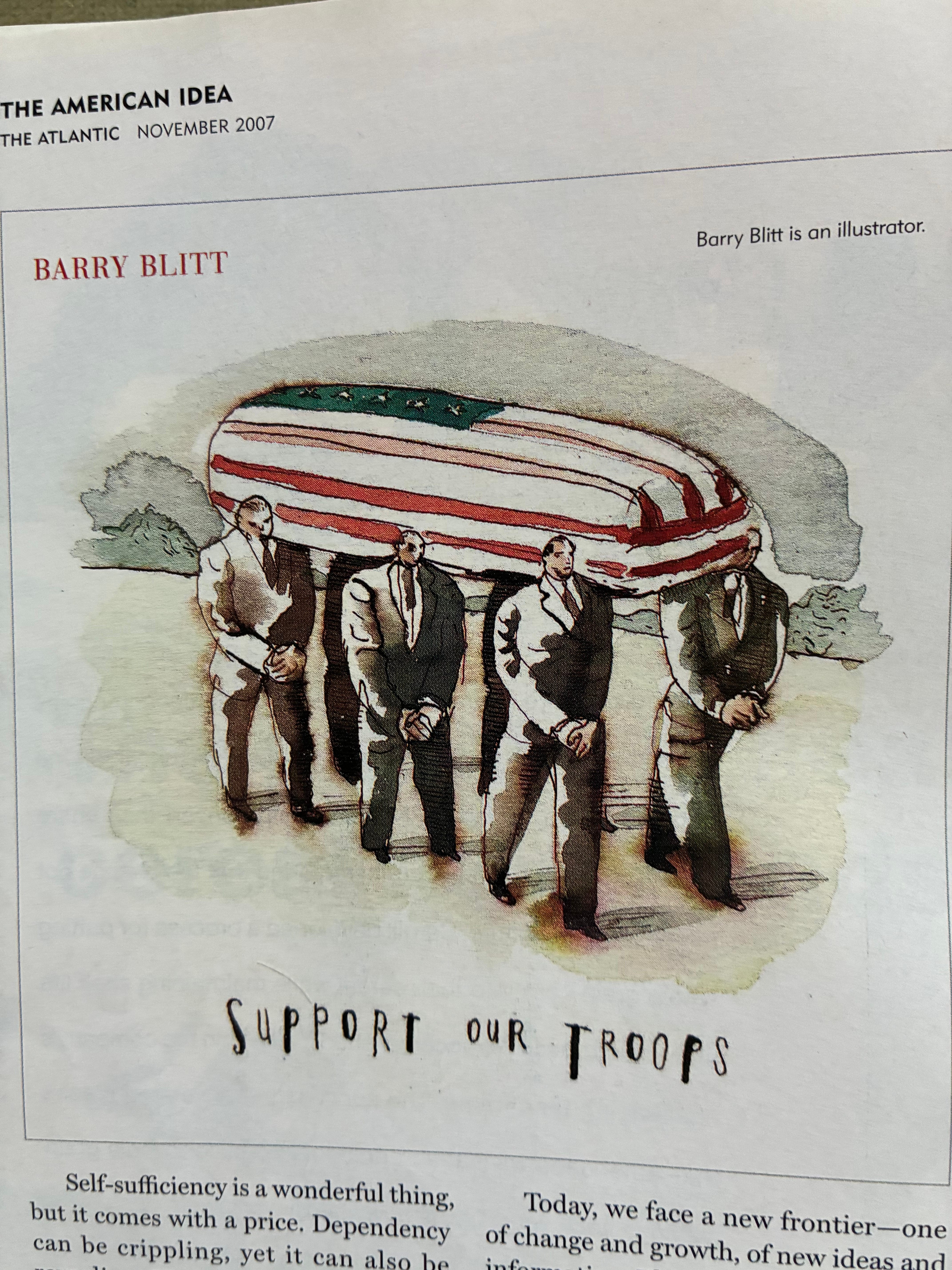
The other day, I was reading an old Atlantic Monthly and came across the following cartoon:
That is one powerful image. I like the tiny heads on the pallbearers. They make me think of the posturing politicians who tell us to “support our troops” while sending them to die in illegal, immoral, and unconstitutional wars.
That cartoon was published near the end of 2007, when America’s disastrous war of choice in Iraq was supposedly improving due to the Petraeus Surge. Of course, General David Petraeus qualified his surge by saying its gains might prove “fragile” and “reversible.” And so they proved.
“Support our troops” is a catchphrase, almost a mantra, often used by cynical politicians to suppress dissent about their disastrous wars of choice. Basically, dissenters are accused of being unpatriotic because their criticism allegedly betrays the troops and weakens national resolve. It’s a BS argument but it’s often compelling and even convincing to some.
Americans have a civic religion defined by the Pledge of Allegiance, the flag, the National Anthem, military parades and pageantry, and U.S. history taught as heritage and as a celebration of American goodness and greatness. When you step outside of that, when you criticize it, dissent from it, you must be prepared to be attacked as a heretic.
Back in 2010, I wrote an article for TomDispatch in which I argued that not every American troop is a hero. I argued instead that real heroes are few and far between, and that the ideal of heroism shouldn’t be associated so closely, even almost exclusively, with military service. These are obvious points (to me, at least), but I took some flak for suggesting that merely donning a military uniform doesn’t and shouldn’t make one a “hero.”
I remain convinced that hyping the troops as universal “heroes” isn’t a form of support. The troops know better. If you truly want to support them, listen to them. Be an informed and knowledgeable citizen. Speak your mind and don’t be afraid to criticize those who seek to use the military for dishonorable or indefensible purposes.
Since this is America, theoretically land of the free, feel free as well to speak out against the military. Our founders were suspicious of large standing armies and were wary of wars as being especially pernicious to democracy.
We Americans celebrate our troops for defending freedom, yet we paradoxically attack those who try to exercise their freedom by denouncing war and militarism. You can’t have it both ways. Unless you want hypocrisy instead of democracy, you can’t celebrate freedom while denying it.
This was, of course, the so-called original sin of the American republic: celebrating freedom while also enshrining the institution of slavery. Rank hypocrisy led inexorably to the U.S. Civil War.
As a retired U.S. military officer, I’ve been thanked for my service more often than I’ve been denounced as a murderous agent of American empire. It’s easy to accept the thanks; slurs and attacks are what they are. People sometimes think to defame or demean others is a way to elevate themselves. So be it.
Another aspect of “support our troops” is communal ritual to mark the passing of local “heroes.” Such rituals take various forms. In my community, one involves a mass motorcycle ride in memory of “fallen” troops killed since 9/11. The language used is that of America’s civic religion, celebrating our “great country” and those “heroes” who’ve made the “ultimate sacrifice.”
It’s easy to acquiesce to that language and sentiment. It’s also easy to attack it and dismiss it as patriotic claptrap.
I see it as something else: a communal rite. A recognition of sacrifice. Even if that sacrifice was not in a worthy cause.
I’m not a fan of these communal rituals and the often cynical uses to which they’re put, but I recognize their potency and the need of some people to participate in them. It’s a collective expression of belonging, of grief, of community. A place to find meaning.
A reader put it very well to me in response to my article on heroes in 2010. I saved the letter and have never quoted from it before but I’d like to do so now:
I think the reason we see the “heroification” of so many is a desperate need of so many to feel a sense of self worth. This is especially true in the working class, who have seen their cultural value, their hopes for the future and the quality of their lives decline so radically in recent decades.
This week here in town we see the massive outpouring for the fallen Marine by those who need so desperately to feel a part of something bigger than themselves, when someone like themselves is honored. I see this as poignant in ways that go far beyond the family’s loss.
This is well and sensitively put. How often in our communal settings are “ordinary” people celebrated for anything? Our culture most often celebrates the rich, the powerful, Hollywood and sports “stars,” while neglecting the everyday heroism (or, if not heroism, acts of generosity) of people from all walks of life.
In sum, “our” troops don’t want to put on pedestals and plinths. They certainly don’t want to be carried in flag-draped caskets. And most don’t want to be celebrated as heroes because they know they haven’t earned it. What they want, I think, is to be understood. What they don’t want is to be wasted, to be betrayed, to be misused.
Who among us would want to see their life as a waste, who would wish to be betrayed, who would seek to be misused?
With Memorial Day approaching, it is good to ponder the wise words of Andy Rooney in the video below. Troops don’t give their lives. Their lives are taken from them. Something so precious shouldn’t be taken so lightly by leaders with neither compassion nor conscience. Even better, as Andy Rooney suggests, is a future where war withers away and peace brings out the very best in us.
News out of the Pentagon is that the great retreat from Germany is beginning. Five thousand U.S. troops are being withdrawn at the request of a petulant president who can’t stand criticism of his disastrous war of choice with Iran. (Then again, maybe it wasn’t a war of choice, as it appears his commander-in-chief, Bibi Netanyahu, gave him none.)
Other countries to have annoyed Trump include Spain and Italy. In Trump’s words: “Italy has not been of any help to us and Spain has been horrible, absolutely horrible.”And we might cite Denmark here as well for refusing to hand over Greenland. Look for more U.S. troop withdrawals as “punishment.”
America! Bad Boy! Get your hand out of that cookie jar!
And wouldn’t that be a wonderful thing! The U.S. empire, to use an expression by my smarter wife today, simply has its hands in too many cookie jars. All those overseas bases (750 or more), all those overseas troop deployments, why, exactly, do we have all these? Perhaps during the height of the Cold War, an extensive network of overseas bases had a certain strategic logic in efforts to contain Soviet expansion, but ever since 1991, most of these bases have made little sense strategically. Much like Topsy, they just grew, and grew some more.
An uncontained U.S. empire features an increasingly unconstrained military-industrial complex flush with cash. This is not a good thing. The complex is drunk on money and power; future disasters are guaranteed.
Paradoxically, if America wants stronger, saner, national defense, we must make major cuts to the imperial war budget. Giving the empire yet more cash, yet more power, is a recipe for continual failure on the grandest of scales.
I don’t like the saying, but sometimes less really can be more. Less (as in lower) spending on the military will produce more (as in safer) conditions here in the U.S. and across the world.
My message to world leaders: If you have U.S. military bases in your country, please, please, insult and annoy Trump. It might be the most effective way to downsize the U.S. empire and to bring the troops home.