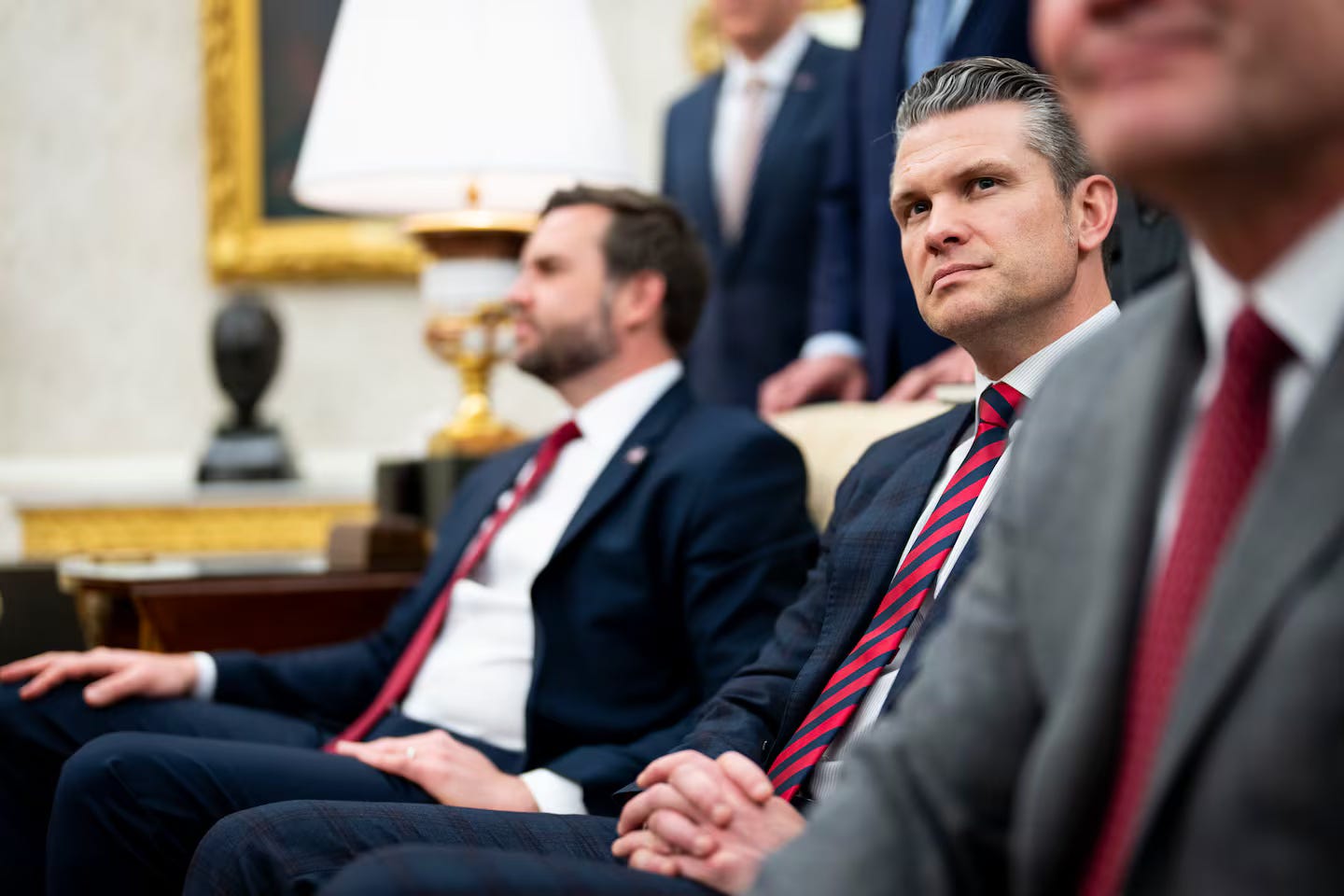
Today, I talked about the decline and fall of the citizen-soldier ideal in America with Judge Napolitano on “Judging Freedom.”
The judge asked me a powerful question about “Thou shalt not kill” and the pursuit of killing in war. Is killing ever truly justified by wartime imperatives? There are no easy answers to that question, nor should there be.
You can fall back on Just War theory, but I wasn’t mentally prepared to discuss that complex subject in detail.
There are times, I believe, when killing in war is justifiable, such as a defensive war against implacable enemies bent on destruction. Nazi Germany and Imperial Japan come to mind from World War II. Of course, war is always awful, always barbarous, and those caught up in war are degraded by it. Nevertheless, U.S. citizen-soldiers of World War II behaved less atrociously and generally stood for higher ideals than their counterparts in Nazi Germany and Imperial Japan.
Again, when you read combat accounts written by U.S. troops, such as E.B. Sledge’s “With the Old Breed” about his service in the Marine Corps fighting the Japanese, you quickly realize both sides fought viciously, both sides committed atrocities, because that is the nature of brutal combat. But the Japanese were more fanatical and more prone to barbarous actions than U.S. troops, though Americans learned quickly to return the favor.
All war is awful, all war is murderous, therefore it should be avoided whenever possible. Still, no one need submit to a dictatorship like that of Nazi Germany or the militaristic rule of imperial Japan. There is nobility in defending kith and kin and for defending as well ideals that serve liberty, freedom, and justice.
High-minded displays of non-violent resistance are admirable, as are mindful appeals to compassion, but they would not have stopped the work of Hitler’s Panzers or his death camps.
The problem is that since World War II, America hasn’t waged defensive or just wars. Its wars, whether in Southeast Asia or the Middle East, have been undeclared wars driven by imperial designs and reasons that do not in any way justify deadly use of force, especially the wanton use of such force. The American people increasingly recognize this. So too do those in command, which is why they’re working so hard to recruit obedient “warriors” to the ranks today, instead of citizen-soldiers capable of thinking for themselves.
Today’s leaders, men like Pete Hegseth, want to turn war into a guiltless exercise in killing, as if victory always goes to the most ruthless and brutal side in war. History teaches us the opposite is often true. And, assuming that America “won” by being utterly ruthless and annihilatory, would we not have lost our humanity in the process?
The bottom line is that we in America must work for peace while resisting our “leaders” who are so eager to embroil this nation in immoral, incessant, and murderous wars.
America’s leaders are always boasting of precision weaponry. Yet the NYT suggests that a precision strike against an Iranian water facility was possibly unintentional, an accident, I guess. Since an intentional strike against critical infrastructure (you can’t get more critical than potable water) for civilians would constitute a war crime—and obviously America would never do that!
Even asking that question, self-styled Secretary of War Pete Hegseth bloviated, is both “disingenuous” and “impugning” the motives of America’s military professionals.
We can’t have reporters asking questions that might impugn the motives of our brave leaders.
Hegseth seems to enjoy himself the most when he’s attacking the media for their lack of faith in him.
The Iran War, yet another disastrous war for the American people (and of course even more so for Iranians), may continue until President Trump’s morale improves. And that may prove to be a very long time. Remember when Hegseth suggested that the war would last eight weeks at most? It’s already roughly double that with no end in sight.
Check out the Iran War Clock. And the war clock keeps ticking …
Can you win a war that isn’t really about the country you’re fighting? Where the aims keep shifting and the motivations are dishonest? We know from Secretary of State Marco Rubio that Israel more or less forced the Trump administration’s hand in attacking Iran. We know from Joe Kent’s testimony that Iran posed no imminent threat to the U.S. We know from President Trump himself that Iran’s nuclear program had been “obliterated” in previous strikes. So why wage war on Iran?
The way we label wars is illustrative of our confusion and dishonesty. “The Vietnam War”: more accurately, it was the U.S. government’s war on Vietnam. “The Iraq War”: again, the U.S. government’s war on Iraq. Same with Afghanistan. Same with Iran. America wages constant wars against other nations and peoples; these wars are really variations on a theme of militarism, imperialism, and profiteering.
Cui bono, who benefits, is always the question to ask. The answer is usually some combination of the military-industrial complex, U.S. oligarchical corporate interests, and, in the case of wars in the Middle East, Zionist Israel and fossil fuel interests.
By its nature, a constant state of warfare feeds authoritarianism and stifles freedom and democracy. Wars favor oligarchs and dictators and feed fascist tendencies. No nation can preserve its freedom in the midst of continual warfare, James Madison warned.
There is no “victory” to be had in these wars, not for the American people. This was true of the Vietnam War and it’s also true of the current war on Iran. America is losing and will lose because these wars weaken freedom and democracy while reinforcing authoritarian and fascistic elements.
America, as in people like us, can only “win” when these wars are ended.
All this has been on my mind as I recalled this review that I wrote (see below) on why the U.S. lost the Vietnam War.
*****
American Reckoning: Why the U.S. Lost the Vietnam War
Written in 2015.
Christian G. Appy, professor of history at U-Mass Amherst, has written a new and telling book on the Vietnam War: American Reckoning: The Vietnam War and Our National Identity (New York, Viking Press). Reading his book made me realize a key reason why the U.S. lost the war: for U.S. leaders it was never about Vietnam and the Vietnamese people. Rather, for these men the war was always about something else, a “something else” that constantly shifted and changed. Whereas for North Vietnam and its leaders, the goal was simple and unchanging: expel the foreign intruder, whether it was the Japanese or the French or the Americans, and unify Vietnam, no matter the cost.
Appy’s account is outstanding in showing the shifting goals of U.S. foreign policy vis-à-vis Vietnam. In the aftermath of World War II, the U.S. first supported the French in their attempts to reassert control over their former colony. When the French failed, the U.S. saw Vietnam through a thoroughly red-tinted lens. The “fall” of a newly created South Vietnam was seen as the first domino in a series of potential Communist victories in Asia. Vietnam itself meant little economically to American interests, but U.S. leaders were concerned about Malaysia and Indonesia and their resources. So to stop that first domino from falling, the U.S. intervened to prop up a “democratic” government in South Vietnam that was never democratic, a client state whose staying power rested entirely on U.S. “advisers” (troops) and weapons and aid.
Again, as Appy convincingly demonstrates, for U.S. leaders the war was never about Vietnam. Under Eisenhower, it was about stopping the first domino from falling; under Kennedy, it was a test case for U.S. military counterinsurgency tactics and Flexible Response; under Johnson, it was a test of American resolve and credibility and “balls”; and under Nixon, it was the pursuit of “peace with honor” (honor, that is, for the Nixon Administration). And this remained true even after South Vietnam collapsed in 1975. Then the Vietnam War, as Appy shows, was reinterpreted as a uniquely American tragedy. Rather than a full accounting of the war and America’s mistakes and crimes in it, the focus was on recovering American pride, to be accomplished in part by righting an alleged betrayal of America’s Vietnam veterans.
In the Reagan years, as Appy writes, American veterans, not the Vietnamese people, were:
portrayed as the primary victims of the Vietnam War. The long, complex history of the war was typically reduced to a set of stock images that highlighted the hardships faced by U.S. combat soldiers—snake-infested jungles, terrifying ambushes, elusive guerrillas, inscrutable civilians, invisible booby traps, hostile antiwar activists. Few reports informed readers that at least four of five American troops in Vietnam carried out noncombat duties on large bases far away from those snake-infested jungles. Nor did they focus sustained attention on the Vietnamese victims of U.S. warfare. By the 1980s, mainstream culture and politics promoted the idea that the deepest shame related to the Vietnam War was not the war itself, but America’s failure to embrace its military veterans.” (p. 241)
Again, the Vietnam War for U.S. leaders was never truly about Vietnam. It was about them. This is powerfully shown by LBJ’s crude comments and gestures about the war. Johnson acted to protect his Great Society initiatives; he didn’t want to suffer the political consequences of having been seen as having “lost” Vietnam to communism; but he also saw Vietnam as a straightforward test of his manhood. When asked by reporters why he continued to wage war in Vietnam, what it was really all about, LBJ unzipped his pants, pulled out his penis, and declared, “This is why!” (p. 82).
Withdrawal, of course, was never an option. As Appy insightfully notes,
LBJ and most of the other key Vietnam policymakers never imagined that withdrawal from Vietnam would be an act of courage. In one sense this moral blindness is baffling because these same men prided themselves on their pragmatic, hardheaded realism, their ability to cut through sentiment and softhearted idealism to face the most difficult realities of foreign affairs. They could see that the war was failing. But they could not pull out. A deeper set of values trumped their most coherent understandings of the war. They simply could not accept being viewed as losers. A ‘manly man’ must always keep fighting.” (p. 84)
A few pages later, Appy cites Nixon’s speech on the bombing of Cambodia, when Nixon insisted the U.S. must not stand by “like a pitiful, helpless giant,” as further evidence of this “primal” fear of presidential impotence and defeat.
Even when defeat stared American leaders in the face, they blinked, then closed their eyes and denied what they had seen. Beginning with Gerald Ford in 1975, America shifted the blame for defeat onto the South Vietnamese, with some responsibility being assigned to allegedly traitorous elements on the homefront, such as “Hanoi Jane” (Fonda). As Appy writes, “Instead of calling for a great national reckoning of U.S. responsibility in Vietnam, Ford called for a ‘great national reconciliation.’ It was really a call for a national forgetting, a willful amnesia.” (p. 224)
As a result of this “willful amnesia,” most Americans never fully faced the murderous legacies of the Vietnam War, especially the cost to the peoples of Vietnam, Laos, and Cambodia. Instead, our leaders and government encouraged us to focus on America’ssuffering. They told us to look forward, not backward, while keeping faith in America as the exceptional nation.
Appy notes in his introduction that America needs “an honest accounting of our history” if we are “to reject—fully and finally—the stubborn insistence that our nation has been a unique and unrivaled force for good in the world.” (p. xix) American Reckoning provides such an honest accounting. But are Americans truly ready and willing to put aside national pride, nurtured by a willed amnesia and government propaganda, to confront the limits as well as the horrors of American power as it is exercised in foreign lands?
Evidence from recent wars and military interventions in Iraq, Afghanistan, and elsewhere still suggests that Americans prefer amnesia, or to see other peoples through a tightly restricted field of view. Far too often, that field of view is a thoroughly militarized one, most recently captured in the crosshairs of an American sniper’s scope. Appy challenges us to broaden that view while removing those crosshairs.
*****
Addendum (2026): Self-styled Secretary of War Pete Hegseth has already floated the lie that Democrats (and a few Republicans) are betraying the country by seeking to constrain the Trump administration in its disastrous war on Iran. What Hegseth is saying, essentially, is that Congress is committing treason in attempting to exercise its constitutional duties.
Always when the warmongers lose a war, they resort to the hoary “stab-in-the-back” myth. Rare indeed is someone like Robert McNamara, who admitted decades after the Vietnam War that he had been wrong, terribly wrong, to prosecute that war.
Usually in America, those who are most unrepentant about war are the ones hired to comment on or wage the next one.
I was reading an article today about Pete Hegseth, self-styled Secretary of War, and his decision to remove four officers from the Brigadier General-select list. Turns out the four officers were either Black or female, but I’m sure that was a coincidence.
Anyhow, the article referenced this pearl of wisdom from Hegseth from last September:
“The leaders who created the woke department have already driven out too many hard chargers. We reverse that trend right now.”
For those of you who don’t know military jargon, “hard charger” is a term of approval. And that’s been Trump and Hegseth’s approach to war with Iran. Call it the bull in the china shop approach. Charge in hard, kill people, break things. Drop enough bombs, kill enough people, and obviously victory must follow.
Hard chargers are what we want in this man’s military, so might Pete Hegseth say. I’ve heard Hegseth’s nickname at the Pentagon is “Dumb McNamara,” apparently for his slicked-back hair together with his, well, lack of intelligence. (Robert McNamara was Secretary of Defense during the disastrous Vietnam War.)
Of course, the military needs its share of Type A, Can-do, mission-driven, hard charging men and women. It also needs its share of skilled, knowledgeable, and smart people as well. And there’s nothing that says that a “hard charger” can’t also be a thinker, especially as that can-do type learns from experience that not every problem can be solved with bullets and bombs.
Deep thinkers are especially needed at strategic levels, else wars go nowhere and are quickly lost. One thing is certain: the so-called Department of War isn’t being led by a deep thinker.
Hegseth, surely a leading member of the kakistocracy, prefers pushups to planning and bombs to diplomacy. He’ll keep charging hard, or, more accurately, he’ll order others to charge hard into harm’s way, all in a quest to drive out “wokeness” and win wars through maximum violence and minimal thought.
Charge harder!
Any enemy wanting to fool Pete Hegseth should invest in a red cape and start waving it smartly.
Reading NBC News this morning, I saw where the U.S. “is winning decisively, devastatingly and without mercy,” so claimed self-styled Secretary of War Pete Hegseth. “We are only four days in,” he added, and the U.S. “will take all the time we need” to prevail. He further added “We are punching them while they’re down, which is exactly how it should be.” (There’s nothing more honorable than punching someone when they’re down, right?)
“They [the Iranians] are toast, and they know it, or at least, soon enough, they will know it. And we have only just begun, to hunt, dismantle, demoralize, destroy and defeat their capabilities,” Hegseth boasted. As far as how long the war will last, he equivocated. Three weeks? Eight weeks? Who knows? Hegseth doesn’t.
Hegseth also doesn’t know something fundamental: You can’t do a wrong thing the right way.
The Iran War is wrong. It’s illegal, unconstitutional, immoral, and also extremely dangerous. There’s no way to prevail in a war fought for the wrong reasons, a war fought without clear goals, a war that is already beginning to spiral out of control. But Hegseth thinks if the U.S. launches enough missiles, drops enough bombs, and torpedoes enough ships, somehow the U.S. will “win.”
Congratulations, U.S. and Israel: You made him a martyr
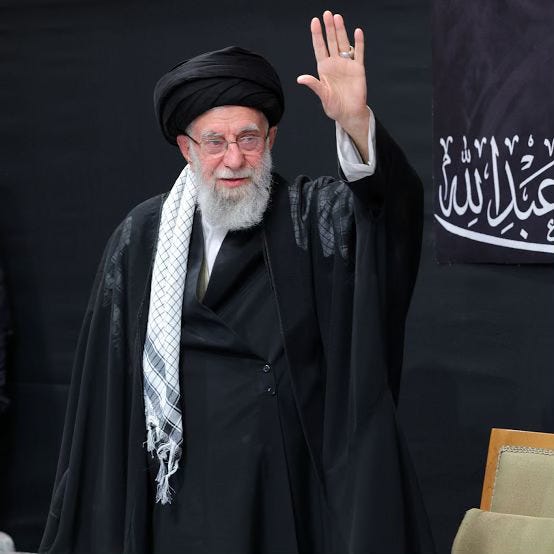
In so many ways, the U.S. has already lost. The Ayatollah Khamenei is now a martyr. Iran is now more likely to pursue a nuclear weapon. Even more so than usual, Israel is now in the driver’s seat, calling America’s shots in the Middle East. This has all the makings of a major catastrophe for U.S. forces, but all Hegseth can see is the promise of punching a man when he’s down.
Clearly, Hegseth is intoxicated with winning “without mercy.” Think about that for a moment—war without mercy. Only the most barbaric or fanatical person would boast about waging war without mercy.
With the Iran War, the Trump administration is marching down the most perilous of paths, blinded by illusions of total victory.
A warning: More than anything, America must not allow this to become a religious war, a crusade, between a Judeo-Christian force and a Shia-Islamic force. We’re already seeing a lot of talk within the U.S. military of a God-driven mission against Iran, with (positive!) references to Armageddon. Such rhetoric is incredibly dangerous and inflammatory. (In this context, that crusader cross tattoo on Hegseth’s chest is more than alarming.)
If anything, the best outcome for the U.S. would be an immediate ceasefire before more U.S. troops are killed and wounded. But how is such a ceasefire to be negotiated? U.S. diplomacy has no credibility. None.
Among the worst outcomes would be the commitment of U.S. troops to Iran, so-called boots on the ground, which would likely create a massive Bay of Pigs-style fiasco. America can ill afford yet another land war quagmire in the Middle East. There is already talk, however, of committing U.S. Special Forces to Iran, perhaps to organize Kurdish and Iranian dissidents against the legitimate Iranian government. Such folly must be prevented.
Any commitment of U.S. troops to Iran would further accelerate escalation. If you begin to hear rumblings about Selective Service and a return to a military draft, you’ll know the Trump administration has become completely unhinged (if it isn’t already).
In just a few days of “major combat operations,” the Trump administration already has more than enough innocent Iranian blood on its hands. That toll in blood is only going to increase, as will the risk of blowback on the “homeland.”
The smartest course for America at this moment is to declare “victory” and leave. Since it’s unlikely Trump and Hegseth will see the light, Congress should immediately cut war funding. Sadly, a weak-willed Congress seems far more likely to pass supplemental funding bills to give Trump and Hegseth a blank check to wage a Judeo-Christian crusade.
We don’t live in interesting times: we live in unhinged times. Perilous times. We must find a way to seek a merciful peace. The alternative just might be World War III.
Should senior military officers consider resigning?
The short answer is yes—if they believe the orders they are given violate their oath to the U.S. Constitution.
In practice, however, resigning for cause is exceedingly rare. The military is a culture of conformity and hierarchy, where resignation is often seen as an act of rebellion—a threat to cohesion and discipline. Officers are taught to work quietly within the system, to suppress doubts, and to remain “loyal” to superiors and to the institution itself. Few are willing to resign openly on moral or legal grounds.
For senior officers, the decision to resign in protest is especially difficult. Colonel David Hackworth, one of the most decorated soldiers of the Vietnam era, resigned after concluding the war was unwinnable—not because he viewed it as unconstitutional. Earlier, General Harold K. Johnson, the Army Chief of Staff under President Lyndon Johnson, considered resigning in protest of the administration’s Vietnam policies but ultimately stayed, hoping to influence policy from within. He later regretted that decision, admitting he had lacked the moral courage to resign.
Both Hackworth and Johnson objected to how the war was fought, not to whether it was lawful. That distinction is crucial.
Senior officers today may likewise convince themselves that remaining in uniform allows them to do the most good—to temper reckless orders from within the system. Resignation, after all, feels like quitting. And there’s an unspoken incentive to stay: the lucrative post-retirement opportunities awaiting those who keep faith with the military-industrial complex.
Given the recent clownish and dangerous behavior of Trump and his defense war secretary, Pete Hegseth, one hopes that senior military leaders are at least preparing for the possibility of resignation—keeping their powder dry until a clear line is crossed. Arguably, that line may already have been crossed.
One resignation might not change much. But several coordinated resignations—anchored in principle—could. The question is whether today’s generals and admirals have the moral courage to do so when the moment arrives.
Trump and Hegseth appear to have neutralized much of the brass by flooding the Pentagon with money. But will those same leaders, drunk on budgets and contracts, have the courage to resist illegal orders and yet another series of wars launched on dubious grounds?
Already, Trump and Hegseth have issued extrajudicial orders—such as the recent killings of suspected smugglers on three speedboats in the Caribbean, ostensibly part of the “war on drugs.” They have deployed active-duty troops to U.S. cities under partisan pretexts that appear to violate the spirit, if not the letter, of the Posse Comitatus Act of 1878. And more attacks on Iran—without any declaration of war—may be imminent.
Given all this, there is ample reason for senior officers to consider coordinated resignations in protest. The question is whether they will summon the moral courage to do what is right—to uphold their oath by walking away.
Perhaps they could call it Operation Just Cause—an operation without bombs or killing, requiring that rarest of things: moral courage.
The military historian Dennis Showalter once told me that he didn’t care about the amount of fat around a general’s belly—he cared about the fat between a general’s ears. It was a telling quip, and one that highlights the shortsighted nature of Pete Hegseth’s emphasis on fitness and military bearing to the generals and admirals he assembled yesterday.
(By the way, what about Trump as commander-in-chief. Is he going to exercise and lose weight? Good luck with that one, Pomade Pete.)
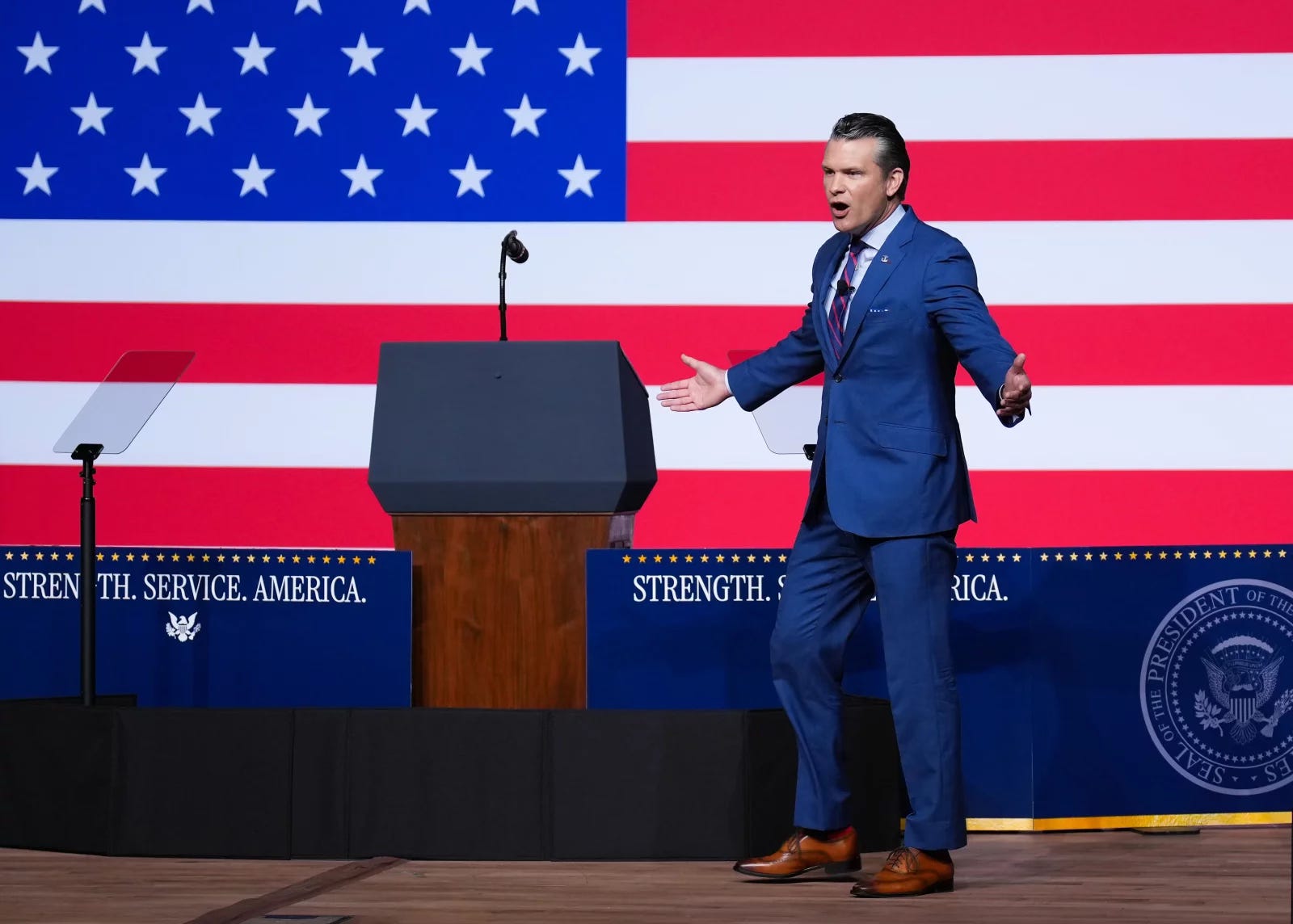
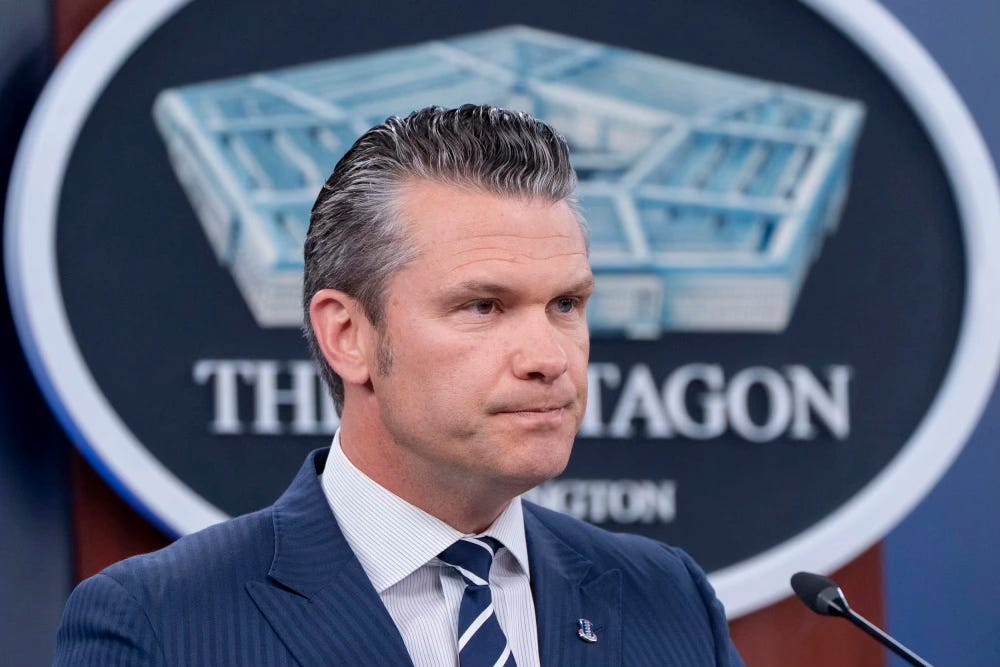
Pomade Pete Hegseth, Self-declared Secretary of War
Of course, physical fitness is important in military settings, especially if you’re at the pointy end of the spear, as they say in the military. But America’s senior leaders today are not “boy generals” like George Armstrong Custer in the U.S. Civil War. They are men and women in their fifties and early sixties, presumably promoted for their integrity, knowledge, insight, skill, and experience, not because they can still run sub-six minute miles or perform 100 pushups.
(Aside: It might be time to buy stock in Ozempic and similar drugs used for weight loss.)
Recall all the media praise showered on William Westmoreland, David Petraeus, and Stanley McChrystal. These three generals were lauded for their physical fitness and military bearing, their “spartan” qualities as warriors. And they all demonstrated strategic mediocrity in fighting and losing the Vietnam, Afghan, and Iraq Wars. They may not have had flabby bellies, but they had flabby minds.
Hegseth is all about “warrior” image over substance. Don’t get me wrong: I think everyone should exercise if they can, and being substantially overweight isn’t healthy. When I was in my early forties and a lieutenant colonel, I ran with the troops and did pushups and sit ups. But there’s a lot more to military effectiveness than being “a lean mean fighting machine.”
But I’ll admit I’m burying the lede here. Trump and Hegseth’s message to senior leaders was far more disturbing than complaints about a fat and woke military. Here’s what I sent to a friend about this:
The “national security” state has kept our country in a state of permanent war since 1947. Trump and Hegseth are just ripping the facade of “security” away and replacing it with “war.”
“Peace” is the word that dare not speak its name. And “war,” of course, has come to the streets of America, with troops deployed to Portland next. Add that to the many police who got their initial training in the military and the rapid expansion of ICE along with detention centers and it’s obvious how the war on terror has truly become global since now the focus is on terror in America.
We are reaping what we sowed …
I was then asked for a more formal comment and came up with this:
The statements of Trump and Hegseth show that the “global” war on terror was and is truly global (as well as permanent) because that war has now come home to America’s cities. Now places like LA and Portland are to be pacified by American “warriors” and warfighters, with detention centers (concentration camps) for those who resist. President Dwight D. Eisenhower was never more right or prescient when he noted, “Only Americans can hurt America.”
Trump and Hegseth see America’s streets as a battleground for the U.S. military against “the enemy within.” The real enemy to democracy, of course, is the very deployment of troops to the streets. American colonists launched a revolution 250 years ago partly because they didn’t want the king’s troops among them as enforcers.
Anyone who doesn’t see the fundamental dangers of Trump and Hegseth’s actions to democracy and our Constitutional rights truly has some flab between their ears.
If there’s one thing we’ve learned (or re-learned, again and again) from the Pentagon it’s that all governments lie and that the first casualty of war is truth. From the Pentagon Papers in the Vietnam War to the Afghan War Papers and the lies about WMD in Iraq, the American people have been deliberately and maliciously lied to about America’s wars and their true causes and purposes. And you can go back further to the infamous “Remember the Maine!” cry that touched off the Spanish-American War of 1898. When it comes to war, America’s leaders have always been economical with the truth.
At the Pentagon, Pomade Pete Strikes Again!
But wait, today’s Pentagon is about to outdo that! As usual with nefarious government decisions, it was announced on Friday when people are most distracted. A short summary from NBC News:
Journalists who cover the Defense Department at the Pentagon can no longer gather or report information, even if it is unclassified, unless it’s been authorized for release by the government, defense officials announced Friday. Reporters who don’t sign a statement agreeing to the new rules will have their press credentials revoked, officials said.
Multiple press associations quickly condemned the new rules and said they will fundamentally change journalists’ ability to cover the Pentagon and the U.S. military. They called for the Trump administration to rescind the new requirements, arguing they inhibit transparency to the American people.
The National Press Club denounced the requirement as “a direct assault on independent journalism at the very place where independent scrutiny matters most: the U.S. military.”
Remember that old saw that, “If you’ve done nothing wrong, you have nothing to hide” from your friendly government surveillance program? Looks like the Pentagon has decided it’s got plenty to hide, meaning it’s done and is planning to do a lot of wrong, and thus only government-approved information will be allowed to be released.
Any journalist worth her or his salt will never agree to this. Journalists who do agree, who sign the Pentagon statement, should just become paid spokespeople for the U.S. military (as indeed many of them already essentially are).
We’ve created a monstrous military, America, one that believes it should be completely unaccountable to us even as we feed it over a trillion dollars a year.
America, there’s only one way to rein in the military: cut the Pentagon budget in half. Show them who’s boss. Of course, Congress controls the purse strings, and Congress, as Ike noted, is intimately intertwined with the military-industrial complex, so it’s not going to be easy to do it.
But no one ever said it’ll be easy: it’s just necessary for the survival of our country as a quasi-democracy.
The so-called SignalGate scandal centered on the bombing of Yemen is highly revelatory. First, some resources. CNN has a useful annotated account of the chats exchanged at the highest levels of the Trump administration. At their respective Substacks, Lenny Broytman and Caitlin Johnstone have telling dissections of these chats as well. At Jacobin, Branko Marcetic has an important article that reminds us of the illegality of the attacks. As the article’s subheading puts it: The press [mainstream media] is mostly framing the Yemen group chat scandal as a story of incompetence. There’s little attention being paid to the deadliness, illegality, and ineffectiveness of the strikes themselves.
To me, among the most telling “chats” came from Secretary of Defense Pete Hegseth. It highlights the “exceptional” nature of America:
*****
Pete Hegseth to Vice President JD Vance: I fully share your loathing of European free-loading. It’s PATHETIC.
But Mike [Waltz, the National Security Adviser] is correct, we are the only ones on the planet (on our side of the ledger) who can do this. Nobody else even close. Question is timing…
*****
This is precisely the problem for America since the Vietnam War, if not before then. We’ve created a monster military, a “global strike” force, that is capable of destroying any target anywhere around the globe. “Nobody else even close,” SecDef Hegseth correctly says. And because we can do it, because we are exceptional in military force, our leaders believe we should do it, even if it’s only to send a “message” to the world how tough we are, how committed we are to killing others.
Other countries—like those “free-loading” European ones—are PATHETIC because they don’t have America’s military might. Only we can smite evildoers around the globe, only we can do so while also arming Israel to the teeth and covering its flanks while it continues its annihilation of Gaza, and this is something we are immensely proud of.
My fellow Americans, this is not something to be proud of. Consider if America’s military in the 1960s had lacked the ability to deploy over half a million troops to Vietnam while also facing down the Warsaw Pact in Europe. Consider if America’s military had lacked the ability to invade Iraq in 2003 while also waging war in Afghanistan and garrisoning the globe with roughly 800 military bases. Consider how much blood would not have been spilled, and treasure wasted, if the U.S. military was smaller, focused on defense, and led by people who didn’t put muscle and flame emojis in their chats to celebrate U.S. military prowess at killing people in Yemen.
That U.S. military forces are the only ones who can kill globally with such comparative ease, that “nobody else even close,” is exactly what is wrong with our government. We place far too much faith and pride in military prowess, so much so that the Pentagon becomes the Pentagod, something we worship, something we make immense sacrifices to, as in budgets that approach $1 trillion yearly.
Not for nothing did President Dwight D. Eisenhower say in 1953 that this is no way of life at all—that we are crucifying ourselves on a cross of iron. Tell me again, who are the pathetic ones?
We must end our intoxication with military power before it ends us.
Officially, the U.S. has the DOD, the department of defense. But when was the last time the U.S. military was primarily oriented toward defense of the CONUS? (CONUS is a military acronym for continental United States.)
My old service, the U.S. Air Force, is far more open about its true aims. It boasts assertively of “global reach, global power” and notably of “global strike.” Not to be outdone, the U.S. Navy has “carrier strike groups,” what used to be termed carrier task forces when they fought real battles in World War II.
Here’s a recent official description: “A Carrier Strike Group (CSG) is a highly powerful, self-contained naval force, capable of projecting power globally, with an aircraft carrier as its core, supported by cruisers, destroyers, submarines, and an air wing, making it a formidable force capable of striking targets 1,000 miles away.”
Doesn’t sound defensive, does it? And of course the U.S. Marines are defined as “expeditionary” forces that are “forward-deployed” for all sorts of expected “contingencies” overseas.
The U.S. military is not about defense. It’s about “full-spectrum dominance.” That means dominance of the land, sea, air, space, cyber, information in all its forms, indeed just about any realm you can think of. No other military, moreover, divides the world into global commands (CENTCOM, AFRICOM, etc.) for the application of U.S. military power. This is not about defending America. It’s about dominating the world. Such a grandiose vision of defense dominance is partly what drives colossal Pentagon budgets that are climbing toward a trillion dollars a year.
SecDef Pete Hegseth, always talking warrior-tough (Doug Mills/NYT)
Consider here the recent kerfuffle about leaked U.S. strike plans for Yemen, which were inadvertently shared with the editor-in-chief at The Atlantic. Here’s an excerpt from those plans:
From Secretary of Defense Offense Pete Hegseth
“1215et: F-18s LAUNCH (1st strike package)”
“1345: ‘Trigger Based’ F-18 1st Strike Window Starts (Target Terrorist is @ his Known Location so SHOULD BE ON TIME – also, Strike Drones Launch (MQ-9s)”
“1410: More F-18s LAUNCH (2nd strike package)”
“1415: Strike Drones on Target (THIS IS WHEN THE FIRST BOMBS WILL DEFINITELY DROP, pending earlier ‘Trigger Based’ targets)”
Note the repetition of the word “strike” and the closing prayer to America’s “warriors.” And ask yourself: Is this truly what national defense should look like? Prayerful appeals to “warriors” as they strike weak and poor countries thousands of miles away in undeclared (and therefore unconstitutional) wars?