“Thou shalt not kill” is a commandment with many exceptions.
Pete Hegseth and the Pentagon want to livestream a military execution by firing squad. We can all watch! Even some Republicans are aghast and Trump says he’ll make the final determination. But Trump is no opponent of capital punishment.
Some moral clarity can be seen from the Catholic Church, as with this statement:
Archbishop Paul S. Coakley, the president of the U.S. Conference of Catholic Bishops, called the planned livestream “a barbaric promotion of a culture of death” and warned it would harm the country.
“The public execution even of one who has done grave harm will only further undermine the moral fabric of our nation and be a blight on the conscience of its people,” he said.
A culture of death, indeed. The United States leads the world in mass shootings, weapons exports (“the merchants of death”), and threats of annihilation (Trump has threatened Iranian civilization with obliteration at least six times).
So much for “Thou shalt not kill”!
Seriously, there was a whole lot of killing in the Old Testament, where God was often quite wrathful and his “chosen” people were encouraged to smite their enemies. As a boy I learned the saying that “the beginning of wisdom is the fear of God.” You never knew when God might demand a human sacrifice (a son?) or encourage you to smite the Amalekites.
1 Samuel 15:3 King James Version
Now go and smite Amalek, and utterly destroy all that they have, and spare them not; but slay both man and woman, infant and suckling, ox and sheep, camel and ass.
God was kind of a dick here. What did he have against camels and donkeys?
With Jesus Christ a New Testament came along that encouraged tolerance, turning the other cheek, putting down swords, and blessing peacemakers as children of God. Those pacific pleas didn’t bother many Americans who prefer instead to think of Jesus as loving warriors armed with guns or flaming swords, looking something like the Dark Lord Sauron in Tolkien’s “Lord of the Rings.”
That is an image very much at odds with “Thou shalt not kill.”
If one murderous death is bad, surely weapons with the ability to murder millions are infinitely worse. Yet the U.S. military is once again embracing genocidal nuclear weapons. Of course, the Pentagon doesn’t speak openly of murdering millions or possibly billions of people. It speaks of “investing” in nukes, of “modernizing” them, of “recapitalizing” the nuclear arsenal.
I must say I prefer the honesty of the King James Version of the Bible about smiting and killing. God didn’t obfuscate that his chosen people should modernize their spears or recapitalize their knives or invest in more swords before annihilating Amalek.
Just as Americans are exceptional at violating the sixth commandment against killing, so too was the god of the Old Testament. He was a jealous god, the superpower of his day, THE exceptional one, with global reach and global power over life and death.
We’ve learned a few lessons from the Bible, but not the wisest ones.
Today, I talked about the decline and fall of the citizen-soldier ideal in America with Judge Napolitano on “Judging Freedom.”
The judge asked me a powerful question about “Thou shalt not kill” and the pursuit of killing in war. Is killing ever truly justified by wartime imperatives? There are no easy answers to that question, nor should there be.
You can fall back on Just War theory, but I wasn’t mentally prepared to discuss that complex subject in detail.
There are times, I believe, when killing in war is justifiable, such as a defensive war against implacable enemies bent on destruction. Nazi Germany and Imperial Japan come to mind from World War II. Of course, war is always awful, always barbarous, and those caught up in war are degraded by it. Nevertheless, U.S. citizen-soldiers of World War II behaved less atrociously and generally stood for higher ideals than their counterparts in Nazi Germany and Imperial Japan.
Again, when you read combat accounts written by U.S. troops, such as E.B. Sledge’s “With the Old Breed” about his service in the Marine Corps fighting the Japanese, you quickly realize both sides fought viciously, both sides committed atrocities, because that is the nature of brutal combat. But the Japanese were more fanatical and more prone to barbarous actions than U.S. troops, though Americans learned quickly to return the favor.
All war is awful, all war is murderous, therefore it should be avoided whenever possible. Still, no one need submit to a dictatorship like that of Nazi Germany or the militaristic rule of imperial Japan. There is nobility in defending kith and kin and for defending as well ideals that serve liberty, freedom, and justice.
High-minded displays of non-violent resistance are admirable, as are mindful appeals to compassion, but they would not have stopped the work of Hitler’s Panzers or his death camps.
The problem is that since World War II, America hasn’t waged defensive or just wars. Its wars, whether in Southeast Asia or the Middle East, have been undeclared wars driven by imperial designs and reasons that do not in any way justify deadly use of force, especially the wanton use of such force. The American people increasingly recognize this. So too do those in command, which is why they’re working so hard to recruit obedient “warriors” to the ranks today, instead of citizen-soldiers capable of thinking for themselves.
Today’s leaders, men like Pete Hegseth, want to turn war into a guiltless exercise in killing, as if victory always goes to the most ruthless and brutal side in war. History teaches us the opposite is often true. And, assuming that America “won” by being utterly ruthless and annihilatory, would we not have lost our humanity in the process?
The bottom line is that we in America must work for peace while resisting our “leaders” who are so eager to embroil this nation in immoral, incessant, and murderous wars.
When I was eighteen, the U.S. Army promised I could “be all that you can be.” The Navy said “It’s not just a job, it’s an adventure.” The Marines were all about “The few — the proud — the Marines.” And the Air Force promised “a great way of life.” I guess I wanted a great way of life, so I joined the Air Force.
Seriously, I never thought I’d serve for twenty years in uniform. My career was relatively easy in the sense that no one ever shot at me, nor did I ever have to take a life. I got an excellent education, met good people, went to interesting places, and got to teach a subject I loved for six years.
Recently, I learned that a member of my family is thinking of joining the military after high school. He hasn’t asked for my advice, but his interest in wearing the uniform made me think about the advice I’d give him if he did ask. What can you say to young men and women that can help them to make an informed decision — the best possible one for them?
It’s easy to be gung-ho about the military. It’s also easy, I think, to dismiss military service with extreme prejudice. The best advice is honest, balanced, and attuned to the person seeking it. In this spirit, what would I say to a young person contemplating enlisting in the military?
Let’s tackle the disadvantages first, the downside and drawbacks to military service, the aspects of military life that potential recruits rarely think about. Here are a few of them:
You could die or be seriously wounded in the military. Think of PTSD, TBI (traumatic brain injury), and similar “hidden” wounds of war. America is incessantly at war, somewhere, and there’s always a chance you could die. But of course young people think they’re immortal and may even crave danger, so this reality rarely deters them.
You may have to kill other people. Perhaps even innocent people, because war is extremely messy and chaotic. Such acts of violence against humanity may lead to moral injury that will haunt your conscience. Are you prepared to kill? Truly?
You sacrifice personal autonomy and some of your rights when you join the military. You have to be willing to follow orders. You can’t just quit and walk away. The military insists on obedience and discipline. Are you prepared to do as you’re told?
If you think you’re important, you’re not: and the military will remind you of this. You’re a pawn in a vast bureaucracy; you’re at the mercy of a system that is often capricious and treats you as a number. You’ll quickly learn the wisdom of acronyms like SNAFU (situation normal, all fucked up) and FUBAR (fucked up beyond all recognition). They may sound funny, until they come to describe your life and career in the military.
You may wish to ask yourself when was the last “good” or necessary war that America has fought for the purpose of true national defense. You may discover that recent wars in Afghanistan, Iraq, and elsewhere were not “good” wars in service of your Oath of Office to the U.S. Constitution. If this gives you pause, if this troubles you, I suggest you don’t enlist.
Take the time to read about veterans who are against war. Consider this letter written by Daniel Hale, who is currently serving prison time for his courageous stance against the murderously imprecise nature of drone warfare. Read about Pat Tillman, the NFL player who enlisted in the Army and who was killed by friendly fire, then used as a propaganda prop by the U.S. military. Don’t think something similar can’t happen to you.
I could mention other disadvantages, such as frequent moves, nonsensical jobs, bad bosses, etc., but many civilian jobs share these. Work isn’t easy; it’s why it’s called “work.”
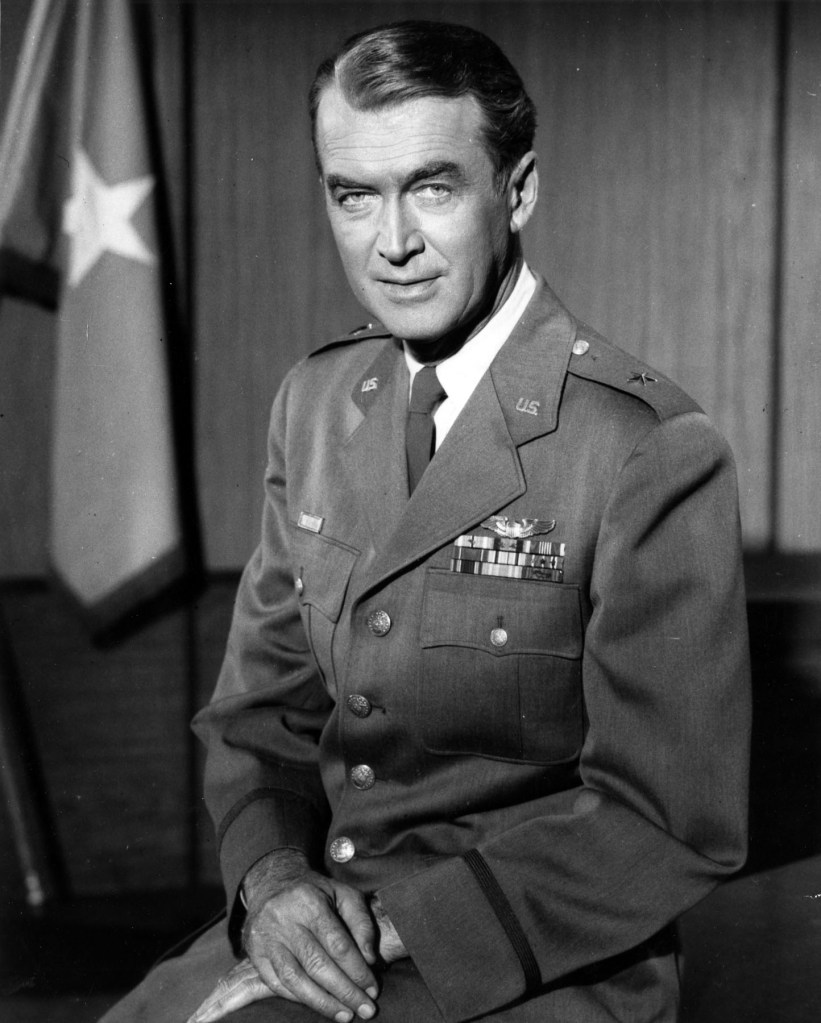
Brigadier General Jimmy Stewart. A bomber pilot during World War II, Stewart suffered from what we today call PTSD. A heroic man, but he’d be the first man to deny that he was a hero. Put differently, Stewart didn’t need war to make him great.
Now, how about the advantages to military service. I know that some of my readers will challenge these, and rightly so, but here are a few “positive waves” about enlisting and taking the oath:
Tradition. For some enlistees, it’s about family tradition. I wasn’t from a strong military family, but my father and his two brothers served in World War II; so did my mother’s brother; and, more recently, my older brother enlisted at the tail end of the Vietnam War and three brothers-in-law also served, one in Vietnam during that horrendous war.
Opportunity. The military today is respected within our society, even venerated. Serving in the military may provide you with unique opportunities both during and after your service.
Teamwork. In a selfish “you can have it all” society, the military reminds us of the importance of teamwork.
Idealism. Taking the Oath of Office should mean something to you. If it doesn’t, don’t enlist.
Purpose, discipline, responsibility, maturity. The military isn’t the only way to live a life of purpose, a disciplined life, a life of responsibility, a life centered on growth and maturation. But, for more than a few people, the military has provided a path forward, a sense of pride and clarity, though that can come at tremendous cost, as explained above.
And, of course, the normal reasons people join: pay, benefits, an opportunity to travel, to start life over, perhaps to escape a bad situation, and so on.
Enlistment, in sum, is a personal decision that must be weighed carefully. What I would say is this: remember the words of Yoda the Jedi Master. “Wars not make one great.” If you’re thinking of enlisting with a hero complex in mind, don’t do it. You’re too immature and you’re misguided to boot. Military service should be about service; it’s also about sacrifice. And you must always remember you may have to make the “ultimate” sacrifice, which is a euphemism for getting killed.
You’re your own person: Do you what you think is right, and good luck.
Update (11/30/21):
This photo by Jonathan Ernst of Reuters shows the “Gold Star” tree at the White House. It’s a tribute to “the fallen” in recent wars. That expression, “the fallen,” is truly a lamentable euphemism. Of course, we should remember the dead, for which we have Memorial Day and “gardens of stone,” i.e. cemeteries. Should we also remember the dead as ornaments on a Christmas tree? I have my doubts here.