
War Is Too Easy

We’ll End the War by Escalating It?

BILL ASTORE

JUL 18, 2026

War is too easy in America today. We’ve come to accept it as normal. Peace is now aberrant. As war grows ever easier, peace becomes ever harder.

“Escalation,” not diplomacy, is touted as the smart way to end wars. Logic doesn’t seem to matter. How do you end a war by launching more damaging and deadly strikes? How is killing even more people a way to peace?

President Trump now seems to believe that climbing the “escalation ladder” in the Iran War and in the Russia-Ukraine War is the best way to resolve these deadly conflicts. It reminds me of that Vietnam-era quip that waging war for peace is like screwing for virginity.

Journalist Aaron Maté’s piece today also cites Washington’s belief in escalation:

Shortly before returning to the White House for a second term, Donald Trump criticized the exiting president, Joe Biden, for letting Ukraine fire long-range US missiles into Russia. “Why are we doing that?” Trump complained. “We’re just escalating this war and making it worse.”

Just as his campaign pledge of “no new wars” gave way to a regime-change war on Iran, Trump’s professed aversion to a US-fueled escalation in Ukraine is no more. At this month’s NATO summit in Turkey, Trump and Secretary of State Marco Rubio endorsed Ukraine’s drone attacks deep inside Russia. With the Russians “finding it more difficult to defend their own airspace,” Rubio explained, this will “create the space now to negotiate the end of this war.” Added Trump: “It’s an escalation, but it’s also an escalation that could help lead to an end.”

How often do “escalations” help to end wars? Does anyone remember how escalation in Vietnam turned out?

Maybe if we truly seek to end a war, we should deescalate attacks, then engage in diplomacy. No, that makes too much sense.

Spock learns that logic often doesn’t apply to murder or war

There’s a great line in an old Star Trek episode, “Journey to Babel,” where Spock is advised he’d do well to “forget logic and devote yourself to motivations of passion and gain,” for “those are the reasons for murder” — and often for war as well.

Of course, these aren’t the only reasons for war, but logic often has little to do with how and why wars are waged. That much is obvious as “climbing the escalation ladder” is seen or sold by Washington as the best way to deescalate in Iran and in Russia and Ukraine.
A Curious Aspect of Air Power

Crash Site
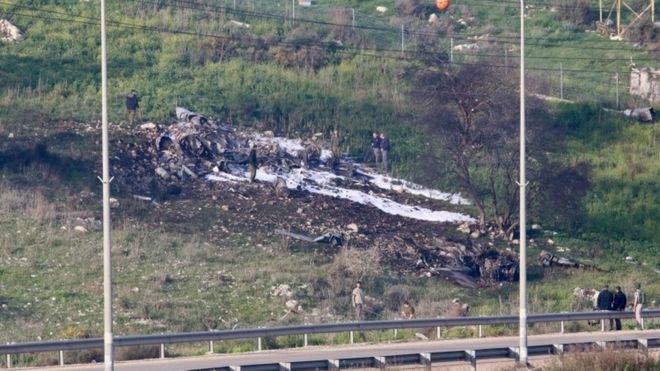
Crash site of Israeli F-16 Fighter Jet

W.J. Astore

Over the past several days, Russia and Israel have lost fighter jets over Syria.  This shouldn’t come as a surprise to those countries.  When jets attack people on the ground, those people tend to fire back (if they have weapons at hand), and sometimes they even hit their targets.

What is interesting is the Russian and Israeli reaction, which was in essence identical: immediate escalation.  More air attacks.  More bombs.  All justified as “reprisal” raids that are couched in terms of self-defense.

The mentality goes something like this: How dare you little people on the ground have the temerity to fire back at us and actually hit our planes?  For that you must be punished with more air attacks and more bombs until you stop firing at and hitting our planes.

I think this reaction is linked to the imagery of jet aircraft as a symbol of technological superiority, a marker of power, potency, and prowess.  Losing a jet over Syrian lands isn’t just seen as a mundane loss of military equipment in combat: it’s seen as a loss of potency by the attacker.  This “loss” necessitates a bigger show of force so as to punish the enemy while regaining that sense of inviolate power from the skies that advanced countries like Russia, Israel, and the USA believe they are entitled to, simply by being “advanced” countries, as measured by military hardware like sophisticated jets.

Air power is a tricky thing.  Students of the American involvement in the Vietnam War may recall that in 1965 U.S. Marine units were initially sent in to guard air bases from attack.  Of course, their mission quickly escalated from static defense to “active” defense to “taking the fight to the enemy,” i.e. full-scale, offensive, military operations.

Today, U.S. ground troops are similarly involved in places like the Middle East and Africa, helping to establish and protect air and drone bases.  Yet, as history teaches us, those missions often expand quickly to aggressive military operations on the ground, often in the name of “securing” those very air bases.  Air attacks may lead to ground operations, which lead to more air attacks in support of the ground ops, which lead to air planes being shot down and then reprisal attacks …

Air power, as I’ve written before, is neither cheap nor surgical nor decisive.  It also often creates its own escalatory dynamic, which is what we’re witnessing now in the skies over Syria.  Israeli jets, Russian jets, American jets, all attempting through force to alter the facts on the ground, but all instead creating conditions that are likely to generate more violence, more instability, and more war.

Curious indeed.