Consider this article a work of speculation; a jumble of ideas thrown at a blank canvas.
A lot of art depicts war scenes, and why not? War is incredibly exciting, dynamic, destructive, and otherwise captivating, if often in a horrific way. But I want to consider war and art in a different manner, in an impressionistic one. War, by its nature, is often spectacle; it is also often chaotic; complex; beyond comprehension. Perhaps art theory, and art styles, have something to teach us about war. Ways of representing it and capturing its meaning as well as its horrors. But also ways of misrepresenting it; of fracturing its meaning. Of manipulating it.
For example, America’s overseas wars today are both abstractions and distractions. They’re also somewhat surreal to most Americans, living as we do in comparative safety and material luxury (when compared to most other peoples of the world). Abstraction and surrealism: two art styles that may say something vital about America’s wars.
If some aspects of America’s wars are surreal and others abstract, if reports of those wars are often impressionistic and often blurred beyond recognition, this points to, I think, the highly stylized representations of war that are submitted for our consideration. What we don’t get very often is realism. Recall how the Bush/Cheney administration forbade photos of flag-draped coffins returning from Iraq and Afghanistan. Think of all the war reporting you’ve seen on U.S. TV and Cable networks, and ask how many times you saw severed American limbs and dead bodies on a battlefield. (On occasion, dead bodies of the enemy are shown, usually briefly and abstractly, with no human backstory.)
Of course, there’s no “real” way to showcase the brutal reality of war, short of bringing a person to the front and having them face fire in combat — a level of “participatory” art that sane people would likely seek to avoid. What we get, as spectators (which is what we’re told to remain in America), is an impression of combat. Here and there, a surreal report. An abstract news clip. Blown up buildings become exercises in neo-Cubism; melted buildings and weapons become Daliesque displays. Severed limbs (of the enemy) are exercises in the grotesque. For the vast majority of Americans, what’s lacking is raw immediacy and gut-wrenching reality.
Again, we are spectators, not participants. And our responses are often as stylized and limited as the representations are. As Rebecca Gordon put it from a different angle at TomDispatch.com, when it comes to America’s wars, are we participating in reality or merely watching reality TV? And why are so many so prone to confuse or conflate the two?
Art, of course, isn’t the only lens through which we can see and interpret America’s wars. Advertising, especially hyperbole, is also quite revealing. Thus the U.S. military has been sold, whether by George W. Bush or Barack Obama, as “the world’s finest military in history” or WFMH, an acronym I just made up, and which should perhaps come with a copyright or trademark symbol after it. It’s classic advertising hyperbole. It’s salesmanship in place of reality.
So, when other peoples beat our WFMH, we should do what Americans do best: sue them for copyright infringement. Our legions of lawyers will most certainly beat their cadres of counsels. After all, under Bush/Cheney, our lawyers tortured logic and the law to support torture itself. Talk about surrealism!
My point (and I think I have one) is that America’s wars are in some sense elaborate productions and representations, at least in the ways in which the government constructs and sells them to the American people. To understand these representations — the ways in which they are both more than real war and less than it — art theory, as well as advertising, may have a lot to teach us.
As I said, this is me throwing ideas at the canvas of my computer screen. Do they make any sense to you? Feel free to pick up your own brush and compose away in the comments section.
P.S. Danger, Will Robinson. I’ve never taken an art theory class or studied advertising closely.
The news out of Washington, D.C. is that another 4000 or so U.S. troops will be sent to help stabilize and reverse the “stalemate” in Afghanistan. The commitment, relatively small in the number of troops, is open-ended in duration, and of course the numbers could (and likely will) rise.
Back in 2009, I wrote the following article for TomDispatch.com, urging then-President Obama not to give in to the “urge to surge.” Of course, America did surge in Afghanistan in 2009-10, but that surge, roughly ten times larger than the mini-surge of this moment, failed to alter the fundamentals on the ground. Indeed, the Taliban and related insurgent forces in Afghanistan have only grown stronger in the aftermath of the failed Obama surge.
Perhaps the new motto of the U.S. military should be: If at first you don’t succeed, surge, surge again.
*****************
Mary McCarthy in Vietnam, Barack Obama in Afghanistan
Seven Lessons and Many Questions for the President
By William Astore (written in 2009)
In 1967, outraged by the course of the Vietnam War, as well as her country’s role in prolonging and worsening it, Mary McCarthy, novelist, memoirist, and author of the bestseller The Group, went to Saigon, then the capital of South Vietnam, to judge the situation for herself. The next year, she went to the North Vietnamese capital, Hanoi. She wrote accounts of both journeys, published originally in pamphlet format as Vietnam (1967) and Hanoi (1968), and later gathered with her other writings on Vietnam as a book, The Seventeenth Degree (1974). As pamphlets, McCarthy’s accounts sold poorly and passed into obscurity; deservedly so, some would say.
Those who’d say this, however, would be wrong. McCarthy brought a novelist’s keen eye to America’s activities and its rhetoric in Vietnam. By no means a military expert, not even an expert on Vietnam — she only made a conscious decision to study the war in Vietnam after she returned from her trip to Saigon — her impressionistic writings were nevertheless insightful precisely because she had long been a critical thinker beholden to no authority.
Mary McCarthy
Her insights into our approach to war-fighting and to foreign cultures are as telling today as they were 40 years ago, so much so that President Obama and his advisors might do well to add her unconventional lessons to their all-too-conventional thinking on our spreading war in Afghanistan and Pakistan.
What were those lessons? Here are seven of them, each followed by questions that, four decades later, someone at President Obama’s next press conference should consider asking him:
1. McCarthy’s most fundamental objection was to the way, in Vietnam, the U.S. government decided to apply “technology and a superior power to a political situation that will not yield to this.” At the very least, the United States was guilty of folly, but McCarthy went further. She condemned our technocentric and hegemonic form of warfare as “wicked” because of its “absolute indifference to the cost in human lives” to the Vietnamese people.
Even in 1967, the widespread, at times indiscriminate, nature of American killing was well known. For example, U.S. planes dropped roughly 7 million tons of bombs on Vietnam and parts of Laos and Cambodia during the war, nearly five times the tonnage used against Germany during World War II. The U.S. even waged war on the Vietnamese jungle and forest, which so effectively hid Vietnamese guerrilla forces, spraying roughly 20 million gallons of toxic herbicides (including the dioxin-contaminated Agent Orange) on it.
In her outrage, McCarthy dared to compare the seeming indifference of many of her fellow citizens toward the blunt-edged sword of technological destruction we had loosed on Vietnam to the moral obtuseness of ordinary Germans under Adolf Hitler.
Questions for President Obama: Aren’t we once again relying on the destructive power of technology to “solve” complex political and religious struggles? Aren’t we yet again showing indifference to the human costs of war, especially when borne by non-Americans? Even though we’re using far fewer bombs in the Af-Pak highlands than we did in Vietnam, aren’t we still morally culpable when these “precision-guided munitions” miss their targets and instead claim innocents, or hit suspected “terrorists” who suddenly morph into wedding parties? In those cases, do we not seek false comfort in the phrase, C’est la guerre, or at least that modern equivalent: unavoidable collateral damage?
2. As Richard Nixon campaigned for the presidency in 1968 by calling for “peace with honor” in Vietnam, McCarthy offered her own warning about the dangers that arose when the office of the presidency collided with an American desire never to be labeled a loser: “The American so-called free-enterprise system, highly competitive, investment-conscious, expansionist, repels a loser policy by instinctive defense movements centering in the ganglia of the presidency. No matter what direction the incumbent, as candidate, was pointing in, he slowly pivots once he assumes office.”
Questions for President Obama: Have you, like Vietnam-era presidents, pivoted toward yet another surge simply to avoid the label of “loser” in Afghanistan? And if the cost of victory (however defined) is hundreds, or even thousands, more American military casualties, hundreds of billions of additional dollars spent, and extensive collateral damage and blowback, will this “victory” not be a pyrrhic one, achieved at a price so dear as to be indistinguishable from defeat?
3. Though critical of the U.S. military in Vietnam, McCarthy was even more critical of American civilian officials there. “On the whole,” she wrote, they “behaved like a team of promoters with a dubious ‘growth’ stock they were brokering.” At least military men were often more forthright than the civilians, if not necessarily more self-aware, McCarthy noted, because they were part of the war — the product, so to speak — not its salesmen.
Questions for President Obama: In promising to send a new “surge” of State Department personnel and other civilians into Afghanistan, are you prepared as well to parse their words? Are you braced in case they sell you a false bill of goods, even if the sellers themselves, in their eagerness to speak fairy tales to power, continually ignore the Fantasyland nature of their tale?
4. Well before Bush administration officials boasted about creating their own reality and new “facts on the ground” in Iraq, Mary McCarthy recognized the danger of another type of “fact”: “The more troops and matériel committed to Vietnam, the more retreat appears to be cut off — not by an enemy, but by our own numbers. To call for withdrawal in the face of that commitment… is to seem to argue not against a policy, but against facts, which by their very nature are unanswerable.”
Questions for President Obama: If your surge in Afghanistan fails, will you be able to de-escalate as quickly as you escalated? Or will the fact that you’ve put more troops in harm’s way (with all their equipment and all the money that will go into new base and airfield and road construction), and committed more of your prestige to prevailing, make it even harder to consider leaving?
5. A cursory reading of The Pentagon Papers, the famously secret government documents on Vietnam leaked to the New York Times by Daniel Ellsberg, reveals how skeptical America’s top officials were, early on, in pursuing a military solution to the situation in South Vietnam. Nevertheless, knowing better, the “best and brightest,” as journalist David Halberstam termed them in his famous, ironic book title, still talked themselves into it; and they did so, as McCarthy noted, because they set seemingly meaningful goals (“metrics” or “benchmarks,” we’d say today), which they then convinced themselves they were actually achieving. When you trick yourself into believing that you’re meeting your goals, as Halberstam noted, there’s no reason to reexamine your course of action.
Questions for President Obama: Much has been written about an internal struggle within your administration over the wisdom of surging in Afghanistan. Now, you, too, have called for the setting of “benchmarks”for your new strategy’s success. Are you wise enough to set them to capture the complexities of political realities on the ground rather than playing to American strengths? Are you capable of re-examining them, even when your advisors assure you that they are being achieved?
6. In her day, Mary McCarthy recognized the inequities of burden-sharing at home when it came to the war in Vietnam: “Casualty figures, still low [in 1967], seldom strike home outside rural and low-income groups — the silent part of society. The absence of sacrifices [among the privileged classes] has had its effect on the opposition [to the war], which feels no need, on the whole, to turn away from its habitual standards and practices — what for? We have not withdrawn our sympathy from American power and from the way of life that is tied to it — a connection that is more evident to a low-grade G.I. in Vietnam than to most American intellectuals.”
Questions for President Obama: Are you willing to listen to the common G.I. as well as to the generals who have your ear? Are you willing to insist on greater equity in burden-sharing, since once again most of the burden of Iraq and Afghanistan has fallen on “the silent part of society”? Are you able to recognize that the “best and brightest” in the corridors of power may not be the wisest exactly because they have so little to lose (and perhaps much to gain) from our “overseas contingency operations”?
7. McCarthy was remarkably perceptive when it came to the seductiveness of American technological prowess. Our technological superiority, she wrote, was a large part of “our willingness to get into Vietnam and stay there… The technological gap between us and the North Vietnamese constituted, we thought, an advantage which obliged us not to quit.”
Questions for President Obama: Rather than providing us with a war-winning edge, might our robot drones, satellite imagery, and all our other gadgetry of war seduce us into believing that we can “prevail” at a reasonable and sustainable cost? Indeed, do we think we should prevail precisely because our high-tech military brags of “full spectrum dominance”?
One bonus lesson from Mary McCarthy before we take our leave of her: Even now, we speak too often of “Bush’s war” or, more recently, “Obama’s war.” Before we start chattering mindlessly about Iraq and Afghanistan as American tragedies, we would do well to recall what McCarthy had to say about the war in Vietnam: “There is something distasteful,” she wrote, “in the very notion of approaching [Vietnam] as an American tragedy, whose protagonist is a great suffering Texan [President Lyndon Baines Johnson].”
Yes, there is something distasteful about a media that blithely refers to Bush’s or Obama’s war as hundreds of thousands of Iraqis and Afghans suffer. For American troops, after all, are not the only ones paying the ultimate price when the U.S. fights foreign wars for ill-considered reasons and misguided goals.
I live in a fairly posh area of America. A place where people have vacation “cottages” with pools, a “destination” place for some, especially in July and August. July 4th is hopping in these parts, with parties and parades and fireworks and trips to the beach and barbecues. It’s summer, it’s warm and sunny, it’s time to relax with family and friends and enjoy life.
And then I read headlines like this today (from FP: Foreign Policy): “U.S. Troops in the Thick of it in Mosul and Raqqa.” And this story about U.S. Marines deploying yet again to Helmand Province in Afghanistan:
Helmand. The commander of 300 Marines newly deployed to Helmand province recently told FP’s Paul McLeary he already has the full authority to get his troops out and about with Afghan troops in the fight. “So far we really haven’t seen much of a need to do it,” said U.S. Marine Corps Brig. Gen. Roger Turner, “but if there’s a need to be somewhere we have the authority and capability and capacity to be where we need to be.”
He also advocated for a larger American footprint, in keeping with reported Pentagon plans to add 3,000 to 5,000 more troops in the coming months. “With a little bit larger force over here we would be in a position to have more flexibility” to do some of the advising he believes would help the Afghan forces push back against two years of Taliban offensives.
And I think of that “Groundhog Day” movie with Bill Murray in which he repeats the same day, again and again, with only minor changes. If you’ve seen the movie, Murray finally breaks out of what appears to be an infinite loop only when he changes his ways, his approach to life, his mentality. He becomes a better person and even gets the girl.
When is the USA going to break out of its infinite loop of war? Only when we change our culture, our mentality.
A “war on terror” is a forever war, an infinite loop, in which the same place names and similar actions crop up again and again. Names like Mosul and Helmand province. Actions like reprisals and war crimes and the deaths of innocents, because that is the face of war.
Speaking of war crimes, another report today from FP: Foreign Policy:
[A] new Human Rights Watch report signals trouble ahead: witnesses in Mosul say that “Iraqi forces beat unarmed men and boys fleeing the fighting within the last seven days, and said they also obtained information about Iraqi forces executing unarmed men during this time period.”
When will it end? Freedom includes freedom from forever war. Yet Americans continue to be told that the price of freedom is having U.S. troops deployed everywhere — the projection of power in 100+ countries. And some consider it patriotic to support those commitments without question, since to question it is seen as not supporting the troops. Which is nonsense, since our troops fight, at least in theory, to support and defend the U.S. Constitution, which, among other rights, enshrines freedom of speech and the right to dissent.
Can we contemplate a future Fourth of July in which American troops are no longer stuck in an infinite loop, fighting yet again in the blasted streets of Mosul or on the dusty plains of Helmand province? A day of independence from war?
That would truly be a day to celebrate with parades, parties, and fireworks.
Too often for Americans, Afghanistan is simply a war. Here’s a pacific slice of life. Donkeys and horses are the main source of transport in the mountains (Photo by Anna M.)
W.J. Astore
There are many ways of looking at war: as a continuation of politics by violent means, as a biological imperative, as the extreme end of a continuum of violence that defines human existence, morally as a sin that is only justified in self-defense, as a business in which profits are the main motive, as criminal activity writ large, as a response to human fears and memories of predation, as a mobilizing force that conveys meaning and a sense of belonging, as a practice that conveys masculinity, the list goes on. War, in sum, is an ecology of death that is arguably as complex as the ecology of life.
But you wouldn’t know this from American commentators talking about war. Consider the Afghan war, now in its sixteenth year and with no end in sight. It’s termed a “generational” war by American generals, a long war, a war that may require a Korean-like commitment by the U.S. military, according to retired General David Petraeus.
A commitment to the “long war” in Afghanistan, seen by Washington as the height of sobriety, is taken apart by Major Danny Sjursen at TomDispatch.com. MAJ Sjursen, who saw combat in Afghanistan, has this to say about the latest mini-surge being contemplated by Washington:
One look at U.S. military attempts at “nation-building” or post-conflict stabilization and pacification in Iraq, Libya, or — dare I say — Syria should settle the issue. It’s often said that the best predictor of future behavior is past behavior. Yet here we are, 14 years after the folly of invading Iraq and many of the same voices — inside and outside the administration — are clamoring for one more “surge” in Afghanistan (and, of course, will be clamoring for the predictable surges to follow across the Greater Middle East).
The very idea that the U.S. military had the ability to usher in a secure Afghanistan is grounded in a number of preconditions that proved to be little more than fantasies. First, there would have to be a capable, reasonably corruption-free local governing partner and military. That’s a nonstarter. Afghanistan’s corrupt, unpopular national unity government is little better than the regime of Ngo Dinh Diem in South Vietnam in the 1960s and that American war didn’t turn out so well, did it? Then there’s the question of longevity. When it comes to the U.S. military presence there, soon to head into its 16th year, how long is long enough? …
And what could a new surge actually do? The U.S. presence in Afghanistan is essentially a fragmented series of self-contained bases, each of which needs to be supplied and secured. In a country of its size, with a limited transportation infrastructure, even the 4,000-5,000 extra troops the Pentagon is reportedly considering sending right now won’t go very far.
Now, zoom out again. Apply the same calculus to the U.S. position across the Greater Middle East and you face what we might start calling the Afghan paradox, or my own quandary safeguarding five villages with only 82 men writ large. Do the math. The U.S. military is already struggling to keep up with its commitments. At what point is Washington simply spinning its proverbial wheels? I’ll tell you when — yesterday.
Yet U.S. military actions are worse than wheel-spinning. To explain why, consider an article I wrote in 2014, when I called upon Charles Darwin’s wedge metaphor to explain how U.S. actions were hammering the “face of nature” of Afghan societal ecology, aggravating unrest and creating new enemies.
The U.S. military keeps hitting the terrorist “wedges” in Afghan society, without really thinking about the larger ecology and the ripple effects. In the violent struggle for existence in Afghanistan, the U.S. compounds the violence, serving to strengthen the very enemy we say we’re seeking to weaken. (Indeed, the Taliban is gaining strength, hence the call for more U.S. troops). At the same time, the U.S. military’s foreign presence is serving to legitimate the indigenous enemy while simultaneously forcing it to learn and adapt.
By surging again and again, i.e. hitting the enemy harder, this is what the U.S. military has succeeded in doing:
1. The enemy has spread along new fault lines created by U.S. military-led hammer blows.
2. The enemy has adapted to force, becoming fitter in its struggle for existence against us.
3. The enemy has gained legitimacy from the struggle.
4. The wider societal ecology has become more radicalized as well as more unstable.
5. A complex and more chaotic ecology has become even less tractable in American hands.
Despite this, the U.S. military still thinks more hammer blows are the answer. The only answer that makes sense — withdrawal from Afghanistan — is the one that is not on that table in Washington where all options allegedly reside.
We’re already living in a new reality of alternative facts, so let’s just declare victory, America, and leave. With or without the U.S. military, the Afghan people will find their own way.
What’s so special about Special Ops? It used to be that special operations troops were few in number. You had Army Green Berets, Navy SEALs, mixed units like the Delta Force, and a few others, but nowadays U.S. Special Operations Command (SOCOM) consists of 70,000 troops, equivalent to five or six regular army divisions, a military within the military.
What’s truly elite about America’s special ops community, as Nick Turse shows in his latest article at TomDispatch.com, is their global reach and global power, to borrow an Air Force phrase. Special ops forces have already been deployed to 137 countries in 2017, or 70% of the planet’s nations. Talk about reach! Yet enduring victories from past deployments, as Turse shows, have been surprisingly elusive.
Why is this? Special ops forces are good at short-term kinetic actions (hit and run strikes, commando stuff), and they do their share of training and advising. Yet their staying power, their persistence, their endurance, their ability to shift strategic winds in America’s favor, simply hasn’t been there. Some would say that’s not their purpose, except that the U.S. military and government has been selling them as strategic game-changers, which they’re not.
As I’ve written before, I see America’s special ops forces as America’s global missionaries, our version of the Catholic Church’s Jesuit order during the Counter Reformation. The Jesuits were soldiers of Christ, a militant order of highly trained missionaries, totally dedicated to upholding the one true faith (Catholicism, of course). For many peoples around the world, Catholicism was the Jesuits. And for many peoples around the world today (137 countries!), Americanism is a gun-toting special ops troop,
Coincidentally, I came across this report from FP: Foreign Policy this morning:
Pentagon taking lead in Africa makes some allies uneasy. At a recent summit meeting in Malawi attended by several U.S. generals and their African counterparts, some allies on the continent, while welcoming American attention, aren’t so sure they want it all from the Pentagon while the State Dept. is diminished.
“We have statements out of Washington about significant reductions in foreign aid,” Gen. Griffin Phiri, the commander of the Malawi Defense Forces, told the New York Times during the African Land Forces Summit, a conference between American Army officers and representatives from 40 African nations. “What I can tell you is that experience has shown us that diplomacy and security must come together.” He was unsure over the “mixed messages” coming out of Washington.
But is Washington’s message really mixed? It seems clear. Ever since 9/11, as Nick Turse has shown in several articles for TomDispatch.com, America has been downplaying diplomacy while ramping up “kinetic” strikes by special ops. This trend has only accelerated under the leadership (if that’s the right word) of Donald Trump and Rex Tillerson at the State Department. When it comes to world affairs, Trump and Tillerson have often been AWOL, leaving the real action to Mattis and the Pentagon.
And nowadays the real action at the Pentagon is centered on SOCOM, the military within the military, America’s militant missionary order.
Even allies question America’s almost monomaniacal commitment to military action everywhere. They’re right to do so. For special ops aren’t so special when they’re deployed everywhere in dribs and drabs, parceled out on missions that lack achievable aims.
Finally, there’s this. Say what you will of the Jesuits, they had faith. A clear ideology. Their faith, their devotion, was an inspiration to many. Even as their symbol was the cross, their skill-set was quite varied, e.g. they were often learned men, well ahead of their times in areas like science and mathematics.
Does Washington’s militant missionary order have a clear ideology? A compelling symbol? A varied skill-set? Favorable and enduring results? Evidence (so far) suggests otherwise.
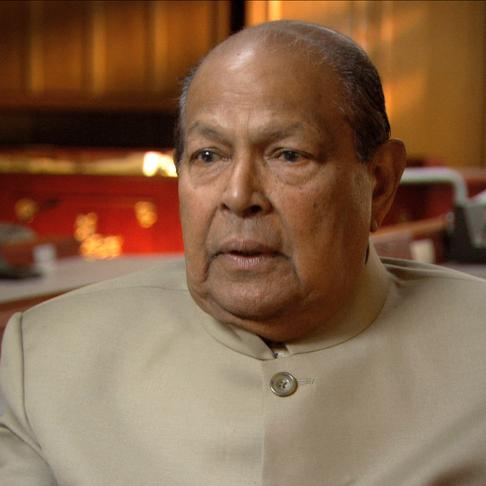
Readers of Bracing Views are familiar with Michael Murry’s frequent contributions to our site. One of Mike’s more penetrating comments originated from a discussion he had with the late Sri Lankan Ambassador Ananda W. P. Guruge. As Mike recently recounted, Guruge “certainly had it right when he told me once why his government had refused America’s offer of military aid against the Tamil insurgency in that little island country: If the Americans come, they will just draw an arbitrary line through a temporary problem and make it permanent.”
Dr. Ananda W. P. Guruge. From closertotruth.com
Not many people have noticed how America’s wars, which used to have clear ending dates, like VE and VJ days in 1945 at the end of World War II, presently never seem to end. In his introduction to Bill Hartung’s new article at TomDispatch.com, “Destabilizing the Middle East (Yet More),” Tom Engelhardt reminds us of how U.S. military interventions in Afghanistan, Iraq, Somalia, Yemen, and elsewhere simply never end. Instead, they fester, they surge and shrink, they metastasize, they become, as Dr. Guruge noted, permanent.
That reality of permanent war is arguably the most insidious problem facing American democracy today. I didn’t say it; James Madison did:
Of all the enemies of true liberty, war is, perhaps, the most to be dreaded, because it comprises and develops the germ of every other. War is the parent of armies; from these proceed debt and taxes; and armies, and debts, and taxes are the known instruments for bringing the many under the domination of the few. In war, too, the discretionary power of the Executive is extended; its influence in dealing out offices, honors and emoluments is multiplied; and all the means of seducing the minds, are added to those of subduing the force, of the people. The same malignant aspect in republicanism may be traced in the inequality of fortunes, and the opportunities of fraud, growing out of a state of war, and in the degeneracy of manner and of morals, engendered in both. No nation can preserve its freedom in the midst of continual warfare …
Why do so many Americans fail to see this? Because believing is seeing. I heard that line on “American Gods” recently, a compelling reversal of “seeing is believing.” It applies here because America’s leaders believe in war, and Americans in general believe in their military, and believing is seeing. A belief in the efficacy of war and the trustworthiness of the military drives America’s “kinetic” actions around the world, and that belief, that faith, serves to make wars permanent.
Believing is seeing. It explains why our wars, despite catastrophic results that are so plainly in sight, persist without end. W.J. Astore
America’s Endless Wars
Tom Engelhardt
Not that anyone in a position of power seems to notice, but there’s a simple rule for American military involvement in the Greater Middle East: once the U.S. gets in, no matter the country, it never truly gets out again. Let’s start with Afghanistan. The U.S. first entered the fray there in 1979 via a massive CIA-led proxy war against the Soviets that lasted until the Red Army limped home in 1989. Washington then took more than a decade off until some of the extremists it had once supported launched the 9/11 attacks, after which the U.S. military took on the role abandoned by the Red Army and we all know where that’s ended — or rather not ended almost 16 years later. In the “longest war” in American history, the Pentagon, recently given a free hand by President Trump, is reportedly planning a new mini-surge of nearly 4,000 U.S. military personnel into that country to “break the stalemate” there. Ever more air strikes and money will be part of the package. All told, we’re talking about a quarter-century of American war in Afghanistan that shows no sign of letting up (or of success). It may not yet be a “hundred-years’ war,” but the years are certainly piling up.
Then, of course, there’s Iraq where you could start counting the years as early as 1982, when President Ronald Reagan’s administration began giving autocrat Saddam Hussein’s military support in his war against Iran. You could also start with the first Gulf War of 1990-1991 when, on the orders of President George H.W. Bush, the U.S. military triumphantly drove Saddam’s army out of Kuwait. Years of desultory air strikes, sanctions, and other war-like acts ended in George W. Bush’s sweeping invasion and occupation of Iraq in the spring of 2003, a disaster of the first order. It punched a hole in the oil heartlands of the Middle East and started us down the path to, among other things, ISIS and so to Iraq War 3.0 (or perhaps 4.0), which began as an air campaign in August 2014 and has yet to end. In the process, Syria was pulled into the mix and U.S. efforts there are still ratcheting up almost two years later. In the case of Iraq, we’re minimally talking about almost three decades of intermittent warfare, still ongoing.
And then, of course, there’s Somalia. You remember the Blackhawk Down incident in 1993, don’t you? That was a lesson for the ages, right? Well, in 2017, the Trump administration is sending more advisers and trainers to that land (and the U.S. military has recently suffered its first combat death there since 1993). U.S. military activities, including drone strikes, are visibly revving up at the moment. And don’t forget Libya, where the Obama administration (along with NATO) intervened in 2011 to overthrow autocrat Muammar Gaddafi and where the U.S. military is still involved more than six years later.
Last but hardly least is Yemen. The first U.S. special ops and CIA personnel moved into a “counter-terrorism camp” there in late 2001, part of a $400 million deal with the government of then-strongman Ali Abdullah Saleh, and the CIA conducted its very first drone assassination in that country in November 2002. Almost 16 years later, as TomDispatch regular Bill Hartung reports, the U.S. is supporting a grim Saudi air and ground war of terror there, while its own drone strikes have risen to new highs.
It’s a remarkable record and one to keep in mind as you consider Hartung’s account of President Trump’s fervent decision to back the Saudis in a big league way not just in their disastrous Yemeni war, but in their increasingly bitter campaign against regional rival Iran. After so many decades of nearly unending conflict leading only to more of the same and greater chaos, you might wonder whether an alarm bell will ever go off in Washington when it comes to the U.S. military and war in the Greater Middle East — or is Iran next? Tom
To continue reading Bill Hartung’s article at TomDispatch.com, click here.
A concept that you learn quickly in the military is that you can delegate authority but not responsibility. The buck stops with the guy or gal in charge, and when it’s policy at the national level, that guy is the commander-in-chief, currently Donald Trump. Yet when it comes to the Afghan war, it appears Trump may be seeking to evade responsibility even as he delegates the specifics of strategy and troop levels to his “civilian” Secretary of Defense, retired General James Mattis.
That’s the news out of Washington: that Trump has delegated to Mattis the decision as to how many additional U.S. troops should be sent to Afghanistan, and what strategy they should employ in a war that Mattis admits the U.S. military is “not winning.”
Think about that. After nearly 16 years and a trillion dollars spent, the U.S. is “not winning” in Afghanistan, which is, to put it honestly, an admission of defeat. “Not winning” means we’re losing, yet how likely is it that the U.S. military, effectively under the command of retired General Mattis, is going to shift gears completely and withdraw?
Mattis testified to Congress that the Taliban “had a good year last year” and that “winning,” which we’re currently not doing, is a scenario in which U.S. forces, working with Afghan forces, are able to provide local security after several years of “frequent skirmishing” with the Taliban and other insurgent forces.
Yes — that’s the definition of “winning.” A long-term U.S. commitment of more troops and more money with continued internecine warfare in Afghanistan.
In the near-term, Mattis will likely send more troops (“trainers” and “advisers”) and more money, promising that this time American training and methods will work, that this time corruption will be curtailed, that this time the Taliban will be neutralized (I doubt Mattis is foolish enough to promise “victory”). Trump will rubber-stamp Mattis’s decision, which gives him the ability to blame his generals if and when the Afghan war takes yet another turn that is contrary to U.S. imperatives. (Recall how Trump blamed his generals for losing the Navy SEAL in the bungled raid on Yemen.)
As a candidate, Trump deplored the waste of America’s wars and suggested he would try to end them. As president, Trump is kowtowing to the Pentagon, ensuring these wars will continue. Worst of all, even as he delegates authority, he is evading responsibility.
It’s a recipe for incessant warfare, yet more suffering, and the continued erosion of democracy in America.
An Afterthought: Let’s suppose for a moment that Trump actually wanted to end the Afghan war. It would require considerable political capital to take on the national security state — capital that Trump currently doesn’t have, embroiled as he is in controversy (lawsuits!) and ongoing investigations. This is hardly ever remarked upon in the media: the fact that Trump, who ran on a platform that was often quite critical of conventional wisdom and wasteful wars, has little latitude to act on this platform (assuming he’d want to) when he’s constantly under attack in the media as a Putin stooge, or worse. Some would say he has only himself to blame here, but it goes deeper than that, I think.
Update (6/16/17): Surprise! News out of the Pentagon today suggests that another 4000 or so U.S. troops will be sent as a mini-surge to help train and advise Afghan forces. And so the “stalemate” in Afghanistan will continue.
As I wrote back in February for TomDispatch.com:
That a few thousand troops could somehow reverse the present situation and ensure progress toward victory is obviously a fantasy of the first order, one that barely papers over the reality of these last years: that Washington has been losing the war in Afghanistan and will continue to do so, no matter how it fiddles with troop levels.
Update 2 (6/16/17): Editorial title at the New York Times: Afghanistan Is Trump’s War Now. It reflects a major flaw and a fatal conceit — that Afghanistan is a war and not a country or a people, that it only matters as a war (at least to Americans), and that somehow Trump now owns it. Recall that before Americans wage war, it’s supposed to require a Congressional declaration. Wars are not supposed to be owned by presidents and waged at their whim. WTF, America?
Update 3 (6/17/17): Watching retired General David Petraeus last night on PBS was a grim experience. He spoke of a generational war in Afghanistan and a U.S. commitment that might come to rival our time in South Korea, i.e. 60+ years. Most revealing of all was the language he used. He spoke of achieving “a sustainable, sustained commitment” to Afghanistan. 4000 additional troops are part of that “sustainable, sustained commitment.”
There was the usual talk of regional stability, of maintaining a base against terrorism, and so on. But what the Petraeus interview revealed was the total bankruptcy of American strategy and thinking, encapsulated so well by the concept of a “generational war” modulated by a “sustainable, sustained commitment.”
Update 4 (6/17/17): Good god. At Fox News, retired General Jack Keane is calling for an additional 10,000 to 20,000 troops to change the momentum in the Afghan war. These troops will somehow change the “absolute disgrace” of the war (he mainly blamed President Obama for refusing to make the necessary commitment to win the war).
These generals never ask the question: Why are our “enemies” doing just fine without U.S. troops and billions of dollars in heavy equipment and air power? Whether in Vietnam or Afghanistan or elsewhere, the answer for these generals is always more: more U.S. troops, more firepower, more aid to our “allies.”
If these generals were investors, they’d keep funneling money to Bernie Madoff even after his fund had been revealed as a Ponzi scheme. After all, the initial returns were promising, and if we keep sending more money, this time, maybe this time, it won’t all be stolen …
In late 2009, I wrote the following article for Huff Post under the title, “One Grizzled Veteran’s Dream.” This Memorial Day Weekend, I’d like to remember the dream a veteran shared with me and lots of other high school juniors back in 1980. Sadly, that dream is even more distant today than it was in 1980.
Thirty years ago, I attended Boys State. Run by the American Legion, Boys State introduces high school students to civics and government in a climate that bears a passing resemblance to military basic training. Arranged in “companies,” we students did our share of hurrying up, lining up, and waiting (sound preparation, in fact, for my career in the military). I recall that one morning a “company” of students got to eat first because they launched into a lusty rendition of the Marine Corps hymn. I wasn’t angry at them: I was angry at myself for not thinking of the ruse first.
Today, most of my Boys State experience is a blur, but one event looms large: the remarks made by a grizzled veteran to us assembled boys. Standing humbly before us, he confessed that he hoped organizations like the American Legion and Veterans of Foreign Wars would soon wither away. And he said that he hoped none of us would ever become a member of his post.
At first, we didn’t get it. Didn’t he like us? Weren’t we tough enough? (Indeed, I recall that one of our adolescent complaints was that the name “Boys State” didn’t seem manly enough.)
Then it dawned on us what the withering away of organizations like the American Legion and the VFW would mean. That in our future young Americans would no longer be fighting and dying in foreign wars. That our world would be both saner and safer, and only members of an “old guard” like this unnamed veteran would be able to swap true war stories. Our role would simply be to listen with unmeasured awe and undisguised thanks, grateful that our own sons and daughters no longer had to risk life or limb to enemy bullets and bombs.
It pains me that we as a country have allowed this veteran’s dream to die. We as a country continue to enlarge our military, expand our foreign commitments, and fight seemingly endless wars, whether in Iraq, Afghanistan, or in other far-off realms of less-than-vital interest to us.
As a result of these wars, we continue to churn out so many new veterans, including so many wounded veterans, not forgetting those who never made it back.
Veterans’ Graves (photo by the author)
Collectively, we Americans tend to suppress whatever doubts we have about the wisdom of our wars with unequivocal statements of support for our troops. And on days like Veteran’s Day, we honor those who served, and especially those who paid the ultimate price on the battlefield.
Yet, wouldn’t the best support for our troops be the achievement of the dream of that grizzled vet who cut through a young man’s fog thirty years ago?
Shouldn’t we be working to achieve a new age in which the rosters of our local VFWs and Legion posts are no longer renewed with the broken bodies and shattered minds of American combat veterans?
Sadly, as we raise more troops and fight more wars, we seem committed to the opposite. Our military just enjoyed its best recruiting class in years. This “success” is not entirely surprising. It’s no longer that difficult to fill our military’s expanding ranks because many of our young men and women simply have little choice but to enlist, whether for economic opportunity, money for college, or benefits like free health care.
Many of course enlist for patriotic reasons as well. Yet the ease of expanding our military ranks during a shooting war is also a painful reminder of the impoverishment of opportunities for young, able-bodied Americans – the bitter fruit of manufacturing jobs sent overseas, of farming jobs eliminated by our own version of corporate collectivization, of a real national unemployment rate that is approaching twenty percent.
On this Veteran’s Day, what if we began to measure our national success and power, not by our military arsenal or by the number of new recruits in the ranks, but rather by the gradual shrinking of our military ranks, the decline of our spending on defense, perhaps even by the growing quiet of our legion posts and VFW halls?
Wouldn’t that be a truer measure of national success: fewer American combat veterans?
Wouldn’t that give us something to celebrate this Veteran’s Day?
I know one old grizzled veteran who would quietly nod his agreement.
President Trump is hawking weapons in the Middle East. After concluding a deal with the Saudis for $110 billion in weaponry, he sought out the Emir of Qatar and said their discussions would focus on “the purchase of lots of beautiful military equipment.”
Trump’s reference to American weapons as “beautiful” echoed the recent words of Brian Williams at MSNBC, who characterized images from the Tomahawk missile attack on Syria as “beautiful,” not once but three times.
We can vilify Trump and Williams for seeing beauty in weapons that kill, but we must also recognize Americans love their technology of death. It’s one big reason why we have more than 300 million guns in America, enough to arm virtually every American, from cradle to grave.
Why do we place so much faith in weapons? Why do we love them so?
In military affairs, America is especially prone to putting its faith in weapons. The problem is that often weaponry is either less important than one thinks, or seductive in its promise. Think of U.S. aerial drones, for example. They’ve killed a lot of people without showing any decisiveness.
Technology is a rational and orderly endeavor, but war is irrational and chaotic. Countries develop technology for war, thinking they are adding order and predictability, when they are usually adding just another element of unpredictability while expanding death.
U.S. air power is a great example — death everywhere, but no decisiveness. Look at Southeast Asia (Vietnam, Laos, Cambodia). The U.S. obliterated vast areas with high explosive and napalm and Agent Orange, killing millions without winning the war. The technological image of America today is not stunning cars or clever consumer inventions but rather Predator and Reaper drones and giant bombs like MOAB.
Profligate expenditures on weapons and their export obviously feed America’s military-industrial complex. Such weapons are sold by our politicians as job-creators, but they’re really widow-makers and life-takers. Americans used to describe armament makers as “merchants of death,” until, that is, we became the number one producer and exporter of these armaments. Now they’re “beautiful” to our president and to our media mouthpieces.
We have a strange love affair with weapons that borders on a fetish. I’ve been to a few military re-enactments, in which well-intended re-enactors play at war. The guys I’ve talked to are often experts on the nuts and bolts of the military weaponry they carry, but of course the guns aren’t loaded. It’s all bloodless fun, a “war game,” if you will.
Nowadays real war is often much like a video game, at least to U.S. “pilots” sitting in trailers in Nevada. It’s not a game to an Afghan or Yemeni getting blown to bits by a Hellfire missile fired by a drone. For some reason, foreigners on the receiving end of U.S. weaponry don’t think of it as “beautiful.” Nor do we, when our weapons are turned against us.
Enough with the “beautiful” weapons, America. Let’s stick to the beauty of spacious skies and amber waves of grain.
USAF personnel train at Ramstein Air Base in Germany. Because we won World War II. (U.S. Air Force photo by Airman 1st Class Elizabeth Baker)
W.J. Astore
As President Trump heads off on an overseas trip, trailing Washington scandals in his wake, it’s worth reminding ourselves of America’s prodigious global presence and the profligate expense at which it comes. As David Vine notes in his latest article for TomDispatch.com, the USA has something like 800 military bases overseas, which must be garrisoned and maintained at a cost of roughly $150 billion each and every year. What exactly are we getting for this colossal global footprint?
Come to think of it, why do we need 800 overseas bases? Our aircraft carriers are basically mobile American bases, and much of our weaponry (Tomahawk cruise missiles, long-range bombers, and Reaper drones, for example) obviates the need for physical bases in foreign lands.
Of course, there are many reasons why these bases persist. One is the influence they give us (or that we think they give us) in places like Turkey and South Korea, for example. Second is the fear American officials have of losing their leading roles on the world stage, i.e. the concern that, if we abandon “our” bases, other countries will take them over, and we will be shunted aside, losing our starring role in world affairs.
Indeed, you could say Americans are the divos and divas of the world stage, elbowing our way into operatic tragedy after operatic tragedy.
Third (always a consideration) is money. There’s so much money to be made from these bases, and so many U.S. contractors involved in making it. And fourth is intelligence. Americans think these bases are essential to gathering intelligence, even as our “intelligence” routinely proves wrong or incomplete.
I spent three years in Britain at U.S. bases there (“Little Americas”), and could have been assigned to U.S. bases in Iceland and Turkey, but the latter never materialized. It’s funny: When you’re in the military, you never give much thought to why we have bases in faraway places. You just take it for granted; it’s the status quo for us.
(As an aside, think of the irony here of Trump’s border wall with Mexico. Even as Americans are everywhere in the world, thrusting our way into foreign countries with our militarized bases, we boast of building walls to keep other peoples out of “Fortress USA.” Only “exceptional” U.S. officials could see no contradiction here.)
Select foreign bases have some value, but the U.S. has far too many at far too high a cost. We’d do well to stop investing in them and to start closing them. American bases in Turkey, South Korea, Japan, and elsewhere are not the key to our security. Our security begins right here at home.
Remember that saying, “Yankee go home”? Why don’t we?