
All Art Is Politics?

Art Transcends the Political

BILL ASTORE

OCT 16, 2026

There’s a kerfuffle about art being political, with journalists and writers I respect, such as Matt Taibbi and Caitlin Johnstone, coming down on opposite sides of the issue.

Johnstone puts it bluntly: “I have no respect for this idea that art is somehow separable from politics. ALL art is political when you live in a genocidal dystopia, because all your expression exists in relation to our freakish civilization.”

While I sympathize with Johnston’s opposition to the ongoing genocide in Gaza, and have written plenty of articles myself against this genocide, I don’t define all my writing as reducible to politics. Writing is a form of self-expression, a creative act, and though we are all influenced by the society in which we live, that doesn’t mean that everything we write (or otherwise create) is necessarily a political expression.

Of course, art can have political meaning, often by design, occasionally not. But if all art is political, doesn’t that suggest that art is simply politics by another name?

Without looking at dictionary definitions, I think of art as a creative act. An act of imagination, an expression of the human spirit. We draw, we write, we sculpt, we make music, we dance, etc., as forms of expression. The richness of that expression–those creative acts–shouldn’t be reduced to political expressions. The best art transcends politics.

It’s like saying all sports is politics. Sure, sports can have political meaning, but sport is something more than political expression. For example, there is a physical joy to sports, as a form of expression, that denies its reduction to politics.

This idea that everything is politics or political is a dangerous one. It seems to be driven by those who want to attack others for the “wrong” politics in their art. Defining art as politics seems a handy formula for the dictator to outlaw or repress art that is considered dangerously “political” or otherwise threatening to political power.
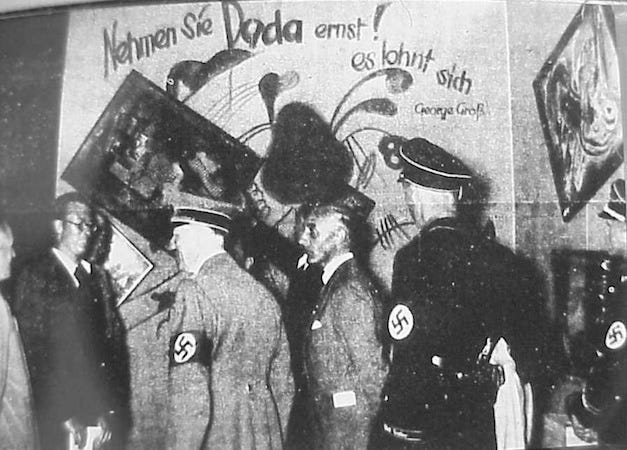
Hitler, a failed artist, judges “degenerate” art

Recall that in the 1930s Adolf Hitler attacked “Jewish” art as degenerate. Included in that was jazz as well, treated by the Nazis as a degenerate form of music, associated as it was with Black and Jewish musicians.

Art, put simply, is something more than politics, and those who create art shouldn’t be defined or judged or constrained or condemned by the politics of critics who see everything through a political lens.

America’s Cowardly Prison in Cuba

W.J. Astore

The U.S. government still keeps 41 prisoners at the Guantánamo Bay Detention Camp in Cuba.  Incredibly, some of these so-called alien enemy combatants have been imprisoned for up to 15 years without benefit of trial; indeed, without even being charged with a crime.  How is this possible in a democracy?  What does it say about our country?

I happen to own an old map of Cuba from 1897 that shows Guantánamo Bay, which is along the southeastern coast of Cuba.  Here’s a photo of a segment of my old map that shows the Bahia de Guantánamo:

IMG_1575

Who could have predicted that when our government, in an imperial land grab, “leased” this base from Cuba in 1903, it would become a century later the site of a loathsome prison for Muslim men snatched mostly from central Asia in a “global war on terror”?

In the immediate aftermath of 9/11, the U.S. government needed a place to send prisoners gathered in the chaotic roundup of suspects in the war’s opening stages.  Among other locations they chose the U.S. naval base at Guantánamo, considered a “safe” spot since it’s both isolated and not in the USA while also being far from the eyes of the media.  What was an expedient, a temporary holding facility, became permanent.  President Obama vowed to close it and failed; President Trump has vowed to expand it with fresh batches of prisoners.

In a remarkable piece at TomDispatch.com, Erin Thompson reminds us that the prisoners at Guantánamo are human beings.  She did (and does) this by curating and displaying their art works.  Their paintings, ship models, and other creations remind us that they exist, that they create, that they hope, that they dream.  The U.S. government has responded by asserting ownership rights over their art.

America’s prison at Guantánamo Bay has been a spectacular fail.  Its very existence amounts to a huge propaganda victory for terrorists and would-be terrorists everywhere.  It’s a stain on our democracy (what’s left of it).  In the eyes of much of the world, it reveals the USA itself to be a terrorist.

The persistence of this prison shows America is losing its own “war on terror.”  Our government lacks the courage to try these men because of fear a few might go free and perhaps spearhead future attacks, despite a national security complex that spends roughly three quarters of a trillion dollars to predict and prevent such attacks.

To paraphrase Shakespeare in Julius Caesar: Cowards die a thousand deaths; a hero dies but once. By keeping this prison open, and by refusing to offer justice to its occupants out of fear of what they might do if released, we are dying a thousand deaths.

War as Art and Advertising

First_abstract_watercolor_kandinsky_1910
Kandinsky, abstract watercolor, 1910.

W.J. Astore

Consider this article a work of speculation; a jumble of ideas thrown at a blank canvas.

A lot of art depicts war scenes, and why not?  War is incredibly exciting, dynamic, destructive, and otherwise captivating, if often in a horrific way.  But I want to consider war and art in a different manner, in an impressionistic one.  War, by its nature, is often spectacle; it is also often chaotic; complex; beyond comprehension.  Perhaps art theory, and art styles, have something to teach us about war.  Ways of representing it and capturing its meaning as well as its horrors.  But also ways of misrepresenting it; of fracturing its meaning.  Of manipulating it.

For example, America’s overseas wars today are both abstractions and distractions. They’re also somewhat surreal to most Americans, living as we do in comparative safety and material luxury (when compared to most other peoples of the world).  Abstraction and surrealism: two art styles that may say something vital about America’s wars.

If some aspects of America’s wars are surreal and others abstract, if reports of those wars are often impressionistic and often blurred beyond recognition, this points to, I think, the highly stylized representations of war that are submitted for our consideration.  What we don’t get very often is realism.  Recall how the Bush/Cheney administration forbade photos of flag-draped coffins returning from Iraq and Afghanistan.  Think of all the war reporting you’ve seen on U.S. TV and Cable networks, and ask how many times you saw severed American limbs and dead bodies on a battlefield.  (On occasion, dead bodies of the enemy are shown, usually briefly and abstractly, with no human backstory.)

Of course, there’s no “real” way to showcase the brutal reality of war, short of bringing a person to the front and having them face fire in combat — a level of “participatory” art that sane people would likely seek to avoid.  What we get, as spectators (which is what we’re told to remain in America), is an impression of combat.  Here and there, a surreal report.  An abstract news clip.  Blown up buildings become exercises in neo-Cubism; melted buildings and weapons become Daliesque displays.  Severed limbs (of the enemy) are exercises in the grotesque.  For the vast majority of Americans, what’s lacking is raw immediacy and gut-wrenching reality.

Again, we are spectators, not participants.  And our responses are often as stylized and limited as the representations are.  As Rebecca Gordon put it from a different angle at TomDispatch.com, when it comes to America’s wars, are we participating in reality or merely watching reality TV?  And why are so many so prone to confuse or conflate the two?

Art, of course, isn’t the only lens through which we can see and interpret America’s wars. Advertising, especially hyperbole, is also quite revealing.  Thus the U.S. military has been sold, whether by George W. Bush or Barack Obama, as “the world’s finest military in history” or WFMH, an acronym I just made up, and which should perhaps come with a copyright or trademark symbol after it.  It’s classic advertising hyperbole.  It’s salesmanship in place of reality.

So, when other peoples beat our WFMH, we should do what Americans do best: sue them for copyright infringement.  Our legions of lawyers will most certainly beat their cadres of counsels.  After all, under Bush/Cheney, our lawyers tortured logic and the law to support torture itself.  Talk about surrealism!

My point (and I think I have one) is that America’s wars are in some sense elaborate productions and representations, at least in the ways in which the government constructs and sells them to the American people.  To understand these representations — the ways in which they are both more than real war and less than it — art theory, as well as advertising, may have a lot to teach us.

As I said, this is me throwing ideas at the canvas of my computer screen.  Do they make any sense to you?  Feel free to pick up your own brush and compose away in the comments section.

P.S. Danger, Will Robinson.  I’ve never taken an art theory class or studied advertising closely.