America’s Original Sin

Hans Baldung Grien, "Eve, Serpent and Death"
Hans Baldung Grien, “Eve, Serpent and Death”

W.J. Astore

I’m a Catholic, so of course I know all about Original Sin.  For disobeying God and tasting the forbidden fruit, Adam and Eve were cast out of the Garden of Eden.  Eve would suffer the pains of childbirth, and both she and Adam would age and die, their earthly bodies returning to the dust from which they came.

I always thought Eve got a bad rap in that story.  She was, after all, tempted by Lucifer, a fallen angel in the shape of a serpent.  Whereas Adam simply gave in to a mild suggestion by Eve to join her.  Eve was tricked by the Master of Deceit, but Adam just joined in for the heck of it, and she shoulders the blame?

Of course, one might see Original Sin as part of God’s master plan.  For without that sin, there would be no need for God to send his only begotten son to redeem mankind.  No Original Sin, no New Testament.  No Beatitudes.  No Roman Catholic Church.  No Christianity.

And without Christianity and its evangelizing zeal, America would doubtless be a far different land.   Assuming Europeans still came to the New World in roughly 1500, would subsequent history be less bloody in the absence of Christianity?  Or would naked conquest have been unrestrained by any moral code of restraint and compassion?

The United States has an original sin as well.  It is the impiety of considering our country as being uniquely favored by God.  American history shows how we’ve killed, enslaved, and otherwise violated God’s great commandment of loving thy neighbor, even as we continue loudly to shout how God uniquely showers His praises on us.  God Bless America!

Is America’s original sin part of some master plan?  How will we redeem ourselves from its awful legacies?  My dad once joked that in school he almost solved an unsolvable equation; I confess I have no solution to such questions.

Readers, have at it in the comments section below.  Is the very idea of Original Sin mysterious and magisterial, or mischievous and misleading?  Have humans evolved beyond the need for God and gods?  Is “sin” a misleading term to apply to America’s past, too metaphysical, too imprecise?  Are there simply too many “chosen people” in this world, too many people who elevate themselves above others just because they believe they share a favored relationship to God?

It’s a grey and rainy day here — a good day for thinking.  Join in.

Hillary Clinton’s Email Fiasco

Trust me!
Trust me!

W.J. Astore

Once again, Hillary Clinton is in the news for the wrong reason.  She used a private email account while she was Secretary of State, rather than an official government email account.  As a result, not all of her (unclassified) emails are part of the public record. Many may be “lost,” consigned to the dustbin of history, whether by accident or design is hard to say.  In the press conference she then gave to explain herself, she was less than forthcoming.  And it now appears that her email server wasn’t even encrypted for the first three months she served as Secretary of State, meaning her official emails were eminently hackable and readable by foreign governments.

Just another meaningless scandal, right?  No — what this reveals is the arrogance of power. Official rules may apply to “little people” like you and me, but to the Clintons, those rules can be ignored.  They think they can do whatever they want.  It’s a clear double standard, and it’s just one more reason why the prospect of Hillary Clinton as president disturbs me.

I remember when Hillary Clinton served as First Lady and worked on health care reform in the early 1990s.  Her right-hand man was Ira Magaziner.  I’d heard of Magaziner since he had served as an outside consultant to my hometown. According to Wikipedia:

“After Oxford, Magaziner and a group of former Brown students attempted to implement social democratic reforms in the city of Brockton, Massachusetts. These reforms included starting an agricultural cooperative, supporting liberal candidates for city council, strengthening the union movement, and printing a progressive town newspaper. Magaziner soon abandoned the project, after the group recognized that the effects of foreign business competition on the local manufacturing base would undercut their efforts.”

Not as I heard it.  Magaziner thought he could come to Brockton and serve as its “instant expert,” remaking the city in his image without paying much attention to the desires of the locals.  Brockton is working-class, fairly conservative, and tough-minded, proud of its championship boxers (Rocky Marciano and Marvin Hagler).  The people of Brockton were less than enamored with Magaziner and his fellow “experts” telling them what to do and how to do it.  So Magaziner withdrew, mission unaccomplished.

Magaziner then took his know-it-all approach and applied it to health care reform, working hand-in-hand with Hillary Clinton and her team.  They concocted a massive reform of the health care system with no buy-in from major stakeholders.  Arrogant policy wonks, they believed their ideas and reforms were so brilliant and compelling they’d easily win assent from Congress.  Instead, they fell flat on their faces.

Nobody likes being dictated to.  And nobody likes people who make their own rules while dancing on the heads of the little people. Hillary’s latest fiasco once again reminds us of her imperious nature, her arrogance, her lack of political deftness.

She’d make a formidable empress.  But a president?  No thanks.

The Best and the Brightest Have Become the Venal and the Vacuous

the-best-and-the-brightest

W.J. Astore

Over at TomDispatch.com, retired Army Colonel Andrew Bacevich asks a telling question: Why does Washington continue to rely on policy “experts,” the “best and brightest” as they were called during the Vietnam War, even when events prove their advice to be consistently wrong?

As Bacevich puts it (with considerable relish):

“Policy intellectuals — eggheads presuming to instruct the mere mortals who actually run for office — are a blight on the republic. Like some invasive species, they infest present-day Washington, where their presence strangles common sense and has brought to the verge of extinction the simple ability to perceive reality. A benign appearance — well-dressed types testifying before Congress, pontificating in print and on TV, or even filling key positions in the executive branch — belies a malign impact. They are like Asian carp let loose in the Great Lakes.”

One of the big drawbacks of a Hillary Clinton vs. Jeb Bush joust in 2016 is that both candidates will be relying on the same neocon “experts” who got us into Afghanistan and Iraq and the ongoing, seemingly endless, war on terror.  What Washington needs most of all is fresh blood and fresher thinking; what 2016 promises is retread candidates and recycled pundits.

The problem is that these pundits rarely admit that they’re wrong.  Even when they do, their admissions run false. They say things like: “We were wrong for the right reason [about Iraq and WMD],” a sentiment echoed by George W. Bush in his memoir that “There are things we got wrong in Iraq, but the cause is eternally right.”  So, as long as your cause is “eternally right” (fighting against Communism in Vietnam; against terror in the Middle East), it doesn’t matter how many things you get wrong (such as how many innocents you end up killing, especially if they’re foreigners).

Their mantra is something like this: Never admit your wrong.  And never apologize. Instead, double down on talking tough and committing troops.

As Bacevich notes:

The present-day successors to Bundy, Rostow, and Huntington subscribe to their own reigning verities.  Chief among them is this: that a phenomenon called terrorism or Islamic radicalism, inspired by a small group of fanatic ideologues hidden away in various quarters of the Greater Middle East, poses an existential threat not simply to America and its allies, but — yes, it’s still with us — to the very idea of freedom itself.  That assertion comes with an essential corollary dusted off and imported from the Cold War: the only hope of avoiding this cataclysmic outcome is for the United States to vigorously resist the terrorist/Islamist threat wherever it rears its ugly head….

The fact that the enterprise itself has become utterly amorphous may actually facilitate such efforts.  Once widely known as the Global War on Terror, or GWOT, it has been transformed into the War with No Name.  A little bit like the famous Supreme Court opinion on pornography: we can’t define it, we just know it when we see it, with ISIS the latest manifestation to capture Washington’s attention.

All that we can say for sure about this nameless undertaking is that it continues with no end in sight.  It has become a sort of slow-motion Vietnam, stimulating remarkably little honest reflection regarding its course thus far or prospects for the future.  If there is an actual Brains Trust at work in Washington, it operates on autopilot.  Today, the second- and third-generation bastard offspring of RAND that clutter northwest Washington — the Center for this, the Institute for that — spin their wheels debating latter day equivalents of Strategic Hamlets, with nary a thought given to more fundamental concerns.”

Tough talk by “experts” with no skin in the game has proved to be a recipe for disaster in slow-motion.  The best and the brightest have become the venal and the vacuous.  Bacevich is right: We can do better, America.

Petraeus and Snowden: Both Leakers of Classified Material, Same Punishment?

Edward Snowden
Edward Snowden

W.J. Astore

Two news items this morning caught my eye.  The first involves Edward Snowden, the security contractor who revealed massive (and ongoing) spying by the National Security Agency (NSA), much of it illegal.  Snowden says he will consider returning to the United States if he is given a fair trial (he is currently in Russia, where he’s been granted asylum and a residency permit for three years).

Watching the Citizenfour documentary (which I recommend highly), it’s apparent that Snowden revealed the sweeping extent of the NSA’s spying not out of malice, not for money, and not out of disloyalty, but rather because he wanted to serve the people by shedding light on the dangerous activities of powerful governmental agencies.  Snowden, in short, was motivated by patriotism. He saw how power was corrupting governmental agencies like the NSA, he recognized the dangers of that power to democracy, and he acted to warn the people of the possibility of this power ending in tyranny.

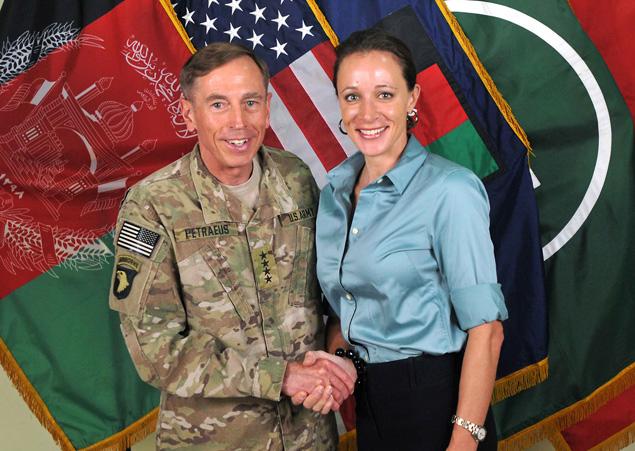
If he returns to the USA, how should he be punished?  May I suggest that he receive the same penalty as General David Petraeus, who also leaked highly classified information?  That penalty would be two years’ probation and a $40,000 fine.

Actually, that penalty wouldn’t be fair to Snowden, since Petraeus’s motivation for leaking classified information was personal. According to the New York Times, Petraeus shared his “black book” notes, much of the content highly classified, freely to Paula Broadwell, his lover and biographer.  He apparently did so in order that she could write a more glowing account of his life.  It’s also possible that this was part of the seduction process between the two: the sharing of those “sexy,” highly classified notes in exchange for further intimacies exchanged between the sheets (or under the desk).

Irony of ironies: The "ascetic" Petraeus bonded with Broadwell as they ran six-minute miles
Petraeus and Broadwell: “All In”

So, Paula Broadwell gained access to “classified notes about official meetings, war strategy, intelligence capabilities and the names of covert officers.”  Later, Petraeus lied to the FBI about the sharing of those notes.  And for these transgressions, he remains at liberty, with a lucrative deal at a private equity firm, teaching at Harvard University and walking the halls of power as an ascetic “hero” of the Surge in Iraq (2007).

Meanwhile, Snowden, who has been very careful not to compromise covert assets, remains in exile, vilified by many as a traitor to his country.

That’s the American moment for you.  A general with powerful friends gets a slap on the wrist for leaking highly classified material to his mistress and lying about it to the FBI, and a young patriot who acts to shed light on the growing power of governmental agencies to spy on the people and to violate their liberties is hounded into exile and denounced as a traitor.

And justice for all, America?

Update (3/5/15): 

Glenn Greenwald notes that Snowden’s desire to return to the U.S. is nothing new (and not news). The main obstacle is that U.S. law prohibits Snowden from using the defense that the documents/information he leaked should never have been classified to begin with. In other words, in a democracy, government should be transparent and accountable to the people, rather than being shrouded in secrecy and unaccountable to the people.  Imagine that!

Greenwald’s article, of course, changes nothing that I wrote above about the two-track justice system in the U.S. If only Snowden had been a military general and ex-chief of the CIA before he became a whistleblower! But, sadly, he was just a young man inspired by idealism and fired up about the dangers of the total surveillance state.

Idealism driven by concerns about the overweening powers of the national security state: We can’t have that in America.  Hang Snowden! Opportunism and deceit by a powerful man who ran a key component of that state (the CIA) and who should definitely have known better about violating security and lying to investigators? Well, that’s OK, “hero” Petraeus. Pay a token fine — and here’s your “Get out of jail free” card.

https://firstlook.org/theintercept/2015/03/04/snowden-wants-come-home-stories-case-study-media-deceit/

The Pledge of Allegiance: What It Means

US_Flag_Backlit

W.J. Astore

I read old stuff.  Heck, I’m a historian: that’s what I’m supposed to do.  So I was reading an old pamphlet on “The Indiana World War Memorial” (circa 1940) and came across the Pledge of Allegiance as it was recited before McCarthyism reared its ugly head in the 1950s:

I pledge allegiance to the flag of the United States and to the Republic for which it stands, one nation, indivisible with liberty and justice for all.

You’ll notice what’s missing: that whole idea of “under God.”  Those words were added in the early 1950s as a way of contrasting God-fearing (and God-favored, if you’ll recall American exceptionalism) Americans to the godless Communists.

You’ll recall, of course, that our nation was founded in part on religious freedom.  The idea you could worship any god or gods you wanted to, or none at all.  We should return to the original “godless” pledge.  It served us quite well in World War II; it would serve us quite well today.

After all, Americans have no monopoly on God.  Furthermore, God does not uniquely bless us.  To believe that is to violate the real Ten Commandments, for to believe you are uniquely blessed by God is tantamount to raising yourself to the level of God.  No — as Abraham Lincoln wisely said, we must not assume that God is on our side; we must pray that we are on His side.

Speaking of the Ten Commandments, Tom Engelhardt at TomDispatch.com has a compelling list of his “ten commandments” in America’s ongoing war on terror.  Like Lincoln, Engelhardt is wise enough not to assume that God is always chanting “USA!  USA!”

Here are Engelhardt’s “ten commandments” for America and for a better world.  I urge you to read the rest of his article at this link:

1. Thou shalt not torture: Torture of every horrific sort in these years seems to have been remarkably ineffective in producing useful information for the state.  Even if it were proved effective in breaking up al-Qaeda plots, however, it would still have been both a desperately illegal (if unpunished) act and a foreign policy disaster of the first order.

2. Thou shalt not send drones to assassinate anyone, American or not: The ongoing U.S. drone assassination campaigns, while killing individual terrorists, have driven significant numbers of people in the backlands of the planet into the arms of terror outfits and so only increased their size and appeal. Without a doubt, such drone strikes represent a global war of, not on, terror. In the process, they have turned the president into our assassin-in-chief and us into an assassin nation.

3. Thou shalt not invade another country: D’oh!

4. Thou shalt not occupy another country: By the way, how did that work out the last two times the U.S. tried it?

5. Thou shalt not upgrade thy nuclear arsenal: The U.S. has now committed itself to a trillion-dollar, decades-long upgrade of its vast arsenal.  If any significant portion of it were ever used, it would end human life as we know it on this planet and so should be considered a singular prospective crime against humanity. After years in which the only American nuclear focus was on a country — Iran — with no nuclear weapons, that this has happened without serious debate or discussion is in itself criminal.

6. Thou shalt not intercept the communications of thy citizens or others all over the world or pursue the elaboration of a global surveillance state based on criminal acts: There seems to be no place the NSA has been unwilling to break into in order to surveil the planet.  For unimaginable reams of information that have seemingly been of next to no actual use, the NSA and the national security state have essentially outlawed privacy and cracked open various amendments to the Constitution.  No information is worth such a price.

7. Thou shalt not be free of punishment for crimes of state: In these years of genuine criminality, official Washington has become a crime-free zone.  No matter the seriousness of the act, none — not one committed in the name of the state in the post-9/11 era, no matter how heinous — has been brought into a courtroom.

8. Thou shalt not use a massive system of secret classification to deprive Americans of all real knowledge of acts of state: In 2011, the U.S. classified 92 million documents and the shroud of secrecy over the business of the “people’s” government has only grown worse in the years since.  Increasingly, for our own “safety” we are only supposed to know what the government prefers us to know.  This represents, of course, a crime against democracy.

9. Thou shalt not act punitively toward those who want to let Americans in on what the national security state is doing in their name: The fierce and draconian campaign the Obama administration has launched against leakers and whistleblowers is unprecedented in our history.  It is a growing challenge to freedom of the press and to the citizen’s right to know.

10. Thou shalt not infringe on the rights of the citizenry to life, liberty, and the pursuit of happiness: Need I even explain?”

Why not make a pledge, America, to these “commandments”?  For they will help us to ensure liberty and justice for all.

Republicans and Fear


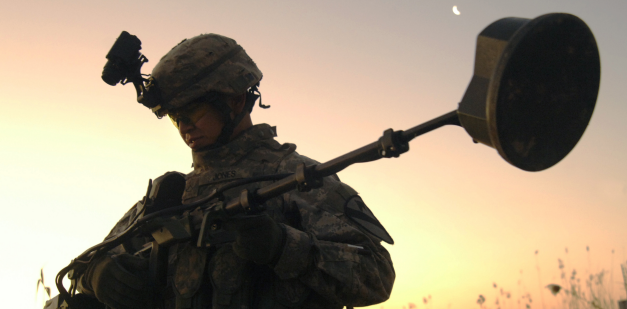
PFC Jones with Mine-Detector. Want to talk about fear?

W.J. Astore

Why, looky here, another article in the New York Times that examines the Republican “hawks” posturing for a presidential run in 2016.  As the article blurb states, “Republicans are scrambling to outmuscle one another on national security issues.”  It’s all about looking tough and calling for more boots on the ground in battles against ISIS and terror everywhere.

Here’s the money quote:

“There’s a lot of fear out there,” said Katon Dawson, a former chairman of the South Carolina Republican Party, noting that the Islamic State, also known as ISIS or ISIL, had become a regular topic of discussion at his regular breakfast spot in Columbia, the Lizard’s Thicket. “The waitresses and managers and everybody there has a notion about ISIL. People understand who this group is now.”

I should think the waitresses at “Lizard’s Thicket” would be more fearful of paying their weekly and monthly bills, given the low wages earned by wait staff in America.  Or that they and their customers would be more fearful of their sons and daughters in uniform being deployed to Iraq to showcase those “muscles” that Republican politicians are always trying to flex.  (Don’t worry: No politicians, Republican or Democrat, are eager to send their own sons and daughters overseas to fight.)

Once again, Republican politicians are banging the drums of fear – and as my dad always said, the empty barrel makes the most noise.  The music is as tragic as it is predictable: endless war in the name of looking tough and defeating terror.  And anyone who dares to suggest the folly of this risks being tarred as an appeaser to ISIS and its ilk.

What burns my butt is that none of these blowhard politicians has any skin in the game.  They risk nothing in bleating for war.  It’s not their sons and daughters who are being deployed to the front lines.

The other day, I was talking to a young woman at my eye doctor’s office.  Her brother is in the Army.  She told me he’s an EOD, an explosive ordnance disposal specialist.  A risky job, I said, to which she replied, “He volunteered for the extra money,” money that the Army has yet to pay him.  He’s got a four-year commitment and is due to be deployed after his training is completed.

So, as they seek to “outmuscle” their political rivals, how many politicians’ sons are in the Army right now, training for EOD duty and risking their lives for the extra money that comes with this hazardous duty?  My educated guess: none.  Absolutely none.

It’s easy to flex (and to risk) the muscles of others, America.  Stop listening to politicians and their fear-mongering.  No foreign terrorist is coming to get you as you enjoy your coffee and hash browns at “Lizard’s Thicket.”  No – the biggest risk is blowhard politicians who are so, so, eager to send your sons and daughters off to yet more wars in the cause of outmuscling their rivals for political office.

America’s Wars as Bloated Hollywood Productions

Age of Extinction, indeed (Source: Wikipedia)

W.J. Astore

Like so many bloated Hollywood movies nowadays, America’s wars may bomb, but they always produce their own sequels.

Look at the latest news from Iraq and Afghanistan.  These wars have persisted for more than a decade, with several re-releases to include “surges” and repeats.  The latest from Iraq is preparations to retake the city of Mosul from ISIS, which promises a repeat of the level of destruction visited upon Fallujah in 2004.  In this there are echoes of Vietnam: in Mosul, we may have to destroy the city to save it.  Five Iraqi brigades, most likely supported by American airpower and some American troops on the ground (air controllers and Special Forces), are poised to strike as early as April.  Doubtless they’ll prevail, at least for the moment, as the city and its civilians pay a price so dear as to be indistinguishable from defeat.  Mosul will be “liberated,” but just look what happened to Fallujah, which after the American “victory” in 2004 is now a devastated city retaken by elements of al-Qaeda in 2014.

(As an aside, it’s interesting that the New York Times uses the word “epic” to describe the Battle of Fallujah from 2004.  Surely a better word is “catastrophic.”  What is epic about a battle that destroys a city, a battle that is ultimately inconclusive?  Check out Bing West’s book about Fallujah, whose title, “No True Glory,” captures the frustrations and contradictions of that battle, mainly from the American perspective.)

Moving to Afghanistan, the latest is that American troops may stay longer than expected (surprise!).  Despite all the talk of “progress” in Afghanistan, the takeaway is the following section, from Secretary of Defense Ash Carter’s recent visit to Afghanistan:

“Despite the aid of American air power, 2014 was the deadliest year for Afghan forces since the start of the war in 2001, and many Afghan and Western officials in Kabul believe that 2015 will likely be worse, particularly with less support from Western allies. That has begun to change the conversation about the possibility of slowing down in the [American] withdrawal.”

In other words, expect more micro-surges of American troops and assets in the coming years, as well as more reports of “progress,” however temporary or illusory (at least America’s best and brightest learned from Vietnam not to talk of seeing light at the end of tunnels).

America’s wars are much like the “Transformers” franchise of movies: thrilling and seemingly conclusive at first, with much talk of missions being accomplished, followed by sequel after sequel of repetitive battles, increasingly loud and destructive, signifying vapidity and intellectual bankruptcy even as a few profit greatly from them.

And no one (certainly none of the producers at the Pentagon) seems to be able to pull the plug on green-lighting ever more sequels to these wars.  Even when they bomb.

(For a different perspective on how recent Hollywood movies support American warmaking through myth-making, see Peter Van Buren’s insightful article “War Porn” at TomDispatch.com.)

Education as Workforce Development: The Horror

Scott Walker: We don't need no higher education (photo courtesy of Slate)
Scott Walker: We don’t need no higher education (photo courtesy of Slate)

W.J. Astore

A strong trend in higher education today is to sell education as workforce development.  I saw this at the college where I used to teach, which was unsurprising given that the college started as a technical institute in a conservative area.  My college proudly advertised itself as valuing partnerships with business and industry, with a “learn to earn” emphasis, so students and parents knew what they were getting when they made their choice.

But the “education as workforce development” ethos is now spreading to universities and states like Wisconsin, driven by Republican governors and administrations keen to put those pointy-headed intellectuals, with their high-falutin’ ideas about education as a pursuit of truth, firmly in their place.  Consider this article at Alternet, and the following passage about Governor Scott Walker’s ideological war on higher education in his state:

Scott Walker has it out for the University of Wisconsin. The University of Wisconsin is a point of pride for the state at large, to the point where their mascot, the badger, is blanketed over everything Wisconsin-related, including government services that aren’t affiliated with the school. Despite this, Gov. Scott Walker, flushwith confidence after decimating public service unions in Wisconsin, has it out now for the university, apparently not caring that it’s the state’s pride and joy. The goal is to slash a whopping $300 million from the University of Wisconsin system over the next two years.

There may be some lip-smacking about “fiscal conservatism” going on with this, but Walker and his staff haven’t really taken many pains to hide that this is rooted in a deeper hostility to the very idea of knowledge itself. “A harbinger of what Walker might face came in an immediate uproar on social media this month after his staff proposed changing the university’s ethereal focus on the pursuit of truth, known as the ‘Wisconsin Idea,’ to a grittier focus on ‘workforce needs,’” reports theWashington Post. Walker backed off recasting higher education as nothing more than job training after his critics pointed out he is a college dropout, but the fact that this wording change was proposed at all shows that the hostility to education is ideological and has little to nothing to do with saving money.”

Higher education should be dedicated to something higher than the pursuit of a job that serves corporate America.  Heck, even corporate America favors the liberal arts as being invaluable to their bottom line, e.g. in the sense of “soft” skills such as the ability to write and speak clearly, collaborating as a team, fostering creativity and curiosity, and the like.  And this is supported by research, as in this report by the Association of American Colleges & Universities, which “is seriously questioning the drive to turn schools into institutions where the primary mission is offering career and vocational training,” according to a CBS News report:

The report, which was released today, concludes that employers “overwhelmingly” endorse broad learning as the best preparation for long-term career success. Employers who were surveyed for the study said that this broad learning should be an expected part of the course work for all students, regardless of their chosen major or field of study.

More than three out of four employers agreed that every college student should be exposed to the liberal arts and sciences, and employers were nearly unanimous (96 percent) in agreeing that all students should gain knowledge of our democratic institutions, which is done through liberal arts courses.”


So, if employers are in favor of liberal arts and the sciences, why are right-wing conservatives like Walker against these subjects?  To ask the question is to answer it.  The push for “workforce development” is all about silencing liberal dissent and squelching critical research.  It’s anti-intellectualism, pure and simple, always a popular trope in America, as Richard Hofstadter noted in his classic book, Anti-Intellectualism in American Life.

Keep ’em dumb and obedient, Walker.  Time-servers in the work trenches.  That’s the way to serve Wisconsin as governor.  Next stop: the presidency.  We don’t need any smart people in that job.  No more Jeffersons need apply.  Right, America?

Your Wish Is My Commando

W.J. Astore

Privatization of war is making it far easier for America’s imperial state to wage endless war throughout the world.  Consider the case of Afghanistan.  The U.S. military is allegedly leaving that country, turning the fight over to the Afghan military, trained and equipped largely by America.

Ashton Carter, Ready to Send in the Mercs
Ashton Carter, ready and willing to send in the Mercs — there ought to be Mercs — don’t bother, they’re here

But the truth is different: the U.S. has simply privatized the Afghan War, turning it over to military contractors, secretive Special Forces, and the CIA, as reported in this article by Tim Shorrock, in which you’ll find the following quote:

“If you define combat mission as only having large numbers of US combat troops in the field, doing patrols, and engaging the Taliban, then, yes, it [the Afghan War] is coming to an end,” says David Isenberg, a Navy veteran and author who has been researching private security and military contractors since the early 1990s. But if you define it as continuing to attack and degrade those you consider hostile, via drone or Special Forces or CIA paramilitaries, all of which are supported by contractors, then not so much.”

Not so much, indeed.  The future is indeed bright for privatized military contractors.  So much so that I have a slogan to offer the next Blackwater/Xe/Academi, the next DynCorp, the next Triple Canopy, the next global mercenary outfit:

My Slogan: Your Wish Is My Commando

Your imperial wish is also my profit, but we won’t mention that fact too loudly.

America was not supposed to go to war like this.  Remember our Founders and their ideas on war?  War was supposed to be a terrible decision, hotly contested among the people by their duly elected representatives in Congress.  It wasn’t supposed to be an easy choice made by presidents, with no real input or debate by that Congress.  It was supposed to involve citizen-soldiers motivated to defend the Constitution and sacred freedoms, not pay-for-hire mercenaries motivated by profit and spoils.

But our imperial state knows that it can’t fool all of the people all of the time on the need for endless wars in places like Iraq and Afghanistan, hence the recourse to wars fought largely in secret by hired guns and CIA/paramilitaries.  The mainstream media, of course, is owned by some of the same corporations that profit from weapons sales overseas, so don’t expect push-back from them.  No — the push-back will have to come from us.  We will have to use all the tools at our disposal to fight for enduring peace.

One thing I know: Without our push-back, enduring (as in endless) war is a certainty for America’s future.

Bonus Lesson: Isn’t it nice to know that this is Ashton Carter’s first day on the job as Secretary of Defense?  And that he’s open to sending more American troops to Afghanistan?  Just the man we needed at the Pentagon.  No wonder he was confirmed 93-5 by the Senate.

American Reckoning: Why the U.S. Lost the Vietnam War

51Srlc0nY8L

W.J. Astore

Christian G. Appy, professor of history at U-Mass Amherst, has written a new and telling book on the Vietnam War: American Reckoning: The Vietnam War and Our National Identity (New York, Viking Press).  Reading his book made me realize a key reason why the U.S. lost the war: for U.S. leaders it was never about Vietnam and the Vietnamese people.  Rather, for these men the war was always about something else, a “something else” that constantly shifted and changed.  Whereas for North Vietnam and its leaders, the goal was simple and unchanging: expel the foreign intruder, whether it was the Japanese or the French or the Americans, and unify Vietnam, no matter the cost.

Appy’s account is outstanding in showing the shifting goals of U.S. foreign policy vis-à-vis Vietnam.  In the aftermath of World War II, the U.S. first supported the French in their attempts to reassert control over their former colony.  When the French failed, the U.S. saw Vietnam through a thoroughly red-tinted lens.  The “fall” of a newly created South Vietnam was seen as the first domino in a series of potential Communist victories in Asia.  Vietnam itself meant little economically to American interests, but U.S. leaders were concerned about Malaysia and Indonesia and their resources.  So to stop that first domino from falling, the U.S. intervened to prop up a “democratic” government in South Vietnam that was never democratic, a client state whose staying power rested entirely on U.S. “advisers” (troops) and weapons and aid.

Again, as Appy convincingly demonstrates, for U.S. leaders the war was never about Vietnam.  Under Eisenhower, it was about stopping the first domino from falling; under Kennedy, it was a test case for U.S. military counterinsurgency tactics and Flexible Response; under Johnson, it was a test of American resolve and credibility and “balls”; and under Nixon, it was the pursuit of “peace with honor” (honor, that is, for the Nixon Administration).  And this remained true even after South Vietnam collapsed in 1975.  Then the Vietnam War, as Appy shows, was reinterpreted as a uniquely American tragedy.  Rather than a full accounting of the war and America’s mistakes and crimes in it, the focus was on recovering American pride, to be accomplished in part by righting an alleged betrayal of America’s Vietnam veterans.

In the Reagan years, as Appy writes, American veterans, not the Vietnamese people, were:

portrayed as the primary victims of the Vietnam War.  The long, complex history of the war was typically reduced to a set of stock images that highlighted the hardships faced by U.S. combat soldiers—snake-infested jungles, terrifying ambushes, elusive guerrillas, inscrutable civilians, invisible booby traps, hostile antiwar activists.  Few reports informed readers that at least four of five American troops in Vietnam carried out noncombat duties on large bases far away from those snake-infested jungles.  Nor did they focus sustained attention on the Vietnamese victims of U.S. warfare.  By the 1980s, mainstream culture and politics promoted the idea that the deepest shame related to the Vietnam War was not the war itself, but America’s failure to embrace its military veterans.” (p. 241)

Again, the Vietnam War for U.S. leaders was never truly about Vietnam.  It was about them.  This is powerfully shown by LBJ’s crude comments and gestures about the war.  Johnson acted to protect his Great Society initiatives; he didn’t want to suffer the political consequences of having been seen as having “lost” Vietnam to communism; but he also saw Vietnam as a straightforward test of his manhood.  When asked by reporters why he continued to wage war in Vietnam, what it was really all about, LBJ unzipped his pants, pulled out his penis, and declared, “This is why!” (p. 82).

Withdrawal, of course, was never an option.  As Appy insightfully notes,

LBJ and most of the other key Vietnam policymakers never imagined that withdrawal from Vietnam would be an act of courage.  In one sense this moral blindness is baffling because these same men prided themselves on their pragmatic, hardheaded realism, their ability to cut through sentiment and softhearted idealism to face the most difficult realities of foreign affairs.  They could see that the war was failing.  But they could not pull out.  A deeper set of values trumped their most coherent understandings of the war.  They simply could not accept being viewed as losers.  A ‘manly man’ must always keep fighting.” (p. 84)

A few pages later, Appy cites Nixon’s speech on the bombing of Cambodia, when Nixon insisted the U.S. must not stand by “like a pitiful, helpless giant,” as further evidence of this “primal” fear of presidential impotence and defeat.

Even when defeat stared American leaders in the face, they blinked, then closed their eyes and denied what they had seen.  Beginning with Gerald Ford in 1975, America shifted the blame for defeat onto the South Vietnamese, with some responsibility being assigned to allegedly traitorous elements on the homefront, such as “Hanoi Jane” (Fonda).  As Appy writes, “Instead of calling for a great national reckoning of U.S. responsibility in Vietnam, Ford called for a ‘great national reconciliation.’  It was really a call for a national forgetting, a willful amnesia.” (p. 224)

As a result of this “willful amnesia,” most Americans never fully faced the murderous legacies of the Vietnam War, especially the cost to the peoples of Vietnam, Laos, and Cambodia.  Instead, our leaders and government encouraged us to focus on America’s suffering.  They told us to look forward, not backward, while keeping faith in America as the exceptional nation.

Appy notes in his introduction that America needs “an honest accounting of our history” if we are “to reject—fully and finally—the stubborn insistence that our nation has been a unique and unrivaled force for good in the world.” (p. xix) American Reckoning provides such an honest accounting.  But are Americans truly ready and willing to put aside national pride, nurtured by a willed amnesia and government propaganda, to confront the limits as well as the horrors of American power as it is exercised in foreign lands?

Evidence from recent wars and military interventions in Iraq, Afghanistan, and elsewhere still suggests that Americans prefer amnesia, or to see other peoples through a tightly restricted field of view.  Far too often, that field of view is a thoroughly militarized one, most recently captured in the crosshairs of an American sniper’s scope.  Appy challenges us to broaden that view while removing those crosshairs.