As the Ukrainian counteroffensive against Russia grinds on (or falters?), as U.S. disaster relief for Hawaii is tied to more military aid for Ukraine, as depleted uranium shells join cluster munitions as America’s latest gift to a blasted war zone, as calls for diplomacy continue to be muted when they’re not actively discouraged and dismissed, I was reminded of the alchemy of war.
Alchemists of the early modern period were sophisticated experimenters driven by an often quasi-religious quest for perfection. We tend to remember only the most craven part of their experiments: the attempt to transmute lead into gold. This transmutation could not be effected, but alchemy itself transmuted into chemistry as its practitioners, through trial and error, developed a better understanding of the nature of the elements, reflected in part by today’s Periodic Table.
Seeking a divine spark
Yet the business of war succeeded where alchemists failed. In their alchemy, the merchants of death turned bullet lead into corporate gold. And what gold! Yearly war budgets continue to soar in the United States toward the trillion dollar mark. Weapons shipments to Ukraine continue at a pace that promises many more shattered and blasted bodies, Ukrainian and Russian.
In a sense, dead bodies are also being transmuted into corporate gold.
Transmutation, I was taught as a Catholic, is a miracle. The Word became flesh and dwelt among us (Jesus Christ, the Son of God, of course). We have made the miraculous the mundane, and indeed the profane. We take lead and spill blood which becomes gold. And some even celebrate this as good for business in the United States.
All these weapons: they’re job-creators! So we crucify the Word and elevate the life-takers and widow-makers as gods.
We are far more deluded than the alchemists of the past.
If you read the mainstream media, it would seem the answer to the Russia-Ukraine War, now about to enter its second year of mass death and widespread destruction, is weapons of various sorts. Western tanks like the German Leopard and American Abrams. Fighter jets like the F-16 produced by Lockheed Martin. If only Ukraine had more tanks, more jets, and the like, they would be able decisively to defeat the Russian military, ejecting it from Ukrainian territory, even from the Crimea, so the argument goes.
As a historian of technology and warfare, I’ve studied this belief in magical weapons. History teaches us that weapons alone usually do not determine winners and losers in war. Weapons themselves are rarely decisive, especially when the sides engaged fight symmetrically. In such cases, new weaponry often increases the carnage.
Consider the events of World War I. Various weapons were tried in an attempt to win the war decisively through military action. These weapons included poison gas (of various types), tanks, flamethrowers, and submarines, among others. None of these weapons broke the stalemate on the Western Front. Countermeasures were found. And World War I dragged on for more than four long years, producing hecatombs of dead.
Image from “All Quiet on the Western Front,” 2022, Netflix
What did work? In a word, exhaustion. In the spring of 1918, Germany launched massive, last-ditch, offensives to win the war before U.S. troops arrived in Europe in large numbers. (The U.S. had entered the war in 1917 but was still mobilizing in 1918.) The Germans came close to winning, but when their offensives grounded to a halt, they had little left in the tank to endure Allied counterattacks. Yes, the Allies had more tanks than the Germans, and were learning to use them effectively with airpower in combined arms assaults. But what truly mattered was exhaustion within the German ranks, exacerbated by the Spanish flu, hunger, and demoralization.
No magical weapon won World War I. And no magical weapon is going to provide Ukraine a decisive edge in its struggle with Russia. Certainly not a hundred or so Western tanks or a few dozen fighter jets.
Indeed, looking at some of the media coverage of the Russia-Ukraine War in the West, you might be excused from mistaking it for advertising videos at a weapons trade show. Over the last year, we’ve learned a lot about Javelin and Stinger missiles, HIMARS rocket launchers, and of course various tanks, fighter jets, and the like. But we’ve seen very little coverage of the mass carnage on both sides. It’s been said the real costs of war will never get in the history books, for who wishes to confront fully the brutality and madness of industrialized warfare?
I’m in the middle of watching the new German version of “All Quiet on the Western Front,” a film deservedly nominated for an Oscar for best picture (available on Netflix). It’s one of the better war films I’ve seen in its depiction of the horrific and dehumanizing aspects of modern industrial warfare. Something like this movie is happening currently in Ukraine, but our leaders, supported by the media, think the answer to the carnage is to send even more destructive weaponry so that more troops (and civilians) can die.
Magical weapons are not the answer. For of course there’s nothing magical about weapons of mass destruction.
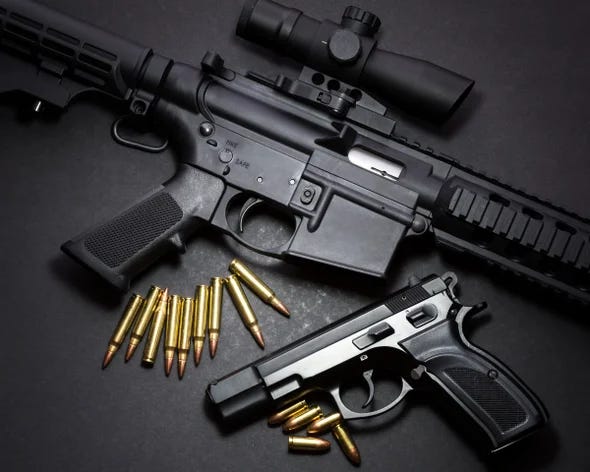
“Honk if you like guns” is on a message board outside a local gun range. It’s a distinctly American sentiment. Since this country has over 400 million guns of various sorts and calibers in circulation, it’s a safe bet that America does indeed “like” guns. And that’s not a liking you’re encouraged to keep to yourself, hence the encouragement to “honk” as you drive past to advertise full throttle your affection for them.
Honk away, I guess (Mariusz Blach, Getty Images)
As I wrote a decade ago, “weapons ‘r’ us.” America, the so-called arsenal of democracy during World War II, is now often simply an arsenal. Guns are expensive and life is cheap. And we literally export that sentiment as America dominates the international trade in arms of all sorts, everything from F-35 jet fighters to M-1 tanks to the humblest of bullets. Indeed, we’re buying so many guns in America there’s even a shortage of those humble bullets.
Americans believe they are unsafe; Americans are also less than happy and are the world’s best customers for anti-depressants, and happiness is a warm gun, as John Lennon wrote.
There is considerable psychic distress in our country, and no wonder. The police video released yesterday of the beating of Tyre Nichols during a routine traffic stop is more than disturbing. A helpless man lies on the ground as police surround him, kicking and hitting him repeatedly. “Savage” is a good descriptor for the beating he took, after which it took nearly half an hour for an ambulance to arrive to render medical aid. Tyre Nichols died in a hospital three days later.
I know it’s an odd juxtaposition: the “honk if you like guns” sentiment and the (alleged) murder of Tyre Nichols by five (or more) police officers in Memphis. Maybe they have little in common, except, perhaps, a liking for violence and the potential of deadly force.
And so, to change the subject, I keep hearing the best way to help Ukraine is to send them more weapons so their armed forces can kill more Russians. It’s a war, after all, and tanks are needed more than talks. Putin only understands one language, the language of murderous violence, and he must be stopped so send Ukraine whatever its military officials request because we can trust them to know best.
And I begin to wonder, which country truly knows the language of murderous violence best? Which country has more mass shootings than any other? Which country spends more on wars and weaponry, has more of its citizens in prison, has more military bases, exports more weaponry around the world, than any other?
Honk if you like guns — it’s a sentiment that says much about our American moment.
“Follow the money” is sage advice in an America that prides itself on unfettered capitalism where everything is a commodity. A huge chunk of money, namely $54 billion, has already been dedicated to Ukraine in its fight against a Russian invasion, with more to follow if Congress has its way. Roughly half this money is going directly to U.S. weapons makers, hence the haste of Congress to vote for its approval. Only a small number of Republicans have objected to this boondoggle; all Democrats in the House and Senate voted in favor of it.
Here’s the thing. The entire defense budget of Ukraine before the war was just under $6 billion. How can Ukraine possibly absorb (mostly) military “aid” that represents NINE TIMES their annual defense budget? It simply can’t be done.
Russia’s military budget for an entire year, roughly $66 billion, only slightly exceeds the U.S. “aid” for Ukraine after three months of war. If the pace of U.S. spending on Ukraine remains the same, the amount of “aid,” assuming the war continues, could touch $200 billion by this time next year. Again, this is for a country that spent $6 billion on its military forces prior to being invaded.
From a military perspective, the gusher of money and equipment being sent to Ukraine makes little sense because there’s no way Ukraine has the infrastructure to absorb it and use it effectively. The U.S. approach seems to be to flood the zone with weaponry and assorted equipment of all sorts, irrespective of how it might be used or where it might ultimately end up. I can’t see how all this lethal “aid” will stay in the hands of troops and out of the hands of various criminal networks and black markets.
In America’s recent wars, such as Iraq and Afghanistan but also as far back as Vietnam, the U.S. military has been remarkably proficient at providing weaponry to enemies. When U.S. forces retreat in defeat, or “evacuate to success,” they usually leave behind mountains of military equipment, as they did in Vietnam, Iraq, and Afghanistan. Weaponry left behind or provided to Afghan and Iraqi security forces helped to arm ISIS, the Taliban, and similar elements the U.S. government says are terroristic. Interestingly, few seem to question the wisdom of all the billions in weaponry provided as “aid” that often ends up fueling more violence and more war.
If guns saved lives and brought safety, America would have the lowest number of people killed by guns and the safest country. We obviously don’t. Flooding countries like Iraq, Afghanistan, and now Ukraine with scores of billions in weaponry and related equipment is not the smartest way toward success. Unless you’re the CEO of a weapons contractor, in which case it’s the very definition of success.
But something must be done! cry those who want to help Ukraine in its war with Russia. Ukraine has already demonstrated its resolve while suffering the evils of war; does it make sense to keep the war going when Ukraine ultimately can’t win it? Just look at a map and the vast resources Russia has available to it; there is no shame, and indeed much sense, in Ukraine, having fought a good fight, negotiating a peace treaty now before the war spreads even further and the country is even more devastated.
In sum, I don’t see $54 billion in U.S. “aid” to Ukraine as being in the best interest of the Ukrainian people. If it serves to prolong a murderous war that ultimately Ukraine can’t win, it may prove more hurtful than helpful.
Americans have a remarkable faith in weapons as “gamechangers,” as simple panaceas to complex problems.
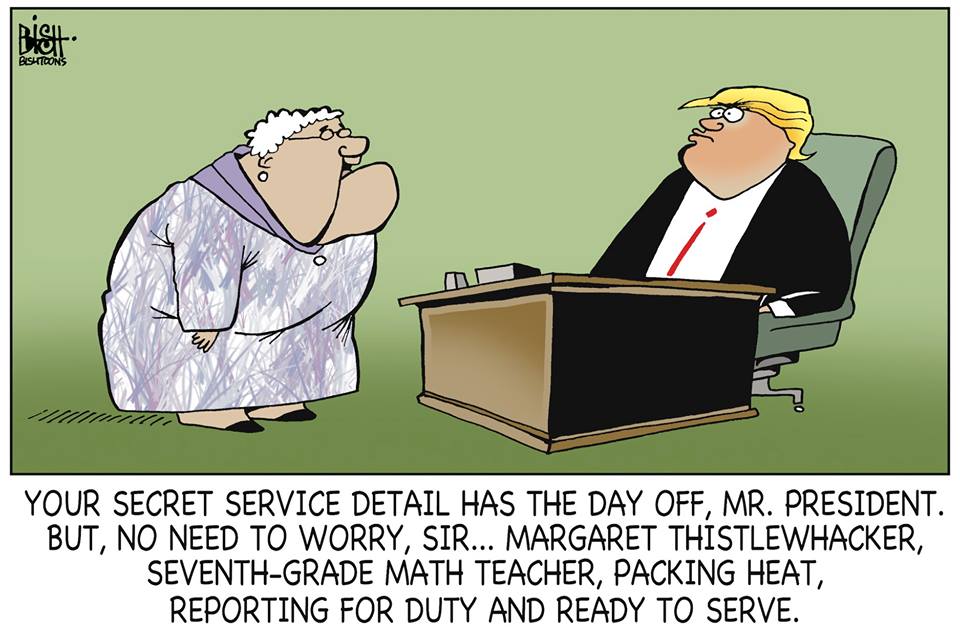
Yesterday, Donald Trump addressed the NRA convention in Houston, offering guns as a panacea to mass shootings. Once again, Trump said that “highly trained” teachers should be allowed to carry concealed guns in the classroom. Apparently, teachers should now be the equivalent of Special Forces warriors, ready to confront shooters with assault weapons at a moment’s notice. When he was president, Trump suggested these warrior-teachers might even see a small bump in pay for their willingness to carry guns and to serve as quasi-SWAT team members at schools. What generosity!
Just as many Americans see more guns as the answer to domestic violence like mass shootings, yet bigger guns and missiles are seen as “game changers” for complex foreign issues like the Russia-Ukraine War. According to CNN, the U.S. government is considering sending the MLRS (multiple launch rocket system) to Ukraine, which has a range of up to 300 miles, to counter Russian troops. One Congressman in particular thinks it’s a dandy idea:
Democratic Rep. Jason Crow of Colorado, who was part of a congressional delegation trip to Kyiv earlier this month, told CNN he believes the systems could help Ukraine gain significant momentum against Russia.
“I think it could be a gamechanger, to be honest with you,” Crow said, not only for offensive attacks but also for defense. He explained that Russian conventional artillery, which has a range of about 50km, “would not get close” to Ukrainian urban centers if MLRS systems were positioned there. “So it would take away their siege tactics,” he said of the Russians.
Where to begin? Are Ukrainian troops trained on such a system? How do you get the system into Ukraine to begin with? What if the system is used to strike targets inside of Russian territory? What about Russian warnings that such a system could lead to reprisals against European or American assets? What if less-than-well-trained Ukrainian troops fire a bunch of missiles that end up killing dozens, even hundreds, of innocent people?
No matter. The “answer” is always more guns, more howitzers, more missiles. They’re “gamechangers”!
Indeed, they just may be. Just not in the way that Trump imagines, or Congressman Crow.
Finally, that word: “gamechanger.” It’s a common practice in America to talk about war as if it’s a sport, a game. Call it the triumph of dumbass thinking. War is neither sport nor game, and you’re not going to “game-change” the Russia-Ukraine War, as in turning the tide so Ukraine wins, just by sending the MLRS, just as you’re not going to decrease mass shootings in schools by arming teachers with guns.
I subscribe to a news feed called “Breaking Defense” (the name may be more ironic than the site creators intended). I saw this advertisement today, which sums up much of what is common in America, where jargon substitutes for thought:
Kratos’ next generation unmanned aerial target drones and their capabilities continue to evolve to represent ever changing, evolving threats from near-peer adversaries to best prepare the American warfighter while keeping costs down for the American taxpayer.
I know nothing about the company (Kratos), but it does appear to have a good command of Pentagon jargon. Those “near-peer adversaries” (meaning China and Russia, mainly). Those “ever changing, evolving threats.” And of course the almost obligatory appeal to the “warfighter.”
From this ad (and others like it), it’s simply assumed that America will always be at war. There’s also an assumption that Americans fall into two basic categories: warfighters and taxpayers. Warfighters are the doers, the hard men and women on the front lines, deserving of everlasting support and praise, and the taxpayers are there to fund it all and cheer along. Naturally, there’s no mention of “peacemakers.”
If we truly want to keep costs down for the American taxpayer, maybe we shouldn’t buy any of these target drones?
In the same email send-out, here’s a sample of the articles at “Breaking Defense”:
In 2022, the Pentagon will need to see real movement on acquisition reform to reduce long understood vulnerabilities that have been essentially ignored for many years.
Here’s the key Army storylines we’ll be tracking at Breaking Defense next year.
Seems like the “Space Force” will be spending lots of money in 2022 due to “vulnerabilities.” Meanwhile, a Russian invasion of Ukraine might “derail” the DoD’s “new strategy.” And the Army is looking at “multi-domains,” which I assume is a smart way for the Army to expand its budgetary reach in the new year.
Nice to know the Pentagon has a new strategy, but how could a Russian incursion into Ukraine derail it? If the U.S. invaded Mexico, would that derail Russia’s defense planning? Or China’s?
Here’s another ad from a different “Breaking Defense” send-out.
Systel’s fully rugged computing solutions are purpose-built for the most demanding environments and workloads. High performance, SWaP-optimized, single LRU solutions supporting edge AI and force-protection missions. MOSA/CMOA, SAVE, and GCIA-compliant. Fully rugged, configurable, and modular. Centralized sensor ingest and data fusion support.
Ah, the good old days of military acronyms! Again, I know nothing about Systel, but the company has a solid command of opaque acronyms. Even the ad has redundancy in the sense that it mentions “fully rugged” twice! Note the mission of “force-protection,” as in keeping U.S. “warfighters” safe while in harm’s way.
Maybe we should keep our troops safe by not putting them in harm’s way, unless the defense of America truly requires it?
There’s nothing special about these ads or stories, which is why I cite them here. Just another day in the American empire of warfighters buying weapons systems to force-protect and confront near-peer threats out to exploit our vulnerabilities across multiple domains. Or, put simply, multi-domain everything!
Among my many weak spots is economics and business. I took exactly one course in college on macroeconomics. I took dozens of courses in math and engineering like calculus, statics, dynamics, fluid mechanics, thermodynamics, biomechanics, you name it. Then I switched academic specialties and became a historian of science, technology, and religion. Again I took dozens of courses in various branches of history, but again my one economics course remains my brief exposure to that world. And I took it as a freshman forty years ago!
Economics has been on my mind lately because so much of what passes for national military (a redundant phrase) strategy in the U.S. is really about making money. Profit. Capitalism, pure and simple. Moving products, expanding markets, diversifying portfolios, and so on. There’s no business like war business. It’s a capitalist’s dream.
In this rich vein of greed-war, I urge you to read Christian Sorensen’s 5-part series on the military-industrial-congressional complex at Consortium News. (Here’s a link to part 5, which also includes links to the previous four parts.) I really like the way he begins Part 5:
Without looking at military adventurism through the lens of the corporation, analysts are bound to produce error-filled studies. For example, one analyst contended in an interview on The Real News Network, “Military force is almost never going to achieve your political aims. The Americans learned this in Vietnam. They’re learning it in Afghanistan. They’re learning it in Syria… So [President Barack] Obama supporting the Saudis and Emiratis in Yemen is a sign really of incoherence on the part of the United States.”
Far from incoherence, the behavior actually is quite rational. A variety of conflicts, disparate and some seemingly futile, is precisely the aim. Conflict itself — producing untold mountains of profit for war corporations and Wall Street — is the goal.
Yes, yes, a thousand times yes. You can’t look at U.S. military-national “strategy” today through a purely strategic lens or one informed solely by military history (as I’m tempted to do). Clausewitz, Jomini, and other classical military theorists won’t help you much. You need to look to Wall Street, to economics, to how capitalism works. You have to look to business cycles, profit, markets, portfolios, diversification, and similar concepts. You have to recognize war is a special kind of business, one that America is very good at because we specialize in it. War and weaponry may well be our leading exports.
Again, I’m tempted as a former engineer and as a professional historian who’s studied strategy (at Oxford no less) to try to make sense of U.S. national-military strategy in logical terms informed by history, Wrong approach! The right approach is to follow the money. Think not of “war as a continuation of politics” but of war as a continuation of capitalism, a special kind of disaster or death capitalism. Remember too to think in terms of portfolios and diversification of the same, after which U.S. policies make all the sense in the world. More conflict means more weapons sales means more money. The same is true of arms races in the false cause of deterrence.
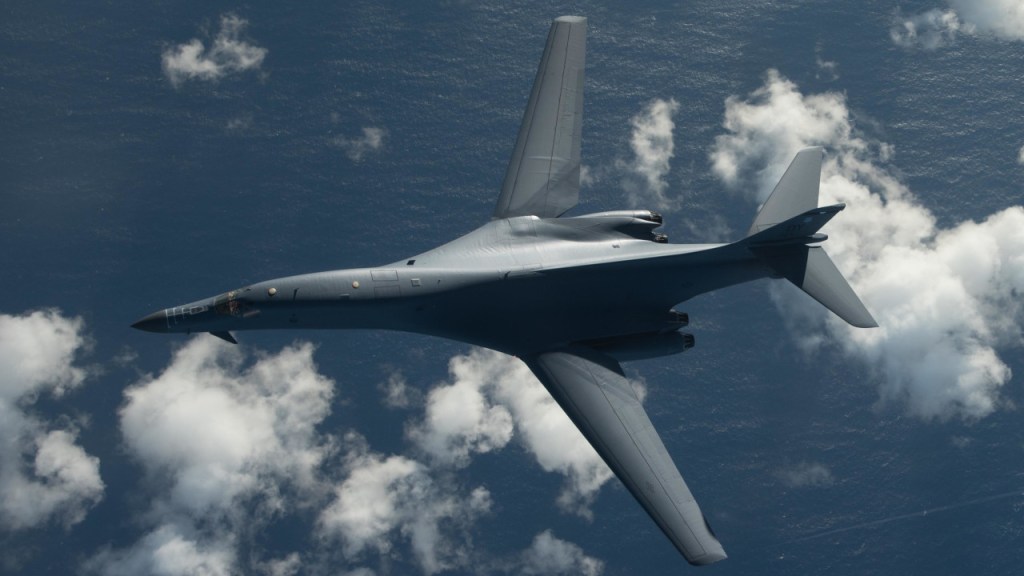
An early example from my life. When I was a young lieutenant in the U.S. Air Force, circa 1985, I wrote a paper on the B-1 bomber and the strategy of “manned penetrating bombers.” In plain speak (plane speak?), the Air Force was spending loads of money on a high-tech swing-wing plane loaded with avionics which would in theory enable it to penetrate Soviet airspace and bomb targets directly. This made little sense to me, nor did it make sense to President Jimmy Carter, who had cancelled the plane as unneeded. After all, B-52s could carry highly accurate cruise missiles and launch them from outside of Soviet airspace, and for much less money.
But the B-1, like any major weapon system, had powerful friends in Congress, since Rockwell International had spread production of the plane and its components to as many Congressional districts as possible. When Ronald Reagan became president in 1981, he quickly reversed Carter’s decision. It wasn’t about strategy. It was about business and profit justified in the name of sending a tough message to the “Evil Empire.” Meanwhile, the Soviet Union collapsed a few years later and the U.S. was stuck with 100 B-1 bombers it didn’t need. Time has proven it to be an expensive plane to maintain, and one that’s never been used (fortunately) on the mission for which it was designed.
The U.S. has a lot of weapons like the B-1 bomber: expensive, unreliable, redundant strategically, and ultimately unneeded. It doesn’t make much sense, until you realize it’s all about making money, moving product, inflating threats, and keeping the cycle going, again and again, wars and weapons without end, Amen.
There’s a bill before the Rhode Island State Legislature (House Bill 6026) that aims to divest state pension funds from military contractors. I wrote a short letter in favor of this bill and submitted it, as follows:
I served in the U.S. Air Force for 20 years, retiring as a lieutenant colonel in 2005. There are many of us within the military who recognize the wisdom of General Smedley Butler, twice awarded the Medal of Honor. Butler wrote that the best way to end war is to take the profit out of it. Butler wrote in the 1930s, when our country believed that weapons makers were “merchants of death.” They were called that because of the vast killing fields of World War I, a war that killed more than 100,000 Americans, together with millions of other troops from Britain, France, Germany, and elsewhere.
Joining Smedley Butler was another great American, General (later President) Dwight D. Eisenhower. In his famous “Cross of Iron” speech in 1953, Ike wrote that unnecessary spending on weaponry would lead to humanity being crucified on a cross of iron. Here are his words:
Every gun that is made, every warship launched, every rocket fired signifies, in the final sense, a theft from those who hunger and are not fed, those who are cold and are not clothed. This world in arms is not spending money alone. It is spending the sweat of its laborers, the genius of its scientists, the hopes of its children… This is not a way of life at all, in any true sense. Under the cloud of threatening war, it is humanity hanging from a cross of iron.
In 1961, President Eisenhower warned all Americans against the dangers of the military-industrial complex. Sixty years later, in 2021, America dominates the world in selling weapons across the globe. We have become the “merchants of death” that Generals Butler and Eisenhower warned us about.
Weapons kill. Weapons make wars more likely. And as Eisenhower said in 1946, “I hate war as only a soldier who has lived it can, only as one who has seen its brutality, its futility, its stupidity.”
It’s time for us to hate war again. It’s time for us to beat our swords into ploughshares, as the Bible tells us. It’s time for us to pursue more peaceful activities.
Rhode Island can set a strong example – a shining example – in the pursuit of peace and sanity. I urge you to vote “for” House Bill 6026.
Let us beat our swords into ploughshares …
*****
The “Divestment Fact Sheet” for the bill explains its purpose, as follows:
Allows us to redirect our investment dollars toward socially productive corporations addressing important social assets like climate resilience, health, and education, which aid economic growth;
Seeks to move money away from corporations whose output foments violence, death, destruction, and social chaos.
Educates the general public about the role of weapons manufacturers in the cycle of tax breaks, lobbying largesse, increasing military budgets and weapon sales.
Reduces the flow of scarce economic resources to military weapons manufacturers by reducing public investment;
Sends a message to the US Congress that we need to sharply reduce investment in military weapons where the costs are increasingly public (ever increasing health bills for traumatized and injured vets of the endless wars, reconstruction bills in foreign lands, ever increasing maintenance bills and graft on weapons systems) and the benefits are private (lobbying firm profits, huge weapons manufacturer bonuses and excessive CEO pay packages).
In America, money talks. As Smedley Butler said, ending the madness of war will most likely come when we can take the profit out of it. Here’s hoping Rhode Island’s effort succeeds — and sets an example for others across our nation.
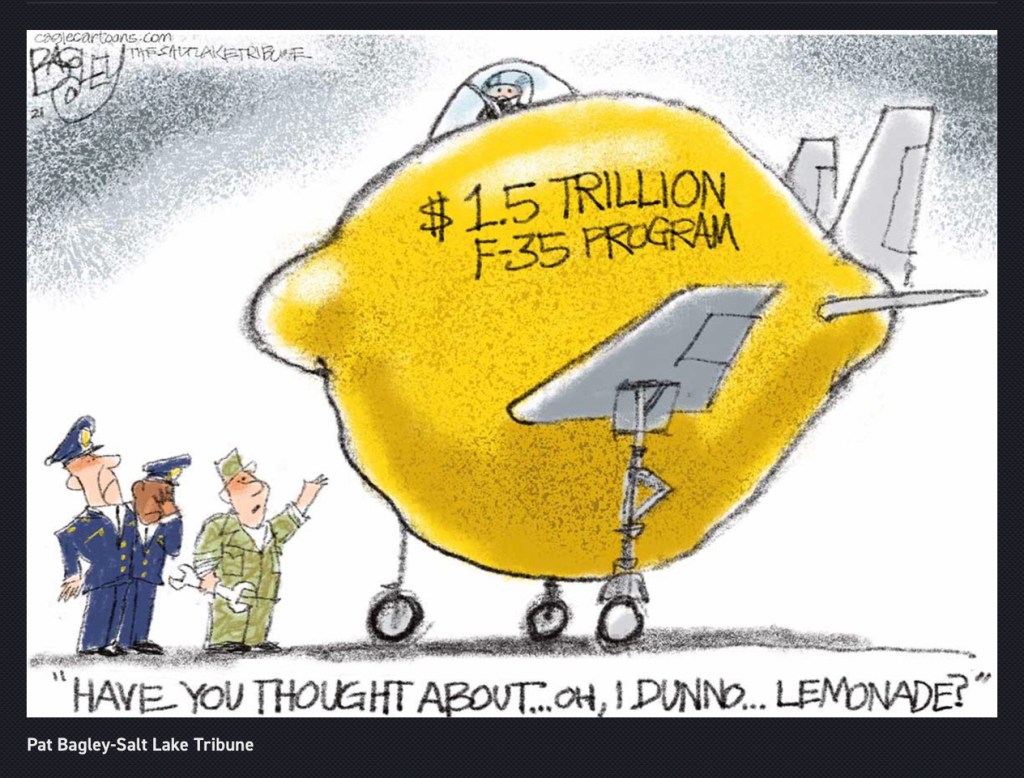
Now the “lemon” is up to $1.7 trillion. Even more lemonade?
W.J. Astore
Imagine you’re a soldier in combat. What’s the most important feature of any weapon system? That it works. That it’s reliable. Nobody wants a weapon that jams in a firefight. Reliability, simplicity, ruggedness are key features of weaponry. Yet the Pentagon and the military-industrial complex seem to specialize in unreliable, complex, fragile ones. Ones that don’t work, or that don’t work very well, and at inflated prices as well. This is the subject of my latest article at TomDispatch, and here’s an excerpt from it:
Cancel culture is a common, almost viral, term in political and social discourse these days. Basically, somebody expresses views considered to be outrageous or vile or racist or otherwise insensitive and inappropriate. In response, that person is “canceled,” perhaps losing a job or otherwise sidelined and silenced. In being deplatformed by Twitter, Facebook, and other social media sites, for instance, this country’s previous president has, it could be argued, been canceled — at least by polite society. More than a few might add, good riddance.
Cancel culture is all around us, with a single glaring exception: the U.S. military. No matter how poorly a major weapons system performs, no matter how much it goes over budget, no matter how long it takes to field, it almost never gets canceled. As a corollary to this, no matter how poorly a general performs in one of our twenty-first-century wars, no matter his lack of victories or failure to achieve mission objectives, he almost never gets cashiered, demoted, or even criticized. A similar thing could be said of America’s twenty-first-century wars themselves. They are disasters that simply never get canceled. They just go on and on and on.
Is it any surprise, then, that a system which seems to eternally reward failure consistently produces it as well? After all, if cancel culture should apply anywhere, it would be to faulty multibillion-dollar weapons systems and more than a few generals, who instead either get booted upstairs to staff positions or retire comfortably onto the boards of directors of major weapons companies.
Let’s take a closer look at several major weapons systems that are begging to be canceled — and a rare case of one that finally was.
* The F-35 stealth fighter: I’ve writtenextensively on the F-35 over the years. Produced by Lockheed Martin, the plane was at one point seven years behind schedule and $163 billion over budget. Nonetheless, the U.S. military persisted and it is now nearing full production at a projected total cost of $1.7 trillion by the year 2070. Even so, nagging problems persist, including engine difficulties and serious maintenance deficiencies. Even more troubling: the plane often can’t be cleared for flying if lightning is anywhere in the area, which is deeply ironic, given that it’s called the Lightning II. Let’s hope that there are no thunderstorms in the next war.
* The Boeing KC-46 tanker: A tanker is basically a flying gas station, air-to-air refueling being something the Air Force mastered half a century ago. Never underestimate the military’s ability to produce new problems while pursuing more advanced technology, however. Doing away with old-fashioned windows and an actual airman as a “boom operator” in the refueling loop (as in a legacy tanker like the KC-135), the KC-46 uses a largely automated refueling system via video. Attractive in theory, that system has yet to work reliably in practice. (Maybe, it will, however, by the year 2024, the Air Force now says.) And what good is a tanker that isn’t assured of actually transferring fuel in mid-air and turns out to be compromised as well by its own fuel leaks? The Air Force is now speaking of “repurposing” its new generation of tankers for missions other than refueling. That’s like me saying that I’m repurposing my boat as an anchor since it happened to spring a leak and sink to the bottom of the lake.
* And speaking of boats, perhaps you won’t be surprised to learn that the Navy has had serious problems of its own with its most recent Gerald R.Ford-class aircraft carriers. That service started building carriers in the 1920s, so one might imagine that, by now, the brass had gained some mastery of the process of updating them and building new ones. But never underestimate the allure of cramming unproven and expensive technologies for “next generation” success on board such vessels. Include among them, when it comes to the Ford-class carriers, elevators for raising munitions that notoriously don’t operate well and a catapult system for launching planes from the deck (known as the Electromagnetic Aircraft Launch System or EMALS) that’s constantly breaking down. As you might imagine, not much can happen on an aircraft carrier when you can’t load munitions or launch planes effectively. Each new Ford-class carrier costs in the neighborhood of $14 billion, yet despite all that money, it simply “isn’t very good at actually being a carrier,” as an article in Popular Mechanics magazine bluntly put it recently. Think of it as the KC-46 of the seas.
* And speaking of failing ships, let’s not forget the Navy’s Littoral Combat Ships (LCS), which have earned the nickname “little crappy ships.” A serious propulsion design flaw may end up turning them into “floating garbage piles,” defense journalist Jared Keller recently concluded. The Navy bought 10 of them for roughly half a billion dollars each, with future orders currently on hold. Lockheed Martin is the lead contractor, the same one responsible for the wildly profligate (and profitable) F-35.
* Grimly for the Navy, problems were so severe with its Zumwalt-class of stealth destroyers that the program was actually canceled after only three ships had been built. (The Navy initially planned to build 32 of them.) Critiqued as a vessel in search of a mission, the Zumwalt-class was also bedeviled by problems with its radar and main armament. In total, the Navy spent $22 billion on a failed “next generation” concept whose cancelation offers us that utter rarity of our moment: a weapon so visibly terrible that even the military-industrial complex couldn’t continue to justify it.
Chief of Naval Operations Admiral Michael Gilday has gone on record as rejecting the idea of integrating exotic, largely untried and untested technologies into new ship designs (known in the biz as “concurrent development”). Godspeed, admiral!
Much like the troubled F-35 and the Littoral Combat Ship, the Zumwalt’s spiraling costs were due in part to the Pentagon’s fixation on integrating just such “leading-edge” technologies into designs that themselves were in flux. (Not for nothing do military wags refer to them as bleeding edge technologies.) Such wildly ambitious concurrent development, rather than saving time and money, tends to waste plenty of both, leading to ultra-expensive less-than-fully effective weapons like the Zumwalt, the original version of which had a particularly inglorious breakdown while passing through (or rather not passing through) the Panama Canal in November 2016.
Given such expensive failures, you might be forgiven for wondering whether, in the twenty-first century, while fighting never-ending disastrous wars across significant parts of the planet, America’s military isn’t also actively working to disarm itself. Seriously, if we’re truly talking about weapons that are vital to national defense, failure shouldn’t be an option, but far too often it is.
With this dubious record, one might imagine the next class of Navy vessel could very well be named for Philip Francis Queeg, the disturbed and incompetent ship captain of novelist Herman Wouk’s The Caine Mutiny. It’s also quite possible that the Pentagon’s next advanced fighter jet will fulfill former Martin Marietta CEO Norman Augustine’s estimate from the 1980s that, by the year 2054, the entire Pentagon budget would be needed to buy one — and only one – combat aircraft. Perhaps a Death Star for America’s new Space Force?
Be sure to read the rest of the article here at TomDispatch.com.
For all his tough-guy posturing and his attempts to pose like Winston Churchill, President Trump has largely been an appeaser to the military-industrial complex and its insatiable appetite for wars and weapons sales.
Trump, frowning (he thinks) like Churchill
Yes, it’s good news that Trump is withdrawing troops from Afghanistan and Iraq, though roughly 2500 troops will remain in each country when Joe Biden takes office in January. In short, Trump isn’t ending these wars; he’s merely reducing the number of boots on the ground. His Acting Defense Secretary, Chris Miller, described it as a “repositioning of forces from those two countries.”
Repositioning! Perish the thought that the U.S. military might retreat or even withdraw. The answer is to “reposition” those deck chairs on the USS Titanic and its imperial wars, never mind the sinking feeling you may be experiencing.
Meanwhile, Trump recently announced more weapons sales to the United Arab Emirates, including F-35 fighter-bombers and Reaper drones, worth $23 billion to U.S. weapons manufacturers. When it comes to empowering merchants of death, the United States is indeed number one.
Throughout his four years of office, Trump courted the Pentagon and the Complex by throwing money at it. He hired Complex functionaries like General (retired) James Mattis and General H.R. McMaster and Raytheon lobbyist Mark Esper to run things for him. The result was predictable: more of the same, such that Trump never kept his campaign promise to end America’s wasteful wars in Afghanistan, Iraq, and elsewhere.
Perhaps this was because Trump didn’t want to be blamed if things went south (as they probably will) if he’d ordered all U.S. troops out of these countries. Trump, like most Americans, hates to be labeled a loser. But what he needed to be reminded of was that these countries were never ours to win to begin with. The answer to “Who lost Afghanistan?” is not the president who finally “repositions” all U.S. troops from that country. The answer is Bush/Cheney, Obama/Biden, Trump/Pence, and, assuming they keep the war going in Afghanistan (and elsewhere), Biden/Harris.
Fighting needless and wasteful wars on the periphery of empire makes sense only to weapons makers and warmongers. Ditto making massive weapons sales, especially to unstable areas. The “Made in America” label used to be seen proudly on everything from clothing and shoes to engines and steel; now it’s affixed mainly to weapons and wars.
Before he took office, Trump promised a new approach, an America First approach, that would end the folly of perpetual wars that cost trillions of dollars. In this he failed. Because when it came to the Pentagon and to weapons makers, Trump chose appeasement rather than confrontation.
William Astore, a retired lieutenant colonel (USAF) and history professor, is a senior fellow at the Eisenhower Media Network (EMN), an organization of critical veteran military and national security professionals.