Lying and Deception in the Iraq War – and Today

pic-arendt2
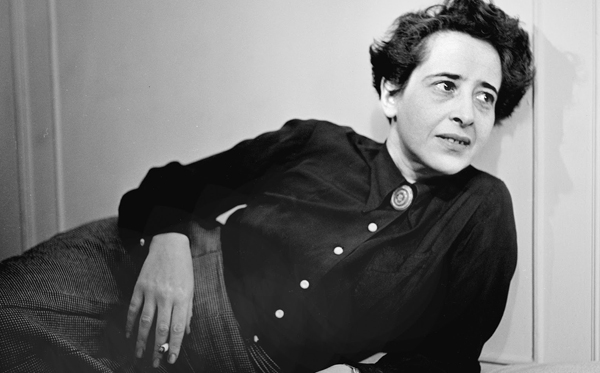
Hannah Arendt, cigarette in hand (Arendt Center, Bard College)

W.J. Astore

(This is part 2 of 2 of an essay dealing with lying, politics, and war, inspired by Hannah Arendt’s writings on The Pentagon Papers.  For part 1, click here.)

After the Vietnam War, the U.S. government oversaw the creation of a post-democratic military, one that was less tied to the people, meaning that the government had even less cause to tell the truth about war.  Unsurprisingly, then, the hubris witnessed in Vietnam was repeated with Iraq, together with an even more sweeping ability to deny or disregard facts, as showcased best in a statement by Karl Rove in 2004.  The actions of the Bush/Cheney Administration, Rove suggested, bypassed the fact- or “reality-based” community of lesser humans precisely because their premises (the need to revolutionize the Middle East and to win the War on Terror through violence) were irrefutable and their motives unimpeachable.  In Rove’s words:

We’re an empire now, and when we act, we create our own reality. And while you’re studying that reality—judiciously, as you will—we’ll act again, creating other new realities, which you can study too, and that’s how things will sort out. We’re history’s actors…and you, all of you, will be left to just study what we do.

So it was that the Bush/Cheney administration manufactured its own “facts” to create its own “reality,” as the Downing Street Memo revealed (according to a senior British official, U.S. intelligence was “fixed” in 2002 to justify a predetermined decision to invade Iraq in 2003).  Dubious intelligence about yellowcake uranium from Africa and mobile biological weapons production facilities in Iraq (both later proved false) became “slam dunk” proof that Iraq had active programs of WMD development.  These lies were then cited to justify a rapid invasion.  That there were no active WMD programs in Iraq meant there could be no true “mission accomplished” moment to the war – a fact George W. Bush lampooned by pretending to  “search” for WMD at the White House Correspondents’ Dinner in 2004.  In this case, lies and self-deception coalesced in a wincing performance before chuckling Washington insiders that recalled the worst of vaudeville, except that Americans and Iraqis were dying for these lies.

Subsequent policy decisions in post-invasion Iraq didn’t fit the facts on the ground because those facts were simply denied.  Then-Secretary of Defense Donald Rumsfeld said in July 2003 he didn’t do quagmires even as Iraq was becoming one for U.S. forces.  Two years later, then-Vice President Cheney claimed the Iraq insurgency was “in the last throes” even as insurgent attacks began to accelerate.  Lies and deception, to include self-deception, doomed the U.S. government to quagmire in Iraq, just as it had in Vietnam forty years earlier.  Similar lies continue to bedevil U.S. efforts in Iraq today, as well as in Afghanistan and many other places.

Even as official lies and deception spread, whistleblowers who stepped forward were gagged and squashed.  Chelsea Manning, Stephen Kim, and John Kiriakou were imprisoned; Edward Snowden was forced into permanent exile in Russia. Meanwhile, officials who toed the government line, who agreed to dissemble, were rewarded.  Whether under Bush or Obama, government officials quickly learned that supporting the party line, no matter how fanciful, was and is rewarded – but that truth-telling would be punished severely.

Lying and Self-Deception Today

How are U.S. officials doing at truth-telling today?  Consider the war in Afghanistan.  Now in its 15th year, regress, not progress, is the reality on the ground.  The Taliban controls more territory than ever, the drug trade is exploding, and Afghan forces remain unreliable.  Yet the U.S. government continues to present the Afghan war as winnable and the situation as steadily improving.

Similarly, consider the war on terror, nowadays prosecuted mainly by drones and special ops.  Even as the U.S. government boasts of terrorists killed and plots prevented, radical Islam as represented by ISIS and the like continues to spread.  Indeed, as terrorism expert David Kilcullen recently admitted, ISIS didn’t exist until U.S. actions destabilized and radicalized Iraq after 2003.  More than anything, U.S. intervention and blundering in Iraq created ISIS, just as ongoing drone strikes and special ops raids contribute to radicalization in the Islamic world.

Today’s generation of “best and brightest” problem-solvers believes U.S. forces cannot withdraw from Afghanistan without the Afghan government collapsing, hence the misleading statements about progress being made in that war.  Radical Islamic terrorists, they believe, must be utterly destroyed by military means, hence deceptive statements about drone strikes and special ops raids as eliminating terrorism.

Accompanying lies and deception about progress being made in wars is image manipulation.  Military action inoculates the Washington establishment, from President Obama on down, from (most) charges of being soft on terror (just as military action against North Vietnam inoculated John F. Kennedy and Lyndon B. Johnson against charges of being soft on communism).  It also stokes the insatiable hunger of the military-industrial complex for bottomless resources and incessant action, a complex that the current crop of Republican and Democratic candidates for president (Bernie Sanders excepted) have vowed to feed and expand.

Whether in Vietnam, Iraq, or in the war on terror today, lying and self-deception have led to wrongheaded action and wrongful lessons.  So, for example, rather than facing the quagmire of Afghanistan and extricating itself from it, Washington speaks of a generational war and staying the course until ultimate victory.  Instead of seeing the often counterproductive nature of violent military strikes against radical Islam, Washington calls for more U.S. troops, more bombing, more “shock and awe,” the approach that bred the Islamic State in the first place.

One thing is certain: The U.S. desperately needs leaders whose judgment is informed by uncomfortable truths.  Comfortable lies have been tried before, and look what they produced: lots of dead people, lost wars, and a crippling of America’s ability to govern itself as a democracy.

More than ever, hard facts are at a premium in U.S. politics.  But the higher premium is the exorbitant costs we pay as a people, and the pain we inflict on others, when we allow leaders to make lies and deception the foundation of U.S. foreign policy.

The Vietnam War, the Pentagon Papers, and Lying

Arendt
Hannah Arendt (Arendt Center at Bard College)

W.J. Astore

In November 1971, the political philosopher Hannah Arendt published “Lying in Politics: Reflections on the Pentagon Papers” in the New York Review of Books.  Earlier that year, Daniel Ellsberg had shared those highly classified government papers with the U.S. media.  They revealed a persistent and systematic pattern of lying and deception by the government about U.S. progress in the Vietnam War.  By undermining the people’s trust in government, lies and deception were destabilizing democracy in America, Arendt said.  Furthermore, America was witnessing two new and related categories of lying.  The first was lying as public relations, the creation and distribution of images substituting for facts and premised in human manipulability (a Madison Avenue approach to war and foreign policy).  The second was lying tied to a country’s reputation as embraced by professional “problem-solvers” as the basis for political action.  Both categories of lying constituted a crisis to the republic.

Widespread lying during the Vietnam War, Arendt explained, had not been aimed at the enemy, as lies often are in war.  Rather, governmental lying had targeted Americans.  The enemy could hardly be fooled, but most Americans could – at least for a time.  Throughout the war, Arendt noted, senior U.S. government and military officials made decisions about Vietnam with the firm knowledge they could not be carried out, a form of self-deception facilitated by constant goal-shifting.  As goals changed and chaos mounted, U.S. officials then became driven by concerns about saving face.  Image-making and image-saving took precedence over reality. The truth about Vietnam – that the U.S. was losing the war – hurt, therefore it was denied, especially in public discourse.

Official lies can fool even the officials themselves, a fact Pulitzer prize-winning reporter David Halberstam noted in his prescient book, “The Making of a Quagmire,” published in 1965.  With respect to the Kennedy Administration’s support of the corrupt Diem/Nhu government of South Vietnam, Halberstam wrote that:

Having failed to get [the Diem/Nhu regime to make needed] reforms, our officials said that these reforms were taking place; having failed to improve the demoralized state of the [South] Vietnamese Army, the Americans talked about a new enthusiasm in the Army; having failed to change the tactics of the [South Vietnamese] military, they talked about bold new tactics which were allegedly driving the Communists back.  For the essence of our policy was: There is no place else to go.

When reporters began to file stories which tended to show that the [U.S.] policy was not working, its authors, President Kennedy and General [Maxwell] Taylor, clung to it stubbornly.  At least part of the explanation for this apparent blindness is that although they knew things were going wrong, they felt that the alternatives were worse.

This “blindness,” a sustained willingness to deny harsh truths about the Vietnam War, persisted throughout the Kennedy, Johnson and Nixon administrations.  U.S. leaders continued to package and sell a losing effort as a winning product. It helped, in Arendt’s words, that U.S. officials had “a truly amazing and entirely honest ignorance of the historically pertinent background” when it came to Vietnam.  Their ignorance was “honest” in the sense they did not believe facts were all that important to success.  What was needed, U.S. officials concluded, were not incontestable facts but the right premises, hypotheses, and theories (such as the infamous Domino Theory) to fit Vietnam within prevailing Cold War orthodoxies.  Overwhelming applications of U.S. military power would serve to actuate these premises, facts be damned.

Upon taking power in 1969, the Nixon Administration, which had promised a quick and honorable end to the war, continued the lies of previous administrations.  Even as Nixon and Henry Kissinger spoke publicly of peace with honor, they talked privately of a lost war.  To shift the blame for defeat, they cast about for scapegoats (as corroborated recently in the HBO documentary, “Nixon by Nixon: In His Own Words”).  Kissinger settled on South Vietnamese “incompetence” as the primary scapegoat.  He reassured Nixon that, after a “decent interval” between U.S. withdrawal and the inevitable South Vietnamese collapse, most Americans would come to see Vietnam as a regrettable (and forgettable) “backwater.”  Naturally, harsh facts such as these were ones Nixon and Kissinger refused to share with the American people.

For Hannah Arendt, truth as represented by verifiable facts is the chief stabilizing factor in politics.  Lacking truths held in common, action is compromised, judgment is flawed, reality is denied.  Deception feeds self-deception until politics is poisoned and collective action for the common good is disrupted.  Yet lies cannot be eliminated simply by moral outrage, Arendt noted.  Rather, truth must be fought for even as humility before truth must be cultivated.

The American people must fight for the truth: that is the lesson of Arendt’s essay.

Next Week: Part II: More Lies and Deception in the Iraq War of 2003

The Missions Unaccomplished Force

060503_MI3_hmed_1p.grid-6x2
At least we win in Hollywood …

Tom Engelhardt.  Introduction by W.J. Astore.

Colonel (retired) Andrew Bacevich has a new article at TomDispatch as well as a new book on America’s War for the Greater Middle East (my copy is already coming in the mail). Bacevich’s main point in his latest article couldn’t be more clear: Congressional cowardice.  Congress refuses to exercise the people’s authority over presidential warmaking, a gross dereliction of duty that ensures perpetual wars with missions perennially left unaccomplished.  And that is the theme of Tom Engelhardt’s introduction to Bacevich’s article.

You’ve heard of the Impossible Missions Force, or IMF, which somehow always gets the job done, whether led by Martin Landau or Peter Graves or Tom Cruise?  Well, that’s Hollywood.  In the real world, we have the MUF, or Missions Unaccomplished Force.  Yes, they always muff it, no matter if the “Decider” is the strutting George W. Bush or the cool and calculating Barack Obama.  But let Tom Engelhardt tell the tale …  W.J. Astore  

The Missions Unaccomplished Force, by Tom Engelhardt

It was a large banner and its message was clear.  It read: “Mission Accomplished,” and no, I don’t mean the classic “mission accomplished” banner on the USS Abraham Lincoln under which, on May 1, 2003, President George W. Bush proudly proclaimed (to the derision of critics ever since) that “major combat operations in Iraq have ended.”  I’m actually referring to a September 1982 banner with those same two words (and an added “farewell” below them) displayed on a landing craft picking up the last Marines sent ashore in Beirut, Lebanon, to be, as President Ronald Reagan put it when they arrived the previous August, “what Marines have been for more than 200 years — peace-makers.”  Of course, when Bush co-piloted an S-3B Viking sub reconnaissance Naval jet onto the deck of the Abraham Lincoln and made his now-classic statement, major combat had barely begun in Iraq (and it has yet to end) — nor was it peace that came to Beirut in September 1982: infamously, the following year 241 Marines would die there in a single day, thanks to a suicide bomber.

“Not for the last time,” writes Andrew Bacevich in his monumental new work, America’s War for the Greater Middle East: A Military History, “the claim proved to be illusory.”  Indeed, one of the grim and eerie wonders of his book is the way in which just about every wrongheaded thing Washington did in that region in the 14-plus years since 9/11 had its surprising precursor in the two decades of American war there before the World Trade Center towers came down.  U.S. military trainers and advisers, for example, failed (as they later would in Iraq and Afghanistan) to successfully build armies, starting with the Lebanese one; Bush’s “preventive war” had its predecessor in a Reagan directive called (ominously enough given what was to come) “combating terrorism”; Washington’s obsessive belief of recent years that problems in the region could be solved by what Andrew Cockburn has called the “kingpin strategy” — the urge to dismantle terror organizations by taking out their leadership via drones or special operations raids — had its precursor in “decapitation” operations against Muammar Gaddafi, Saddam Hussein, and Somali warlord Mohamed Farrah Aidid with similar resulting mayhem.  The belief that “an additional increment of combat power might turn around a failing endeavor” — call it a “surge,” if you will — had its Iraq and Afghan pretrial run in Somalia in 1993.  And above all, of course, there was Washington’s unquenchable post-1980 urge to intervene, military first, in a decisive way throughout the region, which, as Bacevich writes, only “produced conditions conducive to further violence and further disorder,” and if that isn’t the repetitive history of America’s failed post-2001 wars in a nutshell, what is?

As it happened, the effects of such actions from 1980 on were felt not just in the Greater Middle East and Africa, but in the United States, too.  There, as Bacevich writes today, war became a blank-check activity for a White House no longer either checked (in any sense) or balanced by Congress.  Think of it as another sad tale of a surge (or do I mean a decapitation?) that went wrong.

Why Are PTSD Rates So High Among Veterans?

kalkriese_mask
One of the many masks of war

W.J. Astore

Post-traumatic stress disorder (PTSD) is a major problem among veterans who fought in Iraq and Afghanistan.  The VA government web site explains that “OEF/OIF service members are at risk for death or injury. They may see others hurt or killed. They may have to kill or wound others. They are on alert around the clock. These and other factors can increase their chances of having PTSD or other mental health problems.”  The site goes on to say that “Research on OEF/OIF Veterans suggests that 10% to 18% of OEF/OIF troops are likely to have PTSD after they return.” (OEF and OIF are acronyms for the wars in Afghanistan and Iraq.)

That’s a lot of veterans.  Hundreds of thousands, potentially.  Why is this number so high?  Is there something uniquely bad or intense about wars in Iraq or Afghanistan?  We can point to several factors, to include constant redeployments – four or five were not uncommon – on high-risk and high-stress missions, only to witness regress instead of progress.  Add to this the everyday shifts between secure bases and insecure field ops (as with air crews in World War II), direct electronic connections to home (which can prove discomforting rather than reassuring), and transitions from battlefront to homefront that are often too rapid for bodies and minds to adjust.  Finally, we’re witnessing better diagnosis (think of the “epidemic” of concussions in the NFL, which is much more about better recognition of the symptoms rather than an explosion in cases).  Small wonder there’s almost a pandemic of PTSD cases among the troops.

Are today’s troops not adequately prepared to handle the stresses of war?  Were warriors of the past somehow different?  A colleague, the classicist Steven Willett, explained that within ancient Greece there’s no direct evidence of warriors suffering from what we today term PTSD (though doubtless men suffered physical and mental anguish in the aftermath of brutal physical combat associated with Greek phalanxes).

In Willett’s words,

The evidence [of PTSD] is nonexistent because their [the Greek’s] emotional attitude to service and death for the state is not ours.  One way to appreciate this is to look carefully at the beautiful funeral sculptures set up in the Kerameikos of Athens after the first years of the Peloponnesian War.  Dead soldiers stand serenely in the confidence of having done their duty, perhaps with a favorite dog or horse by them, and the parents looking on never betray grief.  The emotional ambience is calm, the tears long shed, the family proud in its sorrow.  A lot of these funeral sculptures are available on line, but the best are in National Archaeological Museum of Athens.  The families and relatives of Spartan soldiers who had died [are] nobly celebrated, while those of the survivors almost mourned.  Think of Thermopylae.

It got me thinking anew about America’s current wars, and how these wars – unlike those for the Greeks – are not directly for communal defense.  Nor are America’s wars fought by communities, not when 99% of Americans exempt themselves from military service.  In Greek society, all able-bodied men believed it to be both duty and honor to wield shield and spear to defend their communities.  (Socrates was one of them.)  In America today, “support” for the troops often begins and ends with a bumper sticker.

Shared sacrifice for communal ideals: such common purpose doubtless acted as a cushion for the physical and mental blows inflicted in Greek warfare.  No matter the era, troops in combat see and experience horrible things, but the trauma is arguably easier to process when blows are cushioned by necessity, and softened by sacrifices shared within tightknit communal settings.

And that’s precisely what’s lacking in the USA today: a sense that our overseas wars are for a communal cause, for honored ideals held in common.  (Other than a vague sense of protecting the “homeland” from “terrorists.”)  The lack of a strongly held communal cause/purpose for our wars ultimately contributes, I believe, to PTSD rates among our returning veterans.  A sense of confusion – why did I suffer – what was it for, intensified by bitterness – my suffering wasn’t worth it – I killed people and saw my buddies killed and it was all for nothing, plagues the troops that our government sends to war ostensibly in our name.

The military historian Sir Michael Howard quotes Carl von Clausewitz on the larger meaning of war.  War, Clausewitz wrote, “cannot be divorced from political [communal] life; and whenever this occurs in our thinking about war, the many links that connect the two elements [of political purpose and war] are destroyed and we are left with something pointless and devoid of sense.”

If we want to lower PTSD rates, the easiest way is to stop sending troops to war, full stop.  And the second easiest way is to stop sending troops to pointless wars that are devoid of political or communal sense.  Wars that serve no larger communal purpose lack meaning.  And where meaning is debased, so too is our troops’ ability to deal with wars in all their horrors.

The Right Approach to Terrorism

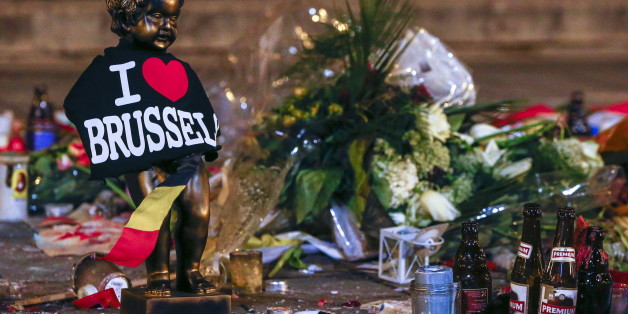
A replica of the Manneken-Pis statue, a major Brussels tourist attraction, is seen among flowers at a memorial for the victims of bomb attacks in Brussels metro and Brussels international airport of Zaventem, in Brussels
Replica of the Manneken-Pis statue, a major Brussels attraction, among flowers at a memorial for the victims of bomb attacks in Brussels. REUTERS/Yves Herman

W.J. Astore

I grew up during the Cold War when America’s rivalry with the Soviet Union posed a clear and present danger to our country’s very existence.  Since the collapse of the USSR, or in other words the last 25 years, the U.S. has not faced an existential threat.  Of course, the terrorist attacks on 9/11 were shocking and devastating, as were recent attacks in Paris and Brussels.  But terrorism was and is nothing new.  We faced it in the 1970s and 1980s, and indeed we will probably always face it.  The question is how best to face it.

Stoking fear among the people is the wrong way to face it.  Restricting liberty is the wrong way.  An overly kinetic approach (i.e. lots of bombs and bullets) is the wrong way.  Invading the Middle East (yet again) is the wrong way.  Most of counter-terrorism, it seems to me, is an exercise in intelligence and policing (national and international).  Yet we seem always to turn to our military to solve problems.  The emphasis is relentlessly tactical/operational, stressing how many terrorists we kill in drone strikes and special ops raids (a version of the old “body count” from the Vietnam War era).

Military strikes and raids generate collateral damage and blowback, arguably creating more enemies than they kill.  We’re helping to sustain a perpetual killing machine, a feedback loop.  The more we “hit” various enemies while playing up the dangers of terrorism, especially in the media, the more they prosper in regards to attention (and recruits) they garner.

One of the first Rand primers I read as young Air Force lieutenant was “International Terrorism: The Other World War,” written by Brian M. Jenkins in 1985.  Jenkins made many excellent points: that terrorists seek to instill fear, that their acts are mainly “aimed at the people watching,” that terrorism can’t be defeated like traditional (uniformed) enemies, that terrorists commit crimes for a larger political purpose (“causing widespread disorder, demoralizing society, and breaking down existing social and political order”), that terrorism is a form of political theater.  As Jenkins notes:

“Terrorism attracts intense interest but produces little understanding.  News coverage focuses on action not words.  Terrorist incidents attract the media because they are genuine human dramas, different from ordinary murder and therefore newsworthy. “

Furthermore, “terrorists provide few lucrative targets for conventional military attack,” though this may be less true of state-sponsored terrorism.

What can we learn from Jenkins’s primer on terrorism?  Three big lessons:

  1. Deny the terrorists their victory by refusing to succumb to fear. In short, don’t panic.  And don’t exaggerate the threat.
  2. Don’t sensationalize the feats of terrorists in 24/7 media coverage of their attacks. That’s what the terrorists want.  They want extensive media coverage, not only to shift public opinion and to spread fear, but also to recruit new members.
  3. Finally, don’t change your way of life, your political system, your liberties, in response to terrorism. Abridging freedoms or marginalizing people (e.g. American Muslims) in the name of attacking terrorism is exactly what the terrorists want.  They want to turn people against one another.  To divide is to conquer.

The question is, when will Americans recognize the complexity of the terrorist threat while minimizing fear and over-reaction?

Terrorists need to be stopped, and that requires robust intelligence gathering, strong policing, and selective military action.  But threat inflation, media hysteria, and militarized over-reaction simply play into the terrorists’ hands.  Fear is the mind-killer, as Frank Herbert wrote.  Let us always remember this as we face the terrorist threat with firmness and resolve.

Above the people, beside the people, against the people

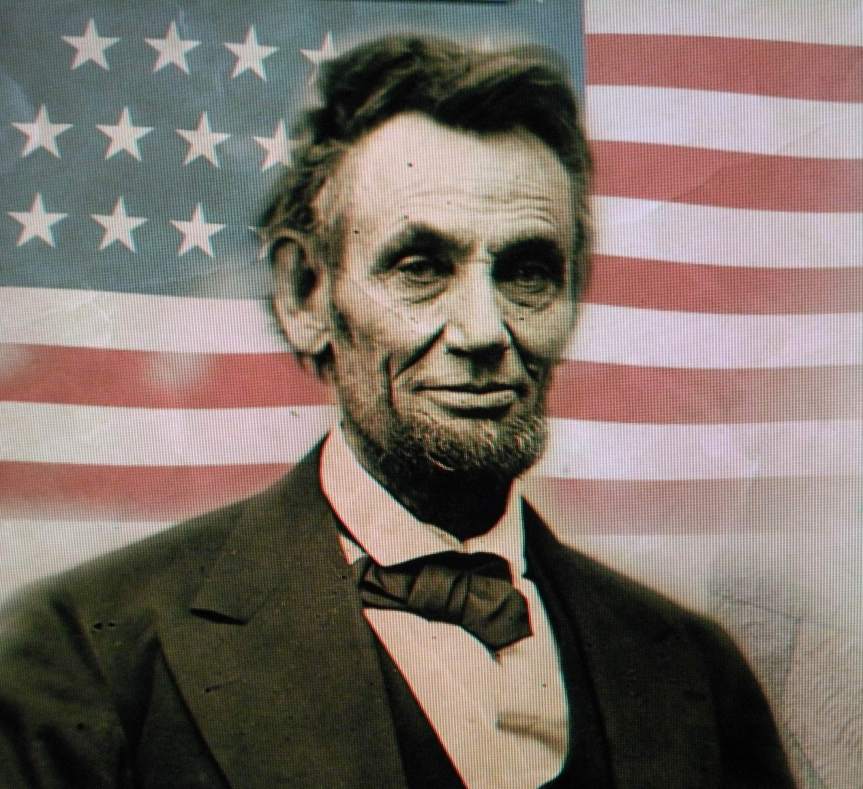
abe

W.J. Astore

Remember when Abraham Lincoln wrote about our government as being “of the people, by the people, for the people”?  Even after 150 years, those words still resonate, but they are increasingly less true.  Today, our government places itself above the people, and when the government is not working against the interests of (most of) the people, it acts as if the people’s interests are beside the point.

We’ve entered a new historical moment in America, which is precisely the point of Tom Engelhardt’s latest essay at TomDispatch.com.  As Engelhardt notes, our electoral process is “part bread-and-circuses spectacle, part celebrity obsession, and part media money machine.” Our foreign policy, and increasingly our domestic policy as well, is dominated by the national security state, the one leviathan in our government that is never paralyzed.  The political process itself is ever more divisive, polarized, and disconnected from the hardships faced by the working and middle classes.  Even planetary dangers such as climate change are either denied or ignored, as if denial or ignorance will keep seas and temperatures from rising.

The very disconnection of our government from painful realities explains in part the appeal of “maverick” candidates like Donald Trump and Bernie Sanders.  Yes, they are two very different men, but what they have in common is their willingness to take the side of ordinary Americans, who have seen their standard of living stagnate or drop over the last thirty years.  Trump says he wants to make America great again: the implicit message is that we pretty much suck now, that we are a nation in decline, and that the sooner we admit it, the sooner we can take action to restore America to greatness.  Sanders says he wants a future we can believe in, which is at its core much like Trump’s message.  America has serious problems, both men are saying, but greatness is still within our grasp if only we act together as a people.

Again, much separates Trump and Sanders, yet both are willing to admit the times are bad for many hardworking Americans.  What they’re saying is this: the American dream is increasingly a nightmare.  And part of the nightmare is a government that doesn’t act in the people’s interests because it’s been co-opted by special interests.  A government that can’t even do its job, such as to declare war or to advise on a Supreme Court nominee, in accordance with its Constitutional duties.

The promise and potential of our country remains.  But that promise, that potential, is being squandered by an alliance of various interests that are no longer responsive to the people.  If not dead, representative democracy in America is on life support.  Unless we can reinvigorate it, as Engelhardt notes in his article, we will continue to suffer a decline analogous to the declines of other great empires (think Rome, for example).  The difference today is the possibility of planetary-wide destruction, whether quickly from nuclear weapons or slowly from climate change.

Never was a revival in American democracy more urgently needed, not only for ourselves, but for the world.

“Members of the jury, you have just found Jesus Christ guilty”: Remembering the Catonsville Nine

IMG_0518

W.J. Astore

In May 1968, nine Catholic activists set fire to draft records in Catonsville, Maryland, in a deliberate act of sabotage and protest against the Vietnam War.  For the crime of destroying government property, a crime they freely admitted, they were tried in federal court in Baltimore and found guilty.  I’ve been reading the edited trial transcript (with commentary) by Daniel Berrigan, one of the Catonsville Nine and a Catholic priest.  What unified these nine people was their moral opposition to the Vietnam War, a moral revulsion to the acts their country was committing in Vietnam, a revulsion that drove them to burn draft records with a weak brew of homemade napalm so as to gain the attention of their fellow citizens.

On this Easter Weekend, I would like to focus on a few of the statements made by the Catonsville Nine, as recorded by Daniel Berrigan in “The Trial of the Catonsville Nine.”

Statement by Philip Berrigan

We have been accused of arrogance
But what of the fantastic arrogance … of our leaders
What of their crimes against the people … the poor and powerless
Still no court will try them … no jail will receive them
They live in righteousness … They will die in honor
For them we have one message … for those
in whose manicured hands … the power of the land lies
We say to them
Lead us … Lead us in justice
and there will be no need to break the law
Let the President do … what his predecessors failed to do
Let him obey the rich less … and the people more
Let him think less of the privileged
and more of the poor
Less of America and more of the world
Let lawmakers … judges … and lawyers
think less of the law … more of justice
less of legal ritual … more of human rights …

Statement by Thomas Lewis

We were speaking as Americans
We were proud to be Americans
Yet we have representatives in Vietnam
who do terrible things in our name
We were saying to the military
This is wrong … This is immoral … This is illegal
And their response to this was
they were only obeying orders

Question from the Judge: But they did respond to you, did they not?

Thomas Lewis: It was an atrocious response.

Statement by Marjorie Melville

I know that burning draft files
is not an effective way
to stop a war … but
who has found a way
of stopping this war
I have racked my brain
I have talked to all kinds of people
What can you do
They say yes … yes
But there is no answer
no stopping it
the horror continues

Statement by Thomas Melville

I hear our president … confuse greatness with strength
riches with goodness … fear with respect
hopelessness and passivity with peace
The clichés of our leaders
pay tribute to property … and indifference to suffering
We long for a hand of friendship and succor
and that hand
clenches into a fist
I wonder how long we can endure

Statement by George Mische

We were not out to destroy life
There is a higher law we are commanded to obey
It takes precedence over human laws
My intent was to follow the higher law
My intent was to save lives … Vietnamese lives
North and South American lives
To stop the madness
That was the intent

Statement of Daniel Berrigan

Question from the Judge: You say your intention was to save these children, of the jury, of myself, when you burned the [draft] records?  That is what I heard you say.  I ask if you meant that.

Daniel Berrigan:

I meant that
of course I mean that
or I would not say it
The great sinfulness
of modern war is
that it renders concrete things abstract
I do not want to talk
about Americans in general ….
I poured napalm [on the draft records]
on behalf of the prosecutor’s
and the jury’s children

Closing Statement by Daniel Berrigan

When at what point will you say no to this war?
We have chosen to say
with the gift of our liberty
if necessary our lives:
the violence stops here
the death stops here
the suppression of truth stops here
this war stops here
Redeem the times!
The times are inexpressibly evil
Christians pay conscious … indeed religious tribute
to Caesar and Mars
by the approval of overkill tactics … by brinksmanship
by nuclear liturgies … by racism … by support of genocide
They embrace their society with all their heart
and abandon the cross
They pay lip service to Christ
and military service to the powers of death
And yet … and yet … the times are inexhaustibly good
solaced by the courage and hope of many
The truth rules … Christ is not forsaken …

At the end of the trial, as all nine defendants were found guilty, a “member of the audience” cried, “Members of the jury, you have just found Jesus Christ guilty.”

That last statement, and the words of the Catonsville Nine, give us much to ponder on this Easter Weekend.

The Next Commander-in-Chief

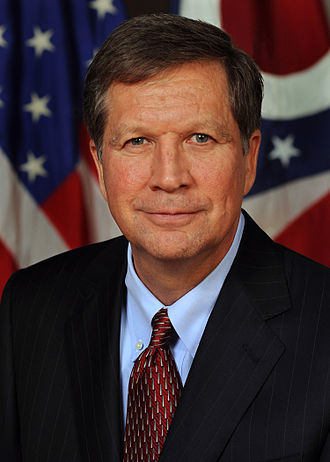
Governor_John_Kasich
John Kasich

W.J. Astore

A reader wrote to ask my opinion on which presidential candidate would make the best commander-in-chief.  This is a speculative exercise, of course, but why not speculate? I’ve watched most of the debates and have a sense of the candidates, though of course I’ve never met them and have no direct experience with them.  (I once shook President Bill Clinton’s hand, and saw Hillary in the background, but that’s a story for another day.)  So let’s take the five remaining candidates in alphabetical order:

Hillary Clinton: Often wrong and too hawkish, which is a bad combination. She was wrong on the Iraq War, wrong on Libya, and unapologetic in her fondness for Henry Kissinger. Under Clinton, I see more wasteful military interventions.

Ted Cruz: Far too eager to use military force.  You’ll recall his posturing about “carpet bombing” and making the sand “glow” in the Middle East, apparently by using nuclear weapons.  The recent terrorist attacks in Belgium have him calling for a police state in U.S. neighborhoods where Muslim-Americans live.

John Kasich: Has experience working military matters while in Congress (18 years on the House Armed Services Committee).  Has executive experience as a governor.  Has had the temerity to criticize the Saudis for supporting radical elements in Islam.  Has opposed wasteful weapons systems (the B-2 and A-12, for example).  Speaks carefully and appears to be temperamentally suited to the job.

Bernie Sanders: He was right to oppose the Iraq War.  Thinks for himself.  Not a slave to neoconservative interventionism.  Yet he lacks experience dealing with the military and with foreign policy.  Has the capacity for growth.

Donald Trump: Lacks an understanding of the U.S. Constitution and his role and responsibilities as commander-in-chief.  Though he has shown a willingness to depart from orthodoxies, e.g. by criticizing the Iraq War and the idea of nation-building, Trump’s temperament is highly suspect.  His bombast amplified by his ignorance could make for a deadly combination.  Hysterical calls for medieval-like torture practices are especially disturbing.

Of the five major candidates, and with Sanders somewhat of a blank slate, I think John Kasich has the best potential — in the short-term — to be an effective commander-in-chief.  This does not mean that I support Kasich for president, for I object to several of his domestic policies.

Not exactly a “bracing view,” perhaps, but it’s my honest attempt to answer a reader’s question.  I do think Sanders has considerable potential to be an excellent commander-in-chief because he possesses moral courage.

Sadly, the odds of either Kasich or Sanders winning in November seem very long indeed.

America’s Post-Democratic Military

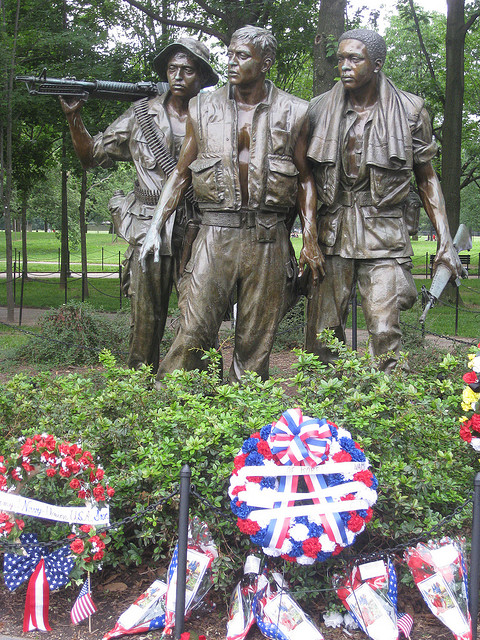
Three_soldiers
America’s citizen-military no longer exists

W.J. Astore

In October 2005, during the Iraq War, historian David M. Kennedy noted that “No American is now obligated to military service, few will ever serve in uniform, even fewer will actually taste battle …. Americans with no risk whatsoever of exposure to military service have, in effect, hired some of the least advantaged of their fellow countrymen to do some of their most dangerous business while the majority goes on with their own affairs unbloodied and undistracted.”

We have, in essence, a post-democratic military in the U.S. today, which is the subject of my latest article for TomDispatch.com.  You can read the entire article here; what follows is the first section on how our citizen-soldier tradition morphed into a professional force of volunteer-warriors augmented by privatized forces of mercenaries and corporations.

From TomDispatch.com:

In the decades since the draft ended in 1973, a strange new military has emerged in the United States. Think of it, if you will, as a post-democratic force that prides itself on its warrior ethos rather than the old-fashioned citizen-soldier ideal.   As such, it’s a military increasingly divorced from the people, with a way of life ever more foreign to most Americans (adulatory as they may feel toward its troops).  Abroad, it’s now regularly put to purposes foreign to any traditional idea of national defense.  In Washington, it has become a force unto itself, following its own priorities, pursuing its own agendas, increasingly unaccountable to either the president or Congress.

Three areas highlight the post-democratic transformation of this military with striking clarity: the blending of military professionals with privatized mercenaries in prosecuting unending “limited” wars; the way senior military commanders are cashing in on retirement; and finally the emergence of U.S. Special Operations Command (SOCOM) as a quasi-missionary imperial force with a presence in at least 135 countries a year (and counting).

The All-Volunteer Military and Mercenaries: An Undemocratic Amalgam

I’m a product of the all-volunteer military.  In 1973, the Nixon administration ended the draft, which also marked the end of a citizen-soldier tradition that had served the nation for two centuries.  At the time, neither the top brass nor the president wanted to face a future in which, in the style of the Vietnam era just then winding up, a force of citizen-soldiers could vote with their feet and their mouths in the kinds of protest that had only recently left the Army in significant disarray.  The new military was to be all volunteers and a thoroughly professional force.  (Think: no dissenters, no protesters, no antiwar sentiments; in short, no repeats of what had just happened.)  And so it has remained for more than 40 years.

Most Americans were happy to see the draft abolished.  (Although young men still register for selective service at age 18, there are neither popular calls for its return, nor serious plans to revive it.)  Yet its end was not celebrated by all.  At the time, some military men advised against it, convinced that what, in fact, did happen would happen: that an all-volunteer force would become more prone to military adventurism enabled by civilian leaders who no longer had to consider the sort of opposition draft call-ups might create for undeclared and unpopular wars.

In 1982, historian Joseph Ellis summed up such sentiments in a prophetic passage in an essay titled “Learning Military Lessons from Vietnam” (from the book Men at War):

“[V]irtually all studies of the all-volunteer army have indicated that it is likely to be less representative of and responsive to popular opinion, more expensive, more jealous of its own prerogatives, more xenophobic — in other words, more likely to repeat some of the most grievous mistakes of Vietnam … Perhaps the most worrisome feature of the all-volunteer army is that it encourages soldiers to insulate themselves from civilian society and allows them to cling tenaciously to outmoded visions of the profession of arms.  It certainly puts an increased burden of responsibility on civilian officials to impose restraints on military operations, restraints which the soldiers will surely perceive as unjustified.”

Ellis wrote this more than 30 years ago — before Desert Storm, the invasions of Afghanistan and Iraq, or the launching of the War on Terror.  These wars (and other U.S. military interventions of the last decades) have provided vivid evidence that civilian officials have felt emboldened in wielding a military freed from the constraints of the old citizen army.  Indeed, it says something of our twenty-first-century moment that military officers have from time to time felt the need to restrain civilian officials rather than vice versa.  Consider, for instance, Army Chief of Staff General Eric Shinseki’s warning early in 2003 that a post-invasion Iraq would need to be occupied by “several hundred thousand” troops.  Shinseki clearly hoped that his (all-too-realistic) estimate would tamp down the heady optimism of top Bush administration officials that any such war would be a “cakewalk,” that the Iraqis would strew “bouquets” of flowers in the path of the invaders, and that the U.S. would be able to garrison an American-style Iraq in the fashion of South Korea until hell froze over.  Prophetic Shinseki was, but not successful.  His advice was dismissed out of hand, as was he.

Events since Desert Storm in 1991 suggest that the all-volunteer military has been more curse than blessing.  Partially to blame: a new dynamic in modern American history, the creation of a massive military force that is not of the people, by the people, or for the people.  It is, of course, a dynamic hardly new to history.  Writing in the eighteenth century about the decline and fall of Rome, the historian Edward Gibbon noted that:

“In the purer ages of the commonwealth [of Rome], the use of arms was reserved for those ranks of citizens who had a country to love, a property to defend, and some share in enacting those laws, which it was their interest, as well as duty, to maintain. But in proportion as the public freedom was lost in extent of conquest, war was gradually improved into an art, and degraded into a trade.”

As the U.S. has become more authoritarian and more expansive, its military has come to serve the needs of others, among them elites driven by dreams of profit and power.  Some will argue that this is nothing new.  I’ve read my Smedley Butler and I’m well aware that historically the U.S. military was often used in un-democratic ways to protect and advance various business interests.  In General Butler’s day, however, that military was a small quasi-professional force with a limited reach.  Today’s version is enormous, garrisoning roughly 800 foreign bases across the globe, capable of sending its Hellfire missile-armed drones on killing missions into country after country across the Greater Middle East and Africa, and possessing a vision of what it likes to call “full-spectrum dominance” meant to facilitate “global reach, global power.”  In sum, the U.S. military is far more powerful, far less accountable — and far more dangerous.

As a post-democratic military has arisen in this country, so have a set of “warrior corporations” — that is, private, for-profit mercenary outfits that now regularly accompany American forces in essentially equal numbers into any war zone.  In the invasion and occupation of Iraq, Blackwater was the most notorious of these, but other mercenary outfits like Triple Canopy and DynCorp were also deeply involved.  This rise of privatized militaries and mercenaries naturally contributes to actions that are inherently un-democratic and divorced from the will and wishes of the people.  It is also inherently a less accountable form of war, since no one even bothers to count the for-profit dead, nor do their bodies come home in flag-draped coffins for solemn burial in military cemeteries; and Americans don’t approach such mercenaries to thank them for their service.  All of which allows for the further development of a significantly under-the-radar form of war making.

The phrase “limited war,” applied to European conflicts from the close of the Thirty Years’ War in 1648 to the French Revolution in 1789, and later to conventional wars in the nuclear age, has fresh meaning in twenty-first-century America.  These days, the limits of limited war, such as they are, fall less on the warriors and more on the American people who are increasingly cut out of the process.  They are, for instance, purposely never mobilized for battle, but encouraged to act as though they were living in a war-less land.  American war efforts, which invariably take place in distant lands, are not supposed to interfere with business as usual in the “homeland,” which, of course, means consumerism and consumption.  You will find no rationing in today’s America, nor calls for common sacrifice of any sort.  If anything, wars have simply become another consumable item on the American menu.  They consume fuel and resources, money, and intellect, all in staggering amounts.  In a sense, they are themselves a for-profit consumable, often with tie-ins to video games, movies, and other forms of entertainment.

In the rush for money and in the name of patriotism, the horrors of wars, faced squarely by many Americans in the Vietnam War era, are now largely disregarded.  One question that this election season has raised: What if our post-democratic military is driven by an autocrat who insists that it must obey his whims in the cause of “making America great again”?

Come 2017, we may find out.

Charles Darwin Has Much to Teach Us About War

U.S. military intervention in Iraq and the overthrow of Saddam Hussein led to the creation of ISIS. Military intervention in Libya and the overthrow of Gaddafi led to chaos and the spread of ISIS to the region. U.S. military intervention in Afghanistan, which initially dislocated the Taliban, has enabled the return of the Taliban to dominance. Why is this? Partly because the U.S. does not understand the ecology of war. The U.S. sees war as a great simplifier, but events prove that war usually generates complexity and chaos. The U.S. also thinks in the short-term, rarely considering the long-term impacts of military action. These are lessons I attempted to grapple with in this article on Charles Darwin’s ideas about the state of nature and its complexity when it experiences hammer blows of change. This complexity is something that U.S. politicians rarely discuss when they talk about war. The rhetoric of people like Trump, Cruz, and Clinton promotes a bigger, stronger, more aggressive and more violent military. Juvenile thinking about war leads to quagmires and disaster, a price America seems willing to pay as long as war remains far from its shores. But for how much longer? How long before the hammer blows of war ripple across the face of nature to disrupt democracy in America? Indeed, these ripples are already striking home, strengthening militarism in the USA and silencing serious talk of pursuing less violent courses in the world.

wjastore's avatarBracing Views

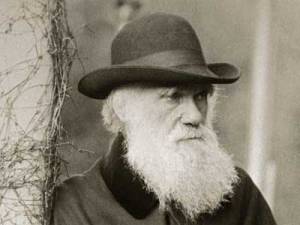
Charles Darwin Charles Darwin

W.J. Astore.  Also at Huff Post.

America’s thinking about military action is impoverished. The U.S. military speaks of precision munitions and surgical strikes, suggesting a process that is controllable and predictable. Experts cite Prussian military theorist Carl von Clausewitz for his axiom that war is a continuation of political discourse with the admixture of violent means. Here, military action is normalized as an extreme form of politics, suggesting again a measure of controllability and predictability.

But what if war is almost entirely imprecise and unpredictable? What if military action and its impacts are often wildly out of line with what the “experts” anticipate? In fact, this is precisely what military history shows, time and time again, to include recent U.S. military actions in Iraq and Afghanistan.

U.S. military action essentially acts like hammer blows that upset the state of nature within the complex ecologies of societies like…

View original post 893 more words