Clinton versus Trump this fall?

trump
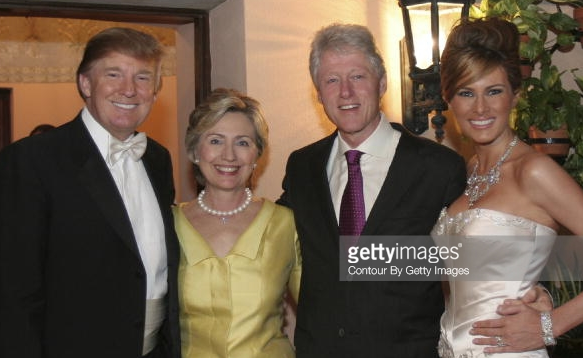
Good chums back in 2005

W.J. Astore

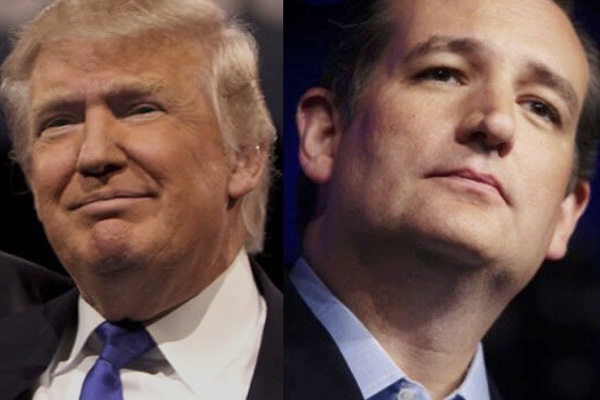
Last night’s primary results suggest it’s Hillary Clinton versus Donald Trump come this fall.  What does this mean for America?

Hillary is the easiest to gauge.  She’s been in politics for a long time and possesses a lengthy and controversial record.  She is of course a transformative candidate, the first female candidate for president from a major party.  That’s where the revolution begins — and ends.  Hillary is a pragmatist who promises a continuation of Obama’s policies.  Even more so than Obama, she is an establishment candidate, well ensconced among Wall Street financiers, K Street lobbyists, and all the other special interests that rule America today through money and power.  If this were 1976, you could well imagine her running as a moderate Republican against a Democratic candidate like Jimmy Carter (or Bernie Sanders).  With respect to foreign policy, she promises a hard line and the continuation of perpetual wars in Iraq, Afghanistan, and elsewhere.

Many liberal Democrats, and more than a few Republicans, will likely vote for her with noses held and fingers crossed.  Mainline Democrats will vote for her based on certain issues, such as Supreme Court vacancies, her pro-choice stance on abortion, and so on.  In a normal election year, an establishment Republican would have a good shot at beating her since Hillary’s negatives are so high.  But this is not a normal year.

Enter Donald Trump.  If Hillary promises more of the same, Trump promises unpredictability.  His simplistic rhetoric about making America great again has obviously resonated, just as Obama’s similarly simplistic message of “hope” and “change” did in 2008.  Trump is a man of (certain) people: unlike Hillary, he’s not a career politician. Unlike Hillary, he’s not tied to the political establishment.  In essence, he’s part wild card, part joker, and his outlandish statements on Muslims and Mexicans and walls and women suggest he’s not playing with a full deck.

No one really knows what a Trump presidency would look like.  I don’t think even Trump knows.  Trump has a habit of speaking off the cuff, of making statements that are more than a little grandiose, partly because he loves to grandstand.  He’s easy to dismiss — all too easy — yet look where he is now, closing in on the Republican nomination despite long odds.

Trump, as I wrote back in July 2015, likes to pose as a proto-fascist.  He likes to boast that the military will follow his orders even if they’re illegal.  (He backed off that statement, but the fact he made it speaks loudly about his judgement.)  On occasion he says something insightful and honest, as when he insisted the Iraq war was a mistake, costing the nation trillions of dollars, or when he attacks poorly negotiated trade deals as hurting working-class Americans.  But with the good comes lots of bad.

A big challenge for Trump this fall will be appearing presidential.  So far his policy knowledge in debates has been a mile wide and an inch deep.  He’s gotten away with this because of the size of the Republican field, but Hillary, the consummate policy wonk, will make mincemeat of him in the fall debates if he continues to speak off the cuff and glide over specifics.

Clinton versus Trump: it’s a grim choice for America.  An establishment oligarch versus a quixotic autocrat.  More of the same versus God knows what.  What they collectively represent is both the decline of progressivism and of conservatism in America.

For now I’m putting my crystal ball aside, except to say that one day (perhaps very soon) Americans may look back with fondness on the eight years Obama was president.

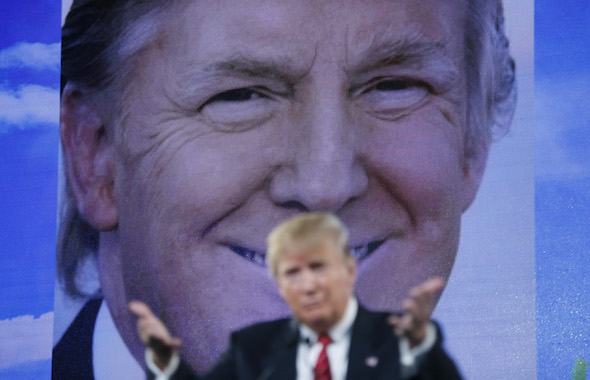
The Bizarre and Scary World of Republicans

11TRANSCRIPTweb-master675
There they go again

W.J. Astore

I watched last night’s Republican debate from Florida (transcript here) and then checked this morning’s coverage from major networks such as NBC and CBS.  The focus of media coverage was the “civility” of this debate compared to previous ones, combined with typical horse race speculations about which candidate won and which lost.

Well, I can’t tell you who won, but I can tell you who lost: the American people lost.

Several lowlights from the debate that stick in my mind:

1. Marco Rubio was asked about climate change and whether human action, such as the emission of greenhouse gases, contributed to it.  Rubio essentially denied that human action had any significant impact on global warming.  The essence of his answer: the climate is changing because the climate always changes.  And the U.S. government can take no action to reduce it.

2.  Donald Trump held to his position on torture.  He believes waterboarding should be used, that laws should be changed to allow harsher means of torture, apparently because the enemy (ISIS) beheads its opponents or drowns them in cages.  He was not challenged on how he would change international laws against torture, nor was he challenged on consistent evidence that torture does not work in efforts to gain accurate intelligence.  Nor were any questions raised about the morality of torture and its proposed expansion if he wins the presidency.

3.  All of the candidates expressed support for sending U.S. ground troops, perhaps 20,000 to 30,000, to combat ISIS in the Middle East.  The situation was presented as a civil war within Islam between radical Sunni and Shia forces, but no candidate explained how U.S. combat forces could win someone else’s civil war, a war driven by fierce ideological differences.  Somehow, magically, the reappearance of big battalions of U.S. troops and massive displays of air power would “shock and awe” radical jihadists into collapse and capitulation.

4.  For the candidates, nothing Obama has done in the last seven years is worthy of the slightest praise.  Obamacare must be repealed.  The Iran nuclear deal is a disaster.  His forthcoming trip to Cuba represents a capitulation to communism.  His executive actions are illegal; all of them must be reversed.

5.  Each candidate tried to best the other on who is more pro-Israel.  According to Trump, “there’s nobody on this stage that’s more pro-Israel than I am.”  Apparently Israel is the only U.S. ally that is worthy of total support and unconditional love by Republican candidates.

6.  Trump refused to qualify his statement that there is “tremendous hate” in the Islamic world directed against the United States.  However, there was no reason given for this hate, and no sense that U.S. military actions overseas, to include invasions, drone strikes, and special ops raids, contribute in any way to Islamic animosity.  The candidates were simply not asked why some, most, or nearly all Muslims “hate” America.

7.  Finally, topics that weren’t discussed at this debate but which are commonly discussed at Democratic debates: racism, shootings by police against Blacks, prison and justice reform, raising the minimum wage, the rising gap between the richest 1% and everyone else, reducing the cost of college education, and efforts to guarantee affordable health care for all.  Nor were women’s issues, such as equal pay for equal work, mentioned.  Indeed, with the exception of Trump’s comment about women being mistreated by the Muslim world, women’s issues simply didn’t exist, not in this debate and not in most of the others.  Indeed, my wife turned to me during a previous Republican debate and said, “Not one of these guys cares one whit about women’s issues — they’re offering us nothing.”

And on that sad yet telling note, I’ll end.


Last Night, Donald Trump Disqualified Himself

Donald Trump
Hail the Leader (Trump at FreedomFest, July 11, 2015 (AP Photo/John Locher)

W.J. Astore

As a retired military officer, I watched last night’s Republican debate from Detroit (transcript here) with a special focus on which candidate is qualified to lead the military as commander-in-chief.  I knew, of course, that Donald Trump had promised in the past to use torture against America’s enemies (last night, he called them “animals”), that he would pursue and kill not only terrorists but their families (apparently because the families always know, according to Trump, what their father/brother/sister is up to, as if there are no secrets in families).  Trump, in short, is an Old Testament “eye for an eye” man: if they behead us, we’ll torture and kill them, end of story.

But Trump was put on the spot when he was asked what he would do if the U.S. military failed to carry out his unlawful orders.  Instead of saying he wouldn’t issue unlawful orders, that he would support and defend the U.S. Constitution, which as president would be his sworn duty to uphold, Trump boasted that the military would follow his orders no matter what.

America: those are the words of a dictator.

Here’s what was said:

BAIER: Mr. Trump, just yesterday, almost 100 foreign policy experts signed on to an open letter refusing to support you, saying your embracing expansive use of torture is inexcusable. General Michael Hayden, former CIA director, NSA director, and other experts have said that when you asked the U.S. military to carry out some of your campaign promises, specifically targeting terrorists’ families, and also the use of interrogation methods more extreme than waterboarding, the military will refuse because they’ve been trained to turn down and refuse illegal orders.

So what would you do, as commander-in-chief, if the U.S. military refused to carry out those orders?

TRUMP: They won’t refuse. They’re not going to refuse me. Believe me.

BAIER: But they’re illegal.

TRUMP: Let me just tell you, you look at the Middle East. They’re chopping off heads. They’re chopping off the heads of Christians and anybody else that happens to be in the way. They’re drowning people in steel cages. And he — now we’re talking about waterboarding.

This really started with Ted, a question was asked of Ted last — two debates ago about waterboarding. And Ted was, you know, having a hard time with that question, to be totally honest with you. They then came to me, what do you think of waterboarding? I said it’s fine. And if we want to go stronger, I’d go stronger, too, because, frankly…

(APPLAUSE)

… that’s the way I feel. Can you imagine — can you imagine these people, these animals over in the Middle East, that chop off heads, sitting around talking and seeing that we’re having a hard problem with waterboarding? We should go for waterboarding and we should go tougher than waterboarding. That’s my opinion.

BAIER: But targeting terrorists’ families?

(APPLAUSE)

TRUMP: And — and — and — I’m a leader. I’m a leader. I’ve always been a leader. I’ve never had any problem leading people. If I say do it, they’re going to do it. That’s what leadership is all about.

Our military does not follow blindly orders issued by “The Leader.” Our military swears an oath to the Constitution.  We swear to uphold the law of the land.  We don’t swear allegiance to a single man (or woman) as president.

Trump’s performance last night reminded me of Richard Nixon’s infamous answer to David Frost about Watergate: “When the president does it, that means it’s not illegal.” No, no, a thousand times no.  The president has to obey the law of the land, just as everyone else has to.  No person is above the law, an American ideal that Trump seems neither to understand nor to embrace.

And that disqualifies him to be president and commander-in-chief.

Might Makes Right: An American Tradition

162111-akmdv

W.J. Astore (also posted at History News Network)

To hear Republican candidates like Donald Trump and Ted Cruz talk, almost any act of violence is justifiable to defeat the enemy. Trump talks of torture, far worse than waterboarding, and total destruction. Cruz ups the ante, speaking of carpet bombing and making the sand glow, apparently via nuclear weapons. Both appear to treat the enemy as inhuman.

Sadly, for America this is nothing new. Just read Bernard Fall on America’s war against Vietnam. In an article for Ramparts (“This Isn’t Munich, It’s Spain”), Fall wrote late in 1965 that the American military strategy in Vietnam was based on massive killing through overwhelming firepower:

The new mix of air war and of land and seaborne firepower in Vietnam is one of technological counter-insurgency — if you keep up the kill rate you will eventually run out of enemies. Or at least armed enemies. Of course, the whole country will hate you, but at least they won’t resist you. What you will get is simply a cessation of resistance — an acquiescence in one’s fate rather than a belief that your side and your ideas have really prevailed.

In other words, America sought to bludgeon the Vietnamese into compliance, rather than winning their hearts and minds through ideas or ideals.

“But what I really fear most,” Fall continued, “is the creation of new ethics to match new warfare. Indications are that a new ethic is already being created, and such influential men as former Secretary of State Dean Acheson have begun to provide its intellectual underpinning.”

Fall cited a speech at Amherst College in 1965 in which Acheson declared:

The end sought by our foreign policy . . . is, as I have said, to preserve and foster an environment in which free societies may exist and flourish. Our policies and actions must be decided by whether they contribute to or detract from achievement of this end. They need no other justification or moral or ethical embellishment. . .

To keep the free world free, America was justified to do anything it desired, irrespective of ethics and morality. Acheson’s words in 1965 have become the essence of U.S. foreign policy today as advanced by men like Trump and Cruz. In short, the end (a “free” society) justifies any means (torture, carpet bombing, perhaps even nuclear weapons) to preserve it.

Fall went on to cite a Pastoral Letter from French Cardinal Feltin in 1960 during France’s war with Algeria. In that letter to French military chaplains, Cardinal Feltin noted:

There cannot be a morality which justifies efficacy by all means, if those means are in formal contradiction with Natural Law and Divine Law. Efficacy, in that case, goes against the very aim it seeks to achieve. There can be exceptional laws for exceptional situations. . . there cannot exist an exceptional morality which somehow takes leave of Natural Law and Divine Law.

Too often in the past as well as today, U.S. foreign policy has taken leave of natural and divine law. The ends do not and should not justify the means, especially when the means (torture, carpet bombing, and the like) contravene the end (a “free” society based on ethical and moral principles).

Rather than posing as protectors of the free world, people like Trump and Cruz should admit their own amorality. They should admit they see the world as a brutal place, occupied by brutes, and that only by slaying those brutes in a brutish way can America preserve its dominant position as chief brute.

Doubtless many of their followers would still salute them for this view. But more reflective souls would see the honesty of Pogo’s famous insight that “We have met the enemy and he is us.”


Today’s Pentagon as an Ant Farm

ant-farm

W.J. Astore

I was on active duty in the military for twenty years.  My experience: It’s very difficult to see the big picture in the military.  The everyday pressures of the mission keep you focused on the short term.  I recall writing many WARs (weekly activity reports) and being focused on the immediate.  Even the yearly budgetary process tends to keep you focused on the short term.  Assignments for officers and enlisted rarely last longer than three years, with combat tours typically much shorter.  Personnel are constantly changing: for one acquisition project I worked on, four program managers (colonels) rotated in and out in three years.

Along with being focused on the immediate, you are actively discouraged from criticizing the system in any fundamental way.  Of course, you’re not supposed to criticize the commander-in-chief, you’re not supposed to be insubordinate to your chain of command, you’re not supposed to undermine morale.  At the same time, one mistake can be deadly to a career.  People in the military therefore tend to play it safe.  Doubters tend to conform.  They shut their mouths.  Or they vote with their feet by leaving the military.

Critics with the best of intentions often get squashed.  Consider the Air Force pilot who found a problem with the F-22 Raptor’s cockpit oxygen supply system.  This was a top priority, safety of flight, issue, but the Air Force played down the problem so as to protect procurement for the Raptor.  The pilot eventually complained to CBS “60 Minutes” and saw his career stall as a result.  Or consider General Eric Shinseki, who as Army Chief of Staff had the temerity to disagree with the Bush Administration’s rosy talk of low troop requirements in the wake of the invasion of Iraq in 2003.  Shinseki was shunted aside by a system that had no room for well-informed dissent.

Pressures to conform and short-term planning and personnel cycles combine to produce mediocrity and to reproduce the past.  John Paul Vann, an expert on the Vietnam War who died in that war, noted the U.S. military didn’t have 12 years’ experience in Vietnam: it had one years’ experience repeated 12 times over.  Something similar is true in Afghanistan today: the U.S. doesn’t have 14 years’ experience fighting the Taliban and building Afghan security forces, but rather one years’ experience repeated 14 times.

U.S. military actions are sequential rather than synergistic.  It’s just one damn thing after another.  The reality of this is often seen more clearly by people who are outside of the military.  Outsiders aren’t caught up in everyday pressures or limited by conformism.  They’re not caught in a Pentagonal box in which misguided tactics and mistaken goals are accepted by insiders as SOP – standard operating procedure.

But perhaps “box” is the wrong image for the Pentagon and its unreflective busyness; ant farm might be better.  If you’re of a certain age, you may remember those old ant farms advertised in the back pages of comic books.  You could send away for a see-through container with sand and ants that allowed you to watch as your crew of ants busily worked away in your “farm.”

Today’s Pentagon reminds me of those old ant farms.  The ants work busily within it.  Anyone watching wouldn’t question their dedication.  Yet as you’re standing outside the farm, watching them, you can see how tightly their world is delimited and circumscribed.  What is obvious to you is simply beyond them.  The ants keep digging in and rolling along.

It’s well worth asking why the U.S. military puts so much pride on working to the point of exhaustion.  A friend of mine worked at the Pentagon.  He worked hard during his normal shift – but he left on-time to go home.  His co-workers, noses to the grindstone, would hassle him about leaving “early.”  He’d reply: I can leave on-time because I didn’t spend hours rotating between the coffee maker and the gym.

A mindless emphasis on over-caffeinated work and fitness, as another friend suggested, may be a post-Vietnam War reaction to the McNamara “managerial” culture of the 1960s.  As he put it, “One easy way of showing one has the right stuff is to be an exercise nut, and the penumbras of that mind-set have really distorted the allocation of effort in our military.”  Recall that General David Petraeus made a moral fetish out of personal fitness and how that indirectly cost him his career (he made his initial connection to his mistress/biographer while running together).  Recall that General Stanley McChrystal was celebrated for his fitness regimen, which didn’t convey the smarts to rein in the insubordinate behavior of his men.

One more anecdote about incessant “army ant” work.  A Vietnam veteran told me this story about mindless work for the sake of show:

“One feature of my first Vietnam unit epitomized all this to me: the trucks in our motor pool were perfectly lined up. I don’t know how they did it. Must have had squads of soldiers pushing them to just the right spot then stuck chocks under the wheels to keep them there. The 4-star-corps commander used to drive by our motor pool frequently to go to USARV HQ. He never stopped to see if the trucks were drivable. They were not. Almost all deadlined.”

Lots of busy-work down on the ant farm may look good from a distance, but it does not produce victory.

Today’s U.S. military has its enemies outgunned.  There’s little wrong with its work ethic.  What the U.S. military hasn’t done is to outthink its enemies.  Indeed, the military’s actions often conspire to create new ones.  To admit this is not to place the blame entirely on the military.  Its civilian leaders have to shoulder blame as well.  But ultimately it’s the military that advises the president and Congress, and I haven’t witnessed senior military officers resigning because their advice hasn’t been followed.

If the U.S. military is to be reformed, you can’t look to the ants to do it.  They’re too busy keeping the system running.  We must look beyond the farm, to outsiders who are able and willing to think freely.  Yet the military too needs to act, if for no other reason than to end a miserable run of defeats (or pyrrhic victories, if that sounds less harsh).  Rather than simply promoting loyal and hardworking ants, it needs to foster seers and thinkers – people willing to buck the system.

It won’t be easy – but it’s sure better than losing.

Why Fund the Arts and Humanities?

stained

W.J. Astore

Federal funding for the arts and humanities often comes under attack, notably from conservative quarters when a particular artistic expression is considered to be objectionable.  Cut the NEH and NEA (national endowments for the humanities and arts), Paul Ryan says, and we can save a whopping $335 million a year (slightly more than the cost of one F-35 jet fighter for the Marine Corps).

What are the humanities and the arts, after all?  Why should the government fund them? Can’t we let the marketplace rule?  Won’t good art find an audience (and patrons) without the government getting involved?

Art and the humanities?  Well, they are what make us human.  Art and music and dance and theater, but also our history, literature, languages, poetry, and so on.  Art and the humanities teach us about the human condition — what it means to be human.  So, in a way, religion is also part of the arts and humanities in the secular sense of the history of various belief systems, what they teach us about morality and ethics, as well as their iconography, music, and so on.

As a personal aside, I’m sure my first true artistic/humanistic experience came in my local Catholic church.  The splendor of light streaming through stained glass windows, the intricacy of the architecture, the majesty of the altar, the beauty of the music: all of this and more represented an artistic and humanistic experience that resonated with me, putting me in touch with something larger than myself.  I’ve felt similar majesty being out in the cathedral of nature, gazing out at the Continental Divide at 12,000 feet as clouds raced overhead after a long hike in the Colorado Rockies.

Nurturing and protecting the arts, humanities, and nature too is fundamental to being human.  We should be stewards of beauty in all its forms.  And certainly government must have a role in funding the arts and humanities as well as protecting the planet.

Unfortunately, the American political scene is oligarchical and driven by venality and greed.  So nowadays what you see in education is an obsessive push for STEM, for competitiveness vis-a-vis various foreign countries, for workforce development, as if education can be reduced simply to job/vocational training. Arts and humanities? Humbug!

I have nothing against science, technology, engineering, and math.  I majored in mechanical engineering as an undergraduate, loved calculus and differential equations, took several courses in physics and chemistry, and eventually got advanced degrees in the history of science and technology. Science is great and wonderful; technology is fascinating and much needed. Vocational training is important too.

But there’s more to life than getting a job.

Oligarchical powers don’t like to fund the arts and humanities.  They’d rather fund business and industry in the name of competitiveness (and profit!). But there’s more to life than building things, crunching numbers, and working for the man. We have souls, if you will (there’s the Catholic in me), and our souls need to be nurtured by ideas and ideals, by beauty, by the angels of our better natures as represented by the arts and humanities.

So please act to save the arts and humanities, especially in our schools. They enrich our lives in ways you simply can’t measure with dollar signs.  And please act to preserve nature and our planet as well, whether you see it as God’s creation or as spaceship Earth — or both.

The Republican Debate of Texas

26DEBATE1jp-master675-v2
Let the insults fly (Rubio and Trump)

W.J. Astore

Last night’s Republican Presidential Debate in Texas would dismay almost anyone interested in debates or politics.  Insults flew.  Boasts filled the air. Donald Trump, Ted Cruz, and Marco Rubio postured about which could be meaner toward “illegals” (undocumented workers).  There was more talk of border walls, of higher defense spending, of cutting taxes, of eliminating Obamacare, of reanimating Antonin Scalia and restoring him to the Supreme Court (think of Stephen King’s “Pet Sematary” but retitled as “SCOTUS Sematary”) — OK, that last one I made up, but if they could, they would.

I took a high school course on “debate and discussion,” and later as a professor I graded my students on debates.  Remember rules like staying on subject?  On following the rules? On keeping to the time allotted, on being civil to your opponent, on sticking to facts, on relying on evidence?  If you don’t recall those criteria, join the club of Trump, Cruz, and Rubio.

Almost any objective observer of the debate would score a win for John Kasich, the governor of Ohio.  He was clear, passionate, and stuck mainly to the subject.  He stressed his executive and governmental experience, spoke in complete sentences, and avoided insults and sound bites.  I don’t agree with much of what Kasich advocates, but he has the temperament and qualifications to make him a sound choice for the presidency.

Trump, of course, plays up his business acumen as preparing him for the presidency, and his argument against bickering politicians like Cruz and Rubio is compelling.  But let’s face it: watch the debates for just a few minutes and you realize Trump is a bully whose main attribute is bombastic self-confidence. By temperament he is unsuited to be president. The grim reality is that Republicans appear to have no answer to him.

This is partly because the debates are about issues only in passing.  They’re mainly about show, and “The Donald” knows how to put on a show.  As Cruz and Rubio split the vote, and Kasich and Carson slowly fade, Trump tightens his grip on the delegate total needed to grab the Republican nomination.

The amazing thing is this: It’s now quite conceivable that come January 2017, we will see Donald Trump inaugurated as president.

The Pentagon as Business and Church

Ike
Ike had it right

W.J. Astore

Military spending is supposed to be about keeping America safe.  It’s supposed to be tied to vital national interests.  And at roughly $750 billion a year (for defense, homeland security, wars overseas, the VA, and nuclear weapons), it’s a colossal chunk of money, representing nearly two-thirds of federal discretionary spending.

There’s also a colossal amount of waste in defense spending, and nearly all of the major candidates currently running for commander-in-chief want more.  Only Bernie Sanders has suggested, tepidly, that defense spending might be cut.

Why is this?  It’s because much of Pentagon spending is not about “keeping us safe.” Listen to the social critic and essayist Lewis Lapham.  For him, the U.S. military establishment is both “successful business enterprise and reformed church.”  In his words, “How well or how poorly the combined services perform their combat missions matters less than their capacity to generate cash and to sustain the images of omnipotence.  Wars, whether won or lost, and the rumors of war, whether true or false, increase the [defense] budget allocations, stimulate the economy, and add to the stockpile of fear that guarantees a steady demand for security and promotes a decent respect for authority.”

Is Lapham too cynical?

It’s true that the more ISIS or China or Russia are hyped as threats, the more money and authority the Pentagon gains.  Not much incentive – if any – exists within the Pentagon to play down the threats it perceives itself as facing.  Minimizing danger is not what the military is about.  Nor does it seek to minimize its funding or its authoritative position within the government or across American society.  Like a business, the Pentagon wants to enlarge its market share and power.  Like a church, it’s jealous of its authority and stocked with true believers.

There was a time when Americans, as well as their commander-in-chief, recognized the onerous burden of defense spending as a regressive tax on society and humanity.  That time was 1953, and that commander was Dwight D. Eisenhower, the former five-star general who’d led the D-Day invasion on June 6, 1944.

This is what Ike had to say about “defense” spending:

Every gun that is made, every warship launched, every rocket fired signifies, in the final sense, a theft from those who hunger and are not fed, those who are cold and not clothed. This world in arms is not spending money alone. It is spending the sweat of its laborers, the genius of its scientists, the hopes of its children. This is not a way of life at all in any true sense. Under the cloud of threatening war, it is humanity hanging from a cross of iron.

Economists use the term “opportunity cost,” and certainly massive spending on weapons and warfare is an opportunity lost for greater spending in needed areas such as education, infrastructure, environmental preservation, and alternative energies.

Keeping Ike’s words in mind, Americans may yet come to recognize that major cuts in the Pentagon “tax” are in the best interests of all.  Even, I daresay, the Pentagon.


What’s the U.S. Strategy in Afghanistan?

poppy
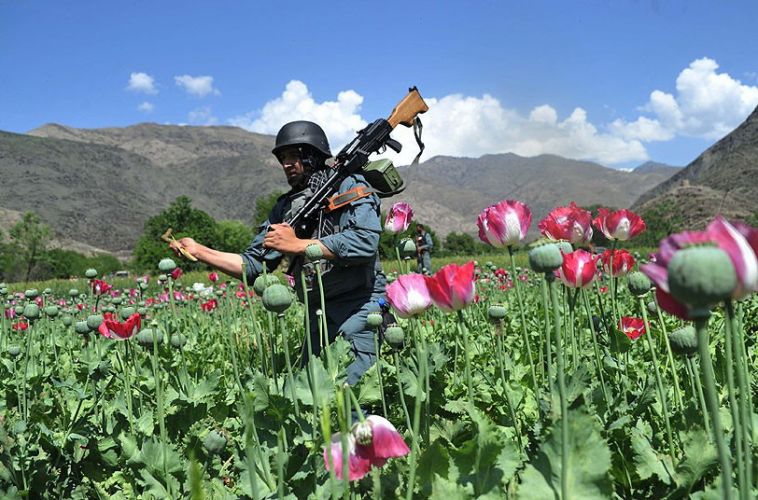
A poppy field in Afghanistan

W.J. Astore

Six years ago, I wrote an article about Afghanistan that opened like so:

In the U.S. debate on Afghanistan, virtually all experts agree that it’s not within the power of the American military alone to win the war. For that, Afghanistan needs its own military and police force, one that is truly representative of the people, and one that is not hopelessly corrupted by drug money and the selfish concerns of the Karzai government in Kabul.

What has changed since 2009?  Karzai is gone, but corruption remains endemic.  The U.S. military is still there, at least until 2017 and likely for far longer.  And drug money!  In a searching summary of the opium trade in recent Afghan history, Alfred McCoy at TomDispatch.com shows convincingly that the drug trade has flourished despite, or rather because of, American efforts to block it or control it.  In his words:

In the almost 15 years of continuous combat since the U.S. invasion of 2001, pacification efforts have failed to curtail the Taliban insurgency largely because the U.S. could not control the swelling surplus from the county’s heroin trade. As opium production surged from a minimal 180 tons to a monumental 8,200 in the first five years of U.S. occupation, Afghanistan’s soil seemed to have been sown with the dragon’s teeth of ancient Greek myth. Every poppy harvest yielded a new crop of teenaged fighters for the Taliban’s growing guerrilla army.

At each stage in Afghanistan’s tragic, tumultuous history over the past 40 years — the covert war of the 1980s, the civil war of the 1990s, and the U.S. occupation since 2001 — opium played a surprisingly significant role in shaping the country’s destiny. In one of history’s bitter twists of fate, the way Afghanistan’s unique ecology converged with American military technology transformed this remote, landlocked nation into the world’s first true narco-state — a country where illicit drugs dominate the economy, define political choices, and determine the fate of foreign interventions.

McCoy’s article, which you should read here in its entirety, raises many questions, but for me the obvious one is this: What is the U.S. military doing in Afghanistan?  What is its strategy?

If it’s trying to win Afghan hearts and minds, you can’t do that by destroying the main cash crop of so many people.  If it’s trying to create a measure of stability, you can’t do that by mounting destructive military operations that spread chaos.  If it’s trying to interdict the drug trade, you can’t do that successfully while maintaining the support of powerful interests in Afghanistan that profit so heavily from that trade.

After nearly 15 years, a sensible person would conclude that American interference in Afghanistan is only making matters worse.  Afghan drug wars are a no-win scenario for U.S. troops.  Lacking a coherent and sensible strategy that is attractive to Afghan power brokers, American forces should smarten up, load up, and pull out.

A sensible strategy in three words: Yankee come home.

Hillary Clinton: A Deeply Compromised Candidate

hillary henry
Hillary and Henry

W.J. Astore

Hillary Clinton is a deeply compromised candidate.  She and her husband have made over $125 million in paid speeches since 2001, including $30 million in 16 months.  There’s nothing wrong with making lots of money: this is America, after all.  But there’s something wrong about accepting big checks from powerful banks and investment houses and then positioning yourself as the champion of “everyday people” in your run for the presidency.

Along with her close alliance with Wall Street, Hillary is essentially a neo-conservative on foreign policy who admires the Real Politik of men like Henry Kissinger.  She promises more interventionism overseas and doubtless more wars.  She is especially close to Israel and advertises herself as a loyal ally to Benjamin Netanyahu.

The person she most closely resembles in recent U.S. politics is Richard Nixon.  Like Nixon, she’s aggressive in foreign policy (recall her infamous quip about the fall of Qaddafi in Libya: “We came, we saw, he died”).  Like Nixon, she is secretive and economical with the truth, despite her truth-telling vows.  Like Nixon, she is a complex person, not without talent, but a person who often doesn’t appear fully comfortable, especially when pressed about her record.  Like Nixon, she leaves very little to chance; there’s calculation to nearly everything she does.

A Hillary Clinton administration promises to be even less transparent than Obama’s.  It would be more in service to the powers that be (big money donors such as the health care industry will come calling for their payback, and they’ll get it).  Despite protestations of being “progressive,” a Clinton administration promises to be regressive in terms of peace, social progress, and fairness for the working classes.

Despite this, her path to the presidency seems remarkably clear.  Bernie Sanders, an honest man of conviction, lacks establishment support.  Hillary’s Republican opponent of the moment, Donald Trump, is an opportunistic business tycoon who apparently says whatever pops into his head.  Trump may be the one candidate with more negative baggage than Hillary.

A Hillary/Trump matchup this fall promises lots of drama, but it’s a lose/lose scenario for anyone looking for real progressive change.