Henry Kissinger’s Big Stick: Bombing

Kissinger's foreign policy
Kissinger’s foreign policy

W.J. Astore

Greg Grandin has a new book on Henry Kissinger and a new article at TomDispatch.com.  Kissinger, writes Grandin, had an affinity (or perhaps an avidity) for power, especially air power, as a way of demonstrating his (and America’s) resolve.

Notes Grandin:

Henry Kissinger is, of course, not singularly responsible for the evolution of the U.S. national security state into a monstrosity. That state has had many administrators. But his example — especially his steadfast support for bombing as an instrument of “diplomacy” and his militarization of the Persian Gulf — has coursed through the decades, shedding a spectral light on the road that has brought us to a state of eternal war …

Kissinger was very hands-on. “Strike here in this area,” Sitton recalled Kissinger telling him, “or strike here in that area.” The bombing galvanized the national security adviser. The first raid occurred on March 18, 1969. “K really excited,” Bob Haldeman, Nixon’s chief of staff, wrote in his diary. “He came beaming in [to the Oval Office] with the report.”

In fact, he would supervise every aspect of the bombing. As journalist Seymour Hersh later wrote, “When the military men presented a proposed bombing list, Kissinger would redesign the missions, shifting a dozen planes, perhaps, from one area to another, and altering the timing of the bombing runs… [He] seemed to enjoy playing the bombardier.” (That joy wouldn’t be limited to Cambodia. According to Washington Post reporters Bob Woodward and Carl Bernstein, when the bombing of North Vietnam finally started up again, Kissinger “expressed enthusiasm at the size of the bomb craters.”) A Pentagon report released in 1973 stated that “Henry A. Kissinger approved each of the 3,875 Cambodia bombing raids in 1969 and 1970” — the most secretive phase of the bombing — “as well as the methods for keeping them out of the newspapers.”

All told, between 1969 and 1973, the U.S. dropped half-a-million tons of bombs on Cambodia alone, killing at least 100,000 civilians. And don’t forgetLaos and both North and South Vietnam. “It’s wave after wave of planes. You see, they can’t see the B-52 and they dropped a million pounds of bombs,” Kissinger told Nixon after the April 1972 bombing of North Vietnam’s port city of Haiphong, as he tried to reassure the president that the strategy was working: “I bet you we will have had more planes over there in one day than Johnson had in a month… Each plane can carry about 10 times the load [a] World War II plane could carry.”

As the months passed, however, the bombing did nothing to force Hanoi to the bargaining table.  It did, on the other hand, help Kissinger in his interoffice rivalries. His sole source of power was Nixon, who was a bombing advocate. So Kissinger embraced his role as First Bombardier to show the tough-guy militarists the president had surrounded himself with that he was the “hawk of hawks.” And yet, in the end, even Nixon came to see that the bombing campaigns were a dead end. “K. We have had 10 years of total control of the air in Laos and V.Nam,” Nixon wrote him over a top-secret report on the efficacy of bombing, “The result = Zilch.” (This was in January 1972, three months before Kissinger assured Nixon that “wave after wave” of bombers would do the trick).

During those four-and a half years when the U.S. military dropped more than 6,000,000 tons of bombs on Southeast Asia, Kissinger revealed himself to be not a supreme political realist, but the planet’s supreme idealist.  He refused to quit when it came to a policy meant to bring about a world he believed heought to live in, one where he could, by the force of the material power of the U.S. military, bend poor peasant countries like Cambodia, Laos, and North Vietnam to his will — as opposed to the one he did live in, where bomb as he might he couldn’t force Hanoi to submit. As he put it at the time, “I refuse to believe that a little fourth-rate power like North Vietnam does not have a breaking point.”

In fact, that bombing campaign did have one striking effect: it destabilized Cambodia, provoking a 1970 coup that, in turn, provoked a 1970 American invasion, which only broadened the social base of the insurgency growing in the countryside, leading to escalating U.S. bombing runs that spread to nearly the whole country, devastating it and creating the conditions for the rise to power of the genocidal Khmer Rouge…

Bombing for Kissinger was a way to show he was tough within an inner circle around Nixon that put a premium on toughness. It was also a way to minimize casualties to Americans while demonstrating a total disregard for casualties among the peoples of Southeast Asia.

Kissinger the bombardier was seduced by the seemingly god-like potential of air power — the ability to strike from on high, to smite evil-doers and those who would thwart Kissinger’s designs.  Best of all, Kissinger never had to bloody his own hands. (Can you imagine Kissinger in a knife fight?  Of course not.  But you can imagine him gleefully gushing over bombing reports and bomb craters as bomber jets knifed through the sky.)

There’s a “Star Trek” episode in which Captain Kirk says, “Above all else, a god needs compassion.”  Kissinger the “air power god” had no compassion.  It was all about power.  The little people who refused to kowtow to him — the Vietnamese, the Cambodians, the Chileans, and so on — these people were simply abstractions for Kissinger.  Put differently, they were pawns on the geopolitical chessboard, to be sacrificed at will by self-styled grandmasters like Kissinger.

In his book “Secrets,” Daniel Ellsberg captured Kissinger’s blithe disregard for the lives of others in a probing question about Vietnamization.  Was it moral, Ellsberg asked, to turn the war over to the South Vietnamese, knowing they were going to incur high casualties while fighting North Vietnam, even as American troops withdrew?  Kissinger had no answer, one senses because the morality of his policies didn’t much matter to him.  The goal was to save America’s “face” in Vietnam; for Kissinger the fates of the peoples of Southeast Asia paled in comparison to the importance of American prestige.

In his deliberately ponderous Germanic accent, Kissinger spoke softly as he wielded the big stick of American bombing. It didn’t work then, nor is it working today for those who still worship at the altar of Kissinger’s Realpolitik.
I Didn’t Raise My Boy to be a Soldier: A Mother’s Plea for Peace

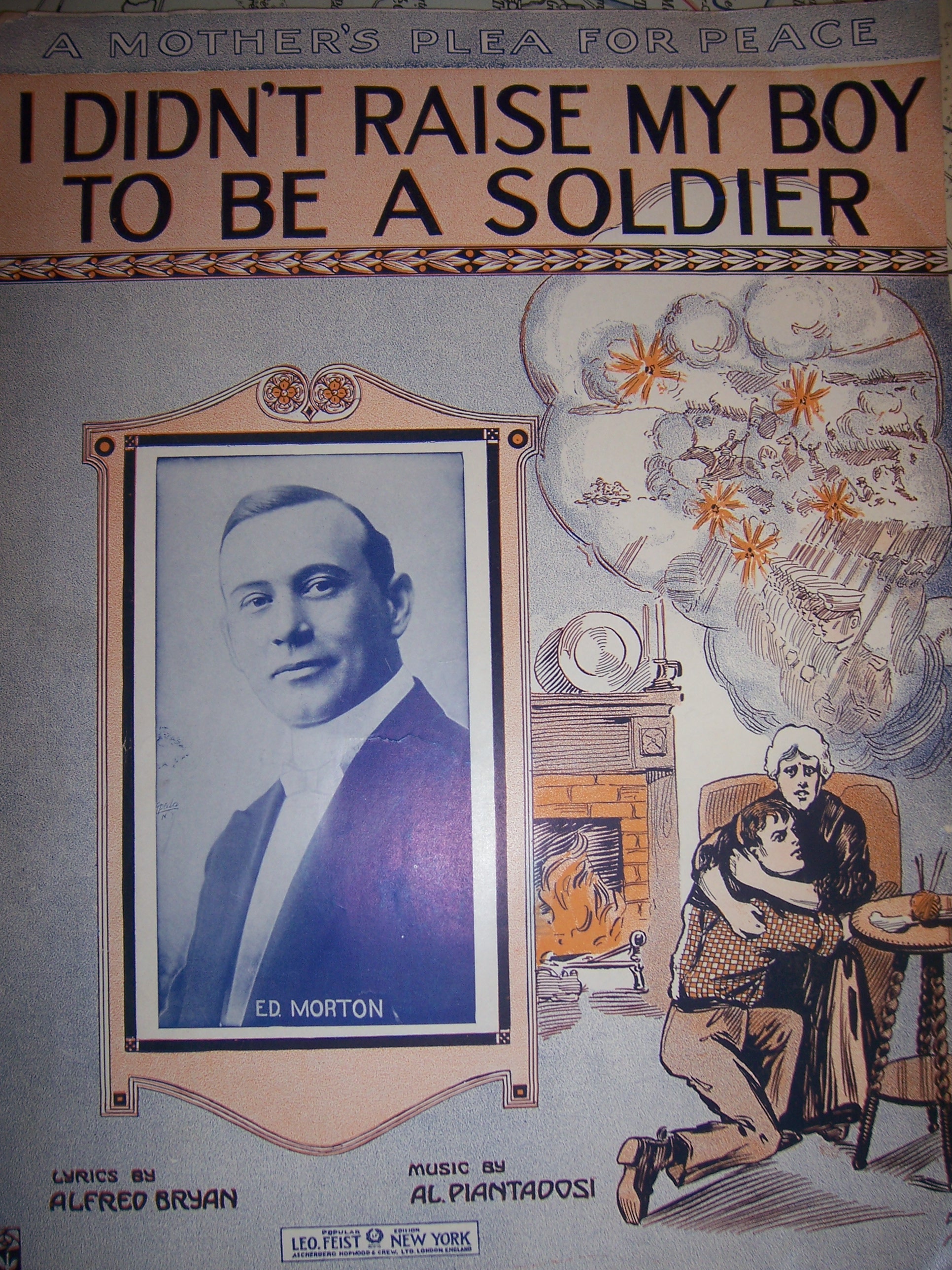
My copy of the sheet music (1915)

W.J. Astore

The year was 1915.  Europe, indeed much of the world, was embroiled in the devastating Great (or World) War.  Under President Woodrow Wilson, the United States was proud to have stayed out of the war, the massive bloodletting of which seemed peculiarly European, an “Old World” form of militarized madness that most Americans wanted no part of.  In fact, in 1916 Wilson would be reelected in large part because he had kept America out of Europe’s great war.  (Of course, the very next year the United States did choose to join the war effort against Germany.)

Yet in 1915 the idea of celebrating the military, nobilizing the military experience, finding higher purpose and meaning in war, was the furthest thing from the minds of most Americans.  Unlike the America of 2015, there was no mantra of “support our troops,” no publicity campaigns that encouraged citizens to “salute” the troops.  What publicity existed discouraged Americans from getting involved in war, a fact exhibited by some old sheet music that I recently ran across in a local thrift shop.

“I Didn’t Raise My Boy to be a Soldier,” copyright 1915 and “respectfully dedicated to Every Mother – Everywhere,” shows a mother protectively holding her grown son as visions of battle assault her mind near the family hearth.  It was a popular song; you can listen to an old Edison recording here.

The lyrics are as simple as they are telling:

Ten million soldiers to the war have gone,

Who may never return again.

Ten million mothers’ hearts must break,

For the ones who died in vain.

Head bowed down in sorrow in her lonely years,

I heard a mother murmur thro’ her tears:

Chorus:

I didn’t raise my boy to be a soldier,

I brought him up to be my pride and joy,

Who dares to put a musket on his shoulder,

To shoot some other mother’s darling boy?

Let nations arbitrate their future troubles,

It’s time to lay the sword and gun away,

There’d be no war today,

If mothers all would say,

I didn’t raise my boy to be a soldier.

(Chorus)

What victory can cheer a mother’s heart,

When she looks at her blighted home?

What victory can bring her back,

All she cared to call her own.

Let each mother answer in the years to be,

Remember that my boy belongs to me!

Nowadays, such lyrics seem hopelessly quaint and naïve, or even cowardly and defeatist.  America must stand up to evildoers around the world.  We must fight ISIS and other elements of radical Islam.  We must “stay the course” in Afghanistan.  We must maintain large and deadly military forces, ever ready to slay other mothers’ sons and daughters in the name of making peace.  Or so we are told, almost daily, by our leaders.

Indeed, our new national chorus goes something like this:  Let’s have another drink of war!  We haven’t had too many.  Keep the bullets coming and the blood flowing.  That is the way to victory!

But as we dream about “victory” by arms, we should recall the line from “I didn’t raise my boy to be a soldier”:

What victory can bring her back, All she cared to call her own.

Unlike in 1915, that’s a question that’s never asked in today’s America.

Tourists of Empire

On the road again ...
On the road again …

W.J. Astore

I recently received an update from the National Priorities Project reminding me of this startling fact:

“The president announced last week that American troops will remain in Afghanistan beyond the planned withdrawal at the end of 2016. This is a devastating blow. We’ve already spent $716 billion and counting on the war in Afghanistan alone, plus countless lives lost and derailed.”

Of course, not the same American troops will “remain” in Afghanistan until 2017 (or 2024, or who knows what year).  U.S. troops, intelligence operatives, privatized paramilitaries, and assorted imperial straphangers are constantly rotating in and out of war zones around the world, sometimes on yearly tours, often on much shorter ones.  This reality got me to thinking about American imperialism as a peculiar form of global tourism.  All those repetitive, fairly short-term, “tours” to foreign countries, followed by new American tour groups (fresh deployments of new combat units).  The result is needless repetition, endless waste, and flat learning curves for Americans.  For the locals who have to endure America’s “tours,” the results are often far worse — and unlike Americans they usually can’t get on a boat or helicopter or jet and leave.

I was stimulated to write this new article on America’s “tourists of empire,” which appears at TomDispatch.com today.  You can read it in full here.  I’ve included some excerpts below.  I hope this article provides a contrary perspective on U.S. military efforts around the world.

Tourists of Empire: America’s Peculiar Brand of Global Imperialism

W.J. Astore.  Courtesy of TomDispatch.com.

The United States is a peculiar sort of empire.  As a start, Americans have been in what might be called imperial denial since the Spanish-American War of 1898, if not before.  Empire — us?  We denied its existence even while our soldiers were administering “water cures” (aka waterboarding) to recalcitrant Filipinos more than a century ago.  Heck, we even told ourselves we were liberating those same Filipinos, which leads to a second point: the U.S. not only denies its imperial ambitions, but shrouds them in a curiously American brand of Christianized liberation theology.  In it, American troops are never seen as conquerors or oppressors, always as liberators and freedom-bringers, or at least helpers and trainers.  There’s just enough substance to this myth (World War II and the Marshall Plan, for example) to hide uglier imperial realities.

Denying that we’re an empire while cloaking its ugly side in missionary-speak are two enduring aspects of the American brand of imperialism, and there’s a third as well, even if it’s seldom noted.  As the U.S. military garrisons the planet and its special operations forces alone visit more than 140 countries a year, American troops have effectively become the imperial equivalent of globetrotting tourists.  Overloaded with technical gear and gadgets (deadly weapons, intrusive sensors), largely ignorant of foreign cultures, they arrive eager to help and spoiling for action, but never (individually) staying long…

Call it Imperial Tourist Syndrome, a bizarre American affliction that creates its own self-sustaining dynamic.  To a local, it might look something like this: U.S. forces come to your country, shoot some stuff up (liberation!), take some selfies, and then, if you’re lucky, leave (at least for a while).  If you’re unlucky, they overstay their “welcome,” surge around a bit and generate chaos until, sooner or later (in places like Iraq and Afghanistan, much, much later), they exit, not always gracefully (witness Saigon 1975 or Iraq 2011).

And here’s the weirdest thing about this distinctly American version of the imperial: a persistent short-time mentality seems only to feed its opposite, wars that persist without end.  In those wars, many of the country’s heavily armed imperial tourists find themselves sent back again and again for one abbreviated tour of duty after another, until it seems less like an adventure and more like a jail sentence.

The paradox of short-timers prosecuting such long-term wars is irresolvable because, as has been repeatedly demonstrated in the twenty-first century, those wars can’t be won.  Military experts criticize the Obama administration for lacking an overall strategy, whether in Syria, Iraq, Afghanistan, or elsewhere.  They miss the point.  Imperial tourists don’t have a strategy: they have an itinerary.  If it’s Tuesday, this must be Yemen; if it’s Wednesday, Libya; if it’s Thursday, Iraq …

It was a dynamic already obvious five decades ago in Vietnam: a ticket-punching mentality that involved the constant rotation of units and commanders; a process of needless reinvention of the most basic knowledge as units deployed, bugged out, and were then replaced by new units; and the use of all kinds of grim, newfangled weapons and sensors, everything from Agent Orange and napalm to the electronic battlefield and the latest fighter planes and bombers — all for naught.  Under such conditions, even the U.S. superpower lacked staying power, precisely because it never intended to stay.  The “staying” aspect of the Vietnam War was often referred to in the U.S. as a “quagmire.”  For the Vietnamese, of course, their country was no “big muddy” that sucked you down.  It was home.  They had little choice in the matter; they stayed — and fought.

Combine a military with a tourist-like itinerary and a mentality to match, a high command that in its own rotating responsibilities lacks all accountability for mistakes, and a byzantine, top-heavy bureaucracy, and you turn out to have a surefire recipe for defeat.  And once again, in the twenty-first century, whether among the rank and file or at the very top, there’s little continuity or accountability involved in America’s military presence in foreign lands.  Commanders are constantly rotated in and out of war zones.  There’s often a new one every year.  (I count 17 commanders for the International Security Assistance Force for Afghanistan, the U.S.-led military coalition, since December 2001.) U.S. troops may serve multiple overseas tours, yet they are rarely sent back to the same area.  Tours are sequential, not cumulative, and so the learning curve exhibited is flat…

At some level, the U.S. military knows it’s screwed.  That’s why its commanders tinker so much with weapons and training and technology and tactics.  It’s the stuff they can control, the stuff that seems real in a way that foreign peoples aren’t (at least to us).  Let’s face it: past as well as current events suggest that guns and how to use them are what Americans know best.

But foreign lands and peoples?  We can’t control them.  We don’t understand them.  We can’t count on them.  They’re just part of the landscape we’re eternally passing through — sometimes as people to help and places to rebuild, other times as people to kill and places to destroy.  What they aren’t is truly real.  They are the tourist attractions of American war making, sometimes exotic, sometimes deadly, but (for us) strangely lacking in substance.

And that is precisely why we fail.

Whistling Past the Afghan Graveyard of Empires

Keep whistling ... (Photobucket; ChuckFitz)
Keep whistling … (Photobucket; ChuckFitz)

W.J. Astore

I read the news today, oh boy.  President Obama has decided to keep thousands of U.S. troops in Afghanistan until 2017, effectively kicking the war to the next president.  According to the New York Times, “The Obama administration sees the choice to slow down the United States’ Afghan exit as the best of bad options.”  Not to be cynical, but the decision to keep U.S. troops in Afghanistan until 2017 is obviously intended to prevent an Iraq-like collapse in 2016, a collapse that Republicans would seize upon in next year’s election cycle to portray democrats as weak and feckless.  All politics is local, as Tip O’Neill said.

Afghanistan is known as the graveyard of empires, but the United States believes if we whistle loud enough past it, no harm will come to us.  In other words, we refuse to learn anything from history, the theme of an article I wrote back in 2009 for TomDispatch on the lessons of Vietnam for Obama, recently anointed as presidential savior.  Sections (2) and especially (4) below seem especially germane to today’s news of yet another extension to America’s troop commitment to Afghanistan.

Mary McCarthy in Vietnam, Barack Obama in Afghanistan
Seven Lessons and Many Questions for the President

By William Astore (written in 2009)

In 1967, outraged by the course of the Vietnam War, as well as her country’s role in prolonging and worsening it, Mary McCarthy, novelist, memoirist, and author of the bestseller The Group, went to Saigon, then the capital of South Vietnam, to judge the situation for herself. The next year, she went to the North Vietnamese capital, Hanoi. She wrote accounts of both journeys, published originally in pamphlet format as Vietnam (1967) and Hanoi (1968), and later gathered with her other writings on Vietnam as a book, The Seventeenth Degree (1974). As pamphlets, McCarthy’s accounts sold poorly and passed into obscurity; deservedly so, some would say.

Those who’d say this, however, would be wrong. McCarthy brought a novelist’s keen eye to America’s activities and its rhetoric in Vietnam. By no means a military expert, not even an expert on Vietnam — she only made a conscious decision to study the war in Vietnam after she returned from her trip to Saigon — her impressionistic writings were nevertheless insightful precisely because she had long been a critical thinker beholden to no authority.

Her insights into our approach to war-fighting and to foreign cultures are as telling today as they were 40 years ago, so much so that President Obama and his advisors might do well to add her unconventional lessons to their all-too-conventional thinking on our spreading war in Afghanistan and Pakistan.

What were those lessons? Here are seven of them, each followed by questions that, four decades later, someone at President Obama’s next press conference should consider asking him:

1. McCarthy’s most fundamental objection was to the way, in Vietnam, the U.S. government decided to apply “technology and a superior power to a political situation that will not yield to this.” At the very least, the United States was guilty of folly, but McCarthy went further. She condemned our technocentric and hegemonic form of warfare as “wicked” because of its “absolute indifference to the cost in human lives” to the Vietnamese people.

Even in 1967, the widespread, at times indiscriminate, nature of American killing was well known. For example, U.S. planes dropped roughly 7 million tons of bombs on Vietnam and parts of Laos and Cambodia during the war, nearly five times the tonnage used against Germany during World War II. The U.S. even waged war on the Vietnamese jungle and forest, which so effectively hid Vietnamese guerrilla forces, spraying roughly 20 million gallons of toxic herbicides (including the dioxin-contaminated Agent Orange) on it.

In her outrage, McCarthy dared to compare the seeming indifference of many of her fellow citizens toward the blunt-edged sword of technological destruction we had loosed on Vietnam to the moral obtuseness of ordinary Germans under Adolf Hitler.

Questions for President Obama: Aren’t we once again relying on the destructive power of technology to “solve” complex political and religious struggles? Aren’t we yet again showing indifference to the human costs of war, especially when borne by non-Americans? Even though we’re using far fewer bombs in the Af-Pak highlands than we did in Vietnam, aren’t we still morally culpable when these “precision-guided munitions” miss their targets and instead claim innocents, or hit suspected “terrorists” who suddenly morph into wedding parties? In those cases, do we not seek false comfort in the phrase, C’est la guerre, or at least that modern equivalent: unavoidable collateral damage?

2. As Richard Nixon campaigned for the presidency in 1968 by calling for “peace with honor” in Vietnam, McCarthy offered her own warning about the dangers that arose when the office of the presidency collided with an American desire never to be labeled a loser: “The American so-called free-enterprise system, highly competitive, investment-conscious, expansionist, repels a loser policy by instinctive defense movements centering in the ganglia of the presidency. No matter what direction the incumbent, as candidate, was pointing in, he slowly pivots once he assumes office.”

Questions for President Obama: Have you, like Vietnam-era presidents, pivoted toward yet another surge simply to avoid the label of “loser” in Afghanistan? And if the cost of victory (however defined) is hundreds, or even thousands, more American military casualties, hundreds of billions of additional dollars spent, and extensive collateral damage and blowback, will this “victory” not be a pyrrhic one, achieved at a price so dear as to be indistinguishable from defeat?

3. Though critical of the U.S. military in Vietnam, McCarthy was even more critical of American civilian officials there. “On the whole,” she wrote, they “behaved like a team of promoters with a dubious ‘growth’ stock they were brokering.” At least military men were often more forthright than the civilians, if not necessarily more self-aware, McCarthy noted, because they were part of the war — the product, so to speak — not its salesmen.

Questions for President Obama: In promising to send a new “surge” of State Department personnel and other civilians into Afghanistan, are you prepared as well to parse their words? Are you braced in case they sell you a false bill of goods, even if the sellers themselves, in their eagerness to speak fairy tales to power, continually ignore the Fantasyland nature of their tale?

4. Well before Bush administration officials boasted about creating their own reality and new “facts on the ground” in Iraq, Mary McCarthy recognized the danger of another type of “fact”: “The more troops and matériel committed to Vietnam, the more retreat appears to be cut off — not by an enemy, but by our own numbers. To call for withdrawal in the face of that commitment… is to seem to argue not against a policy, but against facts, which by their very nature are unanswerable.”

Questions for President Obama: If your surge in Afghanistan fails, will you be able to de-escalate as quickly as you escalated? Or will the fact that you’ve put more troops in harm’s way (with all their equipment and all the money that will go into new base and airfield and road construction), and committed more of your prestige to prevailing, make it even harder to consider leaving?

5. A cursory reading of The Pentagon Papers, the famously secret government documents on Vietnam leaked to the New York Times by Daniel Ellsberg, reveals how skeptical America’s top officials were, early on, in pursuing a military solution to the situation in South Vietnam. Nevertheless, knowing better, the “best and brightest,” as journalist David Halberstam termed them in his famous, ironic book title, still talked themselves into it; and they did so, as McCarthy noted, because they set seemingly meaningful goals (“metrics” or “benchmarks,” we’d say today), which they then convinced themselves they were actually achieving. When you trick yourself into believing that you’re meeting your goals, as Halberstam noted, there’s no reason to reexamine your course of action.

Questions for President Obama: Much has been written about an internal struggle within your administration over the wisdom of surging in Afghanistan. Now, you, too, have called for the setting of “benchmarks”for your new strategy’s success. Are you wise enough to set them to capture the complexities of political realities on the ground rather than playing to American strengths? Are you capable of re-examining them, even when your advisors assure you that they are being achieved?

6. In her day, Mary McCarthy recognized the inequities of burden-sharing at home when it came to the war in Vietnam: “Casualty figures, still low [in 1967], seldom strike home outside rural and low-income groups — the silent part of society. The absence of sacrifices [among the privileged classes] has had its effect on the opposition [to the war], which feels no need, on the whole, to turn away from its habitual standards and practices — what for? We have not withdrawn our sympathy from American power and from the way of life that is tied to it — a connection that is more evident to a low-grade G.I. in Vietnam than to most American intellectuals.”

Questions for President Obama: Are you willing to listen to the common G.I. as well as to the generals who have your ear? Are you willing to insist on greater equity in burden-sharing, since once again most of the burden of Iraq and Afghanistan has fallen on “the silent part of society”? Are you able to recognize that the “best and brightest” in the corridors of power may not be the wisest exactly because they have so little to lose (and perhaps much to gain) from our “overseas contingency operations”?

7. McCarthy was remarkably perceptive when it came to the seductiveness of American technological prowess. Our technological superiority, she wrote, was a large part of “our willingness to get into Vietnam and stay there… The technological gap between us and the North Vietnamese constituted, we thought, an advantage which obliged us not to quit.”

Questions for President Obama: Rather than providing us with a war-winning edge, might our robot drones, satellite imagery, and all our other gadgetry of war seduce us into believing that we can “prevail” at a reasonable and sustainable cost? Indeed, do we think we should prevail precisely because our high-tech military brags of “full spectrum dominance”?

One bonus lesson from Mary McCarthy before we take our leave of her: Even now, we speak too often of “Bush’s war” or, more recently, “Obama’s war.” Before we start chattering mindlessly about Iraq and Afghanistan as American tragedies, we would do well to recall what McCarthy had to say about the war in Vietnam: “There is something distasteful,” she wrote, “in the very notion of approaching [Vietnam] as an American tragedy, whose protagonist is a great suffering Texan [President Lyndon Baines Johnson].”

Yes, there is something distasteful about a media that blithely refers to Bush’s or Obama’s war as hundreds of thousands of Iraqis and Afghans suffer. For American troops, after all, are not the only ones paying the ultimate price when the U.S. fights foreign wars for ill-considered reasons and misguided goals.

Copyright 2009 and 2015 William Astore.

Knowledge is Power, but Power is no Substitute for Knowledge

020309_siers_462

W.J. Astore

Francis Bacon is famous for the aphorism, “Knowledge is power.”  Yet the reverse aphorism is not true.  The United States is the most powerful nation in the world, yet its knowledge base is notably weak in spite of all that power.  Of course, many factors contribute to this weakness.  Our public educational systems are underfunded and driven by meaningless standardized test results.  Our politicians pander to the lowest common denominator.  Our mainstream media is corporate-owned and in the business of providing info-tainment when they’re not stoking fear.  Our elites are in the business of keeping the American people divided, distracted, and downtrodden, conditions that do not favor critical thinking, which is precisely the point of their efforts.

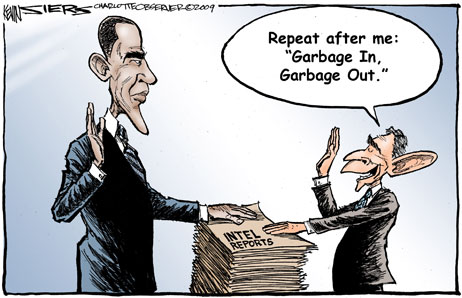
All that is true.  But even when the U.S. actively seeks knowledge, we get little in return for our investment.  U.S. intelligence agencies (the CIA, NSA, DIA, and so on) aggregate an enormous amount of data, then try to convert this to knowledge, which is then used to inform action.  But these agencies end up drowning in minutiae.  Worse, competing agencies within a tangled bureaucracy (that truly deserves the label of “Byzantine”) end up spinning the data for their own benefit.  The result is not “knowledge” but disinformation and self-serving propaganda.

When our various intelligence agencies are not drowning in minutiae or choking on their own “spin,” they’re getting lost in the process of converting data to knowledge.  Indeed, so much attention is put on process, with so many agencies being involved in that process, that the end product – accurate and actionable knowledge – gets lost.  Yet, as long as the system keeps running, few involved seem to mind, even when the result is marginal — or disastrous.

Consider the Vietnam War.  Massive amounts of “intelligence” data took the place of knowledge.  Data like enemy body counts, truck counts, aircraft sorties, bomb tonnages, acres defoliated, number of villages pacified, and on and on.  Amassing this data took an enormous amount of time; attempting to interpret this data took more time; and reaching conclusions from the (often inaccurate and mostly irrelevant) data became an exercise in false optimism and self-delusion.  Somehow, all that data suggested to US officialdom that they were winning the war, a war in which US troops were allegedly making measurable and sustained progress.  But events proved such “knowledge” to be false.

Of course, there’s an acronym for this: GIGO, or garbage (data) in, garbage (knowledge) out.

In this case, real knowledge was represented by the wisdom of Marine Corps General (and Medal of Honor recipient) David M. Shoup, who said in 1966 that:

I don’t think the whole of Southeast Asia, as related to the present and future safety and freedom of the people of this country, is worth the life or limb of a single American [and] I believe that if we had and would keep our dirty bloody dollar-crooked fingers out of the business of these nations so full of depressed, exploited people, they will arrive at a solution of their own design and want, that they fight and work for. And if, unfortunately, their revolution must be of the violent type…at least what they get will be their own and not the American style, which they don’t want…crammed down their throat.

But few wanted to hear Shoup and his brand of hard-won knowledge, even if he’d been handpicked by President Kennedy to serve as the Commandant of the Marine Corps exactly because Shoup had a reputation for sound and independent thinking.

Consider as well our rebuilding efforts in Iraq after 2003.  As documented by Peter Van Buren in his book “We Meant Well,” those efforts were often inept and counterproductive.  Yet the bureaucracy engaged in those efforts was determined to spin them as successes.  They may even have come to believe their own spin.  When Van Buren had the clarity and audacity to say, We’re fooling no one with our Kabuki dance in Iraq except the American people we’re sworn to serve, he was dismissed and punished by the State Department.

Why?  Because you’re not supposed to share knowledge, real knowledge, with the American people.  Instead, you’re supposed to baffle them with BS.  But Van Buren was having none of that.  His tell-all book (you can read an excerpt here) captured the Potemkin village-like atmosphere of US rebuilding efforts in Iraq.  His accurate knowledge had real power, and for sharing it with the American people he was slapped down.

Tell the truth – share real knowledge with the American people – and you get punished.  Massage the data to create false “knowledge,” in these cases narratives of success, and you get a pat on the back and a promotion.  Small wonder that so many recent wars have gone so poorly for America.

What the United States desperately needs is insight.  Honesty.  A level of knowledge that reflects mastery.  But what we’re getting is manufactured information, or disinformation, or BS.  Lies, in plainspeak, like the lie that Iraq had in 2002 a large and active program in developing WMD that could be used against the United States.  (Remember how we were told we had to invade Iraq quickly before the “smoking gun” became a “mushroom cloud”?)

If knowledge is power, what is false knowledge?  False knowledge is a form of power as well, but a twisted one.  For when you mistake the facade you’re constructing as the real deal, when you manufacture your own myths and then forget they’re myths as you consume them, you may find yourself hopelessly confused, even as the very myths you created consume you.

So, a corollary to Francis Bacon: Knowledge is power, but as the United States has discovered in Vietnam, Iraq, and elsewhere, power is no substitute for knowledge.

Holding Military Boots to the Fire

Petraeus with Broadwell
Petraeus: Lots of ribbon candy crowded on that uniform

W.J. Astore

I write a lot about the U.S. military, partly because I served in it for 20 years, partly because I’ve been reading about it since I could read, and partly because I have a lot of affection for colleagues, young and old, who still serve.  My articles tend to be critical because there’s much to criticize about our military.  I get interesting responses, like the one from a military man who said I wrote well and had a few interesting things to say, but why couldn’t I write more positive articles about the military?  Why couldn’t I just focus on “good news”?  I explained to him that the military has a small legion of public affairs officers and that sharing good news is their job, not mine.  He didn’t write back.

I have a few critical things to say in my latest article at TomDispatch: “Seventy Years of Military Mediocrity.”  You can read the entire article here; what follows is an excerpt on America’s most senior officers and some of their faults and failings.  As ever, I welcome your comments.

America’s Senior Officers: Lots of Ribbon Candy, No Sweetness of Victory

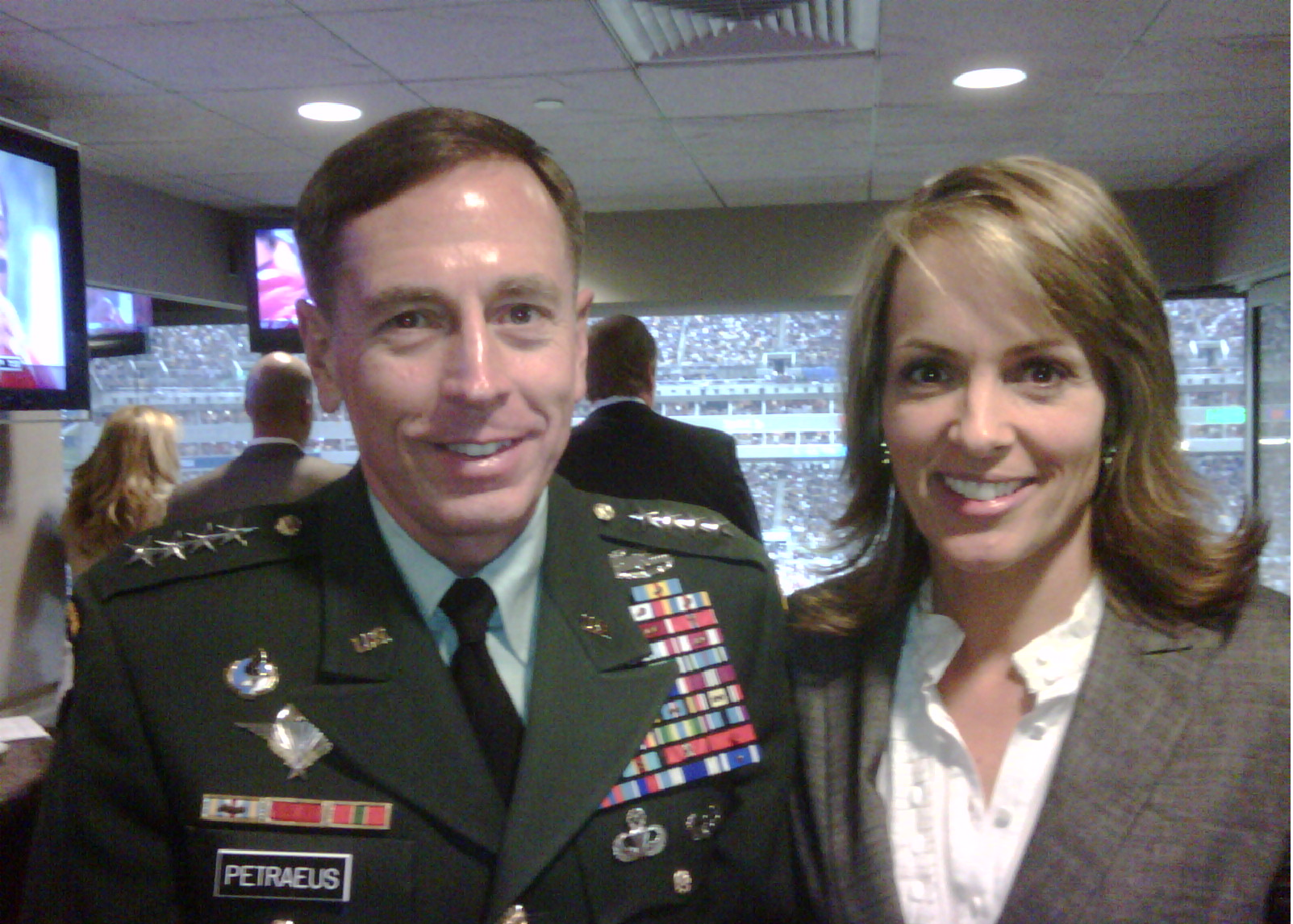
In my first article for TomDispatch back in 2007, I wrote about America’s senior military leaders, men like the celebrated David Petraeus. No matter how impressive, even kingly, they looked in their uniforms festooned with ribbons, badges, and medals of all sorts, colors, and sizes, their performance on the battlefield didn’t exactly bring to mind rainstorms of ribbon candy. So why, I wondered then, and wonder still, are America’s senior military officers so generally lauded and applauded? What have they done to deserve those chests full of honors and the endless praise in Washington and elsewhere in this country?

By giving our commanders so many pats on the back (and thanking the troops so effusively and repeatedly), it’s possible that we’ve prevented the development of an American-style stab-in-the-back theory — that hoary yet dangerous myth that a military only loses wars when the troops are betrayed by the homefront. In the process, however, we’ve written them what is essentially a blank check. We’ve given them authority without accountability. They wage “our” wars (remarkably unsuccessfully), but never have to take the blame for defeats.  Unlike President Harry Truman, famous for keeping a sign on his desk that read “the buck stops here,” the buck never stops with them.

Think about two of America’s most celebrated generals of the twenty-first century, Petraeus and Stanley McChrystal and how they fell publicly from grace.  Both were West Point grads, both were celebrated as “heroes,” despite the fact that their military “surges” in Iraq and Afghanistan proved fragile and reversible.  They fell only because Petraeus was caught with his pants down (in an extramarital affair with a fawning biographer), while McChrystal ran afoul of the president by tolerating an atmosphere that undermined his civilian chain of command.

And here, perhaps, is the strangest thing of all: even as America’s wars continue to go poorly by any reasonable measure, no prominent high-ranking officer has yet stepped forward either to take responsibility or in protest.  You have to look to the lower ranks, to lieutenant colonels and captains and specialists (and, in the case of Chelsea Manning, to lowly privates), for straight talk and the courage to buck the system.  Name one prominent general or admiral, fed up with the lamentable results of America’s wars, who has either taken responsibility for them or resigned for cause.  Yup — I can’t either.  (This is not to suggest that the military lacks senior officers of integrity.  Recall the way General Eric Shinseki broke ranks with the Bush administration in testimony before Congress about the size of a post-invasion force needed to secure Iraq, or General Antonio Taguba’s integrity in overseeing a thorough investigation of prisoner abuse at Abu Ghraib.  Their good deeds did not go unpunished.)

Authority without accountability means no one is responsible.  And if no one is responsible, the system can keep chugging along, course largely unaltered, no matter what happens.  This is exactly what it’s been doing for years now in Iraq, Afghanistan, and elsewhere.

Can we connect this behavior to the faults of the service academies?  Careerism.  Parochialism.  Technocratic tendencies.  Elitism.  A focus on image rather than on substance.  Lots of busywork and far too much praise for our ascetic warrior-heroes, results be damned.  A tendency to close ranks rather than take responsibility.  Buck-passing, not bucking the system.  The urge to get those golden slots on graduation and the desire for golden parachutes into a lucrative world of corporate boards and consultancies after “retirement,” not to speak of those glowing appearances as military experts on major TV and cable networks.

By failing to hold military boots to the fire, we’ve largely avoided unpleasantness between the military and its civilian leadership, not to speak of the American public. But — and here’s the rub — 70 years of mediocrity since World War II and 14 years of failure since 9/11 should have resulted in anti-war protests, Congressional hearings, and public controversy. It should have created public discord, as it did during the Vietnam War, when dissent was a sign of a healthy democracy and an engaged citizenry. Nowadays, in place of protest, we hear the praise, the applause, the thank-yous followed by yet another bombastic rendition of “God Bless America.” Let’s face it. Our military has failed us, but haven’t we failed it, too?

A Few Letters to My Dad during World War II

My Dad in 1945
My Dad in 1945

W.J. Astore

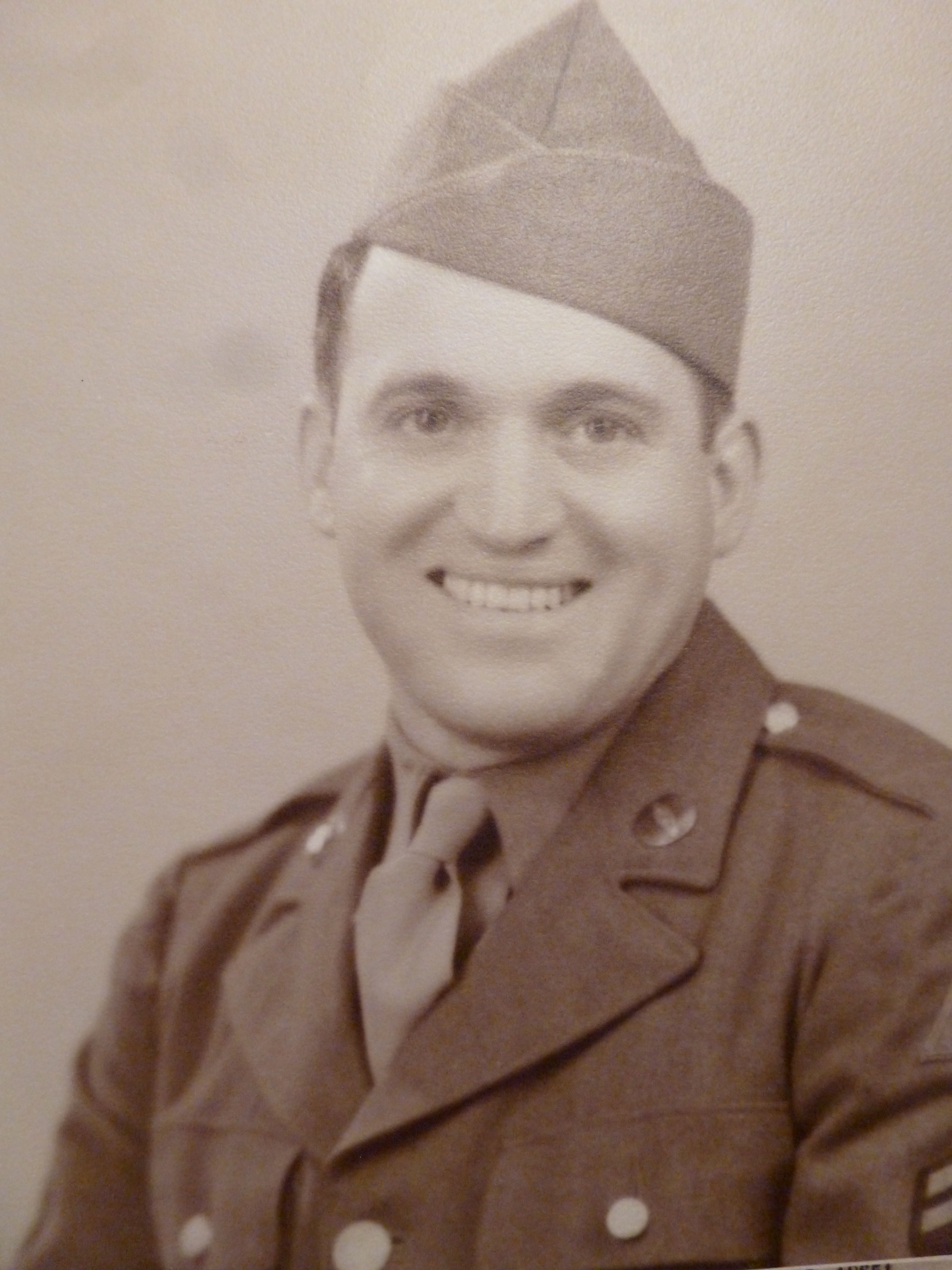
My dad was in the Army in World War II.  He was a dental technician in an armored headquarters group and never went overseas.  But many of his friends did go overseas and saw combat.  What follows are some excerpts from letters sent to my dad.

Bill Zerby was attached to the 781 Tank Battalion, 7th Army, in France and Germany.  In December 1944, just before the Battle of the Bulge, Zerby wrote to my dad that:

“Here we have plenty of mud and rain and 24 hours a day the field artillery lays down a barrage with everything they have.  The outfit is making out pretty well so far.  One good thing these boys don’t believe in taking prisoners…. We all live in houses and have lanterns for lights.  Everything is blacked out at 5 P.M. till dawn.”

I’d like to repeat Zerby’s 3rd sentence: One good thing these boys don’t believe in taking prisoners.

The fight against the Nazis was tough, and it wasn’t just the Germans who violated the Geneva Convention and its rules about taking prisoners.  War, in short, should never be sugarcoated.

At the end of March 1945, Zerby wrote to my dad again, a letter that contained this telling sentence:

“Bookbinder [a fellow soldier] sure got a break [by not going overseas] but he better hope he don’t get sent to Germany.  It seems they don’t like the Heb’s [Jews].”

By this point, Allied troops were beginning to liberate German concentration camps, and beginning as well to realize the murderous hatred the Nazis had for the Jewish people.

On a lighter note, Zerby regales my dad with the following story:

“The place where we live now is a large estate that belongs to a German big shot.  He got chased out and we moved in.  He has a wine cellar that runs all over town—all underground passages, and the dates on some of the casks run back to 1755.  Well some of the wine was really good.  The boys made a tour of the place and took all the best drinks for their own use.  Yes, I was in on it too.  Now we are tired of it and don’t take anymore.  Of course it’s bolted up now but that don’t mean anything.”

In another letter, Zerby writes about American soldiers hunting for deer.  Yes, American troops knew how to have a good time. Wine, venison, and women.  After all, who knew from day to day if you’d live to see home again?

At the end of 1945, Zerby writes again to my dad that “I am now a proud civilian and no more lousy Army life.”  And to my dad’s mention of a few of their friends from the battalion, Zerby writes with painful honesty: “I don’t remember many of those guys anymore.  A hell of a lot of them got bumped off also last winter [in action in France and Germany].  I guess we were just lucky.”

Another of my dad’s friends was Corporal Ed C. Sarna, who was assigned to a headquarters battery in Divisional Artillery.  He wrote to my dad in December 1944 that:

“To date, I have seen a number of [German V-1] buzz bombs at a very close range.  A little in regards to Germany.  If Hitler decided to fight until we hit Berlin, I can sincerely feel that the destruction will wipe Germany right off the map.  At our present place – there isn’t a place found to be livable.  Our forces are really doing a good job of it.”

The Allies wanted to make sure the Germans knew they had been well and truly beaten in this war, so as to prevent the myth that emerged after World War I that the German Army had not been defeated in the field.

This was a sentiment seconded by Corporal Paul Vella, 5th Depot Repair Squadron, Maintenance Division.  He wrote to my dad in March 1945 that “You’re right, Julie, the Germans are getting the shit kicked out of them and the quicker it’s over the better I like it.  I sure would like to see the states after a couple of years of being away from it.”

Corporal Vella also jokingly mentioned the “Soldier’s Prayer” in his letter: Please, Dear God, distribute the bullets like you do the pay and give officers first dibs. Yes, there’s some grim humor shared in the front lines.

There’s nothing really that special about these letters to my dad – and that’s their value.  They are the typical sentiments of American dogfaces in Europe in World War II.  Men who saw the destruction of Germany and the deaths of their friends.  They had no illusions about war, and they didn’t spout patriotic platitudes.  They just wanted the war to be over so they could get back to living their “real” lives.

As one soldier put it to my dad in 1945, “I sure hope that I’ll get my discharge soon, I’ve got plans to complete, my girl is getting tired of waiting so long.”

And thus baby boomers like me followed.

It Should Never Be Done Again: Hiroshima, 70 Years Later

Hiroshima after the bomb

W.J. Astore

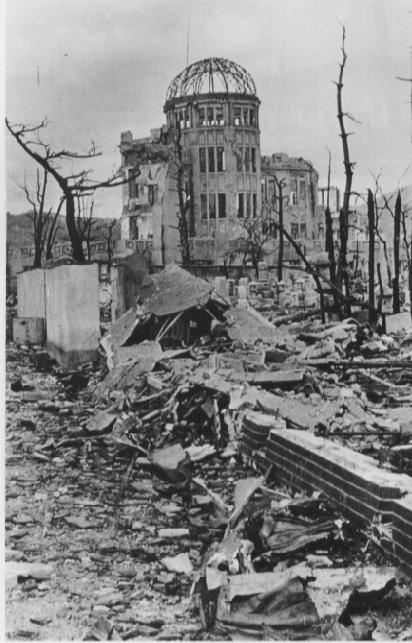
August 6, 1945.  Hiroshima.  A Japanese city roughly the size of Houston.  Incinerated by the first atomic bomb.  Three days later, Nagasaki.  Japanese surrender followed.  It seemed the bombs had been worth it, saving countless American (and Japanese) lives, seeing that a major invasion of the Japanese home islands was no longer needed.  But was the A-bomb truly decisive in convincing the Japanese to surrender?

President Truman’s decision to use atomic bombs against Japan is perhaps the most analyzed, and, in the United States, most controversial decision made during World War II.  The controversy usually creates more heat than light, with hardliners posed on mutually opposed sides.  The traditional interpretation is that Truman used the A-bombs to convince a recalcitrant Japanese Emperor that the war was truly lost.  A quick Japanese surrender appeared to justify Truman’s choice.  It also saved tens of thousands of Allied lives in the Pacific (while killing approximately 250K Japanese).  This thesis is best summed up in Paul Fussell’s famous essay, “Thank God for the Atomic Bomb.”

Even before Hiroshima, however, a small number of scientists argued that the A-bomb should not be used against Japan without a prior demonstration in a remote and uninhabited location.  Later, as the horrible nature of radiation casualties became clearer to the American people, and as the Soviet Union developed its own arsenal of atomic weapons, threatening the United States with nuclear Armageddon, Americans began to reexamine Truman’s decision in the context of the Cold War and the nuclear arms race.  Gar Alperovitz’s revisionist view that Truman was practicing “atomic diplomacy” won its share of advocates in the 1960s. (Alperovitz expanded upon this thesis in the 1990s.)  Other historians suggested that racism and motives of revenge played a significant role in shaping the U.S. decision.  This debate reached its boiling point in the early 1990s, as the Smithsonian’s attempt to create a “revisionist” display to mark the bomb’s 50th anniversary became a lightning rod in the “culture wars” between a Democratic administration and a resurgent Republican Congress.

Were the atomic bombs necessary to get the Japanese to surrender?  Would other, more humane, options have worked, such as a demonstration to the Japanese of the bomb’s power?  We’ll never know with certainty the answer to such questions.  Perhaps if the U.S. had been more explicit in their negotiations with Japan that “unconditional surrender” did not mean the end of Japan’s Emperor, the Japanese may have surrendered earlier, before the A-bomb was fully ready.  Then again, U.S. flexibility could have been interpreted by Japanese hardliners as a sign of American weakness or war fatigue.

Unwilling to risk appearing weak or weary, U.S. leaders dropped the A-bomb to shock the Japanese into surrendering. Together with Stalin’s entry into the war against Japan, these shocks were sufficient to convince the Japanese emperor “to bear the unbearable,” in this case total capitulation, a national disgrace.

A longer war in the Pacific — if only a matter of weeks — would indeed have meant higher casualties among the Allies, since the Japanese were prepared to mount large-scale Kamikaze attacks.  Certainly, the Allies were unwilling to risk losing men when they had a bomb available that promised results.  The mentality seems to have been: We developed it.  We have it.  Let’s use it.  Anything to get this war over with as quickly as possible.

That mentality was not humane, but it was human.  Truman had a weapon that promised decisiveness, so he used it.  The attack on Hiroshima  was basically business as usual, especially when you consider the earlier firebombing raids led by General Curtis LeMay.  Indeed, such “conventional” firebombing raids continued after Hiroshima and Nagasaki until the Japanese finally sent a clear signal of surrender.

Of course, an event as momentous, as horrific, as Hiroshima took on extra meaning after the war, given the nuclear arms race, the Cold War and a climate represented by the telling acronym of MAD (mutually assured destruction). U.S. decisionmakers like Truman were portrayed as callous, as racist, as war criminals.  Yet in the context of 1945, it’s difficult to see any other U.S. president making a different decision, especially given Japan’s apparent reluctance to surrender and their proven fanaticism at Iwo Jima, Okinawa and elsewhere.

As Andrew Rotter notes in Hiroshima: The World’s Bomb (2008), World War II witnessed the weakening, if not erasure, of distinctions between combatants and non-combatants, notably during LeMay’s firebombing of Tokyo in March 1945 but in many other raids as well (Rotterdam and Coventry and Hamburg and Dresden, among so many others). In his book, Rotter supports the American belief that Japan would fight even more fanatically for their home islands than they did at Iwo Jima and Okinawa, two horrendous battles in 1945 that preceded the bomb. But he argues that Truman and Secretary of War Henry Stimson engaged in “self-deception” when they envisioned that the effects of the atomic bomb could be limited to “a purely military” target.

A quarter of a million Japanese died at Hiroshima and Nagasaki and in the years and decades following.  They died horrible deaths.  And their deaths serve as a warning to us all of the awful nature of war and the terrible destructiveness of nuclear weapons.

Hans Bethe worked on the bomb during the Manhattan Project.  A decent, humane, and thoughtful man, he nevertheless worked hard to create a weapon of mass destruction. His words of reflection have always stayed with me.  They come in Jon Else’s powerful documentary, “The Day After Trinity: J. Robert Oppenheimer and the Atomic Bomb.”

Here is what Bethe said (edited slightly):

The first reaction we [scientists] had [after Hiroshima] was one of fulfillment.  Now it has been done.  The second reaction was one of shock and awe: What have we done?  What have we done.  The third reaction was it should never be done again.

It should never be done again: Just typing those words here from memory sends chills up my spine.

Let us hope it is never done again.  Let us hope a nuclear weapon is never used again.  For that way madness lies.

Surprise! Weapons Sales Are Booming

Heck ya!  Send some B-52s to Israel (U.S. Air Force photo)
Heck ya! Send some B-52s to Israel (U.S. Air Force photo)

W.J. Astore

Any optimism that the Iran nuclear deal might slow the momentum of weapons sales to the Middle East has already been strangled in the cradle. Consider the following news item, courtesy of FP: Foreign Policy:

While U.S. Defense Department officials make promises to partner with Middle East allies nervous about the Iranian missile threat in their backyard, U.S. defense contractors are rushing in to ink multiple billion dollar deals to fill the gap. On Wednesday, the State Department announced a pending $5.4 billion deal with Saudi Arabia for a 600 new PAC-3 Patriot missile interceptors, which will bring the Saudi missiles up to date with the latest version of the Patriot.

The massive deal follows an April agreement with Riyadh for $2 billion worth of Patriots, and another $1.5 billion sale, announced this month, for Patriot interceptors in Qatar, United Arab Emirates, Taiwan, South Korea, and Saudi Arabia. Defense contractors Lockheed Martin and Raytheon will produce the missiles.

That’s $9 billion in Patriot surface-to-air missile (SAM) sales, a coup indeed for Lockheed Martin and Raytheon.

At least the Patriot SAM is largely defensive in nature.  One former Obama official has gone a quantum leap further in advocating that the U.S. supply B-52 bombers to Israel armed with special bunker-busting bombs.  Here’s the gist of the story, courtesy of Defense News:

A former top adviser to US President Barack Obama is calling on Washington to provide bunker-busting B-52 bombers to Israel as a means of bolstering Israeli deterrence and the credibility of its so-called military option should Iran opt out of commitments codified in Tuesday’s deal with world powers.

“To have a credible military option, it’s not enough to say all options are on the table. We have to be much more blunt,” said Ambassador Dennis Ross, a longtime diplomat and former special adviser to Obama on Iran.

In an interview Thursday, Ross said he favors the transfer of an unspecified quantity of B-52 Stratofortress bombers outfitted to deliver 30,000-pound GBU-57 Massive Ordnance Penetrators as one of the means of shoring up deterrence vis a vis Iran.

Sure: Just what the Israelis need: a huge long-range strategic bomber, originally built in the 1950s to deter, and if necessary to attack, the Soviet Union with nuclear weapons.  Perhaps an Israeli Major Kong can ride one of those bunker-busters right into the heartland of Iran.

We do indeed have a strange love for weaponry.

The Iran Nuclear Deal: What It Really Means

With Cuba and Iran, perhaps Obama is finally working to earn his peace prize?

W.J. Astore

When I was a teenager, America’s two biggest allies in the Middle East were Israel and Iran.  We considered the Shah of Iran to be a strong ally in the region, and sold him some of our most advanced weaponry, including the F-14 Tomcat fighter with its powerful radar as well as HAWK surface-to-air missiles.  Students from Iran attended American colleges and universities.  Heck, we even helped Iran with its fledgling nuclear power industry.

All that changed, of course, with the Islamic revolution in Iran and the Iranian hostage crisis.  America became “The Great Satan,” American flags were burned, and young Americans were told we had been betrayed.  We took to wearing t-shirts that read “Put a hola in the Ayatollah,” featuring a head shot of the Ayatollah Khomeini with a sniper’s cross hair superimposed on it.  (I should know: I owned and wore that very t-shirt.)

That kind of estrangement, bordering on the unhinged, is what is changing for the better because of the nuclear deal with Iran, notes Peter Van Buren at TomDispatch.com.  In Van Buren’s words:

Here’s what actually matters most [about the Iran nuclear deal]: at a crucial moment and without a shot being fired, the United States and Iran have come to a turning point away from an era of outright hostility. The nuclear accord binds the two nations to years of engagement and leaves the door open to a far fuller relationship. 

Iran and the USA have pulled back from the brink of war.  Sorry: No more off-key renditions by John McCain about bombing Iran.  Billions of dollars saved, countless innocent lives spared.  What’s to complain about?

As Van Buren notes, diplomacy, at least for the time being, was allowed to work.  In his words:

It’s a breakthrough because through it the U.S. and Iran acknowledge shared interests for the first time, even as they recognize their ongoing conflicts in Syria, Yemen, and elsewhere. That’s how adversaries work together: you don’t have to make deals like the July accord with your friends. Indeed, President Obama’s description of how the deal will be implemented — based on verification, not trust — represents a precise choice of words. The reference is to President Ronald Reagan, who used the phrase “trust but verify” in 1987 when signing the Intermediate-Range Nuclear Forces Treaty with the Russians.

The agreement was reached the old-school way, by sitting down at a table over many months and negotiating. Diplomats consulted experts. Men and women in suits, not in uniform, did most of the talking. The process, perhaps unfamiliar to a post-9/11 generation raised on the machismo of “you’re either with us or against us,” is called compromise. It’s an essential part of a skill that is increasingly unfamiliar to Americans: diplomacy. The goal is not to defeat an enemy, find quick fixes, solve every bilateral issue, or even gain the release of the four Americans held in Iran. The goal is to achieve a mutually agreeable resolution to a specific problem. Such deft statecraft demonstrates the sort of foreign policy dexterity American voters have seldom seen exercised since Barack Obama was awarded the 2009 Nobel Peace Prize (Cuba being the sole exception).

Of course, no good deed goes unpunished.  Republicans, having no other viable path to power, reflexively attack the deal even before they’ve read it.  Impostors like Mike Huckabee actually suggest the deal is leading Jews to the door of the ovens, an outrageously inflammatory and irresponsible reference to the Nazi Holocaust against the Jews in World War II.  Such rhetoric, wildly exaggerated, conveniently obscures the real fears of Israel and Saudi Arabia.

And what are those fears?  Here’s Van Buren again to explain:

No, what fundamentally worries the Israelis and the Saudis is that Iran will rejoin the community of nations as a diplomatic and trading partner of the United States, Asia, and Europe. Embarking on a diplomatic offensive in the wake of its nuclear deal, Iranian officials assured fellow Muslim countries in the region that they hoped the accord would pave the way for greater cooperation. American policy in the Persian Gulf, once reliably focused only on its own security and energy needs, may (finally) start to line up with an increasingly multifaceted Eurasian reality. A powerful Iran is indeed a threat to the status quo — hence the upset in Tel Aviv and Riyadh — just not a military one. Real power in the twenty-first century, short of total war, rests with money.

He nails it.  After all, what’s the worse that can happen?  Let’s say Iran cheats and starts to develop a nuclear weapon.  In that case, the U.S. will have broad support in attacking Iran to eliminate that capability.  Meanwhile, the thousands of nuclear warheads that the U.S. possesses, and the hundreds of nuclear bombs the Israelis possess, should serve as a sufficient deterrent against Iranian nuclear designs (assuming the Iranians ever seek to fulfill them).

After so many failed military interventions in the Middle East, after so much death and destruction, isn’t it high time the world community tried diplomacy and engagement?  I’d say so.  And this from a former teenager who wore a t-shirt advocating the assassination of Iran’s revolutionary leader.