The United States of Militarism

Waving the flag and wielding a gun: Hey, it's the USA!
Waving the flag and wielding a gun: Hey, it’s the USA!

W.J. Astore

A century ago, the USA was a dynamic, forward-looking, freedom-espousing country that was focused on science and technology and its practical applications, as represented by Thomas Edison and Henry Ford.  We were about to reelect a president, Woodrow Wilson, precisely because he had kept the country out of World War I.  With the exception of the Navy, the U.S. military was small, and few Americans (Teddy Roosevelt comes to mind) boasted about the “manly” virtues of military service and war.

Here we are, a century later, in a country that has taken up militarism, a country which is increasingly reactionary, authoritarian, and backward-leaning, a country that leads the world not in innovation for ordinary people as in the days of Edison and Ford, but in weapons exports to the world’s trouble spots.

Anyone with a sense of history — indeed, anyone with common sense — should recognize that militaries are antithetical to democracy.  Indeed, most Americans recognized exactly that in 1915.  A true democracy has a military as a reluctant and regrettable choice, driven by the need to defend itself in a hostile and violent world. But over the last century a regrettable choice has become, not only requisite, but celebratory in the USA.  Like so many amped up Teddy Roosevelt’s, striving to prove our manhood, America now believes military service conveys nobility.  Heroic meaning.

Yet celebrating the military, nobilizing the military experience, finding purpose and meaning in continuous war, is the very definition of militarism.

Admittedly, American militarism is a peculiar strain.  It’s not the Germanic kind in which a conservative aristocracy found its reason for being and its privileged position in military service.  There are no Prussian Junkers who willingly revel in a martial code of honor and duty in war.  Indeed, America’s aristocracy of wealth reserves the right to exclude itself from military service even as it applauds the sons and daughters of the lower orders who enlist to fight (and sometimes to die).

Again, it’s a strange militarism, militarism USA, one in which military service is indeed one of the few avenues for America’s working classes to rise by merit (tightly defined within a hierarchical structure that breeds and rewards conformity), and where a few generals actually attain a measure of cult status, however temporary (recent examples include Colin Powell, Tommy Franks, and David Petraeus).  Yet celebrated generals come and go, even as America’s wars are continuous.

Indeed, we’ve become so accustomed to living with the drumbeats of war that we no longer hear them.  It reminds me of a lesson an officer taught on World War I at the Air Force Academy.  He played sounds of an artillery barrage for the entire 50 minutes of the lesson.  When you first walked in, the noise hit you.  Then you sort of forgot about it as he taught the lesson.  Just before the end, he turned off the noise, and the silence spoke.  You realized, just a little, what it had been like for troops in the trenches in 1916 living under artillery bombardment.  And you also realized how quickly we can all become more or less accustomed to the drumbeats of war.

We’re hearing them all the time today — it’s the background noise to our lives.  For some, it’s even become sweet music.  But war and militarism is never sweet music to a functioning democracy.

One final point: Some Americans react as if calling attention to the militarization of our society/culture is the same as being anti-military.  Being against militarism and war is not being anti-military: more the reverse.  There’s a strange conflation or confusion there — and this conflation/confusion is a sign of how far militarism has gotten under our collective skin and into the nation’s blood stream.


Making War on Everything is the American Way

When you're at war, even your own youth become potential enemies.  A sign after the Kent State shootings
When you’re at war, even your own youth become potential enemies. A sign after the Kent State shootings (1970)

W.J. Astore

Here are a few excerpts from my latest article at TomDispatch.com.  I urge you to read the entire article here.  Thank you!

War on drugs. War on poverty. War in Afghanistan. War in Iraq. War on terror. The biggest mistake in American policy, foreign and domestic, is looking at everything as war. When a war mentality takes over, it chooses the weapons and tactics for you.  It limits the terms of debate before you even begin. It answers questions before they’re even asked.

When you define something as war, it dictates the use of the military (or militarized police forces, prisons, and other forms of coercion) as the primary instruments of policy.  Violence becomes the means of decision, total victory the goal.  Anyone who suggests otherwise is labeled a dreamer, an appeaser, or even a traitor.

War, in short, is the great simplifier — and it may even work when you’re fighting existential military threats (as in World War II).  But it doesn’t work when you define every problem as an existential one and then make war on complex societal problems (crime, poverty, drugs) or ideas and religious beliefs (radical Islam).

America’s Omnipresent War Ethos

Consider the Afghan War — not the one in the 1980s when Washington funneled money and arms to the fundamentalist Mujahideen to inflict on the Soviet Union a Vietnam-style quagmire, but the more recent phase that began soon after 9/11.  Keep in mind that what launched it were those attacks by 19 hijackers (15 of whom were Saudi nationals) representing a modest-sized organization lacking the slightest resemblance to a nation, state, or government.  There was as well, of course, the fundamentalist Taliban movement that then controlled much of Afghanistan.  It had emerged from the rubble of our previous war there and had provided support and sanctuary, though somewhat grudgingly, to Osama bin Laden.

With images of those collapsing towers in New York burned into America’s collective consciousness, the idea that the U.S. might respond with an international “policing” action aimed at taking criminals off the global streets was instantly banished from discussion.  What arose in the minds of the Bush administration’s top officials instead was vengeance via a full-scale, global, and generational “war on terror.”  Its thoroughly militarized goal was not just to eliminate al-Qaeda but any terror outfits anywhere on Earth, even as the U.S. embarked on a full-fledged experiment in violent nation building in Afghanistan.  More than 13 dismal years later, that Afghan War-cum-experiment is ongoing at staggering expense and with the most disappointing of results.

While the mindset of global war was gaining traction, the Bush administration launched its invasion of Iraq.  The most technologically advanced military on Earth, one that the president termed “the greatest force for human liberation the world has ever known,” was set loose to bring “democracy” and a Pax Americana to the Middle East.  Washington had, of course, been in conflict with Iraq since Operation Desert Storm in 1990-1991, but what began as the equivalent of a military coup (aka a “decapitation” operation) by an outside power, an attempt to overthrow Saddam Hussein and eliminate his armed forces and party, soon morphed into a prolonged occupation and another political and social experiment in violent nation-building.  As with Afghanistan, the Iraq experiment with war is still ongoing at enormous expense and with even more disastrous results …

It’s the mindset that matters.  In places like Iraq and Afghanistan, places that for most Americans exist only within a “war” matrix, the U.S. invades or attacks, gets stuck, throws resources at the problem indiscriminately, and “makes a desert and calls it ‘peace'” (to quote the Roman historian Tacitus).  After which our leaders act surprised as hell when the problem only grows.

Sadly, the song remains monotonously the same in America: more wars, made worse by impatience for results driven by each new election cycle.  It’s a formula in which the country is eternally fated to lose…

b. traven asked me about “First Causes” when it comes to America’s permanent war mentality. With respect to the Middle East, he mentioned the Saudis and Israelis and the extent to which the USA kowtows to each. Here is my quick response:

I’d say that our war mentality pre-dates our tango with the Saudis and Israelis.  We really didn’t come to support them in a big way until the early 1970s, and by that point Korea and Vietnam and the military-industrial complex had already created a permanent war mentality.

First Cause(s): It’s so hard to say.  The Cold War and anti-Communist hysteria played a powerful role.  So did our culture: the John Wayne mentality.  American exceptionalism and our own myths.  The misreading of history: We must always resist violently or we’re risking another Munich.  Capitalism and the pursuit of profit by any means, to include violence.  Violence itself as a means to profit.

Maybe that’s it: Naked greed feeds wanton aggression.

What say you, readers?  Why is America always at war with itself and the world?

The Hidden Costs of War

Agent Orange victims Nguyen and Hung Vuong Pham, ages 14 and 15, as captured by Brian Driscoll, photographer, in 2008.(Huffington Post, 2013, see link in article)

W.J. Astore

If you’re in the U.S. military or you’re a veteran, you probably know casualty figures, especially deaths, from America’s wars.  To cite one example, America lost more than 58,000 men in the Vietnam War.  Their names are inscribed on the “The Wall” in DC.  I’ve been there.  Seeing all those names is a devastating experience.

But “The Wall” undercounts the number of American dead from that war.  Just the other day, I was talking to a veteran, a graduate of West Point, about Vietnam.  He told me he had two classmates who became pilots and who worked with Agent Orange, a toxic chemical defoliant, in Vietnam.  They both died later of brain tumors from their exposure to the chemical. Their names are not on The Wall.

I shared this story with a colleague, and he wrote back that his father’s best friend flew Agent Orange around in the Pacific, relocating it after the war.  After being exposed to it day after day, he died of cancer in his early thirties.  His name is also not on The Wall.

Wars are not over for our veterans after the U.S. government says they are.  Consider the surge in veteran suicides, especially for those in their fifties and sixties.  Estimates vary as to how many Vietnam veterans have taken their own lives, but the number may be as high as 100,000.  PTSD, chronic pain, depression, alcohol and drug addiction, and many other conditions linked to war ultimately become an unbearable load for many of our veterans.

(And as I’ve written about elsewhere, the cost of war was much much higher for the Vietnamese people, to include the continuing costs of exposure to Agent Orange, as shown in this article at Huffington Post)

My point is this: As a country, we just don’t recognize fully the true costs of our wars.  It’s not enough to add up the billions spent or the number of combat deaths.  We need to reckon with the aftermath of our wars, the way that veterans keep suffering and dying from wounds they suffered, many of them hidden from view, but no less real for that reason.  And we need to reckon with the destruction we inflict on other peoples and countries, for the “American way of war” is profligate with firepower, from high explosive and napalm and cluster munitions to Willy Peter (white phosphorous) and depleted uranium.

And maybe, just maybe, if we ever truly reckon with the cost of war to ourselves and others, we’ll strive harder to avoid war in the future.

A coda: Can we ban forever the term “surgical strike”?  Can we ban forever the term “collateral damage”?  Can we ban these and similar weasel words that diminish the horrifying and murderous nature of war?

Betraying the military (and democracy) by loving indifference

A grim reality of military service that we often prefer not to see

W.J. Astore

Since the end of the Vietnam War, when it eliminated the draft, the United States has relied on an “all-volunteer military,” or AVM.  But that military, as one would expect, has not drawn equally from all segments of American society.  Its recruits have been more rural than urban, more Southern and Midwestern than from coastal regions, more conservative and evangelical than liberal and non-denominational, and certainly more working and middle class than from the affluent upper classes.

Is there a problem here?  Some would answer “no,” but today’s AVM is not the citizen-military of World War II, which drew in a fairly equitable way from all sectors of American society.  Today’s AVM defines itself as a breed apart, as separate from and superior to the masses who choose not to serve.  And in some sense it is a breed apart, because we have allowed it to become so.

This band of self-styled warriors is augmented increasingly by privatized military corporations, or mercenaries in plain speak.  (Indeed, some service members, when they leave the AVM, choose to join privatized military corporations, often doubling or tripling their salaries in the process.)  National Guard and Reserves complete the picture, units of which have been deployed to war zones far more frequently than anticipated since 9/11.

So, the U.S. military today is a curious amalgam.  An AVM or “professional” military, supported by privatized corporations/mercenaries and “weekend warriors,” deployed to foreign locations, acting to guard and sometimes to extend an imperial frontier, often celebrated by gushing politicians and a fawning media as “heroes” and as “the finest fighting force ever,” even as that military is connected less and less tangibly to the American citizenry.

And it’s that very decline in tangible connections that accounts for much of the military boosterism in America.  Most Americans lack any clear sense of what the military does; they certainly care less than they should; but what they are willing to do is to “salute” the troops by buying a beer in a red-white-and-blue can or putting a magnetic ribbon on their SUV as an expression of “support.”

A military that is not drawn equitably and broadly from the people is a military that is potentially corrosive to democracy.  Perhaps not surprisingly, today’s military is also one that is rarely sent on the people’s business in anything but name.  Instead, it is sent on the government’s business, a government riddled by special interests, a deeply compromised government.

Having served myself in the AVM for twenty years, I confess to respect aspects of it while increasingly being uneasy at its current composition and direction.  Why?  Because its composition is less than democratic, and its missions are even less so.  These hard facts are nothing new in history, even in America’s history, even when we had a draft.  Just read General Smedley Butler’s War Is A Racket. What’s new is our acquiescence as a people in the transformation of our military as warriors and mercenaries to well-heeled special interests.

Our nation has betrayed its troops in a strange way — by loving indifference.  Even as the military kills in our name, we choose to look away, sometimes in horror at the face of war, most often in lack of interest.  Even when we show interest, it’s the interest of cheerleaders jumping in celebration, or of fans enthusiastically or politely applauding from the sidelines.  The vast majority of Americans choose to have no real skin in the game.

What our military needs is not gushing cheerleaders or applauding fans but determined critics.  It needs to be challenged.  It needs a good ass-chewing, especially of its decision-makers at the top, the brass.  We sure as hell can’t wait for our “leaders” to do this.

Recent presidents have become cheerleaders-in-chief rather than commanders, nearly all of our Members of Congress have joined the pep squad, and the few critics who exist have been marginalized or attacked as being unpatriotic.

Even as our military becomes less democratic, less a representative sample of the people, we the people refuse to know our military.  We especially don’t want to know what it does in our name (especially the bad stuff, which is largely kept secret from us anyway).  So we end up worshiping a fantasy military, a manic pixie dream military, a figment of our imagination, an amalgam of films like Saving Private Ryan (WWII idealism), Top Gun (technological wargasm), and Act of Valor (Rambo/cowboy histrionics).

We refuse to know our military and what it does.  And if the people don’t know the military, and if the military is not drawn fairly from the people, you have a ripple, a rent, maybe even a fatal fault line, in the political and social life of the Republic.

We don’t know what kind of military we have, we don’t know what it does, but we worship it anyway.  That’s not democracy; that’s militarism as a national religion.

America’s Military Strategy? Persistent Overreach

A Roman Cavalry Mask found at the presumed site of the Battle of Teutoburg Forest

W.J. Astore

Reports that President Obama is considering even more troops and bases to fight ISIS in Iraq put me to mind of Roman general Publius Quinctilius Varus.  Two millennia ago, Varus committed three Roman legions to the Teutoburg Forest in Germania in terrain that neutralized Roman advantages in firepower and maneuverability.  Ambushed and caught in a vise, his legions were destroyed in detail as Varus took his own life.  To Rome the shock and disgrace of defeat were so great that Emperor Augustus cried, “Quinctilius Varus, give me back my Legions!”

Ever since 9/11, American presidents and their military advisors have repeatedly committed U.S. troops and prestige to inhospitable regions in terrain that largely neutralizes U.S. advantages in firepower and maneuverability.  Whether it’s the urban jungles of Baghdad or Fallujah or Mosul or the harshly primitive and mountainous terrain of Afghanistan, American troops have been committed to campaigns that they can’t win (in any enduring sense), under conditions that facilitate ambushes by an elusive enemy with superior knowledge of the local terrain.  The number of U.S. soldiers killed or seriously wounded in these campaigns is roughly equivalent to those lost by Varus, though unlike Varus no U.S. general has yet to fall on his sword.

Unlike Rome, which did learn from Varus’s catastrophe the perils of imperial overreach, the U.S. persists in learning nothing.  Perhaps that’s because America’s defeat is collective and gradual, rather than singular and quick.  America may lack a Varus or a calamity like Teutoburg Forest, yet the overall result since 9/11 has been no less debilitating to American foreign policy.

Despite setback after setback, American presidents and generals persist in trying to control hostile territory at the end of insecure logistical lines while mounting punitive raids designed to deny Al Qaeda or ISIS or the Taliban “safe havens.”  We should have learned the impossibility of doing this from Vietnam, but it seems America’s presidents and generals keep trying to get Vietnam right, even if they have to move the fight to the deserts of Iraq or the mountains of Afghanistan.

Yet seeking to control territory in inhospitable regions like the Middle East or Afghanistan, whether you use American troops or proxy armies, is an exercise in strategic futility.   It’s also old-fashioned thinking: the idea that, to exert influence and control, you need large numbers of military boots on the ground.  But the world has already moved past such thinking into “borderless” hegemony as demonstrated by the Internet, by global business and finance, and by America’s own practice of drone strikes and cyber-war.

By repeatedly deploying American troops – whether in the tens of hundreds or tens of thousands – to so many equivalents of the Teutoburg Forest, our leaders continue a strategy of overreach that was already proven bankrupt in Vietnam.  Meanwhile, despite our own early revolutionary history, our leaders seem to have forgotten that no country likes to be occupied or interfered with by foreigners, no matter how “generous” and “benevolent” they claim to be.  Let’s also not forget that boots on the ground in faraway foreign lands cost an enormous amount of money, a cost that cannot be sustained indefinitely (just ask the British in 1781).

America simply cannot afford more troop deployments (and commitments of prestige) that set the stage for more military disasters.  When you persist in committing your legions to torturous terrain against an enemy that is well prepared to exact a high price for your personal hubris and strategic stubbornness, you get the fate you deserve.

After Varus’s calamity, the Romans stopped campaigning east of the Rhine.  When will America’s leaders learn that persistence in strategic overreach is nothing but folly?

Update (6/21/15): A friend writing from Germany reports that “new archaeological finds near the Elbe apparently show at least one major battle between Roman and Germanic forces in the second century AD. The documentary film’s claim was that the archaeological finds, combined with a few classical source references, show that the Roman armies did engage in major punitive expeditions deep into the territory across the Rhine in the time after Varus, including the one newly discovered which apparently showed a major Roman victory.”

Difficult to see.  Always in motion the future, Yoda once said.  He might have added that the past too “is always in motion.” Did a punitive raid such as this strengthen the Roman Empire or weaken it?  If the Romans won a victory, was it of the Pyrrhic variety?  Did the Romans attempt to sustain a presence across the Rhine only to abandon the attempt?  It will be interesting to see what new evidence is uncovered by archaeologists working in the area.

On Memorial Day, Is There Room to Honor Former Enemies?

sunset july 2014 006

W.J. Astore

Judging by my local newspaper and email stream, Memorial Day is about sales and selling, a reminder that the business of America is business.  But of course Memorial Day is truly about honoring the dead in America’s wars, the veterans who died defending freedom.  Sadly, far too often wars are not fought for high ideals, but that is not the fault of the veteran.

As we remember American veterans this weekend, those who died in the name of defending our country and Constitution, we would do well to ask whether our sympathy for the dead should be limited only to those who fought under the U.S. flag, or whether we should extend it to “the enemy.”  In other words, to all those who suffer and die in wars.

Consider the Vietnam War, a war the USA could and should have avoided.  But we didn’t, and that war was prosecuted with a ruthlessness that was often barbaric.  America lost more than 58,000 in that war, and their names are on the wall in Washington, D.C.  We visit that wall and weep for our dead.

But what about the Vietnamese dead?  Estimates vary, but Vietnam lost roughly three million people in that war, with some figures approaching four million.  The war in Southeast Asia spread to Laos and Cambodia as well, leading to genocide and the “killing fields” of Cambodia.  Do we weep for their dead?

Vietnam today has friendly relations with the USA.  The enemy of the 1960s is, if not an ally, at least a trade partner. There are warm friendships shared between our peoples, nurtured by cultural exchanges between the U.S. and Vietnam.

So, in the case of the Vietnam War, as we remember the American Vietnam veteran, should we not make room in our hearts to remember the Vietnamese veteran as well?

Ultimately, our fellow human beings are not the enemy.  War is the enemy.  A will to destruction is the enemy.  And those caught up in war–the innocent victims on all sides–are worthy of being memorialized.

Far too often, national flags become little more than tribal symbols, much like bikers’ gangs and their colors.  Wear the wrong color, belong to a rival gang, and violence, even a mass shooting, is the result.

Are we fated to keep saluting our own colors while reviling the colors of others?  Are we fated to keep marching off to war under the American flag while killing those who fly a different flag?

Yes, there are necessary wars.  I for one wouldn’t want to live under the Nazi Swastika.  But history shows that necessary and just wars are rare.  For every past war fought for a “just” cause, so many more have been fought for loot, money, power, territory, radical ideologies of one sort or another, dynastic advantage, prestige, and on and on.  The one constant is the troops on all sides who march and die.

A memorial day that remembers the “enemy” dead as well as our own would, perhaps, be a small step toward a memorial day in the future with far fewer war dead to memorialize.


Future Headlines We Don’t Want to See (But Probably Will)

Difficult to see.  Always in motion the future.
Difficult to see. Always in motion the future.

W.J. Astore

History may not repeat itself, but it sure does echo – often loudly.  That’s the theme of Tom Engelhardt’s new article, “Tomorrow’s News Today: Writing History Before It Happens.”  Tom comes up with nine headlines that we’ve seen before, and that (sadly) we’re likely to see again — and again.  Here, shortened, are his nine “future” headlines:

  1. U.S. airstrike obliterates foreign wedding party.
  2. U.S. government surveillance is far more intrusive than previously reported.
  3. Patriotic whistleblower charged with espionage.
  4. Extremist groups exploit unrest caused by U.S. military strikes.
  5. Supposed U.S. ally snubs Presidential summit/meeting.
  6. Young American with Islamic sympathies caught planning terrorism in FBI sting operation.
  7. “Lone Wolf” homegrown terrorist kills innocents; says he was inspired by ISIS.
  8. Toddler kills mother in gun accident.
  9. President says U.S. is both exceptional and indispensable.

You can read all of Tom’s article here.   Perhaps the most sobering aspect of his article is how readily predictable (and repetitive) such headlines are.  Toddlers shooting parents and siblings?  Sadly predictable due to the proliferation of guns and lack of safety measures.  Whistleblowers charged with espionage?  The next Snowden or Manning should be ready to be so charged, even when (especially when) their motives are focused on informing ordinary Americans of what their government is up to.

Inspired by Tom’s article, I came up with seven grim “future” headlines of my own.  I challenge our readers to come up with a few as well.  Just add them to the “Comments” section below.

This is not simply a whimsical or cynical exercise: it’s a reminder of how narrow our country’s narrative appears to be, both now and in the immediate future.  Details change, a name here, a country there, but the headlines remain the same.  We need to act to change these headlines.

My seven “future” headlines

  1. U.S.-trained army [in Iraq, Afghanistan, whereverstan] collapses, abandoning heavy weapons and ammo stocks to rebel forces.
  2. Deep-sea oil drilling platform [in Gulf of Mexico, Arctic Circle, insert environmentally sensitive area] malfunctions, triggering major spill and environmental disaster.
  3. U.S. President starts new war without Congressional declaration of war.
  4. After declaring “mission accomplished” [in Iraq, Afghanistan, Libya, Yemen, insert almost any Middle Eastern/African Country] and withdrawing U.S. troops, President [Bush, Obama, Bush/Clinton] orders troops to return as war is rekindled.
  5. U.S. loses huge weapons cache [in Iraq, Afghanistan, whereverstan]; sends more weapons as replacements.
  6. Lawbreaking major bank/corporation “too big to jail”; pays fine and admits no wrongdoing.
  7. Pentagon weapon system, 10 years behind schedule and $100 billion over budget, fully funded by Congress.

Always in motion the future, as Yoda said.  Let’s hope that a change for the better is not something that’s limited to “Star Wars” movies.

America’s Mutant Military

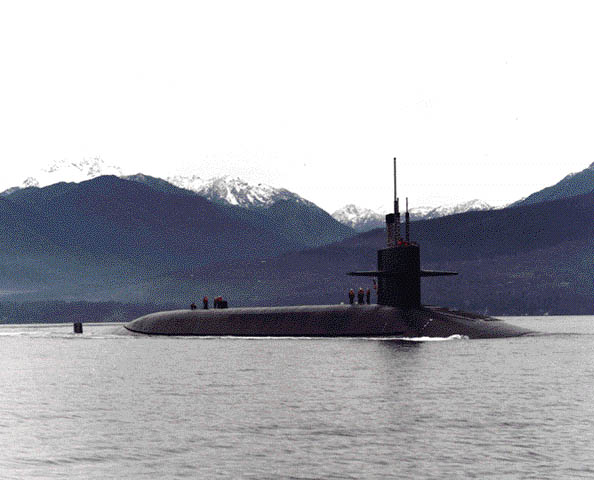
An Ohio-Class Submarine, armed with Trident nuclear missiles

W.J. Astore

I’ve been writing for TomDispatch.com and the amazing Tom Engelhardt since 2007.  When I wrote my first article, “Saving the Military from Itself: Why Medals and Metrics Mislead,” I never imagined I would come to write 37 more for Tom and his site over the next eight years.  TomDispatch has given me an opportunity to write about topics like the elimination of nuclear weapons, the rise of American militarism, the perils of calling all troops in the military “heroes,” the over-hyping of American military prowess by our leaders, and many others.  In all my articles, I hope I’ve offered a contrary perspective on the U.S. military as well as American culture, among other subjects.

My latest article, America’s mutant military, is a personal odyssey of sorts.  I reflect on how the military has changed since I entered it in 1985.  Today’s post-Cold War U.S. military is, to put it bluntly, not as I envisioned it would be as the Berlin Wall was falling and the Soviet Union was collapsing.  Today’s military still has its Cold War weaponry and mindset largely intact, even as a new “mutant” military has emerged, based on special ops and connected to corporations and intelligence agencies, a military hybrid that is often shrouded in secrecy even as it’s celebrated openly in Hollywood action films.

My essay runs 2300 words, so I encourage you to read all of it at TomDispatch.  What follows are a few excerpts from it:

It’s 1990. I’m a young captain in the U.S. Air Force.  I’ve just witnessed the fall of the Berlin Wall, something I never thought I’d see, short of a third world war.  Right now I’m witnessing the slow death of the Soviet Union, without the accompanying nuclear Armageddon so many feared.  Still, I’m slightly nervous as my military gears up for an unexpected new campaign, Operation Desert Shield/Storm, to expel Iraqi autocrat Saddam Hussein’s military from Kuwait.  It’s a confusing moment.  After all, the Soviet Union was forever (until it wasn’t) and Saddam had been a stalwart U.S. friend, his country a bulwark against the Iran of the Ayatollahs.  (For anyone who doubts that history, just check out the now-infamous 1983 photo of Donald Rumsfeld, then special envoy for President Reagan, all smiles and shaking hands with Saddam in Baghdad.)  Still, whatever my anxieties, the Soviet Union collapsed without a whimper and the campaign against Saddam’s battle-tested forces proved to be a “cakewalk,” with ground combat over in a mere 100 hours.

Think of it as the trifecta moment: Vietnam syndrome vanquished forever, Saddam’s army destroyed, and the U.S. left standing as the planet’s “sole superpower.”

Post-Desert Storm, the military of which I was a part stood triumphant on a planet that was visibly ours and ours alone.  Washington had won the Cold War.  It had won everything, in fact.  End of story.  Saddam admittedly was still in power in Baghdad, but he had been soundly spanked.  Not a single peer enemy loomed on the horizon.  It seemed as if, in the words of former U.N. ambassador and uber-conservative Jeane Kirkpatrick, the U.S. could return to being a normal country in normal times.

[But it didn’t happen.  With the Soviets gone, the U.S. military itself was now uncontained, and many hankered to use its power to achieve America’s goal of global power.]

Yet even as civilian leaders hankered to flex America’s military muscle in unpromising places like Bosnia and Somalia in the 1990s, and Afghanistan, Iraq, Libya, Pakistan, and Yemen in this century, the military itself has remained remarkably mired in Cold War thinking.  If I could transport the 1990 version of me to 2015, here’s one thing that would stun him a quarter-century after the collapse of the Soviet Union: the force structure of the U.S. military has changed remarkably little.  Its nuclear triad of land-based ICBMs, submarine-launched SLBMs, and nuclear-capable bombers remains thoroughly intact.  Indeed, it’s being updated and enhanced at mind-boggling expense (perhaps as high as a trillion dollars over the next three decades).  The U.S. Navy?  Still built around large, super-expensive, and vulnerableaircraft carrier task forces.  The U.S. Air Force?  Still pursuing new, ultra-high-tech strategic bombers and new, wildly expensive fighters and attack aircraft — first the F-22, now the F-35, both supremely disappointing.  The U.S. Army?  Still configured to fight large-scale, conventional battles, a surplus of M-1 Abrams tanks sitting in mothballs just in case they’re needed to plug the Fulda Gap in Germany against a raging Red Army.  Except it’s 2015, not 1990, and no mass of Soviet T-72 tanks remains poised to surge through that gap.

[Along with the persistence of America’s “Cold War” military, a new military emerged, especially in the aftermath of 9-11.]

In 2015, so many of America’s “trigger-pullers” overseas are no longer, strictly speaking, professional military.  They’re mercenaries, guns for hire, or CIA drone pilots (some on loan from the Air Force), or warrior corporations and intelligence contractors looking to get in on a piece of the action in a war on terror where progress is defined — official denials to the contrary — by body count, by the number of “enemy combatants” killed in drone or other strikes.

Indeed, the very persistence of traditional Cold War structures and postures within the “big” military has helped hide the full-scale emergence of a new and dangerous mutant version of our armed forces.  A bewildering mish-mash of special ops, civilian contractors (both armed and unarmed), and CIA and other intelligence operatives, all plunged into a penumbra of secrecy, all largely hidden from view (even as they’re openly celebrated in various Hollywood action movies), this mutant military is forever clamoring for a greater piece of the action.

While the old-fashioned, uniformed military guards its Cold War turf, preserved like some set of monstrous museum exhibits, the mutant military strives with great success to expand its power across the globe.  Since 9/11, it’s the mutant military that has gotten the lion’s share of the action and much of the adulation — here’s looking at you, SEAL Team 6 — along with its ultimate enabler, the civilian commander-in-chief, now acting in essence as America’s assassin-in-chief.

Think of it this way: a quarter-century after the end of the Cold War, the U.S. military is completely uncontained.

[And an uncontained military, in a country that celebrates its troops as heroes, that boasts of itself as having the best military in all of recorded history, does not bode well for America’s democratic future.]

Go to TomDispatch.com to read the entire article.  Thank you!

Provoking Wars: Is that what U.S. Foreign Policy Is About?

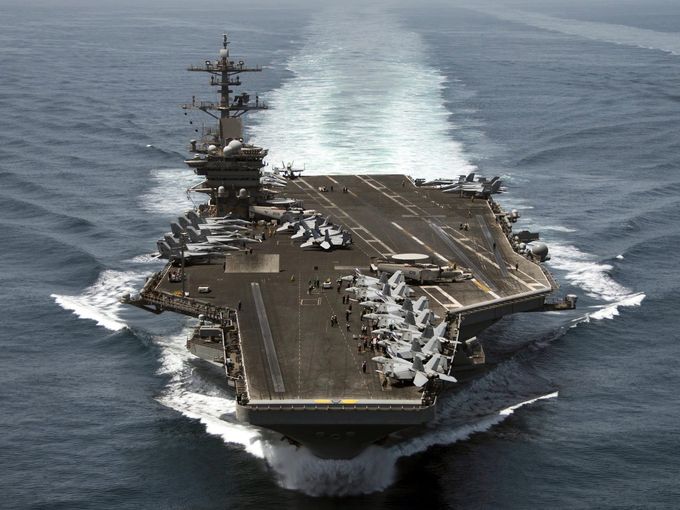
Send in the heavily-armed carriers.  It's about peace!
Send in the heavily-armed carriers. It’s about peace!

b. traven and W.J. Astore

Are America’s foreign policy leaders mad?  It’s a serious question.  Consider last week’s dispatch of 300 military trainers from the 173rd Airborne Brigade to Western Ukraine, a country involved in a contentious jousting match with Vladimir Putin’s Russia.  Or consider this week’s deployment of an aircraft carrier battle group off the coast of Yemen, ostensibly to interdict weapons shipments from Iran, shipments that may not even exist.

These moves have more serious possible repercussions than the usual stupid moves our government makes. They can lead to real war with Russia and Iran. Look at today’s headline in the New York Times: “Putin Bolsters His Forces Near Ukraine.”  Putin may be provoked into an invasion of Ukraine because U.S. meddling has been so blatant (he also knows that when it comes to war in Ukraine, NATO is largely a toothless tiger). The Iranians may renege on the nuclear agreement and deliver extensive military support to the Houthis while directly engaging the House of Saud. In both situations, it’s easy to predict what Obama will do.  Just what John McCain and the neo-cons want him to do.  Bombs away.

It’s a clear case of global reach, global power–and global stupidity.  You’d think massive bungling and endemic corruption in never-ending wars in Iraq and Afghanistan would have taught us something, but the U.S. insists on getting involved in sensitive regional conflicts that could easily spiral out of control.

And when the U.S. chooses to get involved, it’s not with diplomacy.  It’s all about military power.  Yet as much as America professes to love its military, its power is a blunt (and deadly) instrument.  It exacerbates tensions rather than alleviating them.  U.S. military meddling in Ukraine and Yemen promises more conflict, not less.

And perhaps that’s by design.  Consider the reality of America’s ever-burgeoning military budget.  As Dan Froomkin notes, that budget still exceeds the combined defense budgets of the next seven highest spenders (four of those countries—Saudi Arabia, France, the UK, and Germany—are U.S. allies; China and Russia, the only rivals on the list, spend far less than the U.S.).  As the U.S. continues to spend hog-wild on its military, small wonder it remains the go-to option for “diplomacy” around the globe.

Democratic or Republican administration, Obama or Bush, the one constant is global war.  The U.S. is already waging illegal “low intensity” war with drones and special operations across the globe.  (It’s worth pointing out that “low intensity” doesn’t feel low when Hellfire missiles are raining down on your neighborhood or when Special Forces are raiding your village and hauling away your neighbors–or you.)  So why not add another serving of war to an already full plate by meddling in Ukraine?  Sadly, the faction the U.S. seems to favor the most has its share of outright fascists.  But they’re “our” fascists, so who cares if they vote to honor Nazi collaborators and perpetrators of the Holocaust?

Russia, predictably, is antagonized by U.S. meddling.  They see it as the decades-old Anglo-British effort to encircle and isolate Russia and cut them off from their access to the Mediterranean by denying them their Black Sea Fleet base in the Crimea.  To add insult to injury, the essentially Russian population of Eastern Ukraine will be marginalized by the coup regime the U.S. helped to install.  Well, there’s nothing like a new Cold War with Russia to push “defense” spending to even higher levels.

If the U.S. fails to rouse the Soviet bear from slumber, perhaps we can provoke a war with Iran.  So let’s continue to send billions of dollars in weaponry to the Saudis so they can continue to bomb and dominate Shia factions in Yemen.  Heck, let’s send an aircraft carrier task force to show how serious we are about “peace.”  (Let’s hope the U.S. Navy doesn’t blunder and shoot down an Iranian commercial aircraft, as it did in 1988, killing 290 innocent passengers and crew.)

Provocation—that’s when U.S. leaders deploy the military to meddle in Ukraine, in Yemen, and elsewhere across the globe.  Yet men like Bush and Obama continue to sell the military, not as provocateurs, but as peace-bringers.  As diplomats in uniform.  They just happen to carry assault rifles and use Hellfire missiles rather than briefcases and pens.

Saddest of all is that things are only going to get worse.  We’ve witnessed how America’s Nobel Peace Prize-winning President morphed into its assassin-in-chief, approving “signature strikes” to snuff out evil-doers everywhere.  Now look who’s running to replace him in 2016: Hillary the Hun on the Democratic side, and all those little chickenhawk Republicans clucking that they’re to the right of Hillary.

If you’re reading this and have money, we advise you to invest in “defense” stocks.  With all these provocations in the works, the staff here at The Contrary Perspective are bullish on prospects for more weapons–and more war.

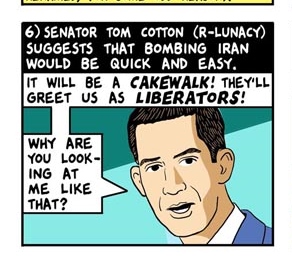
Senator Tom Cotton: Bomb Iran — It’s Easy!

A Panel from Tom Tomorrow lampooning Tom Cotton.  Love the R-Lunacy designation!
A panel from Tom Tomorrow lampooning Tom Cotton. Love the R-Lunacy designation!

W.J. Astore

Would a war against Iran take “only a few days“?  According to Senator Tom Cotton of Arkansas, a few days of precision bombing would be enough to destroy Iran’s nuclear capability.  Oh, there might be a few (thousand) innocent Iranians killed.  And perhaps some radiation spread about.  But wouldn’t some dead and irradiated (Iranian) bodies be worth it?

Despite his military experience in Iraq and Afghanistan, Senator Cotton is a proponent of imaginary war.  You know, war like in a video game, where you drop bombs on target, witness a few explosions, and then it’s game over, with victory for Play Station America.  When you view war like this, as a game, it’s easier to think of it as “inevitable,” which is precisely the word Cotton uses: War with Iran, he says, is inevitable, so let’s flatten them now before they have nukes.

Let’s consider, for a moment, the worst-case scenario: Iran conspires successfully to gain a nuclear weapon in seven years.  What would Iran do with such a weapon?  Iran would face a regional neighbor, Israel, which possesses roughly 200 nuclear weapons. Iran would face a superpower, the United States, which has more than 2000 active nuclear warheads with another 3000 or so in reserve.  Any use of nuclear weapons by Iran would lead to overwhelming retaliation by Israel and/or the United States, so it’s extremely unlikely that Iran would ever use such weapons, unless Iran itself was faced by invasion and destruction.

And there’s the rub.  Relatively weak countries like Iran know that acquiring WMD is a potential game-changer, in the sense that such weapons can deter aggression by the United States.  An Iran with a nuclear weapon is a country that’s less easy for the U.S. to bully.  And Iran has regional rivals (India, Pakistan, and of course Israel) that already possess nuclear arsenals.

Look at what happened to Gaddafi in Libya.  He gave up his WMD (chemical weapons and nerve agents) and the next thing he knew he was being overthrown by a U.S.-led coalition.  We came, we saw, he died, cackled Hillary Clinton.  But would “we” have come if Gaddafi could have threatened a coalition with WMD?

(This is not an argument for WMD or for nuclear proliferation.  As I’ve argued elsewhere, I’d like to see the complete elimination of nuclear weapons on our planet.  They are genocidal weapons, pure and simple.)

It’s all well and good for the U.S. and its partners to work to eliminate any chance of Iran acquiring nukes, but the U.S. needs to go one giant leap further and work to eliminate all nuclear weapons everywhere.  If we did that, maybe Iran wouldn’t want one so much.

In the meantime, Senator Cotton needs to stop imagining how clean and simple it would be to destroy Iran’s nuclear program.  Dropping lots of bombs on Iran while hoping for an imaginary “happy ending” for the U.S. is more than facile thinking.  It’s lunacy.

Update (4/17/15): After I wrote this, I came across Jon Schwarz’s “Seven Things You Didn’t Know the U.S. and its Allies Did to Iran” at The Intercept.  Schwarz also makes the point about the Iranian desire for a nuke as a deterrent against U.S. aggression, and he notes other prominent American leaders who’ve threatened Iran with bombing and/or obliteration.  From his article:

U.S. leaders have repeatedly threatened to outright destroy Iran

It’s not just John McCain singing “bomb bomb bomb Iran.” Admiral William Fallon, who retired as head of CENTCOM in 2008, said about Iran: “These guys are ants. When the time comes, you crush them.” Admiral James Lyons Jr., commander of the U.S. Pacific Fleet in the 1980s, has said we were prepared to “drill them back to the fourth century.” Richard Armitage, then assistant secretary of defense, explained that we considered whether to “completely obliterate Iran.” Billionaire and GOP kingmaker Sheldon Adelson advocates an unprovoked nuclear attack on Iran — “in the middle of the desert” at first, then possibly moving on to places with more people.

Most seriously, the Obama administration’s 2010 Nuclear Posture Review declared that we will not use nuclear weapons “against non-nuclear weapons states that are party to the NPT [Nuclear Non-Proliferation Treaty] and in compliance with their nuclear non-proliferation obligations.” There’s only one non-nuclear country that’s plausibly not in this category. So we were saying we will never use nuclear weapons against any country that doesn’t have them already — with a single exception, Iran. Understandably, Iran found having a nuclear target painted on it pretty upsetting.”