Why Are PTSD Rates So High Among Veterans?

kalkriese_mask
One of the many masks of war

W.J. Astore

Post-traumatic stress disorder (PTSD) is a major problem among veterans who fought in Iraq and Afghanistan.  The VA government web site explains that “OEF/OIF service members are at risk for death or injury. They may see others hurt or killed. They may have to kill or wound others. They are on alert around the clock. These and other factors can increase their chances of having PTSD or other mental health problems.”  The site goes on to say that “Research on OEF/OIF Veterans suggests that 10% to 18% of OEF/OIF troops are likely to have PTSD after they return.” (OEF and OIF are acronyms for the wars in Afghanistan and Iraq.)

That’s a lot of veterans.  Hundreds of thousands, potentially.  Why is this number so high?  Is there something uniquely bad or intense about wars in Iraq or Afghanistan?  We can point to several factors, to include constant redeployments – four or five were not uncommon – on high-risk and high-stress missions, only to witness regress instead of progress.  Add to this the everyday shifts between secure bases and insecure field ops (as with air crews in World War II), direct electronic connections to home (which can prove discomforting rather than reassuring), and transitions from battlefront to homefront that are often too rapid for bodies and minds to adjust.  Finally, we’re witnessing better diagnosis (think of the “epidemic” of concussions in the NFL, which is much more about better recognition of the symptoms rather than an explosion in cases).  Small wonder there’s almost a pandemic of PTSD cases among the troops.

Are today’s troops not adequately prepared to handle the stresses of war?  Were warriors of the past somehow different?  A colleague, the classicist Steven Willett, explained that within ancient Greece there’s no direct evidence of warriors suffering from what we today term PTSD (though doubtless men suffered physical and mental anguish in the aftermath of brutal physical combat associated with Greek phalanxes).

In Willett’s words,

The evidence [of PTSD] is nonexistent because their [the Greek’s] emotional attitude to service and death for the state is not ours.  One way to appreciate this is to look carefully at the beautiful funeral sculptures set up in the Kerameikos of Athens after the first years of the Peloponnesian War.  Dead soldiers stand serenely in the confidence of having done their duty, perhaps with a favorite dog or horse by them, and the parents looking on never betray grief.  The emotional ambience is calm, the tears long shed, the family proud in its sorrow.  A lot of these funeral sculptures are available on line, but the best are in National Archaeological Museum of Athens.  The families and relatives of Spartan soldiers who had died [are] nobly celebrated, while those of the survivors almost mourned.  Think of Thermopylae.

It got me thinking anew about America’s current wars, and how these wars – unlike those for the Greeks – are not directly for communal defense.  Nor are America’s wars fought by communities, not when 99% of Americans exempt themselves from military service.  In Greek society, all able-bodied men believed it to be both duty and honor to wield shield and spear to defend their communities.  (Socrates was one of them.)  In America today, “support” for the troops often begins and ends with a bumper sticker.

Shared sacrifice for communal ideals: such common purpose doubtless acted as a cushion for the physical and mental blows inflicted in Greek warfare.  No matter the era, troops in combat see and experience horrible things, but the trauma is arguably easier to process when blows are cushioned by necessity, and softened by sacrifices shared within tightknit communal settings.

And that’s precisely what’s lacking in the USA today: a sense that our overseas wars are for a communal cause, for honored ideals held in common.  (Other than a vague sense of protecting the “homeland” from “terrorists.”)  The lack of a strongly held communal cause/purpose for our wars ultimately contributes, I believe, to PTSD rates among our returning veterans.  A sense of confusion – why did I suffer – what was it for, intensified by bitterness – my suffering wasn’t worth it – I killed people and saw my buddies killed and it was all for nothing, plagues the troops that our government sends to war ostensibly in our name.

The military historian Sir Michael Howard quotes Carl von Clausewitz on the larger meaning of war.  War, Clausewitz wrote, “cannot be divorced from political [communal] life; and whenever this occurs in our thinking about war, the many links that connect the two elements [of political purpose and war] are destroyed and we are left with something pointless and devoid of sense.”

If we want to lower PTSD rates, the easiest way is to stop sending troops to war, full stop.  And the second easiest way is to stop sending troops to pointless wars that are devoid of political or communal sense.  Wars that serve no larger communal purpose lack meaning.  And where meaning is debased, so too is our troops’ ability to deal with wars in all their horrors.


“Members of the jury, you have just found Jesus Christ guilty”: Remembering the Catonsville Nine

IMG_0518

W.J. Astore

In May 1968, nine Catholic activists set fire to draft records in Catonsville, Maryland, in a deliberate act of sabotage and protest against the Vietnam War.  For the crime of destroying government property, a crime they freely admitted, they were tried in federal court in Baltimore and found guilty.  I’ve been reading the edited trial transcript (with commentary) by Daniel Berrigan, one of the Catonsville Nine and a Catholic priest.  What unified these nine people was their moral opposition to the Vietnam War, a moral revulsion to the acts their country was committing in Vietnam, a revulsion that drove them to burn draft records with a weak brew of homemade napalm so as to gain the attention of their fellow citizens.

On this Easter Weekend, I would like to focus on a few of the statements made by the Catonsville Nine, as recorded by Daniel Berrigan in “The Trial of the Catonsville Nine.”

Statement by Philip Berrigan

We have been accused of arrogance
But what of the fantastic arrogance … of our leaders
What of their crimes against the people … the poor and powerless
Still no court will try them … no jail will receive them
They live in righteousness … They will die in honor
For them we have one message … for those
in whose manicured hands … the power of the land lies
We say to them
Lead us … Lead us in justice
and there will be no need to break the law
Let the President do … what his predecessors failed to do
Let him obey the rich less … and the people more
Let him think less of the privileged
and more of the poor
Less of America and more of the world
Let lawmakers … judges … and lawyers
think less of the law … more of justice
less of legal ritual … more of human rights …

Statement by Thomas Lewis

We were speaking as Americans
We were proud to be Americans
Yet we have representatives in Vietnam
who do terrible things in our name
We were saying to the military
This is wrong … This is immoral … This is illegal
And their response to this was
they were only obeying orders

Question from the Judge: But they did respond to you, did they not?

Thomas Lewis: It was an atrocious response.

Statement by Marjorie Melville

I know that burning draft files
is not an effective way
to stop a war … but
who has found a way
of stopping this war
I have racked my brain
I have talked to all kinds of people
What can you do
They say yes … yes
But there is no answer
no stopping it
the horror continues

Statement by Thomas Melville

I hear our president … confuse greatness with strength
riches with goodness … fear with respect
hopelessness and passivity with peace
The clichés of our leaders
pay tribute to property … and indifference to suffering
We long for a hand of friendship and succor
and that hand
clenches into a fist
I wonder how long we can endure

Statement by George Mische

We were not out to destroy life
There is a higher law we are commanded to obey
It takes precedence over human laws
My intent was to follow the higher law
My intent was to save lives … Vietnamese lives
North and South American lives
To stop the madness
That was the intent

Statement of Daniel Berrigan

Question from the Judge: You say your intention was to save these children, of the jury, of myself, when you burned the [draft] records?  That is what I heard you say.  I ask if you meant that.

Daniel Berrigan:

I meant that
of course I mean that
or I would not say it
The great sinfulness
of modern war is
that it renders concrete things abstract
I do not want to talk
about Americans in general ….
I poured napalm [on the draft records]
on behalf of the prosecutor’s
and the jury’s children

Closing Statement by Daniel Berrigan

When at what point will you say no to this war?
We have chosen to say
with the gift of our liberty
if necessary our lives:
the violence stops here
the death stops here
the suppression of truth stops here
this war stops here
Redeem the times!
The times are inexpressibly evil
Christians pay conscious … indeed religious tribute
to Caesar and Mars
by the approval of overkill tactics … by brinksmanship
by nuclear liturgies … by racism … by support of genocide
They embrace their society with all their heart
and abandon the cross
They pay lip service to Christ
and military service to the powers of death
And yet … and yet … the times are inexhaustibly good
solaced by the courage and hope of many
The truth rules … Christ is not forsaken …

At the end of the trial, as all nine defendants were found guilty, a “member of the audience” cried, “Members of the jury, you have just found Jesus Christ guilty.”

That last statement, and the words of the Catonsville Nine, give us much to ponder on this Easter Weekend.

Today’s Pentagon as an Ant Farm

ant-farm

W.J. Astore

I was on active duty in the military for twenty years.  My experience: It’s very difficult to see the big picture in the military.  The everyday pressures of the mission keep you focused on the short term.  I recall writing many WARs (weekly activity reports) and being focused on the immediate.  Even the yearly budgetary process tends to keep you focused on the short term.  Assignments for officers and enlisted rarely last longer than three years, with combat tours typically much shorter.  Personnel are constantly changing: for one acquisition project I worked on, four program managers (colonels) rotated in and out in three years.

Along with being focused on the immediate, you are actively discouraged from criticizing the system in any fundamental way.  Of course, you’re not supposed to criticize the commander-in-chief, you’re not supposed to be insubordinate to your chain of command, you’re not supposed to undermine morale.  At the same time, one mistake can be deadly to a career.  People in the military therefore tend to play it safe.  Doubters tend to conform.  They shut their mouths.  Or they vote with their feet by leaving the military.

Critics with the best of intentions often get squashed.  Consider the Air Force pilot who found a problem with the F-22 Raptor’s cockpit oxygen supply system.  This was a top priority, safety of flight, issue, but the Air Force played down the problem so as to protect procurement for the Raptor.  The pilot eventually complained to CBS “60 Minutes” and saw his career stall as a result.  Or consider General Eric Shinseki, who as Army Chief of Staff had the temerity to disagree with the Bush Administration’s rosy talk of low troop requirements in the wake of the invasion of Iraq in 2003.  Shinseki was shunted aside by a system that had no room for well-informed dissent.

Pressures to conform and short-term planning and personnel cycles combine to produce mediocrity and to reproduce the past.  John Paul Vann, an expert on the Vietnam War who died in that war, noted the U.S. military didn’t have 12 years’ experience in Vietnam: it had one years’ experience repeated 12 times over.  Something similar is true in Afghanistan today: the U.S. doesn’t have 14 years’ experience fighting the Taliban and building Afghan security forces, but rather one years’ experience repeated 14 times.

U.S. military actions are sequential rather than synergistic.  It’s just one damn thing after another.  The reality of this is often seen more clearly by people who are outside of the military.  Outsiders aren’t caught up in everyday pressures or limited by conformism.  They’re not caught in a Pentagonal box in which misguided tactics and mistaken goals are accepted by insiders as SOP – standard operating procedure.

But perhaps “box” is the wrong image for the Pentagon and its unreflective busyness; ant farm might be better.  If you’re of a certain age, you may remember those old ant farms advertised in the back pages of comic books.  You could send away for a see-through container with sand and ants that allowed you to watch as your crew of ants busily worked away in your “farm.”

Today’s Pentagon reminds me of those old ant farms.  The ants work busily within it.  Anyone watching wouldn’t question their dedication.  Yet as you’re standing outside the farm, watching them, you can see how tightly their world is delimited and circumscribed.  What is obvious to you is simply beyond them.  The ants keep digging in and rolling along.

It’s well worth asking why the U.S. military puts so much pride on working to the point of exhaustion.  A friend of mine worked at the Pentagon.  He worked hard during his normal shift – but he left on-time to go home.  His co-workers, noses to the grindstone, would hassle him about leaving “early.”  He’d reply: I can leave on-time because I didn’t spend hours rotating between the coffee maker and the gym.

A mindless emphasis on over-caffeinated work and fitness, as another friend suggested, may be a post-Vietnam War reaction to the McNamara “managerial” culture of the 1960s.  As he put it, “One easy way of showing one has the right stuff is to be an exercise nut, and the penumbras of that mind-set have really distorted the allocation of effort in our military.”  Recall that General David Petraeus made a moral fetish out of personal fitness and how that indirectly cost him his career (he made his initial connection to his mistress/biographer while running together).  Recall that General Stanley McChrystal was celebrated for his fitness regimen, which didn’t convey the smarts to rein in the insubordinate behavior of his men.

One more anecdote about incessant “army ant” work.  A Vietnam veteran told me this story about mindless work for the sake of show:

“One feature of my first Vietnam unit epitomized all this to me: the trucks in our motor pool were perfectly lined up. I don’t know how they did it. Must have had squads of soldiers pushing them to just the right spot then stuck chocks under the wheels to keep them there. The 4-star-corps commander used to drive by our motor pool frequently to go to USARV HQ. He never stopped to see if the trucks were drivable. They were not. Almost all deadlined.”

Lots of busy-work down on the ant farm may look good from a distance, but it does not produce victory.

Today’s U.S. military has its enemies outgunned.  There’s little wrong with its work ethic.  What the U.S. military hasn’t done is to outthink its enemies.  Indeed, the military’s actions often conspire to create new ones.  To admit this is not to place the blame entirely on the military.  Its civilian leaders have to shoulder blame as well.  But ultimately it’s the military that advises the president and Congress, and I haven’t witnessed senior military officers resigning because their advice hasn’t been followed.

If the U.S. military is to be reformed, you can’t look to the ants to do it.  They’re too busy keeping the system running.  We must look beyond the farm, to outsiders who are able and willing to think freely.  Yet the military too needs to act, if for no other reason than to end a miserable run of defeats (or pyrrhic victories, if that sounds less harsh).  Rather than simply promoting loyal and hardworking ants, it needs to foster seers and thinkers – people willing to buck the system.

It won’t be easy – but it’s sure better than losing.

What’s the U.S. Strategy in Afghanistan?

poppy
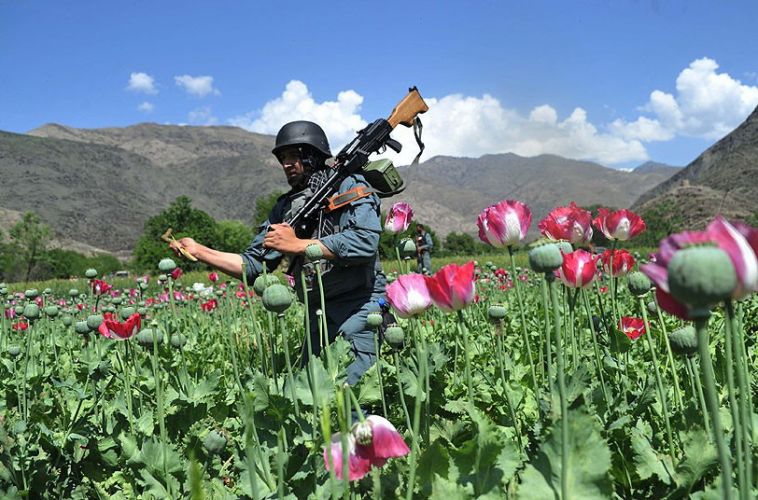
A poppy field in Afghanistan

W.J. Astore

Six years ago, I wrote an article about Afghanistan that opened like so:

In the U.S. debate on Afghanistan, virtually all experts agree that it’s not within the power of the American military alone to win the war. For that, Afghanistan needs its own military and police force, one that is truly representative of the people, and one that is not hopelessly corrupted by drug money and the selfish concerns of the Karzai government in Kabul.

What has changed since 2009?  Karzai is gone, but corruption remains endemic.  The U.S. military is still there, at least until 2017 and likely for far longer.  And drug money!  In a searching summary of the opium trade in recent Afghan history, Alfred McCoy at TomDispatch.com shows convincingly that the drug trade has flourished despite, or rather because of, American efforts to block it or control it.  In his words:

In the almost 15 years of continuous combat since the U.S. invasion of 2001, pacification efforts have failed to curtail the Taliban insurgency largely because the U.S. could not control the swelling surplus from the county’s heroin trade. As opium production surged from a minimal 180 tons to a monumental 8,200 in the first five years of U.S. occupation, Afghanistan’s soil seemed to have been sown with the dragon’s teeth of ancient Greek myth. Every poppy harvest yielded a new crop of teenaged fighters for the Taliban’s growing guerrilla army.

At each stage in Afghanistan’s tragic, tumultuous history over the past 40 years — the covert war of the 1980s, the civil war of the 1990s, and the U.S. occupation since 2001 — opium played a surprisingly significant role in shaping the country’s destiny. In one of history’s bitter twists of fate, the way Afghanistan’s unique ecology converged with American military technology transformed this remote, landlocked nation into the world’s first true narco-state — a country where illicit drugs dominate the economy, define political choices, and determine the fate of foreign interventions.

McCoy’s article, which you should read here in its entirety, raises many questions, but for me the obvious one is this: What is the U.S. military doing in Afghanistan?  What is its strategy?

If it’s trying to win Afghan hearts and minds, you can’t do that by destroying the main cash crop of so many people.  If it’s trying to create a measure of stability, you can’t do that by mounting destructive military operations that spread chaos.  If it’s trying to interdict the drug trade, you can’t do that successfully while maintaining the support of powerful interests in Afghanistan that profit so heavily from that trade.

After nearly 15 years, a sensible person would conclude that American interference in Afghanistan is only making matters worse.  Afghan drug wars are a no-win scenario for U.S. troops.  Lacking a coherent and sensible strategy that is attractive to Afghan power brokers, American forces should smarten up, load up, and pull out.

A sensible strategy in three words: Yankee come home.

Where’s the Anti-War Movement?

antiwar_peace_rally03_618
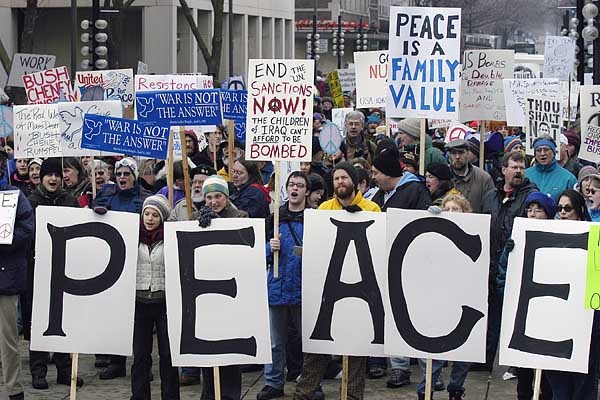
Thousands of people with signs of peace gather on Library Mall for the start of an anti-war rally protesting a potential United States-led war against Iraq. Protesters later marched up State Street to the Wisconsin State Capitol Building. ©UW-Madison University Communications 608/262-0067 Photo by: Jeff Miller

W.J. Astore

Yesterday, Ira Chernus had a stimulating article at TomDispatch.com in which he noted the present lack of an American anti-war movement.  When it comes to war and foreign policy, Americans face a Hobson’s choice: the Democrats with drones and Special Ops and bombing against evildoers, or the Republicans with even more drones and Special Ops and bombing against even more evildoers.  The American master narrative, Chernus noted, is essentially all war.

He’s right about this, and I think it’s mainly for five reasons:

  1. The military draft is gone, so our youth can safely (they think) ignore America’s never-ending wars. In Vietnam, with the draft, most of our youth didn’t have the luxury of apathy.  Today, our youth have little personal incentive (as yet) to push back against the prevailing war narrative.
  2. Militarism.  Creeping militarism has shifted the American narrative rightwards.  In the Vietnam period, General Curtis LeMay’s “bomb them back to the stone age” was a fringe opinion; now it’s mainstream with “carpet bombing” Cruz and Trump and Rubio, the “top three” Republican presidential contenders after the Iowa caucuses.
  3. The Democrats have also shifted rightwards, so much so that now both major political parties embrace endless war. War, in short, has been normalized and removed from partisan politics.  As Chernus documents, you simply can’t get an alternative narrative from the U.S. political mainstream.  For that, you have to look to much smaller political parties, e.g. the Green Party.
  4. The U.S. mainstream media has been thoroughly co-opted by corporations that profit from war.  Anti-war ideas simply don’t get published; or, if they do, they’re dismissed as unserious.  I simply can’t imagine any of today’s TV talking heads coming out against the war on terror like Walter Cronkite came out in the 1960s against Vietnam. There is simply no push back from the U.S. media.
  5. Finally, a nebulous factor that’s always lurking: FEAR.  The popular narrative today is that terrorists may kill you at any time right here in America.  So you must be ready to “lockdown“; you must be ready to “shelter in place.”  You must always defer to the police and military to keep you safe.  You must fully fund the military or YOU WILL DIE. Repeated incantations of fear reinforce the master narrative of war.

Chernus makes many good points about how America’s constant warring in the Middle East only feeds radical Islam.  In short, it’s vital to develop a new narrative, not only because the current one feeds war and death, but also because it’s fated to fail.

I doubt pacifism will fly in warrior corp USA.  But why not containment?  Containment worked against the Soviet Union, or so most Americans believe.  If it worked against the far greater threat posed by the USSR, why shouldn’t it work against radical Islam?

Containment suggests several concrete actions: American troops should pull out of the Middle East.  Bombing and drone strikes should stop.  Establish a cordon sanitaire around the area.  Lead a diplomatic effort to resolve the conflicts.  And recognize that violent civil and ideological wars within Islam may need to burn themselves out.

One thing is certain: Because violent U.S. actions are most likely to act as accelerants to radical Islam, we need to stop attacking.  Now.

Yes, the U.S. has a responsibility to help the peoples of the region.  American actions helped to create the mess.  But you don’t “solve” the mess by blowing more people and things to smithereens.

Containment, diplomacy, humanitarian aid.  Not a chest-thumping course of action celebrated by the likes of Trump or Cruz or Clinton, but a new master narrative that would be more likely to spare lives and reduce the chaos in the Middle East.

Real War: The Horror

blood

W.J. Astore

I recently read Blood Red Snow: The Memoirs of a German Soldier, by Günter Koschorrek, which focuses mainly on combat on the Eastern Front between the Germans and Soviets during World War II.  As Dan White has noted, military history sometimes degenerates into war porn – exciting tales of derring-do that save the day and end in citations and medals.  Real war isn’t like that.  Real war is horror, a horror that Koschorrek quickly came to know as a very young man.

Writing about his first weeks of combat, Koschorrek notes “how impatiently we waited for the opportunity to fight at the front!  Now, after exactly three weeks in combat, no one talks of heroism or enthusiasm any more.  On the contrary, the only wish is to get out of this death trap alive.”

Koschorrek’s first wound in combat is a minor one, which does not qualify him for evacuation from the front.  He writes:

I feel the disappointment—a hope has been dashed.  And then I think how quickly human feelings and attitudes can change.  It is only a matter of weeks since I was dreaming of glory and heroism and was so full of élan that I was almost bursting.  Now I long for a Heimatschuss—because it appears to me to be the only way that I can, with any sort of honor, say goodbye to this soul-destroying environment …

Koschorrek, a machine-gunner, quickly became a hardened veteran of the war.  When he sees friends killed in combat, he writes of a “sort of madness” that came over him, the desire for “bloody revenge.”  He writes:

Revenge and retaliation!  That inflammatory clarion call for revenge!  That’s the way all war leaders want their soldiers to be.  Remorseless, and with hatred and retaliation in their hearts, men can win battles, and quite ordinary soldiers can be converted into celebrities.  Fear is converted into hatred, anger and calls for retribution.  In this way you are motivated to fight on—even decorated with medals as a hero.

As the war drags on and Nazi Germany begins to lose, Koschorrek writes of “deserters and dissenters” within the ranks.  “They are called traitors to the fatherland,” he notes, but Koschorrek concludes with an important insight: “Nobody can be himself during a war—we all belong to the people and the state.”

War witnesses the death of individuality in the name of a collective: the people, the state.  More frightening is the death of individual conscience, as even the worst war crimes are excused in the name of “defending” the state.

As the Soviets close in and begin to invade Germany proper, Koschorrek encounters the aftermath of horrific reprisals committed by the Soviet invaders on the German people.  In one case, he notes how ordinary German villagers “were surprised in their sleep by the Soviets and couldn’t escape.  The [Nazi] party bigwigs, however, were all able to get away in time.”

When the war is finally over, Koschorrek was able to evade capture by the Soviets and transportation to Siberia as a POW.  He writes of trading his war medals (such as the Iron Cross) and ribbons for cigarettes, noting how American soldiers lusted after German war memorabilia.  Koschorrek’s medals and ribbons—marks of valor he wanted so keenly at war’s start—became by war’s end nothing but barter for smokes.

His last words reflect the hard-won wisdom of a man who fought as part of a war of annihilation on the Eastern Front:

when will people realize that it is possible for any of us to be manipulated by domineering and power-crazed individuals who know how to motivate the masses in order to misuse them for their own ends?  While they keep well out of the way [of war], in safety, they have no hesitation in brutally sacrificing their people in the name of patriotism.  Will mankind ever stand together against them?

Koschorrek, a frontline combat soldier, can be faulted for not being more critical of Nazi ideology and its megalomaniacal designs.  He has little to say about Nazi war atrocities.  His account is focused on combat and comrades, in the thick of the fighting, where the desire to stay alive is all-consuming.

It’s a book to be read carefully by anyone who thinks war is glorious.

The Drone Medal Revived!

W.J. Astore

Bad ideas never die at the Pentagon — nor do they fade away.  No — like no-win wars (Vietnam followed by Afghanistan, and so on), they keep coming back to haunt us.

According to today’s New York Times, the Pentagon is reviving the idea of special medals and awards for drone pilots and cyber-warfare specialists.

predator
Give that drone a medal!

This was an idea shot down by former SecDef Chuck Hagel, but bad ideas live a phoenix-like existence at the Pentagon.

Back in July 2012, I wrote the following article for Huffington Post about “the drone medal.”  It still stands today.  There are plenty of military decorations and awards, already on the books, that “a grateful nation” can give to its drone operators and cyberwar experts.  Creating new decorations to celebrate the “chair force” — well, what more can I say?

The Drone Medal (July 2012)

News that the Pentagon is considering a special “Distinguished Warfare Medal” for drone pilots tells us much about the American war-making moment. Leaving aside issues of bravery or courage of drone operators, let’s first consider the name of the medal, with its stress on “distinguished warfare.”

Traditionally, U.S. military medals by their very names have stressed honor or service, such as our highest award, the Medal of Honor, or the Distinguished Service Cross. Other medals are specifically connected to aerial prowess and feats, such as the Distinguished Flying Cross or the Air Medal. Such medals are well named, linked as they are to skills demonstrated by air crews operating in harm’s way.

What are we to make of a medal named for prowess in “warfare,” especially when drone operators are completely isolated from the battlefield? For that matter, how can war by remote control be recognized and celebrated as a “distinguished” form of “warfare”? Wouldn’t it be more honest (and perhaps even more honorable) to name this new decoration the “Drone Medal,” with all that name implies?

In raising these semantic points, I wish to take nothing away from drone pilots. They train hard, they work long hours, and they’re dedicated professionals. What they don’t need is a new medal created especially for them, and I’m guessing most of them would agree.

The U.S. military already has a bewildering array of awards and decorations on the books. If a drone pilot does something especially noteworthy or meritorious, there already exist commendation, meritorious service, and distinguished service medals that can be awarded to recognize his or her contribution.

Honestly, the last thing our bloated military establishment needs is more medals. But if the Pentagon insists on creating a “Distinguished Warfare Medal,” we really should insist on calling the Department of Defense by its old (and, given recent events, much more accurate) name: the Department of War.

War, American Style

769px-National_Security_Agency_headquarters,_Fort_Meade,_Maryland
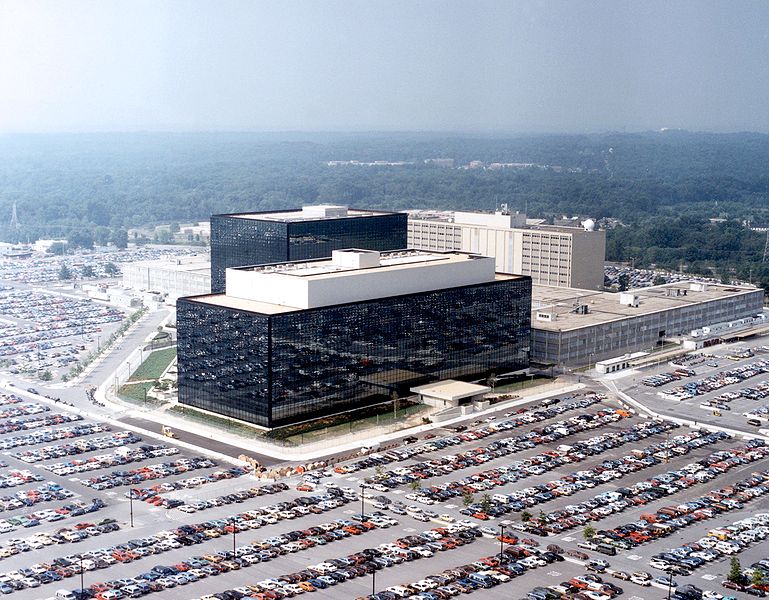
The National Security Agency, just one of seventeen agencies devoted to intelligence

W.J. Astore

A common belief shared by U.S. political pundits and a compliant and complicit U.S. media is that America never chooses its wars: it’s dragged into them.  Last October, I read an article in the “liberal” New York Times that caught the mood perfectly.  It worried the U.S. was being “sucked into” wars in the Middle East, drawn in, inexorably, by forces the world’s lone superpower couldn’t control.  As if America’s leaders had no choice.  As if they (and we) couldn’t walk away whenever we so chose.

What foolishness.  By choice the U.S. has been meddling in the greater Middle East for decades (consider the CIA-orchestrated coup in Iran in 1953, to cite only one example).  America is not being “sucked in” by uncontrollable forces.  Our leaders choose to meddle – most often in extremely violent and prejudicial ways – in regions of the world they understand poorly, if at all

And poor understanding comes despite a massive intelligence complex featuring 17 agencies chewing through $70 billion a year.  Indeed, according to a Washington Post study, the U.S. has nearly 1300 government organizations and nearly 2000 private companies devoted to counterterrorism, homeland security, and intelligence.

Let’s look at a tiny piece of that complex: the presence of 1500 intel operatives working daily to provide “actionable intelligence” for U.S. Central Command (CENTCOM) in Florida.  Roughly the equivalent of a military regiment of high-priced intelligence operatives sits on its collective butt in Florida, gazing at computer screens, producing its own fog of war about the Middle East.

Indeed, much of war, American style has degenerated into watching people killed at a distance.  Think of video footage from drone strikes that call to mind snuff films.  Want explosive climaxes?  As Peter Van Buren noted, they’ve got the war porn for you.

War, American style features lots of bragging about the military (We’re Number One!), lots of grinding in wars that last forever, but no satisfying climaxes, whether in Vietnam or Afghanistan or Iraq or Libya.  Lots of steroidal militarism, but no clear military victories.

Donald Trump had a fleeting moment of sanity when he said in the last presidential debate that the U.S. after 9/11 wasted three or four trillion dollars on wars with nothing to show for it.  That money should have been invested in America instead, he said, which caused Carly Fiorina to denounce him for sounding like Barack Obama!  Yes, Obama the “feckless weakling,” according to that man-burger, Chris Christie.

Ergo I can suggest one safe bet for 2016: more war.  At least we’re number one at something.

Update: I added this to the comments section below, but will also put it here for new readers.

Ten Features of War, American Style

1. Wars are no longer declared by Congress, and thus they are not waged in the name of the people.
2. Wars are now fought by “warriors” rather than by citizen-soldiers. Citizens are excluded from wars by choice and by design; they are reduced to cheerleaders and told to go shopping.
3. Wars no longer have a discernible end point. (How do you end a war on terror?)
4. Wars are supported by both parties and by the corporate-owned media as well. Dissenters to war are pushed to the margins and dismissed as unserious and/or misguided and/or unpatriotic.
5. War damage is confined largely to foreigners; American life continues on, undisturbed by war.
6. Major corporations continue to profit from war; similarly, the USA remains dominant in the world arms trade.
7. “Security” has become the byword of America, a security that is linked to a strong military presence overseas and a strong police presence at home. “Security” has become synonymous with guns and prisons in Lockdown USA. In other words, a war mentality has spread deeply into American consciousness, so much so that few people recognize its signs anymore. (Peace, love, understanding? Get thee behind me, Hippie!)
8. Related to (7): The celebration of all things military. Baseball uniforms with camouflage. Camouflage headsets for football coaches. Constant celebrations of military “heroes” in “private” venues, some of them paid for using public (taxpayers’) dollars.
9. No need for elites to risk their sons and daughters in war (no draft), thus apathy. When they do express some concern, they’re largely unable to critique war and U.S. foreign policy since they’ve been trained to defer to “experts.” Those experts? Mostly retired military officers, many with conflicts of interest, e.g. they work for defense contractors that profit from continuous war.
10. Fear. Fear is both a product of war and a generator of it. Fear is constantly stoked in the USA.

Chris Hedges, of course, is superb on this general question. Read his “War Is A Force that Gives Us Meaning.”

Feeding the Disease of Terrorism

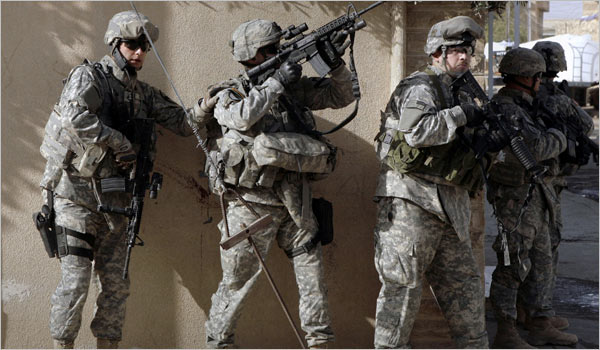
07kurds.xlarge1 U.S. troops in Mosul, Iraq in 2007.  A foreign presence to Iraqis
W.J. Astore

I’m a retired U.S. military officer.  When I think of U.S. troops, naturally I see them as my gals and guys.  I identify with them.  And I know enough of them to know that their intent is usually good — at least in the sense that they seek to do their duty.

But I’m also an historian with a modicum of empathy.  I know that foreigners don’t see the U.S. military as I see it.  Nor do they experience it the way I experienced it.  To cite just one anecdote: I recall a story in the New York Times in which U.S. troops in Iraq ask an Iraqi farmer if he’s seen any foreign fighters around.  The Iraqi has a simple answer: “Yes. You.”

Six years ago, I wrote an article for Huffington Post on “Catch-22 in Afghanistan.”  I argued that the more the U.S. military intervened in the affairs of Afghanistan, the less likely it was that a permanent, and suitably Afghan, solution would be found to the problems confronting that country.  Not much has changed in those six years, except that today the Taliban controls even more territory, the drug trade is even more pervasive, and corruption is even more endemic.

We need to learn (or re-learn) a basic lesson: The more the U.S. intervenes in conflicts within other countries, the less likely it is that a favorable outcome will result (favorable for the U.S., that is), simply because U.S. forces are viewed as a foreign contagion. And indeed we are that.

Ignoring its Afghan failures, the U.S. government now seeks to widen its military commitment to the most hotly contested areas of the Middle East.  Our leaders act as if the way to end civil wars driven in part by radical Islam is violent intervention led by American troops.

But American troops (and drones and bombs and all the rest) are not the answer.  Indeed, their actions spread the contagion further.

The other day, I was reading about “super-bugs,” those bacterial infections that have become highly resistant to traditional antibiotics due to misuse and overuse of the same.  In seeking to “destroy” ISIL and similar “infections,” the American government instead often feeds them.  Indeed, I was surprised to learn that in medicine there are super-bugs that literally feed on traditional antibiotics.  They gain strength from being attacked.  Such is often the case for “bugs” like ISIL, which feed off of heavy-handed U.S. military actions.

This is not an argument for the U.S. military to do nothing.  Rather, it’s a reminder of the limits of power and the complexity of life.  It’s a reminder too that to foreigners the U.S. military is the foreign presence, the contagion.  Even when it seeks to act as a “cure,” it may in fact be feeding the disease.

Terrorism in Paris: A Few Thoughts

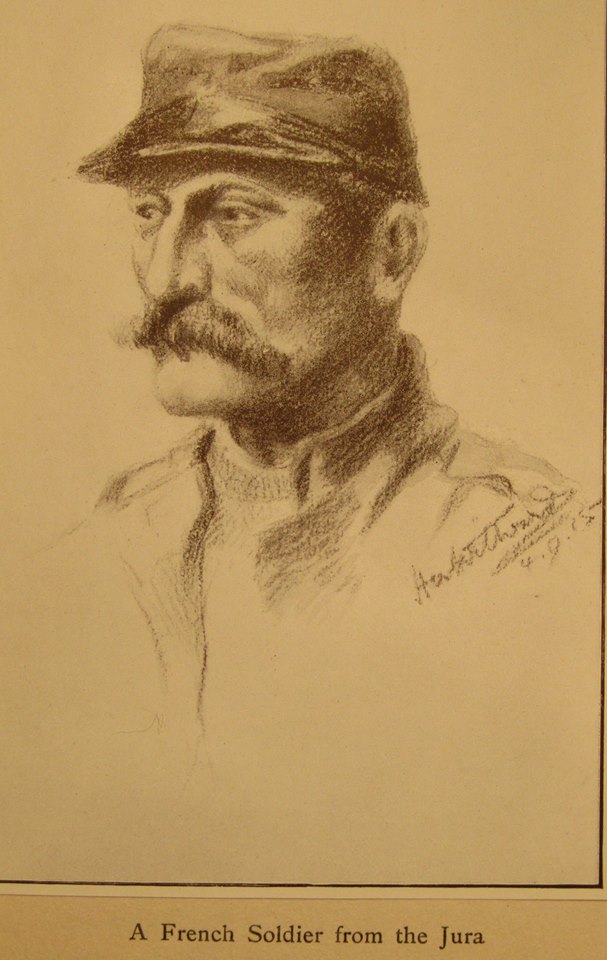
The French showed great resolve in 1915. A century later, that resolve yet lives

W.J. Astore

The world is still trying to digest the horrifying news from Paris of terrorist attacks by ISIS.  We sympathize with all the victims of terrorism and other forms of violence, and we stand with France and its desire to bring the perpetrators and their accomplices to justice.

Yet we also must be careful not to overreact — not to play into the hands of ISIS and similar terrorist organizations.

French President François Hollande is already on the record as vowing, “We are going to lead a war [against ISIS] which will be pitiless.” But the answer to terrorism is not “pitiless” war.  That’s exactly what terrorists want: they thrive on war and endless cycles of horrifying violence.

I understand Hollande’s rhetorical purpose.  He’s saying: We’re united, we’re tough, we’ll avenge the murder of innocents.  But pitiless war has been tried again and again in history — and it begets more atrocities and more war.

Terrorism is nothing new.  What’s new is the way the West is elevating it into a generational war — another crusade.  We must be very careful not to let the rhetoric of “generational” and “merciless” war become a self-fulfilling prophecy.

We must also be careful not to overreact to the threat of terrorism.  In spite of the latest horrifying attacks in Paris, the threat of terrorism remains remote for the vast majority of us.  The answer to the terrorist threat is not more state surveillance, not more military reprisals, not more curtailments of individual freedoms in the false name of security.

What is the answer?  Resolve.  Patience.  Cooperation (e.g. international police work, intelligence sharing, and so forth). And action.  Anger and cries for revenge in the form of “pitiless” war are natural after a profound shock, but they are not smart policy. Injustices committed in the name of “pitiless” war will not bring justice to the victims of the Paris attacks.

Resolve — yes.  Justice — yes.  Courage — yes.  Action — yes.  Pitiless war — no.