President Joe Biden turns 80 this year. If he chooses to run and is reelected in 2024, he’ll be 82 and will serve as president until he’s 86. His Republican rival, Donald Trump, will be 78 in 2024 and is overweight and perhaps obese. Biden, meanwhile, is moving more slowly and appears to be experiencing signs of age-related cognitive decline. Leaving aside their politics and policies and personalities, are either of these men truly fit to be president?
We all age differently, of course. But it used to be said that being POTUS was the toughest job in the world. Younger men like Jimmy Carter, Bill Clinton, and George W. Bush aged noticeably in office due to the strains of the job. Yet pointing out the rigors of the presidency, and raising questions about whether men in their 80s are truly capable of handling such rigors, exposes one to claims of bias based on age.
A lot of jobs have mandatory retirement ages. My dad was a firefighter and he had to retire at 65. While we don’t expect the POTUS to climb ladders or charge into burning buildings or carry bodies, there’s still something to be said for the difficulty of men in the twilight of their lives serving as the “leader of the free world.”
(I say men here because women live longer and often age more gracefully. But I think it’s also true in the U.S. that a woman “pushing 80” would be dismissed out of hand as too old for the presidency; societal bias against older women still exists, though of course older women can cling to power with the same tenacity as men: just look at House Speaker Nancy Pelosi.)
I remember the bad old days of the Cold War when Soviet leaders were mocked in the U.S. as a gerontocracy of sorts. So when Leonid Brezhnev died at the age of 75, he was briefly succeeded by Yuri Andropov (died at 69) and Konstantin Chernenko (died at 74 after serving for just over a year as General Secretary). Then the much younger Mikhail Gorbachev took over at age 54 and more than anyone helped to revolutionize U.S.-Soviet relations.
In a way, Joe Biden is the U.S. equivalent of Andropov and Chernenko, a time-server who was elevated by his party as a caretaker. “Nothing will fundamentally change,” Biden said of his administration, a promise he has indeed kept. Those same words could have come from Andropov and Chernenko.
The problem for the Democrats is that there’s no clear younger heir-apparent to Biden. Harris? Mayor Pete? Gavin Newsom? (Newsom, like Mitt Romney, has presidential hair but little else.) Where is the Democratic equivalent to Mikhail Gorbachev?
The Republicans have their own issues, the main one being the cult of personality surrounding Donald J. Trump. But what really empowers Trump, besides his own craftiness at cons and culture wars, is the weakness and hypocrisy of the Democrats. When your most likely opponent is a “no hope, no change” figurehead in his early 80s, even Trump appears by comparison to be a change agent of sorts.
America truly needs fundamental change, someone like Mikhail Gorbachev, a leader willing to face facts and tell harsh truths. Someone with a fresh perspective and the energy to convey it. Both Biden and Trump are too old, if not in their bodies, then in their thinking, to be the reformer America so desperately needs.
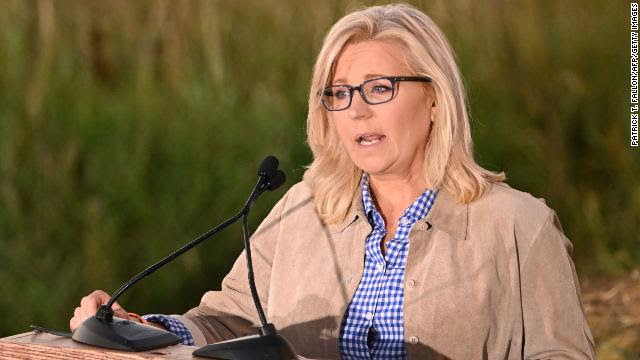
The big news in U.S. politics today is Liz Cheney, daughter of former Vice President Dick Cheney, losing her House seat to a Trump-backed challenger.
Liz Cheney has recently built a reputation as the “sensible” Republican, calling on other Republicans to reject Trumpism, alternative facts, fake news, and all the rest of Trump’s baggage. She was an outspoken critic of Trump’s role in the January 6th Capitol riots. She broke from the Trump cult and was punished for it.
Liz Cheney concedes defeat
Trump’s hold on the Republican Party is indeed strong, but I don’t see him as a cult-like leader. I think many of Trump’s followers are with him because of the lack of viable alternatives. Trump’s strength, in other words, is the weakness of his competitors, including Republican has-been challengers like Ted Cruz and Marco Rubio, but especially of Democrats like Joe Biden, Kamala Harris, and Nancy Pelosi.
There’s been much hype in the mainstream media about Joe Biden having finally found his groove, with legislation being passed that is supposed to address climate change, to lower prescription drug prices, and to make health care more affordable. But when you look closely at what Biden has signed into law, the benefits largely disappear. Provisions to address climate change include massive handouts to the fossil fuel industry. New regulations to lower drug prices won’t come into effect until 2025 at the earliest, and only for a small number of drugs. (The cost of insulin will remain high for anyone not on Medicare, i.e. anyone under 65 without excellent health insurance.) Subsidies for health insurance are available but drive people into the “marketplace” where they can buy private for-profit health care plans that include high co-pays and deductibles.
In short, the Democrats, the main opposition to Trump, are up to their usual tricks, promising to make things better for the working classes while doing the bidding of their owners and donors. It’s Democratic actions and inaction, more so than the wonders of Trump’s personality, that drive so many people to look to Trump as a viable alternative.
The Democrats could win back many of Trump’s supporters if they simply kept their campaign promises. Those included, among others, a $15 federal minimum wage, significant student debt relief, a public option for health care, and family-friendly benefits for child care, family leave, education, and the like. They simply haven’t done it, and won’t do it, because the quest for corporate money and donors continues to drive policy.
So the Democratic playbook for this fall is the same as it’s been for years: scare the people into voting against “crazy” Republicans. Indeed, the Democratic establishment has actively funded more extreme right-wing candidates, boosting their chances in primaries against more moderate Republicans, because the Democrats assume they’ll have a better chance defeating the “crazy” right-wingers in November. One might ask Hillary Clinton how that worked out for her campaign in 2016 as she boosted Donald Trump against candidates like Jeb Bush, knowing in her heart that Trump would be far easier to defeat. What happened there, Hillary?
Trump, of course, has always been a sly con man. In a sense, he isn’t a hypocrite. What you see is what you get with Trump. With the Democrats, what you see is not what you get. We keep being told that Biden is accomplishing great things, that he’s channeling FDR (!), when it’s obvious he is what he’s always been: a centrist law-and-order Democrat who’s loyally served Wall Street, Big Pharma, and similar big money and corporate interests for virtually his entire 50-year career.
Those Americans who choose to follow Trump, in short, are not a bunch of irredeemable deplorables, they’re not gullible cultists, they’re not bigots, racists, and white supremacists. Not in the main. They’re Americans looking for answers, caught in a vise, being squeezed by the uncaring powers around them, including their own government, and including politicians like Liz Cheney.
Liz Cheney’s father didn’t prevent the 9/11 attacks. He got America involved in two disastrous wars in Afghanistan and Iraq that killed and wounded tens of thousands of U.S. troops and hundreds of thousands of Afghan and Iraqi people. He was a director of America’s military-industrial complex that harmed so many of the sons and daughters of parents who became Trump supporters because they were tired of endless wars that served no one but the friends of Cheney. And Liz Cheney used her father in campaign ads that touted her as a patriot against the corruption of Trump.
That obviously didn’t sit well with the people of Wyoming.
There’s an increasing sense of desperation in America, a growing sense that things are getting worse, that we’re headed for Dickensian times of hardship and exploitation. And Democratic “solutions” aren’t even half measures. Nor was signing up Liz Cheney as an ally to rail against Trump and his MAGA followers.
The answer — and we’ve heard it before — is hope and change. Real hope and real change. We had a candidate and a movement in 2008 who seemed to embody true change, but as soon as he won the presidency, he disbanded his movement, kowtowed to Wall Street, and passed a Republican health care bill that ironically became known as Obamacare. After that record, you can see why so many Americans decided they “won’t get fooled again,” and why more than a few Obama supporters switched to Trump in 2016.
What’s the answer? One thing is certain. It’s not “centrists” like Liz Cheney — or Joe Biden. The voters have spoken.
There’s way too much fear mongering in America, which helps to drive the paranoid nature of U.S. foreign and domestic policy. This is the subject of my latest article at TomDispatch.com, which I’ve included below in its entirety. If you don’t read TomDispatch, I urge you to subscribe (top right corner on the home page). Tom Engelhardt has been running the site for 20 years (I’ve been writing for it for 15 of them), and I’ve found the content to be stimulating and thought-provoking. Many thanks for your continued interest in “Bracing Views” as well, which, I joke to Tom, is a little like a baby TomDispatch.
Dystopia, Not Democracy
I have a brother with chronic schizophrenia. He had his first severe catatonic episode when he was 16 years old and I was 10. Later, he suffered from auditory hallucinations and heard voices saying nasty things to him. I remember my father reassuring him that the voices weren’t real and asking him whether he could ignore them. Sadly, it’s not that simple.
That conversation between my father and brother has been on my mind, as I’ve been experiencing America’s increasingly divided, almost schizoid, version of social discourse. It’s as if this country were suffering from some set of collective auditory hallucinations whose lead feature was nastiness.
Take cover! We’re being threatened by a revived red(dish) menace from a “rogue” Russia! A “Yellow peril” from China! Iran with a nuke! And then there are the alleged threats at home. “Groomers”! MAGA kooks! And on and on.
Of course, America continues to face actual threats to its security and domestic tranquility. Here at home that would include regular mass shootings; controversial decisions by an openly partisan Supreme Court; the Capitol riot that the House January 6th select committee has repeatedly reminded us about; and growing uncertainty when it comes to what, if anything, still unifies these once United States. All this has Americans increasingly vexed and stressed.
Meanwhile, internationally, wars and rumors of war continue to be a constant plague, made worse by the exaggeration of threats to national security. History teaches us that such threats have sometimes not just been inflated but created ex nihilo. Those would, for instance, include the non-existent Gulf of Tonkin attack cited as the justification for a major military escalation of the war in Vietnam in 1965 or those non-existent weapons of mass destruction in Iraq used to justify the 2003 U.S. invasion of that country.
All this and more is combining to create a paranoid and increasingly violent country, an America deeply fearful and perpetually thinking about warring on other peoples as well as on itself.
My brother’s doctors treated him as best they could with various drugs and electroshock therapy. Crude as that treatment regimen was then (and remains today), it did help him cope. But what if his doctors, instead of trying to reduce his symptoms, had conspired to amplify them? Indeed, what if they had told him that he should listen to those voices and so aggravate his fears? What if they had advised him that sanity meant arming himself against those very voices? Wouldn’t we, then or now, have said that they were guilty of the worst form of medical malpractice?
And isn’t that, by analogy, true of America’s leaders in these years, as they’ve driven this society to be ever less trusting and more fearful in the name of protecting and advancing their wealth, power, and security?
Fear Is the Mind-Killer
If you’re plugged into the mental matrix that’s America in 2022, you’re constantly exposed to fear. Fear, as Frank Herbert wrote in Dune, is the mind-killer. The voices around us encourage it. Fear your MAGA-hat-wearing neighbor with his steroidal truck and his sizeable collection of guns as he supposedly plots a coup against America. Alternately, fear your “libtard” neighbor with her rainbow peace flag as she allegedly plots to confiscate your guns and brainwash your kids. Small wonder that more than 37 million Americans take antidepressants, roughly one in nine of us, or that, in 2016, this country accounted for 80% of the global market for opioid prescriptions.
A climate of fear has led to 43 million new guns being purchased by Americans in 2020 and 2021 in a land singularly awash in more than 400 million firearms, including more than 20 million assault rifles. A climate of fear has led to police forces being heavily militarized and fully funded rather than “defunded” (which actually would mean a bit less money going to the police and a bit more to non-violent options like counseling and mental-health services). A climate of fear has led Democrats and Republicans in the House of Representatives who can agree on little else to vote almost unanimously to fork over $840 billion to the Pentagon in Fiscal Year 2023 for yet more wars and murderous weaponry. (Of course, the true budget for what is still coyly called “national defense” will soar well above a trillion dollars then, as it often has since 9/11/2001 and the announcement of a “global war on terror.”)
The idea that enemies are everywhere is, of course, useful if you’re seeking to create a heavily armed and militarized form of insanity.
It’s summer and these days it just couldn’t be hotter, so perhaps you’ll allow me to riff briefly about a scene I’ve never forgotten from The Big Red One, a war film I saw in 1980. It involved a World War II firefight between American and German troops in a Belgian insane asylum during which one of the mental patients picks up a submachine gun and starts blasting away, shouting, “I am one of you. I am sane!” In 2022, sign him up and give him a battlefield commission.
Where fear is omnipresent and violence becomes routinized and normalized, what you end up with is dystopia, not democracy.
We Must Not Be Friends but Enemies
At this point, consider us to be in a distinctly upside-down world. Reverse Abraham Lincoln’s moving plea to Southern secessionists in his first inaugural address in 1861 — “We must not be enemies but friends. We must not be enemies” — and you’ve summed up all too well our domestic and foreign policy today. No, we’re neither in a civil war nor a world war yet, but America’s national (in)security state does continue to insist that virtually every rival to our imperial being must be transformed into an enemy, whether it’s Russia, China, or much of the Middle East. Enemies are everywhere and must be feared, or so we’re repetitiously told anyway.
I remember well the time in 1991-1992 when the Soviet Union collapsed and America emerged as the sole victorious superpower of the Cold War. I was a captain then, teaching history at the U.S. Air Force Academy. Those were also the years when, even without the Soviet Union, the militarization of this society somehow never seemed to end. Not long after, in launching a conflict against Saddam Hussein’s Iraq, this country officially kicked ass in the Middle East and President George H.W. Bush assured Americans that, by going to war again, we had also kicked our “Vietnam Syndrome” once and for all. Little did we guess then that two deeply destructive and wasteful quagmire wars, entirely unnecessary for our national defense, awaited us in Afghanistan and Iraq in the century to come.
Never has a country squandered victory — and a genuinely global victory at that! — so completely as ours has over the last 30 years. And yet there are few in power who consider altering the fearful course we’re still on.
A significant culprit here is the military-industrial-congressional complex that President Dwight D. Eisenhower warned Americans about in his farewell address in 1961. But there’s more to it than that. The United States has, it seems, always reveled in violence, possibly as an antidote to being consumed by fear. Yet the intensity of both violence and fear seems to be soaring. Yes, our leaders clearly exaggerated the Soviet threat during the Cold War, but at least there was indeed a threat. Vladimir Putin’s Russia isn’t close to being in the same league, yet they’ve treated his war with Ukraine as if it were an attack on California or Texas. (That and the Pentagon budget may be the only things the two parties can mostly agree on.)
Recall that, after the collapse of the Soviet Union, Russia was in horrible shape, a toothless, clawless bear, suffering in its cage. Instead of trying to help, our leaders decided to mistreat it further. To shrink its cage by expanding NATO. To torment it through various forms of economic exploitation and financial appropriation. “Russia Is Finished” declared the cover article of the Atlantic Monthly in May 2001, and no one in America seemed faintly concerned. Mercy and compassion were in short supply as all seemed right with the “sole superpower” of Planet Earth.
Now the Russian Bear is back — more menacing than ever, we’re told. Marked as “finished” two decades ago, that country is supposedly on the march again, not just in its invasion of Ukraine but in President Vladimir Putin’s alleged quest for a new Russian empire. Instead of Peter the Great, we now have Putin the Great glowering at Europe — unless, that is, America stands firm and fights bravely to the last Ukrainian.
Add to that ever-fiercer warnings about a resurgent China that echo the racist “Yellow Peril” tropes of more than a century ago. Why, for example, must President Joe Biden speak of China as a competitor and threat rather than as a trade partner and potential ally? Even anti-communist zealot Richard Nixon went to China during his presidency and made nice with Chairman Mao, if only to complicate matters for the Soviet Union.
If imperial America were willing to share the world on roughly equal terms, Russia and China could be “near-peer” friends instead of, in the Pentagon phrase of the moment, “near-peer adversaries.” Perhaps they could even be allies of a kind, rather than rivals always on the cusp of what might potentially become a world-ending war. But the voices that seek access to our heads prefer to whisper sneakily of enemies rather than calmly of potential allies in creating a better planet.
And yet, guess what, whether anyone in Washington admits it or not: we’re already rather friendly with (as well as heavily dependent on) China. Here are just two recent examples from my own mundane life. I ordered a fan — it’s hot as I type these words in my decidedly unairconditioned office — from AAFES, a department store of sorts that serves members of the military, in service or retired, and their families. It came a few days later at an affordable price. As I put it together, I saw the label: “Made in China.” Thank you for the cooling breeze, Xi Jinping!
Then I decided to order a Henley shirt from Jockey, a name with a thoroughly American pedigree. You guessed it! That shirt was plainly marked “Made in China.” (Jockey, to its credit, does have a “Made in America” collection and I got two white cotton t-shirts from it.) You get my point: the American consumer would be lost without China, the present workhouse for the world.
You’d think a war, or even a new Cold War, with America’s number-one provider of stuff of every sort would be dumb, but no one is going to lose any bets by underestimating how dumb Americans can be. Otherwise, how can you explain Donald Trump? And not just his presidency either. What about his “Trump steaks,” “Trump university,” even “Trump vodka”? After all, who could be relied upon to know more about the quality of vodka than a man who refuses to drink it?
Learning from Charlie Brown
Returning to fears and psychiatric help, one of my favorite scenes is from “A Charlie Brown Christmas.” In that classic 1965 cartoon holiday special, Lucy ostensibly tries to help Charlie with his seasonal depression by labeling what ails him. The wannabe shrink goes through a short list of phobias until she lands on “pantophobia,” which she defines as “the fear of everything.” Charlie Brown shouts, “That’s it!”
Deep down, he knows perfectly well that he isn’t afraid of everything. What he doesn’t know, however, and what that cartoon is eager to show us, is how he can snap out of his mental funk. All that he needs is a little love, a little hands-on kindness from the other children.
America writ large today is, to my mind, a little like Charlie Brown — down in the dumps, bedraggled, having lost a clear sense of what life in our country should be all about. We need to come together and share a measure of compassion and love. Except our Lucys aren’t trying to lend a hand at the “psychiatric help” stand. They’re trying to persuade us that pantophobia, the fear of everything, is normal, even laudable. Their voices keep telling us to fear — and fear some more.
It’s not easy, America, to tune those voices out. My brother could tell you that. At times, he needed an asylum to escape them. What he needed most, though, was love or at least some good will and understanding from his fellow humans. What he didn’t need was more fear and neither do we. We — most of us anyway — still believe ourselves to be the “sane” ones. So why do we continue to tolerate leaders, institutions, and whole political parties intent on eroding our sanity and exploiting our fears in service of their own power and perks?
Remember that mental patient in The Big Red One, who picks up a gun and starts blasting people while crying that he’s “sane”? We’ll know we’re on the path to sanity when we finally master our fear, put down our guns, and stop eternally preparing to blast people at home and abroad.
A book that shook my world was journalist Hedrick Smith’s “The Power Game,” published 35 years ago in 1987. It was about “How Washington really works,” and what I remember about it is how it made me feel, as in discouraged and outraged. I learned about the power of lobbyists, the power of money, and what money gains you, which is access. More-or-less legal forms of corruption in 1987 are now most definitely legal, with the Supreme Court decreeing that corporations are citizens and that money is speech. It’s amazing how the law can be twisted to serve the interests of the powerful. I for one do not believe that Raytheon and I are both equal citizens and that we both have equivalent access to elected representatives through our “speech,” i.e. our money. But the Supreme Court professes to believe this so there you have it.
When you look at who runs America, it’s a fairly short list. Wall Street, Big Pharma, the fossil fuel companies, Big Tech and Silicon Valley, the military-industrial complex (National Security State), the major banks and insurance companies: any “citizen” with access to billions of dollars who can then buy or rent politicians with millions of dollars. It’s a great deal for them, “investing” in politicians, making them dance to their tune, but it’s a lousy deal for the rest of us.
This makes me think of one of my father’s favorite sayings: He who pays the piper calls the tune. If I toss a penny and ask for a tune, and another “citizen” tosses twenty bucks and asks for a different one, I’m not surprised when the piper doesn’t play my tune. So when the Princeton Study said that the U.S. is an oligarchy and that politicians in Washington don’t listen to us, I wasn’t surprised. I learned it from Hedrick Smith in 1988 when I read his book.
Interestingly, when Smith wrote “The Power Game,” America had just over 4000 political action committees, or PACs. In 2014, America had well over 7000 PACs, including “Super” PACs, which have far fewer constraints in how they can use their money in the political realm. Now we even have “dark” money, and so we’re barraged by ads on TV and elsewhere attacking a candidate or an issue without any clear idea of who’s behind it all and why. But, remember, money is speech and corporations are citizens, so let the good times roll in the U.S. political process.
When Hedrick Smith wrote, things weren’t quite as bad in America. There were more newspapers, more media sources, more real journalists. Nowadays, five or six corporations own all the mainstream media outlets, and it’s not in their interest to promote views that are honest and provocative. Indeed, they love PACs and Super PACs and all the money spent by them and political campaigns to influence voting.
It’s gotten to be so corrupt, and so tightly controlled, as in rigged, that it almost doesn’t matter who runs for office. Clearly, Joe Biden and Kamala Harris aren’t driving policy in America. The few decisions they themselves truly make are almost inconsequential.
One thing I really liked about Hedrick Smith is his honesty. He gave a talk on his book, link here:
Where he explained that, if you’re a politician and you accept certain campaign donations, it’s understood between both parties that when the donor needs you to vote a certain way, you will vote that way, no questions asked. Everyone in Congress understands this. It’s why every effort by real citizens to get big money out of politics fails. It fails because the big donors won’t have it. They like to be able to buy politicians, thank you very much. That’s how democracy works, so says the Supreme Court. If you don’t like it, start your own corporation, make a few billion, then you too can buy your own politician.
A revival of democracy in America starts with campaign finance reform, which most politicians say they’re for even as they vote against it. Sounds like a conundrum to me. Can we solve it by explaining to our esteemed justices (John Roberts, can you hear me?) that money is not the same as speech and that corporations really aren’t the same as citizens?
Finally, a rather obvious point, but it bears repeating. Justices like Thomas, Roberts, Kavanaugh, Gorsuch, and Barrett weren’t just selected because they were reliable votes against abortion. They were really vetted and selected because they will always rule with the powerful against the powerless. They are, in a word, pro-corporate.
And if the Supreme Court is pro-corporate, if Congress is pro-corporate, and if the president is a figurehead known for his pro-corporate policies as a Senator from Delaware, what kind of America are we truly looking at?
In the power game that is Washington, it’s the American people who suffer the agony of defeat.
The last real Democratic President was Jimmy Carter. The last U.S. election offering a real alternative vision was George McGovern versus Richard Nixon in 1972.
Since then, Democratic Presidents like Clinton, Obama, and Biden have been DINOs, or Democrats in name only. In a rare moment of honesty, Obama admitted his administration had echoed the policies of “moderate” Republicans. Friendly to Wall Street, banking interests, corporations, the military-industrial complex, and the usual assortment of oligarchs. Obama’s health care plan was a corporate-friendly sellout that echoed the plan put together by Republicans like Mitt Romney. The DINOs fully support forever war and huge military budgets; Obama was quite happy to admit America had “tortured some folks” and that he’d gotten very good at ordering people to be killed, mainly via assassination by drone. It’s a far cry from Jimmy Carter trying to put human rights at the center of his foreign policy in the late 1970s.
Democrats began to move rightwards after McGovern’s resounding defeat in 1972. They haven’t stopped this rightward drift; indeed, it’s accelerated. The Republicans responded by embracing men like Trump as they found plenty of room even further to the right of the DINOs. America, Gore Vidal once said, basically has one property party with two right wings, and that’s only become truer and more obvious over the last fifty years.
What is to be done? We need viable alternatives, but of course the game is rigged, as Matthew Hoh, principled candidate for the Senate in North Carolina, discovered as Democrats conspired to keep him off the ballot, even though his efforts with the Green Party were more than sufficient to earn him a place on that ballot. Both parties, Democrat and Republican, will do anything to keep their duopoly while also endlessly punching each other. Neither party serves the interests of the people.
Perhaps Caitlin Johnstone can offer some hope, or at least a diagnosis for the right path ahead. Here’s what she had to say in her latest post about how the political system in America is structured and manipulated for the benefits of the powerful:
1. Use narrative manipulation to divide the population into a roughly 50/50 ideological split.
2. Ensure you control both of those factions.
3. Convince everyone that the only reason nothing changes is because their half of the population doesn’t win enough elections.
Everyone’s pulling on a rope that doesn’t lead anywhere and doesn’t do anything, convinced by powerful manipulators that they’re engaged in a life-or-death tug o’ war match of existential importance. Meanwhile the powerful just do as they like, completely indifferent to that spectacle and its back-and-forth exchanges.
A group is artificially split into two sides and told to pull a rope in opposite directions while someone else stands back and shoots them all with a BB gun. When they complain about the welts, they’re told it’s happening because their side isn’t pulling hard enough. But really they’d be getting shot no matter what they did.
This doesn’t mean give up, it just means give up on the fake tug o’ war game. If you’re playing tug o’ war while someone rummages through your handbag looking for cash, the first step to stopping them is putting down the rope and going after them. It’s like if everyone was pushing on a fake fire escape in a burning building: the first step to getting them out of there is showing them that the door is just painted on the wall and doesn’t lead anywhere. That’s not telling them to give up hope, it’s just telling them to give up on an ineffective strategy.
Perhaps Johnstone didn’t go far enough here. Americans go in for assault rifles, not BB guns. But she’s surely right that you’re not going to reform this system from within, i.e. from pulling harder on the Democrat or Republican rope. You need to stop playing an unwinnable game.
Organize. Vote third party when a sane candidate is available. Stop donating to DINOs and their even more dubious Republican cousins. Protest. Tell others. You never know what will be the spark that ignites true and meaningful change.
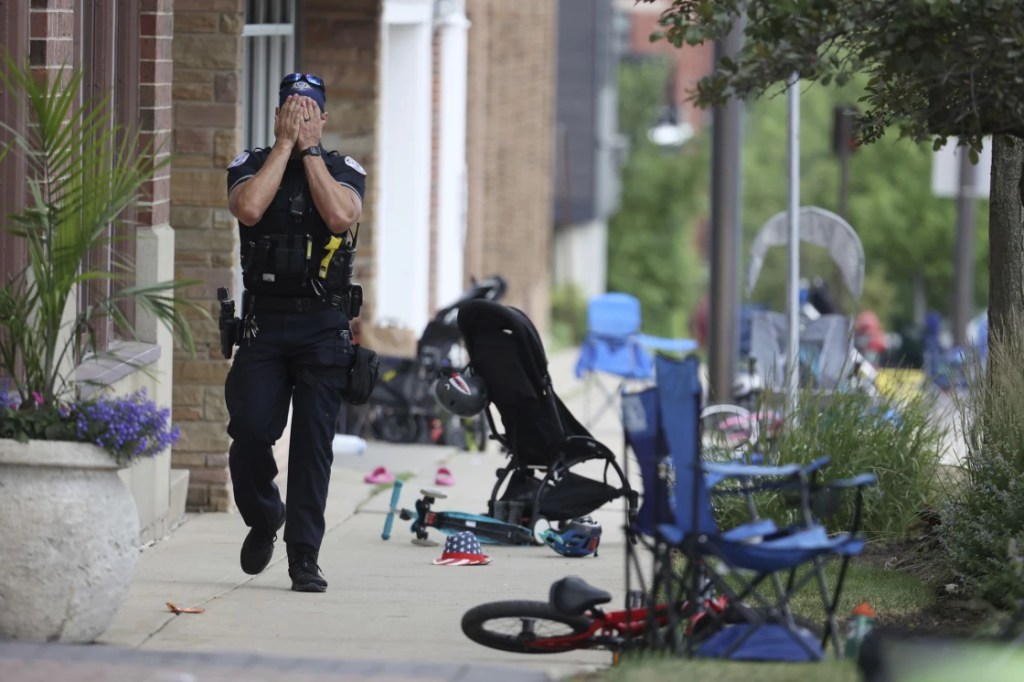
A police officer reacts to the Highland Park mass shooting near Chicago on July 4th (Getty images)
W.J. Astore
Another mass shooting in America, this one during a July 4th parade, killing six and wounding dozens. I saw this blinding flash of the obvious at the New York Times today: “Why does the U.S. have so many mass shootings? Mostly because people have so many guns.” Well, that seems logical. I saw an interview on MSNBC where it was asked whether the shooter was a Trump supporter and whether he was a “loner.” To his credit, the expert being interviewed explained that, though the shooter posed with a Trump flag, it may have been meant ironically, and that he wasn’t a loner in the traditional sense as he was part of an active online community of bizarre mass shooting enthusiasts.
There’s always the tendency to dismiss these shooters as loners, as nutcases, and to politicize it as well by suggesting that Trump or some other figure was at least partially responsible. But America had plenty of mass shootings before Trump came along, and these guys are not all loners. Indeed, in some sense they’re a manifestation of a society obsessed with guns and violence, of settling scores and dominating the Other (or others) through killing, mainly with guns.
Speaking of killing with guns, is it really necessary to shoot an apparently unarmed Black man sixty times (!) after he fled a traffic stop? Here’s the story from CNN:
The city of Akron, Ohio, remains on edge one week after the fatal police shooting of 25-year-old Jayland Walker. A news conference held by city officials on Sunday — along with the release of 13 police body camera videos — has started to paint a fuller picture of the shooting, which police say happened when Walker, who is Black, fled an attempted traffic stop on June 27. Walker was unarmed at the time he was killed, Akron Police Chief Stephen Mylett said. Authorities said Walker suffered at least 60 wounds in the fatal shooting. The Mayor of Akron declared a state of emergency and issued a curfew for Monday night through this morning in order to “preserve peace” in the community.
A “curfew” to preserve peace: Something tells me we’re going to see a lot more of these “curfews” in the U.S. in the coming years, enforced by heavily armed police with converted MRAPs and similar tank-like vehicles. It’s hard not to think that America’s overseas wars have come home to Main Street USA, not in the same form as Baghdad or Kabul, but close enough.
Americans tend to put a lot of faith in “good guys with guns.” Those “good guys” failed to act for more than an hour in Uvalde, Texas, a delay that led to more children being slaughtered. In Akron, Ohio, the “good guys” apparently fired more than 60 rounds at Jayland Walker, who apparently was unarmed at the time of the shooting (though apparently he had a gun in his car). I like this official statement by the police: “The decision to deploy lethal force as well as the number of shots fired is consistent with use of force protocols and officers’ training,” the Fraternal Order of Police Akron Lodge 7 said in a statement.
America is in the (pistol) grips of a massive social experiment: what happens to a society when it’s consistently betrayed by its leaders, when people are increasingly desperate and fearful, and where those same people are massively armed with readily-available guns, including military-grade firearms. A society that continues to advertise violence on its TV and cable shows, that continues to suggest that more guns are the answer to gun violence, where the Supreme Court of the land embraces the idea of open carry of loaded firearms as a fundamental Constitutional right. It seems a foregone conclusion that such an experiment can only lead to higher body counts across the country. And indeed there were many more deadly shootings this past weekend, as this article summarizes.
Welcome to “extreme life,” as Tom Engelhardt notes today at TomDispatch.com. And while his article focuses mainly on soaring temperatures and extreme weather due to climate change, he starts by noting how the Supreme Court struck down the New York law that restricted the carrying of concealed firearms. Yes, America today is “packing heat” in more ways than one. Rising temperatures, soaring gun sales, more and more mass shootings, increasing alienation and unease: these times aren’t just “interesting,” as the alleged Chinese curse goes, they truly are increasingly extreme.
And in extremity, people often make the worst of choices, turning to anyone who promises them relief, a measure of “peace,” even if it takes the form of a militarized curfew.
I have a brother who’s mentally ill. When you deal with mental illness in your family, you come to realize that local, state, and federal resources are limited. Funding is iffy. Expertise is dodgy. Facilities are often disappointing. And systems and bureaucracies can seem heartless.
I take nothing away from the dedicated doctors, nurses, and other staff I’ve met who’ve helped care for my brother. Considering the resources available to them, they often do a fantastic job.
It soon appears my brother will be assigned to a nursing home, though he does not yet require that level of care. The system, however, has virtually no other options available between a halfway-house-like setting, where a nurse isn’t available 24/7, and a nursing home, which does have nurses 24/7.
My brother was in a smaller group home where he had his own room, but a series of minor medical issues caused him to be “re-leveled” beyond the care provided by that home. He was rather unceremoniously dumped into a private, for-profit, nursing home, where he remains as he awaits a much-delayed court date. Indeed, his “temporary” assignment to the nursing home expired last December, with various agencies finger-pointing and blaming each other for the delay in reviewing my brother’s case.
Mental illness is such a devastating thing. It can be far worse than physical illness. When my brother had his first serious breakdown in 1973, we certainly didn’t understand what was happening. Back then, there was far more stigma attached to mental illness, and few people talked about it. It’s a shattering experience, and my brother had the worst of it, including ECT or electroshock treatments and powerful drugs like Stelazine and similar anti-psychotic drugs.
I was writing to a sympathetic attorney about my brother’s case today, and I thought maybe I’d share a little of what I wrote. My brother’s situation, I wrote,
speaks to a larger point about how our government cares for the mentally ill, the lack of funding and so forth, something that’s not going to be fixed by an email by me.
Still, it’s a system that tends to see my brother as just another client, just another case file, just another court date, even just another billable moment.
Wouldn’t it be nice to have asylums in the true sense of that word for those among us who needed them? But our government chooses to fund more F-35 jet fighters, more nuclear missiles, more police forces, and so forth.
The poor and mentally ill have no power because they have no lobbyists and very few advocates.
It’s a sign of the sickness of our society that we care so little for the sick.
That poor attorney got more than she bargained for. But I truly believe a society can be judged by how it treats the poor, the sick, the unhoused, the desperate. Our society tends to treat them like dirt, like losers, like a nuisance, even as the government gushes money for more police, more weapons, and more wars, whether internally or externally.
This is ultimately why our society is so sick. Because we care so little for the neediest among us.
I’m sorry this is so depressing, and I plead guilty as well for not caring enough, for not acting instead of just blogging away about it.
Jesus healed the sick and dying and attracted society’s outcasts. He praised the poor and railed against the rich. Is it any wonder He was crucified? So, we Americans invented our own Jesus, one who showers money on his believers, one who rewards them with happiness and health, a Santa Claus Jesus who gives out gifts to good little girls and boys.
And if you’re not “good”? I guess you get to be homeless or dumped in a nursing home. Next time, pray harder, loser.
American schools are soft, you say? I know what you mean. I taught college for 15 years, so I’ve dealt with my share of still-teenagers fresh out of high school. Many of them inspired me, but some had clearly earned high marks too easily and needed remedial help in math, English, or other subjects. School discipline had been too lax perhaps and standards too slack, because Johnny and Janey often couldn’t or wouldn’t read a book, though they sure could text, tweet, take selfies, and make videos.
Oh, wait a sec, that’s not what you meant by “soft,” is it? You meant soft as in “soft target” in the context of mass school shootings, the most recent being in Uvalde, Texas. Prominent Republicans like Senators Lindsey Graham and Ted Cruz have highlighted the supposed softness of American schools, their vulnerability to shooters armed with military-style assault rifles and intent on mass murder.
That “softness” diagnosis leads to a seemingly logical quick fix: “harden” the schools, of course! Make them into “targets” too intimidating to approach thanks to, among other security measures, surveillance cameras, metal detectors, bulletproof doors and windows, reinforced fences, armed guards, and even armed teachers.
Here’s the simple formula for it all: no more limpness, America, it’s time to get hard. Johnny and Janey may still find it challenging to read books or balance a checkbook (or even know what a checkbook is), but, hey, there must be an app for that, right? At least they’ll stay alive in our newly hardened schools. Or so we hope. There’s no app, after all, for reviving our kids after they’ve been shot and shredded by some assault-rifle-wielding maniac.
As a retired military officer and professor, and a former gun owner, the latest chapter in this country’s gun mania, the Republican urge to keep all those assault weapons circulating and still protect our children, strikes me not just all too strangely, but all too familiarly as well. Those voices calling for billions of dollars to “harden” schools reflect, of course, the imagery of a sexualized hyper-masculinity, but something else as well: a fetish for military-speak. In my service, the Air Force, we regularly spoke of “hardening” targets or “neutralizing” them.
In essence, politicians like Graham and Cruz seem way too eager to turn our schools into some combination of fortresses and bomb shelters, baby versions of the massive nuclear shelter I occupied in the 1980s during my first tour of duty in the Air Force (on which more in a moment). Button up and hunker down, America — not from the long-gone “red” enemy without, armed with nuclear missiles, but from the red-hot (as in murderously hateful) enemy within. These days, that increasingly means a school-age shooter or shooters armed with military-grade weaponry, usually acquired all too legally. Sound the klaxons! Lock and (especially) load! It’s time to go to DEFCON 1 (maximum military readiness, as in war) not in nuclear shelters but in America’s schools.
Speaking of my Cold War nuclear-bunker days in the 1980s, when I was stationed at Cheyenne Mountain, America’s command center for its nuclear defense in Colorado, a few things stood out then. Security guards, for one. Locking cipher doors, for another. Security ID badges. Razor wire. Video monitors. Blast doors. I was in the ultimate lockdown fortress. But tell me the truth: Is this truly what we want our schools to look like — pseudo-military bunkers for the (hot) war increasingly blazing in our society?
In fact, the whole “hardening” idea represents not a defense against, but a surrender to the notion of schools as potential sites of gun combat and mass death. To submit to such a scenario is, in the view of this retired military officer and educator, a thoroughly defeatist approach to both safety and education. It’s tantamount to admitting that violence and fear not only rule our lives but will continue to do so in ever more horrific ways and that the only solution is to go hard with even more “security” and even more guns. Hardening our schools implies hardening our hearts and minds, while we cede yet more power to security experts and police forces. And that may be precisely why so many authority figures so lustily advocate for the “hard” way. It is, in the end, the easy path to disaster.
The Hard Way as the Easy Way Out
Though six of my college-teaching years were at a military academy, where I wore a uniform and my students saluted me as class began, it never occurred to me to carry a loaded gun (even concealed). For the remaining nine years, I taught at a conservative college in rural Pennsylvania where, you may be surprised to learn, guns were then forbidden on campus. But that, of course, was in another age. Only at the tail end of my college teaching career were lockable doors installed and voluntary lockdown drills instituted.
I never ran such a drill myself.
Why not? Because I refused to inject more fear into the minds of my students. In truth, given the unimaginably violent chaos of a school shooting, you’d almost automatically know what to do: lock the door(s) to try to keep the shooter out, call 911, and duck and cover (which will sound familiar to veterans of early Cold War era schooling). If cornered and as a last resort, perhaps you’d even rush the shooter. My students, who were young adults, could have plausibly done this. Children in the third and fourth grades, as in the Uvalde slaughter, have no such option.
That mass shooting took place at a hardened school with locking doors, one that ran lockdown and evacuation drills regularly, and had fences. And yet, of course, none of that, including 911 calls from the students, prevented mass death. Not even the presence of dozens of heavily armed police inside and outside the school mattered because the commander at the scene misread the situation and refused to act. Well-trained “good guys with guns” proved remarkably useless against the bad guy with a gun because the “good guys” backed off, waited, and then waited some more, more than an hour in all, an excruciating and unconscionable delay that cost lives.
But combat can be like that. It’s chaotic. It’s confusing. People freeze or act too quickly. It’s not hard to make bad decisions under deadly pressure. At Uvalde, the police disregarded standard operating procedure that directs the immediate engagement of the shooter until he’s “neutralized.” But we shouldn’t be surprised. Fear and uncertainty cloud the judgment even of all-too-hardened professionals, which should teach us something about the limitations of the hard option.
A related hardening measure that’s been proposed repeatedly, including by former President Trump, is to arm and train teachers to confront shooters. It’s a comforting fantasy, imagining teachers as Dirty Harry-like figures, blowing away bad guys with poise and precision. Sadly, it’s just that, a fantasy. Imagine teachers with guns, caught by surprise, panicking as their students are shot before their eyes. How likely are they to respond calmly with deadly accuracy against school shooter(s) who, the odds are, will outgun them? “Friendly fire” incidents happen all too frequently even in combat featuring highly trained and experienced soldiers. Armed teachers could end up accidentally shooting one or more of their students as they tried to engage the shooter(s). How could we possibly ask teachers to bear such a burden?
Let’s also think about the kind of teacher who wants to carry a weapon in a classroom. My brother was a security policeman in the Air Force, and he understands all too well the allure of weaponry to certain types of people. As he put it to me recently, “A gun is power. To some, even the psychologically relatively stable among us, carrying a gun is indeed like having a permanent hard-on. You have the power of life and death as well. It can be a pure ego-driven power trip, sexual, every time you get to pull the trigger. You give a guy a gun and strange things can happen.”
Think of your least favorite teacher in your K-12 experience, perhaps the one who intimidated you the most. Now, think of that very teacher “hardened” with a gun in class. Sounds like a good idea, right?
Arming Lady Liberty (to the Teeth)
Arming teachers is a measure of our collective confusion and desperation, though some politicians like Donald Trump are sure to continue to press for it. Again, if I’m an armed teacher, perhaps with a concealed 9mm pistol, I’d have virtually no chance against a shooter or shooters with AR-15s and body armor. Does that mean I need an AR-15 and body armor, too? Who needs an arms race with the Russians or Chinese when we can have one in every school in America?
What, then, of hardening schools? We’re back to locking security doors, reinforced fences around campus, cameras everywhere, metal detectors at each entrance, and of course more armed police (or “school resource officers,” known as SROs) in the hallways. We’re talking about untold scores of billions of dollars spent to turn every American school into a fortress/bunker, a place to hunker down and ride out a violent weapons-of-mass-destruction storm of our own making.
And mind you, of all the things we don’t know, one thing we do: this hunkering down, this fear will be indelibly etched into the minds of our kids as they navigate our ever more hardened, over-armed schools. It won’t be healthy, that’s for sure. In seeking to reduce and eliminate school shootings in America, we should be guided by the goal of not making matters worse for our children.
As horrific as they are, headline-grabbing school shootings are rare indeed compared to the number of schools across America. Indeed, given the violence of this society and the extreme violence we routinely export to other countries across the globe, it’s surprising we don’t have more school shootings. Their relative rarity should reassure us that all is not lost. Not yet, anyway.
I get it. We all want to feel safe and, above all, we want our kids to be safe. But buying them bulletproof backpacks or hardening their schools is the wrong approach. Besides, if we spend massively on school security, what’s to stop a shooter determined to kill children from going elsewhere to find them? It’s horrifyingly grim logic, but he’d likely go to a playground, or the movies, or a dance recital, or any other “soft” place where children might gather. And what then? I for one don’t want to live in fortress America, surrounded by armed and armored police and intrusive security gadgetry “for my protection.”
Admittedly, in a country in which Republicans and Democrats can’t seem to agree on anything but the most modest gun reforms (forget banning military-style weapons or even restrictingtheir sale to people 21 and older), the hardening of schools is an easy target (so to speak). As gun enthusiasts like to say: don’t focus on the weapons, focus on the shooters.
Guns don’t kill people; people kill people, right? As best we can, we must identify those crazed enough to want to murder innocent kids and get them the help they need before they start squeezing triggers. We should deny unstable people the ability to own and wield weapons of mass destruction — that is, assault rifles (and preferably simply ban such weaponry period). We must do everything possible to reform our blood-drenched society with all its weapons-porn. One thing is guaranteed, as a “solution” to the gun problem, adding more of them and other forms of “hardness” into an already deadly mix will only worsen matters.
Quick fixes are tempting, but school-hardening measures and even more “good guys with guns” aren’t the answer. If they were, those 19 children and two adults in Uvalde might still be alive. An exercise in over-the-top security, meanwhile, is guaranteed to do one thing — and that is, of course, starve schools of the funds they need to… well, teach our kids. You know, subjects like math and science and English and history. We’re trending toward graduating a generation of young people who may have trouble reading and writing and adding but will be experts at ducking and covering behind hardened backpacks.
Going hard isn’t the answer, America. Unless the “hard” you’re talking about is the hard I grew up with, meaning high academic standards instilled by demanding and dedicated teachers. If, however, we continue to harden and militarize everything, especially our schools and the mindsets of our children, we shouldn’t be at all surprised when this country becomes a bastion bristling with weapons, one where Lady Liberty has relinquished her torch and crown for an AR-15 and a ballistic helmet from the local armory.
Fifty years ago, a remarkable thing happened in America. A pro-peace candidate, George McGovern, won the nomination for one of America’s two major political parties. Of course, McGovern went on to lose big time to Richard Nixon in the fall, but his rise within the Democratic Party, much of it driven by grassroots activism, still inspires hope.
McGovern was right in 1972 in his justly famous “Come home, America” speech after he gained the nomination. It’s time to end overseas wars and military adventurism and heal our divisions here at home. The big problem, of course, is that so many powerful elements within the U.S. thrive best when the masses are kept busy fighting each other.
A friend posted this image on Facebook, which sums up much of America’s predicament today:
Progress within the terrarium won’t happen as long as we keep fighting each other
To borrow from my father once again, in America the rich are getting richer and the poor poorer. And the rich have neither sympathy nor use for the poor. Unless by “use” you mean soldiers for empire, cleaners for mansions, and so on.
What is to be done? People ask me this a lot, expecting me to have a magical solution. I say fight the best you can, using your skills and the tools at your disposal. But make sure you’re fighting the right people and forces. Don’t fight your neighbors within the terrarium. Fight the powerful who are preventing change by keeping us divided, distracted, and downtrodden.
It’s staggering the number of people dying in America in ways that are preventable. Here’s a quick summary, courtesy of Blake Fleetwood at Scheerpost:
Gun deaths are at record levels, up 45% from the previous decade. In 2020 there were a total of 45,222 firearm deaths in the US.
Suicide rates have gone up more than 30% in the last 20 years. More than 1.4 million adults attempt suicide every year in America. And 45,979 succeeded in killing themselves in 2020. The highest rate of suicide is among middle class white men. Suicides rose to the highest in the central part of the country. In 2020, 54% of people who died by suicide did not have a known mental health condition.
Health risks for adolescents have shifted from pregnancy, alcohol, and drug use to depression, suicide, and self harm.
Drug overdose data from the CDC indicates that there were an estimated 100,306 drug overdose deaths in the United States during the 12-month period ending in April 2021, an increase of 28.5% from the 78,056 deaths during the same period the year before.
When you start adding these numbers, you reach a grim conclusion: Americans are killing themselves and others at record rates. Grimmer still are the numbers from the Covid-19 pandemic, which in the U.S. has killed more than a million people. Estimates suggest that a true national health care system could have reduced this number by 300,000 (!), but there’s no interest among Democrats or Republicans to create such a system. Our politicians, corrupted by money from the health care “industry,” Big Pharma, etc., have no interest in saving lives (or even saving money, since a national health care system would save trillions over time).
Is it any wonder why the U.S. government embraces violence with such zeal? If you can’t care for your own people, why should you care at all for other peoples, such as in Yemen or Ukraine? What matters is profit from selling weapons, whether in the U.S., awash in assault rifles and other guns, or overseas with massive arms sales or shipments to Saudi Arabia and Ukraine, among others.
Violence or the threat of violence can be enormously profitable to those who deal in it.
Last night, I was watching baseball and saw an advertisement for a new show. In one 30-second clip, I saw several assault rifles and a gun battle, with a few handguns thrown in for good measure. We are assaulted constantly by such imagery, so much so that gun violence is seen as “normal” because it has become our new normal. Hence the gruesome spike in mass shootings across America.
Way back in the early 1980s, I had a sticker that read “NRA Freedom.” Remarkably, “freedom” in America has become synonymous with having guns everywhere, more than 400 million of them. Other freedoms, such as freedom of speech, freedom of the press, and freedom of assembly, are being curtailed and eroded with barely a complaint, but any attempt to make it slightly more difficult for a few people to buy guns is instantly opposed.
A culture of freedom is increasingly a cult of death. And as the Outlaw Josey Wales said, “Dyin’ ain’t much of a living.” Time to learn from Josey.