Hillary to Bernie: You Smear Me When You Tell the Truth

bernie

W.J. Astore

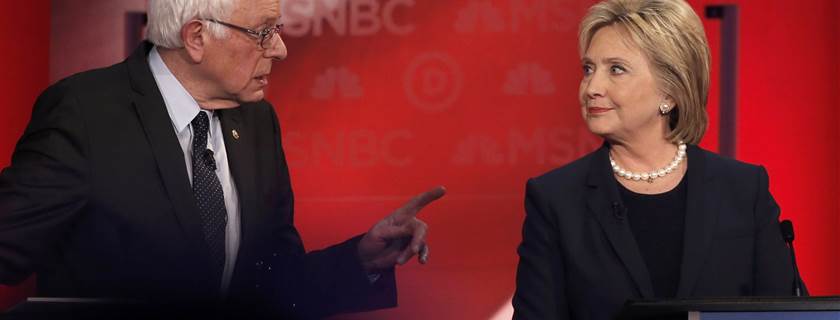
I watched yet another Democratic debate last night, this one moderated by MSNBC in a more traditional format instead of the previous version’s “town hall.”  Much was repeated: Bernie Sanders wants a “revolution” to overthrow a rigged economy and to enact campaign finance reform, Hillary Clinton says she’s a progressive who can get things done and who will build on the legacy of President Obama.

For me, the big moment came when Hillary tried to change the narrative on her taking millions of dollars from banks, investment houses, and Wall Street in the form of speaking fees and money from Super PACs.  She accused Bernie of a “smear” campaign when he “insinuated” she might be influenced by all this money.  She said other progressives (she cited Obama, for example) took money from Wall Street yet still allegedly held the big money boys to account.

Another moment, not as big but also telling, was when Bernie painted Hillary as an “establishment” candidate.  Talk about stating the obvious!  But Hillary rejected this by playing the gender card.  How can I be an establishment candidate for president, Hillary asked, when if elected I’d be the first woman president?  This is total nonsense, of course. She is an establishment candidate who just happens to be a woman.  But I suppose she and her team had no other response to the truth Bernie was bringing.

Speaking of the establishment, after claiming she wasn’t part of it, Hillary cited Henry Kissinger’s praise of her, saying Kissinger had applauded her for running a tight ship at the State Department.  Praise from Caesar …

But back to the “smear” campaign.  Obviously, Hillary and her team are hoping the media will focus on the smoke and mirrors generated by that loaded term, while neglecting the reality of Bernie’s truth-telling.  Given the craven nature of the mainstream media, her cynical gambit may even work.

When the big money boys give millions to candidates, any candidate, they’re not usually so blatant (or stupid) as to be buying votes.  They’re not going to get caught telling a candidate, vote yes on this, no on that.  What they’re buying is access.  They’re gaining the candidate’s ear. They want to be the last “person” to whisper in the candidate’s ear before she or he makes a decision.

I’m sure Hillary believes she’s her own woman.  But she knows how the system works, and so does Bernie.  If you accept big money, you know it always comes with strings attached.  The more big money you accept, the more strings, until no matter how much you resist, you end up dancing like a puppet on those strings.  That’s basically Bernie’s point, and it’s not a smear. It’s the truth.

An interesting question came up about whether Hillary would be willing to share transcripts of all her speeches before the big money boys.  She said she’d look into it.  If she’s the “progressive” she claims to be, she should be willing to share those transcripts immediately as a matter of public record.  Something tells me we either won’t see these transcripts, or they’ll be released months from now, after the primary race is decided.


Bernie Sanders Won Last Night’s Democratic Debate

bernie
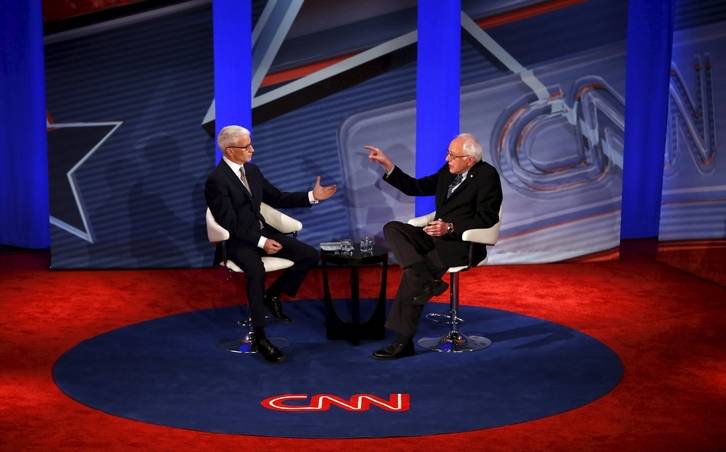
Bernie Sanders makes a point to Anderson Cooper during last night’s debate

W.J. Astore

Last night, Bernie Sanders and Hillary Clinton separately took questions from a “town hall” in Derry, New Hampshire with Anderson Cooper moderating.  Overall, both candidates did well, though I give the edge to Sanders (more on why in a moment).

Sanders came across as passionate on the issues and concerned for ordinary Americans.  He continues to speak of a political revolution, which to him doesn’t mean tumbrels to the guillotine.  It means getting more people involved in the political process, especially youth and the disadvantaged.  He spoke eloquently of helping others.  Memorable to me was his work to desegregate housing owned by the University of Chicago when Sanders was a student.  When asked why he fought against racist policies, Sanders said he’s always hated a bully – and always fought for fairness and equality.  He came across, in short, as an honest and decent man, a man of integrity, which is the word his wife used to describe him (she was sitting in the audience, and was asked to describe her husband with a single word).

Hillary came across as determined and competent and informed.  She tended to meander during her answers, coming across as somewhat of a policy wonk or a technocrat.  She rejected Sanders’ talk of a revolution, preferring to build on President Obama’s (and her own) legacy.  For example, she wants to put the finishing touches to Obamacare, rather than going for Sanders’ idea of a single-payer, “Medicare for all” system.  She spoke briefly of breaking the ultimate glass ceiling for women – her gaining the office of the presidency – and how that would inspire women of all ages.  She took her usual hardline on U.S. foreign policy, making no promises that she would reduce wars or for that matter spending on defense.

In sum, if you’re happy with the status quo, you’ll get plenty of that with Clinton.  If you want change, if you’re tired of a “rigged” economy and a corrupt political process, Sanders is far more likely to act in your favor.

Where I thought Hillary fell down was in her posturing as a progressive.  The millions of dollars she has accepted in speaking fees from banks and investment houses, she suggested, would have no impact on her policy decisions, which is simply implausible.  Powerful organizations don’t give political candidates big money without strings attached to it, and of course Clinton knows this.  It also seemed implausible when Clinton suggested she had not decided to run for president when she accepted those speaking fees.  As if her “doubts” about running absolved her of responsibility for taking big money from Wall Street.  It was all frankly unconvincing.

Hillary Clinton is a fighter.  She came across best when she spoke of the Republican right-wing attacks she’d had to endure over the last 25 years, and what they’d taught her about the political process.  Her footing was less secure when she had to relate to other people.  For example, a man suffering from advanced-stage cancer asked her about dying with dignity.  Bill Clinton, the “natural” as Hillary called him, would have turned this into an empathetic “I feel your pain” moment.  But Hillary got lost in the details, saying she would have to study up on the ethics of terminal care, the laws, the role of medical professionals, what other countries are doing (she mentioned The Netherlands), and so on.  As she tackled the problem in a wonkish way, she seemed to forget the person standing in front her.

In sum, Bernie Sanders is driving the narrative, not Hillary Clinton.  It’s Bernie who’s been talking about a rigged system, about economic fairness, about working for unions, about justice and prison reform, and it’s Hillary who’s been put on the defensive.  So lately Hillary’s been borrowing liberally from Bernie’s script.  She’s now talking about “the deck being stacked” against ordinary people, and how she’s going to fight for workers, and how much Wall Street is supposedly against her candidacy.

As Bernie has gained in the polls, as his message has begun to resonate, Hillary has responded by trying to be more like Bernie.  And it just doesn’t ring true, at least for me.  Advantage, Bernie.


Where’s the Anti-War Movement?

antiwar_peace_rally03_618
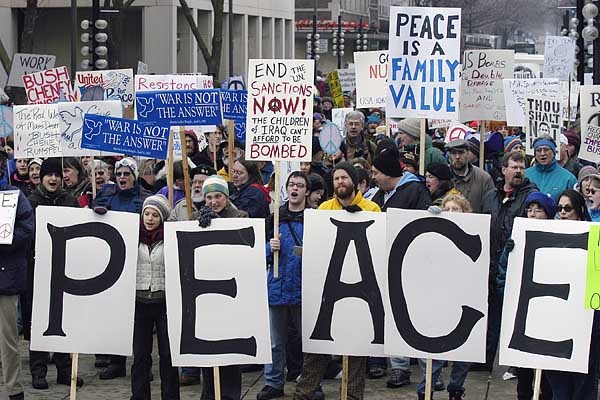
Thousands of people with signs of peace gather on Library Mall for the start of an anti-war rally protesting a potential United States-led war against Iraq. Protesters later marched up State Street to the Wisconsin State Capitol Building. ©UW-Madison University Communications 608/262-0067 Photo by: Jeff Miller

W.J. Astore

Yesterday, Ira Chernus had a stimulating article at TomDispatch.com in which he noted the present lack of an American anti-war movement.  When it comes to war and foreign policy, Americans face a Hobson’s choice: the Democrats with drones and Special Ops and bombing against evildoers, or the Republicans with even more drones and Special Ops and bombing against even more evildoers.  The American master narrative, Chernus noted, is essentially all war.

He’s right about this, and I think it’s mainly for five reasons:

  1. The military draft is gone, so our youth can safely (they think) ignore America’s never-ending wars. In Vietnam, with the draft, most of our youth didn’t have the luxury of apathy.  Today, our youth have little personal incentive (as yet) to push back against the prevailing war narrative.
  2. Militarism.  Creeping militarism has shifted the American narrative rightwards.  In the Vietnam period, General Curtis LeMay’s “bomb them back to the stone age” was a fringe opinion; now it’s mainstream with “carpet bombing” Cruz and Trump and Rubio, the “top three” Republican presidential contenders after the Iowa caucuses.
  3. The Democrats have also shifted rightwards, so much so that now both major political parties embrace endless war. War, in short, has been normalized and removed from partisan politics.  As Chernus documents, you simply can’t get an alternative narrative from the U.S. political mainstream.  For that, you have to look to much smaller political parties, e.g. the Green Party.
  4. The U.S. mainstream media has been thoroughly co-opted by corporations that profit from war.  Anti-war ideas simply don’t get published; or, if they do, they’re dismissed as unserious.  I simply can’t imagine any of today’s TV talking heads coming out against the war on terror like Walter Cronkite came out in the 1960s against Vietnam. There is simply no push back from the U.S. media.
  5. Finally, a nebulous factor that’s always lurking: FEAR.  The popular narrative today is that terrorists may kill you at any time right here in America.  So you must be ready to “lockdown“; you must be ready to “shelter in place.”  You must always defer to the police and military to keep you safe.  You must fully fund the military or YOU WILL DIE. Repeated incantations of fear reinforce the master narrative of war.

Chernus makes many good points about how America’s constant warring in the Middle East only feeds radical Islam.  In short, it’s vital to develop a new narrative, not only because the current one feeds war and death, but also because it’s fated to fail.

I doubt pacifism will fly in warrior corp USA.  But why not containment?  Containment worked against the Soviet Union, or so most Americans believe.  If it worked against the far greater threat posed by the USSR, why shouldn’t it work against radical Islam?

Containment suggests several concrete actions: American troops should pull out of the Middle East.  Bombing and drone strikes should stop.  Establish a cordon sanitaire around the area.  Lead a diplomatic effort to resolve the conflicts.  And recognize that violent civil and ideological wars within Islam may need to burn themselves out.

One thing is certain: Because violent U.S. actions are most likely to act as accelerants to radical Islam, we need to stop attacking.  Now.

Yes, the U.S. has a responsibility to help the peoples of the region.  American actions helped to create the mess.  But you don’t “solve” the mess by blowing more people and things to smithereens.

Containment, diplomacy, humanitarian aid.  Not a chest-thumping course of action celebrated by the likes of Trump or Cruz or Clinton, but a new master narrative that would be more likely to spare lives and reduce the chaos in the Middle East.

A Surefire Recipe for the End of Democracy

cheerleader camo
Camo-clad NFL Cheerleaders “Salute” the Troops

W.J. Astore

I’ve written several articles about the United States and creeping militarism (see here and here, for example).  This should be obvious, but I’ll say it again: Calling attention to the militarization of American society is pro-democracy, not anti-military.  Indeed, back in the citizen-soldier era of my father, being “gung ho” for the military wasn’t even applauded within the military!

As one veteran wrote to me:

When I was in the military, being “gung ho” was not considered a compliment by most of my friends… Of course we were not professional military types, just taking our turns to do our duty. We remembered the American soldier epitomized by Bill Mauldin as “Willie” and “Joe” who fought successfully against the German Army and the Japanese fanatics…The popular war movies of WWII after the war usually pitted the austere, indoctrinated Nazis fighting to demonstrate the Nazi superiority against the average American citizen soldier. Remember the movie “Battleground”? Today the images of our Army uncomfortably remind me of the way the German superman was portrayed that we overcame. 

As America today celebrates its “superman” warriors (one soldier recently called this “the age of the commando”), our country neglects these same men and women when they leave the military, often with crippling physical and psychological wounds.

As another veteran wrote to me:

[There is a] disjunction between the cult of military hero-worship in American society and American ignorance of veterans’ problems.  I am continually disgusted with those who are pimping off the mystique [surrounding our troops] who don’t deserve any special regard for their military service.  And a final but important point: many combat vets, knowing full well the realities of combat and its effects on combatants, do not want to be thanked at all [by the public].

America’s militarism both feeds and draws support from our endless wars.  The war on terror has been ongoing since 2001.  So too the war in Afghanistan.  Iraq keeps getting more chaotic.  Miscalculation in Syria could lead to World War III.

Speaking of future wars, just look at the rhetoric of our more popular political candidates for president, to include Donald “bomb those suckers” Trump and Ted “carpet bomb” Cruz.  Chickenhawk politicians are nothing but opportunists.  They may be leading the war charge, but they know they’re backed by a society in thrall to military spectacle (as represented, for example, by pom-pom shaking cheerleaders in skimpy camouflage outfits).

Unstinting praise of America’s “warriors” and “heroes” is reinforced by feel-good corporate/military advertising.  Recall Budweiser’s “welcome home” party for an Army lieutenant that aired during the Super Bowl a couple of years back.  Or red-white-and-blue Budweiser cans to “honor” the troops on July 4th.  “Saluting” the troops with colorful beer cans – really?

Signs of militarism USA are everywhere.  Police forces with MRAPs and similar tank-like vehicles.  Colleges and universities jostling for “defense” funding (even bucolic campuses want those war bucks).  Popular games that glorify military mayhem, such as the “Call of Duty” video games.  Even mundane items like camouflage headsets for NFL coaches.

It’s time to end the madness.  Paraphrasing Dwight Eisenhower, only Americans can defeat America.  Constant celebration of all things military is not a recipe for victory.  But it is a surefire recipe for the end of democracy.

The Challenger Shuttle Disaster, Thirty Years Later

Challenger_flight_51-l_crew
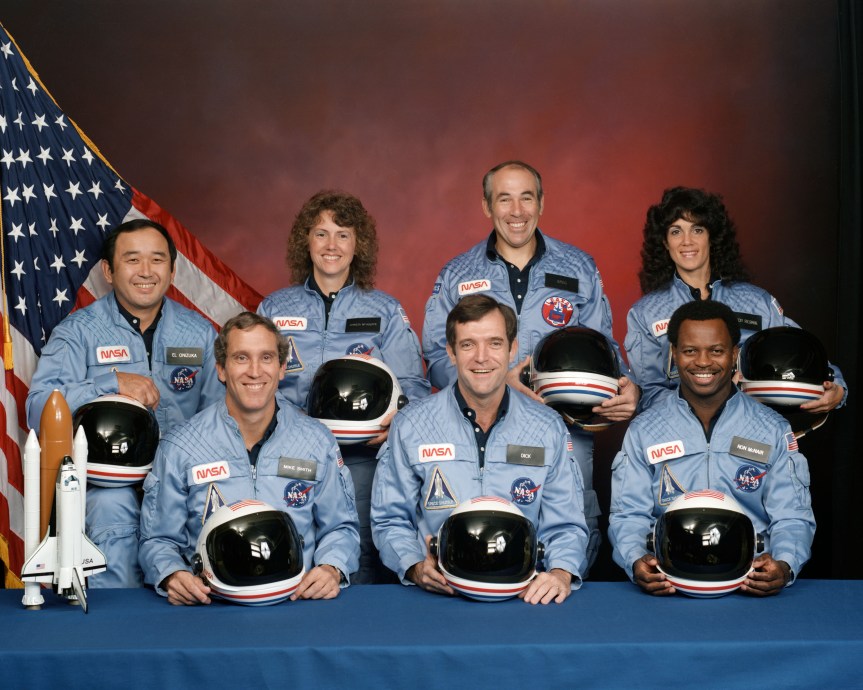
The Crew of the Challenger

W.J. Astore

When the Challenger blew up thirty years ago this January, I was a young Air Force lieutenant working an exercise in Cheyenne Mountain Command Center near Colorado Springs, Colorado.  I remember the call coming in to the colonel behind me.  I heard him say something like, “Is this real world?”  In other words, is this really happening, or is it part of the exercise?  The answer at the other end was grim, our exercise was promptly cancelled, and we turned on the TV and watched the explosion.

Our initial speculation that day was that an engine had malfunctioned (the explosion appeared to have occurred when the shuttle’s engines were reaching maximum thrust).  But it turned out the shuttle had a known technical flaw that had not been adequately addressed.  Something similar would happen to the Columbia in 2003: a known technical flaw, inadequately addressed, ended up crippling the shuttle.

When I taught a course on “technology and society” at the collegiate level, I had my students address the non-technical causes of the Challenger and Columbia disasters.  Here is the question I put to them in the course syllabus:

NASA lost two space shuttles: the Challenger in 1986 and the Columbia in 2003.  Tragically, both these accidents were preventable.  Both had clear technical causes.  In 1986, faulty O-rings on the solid rocket boosters allowed gas to escape, leading to an explosion of the center fuel tank.  In 2003, insulation foam that detached from the shuttle upon liftoff damaged the heat insulation tiles that protect the shuttle from the intense heat of reentry, leading to internal explosions as the Columbia reentered the atmosphere.

Both accidents also highlighted wider issues involving risk management, institutional culture, and control of highly complex machinery.  Before each accident, NASA engineers had warned managers of preexisting dangers.  In the case of the Challenger, it was the risk of launching in low temperatures, as shown by previous data of gas leakage at O-ring seals when the air temperature was below sixty degrees Fahrenheit.  In the case of the Columbia, visual data suggested the shuttle had sustained damage soon after liftoff, a fact that could have been confirmed by cameras and/or a space walk.  In both cases, managers overruled or disregarded the engineers’ concerns, leading to catastrophe.

Question: What do you think were the key non-technical factors that interacted with the technical flaws?  What lessons can we learn from these accidents about controlling complex technical systems?

I wanted my students to focus on issues such as group think, on management concerns about cost and schedule and how those might cloud judgment, on the difficulty of managing risk, on the possibilities of miscommunication among well-intentioned people operating under stress.

I ended the lesson with a quote from Richard Feynman, the Nobel Prize winning scientist who had served on the Challenger board of inquiry after the accident.  Feynman’s honest assessment of the critical flaws in NASA’s scheme of management was shunted to an appendix of the official report.  It’s available in his book, “What Do You Care What Other People Think?”

This is what Feynman had to say:

“For a successful technology, reality must take precedence over public relations, for Nature cannot be fooled.”

It was a devastating conclusion – a much needed one then, and arguably even more needed today.

Defeating ISIS: Do We Even Have A Strategy?

AP_jihadi_john_cf_160119_12x5_1600
Image showing Jihadi John.  Apparently killed, then quickly replaced by a new “Jihadi John” — a visual metaphor of “progress” in the war on ISIS (AP photo)

W.J. Astore

An overarching strategy for defeating ISIS is simple enough to state:  A concerted effort by regional power brokers to tamp down Islamic extremism while reducing the violent and chaotic conditions in which it thrives.  Regional power brokers include the Israelis, the Saudis, the Iranians, and the Turks, joined by the United States and Russia.  They should work, more or less cooperatively, to eliminate ISIS.

Why?  Because you never know when a spark generated by extremists will ignite an inferno, especially in a tinderbox (a fair description of the Middle East).  We know this from history.  Consider the events of the summer of 1914.  A Serbian “Black Hand” extremist assassinates an archduke of the Austro-Hungarian Empire in the Balkans (that era’s tinderbox of extremism).  Most of Europe yawned, at least initially.  A small brush fire between the Serbs and the Empire, easily containable, people said.  Yet within weeks European troops were marching in the millions to their deaths in what became World War I.

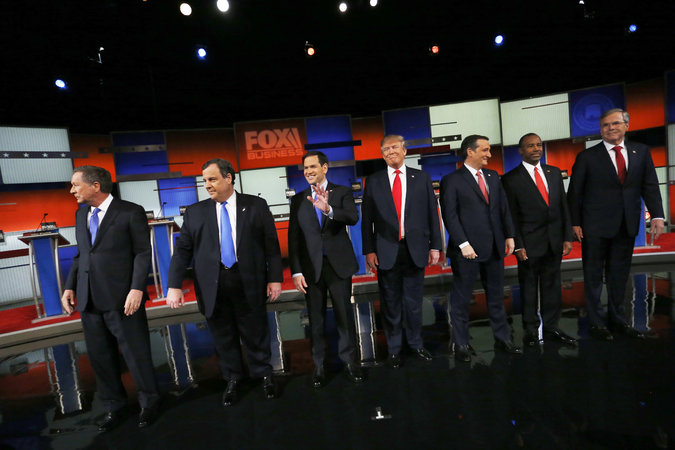
In today’s Middle East, we’ve been lucky (so far) to avoid the kind of provocation and miscalculation that led to World War I.  But consider the actions of a new president, say a Chris Christie.  During a presidential debate, Christie promised to declare a no-fly zone over Syria and to shoot down any Russian plane that violated it.  It’s the kind of ultimatum that very well could lead to another world war.

Provocations and ultimatums can rapidly spiral among nations that lack uniformity of purpose.  For many of the power brokers engaged in the Middle East, defeating ISIS is either not the goal, or it’s not the primary one. Put differently, there are too many forces involved, working to discordant ends.  Their actions, often at cross-purposes, ensure that entities like ISIS survive.

Let’s take the United States, for example.  Every American politician says he (or she) wants to destroy ISIS.  Yet in spite of this nation’s enormous military strength, we seem to be too weak, psychologically as well as culturally, to deal with Russia, Iran, et al. as diplomatic equals.  The “exceptional” country thinks it must “lead,” and that means with bombing, drone strikes, troops on the ground, and similar “kinetic” actions.  Rather than dousing the flames, such actions fuel the fire of Islamic extremism.

Consider America’s domestic political scene as well.  ISIS is incessantly touted as a bogeyman to fear, most notably by Republican presidential candidates seeking to draw a contrast between themselves and Barack Obama, the “feckless weakling” in the words of Chris Christie.  But the Republican “alternative” is simply more bombing and more U.S. troops.  Making the sand glow is no strategy, Ted Cruz.

Strategy is a synthesis of means, ends, and will.  Currently, the means is military force, with a choice of more (from Obama) or even more (from Republicans).  Our leaders have no idea of the ends at all, other than vague talk of “destroying” ISIS.  The will they exhibit is mostly bombast and fustian.

A nation lacking will, with no clear vision of means and ends, is a nation without a strategy.  And a nation without a strategy is one that’s fated to fail.

The 2016 Presidential Candidates in a Word

face plant
Politics: Sometimes I just want to do a face plant (Photo: Barbara Neiberg)

W.J. Astore

Continuing our election coverage, I thought I’d try to sum up each major candidate with a single word (excluding profanities).  I encourage readers to submit your own words for each candidate in the comments section below.


The Democrats

Clinton: Compromised.  No candidate is more beholden to special interests and the establishment than Hillary.

Sanders: Revolutionary.  Let’s face it: It would be revolutionary for a Socialist Jew to win the Democratic nomination.  And “revolution” is one of Bernie’s favorite words.

O’Malley: Eclipsed.  I had to strain to remember his name, and I’ve watched the debates.  Simply overshadowed by Hillary and Bernie.


The Republicans

Trump: Bombastic.  Trump makes a lot of noise, and my dad always told me “the empty barrel makes the most noise.”

Cruz: Oleaginous.  There’s something slippery about Cruz.

Rubio: Callow.  An eager beaver, apple-polishing type.  Not quite ready for prime time.

Bush: Uncertain.  He doesn’t seem to believe the words coming out of his own mouth.  This is one reason why Trump calls him “weak,” because The Donald never doubts himself.

Carson: Serene.  His calm is perfect for a neurosurgeon, but he’s out of his element on the political stage.

Christie: Angry.  He seems to despise both Obama (“feckless weakling”) and Hillary.  Like Tony Soprano but without the charm.

Kasich: Grey.  A conventional Republican governor, he blends into the background due to the strutting peacocks that surround him.

What do you think, readers?  Have at it!


The Republican Alternate Universe of Paranoia

repubdebate-162-master675
Paranoia will destroy ya

W.J. Astore

I watched last night’s Republican debate so you wouldn’t have to.  Leaving aside the usual mugging by Donald Trump, the usual jousting over side issues like whether Ted Cruz is a natural born citizen, I thought I’d take an impressionistic approach to the debate.  You can read the debate transcript here (if you dare), but here is my admittedly personal take on the main messages of the debate.

  1. Barack Obama and Hillary Clinton are coming to take your guns. So you need to elect a Republican who will allow you to keep your guns and to buy many, many more guns while carrying them openly in public.
  2. Related to (1), ISIS is coming to these shores. In fact, they’re already here.  That’s one big reason why everyone needs guns – to protect ourselves from ISIS and other terrorists out to kill Americans on Main Street USA.
  3. America is weak. Obama has gutted our military.  The Iranians and Russians laugh at us.  To stop them from laughing, America needs to rebuild its military, buy more weapons, and use them freely.  In fact, all the next commander-in-chief needs to do is ask military leaders what they need to win, give them exactly that, then stand back as our military (especially Special Ops troops) kicks ass.  Victory!
  4. America is weak (again), this time economically. The Chinese are kicking our ass.  They’re tougher than us and smarter than us.  We need to teach them who’s boss, perhaps with a big tariff on Chinese imports, combined with intense pressure on them to revalue their currency.
  5. The American tax system is unfair to corporations. We need to lower corporate tax rates so that American companies won’t relocate, and also so that American businesses will be more competitive vis-à-vis foreign competitors.
  6. The most oppressed “minority” in the U.S. are not Blacks or Hispanics or the poor: it’s the police. Yes, the police.  They are mistreated and disrespected.  Americans need to recognize the police are there to protect them and to defer to them accordingly.
  7. The only amendment worth citing in the U.S. Constitution is the Second Amendment.
  8. The National Security Agency, along with all the other intelligence agencies in America, need to be given more power, not less. They need broad and sweeping surveillance powers to keep America safe.  Privacy issues and the Fourth Amendment can be ignored.  People like Edward Snowden are traitors. “Safety” is everything.
  9. Bernie Sanders is a joke. Hillary Clinton just might be the anti-Christ.
  10. Immigrants are a threat, especially if they’re Muslim. They must be kept out of America so that they don’t steal American jobs and/or kill us all.

What I didn’t hear: Anything about the poor, or true minorities, or gender inequities, or the dangers of more war, and so on.

My main takeaway from this debate: Republican candidates live in the United States of Paranoia, a hostile land in which fear rules.  Think “Mad Max, Fury Road,” but without any tough females about.  (I have to admit I missed Carly Fiorina/Imperator Furiosa on the main stage.)

Only one candidate struck a few tentative notes of accord through bipartisan collaboration and compromise: Ohio governor John Kasich.  In his closing statement, he spoke eloquently of his parents’ working-class background.  He’s also the only candidate with the guts not to wear the by-now obligatory flag lapel pin.  I’m not a Republican, but if I had to vote for one, it would be him.  Why?  Because he’s the least batshit crazy of the bunch.

Yes, it was a depressing night, one spent in an alternate universe detached from reality.  In the end, old song lyrics popped into my head: “paranoia will destroy ya.”  Yes, yes it will, America.

Real War: The Horror

blood

W.J. Astore

I recently read Blood Red Snow: The Memoirs of a German Soldier, by Günter Koschorrek, which focuses mainly on combat on the Eastern Front between the Germans and Soviets during World War II.  As Dan White has noted, military history sometimes degenerates into war porn – exciting tales of derring-do that save the day and end in citations and medals.  Real war isn’t like that.  Real war is horror, a horror that Koschorrek quickly came to know as a very young man.

Writing about his first weeks of combat, Koschorrek notes “how impatiently we waited for the opportunity to fight at the front!  Now, after exactly three weeks in combat, no one talks of heroism or enthusiasm any more.  On the contrary, the only wish is to get out of this death trap alive.”

Koschorrek’s first wound in combat is a minor one, which does not qualify him for evacuation from the front.  He writes:

I feel the disappointment—a hope has been dashed.  And then I think how quickly human feelings and attitudes can change.  It is only a matter of weeks since I was dreaming of glory and heroism and was so full of élan that I was almost bursting.  Now I long for a Heimatschuss—because it appears to me to be the only way that I can, with any sort of honor, say goodbye to this soul-destroying environment …

Koschorrek, a machine-gunner, quickly became a hardened veteran of the war.  When he sees friends killed in combat, he writes of a “sort of madness” that came over him, the desire for “bloody revenge.”  He writes:

Revenge and retaliation!  That inflammatory clarion call for revenge!  That’s the way all war leaders want their soldiers to be.  Remorseless, and with hatred and retaliation in their hearts, men can win battles, and quite ordinary soldiers can be converted into celebrities.  Fear is converted into hatred, anger and calls for retribution.  In this way you are motivated to fight on—even decorated with medals as a hero.

As the war drags on and Nazi Germany begins to lose, Koschorrek writes of “deserters and dissenters” within the ranks.  “They are called traitors to the fatherland,” he notes, but Koschorrek concludes with an important insight: “Nobody can be himself during a war—we all belong to the people and the state.”

War witnesses the death of individuality in the name of a collective: the people, the state.  More frightening is the death of individual conscience, as even the worst war crimes are excused in the name of “defending” the state.

As the Soviets close in and begin to invade Germany proper, Koschorrek encounters the aftermath of horrific reprisals committed by the Soviet invaders on the German people.  In one case, he notes how ordinary German villagers “were surprised in their sleep by the Soviets and couldn’t escape.  The [Nazi] party bigwigs, however, were all able to get away in time.”

When the war is finally over, Koschorrek was able to evade capture by the Soviets and transportation to Siberia as a POW.  He writes of trading his war medals (such as the Iron Cross) and ribbons for cigarettes, noting how American soldiers lusted after German war memorabilia.  Koschorrek’s medals and ribbons—marks of valor he wanted so keenly at war’s start—became by war’s end nothing but barter for smokes.

His last words reflect the hard-won wisdom of a man who fought as part of a war of annihilation on the Eastern Front:

when will people realize that it is possible for any of us to be manipulated by domineering and power-crazed individuals who know how to motivate the masses in order to misuse them for their own ends?  While they keep well out of the way [of war], in safety, they have no hesitation in brutally sacrificing their people in the name of patriotism.  Will mankind ever stand together against them?

Koschorrek, a frontline combat soldier, can be faulted for not being more critical of Nazi ideology and its megalomaniacal designs.  He has little to say about Nazi war atrocities.  His account is focused on combat and comrades, in the thick of the fighting, where the desire to stay alive is all-consuming.

It’s a book to be read carefully by anyone who thinks war is glorious.

The Drone Medal Revived!

W.J. Astore

Bad ideas never die at the Pentagon — nor do they fade away.  No — like no-win wars (Vietnam followed by Afghanistan, and so on), they keep coming back to haunt us.

According to today’s New York Times, the Pentagon is reviving the idea of special medals and awards for drone pilots and cyber-warfare specialists.

predator
Give that drone a medal!

This was an idea shot down by former SecDef Chuck Hagel, but bad ideas live a phoenix-like existence at the Pentagon.

Back in July 2012, I wrote the following article for Huffington Post about “the drone medal.”  It still stands today.  There are plenty of military decorations and awards, already on the books, that “a grateful nation” can give to its drone operators and cyberwar experts.  Creating new decorations to celebrate the “chair force” — well, what more can I say?

The Drone Medal (July 2012)

News that the Pentagon is considering a special “Distinguished Warfare Medal” for drone pilots tells us much about the American war-making moment. Leaving aside issues of bravery or courage of drone operators, let’s first consider the name of the medal, with its stress on “distinguished warfare.”

Traditionally, U.S. military medals by their very names have stressed honor or service, such as our highest award, the Medal of Honor, or the Distinguished Service Cross. Other medals are specifically connected to aerial prowess and feats, such as the Distinguished Flying Cross or the Air Medal. Such medals are well named, linked as they are to skills demonstrated by air crews operating in harm’s way.

What are we to make of a medal named for prowess in “warfare,” especially when drone operators are completely isolated from the battlefield? For that matter, how can war by remote control be recognized and celebrated as a “distinguished” form of “warfare”? Wouldn’t it be more honest (and perhaps even more honorable) to name this new decoration the “Drone Medal,” with all that name implies?

In raising these semantic points, I wish to take nothing away from drone pilots. They train hard, they work long hours, and they’re dedicated professionals. What they don’t need is a new medal created especially for them, and I’m guessing most of them would agree.

The U.S. military already has a bewildering array of awards and decorations on the books. If a drone pilot does something especially noteworthy or meritorious, there already exist commendation, meritorious service, and distinguished service medals that can be awarded to recognize his or her contribution.

Honestly, the last thing our bloated military establishment needs is more medals. But if the Pentagon insists on creating a “Distinguished Warfare Medal,” we really should insist on calling the Department of Defense by its old (and, given recent events, much more accurate) name: the Department of War.