FDR’s Four Freedoms brought meaning to World War II
W.J. Astore
At TomDispatch.com, Andrew Bacevich asks a pregnant question: What should we call America’s no-name wars? (Afghanistan, Iraq, Libya, Syria, and so on.) It used to be the GWOT (global war on terror), sometimes shortened to War on Terror and favored by the Bush/Cheney administration. The Obama administration punted, preferring the anodyne label of “overseas contingency operations.” Other names and concepts have been floated, such as “generational war” and “long war,” and the U.S. military itself, which is quite expert at creating acronyms, has used terms like MOOTW (military operations other than war). Indeed, the fact that America’s wars lack a commonly accepted name points to the lack of a common theme or strategy. Put differently, when you can’t name something accurately, how can you understand it, let alone fight it smartly and win it?
Forgive me for being flippant, but I can think of a few less than reverent names that serve to highlight the folly of America’s nameless wars. How about these?
“Perpetual Preemptive War”: Preemptive war was the great idea of the Bush/Cheney administration. Remember how we couldn’t allow the smoking gun of Iraqi WMD to become a mushroom cloud? We had to preempt the non-existent WMD, hence the disastrous Iraq war(s).
“Generational War for Generals”: General David Petraeus has spoken of a generational war against terror in countries like Afghanistan, comparing it to America’s 60+ year commitment to South Korea. Waging that war should keep a lot of U.S. generals busy over the next few decades.
“Bankrupt Strategy to Bankrupt America”: America’s total national debt just reached $21 trillion (you read that right), with perhaps $6 trillion of that due to America’s wars since 9/11. If we keep up this pace of spending, we will soon conquer ourselves to bankruptcy. Mission accomplished!
“The Wars to End All Peace”: Woodrow Wilson had “the war to end all wars” with World War I. Bush/Obama/Trump can say that they have the wars to end all peace, since there simply is no prospect of these wars ever ending in the foreseeable future.
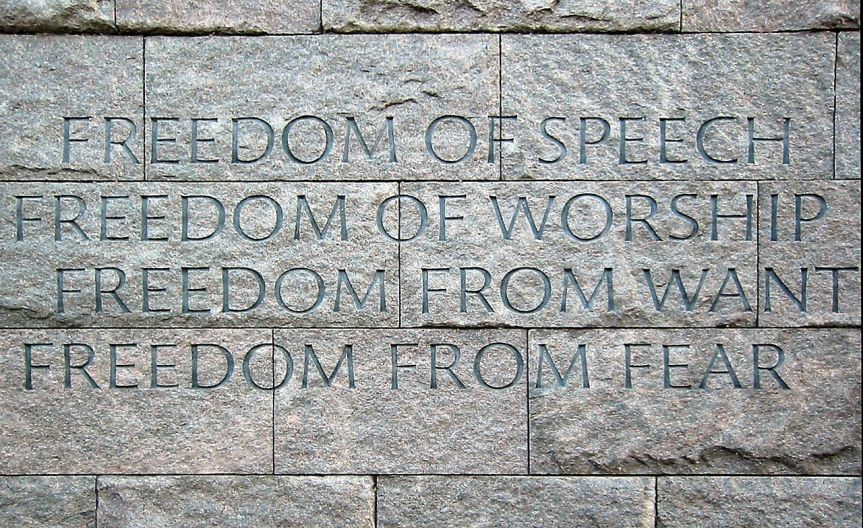
“Endless War to End Democracy”: FDR had the Four Freedoms and a real war to end Nazi Germany and Imperial Japan as threats to world peace. We now have endless war to end democracy in America. As James Madison wrote,
Of all the enemies of true liberty, war is, perhaps, the most to be dreaded, because it comprises and develops the germ of every other. War is the parent of armies; from these proceed debt and taxes; and armies, and debts, and taxes are the known instruments for bringing the many under the domination of the few. In war, too, the discretionary power of the Executive is extended; its influence in dealing out offices, honors and emoluments is multiplied; and all the means of seducing the minds, are added to those of subduing the force, of the people. The same malignant aspect in republicanism may be traced in the inequality of fortunes, and the opportunities of fraud, growing out of a state of war, and in the degeneracy of manner and of morals, engendered in both. No nation can preserve its freedom in the midst of continual warfare …
In short, instead of fighting for Four Freedoms, we’re now waging a permanent war that will end freedom.
Small wonder we avoid naming our wars – their theme and meaning are too frightening to nail down with precision.
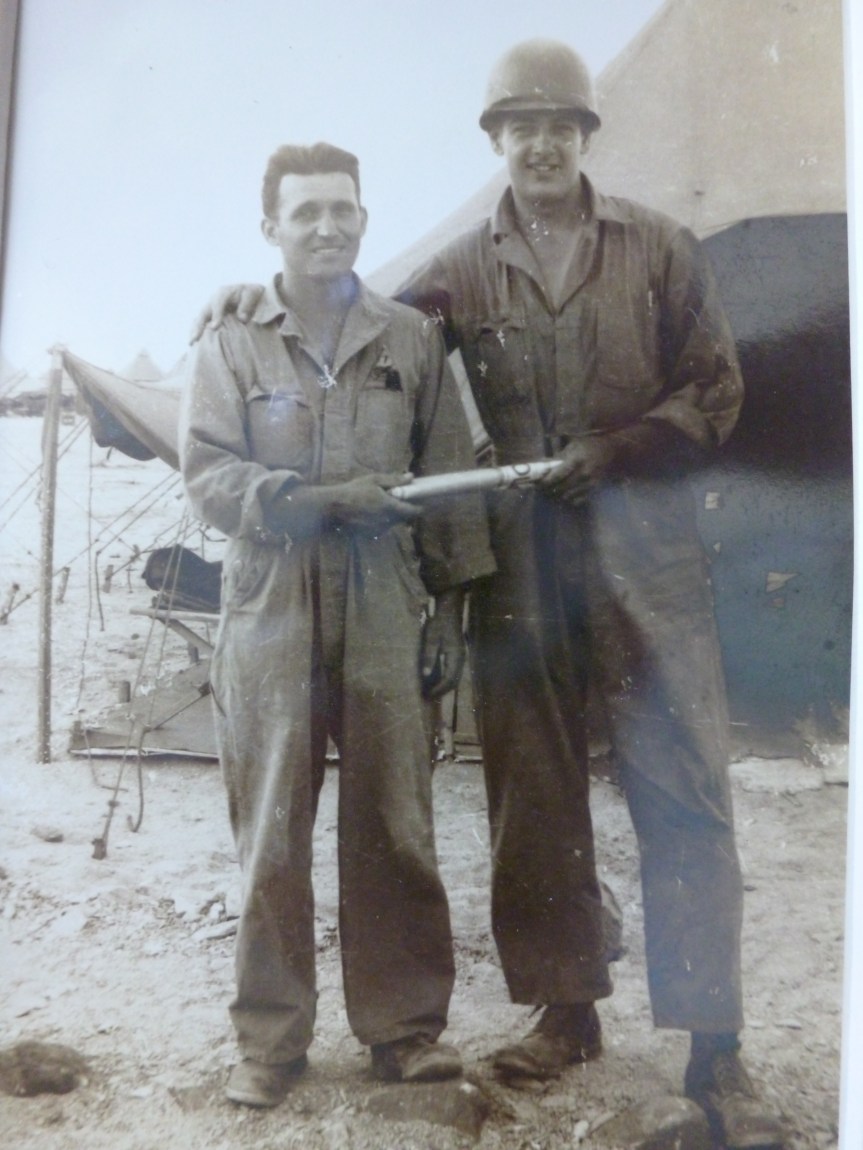
Every now and again I look over my dad’s letters from World War II. He was attached to an armored headquarters company that didn’t go overseas, but he had friends who did serve in Europe during and after the Battle of the Bulge in late 1944. Also, he had two brothers, one who served in Europe attached to a quartermaster (logistics) company in the Army, the other who served in the Pacific as a Marine.
Reading my dad’s letters and those from his friends and brothers, you get a sense of the costs of war. They mention friends who’ve been killed or wounded in action; for example, a soldier who lost both his legs when his tank ran over a mine. (His fellow soldiers took up a collection for him.) They talk about strange things they’ve seen overseas, e.g. German buzz bombs or V-1 rockets, a crude version of today’s cruise missiles. They look forward to furloughs and trips to cities such as Paris. They talk about bad weather: cold, snow, mud. They talk about women (my dad’s brother, Gino, met a Belgian girl that he wanted to marry, but it was not to be). But perhaps most of all, they look forward to the war’s end and express a universal desire to ditch the military for civilian life.
All of my dad’s friends wanted to get out of the military and restart their civilian lives. They didn’t want a military career — not surprising for draftees who thought of themselves as citizen-soldiers (emphasis on the citizen). In their letters, they never refer to themselves as “warriors” or “warfighters” or “heroes,” as our society is wont to do today when talking about the troops. War sucked, and they wanted no part of it. One guy was happy, as he put it, that the Germans were getting the shit kicked out of them, and another guy was proud his armored unit had a “take no prisoners” approach to war, but this animus against the enemy was motivated by a desire to end the war as quickly as possible.
Reading these letters written by citizen-soldiers of the “greatest generation” reminds me of how much we’ve lost since the end of the Vietnam War and the rise of the “all volunteer” military. Since the 9/11 attacks in particular, we’ve witnessed the rise of a warrior/warfighter ideal in the U.S. military, together with an ethos that celebrates all troops as “heroes” merely for the act of enlisting and putting on a uniform. My dad and his friends would have scoffed at this ethos — this idolization of “warriors” and “heroes” — as being foreign to a citizen-soldier military. Back then, the country that boasted most of warriors and heroes was not the USA: it was Nazi Germany.
Discarding the citizen-soldier ideal for a warrior ethos has been and remains a major flaw of America’s post-Vietnam military. It has exacerbated America’s transition from a republic to an empire, even as America’s very own wannabe Roman emperor, Donald Trump, tweets while America burns.
Men (and women) of the greatest generation served proudly if reluctantly during World War II. They fought to end the war as quickly as possible, and they succeeded. America’s endless wars today and our nation’s rampant militarization dishonor them and their sacrifices. If we wish to honor their service and sacrifice, we should bring our troops home, downsize our empire and our military budget, and end our wars.
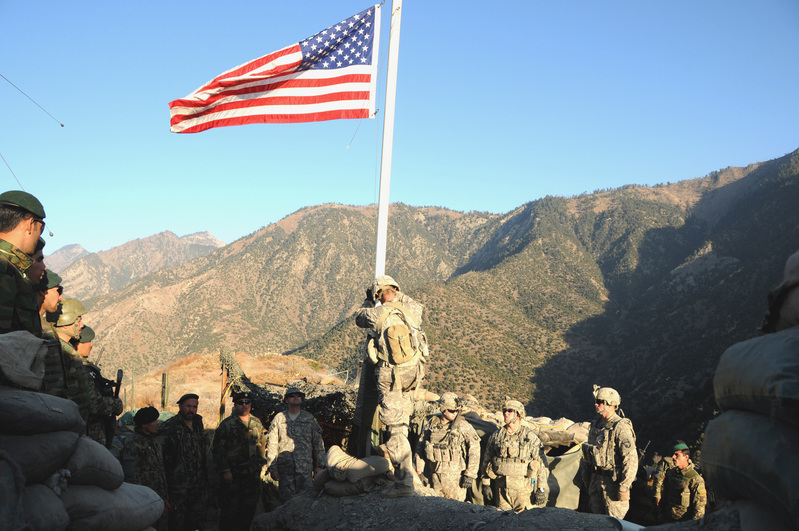
U.S. troops and outposts and flags are everywhere, but for whose interests, and at what cost?
W.J. Astore
In my latest article for TomDispatch.com, I address America’s real wars overseas and contrast them with the phony war in the so-called Homeland. What I mean by “phony” is the lack of national mobilization for, and even interest in, these overseas wars. These wars exist and persist; they are both ever-spreading and never-ending; yet few Americans outside of the military and the Washington beltway crowd have any stake in them. Except when U.S. troops die or a spectacular bomb is used, the mainstream media rarely covers them.
Meanwhile, the Trump administration has defined a new National Defense Strategy (NDS) that has only expanded America’s list of enemies and rivals. A quick summary:
Conventional conflict against peer enemies, e.g. Russia and China.
Conventional conflict against “rogue” states, e.g. North Korea and Iran.
Unconventional (anti-terror) operations, e.g. Afghanistan, Syria, Yemen, Niger, etc.
If that’s not enough, the Pentagon also seeks extended nuclear supremacy (at a cost of at least $1.2 trillion over the next few decades) and full-spectrum dominance for space and cyber as well as land, sea, and air. As U.S. “defense” budgets continue to grow, there’s really no sense of limits, monetary or otherwise. Rising budgets feed endless war, and vice-versa. It’s a fail-safe recipe for imperial over-stretch and the decline if not collapse of America.
What follows is an excerpt from my latest article; you can read the entire article here at TomDispatch.com.
America’s New (Phony) National Defense Strategy
Even phony wars need enemies. In fact, they may need them more (and more of them) than real wars do. No surprise then that the Trump administration’s recently announced National Defense Strategy (NDS) offers a laundry list of such enemies. China and Russia top it as “revisionist powers” looking to reverse America’s putative victory over Communism in the Cold War. “Rogue” powers like North Korea and Iran are singled out as especially dangerous because of their nuclear ambitions. (The United States, of course, doesn’t have a “rogue” bone in its body, even if it is now devoting at least $1.2 trillion to building a new generation of more usable nuclear weapons.) Nor does the NDS neglect Washington’s need to hammer away at global terrorists until the end of time or to extend “full-spectrum dominance” not just to the traditional realms of combat (land, sea, and air) but also to space and cyberspace.
Amid such a plethora of enemies, only one thing is missing in America’s new defense strategy, the very thing that’s been missing all these years, that makes twenty-first-century American war so phony: any sense of national mobilization and shared sacrifice (or its opposite, antiwar resistance). If the United States truly faces all these existential threats to our democracy and our way of life, what are we doing frittering away more than $45 billion annually in a quagmire war in Afghanistan? What are we doing spending staggering sums on exotic weaponry like the F-35 jet fighter (total projected program cost: $1.45 trillion) when we have far more pressing national needs to deal with?
Like so much else in Washington in these years, the NDS doesn’t represent a strategy for real war, only a call for more of the same raised to a higher power. That mainly means more money for the Pentagon, the Department of Homeland Security, and related “defense” agencies, facilitating more blitz attacks on various enemies overseas. The formula — serial blitzkrieg abroad, serial sitzkrieg in the homeland — adds up to victory, but only for the military-industrial complex.
Five years ago, I remember talking about lockdown drills (or “active shooter drills”) with colleagues at Penn College. Such drills were voluntary. Basically, the drill involved locking the classroom door, moving students to the back of the classroom, and having them hunker down, away from windows, while keeping silent so as to avoid detection by a shooter roaming the halls.
I was against these drills. I thought they added to the fear, and I chose not to do them. But maybe I would do them today.
After one shooting massacre (I can’t recall if it was Virginia Tech in 2007 or Sandy Hook in 2012), locks were added to the classroom doors. In theory, if I heard gunshots, I or one of my students could jump up and lock the door before a shooter got in. But what if a determined shooter shot the lock out?
What a world we Americans live in. Locked classrooms, lockdown drills for active shooters, and now the proposal to turn teachers into so many Harry Callahans (Clint Eastwood’s Dirty Harry) and our schools into “hardened” targets by arming teachers with pistols. Perhaps we should keep an AR-15 in each classroom (alongside the fire extinguisher), with a sign that reads, “In case of emergency, break glass – then lock and load.”
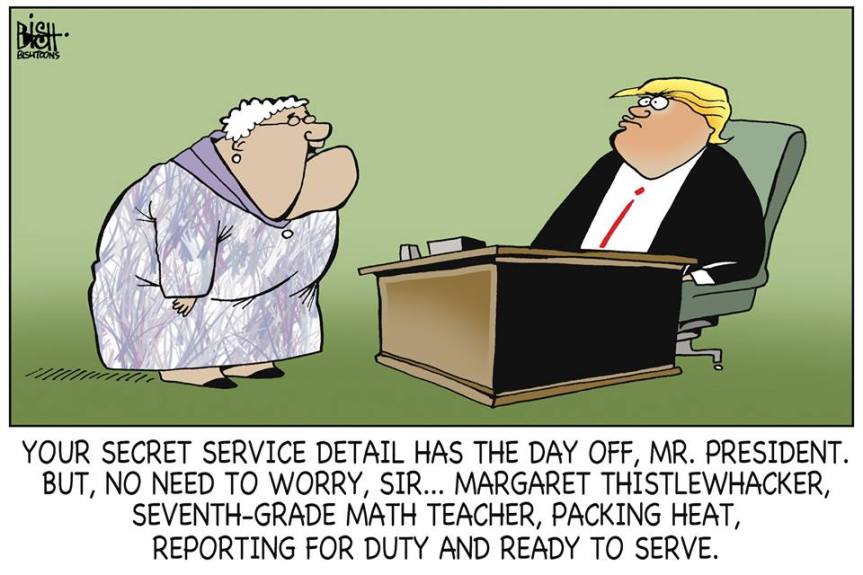
President Trump has argued that select teachers be armed – following the NRA’s theory that a good man with a gun is the best insurance against a bad man with a gun. It’s a crazy idea, but we live in a crazy country. Among the worst parts of Trump’s proposal was his stingy suggestion that armed and trained teachers might earn “a little bit” of a bonus. How generous of our brave commander-in-chief.
Think about that for a moment. There is an active shooter (or shooters) in a school, armed with military-style assault weapons and perhaps protected by body armor. Young people are running and screaming, bullets are flying, and in this bloody chaos, we place our faith in a teacher, perhaps armed with a 9mm pistol, thoroughly trained in shooting under combat conditions, willing to risk it all “for a little bit of a bonus.”
It’s a powerful fantasy: the cold bold Harry Callahan-like teacher, taking aim with his or her pistol and blowing away school intruders with perfect head shots. And that’s exactly what it is: a fantasy. As Belle Chesler, a teacher, put it at TomDispatch.com, “We are not warriors, we are teachers. We are not heroes, we are teachers.”
It’s one thing to shoot at paper targets on a gun range; it’s another thing entirely to fire accurately in combat when you’re outgunned and someone is firing back at you. What if, during the chaos of shooting, a teacher accidentally shoots a few students? So-called friendly fire incidents happen frequently in combat, despite the most careful troop training.
If you want more security guards in America’s schools, hire them. Don’t try to turn teachers into cheap cut-rate guards. Yet “a little bit of a bonus” for armed teachers is the best idea our stingy billionaire of a president can come up with.
As we saw in Parkland, Florida, even armed and trained deputies may hesitate before confronting a heavily-armed shooter. How is your average teacher going to react? At least we know Trump will rush in, heel spurs and all, whether he’s armed or unarmed, to save the day. Or so he says.
Most people, even when armed, will not rush toward the sound of gunfire. We tend instinctively to freeze, to take cover, or to run. It takes a combination of training, willpower, and courage to rush toward danger, often strengthened by teamwork and inspired by one or more leaders who set the example. The problem is not as simple as “give a teacher a gun, and he or she will blow the bad guy away.”
In a country awash in weapons, there are no easy answers. One model is to turn our schools into fortresses, complete with surveillance cameras and panic buttons and smoke ejectors in hallways, as in this “safe” school in Indiana. Trump’s model is to arm select teachers for a tiny bonus. Limited efforts at gun control, such as raising the age to purchase an assault rifle from 18 to 21, are like putting a Band-Aid on a sucking chest wound. One thing is certain: better law enforcement is crucial, e.g. there were many warnings about the Parkland shooter that were dismissed or ignored.
Again, there are no easy answers. And so Lockdown America is now our reality.
Update (3/9/18): In the wake of the Parkland shootings, Florida legislators have approved guns for teachers in the classroom, as well as more spending on school security. Assault weapons, however, are not to be banned. So the solution to bad men with guns is indeed good men with guns, according to Florida. The NRA wins again.
How long before a teacher, teacher’s aide, or coach with a gun accidentally or intentionally hurts a student with a gun? How long before the inevitable lawsuits result from this, the multi-million dollar settlements? Will school districts be required to carry expensive insurance against gun shootings by educators? Are taxpayers ready to pony up a lot more money to cover the costs of insurance premiums and lawsuits?
The five-sided puzzle palace on the Potomac is about to be flooded with new money
W.J. Astore
Over at Foreign Policy, there’s a good article on how the Pentagon gets so much money so easily. Basically, the Pentagon complains about lack of “readiness” for war, and Congress caves. But as the article’s author, Gordon Adams, notes, most of the boost in spending goes not to training and maintenance and other readiness issues but to expensive new weaponry:
But the big bucks, according to the Pentagon’s own briefing, will go into conventional military equipment. That means more F-35s and F-18s than planned, a new presidential helicopter, Navy surveillance planes and destroyers, Marine helicopters, space launch rockets, tank modifications, another Army multipurpose vehicle, and a joint tactical vehicle the Army, Marines, and Air Force can all use. Basically, the services will soon have shiny new hardware.
With its $160+ billion budgetary boost over the next two years, the U.S. military will soon have many more shiny toys, which pleases Congress (jobs) and of course the military-industrial complex (higher and higher profits).
All of this is par for the Pentagon course, yet there are other, cultural and societal, reasons why the Pentagon is winning all the budgetary battles at home. Here are seven key reasons:
The heroes narrative. Collectively and individually, U.S. troops have been branded as heroes. And who is churlish and ungenerous enough to underfund America’s heroes?
Military weaponry has been rebranded as being all about our “safety” and “security.” With spillover into the Homeland, and even America’s classrooms (think about how guns for teachers are now being equated with safety for America’s children).
Defense contractors increasingly influence (and even own) the media, ensuring “journalists” like Brian Williams will wax poetically about the inspiring beauty of weapons. Rarely do you hear sustained criticism from the mainstream media about wasteful spending at the Pentagon.
At the same time, the mainstream media relies on “retired” senior military officers for analysis and commentary. Some of these men have links to defense contractors, and all of them are loath to criticize the military. They are, in a word, conflicted.
Throughout U.S. popular culture, military hardware is portrayed as desirable and “cool.” Think of all the superhero movies featuring jet fighters and other military hardware, or all the jets and helicopters flying over sports stadiums across the USA. For that matter, think of all the video games that focus on war and weaponry.
Related to (5) is a collective fantasy of power based on violence in war. Most Americans are powerless when it comes to politics and decision-making. Here is where our “beautiful” weapons can serve as potent symbols for a largely impotent people.
Finally, the ever-present climate of fear: fear of terrorists, immigrants, missiles from North Korea, Russian nukes, and so forth, even as the real killers in the USA (opioid abuse, vehicle accidents, shootings, bad or no healthcare, poor diets, climate-change-driven catastrophes, and of course diseases, some of which are preventable) are downplayed.
Defense spending used to be examined closely, with many programs exposed as wasteful. This was common in the aftermath of the Vietnam War in the 1970s and early 1980s – remember Senator William Proxmire and his Golden Fleece awards? Now, it seems there’s no such thing as wasteful spending. It’s a remarkable change of narrative representing an amazing success story for the military-industrial complex.
It will take more than cutting the Pentagon’s budget to effect change. America needs to change its mindset, an ethos in which weapons, even wars, are equated with safety and security and potency, and even occasionally with entertainment and fun.
In sum, the Pentagon is doing what it’s always done: issuing demands for more and more money. It’s up to us (and Congress) to say “no.”
I grew up on science and the American space program. My favorite character on “Star Trek” was Mr. Spock, the eminently logical Vulcan science officer. I loved physics in high school and ended up majoring in mechanical engineering in college. Later, I got advanced degrees in the history of science and technology, especially as these subjects relate to Christianity.
Suffice to say I have a deep respect and a fond affection for science. That’s why it pains me to see the U.S. government taking positions against science, and specifically against global warming/climate change.
What disturbs me (among other things) is the denial of facts — the disparagement of science — by high officials in our government. Denying global warming is like denying evidence of evolution. People do the latter as a matter of faith — they take refuge in Creationism and Biblical literalism, partly because it’s easier, partly because they’re “true believers,” partly because they don’t trust experts, and partly because it’s flattering to their own self-image as being made in the image of God. And there are certainly ministers within Christian sects who encourage their followers to reject science — it’s one way for these ministers to bolster their own authority.
The denial of the science of global warming is for some of the same reasons (it’s easier, lack of trust in experts) but largely due to capitalism and the desire for profit. The ministers of capitalism are not about to cede authority to scientists, not on this issue at least. There are trillions of dollars of fossil fuels still in the ground, and who wants to leave it there when there’s so much money to be made in extraction? Damn the long-term costs to the environment and to vulnerable peoples worldwide — full speed ahead on short-term profits!
But as Tom Engelhardt notes in his latest article at TomDispatch.com, the global environment won’t be deterred by our denial of facts. Environmental blowback is guaranteed — and will grow increasingly severe — as long as our government continues to ignore or downplay the high costs of burning fossil fuels.
In the aftermath of Sputnik and in the context of the Cold War, our government pushed science as a bulwark to democracy and freedom. Now that same government is disrespecting science in the name of profitability and economic competitiveness.
As Mr. Spock might say, dissing science is not logical. Nor will it end well for ourselves or our planet.
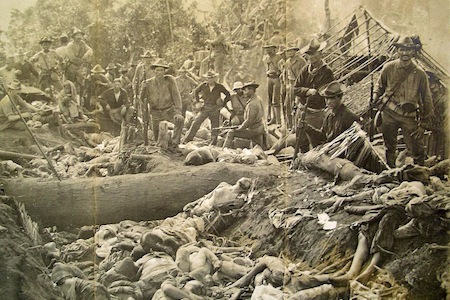
U.S. troops pose with dead Moro rebels, Philippines, 1906
W.J. Astore
Introduction: In September 2012, I wrote the following piece on U.S. imperialism, inspired by an old sound recording. It came to mind as I read a review in The Nation of a new book by Stephen Kinzer, The True Flag: Theodore Roosevelt, Mark Twain, and the Birth of American Empire. Its reviewer, Brenda Wineapple, notes the terrible toll of America’s “splendid little war” against Spain in 1898, followed by the campaign to conquer and control (or, to use the expression from those days, to “civilize”) the Filipino people. Here’s an excerpt from her review:
The war in the Philippines, however, was far from over. Even after McKinley’s assassination, US soldiers continued to ravage the country, killing Filipinos, burning their villages, and laying waste to crops; after three years of such “counterinsurgency,” Kinzer writes, “Americans lost whatever national innocence had survived slavery, anti-Indian campaigns, and the Mexican War.” Twain and the anti- imperialists had never seen any innocence to speak of: “Lust of conquest had long ago done its work…. There was no principle but commercialism, no patriotism but of the pocket,” Twain wrote.
At the end of 41 months, hundreds of thousands of Filipino civilians had died, and at least 20,000 insurgents—far more than had perished in the 350 years of Spanish rule. But, Kinzer argues, no lessons had been learned: US foreign policy in the 20th and 21st centuries may spring from an ambivalence to intervene in the world, but it continues to represent itself as benevolent when it does so for its own economic self-interest.
She and Stephen Kinzer mention President William Howard Taft, which brings me again to my article from 2012. I can still faintly hear Taft’s voice, emerging from my friend’s old phonograph horn, telling Americans how they had to embrace “the ignorant masses” of the Philippines. How deadly that embrace would prove for so many Filipinos …
The Siren Song of American Imperialism (2012)
Considering the scale of our mistakes over the last decade in Iraq and Afghanistan, if we as a country truly want to pursue a leaner, smarter, more effective foreign policy, the first step we must take is to stop listening to the siren song of our own imperial rhetoric. We need to stop posing as benevolent caregivers and start being more honest with ourselves.
And that honesty extends to our own history. The French have a saying that translates to “the more things change, the more they remain the same.” The appropriateness of that saying was brought home to me last week when a good friend of mine played an old campaign speech of William Howard Taft. In 1908, when he was running for president to succeed Teddy Roosevelt, Taft recorded several speeches on Edison-era cylinders. Fortunately for me, my friend collects vintage Edison phonographs and cylinders.
As I stood in front of the large trumpet-like horn of the player, Taft’s voice came alive for me. As Taft sought to justify the U.S. invasion and occupation of the Philippines, it occurred to me that the rhetoric he was using a century ago was the same as that of Presidents Bush and Obama in justifying our most recent foreign misadventures in Iraq and Afghanistan. Taft, as we shall see, was if anything more direct and honest than our most recent commanders-in-chief.
The thrust of Taft’s speech was that Americans were lifting up the benighted and “ignorant masses” of the Philippines. In Taft’s words, we were involved “in a great missionary work that does our nation honor,” one that “is certain to promote … the influence of Christian civilization.” Evidence of our progress included improvements to Filipino infrastructure such as the building of harbors, roads, and railroads. More evidence included our role in building up Filipino police forces to improve internal security. Education was also cited as decreasing “the dense ignorance of the ninety percent.”
Having portrayed our presence in the Philippines as purely benevolent and disinterested, Taft ended with a rousing dismissal of critics who were advocating what today would be termed “cutting and running.” To relinquish the “burden” of our civilizing mission in the Philippines, Taft concluded, would be “cowardly.”
Considering Taft’s rhetoric and comparing it to that of Bush and Obama, it’s clear that little has changed in one hundred years. It’s true that we no longer talk openly about spreading “Christian” civilization. And we’re more circumspect about portraying native peoples as “dense” and “ignorant.” But other than that, our imperial rhetoric hasn’t changed at all. Our presidents still praise our country as being motivated entirely by benevolence; as evidence of our generosity and “progress,” they still tout infrastructure built and native police forces trained; and they still dismiss critics of our imperial efforts as misguided (at best) or cowardly (of the worst kind of “cut and run” variety).
But the truth is that it’s tragically hard to win hearts and minds overseas when we don’t even recognize what’s in our own hearts and minds. We venture forth on “civilizing” missions when our own culture could use some civilizing. We think we’re pure of heart, but “civilizing” missions based on military occupation inevitably contain a heart of darkness.
Whether it’s the presidential election of 1908 or our current one of 2012, we’ve heard enough speeches about how great and noble and honorable we are. To chart a new course, let’s educate our own “ignorant natives” in the USA before we try to cure ignorance elsewhere. Let’s rebuild our own crumbling infrastructure. Let’s tame our own passions. And let’s reconnect with a virtue that, though not unique to Christianity, was then and is now closely associated with it. The virtue? Humility.
To put this in words that may have resonated with Taft, the self-styled “Christian missionary,” let’s first work on removing the beam from our own eye before focusing on the motes in the eyes of others. For it’s only after removing our own beam that we’ll succeed in charting a smarter foreign policy — as well as a far less hypocritical one.
To paraphrase Taft, it would be cowardly indeed to lay down the burden of removing that beam until our purpose is achieved.
Painting of Everett Dirksen, a thrifty Republican. Remember those?
W.J. Astore
Though it’s unconfirmed that Congressman Everett M. Dirksen ever uttered perhaps the most famous words attributed to him: “A billion here, a billion there, and pretty soon you’re talking real money,” the sentiment surely needs to be updated for America’s profligate military moment. Replace “billion” with “trillion” and you have the perfect catchphrase for today’s Pentagon.
Consider the following facts:
The F-35 jet fighter is projected to cost $1.45 trillion over the life of the program.
Modernization of the U.S. nuclear arsenal is projected to cost $1.2 trillion, though some estimates suggest $1.7 trillion as the more likely sum.
America’s Afghan War has already cost $1 trillion. Add to that another $45+ billion to support war ops for this year, and perhaps the same amount of spending each year for the next decade.
A low-ball estimate for America’s Iraq War is $1 trillion, but when one adds in veterans health care and similar long-term issues, the cost rises into the $2-3 trillion range.
Each year, spending on the Pentagon, Homeland Security, wars, nuclear weapons, the VA, and interest on the national debt associated with previous military spending approaches $1 trillion.
We’re talking about real money, right?
Yet all this spending is scarcely debated within Congress. Together with the Trump administration, Congress is a rubber stamp for the Pentagon. Meanwhile, Congress will fight tooth and nail over a few million dollars to support the arts, humanities, and similar “wasteful” programs. Planned Parenthood is always under attack, despite the paltry sum they receive (roughly half a billion) to provide vital functions for women’s health. Even the $200 billion promised by Trump to support infrastructure improvements is a trickle of money compared to the gusher of funds dedicated to the Pentagon and all of its exotic WMD.
People laughed at Bernie Sanders when he proposed health care for all and free education in state colleges. That socialist fool! America can’t afford that! Indeed, much better for people to go into debt as they struggle to pay for health care or college. That’s private enterprise and “freedom” for you. Own the debt and you can own the world.
No — Bernie Sanders wasn’t crazy. America could easily afford universal health care and virtually free education at state colleges and universities. Our elites simply choose not to consider these proposals, let alone fund them. But more nukes? More wars? More jets and subs and tanks? Right this way, my boy!
All these trillions for weapons and wars — one thing is certain: “freedom,” as they say, sure isn’t free.
Update (2/27/18): At TomDispatch.com, Bill Hartung goes into greater detail on the Pentagon’s massive budget for 2018 and 2019. As he notes: “The figures contained in the recent budget deal that kept Congress open, as well as in President Trump’s budget proposal for 2019, are a case in point: $700 billion for the Pentagon and related programs in 2018 and $716 billion the following year. Remarkably, such numbers far exceeded even the Pentagon’s own expansive expectations. According to Donald Trump, admittedly not the most reliable source in all cases, Secretary of Defense Jim Mattis reportedly said, ‘Wow, I can’t believe we got everything we wanted’ — a rare admission from the head of an organization whose only response to virtually any budget proposal is to ask for more.”
The title of Hartung’s article sums it up: The Pentagon Budget as Corporate Welfare for Weapons Makers.
Put succinctly, it’s warfare as welfare — and wealth-care — for the military-industrial complex.
My dad (left) during armored desert maneuvers in California
W.J. Astore
Life isn’t fair: that’s a lesson my dad learned growing up during the Great Depression and working hard in the Civilian Conservation Corps and local factories in the 1930s. He also learned it during World War II, when he was drafted and eventually assigned to an armored headquarters company at Fort Jackson, South Carolina. In fact, before World War II, my dad tried to enlist in the Navy, only to discover he was too short to make the grade (he was just under 64″, the Navy minimum, and recruiters were picky before Pearl Harbor). A half-inch or so probably saved my dad’s life. After that experience, my dad vowed he wouldn’t volunteer for war; he’d wait until he was drafted, which he was in 1942 by the Army.
My dad was on track to be a surgical technician for the 7th Armored Division; he would have gone overseas and faced combat. But another soldier on the dental technician track talked my dad into switching positions with him. My dad agreed, only to learn a dental technician was limited to a corporal technician’s rating, whereas a surgical tech could become a sergeant with higher pay. My dad was also “excess” on the table of organization when he finished training, so he was reassigned from the 7th Armored to the 15th Armored Group.
My dad had to transfer and got less pay, but he got lucky: his new unit didn’t go overseas, whereas the 7th Armored did. A guy he knew, Danny Costellani, was transferred from medical battalion to armored infantry while in France and was killed in action. My dad knew this could have been him.
While my dad was assigned to Fort Jackson, South Carolina, late in 1944, there was a frantic call for more soldiers to be sent overseas in response to high losses during the Battle of the Bulge, the last major German offensive of World War II. Many “green” recruits were rushed through basic training and shipped overseas to fight the Germans. But a few local Southerners noticed that highly qualified soldier-athletes at Fort Jackson weren’t being sent anywhere. They just seemed to stay in place while playing baseball, football, tennis, and other sports. I’ll let my dad take the story from here:
During the Battle of the Bulge some Southern civilians were wondering why their sons, after Basic Training were shipped overseas as replacements. While the Post Commander had on station complement a group of about fifty soldiers who played sports for the Ft Jackson baseball, basketball, football and even tennis teams. Well the general got an order from higher echelons to put all able bodied troops into a combat outfit. Well fifty of our soldiers were shipped overseas and fifty of the general’s athletes were put into our company. When that happened the rest of our company figured we would never go overseas. As time showed 99% stayed state side. The 15th Armored Group took all the athletic honors. Very seldom did our sports teams lose.
My dad saved newspaper clippings that celebrated the athletic achievements of the 15th Armored Group. One photo showed the 15th Headquarters and Headquarters Company orientation room, which included a prominent section on “The World of Sports” and a table showcasing all individual and team trophies.
My dad may have owed his life to a picky Navy recruiter and a fellow soldier who wanted sergeant’s stripes. These athletes at Fort Jackson may have owed their lives to a post commander who preferred winning at sports to shipping the most able-bodied troops overseas to fight the enemy.
Yes, life isn’t fair. And fate sure does have an odd sense of humor.
I’ve never gotten excited about or interested in a particular sports team, whether professional or amateur. I don’t care whether a particular team wins or loses and I go out of my way not to watch games on TV or listen to a radio broadcast.
Prior to this year’s Super Bowl game, I listened to people chant, on the phone or in person, “Go Patriots” or “Go Eagles.” Even a Catholic priest at the end of a mass I attended recently couldn’t leave the altar before letting the parishioners know he was a Patriots fan.
Spectator sports have always been a secular religion in most developed countries but with no promise of any form of salvation, afterlife, or reincarnation. The most you can really expect from your team is winning a bet on the game. But spectator sports is a distraction with negative consequences, ultimately, to society and the individual sports fan—such as having no understanding of the actions of political parties.
And because each season of the year has its athletic contests there is no letup. A fan is deluged all year round with games as well as incessant commentaries on athletes and the points they score or might score. Athletic contests and players, even on the high school level, are a major topic of conversation, especially among adult males I view such conversations as not only boring but irrelevant to my own life, to what I would call meaningful concerns.
In fact, I would argue spectator sports discussions have no lasting therapeutic value in dealing with the real “slings and arrows of outrageous fortune.” Political philosopher Noam Chomsky recently said, probably somewhat sarcastically, that if as much mental energy was expended in solving the social and economic problems of the world as is expended in trying to explain why a given team wins or loses a game, much socially and politically induced suffering and death could be eliminated.
Eavesdrop on virtually any conversation, especially at World Series, Super Bowl, or NBA playoff times, and you’ll hear conversations that would make you believe you were in a think-tank rivaling the Institute for Advanced Study at Princeton.
Now, as a sociologist, I realize the important function of sports in society. That function, of course, is a distraction from life’s existential problems and dilemmas. Death, loss of loved ones, nuclear war, global warming are certainly among those problems. And, most assuredly, being a spectator sports fanatic is a far better alternative than being a drug addict or engaging in anti-social behavior. I also admit spectator sports have a limited psycho-therapeutic effect on some people.
My quarrel is with the level of energy spent watching and then discussing sports events. Even expressing one’s preference for one team or another I find disturbing, mainly because I feel there are more worthwhile causes to champion. Agonizing, so it seems, over the prowess of individual players and their team’s chances of winning playoffs or championships is a waste of time and energy. Simply put, I cannot empathize in the slightest with the sports fan. In that respect I guess I’m a type of sociopath since sociopaths can’t empathize with other human beings in general.
Arguably, spectator sports also contribute to the “us” versus “them” perspective toward social life, the belief that life is not interesting or worthwhile unless “us” is always trying to defeat “them,” whether “them” be a rival team or country–in other words, not “us.”
The great (former) coach of the Green Bay Packers, Vince Lombardi once proclaimed, “Winning isn’t everything; it’s the only thing.” Could Lombardi’s philosophy be applied to our current president who is also an ardent sports fan? Could Donald Trump’s insistence on America becoming “great again,” with all the dire consequences to minority groups and the underclass, not to mention the world in general, be the by-product of his obsessive interest in spectator sports? At one time our president wanted to be owner of an NFL team. What does that tell us?
Two psychological processes seem to account for the prevalence of the typical sports fan. These are vicarious identification and reification. Vicarious identification is thinking that one “IS” actually the team he or she is watching. The team’s victory or defeat is his/her victory or defeat. Being able to enjoy plays, movies, and novels entails the same process; for the moment, one is a character in a work of fiction. The ability of consciousness (mind, soul, brain, spirit, if you prefer) to immerse itself in a story or situation that is fictitious is, for sure, one of the great joys of life. From time to time I’ve watched certain films or videos multiple times and can still fool myself into thinking that I don’t really know the outcome. Perhaps spectator sports allow male fans in particular to be the macho male, the alpha male they’re not in everyday life, without having to perform in any way. No need to resort to violent behavior if one vicariously identifies with a football team or professional wrestlers.
Reification is psychologically treating an abstract concept or mental construct as if it were real, as if it were empirical or tangible reality. Semanticists will say “the word is not the thing” or “the map is not the territory.” Nations, states, cities do not exist as realities (sui generis); they are only abstract concepts, in other words, words. People exist, athletes exist, and games are played, but the sports fan wants his/her “team” to win because the name of the team itself is regarded as if it were a live person or group of people.
It doesn’t matter, usually, who the real life players are or even if there are any real life players. It’s the “team” itself—the word is the thing. I once asked my students who were fans of the Pittsburgh Steelers whether they would still want the Steelers to defeat the Dallas Cowboys if the teams’ executives exchanged players and coaches. The Steelers fans said they would still support or root for the Steelers over the Cowboys. I tried to point out the error in their thinking, that there is no such reality as the “Steelers” or the “Cowboys,” that only players and their coaches exist. No, the Steelers fans would remain Steelers fans and want the team to win because they are “The Steelers.”
Existence precedes essence, say the existentialists. Existence is what is tangibly real, for example, what could physically maim, hurt, kill. Essence refers to words, ideas, concepts. (For example, essence would be the “thoughts and prayers” for gun victims–what we hear so much these days from our politicians in the wake of shooting violence.) Scoring a touchdown is “existence.” The team that fans roots for is “essence,” in other words, nothing but an idea with no more substance than the number “5.” When one regards spectator sports existentially it becomes difficult to be a fan, although one may enjoy viewing brilliantly executed plays on the field or in the arena.
My argument here, then, is that the serious spectator sports fan is likely to be distracted from engaging in philosophical, political, aesthetic, critical thinking or reflection. Now, I have no doubt that one could be a sports fan, even a fanatical sports fan, and be a social activist, an artist, a scholar, a reflective person capable of deep meditation. I just see spectator sports as tending to obstruct or preclude intellectual and aesthetic development in the general population of a given country.
Professional and collegiate athletic events do benefit our economic system by creating all kinds of jobs and careers, and not just for the players. But spectator sports may also stand in the way of the fan being exposed to and contemplating the vital social and political issues of the times. It is reasonable to ask whether being a serious sports fan erodes participation in the democratic process. Why are most universities known for their teams and not for what their faculties teach? What’s the first thing an American thinks of when he or she thinks of “Ohio State” or “Notre Dame” or “Penn State”? Is it higher learning? Or football?
Richard Sahn teaches sociology at a college in Pennsylvania.