Carrier strike forces, bombers, fighters: As American as apple pie
W.J. Astore
Our government likes to talk about global security, which in their minds is basically synonymous with homeland security. They argue that the best defense is a good offense, that “leaning forward in the foxhole,” or always being ready to attack, is the best way to keep Americans safe. Hence the 800 U.S. military bases in foreign countries, the deployment of special operations units to 130+ countries, and the never-ending “war on terror.”
Consider this snippet from today’s FP: Foreign Policy report:
If Congress votes through the massive tax cuts currently on the House floor, it would likely mean future cuts to Pentagon budgets “for training, maintenance, force structure, flight missions, procurement and other key programs.”
That’s according to former defense secretaries Leon E. Panetta, Chuck Hagel and Ash Carter, who sent a letter to congressional leadership Wednesday opposing the plan. “The result is the growing danger of a ‘hollowed out’ military force that lacks the ability to sustain the intensive deployment requirements of our global defense mission,” the secretaries wrote.
“Our global defense mission”: this vision that the U.S., in order to be secure, must dominate the world ensures profligate “defense” spending, to the tune of nearly $700 billion for 2018. Indeed, the Congress and the President are currently competing to see which branch of government can throw more money at the Pentagon, all in the name of “security,” naturally.
Here’s a quick summary of the new “defense” bill and what it authorizes (from the Washington Post):
The bill as it stands increases financial support for missile defense, larger troop salaries and modernizing, expanding and improving the military’s fleet of ships and warplanes. The legislation dedicates billions more than Trump’s request for key pieces of military equipment, such as Joint Strike Fighters — there are 20 more in the bill than in the president’s request — and increasing the size of the armed forces. The bill also outlines an increase of almost 20,000 service members — nearly twice Trump’s request.
In the House of Representatives, the bill passed by a vote of 356-70. At least Congress can agree on something — more and more money for the Pentagon. (The $700 billion price tag includes $65.7 billion “for combat operations in Iraq, Afghanistan, Syria, Yemen, various places in Africa, and elsewhere,” notes FP: Foreign Policy.)
Besides all this wasteful spending (the Pentagon has yet to pass an audit!), the vision itself is deeply flawed. If you want to defend America, defend it. Strengthen the National Guard. Increase security at the border (including cyber security). Spend money on the Coast Guard. And, more than anything, start closing military bases overseas. End U.S. participation in wars in Afghanistan, Iraq, and throughout the greater Middle East and Africa. Bring ground troops home. And end air and drone attacks (this would also end the Air Force’s “crisis” of being short nearly 2000 pilots).
This is not a plea for isolationism. It’s a quest for sanity. America is not made safer by spreading military forces around the globe while bombing every “terrorist” in sight. Quite the reverse.
Until we change our vision of what national defense really means–and what it requires–America will be less safe, less secure, and less democratic.
My father’s family was Italian, and his relatives fought, suffered, and died in Italy’s wars before and during World War I. In his diary, my dad recounted these relatives and their fates:
My mother as far as I can recall had two brothers in the [Italian military] service. One brother had an exploding shell land near him. He was highly agitated. A doctor who knew my mother’s family saw that he got a medical discharge.
His brother had a much more dangerous career in the Italian Army. He was a forward observer for an artillery unit. He was severely gassed on the Austrian front. He survived the war but had a premature death from the effects of the gas.
Luigi, Uncle Louie, Astore had quite a career in the Italian Army. My mother used to call him El Sargento.
Uncle Louie fought three years in the Turkish War[1911-12] and four years in World War 1. He was a prisoner of war in Germany for a year. I overheard a conversation and he remarked that things were tough as a prisoner and food was a scarce item. He never told me about his experiences in World War 1.
So, my grandmother had one brother who had shell-shock (PTSD) and another who died prematurely from poison gas. My grandfather had a brother (Luigi) who was a POW who nearly starved and who didn’t talk about his war experiences. (I am too young to have clear memories of Luigi, but photos show an unsmiling man, which is not surprising given his war experiences.)
War is all hell, as General William Sherman said, and my father’s family’s experience in Italy illustrates the truth of that.
A childhood friend of mine, who also had Italian parents, sent along a book recommendation to me: The White War: Life and Death on the Italian Front, 1915-1919 by Mark Thompson. My friend wrote a nice little review of it in an email to me, which follows below:
The White War (about Italy’s WWI fight against the Austro-Hungarians) has been fascinating but also depressing. The insistence of Italian staff officers to send poorly armed and trained men into a battlefield even more deadly than the western front (the Italians had to scale hills and mountains in the face of withering machine gun and artillery fire) boggles the mind. The Italian high command also had the dubious distinction of ordering more summary executions of the rank and file than the Brits, French, Germans, and Austrians. Illiterate peasants needlessly sent to their deaths in the hundreds of thousands with Italian military policemen stationed with machine guns to their rear with orders to fire on them in case they did not show the requisite élan. (My mother’s paternal uncle fell in that war–I wonder what horrors he saw and experienced.) If it did not already exist, surely the stereotypical Italian cynicism toward governmental authority resulted from the incompetence and brutality of Italian military leadership in WWI.
With respect to Italian POWs and food scarcity during captivity, my friend noted the following startling fact that he gleaned from reading The White War:
Italian authorities made it a policy to prevent food packages from being sent to Italian POWs in Austrian control as part of their strategy to deter Italian soldiers from surrendering. Many POWs died as a result. Unbelievable.
So much for the alleged glories of war. Italy’s war against Austria-Hungary, fought under bitterly cold conditions in the torturous terrain of the alps, is little known in the United States. It was a disastrous struggle that consumed nearly a million men for little reason, and the frustrations of that war – the betrayal of common soldiers by societal elites – contributed to estrangement, bitterness, and the embrace of fascism in the 1920s as an alternative to the status quo.
In U.S. politics today, with the backdrop of President Donald Trump’s strong man posturing that recalls the thrusting belligerence of the Italian fascist dictator Benito Mussolini, are we witnessing something similar? Recall that Trump in 2016 garnered a lot of support in rural areas by taking a position against America’s wasteful wars, even as he beckoned to an unspecified “great” past. Mussolini, who railed against Italy’s “mutilated victory” in World War I, also won support by calling for societal revival, even as he beckoned to the greatness of Italy’s imperial past.
Like Mussolini, Trump wasn’t (and isn’t) against war. Rather, both men were against losing wars. Appealing to tough-guy generals like George Patton and Douglas MacArthur, Trump promised Americans who had suffered they’d “win” again. Like Mussolini, he promised a brighter future (endless victories!) through higher military spending and aggressive military action. No more shame of “mutilated” victories — or so Mussolini and Trump promised.
Did Trump win because he had the nerve to highlight the “mutilated victory” nature of America’s wars? (Note that the caption here, from the Krinera/Shen study and the Zaid Jilani article, is unclear. The intent is to show that higher casualty rates favored Trump, and, if rates had been lower, Hillary Clinton may have won instead.)
Trump tapped the anger and resentments of American families who’d borne the sacrifices and suffering of the mutilated victories of Afghanistan and Iraq. He did this so well that, according to Zaid Jilani at The Intercept, citing a study by Boston University political science professor Douglas Krinera and University of Minnesota Law professor Francis Shen, it may have provided his winning margin of victory in 2016. As the study notes (also see the illustration above):
“[The] three swing states — Wisconsin, Pennsylvania, and Michigan — could very well have been winners for [Hillary] Clinton [in 2016] if their war casualties were lower.”
Like rural Italian families in the aftermath of World War I, American rural families in the Bush-Obama “war on terror” rejected the status quo posturing of establishment politicians (e.g. Hillary Clinton), turning instead to the anger-driven nationalism (Italy first! America first!) of self-styled strong men like Mussolini and Trump.
The question is, as America’s fruitless wars persist, and as rural American families continue to bear a disproportionate share of the burden of these wars, will “strong” men like Trump continue to prosper? Put differently, will the Democratic Party finally have the guts to offer an alternative vision that rejects forever war across the planet?
We know what happened to Mussolini’s quest to make Italy great again — total defeat in World War II. Will a similar fate befall Trump’s quest?
Today I saw this bulletin from FP: Foreign Policy:
OUTSIDE THE WIRE: Several years after pulling back, American troops will head outside the wire to battle the Taliban and turn up the air war, FP’s Paul McLeary and Dan De Luce report.
America’s wars never end. So much for Armistice Day of 99 years ago. In place of Woodrow Wilson’s eternal peace, we now have eternal war. It doesn’t have to be this way. We have a choice, as this article, that I wrote for Veterans Day in 2009, suggests.
Thirty years ago, I attended Boys State. Run by the American Legion, Boys State introduces high school students to civics and government in a climate that bears a passing resemblance to military basic training. Arranged in “companies,” we students did our share of hurrying up, lining up, and waiting (sound preparation, in fact, for my career in the military). I recall that one morning a “company” of students got to eat first because they launched into a lusty rendition of the Marine Corps hymn. I wasn’t angry at them: I was angry at myself for not thinking of the ruse first.
Today, most of my Boys State experience is a blur, but one event looms large: the remarks made by a grizzled veteran to us assembled boys. Standing humbly before us, he confessed that he hoped organizations like the American Legion and Veterans of Foreign Wars would soon wither away. And he said that he hoped none of us would ever become a member of his post.
At first, we didn’t get it. Didn’t he like us? Weren’t we tough enough? (Indeed, I recall that one of our adolescent complaints was that the name “Boys State” didn’t seem manly enough.)
Then it dawned on us what the withering away of organizations like the American Legion and the VFW would mean. That in our future young Americans would no longer be fighting and dying in foreign wars. That our world would be both saner and safer, and only members of an “old guard” like this unnamed veteran would be able to swap true war stories. Our role would simply be to listen with unmeasured awe and undisguised thanks, grateful that our own sons and daughters no longer had to risk life or limb to enemy bullets and bombs.
It pains me that we as a country have allowed this veteran’s dream to die. We as a country continue to enlarge our military, expand our foreign commitments, and fight seemingly endless wars, whether in Iraq, Afghanistan, or in other far-off realms of less-than-vital interest to us.
As a result of these wars, we continue to churn out so many new veterans, including so many wounded veterans, not forgetting those who never made it back.
Collectively, we Americans tend to suppress whatever doubts we have about the wisdom of our wars with unequivocal statements of support for our troops. And on days like Veteran’s Day, we honor those who served, and especially those who paid the ultimate price on the battlefield.
Yet, wouldn’t the best support for our troops be the achievement of the dream of that grizzled vet who cut through a young man’s fog thirty years ago?
Shouldn’t we be working to achieve a new age in which the rosters of our local VFWs and Legion posts are no longer renewed with the broken bodies and shattered minds of American combat veterans?
Sadly, as we raise more troops and fight more wars, we seem committed to the opposite. Our military just enjoyed its best recruiting class in years. This “success” is not entirely surprising. It’s no longer that difficult to fill our military’s expanding ranks because many of our young men and women simply have little choice but to enlist, whether for economic opportunity, money for college, or benefits like free health care.
Many of course enlist for patriotic reasons as well. Yet the ease of expanding our military ranks during a shooting war is also a painful reminder of the impoverishment of opportunities for young, able-bodied Americans – the bitter fruit of manufacturing jobs sent overseas, of farming jobs eliminated by our own version of corporate collectivization, of a real national unemployment rate that is approaching twenty percent.
On this Veteran’s Day, what if we began to measure our national success and power, not by our military arsenal or by the number of new recruits in the ranks, but rather by the gradual shrinking of our military ranks, the decline of our spending on defense, perhaps even by the growing quiet of our legion posts and VFW halls?
Wouldn’t that be a truer measure of national success: fewer American combat veterans?
Wouldn’t that give us something to celebrate this Veteran’s Day?
I know one old grizzled veteran who would quietly nod his agreement.
Yesterday, I saw a sticker on a pickup truck that read “God, Country, Guns.” To me, that sticker made as much sense as “God, Country, Hammers” or “God, Country, Bicycles.” A gun is just that: a tool, an object, like a hammer or a bicycle, only much more dangerous in the wrong hands.
But many Americans don’t look at guns as tools, as objects, as a deadly technology that requires great care and also strict regulations. They identify it with God and Country. They see it as representing certain values, such as freedom and liberty and individuality. For some men, guns are synonymous with masculinity. They are symbols of potency. Of agency. They are worthy of protection, indeed of a lifelong vow, ’til death do us part. Hence the catchphrase, “you can have my gun when you pry it from my cold, dead hands.”
This sacralization of the gun, its elevation as a totem of strength and virility, its hugely symbolic presence in American life, is an important reason why gun control efforts largely fail, even in the aftermath of horrendous mass shootings. Reasoned and reasonable efforts to limit mass shootings, e.g. by banning military-style assault weapons, high-capacity clips, and bump stocks, are no match for people’s emotional — I daresay religious or spiritual — attachment to guns.
I’ve owned guns myself and have enjoyed firing everything from a pellet rifle to a .45-70 and from a .22 pistol to a .44 magnum. As a historian of technology, I appreciate the history of guns as well as their aesthetic beauty. (If you go to a gun show or hang around gun owners, you’ll often hear guns described as “beautiful.”) But my appreciation for guns doesn’t translate to an affection for them. And in the cause of greater public safety and a reduction in mass shootings, I’d like to see stricter regulations for certain guns and related accessories.
Again, here are three reasonable changes I’d like to see:
No military-style assault or high-caliber sniper rifles.
No high-capacity clips.
No bump stocks or other devices to increase rate of fire.
Yet, no matter how reasonable these changes seem to most, organizations like the National Rifle Association will oppose them,* as will those who associate guns with God and Country and freedom and similar values.
Growing up in the 1970s, I remember reading “Field and Stream” and “Outdoor Life” (and an occasional “American Rifleman” too). In the early ’80s, I wrote a paper on the history of hunting in America prior to the U.S. Civil War. Until fairly recently, gun owners focused mainly on hunting and personal protection, using weapons like bolt-action or lever-action rifles, shotguns, and revolvers. Rifles that I recall friends talking about or owning were .30-06 or .30-30. Nobody talked about owning an AR-15 or AK-47 or similar military-style assault rifles with “banana” (high-capacity) clips and bump stocks.
America, of course, is a land of extremes, and one example is today’s gun-rights crowd, which attacks all regulations or restrictions as an assault on their “rights” or “way of life” as articulated in the Second Amendment. But it didn’t use to be this way. Indeed, it wasn’t this way when I was a teenager. How did guns become so venerated, so cherished, so worshiped, in American culture? So much so that people ride around today with stickers equating gun ownership with God and Country?
As long as our society continues to worship the gun, the more likely it is that we’ll suffer more mass shootings — and indeed shootings in general.
*Yes, in the aftermath of the Vegas Massacre, it’s true the NRA said it wouldn’t oppose “additional regulations” on bump stocks. Note, however, that no ban is forthcoming from Congress. The NRA are a savvy bunch…
The revolving door between major defense contractors and the Pentagon is spinning ever more rapidly, notes FP: Foreign Policy. Here’s a telling report from last week:
McCain says enough, but does he mean it? During a hearing Thursday to vet several Trump administration nominees for top Pentagon jobs, Sen. John McCain (R-Ariz.) said he was tired of seeing defense industry executives go to work in the Pentagon.
But he indicated he’ll support the Mark Esper, chief lobbyist for for Raytheon — the fourth largest defense contractor in the United States — for secretary of the Army, telling Esper his concerns “grew out of early consultations I had with the administration about potential nominations, including yours.” McCain added that “it was then that I decided I couldn’t support further nominees with that background, beyond those we had already discussed.”
Lots of defense industry execs already at work. But at least one more will soon pass through McCain’s Senate Armed Services Committee, however. At some point in the coming weeks, John C. Rood, senior vice president for Lockheed Martin International will testify for the under secretary of defense for policy job, the third highest position in the Defense Department.
The Senate has already approved former Boeing executive Patrick Shanahan to be deputy defense secretary — the second highest position in the Pentagon — and Ellen Lord, the former chief executive officer of Textron Systems, to be undersecretary of defense for acquisition.
In short, there are no fresh thinkers at the Pentagon: just men and women drawn mainly from the corporate world or from the ranks of military retirees (or both). They’re hired because they know the system — but also because they believe in it. They’re not going to rock the boat. They believe in “staying the course.”
The result is a system with no new ideas. Consider Afghanistan. Sixteen years after the initial invasion after 9/11, American forces are still bogged down there. As FP: Foreign Policy reports today, we finally have an official number for the latest mini-surge orchestrated by retired Generals John Kelly and James Mattis:
We have a surge number. After months of tapdancing around exactly how many more U.S. troops are are heading to Afghanistan, Monday’s request asks for $1.2 billion to support an additional 3,500 U.S. troops in Afghanistan.
Somehow, a few thousand extra U.S. troops are supposed to reverse the growth of the Taliban while improving Afghan security forces and reining in Afghan governmental corruption. In short, sixteen years’ experience has meant nothing to U.S. decision makers.
It puts me to mind of a great description of military thinking from C.S. Forester’s “The General,” a remarkable novel about British generalship in World War I (and one of General John Kelly’s favorite books). Here’s what Forester had to say about the persistence of military folly among the generals planning major offensives in that war:
“In some ways it was like the debate of a group of savages as to how to extract a screw from a piece of wood. Accustomed only to nails, they had made one effort to pull out the screw by main force, and now that it had failed they were devising methods of applying more force still, of obtaining more efficient pincers, of using levers and fulcrums so that more men could bring their strength to bear. They could hardly be blamed for not guessing that by rotating the screw it would come out after the exertion of far less effort; it would be a notion so different from anything they had ever encountered that they would laugh at the man who suggested it.”
Forester goes on to write that:
“The Generals round the table were not men who were easily discouraged–men of that sort did not last long in command in France. Now that the first shock of disappointment had been faced they were prepared to make a fresh effort, and to go on making those efforts as long as their strength lasted.”
That’s the U.S. military in Afghanistan in a nutshell: fresh efforts, but no fresh thinking. How could it not be so? The same generals are in charge, men like Mattis and Kelly, who led previous “surges,” backed by civilian leaders drawn from private military contractors, whose main priority it is to spend this year’s massive defense budget while ensuring next year’s budget will be even more massive.
There’s no incentive in the system for fresh thinking, and certainly none for saving money. Instead, it’s all about showing “resolve,” even if resolve in this case means hammering and pulling away at so many screws. And this even makes a weird sort of sense, for there’s a lot of profit to be made in the name of developing better pincers and levers and fulcrums to tackle “screws” like Afghanistan.
Here are two items this morning from FP: Foreign Policy (foreignpolicy.com), which provides a daily summary (Situation Report, or SITREP) of news items related to the U.S. military and foreign policy. Together, they represent the very definition of insanity.
Item 1: The Congressional Budget Office on Tuesday said U.S. taxpayers are on the hook for about $1.2 trillion over the next 30 years to modernize the country’s nuclear arsenal. That huge number takes into account the replacement of nuclear-capable submarines, ICBMs, and new aircraft for the Air Force.
The budget office warned that the projected costs would muscle out some conventional weapons programs in the coming years unless the Pentagon’s budget is increased substantially. The CBO identified some cost savings however, saying the Pentagon could save as much as $139 billion if it delayed production of a new ICBM, stalled a secretive new nuclear-capable bomber called the B-21, and reduced the number of ICBMs and missile-carrying nuclear submarines than planned.
All of those plans are carry-overs from the Obama administration, as the Trump team has yet to articulate a nuclear weapons strategy.
Item 2: War in Afghanistan, redacted. The Afghan government is losing control of more and more territory to the Taliban, according a grim new report from the congressionally-mandated Special Inspector General for Afghanistan Reconstruction. On the humanitarian side, civilian casualties from coalition and Afghan air strikes spiked by 52 percent in the first nine months of this year over last year, the report notes.
In response to those unfriendly stats, the U.S. military has started to withhold information from the American public, refusing to report figures related to the size and success of Afghan security forces — which the U.S. taxpayer has spent tens of billions to build and sustain.
“The Afghans know what’s going on; the Taliban knows what’s going on; the U.S. military knows what’s going on,” John F. Sopko, the special inspector general for Afghanistan, told the New York Times. “The only people who don’t know what’s going on are the people paying for it.”
In sum, the American people will possibly pay more than a trillion dollars in the next three decades for more nuclear weapons (when the stated goal of leaders like Obama had been to eliminate them), even as information about the never-ending war in Afghanistan is withheld from the American people (especially the jaw-dropping waste of billions of dollars on Afghan security forces that can’t or won’t fight).
Meanwhile, U.S. citizens in Puerto Rico languish in the dark, the victims of a U.S. government that seeks to punish the island for its debt to various financial institutes and power brokers.
Nick Turse has an excellent article at TomDispatch.com documenting how U.S. special ops forces are involved in many countries that share a border with Russia. A telling quotation from his article comes from General Raymond Thomas, the head of U.S. Special Operations Command (SOCOM). Testifying before Congress, Thomas said
“We are working relentlessly with our [European] partners and the Department of State to build potency in eastern and northern Europe to counter Russia’s approach to unconventional warfare, including developing mature and sustainable Special Operations capabilities across the region.”
This looks like typical bureaucratese, but two words struck me as revealing: “relentlessly” and “potency.” Typically, one might say one is working “tirelessly,” or “cooperatively,” or just plain working. The idea one is working “relentlessly” serves to highlight the often frenetic nature of U.S. military deployments, the emphasis on ceaseless toil and constant action, especially of the kinetic variety. This is a leading feature of America’s can-do military, a strong preference for acting first, thinking later. And it doesn’t bode well as American special ops forces take up “mature and sustainable” positions in former Soviet satellite countries for the alleged reason of deterring Russian aggression.
The second word that struck me from the general’s testimony was “potency.” Americans certainly can’t be seen as impotent. But potency here is really a weasel word for offensive potential — the ability to strike “kinetically” at an enemy. For example, one could say the Soviets were building up potency in Cuba during the early 1960s, but the Kennedy administration didn’t exactly see nuclear missiles being based there in those terms. Is Kim Jong-un similarly building up regional “potency,” working “relentlessly” to deter U.S. aggression in his region of the world? American military and foreign policy experts would laugh at those words and sentiments coming from the mouth of rival leaders like Vladimir Putin or Kim Jong-un.
With ever bigger military budgets, and ever growing ambitions, the U.S. military is relentlessly building up potency, which is nevertheless always framed as defensive, even benign.
Something tells me the Russians don’t see it this way.
Hail Trump? Includes wannabe American Emperor in Golf Cart.
W.J. Astore
President Donald Trump has a disturbing way of talking about the U.S. military. Consider the following Trump quotation about the recent attack on U.S. troops in Niger:
“I have generals that are great generals,” Trump said. “I gave them authority to do what’s right so that we win. My generals and my military, they have decision-making ability. As far as the incident that we’re talking about [in Niger], I’ve been seeing it just like you’ve been seeing it. I’ve been getting reports.” [emphasis added]
For Trump, it’s not the American people’s military, it’s “my” military. Generals are not Congressionally-appointed officers, they’re “my” generals. Trump has a fundamental misunderstanding of his role as commander-in-chief, as well as the role of the U.S. military. He sees himself as the big boss of “his” military, with generals as his personal employees whom he can order around and fire at will.
And by “order around,” I mean the issuance of orders regardless of their legality, a point Trump made back in March of 2016, in response to a debate question by Bret Baier:
BAIER: Mr. Trump, just yesterday, almost 100 foreign policy experts signed on to an open letter refusing to support you, saying your embracing expansive use of torture is inexcusable. General Michael Hayden, former CIA director, NSA director, and other experts have said that when you asked the U.S. military to carry out some of your campaign promises, specifically targeting terrorists’ families, and also the use of interrogation methods more extreme than waterboarding, the military will refuse because they’ve been trained to turn down and refuse illegal orders.
So what would you do, as commander-in-chief, if the U.S. military refused to carry out those orders?
TRUMP: They won’t refuse. They’re not going to refuse me. Believe me.
BAIER: But they’re illegal.
…
TRUMP: And — and — and — I’m a leader. I’m a leader. I’ve always been a leader. I’ve never had any problem leading people. If I say do it, they’re going to do it. That’s what leadership is all about.
As I wrote then, Trump’s fundamental misunderstanding of leadership, and especially his boasts about the military obeying his orders irrespective of their legality, disqualified him as a presidential candidate. Of course, Trump’s dictatorial statements didn’t deter his determined fans. Indeed, they elected him because they wanted a Strong Man, not because they feared one.
So here we are, with a dictator wannabe as president, treating the U.S. military as if it’s his personal Praetorian Guard. If the Republic isn’t dead, its heartbeat is fading fast. Meanwhile, the sordid and corrupt Empire of Trump – just by its endurance – grows ever stronger.
Critical thinking? Forget that. Obey! (Inspired by the movie, “They Live”)
W.J. Astore
When I was still teaching college, I’d tell my students that a major goal of their education was developing a bullshit meter. This BS meter, I said, would help them to discriminate between fact and fiction, between informed views and misinformed ones, between respectable opinions and disreputable propaganda. Become critical thinkers, I told them. And that included being critical of my teaching, for every professor has biases and makes choices about what to include and what to exclude, what to stress and what to elide.
Critical thinking skills are what is being elided and excluded in much of education today. This is obviously convenient to those in power, for they do not wish to be questioned. In the name of economic competitiveness, of teaching job skills, of STEM (science, technology, engineering, and math), students are encouraged to focus on getting ahead, on making a high salary after graduation, the better to repay student loans and contribute back to the college as alumni. On their web sites and marketing brochures, colleges often feature prominently how much their students can be expected to make in salary after graduation. The almighty dollar sign: It’s the key metric of success.
A narrow utilitarianism, based on money, has come to define education. Much like war, education is becoming just another racket (think here of Trump University!). Eight years ago, when I was still teaching away in the classroom, I wrote the following article for TomDispatch.com. I’ve decided to share it here today, because I don’t think much has changed since 2009. Indeed, education in America has only worsened as Donald Trump and Company have taken a hatchet to educational funding. But stupid is as stupid does. (Then again, Trump isn’t so stupid; as he himself enthused after the Nevada caucuses in 2016, “I love the poorly educated!” Yes, hmm, yes.)
Hardly a week goes by without dire headlines about the failure of the American education system. Our students don’t perform well in math and science. The high-school dropout rate is too high. Minority students are falling behind. Teachers are depicted as either overpaid drones protected by tenure or underpaid saints at the mercy of deskbound administrators and pushy parents.
Unfortunately, all such headlines collectively fail to address a fundamental question: What is education for? At so many of today’s so-called institutions of higher learning, students are offered a straightforward answer: For a better job, higher salary, more marketable skills, and more impressive credentials. All the more so in today’s collapsing job market.
Based on a decidedly non-bohemian life — 20 years’ service in the military and 10 years teaching at the college level — I’m convinced that American education, even in the worst of times, even recognizing the desperate need of most college students to land jobs, is far too utilitarian, vocational, and narrow. It’s simply not enough to prepare students for a job: We need to prepare them for life, while challenging them to think beyond the confines of their often parochial and provincial upbringings. (As a child of the working class from a provincial background, I speak from experience.)
And here’s one compelling lesson all of us, students and teachers alike, need to relearn constantly: If you view education in purely instrumental terms as a way to a higher-paying job — if it’s merely a mechanism for mass customization within a marketplace of ephemeral consumer goods — you’ve effectively given a free pass to the prevailing machinery of power and those who run it.
Three Myths of Higher Ed
Three myths serve to restrict our education to the narrowly utilitarian and practical. The first, particularly pervasive among conservative-minded critics, is that our system of higher education is way too liberal, as well as thoroughly dominated by anti-free-market radicals and refugee Marxists from the 1960s who, like so many Ward Churchills, are indoctrinating our youth in how to hate America.
Nonsense.
Today’s college students are being indoctrinated in the idea that they need to earn “degrees that work” (the official motto of the technically-oriented college where I teach). They’re being taught to measure their self-worth by their post-college paycheck. They’re being urged to be lifelong learners, not because learning is transformative or even enjoyable, but because to “keep current” is to “stay competitive in the global marketplace.” (Never mind that keeping current is hardly a guarantee that your job won’t be outsourced to the lowest bidder.)
And here’s a second, more pervasive myth from the world of technology: technical skills are the key to success as well as life itself, and those who find themselves on the wrong side of the digital divide are doomed to lives of misery. From this it necessarily follows that computers are a panacea, that putting the right technology into the classroom and into the hands of students and faculty solves all problems. The keys to success, in other words, are interactive SMART boards, not smart teachers interacting with curious students. Instead, canned lessons are offered with PowerPoint efficiency, and students respond robotically, trying to copy everything on the slides, or clamoring for all presentations to be posted on the local server.
One “bonus” from this approach is that colleges can more easily measure (or “assess,” as they like to say) how many networked classrooms they have, how many on-line classes they teach, even how much money their professors bring in for their institutions. With these and similar metrics in hand, parents and students can be recruited or retained with authoritative-looking data: job placement rates, average starting salaries of graduates, even alumni satisfaction rates (usually best measured when the football team is winning).
A third pervasive myth — one that’s found its way from the military and business worlds into higher education — is: If it’s not quantifiable, it’s not important. With this mindset, the old-fashioned idea that education is about molding character, forming a moral and ethical identity, or even becoming a more self-aware person, heads down the drain. After all, how could you quantify such elusive traits as assessable goals, or showcase such non-measurements in the glossy marketing brochures, glowing press releases, and gushing DVDs that compete to entice prospective students and their anxiety-ridden parents to hand over ever larger sums of money to ensure a lucrative future?
Three Realities of Higher Ed
What do torture, a major recession, and two debilitating wars have to do with our educational system? My guess: plenty. These are the three most immediate realities of a system that fails to challenge, or even critique, authority in any meaningful way. They are bills that are now long overdue thanks, in part, to that system’s technocratic bias and pedagogical shortfalls — thanks, that is, to what we are taught to see and not see, regard and disregard, value and dismiss.
Over the last two decades, higher education, like the housing market, enjoyed its own growth bubble, characterized by rising enrollments, fancier high-tech facilities, and ballooning endowments. Americans invested heavily in these derivative products as part of an educational surge that may prove at least as expensive and one-dimensional as our military surges in Iraq and Afghanistan.
As usual, the humanities were allowed to wither. Don’t know much about history? Go ahead and authorize waterboarding, even though the U.S. prosecuted it as a war crime after World War II. Don’t know much about geography? Go ahead and send our troops into mountainous Afghanistan, that “graveyard of empires,” and allow them to be swallowed up by the terrain as they fight a seemingly endless war.
Perhaps I’m biased because I teach history, but here’s a fact to consider: Unless a cadet at the Air Force Academy (where I once taught) decides to major in the subject, he or she is never required to take a U.S. history course. Cadets are, however, required to take a mind-boggling array of required courses in various engineering and scientific disciplines as well as calculus. Or civilians, chew on this: At the Pennsylvania College of Technology, where I currently teach, of the roughly 6,600 students currently enrolled, only 30 took a course this semester on U.S. history since the Civil War, and only three were programmatically required to do so.
We don’t have to worry about our college graduates forgetting the lessons of history — not when they never learned them to begin with.
Donning New Sunglasses
One attitude pervading higher education today is: students are customers who need to be kept happy by service-oriented professors and administrators. That’s a big reason why, at my college at least, the hottest topics debated by the Student Council are not government wars, torture, or bail-outs but a lack of parking and the quality of cafeteria food.
It’s a large claim to make, but as long as we continue to treat students as customers and education as a commodity, our hopes for truly substantive changes in our country’s direction are likely to be dashed. As long as education is driven by technocratic imperatives and the tyranny of the practical, our students will fail to acknowledge that precious goal of Socrates: To know thyself — and so your own limits and those of your country as well.
To know how to get by or get ahead is one thing, but to know yourself is to struggle to recognize your own limitations as well as illusions. Such knowledge is disorienting, even dangerous — kind of like those sunglasses donned by Roddy Piper in the slyly subversive “B” movie They Live (1988). In Piper’s case, they revealed a black-and-white nightmare, a world in which a rapacious alien elite pulls the levers of power while sheep-like humans graze passively, shackled by slogans to conform, consume, watch, marry, and reproduce.
Like those sunglasses, education should help us to see ourselves and our world in fresh, even disturbing, ways. If we were properly educated as a nation, the only torturing going on might be in our own hearts and minds — a struggle against accepting the world as it’s being packaged and sold to us by the pragmatists, the technocrats, and those who think education is nothing but a potential passport to material success.
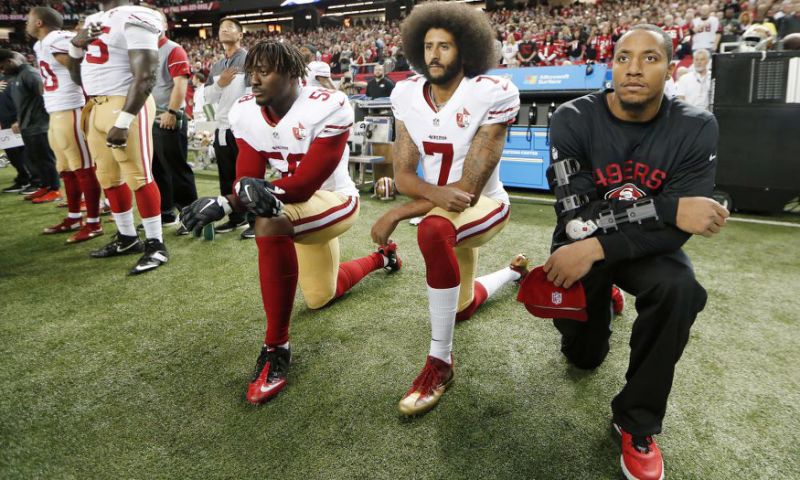
Back in June 2013, I wrote the following article on “Bread and Circuses in Rome and America.” It flashed through my mind this morning because of Robert Lipsyte’s post today at TomDispatch.com on Trump, the NFL, violence, race, brain injuries, and patriotism. I urge you to read it as well as Tom Engelhardt’s introduction, which cites the bread and circuses of the Roman Empire.
A key insight in my article below came from a correspondent, Amy Scanlon, who keenly observed that the Roman Imperium saw compassion, not violence, as a vice. The gladiatorial games were meant to keep Romans at a fever pitch for war (with the bloody, murderous games being the next best thing to war). It’s not much of a stretch to think of NFL violence as keeping Americans at a similar feverish pitch; and, not just the NFL, but the commercials during the games, which are often saturated with guns and violence and war.
The expression “bread and circuses“ captures a certain cynical political view that the masses can be kept happy with fast food (think Cartman’s “Cheesy Poofs” on South Park) and faster entertainment (NASCAR races, NFL games, and the like). In the Roman Empire, it was bread and chariot races and gladiatorial games that filled the belly and distracted the mind, allowing emperors to rule as they saw fit.
There’s truth to the view that people can be kept tractable as long as you fill their bellies and give them violent spectacles to fill their free time. Heck, Americans are meekly compliant even when their government invades their privacy and spies upon them. But there’s a deeper, more ominous, sense to bread and circuses that is rarely mentioned in American discourse. It was pointed out to me by Amy Scanlon.
In her words:
Basically ancient Rome was a society that completely revolved around war, and where compassion was considered a vice rather than a virtue… [The] Romans saw gladiatorial contests not as a form of decadence but as a cure for decadence. And decadence to the Romans had little to do with sexual behavior or lack of a decent work ethic, but a lack of military-style honor and soldierly virtues. To a Roman compassion was a detestable vice, which was considered both decadent and feminine. Watching people and animals slaughtered brutally [in the arena] was seen as a way to keep the civilian population from this ‘weakness’ because they didn’t see combat…
Scanlon then provocatively asks, “Could our society be sliding towards those Roman attitudes in a bizarre sort of way?”
I often think that America suffers from an empathy gap. We are simply not encouraged to put ourselves in the place of others. For example, how many Americans fancy the idea of a foreign power operating drones in our sovereign skies, launching missiles at gun-toting Americans suspected by this foreign power of being “militants“? Yet we operate drones in places like Afghanistan, Pakistan, and Yemen, killing suspected militants with total impunity. Even when innocent women and children are killed, our emperors and our media don’t encourage us to have compassion for them. We are basically told to think of them as collateral damage, regrettable, perhaps, but otherwise inconsequential.
Certainly, our military in the last two decades has put new stress on American troops as “warriors” and “warfighters,” a view more consistent with the hardened professionals of the Roman Empire than with the citizen-soldiers of the Roman Republic. Without thinking too much about it, we’ve come to see our troops as an imperial guard, ever active on the ramparts of our empire. War, meanwhile, is seen not as a last course of defense but as a first course to preempt the evil designs of the many hidden enemies of America. Our troops, therefore, are our protectors, our heroes, the defenders of America, even though that “defense” treats the entire globe as a potential killing field.
Scanlon’s view of the Roman use of bread and circuses — as a way to kill compassion to ensure the brutalization of Roman civilians and thus their compliance (or at least their complacency) vis-à-vis Imperial expansion and domestic policing — is powerful and sobering.
At the same time, the Obama administration is increasingly couching violent military intervention in humanitarian terms. Deploying troops and tipping wars in our favor is done in the name of defeating petty tyrants (e.g. Khadafy in Libya; Is Assad of Syria next?). Think of it as our latest expression of “compassion.”
All things considered, perhaps our new national motto should be: When in America, do as the Roman Empire would do. Eat to your fill of food and violence, cheer on the warfighters, and dismiss expressions of doubt or dismay about military interventions and drone killings as “feminine” and “weak.”
At least we can applaud ourselves that we no longer torture and kill animals in the arena like the Romans did. See how civilized we’ve become?