The Millionaires in Congress Don’t Care About Sending Your Son or Daughter to War

Please save us from flag lapel pins

W.J. Astore

Yes, I know it’s a harsh claim that Members of Congress don’t care about sending your son or daughter off to war. Partly that’s because more than half of them are millionaires. And if they’re not millionaires now, they will be when they leave office and cash in as lobbyists and similar Beltway bandit jobs.  After all, it’s hard to sympathize with working-class families with sons and daughters in the military when 1) You’re rich (or at least comfortably well-off); and 2) You have no sons or daughters in the military, and never will.

I wrote to one of my senators in PA, Bob Casey, about the need to end our wars in Afghanistan and elsewhere — about the need to bring our troops home rather than continuing to place them in harm’s way for no reason that’s in our national interest. When I wrote, I asked him if he would send any of his four daughters to Afghanistan, or even if he’d urge any of them to serve our country in any capacity in the military. I never heard back from him or his staff, not that I was surprised.

Senator Bob Casey is a Catholic who went to Holy Cross in Massachusetts in the early 1980s. I’m a Catholic who did my ROTC service at Holy Cross in the early 1980s. We may have even crossed paths on campus. But Bob Casey is from a well-connected political family. I’m the son of a firefighter and a homemaker who joined ROTC to help pay for college. Bob Casey and his daughters have never had to think about military service except in the most abstract terms. They might applaud it, but they won’t do it.

The same was true for Mitt Romney and his five sons. Eager to salute the military; not eager to join and serve. Fortunate sons (and daughters), all.

You could say the same for virtually all Members of Congress today.  Almost no military service.  Few sons or daughters in the military, and certainly none in the front lines in combat branches.  Certainly, they’ll praise our troops.  They’ll salute the flag with vigor.  But what they won’t do is to send their loved ones into harm’s way.

Each and every time our Congress or our President sends troops into harm’s way, they should think whether they’d risk their own.  For example, it’s conceivable that President Obama’s oldest daughter, Malia, could join the military in 2015 at the age of seventeen.  (You can join the military at seventeen with parental permission.)  After basic and advanced training, many American teenagers have been sent into combat only to die before they’re out of their teen years.

Can we imagine such a tragic fate befalling the son or daughter of any prominent politician in the United States?  Of course not.  The burden of military service has perhaps never been shared equally in our history, but its inequality has never been more slanted than it is now.  The rich and privileged exempt their offspring from service (or at least from dangerous service), which only emboldens them when they cast their votes for more war.  In doing so, they risk nothing near and dear to them.  Heck, they may even pose as being “tough” and “uncompromising.”

Save me the flag lapel pins of our millionaire politicians and all their posing.  Want to support our troops?  If you’re young enough, quit Congress and enlist in the military.  Or be sure to encourage your own sons and daughters to join and serve in harm’s way.  At least then you can say you’ve made a sacrifice commensurate with those made by so many working-class families across the USA.

Prediction for 2014: War Will Continue to Find A Way

“War is like love; it always finds a way.”  So wrote Bertolt Brecht, and when it comes to American politics and foreign policy in 2014, you can bet on Brecht being right.  There is no major anti-war party in the USA today.  Despite claims to fiscal austerity, Democrats and Republicans fall over themselves to fully fund the Pentagon and its ongoing wars across the globe.  Our misguided involvement in Afghanistan lurches into its thirteenth year with promises that it won’t end until 2024 at the earliest.  The only certainty for 2014 is more dead bodies, more casualties of war, more money wasted.

Barbara Tuchman, a historian who knew how to write for the educated public, was right in pointing out the persistence of folly in history.  A heavily militarized U.S. foreign policy is an illustration of that.  Our country continues to seek global dominance through militarized measures, perhaps because we’ve exported so much of our non-militarized economy to countries having cheaper labor. War and weapons are now are primary export.  That, and our desire for total information dominance that produced all of the abuses that Edward Snowden is revealing.

As we persist in war and weapons and surveillance, we’d do well to recall the words of John Bright, a British statesman who spoke about war and its dangers in the House of Commons in 1854. Here’s what Bright had to say:

“It is a painful and terrible thing to think how easy it is to stir up a nation to war … and you will find that wars are always supported by a class of arguments which, after the war is over, the people find were arguments they should not have listened to.”

When are we going to stop listening to arguments in favor of more wars and more weapons and more infringements of our rights, all justified in the name of “toughness” and “sanity” and “security”?

Sadly, not in 2014.

But if we’re truly looking to make meaningful resolutions for 2014, how about bringing our troops home?  How about building fewer weapons?  How about working to eliminate our nuclear arsenal? How about spying less and trusting more?

There are those that think that pursuing a less militant course is naive.  But what’s truly naive is the idea that constant warfare is consistent with any kind of enlightened democracy.

Let’s work together to ensure my prediction for 2014 is wrong.  Let’s find ways to stir up our nation to pursue peace.

John Bright
John Bright

Does Scrooge Reign in the USA Today?

Alastair Sim as Scrooge

W.J. Astore

My wife and I always watch “A Christmas Carol” around this time, the classic version with Alastair Sim as Ebenezer Scrooge.  Before his redemption, Scrooge is the ultimate miser, a mean-spirited soul who refuses to give to charity since he’s already paying taxes to support prisons and workhouses.  For his fellow man Scrooge has no concern, arguing that those who can’t support themselves had best die “to decrease the surplus population.”

By all accounts, including his own, Scrooge is a successful man of business, always keeping a positive balance on his ledger sheet, even if he has to pinch pennies to do so.  Generous he is not; you might say he passes nickels around as if they were manhole covers.

His partner Jacob Marley, dead for seven years, restores Scrooge’s humanity with the help of three spirits.  Perhaps Marley has the best line when he screams at Scrooge: “Business!  Mankind was my business!”  The Spirit of Christmas Present also has a powerful scene in which he reveals two slack-eyed and wretched children under his robe, “want” and “ignorance,” and tells Scrooge to be beware of both but especially of ignorance.

So, in this season of generosity of spirit, how are we doing in the USA?  Does the skinflint Scrooge rule, or does the redeemed one?  Well, just one factoid.  Unemployment benefits are due to run out for 1.3 million Americans on December 28th.  What are the options for those in want of a job?  Are there no prisons, no workhouses?  Perhaps they had best die to decrease the surplus population.

Extending unemployment benefits for another year would cost roughly $25 billion.  A penurious America can’t afford that, right?  But the USA can afford $633 billion for the new Pentagon budget and its “overseas contingency operations” (a great euphemism for war).  We’ll spend roughly as much money on these “contingency ops” ($81 billion) as we will on federal funding of education. So much for the Spirit of Christmas Present and his warning about the price of ignorance

Heck, we can even afford $355 billion over the next ten years to modernize America’s nuclear arsenal (this money is separate from the budget for the Pentagon). At the same time, more of the unemployed will see their benefits cut.  According to an article at Counterpunch, “Another 1.9 million who were projected to continue benefits in 2014 will also now lose them. Emergency benefits that up to now included extended benefits from 40-73 weeks, will now revert back to only 26 weeks. This occurs at a time when 4.1 million workers are considered long term unemployed, jobless for more than 26 weeks. Knocking millions off of benefits will likely result in 2014 in even more millions of workers leaving the labor force, which will technically also reduce the unemployment rate.”

That’s one way to reduce the official unemployment rate: Leave the unemployed so disillusioned with their plight that they give up looking for jobs.  When the “long-term” unemployed stop looking, the government stops counting them.  Did I hear someone bark “Humbug”?

The more our country follows the benighted Scrooge — the more ungenerous we are to the unemployed even as we ladle out benefits to the rich and powerful — the more we should fear a visit from that most horrifying ghost of all: The Spirit of Christmas Future.

“Doin’ Right Ain’t Got No End”

Bill McKinney as Captain Terrill in "The Outlaw Josey Wales"
Bill McKinney as Captain Terrill in “The Outlaw Josey Wales”

W.J. Astore

President Obama’s recent ten-year commitment to Afghanistan (until 2024 and beyond) put me to mind of a line from The Outlaw Josey Wales (1976), the classic Western starring Clint Eastwood.  Eastwood plays the “outlaw” who just wants to be left alone in the aftermath of a brutal civil war.  But another character, the vicious Captain Terrill, wants to pursue and kill all the Confederate irregulars who had fought against the Union.  In hot pursuit of Eastwood and a wounded confederate, Terrill rejects the idea that the killing will stop once the final two “outlaws” are dead.

“Doin’ right ain’t got no end,” Terrill coldly says.

That’s our government’s attitude in a nutshell: “Doin’ right ain’t got no end,” especially when the “right” involves killing outlaws.  No matter how many we kill, there’ll always be more to find. And in the brutally imprecise process of rooting them out and killing them, we’ll make many mistakes and harm many innocents, thereby creating many new enemies — and many more men like Captain Terrill.

Like Terrill, our government’s actions and attitudes have conspired to create a forever war, a score-settling exercise against outlaws that serves to perpetuate terror. We’re trapped in a cycle of violence that’s very much of our own making. We believe we inhabit an implacably hostile realm that supposedly hates us and our freedoms too, and by believing it, we make it so.

This neurotic state recalls a science fiction novel, Deathworld (1960), which I read as a teenager. Its author, Harry Harrison, imagined a world where the flora and fauna are relentlessly hostile to a certain band of can-do colonists, who reply in kind with Spartan-like warrior intensity and murderous brutality.

As impressive as these warriors and their death-dealing technology are, their actions merely beget more violence. Until an outsider visits and sees the situation for what it truly is, the colonists cannot perceive that it’s their own fear and violent natures which are driving their enemies to attack. Unless they change their implacably hostile mindset, their ultimate defeat is inevitable because their actions spawn new enemies and endless violence everywhere.

As the United States exercises its global power in the name of winning a war on terror, we are creating a death world of our own making. As long as we continue to believe we’re “doin’ right” in fighting an open-ended (and seemingly endless) war, Captain Terrill’s words will continue to render a harsh and endless judgment.

“Doin’ right ain’t got no end” – a tragic meme for a death world of our own making.

We Need an “All Quiet on the Afghan Front” (Updated)

The face of battle is ugly.  All the more reason why we need to face it
The face of battle is ugly. All the more reason why we need to face it

W.J. Astore

Beverly Gologorsky has an insightful article today at TomDispatch.com on the lack of references to America’s wars in U.S. contemporary fiction.  She traces this to social class: the fact that most troops come from the working classes, to which most contemporary fiction writers (and doubtless editors and agents and publishers as well) have limited exposure.

Doubtless she’s right about this.  The “all volunteer” military draws recruits mainly from rural, working class, hardscrabble areas.  The literati, the urban hipsters, tend to see this as “fly over” country: a cultural wasteland best to be avoided.  You won’t catch too many of them hanging around military posts in the Deep South.  And you certainly won’t catch them at a FOB (forward operating base) in Afghanistan eating MREs and dodging IEDs.

In other words, it’s not class differences alone that account for America’s dearth of fictional accounts that draw on America’s wars (whether in Iraq or Afghanistan or elsewhere).  My sense is that most fiction writers nowadays simply know very little about war.  When they do try to write about it, they get important details wrong.  It’s also difficult in literary circles to defend writing about the military in a fair-minded and sympathetic way.  Within such circles, books with war-related themes are déclassé or otherwise suspect.  Far easier (and trendier) to write about gender/LGBTQ issues, or “Tiger Moms,” or relationships involving conflicted metro-sexuals … and probably far more remunerative as well.

When they do choose to write about war, thinking liberals have to defend themselves.  I have a friend, a civilian academic who writes prolifically about war, who has had to defend his choice of subject among his historian peers in academe.  It was very difficult for me, a retired military officer, to get any job in civilian academe (despite advanced degrees from Oxford and Johns Hopkins). Civilian academe wants very little to do with war and the military (except for accepting billions in federal funding for weapons research, of course).

Let’s face it: Among the literati, war and the military are suspect.  Good liberals don’t write about such things, except in the dismissive sense of condemning them.

So yes, class enters into it, but ideology does as well, a cultural smugness that previous generations of writers didn’t have because they in fact did serve in the military (Herman Wouk, Norman Mailer, Kurt Vonnegut, Howard Zinn, and so many others).  They had lived war and could in fact write honestly about it in an informed and critical way.

And that’s precisely what’s missing in American fiction: boldly critical, and powerfully heartfelt, writing about America’s wars today.  So far, there is no “All Quiet on the Afghan Front” to mobilize Americans against the horrors and waste of war.  I doubt we’ll ever see such a book.  And the lack of such books serves only to perpetuate our wars.

And that’s a tragedy.  We need honest accountings of war and its devastating effects, an honesty often paradoxically caught best by fiction.  Perhaps Gologorsky’s latest novel, Stop Here, will help.  She certainly deserves a salute for raising a vitally important issue.

Update (12/11): Two novels about the Iraq War and its impact on Americans came out in 2012.  I haven’t read them yet but have heard they are good: Billy Lynn’s Long Halftime Walk, by Ben Fountain; and The Yellow Birds, by Kevin Powers.

A friend made the following great comment: “a good number of front-line memoirs/narratives by US soldiers as opposed to embedded journalists [have come out of Iraq and Afghanistan]–the thing is their tone differs sharply as a rule from the world war and Vietnam predecessors. It’s more “professional/experiential” than heroic/victim like Erich Maria Remarque or Henri Barbusee.”

I made the following reply to this comment:

Many of today’s war memoirs are more “there I was” stories — the military as part job, part adventure.  Which is probably class-based as well.  Soldiers drawn from the working classes are perhaps more prone to see the military as a skilled trade.  They want to show they’ve mastered the trade.  And they tell war stories like guys at work tell profession-based tales as well as colorful stories of hunting trips and the like.

When we relied on a draft (or when the Oxbridge set volunteered to defend king and country in WW1): Some of these men saw military service as something more exalted.  Less of a job and more of a noble deed.  And when they discovered how sordid war could be (and usually is), their disenchantment was more profound than that of the working classes, who thought of war from the git-go as another dirty job to endure.

This is painting with a very broad brush, but I think there’s some truth here.  We’re seeing fewer critical reflections on America’s wars from the troops because today’s troops lack the education/naivete of their social “betters.”  And the social “betters”: they know little about war and care even less.

Update (12/12): Another point stimulated by a reader’s comment: There was a general revulsion to war in the wake of WW1 (in Europe) and Vietnam (in the USA).  That helped to open the door for honest books about war written by veterans.  Most Americans today have no revulsion for war, partly because it’s not on their radar, and partly because everything they are shown in the media is positive or “balanced.”  Negative coverage of war is dismissed as unsupportive to “our troops.”

Put differently, Americans are in denial about the costs of war and empire.  Or we dismiss those costs as “necessary” for our defense.  Some of my students truly believe that, in the words of George W. Bush, we have to fight “them” over there else we’ll have to fight them here in the USA.

There’s very little sense of the true asymmetry of America’s wars today: the fact that we can strike with relative impunity anywhere in the world.  Media coverage portrays America as a fortress under siege rather than as an expansionist and interventionist empire.  Such coverage occludes the true face of war, especially its profitable side (consider US domination of the world’s arms trade, for example).

Update (12/23): I’ve finished “Billy Lynn’s Long Halftime Walk” and it was excellent.  It’s particularly strong on why men join the military (often the best of a series of not-so-good options) and why they fight and continue to risk their lives (unit camaraderie, codes of manliness and honor, sense of duty).  And it’s especially critical of the “fortunate sons” who never have to serve, especially those who are also willing to exploit the troops for their own aggrandizement and sense of well-being.  It’s not as brilliant as “Catch-22,” but it’s more accessible and it makes its points with verve and humor.  Its take-down of American football, especially the excessive patriotic pomp and sexual titillation of halftime shows, is especially fine.

Our Pro-War Media

Cheerleaders may support our troops, but media cheerleaders are bad at covering our wars

W.J. Astore

Five years ago, I wrote an article for Nieman Watchdog with the title, “Networks Should Replace Pentagon Cheerleaders with Independent Military Analysts.”  Major media networks rely on retired colonels, generals, and admirals to give “unbiased” and “disinterested” commentary on military matters to the wider public.  At the same time, many of these same retired military talking heads serve on boards for major defense contractors, a clear conflict of interest, as revealed most tellingly by David Barstow.  I argued that media outlets need to develop their own, independent, commentators, ones that are not embedded with (or in bed with) the military and companies that profit from war.

In five years, I’ve witnessed no change to military coverage on TV and cable news.  It’s wave-the-flag boosterism, pure and simple.  The main problem with such uncritical coverage is that it keeps us in untenable (and unwinnable) wars.  Consider the latest announcement from Afghanistan that American troops will remain in that country for another decade.  Such an announcement is greeted with collective yawns by the U.S. media, even though a majority of Americans want U.S. troops out of Afghanistan now.  After a dozen years of death and waste and corruption, who can blame them?

Critical documentaries have been made about the U.S. military and its wars, but they are consigned largely to leftist fringes and seen by audiences that need little convincing about the peril of war.  To name just three, consider watching The Ground Truth (veterans’ perspectives from Iraq), Dirty Wars (based on the Jeremy Scahill book by the same title), and Unmanned: America’s Drone Wars (currently streaming for free online).  These documentaries give the lie to the idea that America’s wars are heroic and clean and necessary.

Nevertheless, a pervasive myth is the belief that the U.S. media is “liberal” and “anti-military.”  In “Stop Blaming the Press,” journalist David Danelo (in the U.S. Naval Institute’s Proceedings from January 2008) recalled a comment made by the Commandant of the Marine Corps, General James Conway, in September 2006.  Lauding Marine reporters, General Conway barked, “Maybe if we could get the rest of the media to do the job like you folks, we might have a chance of winning the war [in Iraq].”  Stormy applause greeted this comment.

To his credit, Danelo defended the fairness of most U.S. media coverage, which drew strong dissents in the February 2008 issue of Proceedings.  A Navy officer complained that Danelo failed “to level criticism at reporters for not doing their part to ensure victory.”  Today’s press, this officer implied, neither supported American troops nor wanted America to succeed in its wars.  Another officer, a retired Marine, wrote that “just one negative story” from an American journalist “bolsters our enemies’ confidence and resolve while equally destroying support from the public at home, thus eroding our servicemen’s and women’s resolve on the battlefield.”  Refusing to suffer such journalistic “fools,” whose “stories could not have been more harmful than if al Qaeda had written them,” this officer demanded immediate military censorship of media working in-theater.  Those journalists who refused to cooperate “would operate at their own risk and without military protection,” this retired Marine concluded ominously.

The idea that critical media coverage provides aid and comfort to the enemy is a commonplace.  It serves to muzzle U.S. media watchdogs, ensuring that America will continue to unleash its dogs of wars across the world.

Sadly, the saying “The first casualty in war is truth” has never been more true.  When our media coverage of wars is compromised, so too are our wars.  And when our wars are fought for ill-conceived notions, so too will our media coverage be ill-conceived and notional.

As long as our nation keeps lying to itself in its wave-the-flag media coverage of war, our nation’s wars will persist.

War Is Becoming Obsolete — In 1884

At least coins were more attractive in 1884 (Morgan silver dollar)

W.J. Astore

One of the occupational hazards of being a historian is reading old books.  The one in front of me is John Fiske’s The Destiny of Man (1884).  Fiske was an American philosopher and popular writer on Darwinism, Spencerism, and many other representative isms of his day.  Like many thinkers of the late 19th century, he believed in inevitable progress as well as the inherent superiority of men like himself.

From the vantage point of 2013, what is perhaps most striking about Fiske was his optimism that war was coming to an end.  In his words:

The nineteenth century, which has witnessed an unprecedented development of industrial civilization, with its attendant arts and sciences, has also witnessed an unprecedented diminution of the primeval spirit of militancy.  It is not that we have got rid of great wars, but that the relative proportion of human strength which has been employed in warfare has been remarkably less than in any previous age … In almost every case [of war since the Revolutionary War and Napoleon] the result has been to strengthen the pacific tendencies of modern society …[War] has now become narrowly confined in time and space, it no longer comes home to everybody’s door, and, in so far as it is still tolerated…it has become quite ancillary to the paramount needs of industrial civilization …the final extinction of warfare is only a question of time.

War was coming to an end, to be replaced by the reign of law, Fiske predicted in 1884.  Thirty years later, the horrors of World War I came to visit (in one way or another) almost everyone’s door, with World War II proving an even more persistent caller.  Today, the United States finds itself in a self-defined, and apparently endless, “war on terror.”  What happened to Fiske’s pacific progress?

We all have blind spots.  For Fiske one of those was the European imperialism of his day, which he didn’t treat as war since inferior brutes needed civilizing by Whites.  Another was his belief in inevitable progress and the perfectibility of man, as shown by “the pacific principle of federalism” and the “due process of law,” which he believed would settle future disputes without war.

Rather than bashing Fiske, it’s perhaps more useful to ask what our blind spots might be.  American exceptionalism is certainly one.  Just as Fiske believed that the White man was inherently superior – the culmination and fruition of evolution and civilization – many Americans seem to believe that the United States is the best nation in the world, the most technologically advanced, the most favored by God.  This belief that “When America does it, it’s OK; when another country does it, it’s wrong” is one that’s opened many a Pandora’s Box.  A second blind spot is our belief that more and better technology will solve the most intractable problems.  Consider global warming.  It’s most definitely happening, driven in part by unbridled consumption of goods and fossil fuels.  Our solution?  Deny the problem exists, or avoid responsibility even as our country goes whole hog into boosting production of new (and dirtier) sources of fossil fuels via hydraulic fracturing (fracking).

Like Fiske, Americans by nature believe in their own exceptionalism.  Like Fiske, Americans by nature are generally optimistic.  But Fiske dismissed the horrors of imperialism even as he missed the looming disaster of mass industrialized killing in two world wars.

What are we dismissing?  What are we missing?  I’ve suggested we’re dismissing the blowback produced by our own exceptionalism even as we’re missing the peril we pose to the health of our planet.  I encourage you to add your thoughts below.

Too Many Troops Have Died in the Name of Big Boy Pants

Too many troops have died in the name of big boy pants

W.J. Astore

Jeremy Scahill is a reporter for whom the word “intrepid” may have been invented. He’s been remarkably bold in covering the creation of private mercenary forces in the United States (as documented in his bestseller, Blackwater) as well as America’s “turn to the dark side” after 9/11/2001, which led to “wars of choice” in Iraq and Afghanistan, together with interventions in Somalia, Yemen, and across the world in the name of combating terrorism. Indeed, the subtitle of Scahill’s new book is “The World Is A Battlefield.” And since there’s always a terrorist organization at large somewhere in the world, we are ensured of a forever war, a grim prospect on this Veterans Day.

I’ve written an extended review of Scahill’s Dirty Wars at Michigan War Studies Review, edited by the incomparable Jim Holoka.  An aspect of this review I’d like to focus on is the use of macho language by Bush Administration operatives soon after 9/11.  A strength of Scahill’s account is his ear for the tough talk of civilians within the administration, most of whom had no military experience.

In the days and weeks following 9/11, L. Paul Bremer, later to become the head of the Coalition Provisional Authority in Iraq, wrote of the Clinton’s Administration’s “limp-wristed” approach to terrorism.  Cofer Black, Bush’s head of counter-terrorism, talked of “taking the gloves off” as well as of “unleashing the junkyard dog” of CIA and special operations forces against terrorist networks.  Perhaps the most telling attempt at tough-talk came from the lips of Jose Rodriguez, Director of Operations at the CIA, who said it was time for “everybody in the government to put their big boy pants on and provide the authorities what we [the CIA] needed [to take action].” [Emphasis added.]

The worst fear of these men seems to have been of appearing weak. They didn’t want to be caught wearing little boy pants; they didn’t want to fight with gloves on; and they certainly didn’t want to appear to be limp-wristed. No — these were REAL men. They wanted to put on big boy pants; they were ready for bare-knuckle brawls; no limp-wristed wimps need apply.

Here Scahill quotes Malcolm Nance, a career counterterrorist expert for the U.S. Navy, as describing Cofer Black and his fellow tough-guys as “civilian ideologues” who embraced “Tom Clancy Combat Concepts” that consisted of “going hard, … popping people on the streets, … dagger and intrigue all the time.”  Tom Clancy might make for decent Hollywood action movies, but it’s never a good idea to confuse fantasy with reality.

There’s much more to Scahill’s book (and the documentary that accompanies it, also named “Dirty Wars”) than this, and I urge you to read it.  Its major theme is the abuse of power by the U.S. government and the erosion of Constitutional safeguards and freedoms, all justified in the name of “keeping us safe.”  But one of its minor themes is the macho posturing of men with little or no experience in the military who were all too willing to order others to fight in their name.

Yes, they all put on the “big boy pants” — figuratively speaking. They sat in offices and ordered young troops into battle.  And I’m sure they signed those orders with bare knuckles and firm wrists.  In so doing they risked nothing and gained, at least in their own minds, a reputation for toughness.

Far too often in the history of war have old men believed that, by sending others off to fight and die, they were putting on the big boy pants. The costs of such macho posturing have been, and continue to be, far too high.

The United States: Empire or Umpire?

Is this really the role of the United States in the world?

Daniel N. White.  Introduction by W.J. Astore.

Is the United States an empire or umpire?  This is the intriguing question raised and interrogated in the latest probing article by Dan White.  Since I’m a baseball fan as well as a student of the U.S. military, let me take a swing at an answer.  An umpire is supposed to be a neutral observer and arbiter.  He is disinterested and dispassionate.  By definition, an umpire can’t be a player, and certainly not a main player, a “star.”  Umpires are supposed to fade into the background, plying a demanding profession without pursuing private agendas or personal glory.

Does that sound anything like the role the United States plays in the world?  But I’ll let Dan White take it from here.  W.J. Astore

Yes, We’re An Empire: Just Look At How We Treat the Natives

Daniel N. White

Recently I attended a guest lecture/seminar at the University of Texas at Austin, hosted by Jeremi Suri, a rising star of UT’s History department.  The topic was “The US—Empire or Umpire?”  Suri, a personable sort, brought in another mainstream historian, Elizabeth Cobbs Hoffman, to promote her latest tome which argues that the US is not in fact an empire but instead acts abroad as an umpire.

There are some lawyerly arguments that suggest that because the US does not enslave the rest of the world for its own financial benefit—this is fundamentally the argument made by Suri and Hoffman—the US isn’t an empire.  Cobbs Hoffman was proud that in her recent US history classes a majority of the students came in thinking that the US was an empire but left, after a semester of her ministrations, thinking otherwise.

How swell.  Lawyerly arguments are for lawyers in courtrooms attempting to convince other lawyers who all think along the same narrow lines.  Most lawyerly arguments aren’t but petty quibbles about word definitions.  For the rest of us, we are wise to heed instead the evidence of our senses and the stirrings of our hearts.

The most fundamental evidence of America as an empire is the wars we wage abroad.  Countries that have done us no injury have the “privilege” of the US waging a war in their land with their inhabitants having no say in the matter.  The most telling giveaway to the question of empire is our regard for the inhabitants in those countries who fight on our behalf.  Fundamentally, we have none.  They are our tools, nothing more.

During the Vietnam War, the weekly casualty lists routinely had South Vietnamese military (ARVN) killed and wounded exceeding ours.  Only two weeks in the entire war did American casualties exceed ARVN’s—the two weeks following the Tet Offensive.  South Vietnam, whose population may have been 14 million during the war, paid a terrible butcher’s bill for its leaders assenting to and participating in an American war in their country.

Yet how much reportage was there ever in the US press about the South Vietnamese army and its casualties?  ARVN troops were in it for the duration, unlike US troops, and they and their sacrifices were ignored almost entirely by the US press, people, and government.  Once a week, Walter Cronkite would recite ARVN casualty figures, when the US Military Assistance Command in Vietnam (MACV) released that week’s figures.  But that was all the attention the US press ever gave them.

That same neglect of the natives the US claims to be “liberating” has been repeated in our recent wars in the Middle East and Central Asia.  Where are the articles about the Afghan Army and its casualties in the US media?  The Iraqi Army and its casualties?  We corral the inhabitants in those countries into our schemes for our uses and have paid them—their lives, their hurts, their deaths—no attention, just as we paid ARVN no attention during the Vietnam War.

If we’re not an empire to behave like this, then we are surely the cruelest and most heartless race of people wandering the globe.

What follows is an illustration of the gruesome results of our imperial wars—the kind of illustration that never made our news reports.  Richard Critchfield was a war reporter in Vietnam, after which he wrote several superlative books about rural life, both in the US and in the Third World.  In 1965 Critchfield encountered a young Vietnamese draftee at Cong Hoa, ARVN’s largest military hospital.  The wounded draftee had just arrived after a 50-mile ambulance ride:

From Villages, by Richard Critchfield, pp 62-3:

After he (the ARVN doctor, a civilian drafted into ARVN six years earlier) read the student’s chart, the doctor’s manner softened.  He patted the boy gently on the shoulder and lifted up the cotton sheet from the foot of the stretcher.

‘Foot blown off with a mine,’ he told me in English.  He spoke to the boy again in their own language, then turned back.  ‘After treatment here, the boy will go back to his unit in My Tho to wait for the local military council to meet.  The council will decide whether he can go home or not, of whether he must stay in the army to do some light job.  He wants to go home.  He should go home.  When the wound has healed, we will send him to the rehabilitation department for an artificial limb.  He says his wife came south with him.  She rents a house outside the camp.  They have a two-month old son.  It must be a very small house.’  He said that as a private with one son, the boy got the equivalent of eighteen dollars a month; totally disabled, he would get thirty-five dollars a year.  The doctor thought there were at least fifty thousand partially disabled veterans in the country already; perhaps it was a blessing he did not know the war would last another ten years.

The doctor spoke to the boy again.  ‘He says he is an infantry rifleman and that he has never killed anybody.’  A wounded sergeant in a nearby stretcher muttered, ‘Who knows where the bullets go?’  The doctor lifted up the bandages from the boy’s forehead; the right eye was shut and swollen.  Unclipping an X-ray from the foot of the stretcher and holding it up to the light the doctor motioned me over.  The black film showed the boy’s skull; in the black socket of his right eye was a jagged rectangular shape a quarter inch long.  ‘Steel fragment.  That eye will have to come out.’  An orderly called the doctor and he went away.

I saw that the boy was moving; painfully, and with great effort, he reached down, groped for the X-ray on his legs where the doctor had left it, clutched it and held it up to the light.  We didn’t dare stop him.  There was no outcry, just thought—the deep private thought of someone faced with the final, tragic collapse of so much of his life.  After a moment he lowered the X-ray carefully back to where it had been, put his head down, and stared upward.

I told my interpreter to ask if there was anything we could do.  At first the boy did not seem to hear.  We waited.  Then he spoke and said, yes, he wanted to send telegrams to his wife and his mother, who did not know what had happened to him nor where he was.  The words started pouring out then; my interpreter could only catch part of it.  ‘The war must end….so there is no more killing…so I can go home…I want to go home…I want…my brothers*…’  He was crying hard now and the tears streamed down from his good eye.  In shame he tried to dab at them with his pajama sleeve.  I thrust some piaster notes into my interpreter’s hand to give to the boy and went outside to stare hard at the hedges shaped like rabbits and elephants.

Critchfield elsewhere tells another revealing story of Americans abroad at war, again from his Vietnam War days.  From p. 183 of Villages:

“Tran Van Huong, when prime minister of Vietnam in the 1960s, once told me no American had ever asked him, ‘What do you need and how can we help you?’”

In all my years of reading about the Vietnam War, I can’t recall any other American reporter ever asking any Vietnamese that same question of Critchfield’s.   I rather doubt that any American military officer, USAID worker, or diplomat ever asked that question at any time during the war.  Maybe some NCOs in the Army did.  Maybe.

And I can’t recall any US reporter with snap and wit enough to ever ask any Afghan or Iraqi official that same question: What do you need and how can we help you?   If they had they most certainly would have received the same answer as PM Huong gave Critchfield in 1965.

Once again, Americans ignore that our butcher’s bill in both these wars is a fraction of our much less populous allies’.  Except that this time there is never any word of Afghan or Iraqi military casualties in US war reports in our media.  Our total lack of interest in “the natives” is worse now in our globalized today than it was in our provincial yesterday.

Fifty years after Vietnam the US is still treating our “allies” as third-world primitives.  US reporters, politicians, academics, and moral leaders are just as blind to it this time around as they were then.  They are content with childish slogans and arguments about our inherent goodness.  Nguyen Cao Ky was right when he said that Americans are like big children.  We have a child’s self-centered view of ourselves, a child’s disregard for actions and their consequences to others, and we embrace childish rationalizations and arguments.

Our wars abroad are all about us and our plans and wishes.  They aren’t at all for the benefit of the host country and its peoples.  That makes us either an empire or a bunch of criminal lunatics.

What it most certainly doesn’t make us is an umpire.

*The young ARVN trooper had been a student from a coastal village, youngest of three brothers.   Both of his brothers had already been drafted into the ARVN and killed before he was drafted.  Unlike the US draft, there were no sole surviving son deferrals for the ARVN draft.

Daniel N. White has lived in Austin, Texas, for a lot longer than he originally planned to.  He reads a lot more than we are supposed to, particularly about topics that we really aren’t supposed to worry about.  He works blue-collar for a living–you can be honest doing that–but is somewhat fed up with it right now.  He will gladly respond to all comments that aren’t too insulting or dumb.  He can be reached at Louis_14_le_roi_soleil@hotmail.com.

Ann Jones on the Horrendous Costs of War to Our Veterans

wallatnight1
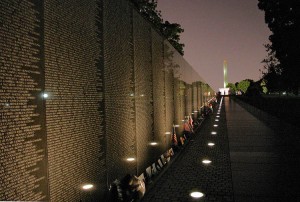
Veterans Day has become a day of sales and promotions instead of a time of reflection about the costs of war and the sacrifices of our troops.  The great virtue of Ann Jones’s new book, They Were Soldiers: How the Wounded Return from America’s Wars — The Untold Story is that it truly makes us confront the painful realities of war, which is (or should be) a large part of what Veterans Day is all about.

You don’t thank a veteran because he or she dons a uniform and salutes smartly.  You thank a veteran because he or she volunteered (or was drafted in past days) for a life of sacrifice.  In the military, one’s freedoms are abridged in the name of defending freedom, a paradox that is justifiable when the cause is just.  But even when the cause is just, the sacrifices our troops make and the wounds they bear are often as horrendous to them as they are hidden from the rest of us.

That’s the virtue of Ann Jones’s new book.  She makes us reckon with the true costs of America’s “long war” on terror, a reckoning that’s much needed in Veterans Day ceremonies that often involve far too much vapid consumerism and not enough honest reflection. W.J. Astore

They Didn’t Know What They Were Getting Into: The Cost of War American-Style 
By Ann Jones

(Used by permission of TomDispatch.com)

The last time I saw American soldiers in Afghanistan, they were silent. Knocked out by gunfire and explosions that left them grievously injured, as well as drugs administered by medics in the field, they were carried from medevac helicopters into a base hospital to be plugged into machines that would measure how much life they had left to save. They were bloody.  They were missing pieces of themselves. They were quiet.

It’s that silence I remember from the time I spent in trauma hospitals among the wounded and the dying and the dead. It was almost as if they had fled their own bodies, abandoning that bloodied flesh upon the gurneys to surgeons ready to have a go at salvation. Later, sometimes much later, they might return to inhabit whatever the doctors had managed to salvage.  They might take up those bodies or what was left of them and make them walk again, or run, or even ski.  They might dress themselves, get a job, or conceive a child. But what I remember is the first days when they were swept up and dropped into the hospital so deathly still.

They were so unlike themselves. Or rather, unlike the American soldiers I had first seen in that country. Then, fired up by 9/11, they moved with the aggressive confidence of men high on their macho training and their own advance publicity.

I remember the very first American soldiers I saw in Afghanistan.  It must have been in 2002.  In those days, very few American troops were on the ground in that country — most were being readied for Iraq to fulfill the vainglorious dreams of George W. Bush and Co. — and they were not stationed in Kabul, the Afghan capital, but in the countryside, still supposedly searching for Osama bin Laden.

I was in the north, at the historic Dasht-i Shadian stadium near the city of Mazar-i-Sharif, watching an afternoon of buzkashi, the traditional Afghan sport in which mounted men, mostly farmers, vie for possession of a dead calf.  The stadium was famous not only for the most fiercely contested buzkashi games in the country, but also for a day during the Soviet occupation of Afghanistan when local people invited 50 Soviet soldiers to enjoy the spectacle at Dasht-i Shadian and slaughtered them on the spot.

I was seated with Afghan friends in the bleachers when a squad of Americans in full battle gear barged into the dignitaries’ box and interrupted play. Some of them insisted on riding the horses.  At a sign from the local warlord presiding over the games, Afghan riders helped the Americans mount.  They may also have cued their horses to bolt, race away, and dump them in the dirt.

A little stiffly, the soldiers hiked back to the grandstand, took up their rifles, and made a great show of laughing off the incident — of being loud and boisterous “good sports.” But a large audience of poker-faced Afghan men had taken their measure.  A friend said something to me that I never forgot in years after as I watched the “progress” of the war unfold: “They didn’t know what they were getting into.”

The next day, I spotted another squad of American soldiers in the city’s central bazaar.  In the midst of busy shops, they had fanned out in full battle gear in front of a well-known carpet store, dropped to one knee, and assumed the firing position. They aimed their assault rifles at women shoppers clad in the white burqas of Mazar and frozen in place like frightened ghosts.  The Americans were protecting their lieutenant who was inside the store, shopping for a souvenir of his sojourn in this foreign land.

I can’t say exactly when the U.S. military brought that swagger to Kabul. But by 2004 the Americans were there behind the walls of fortified urban bases, behind concrete barriers and gigantic sandbags at armed checkpoints, blocking traffic, and closing thoroughfares. Their convoys were racing at top speed through city streets with machine-gunners on alert in the turrets of their armored vehicles.  Women half-blind under their burqas brought their children to guide them across suddenly dangerous streets.

Enter the Warriors

I had come to Afghanistan to work for those women and children.  In 2002, I started spending winters there, traveling the country but settling in Kabul. Schools long closed by the Taliban were reopening, and I volunteered to help English teachers revive memories of the language they had studied and taught in those schools before the wars swept so much away. I also worked with Afghan women and other internationals — few in number then — to start up organizations and services for women and girls brutalized by war and stunned by long confinement to their homes.  They were emerging silently, like sleepwalkers, to find life as they had once known it long gone. Most of Kabul was gone too, a landscape of rubble left from years of civil war followed by Taliban neglect and then American bombs.

After the Taliban fled those bombs, the first soldiers to patrol the ruined streets of Kabul were members of ISAF, the International Security Assistance Force established by the U.N. to safeguard the capital.  Turks, Spaniards, Brits, and others strolled around downtown, wearing berets or caps — no helmets or armor — and walked into shops like casual tourists.  They parked their military vehicles and let kids climb all over them. Afghans seemed to welcome the ISAF soldiers as an inconspicuous but friendly and reassuring presence.

Then they were supplanted by the aggressive Americans. The teachers in my English classes began to ask for help in writing letters to the U.S. military to claim compensation for friends or neighbors whose children had been run over by speeding soldiers.  A teacher asked, “Why do Americans act in this way?”  I had, at the time, no answer for her.

In my work, I found myself embroiled ever more often with those soldiers as I tried to get compensation, if not justice, for Afghans.  As a reporter, I also occasionally felt duty-bound to attend press briefings concocted by Washington’s militarized theorists of a future American-dominated world of global free markets, spreading democracy, and perfect security in the oddly rebranded “homeland.”

The Pentagon prepared PowerPoint presentations cluttered with charts and arrows indicating how everything was ultimately connected to everything else in an insulated circularity of hokum.  Subordinates based in Kabul delivered those talks to American journalists who dutifully took notes and submitted soon-familiar stories about new strategies and tactics, each guaranteed to bring success to Washington’s Afghan War, even as commanding generals came and went year after year.

To American officials back in that homeland, war was clearly a theoretical construct, and victory a matter of dreaming up those winning new strategies, or choosing some from past wars — Iraq, for example, or Vietnam — and then sending in the brash kids I would see in that stadium near Mazar-i-Sharif to carry them out. War was, in short, a business plan encoded in visual graphics.  To Afghans, whose land had already served as the playing field for more than 20 years of Washington’s devastating modern wars, it wasn’t like that at all.

Frankly, I didn’t like the U.S. soldiers I met in those years.  Unlike the ISAF troops, who appeared to be real people in uniforms, the Americans acted like PowerPoint Soldiers (with a capital S), or, as they preferred to be called, Warriors (with a capital W).  What they seldom acted like was real people.  For one thing, they seemed to have been trained to invade the space of any hapless civilian.  They snapped to attention in your face and spat out sentences that splashed your flesh, something they hadn’t learned from their mothers.

In time, though, their canned — and fearful — aggressiveness stirred my sympathy and my curiosity to know something about who they really were, or had been.  So much so that in the summer of 2010, I borrowed body armor from a friend and applied to embed with U.S. soldiers.  At the time, General Stanley McChrystal was massing troops (and journalists) in the Taliban heartland of Helmand Province in southwestern Afghanistan for a well-advertised “decisive” showdown with the insurgency.  I, on the other hand, was permitted to go to a forward operating base in northeast Afghanistan on the Pakistani border where, it was said, nothing was going on.  In fact, American soldiers were “falling” there at a rate that took their commanders by surprise and troubled them.

By the time I arrived, those commanders had become secretive, cloistering themselves behind closed doors — no more PowerPoint presentations offering the press (me) straight-faced assessments of “progress.”

For TomDispatch, I wrote a piece about that base and included one fact that brought me a deluge of outraged email from wives and girlfriends of the Warriors.  It wasn’t my description of the deaths of soldiers that upset them, but my noting that the most common disabling injury on that base was a sprained ankle — the result of jogging in the rocky high-desert terrain. How dare I say such a thing, the women demanded.  It demeaned our nation’s great Warriors. It was an insult to all patriotic Americans.

I learned a lesson from that.  America’s soldiers, when deployed, may no longer be “real people” even to their loved ones.  To girlfriends and wives, left alone at home with bills to pay and kids to raise, they evidently had to be mythic Warriors of historic importance saving the nation even at the sacrifice of their own lives.  Otherwise, what was the point?

Where Have All the Soldiers Gone?

And that may be the point: that there wasn’t one, not to this war of choice and revenge, or the one in Iraq either.  There were only kids in uniform, most of whom by that time knew that they hadn’t known what they were getting into, and now were struggling to keep their illusions and themselves alive.  They walked the streets of the base, two by two, battle buddies heading for the DFAC (mess hall), the laundry, the latrine, the gym. They hung out on the Internet and the international phones, in the war and out of it at the same time, until orders came down from somewhere: Washington, Kabul, Bagram, or the map-lined room behind the closed door of the base commander’s office.  As a result, every day while I was on that base, patrols were ordered to drive or walk out into the surrounding mountains where Taliban flags flew. Very often they returned with men missing.

What had happened to those boys who had been there at breakfast in the DFAC? Dead or torn up by a sniper or a roadside bomb, they had been whisked off by helicopters and then… what?

They lodged in my memory.  Unable to forget them, almost a year later, when I was officially not a nosy journalist but a research fellow at a leading university, I again applied for permission to embed in the military.  This time, I asked to follow casualties from that high desert “battle space” to the trauma hospital at Bagram Air Base, onto a C-17 with the medical teams that accompanied the wounded soldiers to Landstuhl Regional Medical Center in Germany — the biggest American hospital outside the United States — then back onto a C-17 to Walter Reed Army Medical Center in Washington, and in some cases, all the way home.

Over the years, more and more of America’s kids made that medevac journey back to the States. Costsofwar.com has tallied 106,000 Americans wounded in Iraq and Afghanistan or evacuated from those war zones because of accident or disease.  Because so many so-called “invisible wounds” are not diagnosed until after soldiers return home, the true number of wounded must be much higher. Witness the fact that, as of June 2012, 247,000 veterans of Afghanistan and Iraq had been diagnosed by the VA with post-traumatic stress disorder, and as of May 31, 2012, more than 745,000 veterans of those wars had filed disability claims with the Veterans Administration (VA).  Taxpayers have already spent $135 billion on medical and disability payments for the veterans of Afghanistan and Iraq, and the long-term medical and disability costs are expected to peak at about midcentury, at an estimated $754 billion.

Then there were the “fallen,” the dead, shipped to Dover Air Base in metal “transfer cases” aboard standard cargo planes. They were transferred to the official military mortuary in ceremonies from which the media, and thus the public, were until 2009 excluded — at least 6,656 of them from Iraq and Afghanistan by February of this year. At least 3,000 private contractors have also been killed in both wars. Add to this list the toll of post-deployment suicides, and soldiers or veterans hooked on addictive opioids pushed by Big Pharma and prescribed by military doctors or VA psychiatrists either to keep them on the job or, after they break down, to “cure” them of their war experiences.

The first veterans of the wars in Afghanistan and Iraq returned to the United States 10 years ago in 2003, yet I’ve never spoken to a damaged soldier or a soldier’s family members who thought the care he or she received from the Veterans Administration was anything like appropriate or enough.  By the VA’s own admission, the time it takes to reach a decision on a veteran’s benefits, or simply to offer an appointment, is so long that some vets die while waiting.

So it is that, since their return, untold numbers of soldiers have been looked after by their parents.  I visited a home on the Great Plains where a veteran has lain in his childhood bed, in his mother’s care, for most of the last decade, and another home in New England where a veteran spent the last evening before he took his own life sitting on his father’s lap.

As I followed the sad trail of damaged veterans to write my new book, They Were Soldiers: How the Wounded Return From America’s Wars — the Untold Story, I came to see how much they and their families have suffered, like Afghans, from the delusions of this nation’s leaders — many running counter to international law — and of other influential Americans, in and out of the military, more powerful and less accountable than themselves.

Like the soldiers, the country has changed.  Muted now is the braggadocio of the bring-‘em-on decider who started the preemptive process that ate the children of the poor and patriotic.  Now, in Afghanistan as in Iraq, Washington scrambles to make the exit look less like a defeat — or worse, pointless waste.  Most Americans no longer ask what the wars were for.

“Follow the money,” a furious Army officer, near the end of his career, instructed me. I had spent my time with poor kids in search of an honorable future who do the grunt work of America’s military.  They are part of the nation’s lowliest 1%. But as that angry career officer told me, “They only follow orders.” It’s the other 1% at the top who are served by war, the great American engine that powers the transfer of wealth from the public treasury upward and into their pockets. Following that money trail reveals the real point of the chosen conflicts. As that disillusioned officer put it to me, the wars have made those profiteers “monu-fuckin’-mentally rich.” It’s the soldiers and their families who lost out.

Ann Jones has a new book published today: They Were Soldiers: How the Wounded Return from America’s Wars — the Untold Story, a Dispatch Books project in cooperation with Haymarket Books. Andrew Bacevich has already had this to say about it: “Read this unsparing, scathingly direct, and gut-wrenching account — the war Washington doesn’t want you to see. Then see if you still believe that Americans ‘support the troops.’” Jones, who has reported from Afghanistan since 2002, is also the author of two books about the impact of war on civilians: Kabul in Winter and War Is Not Over When It’s Over.

Copyright Ann Jones 2013.
