If you’ve been in or near the military, you’ve heard quips about military intelligence being the ultimate oxymoron or that it’s akin to military music, i.e. not very musical, unless you love pompous marches. But increasingly military intelligence isn’t even human anymore (some troops might argue it never was) as officers in particular look to AI programs like ChatGPT and Claude to do their “thinking” for them.
Reports indicate the Pentagon used Anthropic’s Claude AI to script the order for the attack on Venezuela, and apparently Claude was used again to plot attacks on Iran that led to the destruction of a girls school at Minab. (It’s unclear whether AI contributed to that disaster, though I’m guessing AI provides an illusion of certainty that could exacerbate targeting errors.) Americans in general place too much faith in technology, but AI modules aren’t immune from GIGO, or garbage in, garbage out. Or perhaps GIDO: garbage in, death out.
A colleague reports that military officers now routinely use AI to write orders and evaluations, with self-styled Secretary of War Pete Hegseth pushing the wonders of AI. The military’s increasing use of AI, my colleague notes, “completely circumvents the use of human intelligence, emotion, and critical thought,” concluding that “When they’re in the trenches – they [officers] won’t have time to check Chat GPT when giving orders in this next war.”
AI, in short, is becoming a force unto itself in military circles, so much so that General ChatGPT and Admiral Claude may soon be the most influential “officers” within the flag ranks.
Flush with cash, the Pentagon also sees AI as an easy way to spend money while calling it an “investment,” as William Hartung notes here:
The task of getting Pentagon money has become less daunting as the department focuses on missions impossible like a leak proof missile defense system (Golden Dome), plus all manner of (potentially) AI-driven systems — from drones, to driverless military vehicles to uncrewed ships to targeting systems that facilitate dropping more bombs per minute (which is how Palantir’s systems were used to enable and accelerate Israel’s genocide in Gaza.)
They’re creating an AI “killer drone” system that makes one wonder how long it’ll be before Skynet takes over and starts killing all humans everywhere. Admittedly, that might be a “Terminator” fantasy, the real problem being mass surveillance and selective targeting by our human “leaders” directed against anyone with the temerity to resist them.
The AI industry, notes Caitlin Johnstone, “is a mix of military technology, mass surveillance technology, and people trying to become billionaires by turning human laziness and narcissism into a chatbot product.”
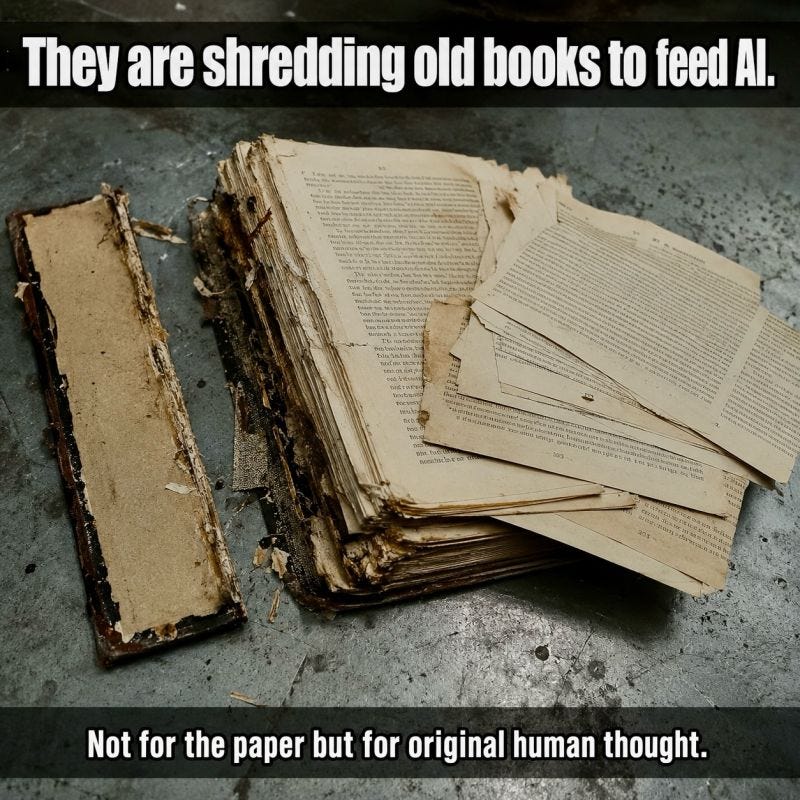
So much for an AI-driven utopia. They’re even destroying books now and feeding their contents to AI modules. Book shredding has replaced book burning with the goal of creating “smarter” AI modules.
Save your books, everyone, before they’re fed into the maw of Claude and similar AI behemoths.
I remember from “Lost in Space” there was an android that intoned “crush, kill, destroy.” I guess it’s now “slice, scan, shred.” It doesn’t bode well.
Note: No AI programs were consulted in the construction of this rant.
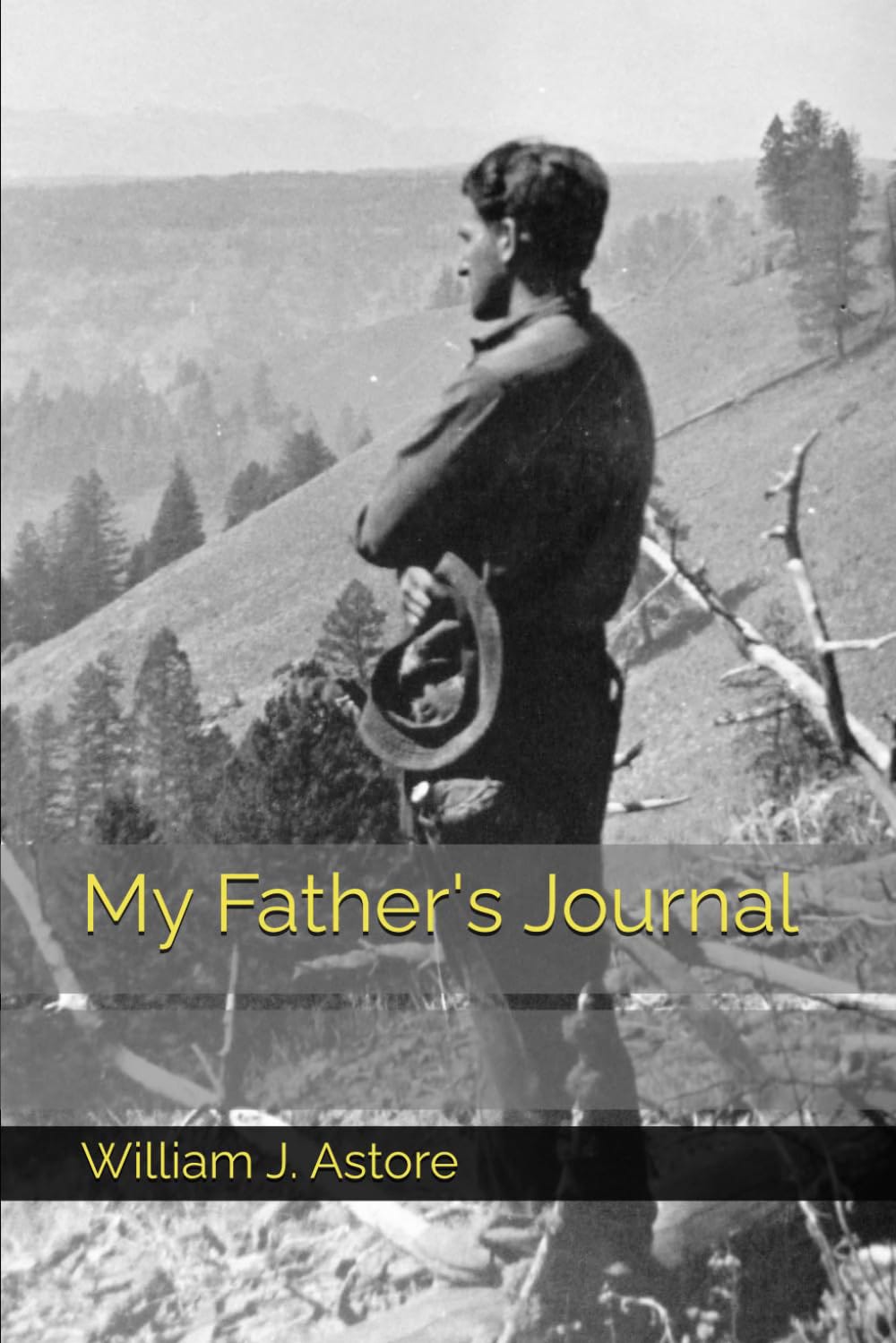
It seems like forever and a day, but I finally published my dad’s journal with my notes and photos at Amazon. Here’s the link.
It’s available for $10 in paperback, $5 on Kindle, or free if you have Kindle unlimited.
Here’s my description of the book:
Before he died, my father wrote a journal about his life. Born in 1917, he lived through the Great Depression, served in the Civilian Conservation Corps (mainly in Oregon) in the 1930s, survived working in factories and in the U.S. Army during World War II, and eventually became a firefighter for the City of Brockton (MA), serving for over 30 years.
Though he never finished high school, he read philosophy, loved classical music, and was an avid opera fan. The son of Italian immigrants, his story is the story of America, the story of a young man who worked hard and who in the process acquired a lot of wisdom from life’s setbacks.
This journal recounts many episodes in his life and the lessons he learned from them. It is one remarkable note in a fanfare for the common man.
*****
I started transcribing my dad’s journal soon after he died in 2003, but it took me two decades to put it all together in book form. If you find time to read it and you like it, perhaps you can bop on over to Amazon and write a review of it.
Thanks so much to all my readers. I hope you enjoy my book about my dad.
The face of battle is ugly. All the more reason why we need to face it
W.J. Astore
Beverly Gologorsky has an insightful article today at TomDispatch.com on the lack of references to America’s wars in U.S. contemporary fiction. She traces this to social class: the fact that most troops come from the working classes, to which most contemporary fiction writers (and doubtless editors and agents and publishers as well) have limited exposure.
Doubtless she’s right about this. The “all volunteer” military draws recruits mainly from rural, working class, hardscrabble areas. The literati, the urban hipsters, tend to see this as “fly over” country: a cultural wasteland best to be avoided. You won’t catch too many of them hanging around military posts in the Deep South. And you certainly won’t catch them at a FOB (forward operating base) in Afghanistan eating MREs and dodging IEDs.
In other words, it’s not class differences alone that account for America’s dearth of fictional accounts that draw on America’s wars (whether in Iraq or Afghanistan or elsewhere). My sense is that most fiction writers nowadays simply know very little about war. When they do try to write about it, they get important details wrong. It’s also difficult in literary circles to defend writing about the military in a fair-minded and sympathetic way. Within such circles, books with war-related themes are déclassé or otherwise suspect. Far easier (and trendier) to write about gender/LGBTQ issues, or “Tiger Moms,” or relationships involving conflicted metro-sexuals … and probably far more remunerative as well.
When they do choose to write about war, thinking liberals have to defend themselves. I have a friend, a civilian academic who writes prolifically about war, who has had to defend his choice of subject among his historian peers in academe. It was very difficult for me, a retired military officer, to get any job in civilian academe (despite advanced degrees from Oxford and Johns Hopkins). Civilian academe wants very little to do with war and the military (except for accepting billions in federal funding for weapons research, of course).
Let’s face it: Among the literati, war and the military are suspect. Good liberals don’t write about such things, except in the dismissive sense of condemning them.
So yes, class enters into it, but ideology does as well, a cultural smugness that previous generations of writers didn’t have because they in fact did serve in the military (Herman Wouk, Norman Mailer, Kurt Vonnegut, Howard Zinn, and so many others). They had lived war and could in fact write honestly about it in an informed and critical way.
And that’s precisely what’s missing in American fiction: boldly critical, and powerfully heartfelt, writing about America’s wars today. So far, there is no “All Quiet on the Afghan Front” to mobilize Americans against the horrors and waste of war. I doubt we’ll ever see such a book. And the lack of such books serves only to perpetuate our wars.
And that’s a tragedy. We need honest accountings of war and its devastating effects, an honesty often paradoxically caught best by fiction. Perhaps Gologorsky’s latest novel, Stop Here, will help. She certainly deserves a salute for raising a vitally important issue.
Update (12/11): Two novels about the Iraq War and its impact on Americans came out in 2012. I haven’t read them yet but have heard they are good: Billy Lynn’s Long Halftime Walk, by Ben Fountain; and The Yellow Birds, by Kevin Powers.
A friend made the following great comment: “a good number of front-line memoirs/narratives by US soldiers as opposed to embedded journalists [have come out of Iraq and Afghanistan]–the thing is their tone differs sharply as a rule from the world war and Vietnam predecessors. It’s more “professional/experiential” than heroic/victim like Erich Maria Remarque or Henri Barbusee.”
I made the following reply to this comment:
Many of today’s war memoirs are more “there I was” stories — the military as part job, part adventure. Which is probably class-based as well. Soldiers drawn from the working classes are perhaps more prone to see the military as a skilled trade. They want to show they’ve mastered the trade. And they tell war stories like guys at work tell profession-based tales as well as colorful stories of hunting trips and the like.
When we relied on a draft (or when the Oxbridge set volunteered to defend king and country in WW1): Some of these men saw military service as something more exalted. Less of a job and more of a noble deed. And when they discovered how sordid war could be (and usually is), their disenchantment was more profound than that of the working classes, who thought of war from the git-go as another dirty job to endure.
This is painting with a very broad brush, but I think there’s some truth here. We’re seeing fewer critical reflections on America’s wars from the troops because today’s troops lack the education/naivete of their social “betters.” And the social “betters”: they know little about war and care even less.
Update (12/12): Another point stimulated by a reader’s comment: There was a general revulsion to war in the wake of WW1 (in Europe) and Vietnam (in the USA). That helped to open the door for honest books about war written by veterans. Most Americans today have no revulsion for war, partly because it’s not on their radar, and partly because everything they are shown in the media is positive or “balanced.” Negative coverage of war is dismissed as unsupportive to “our troops.”
Put differently, Americans are in denial about the costs of war and empire. Or we dismiss those costs as “necessary” for our defense. Some of my students truly believe that, in the words of George W. Bush, we have to fight “them” over there else we’ll have to fight them here in the USA.
There’s very little sense of the true asymmetry of America’s wars today: the fact that we can strike with relative impunity anywhere in the world. Media coverage portrays America as a fortress under siege rather than as an expansionist and interventionist empire. Such coverage occludes the true face of war, especially its profitable side (consider US domination of the world’s arms trade, for example).
Update (12/23): I’ve finished “Billy Lynn’s Long Halftime Walk” and it was excellent. It’s particularly strong on why men join the military (often the best of a series of not-so-good options) and why they fight and continue to risk their lives (unit camaraderie, codes of manliness and honor, sense of duty). And it’s especially critical of the “fortunate sons” who never have to serve, especially those who are also willing to exploit the troops for their own aggrandizement and sense of well-being. It’s not as brilliant as “Catch-22,” but it’s more accessible and it makes its points with verve and humor. Its take-down of American football, especially the excessive patriotic pomp and sexual titillation of halftime shows, is especially fine.