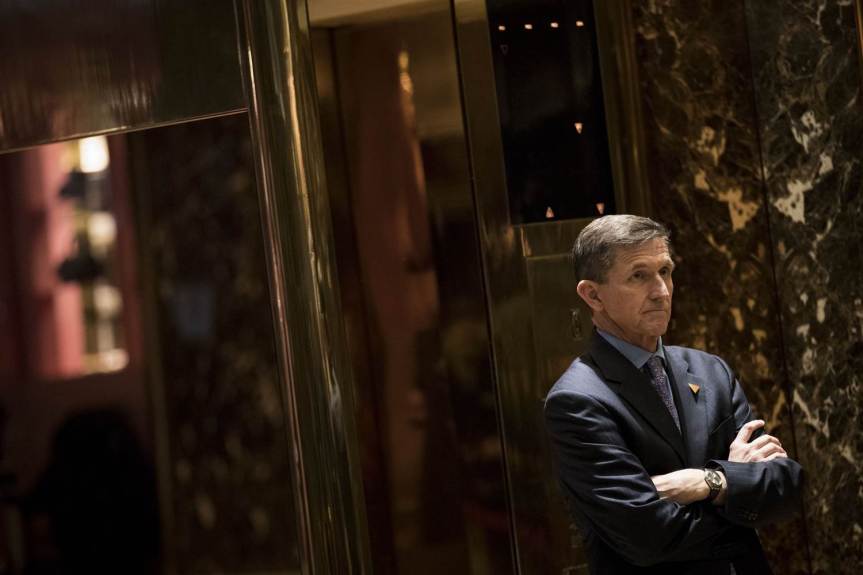
Flynn waiting for an elevator in Trump Tower back in December (NBC)
W.J. Astore
General Michael Flynn’s resignation as National Security Adviser is good news, and not only because of his lack of candor in regards to Russia. Flynn is a believer in religious war. He sacralized the war on terror and saw himself as a holy warrior against radical Islamist terrorists. (Of course, he couldn’t perceive his own extremism and radicalism.)
Both in religious terms and in predatory terms, men like Flynn and Steve Bannon see radical Islamists as the enemy. These “animals” cut off heads! A creed war that treats the enemy as animals is a combustible combination. When you see the enemy as an inferior yet insidious “Other,” there is no opportunity for compromise. Vermin can only be exterminated. Especially when they are allegedly out to destroy your “Judeo-Christian” values.
Flynn’s war against radical Islamists would be unending, driven as it would be by outrage against what he saw as a verminous enemy. In such a “holy” war, killing acquires quasi-sacred meaning. Flynn’s war was not to be a Clausewitzian war of politics by other means. Nor was it a greed-war driven by money and empire. His war was far more insidious.
When you conceive of the enemy as predators who simultaneously have the human ability to enslave you with their own creed (Sharia Law): Well, this enemy is a shape-shifting monster. Small wonder that Flynn infamously tweeted: “Fear of Muslims is RATIONAL.”
What was the source of his fear? In theory, what is the biggest threat to humans? Not tigers or snakes or other predators; they can be identified. The biggest threat is something human but not quite human. Something that looks human, has human skills, human smarts, but is ruthlessly inhuman, even as it readily blends in with “normal” humans.
They look like us — act like us — and that’s precisely the problem! Even a five-year-old Muslim refugee, no matter how innocent-looking, is seen by Sean Spicer and crew as an opening to an unstoppable invasion of America, hence Trump’s hurried and sweeping ban on Muslim immigration.
Flynn’s ideology supported the dynamic of permanent religious war. His writings and tweets were consistent with an exterminatory struggle for existence of the worst kind. His actions and views would only perpetuate jihad, a struggle he apparently sees as inevitable.
Until we neutralize jihadists like Flynn (and Bannon) and his Islamist counterparts, until we see a common humanity instead of viewing the enemy as insanely ferocious predators who are out to destroy our way of life, there is no hope for even a semblance of peace in this world.
Nora al-Awlaki, 8 years old, killed in the Yemen raid
W.J. Astore
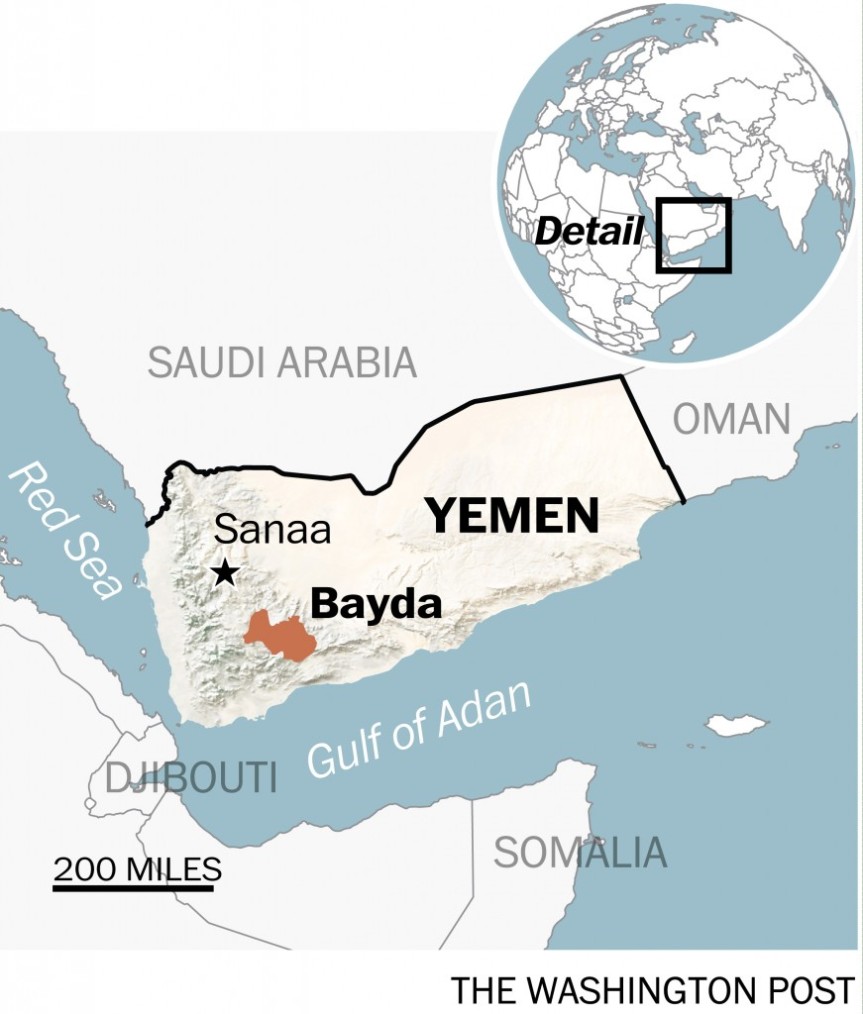
The Trump administration’s first “kinetic” military action, last weekend’s raid on Yemen that killed a Navy SEAL as well as fifteen women and children, was an operational failure. Aggravating that failure has been the aggressive propaganda spin applied by the White House. According to White House spokesman Sean Spicer, the operation was a major success:
“Knowing that we killed an estimated 14 AQAP [Al Qaeda in the Arabian Peninsula] members and that we gathered an unbelievable amount of intelligence that will prevent the potential deaths or attacks on American soil – is something that I think most service members understand, that that’s why they joined the service.”
Later, Spicer doubled down, accusing Senator John McCain (and other critics of the raid) of defaming the dead Navy SEAL when he suggested the raid had been something less than a towering success. McCain, Spicer said, owed the dead SEAL an apology.
Trump himself then joined the fray, accusing John McCain in a tweet of emboldening the enemy and suggesting he’d “been losing so long he doesn’t know how to win anymore.”
Yet, by Spicer’s logic, President Trump himself owes an apology to all U.S. troops killed in the Iraq and Afghan wars, since Trump has criticized these wars as either unnecessary or botched in execution. Recall here that Trump said he was against the Iraq invasion in 2003, but once the U.S. invaded, he said the U.S. government botched it by not taking Iraq’s oil, which, he claimed, would have prevented the rise of ISIS.
The Iraq war, Trump has said, was a mistake, a failure, a loss. He promised to show America how to “win” again. Is the recent Yemen raid what he meant by a “win”?
Nearly everything went wrong in the Yemen raid. Surprise wasn’t achieved. U.S. troops were killed and wounded. Far too many non-combatants (innocent civilians) were killed, including an eight-year-old girl. A $75 million Osprey malfunctioned and had to be destroyed.
To hazard a guess, this raid probably cost the U.S. in the neighborhood of $250 million while failing to achieve its main objective. Meanwhile, the enemy put up fierce resistance with weaponry, mainly small arms and explosives, that probably cost less than $100,000.
In brief, the U.S. raid on Yemen was prodigal in cost, profligate in resources, and unproductive in results.
Of course, I can’t say for certain that the raid didn’t secure vital intelligence. According to Spicer, an “unbelievable” amount of intelligence was seized. But early signs are unpromising. The U.S. military chose to share, in the immediate aftermath of the raid, a video of bomb-making training by al-Qaeda (apparently from a seized laptop), only to remove it when they learned the training video was a decade old and readily available on YouTube. Some intelligence coup!
The Trump administration is promising to launch more raids, featuring an “easier approval cycle” than witnessed under President Obama. Indeed, some reports suggest President Trump was goaded into approving the Yemen raid by being told his predecessor wouldn’t have approved it.
If the Yemen raid is the new face of “winning” under Trump, America may yet long for the days of “losing” under previous presidents.
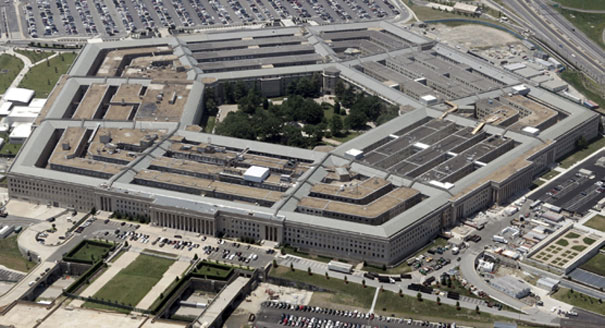
Show me your budget and I’ll tell you what you value. Under the Trump administration, what is valued is spending on military weaponry and wars. The Pentagon is due to get a major boost under Trump, as reported by the Associated Press and FP: Foreign Policy:
Money train. It’s looking like it might be Christmas in February for the U.S. defense industry. The Pentagon has delivered a $30 billion wish list to Congress that would fund more ships, planes, helicopters, drones, and missiles, the AP reports.
And that might only be the beginning.
President Trump has already ordered the Pentagon to draft a “supplemental” budget for 2017 that would include billions more for the U.S. military on top of the $600 billion the Obama administration budgeted for…
As FP’s Paul McLeary and Dan De Luce recently reported, there are proposals floating around for a defense budget as high as $640 billion for 2018, which would bust through congressionally-mandated spending caps that Democrats — and many Republicans — are happy to keep in place. Defense Secretary Jim Mattis has been tasked with completing the supplemental request by March 1.
The Pentagon, which has never passed a financial audit and which has wasted more than two trillion dollars over the years (this figure came in 2001, when Donald Rumsfeld was Secretary of Defense under Bush/Cheney), is due to be given even more money to spend, irrespective of past performance or future need.
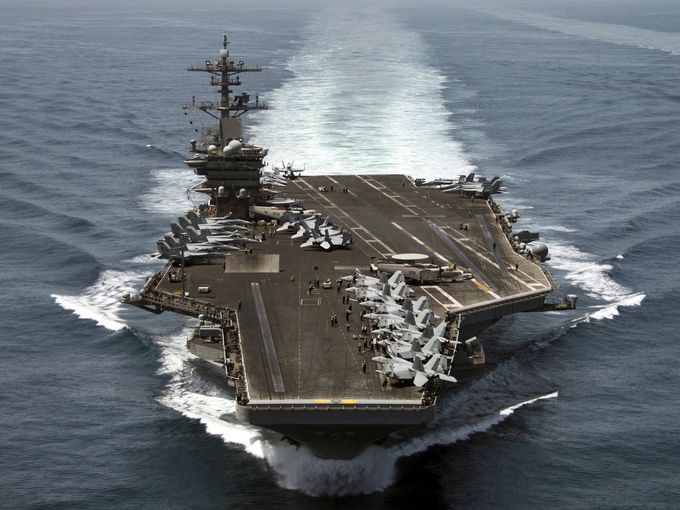
Naturally, each military service is already posturing and clamoring for the extra money promised by Trump. Consider the U.S. Navy, which, according to Vice Chief of Naval Operations Admiral William Moran, will be “Just Flat Out Out Of Money” without this supplemental funding boost from Congress.
According to the Navy and Marine Corps:
Five attack submarines would see their maintenance availabilities canceled this year and be put at risk of being decertified if no supplemental were passed out of Congress, Moran added, in addition to similar cuts to surface ship maintenance availabilities.
Assistant Commandant Gen. Glenn Walters said “we would stop flying in about July” without a supplemental. He clarified that forward forces would continue to operate, but for units training at home, “all training would cease without a supplemental, and that includes the parts money and the flying hour money.”
Even if the supplemental – which could total between $30 and $40 billion for all the armed services – is passed in a timely manner, the Navy and Marine Corps still face massive readiness issues that money can’t immediately address.
That last part is disturbing indeed. Even with billions in additional funding, the Navy still faces “massive readiness issues.”
Well, here are a few radical suggestions for Trump and the Pentagon:
If money is tight, why not re-prioritize? If readiness is compromised, why not scale back the mission?
Before boosting funding, why not force the Pentagon to pass a financial audit?
If trillions of dollars have gone “missing” over the last decades (remember, a Republican Secretary of Defense made this claim), why not launch missions to find that money before spending billions of new money?
You don’t reform a bureaucracy that wastes money by giving them more money. It’s like reforming an addict on drugs by giving him more money to spend on drugs. Until the Pentagon can account for its spending, its budget needs to be flatlined or cut.
The only way to force the Pentagon to think about “defense” spending is to limit its budget. Throwing money at the Pentagon just ensures more of the same, only more: as in more weaponry, more wars, and more fraud, waste, and abuse.
Given the Pentagon’s track record over the last half-century, does anyone truly think that more money is a solution to anything?
In a recent article for TomDispatch.com, I argued that Americans have embraced weapons and warriors, guns and gun exports, prisons and guards, all supported by a steady stream of fear. The end result has been a cesspool of violence largely of our own making. In such an environment, a man like Donald Trump, more opportunist than populist, more power-driven than public servant, more cynic than idealist, has ample opportunities to thrive.
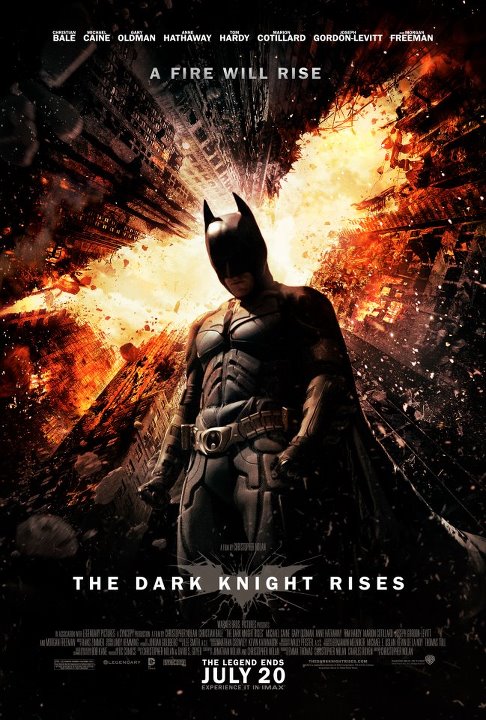
The complete article is here; in this excerpt, I focus on Trump’s rise as well as the rise of a uniquely American anti-hero, the vigilante Dark Knight, AKA Batman.
Since the end of the Cold War, America has been exporting a mirror image of its domestic self — not the classic combo of democracy and freedom, but guns, prisons and security forces. Globally, the label “Made in the USA” has increasingly come to be associated with violence and war, as well, of course, as Hollywood action flicks sporting things that go boom in the night.
Such exports are now so commonplace that, in some cases, Washington has even ended up arming our enemies. Just consider the hundreds of thousands of small arms sent to Iraq and Afghanistan that were simply lost track of. Many of them evidently ended up on sale at local black markets.
Or consider the weapons and equipment Washington provided to Iraq’s security forces, only to see them abandoned on the battlefield and captured by the Islamic State.
Look as well at prisons like Gitmo — which Donald Trump has no intention of ever closing — and Abu Ghraib, and an unknown number of black sites that were in some of these years used for rendition, detention and torture, and gave the United States a reputation in the world that may prove indelible.
And, of course, American-made weaponry like tear gas canisters and bombs, including cluster munitions, that regularly finds its way onto foreign soil in places like Yemen and, in the case of the tear gas, Egypt, proudly sporting those “Made in the USA” labels.
Strangely, most Americans remain either willfully ignorant of, or indifferent to, what their country is becoming. That American-made weaponry is everywhere, that America’s warriors are all over the globe, that America’s domestic prisons are bursting with more than two million captives, is even taken by some as a point of pride…
Increasingly, Americans are submerged in a violent cesspool of our own making. As a man who knows how to stoke fear as well as exploit it, President Trump fits into such an atmosphere amazingly well. With a sense of how to belittle, insult and threaten, he has a knack for inflaming and exploiting America’s collective dark side.
But think of Trump as more symptom than cause, the outward manifestation of an inner spiritual disease that continues to eat away at the country’s societal matrix. A sign of this unease is America’s most popular superhero of the moment. He even has a new Lego movie coming. Yes, it’s Batman, the vigilante alter-ego of Bruce Wayne, ultra-rich philanthropist and CEO of Wayne Enterprises.
The popularity of Batman, Gotham City’s Dark Knight, reflects America’s fractured ethos of anger, pain, and violence. Americans find common cause in his tortured psyche, his need for vengeance, his extreme version of justice. But at least billionaire Bruce Wayne had some regard for the vulnerable and unfortunate.
America now has a darker knight than that in Donald J. Trump, a man who mocks and assaults those he sees as beneath him, a man whose utterances sound more like a Batman villain, a man who doesn’t believe in heroes — only in himself.
The Dark Knight may yet become, under Trump, a genuine dark night for America’s collective soul. Like Batman, Trump is a product of Gotham City. And if this country is increasingly Gotham City writ large, shining the Batman symbol worldwide and having billionaire Trump and his sidekick — Gen. Michael Flynn? — answer the beacon is a prospect that should be more than a little unnerving.
It wasn’t that long ago that another superhero represented America — Superman. Chivalrous, noble, compassionate, he fought without irony for truth, justice and the American way. And his alter ego, of course, was mild-mannered Clark Kent, a reporter no less.
In Trump’s America, imagine the likelihood of reporters being celebrated as freedom fighters as they struggle to hold the powerful accountable. Perhaps it’s more telling than its makers knew that in last year’s dreary slugfest of a movie, Batman v Superman: Dawn of Justice, the bat rode high while the son of Krypton ended up six feet under.
Let me, in this context, return to that moment when the Cold War ended.
Twenty-five years ago, I served as escort officer to Gen. Robinson Risner as he spoke to cadets at the U.S. Air Force Academy. Risner’s long and resolute endurance as a prisoner of war during the Vietnam War — captured in his memoir, The Passing of the Night — had made him something of a real-life superhero to us then.
He talked to the cadets about public service, love of country and faith in God — noble virtues, based on humility, grace and inner strength. As I look back to that night, as I remember how Gen. Risner spoke with quiet dignity of the virtues of service and sacrifice, I ask myself how America today could have become such a land of weapons and warriors, guns and gun exports, prisons and fear, led by a boastful and boorish bullyboy.
How did America’s ideals become so twisted? And how do we regain our nobility of purpose? One thing is certain — the current path, the one of ever greater military spending, of border walls and extreme vetting, of vilification of the Other, justified in terms of toughness and “winning,” will lead only to further violence and darker (k)nights.
Be sure to check out TomDispatch.com, a regular antidote to the mainstream media.
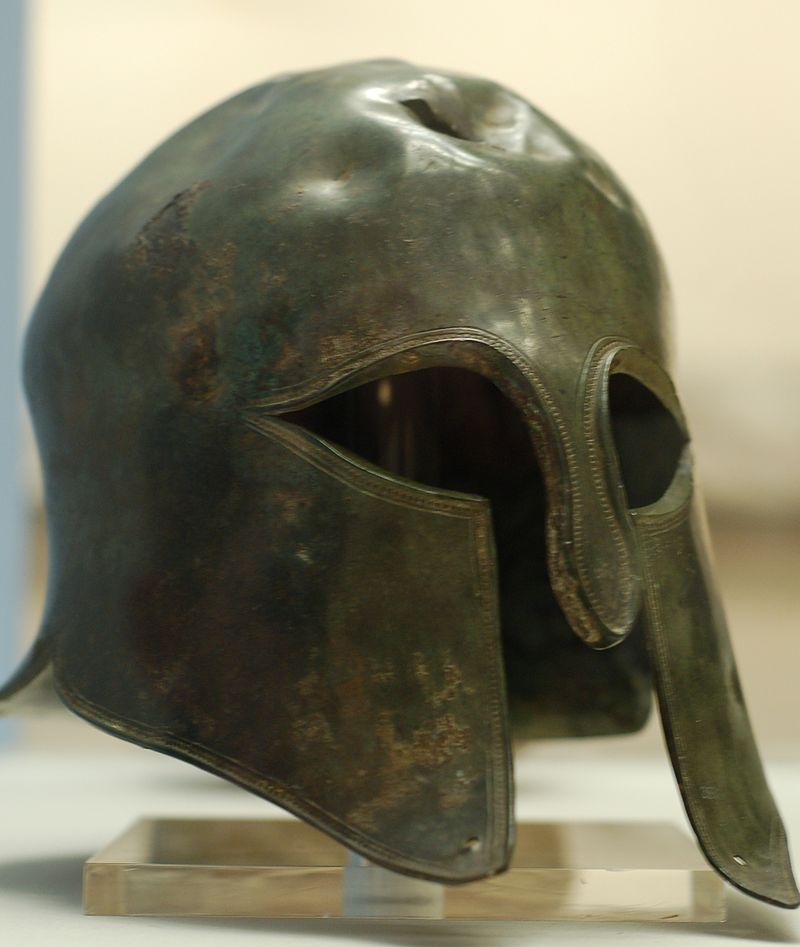
Spartan Helmet at the British Museum. Like the Spartans, it has known war
Steven J. Willett
Editor’s Introduction: Today, the ancient Greek city-state of Sparta has a reputation for being mindlessly devoted to warriors and war, yet this is a caricature of history. Sparta was neither mindless nor careless in its pursuit of war. Rather, as the classicist Steven Willett reminds us in this insightful article, appearing here first at Bracing Views, the Spartans deliberated with great care. They knew the perils of war, and entered on the same “very slowly,” as Willett shows by a close and sensitive analysis of the famous speech of Archidamus, a Spartan king, from Thucydides’ history. Would that the United States, which now fancies itself the inheritor of Spartan warrior excellence, deliberate about war with the same care as Archidamus exercised more than two millennia ago. W.J. Astore
In his History of the Peloponnesian War, Thucydides lays out the events that precipitated a long, enormously destructive war between the city-states of Athens and Sparta. The war ran from 431BCE to 404BCE with only a few years of intervening peace. Like many wars this one began in minor incidents far from the two states: Sparta was a land power with a league of allied cities in the Peloponnesus, while Athens was a sea power with a far-flung empire extending over the shores of the Aegean all the way to the Hellespont. The Athenian Empire embraced hundreds of cities and the Aegean islands, and at the start of the war was so wealthy it had begun a magnificent building program on the Acropolis.
I’ve summarized the history of events leading up to Sparta’s deliberations about going to war with Athens in Appendix One. The majority opinion of Sparta was that the Athenians were guilty of injustice and that war was justified. At this point Archidamus, one of Sparta’s two kings, “a man considered to be both intelligent and sensible” (Thucydides I.79.2), spoke before the Spartan war council. (On Thucydides’ accounts of speeches and the reliability thereof, see Appendix Two.) All translations are my own.
In the following section of the speech (I.84-85.1), Archidamus reviews the ethical principles that underlie Spartan reluctance to act precipitously. It provides an object lesson in the rational approach to making decisions about war, an approach that the United States would do well to emulate (but hasn’t).
Archidamus’ Speech About the Perils of Precipitous War
(1) And the slowness and hesitation, for which we [the Spartans] are especially blamed, should not shame you (αἰσχύνεσθε): rushing headlong [into war] may end it more slowly because the attempt lacked preparation. (2) Besides, we have always lived in a city that is free (ἐλευθέραν) and held in the highest repute (εὐδοξοτάτην). This very slowness amounts to truly rational (ἔμφρων) moderation (σωφροσύνη): for because of it we do not become insolent (ἐξυβρίζομεν) in success and yield less than others in misfortune. Nor are we, when those incite us with praise to dangerous actions (τὰ δεινὰ) contrary to our own best judgment, excited by pleasure, and if anyone provokes us with accusations we are not the least persuaded by our vexation. (3) We are both warlike (πολεμικοί) and well advised (εὔβουλοι) due to our good order (εὔκοσμον): warlike because shame (αἰδὼς) is the greatest part of moderation (σωφροσύνης), and courage (εὐψυχία) the greatest part of a sense of shame (αἰσχύνης), while we are well advised because we are trained with too little learning (ἀμαθέστερον) for contempt of the laws and by hardship to be more moderate (σωφρονέστερον) than to disobey them, and we are not so intelligent in useless matters that we finely criticize the enemy’s preparations in words only to fail matching them in deeds, but think that the intentions of our neighbors are like our own and that the occurrence of chance events cannot be determined (διαιρετάς) by argument. (4) We always prepare in practice against enemies who [we assume also] plan well, and should not place our hopes on their possible mistakes but in the security of our own forethought. We do not need to believe that one man differs very much from another man, but the best is one who has trained in the most rigorous discipline. (85.1) These practices, then, which our fathers bequeathed us and we always maintain for their continuing benefits, should never be abandoned, nor should we be incited in the short space of a day to make decisions on which hang many lives, resources and cities, but only at leisure.
Archidamus begins this passage by refuting the well-known Spartan tendency to dilatoriness by claiming it is nothing that should shame them. He uses the verb (occurring again as a noun below), αἰσχύνω, which means to be ashamed in the moral sense of having done something dishonorable, to feel shame for a dishonorable act. It can also be translated to dishonor, tarnish, or mar. Ancient Greece was in many ways a shame culture like that of my own home of Japan. To be charged with something shameful was one of the worst moral accusations. He then justifies that valuation of shame by stating that it has made Sparta a city that is free and most highly famed. The adjective he uses, ἐλεύθερος, means free in the sense of being unobstructed by any outside sources capable of restricting action. The noun form of the adjective is ἐλευθερία, freedom or liberty, and the word had very strong emotional connotations to the Greeks in their united opposition to Persia during the Greco-Persian Wars. For the Greeks, Persia was the epitome of tyranny, and to maintain their freedom they were willing to risk everything in the period of greatest threat, 490-479, when the Greek mainland faced invasion twice by Persia, the greatest empire in the world.
Having restored honor to Spartan dilatoriness in a negative sense, Archidamus then gives their habitual slowness a positive moral content: it’s a “truly rational (ἔμφρων) moderation (σωφροσύνη).” The adjective ἔμφρων means literally in one’s mind or senses, but here rational or intelligent. The noun σωφροσύνη (sophrosune) is an almost untranslatable word with a variety of meanings clustered around moderation, prudence, temperance, self-control (against pleasure or pain) and many others. I have chosen to use a single word, moderation, in translating it, but the phrase soundness of mind perhaps comes closest. Heraclitus Fr. 112 gives a powerful definition of its meaning: σωφρονεῖν ἀρετὴ μεγίστη καὶ σοφίη ἀληθέα λέγειν καὶ ποιεῖν κατὰ φύσιν ἐπαΐοντας (“Soundness of mind is the greatest virtue and practical wisdom is speaking the truth and acting in accordance with the natural constitution of things”). I’ve highlighted the two words whose roots lie in sophrosune: sophronein and sophie, “soundness of mind” and “practical wisdom.” Practical wisdom includes the skill of a craftsman or the diagnostic analysis of a physician.
Because of moderation, he continues, the Spartans don’t become insolent in success. The verb ἐξυβρίζομεν is another word very difficult to render in English. It means to break out into insolence, to run riot, to commit violence. It referred to behavior that shamed or humiliated the victim for the gratification of the abuser and included both verbal and physical assaults. The English word hubris is derived from it, but has a much thinner emotional sense than violence: foolish pride or dangerous overconfidence. To commit hubris in Greece was a crime subject to severe punishments if convicted.
Lesson for America: A good example of hubris in the Greek sense is the behavior of the United States after the fall of the Soviet Union in 1991: we declared ourselves the ‘winners’ in the Cold War, the USSR the ‘losers,’ and rubbed the defeat constantly in their faces. Under President Clinton we began to push NATO into the old Warsaw Pact countries in violation of promises to Gorbachev, to impoverish the Russian people by sending economic advisors to mount a massive deregulation of state enterprises and finally to exploit and ultimately partition Russia during the Yeltsin regime. In short, we ran riot. I was a student in St. Petersburg during the 1990s and saw the misery we unleashed up front and close: the homeless sleeping in bundles beneath famous statues, impoverished Afghan veterans selling war relics and even their own clothing on Nevsky Prospect and proud, old naval captains quietly and politely asking for some rubles in their soft, broken English.
When Archidamus follows this with the statement that Sparta cannot be incited to dangerous actions, τὰ δεινὰ, he means really serious dangers. The plural noun is very strong: fearful, dread, terrible, dire, the outcome of actions and of powerful natural events. He is directing his comments to the Corinthians and the other Peloponnesians who clamored for immediate war.
Lesson for America:Now that the (expired) Obama administration has initiated Cold War II, we have Members of Congress calling for wars with Iran, continuing wars in Iraq, Afghanistan, Libya and Syria, and even advocating policies that could lead to war with Russia. There doesn’t seem to be the slightest sense of the terrible consequences of such clamorous policies.
Section 3 of chapter 84 consists of one long sentence, which I’ve translated without a full stop, but will break into clauses for discussion. It is the most important section in the speech since it articulates the Spartan sense of their own ethical standards as a warrior society.
The first clause emphasizes two key Spartan qualities: they are “warlike (πολεμικοί)” and “well advised (εὔβουλοι)” because of their “good order.” The plural adjective πολεμικοί is derived from the Greek word for war and means warlike, valiant or courageous in war. They are “well advised” in the sense of exercising prudent, effective planning. The prefix εὔ~ in εὔβουλοι means good or well. The source of these two qualities is their “good order (εὔκοσμον).” The meanings of εὔκοσμος are variously behaving well, orderly, decorous, in good order. The word has a wide usage from Homer to the Roman period in many different semantic domains, but here Archidamus means that Spartans maintain the decorous, well-organized and graceful bearing of habitual discipline. From this disciplined, orderly bearing comes their qualities of being warlike and well advised. One thinks, for example, of a Spartan army marching in good order to the rhythm of auloi (pipes), their indifference to weather wrapped only in their scarlet cloak, their strict formation in the phalanx. Effective planning and valor, Archidamus means, are impossible without rigorous good order.
Then in the second clause he surprisingly deepens the meaning of “good order” by saying, in effect, “We are warlike because shame is the major part of moderation just as courage is the major part of shame.” He uses two words for shame: the nouns αἰδώς and αἰσχύνη. They mean very much the same thing, but the use of the second word αἰσχύνη in context means something more like honor: “courage is the major part of a sense of honor” because in battle the most shameful thing is a failure of courage or a failure to stand by your comrades. He follows that with an expansion of what it means to be well advised: “we are well advised because we are trained with too little learning (ἀμαθέστερον) for contempt of the laws and by hardship to be more moderate (σωφρονέστερον) than to disobey them.” He uses two comparative adjectives here, where the first means “not so highly learned” as to despise the laws, and the second is a form of that crucial word σωφροσύνη, but here it carries the sense of “more prudent” than to hold the laws in contempt. The Spartans were severe in their respect for the laws, and I’m sure everyone knows Simonides’ great epitaph on the Spartan dead at Thermopylae:
Oh stranger, tell the Lacedaemonians that
we lie here, obedient to their commands.
The third clause picks up the idea that Spartans are not so intelligent as to believe they can individually make public policy on their own and submit it to the assembly (a real failing of the Athenians): “we are not so intelligent in useless matters that we finely criticize the enemy’s preparations in words only to fail matching them in deeds, but think that the intentions of our neighbors are like our own and that the occurrence of chance events cannot be determined (διαιρετάς) by argument.” The Greek adjective διαιρέτης means divided, separated, distinguishable. The idea here is that chance events cannot be determined by rational argument: just as we denigrate our enemy’s intelligence, so we don’t pretend to know the future.
The final sentence in chapter I.85.1 should be engraved on the architrave of every department of war in the world: “nor should we be incited in the short space of a day to make decisions on which hang many lives, resources and cities, but only at leisure.” That is to say, hasten slowly, very slowly to make war.
Lesson for America: Haste makes waste, especially in war, whether in ill-judged attacks on the Taliban in Afghanistan, the overthrow of Saddam Hussein’s regime and the disbandment of the military in Iraq, or the elimination of Qaddafi in Libya, all done overconfidently and with inadequate intelligence.
In the course of the speech prior to my direct quotation, Archidamus makes other invaluable points about the dangers of war with Athens. He begins by emphasizing the sheer difficulty of making war against a city like Athens that possesses a distant empire, is the most experienced at sea and has the best resources in public and private wealth, ships, horses, hoplites and “a population such as does not exist in any other single place in Greece” (I.80.3). On top of that, they have tribute-paying allies, which enhances Athenian endurance. Then in turn he emphasizes Sparta’s weaknesses (I.80.4-81.5): we are inferior in ships, which take time to prepare and train, and in money because we do not have a common treasury or sufficient private sources. We surpass them in hoplites, so we could overrun and ravage their land, but they have extensive lands under their control and can import what they need by sea. If we try to make their allies defect, we will need a fleet since for the most part they are islanders. If we can’t defeat them with our ships or deny them the revenues they need to maintain their fleet, we shall be harmed even more. He ends this line of argument with a counsel that the Spartans not break the treaty or transgress their oaths, but resolve the disputes with arbitration. (Athens had in fact offered arbitration in I.78.4).
His warning about the uncertainly of war proved in the end to be all too true: “We should certainly not be borne up by the hope that the war will end quickly if we ravage their land. I fear that we shall bequeath it rather to our children, so likely it is that the Athenians in their spirited resolution will neither be enslaved by their land nor like novices terrified by war” (I.81.6). It was in fact the grandchildren who received the bequeath of war.
Lesson for America: Your enemies are not novices who are terrified by war. With the Afghan war in its 16th year and the Iraq war in its 14th year, America’s interventions in the Greater Middle East are becoming generational wars, soon to be fought by the children and grandchildren of soldiers who fought in Desert Storm and Iraqi Freedom. You wage war long, you wage war wrong; the Greeks discovered this as they weakened themselves in generational internecine warfare.
The next stage of Archidamus’ speech (I.82.1-6) is a call to take matters slowly, warn Athens it will not permit what they are doing and begin equipping themselves with Greek and barbarian allies (meaning primarily Persian). If Athens sees us preparing, they may give way. He recommends that they think of Athens’ land as a hostage and spare it if possible in order not to drive them into despair and thus make them that much harder to handle. We shall get ourselves into a more difficult situation if we allow our allies to incite us to war when we are unprepared. Let no one think we are cowards if our confederacy does not immediately attack a single city, “For they have as many allies as we do, who pay tribute too, and war is not so much a matter of arms but of finance, which provides the efficacy of arms, especially between continental and maritime powers” (I.83 2). So we should, he concludes, first provide for expenditures and not be stirred to premature action by our allies.
Ultimately, the Spartans rejected Athens’ offer of arbitration, blaming them for breach of the treaty, as Archidamus feared they might (I.81.5), and the terrible war commenced in 431. By the late 420s both sides had suffered major defeats and they agreed to the 50-year Peace of Nicias in 421. Athens blatantly violated the peace in 414 acting arrogantly (with hubris aforethought) in the belief they could finally win the war. Thucydides follows the last phase of the war in Books VI and VII to the catastrophe of the Syracuse Expedition.
Thus ended the 27-year conflict that constituted the slow suicide of Greece. In endless wars are we not witnessing today the slow suicide of the United States?
Steve Willett is a classicist living in Japan. He welcomes reader comments at steven.willett@gmail.com.
Appendix 1
Events Leading Up to the Speech of Archidamus
The first incident that ultimately triggered war was a political dispute between the island of Corcyra, on the western shore of the Adriatic, and the colony of Epidamnus that it had founded some distance north on the mainland. This dispute drew Corinth into the fray when Epidamnus asked her for help against Corcyra, which was besieging the colony. War then broke out between Corcyra and Corinth, with the island winning a naval engagement (435) and Corinth using the rest of 435 and 434 to prepare a large naval armada assisted by ground support for a decisive onslaught.
Both disputants then sent delegations to Athens in 433 and spoke before the Assembly appealing for help. Corcyra asked for an alliance with Athens against Corinth, emphasizing the fact that of the three major Greek navies at the time, Athens, Corcyra and Corinth, an alliance would give two fleets to Athens. Corinth in turn argued that as repayment for past support in an earlier incident involving the Peloponnesian League, Athens should remain neutral. The Assembly decided on a strictly defensive alliance with Corcyra, meaning that neither side adopted all the friends and enemies of the other.
In the second naval battle between Corcyra and Corinth, Athens sent a small contingent of 10 ships to help Corcyra, hoping to avoid a direct conflict so it wouldn’t violate the Thirty Years’ Peace that ended the First Peloponnesian War (446/5). Thucydides describes that battle in a vivid narrative, stating that it was the largest naval engagement ever fought up to that time. It ended with a clear victory for Corinth. Unfortunately, the Athenian ships had engaged Corinthian forces, thus giving Corinth grounds to charge her with violation of the peace treaty. This was the first incident that contributed to war between the Athenian Empire and the Peloponnesian League led by Sparta.
The second incident involved the city of Potidaea on the isthmus of Pallene, the western arm of Chalcidice in the northwest Aegean. It was a colony of Corinth, but a tribute-paying member of the Athenian Empire. The city revolted from Athens, incited by Corinth as it believed, and led to ground battles in which Athens defeated the Corinthian force, besieged Potidaea and trapped many Corinthian soldiers inside the city.
I have emphasized this chain of incidents, starting in small far-off Epidamnus and Potidaea, to illustrate a fact we should always remember: many wars begin with a precipitating event that arises far from the centers of power but whose real origin is obscure. The “truest reason” of the war, Thucydides says, though most concealed in discussion, was the Spartan fear of the growing power of Athens. He touches on the true cause earlier in Book I (I.23.6) and elaborates it later.
When Corinth called its allies to Sparta for a conference to condemn Athens, each harbored local grievances: the Corinthians complained that Athens was besieging a colony of theirs with men of Corinth and the Peloponnesus trapped inside; the Athenians complained that the Peloponnesian had caused the defection of Potidaea, which was a tribute-paying ally, and were fighting together with the Potidaeans (I.66).
This conference marks the beginning of a direct confrontation between its two greatest military forces in Greece. The Spartans additionally invited anybody else who claimed to have been unjustly treated by Athens. Several other cities spoke against her, but Corinth came last to let them provoke the Spartans first.
The Corinthian defense emphasized the tyranny of the Athenian Empire, Athens’ seduction of Corcyra and its radical difference from Sparta: one instinct with a spirit of innovative, daring, mercurial, impulsive action and one inclined to slow, sluggish commitment to action only when necessary. The Corinthians attribute this hesitancy to a preference for fair dealing that does not distress other states and for a defense that scrupulously avoids any harm to itself. They cap this line of argument with a superb aphorism against Athens: “If someone were to summarize them as born neither to enjoy any rest themselves nor to let other men enjoy it, he would speak the truth” (I.70.9). The whole description of Athens’ relentless thirst for innovation and its resilience in setbacks (I.70.2-9) is to my mind a far better account of the city’s creative effervescence than Pericles’ Funeral Oration, which is essentially a rhetorical defense of and a call to war.
Athens had some ambassadors in Sparta at the time, but on different business. They asked to speak and mounted a Realpolitik defense of their empire, which they claimed to have acquired voluntarily and not by force, and their sometimes harsh maintenance of it as normal practice for those who wield power. The tribute-paying members should in fact be happy they’ve not experience far worse treatment. The ambassadors were rather direct, however, in warning Sparta against going to war with such a powerful, wealthy state supported by a vast empire.
Sparta then closed the conference to outsiders so they could debate candidly among themselves.
The first to speak was one of the city’s two kings, Archidamus, who gave his name to the first 10 years of the war from 431 to the Peace of Nicias in 421.
Appendix 2
Note on the Speeches in Thucydides
Thucydides includes many speeches that are long and very difficult to interpret from their contorted, often opaque syntax and their complex semantic usage. Unlike his narrative passages, the ancient world found his speeches very tough going indeed. Some speeches he certainly heard in Athens before his exile in 424/3, such as Pericles’ Funeral Oration, and could well have made aides-mémoire of them. Others he might have heard outside Athens in exile, but there is not one certain case, though the possibility cannot be discounted. Others finally are imaginative reconstructions based, as he says in I.22, on his judgement of what would have been the most important or appropriate for the speakers to say regarding the current circumstances while keeping as close as possible to the general sense of the content. My opinion is that Archidamus’ speech accurately reflects his views: Athens had engaged in close relations with Sparta since well before the Greco-Persian Wars (499-449), giving her more than enough time to accurately assess the Spartan decision-making process and its civic ethics. Thucydides very likely had his own sources of information. He certainly would not have written the speech as he did if it contained obvious distortions. Here is what he writes about his exile in V.26.5: “I lived through the whole of it [the war], being of an age to understand events and apply my judgement to learn the exact truth. It happened that I was banished from my own country for 20 years after my command at Amphipolis, and by my association with both parties, as much with the Peloponnesian as the Athenians due to my exile, I could at leisure better learn the course of events.”
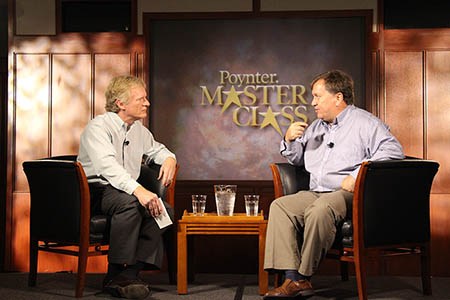
Reporter David Barstow (right) in 2014. He won a Pulitzer in 2009 for his reporting on retired generals serving as Pentagon hacks (referenced in the article below)
W.J. Astore
Note to reader: In May of 2008, I wrote this draft article, which became the basis of a shorter piece published at Nieman Watchdog later that year under the title, “Networks should replace Pentagon cheerleaders with independent military analysts.” Media coverage of the U.S. military and America’s wars is often lamentable as well as one-sided; if anything, media coverage as well as access under Obama has worsened. I’ve decided not to edit what I wrote in 2008, partly because the underlying dynamic remains the same. Rare it is for the curtain to be lifted on the messy realities of war; and those who choose to lift it, like Chelsea Manning, pay a high price indeed for honesty.
Obama’s recent decision to commute Manning’s prison sentence was a rare case of mercy, in this case extended to a truth-teller who did far more than the silver-haired generals cited below to educate Americans about war and its awful realities. 1/18/2017
The first thing that came to mind as I read David Barstow’s exposé [April 2008] in the New York Times, “Behind TV Analysts, Pentagon’s Hidden Hand,” was the classic scene in Casablanca where Claude Rains expresses his shock to Humphrey Bogart at the gambling going on, even as he collects his own winnings. Surely, Americans knew that the retired generals and colonels being paraded before them on network news were, in spite of their mufti, anything but unbiased, independent, “civilian” critics?
OK, maybe I’m more skeptical than some. But I was genuinely surprised, even shocked, at the brazenness of the Pentagon’s PR campaign, the fact that so many retired military men eagerly joined in “to carry [the Pentagon’s] water,” even at how eagerly they traded on their military expertise. Some even continued to advise top defense contractors as they offered supposedly disinterested testimony on TV. At times, however, their testimony merely echoed talking points fed to them during invitation-only briefings at the Pentagon. These briefings were designed not to support troops in harm’s way (a laudable goal) but to defend [Secretary of Defense] Don Rumsfeld and the Bush Administration’s strategy. (Those few officers who refused to parrot the Pentagon’s line found their access curtailed or even denied, Barstow shows.)
Not surprisingly, the mainstream media has either ignored Barstow’s exposé or effectively dismissed it as old news or business as usual. Fortunately, Glenn Greenwald at Salon has tenaciously pursued the story, revealing ever more clearly how the Pentagon’s propaganda campaign tried “to put the best possible face” (one retired officer’s words) on failing efforts in Iraq.
Clearly, the Pentagon courted these retired military men, identifying reliable “go to guys” and rewarding them with access to the Pentagon and the Secretary of Defense (access being pure gold within the Washington beltway). Such access included the aforementioned, invitation-only, PowerPoint briefings, which included “talking points” that these officers could then robotically repeat on TV, passing them off as their own informed and unbiased opinions. Such collusion indicates a well-oiled, influence-peddling, Pentagonal machine serviced by sycophantic cheerleaders, and it assuredly warrants investigation by Congress.
Seven Reasons to Dismiss the Sycophants
That said, the very idea of relying on retired military men as expert critics was fundamentally flawed from the beginning. The obvious reason why networks relied on these men (and they were all men) as expert commentators was because they lacked their own in-house experts. That, and the fact that they wanted to purchase the authority of these colonels and generals while being seen by viewers at home as patriotic and supportive of the troops.
I’d like to suggest seven reasons why this reliance on retired military “talking heads” was so wrongheaded, some obvious, some perhaps less so:
Despite their civilian coat-and-tie camouflage, these officers are not ex-generals and ex-colonels: they are retired colonels and generals–a distinction with a difference. They still carry their rank; they still wear the uniform at military functions; the rank-and-file still deferentially call them “sir”; their cars still have military stickers with eagles (for full colonels) and stars (for generals); they’re still saluted smartly when they drive on- and off-post. These men enjoy constant reminders and privileges of their high military status, and I’d wager nearly all of them think of themselves as military men first, “civilians” second. In short, these men identify with the U.S. military–indeed, they are the military–hardly a recipe for disinterested or dispassionate analysis of our military’s performance in Iraq, or anywhere else for that matter.
Along with identifying closely with the military, many of these media generals and colonels serve as advisors to defense contractors, who potentially stand to profit from continued fighting. This remarkable state of affairs persists despite the fact that, throughout their career, military officers are taught to avoid even the appearance of conflicts of interest, precisely because the potential for impropriety taints the integrity of the officer as well as the entire military-contractor process. It’s not enough to say, “I’m a man of integrity and I’d never compromise it for self-interest or personal gain.” You must strive to avoid even the appearance of a conflict of interest–a maxim that is so drilled into military training that it should be reflexive to these men, like coming to attention and saluting the flag as the National Anthem is played. Yet several of these men apparently saw no conflict in advising defense contractors while marching before the TV cameras to present “critical” and “independent” military analysis.
Within the military, there’s a strong bias against Monday-morning quarterbacks. There’s a natural tendency to defer to the commander-in-the-field, and to allow him or her to get on with the job without being micro-managed or second-guessed. As newly minted “civilian” advisors to the networks, these men don’t want to become what they themselves probably despised while they still wore the uniform–those cold, timid, milquetoast critics who’ll never know the triumphs and tribulations of Teddy Roosevelt’s mythical man in the arena.
Along with a strong bias against second-guessing, many military men see criticism as disloyal and destructive, not loyal and constructive. As a concept, loyalty within the military is simple to define but incredibly complex in its manifestations. Officers swear an oath to the Constitution of the United States, of course, and to that they must remain loyal. But there also exist strong personal and institutional loyalties; sometimes, these loyalties are so strong that they come to obscure the somewhat more abstract, if higher, loyalty to the Constitution. Sadly, some military men put loyalty to their service branch first, even before loyalty to the Constitution. Or they conflate the two: What’s good for the Army is ipso facto good for the country.
This is not to say these military men are somehow “bad”–only that they’re human. To understand this better, let’s look at a typical general’s background. In a very powerful way, this man probably lives for and loves the military. Military service may be in his family tree for generations. Perhaps he followed his father from post to post as a child (a military “brat,” it’s called, with affection). He then attends a service academy like Annapolis or West Point, where he’s told incessantly that he’s the best, and where he also learns that loyalty to one’s peers and service is paramount. As a commissioned officer, he then serves for thirty or more years in uniform, achieving flag rank and all the privileges as well as burdens that come with that rank. After this man retires, would we expect him to become a dynamic and even outspoken critic of an institution that defined his life? An institution that he loves?
It’s unlikely that senior military men will provide trenchant criticism, not only because they identify closely and personally with the military, but because they don’t want to run the risk of possibly undermining troop morale in the field. Related to this is the belief that “negative” and “biased” media criticism led to America’s defeat in Vietnam, the old “stab-in-the-back” myth that I’ve addressed elsewhere, and that Barstow’s exposé proves is still alive and well in today’s military.
Thus the testimony of these military men is not simply self-interested. They genuinely believe their boosterism is helping to redress the balance of otherwise negatively-biased, “liberal,” anti-military media coverage. Lending credence to this reading is a recent article in the Naval Institute’s Proceedings (January 2008). In “Stop Blaming the Press,” journalist David Danelo recalls a comment made by the current Commandant of the Marine Corps, General James Conway, back in September 2006. Lauding Marine reporters, Conway barked to rousing applause, “Maybe if we could get the rest of the media to do the job like you folks, we might have a chance of winning the war [in Iraq].”
In defending the evenhandedness of most media coverage, Danelo’s piece drew two strong dissents in the February issue of Proceedings. One Navy officer wrote to complain that Danelo failed “to level criticism at reporters for not doing their part to ensure victory.” Today’s press, this officer implied, neither supported the American soldier nor wanted to see America succeed in the war. Another officer, a retired Marine, wrote that “just one negative story” from an American journalist “bolsters our enemies’ confidence and resolve while equally destroying support from the public at home, thus eroding our servicemen’s and women’s resolve on the battlefield.” Refusing to suffer such journalistic “fools,” whose “stories could not have been more harmful than if al Qaeda had written them,” this officer demanded immediate military censorship of media working in-theater. Those journalists who refused to cooperate “would operate at their own risk and without military protection,” he concluded ominously.
Such opinions remain a commonplace in today’s military, especially among men of a certain age who began their service at the tail end or soon after the end of the Vietnam War. Indeed, evidence strongly suggests Senator John McCain shares this opinion.
Paradoxically, the fact that the war in Iraq has not gone well may be a reason why some of these military men believe we can’t afford criticism, especially if you believe this war can and must be won, as most of them do. Call this the “You can’t handle the truth” argument, combined with the “wars are always messy” argument. These arguments lead military men to suppress their own doubts, fearing that, if they air them fully, they’ll not only fatally wound an already faltering war effort, but that their peers may even see them as having given aid and comfort to the enemy.
The last, and perhaps most powerful, reason why networks should not lean heavily on retired military men as commentators is that it’s extremely difficult for anyone, let alone a diehard military man, to criticize our military because such criticism is taken so personally by so many Americans. When you criticize the military, people don’t necessarily recognize the patriotic subtlety of your exposé of the military-industrial complex. They hear you attacking Johnny and Suzy—the efforts of their son and daughter, or the boy and girl next door, who selflessly joined the military to defend America and make a positive difference in the world. Who really wants to hear that Johnny and Suzy may possibly be fighting (and dying) for a mistake? (Another way of putting this might be, “Why doesn’t that Cindy Sheehan shut up already?”) And, assuming he believed it, what retired military man wants to pass along that message to an audience of millions on TV?
What Is to be Done?
Relying on senior military officers, recently retired, to serve as disinterested critics is a bit like inviting Paul von Hindenburg, ex-Field Marshal of the German Army, to testify in 1919 on why his army lost World War I. You may get some interesting testimony–just don’t expect it to be critical or for that matter even true.
What the mainstream media must do now is act. Specifically, they must develop their own, independent, military experts, ones not beholden to the military-industrial complex, ones who don’t own stock in the defense industry, ones who don’t serve as advisors to defense contractors.
The mainstream media must also be willing to risk the ire of the American people by criticizing the military in stronger terms. The fact that major media outlets have come to rely on military talking heads for “critical” analysis reveals the inherent timidity of today’s media in taking on the Pentagon and the Bush Administration. Media outlets must get over their fear of being perceived as unpatriotic. They must air tough-minded criticism, even if some viewers tune out, turn off, and drop in to “patriotic” outlets like Fox News.
Obviously, it will take time for the media to develop its own, truly independent, military experts. In the meantime, they should consider using junior officers and NCOs, with recent combat experience, who have separated from the service. Why does an “expert” have to be a retired, white-haired colonel or general?
For that matter, why does an “expert” need to have worn an American military uniform? Some of the most creative analysis may come from “civilian” military historians or even from foreign military officers who are not emotionally connected to the U.S. military, and who thus don’t have to worry about having their patriotism questioned each time they hazard a criticism of U.S. strategy or tactics.
Until the mainstream media takes these steps, it will continue to be in thrall to the military, as is Congress itself, which also largely refuses to challenge the military before or during a war, in part because members of Congress fear being accused of defeatism and thus of losing elections.
The truth is that there’s a creeping militarism in our country–an excessive deference to military men, whether retired or still on active duty. Just look at the acclaim awarded to General Petraeus each time he comes to testify before Congress. Indeed, the presumptive Republican presidential nominee, John McCain, is already deferring to Petraeus, stating he would not make any decision regarding diverting troops to Afghanistan to search for Osama bin Laden without first receiving the blessing of the presumptive commanding general of CENTCOM.
If that’s where we’re headed, why don’t we just declare Petraeus to be our Caesar and appoint our “civilian” mainstream media military experts to command his Praetorian Guard? It sure would make matters clearer to the American people.
Will Donald Trump keep his campaign promise to end America’s wasteful wars overseas? Since he’s stated he knows more than America’s generals, will he rein them in? Will he bring major reforms to the military-industrial complex, or will he be nothing but talk and tweets?
At Trump’s first news conference today as president-elect, he had little to say about the military, except once again to complain about the high cost of the F-35 jet fighter program. The questions asked of him dealt mainly with Russia, hacking, potential conflicts of interest, and Obamacare. These are important issues, but how Trump will handle the Pentagon and his responsibilities as commander-in-chief are arguably of even greater import.
Ironically, the last president who had some measure of control over the military-industrial complex was the retired general who coined the term: Dwight D. Eisenhower. Another president – Jimmy Carter – attempted to exercise some control, e.g. he cancelled the B-1 bomber, a pet project of the U.S. Air Force, only to see it revived under Ronald Reagan.
Excepting Carter, U.S. presidents since Ike have issued blank checks to the military, the Pentagon, and its bewildering array of contractors. Whether Democrats (JFK, LBJ, Clinton, Obama) or Republicans (Nixon, Ford, Reagan, the Bushes), rubber-stamping Pentagon priorities has been a common course of presidential action, aided by a willing Congress that supports military spending to “prime the economic pump” and create jobs.
Ike, of course, was hardly perfect, but he had the cred to command the military, to rein it in, perhaps as much as any one man could in the climate of fear generated by McCarthyism and the Cold War hysteria of the 1950s. Hardly a pacifist, Ike nevertheless came to hate war. Can we imagine any president nowadays writing these words?
Every gun that is made, every warship launched, every rocket fired signifies, in the final sense, a theft from those who hunger and are not fed, those who are cold and are not clothed. This world in arms is not spending money alone. It is spending the sweat of its laborers, the genius of its scientists, the hopes of its children… This is not a way of life at all, in any true sense. Under the cloud of threatening war, it is humanity hanging from a cross of iron.
Ike’s wisdom stemmed from his experience with the bloody awfulness of war. Recent presidents, by comparison, have been unstinting in their praise of the U.S. military. Ronald Reagan, who had a cozy job in Hollywood during World War II, was a snappy saluter who oversaw a major military expansion. More recently, Barack Obama, with no military experience, went out of his way to praise the U.S. military in hyperbolic terms as the “greatest” in human history.
Recent presidents have idolized the military, perhaps because they either never served in it or never really experienced its foibles and faults, its flaws and failings. Perhaps as well they’ve celebrated the military because they saw it as a popular and easy form of patriotism. But the Pentagon needs a commander-in-chief, not a cheerleader-in-chief. It needs to be challenged, it needs a boot up its collective ass, if it’s ever going to reform its prodigal ways.
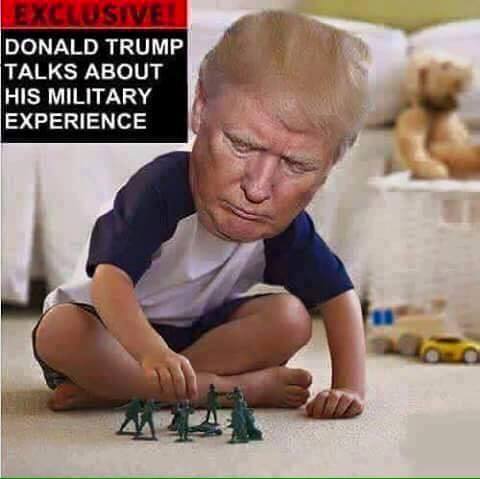
Trump has been critical of the military, an encouraging sign. But his appointment of retired generals to key positions of power suggests conformity and business as usual. Trump himself is a military poseur, a man impatient with facts, a man who didn’t know what the nuclear triad was even as he talked of (false) nuclear gaps vis-à-vis Russia.
Even as he talked of wasteful wars and clueless generals, Trump promised to use the U.S. military as a battering ram to smash America’s enemies. He promised as well to rebuild the military, increasing the Pentagon budget while taking the fight to ISIS, words that suggest President Trump won’t often say “no” to the national security state. Ike, however, could and did say “no.” He had the toughness to weather the predictable Pentagon, Congressional, and military/corporate storms. Will Trump?
Again, the last president to lead a novel initiative in national security was Jimmy Carter, with his focus on human rights. Dismissed as naïve and pusillanimous, he became a one-term president. Trump has promised to end wasteful wars, to re-prioritize federal spending to focus on internal “security” measures such as national infrastructure, and to make NATO and other U.S. allies pay their fair share of defense costs.
If he carries through on these promises, he’ll be the first president since Ike to make a measurable and significant course correction to America’s warship of state. But first he needs to be held to account, most certainly at press conferences but elsewhere as well. Endless war is a threat to democracy; so too are politicians who posture but do nothing to rein in militarism, imperialism, and authoritarianism.
If Trump combines the two, if he doubles down on incessant war and a cult of authority, American democracy may suffer a mortal blow.
In a longer article for TomDispatch.com, I recently wrote about Donald Trump’s team of generals for national defense and homeland security. Trump wants four senior retired generals, two from the Army and two from the Marine Corps, to serve as his senior civilian advisers in matters of defense and security.
Here’s the point: You simply can’t have civilian control of the military when you appoint senior generals to these positions.
I’m astonished more Americans aren’t outraged at this. It’s a sign of how much militarism has gripped our nation and government, as well as the sweep and scope of the national security state.
I was reading Samuel Hynes’ excellent book, The Soldiers’ Tale: Bearing Witness to Modern War, and came across two passages that resonated with me. In talking about war as a culture, Hynes notes that “Military traditions, values, and patterns of behavior penetrate every aspect of army [and Marine Corps] life and make the most ordinary acts and feelings different.”
The generals Trump is hiring are all military careerists, men whose “traditions, values, and patterns of behavior” are steeped in the ways of the Army and Marine Corps, affecting even “the most ordinary acts and feelings.” Their behavior, their commitments, their loyalties, their world views, are the antithesis to civilian culture and to the ethos of democracy. (For example, General James Mattis, Trump’s selection as Secretary of Defense, is most often described as a “warrior-monk,” a man with a Spartan-like dedication to war. But would Athens have anointed a Spartan, even as its minister of war?)
Again, the point is not to attack the military. It’s that the U.S. government already has plenty of generals in charge, wielding enormous authority. Trump’s decision to add yet another layer of military authority to his government makes it less of a democracy and more of a junta.
A second point from Hynes. He notes how most citizen-soldiers in America’s military past were not war-lovers, but that a few were, notably General George S. Patton. In the same breath, Hynes notes that dictators like Hitler and Mussolini “loved war.”
Which American general does Trump profess to admire the most? George S. Patton. And who among his generals most resembles Patton as a “real” warrior? According to Trump, it’s General Mattis.
Again, the point is not to attack the military, but rather to note the U.S. national security state already has plenty of warriors and warfighters in charge. Putting an alleged Patton-clone in charge of the Pentagon represents an abrogation of two centuries of American tradition that insisted on civilian supremacy over the military.
Given his inflammatory tweets about nuclear arms races with their “bring it on” mentality, Trump has all the makings of tinpot provocateur, an unstable military poseur who likes to speak loudly while swinging a nuclear-tipped stick. Will Trump’s generals, his Pattons and MacArthurs, serve as a check to his provocations and his posturings? It doesn’t seem likely.
Congress should reject Trump’s choices for Secretary of Defense (Mattis) and Homeland Security (Kelly). Not because these retired generals are bad men, but because they are the wrong kind of people. If you want civilian control of the military (and don’t we still want that?), you need to hire true civilians. Men and women whose identities haven’t been forged in armories. Independent thinkers and patriots with some history of dissent.
How about someone like Daniel Ellsberg for Secretary of Defense? And, since global warming is a huge threat to the U.S., how about Bill McKibben for Homeland Security?
After all, whether they’re in or out of uniform, the U.S. government already has plenty of generals.
With all these generals being called out of retirement to serve as Donald Trump’s “civilian” advisers, whether it’s General James “Mad Dog” Mattis as Secretary of Defense or General Mike Flynn (the real mad dog) as National Security Adviser, it’s difficult to envision the American empire being shrunk anytime soon. The U.S. military is overcommitted around the world, attenuating its strength even as the American taxpayer foots the bill to the tune of over $600 billion a year, not including nuclear weapons, veterans affairs, interest on the national debt related to war and defense spending, and so on.
With its endless wars and global adventurism, the U.S. is slowly bankrupting itself even as President-elect Trump promises higher military spending and more toughness abroad. Imperial over-commitment, for the historically-minded, recalls the fate of the Roman empire. Many moons ago, the classicist Steven Willett wrote the following words to me, words that America’s militarists and imperialists would be wise to read – and heed:
My personal concern is the misallocation of our resources in futile wars and global military hegemony. We are acting under the false belief that the military can and should be used as a foreign policy tool. The end of US militarism is bankruptcy. I agree with [Andrew] Bacevich’s recommendation that the US cut military spending 6% a year for 10 years. The result would be a robust defensive military with more freed-up resources for infrastructure, education, research and alternative energy. Our so-called defense budget is a massive example of what economists call an opportunity cost.
The US is now about where Rome was in the third to fourth centuries. In his magisterial study “The Later Roman Empire, 284-602: A Social, Economic, and Administrative Survey,” A. H. M. Jones shows what a drain the army was on the [economy of Rome]. By the third to fifth centuries, the army numbered about 650,000 scattered along the limes and stationed at central strategic locations. It took most of the state’s revenues, which had long been declining as the economy in the west declined. And even that 650,000 was far too small for adequate defense of the [Roman] empire.
General Mattis, described as a “warrior-monk” with a reputation for a close study of military history, perhaps understands some of this. But can he rein in the American empire and decrease U.S. military spending? The prospects seem grim.
Trying to be strong everywhere is a recipe for being weak when and where it counts. Under the five good emperors, Rome was able to balance imperial ambition with domestic vitality. Any chance Donald Trump is going to be a “good” emperor, a Marcus Aurelius, a man of wisdom? Early signs are unpromising, to say the least.
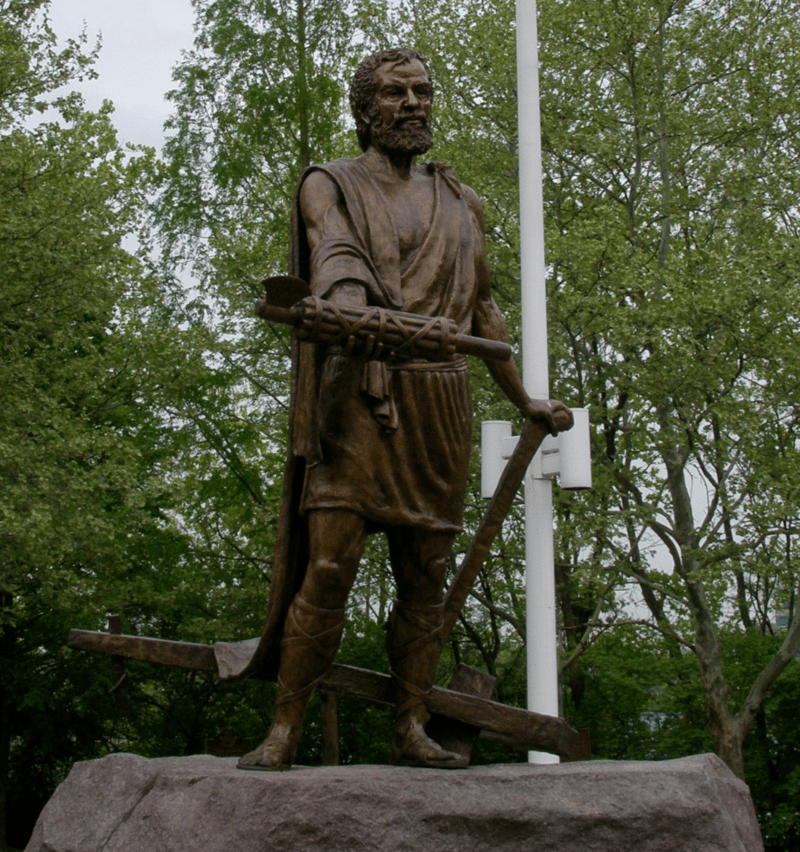
Of course, America is supposed to be a democracy. We’re supposed to look back to the Roman Republic, not its empire. We’re supposed to be committed to a limited military of citizen-soldiers who are eager to shed their armor and weapons and return to the plow, like Cincinnatus — or George Washington. We’re not supposed to worship warriors and violence.
Imperial decline and cultural decadence march together in step. Under Trump, it appears they’ll soon be marching in lockstep at double-time. Grim times, indeed.
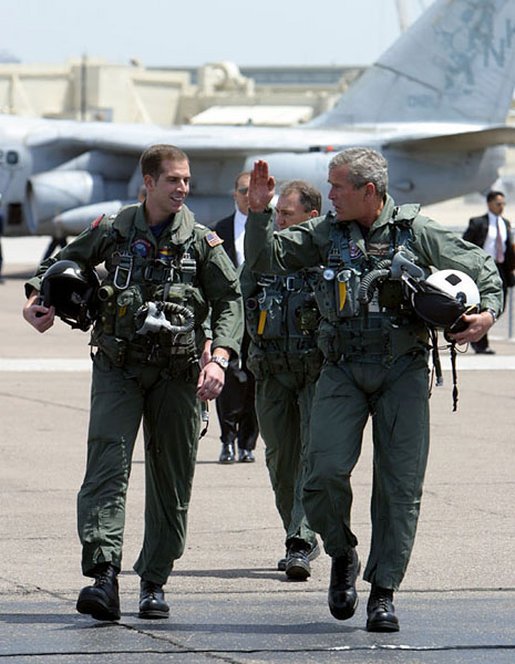
President Bush just before he gave his “mission accomplished” speech in May 2003
Chris Hedges
In May 2003, Chris Hedges gave a controversial commencement speech at Rockford College (Rockford University since 2013) in Illinois. Back then, Hedges was an award-winning reporter for the New York Times who had recently completed a book, War Is A Force that Gives Us Meaning (2002), which I highly recommend. Earlier that month, President George W. Bush had given his “Mission Accomplished” speech about the Iraq war, and patriotic pride was riding high. Hedges had the foresight to recognize the mission had not been accomplished, and that the cost of war (all wars) would be high to the United States as well as to the countries purportedly liberated.
Booed and interrupted on several occasions during his speech, Hedges persevered. His words from 2003 are well worth reading again, especially as President-elect Trump assembles a team of former generals and hardline rightists with the promise of obliterating ISIS and of “winning” conflicts around the world.
Here is his speech, in its entirety. I have bolded one passage on Athens and the poison of war that is particularly telling for the current American moment. W.J. Astore
Chris Hedges at Rockford College, Commencement Address, May 2003
I want to speak to you today about war and empire.
Killing, or at least the worst of it, is over in Iraq. Although blood will continue to spill — theirs and ours — be prepared for this. For we are embarking on an occupation that, if history is any guide, will be as damaging to our souls as it will be to our prestige, power, and security. But this will come later as our empire expands and in all this we become pariahs, tyrants to others weaker than ourselves. Isolation always impairs judgment and we are very isolated now.
We have forfeited the good will, the empathy the world felt for us after 9-11. We have folded in on ourselves, we have severely weakened the delicate international coalitions and alliances that are vital in maintaining and promoting peace and we are part now of a dubious troika in the war against terror with Vladimir Putin and Ariel Sharon, two leaders who do not shrink in Palestine or Chechnya from carrying out acts of gratuitous and senseless acts of violence. We have become the company we keep.
The censure and perhaps the rage of much of the world, certainly one-fifth of the world’s population which is Muslim, most of whom I’ll remind you are not Arab, is upon us. Look today at the 14 people killed last night in several explosions in Casablanca. And this rage in a world where almost 50 percent of the planet struggles on less than two dollars a day will see us targeted. Terrorism will become a way of life, and when we are attacked we will, like our allies Putin and Sharon, lash out with greater fury. The circle of violence is a death spiral; no one escapes. We are spinning at a speed that we may not be able to hold. As we revel in our military prowess — the sophistication of our military hardware and technology, for this is what most of the press coverage consisted of in Iraq — we lose sight of the fact that just because we have the capacity to wage war it does not give us the right to wage war. This capacity has doomed empires in the past.
“Modern western civilization may perish,” the theologian Reinhold Niebuhr warned, “because it falsely worshiped technology as a final good.”
The real injustices, the Israeli occupation of Palestinian land, the brutal and corrupt dictatorships we fund in the Middle East, will mean that we will not rid the extremists who hate us with bombs. Indeed we will swell their ranks. Once you master people by force you depend on force for control. In your isolation you begin to make mistakes.
Fear engenders cruelty; cruelty, fear, insanity, and then paralysis. In the center of Dante’s circle the damned remained motionless. We have blundered into a nation we know little about and are caught between bitter rivalries and competing ethnic groups and leaders we do not understand. We are trying to transplant a modern system of politics invented in Europe characterized, among other things, by the division of earth into independent secular states based on national citizenship in a land where the belief in a secular civil government is an alien creed. Iraq was a cesspool for the British when they occupied it in 1917; it will be a cesspool for us as well. The curfews, the armed clashes with angry crowds that leave scores of Iraqi dead, the military governor, the Christian Evangelical groups who are being allowed to follow on the heels of our occupying troops to try and teach Muslims about Jesus.
The occupation of the oil fields, the notion of the Kurds and the Shiites will listen to the demands of a centralized government in Baghdad, the same Kurds and Shiites who died by the tens of thousands in defiance of Saddam Hussein, a man who happily butchered all of those who challenged him, and this ethnic rivalry has not gone away. The looting of Baghdad, or let me say the looting of Baghdad with the exception of the oil ministry and the interior ministry — the only two ministries we bothered protecting — is self immolation.
As someone who knows Iraq, speaks Arabic, and spent seven years in the Middle East, if the Iraqis believe rightly or wrongly that we come only for oil and occupation, that will begin a long bloody war of attrition; it is how they drove the British out and remember that, when the Israelis invaded southern Lebanon in 1982, they were greeted by the dispossessed Shiites as liberators. But within a few months, when the Shiites saw that the Israelis had come not as liberators but occupiers, they began to kill them. It was Israel who created Hezbollah and was Hezbollah that pushed Israel out of Southern Lebanon.
As William Butler Yeats wrote in “Meditations in Times of Civil War,” “We had fed the heart on fantasies / the hearts grown brutal from the fair.”
This is a war of liberation in Iraq, but it is a war now of liberation by Iraqis from American occupation. And if you watch closely what is happening in Iraq, if you can see it through the abysmal coverage, you can see it in the lashing out of the terrorist death squads, the murder of Shiite leaders in mosques, and the assassination of our young soldiers in the streets. It is one that will soon be joined by Islamic radicals and we are far less secure today than we were before we bumbled into Iraq.
We will pay for this, but what saddens me most is that those who will by and large pay the highest price are poor kids from Mississippi or Alabama or Texas who could not get a decent job or health insurance and joined the army because it was all we offered them. For war in the end is always about betrayal, betrayal of the young by the old, of soldiers by politicians, and of idealists by cynics. Read Antigone, when the king imposes his will without listening to those he rules or Thucydides’ history. Read how Athens’ expanding empire saw it become a tyrant abroad and then a tyrant at home. How the tyranny the Athenian leadership imposed on others it finally imposed on itself.
This, Thucydides wrote, is what doomed Athenian democracy; Athens destroyed itself. For the instrument of empire is war and war is a poison, a poison which at times we must ingest just as a cancer patient must ingest a poison to survive. But if we do not understand the poison of war — if we do not understand how deadly that poison is — it can kill us just as surely as the disease.
We have lost touch with the essence of war. Following our defeat in Vietnam we became a better nation. We were humbled, even humiliated. We asked questions about ourselves we had not asked before.
We were forced to see ourselves as others saw us and the sight was not always a pretty one. We were forced to confront our own capacity for atrocity — for evil — and in this we understood not only war but more about ourselves. But that humility is gone.
War, we have come to believe, is a spectator sport. The military and the press — remember in wartime the press is always part of the problem — have turned war into a vast video arcade came. Its very essence — death — is hidden from public view.
There was no more candor in the Persian Gulf War or the War in Afghanistan or the War in Iraq than there was in Vietnam. But in the age of live feeds and satellite television, the state and the military have perfected the appearance of candor.
Because we no longer understand war, we no longer understand that it can all go horribly wrong. We no longer understand that war begins by calling for the annihilation of others but ends if we do not know when to make or maintain peace with self-annihilation. We flirt, given the potency of modern weapons, with our own destruction.
The seduction of war is insidious because so much of what we are told about it is true — it does create a feeling of comradeship which obliterates our alienation and makes us, for perhaps the only time of our life, feel we belong.
War allows us to rise above our small stations in life; we find nobility in a cause and feelings of selflessness and even bliss. And at a time of soaring deficits and financial scandals and the very deterioration of our domestic fabric, war is a fine diversion. War for those who enter into combat has a dark beauty, filled with the monstrous and the grotesque. The Bible calls it the lust of the eye and warns believers against it. War gives us a distorted sense of self; it gives us meaning.
Once in war, the conflict obliterates the past and the future all is one heady intoxicating present. You feel every heartbeat in war, colors are brighter, your mind races ahead of itself. We feel in wartime comradeship. We confuse this with friendship, with love. There are those who will insist that the comradeship of war is love — the exotic glow that makes us in war feel as one people, one entity, is real, but this is part of war’s intoxication.
Think back on the days after the attacks on 9-11. Suddenly we no longer felt alone; we connected with strangers, even with people we did not like. We felt we belonged, that we were somehow wrapped in the embrace of the nation, the community; in short, we no longer felt alienated.
As this feeling dissipated in the weeks after the attack, there was a kind of nostalgia for its warm glow and wartime always brings with it this comradeship, which is the opposite of friendship. Friends are predetermined; friendship takes place between men and women who possess an intellectual and emotional affinity for each other. But comradeship — that ecstatic bliss that comes with belonging to the crowd in wartime — is within our reach. We can all have comrades.
The danger of the external threat that comes when we have an enemy does not create friendship; it creates comradeship. And those in wartime are deceived about what they are undergoing. And this is why once the threat is over, once war ends, comrades again become strangers to us. This is why after war we fall into despair.
In friendship there is a deepening of our sense of self. We become, through the friend, more aware of who we are and what we are about; we find ourselves in the eyes of the friend. Friends probe and question and challenge each other to make each of us more complete; with comradeship, the kind that comes to us in patriotic fervor, there is a suppression of self-awareness, self-knowledge, and self-possession. Comrades lose their identities in wartime for the collective rush of a common cause — a common purpose. In comradeship there are no demands on the self. This is part of its appeal and one of the reasons we miss it and seek to recreate it. Comradeship allows us to escape the demands on the self that is part of friendship.
In wartime when we feel threatened, we no longer face death alone but as a group, and this makes death easier to bear. We ennoble self-sacrifice for the other, for the comrade; in short we begin to worship death. And this is what the god of war demands of us.
Think finally of what it means to die for a friend. It is deliberate and painful; there is no ecstasy. For friends, dying is hard and bitter. The dialogue they have and cherish will perhaps never be recreated. Friends do not, the way comrades do, love death and sacrifice. To friends, the prospect of death is frightening. And this is why friendship or, let me say love, is the most potent enemy of war. Thank you.