America Needs a Stronger Anti-War Movement

W.J. Astore

Remember that saying from the Vietnam War era, “Suppose they gave a war and no one came?”  Considering present events, we need to modify that.  Suppose they kept giving us war after war and no one cared?

It’s remarkable that, even as President Trump expands our military involvement overseas, there is no significant anti-war protest movement in America.  Why is this?  Perhaps Americans don’t recognize the reality of today’s wars?

Tom Engelhardt has a great article today in which he reflects about World War II, the Vietnam War, and current conflicts around the world.  He ends his article with this powerful question:

In many ways, from its founding the United States has been a nation made by wars. The question in this century is: Will its citizenry and its form of government be unmade by them?

The answer to that is “yes,” if we continue largely to ignore them.
no-more-war
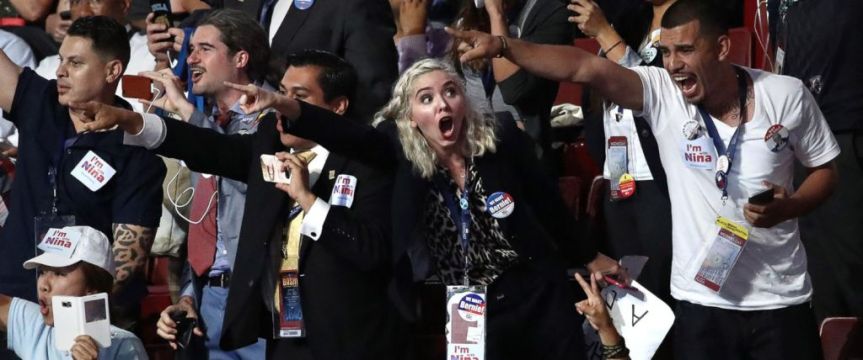
Protesters who shouted “No more war!” at the Democratic National Convention were silenced

Let me give you an example; it may sound trivial, but I think it’s indicative.  I just finished watching a seven-part series on HBO, “Big Little Lies.”  Set on the Monterey peninsula in California, the series revolved around several sets of mostly affluent, mostly White, parents and the travails of their privileged children.  The series did tackle serious issues, especially spousal abuse, and did feature fine acting.  What it did not feature was any sense that the U.S. has a military, let alone that America is at war around the world.

Wait a minute, you’re saying.  Why should a series featuring mostly affluent adults and their precocious children have said anything about the U.S. military and its wars?  Because of the setting.  I lived in Monterey for three years while serving as the military dean of students at the Defense Language Institute Foreign Language Center at the Presidio of Monterey.  I also taught at the Naval Postgraduate School in Monterey.  The U.S. military has a high profile there, but you’d never know it from watching “Big Little Lies.”  From that series, you’d think nearly everyone lived in sleek and expensive houses gazing out on the Pacific Ocean.  You’d never think that American adults had any concern whatsoever about what their military was up to around the world.  And perhaps that’s even true.

One teenager in “Big Little Lies” stirs family controversy by plotting to sell her virginity on the Internet to raise awareness of human trafficking.  (She eventually backs down.)  Perhaps she might have protested America’s wars instead?

So, why aren’t Americans protesting war?  Besides the unreality of these wars to the “Big Little Lies” crowd, here are some reasons that come to mind:

  • They’re couched as “necessary” wars against terrorism.
  • Unlike WWII or Vietnam, there’s no draft, hence the wars directly impact only American “volunteers” and their families/friends.
  • Recent U.S. casualties are much lower than they were from 2004-10 before, during, and after the “surges” in Iraq and Afghanistan, and much lower than in Vietnam. Americans care most when Americans die.  Witness the reaction to one Navy SEAL dying in a raid in Yemen.  If comparatively few American are dying, we don’t care much.
  • There is no major anti-war political party in the USA; the Democrats have embraced war as tightly as the Republicans. In short, there’s no strong rallying point against war.
  • The U.S. military has developed a form of war, based on technologies such as “smart” munitions and drones, that at least to us seems antiseptic and low cost.
  • American exceptionalism also plays a role, the government/mainstream media spin that Americans always enter wars reluctantly and only to do good.
  • Fear.  And nationalism (America First!) disguised as patriotism.

Another crucial reason: Many if not most Americans are remarkably disconnected from their government and its actions.  As Engelhardt wrote in another article (on the legendary journalist I. F. Stone):

What’s missing is any sense of connection to the government, any sense that it’s “ours” or that we the people matter. In its place—and you can thank successive administrations for this—is the deepest sort of pessimism and cynicism about a national security state and war-making machine beyond our control. And why protest what you can’t change?

Engelhardt wrote this in 2015, when Barack Obama was still commander-in-chief.  Now we have Trump and his unmerry crew, operating in their own bellicose reality.  In 2017 even more Americans are disconnected from the government, which they don’t see as “theirs.”  (Meanwhile, those who do see Trump and Crew as “theirs” probably embrace a bellicose approach to foreign policy.)

Disconnecting from government does not mean one should disconnect from its wars.  Those wars are being waged in our name; it’s up to us to work to end them.

Afterthoughts: Many Americans think that anti-war protest is somehow against “our” troops.  Yet, what could be better for our troops than fewer wars and less fighting?  Also, it’s foolhardy to give the U.S. military a blank check when it comes to war.  We the people are supposed to control our military, which is why America’s Founders gave Congress the power to declare war and to control the budget.  Finally, whether they know it or not, the Pentagon and its generals seriously need push-back from the American people.  When I watch Congressional hearings, most of our representatives are at pains to praise the military, instead of challenging it with tough questions.

Our military gets enough kudos!  What it needs is serious criticism, not unstinting praise along with buckets of money.
Ready for War with Iran?

W.J. Astore

General Joseph Votel, U.S. Centcom commander, testified to the House Armed Services Committee this week that the greatest destabilizing force in the Middle East is Iran, and that the U.S. must be prepared to use “military means” to confront and defeat the Iranian threat to the region.

No doubt Iran is a pest to U.S. designs in the Middle East.  No doubt Iran has its own agenda. No doubt Iran is no friend to Israel.  But the greatest destabilizing force in the Greater Middle East?  That’s the USA.  We’re the ones who toppled Iraq in 2003, along with the legitimate government of Iran 50 years earlier.

Iran/Persia has lived in, and sometimes dominated, the Greater Middle East for 2500 years.  By comparison, the USA is a newcomer on the block. Yet it’s the Iranians who are the destabilizers, the ones operating in a nefarious “grey zone” between peace and war, at least according to U.S. generals.

mattis
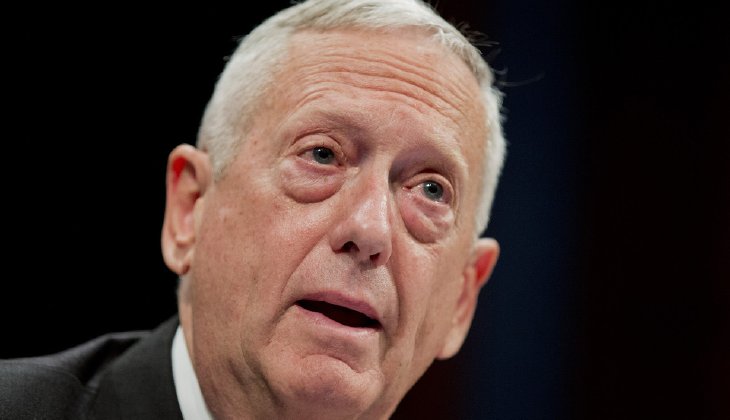
According to General Mattis, the Iranians are the greatest threat to stability and peace in the Middle East.  The U.S., with its massive military and extensive weapons sales, only safeguards peace and stability. 

Besides the disastrous U.S. invasion of Iraq in 2003, which accidentally helped Iran, the U.S. continues to sell massive amounts of weaponry to Iran’s rivals, most especially Saudi Arabia. U.S. military operations in Yemen, Syria, Iraq, and elsewhere in the Middle East have both destabilized the region and created marketplaces for U.S. weaponry and opportunities for economic exploitation by multinational corporations.

I’m no fan of Iran and its leaders, but can one blame them for resisting U.S. military and economic incursions into their sphere of influence? Recall how we reacted when the Russians put missiles into Cuba. Look at all the hostile rhetoric directed today against Mexico and its allegedly unfair trade practices vis-a-vis the U.S.

Let’s not forget that for 25 years (1953-78), the Shah of Iran was an American ally.  The U.S. military loved to sell him our most advanced weaponry, which at that time included F-14 Tomcat fighters and HAWK missile systems. That cozy relationship died with the Iranian Revolution (1979); ally turned to enemy as the U.S. supported Saddam Hussein and Iraq during the bloody Iran-Iraq War of the 1980s.

Yet, despite all this history, despite all the U.S. meddling, all the weapons sales, all the invasions and sanctions, somehow it’s the Iranians who are the destabilizing force, the ones deserving of more “disruptive” U.S. military action.

As America’s designs are frustrated in the Middle East, American generals never look in the mirror to see their own faults and failings. Instead, they cast about for new countries to blame — and to attack. Iran is seemingly next on the list, a country that General Mattis, America’s Secretary of Defense, said is “the single most enduring threat to stability and peace in the Middle East.”

Anyone for war with Iran?  U.S. generals are ready.

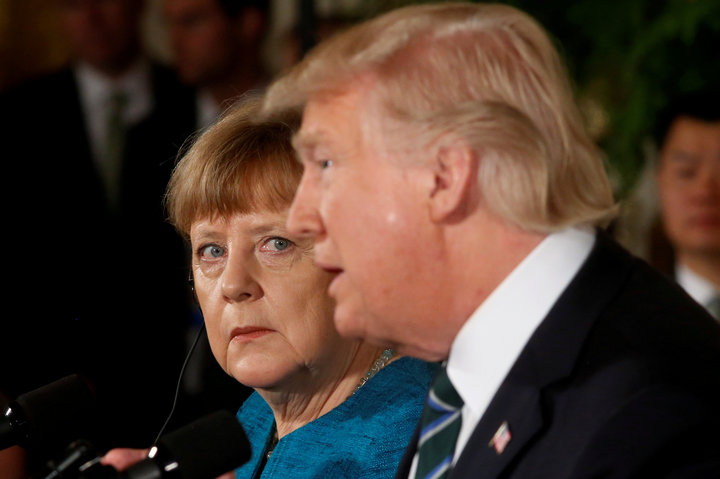
The Deeply Disturbing Trump-Merkel Press Conference

merkel_trump_meeting
Trump, in his own militarized world

W.J. Astore

Yesterday’s Trump-Merkel Press Conference was disturbing on several levels.  Worst of all was the scene of a German Chancellor listening to an American president boast about how strong his military is, and how much stronger it soon will be. Not that long ago in historical terms, Germany was a country that stressed military dominance. Two lost world wars cured Germany of its militarism. American militarism has taken its place.

As Trump responded to questions, again and again he returned to the U.S. military, vowing that he’s going to strengthen it from its “depleted” condition, perhaps to a level of power that “we’ve never seen before.”

America as a country is “very strong, very strong,” said Trump, a “very powerful company/country,” and soon the U.S. military would be “stronger,” and “perhaps far stronger than ever before.”  Naturally, the president added that he hoped he wouldn’t have to use that “far stronger” military, even as the U.S. military garrisons the globe at more than 700 bases while launching ongoing attacks against “radical Islamic terrorism” (Trump loves enunciating those three words) in places like Yemen.

Merkel and Trump hold a joint news conference in the East Room of the White House in Washington
She’s right to be worried …

This coming year, Trump is enlarging the military with a fresh influx of $54 billion.  “My generals,” as Trump likes to refer to James Mattis and John Kelly and Company, support him in part because he’s boosting military spending.  But will they continue to support Trump and his advisers like Steve Bannon when the President uses that “much stronger” military in unwise ways?

When you forge a bigger hammer, you tend not to leave it unused in the tool shed.  No — you look for bigger nails to strike.  As Trump noted at the press conference, he’s not an isolationist.  “Fake news,” he said.

That Trump, with his “far stronger” military, is not an isolationist is disturbing “real” news indeed.  Small wonder that the German Chancellor looked discomfited; her country has seen it all before.

What price military dominance?  Perhaps Chancellor Merkel could explain that to President Trump, if only he’d listen.

Trump: Yet Another War President?

trump
Yet another war president?

W.J. Astore

Is Donald Trump going to be yet another American war president?  Come to think of it, is there any other kind?

This is no accident.  Tom Engelhardt has an insightful article at TomDispatch today about how Trump the blowhard is a product of blowback from America’s failed wars, notably Iraq.  There’s much truth in this insight, since it’s hard to imagine demagogue Trump’s rise to power in a pacific climate.  Trump arose in a climate of fear: fear of the Other, especially of the terrorist variety, but also of any group that can be marginalized and vilified.  Think of Mexicans and the infamous Wall, for example.

In a separate post, Engelhardt noted the recent death of Marilyn Young, an historian who found herself specializing in America’s wars, notably Vietnam.  He cited a New York Times obituary on Young that highlighted her attentiveness to America’s wars and their continuity.

Since her childhood, Young noted, America had been at war: “the wars were not really limited and were never cold and in many places have not ended — in Latin America, in Africa, in East, South and Southeast Asia.”

She confessed that:

“I find that I have spent most of my life as a teacher and scholar thinking and writing about war.  I moved from war to war, from the War of 1898 and U.S. participation in the Boxer Expedition and the Chinese civil war, to the Vietnam War, back to the Korean War, then further back to World War II and forward to the wars of the 20th and early 21st centuries.”

“Initially, I wrote about all these as if war and peace were discrete: prewar, war, peace or postwar,” she said. “Over time, this progression of wars has looked to me less like a progression than a continuation: as if between one war and the next, the country was on hold.”

As George Orwell wrote in 1984, all that matters is for a state of war to exist (whether declared or, nowadays in the USA, undeclared).  A war mentality is the driver for autocratic excesses of all sorts.  It serves to focus the attention of people to various perceived enemies, whether from without or from within.  It promotes simplified thinking and generates fear, and fear is the mind-killer.  “Us and Them,” as Pink Floyd sang.

Aggravating simplistic and hateful “us and them” thinking in the USA is the lack of a major political party dedicated to peace.  In the USA, we have two war parties.  Trump knew this and readily exploited (and continues to exploit) it.  He knows the modern Democratic Party won’t seriously challenge the war rhetoric that drove and drives America’s new militarized reality.

Why?  Because the Democrats nurtured it.  Recall that in 2004 John Kerry “reported for duty” by saluting the Democratic National Convention.  Barack Obama in 2008 quickly morphed from a “hope and change” liberal to a drone-wielding assassin-in-chief while pursuing his “good” war in Afghanistan.  Hillary Clinton in 2016 proudly embraced Henry Kissinger and projected a harsh exterior as a hardheaded hawk.  “We came, we saw, he died,” she famously chuckled about Libya and the death of Qaddafi.  Even Bernie Sanders, with all his dreams, said little about cutting the Pentagon’s budget.

You can go back further and tag other recent Democratic presidents, such as LBJ during the Vietnam War or JFK during the Cuban Missile Crisis.  Candidate Kennedy wantonly exaggerated the “missile gap” in nuclear capability between the US and USSR (JFK had it backwards; it was the US that had clear superiority).  Jimmy Carter took a different approach, but he too soon learned his lesson, ordering a huge military buildup (overseen by the Reagan Administration) and declaring the “Carter Doctrine” to safeguard Persian Gulf oil supplies as a vital US interest.  That policy contributed in its own way to America’s recent disasters in the Greater Middle East.

Did Jimmy Carter, then, lead to Donald Trump?  Indirectly, yes.  America’s insatiable hunger for global resources (especially oil) and its desire for global power bred the conditions under which blowback came to America’s shores.  Blowback helped to generate the fear and confused desires for revenge that Trump tapped with great success in his campaign.

Today, America’s state of incessant warfare is consuming its democracy, yet President Trump’s answer is to call for more military spending, more violent attacks overseas, and more walls at home, all in a vain quest to “win” again.  Small wonder then that he’s ramping up military spending while ordering more attacks.

Trump knows what got him to the Oval Office, and it wasn’t his keen intelligence or gentlemanly charm or skill at diplomacy.  Recall that his favorite generals, George Patton and Douglas MacArthur, were all about “winning” even as they both wanted to wage the wrong wars (Patton was ready to take on the Soviets in 1945; MacArthur wanted to cross the Yalu River and invade China during the Korean War).

Will Trump, like his favorite World War II generals, seek to wage the wrong wars?  Will he recognize that fighting the wrong war is a loss even when you “win”?  Does he want to be a “war president,” and, if so, who will stop him?

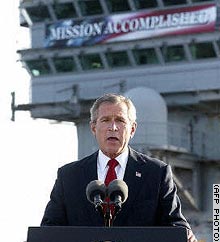
The Iraqi Surge and Alternative Facts

vstory.bush.banner.afp
An Alternative Fact

W.J. Astore

Donald Trump and Kellyanne Conway didn’t invent alternative facts.  The U.S. government has been peddling those for decades.  Consider the recent history of the Iraq War.  Recall that in 2002 it was a “slam dunk” case that Iraq had active programs to develop weapons of mass destruction (WMD).  (We couldn’t allow the smoking gun to become a mushroom cloud, said Condoleezza Rice.) In 2003, President George W. Bush landed on an aircraft carrier and declared that major combat operations were over in Iraq – mission accomplished!  And in 2007, the “surge” orchestrated by General David Petraeus was sold as snatching victory from the jaws of defeat in Iraq.  All of those are “alternative facts.” All were contradicted by the facts on the ground.

Nowadays, most people admit Iraq had no active WMD programs in 2002 and that the mission wasn’t accomplished in 2003, but the success of the surge in 2007 is still being sold as truth, notes Danny Sjursen at TomDispatch.com.  Sjursen, who participated in the surge as a young Army lieutenant, notes that it did succeed in temporarily reducing sectarian violence in Iraq, but that was precisely the problem: it was temporary.  The surge was supposed to allow space for a stable and representative Iraqi government to emerge, but that never happened.

A short-term tactical success, the surge was a strategic failure in the long-term.  Partly this was because long-term success was never in American hands to achieve, and it certainly wasn’t attainable by U.S. military action alone.  In sum, the blood and treasure spilled in Iraq was for naught.  But that harsh truth hasn’t stopped the surge from becoming a myth of U.S. military triumph, one that led to another unsuccessful surge, this time in Afghanistan in 2009-10, also conducted by General Petraeus.

These surges sustain an alternative fact that the U.S. military can “win” messy insurgencies and sectarian/ethnic wars, whether in Iraq or Afghanistan or Libya or Yemen or elsewhere.  They contribute to hubris and the idea we can remake the world by using our military, a belief that President Trump and his bevy of generals (all veterans of Iraq and Afghanistan) seem to share and want to put into practice again.  This time, they promise to get it right.

The President and the Pentagon are currently considering sending several thousand more troops to Afghanistan.  This mini-surge is being advertised as America’s best chance of defeating terrorists in the AfPak region.  Even though previous, and much bigger, surges in Iraq and Afghanistan were failures, the alternative fact narrative of “successful” surges remains compelling, even authoritative, among U.S. national security experts.  They may grudgingly admit that, yes, those previous surges weren’t quite perfect, but we’ve learned from those – promise!

Prepare for more troop deployments and more surges, America.  And for more “victories” as alternative facts, as in lies.

Afghan War Update: Fail, Fail Again

Khanabad 08-04-2008 carpenters
Afghan carpenters: the peaceful, “normal,” Afghanistan that Americans rarely see, because “Afghan” and “War” are always co-joined in our minds (Photo by Anna M.)

W.J. Astore

According to General Joseph Votel, Commander of U.S. Central Command, several thousand more U.S. troops will likely be sent to Afghanistan in an attempt to stabilize Afghan governmental forces and to halt, and eventually reverse, recent Taliban gains.

Basically, the U.S. is rewarding Afghan governmental forces for failure.  The more they fail, the more aid the U.S. sends in the form of money, weaponry, and troops.  Naturally, warrior-corporations (among others) profit from this, so even though the Afghan war itself is unwinnable (you can’t win someone else’s civil war), someone always wins in the sense of making loads of money.

The motto for the U.S. war in Afghanistan might go something like this: If at first you succeed (in defeating the Taliban in 2001), fail and fail again by overstaying your welcome and flailing around in a country that has a well-deserved reputation as “the graveyard of empires.”

There are several reasons why U.S. folly in Afghanistan persists.  First, there’s our national conviction that all wars must be won, else American credibility will be irreparably damaged.  We’d rather persist in a losing cause than to admit defeat and withdraw.  Smart, right?

Second is the domestic political scene.  Afghanistan is already being advertised (by the New York Times, no less) as “Trump’s war.”  Do you think “winner” Trump wants to be seen as backing away from a fight?

Third is the men in charge of the fight and how they see the war.  Trump’s generals and top civilian advisers don’t see the Afghan war in terms of Afghanistan; they see it in terms of themselves and their global war on radical Islamic terrorism.  They can’t be seen as “losing” in that global war, nor can they see themselves as lacking in toughness (especially when compared to the Obama administration), so queue up more troop deployments and future mission creep.

Parallels to Vietnam in the 1960s are immediate and telling.  The refusal to admit defeat.  Domestic politics.  War in the name of containing a global enemy, whether it’s called communism or terrorism.  Nowadays, since there’s no military draft and relatively few U.S. troops are being killed and wounded, there’s little opposition to the Afghan war in the U.S.  Lacking an opposition movement like the one the U.S. experienced during the Vietnam War, the Afghan war may well continue for generations, sold as it has been as a critical “platform” in the war on terror.

Two comments.  First, we’ll never win the war in Afghanistan because that’s the only way we understand the country and its peoples: as a war.  Second, as the saying goes in Afghanistan, the U.S. has the watches, but the Taliban has the time.  Sure, we have all the fancy technology, all the force multipliers, but all the Taliban (and other “insurgent” forces) has to do is to survive, biding its time (for generations, if necessary) until Americans finally see the light at the end of their own tunnel and leave.

It’s been sixteen years and counting, but we still don’t see the light. Maybe in another sixteen years?

Update (3/11/17): I wrote the following to a reader:

Most of what I read or see about Afghanistan is filtered through the U.S. military, or journalists embedded with the U.S. military.  Rarely do we see in the USA the “real” Afghanistan, the one that’s not synonymous with war or terrorism or corruption or violence or drugs.

chick pea
Afghan Chick Pea Vendor (Anna M.)

That’s a BIG problem for our understanding of Afghanistan.  We see what we want to see, which is mainly (to repeat myself) terrorism, violence, IEDs, and heroin.

Back in 2008 or thereabouts, I had a student who’d been in the Army and deployed to Afghanistan.  I asked him what he remembered: he said “dirt” and primitiveness.  That it made him think of Biblical times.  So I think Americans see Afghanistan as “primitive” and “dirty” and benighted. Again, how can we “win” there, with that attitude?

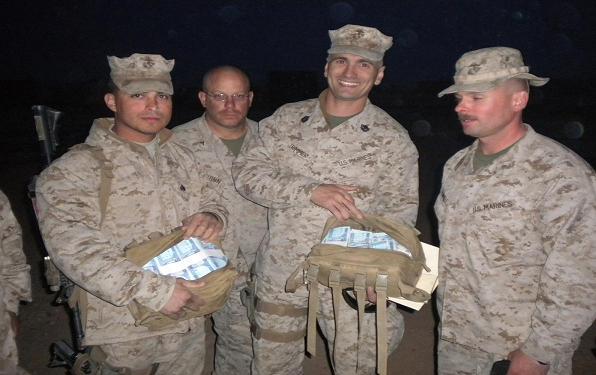
The Endless, Victoryless, Afghan War

250 000 dollar - 50
Money isn’t always the answer …

W.J. Astore

Last week, I wrote an article for TomDispatch.com on the Afghan war.  You can read the entire article here, but I wanted to share some excerpts and some afterthoughts.

Some Excerpts

America’s war in Afghanistan is now in its 16th year, the longest foreign war in our history.  The phrase “no end in sight” barely covers the situation.  Prospects of victory — if victory is defined as eliminating that country as a haven for Islamist terrorists while creating a representative government in Kabul — are arguably more tenuous today than at any point since the U.S. military invaded in 2001 and routed the Taliban.  Such “progress” has, over the years, invariably proven “fragile” and “reversible,” to use the weasel words of General David Petraeus who oversaw the Afghan “surge” of 2010-2011 under President Obama.  To cite just one recent data point: the Taliban now controls 15% more territory than it did in 2015…

Afghanistan, U.S. military theorists claim, is a different kind of war, a fourth-generation war fought in a “gray zone”; a mish-mash, that is, of low-intensity and asymmetric conflicts, involving non-state actors, worsened by the meddling of foreign powers like Pakistan, Iran, and Russia — all mentioned in General Nicholson’s [recent] testimony [before the Senate Armed Services Committee].  (It goes without saying that the U.S. doesn’t see its military presence there as foreign.)  A skeptic might be excused for concluding that, to the U.S. military, fourth-generation warfare really means a conflict that will last four generations…

Asked by Senator Lindsey Graham whether he could do the job in Afghanistan with 50,000 troops, which would quadruple coalition forces there, [General] Nicholson answered with a “yes”; when asked about 30,000 U.S. and other NATO troops, he was less sure.  With that 50,000 number now out there in Washington, does anyone doubt that Nicholson or his successor(s) will sooner or later press the president to launch the next Afghan surge?  How else to counter all those terrorist strands in that petri dish?  (This, of course, represents déjà vu all over again, given the Obama surge [in 2009-10] that added 30,000 troops to 70,000 already in Afghanistan and yet failed to yield sustainable results.)

That a few thousand [additional] troops [requested by General Nicholson, the overall commander in Afghanistan] could somehow reverse the present situation and ensure progress toward victory is obviously a fantasy of the first order, one that barely papers over the reality of these last years: that Washington has been losing the war in Afghanistan and will continue to do so, no matter how it fiddles with troop levels.

Whether Soviet or American, whether touting communism or democracy, outside troops to Afghan eyes are certainly just that: outsiders, foreigners.  They represent an invasive presence.  For many Afghans, the “terrorist strands” in the petri dish [a metaphor General Nicholson used to describe the AfPak theater] are not only the Taliban or other Islamist sects; they are us.  We are among those who must be avoided or placated in the struggle to stay alive — along with government forces, seen by some Afghans as collaborators to the occupiers (that’s us again).  In short, we and our putative Afghan allies are in that same petri dish, thrashing about and causing harm, driving the very convergence of terrorist forces we say we are seeking to avoid.

In sum, I argued that the biggest foe the U.S. faces in Afghanistan is our own self-deception.  Rarely do we see ourselves as foreigners, and rarely do we perceive how pushy we are, even as we remain stubbornly ignorant or highly myopic when it comes to Afghan culture and priorities.

After I wrote my article for TomDispatch, I jotted down the following, somewhat disorganized, thoughts about ourselves and our wars.

Some Afterthoughts

There’s a form of war fatigue, a lack of interest, in the U.S.  We treat our wars as if they’re happening off stage, or even in another universe.  And I suppose for most Americans this is indeed the case.  The wars matter little to us.  Why?  Because they are largely invisible and without effect (until blowback).

There’s no narrative thread to our wars (Afghan/Iraq), unless it’s “déjà vu all over again.”  Lines don’t move on maps.  Enemies aren’t truly defeated.  Meanwhile, a war on terror is a contradiction in terms, because war is terror.  So you have “terror on terror,” which can only propagate more war.  And with President Trump throwing more money at the Pentagon, and hiring more generals and bellicose civilians, the dynamic created is as predictable as it is unstoppable: more and more war.

Trump seems to think that expanding the military will make us so strong that no one will dare attack us.  But that just raises the stakes for the underdogs.  More than ever, they’ll want to humble Goliath.

Here’s the thing.  I’m not an expert on Afghanistan.  I’ve never been there.  I’ve talked to soldiers and others who’ve been there, I’ve read lots of articles and books, but Afghanistan remains an intellectual/historical construct to me.  My own conceit that I can write about it with authority is my country’s conceit.  Afghanistan would be better without my advice, and without our country’s military intervention.

What I do know is my own country and my own military.  I know our forms of deception, our apologetics, our ways of thinking reductively about other peoples as problems to be solved with a judicious application of money or “surgical” military power.

As I write about Afghanistan, I’m really writing about my country and how it views Afghanistan.  We Americans see Afghanistan through a glass darkly; even worse, U.S. generals see it through a glass bloody — forever bloodstained and blackened by war.

America’s wars overseas are solipsistic wars.  When we do think about them, they’re all about us.  They’re not about Afghans or Iraqis or whomever.  They are mirrors in which we see favorable reflections of ourselves, flat surfaces that flatter us.  We prefer that to portals or revolving doors that we (and especially they) could walk through, that would expose us to hazards as well as to harsh truths.

Concluding Thought

Afghanistan is not a war for us to win, nor is it a country for us to make in our image.  It’s a very different culture, a very different world, one that will resist American (and other foreign) efforts to remake it, as it has for centuries and centuries.

Isn’t it time to let Afghanistan be Afghanistan?  To let its peoples find their own path?

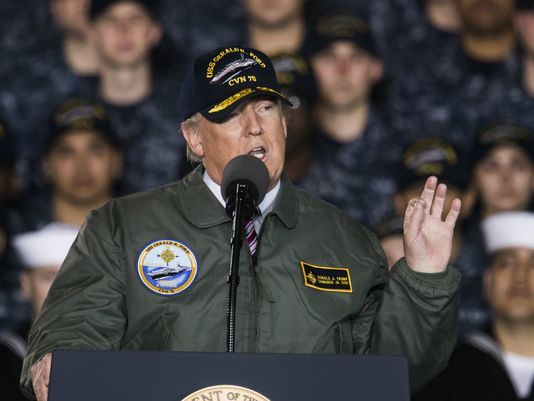
The Madness of King Trump I

trump
Mad King Trump, promising a new American Armada

W.J. Astore

At TomDispatch.com today, Rebecca Gordon writes about “American carnage” resulting from forever wars across the globe.  Her article references King George III, the “mad king” of Britain during the American Revolution, which raises an interesting point.  In Britain today, there’s a Royal Navy and a Royal Air Force, but there is no Royal Army.  That’s because the British acted to limit the authority of the monarchy, notably in the aftermath of the disastrous English Civil War and the rise of Cromwell in the 17th century.  Royal armies, the British learned, can be powerful forces for suppression of the rights of citizens.

In the 18th century, America’s founders tapped into a commonly held fear of royal armies to motivate fence-straddling colonists to rebel against King George III.  The colonists, as Gordon notes, accused the king in the Declaration of Independence of making “the Military independent of and superior to the Civil power.”

Thus it was when the colonists gained their independence, they acted to keep America’s standing army as small as possible while subjecting it firmly to civilian control.  America wanted no “royal” army, no class of aristocrats whose identity resided in that army, and certainly no leader who postured and posed as a military commander, as kings of that age typically did.

What America has witnessed since the end of World War II is the emergence of a large standing military that is increasingly identified with our president as a quasi-monarch “commander-in-chief.”  And like monarchs of the past, U.S. presidents now dress up in military uniforms, strutting about as if they literally are “the king” of their military.  (Trump, for example, talks of “my” generals.) Meanwhile, a U.S. president has, with the paramilitary CIA, his own private military augmented by a newly empowered military within the military, Special Operations Command, whose operations are often so highly classified as to be beyond effective civilian oversight.

America has regressed to the pre-revolutionary 17th century, when monarchs fought long wars against other monarchs, often in religious/confessional conflicts which were also motivated by money, power, resources, and similar concerns and which lasted for decades or even centuries.  These wars, often involving mercenaries and warrior-corporations, ran out of control and eventually came to bankrupt states, leading to an “enlightenment” witnessed at the creation of the United States, whose founders tried to rein in the tyranny of monarchs and their wasteful forever wars.

Sadly, America is no longer “enlightened.”  King Trump is a mix of Mad King George III and France’s imperious and vainglorious Louis XIV (“I am the state”), but without George’s or Louis’s interest in science and wider forms of knowledge.  And, much like royal courtiers of the past, King Trump’s courtiers are often “aristocratic” generals or slithering sycophants.

Consider a Trump courtier who’s been getting a lot of press lately: Sebastian Gorka.  He’s embraced the idea of a war against radical Islamic terrorism, tracing that war to jihadist flaws within Islam.  This virulent disease within Islam, Gorka and likeminded advisers to Trump argue, must and can be wiped out by American-led military action.  Much like Catholic King Philip II, who launched the Spanish Armada to extirpate the heresy of English Protestantism under Queen Elizabeth I, Trump and Gorka and Crew seek to unleash the American armada against the heresy of radical jihadist Islam.

King Trump I is about to escalate what he and his courtiers see as a religious/civilizational war.  Donning a military cap and flight jacket, Trump promises quick victories against a dastardly enemy.  Even as he pursues his wars, the U.S. military will continue to expand, as will paramilitaries and warrior-corporations.  Even as victory proves as elusive as the fighting is enervating to domestic concerns, Mad King Trump will persist.  America must win.  For he is the state.

Under Trump, as with mad King George III, big changes are ahead.  Just not the ones these monarchs imagined for themselves and their empires.

Sun Tzu, Steve Bannon, and the Trump White House “Warriors”

steve-bannon-interview-on-donald-trump
Steve Bannon, self-professed student of the Art of War (Getty Images)

W.J. Astore

A favorite book of Steve Bannon’s is Sun Tzu’s The Art of War.  A classic of military strategy, The Art of War was compiled during the Warring States period (403-221 BCE) in ancient Chinese history.  It was a time of intense civil warfare in China, a time when a cessation in fighting was merely a pause between the next round of battles among warlords.  It’s still widely read today for its insights into war, its clever stratagems and tactics, and its lessons into human nature and behavior.

Bannon, who served in the U.S. Navy, is an armchair strategist with an affinity for military history books.  He appears to believe in inevitable conflict between the Judeo-Christian West, which he favors due to its “enlightened” values, and the World of Islam, which he sees as retrograde and barbaric when compared to the West.  He sees the world as already being in a “warring states” period writ large, a realm of conflict marked by “holy war” to be mastered by warrior/scholars like himself.

Joining him in this belief is Donald Trump, who took great pains to recite the phrase “radical Islamic terrorism” in his speech before Congress, as if using these words were a mark of personal courage on his part.  Trump has boasted about winning the “next” war, as if war during his presidency is inevitable.  And I suppose it is, with Trump at the helm and advisers like Bannon, Sebastian Gorka, and Stephen Miller pursuing a bellicose hardline against Islam.

Be careful what you wish for, Trump and cronies, and be especially careful about declaring victory in wars before you’ve even fought them.  Here Sun Tzu has much to teach our “warriors” in the White House.

For one thing, Sun Tzu writes that a battle is best won without fighting at all.  Said Sun Tzu: “Fighting and winning a hundred wars is not the greatest good.  Winning without having to fight is.”  In other words, you set the stage so carefully that the enemy must surrender or face obliteration before the curtain is even raised on war.

Secondly, Sun Tzu warns about the folly of protracted wars, how they deplete the national budget and weaken a state, especially when support among the people is tepid.  Warfare, notes Sun Tzu, must be treated with the greatest caution, even as it is waged with great cunning.  Best of all is to outsmart the enemy; next best is to form alliances, to build a much bigger army than the enemy, which may force them to capitulate.  Worst of all is to get bogged down in long wars, especially in cities, which require expensive sieges that wear on both sides (just ask the Germans at Stalingrad about this).

Ultimately, Sun Tzu writes that by understanding oneself and one’s enemy, a skilled leader can engage in a hundred battles without ever being in serious danger.  But an unskilled leader who does not truly know his own nature or that of his enemies is one who is fated always to lose.  Trump, who fancies himself a great leader and who is ignorant of foreign nations and peoples, does not inspire confidence here, even as he promises the American people that we’re going to win so much, we’ll get bored with winning.

Sun Tzu puts great emphasis on careful planning and sober deliberation before launching attacks.  If the recent Yemen raid is any indicator, Trump is neither a careful planner nor a sober deliberator.  Indeed, Trump’s personal qualities expose him to being manipulated by a cunning enemy.  In listing the personal traits that are dangerous in a commander, Sun Tzu mentions “quick to anger” as well as “self-consciousness” or vanity.  One who’s quick to anger can be goaded by insults into making poor decisions; one who’s vain and self-conscious can be humiliated or manipulated into rash action.

Trump promises an American military that is so big and so strong that no country will dare attack us.  Yet Trump himself, surrounded by his “warrior” advisers, isn’t content to build a huge military while not using it.  Indeed, Trump is already using it, notably in Yemen, pursuing policies that are fated to perpetuate warfare around the globe.  And it’s hardly encouraging that, after the failed Yemen raid, Trump shifted the blame to his generals rather than taking it himself.

Remember what Sun Tzu warned about vanity as well as perpetual warfare, especially when your own people are increasingly divided?  Something tells me this lesson is lost on Trump, Bannon, and crew.  Embracing the stratagems of The Art of War, its emphasis on surprise, subterfuge, deception, and quick strikes, is not enough.  You must seek the wisdom at its core, which is very much against war except as a last resort.

Know thyself, said Sun Tzu, echoing the Greek philosopher Socrates.  Face yourself squarely, recognize your flaws, your vanity (“All is vanity,” say the Christian Bible, a book Trump professes to treasure), and be careful indeed in unleashing war.

Do Trump, Bannon, and company know themselves, admit to their flaws and vanities, and recognize that war, in all its perils and costs, should be a course of last resort?  So far, evidence is wanting.

Update (8/12/17): Bannon has said his concern about a civilizational conflict with Islam dates from his time in the Navy and a visit to Pakistan.  Apparently, however, his ship visited Hong Kong rather than Pakistan.  Bannon also recalls specific details of Iran — its resemblance to a “primeval” wasteland — that he apparently was not privy to.  All this is revealed in an article at The Intercept.  Either Bannon’s memory is faulty or he is an esteemed member of the “alternative fact” club, where you just make things up to fit your preconceived notions.

As Peter Maass at The Intercept notes: “It turns out that Bannon, who has drawn a large amount of criticism for his exclusionary stances on race, religion, and immigration, has also inaccurately described his military service, simultaneously creating an erroneous narrative of how he came to an incendiary anti-Muslim worldview that helps shape White House policy.”

“We’re a nation at war”

james_madison_1894_issue-2
Madison: Permanent war marks the end of democracy

W.J. Astore

Last week, Army General Raymond “Tony” Thomas, head of U.S. Special Operations Command (SOCOM), expressed his dismay about the Trump administration. “Our government continues to be in unbelievable turmoil,” Thomas opined.  “I hope they sort it out soon because we’re a nation at war.”

What does that mean, we’re a nation at war?  Many will think that a dumb question, but is it?  Sure, we have roughly 10,000 troops in Afghanistan, and that war isn’t over.  Sure, the U.S. is still helping Iraqi forces (notably in Mosul) against ISIS and related terrorist groups. Yes, the U.S. and NATO (joined by Russia?) are seeking to corral and eventually to end ISIS and “radical Islamic extremism/terrorism.”  But do these efforts constitute a world war, like World Wars I and II?

It doesn’t feel like a war — not in the USA, at least.  Congress has made no formal declaration of war.  Few Americans are sacrificing (of course, the troops in harm’s way are). There’s no rationing.  No tax increases to pay for the war.  No national mobilization of resources.  No draft.  No change in lifestyles or priorities. Nothing.  Most Americans go about their lives oblivious to the “war” and its progress (or lack thereof).

Here’s my point. Terrorism, whether radical Islamist or White supremacist or whatever variety, will always be with us.  Yes, it must be fought, and in a variety of ways.  Police action is one of them.  Political and social changes, i.e. reforms, are another.  Intelligence gathering.  Occasionally, military action is warranted.  But to elevate terrorism to an existential threat is to feed the terrorists.  “War” is what they want; they feed on that rhetoric of violence, a rhetoric that elevates their (self)-importance.  Why feed them?

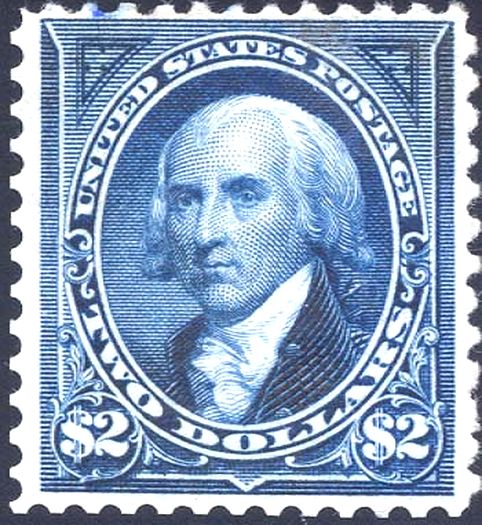
Another aspect of this: a war on terrorism is essentially a permanent war, since you’ll never get rid of all terrorists.  And permanent war is perhaps the greatest enemy of democracy — and a powerful enabler of autocrats. James Madison saw this as clearly as anyone:

Of all the enemies of true liberty, war is, perhaps, the most to be dreaded, because it comprises and develops the germ of every other.  War is the parent of armies; from these proceed debt and taxes; and armies, and debts, and taxes are the known instruments for bringing the many under the domination of the few.  In war, too, the discretionary power of the Executive is extended; its influence in dealing out offices, honors and emoluments is multiplied; and all the means of seducing the minds, are added to those of subduing the force, of the people.  The same malignant aspect in republicanism may be traced in the inequality of fortunes, and the opportunities of fraud, growing out of a state of war, and in the degeneracy of manner and of morals, engendered in both. No nation can preserve its freedom in the midst of continual warfare …

After reading Madison, does anyone dedicated to democracy really want to be “at war” for, well, generations?  Forever?

Of course, there’s another aspect to General Thomas’s critique that must be mentioned, and that’s his audacity in criticizing the government (and, by extension, his commander-in-chief) for not having its act together in “the war.”  Generals are supposed to fight wars, not critique in public the government they serve.

War rhetoric doesn’t just inspire terrorists and empower autocrats while weakening democracy: It also emboldens generals.  They begin to think that, if the nation is at war, they should have a powerful role in making sure it runs well, until the state becomes an apparatus of the military (as it did in Germany during World War I, when Field Marshal Hindenburg and General Ludendorff ran Germany from 1916 to its collapse in November 1918).  The Trump administration has already put (long-serving and recently retired) generals at the helm of defense, homeland security, and the National Security Council. Remember the days when civilians filled these positions?

One more point: If the U.S. is now “a nation at war,” when, do tell, will we return to being a nation at peace?  If the answer is, “When the last terrorist is eliminated,” say goodbye right now to what’s left of American democracy.