The Self-Defeating Military

pilot
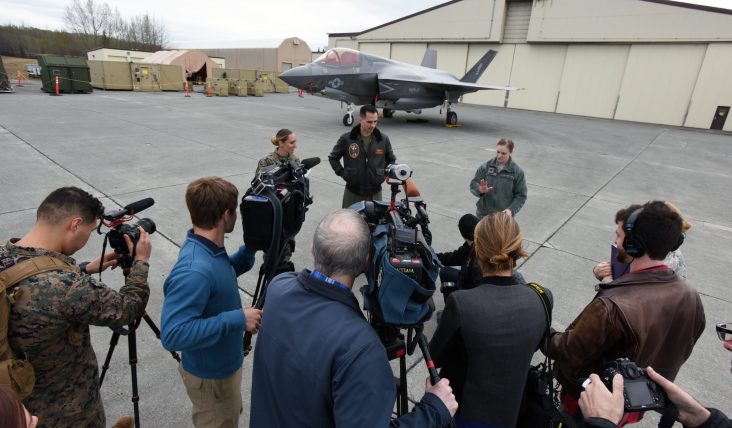
One of the pilots who flew at the Super Bowl in his F-35 gets a little media love

W.J. Astore

In my latest article for TomDispatch.com, I tackle the U.S. military and its self-defeating nature when it comes to wars overseas.  But there is a “war” that the military-industrial complex truly is winning handily, even overwhelmingly, and that’s the one for money and power within and across American society.  Put differently, when it comes to winning hearts and minds, the military fails spectacularly overseas but succeeds brilliantly here in the “homeland.”

Consider only one example: America’s major sporting events.  Each one has now become a military celebration.  At the Super Bowl this past weekend, four 100-year-old military veterans from World War II were the centerpiece of this year’s opening ceremonies (ostensibly to mark the 75th anniversary of the ending of that war in 1945, as well as the 100th year of the NFL), and of course no event is complete without military colorguards, saluting troops, and a loud flyover by combat jets at the close of the national anthem.  This is all accepted as “normal” and patriotic, the very mundanity of which illustrates the triumph of the military-industrial complex in our lives.

What follows is an excerpt from my article from TomDispatch:

The Future Is What It Used to Be

Long ago, New York Yankee catcher and later manager Yogi Berra summed up what was to come this way: “The future ain’t what it used to be.” And it wasn’t. We used to dream, for example, of flying cars, personal jetpacks, liberating robots, and oodles of leisure time. We even dreamed of mind-bending trips to Jupiter, as in Stanley Kubrick’s epic film 2001: A Space Odyssey. Like so much else we imagined, those dreams haven’t exactly panned out.

Yet here’s an exception to Berra’s wisdom: strangely enough, for the U.S. military, the future is predictably just what it used to be. After all, the latest futuristic vision of America’s military leaders is — hold onto your Kevlar helmets — a “new” cold war with its former communist rivals Russia and China. And let’s add in one other aspect of that military’s future vision: wars, as they see it, are going to be fought and settled with modernized (and ever more expensive) versions of the same old weapons systems that carried us through much of the mid-twentieth century: ever more pricey aircraft carriers, tanks, and top of the line jet fighters and bombers with — hey! — maybe a few thoroughly destabilizing tactical nukes thrown in, along with plenty of updated missiles carried by planes of an ever more “stealthy” and far more expensive variety. Think: the F-35 fighter, the most expensive weapons system in history (so far) and the B-21 bomber.

For such a future, of course, today’s military hardly needs to change at all, or so our generals and admirals argue. For example, yet more ships will, of course, be needed. The Navy high command is already clamoring for 355 of them, while complaining that the record-setting $738 billion Pentagon budget for 2020 is too “tight” to support such a fleet.

Not to be outdone when it comes to complaints about “tight” budgets, the Air Force is arguing vociferously that it needs yet more billions to build a “fleet” of planes that can wage two major wars at once. Meanwhile, the Army is typically lobbying for a new armored personnel carrier (to replace the M2 Bradley) that’s so esoteric insiders joke it will have to be made of “unobtainium.”

In short, no matter how much money the Trump administration and Congress throw at the Pentagon, it’s a guarantee that the military high command will only complain that more is needed, including for nuclear weapons to the tune of possibly $1.7 trillion over 30 years. But doubling down on more of the same, after a record 75 years of non-victories (not to speak of outright losses), is more than stubbornness, more than grift. It’s obdurate stupidity.

Why, then, does it persist? The answer would have to be because this country doesn’t hold its failing military leaders accountable. Instead, it applauds them and promotes them, rewarding them when they retire with six-figure pensions, often augmented by cushy jobs with major defense contractors. Given such a system, why should America’s generals and admirals speak truth to power? They are power and they’ll keep harsh and unflattering truths to themselves, thank you very much, unless they’re leaked by heroes like Daniel Ellsberg during the Vietnam War and Chelsea Manning during the Iraq War, or pried from them via a lawsuit like the one by the Washington Post that recently led to those Afghanistan Papers.

My Polish mother-in-law taught me a phrase that translates as, “Don’t say nothin’ to nobody.” When it comes to America’s wars and their true progress and prospects, consider that the official dictum of Pentagon spokespeople. Yet even as America’s wars sink into Vietnam-style quagmires, the money keeps flowing, especially to high-cost weapons programs.

Consider my old service, the Air Force. As one defense news site put it, “Congressional appropriators gave the Air Force [and Lockheed Martin] a holiday gift in the 2019 spending agreement… $1.87 billion for 20 additional F-35s and associated spare parts.” The new total just for 2020 is “98 aircraft — 62 F-35As, 16 F-35Bs, and 20 F-35Cs — at the whopping cost of $9.3 billion, crowning the F-35 as the biggest Pentagon procurement program ever.” And that’s not all. The Air Force (and Northrop Grumman) got another gift as well: $3 billion more to be put into its new, redundant, B-21 stealth bomber. Even much-beleaguered Boeing, responsible for the disastrous 737 MAX program, got a gift: nearly a billion dollars for the revamped F-15EX fighter, a much-modified version of a plane that first flew in the early 1970s. Yet, despite those gifts, Air Force officials continue to claim with straight faces that the service is getting the “short straw” in today’s budgetary battles in the Pentagon.

What does this all mean? One obvious answer would be: the only truly winning battles for the Pentagon are the ones for our taxpayer dollars.

Read the rest of my article here.  And thanks!
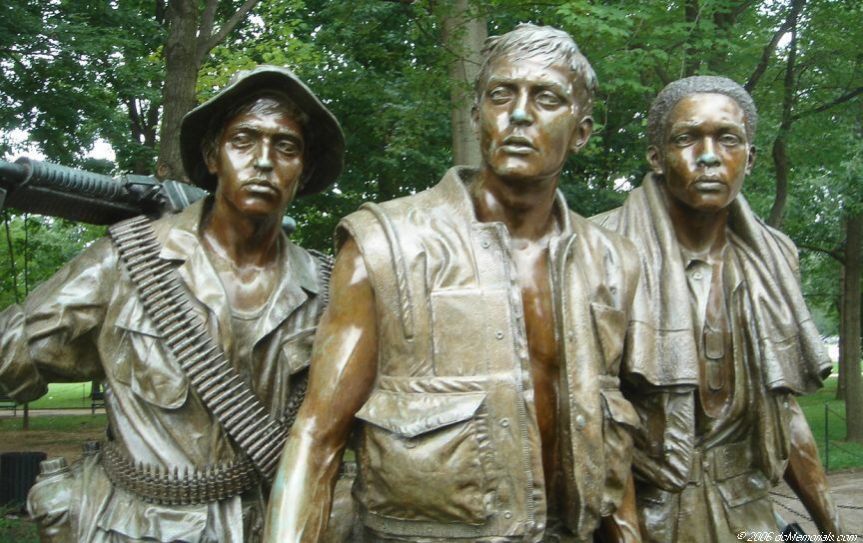
Talking About Military Leadership

vietnam

W.J. Astore

In 2004, when I was still on active duty, I spoke on leadership at the Panetta Institute in Monterey, California.  At the time, I was the associate provost/dean of students at the Defense Language Institute Foreign Language Center.

To prepare for my talk, I jotted down a few notes; I’ve decided not to update these or change them.  (I’m sure I’d say a few different things today; then again, I’ve been retired from the military since 2005.)

Here are my notes from 2004 (with a few additions for the sake of clarity):

What is uniquely military about military leadership?

  • Life and death situations (but also true of Police, Fire, MDs, etc.)
  • Mandate to take the lives of others under certain ROEs (rules of engagement)
  • Inherent chaos (fog and friction) of war.  Thus leaders must promote cohesion—bonds of trust within a unit—else the unit may collapse under the stresses of war
  • Possibility of routine loss of leaders on the battlefield requires the development of junior leaders with the willingness and emotional strength to take command when needed
  • Importance of an officer’s commission from the president, and his/her oath of office to the Constitution.  Fidelity to the Constitution, and Integrity and Honor in general, are essential qualities
  • Role of long-serving NCOs (non-commissioned officers)—take care of them, and help them take care of junior enlisted.  Put their needs before your own.  Share sacrifices: Yes, RHIP (rank has its privileges).  But officers should eat same grub as grunts.  Take care of the needs of the men and women you’re leading before you address your own needs.

No one personality type.  Our greatest leaders have been everything from vainglorious (MacArthur) to self-effacing (Gen Bradley)

“They don’t care how much you know, but they’ll know how much you care.”  Actually, your subordinates care about both.  Combination of emotional intelligence with intellect and hard work.  You don’t have to be the brightest or best, but you may need to compensate with work.

Respect for subordinates; and don’t play favorites

Listen before acting

Keep calm in times of stress

Role model: As a leader, you are always being watched

Humility but not diffidence: If you don’t lead, who will?

Refuse to tolerate incompetence

Recognize top performers.  Don’t take your best people for granted.  Remember to reward them.

Communication: Telling people to suck it up sounds tough and appropriate in a military context.  But are you sucking it up too?  Nothing more corrosive than hypocrisy at the top.  Integrity and sincerity are essential.

Look inside yourself.  Why do you want to be a leader?

Academic leadership: Irony is that many academics avoid leadership positions because they distract from individual scholarship and academic achievement.  [This mindset is] foreign to the military.  Officers and NCOs trained to lead.  Necessary because war might quickly knock out commanders; subordinates must be ready to act.  Thus department chairs [in academe] often rotate; “burden sharing” rather than leadership.  Healthy iconoclasm in academe, but it should not get in the way of leading.

“Question authority” is not enough.  “Change authority” or “Become authority” if you don’t like the answers you’re hearing.

At the USAF Academy, there was a “Bring Me Men” ramp, but that slogan was removed due to sexual harassment scandals, even though the sentiment was based on a quotation from the late 19th century.  But what it always was intended to mean was “Bring Me Leaders.”  Leaders have moral courage to take responsibility and report clearly to the people.  As commissioned officers, we swear an oath to the Constitution, and to protect it against foreign and domestic enemies.  We do not swear an oath of allegiance to a specific leader or monarch.  But an officer must also respect the chain of command.  You go outside that chain at your peril.

Get to know your military.  How many of you plan to serve in the military?  Congress is ignorant of military matters.  A minority have served (about 30%, whereas in 1969 it was nearly 70%) and even fewer have sons and daughters who are willing to serve.  Only six congressional representatives and one senator have children serving in the military.  7/535 members = 1.3%.  Among the rich and connected, the military is not seen as a desirable profession compared to law, medicine, business, or other, honorable professions.

How to get to know “your” military: Take an ROTC course at your college/university.  Attend a military ceremony.  Ask questions.  The U.S. military needs your interest.  Perhaps too narrowly drawn from the lower classes, but that’s not the military’s fault.  No recruit is turned away because he or she is too rich or because he or she attended Stanford or Berkeley.

How would you like to be the leader of a U.S. military unit in Iraq that was expecting to rotate after a year, after which your men and women are told they have to stay for six more months, possibly longer?  How do you keep people’s spirits up?  Keep them focused on the mission while they’re separated from loved ones for months at a time?

End of notes.  Comments, readers?

The Truth Needs Its Own Channel

POW_MIA_LOGO_FOR_TRIAD_400x

W.J. Astore

Today’s article is a potluck of observations.  Please fire away in the comments section if I stimulate some thoughts!

  1. My wife today noticed how the weather is now militarized.  An “arctic invasion” of cold air is coming our way, or so the Weather Channel warned.  Do we need a new “Weather Force” to meet this “invasion”?
  2. The other day at the gym, I was watching the impeachment drama on two TVs tuned to Fox News and MSNBC.  For Fox News and its parade of Republican guests, the impeachment was a “hoax.”  For MSNBC, it was a foregone conclusion Trump is as guilty as sin.  I mentioned this to my wife and she had the perfect comment: “The truth needs its own channel.”
  3. A reader wrote to me about a piece I wrote in 2008 about all the “warrior” and “warfighter” talk used by the U.S. military today.  It got me to thinking yet again about the rhetoric of war.  Back in World War II, when we fought real wars and won them, we had a Department of War to which citizen-soldiers were drafted.  After World War II, we renamed it the Department of Defense, and after Vietnam we eliminated the draft, after which you began to hear much talk of warriors and warfighters.  In the 75 years since 1945, America has fought many wars, none of them formally declared by Congress, and none of them “defensive” in any way.  The longest of those wars (Vietnam, Afghanistan, Iraq) have been utter disasters.  Which is not surprising, since wars based on lies and fought for non-compelling reasons usually are losers.  So, how do you buck up the morale of all those volunteer troops while encouraging them not to think about the losing causes they’re engaged in?  Get them to focus on their warfighter identities, their warrior “cred,” as if it’s a great thing for democracies to fight constant wars.
  4. The New York Times endorsed Elizabeth Warren and Amy Klobuchar today as the Democrats best prepared to serve as president.  Looks like Jimmy Dore is right: establishment Democrats would rather lose to Trump than win with a true progressive like Bernie Sanders.
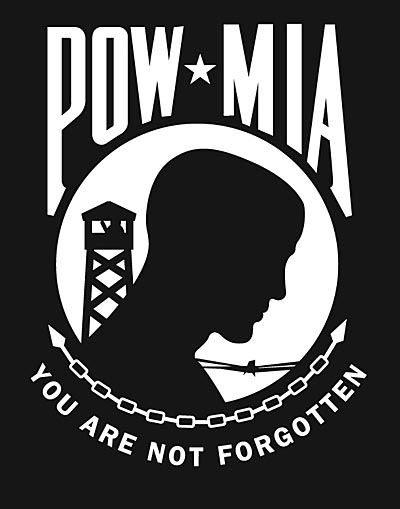
  5. The other day, I went to my local post office and saw the POW/MIA flag flying.  It got me to thinking: Who are the POWs/MIAs we need to remember today?  Don’t get me wrong.  As a retired military officer, I think we should remember America’s POWs and MIAs.  But I see no reason to fly flags everywhere to remind us of those veterans who were prisoners of war or missing in action.  Sadly, the POW/MIA flag is associated with conservative activism and reactionary views; it also can serve as a distraction from the enormous damage inflicted overseas by the U.S. military.  As Americans, we are constantly told by our leaders to focus on American victims of war; rarely if ever are we encouraged to think of war itself as a disaster, or to think of the victims on the receiving end of American firepower.

More on the POW/MIA issue: In the early 1990s, when I was a young captain, there were persistent rumors of American POWs who’d been deliberately left behind by our government.  These rumors were strong, so strong that the George H.W. Bush administration had to issue denials.

What are we to make of this?  One thing strikes me immediately: an often profound mistrust of our government exists within the military.  Our government has lied to us so often that some of my fellow officers believed it was lying again when it said there were no POWs remaining in Southeast Asia.  We just assumed our government was so wretched and dishonest that it would abandon our troops to their fate.

This is nearly 30 years ago but it’s stayed in my memory — the suspicion back then that those commie bastards still held U.S. troops and our own government was part of the cover-up.  (All those Chuck Norris and Rambo movies didn’t help matters.)

For more on this: The POW/MIA issue is still very much alive and is discussed by H. Bruce Franklin in his article,  “Missing in Action in the 21st Century,” available at hbrucefranklin.com.  As Franklin noted recently to me, “What we now think of as the Trump base was organized originally in this [POW/MIA] movement.”  Now that’s a fascinating comment.

What say you, readers?

America is a force for good …

W.J. Astore

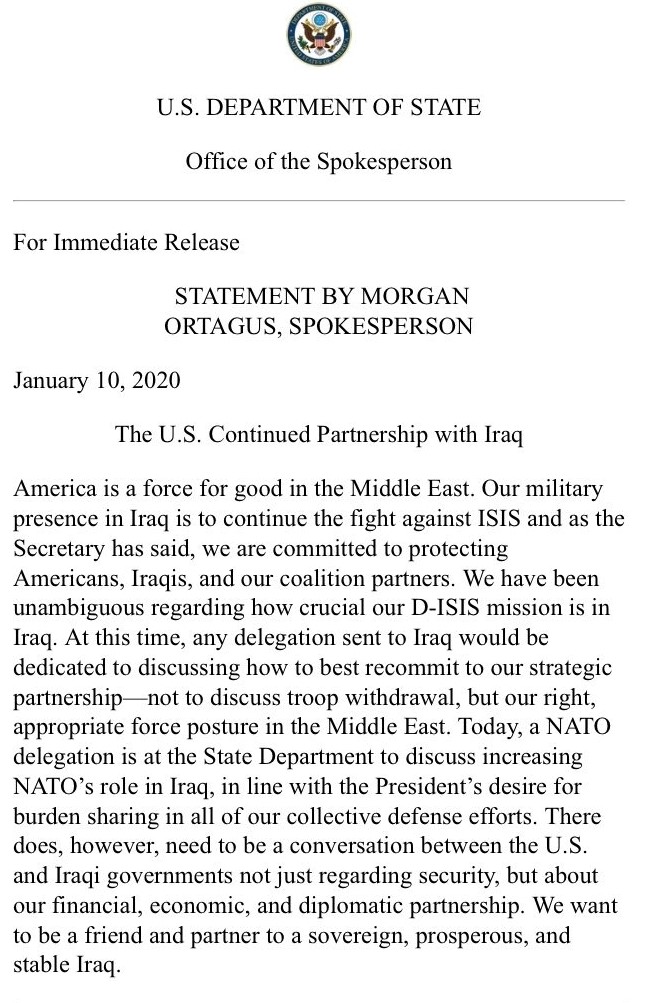
A friend sent along the following statement from the U.S. State Department:

IMG_0921

My Commentary:

Sovereignty is just fine, Iraqi people — as long as you do exactly what America says.  By the way, I thought ISIS was 100% eliminated, according to President Trump.

I’m sure the Iraqi government can’t wait to have this “conversation” with the U.S. government.  Note, however, that any “conversation” about withdrawing U.S. troops from Iraq is already forbidden.  So much for sovereignty!

Trump Wishes Peace to Iran while Accusing Democrats of Enabling Attacks on U.S. Troops

Trump US Iran, Washington, USA - 08 Jan 2020
Trump boasting of big missiles while denouncing Democrats

W.J. Astore

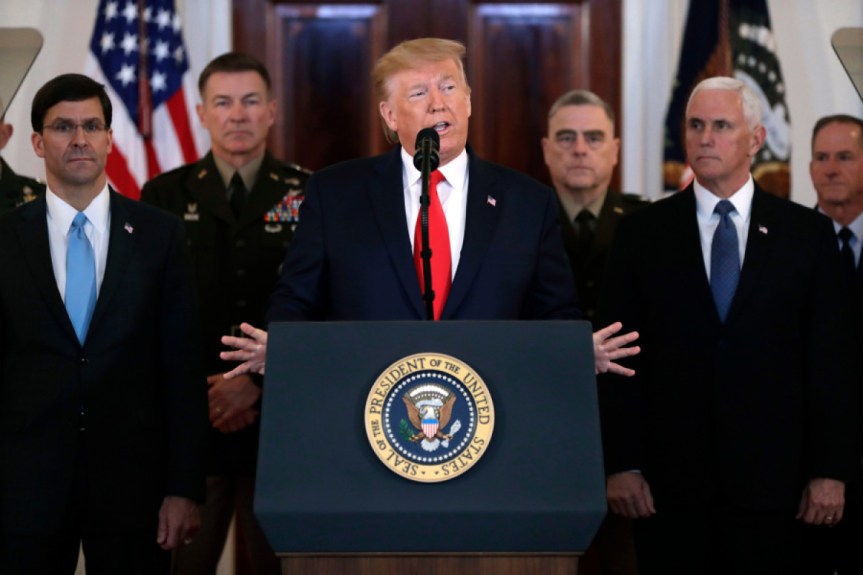
I watched Trump’s speech today to the nation on Iran.  It had the usual boasts about the U.S. military and its “big” and “lethal” missiles, the usual bombast, the usual lies.  But this passage of his speech truly struck me as beyond the pale:

Iran’s hostilities substantially increased after the foolish Iran nuclear deal was signed in 2013, and they were given 150 billion dollars, not to mention 1.8 billion dollars in cash. Instead of saying thank you to the United States, they chanted Death to America.

In fact, they chanted Death to America the day the agreement was signed. Then Iran went on a terrorist spree funded by the money from the deal and created hell in Yemen, Syria, Lebanon, Afghanistan, and Iraq. The missiles fired last night at us and our allies were paid for with the funds made available by the last administration.

That’s right: the missiles used against U.S. forces last night we’re paid for by the Obama administration.  Not only that: Iran went on a “terrorist spree” funded by the “foolish” Iran nuclear treaty, spreading “hell” throughout Yemen, Syria, Lebanon, Afghanistan, and Iraq.  I’m sure glad Saudi Arabia, Israel, the United States, and other military actors in the region never spread any “hell,” despite all those Hellfire missiles launched from American drones.

So here’s a new claim for you.  If the U.S. military is losing in Iraq and Afghanistan and elsewhere, the culprit is clear: the Obama administration and by extension the Democrats, the appeasers who funded Iran and made possible all of its “terrorist” activities.

Best of all, Trump wished peace and prosperity to the Iranian people, but you heard nothing about working peacefully and in prosperous ways with the Democrats.

Clearly, Trump sees the real enemy of America: Obama and the Democrats.

Ready for War with Iran?

The Trump administration has been spoiling for war with Iran almost since the election of 2016. This article, which I posted in the spring of 2017, makes this obvious. Now we have Trump’s decision to kill Iran’s top ranking general, Qassim Suleimani, which can only escalate an already tense situation in the region. Anything is possible here, including wider war and major economic disruptions.

A couple of years ago, I remember writing that it wouldn’t surprise me to see a conflict with Iran in 2020, timed to coincide with the presidential election. And I’m hardly the only one to have predicted this. Trump does not want to lose the election. The question is: What is he prepared to do to guarantee victory, if only in his own mind? Is he willing to risk a devastating war in the Middle East? And who will act to stop him?

Trump fancies himself a tough guy, and practices posing like Winston Churchill. With a Republican Party willing to rubber stamp his every action and impulse, and with a Democratic Party that eagerly issues blank checks to the Pentagon, who is to stop Trump from bellicose actions that could lead, yet again, to a disastrous war in the Middle East?

wjastore's avatarBracing Views

W.J. Astore

General Joseph Votel, U.S. Centcom commander, testified to the House Armed Services Committee this week that the greatest destabilizing force in the Middle East is Iran, and that the U.S. must be prepared to use “military means” to confront and defeat the Iranian threat to the region.

No doubt Iran is a pest to U.S. designs in the Middle East.  No doubt Iran has its own agenda. No doubt Iran is no friend to Israel.  But the greatest destabilizing force in the Greater Middle East?  That’s the USA.  We’re the ones who toppled Iraq in 2003, along with the legitimate government of Iran 50 years earlier.

Iran/Persia has lived in, and sometimes dominated, the Greater Middle East for 2500 years.  By comparison, the USA is a newcomer on the block. Yet it’s the Iranians who are the destabilizers, the ones operating in a nefarious “grey zone” between peace…

View original post 337 more words

Wars, Secrecy, and Lies

W.J. Astore

You know an American war is going poorly when the lies come swiftly, as with the Afghan War, or when it’s hidden under a cloak of secrecy, which is also increasingly true of the Afghan War.

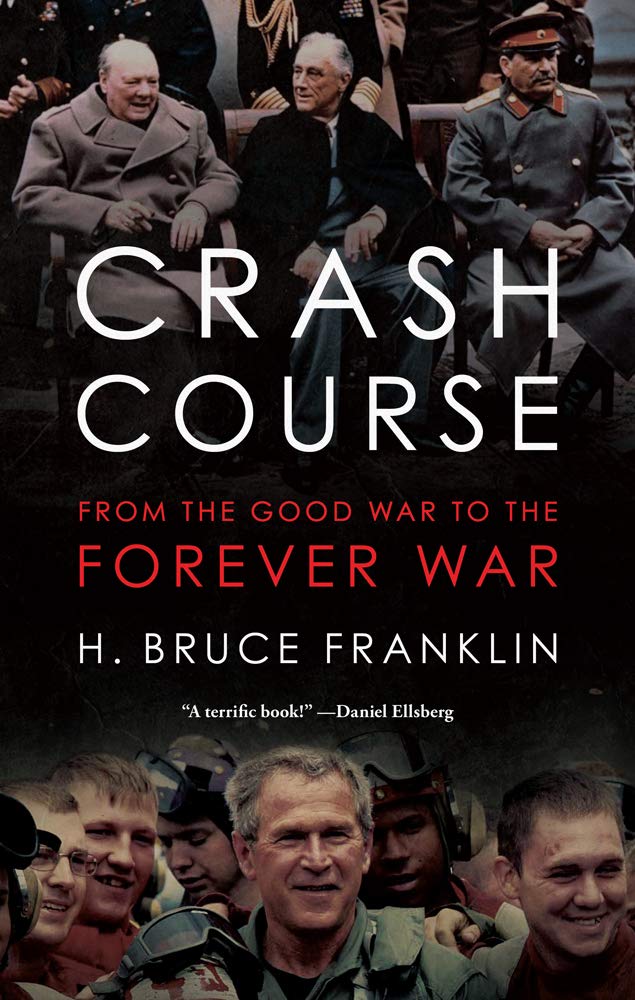
This is nothing new, of course.  Perhaps the best book I read in 2019 is H. Bruce Franklin’s Crash Course: From the Good War to the Forever War.  Franklin, who served in the U.S. Air Force in the 1950s before becoming an English professor, cultural historian, and an outspoken opponent of the Vietnam War, is devastating in his critique of the military-industrial complex in this memoir.  I recommend it highly to all Americans who want to wrestle with tough truths.

Let’s consider one example: Franklin’s dismissal of the “stab-in-the-back” myth (or Rambo myth) that came out of the Vietnam War.  This was the idea the U.S. military could have won in Vietnam, and was indeed close to winning, only to be betrayed by weak-kneed politicians and the anti-war movement.

Franklin demolishes this argument in a paragraph that is worth reading again and again:

One widespread cultural fantasy about the Vietnam War blames the antiwar movement for forcing the military to “fight with one arm tied behind its back.”  But this belief stands reality on its head.  The American people, disgusted and angry about the Korean War, were in no mood to support a war in Vietnam.  Staunch domestic opposition kept Washington from going in overtly.  So it went covertly.  It thereby committed itself to a policy based on deception, sneaking around, and hiding its actions from the American people.  The U.S. government thus created the internal nemesis of its own war: the antiwar movement.  That movement was inspired and empowered not just by our outrage against the war [but] also by the lies about the war, lies necessitated by the war, coming from our government and propagated by the media.  Although it was the Vietnamese who defeated the United States, ultimately it was the antiwar movement, especially within the armed forces, that finally in 1973 forced Washington to accept, at long last, the terms of the 1954 Geneva Accords, and to sign a peace treaty that included, word for word, every major demand made by the National Liberation Front (the so-called Viet Cong) back in 1969…

The truth was that for three decades our nation had sponsored and then waged a genocidal war against a people and a nation that had never done anything to us except ask for our friendship and support [during and after World War II].

61Qv9KVJn-L

This is well and strongly put.  The American people had no interest in intervening in Vietnam in the 1950s; the Korean debacle had been enough.  But the U.S. government intervened anyway, lying about its involvement until it could no longer lie.  Then a bigger lie was concocted, the Gulf of Tonkin incident, to justify a larger commitment of troops in the mid-1960s, which led to near-genocidal destruction in Vietnam.

Wars built on lies are rarely won, especially in a democracy.  But even as they are lost (Vietnam in the 1960s, and now Afghanistan), there are always “winners.”  Weapons contractors and other war profiteers.  The Pentagon, which from war gains more money and more power.  And authoritarian elements within society itself, which are reinforced by war.

If we wish to take our democracy back, a powerful first step is to end all American wars overseas.  This would not be isolationism; this would be sanity.

Wars, secrecy, and lies are three big enemies of democracy. Maybe the big three. War suppresses thought and supports authoritarianism. Secrecy prevents accountability. Lies mislead the people. And that’s what we have today. Constant warfare. Secrecy, e.g. reports on “progress” in the Afghan War are now classified and no longer shared. Lies are rampant; indeed, lies are policy. Just look at the Afghan Papers.

Yet wars, secrecy, and lies have been incredibly successful. The Pentagon budget is booming! Weapons sales are exploding! No one is being held accountable for failures or war crimes. Indeed, convicted war criminals are absolved and touted as heroes by the president.

The solution is as obvious as it will be painful. We need peace, transparency, and truth. End the wars, declassify all those “secrets” we the people should know about our military and wars, and reward truth-tellers instead of punishing them.

Top Stories of U.S. Foreign Policy in 2019

download
What happened to Afghanistan and all that lying about progress?

W.J. Astore

According to FP: Foreign Policy, these are the top five stories in U.S. foreign policy in 2019.  I’ve inserted quick comments at the end in bold:

1. U.S. and Turkey Lock Horns Over Syria.

“U.S. support to the Syrian Democratic Forces has long angered Turkey, a NATO ally which views the Kurdish-led group as a terrorist threat … But in a fateful October phone call, Turkish President Recep Tayyip Erdogan repeated his longtime threat to launch a cross-border invasion. This time Trump capitulated, moving a handful of U.S. troops so the Turks could begin the assault against the Kurds … Hundreds have been killed and roughly 200,000 people were displaced.”

Comment: Syria is not a vital U.S. interest.  U.S. forces shouldn’t be there.  And who are these “democratic forces” of Syria?

2. Trump Impeached Over Ukraine Scandal.

“Trump’s efforts to pressure Ukraine into investigating a Democratic rival this year led to the third impeachment of a U.S. president in history, thrusting Washington’s national security apparatus into the spotlight.”

Comment: The U.S. shouldn’t be meddling in Ukraine.  And we shouldn’t be sending more weapons there.  I sure as hell don’t want my taxpayer dollars going to weapons for Ukraine.

3. North Korea Talks Sputter and Stall.

“The historic nuclear talks between Trump and North Korean Supreme Leader Kim Jong Un in 2018 offered hope that the two countries could de-escalate tensions and prevent a nuclear confrontation. Talks stalled after the Singapore Summit in June 2018. While both sides made significant verbal commitments in 2019, the year saw a gradual deterioration of bilateral relations.”

Comment: North Korea isn’t giving up its nuclear weapons.  The North Koreans saw what happened to Gaddafi in Libya when he gave up his WMD.  Plus nuclear weapons and missiles are a prestige project for Kim Jong-un, who’s played Trump like a fiddle.

4. Iran Strikes Back.

“Tensions between Iran and the United States skyrocketed in 2019, as the U.S. maximum pressure campaign took effect and Tehran lashed out against harsh U.S. sanctions. (Trump withdrew from the 2015 nuclear deal in 2018.) … Attacks have ceased in recent weeks as Tehran launched a brutal crackdown on the worst political unrest the country has seen since the Islamic Revolution 40 years ago. But U.S. officials are bracing for another devastating strike in the region, this time perhaps targeting the region’s critical sources of drinking water.”

Comment: Harsh U.S. sanctions are an act of war — or at least we’d see them that way if the roles were reversed.  And why is Iran always seen as the aggressor capable of launching “devastating” strikes?

5. Venezuela Crisis Simmers.

“Venezuela’s Russia-backed leader Nicolás Maduro clung to power this year despite an economic collapse, nationwide blackouts and fierce opposition from Juan Guaidó, who declared himself Venezuela’s interim president in January with support from the West. Tensions threatened to boil over in May, when Guaidó tried and failed to ignite an uprising.  The attempted coup was seen as an embarrassing failure by the United States and particularly National Security Advisor John Bolton, reportedly the architect of multiple attempts to unseat Maduro. In addition to harsh sanctions, the United States went so far as to draw up military options, but never took any action.”

Comment: Looks like Bolton takes the fall for inept U.S. meddling in Venezuela.  Guess what?  It’s all about the oil — and the money.

Of course, FP: Foreign Policy missed the biggest story of 2019: Consistent, extensive, and persistent lying by U.S. leaders about the course of the Afghan War, as revealed by the “Afghan Papers” published by the Washington Post.

Readers — what do you think about this list?  In the holiday spirit, I see much naughtiness here, and no niceness.  Santa won’t be pleased.

Rewarding the Pentagon for Lying

what
Nothing to see here, people!

W.J. Astore

The Afghan Papers have revealed widespread, systemic, and enduring lying about the course and progress of the Afghan War by U.S. military and civilian leaders.  So, what’s the punishment for all this lying?  Record-setting Pentagon budgets!  The more they lie, the more money they get.  Is it any wonder why these wars persist, without apparent end, when no one is punished for lies that lead to the death of American troops (not forgetting all the foreign innocents who are killed and wounded because of these lies)?

This may seem hard to believe, but “Integrity First” is the fundamental core value of the U.S. Air Force.  But what happens when the system is revealed to have no integrity? When the system sends young Americans to die in a lost war, a war that our most senior leaders have lied about since almost the very beginning?

I know we’re all jaded and cynical, but this is a monstrous failure, a horrendous betrayal of trust.

The entire military leadership at the top should be gutted. Anyone implicated in these lies, distortions, etc. should be cashiered. That’s what a real president and commander-in-chief would do. Heads should roll!

But the Pentagon prefers to obfuscate and pretend that the Afghan Papers are old news, and pretty much meaningless at that.  Meanwhile, fake tough guy Trump (along with the Congress) kowtows to the Pentagon, giving the generals everything they want as next year’s Pentagon budget soars to $738 billion, including money for a “Space Force,” among many other boondoggles.

Endless self-serving lies rewarded by scads of money — small wonder that America’s wars persist without end.

Troop “Reduction” in Afghanistan!

DH0-1MJXYAISyrp
Photo that allegedly persuaded Trump that Afghanistan wasn’t a lost cause

W.J. Astore

Trump was elected president in 2016 partly because he railed against America’s wasteful wars.  So, what did his advisers talk him into?  A mini-surge of troops to Afghanistan.  I still recall the odd news of Trump being shown photos of Afghan women in skirts (vintage 1972) to convince him that westernization and modernization of Afghanistan was possible.

Several thousand additional U.S. troops were sent to Afghanistan in 2017, predictably achieving nothing of note.  A little more than two years later, we have another item of “big” news today, according to CNN:

The Trump Administration is preparing to announce a long-awaited reduction of US troops in Afghanistan, a senior administration official confirmed to CNN. There are between 12,000 and 13,000 US troops in the country right now, and the US has maintained a solid presence throughout the 18-year war in the area. This drawdown would remove up to 4,000 troops, with more possible reductions in the future, the official said. That matches the claim Trump made on Fox News Radio in August that his administration would take the number “down to 8,600.” The reduction comes at the same time the US is restarting peace talks with the Taliban, and some worry the troop drawdown could be seen as a concession to the terrorist group.

Where to begin with this CNN snippet?

  1.  The “reduction” is not a reduction but a return to previous troop levels at the end of the Obama administration.
  2. The U.S. “has maintained a solid presence”?  Good god.  You’d never know about all the bombing, droning, and killing the U.S. has done over the last 18+ years.  Or is that the “solid presence” we’ve been maintaining?
  3. The troop “drawdown” as a “concession” to the Taliban?  Guess what: The Taliban aren’t going anywhere, and they’re winning.  A few thousand U.S. troops, either as a “plus-up” or “drawdown,” have had and will have no impact on the reality on the ground.

Sometimes I don’t know whether to laugh, cry, or do both.  Perhaps my dad put it best: “We laugh to hide the tears.”

Update (12/17): Speaking of laughing to hide the tears, the Pentagon has responded to the systematic lying revealed by the so-called Afghan Papers.  It won’t surprise you the response consists of three artless dodges:

  1. We’re looking forward, not backward!
  2. This is all old news.
  3. Nothing to see here, move along.

I kid you not.