Seven Reasons Why We Can’t Stop Making War (2010)

W.J. Astore

From Boots on the Ground to Robot Assassins in the Sky

I’m proud to say I’ve been writing for TomDispatch since 2007, posting more than 100 original articles at the site. Among the many features of that remarkable site, run by Tom Engelhardt, this generation’s I.F. Stone, is its reach across political spectrums, across America, and indeed across the globe. My most recent article, for example, was translated into Portuguese (for a Brazilian site) and Swedish. Tom and I usually aren’t contacted for permission; these translations and postings just happen.

Briefly in 2010, a few of my “tomgrams” broke through to the mainstream media, being reposted by CBS News. What follows is one of them, “Seven Reasons Why We Can’t Stop Making War,” in which I refer to a disaster of that day, the BP Deepwater Horizon oil spill.

Sadly, despite a little boost from CBS News, my critique went unheeded. Surprise! America is still making war (with certain entities profiting greatly from this), now with yet more robots even as U.S. boots on ground in direct combat are far fewer. It’s a formula for “low-cost” forever war that of course comes at a very high cost indeed, starting with a Pentagon budget soaring toward $900 billion a year, not including more than $120 billion already provided or promised to Ukraine for its war effort.

From CBS News in 2010, my article on why the U.S. can’t stop making war. The original title was “Operation Enduring War” at TomDispatch in July 2010.

If one quality characterizes our wars today, it’s their endurance.  They never seem to end. 

Though war itself may not be an American inevitability, these days many factors combine to make constant war an American near certainty.  Put metaphorically, our nation’s pursuit of war taps so many wellsprings of our behavior that a concerted effort to cap it would dwarf BP’s efforts in the Gulf of Mexico.

Our political leaders, the media, and the military interpret enduring war as a measure of our national fitness, our global power, our grit in the face of eternal danger, and our seriousness.  A desire to de-escalate and withdraw, on the other hand, is invariably seen as cut-and-run appeasement and discounted as weakness.  Withdrawal options are, in a pet phrase of Washington elites, invariably “off the table” when global policy is at stake, as was true during the Obama administration’s full-scale reconsideration of the Afghan war in the fall of 2009.  Viewed in this light, the president’s ultimate decision to surge in Afghanistan was not only predictable, but the only course considered suitable for an American war leader. Rather than the tough choice, it was the path of least resistance.

Why do our elites so readily and regularly give war, not peace, a chance?  What exactly are the wellsprings of Washington’s (and America’s) behavior when it comes to war and preparations for more of the same?

Consider these seven:

1.  We wage war because we think we’re good at it — and because, at a gut level, we’ve come to believe that American wars can bring good to others (hence our feel-good names for them, like Operations Enduring Freedom and Iraqi Freedom). Most Americans are not only convinced we have the best troops, the best training, and the most advanced weapons, but also the purest motives.  Unlike the bad guys and the barbarians out there in the global marketplace of death, our warriors and warfightersare seen as gift-givers and freedom-bringers, not as death-dealers and resource-exploiters.  Our illusions about the military we “support” serve as catalyst for, and apology for, the persistent war-making we condone.

2.  We wage war because we’ve already devoted so many of our resources to it.  It’s what we’re most prepared to do.  More than half of discretionary federal spending goes to fund our military and its war making or war preparations.  The military-industrial complex is a well-oiled, extremely profitable machine and the armed forces, our favorite child, the one we’ve lavished the most resources and praise upon.  It’s natural to give your favorite child free rein.

3.  We’ve managed to isolate war’s physical and emotional costs, leaving them on the shoulders of a tiny minority of Americans.  By eliminating the draft and relying ever more on for-profit private military contractors, we’ve made war a distant abstractionfor most Americans, who can choose to consume it as spectacle or simply tune it out as so much background noise.

4.  While war and its costs have, to date, been kept at arm’s length, American society has been militarizing fast.  Our media outlets, intelligence agencies, politicians, foreign policy establishment, and “homeland security” bureaucracy are so intertwined with military priorities and agendas as to be inseparable from them.  In militarized America, griping about soft-hearted tactics or the outspokenness of a certain general may be tolerated, but forceful criticism of our military or our wars is still treated as deviant and “un-American.”

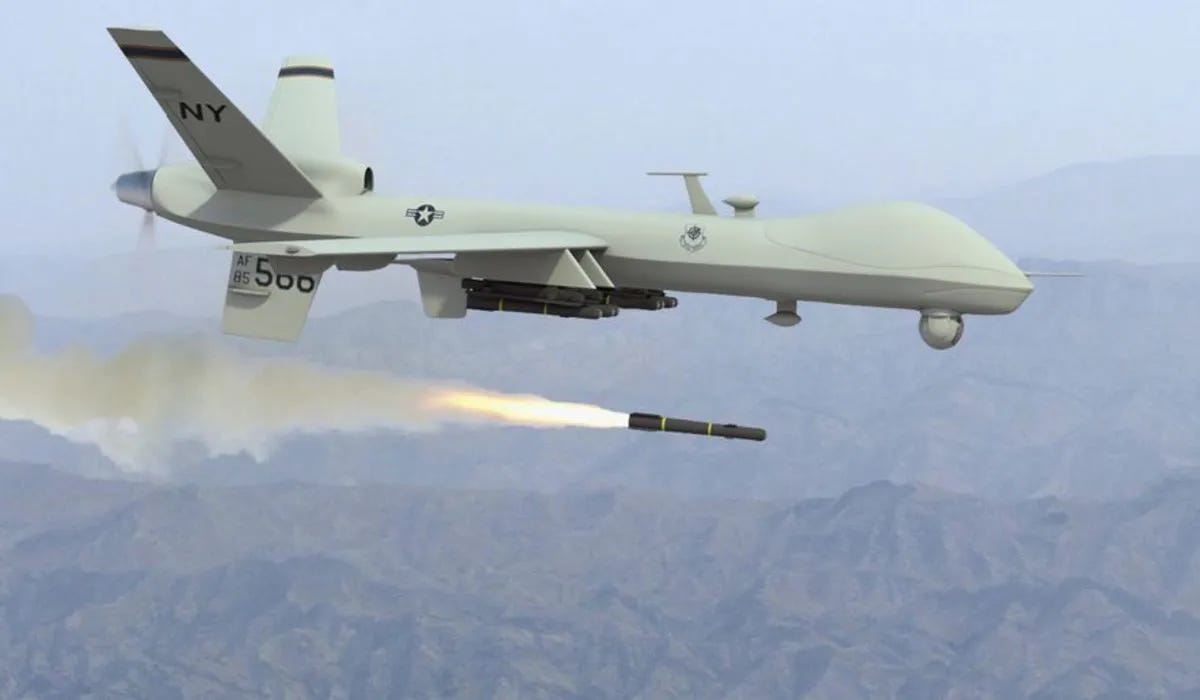
5.  Our profligate, high-tech approach to war, including those Predator and Reaper drones armed with Hellfire missiles, has served to limit American casualties — and so has limited the anger over, and harsh questioning of, our wars that might go with them.  While the U.S. has had more than 1,000 troops killed in Afghanistan, over a similar period in Vietnam we lost more than 58,000 troops.  Improved medical evacuation and trauma care, greater reliance on standoff precision weaponry and similar “force multipliers,” stronger emphasis on “force protection” within American military units: all these and more have helped tamp down concern about the immeasurable and soaring costs of our wars.

It all seems so easy—even “clean”—from the sky. Not even a single U.S. pilot at risk.

6.  As we incessantly develop those force-multiplying weapons to give us our “edge” (though never an edge that leads to victory), it’s hardly surprising that the U.S. has come to dominate, if not quite monopolize, the global arms trade.  In these years, as American jobs were outsourced or simply disappeared in the Great Recession, armaments have been one of our few growth industries.  Endless war has proven endlessly profitable — not perhaps for all of us, but certainly for those in the business of war.

7.  And don’t forget the seductive power of beyond-worse-case, doomsday scenarios, of the prophecies of pundits and so-called experts, who regularly tell us that, bad as our wars may be, doing anything to end them would be far worse.  A typical scenario goes like this: If we withdraw from Afghanistan, the government of Hamid Karzai will collapse, the Taliban will surge to victory, al-Qaeda will pour into Afghan safe havens, and Pakistan will be further destabilized, its atomic bombs falling into the hands of terrorists out to destroy Peoria and Orlando.

Such fevered nightmares, impossible to disprove, may be conjured at any moment to scare critics into silence.  They are a convenient bogeyman, leaving us cowering as we send our superman military out to save us (and the world as well), while preserving our right to visit the mall and travel to Disney World without being nuked.

The truth is that no one really knows what would happen if the U.S. disengaged from Afghanistan.  But we do know what’s happening now, with us fully engaged: we’re pursuing a war that’s costing us nearly $7 billion a month that we’re not winning (and that’s arguably unwinnable), a war that may be increasing the chances of another 9/11, rather than decreasing them.

Capping the Wellsprings of War

Each one of these seven wellsprings feeding our enduring wars must be capped.  So here are seven suggestions for the sort of “caps” — hopefully more effective than BP’s flailing improvisations — we need to install:

1.  Let’s reject the idea that war is either admirable or good — and in the process, remind ourselves that others often see us as “the foreign fighters” and profligate war consumers who kill innocents (despite our efforts to apply deadly force in surgically precise ways reflecting “courageous restraint“).

2.  Let’s cut defense spending now, and reduce the global “mission” that goes with it.  Set a reasonable goal — a 6-8% reduction annually for the next 10 years, until levels of defense spending are at least back to where they were before 9/11 — and then stick to it.

3.  Let’s stop privatizing war.  Creating ever more profitable incentives for war was always a ludicrous idea.  It’s time to make war a non-profit, last-resort activity.  And let’s revive national service (including elective military service) for all young adults.  What we need is a revived civilian conservation corps, not a new civilian “expeditionary” force.

4. Let’s reverse the militarization of so many dimensions of our society.  To cite one example, it’s time to empower truly independent (non-embedded) journalists to cover our wars, and stop relying on retired generals and admirals who led our previous wars to be our media guides.  Men who are beholden to their former service branch or the current defense contractor who employs them can hardly be trusted to be critical and unbiased guides to future conflicts.

5.  Let’s recognize that expensive high-tech weapons systems are not war-winners.  They’ve kept us in the game without yielding decisive results — unless you measure “results” in terms of cost overruns and burgeoning federal budget deficits.

6.  Let’s retool our economy and reinvest our money, moving it out of the military-industrial complex and into strengthening our anemic system of mass transit, our crumbling infrastructure, and alternative energy technology.  We need high-speed rail, safer roads and bridges, and more wind turbines, not more overpriced jet fighters.

7.  Finally, let’s banish nightmare scenarios from our minds.  The world is scary enough without forever imagining smoking guns morphing into mushroom clouds.

There you have it: my seven “caps” to contain our gushing support for permanent war. 

No one said it would be easy.  Just ask BP how easy it is to cap one out-of-control gusher.

Nonetheless, if we as a society aren’t willing to work hard for actual change — indeed, to demand it — we’ll be on that military escalatory curve until we implode.  And that way madness lies.

The opinions expressed in this commentary are solely those of the author.

By William J. Astore (2010)

Bonus Lesson (2023): “Enduring war” is not consistent with “enduring freedom.” Who knew? And we do seem as a society to be closer to implosion, a prediction I very much hope I’m ultimately proven wrong about.

Junior ROTC Shouldn’t Exist

W.J. Astore

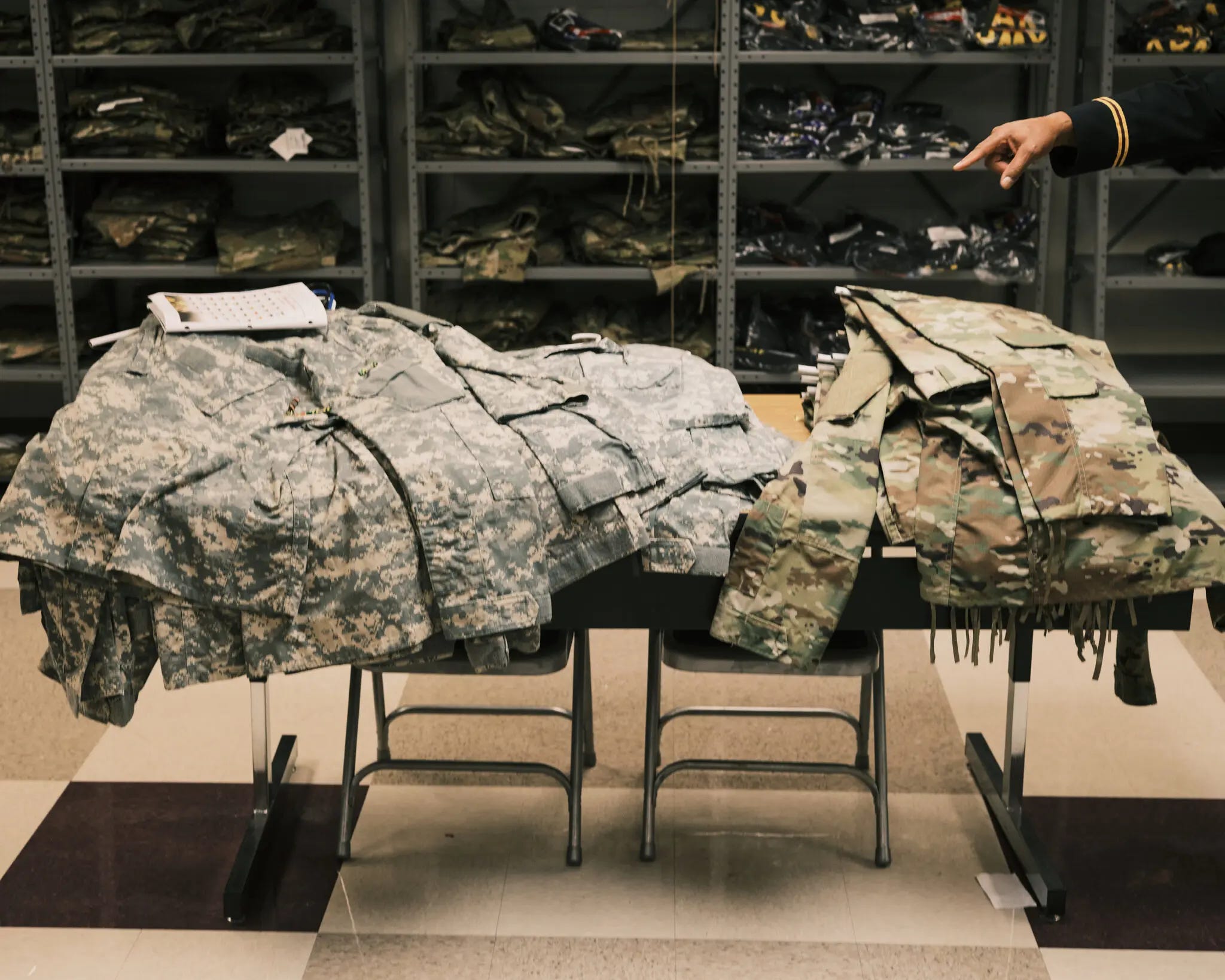
High school students shouldn’t be wearing military uniforms

I entered the Air Force through ROTC and served for 20 years, retiring as a lieutenant colonel.  I also taught for 15 years at both military and civilian colleges.  As a retired military officer and as an educator, perhaps I have some standing on the issue of Junior ROTC in our nation’s high schools. So, to put it bluntly:

  • High school students, in my opinion, are too young to decide to wear a military uniform.  In short, I believe JROTC is inappropriate.
  • Many veterans involved in JROTC in our nation’s schools lack experience and qualifications in education.
  • The U.S. military is already glorified in our culture and society.  Its dominance of American institutions is undeniable.  That dominance should not extend into America’s high schools.
Combat uniforms wait patiently for fresh high school bodies (Zack Wittman for the NYT) 

A friend with experience in JROTC alerted me to notable shifts in the program’s mission and organization, especially since the 9/11 attacks. In the past, JROTC had focused on leadership and civics while being overseen by civilian directors. In the 1990s, the director of JROTC for the Air Force was a civilian with a doctorate in education. The current director of AF JROTC is an active-duty colonel with no experience in education, though he has an MBA and a master’s in strategic studies. (His deputy is a retired colonel who similarly lacks credentials in education.)

Over the past 20 years or so, JROTC has increasingly been militarized and used as a feeder for military recruitment, despite disclaimers that it is “not an accessions program.” High schools are enticed to support JROTC with financial incentives such as subsidized (read: low-cost) instructors, veterans who often lack teaching credentials but who are willing to do grunt work at schools (monitoring lunchrooms, school exits, and the like). In return, the military gets access to young, impressionable students, the ultimate goal being recruitment of the same into the ranks.

JROTC, in sum, is now militarized. It’s more of a pipeline to military service as a “warrior” than a civics program that develops alert and knowledgeable citizens who may then decide freely to enlist as citizen-soldiers. Consider this change as yet another example of creeping fascism in America.

Put uncharitably, JROTC is preying on America’s youth.

Incredibly, students in some high schools today are being assigned automatically and involuntarily to JROTC classes, notes the New York Times. In a sense, 14- and 15-year-olds are being drafted into JROTC and trained by gung-ho veterans with virtually no experience in education.

And people say the draft died fifty years ago!

JROTC is in 3500 high schools across the nation, and, as the New York Times notes, has its highest enrollment numbers in areas where there’s “a large proportion of nonwhite students and those from low-income households.” To such students the military promises opportunity, an identity, and of course financial aid for college, enticing inducements indeed.

Again, students in JROTC don’t have to join the military upon graduation. They’re not dragooned into the ranks. But they are gradually enticed and subtly pressured into joining. The military doesn’t run JROTC programs for purely altruistic reasons.

Imagine, for a moment, the elimination of those 3500 JROTC programs. Or, better yet, a re-imagining and re-purposing of them. Why not make a true national service corps of teenagers in which military service is only one option among many? A national service corps that fosters civilian conservation, that offers options for fostering peace, that is focused on service within communal settings that is unrelated to wielding weapons while wearing battle dress uniforms. There are many ways, after all, to serve one’s community and country, ones that don’t involve military discipline and exposure to what concerned parents term “indoctrination.” 

Speaking for myself, I wasn’t ready to wear a military uniform when I was 14. When I was 18 and enlisted in ROTC, I’d graduated from high school. I (sort of) knew what I was doing and the true seriousness of the choice I had made.

Military service is far too serious to be inflicted on impressionable young teenagers. Let’s give our kids time to grow and mature before we start issuing them uniforms for battle. Better yet, let’s work to create a more peaceful world where there’s far less call for militaries, period.

(For more information on JROTC, see this recent panel discussion sponsored by Massachusetts Peace Action.)

The Pentagon’s National Defense Strategy

W.J. Astore

Bombs, Bullets, and Bellicosity Instead of Brains

In my latest article for TomDispatch.com, I parse the meaning of America’s latest National Defense Strategy. Hint: It’s not about defense.

More than two millennia ago, in the History of the Peloponnesian War, Thucydides recounted a disastrous conflict Athens waged against Sparta. A masterwork on strategy and war, the book is still taught at the U.S. Army War College and many other military institutions across the world. A passage from it describing an ultimatum Athens gave a weaker power has stayed with me all these years. And here it is, loosely translated from the Greek: “The strong do what they will and the weak suffer as they must.”

Recently, I read the latest National Defense Strategy, or NDS, issued in October 2022 by the Pentagon, and Thucydides’s ancient message, a warning as clear as it was undeniable, came to mind again. It summarized for me the true essence of that NDS: being strong, the United States does what it wants and weaker powers, of course, suffer as they must. Such a description runs contrary to the mythology of this country in which we invariably wage war not for our own imperial ends but to defend ourselves while advancing freedom and democracy. Recall that Athens, too, thought of itself as an enlightened democracy even as it waged its imperial war of dominance on the Peloponnesus. Athens lost that war, calamitously, but at least it did produce Thucydides, a military leader who became a historian and wrote all too bluntly about his country’s hubristic, ultimately fatal pursuit of hegemony.

Imperial military ambitions contributed disastrously to Athens’s exhaustion and ultimate collapse, a lesson completely foreign to U.S. strategists. Not surprisingly, then, you’ll find no such Thucydidean clarity in the latest NDS approved by Secretary of Defense Lloyd Austin. In place of that Greek historian’s probity and timeless lessons, the NDS represents an assault not just on the English language but on our very future. In it, a policy of failing imperial dominance is eternally disguised as democratic deterrence, while the greatest “strategic” effort of all goes (remarkably successfully) into justifying massive Pentagon budget increases. Given the sustained record of failures in this century for what still passes as the greatest military power on the planet — Afghanistan, Iraq, and Libya, of course, but don’t forget SomaliaSyriaYemen, and indeed the entire $8 trillion Global War on Terror in all its brutality — consider the NDS a rare recent “mission accomplished” moment. The 2023 baseline “defense” budget now sits at $858 billion, $45 billion more than even the Biden administration requested.

With that yearly budget climbing toward a trillion dollars (or more) annually, it’s easy to conclude that, at least when it comes to our military, nothing succeeds like failure. And, by the way, that not only applies to wars lost at a staggering cost but also financial audits blown without penalty. After all, the Pentagon only recently failed its fifth audit in a row. With money always overflowing, no matter how it may be spent, one thing seems guaranteed: some future American Thucydides will have the material to produce a volume or volumes beyond compare. Of course, whether this country goes the way of Athens — defeat driven by military exhaustion exacerbated by the betrayal of its supposedly deepest ideals leading to an ultimate collapse — remains to be seen. Still, given that America’s war colleges continue to assign Thucydides, no one can say that our military and future NDS writers didn’t get fair warning when it comes to what likely awaits them.

Bludgeoning America with Bureaucratese

If you can’t dazzle them with brilliance, baffle them with BS.

That’s a saying I learned early in my career as an Air Force officer, so I wasn’t exactly surprised to discover that it’s the NDS’s guiding philosophy. The document has an almost Alice in Wonderland-like quality to it as words and phrases take on new meanings. China, you won’t be surprised to learn, is a “pacing challenge” to U.S. security concerns; Russia, an “acute threat” to America due to its “unprovoked, unjust, and reckless invasion of Ukraine” and other forms of “irresponsible behavior”; and building “combat-credible forces” within a “defense ecosystem” is a major Pentagon goal, along with continuing “investments in mature, high-value assets” (like defective aircraft carriers, ultra-expensive bombers and fighter jets, and doomsday-promising new ICBMs).

Much talk is included about “leveraging” those “assets,” “risk mitigation,” and even “cost imposition,” a strange euphemism for bombing, killing, or otherwise inflicting pain on our enemies. Worse yet, there’s so much financial- and business-speak in the document that it’s hard not to wonder whether its authors don’t already have at least one foot in the revolving door that could, on their retirement from the military, swing them onto the corporate boards of major defense contractors like Boeing and Raytheon.

Perhaps my favorite redefined concept in that NDS lurks in the word “campaigning.” In the old days, armies fought campaigns in the field and generals like Frederick the Great or Napoleon truly came to know the price of them in blood and treasure. Unlike U.S. generals since 1945, they also knew the meaning of victory, as well as defeat. Perish the thought of that kind of campaigning now. The NDS redefines it, almost satirically, not to say incomprehensibly, as “the conduct and sequencing of logically-linked military initiatives aimed at advancing well-defined, strategy-aligned priorities over time.” Huh?

Campaigning, explains the cover letter signed by Secretary of Defense Austin (who won’t be mistaken for Frederick II in his bluntness or Napoleon in his military acuity), “is not business as usual — it is the deliberate effort to synchronize the [Defense] Department’s activities and investments to aggregate focus and resources to shift conditions in our favor.”

Got it? Good!

Of course, who knows what such impenetrable jargon really means to our military in 2023? This former military officer certainly prefers the plain and honest language of Thucydides. In his terms, America, the strong, intends to do what it will in the world to preserve and extend “conditions in our favor,” as the NDS puts it — a measure by which this country has failed dismally in this century. Weaker countries, especially those that are “irresponsible,” must simply suffer. If they resist, they must be prepared for some “cost imposition” events exercised by our “combat-credible forces.” Included in those are America’s “ultimate backstop” of cost imposition… gulp, its nuclear forces.

Again, the NDS is worthy of close reading (however pain-inducing that may be) precisely because the secretary of defense does claim that it’s his “preeminent guidance document.” I assume he’s not kidding about that, though I wish he were. To me, that document is to guidance as nuclear missiles are to “backstops.” If that last comparison is jarring, I challenge you to read it and then try to think or write clearly.

Bringing Clarity to America’s Military Strategy

To save you the trauma of even paging through the NDS, let me try to summarize it quickly in my version — if not the Pentagon’s — of English:

  1. China is the major threat to America on this planet.
  2. Russia, however, is a serious threat in Europe.
  3. The War on Terror continues to hum along successfully, even if at a significantly lower level.
  4. North Korea and Iran remain threats, mainly due to the first’s growing nuclear arsenal and the second’s supposed nuclear aspirations.
  5. Climate change, pandemics, and cyberwar must also be factored in as “transboundary challenges.”

“Deterrence” is frequently used as a cloak for the planetary dominance the Pentagon continues to dream of. Our military must remain beyond super-strong (and wildly overfunded) to deter nations and entities from striking “the homeland.” There’s also lots of talk about global challenges to be met, risks to be managed, “gray zone” methods to be employed, and references aplenty to “kinetic action” (combat, in case your translator isn’t working) and what’s known as “exploitable asymmetries.”

Count on one thing: whatever our disasters in the real world, nobody is going to beat America in the jargon war.

Missing in the NDS — and no surprise here — is any sense that war is humanity’s worst pastime. Even the mass murder implicit in nuclear weapons is glossed over. The harshest realities of conflict, nuclear war included, and the need to do anything in our power to prevent them, naturally go unmentioned. The very banality of the document serves to mask a key reality of our world: that Americans fund nothing as religiously as war, that most withering of evils.

Perhaps it’s not quite the banality of evil, to cite the telling phrase political philosopher Hannah Arendt used to describe the thoughts of the deskbound mass-murderers of the Holocaust, but it does have all of war’s brutality expunged from it. As we stare into the abyss, the NDS replies with mind-numbing phrases and terms that wouldn’t be out of place in a corporate report on rising profits and market dominance.

Yet as the military-industrial complex maneuvers and plots to become ever bigger, ever better funded, and ever more powerful, abetted by a Congress seemingly lustful for ever more military spending and weapons exports, hope for international cooperation, productive diplomacy, and democracy withers. Here, for instance, are a few of the things you’ll never see mentioned in this NDS:

  1. Any suggestion that the Pentagon budget might be reduced. Ever.
  2. Any suggestion that the U.S. military’s mission or “footprint” should be downsized in any way at all.
  3. Any acknowledgement that the U.S. and its allies spend far more on their militaries than “pacing challengers” like China or “acute threats” like Russia.
  4. Any acknowledgment that the Pentagon’s budget is based not on deterrence but on dominance.
  5. Any acknowledgement that the U.S. military has been far less than dominant despite endless decades of massive military spending that produced lost or stalemated wars from Korea and Vietnam to Afghanistan and Iraq.
  6. Any suggestion that skilled diplomacy and common security could lead to greater cooperation or decreased tensions.
  7. Any serious talk of peace.

In brief, in that document and thanks to the staggering congressional funding that goes with it, America is being eternally spun back into an age of great-power rivalry, with Xi Jinping’s China taking the place of the old Soviet Union and Vladimir Putin’s Russia that of Mao Zedong’s China. Consistent with that retro-vision is the true end goal of the NDS: to eternally maximize the Pentagon budget and so the power and authority of the military-industrial-congressional complex.

Basically, any power that seeks to push back against the Pentagon’s vision of security through dominance is defined as a threat to be “deterred,” often in the most “kinetic” way. And the greatest threat of all, requiring the most “deterrence,” is, of course, China.

In a textbook case of strategic mirror-imaging, the Pentagon’s NDS sees that country and its People’s Liberation Army (PLA) as acting almost exactly like the U.S. military. And that simply cannot be allowed.

Here’s the relevant NDS passage:

“In addition to expanding its conventional forces, the PLA is rapidly advancing and integrating its space, counterspace, cyber, electronic, and information warfare capabilities to support its holistic approach to joint warfare. The PLA seeks to target the ability of the [U.S.] Joint Force to project power to defend vital U.S. interests and aid our Allies in a crisis or conflict. The PRC [China] is also expanding the PLA’s global footprint and working to establish a more robust overseas and basing infrastructure to allow it to project military power at greater distances. In parallel, the PRC is accelerating the modernization and expansion of its nuclear capabilities.”

How dare China become more like the United States! Only this country is allowed to aspire to “full-spectrum dominance” and global power, as manifested by its 750 military bases scattered around the world and its second-to-none, blue-water navy. Get back to thy place, China! Only “a free people devoted to democracy and the rule of law” can “sustain and strengthen an international system under threat.” China, you’ve been warned. Better not dare to keep pace with the U.S. of A. (And heaven forfend that, in a world overheating in a devastating way, the planet’s two greatestgreenhouse gas emitters should work together to prevent true catastrophe!)

Revisiting the Oath of Office

Being a retired U.S. military officer, I always come back to the oath of office I once swore to uphold: “To support and defend the Constitution of the United States against all enemies, foreign and domestic.” Naturally, if China, Russia, or any other country or entity attacks or otherwise directly menaces the U.S., I expect our military to defend this country with all due vigor.

That said, I don’t see China, Russia, or weaker countries like Iran or North Korea risking attacks against America proper, despite breathless talk of world “flashpoints.” Why would they, when any such attack would incur a devastating counterattack, possibly including America’s trusty “backstop,” its nuclear weapons?

In truth, the NDS is all about the further expansion of the U.S. global military mission. Contraction is a concept never to be heard. Yet reducing our military’s presence abroad isn’t synonymous with isolationism, nor, as has become ever more obvious in recent years, is an expansive military structure a fail-safe guarantor of freedom and democracy at home. Quite the opposite, constant warfare and preparations for more of it overseas have led not only to costly defeats, most recently in Afghanistan, but also to the increasing militarization of our society, a phenomenon reflected, for instance, in the more heavily armed and armored police forces across America.

The Pentagon’s NDS is a classic case of threat inflation cloaked in bureaucratese where the “facts” are fixed around a policy that encourages the incessant and inflationary growth of the military-industrial complex. In turn, that complex empowers and drives a “rules-based international order” in which America, as hegemon, makes the rules. Again, as Thucydides put it, the strong do what they will and the weak suffer as they must.

Yet, to paraphrase another old book, what does it profit a people to gain the whole world yet lose their very soul?  Like Athens before it, America was once a flawed democracy that nevertheless served as an inspiration to many because militarism, authoritarianism, and imperial pretense didn’t drive it. Today, this country is much like Thucydides’s Athens, projecting power ever-outwards in a misbegotten exercise to attain mastery through military supremacy.

It didn’t end well for Athens, nor will it for the United States.

The Madness of U.S. Militarism

W.J. Astore

Where are today’s Eisenhowers, Butlers, and Shoups?

As a teenager in the 1970s, I recall talking to my dad about fears of nuclear war between the United States and the Soviet Union. My dad took a broad view, suggesting that if U.S. and Soviet leaders were stupid enough to blow each other to smithereens, a billion Chinese people would be left to pick up the slack and move the world forward.

My dad was right about many things, but what he didn’t realize was that U.S. nuclear war plans (known as SIOPs) often called for the elimination of the USSR and China, even if China had had no involvement in events leading up to the war. Basically, the ruling U.S. nuclear war philosophy was: If you’re red, you’re dead.

Daniel Ellsberg wrote about this in his book, The Doomsday Machine. As I wrote in my review of that book:

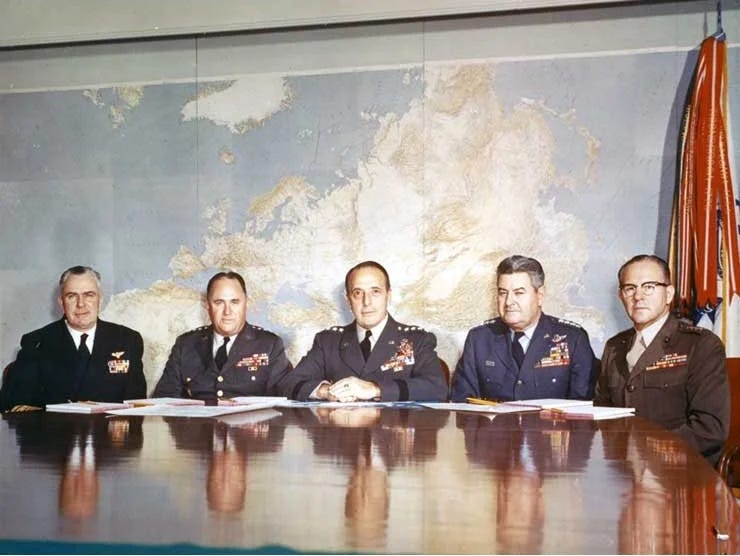
“U.S. nuclear war plans circa 1960 envisioned a simultaneous attack on the USSR and China that would generate 600 million deaths after six months.  As Ellsberg notes, that is 100 Holocausts.  This plan was to be used even if China hadn’t directly attacked the U.S., i.e. the USSR and China were lumped together as communist bad guys who had to be eliminated together in a general nuclear war.  Only one U.S. general present at the briefing objected to this idea: David M. Shoup, a Marine general and Medal of Honor winner, who also later objected to the Vietnam War.”

What’s truly startling is that only one U.S. military leader present, General David Shoup, objected to the SIOP that would lead to the death of 600 million people in six months. A decade later, scientists learned that such a huge nuclear exchange would likely cause a nuclear winter that would kill billions due to famine. Truly, the (few) living would envy the (many) dead.

Mention of David Shoup’s name leads me to this fine article: “The Marine Corps legend who tried to stop the Vietnam War,” by James Clark. Shoup was a remarkable American who helped to prevent the Cuban Missile Crisis of 1962 from escalating to a nuclear war. Once he retired from the Marines, he became a vocal opponent of the Vietnam War and militarism in general, a worthy successor to General Smedley Butler.

The Joint Chiefs in 1961. General Shoup is on the far right, next to General Curtis LeMay, architect of SAC and of a possible nuclear doomsday

I urge you to read Clark’s article on Shoup, who quotes Shoup’s hard-won wisdom here:

About the Vietnam War, Shoup said “I believe that if we had and would keep our dirty, bloody, dollar-crooked fingers out of the business of these nations so full of depressed, exploited people, they will arrive at a solution of their own.”

In the Atlantic Monthly, Shoup, echoing the warning of Eisenhower about the military-industrial complex, wrote bluntly about America’s war culture and its anti-democratic nature:

Somewhat like a religion, the basic appeals of anti-Communism, national defense and patriotism provide the foundation for a powerful creed upon which the defense establishment can build, grow, and justify its cost. More so than many large bureaucratic organizations, the defense establishment now devotes a large share of its efforts to self-perpetuation, to justifying its organizations, to preaching its doctrines, to self-maintenance and management.

You would think that a Medal of Honor recipient who’d proved his bravery and patriotism at Tarawa during World War II would be immune from charges of being unpatriotic or weak on defense, but you’d be wrong.

Where are today’s Shoups among the U.S. military brass? Where are the leaders who are against genocidal nuclear war and who are willing to speak out against it? Where are the leaders who reject a new cold war with China and Russia? Where are the leaders with the courage to advocate for peace whenever possible in place of more and more war?

Have we fallen so far under the spell of militarism that America no longer produces leaders like Dwight Eisenhower, Smedley Butler, and David Shoup, generals who truly knew war, despised it, and wanted above all to put an end to it?

A Peculiar Form of American Madness

W.J. Astore

Heroification of the military is a strange mindset for any self-avowed democracy

America is touched by a peculiar form of collective madness that sees military action as creative rather than destructive, desirable rather than deplorable, and constitutive to democracy rather than corrosive to it.

This madness, this hubris, this elevation or heroification of the military and war has to end, or it will most certainly end America, if not the world.

Related to this, America advances and sustains a historical narrative based on triumphalism, exceptionalism, and goodness. We Americans see total military dominance as something to crow about, even as we insist that it’s our birthright as “exceptional” Americans. This mindset, or Zeitgeist if you will, enables and empowers a national security state that easily consumes more than half of federal discretionary spending each year. As long as this mindset persists, the MICC or MICIMATT will persist and continue to grow in reach and power.

So that’s my first big step in taming the military-industrial-congressional-intelligence-media-academia-think-tank complex. America’s mindset, its culture, must change. Change the mindset and you begin to change the deference if not adulation granted to the MICIMATT.

Change the mindset, weaken the blob. That was what Dwight D. Eisenhower had in mind in his “Cross of Iron” speech in 1953.1 Our peculiar form of militarized madness is simply no way of life at all for democracy or for the planet.

It won’t be easy because we’re taught to salute the military and support “our” beloved troops. We’re taught that corporations like Boeing and Raytheon are job-creators, even citizens. We look to Congress to represent us, even as its members thrive on corporate campaign contributions (bribes) while genuflecting to the generals and admirals. We look to the media for news and information even as those outlets are fueled by advertising dollars from companies like Boeing, if not owned by them. We look to “liberal” academia for new ideas even as colleges and universities compete for Pentagon research and development dollars. We look to think tanks for fresh approaches even as they’re funded by weapons contractors.

Under these conditions, it’s not surprising that the U.S. no longer sees peace as possible or even as desirable. Peace is rarely mentioned by U.S. political candidates or by the mainstream media. War is simply taken for granted; even worse, it’s seen as the health of the state.

That war is now seen as the health of the state is indeed a peculiar form of American madness. As the Christmas season approaches, is it too much to ask for sanity as in peace on earth and good will toward all?

1

Ike’s “Cross of Iron” speech in 1953 was brilliant in its clarity and power. Can you imagine any U.S. politician saying these words today?

“Every gun that is made, every warship launched, every rocket fired signifies, in the final sense, a theft from those who hunger and are not fed, those who are cold and are not clothed.

This world in arms is not spending money alone. It is spending the sweat of its laborers, the genius of its scientists, the hopes of its children. The cost of one modern heavy bomber is this: a modern brick school in more than 30 cities.  It is two electric power plants, each serving a town of 60,000 population. It is two fine, fully equipped hospitals. It is some fifty miles of concrete pavement. We pay for a single fighter plane with a half million bushels of wheat. We pay for a single destroyer with new homes that could have housed more than 8,000 people.

This is, I repeat, the best way of life to be found on the road the world has been taking. This is not a way of life at all, in any true sense. Under the cloud of threatening war, it is humanity hanging from a cross of iron.”

Militarism Run Mad

W.J. Astore

Remember President Biden’s request for $33 billion in “aid” to Ukraine? That $33 billion package has become $40 billion and has already been approved by the House. More than half of this “aid” is in the form of weapons or in support of deploying more U.S. troops and equipment to Europe. And even that $40 billion isn’t high enough for some members of the Senate, who are calling for even more “aid,” i.e. more spending at the expense of the American taxpayer that will likely serve to prolong the Russia-Ukraine War.

More and more money for war recalls a famous quip by Winston Churchill in the age of navalism, when industrial interests in the UK pushed for more and more battleships to be built so that Britain could continue to rule the waves and not be slaves.

As Churchill famously said: The Admiralty had demanded six ships; the economists offered four; and we finally compromised on eight.

America has embraced a militarized Keynesianism that is very good indeed for weapons makers like Raytheon and Lockheed Martin. It’s also very good for the Pentagon, whose budget projections keep rising when they should be falling.

Think about it. Overall, the Russian military hasn’t yet distinguished itself in Ukraine, and the longer the war lasts, the weaker that military becomes. If the U.S. military budget was actually based on an honest assessment of threats, the budget should be decreasing as Russia becomes less of a threat.

Another interesting aspect of this is that it’s mainly been Republicans voting against the $40 billion package in “aid.” Democrats, no matter how “progressive,” are eagerly voting for it, even as inflation soars in America and people struggle to make ends meet.

Perhaps it’s time to build more battleships to help the poor and struggling? We can house the unhoused in ships!

Housing for the unhoused! The HMS Dreadnought battleship

The Military-Industrial Complex Is Not a Way of Life at All

W.J. Astore

As I mentioned in a previous Bracing View, I was invited to participate in a forum to generate new ideas to tackle the military-industrial complex (MIC) that President Dwight D. Eisenhower warned us about in 1961. Here are a few more thoughts in response to this stimulating collaboration:

When I was a college student in the early 1980s, and in Air Force ROTC, I wrote critically of the Reagan defense buildup. Caspar Weinberger, he of the “Cap the knife” handle for cost-cutting, became “Cap the ladle” as Reagan’s Secretary of Defense, ladling money in huge amounts to the Pentagon.  History is repeating itself again as the Biden administration prepares to ladle $813 billion (and more) to the Pentagon.

How do we stop this?  Of course, we must recognize (as I’m sure we all do) what we’re up against.  Both political parties are pro-military and, in the main, pro-war.  Our economy is based on a militarized Keynesianism and our culture is increasingly militarized.  Mainstream Democrats, seemingly forever afraid of being labeled “weak” on defense, are at pains to be more pro-military than the Republicans.  Biden, in Poland, echoed the words of Obama and other past presidents, declaring the U.S. military to be “the finest fighting force” in history.  Think about that boast.  Think about how Biden added that the nation owes the troops big. This is a sign of a sick culture.

Ike gave his MIC speech in 1961, and for 61 years the MIC has been winning.  Even after the collapse of the Soviet Union in the early ‘90s, the MIC held its own; after 9/11, it went into warp speed and is accelerating.  To cite Scotty from Star Trek: “And at Warp 10, we’re going nowhere mighty fast.” 

We need a reformation of our institutions; we need a restoration of our democracy; we need a reaffirmation of the U.S. Constitution; we need to remember who we are, or perhaps who we want to be, as a people.

Do we really want to be the world’s largest dealer of arms?  Do we really want to spend a trillion or more dollars, each and every year, on wars and weapons, more than the next dozen or so countries combined, most of which are allies of ours?  (“Yes” is seemingly the answer here, for both Democrats and Republicans.)  Is that really the best way to serve the American people?  Humanity itself?

Consider plans to “invest” in “modernizing” America’s nuclear triad.  (Notice the words used here by the MIC.)  What does this really mean?  To me, it means we plan on spending nearly $2 trillion over the next 30 years to replace an older suicide vest with a newer one, except this suicide vest will take out humanity itself, as well as most other life forms on our planet.  To channel Greta Thunberg’s righteous anger, “How dare you!” https://www.youtube.com/watch?v=xVlRompc1yE

Or, as Ike said in 1953, “This is not a way of life at all … it is humanity hanging from a cross of iron.”

We will need the broadest possible coalition to tackle this outrage against civilization and humanity.  That’s why I applaud these efforts to tackle the MIC, even as I encourage all of us to enlist and recruit more people to join our ranks.

My father enlisted in the Civilian Conservation Corps in 1935 to do his bit for his family and his nation.  He fought forest fires in Oregon and later became a firefighter after serving in the Army during World War II.  That was the last formally declared war that America fought.  It was arguably the last morally justifiable war this country has fought, waged by citizens who donned a uniform, not “warriors” who are told that the nation owes them big.

In “It’s A Wonderful Life,” Jimmy Stewart, a true war hero, played a man who never fought in World War II, who stayed at home and helped ordinary people even as his younger brother Harry went off to war and earned the Medal of Honor.  Yet the movie doesn’t celebrate Harry’s war heroism; it celebrates the nobility, decency, and humility of George Bailey.

How do we get back to that America?  The America from before the MIC, that celebrated decency and kindness and humanitarianism?

Yes, I know.  It’s just a Frank Capra movie, and America has never been a perfect shining city.  All I’m saying is we need more of that spirit, and more of the righteous anger of Greta Thunberg, if we are to prevail.

Time for a Real Peace Dividend

W.J. Astore

On “Two Minutes to Midnight,” I talk about some of the themes I’ve developed at this site. Produced by Catalysta, the idea behind the series is to encourage fresh thinking on the challenges confronting us in a rapidly changing world.

Here is the Youtube link: https://www.youtube.com/watch?v=JTc7Qj4AXWU&t=59s

In this interview, I explain how and why America spends way too much on weaponry and wars, and how we can shift the narrative and revive the idea of peace. Echoing George McGovern, it’s time to “come home, America,” to invest in our country and ourselves, rather than to fund more weaponry and more overseas wars.

Near the end of the video, I make an appeal to younger generations of America to lift their voices against the military-industrial-Congressional complex. I urge them not to be intimidated and to speak their mind, explaining that many veterans are just as fed up as they are. Collectively, we need to act. And perhaps the first and most critical step is getting big corporate money out of politics even as we work to make major cuts to the U.S. war budget.

Special thanks to Edward Goldberg at Catalysta.net for inviting me and offering me a chance to share my views with a wider audience.

The Unexamined U.S. Military

W.J. Astore

Perhaps you’ve heard the saying that the unexamined life is not worth living. Can it also be said that the unexamined military is not worth having?

What amazes me about the U.S. military is how little it is scrutinized. Sure, there’s armed services committees in the House and Senate, but they seem most concerned about shoveling more money toward the Pentagon. Either that or the dire perils of “critical race theory,” which is surely threatening the Republic more than runaway militarism, endless wars, and unneeded nuclear weapons.

What is to be done? I see only one solution: major cuts to the “defense” budget. And that budget is even higher than the stated figure of $705 billion or thereabouts. Nuclear weapons come under the Department of Energy, for example. Homeland Security has its separate budget (isn’t defense of the homeland what the Pentagon is all about?). The various intelligence agencies like the CIA and NSA and so forth churn through scores of billions yet couldn’t predict the collapse of the Soviet Union or the 9/11 attacks. Interestingly, after 9/11 these agencies saw vast increases in funding. Who knew incompetence could be so rewarding?

If you add up all the billions tied to weapons and wars and “defense” in America, you routinely exceed a trillion dollars a year. It’s almost an unfathomable sum. Perhaps it is to the U.S. military as well, since they can’t pass an audit. No one really knows where all the money is going.

Ike knew the score. Sixty years ago, President Eisenhower warned us all about the military-industrial-Congressional complex. A few people listened, but nobody in power did anything about it. Since then the Complex has only grown stronger and more pervasive (and invasive) in America. And now that same Complex owns the mainstream media. Remarkably, the “journalists” telling us all about the Complex on MSNBC and CNN and Fox are often retired CIA and military officials; they don’t even bother disclosing their obvious conflict of interest here.

Strangely, it’s become patriotic to salute our military rather than to examine it and challenge it. Americans, generally a boisterous and busy bunch, are remarkably quiet and passive except for all the saluting and praising. Until this mindset, and this behavior, changes radically, America will continue on a wasteful and wanton path forged by weapons and war.

And that really is something we need to examine in the collective life of our country.

Sure, stealth bombers look cool. But together we paid roughly $2 billion per plane for a weapon designed to drop nuclear bombs on people.

Memorial Day 2021

W.J. Astore

In my village, there’s a memorial to the men who served in “the war with Germany,” 1917-18, which we now call World War I. Here’s a photo of it that I took a few days ago:

It includes the names of some of the oldest and most prominent families of my community, which is not surprising. World War I did witness a draft in America, but there was also a sense of noblesse oblige among the more affluent, a sense that one was required to serve if one was healthy.

I’ve often wondered what would have happened if Woodrow Wilson, reelected as president in 1916, actually had acted to keep America out of the war, as he promised he would. The “Yanks and the tanks” helped to tip the scales against Imperial Germany on the Western Front in the spring of 1918. Without the presence of U.S. doughboys (troops), and more importantly the promise of more to come, it’s possible the French and British may have been defeated by the great German offensive, or at the very least may have decided to sue for peace. But of course the German offensive ran its course and stalled, and the Allied counteroffensive (supported by a million or so fresh Yanks) wore down the Germans until they sued for peace, with the war finally ending on November 11, 1918.

It’s tempting to think that a German victory or quasi-victory in 1918 or 1919 would have prevented the rise of someone like Adolf Hitler. Hitler himself was devastated by Germany’s loss in 1918, as so many Germans were, and that loss combined with the seductive lie that Germany had been “stabbed in the back” by traitorous elements on the homefront created the climate in which a rabble-rouser like Hitler could rise and thrive. And surely the Second Reich under Kaiser Wilhelm and officers like Paul von Hindenburg and Erich Ludendorff was preferable to the Third Reich under Hitler and his henchmen?

I’m not so sure. Germany’s Second Reich achieved something in 1917 the Third Reich couldn’t in 1941: the defeat of Russia. (The injection of Lenin into Russia as a poison pill of sorts contributed to the Russian Revolution and the death of the Tsar.) But that same Second Reich imposed the harshest of peaces on a destabilized Russia. Known as the Treaty of Brest-Litovsk, the Germans took huge swaths of territory from Russia, most of its industrial resources, and much of its agricultural base as well. Basically, men like Ludendorff saw the Slavic peoples as inferior and pictured them as Germany’s slaves. Russia’s western lands were to become living space for the superior Germanic peoples. In short, Lebensraum (living space) wasn’t just Hitler’s idea: it was an ambition shared by many German militarists. Let’s recall as well the name of the general who marched beside Hitler in the infamous Beer Hall Putsch of 1923. That general: Ludendorff.

Area Lost by Russia in Treaty. Treaty of Brest-Litovsk (March 1918)

A German victory in 1918 or 1919 would have produced a hell of sorts for the Slavic peoples to the east. Perhaps not a Hitlerian Holocaust (virulent and murderous anti-Semitism was peculiar to Hitler and the Third Reich), but nevertheless an empire characterized by an expansionist militarism that saw dispossession and slavery as perfectly legitimate options for the future. In sum, the Germans of early 1918 were ruthless in victory, so when Germany ultimately lost later that year, the Allies reciprocated with ruthlessness of their own in 1919.

German militarism had to be stopped, or so the men with names on the monument in my village appear to have decided. The shame of it all is how World War I led, not to eternal peace as Wilson promised, but to World War II and to so many wars and conflicts after that.

Memorial Day reminds us of the price troops pay for seemingly endless wars, and that even when wars appear to be for good, even noble, causes, how often those causes are betrayed whether during or after those wars.