Splinterlands: A Dystopic Novel for Our Trumpian Age

splinter

W.J. Astore

Equal parts amusing and alarming, John Feffer’s dystopian novel, Splinterlands, begins with Hurricane Donald, which floods Washington DC only five years from now.  You may deny climate change, Feffer suggests, but Mother Nature will have the last word.  She will unleash catastrophes and chaos that, combined with political fragmentation driven by hyper-aggressive capitalism and myopic nationalism, lead to a truly New World (Dis)order, characterized by confessional wars, resource shortfalls, and, within two generations, the end of the world as we know it.

Can “prophets of disintegration” like Donald Trump, driven by “market authoritarianism” and their own hubris, remake the world in their own chaotic image?  Feffer makes a persuasive case that they can.  Instead of seeing “the end of history” as a triumph of liberal democracy and a beneficial global marketplace driven by efficiency and technology, Feffer sees the possibility of factionalism of all sorts, a rejection of tolerance and diversity and the embrace of intolerance, identity politics, and similar exclusionary constructs.

Coincidentally, a cautionary letter from the Oscar nominees for Best Foreign Film just crossed my desk; its words encapsulate what Feffer is warning us about.  The film directors denounced “the climate of fanaticism and nationalism we see today in the US and so many other countries.”  The letter goes on to say that:

“The fear generated by dividing us into genders, colors, religions and sexualities as a means to justify violence destroys the things that we depend on – not only as artists but as humans: the diversity of cultures, the chance to be enriched by something seemingly ‘foreign’ and the belief that human encounters can change us for the better. These divisive walls prevent people from experiencing something simple but fundamental: from discovering that we are all not so different.”

The problem, of course, is that many people prefer divisive walls, while finding meaning in fanaticism, nationalism, and the politics of difference.  We are now, Feffer writes, in a period of Great Polarization. His book is about what will happen if that polarization wins out.  He writes:

“The middle dropped out of the world.  Extremes of wealth and ideology flourished.  Political moderates became an endangered species and ‘compromise’ just another word for ‘appeasement.’  First came the disagreements over regulatory policy, then sharper political divides.  Finally, as the world quick-marched itself back through history, came the return of the war of all against all.  The EU, committed to the golden mean, had no way of surviving in such an environment without itself going to extremes.”

The result?  By the 2020s, the EU “evaporated like so much steam.” With Brexit ongoing, with the EU under increasing stress daily, Feffer’s scenario of an evaporating EU seems more than plausible.

Meanwhile, another breaking news item just crossed my desk: President Trump is seeking a $54 billion increase to America’s defense budget, to be funded by deep cuts to other federal agencies such as the EPA and Education.  Trump and his team see the world as a dangerous place, and the military as the best and only means to “protect” America, as in “America first.”  But by its nature the U.S. military is a global force, and more money for it means more military adventurism, driving further warfare, fragmentation, and chaos, consistent with Feffer’s vision of a future “splinterlands.”

As one of Feffer’s characters says, “There’s always been enormous profits in large-scale suffering.”  Feffer’s dystopic novel — like our real world today — features plenty of that. People suffer because of climate change.  Energy shortages.  Wars.  Water shortages.  Even technology serves to divide rather than to unite people, as many increasingly retreat into virtual “realities” that are far more pleasant than the real world that surrounds them.

Feffer’s book, in short, is provocative in the best sense.  But will it provoke us to make wiser, more inclusive, more compassionate, more humane choices?  That may be too much to ask of any book, but it’s not too much to ask of ourselves and our leaders.  The dystopic alternative, illustrated so powerfully in Feffer’s Splinterlands, provides us with powerful motivation to shape a better, less splintered, future.


Making America Divided Again

trump
Rise above the pettiness, don’t be the pettiness

W.J. Astore

Trump’s latest press conference is worrisome for so many reasons.  He seems to live in his own reality (e.g. his administration is “a fine-tuned machine“).  He’s still obsessed with Hillary Clinton and the margin of his victory.  He seems only recently to have learned how serious the prospects of a nuclear holocaust could and would be.  He continues to defend General Michael Flynn, saying that even though Flynn undermined the Obama administration and lied to Vice President Mike Pence, his rapprochement to Russia was laudable (with Trump suggesting that, even though he hadn’t approved Flynn’s actions, he might have).  He even tasked a Black reporter to set up a meeting with the Congressional Black Caucus for him!

What to make of The Donald?  Trump seems to thrive on creating animosity, then exploiting it.  Special targets for him include the U.S. intelligence community and the media, both of which he sees as implacable enemies.  But is animosity and chaos any way to run a country or to represent a people?

I can see how calling out your perceived enemies might work in business, especially a personal one, though Trump’s bankruptcies suggest otherwise.  But Trump is no longer a free-wheeling real estate tycoon.  He’s president now, a symbol (like it or not) of America. Generating animosity and discord as a public servant is divisive, fractious, selfish, and unwise.

A united America is much stronger than a disunited America, but since Trump thrives on division, his personal style is weakening our country. You might say he’s the opposite of Abraham Lincoln, who appealed to the better angels of our nature in a noble but ultimately failed attempt to unite a disunited country. Whatever else Trump is about, it’s not better angels.

Instead of making America great again, Trump is making it divided and uncivil again.

Mister President: Please stop blaming the media, or Hillary, or the intelligence community, or judges, or anyone else for that matter.  Get on with the job of being a public servant.  America needs inspired leadership, not self-serving rhetoric.  We need a uniter, not a divider.

Rise above the pettiness, Mister President.  For the nation’s sake, don’t be the pettiness.

Get Another Goat

Michael Murry

Democrats need an honest post-mortem – not dishonest scapegoating – in the aftermath of their devastating 2016 defeat.

Transferred nationalism, like the use of scapegoats, is a way of attaining salvation without altering one’s conduct. – George Orwell, “Notes on Nationalism” (London: Polemic, 1945)

Many have written about the recent Women’s March in Washington, D.C. — and in other cities across the United States – which occurred in response to President Donald Trump’s early executive orders, cabinet appointments, in-your-face culture-war media-baiting, and (of course) his signature late-night twitter trolling. Lots of things to legitimately oppose and protest, surely, but to my knowledge, few of these articles have analyzed the women-led protest marches from the standpoint of exculpatory political scapegoating, if not transferred nationalism, as George Orwell explained the meaning of that term in his famous essay. For my part, I would like to try and address this imbalance.

First off, several signs that I saw from the Women’s March addressed President Donald Trump personally in terms that I had difficulty connecting with Women’s Rights, such as I understand them. I don’t have a problem with either the imagery or the language, however crude or even profane, since Donald Trump himself seems to delight in offending as many persons, nations, and institutions as he possibly can if it serves his purposes. So, if he receives rough treatment, in picture or word, then he has it coming. He gets no sympathy from me. My problem with these signs stems not from their tone of deserved disrespect, but from their strange fixation on Russia and Russian President Vladimir Putin who – as far as I can tell – has no power to deny an American woman equal pay, access to a safe abortion, maternity leave, or quality public education for her children, among other issues that women – as women – typically consider important.

For example, take the following piece of work, a pointed paraphrase of an old children’s nursery rhyme:

tinkle

I saw other signs of a similar nature, another of which I will cite later as a further example. I cannot speak to the generality of such sentiments, and I would hope that only a few persons harbor them, but this unfortunate expression of malignant partisan irrelevancy immediately gets to the point raised by Robert Parry in an article he wrote for Consortium News (February 1, 2017): namely, “Dangers of Democratic Putin-Bashing – Exclusive: As national Democratic leaders continue to blame Russian President Putin for their 2016 defeat, they’re leading their party into a realignment with the neocons and other war hawks.”

While I concur with Mr. Parry’s article in the main, I have to disagree with his use of the present progressive tense and the word “realignment.” As a matter of fact, the alignment of the Democratic Party with “neocons and other war hawks” took place decades ago, with President Bill Clinton. President Barack Obama and the hapless Democrats in Congress, for their part, have only reinforced and strengthened this alignment.  To speak of this dreadful reality as if it exists only as a possible development in the future rather misstates the truly grim and long-established reality. Otherwise, and specifically as this article relates to the Women’s March, consider a comment I came across in response to Robert Parry’s article:

“evelync”
February 1, 2017 at 11:35 am

I have to admit that I was unable to drag myself to the women’s march because I was unsettled by the concern that it was being used, perhaps, to try to keep Hillary Clinton’s foot in the door.

Another commenter wrote:

“D5-5”
February 1, 2017 at 2:15 pm

I don’t know that having allowed themselves to sink into the behaviors employed to knock off [Senator Bernie] Sanders, then expanding these to Russia-bashing, as the Dems and Clinton did, will likely take them in the direction of an ‘oh, let’s get honest here and see why we lost the election, and straighten ourselves right out to become an actually decent alternative to offer to the American people.’

Two points here:

(1) Why not blame the Democratic Party and its deeply unpopular, demonstrably inept, largely unaccomplished, and repeatedly discredited candidate, You-Know-Her [Hillary Clinton], for losing instead of crediting the political rookie Donald Trump – and by extension, Russian President Vladimir Putin – for “winning”?

(2) Why not insist that the losing Democrats conduct a long-overdue autopsy, summarily purge their Wall-Street/Permanent-War “leadership” (the names Clinton and Obama come to mind here), and reform themselves into a truly working-class, anti-war party capable of winning back the loyalty of those impoverished Americans whom they have betrayed and abandoned for Ivy-League University degrees and swell vacations on Martha’s Vineyard with other newly rich members of their privileged “professional” class?

But attaining emotional salvation through scapegoating – so as not to require actually doing anything to cure the real political and economic disease of neoliberalism – does seem the order of the day among these marchers, most of whom one must suppose voted for You-Know-Her and the neoliberal status quo that downwardly dropping American workers hate with an abiding and vengeful passion. The Damsel of Distress has done it again, snatching defeat from the jaws of victory as only a “New Democrat” named Clinton could manage. How that must hurt!

Moving right along, I came across another image from the Women’s March that showed a man holding a mask of Vladimir Putin in front of his face while holding what looked like marionette strings from which dangled the image of Donald Trump as a puppet.

puppet

Now, I know You-Know-Her openly called Donald Trump a “puppet” of Vladimir Putin during one of the fall campaign debates, so it does not surprise me that some of her partisan supporters would credulously accept this gratuitous slur without bothering to think through the preposterous illogic behind it. For as those who have read the WikiLeaks documents have explained, the Clinton campaign tried everything they could to promote the candidacy of Donald Trump on the theory that he would make the weakest opponent, one whom You-Know-Her would have the least trouble vanquishing. Consider the following excerpt from the articleThey Always Wanted Trump: Inside Team Clinton’s year-long struggle to find a strategy against the opponent they were most eager to face”, by Gabriel Debenedetti, Politico (November 07, 2016):

Clinton’s team drew up a plan to pump Trump up. Shortly after her kickoff, top aides organized a strategy call, whose agenda included a memo to the Democratic National Committee: “This memo is intended to outline the strategy and goals a potential Hillary Clinton presidential campaign would have regarding the 2016 Republican presidential field,” it read.

“The variety of candidates is a positive here, and many of the lesser known can serve as a cudgel to move the more established candidates further to the right. In this scenario, we don’t want to marginalize the more extreme candidates, but make them more ‘Pied Piper’ candidates who actually represent the mainstream of the Republican Party,” read the memo.

“Pied Piper candidates include, but aren’t limited to: Ted Cruz, Donald Trump, Ben Carson

We need to be elevating the Pied Piper candidates so that they are leaders of the pack and tell the press to [take] them seriously.”

Now, aside from the arrogant (but not implausible) notion that You-Know-Her’s campaign could tell [as in, “command”] the press whom to take seriously, no one has ever questioned the accuracy of these memoranda from John Podesta to You-Know-Her’s campaign. But just consider what they tell us.

First, if Donald Trump owed his candidacy to You-Know-Her’s campaign to promote him as a Pied Piper over all the other Republican candidates, and if Russian President Vladimir Putin somehow contrived to make all this happen, then that would credit Vladimir Putin with first manipulating one puppet, You-Know-Her, to control Trump, another puppet. In the interest of metaphorical accuracy, then, the marching protester here should have worn a Putin mask while holding the strings to a puppet of You-Know-Her holding the strings to another puppet, All-About-Him [Trump].

Second, if President Putin had successfully pulled off this convoluted manipulation of both presidential candidates, then why would he possibly let that fact come to light in these WikiLeaks memos? Wouldn’t he want to keep his sinister Machiavellian machinations a secret, so as not – as America’s CIA spooks like to say – reveal his “sources and methods”? As a former KGB intelligence officer, surely he knows his espionage tradecraft better than that. So, logically, President Putin would have no interest in revealing his omnipotent control of America’s two hapless presidential candidates. It makes no sense that Russia would leak anything about this to WikiLeaks or any other journalistic source. That would only discredit Trump as a dupe of both You-Know-Her and Vladimir Putin.

Complete bullshit, either way. It would appear that – in truth – John Podesta and You-Know-Her got just the opponent they wanted to run against: Donald Trump. Then they lost to their own “Pied Piper” puppet. But still they want to scapegoat Russian President Vladimir Putin for their own manifest failure to recognize and respond to the seething desperation of America’s working class. The people want jobs and incomes, not more NAFTA or TPP trade deals. You-Know-Her promised more of the latter. Trump promised at least some of the former. Gee whiz. Who could have ever figured out which way that “choice” would go?

Not that Republican Donald Trump will necessarily deliver anything more than tax cuts and deregulation to the Corporate Oligarchy while shoveling loads of crappy culture war to the proles who voted for him, but sheer luck, some media-sense, and good timing have given him the chance. I seriously doubt that he has the knowledge and competence to pull off anything resembling PEACE, but he does now have that opportunity. Who knows if he has the wit to seize it?

At any rate, it appears as if the defeated Democrats have chosen Russian President Putin as an attractive scapegoat simply due to (1) his “foreignness” and (2) the nature of transferred nationalism. This psychological transference, Orwell wrote, “has an important function. … It makes it possible for [the nationalist] to be much more nationalistic – more vulgar, more silly, more malignant, more dishonest – than he [or she] could ever be on behalf of [their] native country, or any unit of which [they] had real knowledge.”

Americans know little, if anything, about the Russian Federation or its duly elected, competent, domestically popular, and internationally respected president. Creative costumes and too-clever-by-half slogans aside, it seems like a monumental waste of time, energy, and limited American attention span for the Democrats to scapegoat President Putin for their own stupidity, arrogance, and insensitivity to their party’s traditional base.

The Democrats had better look inward and get their own act together. Either that, or get another goat.

Michael Murry is a Vietnam Veteran, gargoyle sculptor, and poet.  A loyal correspondent to Bracing Views, he is also a contributor to The Contrary Perspective.

America: Submerged in a Violent Cesspool

the-dark-knight-rises-poster1
What kind of fire is rising in America today?

In a recent article for TomDispatch.com, I argued that Americans have embraced weapons and warriors, guns and gun exports, prisons and guards, all supported by a steady stream of fear.  The end result has been a cesspool of violence largely of our own making.  In such an environment, a man like Donald Trump, more opportunist than populist, more power-driven than public servant, more cynic than idealist, has ample opportunities to thrive. 

The complete article is here; in this excerpt, I focus on Trump’s rise as well as the rise of a uniquely American anti-hero, the vigilante Dark Knight, AKA Batman. 

Since the end of the Cold War, America has been exporting a mirror image of its domestic self — not the classic combo of democracy and freedom, but guns, prisons and security forces. Globally, the label “Made in the USA” has increasingly come to be associated with violence and war, as well, of course, as Hollywood action flicks sporting things that go boom in the night.

Such exports are now so commonplace that, in some cases, Washington has even ended up arming our enemies. Just consider the hundreds of thousands of small arms sent to Iraq and Afghanistan that were simply lost track of. Many of them evidently ended up on sale at local black markets.

Or consider the weapons and equipment Washington provided to Iraq’s security forces, only to see them abandoned on the battlefield and captured by the Islamic State.

Look as well at prisons like Gitmo — which Donald Trump has no intention of ever closing — and Abu Ghraib, and an unknown number of black sites that were in some of these years used for rendition, detention and torture, and gave the United States a reputation in the world that may prove indelible.

And, of course, American-made weaponry like tear gas canisters and bombs, including cluster munitions, that regularly finds its way onto foreign soil in places like Yemen and, in the case of the tear gas, Egypt, proudly sporting those “Made in the USA” labels.

Strangely, most Americans remain either willfully ignorant of, or indifferent to, what their country is becoming. That American-made weaponry is everywhere, that America’s warriors are all over the globe, that America’s domestic prisons are bursting with more than two million captives, is even taken by some as a point of pride…

Increasingly, Americans are submerged in a violent cesspool of our own making. As a man who knows how to stoke fear as well as exploit it, President Trump fits into such an atmosphere amazingly well. With a sense of how to belittle, insult and threaten, he has a knack for inflaming and exploiting America’s collective dark side.

But think of Trump as more symptom than cause, the outward manifestation of an inner spiritual disease that continues to eat away at the country’s societal matrix. A sign of this unease is America’s most popular superhero of the moment. He even has a new Lego movie coming. Yes, it’s Batman, the vigilante alter-ego of Bruce Wayne, ultra-rich philanthropist and CEO of Wayne Enterprises.

The popularity of Batman, Gotham City’s Dark Knight, reflects America’s fractured ethos of anger, pain, and violence. Americans find common cause in his tortured psyche, his need for vengeance, his extreme version of justice. But at least billionaire Bruce Wayne had some regard for the vulnerable and unfortunate.

America now has a darker knight than that in Donald J. Trump, a man who mocks and assaults those he sees as beneath him, a man whose utterances sound more like a Batman villain, a man who doesn’t believe in heroes — only in himself.

The Dark Knight may yet become, under Trump, a genuine dark night for America’s collective soul. Like Batman, Trump is a product of Gotham City. And if this country is increasingly Gotham City writ large, shining the Batman symbol worldwide and having billionaire Trump and his sidekick — Gen. Michael Flynn? — answer the beacon is a prospect that should be more than a little unnerving.

It wasn’t that long ago that another superhero represented America — Superman. Chivalrous, noble, compassionate, he fought without irony for truth, justice and the American way. And his alter ego, of course, was mild-mannered Clark Kent, a reporter no less.

In Trump’s America, imagine the likelihood of reporters being celebrated as freedom fighters as they struggle to hold the powerful accountable. Perhaps it’s more telling than its makers knew that in last year’s dreary slugfest of a movie, Batman v Superman: Dawn of Justice, the bat rode high while the son of Krypton ended up six feet under.

Let me, in this context, return to that moment when the Cold War ended.

Twenty-five years ago, I served as escort officer to Gen. Robinson Risner as he spoke to cadets at the U.S. Air Force Academy. Risner’s long and resolute endurance as a prisoner of war during the Vietnam War — captured in his memoir, The Passing of the Night — had made him something of a real-life superhero to us then.

He talked to the cadets about public service, love of country and faith in God — noble virtues, based on humility, grace and inner strength. As I look back to that night, as I remember how Gen. Risner spoke with quiet dignity of the virtues of service and sacrifice, I ask myself how America today could have become such a land of weapons and warriors, guns and gun exports, prisons and fear, led by a boastful and boorish bullyboy.

How did America’s ideals become so twisted? And how do we regain our nobility of purpose? One thing is certain — the current path, the one of ever greater military spending, of border walls and extreme vetting, of vilification of the Other, justified in terms of toughness and “winning,” will lead only to further violence and darker (k)nights.

Be sure to check out TomDispatch.com, a regular antidote to the mainstream media.

For Shame, Mr. Trump

29military-master768
Valor, Mr. President?  Where is yours?

W.J. Astore

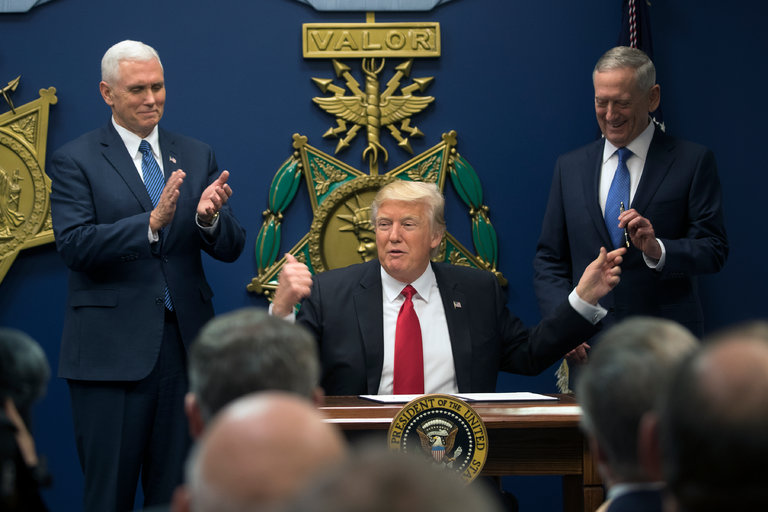
Trump has done it again.  At the Pentagon, before a backdrop that honors America’s highest award for valor, the Medal of Honor, Trump signed an Executive Order on immigration.  The backdrop seemed to suggest that Trump was doing something honorable and brave himself in signing yet another Executive Order.  This EO, as the New York Times reported, “suspended entry of all refugees to the United States for 120 days, barred Syrian refugees indefinitely and blocked entry for 90 days for citizens of seven predominantly Muslim countries. It also allows Christians to be granted priority over Muslims.”

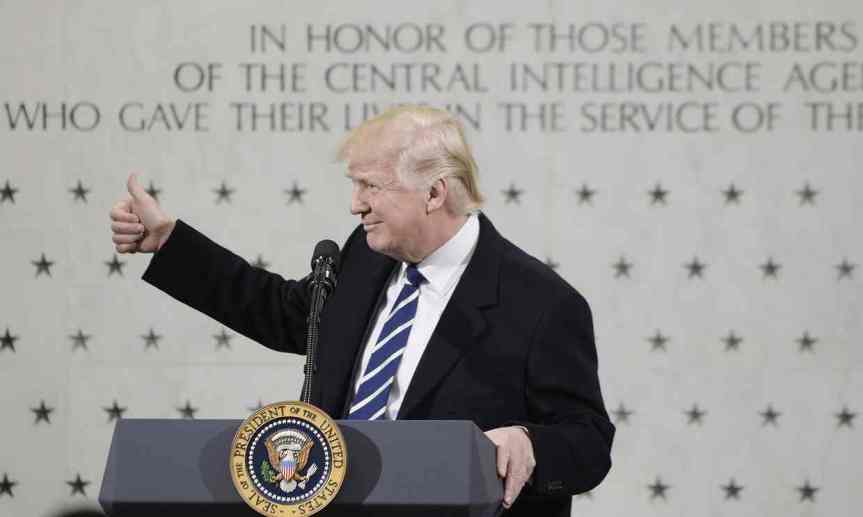
Last week, Trump appeared at the CIA, before its wall of heroes, blustering again about grabbing Iraq’s oil and boasting of the number of times he’d appeared on Time magazine (more than Patriots quarterback Tom Brady, which seemed to please him to no end).

Perhaps Trump will next appear before Christ on the cross to complain about how he (Trump) is being crucified in the press.

You’ve got to hand it to Trump: the man simply has no shame.  And no taste either.

Trump’s pomposity was captured perfectly yesterday in a quip at my local bank.  I was asking the teller about dollar coins (yes, we still have those), and she showed me a couple. They looked too much like quarters so I passed on getting any.  The gent behind me quipped: “Just wait until Trump puts himself on the coin.”  As I laughed and said words to the effect of, I can see it happening, the gent then quipped, “Trump will be on both sides!”

That about sums it up.  Trump would indeed put his own mug on both sides of the coin.  It would be a clear case of “heads he wins, tails we lose.”

Trump, Time Magazine’s Narcissist of the Millennium

4000

W.J. Astore

Yesterday, I caught President Trump’s speech before the CIA.  As he stood before the wall of honor, surrounded by the stars on that wall that represent those who gave their lives for their country, Trump deviated from his prepared comments to boast about how many times he’d appeared on the cover of Time magazine.

Here’s what he said: I HAVE BEEN ON THEIR COVER ABOUT 14 OR 15 TIMES. I THINK WE HAVE THE ALL-TIME RECORD IN THE HISTORY OF TIME MAGAZINE — IF TOM BRADY IS ON THE COVER, IT’S ONE TIME. I’VE BEEN ON 15 TIMES. I THINK THAT’S A RECORD THAT COULD NEVER BE BROKEN.

Really, President Trump?  You’re giving a speech before members of the CIA, and what comes to mind is the number of times your own mug has appeared on a magazine cover? And you’re doing this in front of the CIA’s wall of honor, which, according to your own words, is “very special”?

Whatever one thinks of the CIA and its history, one thing is certain from this speech: America has elected an appallingly tone-deaf and callous narcissist as its 45th president.


Can Trump Tame the Pentagon?

101222_pentagon_605_reuters
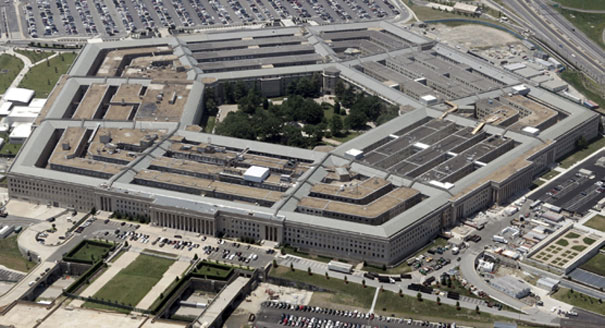
Can Trump tame the Pentagon?

W.J. Astore

Will Donald Trump keep his campaign promise to end America’s wasteful wars overseas?  Since he’s stated he knows more than America’s generals, will he rein them in?  Will he bring major reforms to the military-industrial complex, or will he be nothing but talk and tweets?

At Trump’s first news conference today as president-elect, he had little to say about the military, except once again to complain about the high cost of the F-35 jet fighter program.  The questions asked of him dealt mainly with Russia, hacking, potential conflicts of interest, and Obamacare.  These are important issues, but how Trump will handle the Pentagon and his responsibilities as commander-in-chief are arguably of even greater import.

Ironically, the last president who had some measure of control over the military-industrial complex was the retired general who coined the term: Dwight D. Eisenhower.  Another president – Jimmy Carter – attempted to exercise some control, e.g. he cancelled the B-1 bomber, a pet project of the U.S. Air Force, only to see it revived under Ronald Reagan.

Excepting Carter, U.S. presidents since Ike have issued blank checks to the military, the Pentagon, and its bewildering array of contractors.  Whether Democrats (JFK, LBJ, Clinton, Obama) or Republicans (Nixon, Ford, Reagan, the Bushes), rubber-stamping Pentagon priorities has been a common course of presidential action, aided by a willing Congress that supports military spending to “prime the economic pump” and create jobs.

Ike, of course, was hardly perfect, but he had the cred to command the military, to rein it in, perhaps as much as any one man could in the climate of fear generated by McCarthyism and the Cold War hysteria of the 1950s.  Hardly a pacifist, Ike nevertheless came to hate war.  Can we imagine any president nowadays writing these words?

Every gun that is made, every warship launched, every rocket fired signifies, in the final sense, a theft from those who hunger and are not fed, those who are cold and are not clothed. This world in arms is not spending money alone. It is spending the sweat of its laborers, the genius of its scientists, the hopes of its children… This is not a way of life at all, in any true sense. Under the cloud of threatening war, it is humanity hanging from a cross of iron.

Ike’s wisdom stemmed from his experience with the bloody awfulness of war. Recent presidents, by comparison, have been unstinting in their praise of the U.S. military.  Ronald Reagan, who had a cozy job in Hollywood during World War II, was a snappy saluter who oversaw a major military expansion.  More recently, Barack Obama, with no military experience, went out of his way to praise the U.S. military in hyperbolic terms as the “greatest” in human history.

Recent presidents have idolized the military, perhaps because they either never served in it or never really experienced its foibles and faults, its flaws and failings.  Perhaps as well they’ve celebrated the military because they saw it as a popular and easy form of patriotism.  But the Pentagon needs a commander-in-chief, not a cheerleader-in-chief.  It needs to be challenged, it needs a boot up its collective ass, if it’s ever going to reform its prodigal ways.

Trump has been critical of the military, an encouraging sign.  But his appointment of retired generals to key positions of power suggests conformity and business as usual.  Trump himself is a military poseur, a man impatient with facts, a man who didn’t know what the nuclear triad was even as he talked of (false) nuclear gaps vis-à-vis Russia.

Even as he talked of wasteful wars and clueless generals, Trump promised to use the U.S. military as a battering ram to smash America’s enemies.  He promised as well to rebuild the military, increasing the Pentagon budget while taking the fight to ISIS, words that suggest President Trump won’t often say “no” to the national security state.  Ike, however, could and did say “no.”  He had the toughness to weather the predictable Pentagon, Congressional, and military/corporate storms.  Will Trump?

Again, the last president to lead a novel initiative in national security was Jimmy Carter, with his focus on human rights.  Dismissed as naïve and pusillanimous, he became a one-term president.  Trump has promised to end wasteful wars, to re-prioritize federal spending to focus on internal “security” measures such as national infrastructure, and to make NATO and other U.S. allies pay their fair share of defense costs.

If he carries through on these promises, he’ll be the first president since Ike to make a measurable and significant course correction to America’s warship of state.  But first he needs to be held to account, most certainly at press conferences but elsewhere as well.  Endless war is a threat to democracy; so too are politicians who posture but do nothing to rein in militarism, imperialism, and authoritarianism.

If Trump combines the two, if he doubles down on incessant war and a cult of authority, American democracy may suffer a mortal blow.

Democracy is Impossible in Post-Truth America

truthiness
Post-truth is Anti-democracy (Getty Images at The Week)

W.J. Astore

“Post-truth” was the big word for 2016, according to Oxford Dictionaries. And why not? Donald Trump won the presidency with lies and half-truths and spin, so the word does indeed resonate.

But America has been edging toward post-truth for a long time — even at its founding, skeptics might say.  The “City on a Hill,” forged on an image of Christian rectitude, witnessed the genocide of Native Americans (“savages”) and the embrace of slavery based on specious theories of racial inferiority, even as the Bible taught the love of neighbor and the equality of all before God.

More recently, America has witnessed the triumph of post-truth in the aftermath of 9/11. Recall how the attacks on 9/11 were falsely connected to Iraq, which was then connected to false claims of Iraq having active programs of WMD development, including “yellowcake” uranium as well as chemical and biological agents spread by aerial drones.  All proven false, but all used to justify the invasion of Iraq in 2003.

Indeed, many Americans continue to believe that Saddam Hussein planned the 9/11 attacks (in league with Osama Bin Laden). Recall here the rare honesty of Britain’s Downing Street Memo of 2002, which asserted that the “facts” being offered by the Bush/Cheney administration were being manufactured (“fixed”) around a pre-determined policy of invasion.  The result?  Iraq was yet another un-democratic war, based in part on lies. Indeed, it’s no accident that Congress hasn’t issued a formal declaration of war since 1941.  (Another war based on lies: the Vietnam War, e.g. recall the false reports of attacks at Tonkin Gulf.)

Another example of post-truth was the Surge of 2007, advertised as a “win” for America even as General David Petraeus warned that progress in Iraq was both “fragile” and “reversible.”  So it has proved, for here we are, a decade later, trying to recapture territory (such as Mosul) that had allegedly been pacified under Petraeus.

America’s post-truth crew has now been captured by a shameless con man, the Tweeter-in-chief, Donald Trump.  Recall a saying often attributed to P.T. Barnum that “a sucker is born every minute.” Trump knows this — and will exploit it to the hilt, if the American people let him.

As January 20th approaches, Americans need to prepare themselves for a post-truth presidency.  As my dad used to say to me: “Don’t believe anything that you read and only half of what you see.”  Wise words for the days and years to come, but they come with a major problem.  Some sense of truth, of consensus based on acknowledged facts and a rigorous and fair-minded process of reasoning, is needed for a democracy to function.

Without integrity, which is based on facts and honesty and a willingness to reason together in good will and with honorable intentions, democracy simply cannot function. Put simply, a post-truth America is an anti-democratic America.  For without truth, without some consensus based on facts, all you have is lies, misinformation, and spin: a foundation of sand upon which nothing of worth can be built.

More on Trump’s Generals

trump

W.J. Astore

In a longer article for TomDispatch.com, I recently wrote about Donald Trump’s team of generals for national defense and homeland security. Trump wants four senior retired generals, two from the Army and two from the Marine Corps, to serve as his senior civilian advisers in matters of defense and security.

Here’s the point: You simply can’t have civilian control of the military when you appoint senior generals to these positions.

I’m astonished more Americans aren’t outraged at this. It’s a sign of how much militarism has gripped our nation and government, as well as the sweep and scope of the national security state.

I was reading Samuel Hynes’ excellent book, The Soldiers’ Tale: Bearing Witness to Modern War, and came across two passages that resonated with me. In talking about war as a culture, Hynes notes that “Military traditions, values, and patterns of behavior penetrate every aspect of army [and Marine Corps] life and make the most ordinary acts and feelings different.”

The generals Trump is hiring are all military careerists, men whose “traditions, values, and patterns of behavior” are steeped in the ways of the Army and Marine Corps, affecting even “the most ordinary acts and feelings.” Their behavior, their commitments, their loyalties, their world views, are the antithesis to civilian culture and to the ethos of democracy. (For example, General James Mattis, Trump’s selection as Secretary of Defense, is most often described as a “warrior-monk,” a man with a Spartan-like dedication to war.  But would Athens have anointed a Spartan, even as its minister of war?)

Again, the point is not to attack the military. It’s that the U.S. government already has plenty of generals in charge, wielding enormous authority. Trump’s decision to add yet another layer of military authority to his government makes it less of a democracy and more of a junta.

A second point from Hynes. He notes how most citizen-soldiers in America’s military past were not war-lovers, but that a few were, notably General George S. Patton. In the same breath, Hynes notes that dictators like Hitler and Mussolini “loved war.”

Which American general does Trump profess to admire the most? George S. Patton. And who among his generals most resembles Patton as a “real” warrior? According to Trump, it’s General Mattis.

Again, the point is not to attack the military, but rather to note the U.S. national security state already has plenty of warriors and warfighters in charge. Putting an alleged Patton-clone in charge of the Pentagon represents an abrogation of two centuries of American tradition that insisted on civilian supremacy over the military.

Given his inflammatory tweets about nuclear arms races with their “bring it on” mentality, Trump has all the makings of tinpot provocateur, an unstable military poseur who likes to speak loudly while swinging a nuclear-tipped stick. Will Trump’s generals, his Pattons and MacArthurs, serve as a check to his provocations and his posturings? It doesn’t seem likely.

Congress should reject Trump’s choices for Secretary of Defense (Mattis) and Homeland Security (Kelly). Not because these retired generals are bad men, but because they are the wrong kind of people. If you want civilian control of the military (and don’t we still want that?), you need to hire true civilians. Men and women whose identities haven’t been forged in armories. Independent thinkers and patriots with some history of dissent.

How about someone like Daniel Ellsberg for Secretary of Defense? And, since global warming is a huge threat to the U.S., how about Bill McKibben for Homeland Security?

After all, whether they’re in or out of uniform, the U.S. government already has plenty of generals.

The F-35 Fighter: Not Invisible to Trump’s Radar

a-10-thunderbolt-ii_001
You can hang a lot more weaponry from an A-10 Warthog (vintage 1970s) than you can from a modern F-35

W.J. Astore

Is Donald Trump putting coal in Lockheed Martin’s Christmas stocking?

Trump has sent another tweet about the F-35 jet fighter (Lockheed Martin is the primary contractor), this time asking Boeing to price out a comparable F-18 Super Hornet as a possible replacement for that jet.  Trump’s tweet caused Lockheed Martin shares to dive even as Boeing shares climbed.

Trump is right to pressure Lockheed Martin on the F-35, though I’m not sure tweets are the best way to do this.  I remember planning for the F-35 twenty years ago when I was on active duty in the Air Force.  The F-35 Joint Strike Fighter was supposed to be a relatively low cost fighter/attack aircraft that would meet Air Force, Navy, and Marine needs.  Back then, the flyaway cost was estimated at $40 million per plane, more expensive than the F-16 but roughly equivalent to the F-15E “Strike Eagle.”  The current flyaway cost is roughly $200 million per plane,* and even higher for the Marine Corps version with its vertical landing/short takeoff capacity.

f-35
The F-35: Stealthy but expensive, with a long history of cost overruns

What happened?  Everything went wrong as each service piled requirements onto the F-35 and all kinds of exotic features were added to it.  Stealth capability.  Loads of special software featuring millions of lines of code.  Unique (and expensive) helmets for its pilots. Vertical landing/short takeoff capacity for the Marines, which drove an airframe configuration that made it less maneuverable for the Air Force.  In short, the F-35 became like a Swiss army knife, featuring lots of tools and moving parts.  Sure, in a pinch a Swiss army knife can be used as a screwdriver or what have you, but most of the time what you really need is the best screwdriver for the job.

The F-35 is reminiscent of another ill-fated effort to build a jet acceptable to all the services: the F-111 “swing-wing” program of the 1960s.

f111
Big and ungainly, the F-111 was mainly used as a bomber and electronics warfare plane

The Navy never deployed it, and the Air Force was never that happy with it, converting it to a fighter/bomber and an electronics warfare plane.  The Navy went on to build its own fighter jet, the F-14, even as the Air Force built its fighter jet, the F-15.  Then the Air Force and Navy got two decent fighter/attack jets, the F-16 and F-18, out of the lightweight fighter competition.**

Here’s the thing: Although jets like the F-15 and F-18 are not stealthy, they are very effective, especially when updated with the latest weaponry and avionics and flown by skilled pilots.  Meanwhile, highly effective UAVs (drones) have emerged, e.g. Predators and Reapers, with long loiter times and no risk of U.S. casualties.  To put it bluntly, does the U.S. really need the F-35, especially given its high cost and underwhelming performance?

Back to Donald Trump.  Is he bluffing when he threatens to buy Boeing-made F-18s instead of the F-35?  Is he posturing to get Lockheed Martin to cut the price of the F-35 (which, at this late stage of its development, may not even be possible)?  One thing is certain: A lot of good American jobs are riding on Trump’s tweets.  Expect Lockheed Martin to rally its Congressional allies to defend the program.  The plane’s multitude of contracts were deliberately spread throughout the 50 states to gain as much Congressional support as possible.

For a little fun, go to the Lockheed Martin website at the following link:

https://www.f35.com/about/economic-impact-map

Let’s put in Pennsylvania.  Here’s what you get: 41 supplier locations, 2100 jobs, $172.5M in economic impact.  How about New York?  77 suppliers, 8160 jobs, $695.2M in economic impact.  How about Bernie Sanders’s state of Vermont?  3 suppliers, 1410 jobs, $124.5 million in economic impact.  Small wonder that even Bernie Sanders during the campaign was an F-35 supporter.

One thing is certain: the stealthy F-35 has not evaded Trump’s radar.  Whether Trump will shoot it down or simply watch it as it soars on by while burning through piles of money remains to be seen.

Note: For a more detailed report on the F-35’s performance issues, see “The F-35 Stealth Fighter May Never Be Ready for Combat: Testing report contradicts the U.S. Air Force’s rosy pronouncements,” by DAN GRAZIER & MANDY SMITHBERGER, available at this link. In short, the plane’s “requirement” to be stealthy is driving higher costs and lower performance. The plane gobbles gas so it has limited combat endurance. It’s a step backwards in effectiveness, at a much higher cost to the American taxpayer than previous planes such as the F-15, F-16, and A-10.  Meanwhile, many of its missions are now filled by drones.

For a counterpoint in favor of the F-35, see this link.  The F-35 has unique capabilities; it should, given its price tag.  Leaving aside high cost and questionable performance, it’s vital to remember the mission.  Are there really missions that only the F-35 can do, or that no plane can do as effectively?  But the real case for the F-35 seems to come down to the fact that the program is simply too big to fail; the “sunk costs” are too high; its rivals are too old; and too many American jobs are dependent on it.  In short, the U.S. military is stuck with the plane — and the American taxpayer is stuck with the bill.

*Estimates vary about the final flyaway cost since it’s ultimately dependent on how many F-35s are produced.  Current estimates for the entire U.S. purchase are $400 billion, with another trillion dollars for maintenance and spares and related costs over the program’s lifetime.

**The most rugged and effective attack jet in the Air Force’s inventory, the A-10, was never much liked by the Air Force; generals have fought to eliminate it in favor of the much less effective F-35, but Congress has actually fought back to keep the A-10, affectionately known as the Warthog, a name and image contrary to the AF fighter pilot mystique of “eagles” and “fighting falcons.”