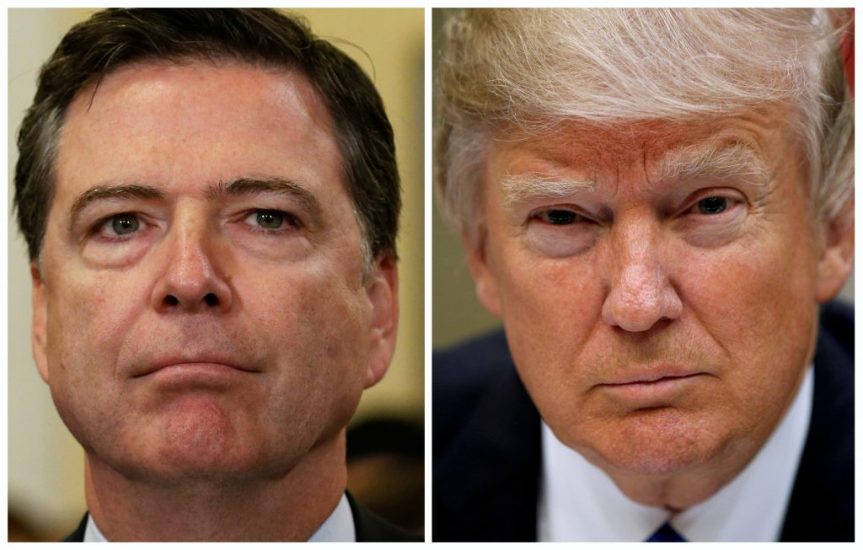
Another day, another Trump scandal, this one stemming from a memo written by the former FBI director, James Comey, in the aftermath of a private conversation he had with the President. According to the Comey memo, the president urged him to drop the FBI’s investigation into Michael Flynn’s ties to Russia, using these words: “I hope you can see your way clear to letting this go, to letting Flynn go. He is a good guy. I hope you can let this go.”
Obstruction of justice? Impeachable offense? That’s debatable. But the alleged conversation obviously takes on heightened meaning after Trump fired Comey, in part because of frustration with the FBI’s investigation into alleged collusion between the Trump campaign and Russia during the election.
It’s unclear if any crimes were committed here. What is clear is that Trump is a poor manager of himself as well as his staff. Flynn, with his dodgy record, should never have been hired. Furthermore, the president should not have gone out on a limb to defend him, cajoling the FBI director, in so many words, to go easy on my guy.
Perhaps Trump’s biggest flaw is his combination of boastfulness, lack of judgment, and his ego-driven need to take charge. He reminds me of an Air Force saying: “He’s all Mach and no compass heading.” He’ll break the sound barrier while moving in the opposite direction to sound governance.
I wrote back in March of 2016 that candidate Trump had disqualified himself from the presidency by boasting about how America’s generals would follow his orders irrespective of their legality. My main point was that Trump had no understanding of his Constitutional responsibilities, nor did he seem to care much about learning them. If Comey’s memo is accurate, I think it’s another instance of Trump either not knowing or not caring about propriety, about the rule of law.
Trump’s experience in life is as a CEO of a family business. Everyone has always worked for him; in essence, he’s been King Trump. Even though he’s now president, he still acts like a king, making up his own rules as he goes along, not knowing a rule book already exists.
Will Trump survive his first term? As Yoda might say, Difficult to see — always in motion the future. One thing is certain: Trump continues to consume all the oxygen in Washington, extinguishing any hope of real progress or effective governance at the federal level.
U.S. media outlets have been consumed by the story today that President Trump improperly or unwisely shared classified material on ISIS with the Russians, material that apparently came from Israel. For its part, the Trump administration denies the charge that information was improperly or unwisely shared.
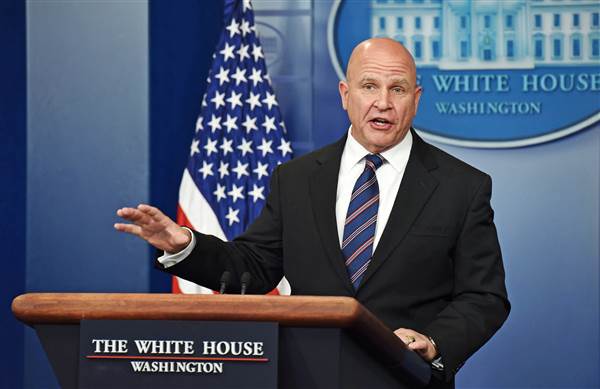
Today, National Security Adviser H.R. McMaster defends Trump’s decision to share classified information with the Russians
A couple of comments. First, the president has broad powers of declassification and the discretion to share sensitive secrets with others. Sharing classified information with the Russians, an ally of a sort in the struggle against ISIS, is not necessarily a bad idea. Trump seems to have decided it was a way to strengthen relations and build trust at high levels with the Russian government, a defensible position, in my view.
Second, I’ll repeat here what I said about classification and the Hillary Clinton email scandal: Far too much information is classified by the U.S. government. Classification is vastly overused by our government to conceal many sins, blunders, nefarious designs, and who knows what else. There’s nothing sacred about secrecy; indeed, a democracy should prefer transparency, rather than stamping everything “secret” or “top secret” and thereby keeping nearly all Americans in the dark.
Obviously, I’m not privy to the exact nature of the intelligence shared, the sensitivity and vulnerability of the source(s) and collection methods, and so on. I’m not an intelligence trade-craft expert. So far, Israeli operatives seem unconcerned, but whether their blase attitude is feigned or not is unknown.
Americans elected Trump because he promised to do things differently. He campaigned on the idea of being unorthodox; indeed, he is unorthodox. Surely no one should be surprised when he decides to speak in the clear to Russian government officials on matters concerning ISIS and terrorism.
Repeat after me, America: Secrecy is not sacred. Transparency is desirable. So too is building trust with rivals as well as friends. Trump has his faults, major ones I believe, but this current controversy is a tempest in a teapot.
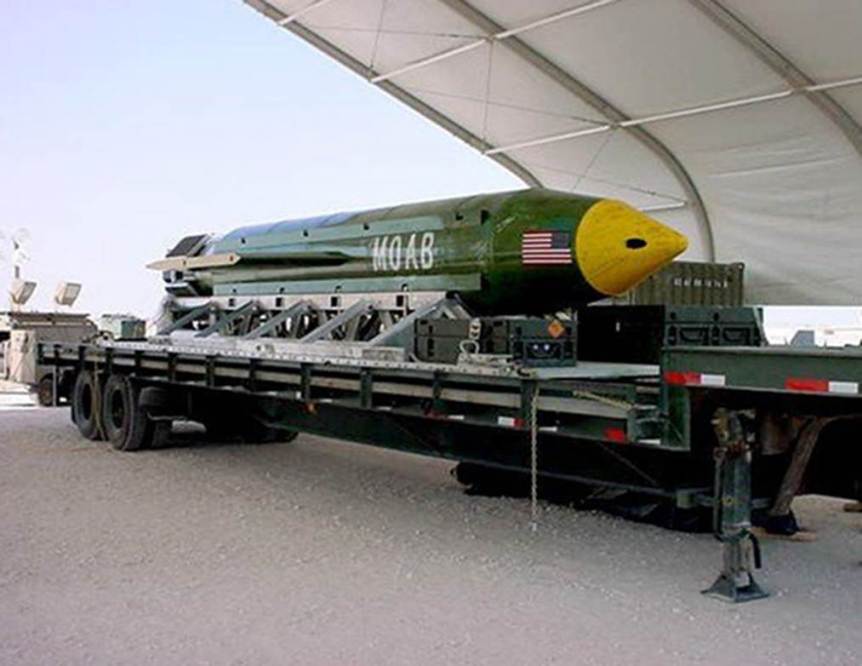
At this moment, it’s hard to think of a better symbol of American militarism than a giant bomb with a U.S. flag on it. President Donald Trump touted the use of the “mother of all bombs” (MOAB) in Afghanistan as a “very, very successful mission” even though evidence of that success is scant. He further cited MOAB as evidence of the “tremendous difference, tremendous difference” between his administration’s willingness to use force and Obama’s. In short, Trump loved MOAB precisely because Obama didn’t use it. To Trump, MOAB was a sort of penis extender and a big middle finger all-in-one. Virility and vulgarity.
MOAB is an icon of U.S. militarism, as are other weapons in the American arsenal. Weapons like our warplanes, aircraft carriers, Predator and Reaper drones, and Tomahawk and Hellfire missiles. U.S. foreign policy often hinges on or pivots about the deployment of these icons of power, whether it’s aircraft carriers and anti-missile systems being sent to Korea or more bombs and missiles being used in Iraq, Syria, and Afghanistan, among other countries.
Weapons sales further define U.S. foreign policy. Witness the recent announcement of $100 billion in arms for the Saudis, soon to be confirmed by Trump in his forthcoming trip to Saudi Arabia. This sale sets up even more military aid for Israel, in that Washington insists Israel must always maintain a qualitative edge in weaponry over its Arab rivals.
Unlike, say, Wilhelmine Germany, which elevated Field Marshal Paul von Hindenburg to iconic status during and after World War I, America today is lacking in winning generals. Sure, there have been a few pretenders. William Westmoreland in Vietnam, H. Norman Schwarzkopf in Desert Storm, Tommy Franks in Iraqi Freedom, and David Petraeus of “Surge” fame come to mind, but their “victories” were either illusory or lacking in staying power. Since we can’t idolize our generals, we celebrate our weapons instead.
These weapons are indeed iconic symbols. They capture an ideology of destruction. A predilection for spreading misery worldwide, as Tom Engelhardt notes in his latest must-read article at TomDispatch.com. As Engelhardt notes in his “send-out” message to his piece:
The first part of my latest post focuses on the now seven month-long U.S.-backed Iraqi military offensive against the city of Mosul, which shows little sign of ending and has reduced that city, like so many other places in the region, to ruins, if not rubble. Mosul, in other words, has been on my mind, but perhaps not completely for the reason you might expect. Its destruction (and the generation of yet more uprooted people and refugees) has led me to wonder what ever happened to the globalizers who for so many years told us about the wonders of tying the planet ever more tightly together and leveling all playing fields. It seems obvious to me that war, American-style, these last 15 years, has played a distinctly globalizing role on this ever smaller planet of ours — just globalizing misery, not happy news. In this piece I use the destruction of Mosul to lay out my thoughts on just what globalization really means in 2017, why the Trump presidency is linked to such grim events, and just why the globalizers have stopped talking about the phenomenon.
When I read Tom’s note above about the “leveling” of “playing fields,” my first thought was that America is indeed working to level the world — just not in the figurative sense of promoting economic equality, but in the literal sense of leveling areas with bombs, cities like Mosul, for example, or alleged training areas for terrorists in Afghanistan. As Engelhardt himself notes in his article, U.S. military action isn’t making the world flatter in the sense of equitable globalization; it’s simply flattening areas with overwhelming explosive force.
Most Americans simply don’t know or care much about foreign cities being leveled/flattened by America’s icons of power. You might say it’s not on our radar screens. The media and our leaders do a very good job of keeping us divided, distracted, and downtrodden. What American has time to worry about Mosul or some obscure region of Afghanistan? Unless or until the leveling and flattening come our way, to our cities and valleys, but by that point it will be far too late to act.
With all our talk of MOAB and aircraft carriers and missiles and their “beauty” and “tremendous success,” are we that far away from the lost souls in the movie “Beneath the Planet of the Apes,” who elevated the atomic bomb as their false idol, their version of the Biblical golden calf?
1. Andrew Bacevich at TomDispatch.com describes 24 stories/questions that are being ignored or neglected by the mainstream media as they obsess about Donald Trump. I’d like to add #25 to his list, as follows: Why is everything in America classified? The constant appeal to classification, to secrecy, prevents the discussion of vitally important military and security matters in public. Is the real target of all this secrecy our rivals and enemies, or is it the American people?
Related to my #25, of course, is the persecution of “whistleblowers” for allegedly violating secrecy. Under the Obama administration, people were accused of sedition and treason when their real “crime” was trying to keep the American people informed about what their government is really doing.
In short, when did the USA become the former Soviet Union, with its own NKVD/KGB and a state-controlled media that essentially promulgates and enforces the dictates of the powerful?
2. Afghanistan is a mess. According to this morning’s SITREP at FP: Foreign Policy, “Defense and intelligence officials are warning that the deteriorating situation in Afghanistan is likely to get worse before it ever gets better, despite the presence of thousands of U.S. troops and tens of billions invested in building and funding the faltering Afghan security forces.”
“’The intelligence community assesses that the political and security situation in Afghanistan will almost certainly deteriorate through 2018, even with a modest increase in military assistance by the United States and its partners,’ Director of National Intelligence Dan Coats said in a Senate hearing Thursday. The Pentagon is looking to add another 3,000 troops to the effort there in the coming months, pushing American advisors closer to the front lines to work directly with Afghan forces in the fight.”
After sixteen years of American/Coalition efforts, the Taliban is resurgent, yet the only strategy U.S. generals can offer is more troops and more money to train Afghan security forces that are mostly unreliable and often non-existent. Why can’t the U.S. military admit defeat and leave?
Consider a sports analogy. Last week, the Yankees-Cubs played an 18-inning game, eventually won by the Yankees. Game over. Imagine if the Cubs had said, “OK — We lost. But we want to keep playing. Maybe another 18 innings. Maybe forever. We just want to keep playing until we can claim, falsely even, that we’ve won.” We’d label the Cubs as crazy. As poor sports. As deluded.
But this is what America is in Afghanistan. We’ve lost in extra innings but we still want to keep playing — forever, it seems.
Daniel Ellsberg nailed it back in 2009. The U.S. is a foreign power in Afghanistan engaged in a bloody stalemate that cannot be won. Yet America persists, in part because U.S. presidents kowtow to military “judgment” and the idea that to withdraw from Afghanistan is to appear weak and unmanly.
3. Speaking of issues of manliness, Donald Trump (among others) likes to use the phrase “taking the gloves off” to refer to hyper-aggressive military actions. When did bare-knuckle brawling become a smart way to fight? Actually, it’s a great way to break your hand. Boxing is dangerous enough while wearing gloves, yet our Washington “fighters” are ready to get down and dirty by doffing their gloves. As I’ve written before, far too many Americans (and people in general) have died in the name of big-boy pants and similar machismo nonsense.
4. At TomDispatch.com, Army Major Danny Sjursen succinctly summarizes the U.S. military’s strategy in one word: More. As Sjursen puts it in his article:
Predictions are always a dicey matter, but recent history suggests that we can expect military escalation, which already seems to be underway in at least three of those countries. More, after all, remains the option of choice for America’s generals almost 70 years after MacArthur went head to head with his president over Korea.
What then is to be expected when it comes to the conflict with ISIS in Iraq, the complex, multi-faceted Syrian civil war, and America’s longest war of all, in Afghanistan? All signs point to more of the same. Open up a newspaper or check out a relevant website and you’ll find, for example, that U.S. Afghan commander General John Nicholson wants a new mini-surge of American troops dispatched into that country, while the U.S. commander in the fight against ISIS, General Stephen Townsend, may require yet more ground troops to “win” in Iraq and Syria.
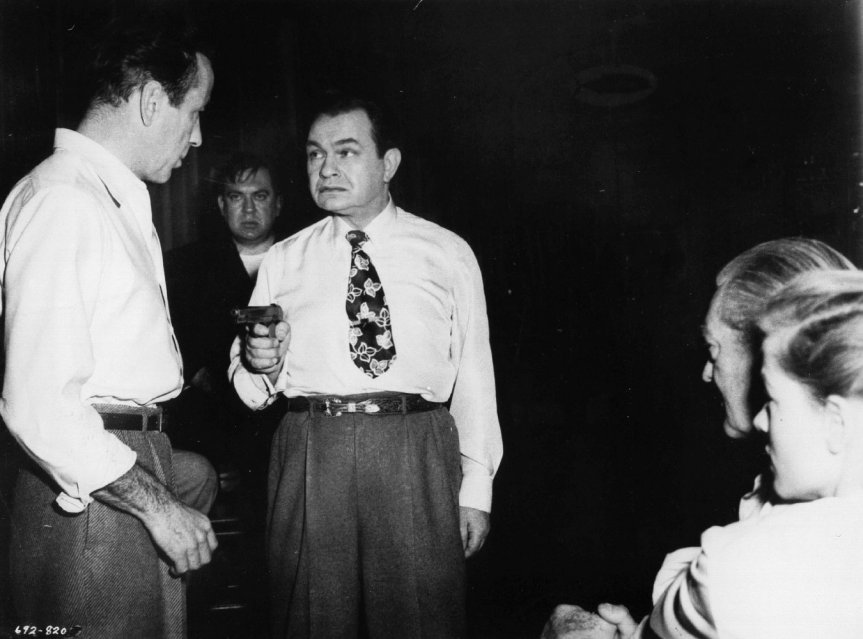
More is the mantra of America’s generals. It’s how they measure their influence as well as their success. In this, they remind me of the gangster Johnny Rocco in the movie “Key Largo.” When Humphrey Bogart asks Rocco what he wants, Rocco pauses, after which Bogart has the answer that Rocco seizes upon: More. Will he ever get enough? Rocco answers: Well, I never have. No, I guess I won’t.
Even though Trump has promised a major hike in military spending for 2018, the Pentagon is already clamoring for more. Like Johnny Rocco, America’s generals and admirals can never get enough.
5. Finally, a dire lesson from history. When strong men seek to take over a government, they first seek to seize or neutralize the military and police forces of their country. It’s a time-tested formula. Consider Trump’s early actions. From his hiring of generals and his promises of scores of billions more for the Pentagon as well as to his hiring of good buddy Jeff Sessions as Attorney General and his firing of James Comey at the FBI, Trump is well on his way to winning over and controlling the agencies of violence and enforcement in the U.S.
Comey is terminated. An ineffective leader? It takes one to know one.
W.J. Astore
Sometimes it’s necessary to state the obvious. The firing of FBI Director James Comey is not about his job performance and especially his handling of Hillary Clinton’s emails. It’s all about Donald J. Trump.
While I greatly appreciate you informing me, on three separate occasions, that I am not under investigation, I nevertheless concur with the judgment of the Department of Justice that you are not able to effectively lead the Bureau.
The bolded phrase is remarkable. Trump is at pains to suggest that Comey is not investigating him, yet the FBI is indeed looking into Russian influence in the 2016 election, including ties between the Trump campaign and Russian officials.
Whether you believe the whole Russian influence dispute is a made-up scandal, a red herring, so to speak, the fact is that Trump sees it as a major threat to his prerogatives and power. That’s why he’s at pains to state bluntly that Comey is not investigating him. Comey, Trump says, told him three times — three times! — he’s not under investigation.
The president doth protest too much. If you think Comey is unable to lead effectively, fire him for that reason. You don’t need to include a self-aggrandizing statement of how blameless or innocent you are in the ongoing Russian investigation.
Trump’s firing of Comey, moreover, displays his petulance, his impetuousness, and indeed his nervousness about the trajectory of his presidency.
As the CEO of a family business, Trump is used to firing people who don’t kowtow to him. Running a nation, however, is not like running a family business. Right?
Will Trump prevail? Time will tell. One thing is certain: American democracy — what’s left of it — suffered another body blow yesterday.
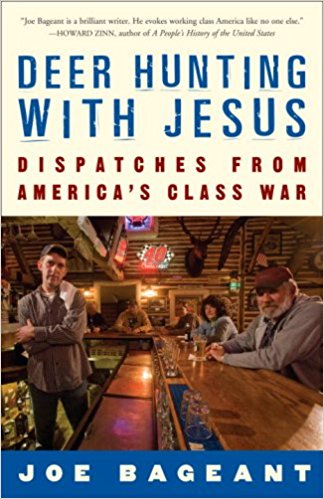
Joe Bageant was a remarkable writer, the author of “Deer Hunting with Jesus” as well as “Rainbow Pie.” A self-confessed “redneck,” he worked his way into the middle class as an editor, but he never forgot his roots in Appalachia and the subsistence farming of his Scots-Irish family. Bageant had a brutally honest and unadorned way of speaking and writing, and also a great affection and deep respect for traditional communal values in America.
The other day, I was reading an old essay Bageant wrote, “Live from Planet Norte” (June 2010), long before Donald Trump was even remotely considered to be presidential material. As usual, Joe nailed it:
[I]n the process of building our own gilded rat-cage, we have proven that old saw about democracy eventually leading to mediocrity to be true. Especially if you keep dumbing down all the rats. After all, Dan Quayle, Donald Trump and George W. Bush hold advanced degrees from top universities in law, finance and business.
The head rats, our “leaders” (if it is even possible to lead anybody anywhere inside a cage), have proven to be as mediocre and clueless as anyone else. Which is sort of proof we are a democracy, if we want to look at it that way. While it is a myth that virtually anybody can grow up to be president, we have demonstrated that nitwits have more than a fighting chance. During my 40 years writing media ass-wipe for the public, I have interviewed many of “the best of my generation,” and, believe me, most of them were not much.
Naturally, they believe they are far superior by virtue of having made it to an elevated point in the gilded cage, closer to the feed, water and sex. Because they believe it, and the media–sycophants waiting for quotes–echoes their belief, discussing their every brain fart, we tend to believe it, too. Nothing shakes our belief, not even staring directly into the face of a congenital liar and nitwit like Sarah Palin, or a careening set of brainless balls like Donald Trump or a retarded jackal like George W. Bush.
Americans are unable to explain why such people “rise to the top” in our country. We just accept that they do, and assume that America’s process of natural selection – the survival of the wealthiest – is at work. These people are rich; therefore, they should run the country. God said so. It’s a uniquely American principal of governance, which in itself, makes the case for our stupidity.
Donald Trump is best at selling a certain image of himself: the self-made billionaire, the savvy deal-maker, the populist patriot who sides with the little guy. But Joe Bageant had him pegged: a careening set of brainless balls is maybe the best, and certainly the most colorful, descriptor I’ve come across for Trump.
Bageant’s larger question is clear: How did Americans come to value such nitwits, halfwits, and dimwits? Just because they have money? Just because they have a veneer of “success” about them, when this “success” is evidenced by nothing more than money or fame and the sly charm of grifters?
Americans, who worship at the altar of success as measured by the almighty dollar, are kneeling to pray before the empty suits of men like Donald Trump. Bageant knew better than to join that mindless cult; so should we all.
As the end of Trump’s first 100 days in office approaches, we can already see the novice commander-in-chief’s approach to military action. The approach is to empower “his” generals. And the results? A triumph of image over substance. “Spin it to win it” is the byword for Trump’s military “strategy.”
A few examples:
The disastrous raid on Yemen that led to the death of a Navy SEAL as well as many civilians, including children, was spun by the Trump administration as a great success. At the same time, Trump pinned the death of the SEAL on his generals, saying “they” lost him.
The launch of 59 expensive cruise missiles against a Syrian airfield did little to change the actions of the Assad government. Nor did it knockout the airfield. Yet it was spun by Trump as a remarkable victory. In his words, “We’ve just fired 59 missiles, all of which hit, by the way, unbelievable, from, you know, hundreds of miles away, all of which hit, amazing. It’s so incredible. It’s brilliant. It’s genius. Our technology, our equipment, is better than anybody by a factor of five. I mean look, we have, in terms of technology, nobody can even come close to competing.”
The use of the “mother of all bombs” (MOAB) in Afghanistan was seized upon by Trump as an example of his toughness and decisiveness vis-à-vis the Obama administration’s use of force. Yet Trump didn’t even know about the bomb until after it was used. Nevertheless, he boasted “If you look at what’s happened over the last eight weeks [of my administration] and compare that really to what’s happened over the past eight years, you’ll see there’s a tremendous difference, tremendous difference.” Dropping MOAB, Trump claimed on scant evidence, “was another very, very successful mission.”
The Trump administration lost track of an aircraft carrier battle group, saying it was on its way as a show of force against North Korea even as it was headed in the opposite direction. This blunder was chalked up to a miscommunication between the White House and Pentagon, even as allies such as South Korea and Japan expressed concern about the credibility of U.S. support at a time of rising tensions.
As Tom Engelhardt notes in his latest must-read piece at TomDispatch.com:
President Trump did one thing decisively. He empowered a set of generals or retired generals — James “Mad Dog” Mattis as secretary of defense, H.R. McMaster as national security adviser, and John Kelly as secretary of homeland security — men already deeply implicated in America’s failing wars across the Greater Middle East. Not being a details guy himself, he’s then left them to do their damnedest. “What I do is I authorize my military,” he told reporters recently. “We have given them total authorization and that’s what they’re doing and, frankly, that’s why they’ve been so successful lately.”
Have the generals really been “so successful lately,” President Trump? The facts suggest otherwise. Meanwhile, Trump has not yet learned that generals always want more – they believe they can win if they just get more troops, more money, more weaponry. They’ll support Trump as long as he keeps funneling more of everything their way – and as long as he keeps spinning their blunders and missteps as victories.
Is this the face of “success” in Yemen? A little girl dead?
For the moment, Trump’s generals may love him for his “spin it to win it” boosterism and his blank checks of support. But beware, men wearing stars. Trump has already shown he prefers to delegate responsibility as well as authority when things go bad (recall the failed raid on Yemen and the dead SEAL).
Trump may not be a micro-manager, but that’s because he doesn’t know anything. He just wants to spin military action as a win – for Trump. If the generals keep losing, Trump will turn on them. The question is, will they turn on him?
More disturbing still: When failed military actions are spun as alt-fact “victories,” the violence isn’t done simply to facts: it’s done to innocent people around the world. It’s no game when innocent children die in the false name of “winning.”
I used to think the Republican party had principles of substance. I supported Gerald Ford in 1976 and found common cause with Ronald Reagan during the early ’80s. Ford was a decent man, a moderate Republican (imagine such a thing in 2017!), and people forget that Reagan worked with Gorbachev on the elimination of nuclear weapons.
Today’s Republican Party? The only “principles” they seem to have are driven by profit and power. When you sell people’s privacy, conspire to deny them health care, and authorize projects that threaten the very air they breathe and the water they drink, you are the antithesis of public servants.
President Trump, of course, is partly to blame, but he’s often little more than a blustering figurehead. Republicans in 2017 would be seeking to gut Obamacare, rape the earth, and sell everything in and out of sight regardless of which of their candidates had won the presidency. Would it really be much different under President Ted Cruz or Ben Carson or Jeb! Bush?
Who’s to blame? It sure isn’t the Russians or Comey at the FBI. You might blame Hillary Clinton in part for running a horrible campaign. And surely the Democratic Party for favoring her over Bernie Sanders. I’d also blame all those who voted for Trump and who were driven to do so for their own unprincipled reasons.
We can’t say we weren’t warned
America is already paying a high cost for Republican rule. Lindy West at the Guardian puts it well: “America has never seen a party less caring than 21st-century Republicans.”
As she explains:
I don’t know that America has ever seen a political party so divested of care. Since Trump took office, Republicans have proposed legislation to destroy unions, the healthcare system, the education system and the Environmental Protection Agency; to defund the reproductive health charity Planned Parenthood and restrict abortion; to stifle public protest and decimate arts funding; to increase the risk of violence against trans people and roll back anti-discrimination laws; and to funnel more and more wealth from the poorest to the richest. Every executive order and piece of GOP legislation is destructive, aimed at dismantling something else, never creating anything new, never in the service of improving the care of the nation.
Contemporary American conservatism is not a political philosophy so much as the roiling negative space around Barack Obama’s legacy. Can you imagine being that insecure? Can you imagine not wanting children to have healthcare because you’re embarrassed a black guy was your boss? It would be sad if it wasn’t so dangerous.
A close friend put it well: “I think much of it is about spite — let’s take away whatever Obama did just because we hate him and because we CAN. Whatever he did must be wrong. Have they [the Republicans] done anything or passed any regulation since they took office that actually benefits anyone other than big business (and maybe coal miners)? I honestly can’t think of anything! Isn’t [Steve] Bannon’s philosophy to deconstruct and destroy the government? I’d say he’s succeeding.”
Yes, it’s always easier to destroy than to create. And when you destroy, there’s money to be made from the wreckage.
Behold, I give you today’s Republican Party, a party of wreckers.
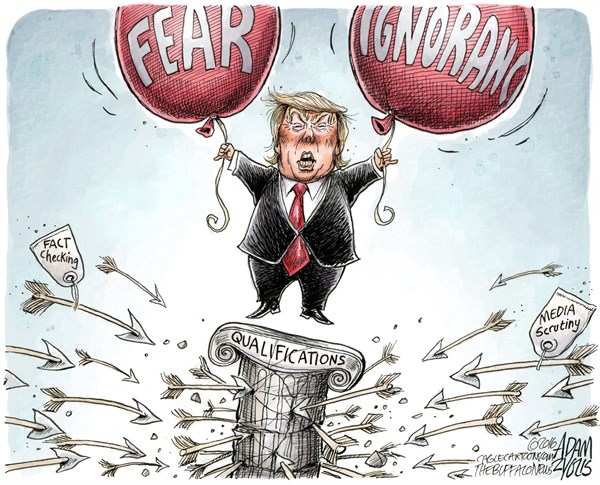
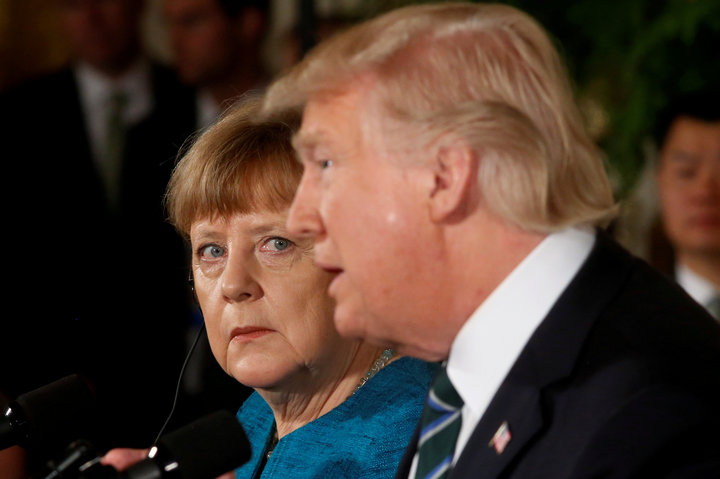
President Donald Trump is incurious, ignorant, and ill-informed. He hides this with rudeness, bluster, and lies. As an anonymous German Foreign Ministry official said during Chancellor Merkel’s visit, Trump “uses rudeness to compensate for his weakness.”
Trump couldn’t hold his own with a brilliant woman of substance like Angela Merkel, so he changed the narrative. He accused Germany of not paying up with NATO; he said Obama wiretapped Merkel, just like he tapped Trump tower; he whined about unfair trade with Germany. In public, Trump showed little substance and no sophistication.
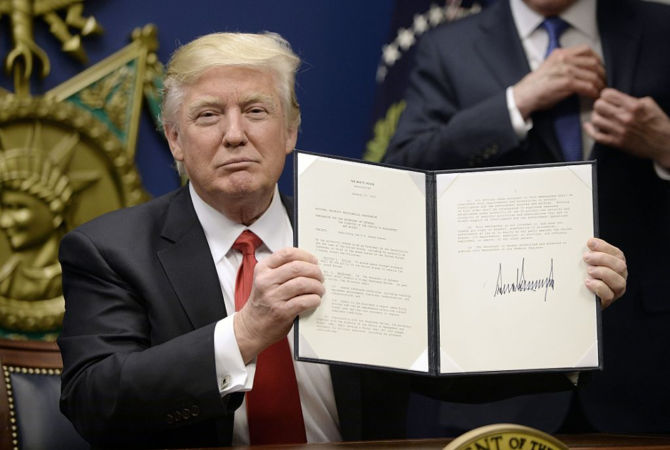
It’s not that Trump can’t learn; he doesn’t want to. He’s happy watching Fox News or movies like “Finding Dory,” golfing at his expensive resorts, signing executive orders and holding them aloft like a proud second-grader (Look Ma! I can sign my name!), and holding rabble-rousing rallies (“Lock her up!”) and basking in applause.
Trump operates in the shallows. His experience is in high-priced real-estate and media. He’s best at hyping a certain image of himself. He’s a bull-shitter, and he’s had lots of practice.
A big part of the presidency is ceremonial: the U.S. president is king and prime minister all in one. Trump is failing at both jobs. As a symbol of America, he’s boorish, boastful, and bullying. As a prime minister, he’s incurious, ignorant, and vain.
Five examples: Candidate Trump knew nothing about America’s nuclear triad. He didn’t know it consists of SLBMs (on Trident submarines), ICBMs (land-based), and “air-breathing” bombers. All he “knew” is that allegedly the U.S. nuclear arsenal is obsolete and inferior to the Russian arsenal. But actually the U.S. arsenal is more accurate, more survivable, and far superior to that of any other country, including Russia.
Second example. According to Trump, before he came along, nobody knew how complicated health care could be. We owe that stunning insight to Trump. Third example. According to Trump, Germany owes vast sums of money to the U.S. for defense costs, a false claim rejected by the Germans.
Fourth example: Based on a false Fox News report, Trump accused the previous president of committing a felony by tapping his phones during the campaign season, a charge for which there is no evidence whatsoever. Yet Trump refuses to rescind the charge, despite its repudiation by the FBI, NSA, British intelligence, and his own party.
Fifth example: Trump refuses to admit his Muslim ban is, well, a Muslim ban. Yet the ban refuses to target the one country that supplied 15 out of the 19 hijackers on 9/11: Saudi Arabia. Most experts agree that Trump’s ban is unconstitutional and counterproductive in the war on terror.
Being Trump means never having to say you’re sorry. In his unapologetic blustering, Trump echoes the foreign leader he seems to admire most: Vladimir Putin. In Putin’s Russia, with its history of Tsars and other strong leaders, uncompromising firmness and unyielding certitude are expected if not always applauded. In democratic America, an ability to compromise and a willingness to yield on matters of fact are generally seen as signs of adult leadership by statesmen who serve the people rather than themselves.
Trump’s behavior is better suited to that of Tsars and other anti-democratic strongmen. Trump the incurious has surrounded himself with loyalists, family members like his daughter Ivanka and her husband Jared Kushner, and commissars who watch over his cabinet appointees to ensure their loyalty. Pettiness, paranoia, and score-settling characterize the Executive branch.
Trump often harkens back to World War II and the likes of Generals Patton and MacArthur. How does he compare to the president back then? Franklin D. Roosevelt had a global view of the world while exhibiting a mastery of detail. (So too did Winston Churchill.) Self-confident, FDR looked for no-men, not yes-men. He and his administration took pains to be inclusive and bipartisan. And FDR, with help from Allies like Churchill and Stalin, won World War II.
By comparison, Trump has a parochial view of the world and can’t even master himself (witness those temper-driven tweets). He hires yes-men and demonizes Democrats and indeed anyone he sees as against him. Alienating allies like Britain, Australia, and Germany, Trump seems least critical of Russia.
Some leaders surprise: they grow in office. But Trump’s smugness, his unwillingness to admit when he’s wrong, his showboating to hide uncomfortable truths, are stunting him. Effective at selling himself and entertaining as a blowhard on (un)reality TV, Trump is failing as a statesman.
Rather than grow, it’s likely Trump will wither in office. The problem is he won’t be alone in his decline and fall.
Update: To state the obvious, Trumpcare is not a health care plan: it’s a massive tax cut for the rich combined with a cut in services for the working classes and poor. Under this “plan,” the CBO estimates that 14 million will initially lose coverage, rising by another 10 million in the next decade. How is this a health care plan? Add cynicism and broken promises to Trump’s qualities.
Update (3/25): As Heather Digby Parton puts it, Trump “truly believes that he’s never ever been wrong about anything and when he lies he’s actually telling the future. He said it over and over again in that astonishing interview [for Time Magazine].”
Matt Taibbi, in his inimitable style, captured Trump during the election season: “On the primary trail we had never seen anything like him: impulsive, lewd, grandiose, disgusting, horrible, narcissistic and dangerous, but also usually unscripted and 10 seconds ahead of the news cycle … maybe he was on the level, birthing a weird new rightist/populist movement, a cross of Huey Long, Pinochet and David Hasselhoff. He was probably a monster, but whatever he was, he was original.” (Insane Clown President, pg. 221)
Yesterday’s Trump-Merkel Press Conference was disturbing on several levels. Worst of all was the scene of a German Chancellor listening to an American president boast about how strong his military is, and how much stronger it soon will be. Not that long ago in historical terms, Germany was a country that stressed military dominance. Two lost world wars cured Germany of its militarism. American militarism has taken its place.
As Trump responded to questions, again and again he returned to the U.S. military, vowing that he’s going to strengthen it from its “depleted” condition, perhaps to a level of power that “we’ve never seen before.”
America as a country is “very strong, very strong,” said Trump, a “very powerful company/country,” and soon the U.S. military would be “stronger,” and “perhaps far stronger than ever before.” Naturally, the president added that he hoped he wouldn’t have to use that “far stronger” military, even as the U.S. military garrisons the globe at more than 700 bases while launching ongoing attacks against “radical Islamic terrorism” (Trump loves enunciating those three words) in places like Yemen.
She’s right to be worried …
This coming year, Trump is enlarging the military with a fresh influx of $54 billion. “My generals,” as Trump likes to refer to James Mattis and John Kelly and Company, support him in part because he’s boosting military spending. But will they continue to support Trump and his advisers like Steve Bannon when the President uses that “much stronger” military in unwise ways?
When you forge a bigger hammer, you tend not to leave it unused in the tool shed. No — you look for bigger nails to strike. As Trump noted at the press conference, he’s not an isolationist. “Fake news,” he said.
That Trump, with his “far stronger” military, is not an isolationist is disturbing “real” news indeed. Small wonder that the German Chancellor looked discomfited; her country has seen it all before.
What price military dominance? Perhaps Chancellor Merkel could explain that to President Trump, if only he’d listen.