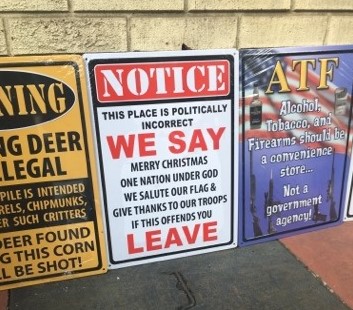
So much of what passes for America’s Kulturkampf (culture struggle) consists of phony, made up, manufactured issues. Consider the following sign, sent to me by a friend as he toured the wilds of Pennsylvania:
It is supposedly “politically incorrect” to say Merry Christmas, to state the Pledge of Allegiance (“one nation under God”), to salute the flag, and to thank the troops. Those who do all these things apparently take pride in their alleged outspokenness and their love of all things American.
Sigh.
Forgive me for stating the obvious, but it’s never been politically incorrect to say Merry Christmas. Virtually all Americans say they believe in God or some higher power. Nearly all Americans respect the flag (even those who kneel in protest, I’d argue), and America’s respect for the military has never been higher.
But this sign with its false narrative encapsulates much of the Republican/Trumpian message: We’re the real Americans. And anyone who says “Happy Holidays” or who suggests separation of church and state or who sees protest as legitimate free speech is obviously un-American and should leave the country.
I just wonder at all those Americans who buy signs like this, thinking that by doing so they’re showcasing their bravery at being non-PC and their pride in being so “American.”
One thing is certain: this manufactured culture war is a great way to distract and divide the commoners as the rich and powerful continue their looting of America.
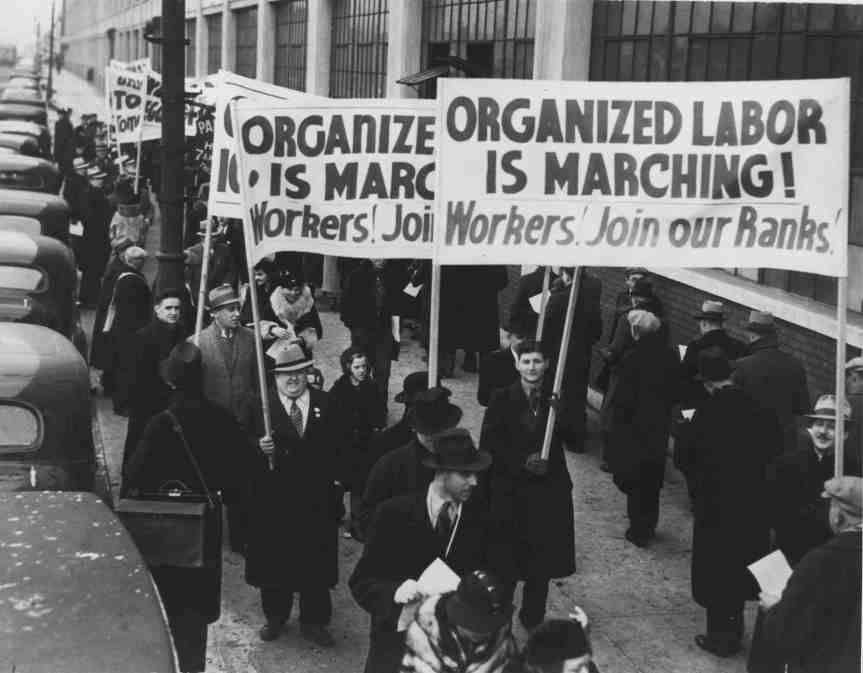
Labor Day Weekend is upon us again. My dad told me that the harder he worked physically, the less he got paid. He worked in factories before he took the civil service exam and became a firefighter in the early 1950s. Over time, his pay and benefits increased due to the power of the firefighters’ union. So make that two lessons from my dad. The first is that workers doing “grunt” work deserve better pay and more respect; the second is that unions should be celebrated for helping workers to get higher pay and better benefits. Yet sadly Labor Day Weekend in America is typically sold as yet another opportunity to spend money at various “sales.” It’s not celebrated as a day to mark the contributions of the humble worker across America. Indeed, if it’s truly “labor” day, shouldn’t nearly everyone have the day off?
Workers had to fight bitter, sometimes deadly, battles for nickles and dimes. And they still do. We need to remember those battles and work to improve the plight of workers everywhere.
Labor Day weekend is a reminder there’s no labor party in U.S. politics. Instead, we have two pro-business parties: the Republicans and the Republicans-lite, otherwise known as the Democrats. Both are coerced if not controlled by corporations through campaign finance “contributions” (bribes) and lobbyists (plus the promise of high-paying jobs should your local member of Congress lose an election or wish to transition to a much higher paying job as a lobbyist/influence peddler). With money now defined as speech, thanks to the Supreme Court, there’s a lot of “speech” happening in Congress that has nothing to do with the concerns of workers.
Nevertheless, a myth exists within the mainstream media that “socialist” progressive politicians are coming this fall to take your money and to give it to the undeserving poor (and especially to “illegal” immigrants, who aren’t even citizens!). First of all, the so-called Democratic Socialists are not…
I recently read an article on Rocky Bleier’s return to Vietnam, the subject of a documentary on ESPN.
Rocky Bleier played on the Pittsburgh Steelers football team in the 1970s, when the Steelers were at their finest. Before that, he was drafted into the Army and was wounded in combat in Vietnam. Doctors thought he’d never play football again, but Bleier proved them wrong, helping the Steelers to win four Super Bowls.
Bleier’s return to Vietnam was emotional and revealing, but in a way that is one-sided, privileging the American experience of that war. Franco Harris, another famous football player, puts it succinctly: “It’s a tragedy, I wish the war [Vietnam] had never happened.” But was America’s war in Vietnam simply a tragedy? Or was it more of a crime? What was America after in Vietnam? And at what cost to the peoples of Southeast Asia?
As Bleier puts it, “All of a sudden I had an overwhelming feeling of loss and sadness. Why did we fight this war? Why did we lose 58,000 soldiers and in all honesty for what? Maybe for first time I can understand on a slight basis the impact that our soldiers go through and maybe just a little what post-traumatic stress might be and how the body reacts to all the emotions.”
Those are important words. But what about the millions of Vietnamese, Cambodians, and Laotians killed in that war? What about their war burdens? What about the suffering that is still ongoing in Southeast Asia today due to chemical defoliants, unexploded ordnance, land mines, and the like?
In this article on Rocky Bleier, the Vietnamese people make an appearance, but nothing is said of their suffering. Instead, they are presented as entirely pro-American:
“Everyone we met [in Vietnam] was pro American. There is a whole generation that the war is for the history books and not an experience they were a part of. The viewpoint has changed,” Bleier said.
The “viewpoint” that’s changed isn’t specified, but I assume Bleier is saying the Vietnamese used to be anti-American (I wonder why?), but are now pro-American in spite of the enormous devastation America inflicted on Vietnam.
Again, it’s good to see a prominent American sports figure talk about the tragedy of Vietnam and the pointlessness of that war. But, as with many other documentaries about Vietnam, including the Ken Burns series in 2017, it’s always all about us, and the tragedy is almost exclusively presented as an American one.
That bias may be predictable, but it’s no less pernicious for being so.
Update: Here’s the short version of the ESPN documentary. It features one Vietnamese soldier who fought for the Americans; he is allowed a statement about the general waste and horror of war. No other Vietnamese are shown, and no other opinions are solicited.
As students report back to their various schools, I’ve noticed this article is getting renewed attention. When I started college in 1981, the motto was “learn how to learn.” Today’s motto, however, seems to be “learn how to earn.” There’s a twisted logic to this, given the expense of private schools (and many public ones, for that matter).
I was lucky to have teachers and professors who were passionate about learning, and who were not straitjacketed by the demands of standardized testing. Many of them were inspired, I think, by the counterculture movements of the 1960s. They spoke their minds, and I was the better for it.
Nowadays, when I look at available jobs in academe, I see a surging demand for various administrators, deans, student affairs, coaches, diversity promoters, and the like, but few positions for full-time teachers and professors. How did education become dominated by management? How did it become just another business, another product, another disposable commodity?
Last night, my mind boggled as a sportscaster talked about his “corporate family” on TV. Corporate family — an American oxymoron for this moment. Education, I used to tell my students, should provide you with a BS meter in life. Last night, my BS meter was pegged. Thanks for reading.
Is American education becoming an exercise in mind-consumption? (Image: Jared Rodriguez / Truthout)
W.J. Astore
Trump! Mueller! Collusion!
I know: who cares about the education of our kids as the redacted Mueller Report dominates the airwaves on CNN, MSNBC, and similar cable “news” networks?
I care. I spent fifteen years as a history professor, teaching mostly undergraduates at technically-oriented colleges (the Air Force Academy; the Pennsylvania College of Technology). What I experienced was the slow death of education in America. The decline of the ideal of fostering creative and critical thinking; the abandonment of the notion of developing and challenging young people to participate intelligently and passionately in the American democratic experiment. Instead, education is often a form of social control, or merely a means to an end, purely instrumental rather than inspirational. Zombie education.
Nowadays, education in America is about training for a vocation, at least…
Among the most popular articles I’ve written is this one. It captured the suppression of anti-war views by the DNC in 2016. This isn’t surprising; Hillary Clinton was more hawkish than Donald Trump, and the Democrats are just as eager to appease the military-industrial complex as are Republicans (indeed, often more so).
America has two war parties, and this remains so to this day. And the mainstream media, which is basically owned by corporations dominated by military concerns, never challenges America’s culture of permanent war.
I can’t wait to witness all of the DNC’s super-delegates lining up behind a pro-war candidate (Biden? Harris? Booker?) in the summer of 2020. Once again, the lights will be shut off on those fighting for peace.
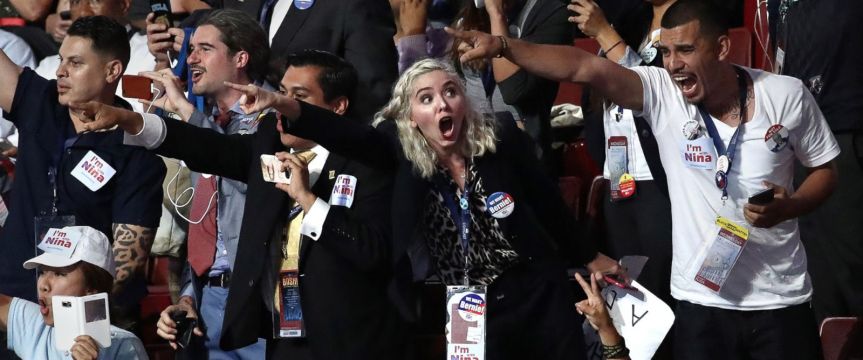
Yes, there was a revealing moment at last night’s Democratic National Convention. No, it wasn’t President Obama’s soaring speech, or Joe Biden’s heartfelt appeal, or Tim Kaine’s “believe me” lampoon of Donald Trump. All these were scripted.
It was the anti-war protesters who spoke out against drone assassinations and war while former CIA Director and Secretary of Defense Leon Panetta spoke.
Good for them. This democratic convention has been at pains to please the military. Last night, Panetta called the U.S. military our greatest national treasure. Obama repeated his claim that the U.S. military is the finest fighting force since Cain slew Abel. Tim Kaine opened his remarks by mentioning the Marines and shouting Semper Fi.
The Democrats are the new Republicans: they’re going “all in” on military boosterism and ra-ra patriotism.
Which is why the anti-war protest was so refreshing. End the…
“War is man at his worst.” This is the wise conclusion of Jesse Ventura, former governor, wrestler, and Vietnam veteran. Heroes save lives; they don’t take them: more wise words from Ventura. Given war’s murderous brutality and sheer awfulness, why does it persist? And why are Americans constantly preparing for it? Here are a few thoughts from a piece I wrote six years ago.
A young Tom Cruise loving his machine gun in “Taps”
W.J. Astore
“[W]ar is a distressing, ghastly, harrowing, horrific, fearsome and deplorable business. How can its actual awfulness be described to anyone?” Stuart Hills, By Tank Into Normandy, p. 244
“[E]very generation is doomed to fight its war, to endure the same old experiences, suffer the loss of the same old illusions, and learn the same old lessons on its own.” Philip Caputo, A Rumor of War, p. 81
The persistence of war is a remarkable thing. Two of the better books about war and its persistence are J. Glenn Gray’s “The Warriors” and Chris Hedges “War Is a Force that Gives Us Meaning.” Hedges, for example, writes about “the plague of nationalism,” our willingness to subsume our own identities in the service of an abstract “state” as well as our eagerness to serve that state by killing…
I grew up in the Catholic Church, where I professed my faith weekly at every mass I attended. I also grew up a fan of the U.S. military, even as I read many books critical of its performance in the Vietnam War. Thankfully, I didn’t have to profess my faith in that military, but if I had, what would such a “profession” have looked like? This is the subject of my latest article at TomDispatch.com, which you can read about here.
Here’s what I believe America’s profession of faith would look like at this moment in our militarized history:
* We believe in wars. We may no longer believe in formal declarations of war (not since December 1941 has Congress made one in our name), but that sure hasn’t stopped us from waging them. From Korea to Vietnam, Afghanistan to Iraq, the Cold War to the War on Terror, and so many military interventions in between, including Grenada, Panama, and Somalia, Americans are always fighting somewhere as if we saw great utility in thumbing our noses at the Prince of Peace. (That’s Jesus Christ, if I remember my Catholic catechism correctly.)
* We believe in weaponry, the more expensive the better. The underperforming F-35 stealth fighter may cost $1.45 trillion over its lifetime. An updated nuclear triad (land-based missiles, nuclear submarines, and strategic bombers) may cost that already mentioned $1.7 trillion. New (and malfunctioning) aircraft carriers cost us more than $10 billion each. And all such weaponry requests get funded, with few questions asked, despite a history of their redundancy, ridiculously high price, regular cost overruns, and mediocre performance. Meanwhile, Americans squabble bitterly over a few hundred million dollars for the arts and humanities.
* We believe in weapons of mass destruction. We believe in them so strongly that we’re jealous of anyone nibbling at our near monopoly. As a result, we work overtime to ensure that infidels and atheists (that is, the Iranians and North Koreans, among others) don’t get them. In historical terms, no country has devoted more research or money to deadly nuclear, biological, and chemical weaponry than the United States. In that sense, we’ve truly put our money where our mouths are (and where a devastating future might be).
* We believe with missionary zeal in our military and seek to establish our “faith” everywhere. Hence, our global network of perhaps 800 overseas military bases. We don’t hesitate to deploy our elite missionaries, our equivalent to the Jesuits, the Special Operations forces to more than 130 countries annually. Similarly, the foundation for what we like to call foreign assistance is often military training and foreign military sales. Our present supreme leader, Pope Trump I, boasts of military sales across the globe, most notably to the infidel Saudis. Even when Congress makes what, until recently, was the rarest of attempts to rein in this deadly trade in arms, Pope Trump vetoes it. His rationale: weapons and profits should rule all.
* We believe in our college of cardinals, otherwise known as America’s generals and admirals. We sometimes appoint them (or anoint them?) to the highest positions in the land. While Trump’s generals — Michael Flynn, James Mattis, H.R. McMaster, and John Kelly — have fallen from grace at the White House, America’s generals and admirals continue to rule globally. They inhabit proconsul-like positions in sweeping geographical commands that (at least theoretically) cover the planet and similarly lead commands aimed at dominating the digital-computer realm and special operations. One of them will head a new force meant to dominate space through time eternal. A “strategic” command (the successor to the Strategic Air Command, or SAC, so memorably satirized in Stanley Kubrick’s Dr. Strangelove) continues to ensure that, at some future moment, the U.S. will be able to commit mass genocide by quite literally destroying the world with nuclear weapons. Indeed, Pope Trump recently boasted that he could end America’s Afghan War in a week, apparently through the mass nuclear genocide of (his figure) 10 million Afghans. Even as he then blandly dismissed the idea of wiping that country “off the face of the earth,” he openly reflected the more private megalomania of those military professionals funded by the rest of us to think about “the unthinkable.” In sum, everything is — theoretically at least — under the thumbs of our unelected college of cardinals. Their overblown term for it is “full-spectrum dominance,” which, in translation, means they grant themselves god-like powers over our lives and that of our planet (though the largely undefeated enemies in their various wars don’t seem to have acknowledged this reality).
* We believe that freedom comes through obedience. Those who break ranks from our militarized church and protest, like Chelsea Manning, are treated as heretics and literally tortured.
* We believe military spending brings wealth and jobs galore, even when it measurably doesn’t. Military production is both increasingly automated and increasingly outsourced, leading to far fewer good-paying American jobs compared to spending on education, infrastructure repairs of and improvements in roads, bridges, levees, and the like, or just about anything else for that matter.
* We believe, and our most senior leaders profess to believe, that our military represents the very best of us, that we have the “finest” one in human history.
* We believe in planning for a future marked by endless wars, whether against terrorism or “godless” states like China and Russia, which means our military church must be forever strengthened in the cause of winning ultimate victory.
* Finally, we believe our religion is the one true faith. (Just as I used to be taught that the Catholic Church was the one true church and that salvation outside it was unattainable.) More pacific “religions” are dismissed as weak, misguided, and exploitative. Consider, for example, the denunciation of NATO countries that refuse to spend more money on their militaries. Such a path to the future is heretical; therefore, they must be punished.
Please read the rest of my article here at TomDispatch.com. And please comment. Did I miss anything in my version of America’s militarized profession of faith?
Over at ABC News, an article asks whether Donald Trump is a white supremacist. Bernie Sanders thinks so. Elizabeth Warren does too.
I’m not so sure. Trump sounds like a white supremacist. His rhetoric encourages white supremacists. He has a long history of bigotry and racism. QED?
I’m hesitant to say it’s proven, but I know one thing is certain: Trump is a Trump supremacist.
A self-confessed “very stable genius.” A man without a racist bone in his body. The least racist person you’ll ever meet, according to Trump himself. A president who ranks himself as roughly equal to Abraham Lincoln, considered by most historians to have been America’s finest president.
Vanity, thy name is Trump. And because Trump is a white male, ipso facto white men are supreme; they must be, because Trump is one of them, indeed the finest example of them, at least in his own mind.
So, I think it’s tempting yet too simplistic to say Trump is a white supremacist. Trump is a Trump supremacist. Everyone else is inferior to Trump, some more so than others. The less you look like Trump, or act like Trump, the less he thinks of you. Thus it’s no surprise he surrounds himself with mostly white men, many with dubious pasts of sexism or racism. To Trump, these are not disqualifiers. How could they be? He’s sexist and racist, so how can that ultimately be a bad thing?
From his lofty perch as the greatest human in all of history, Trump looks down on all of us. He just sneers a bit more if you’re brown or black or less than 100% boorishly male.
Trump is under fire for his “tone-deaf” visits to El Paso and Dayton, in which he bragged about the size of his crowd and how deeply people respect the Office of the Presidency. And media outlets act surprised that Trump has an “empathy gap”! Anyone who’s watched Trump as a “celebrity” knows that everything is all about him. If he’s anything, Trump is a narcissist motivated by money and driven by ego. This is why the Saudis, the North Koreans, and others find it so easy to manipulate him. They just flatter him.
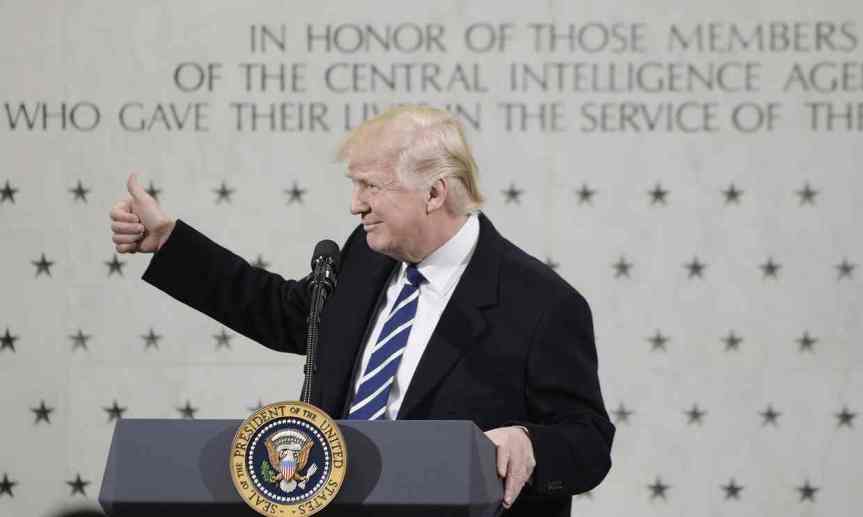
Yesterday, I caught President Trump’s speech before the CIA. As he stood before the wall of honor, surrounded by the stars on that wall that represent those who gave their lives for their country, Trump deviated from his prepared comments to boast about how many times he’d appeared on the cover of Time magazine.
Here’s what he said: I HAVE BEEN ON THEIR COVER ABOUT 14 OR 15 TIMES. I THINK WE HAVE THE ALL-TIME RECORD IN THE HISTORY OF TIME MAGAZINE — IF TOM BRADY IS ON THE COVER, IT’S ONE TIME. I’VE BEEN ON 15 TIMES. I THINK THAT’S A RECORD THAT COULD NEVER BE BROKEN.
Really, President Trump? You’re giving a speech before members of the CIA, and what comes to mind is the number of times your own mug has appeared on a magazine cover? And you’re doing this in front of the CIA’s…
What can you say about mass shootings in America that hasn’t already been said? El Paso and Dayton (not Toledo, Mr. Trump) are the most recent in a seemingly unending series of shootings in America. A grim statistic:
“Dayton was the 22nd mass killing in America this year, according to an AP/USA Today/Northeastern University mass murder database, which tracks all attacks involving four or more people killed.”
Or, alternatively: “The shooting in Ohio marked the 31st deadly mass shooting in America this year, defined as those where at least three people are killed by gun violence in a single episode.”
“As of today (Aug. 4), we are 216 days into 2019. In the US over that time, more than 1,300 people have been injured or killed in mass shootings, according to data collected by the Gun Violence Archive.
QUARTZ
Injuries and deaths related to mass shootings.
The nonprofit organization, which is based in Washington, DC, defines a mass shooting as an event in which at least four people were shot. By its calculations, that means there have been some 292 mass shootings in the US since the year began.”
In a prepared statement this morning, President Trump came out against white supremacy, racism, and bigotry, but tragically this is a clear case of “Do what I say, not what I do” for Trump. He compounded his hypocrisy by ignoring the ready availability of assault weapons, blaming instead mental illness and violent video games, among other factors.
Firstly, the mentally ill are more likely to be the victims of violence than the perpetrators of it. Secondly, violent video games are a global phenomenon, but I’m not reading about dozens of mass shootings each year in Japan or Korea or Sweden.
Trump’s weak-willed words were thoroughly predictable; he’s closely aligned with the National Rifle Association and its total fixation on gun rights to the exclusion of all others. He’s not alone in this. When I taught in rural Pennsylvania, my students knew all about the Second Amendment. But their knowledge of the First, Fourth, and Fifth Amendments was far weaker. Yes, for many Americans guns really do trump free speech, freedom of the press, and similar rights.
Predictably, Americans search for a magic bullet (pun intended) after these horrifying massacres to put a stop to them. How about better background checks? Eliminating extended magazines for the millions of assault rifles that are already in the hands of Americans? Better databases to track the mentally ill and the criminally violent? And so on. And we should have better background checks before you can buy a gun; we should stop selling military-style hardware; we should keep better track of dangerous people. But steps such as these will only stem the violence (if that). They won’t put an end to it.
Our culture is suffused with violence. At the same time, powerful forces are at play (stoked by our very own president) to divide us, to inflame our passions, to turn us against them, where “them” is some category of “other,” as with the El Paso shooter, who targeted immigrants “invading” America.
To stop mass shootings, we must change our culture of violence. This is made much more difficult by men like Trump, who’ve embraced violent rhetoric for their own selfish purposes. But we must change it nonetheless, else witness more carnage across America.
Note to readers: This is not the first time I’ve written about violence and guns in America. Here are links to a few articles on this subject at Bracing Views:



 W.J. Astore
 Is American education becoming an exercise in mind-consumption? (Image: Jared Rodriguez / Truthout)
  Honest passion at the DNC

 W.J. Astore


