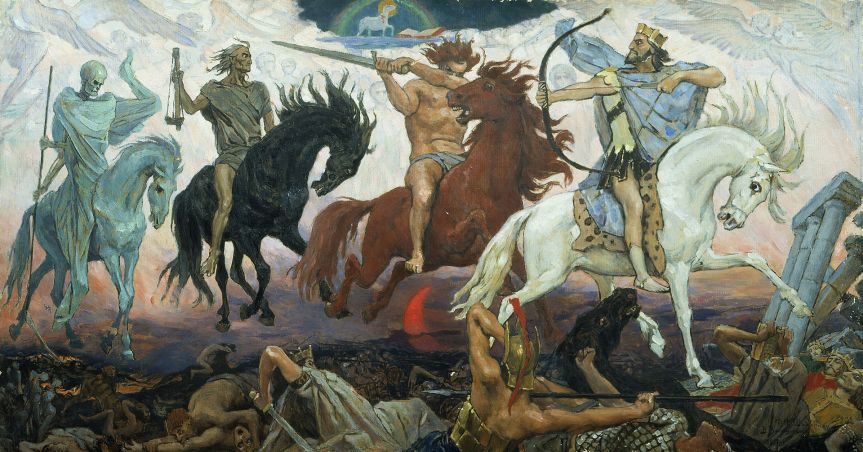
The Four Horsemen of the Apocalypse (Viktor Vasnetsov)
W.J. Astore
On this 15th anniversary of the 9/11 attacks in 2001, we should ask ourselves what those attacks inaugurated. In a word, calamity. The wildly successful actions of Al Qaeda, combined with the wild overreactions of the Bush/Cheney administration, marked the 21st century as one that will likely become known to future historians as calamitous.
In thinking about the 9/11 attacks, as an Air Force officer, what struck me then, and still does now, is the psychological blow. We Americans like to think we invented flight (not just that the Wright Brothers succeeded in the first powered flight that was both sustained and controlled). We like to think that airpower is uniquely American. We take great pride that many airliners are still “Made in the USA,” unlike most other manufactured goods nowadays.
To see our airliners turned into precision missiles against our skyscrapers, another potent image of American power, by a terrorist foe (that was once an ally against Soviet forces in Afghanistan) staggered our collective psyche. That’s what I mean when I say Al Qaeda’s attacks were “successful.” They created an enormous shock from which our nation has yet to recover.
This shock produced, as Tom Engelhardt notes in his latest article at TomDispatch.com, a form of government psychosis for vengeance via airpower. The problem, of course, is that the terrorist enemy (first Al Qaeda, then the Taliban, now ISIS) simply doesn’t offer big targets like skyscrapers or the Pentagon. The best the U.S. can do via airpower is to strike at training camps or small teams or even individuals, all of which matter little in the big scheme of things. Meanwhile, U.S. air strikes (and subsequent land invasions by ground troops) arguably strengthen the enemy strategically. Why? Because they lend credence to the enemy’s propaganda that the USA is launching jihad against the Muslim world.
The wild overreactions of the Bush/Cheney administration, essentially continued by Obama and the present national security state, have played into the hands of those seeking a crusade/jihad in the Greater Middle East. What we have now, so the experts say, is a generational or long war, with no foreseeable end point. Its product, however, is obvious: chaos, whether in Iraq or Libya or Yemen or Syria. And this chaos is likely to be aggravated by critical resource shortages (oil, water, food) as global warming accelerates in the next few decades.
We are in the early throes of the calamitous 21st century, and it all began fifteen years ago on 9/11/2001.
Last night’s “commander-in-chief” security forum that featured Hillary Clinton and Donald Trump was, not surprisingly, disappointing. (You can read the transcript here.) Trump recently stated he was in favor of large increases in defense spending, but he wasn’t asked about this. He wasn’t asked about his support of torture, nor was he challenged on his remarkably dangerous statement back in March that military officers would obey his presidential decrees, even when they were unlawful. Hillary was challenged on her email fiasco at the State Department, and rightly so, but she pretty much got a free pass on her support of the calamitous Iraq war and the chaos following the Libyan intervention. And of course neither candidate was challenged on their blanket support of Israel.
What you got was two self-absorbed candidates, one wonkish, the other one clearly a wanker, both of them posing as warriors as long as someone else’s kids are doing the fighting. Here’s a question for Trump and Hillary: the next time you deploy troops to Iraq or Syria or Afghanistan or wherever, will you include Ivanka or Chelsea, respectively, and put them in harm’s way?
Most interesting to me was Trump’s old-fashioned imperialism, which explains much of his appeal to the rabid right. Here’s what Trump had to say about how the Iraq war should have turned out for the USA:
“We [the USA] go in [to Iraq in 2003], we spend $3 trillion, we lose thousands and thousands of lives, and then, Matt, what happens is, we get nothing. You know, it used to be to the victor belong the spoils. Now, there was no victor there, believe me. There was no victor. But I always said: Take the oil.”
You have to hand it to The Donald: at least he’s occasionally honest. The Iraq war was about oil, among other things, and Trump says the USA as the “victor” should have taken it. Why? Because might makes right. Because, as Thucydides said so many centuries ago, the strong do what they will and the weak suffer as they must.
Remember when George W. Bush said Iraq’s oil was the “patrimony” of the Iraqi people and that the USA wasn’t about to take it? That the Iraq war was about freedom and democracy in the Middle East, not a naked grab for resources? Trump is having none of that. Any wonder that he’s so popular among Americans who are tired, as they see it, of losing?
“Take the oil!” It’s a statement that could easily appear on the next iteration of Trump’s baseball cap.
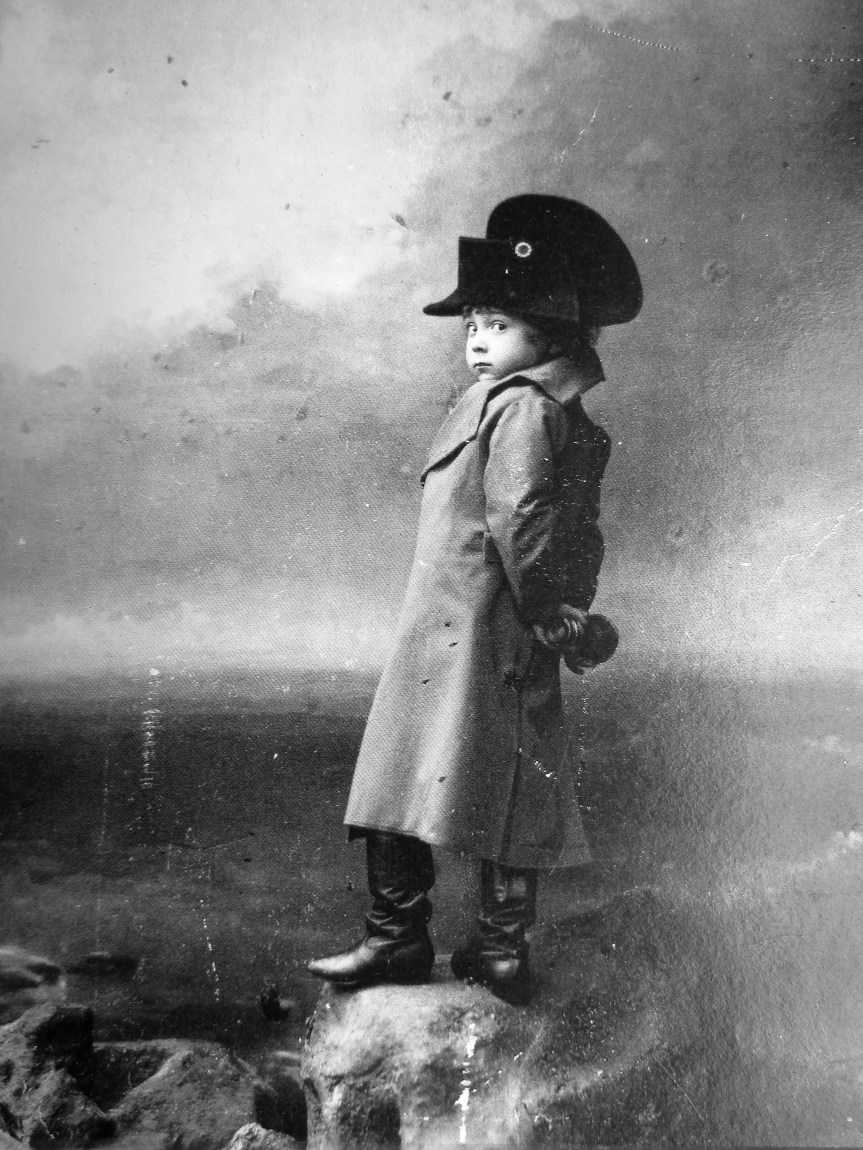
Photo by Paul Nadar (1891), from a French postcard
W.J. Astore
I was reading the novelist Ursula K. Le Guin and came across the following commentary by her:
“A hero whose heroism consists of killing people is uninteresting to me, and I detest the hormonal war orgies of our visual media … War as a moral metaphor is limited, limiting, and dangerous. By reducing the choices of action to ‘a war against’ whatever-it-is, you divide the world into Me or Us (good) and Them or It (bad) and reduce the ethical complexity and moral richness of our life to Yes/No, On/Off. This is puerile, misleading, and degrading. In stories, it evades any solution but violence and offers the reader mere infantile reassurance. All too often the heroes of such fantasies behave exactly as the villains do, acting with mindless violence, but the hero is on the ‘right’ side and therefore will win.”
This passage is copyrighted 2012, and surely Le Guin is commenting in part on the American political and war scene, even if these comments came as an afterword to her novel “A Wizard of Earthsea.”
The stories we tell ourselves – our driving narratives and metaphors – are very powerful. I learned this almost three decades ago from one of my professors at Johns Hopkins. We were talking about the scientific revolution, the label applied after the fact by historians to the era of Copernicus, Kepler, Galileo, and Newton. Did that era truly deserve the label of a “revolution” in thought? On one level, yes. A heliocentric vision replaced a geocentric one. Newtonian physics replaced Aristotelian metaphysics. But on another level, the label was misleading. If you view this era only through a “revolutionary” lens, everything gets magnified and refracted through it. You’re always looking for evidence of the “revolution” that you know is there. The revolutionary narrative/metaphor, in other words, restricts and distorts your vision. It also tends to answer questions before they’re even asked. Certain historical figures get labeled as “revolutionaries,” others as “reactionaries,” some as winners, others as losers, almost without having to think about it.
That’s disturbing enough for a historian dealing with the “dead” past. Think about how that distortion, that resort to easy categorization, applies to the living, to the present, in “wartime.” Viewing everything through a war lens both restricts and distorts our vision. We quickly force people to take sides, or we assign them a side regardless of their complexity (“You’re either for us or against us,” as George W. Bush noted in the aftermath of 9/11). Just as quickly, the “heroes” adopt the violent methods of the bad guys (witness the bombing, the invasions, the use of torture, performed by the U.S. in the stated cause of “liberation”). No ethical complexity is tolerated since “our” troops are on the right side (so we think). Even when they embrace violence and lose control, deadly mistakes and even war crimes are readily excused as aberrations that should be forgotten, rare exceptions that do nothing to besmirch America’s exceptional and heroic nature.
The power of narratives is remarkable. The United States continues to be driven by one that’s dominated by power, violence, and war. Is it any wonder, then, that the two major party candidates for the presidency, Hillary Clinton and Donald Trump, fit so easily and readily into this narrative? Hillary plans to continue to wage war even more aggressively than Obama has, and Trump is all about violent solutions and an “Us” versus “Them” mentality. (Build a wall! Biggest, baddest military! Make America great again! Punch the protesters! Extreme vetting! Throw the illegals out!)
Until we change our national narrative from one of constant war and violence to something more pacific and modulated, our political scene will continue to be, to borrow Le Guin’s words, puerile and misleading and degrading, with candidates serving up heroic violence as pabulum, as infantile reassurance.
Perhaps there should be a “new rule” on the American military scene: When the B-52s are called out (Vietnam, Iraq, Afghanistan), it means America has well and truly lost.
Unbeknownst to most Americans, since April of this year, B-52s flying out of “Al Udeid airbase in Qatar … have conducted more than 325 strikes in almost 270 sorties, using over 1,300 weapons” against ISIS and now in Afghanistan, notes Paul Rogers at Open Democracy.
For those of you unfamiliar with B-52s, they are huge long-range bombers, originally deployed in the 1950s to carry nuclear weapons against the Soviet Union. In the 1960s and early 1970s, they were called upon to carry conventional bomb loads during the Vietnam War. Their enormous bomb tonnages did not serve to win that war, however, nor has the subsequent use of B-52s in places like Iraq and Afghanistan served to win those wars. They have become a sort of stop-gap weapon system, their ordnance called upon to stem the tide of American military reversals even as their presence is supposed to demonstrate American resolve.
In a way, America’s B-52s are like the Imperial Star Destroyers of the “Star Wars” universe.
An imperial star destroyer loses yet another chase
Big, lumbering ships that never seem to provide a winning edge vis-a-vis the smaller, “rebel” forces against which they’re deployed. But the empire, which never seems to learn, keeps using them, even as it seeks even bigger, “Death Star” weaponry with which to annihilate the resistance.
Of course, when Americans think about air power, they don’t think of “Star Wars” battles or B-52s on bombing runs. They think of audacious and cocky fighter pilots, like Tom Cruise’s “Maverick” in the highly popular movie, “Top Gun.” For me, the most telling scene in that movie is when the flashy, undisciplined, and self-centered Maverick puts his F-14 Tomcat jet into an irrecoverable flat spin. That wouldn’t be so bad, except Maverick has a backseater, “Goose,” who dies during the ejection. Maverick, of course, ejects safely and lives to fight another day.
It’s too late for Goose, but Tom Cruise lives on to make more bad movies
Again, most people probably remember the cheesy ending to this movie where Cruise is shooting down MiG after MiG. But take another look at the flat spin scene. America, like Maverick and Goose’s jet, is dropping from the sky, spinning wildly and uncontrollably all the way. And while a few Mavericks may be lucky enough to get away unscathed, many Gooses in the process are going to end up dead.
Goose didn’t deserve to die in “Top Gun,” and neither do the many “gooses” around the world caught in the violent and all-too-real backwash of America’s jet-fueled wars.
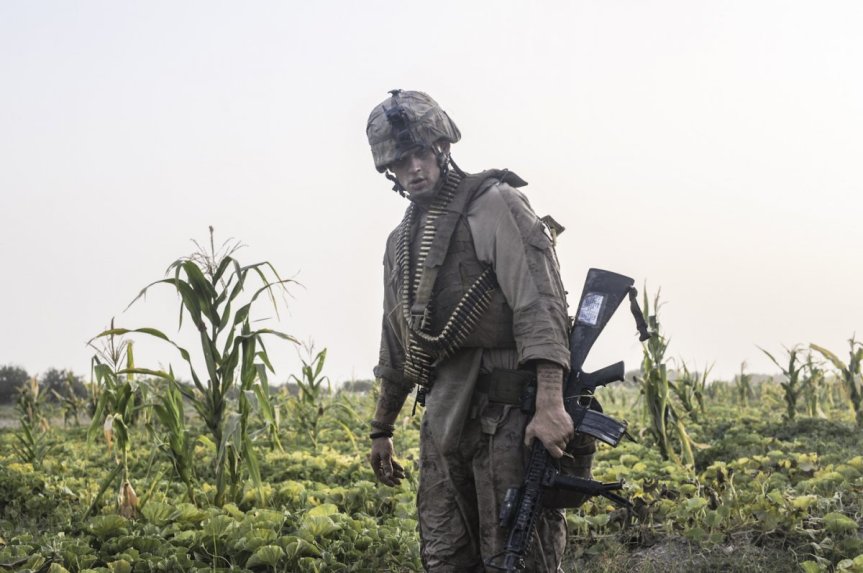
Why can’t we bring them home? (U.S. Marine in Afghanistan; photo by Peter van Agtmael/Magnum)
W.J. Astore
Carl von Clausewitz, the Prussian military theorist who wrote at the end of the Napoleonic Era, is noted for saying that war is a continuation of politics. That saying explains much of current U.S. military war-making, but only if you first and foremost focus on domestic politics – and economics.
Wars make money for weapons makers, and the U.S. dominates the world’s arms trade. Wars require a large “defense” establishment, and the U.S. national security state has essentially become a fourth branch of government that threatens to eat the rest. Wars tend to strengthen reactionary elements within society, shunting to the fringes those who argue for peace amid a climate of fear. Wars, in short, have their purposes – it’s just that the salient ones often differ from the stated ones. For clarity, it often helps to follow the money. Who profits from war? Addressing that question will explain many of the reasons why America’s wars have no promise of ending.
In the meantime, current U.S. war-making looks something like this:
In places like Iraq and Afghanistan, the pursuit of “stability” (whatever that means) mainly through the arming and training of indigenous security forces. Using Afghans and Iraqis as foot soldiers, as well as a heavy reliance on private military contractors (mercenaries), reduces the U.S. military “footprint” on the ground, which reduces U.S. casualties and thus domestic interest in as well as opposition to these wars. Typical U.S. governmental actions include military training, selling weapons, and providing air support (mainly in the form of bombing and reconnaissance).
Waging these wars, at the end of long logistical lines, is profligate in dollars — witness the high cost of indigenous forces in Iraq and Afghanistan, which rarely perform anywhere close to U.S. expectations — which has the added benefit of justifying enormous “defense” budgets in the U.S.
What these wars don’t promise is either “victory” or closure. But that’s not the main point of them. U.S. politicians like George W. Bush and Barack Obama are not concerned with victory: they’re focused on sustaining illusions of progress for domestic political gain. For example, the recent recapture of Falluja from ISIS is defined by the U.S. government as “progress,” even though that city had already been “pacified,” i.e. largely destroyed at high cost to U.S. forces, more than a decade ago.
In the war on terror, the heavy use of special operations forces and drones, both to kill terrorists and to interdict their supplies, logistics, and sources of their funding. Again, the emphasis is on minimizing U.S. casualties, which is the key consideration in U.S. domestic politics. American lives are not risked in drone attacks, and relatively few Americans have been killed in special ops raids, which, because they are often so highly classified, rarely register in the U.S. media unless Americans are indeed killed.
Here again, it’s unclear if any real progress is being made in this war, but the Obama administration in particular has sold such raids and strikes as killing thousands of terrorists while minimizing U.S. casualties. Such claims serve to squelch, if only temporarily, Republican claims that Obama is weak and soft on defense. Domestic political concerns, rather than long lasting effectiveness, once again rule.
Confrontation with “peer” rivals like Russia and China. This is old-school stuff, a variant of Cold War containment and deterrence. “Pivots” to the Pacific and the rhetorical pillorying of Vladimir Putin help to justify massive U.S. military spending that approaches $750 billion each and every year. The war on lightly armed terrorists isn’t enough to sustain this figure, but reports that China’s getting an aircraft carrier or Russia’s working on nuclear weapons justify new U.S. carriers and a trillion-dollar splurge on U.S. nuclear arsenals.
Here again, U.S. war-making is driven far more by domestic politics (and economics) than by needs-driven analysis of national defense. Exaggerating peer threats like China and Russia keeps a sclerotic Pentagon, a supine Congress, and a bloated military-industrial complex happy.
At this point, an astute reader might ask: But what is the real Clausewitzian strategy for war-making in the United States? How is war a continuation of politics? Again, one must look to U.S. domestic politics to address this question. “Toughness” must be demonstrated, therefore wars must be continued, no matter how costly and unpromising, if only to keep up appearances. President Obama, for example, has refused to make key decisions about the Afghan war, leaving it to the next president to decide whether the U.S. commitment of troops continues after 2017. There’s an outstanding chance that the next U.S. president will continue that war, placing it on the backburner to simmer until the next election cycle in 2020.
In sum, the new American way of war-making consists of methods rather than strategies, methods that produce endless war that serve mostly domestic political and economic purposes. A telltale sign that things are going really poorly is when the U.S. military declares another “surge” of its ground forces, which whether in Iraq in 2007 or Afghanistan in 2009-10 seemed calculated not to produce victory or closure but again to squelch domestic political opposition from hawkish rivals. That in itself is considered a “win” for whichever administration is in power.
What is never considered in U.S. war-making is ending the wars. Domestically, attempts at limiting U.S. war-making are instantly tarred with the brush of “cutting and running,” of weakness, even of cowardice. Rare is the U.S. president who dares to stand up to those clamoring for war.
Attempts to downsize the global presence of the U.S. military are similarly equated with weakness. As a result, no U.S. president (or major party candidate for president, like Clinton or Trump) dares to suggest it. Refusing to walk away, fearing loss of face but especially fearing domestic political defeat, presidents as diverse as Lyndon Johnson and Richard Nixon in the 1960s and lately Bush and Obama have embraced the folly of waging unwinnable wars. It’s likely little will change in 2017, irrespective of which major party wins the election.
Both presidential nominees of the major parties, Hillary Clinton and Donald Trump, have promised to make the U.S. military bigger and better. But for what purpose? A bigger, badder military is the purpose, and again it’s driven by domestic political and economic imperatives. You have to go outside the major parties, to the Libertarians or the Greens, to hear any talk of significant military reductions. Libertarians have talked of military reductions of 20%, the Greens of deeper cuts of up to 50%. In today’s militarized America, those parties aren’t going anywhere.
War-making as a continuation of domestic politics for political and economic profit – it sure explains a lot about the actions of the U.S. government and military. It may not be what Carl von Clausewitz had in mind, but it surely is America’s reality.
Recently, a good friend gave me a copy of Daniel Anselme’s “On Leave,” a book published in 1957 in the early stages of France’s war in Algeria, which ultimately ended in France’s defeat and Algerian independence in 1962. A novel, it follows three French soldiers on furlough in and around Paris and their desperate (and mostly failed) efforts to reconnect to home prior to returning to a brutal war.
The main themes are disaffection and disorientation. The gulf in understanding between the soldier-conscripts and their families and the wider public is simply too wide to be bridged. Instead, the soldiers find comfort in drink, women, and especially in each other. Having relied on each other in war, they come to rely on each other again in the short downtime they have from its brutalities.
What struck me forcibly was the indifference of France to the soldiers. We see a similar indifference today in the U.S., despite all of the “support our troops” rhetoric. This “support” often is, as the saying goes, a mile wide but only an inch deep. Another similarity between then and now is the gulf in understanding between what the soldiers know about war and what the people think they know. The soldiers know the horrors; the people only know a few talking points. Back then it was about upholding the honor of France; nowadays in the USA it’s about fighting them (the terrorists) over there so we don’t have to fight them here.
For the troops, it’s always the same cause: preservation. Survival. Saving oneself and one’s buddies.
One soldier gives an electric speech about “when will it end.” How many men is France willing to lose in its attempt to hold onto some smidgen of colonial glory? How long will the wars in Africa go on? His speech made me think of our own, seemingly endless, wars.
All three men in this story — a sergeant, a corporal, and a private — are unwounded physically from war. Yet all three are psychological casualties. War and atrocity has already inflicted a serious toll, as all three suffer some of the less obvious costs of war and extended military service (broken marriages, family arguments and estrangement and resentment, guilt at not being able to conform to family expectations, a growing sense of fatalism).
Recognizing a lost cause, French President Charles de Gaulle eventually smartened up and pulled out of Algeria. But the U.S. today doesn’t have leaders of de Gaulle’s grit and smarts to recognize a losing hand. So America’s wars just grind on and on.
“On Leave” is a fine book. Would that it were on President Obama’s summer reading list, or on Hillary’s or Trump’s. They could all use a heavy dose of reality about war’s futility.
My latest article at TomDispatch.com focuses on the need for military dissent in an age of creeping militarism and perpetual war. In my article, I identify some of the key reasons why such dissent is tightly constrained and often severely limited. This is especially problematic for at least two reasons. The first is that Americans say they trust the military more than any other societal institution. If the military censors itself, it misses an invaluable opportunity to educate an attentive public about the disastrous path of America’s wars.
The second reason is that a democracy’s health depends on dissent. A country in which dissent is suppressed, a country that finds itself engaged in perpetual war, is a country that cannot sustain democratic institutions. We’re already witnessing the withering away of democracy in America. That it’s happening in slow motion doesn’t mean that it isn’t happening.
A Marine Corps sergeant and Vietnam War veteran wrote to me in “salty” language that “his damn war [was] fucked up,” but that while he was still in uniform he “spoke little [against the war] and only then about how it was being run.” We need more honesty from today’s veterans about how America’s damn wars are fucked up. Maybe then we’ll finally get off our duffs and work to put a stop to them.
Here are a few excerpts from my article; I invite you to read all of it at TomDispatch.com.
The Pentagon has, in a very real sense, become America’s national cathedral. If we’re going to continue to worship at it, we should at least ask for some minimal level of honesty from its priests. In militarized America, the question of the moment is how to encourage such honesty.
Call it patriotic dissent. By “dissent” I mean honest talk from those who should know best about the hazards and horrors of perpetual war, about how poorly those conflicts have gone and are going. We desperately need to encourage informed critics and skeptics within the military and the [Military-Industrial] Complex to speak their minds in a way that moves the national needle away from incessant bombing and perpetual war.
Yet to do so, we must first understand the obstacles involved. It’s obvious, for example, that a government which has launched a war against whistleblowers, wielding the World War I-era Espionage Act against them and locking away Chelsea Manning for a veritable lifetime in a maximum security prison, isn’t likely to suddenly encourage more critical thinking and public expression inside the national security state. But much else stands in the way of the rest of us hearing a little critical speech from the “fourth branch” of government …
Leaving military insularity, unit loyalty, and the pressure of combat aside, however, here are seven other factors I’ve witnessed, which combine to inhibit dissent within military circles.
1. Careerism and ambition: The U.S. military no longer has potentially recalcitrant draftees — it has “volunteers.” Yesteryear’s draftees were sometimes skeptics; many just wanted to endure their years in the military and get out. Today’s volunteers are usually believers; most want to excel. Getting a reputation for critical comments or other forms of outspokenness generally means not being rewarded with fast promotions and plum assignments. Career-oriented troops quickly learn that it’s better to fail upwards quietly than to impale yourself on your sword while expressing honest opinions. If you don’t believe me, ask all those overly decorated generals of our failed wars you see on TV.
2. Future careerism and ambition: What to do when you leave the military? Civilian job options are often quite limited. Many troops realize that they will be able to double or triple their pay, however, if they go to work for a defense contractor, serving as a military consultant or adviser overseas. Why endanger lucrative prospects (or even your security clearance, which could be worth tens of thousands of dollars to you and firms looking to hire you) by earning a reputation for being “difficult”?
3. Lack of diversity: The U.S. military is not blue and red and purple America writ small; it’s a selective sampling of the country that has already winnowed out most of the doubters and rebels. This is, of course, by design. After Vietnam, the high command was determined never to have such a wave of dissent within the ranks again and in this (unlike so much else) they succeeded. Think about it: between “warriors” and citizen-soldiers, who is more likely to be tractable and remain silent?
4. A belief that you can effect change by working quietly from within the system: Call it the Harold K. Johnson effect. Johnson was an Army general during the Vietnam War who considered resigning in protest over what he saw as a lost cause. He decided against it, wagering that he could better effect change while still wearing four stars, a decision he later came deeply to regret. The truth is that the system has time-tested ways of neutralizing internal dissent, burying it, or channeling it and so rendering it harmless.
5. The constant valorization of the military: Ever since 9/11, the gushing pro-military rhetoric of presidents and other politicians has undoubtedly served to quiet honest doubts within the military. If the president and Congress think you’re the best military ever, a force for human liberation, America’s greatest national treasure, who are you to disagree, Private Schmuckatelli?
America used to think differently. Our founders considered a standing army to be a pernicious threat to democracy. Until World War II, they generally preferred isolationism to imperialism, though of course many were eager to take land from Native Americans and Mexicans while double-crossing Cubans, Filipinos, and other peoples when it came to their independence. If you doubt that, just read War is a Racket by Smedley Butler, a Marine general in the early decades of the last century and two-time recipient of the Medal of Honor. In the present context, think of it this way: democracies should see a standing military as a necessary evil, and military spending as a regressive tax on civilization — as President Dwight D. Eisenhower famously did when he compared such spending to humanity being crucified on a cross of iron.
Chanting constant hosannas to the troops and telling them they’re the greatest ever — remember the outcry against Muhammad Ali when, with significantly more cause, he boasted that he was the greatest? — may make our military feel good, but it won’t help them see their flaws, nor us as a nation see ours.
6. Loss of the respect of peers: Dissent is lonely. It’s been more than a decade since my retirement and I still hesitate to write articles like this. (It’s never fun getting hate mail from people who think you’re un-American for daring to criticize any aspect of the military.) Small wonder that critics choose to keep their own counsel while they’re in the service.
7. Even when you leave the military, you never truly leave: I haven’t been on a military base in years. I haven’t donned a uniform since my retirement ceremony in 2005. Yet occasionally someone will call me “colonel.” It’s always a reminder that I’m still “in.” I may have left the military behind, but it never left me behind. I can still snap to attention, render a proper salute, recite my officer’s oath from memory.
In short, I’m not a former but a retired officer. My uniform may be gathering dust in the basement, but I haven’t forgotten how it made me feel when I wore it. I don’t think any of us who have served ever do. That strong sense of belonging, that emotional bond, makes you think twice before speaking out. Or at least that’s been my experience. Even as I call for more honesty within our military, more bracing dissent, I have to admit that I still feel a residual sense of hesitation. Make of that what you will.
Bonus Reason: Troops are sometimes reluctant to speak out because they doubt Americans will listen, or if they do, empathize and understand. It’s one thing to vent your frustrations in private among friends on your military base or at the local VFW hall among other veterans. It’s quite another to talk to outsiders. War’s sacrifices and horrors are especially difficult to convey and often traumatic to relive. Nevertheless, as a country, we need to find ways to encourage veterans to speak out and we also need to teach ourselves how to listen — truly listen — no matter the harshness of what they describe or how disturbed what they actually have to say may make us feel …
And I conclude my article in this way:
Some will doubtless claim that encouraging patriotic dissent within the military can only weaken its combat effectiveness, endangering our national security. But when, I wonder, did it become wise for a democracy to emulate Sparta? And when is it ever possible to be perfectly secure?
Someday, someone will write a history of the U.S. national security state in the twenty-first century and, if the first decade and a half are any yardstick, it will be called something like State of Failure. After all, almost 15 years after the U.S. invaded the Taliban’s Afghanistan, launching the second American Afghan War of the past half-century, U.S. troops are still there, their “withdrawal” halted, their rules of engagement once again widened to allow American troops and air power to accompany allied Afghan forces into battle, and the Taliban on the rise, having taken more territory (and briefly one northern provincial capital) than at any time since that movement was crushed in the invasion of 2001.
Thirteen years after George W. Bush and his top officials, dreaming of controlling the oil heartlands, launched the invasion of Saddam Hussein’s Iraq (the second Iraq War of our era), Washington is now in the third iteration of the same, with 6,000 troops (and thousands of private contractors) back in that country and a vast air campaign underway to destroy the Islamic State. With modest numbers of special operations troops on the ground and another major air campaign, Washington is also now enmeshed in a complex and so far disastrous war in Syria. And if you haven’t been counting, that’s three wars gone wrong.
Then, of course, there was the American (and NATO) intervention in Libya in 2011, which cracked that autocratic country open and made way for the rise of Islamic extremist movements there, as well as the most powerful Islamic State franchise outside Syria and Iraq. Today, plans are evidently being drawn up for yet more air strikes, special operations raids, and the like there. Toss in as well Washington’s never-ending drone war in Pakistan’s tribal borderlands, its disastrous attempt to corral al-Qaeda in the Arabian Peninsula in Yemen (leading to a grim and horrifying Saudi-led, American-supported internecine conflict in that country), and the unending attempt to destroy al-Shabaab in Somalia, and you have at least seven wars and conflicts in the Greater Middle East, all about to be handed on by President Obama to the next president with no end in sight, no real successes, nothing. In these same years Islamic terror movements have only spread and grown stronger under the pressure of the American war machine.
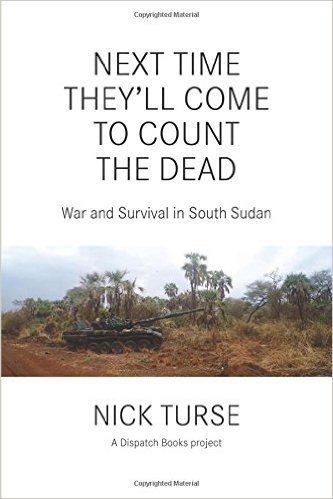
It’s not as if Washington doesn’t know this. It’s quite obvious and, as TomDispatch Managing Editor Nick Turse, author of the highly praisedNext Time They’ll Come to Count the Dead, points out today in his latest report on the U.S. military’s pivot to Africa, the pattern is only intensifying, something clearly recognized by key American commanders. What’s strange, however, is that none of this seems to have caused anyone in the national security state or the military to reconsider the last 15 years of military-first policies, of bombs dropped, troops dispatched, drones sent in, and what the results were across the Greater Middle East and now Africa. There is no serious recalibration, no real rethinking. The response to 15 years of striking failure in a vast region remains more of the same. State of failure indeed!
Be sure to read Nick Turse on how U.S. military efforts in Africa show more regress than progress.
Two weeks ago, I did an interview with TheoFantastique on the military in science fiction. I’d like to thank John Morehead, the site’s creator, for inviting me to answer a few questions on a subject near and dear to my heart.
TheoFantastique: Bill, thanks for making a little time to respond to a few questions related to the subject matter of your article. What are some general observations you have made about the shift in science fiction film depictions of the American military from the post-World War II period to the present?
Bill Astore: Thanks for inviting me, John. I grew up in the late 1960s and 1970s, in the immediate aftermath of the Vietnam War and Watergate. Films of that era were generally critical of the establishment, including sci-fi films. I fondly recall Planet of the Apes with its anti-nuclear message. Also Soylent Green with its warning about over-population, but even more dire was the way in which the authorities hid from the people the true nature of their new food source. Think also of Capricorn One, hardly a great film, but one which exposed a government conspiracy at the heart of the first manned mission to Mars. And Silent Running with Bruce Dern. The basic message was how humans were destroying planet earth, often due to nuclear war or environmental destruction, or both. Finally, Logan’s Run was a favorite of mine, but again the message was how the government of that world hid from the people the true nature of life outside of the bubble.
I remember seeing Alien in the theater and being blown away by the alien “birth” scene. But again the theme of that film was you can’t trust the authorities, who wanted the “alien” at any cost, i.e. the crew was expendable. Think of Outland as well with Sean Connery: yet more corruption among the establishment, this time involving drugs and production quotas in space mining. Here the workers were expendable.
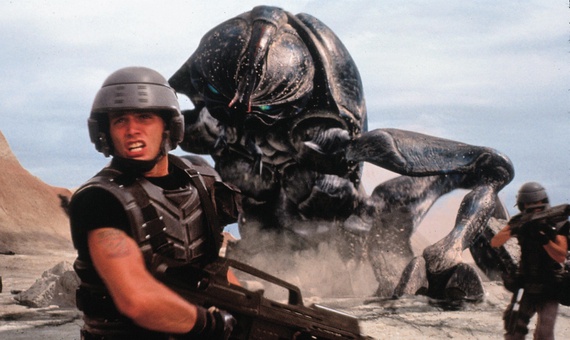
I know I’m digressing from your question, but my general point is this: Sci-Fi films (and stories) are generally questioning (or questing, perhaps). They are usually not pro-military or pro-authority. Put differently, for every Starship Troopers there’s a Bill the Galactic Hero as a counterweight.
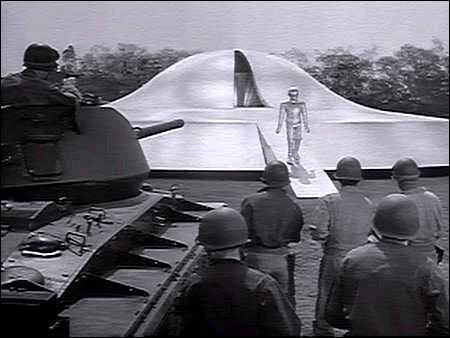
Think of one of my all-time favorite films, The Day the Earth Stood Still. The military is completely ineffectual in that film. Worse: the military contributes to the problem. Similarly, in the 1950s lots of films were made about the dangers of nuclear war and radiation. The military usually didn’t emerge in a favorable light in those films, if I recall correctly.
I think this began to change with films like Star Wars and Close Encounters of the Third Kind. Star Wars could be read as apolitical (“a long time ago, in a galaxy far, far away”), even if that wasn’t George Lucas’s intent. In Close Encounters, a terrific film that I saw in the theater, the authorities actually know what they’re doing. They greet the alien mothership peacefully, and communicate with music and light instead of guns and nukes. Again, I don’t think Spielberg was making a pro-authority or pro-military film, but I believe he didn’t want to make a political film, a film like The Day the Earth Stood Still.
After these two films, Hollywood embraced space operas and feel-good movies. There were exceptions, of course. One of my favorite movies is Starman with Jeff Bridges. Again, the authorities only want the alien for the powers he brings with him. Think too of The Man Who Fell to Earth and the way in which his life is corrupted by human excess. Doesn’t he get addicted to television?
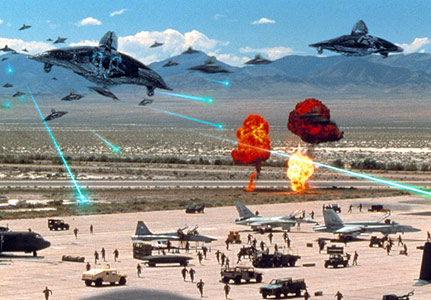
The movie that really changed it all was Independence Day, a perfect film in the aftermath of Desert Storm (the expulsion of Iraq from Kuwait). Here, of course, the militaries of various countries come together to defeat the aliens, led by an American president who climbs into the cockpit to lead the charge himself. This proved so popular that it’s no surprise George W. Bush tried to replicate the scene in the aftermath of the U.S. invasion of Iraq in 2003 (his infamous landing on an aircraft carrier, followed by his “Mission Accomplished” victory speech).
TheoFantastique: What represents much of the portrayal of the U.S. and its military, and what does this say back to us by way of reflection on American militarism around the world?
Bill Astore: I think many, if not most, Americans now want to see the U.S. military portrayed in a positive light in films. Since the 1980s, and especially since the 1990s, Americans have been told to “support our troops.” After 9/11, ordinary Americans were taught and told we live in a dangerous world filled with “alien” terrorists, and that we had to submit to authority to combat and defeat those “aliens.”
Some recent sci-fi films, I believe, have come to celebrate the military, its weaponry, and its can-do spirit of “warriors.” They’ve played it safe, in other words. In some cases, film makers may have curried favor with the Pentagon as a way of securing military cooperation in filming. For example, to secure access to bases, to advanced technologies such as the F-22 and F-35 jet fighters, and so on. It makes their films “sexier” to have such access.
I’m sure some would say, So what? What’s wrong with a summer blockbuster that portrays military action in a favorable light? To that I’d say: reel war is nothing like real war. The best science fiction films — or the memorable ones — inspire us to dream of bettering ourselves as individuals and as a species. And I think the best films still seek to challenge us to be more noble, more benevolent, more compassionate.
TheoFantastique: How do you feel as a retired Air Force officer about current science fiction’s perspective on the U.S. military?
Bill Astore: I have mixed feelings. On the one hand, I’m glad that films are not universally anti-military. On the other hand, I’m upset that many films tend to glorify battle and war. War often looks very sexy and exciting in today’s crop of sci-fi action flicks. We need to remember that war is bloody awful, and that lasers and light sabers would not make it any less awful.
Check out TheoFantastisque, a meeting place for myth, imagination, and mystery in pop culture.
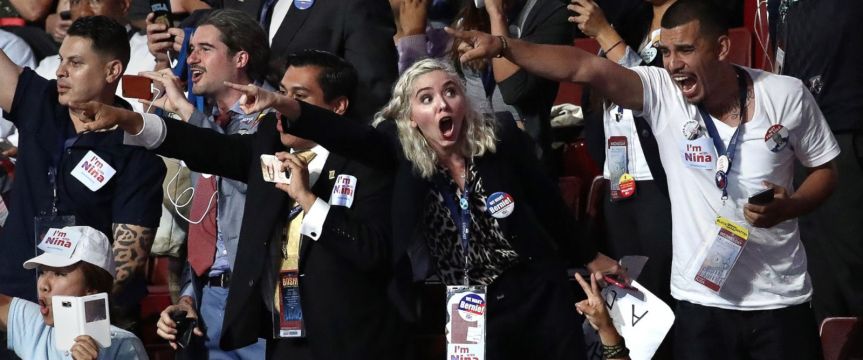
Yes, there was a revealing moment at last night’s Democratic National Convention. No, it wasn’t President Obama’s soaring speech, or Joe Biden’s heartfelt appeal, or Tim Kaine’s “believe me” lampoon of Donald Trump. All these were scripted.
It was the anti-war protesters who spoke out against drone assassinations and war while former CIA Director and Secretary of Defense Leon Panetta spoke.
Good for them. This democratic convention has been at pains to please the military. Last night, Panetta called the U.S. military our greatest national treasure. Obama repeated his claim that the U.S. military is the finest fighting force since Cain slew Abel. Tim Kaine opened his remarks by mentioning the Marines and shouting Semper Fi.
The Democrats are the new Republicans: they’re going “all in” on military boosterism and ra-ra patriotism.
Which is why the anti-war protest was so refreshing. End the wars — end the killing — what’s wrong with these protesters for expressing such crazy sentiments at a Democratic political rally? (An aside: my favorite sign read “Fauxmocracy.”)
The DNC response was swift. Apparently, they cut the lights to the section where the main body of protesters sat (the Oregon delegation), but the protesters simply pulled out their Smart phones for light. Panetta, of course, ignored them, carrying on with his prepared speech that vilified Trump for his remarks about Vladimir Putin and hacking. (Pretty dumb by The Donald, but the man is an empty barrel, an Archie Bunker who loves to make lots of noise.)
Most interesting of all was media response. I was watching MSNBC (I think) when a commentator attacked the anti-war protesters for undercutting Panetta’s speech against Trump. Yes, it was the protesters who were TOTALLY in the wrong! How dare they chant “no more war” at a former CIA Director and secretary of war? How dare they challenge an olympian like Panetta while he’s on the stage? How dare they organize and exercise their first amendment rights?
Expect more unbounded praise of the U.S. military tonight by Hillary Clinton. Expect more talk of war. Just don’t expect any honest talk about the cost of America’s wars or any vows about ending them in our lifetimes.
Update (7/28):
I just endured General Allen’s jingoistic speech/scream and all the “USA! USA!” chants, followed by a short speech by a Medal of Honor recipient in favor of Clinton.
After which Brian Williams of MSNBC said, “Sadly,” you could still hear faintly the voices of protesters shouting “No more war.” Why is that so sad, Brian Williams? Why is it so sad for Democrats to be against war? Why must they shut up when a general speaks, a general who boasts of making the U.S. military stronger with even better weaponry with which to kill?
That’s the real “sad” part, Brian Williams: How the Democratic Party has become the war party.