“Military appreciation” now includes cheerleaders in skimpy camo outfits
W.J. Astore
A few weeks ago, I was stuck at a dealership, my car awaiting service. In the waiting room, The Today Show was blasting out, featuring a performance by a well-known pop star. Choreographed and repetitive, her performance was substance- and content-free, a repetition of words that were mostly unclear to me, set to a machine gun-like beat echoed by gyrating dancers on stage.
And I thought to myself: this is much like America’s wars, or at least how they’re packaged and presented to the American people.
America’s wars have been choreographed. Obligatory cheers for “our” troops. Plenty of flags and songs to “bless” America. Lots of video footage of gyrating jets putting “bombs on target.” Meanwhile, the overall meaning is unclear. Vague promises are made of “progress,” but signs of the same are difficult to decipher.
War has become the background music to our lives. A sobering fact: If you’re a high school student in America, you can’t remember a time when America has been at peace. Your country has always been at war – and so it always will be, for it’s impossible to win a war on terror, because war is terror.
But back to TheToday Show. I watched it in the 1970s. Back then it featured serious news along with lighter “fluff” pieces like movie reviews (I fondly recall Gene Shalit). Now it’s dominated by entertainment and celebrities, infotainment driven by the pursuit of ratings. In other words, it’s much like our war coverage, which features celebrity generals and various forms of fluff, driven largely by “ratings,” i.e. keeping the people happy — and happily ignorant – about the realities of war.
I remember talking to an Army battalion commander about some of the realities he and his men faced in Iraq. Back in the Surge days, he mentioned a “churn rate” of 50% in U.S. infantry units: troops either didn’t want to reenlist, or they went into privatized militaries and doubled or tripled their pay. He mentioned repetitive overseas deployments that contributed to stress, domestic violence, divorce, and broken families. He himself was not at home for eight out of twelve Christmases.
In the field, his troops faced 12-16 hour days of drudgery. He referred to the Surge as “mental ditch-digging,” the fatigue that came with humping gear in the desert (or the cities) of Iraq with little to show for it. Such work, often frustrating, occasionally deadly, placed enormous strain on young troops, many of whom had been in high school not that long ago.
Nothing about this is exceptional – it’s just war. Demanding. Tough. Ugly. The kind of war that isn’t featured on American “news” shows, driven as they are by ratings and infotainment.
Of course, a real shooting war is far worse than simply long hours and repetitive duty. That’s why an Army major used to remind me, “Any day in the Army you’re not being shot at is a good day.” But our media prefers to put a happy face on war.
America’s latest wars are never-ending. A reason for this, not acknowledged enough, is the way they’re being packaged, sanitized, and sold to the American public as infotainment. As a performance that’s meant to be cheered briefly and just as quickly forgotten, like that pop star and her gyrating dancers on TheToday Show.
We’re only sixteen years into the 21st century, but it seems like a “best of times, worst of times” kind of epoch. It’s the best of times for the aristocracy of the rich, and the worst of times for the poor and disadvantaged, especially when they live close to or in war zones.
Perhaps that’s a statement of the obvious, except the gap between the richest and poorest continues to grow. Their worlds, their realities, are so different as to be virtually disconnected. This is a theme of several recent science fiction films, including the “Hunger Games” series (the Capitol versus the Districts) and “Elysium,” in which the privileged rich literally live above the sordid earth with its teeming masses.
Some of the big fears of our present century include the emergence of a “super bug,” a contagion that is highly resistant to traditional drugs. We’ve overused antibiotics and are slowly breeding new strains of bacteria that modern medicine can no longer defeat. Meanwhile, many people in the U.S. still lack health care, or they’re reluctant to use it because it’s too expensive for them. And then there are the workers who lack sick leave. They force themselves to go to work, even when sick, because they need the money. How long before inadequate health care and sick workers facilitate the conditions for the spread of a plague?
And then there’s the contagion of violence and war. America’s wars in places like Iraq, Afghanistan, and Africa are basically open-ended. They are today’s version of the “Hundred Years’ War” between England and France, an on-again, off-again struggle for dominance that sprawled across two centuries. In fact, America’s “war on terror,” with its “surgical strikes” and reliance on technology as a quasi-panacea, seems to be breeding new types of “super-bug” terrorists who are highly resistant to traditional techniques of policing and war.
In this effort, one thing is certain: No U.S. president will be declaring “peace” or even “normal” times for the next decade or two (or three).
Finally, let’s not forget global warming. The Pentagon and the CIA haven’t. Republicans may have their share of climate change deniers, but when it comes to the U.S. national security state, contingency plans are already in place for the disasters awaiting us from global warming. Competition for scarce resources (potable water especially, but food and fuel as well) combined with more intense storms, widespread flooding, and much warmer temperatures, will generate or aggravate wars, famines, and plagues.
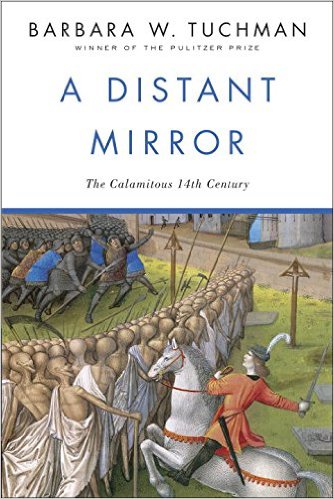
In “A Distant Mirror,” the historian Barbara Tuchman wrote about the calamitous 14th century of plagues and wars and a mini-ice age in the northern hemisphere. We seem to be facing a calamitous 21st century of plagues and wars and a mini-hothouse age. It’s a grim prospect.
The question is: Can we act collectively to avert or avoid the worst of these calamities? Or are we fated to dance our very own 21st-century danse macabre?
In Nice, France, 84 people were killed by a maniac who drove a truck into a crowd on Bastille Day (French Independence Day). The driver, identified as Mohamed Lahouaiej Bouhlel, was a French-Tunisian with a criminal record but with no known terrorist links.
Much remains unknown about this attack. Was the driver acting alone? Was he “radicalized,” killing for a political/religious purpose? Was he working with a terrorist sect, or perhaps he sympathized with one? We should be careful not to jump to conclusions.
I want to make one rather obvious point: It’s easy to politicize such horrendous attacks. It’s easy to say things like: “It’s all the fault of radical Islam! The West is at war with radical Islam! Muslim immigrants are to blame!” And so on. Before reaching any conclusions, let’s gather all the evidence.
There’s a natural tendency to resort to the rhetoric of warfare here. Politicians are especially prone to this. And if you don’t agree with them, they dismiss you as naive or delusional — or worse.
The problem with warfare rhetoric is that it answers questions before they’re even asked. It imposes solutions before you even fully understand the problem. For example, if it’s a “war,” the inevitable solution is more militarization. More surveillance. More police. More weapons. Perhaps more military strikes as well.
But what if more military strikes actually aggravate the problem? What if more police, more surveillance, more raids combine to abridge the freedoms that France fought for, the very freedoms which the French celebrate each year on Bastille Day?
Liberty, equality, and fraternity are noble goals. They need always to be nourished and protected, not just from terrorists and other criminals, but from those in authority who may overreact in the name of protecting the people.
In my latest article for TomDispatch.com, I focus on the “alien” nature of U.S. military interventions. Here are some excerpts from my article:
The latest Independence Day movie, despite earning disastrous reviews, is probably still rumbling its way through a multiplex near you. The basic plot hasn’t changed: ruthless aliens from afar (yet again) invade, seeking to exploit our precious planet while annihilating humanity (something that, to the best of our knowledge, only we are actually capable of). But we humans, in such movies as in reality, are a resilient lot. Enough of the plucky and the lucky emerge from the rubble to organize a counterattack. Despite being outclassed by the aliens’ shockingly superior technology and awe-inspiring arsenal of firepower, humanity finds a way to save the Earth while — you won’t be surprised to know — thoroughly thrashing said aliens.
Remember the original Independence Day from two decades ago? Derivative and predictable it may have been, but it was also a campy spectacle — with Will Smith’s cigar-chomping military pilot, Bill Pullman’s kickass president in a cockpit, and the White House being blown to smithereens by those aliens. That was 1996. The Soviet Union was half-a-decade gone and the U.S. was the planet’s “sole superpower.” Still, who knew that seven years later, on the deck of an aircraft carrier, an all-too-real American president would climb out of a similar cockpit in a flight suit, having essentially just blown part of the Middle East to smithereens, and declare his very own “mission accomplished” moment?
In the aftermath of the invasion of Afghanistan and the “shock and awe” assault on Iraq, the never-ending destructiveness of the wars that followed, coupled with the U.S. government’s deployment of deadly robotic drones and special ops units across the globe, alien invasion movies aren’t — at least for me — the campy fun they once were, and not just because the latest of them is louder, dumber, and more cliché-ridden than ever. I suspect that there’s something else at work as well, something that’s barely risen to consciousness here: in these years, we’ve morphed into the planet’s invading aliens.
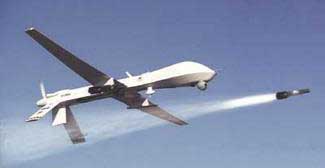
Think about it. Over the last half-century, whenever and wherever the U.S. military “deploys,” often to underdeveloped towns and villages in places like Vietnam, Afghanistan, or Iraq, it arrives very much in the spirit of those sci-fi aliens. After all, it brings with it dazzlingly destructive futuristic weaponry and high-tech gadgetry of all sorts (known in the military as “force-multipliers”). It then proceeds to build mothership-style bases that are often like American small towns plopped down in a new environment. Nowadays in such lands, American drones patrol the skies (think: the Terminator films), blast walls accented with razor wire and klieg lights provide “force protection” on the ground, and the usual attack helicopters, combat jets, and gunships hover overhead like so many alien craft. To designate targets to wipe out, U.S. forces even use lasers!
In the field, American military officers emerge from high-tech vehicles to bark out commands in a harsh “alien” tongue. (You know: English.) Even as American leaders offer reassuring words to the natives (and to the public in “the homeland”) about the U.S. military being a force for human liberation, the message couldn’t be more unmistakable if you happen to be living in such countries: the “aliens” are here, and they’re planning to take control, weapons loaded and ready to fire.
Other U.S. military officers have noticed this dynamic. In 2004, near Samarra in Iraq’s Salahuddin province, for instance, then-Major Guy Parmeter recalled asking a farmer if he’d “seen any foreign fighters” about. The farmer’s reply was as simple as it was telling: “Yes, you.” Parmeter noted, “You have a bunch of epiphanies over the course of your experience here [in Iraq], and it made me think: How are we perceived, who are we to them?”
Americans may see themselves as liberators, but to the Iraqis and so many other peoples Washington has targeted with its drones, jets, and high-tech weaponry, we are the invaders.
Do you recall what the aliens were after in the first Independence Day movie? Resources. In that film, they were compared to locusts, traveling from planet to planet, stripping them of their valuables while killing their inhabitants. These days, that narrative should sound a lot less alien to us. After all, would Washington have committed itself quite so fully to the Greater Middle East if it hadn’t possessed all that oil so vital to our consumption-driven way of life? That’s what the Carter Doctrine of 1980 was about: it defined the Persian Gulf as a U.S. “vital interest” precisely because, to quote former Deputy Secretary of Defense Paul Wolfowitz’s apt description of Iraq, it “floats on a sea of oil.”
Consider it an irony of alien disaster movies that they manage to critique U.S. military ambitions vis-à-vis the “primitive” natives of far-off lands (even if none of us and few of the filmmakers know it). Like it or not, as the world’s sole superpower, dependent on advanced technology to implement its global ambitions, the U.S. provides a remarkably good model for the imperial and imperious aliens of our screen life.
In President Obama’s drone wars, how many innocent civilians have been killed? An official U.S. government report will suggest that roughly 100 civilians have been killed since 2009 in drone strikes, a surprisingly small number. According to NBC News:
The Long War Journal, a project of the right-leaning Foundation for Defense of Democracies think tank whose numbers tend to be the most favorable for U.S. policy-makers, tallied 207 civilian casualties since 2009 in 492 strikes in Pakistan and Yemen. That does not include strikes in Somalia and Libya, which the Obama administration includes in its count of around 100 [civilians killed].
New America, a left-leaning Washington think tank, counted between 244 and 294 civilians killed in 547 attacks in Pakistan, Yemen and Somalia.
The Bureau of Investigative Journalism estimates that as many as 1068 civilians were killed in Pakistan, Yemen and Somalia, the vast majority since 2009.
So it’s unclear whether the Obama administration’s drone strikes have killed 100 innocents, 300 innocents, or over 1000 innocents. Part of the discrepancy involves who is a “militant” and who is an innocent civilian. The U.S. government tends to count all military-age males killed in drone strikes as “militants,” effectively changing the meaning of civilian to “women and children.”
In one respect, this body count doesn’t matter. Dead is dead, whether you’re talking about 100 people or 1000. And isn’t the death of 100 innocents enough to provoke protest if not outrage? Think of the reaction in the U.S. to the killing of 49 innocent civilians in Orlando. Better yet, think if a foreign government was flying drones over our skies, taking out American “terrorists” while killing a few innocent civilians now and again. Would we dismiss 100 dead American civilians as “collateral damage,” regrettable but necessary in this foreign power’s war on terror?
Of course not. Americans would memorialize the dead, honor them, and make them a cause for vengeance.
For all the people the U.S. government is killing overseas in hundreds of deadly drone strikes, it’s not obvious that any progress is being made in the war on terror. The wars continue, with the Taliban gaining strength in Afghanistan. ISIS is on the wane, until it rebounds or morphs into another form. What is essentially terror bombing as a weapon against terror has little chance of ending a war on terror. Meanwhile, hammer blows from the sky against fractured societies only serve to propagate the fractures, creating new fault lines and divisions that are exploitable by the determined and the fanatical.
Indeed, we really have no clear idea whether these multi-billion dollar air campaigns are making any progress in war. Much of the data and results of these campaigns are both classified and open to bias, with reports of casualties being manipulated or “spun” by all sides. All we really know is that innocents are killed (whether 100 or 1000) as the wars persist with no end in sight.
Meanwhile, American exceptionalism rules. As Tom Engelhardt noted back in May of 2015:
In his public apology for deaths [of innocents by drones] that were clearly embarrassing to him, President Obama managed to fall back on a trope that has become ever more politically commonplace in these years. Even in the context of a situation in which two innocent hostages had been killed, he congratulated himself and all Americans for the exceptional nature of this country. “It is a cruel and bitter truth,” he said, “that in the fog of war generally and our fight against terrorists specifically, mistakes — sometimes deadly mistakes — can occur. But one of the things that sets America apart from many other nations, one of the things that makes us exceptional is our willingness to confront squarely our imperfections and to learn from our mistakes.”
Whatever our missteps, in other words, we Americans are exceptional killers in a world of ordinary ones. This attitude has infused Obama’s global assassination program and the White House “kill list” that goes with it and that the president has personally overseen.
Drone strikes are a method of war, but they’ve become the American strategy. The strategy, so it seems, is to keep killing bad guys until the rest give up and go home. But the deaths of innocents, whether 100 or 1000, serve to perpetuate cycles of violence and revenge.
We have, in essence, created a perpetual killing machine.
Update (7/2/2016): Well, the Obama administration has done it again, releasing its report on drone casualties on the afternoon of Friday, July 1st, just before the long Independence Day weekend, ensuring minimal media coverage. The report excludes “active” war zones such as Iraq, Afghanistan, and Syria, a convenient definition that serves to lower the death toll.
According to the report, U.S. drone strikes in places like Yemen, Libya, tribal Pakistan, and Somalia have accounted for about 2500 “terrorists” while killing 64 to 116 civilian bystanders. The tacit message: We’re killing 25 times (or perhaps 40 times) as many “terrorists” as we are innocent civilians, a very effective (even humane?) kill ratio.
Talk about an exercise in cynical bookkeeping! One can guess what happened here. Someone high up in the government began with the civilian body count judged acceptable: I’m guessing that figure was roughly 100. Then, they worked backwards from that. How do we get 100? Well, if we exclude “active” war zones such as Iraq, Afghanistan, and Syria, and if we squint sideways …
Well, you probably know the saying: the very first casualty in war is truth. Followed by an honest accounting of civilian casualties, as this latest report from the Obama administration shows.
All they are sayin’ is give bombing a chance (U.S. Air Force photo)
W.J. Astore
In my latest article for TomDispatch.com, which you can read in its entirety here, I tackle the American infatuation with air power and bombing. Despite its enormous destructiveness and indecisive results in Korea, Vietnam, Desert Storm, the Iraq invasion of 2003, and in the ongoing War on Terror, U.S. leaders persist in bombing as a means to victory, even against dispersed organizations such as ISIS and the Taliban that offer few targets. As I put it in my article:
For all its promise of devastating power delivered against enemies with remarkable precision and quick victories at low cost (at least to Americans), air power has failed to deliver, not just in the ongoing war on terror but for decades before it. If anything, by providing an illusion of results, it has helped keep the United States in unwinnable wars, while inflicting a heavy toll on innocent victims on our distant battlefields. At the same time, the cult-like infatuation of American leaders, from the president on down, with the supposed ability of the U.S. military to deliver such results remains remarkably unchallenged in Washington.
Indeed, as Glenn Greenwald points out, Hillary Clinton’s presumptive Defense Secretary, Michele Flournoy, has already issued calls for more U.S. bombing and military interventions in the Middle East. Talk about doubling down on a losing strategy.
Yet “strategy” isn’t really the right word. Bombing is a method of war, not a strategy. And in this case the method truly is the madness, with the end being perpetual war.
When will the madness end? To be honest, I don’t see an end in the immediate future, so invested in bombing are America’s leaders and foreign “diplomats.”
Here’s the rest of my article for TomDispatch.com.
Yet despite this “asymmetric” advantage [America’s dominance of the air], despite all the bombing, missile strikes, and drone strikes, “progress” proved both “fragile” and endlessly “reversible” (to use words General David Petraeus applied to his “surges” in Iraq and Afghanistan). In fact, 12,000 or so strikes after Washington’s air war against ISIS in Syria and Iraq began in August 2014, we now know that intelligence estimates of its success had to be deliberately exaggerated by the military to support a conclusion that bombing and missile strikes were effective ways to do in the Islamic State.
So here we are, in 2016, 25 years after Desert Storm and nearly a decade after the Petraeus “surge” in Iraq that purportedly produced that missing mission accomplished moment for Washington — and U.S. air assets are again in action in Iraqi and now Syrian skies. They are, for instance, flying ground support missions for Iraqi forces as they attempt to retake Falluja, a city in al-Anbar Province that had already been “liberated” in 2004 at a high cost to U.S. ground troops and an even higher one to Iraqi civilians. Thoroughly devastated back then, Falluja has again found itself on the receiving end of American air power.
If and when Iraqi forces do retake the city, they may inherit little more than bodies and rubble, as they did in taking the city of Ramadi last December. About Ramadi, Patrick Cockburn noted last month that “more than 70% of its buildings are in ruins and the great majority of its 400,000 people are still displaced” (another way of saying, “It became necessary to destroy the town to save it”). American drones, meanwhile, continue to soar over foreign skies, assassinating various terrorist “kingpins” to little permanent effect.
Tell Me How This Ends
Here’s the “hot wash”: something’s gone terribly wrong with Washington’s soaring dreams of air power and what it can accomplish. And yet the urge to loose the planes only grows stronger among America’s political class.
Given the frustratingly indecisive results of U.S. air campaigns in these years, one might wonder why a self-professed smart guy like Ted Cruz, when still a presidential candidate, would have called for “carpet” bombing our way to victory over ISIS, and yet in these years he has been more the norm than the exception in his infatuation with air power. Everyone from Donald Trump to Barack Obama has looked to the air for the master key to victory. In 2014, even Petraeus, home from the wars, declared himself “all in” on more bombing as critical to victory (whatever that word might now mean) in Iraq. Only recently he also called for the loosing of American air power (yet again) in Afghanistan — not long after which President Obama did just that.
Even as air power keeps the U.S. military in the game, even as it shows results (terror leaders killed, weapons destroyed, oil shipments interdicted, and so on), even as it thrills politicians in Washington, that magical victory over the latest terror outfits remains elusive. That is, in part, because air power by definition never occupies ground. It can’t dig in. It can’t swim like Mao Zedong’s proverbial fish in the sea of “the people.” It can’t sustain persuasive force. Its force is always staccato and episodic.
Its suasion, such as it is, comes from killing at a distance. But its bombs and missiles, no matter how “smart,” often miss their intended targets. Intelligence and technology regularly prove themselves imperfect or worse, which means that the deaths of innocents are inevitable. This ensures new recruits for the very organizations the planes are intent on defeating and new cycles of revenge and violence amid the increasing vistas of rubble below. Even when the bombs are on target, as happens often enough, and a terrorist leader or “lieutenant” is eliminated, what then? You kill a dozen more? As Petraeus said in a different context: tell me how this ends.
Recalling the Warbirds
From Ronald Reagan to Barack Obama, dropping bombs and firing missiles has been the presidentially favored way of “doing something” against an enemy. Air power is, in a sense, the easiest thing for a president to resort to and, in our world, has the added allure of the high-tech. It looks good back home. Not only does the president not risk the lives of American troops, he rarely risks retaliation of any kind.
Whether our presidents know it or not, however, air power always comes with hidden costs, starting with the increasingly commonplace blowback of retaliatory terrorist strikes on “soft” targets (meaning people) in cities like Paris or Madrid or London. Strikes that target senior members of enemy armies or terrorist organizations often miss, simply stoking yet more of the sorts of violent behavior we are trying to eradicate with our own version of violence. When they don’t miss and the leadership of terror groups is hit, as Andrew Cockburn has shown, the result is often the emergence of even more radical and brutal leaders and the further spread of such movements. In addition, U.S. air power, especially the White House-run drone assassination program, is leading the way globally when it comes to degrading the sovereignty of national borders. (Witness the latest drone strike against the head of the Taliban in violation of Pakistani airspace.) Right now, Washington couldn’t care less about this, but it is pioneering a future that, once taken up by other powers, may look far less palatable to American politicians.
Despite the sorry results delivered by air power over the last 65 years, the U.S. military continues to invest heavily in it — not only in drones but also in ultra-expensive fighters and bombers like the disappointing F-35 (projected total cost: $1.4 trillion) and the Air Force’s latest, already redundant long-range strike bomber (initial acquisition cost: $80 billion and rising). Dismissing the frustratingly mixed and often destabilizing results that come from air strikes, disregarding the jaw-dropping prices of the latest fighters and bombers, America’s leaders continue to clamor for yet more warplanes and yet more bombing.
And isn’t there a paradox, if not a problem, in the very idea of winning a war on terror through what is in essence terror bombing? Though it’s not something that, for obvious reasons, is much discussed in this country, given the historical record it’s hard to deny that bombing is terror. After all, that’s why early aviators like Douhet and Mitchell embraced it. They believed it would be so terrifyingly effective that future wars would be radically shortened to the advantage of those willing and able to bomb.
As it turned out, what air power provided was not victory, but carnage, terror, rubble — and resistance.
Americans should have a visceral understanding of why populations under our bombs and missiles resist. They should know what it means to be attacked from the air, how it pisses you off, how it generates solidarity, how it leads to new resolve and vows of vengeance. Forget Pearl Harbor, where my uncle, then in the Army, dodged Japanese bombs on December 7, 1941. Think about 9/11. On that awful day in 2001, Homeland USA was “bombed” by hijacked jet liners transformed into guided missiles. Our skies became deadly. A technology indelibly associated with American inventiveness and prowess was turned against us. Colossally shocked, America vowed vengeance.
Are our enemies any less resolutely human than we are? Like us, they’re not permanently swayed by bombing. They vow vengeance when friends, family members, associates of every sort are targeted. When American “smart” bombs obliterate wedding parties and other gatherings overseas, do we think the friends and loved ones of the dead shrug and say, “That’s war”? Here’s a hint: we didn’t.
Having largely overcome the trauma of 9/11, Americans today look to the sky with hope. We watch the Blue Angels and Thunderbirds with a sense of awe, wonder, and pride. Warplanes soar over our sports stadiums. The sky is ourhigh ground. We see evidence of America’s power and ingenuity there. Yet people in Afghanistan, Iraq, and elsewhere often pray for clouds and bad weather; for them, clear skies are associated with American-made death from above.
It’s time we allow other peoples to look skyward with that same sense of safety and hope as we normally do. It’s time to recall the warbirds. They haven’t provided solutions. Indeed, the terror, destruction, and resentments they continue to spread are part of the problem.
The language of war fascinates me. I was reading President Obama’s response to Donald Trump on whether Obama “gets it” when it comes to the threat of terrorism and came across this passage:
“Someone [Donald Trump] seriously thinks that we don’t know who we are fighting? If there is anyone out there who thinks we are confused about who our enemies are — that would come as a surprise to the thousands of terrorists who we have taken off the battlefield.”
That’s such a curious phrase: “terrorists who we have taken off the battlefield.” As if the United States has simply evacuated them or relocated them instead of killing them.
I think the distancing effect of air power has something to do with this euphemistic language. The U.S. military “takes people off the battlefield” rather than killing them, blowing them up, and so on. Obama’s personality may also play a role: a rational person, he’s been compared to the Vulcan Mr. Spock from “Star Trek” in his coolly logical approach to war.
Perhaps that coolly rational side, and not his preference to avoid terms like “radical Islamic terrorism,” is what gets Obama into trouble. Many Americans would prefer more directness, more passion, even though such directness and passion is often the approach of posturing chickenhawks. Consider the language of Bush/Cheney and all their blustering about “wanted, dead or alive” and “the axis of evil“ and “you’re either for us or against us.” Bush/Cheney talked as if they had just walked off a Western movie set after a gunfight, but both avoided the Vietnam War when they were young men, with Cheney famously saying he had other, more important things to do with his life. (Bush flew in the Texas Air National Guard, apparently gaining a slot after his father pulled some political strings.)
So, what should Obama have said in place of “we’ve taken them off the battlefield”?
Why not be honest and say something like this? “I’m well into the eighth and final year of my administration, during which I’ve approved drone strikes and air raids that have killed thousands of suspected and confirmed terrorists. Sure, we’ve often missed some targets, killing innocent people instead, but hey — war is hell. I’ve approved Pentagon budgets that each year approach $750 billion, I’ve overseen the U.S. dominance of the international trade in weapons, I continue to oversee an empire of roughly 700 overseas U.S. bases. Some have even called me the assassin in chief, and they’re right about that, because under my command deadly drone strikes have increased dramatically. Meanwhile, we’ve already made some 12,000 air strikes against ISIS/ISIL. So don’t tell me, Mr. Trump, that I don’t know who the enemy is. Don’t tell me I’m not willing to murder terrorists whenever and wherever we find them, even when they’re U.S. citizens and teenagers. Don’t tell me I don’t get it.”
Those words would be honest – though they’d really just scratch the surface of the Obama-led efforts to secure the “Homeland.” But instead Obama speaks of “taking” terrorists “off the battlefield,” cloaking his administration’s violent actions in a euphemistic phrase that would be consistent with angels from on high coming down to lift terrorists off the battlefield to some idyllic oasis.
Odd, isn’t it, that so few Americans criticize Obama for his murderous actions in overseas wars, but so many will criticize him for not bragging and boasting about it.
Well, if America is looking for a braggart, someone willing to boast about himself, they have their man in Donald Trump. If they’re looking for a new assassin in chief, they have their woman in Hillary Clinton. And if they’re looking for fresh ideas, a new strategy, a way to end our seemingly endless wars, they’re simply out of luck this election season, unless you go to a third-party candidate like Jill Stein.
In these over-heated times, the chances of a third-party challenge with substance are somewhere between nada and nil. In the United States in 2016, war and weapons sales and imperial expansion will continue to find a way, even as our leaders cloak their violent actions using the most anodyne phrases.
The FP: Foreign Policy feed that I receive had two items that grabbed my attention this morning. The first involves the war in Afghanistan. In short, there’s no end in sight. Unlike in the Vietnam War, no one is seeing any lights at the end of tunnels. Nevertheless, U.S. and NATO leaders vow to keep supporting Afghan forces as they continue to lose territory to a resurgent Taliban that had basically given up in 2001.
Here’s the latest from FP (co-authored by Paul McLeary with Adam Rawnsley):
NATO’s not done in Afghanistan. It looks like the United States and NATO are going to stick it out in Afghanistan for at least a few more years, as the Afghan army continues to battle a resurgent Taliban with no end in sight. Following a NATO meeting in Brussels this week, British Defense Secretary Michael Fallon told reporters that U.S. Defense Secretary Ash Carter “told us the troop numbers and the dispositions are being looked at again,” as President Barack Obama weighs whether to draw the U.S. presence in Afghanistan down from 9,800 to 5,000 by the end of this year. NATO says it’s in, at least through the end of next year. Secretary-General Jens Stoltenberg said the allies are abandoning their plans to pull back to Kabul by the end of this year, and “will have what we call a flexible regional approach, meaning that we will continue to be of course in Kabul but also out in the different regions.”
That’s significant. So are comments by an anonymous NATO diplomat who told the AP that the alliance will most likely come up with the $5 billion needed to fund the current number of Afghan security forces through 2020. The longest of the Long Wars grinds on.
Put bluntly, U.S. and NATO leaders continue to reinforce failure in Afghanistan. Their strategy, such as it is, is simply more of what hasn’t worked over the last fifteen years. Apparently, forever war is sustainable to the U.S. and NATO. No one seems to be asking whether the cost is sustainable to the Afghan people.
The second item involves American aid to Israel, which is primarily military aid. Here’s how the folks at FP put it:
Israel: After much back and forth sparring, the U.S. and Israel appear to be nearing an agreement on a U.S. military aid package. Israeli officials had been hoping that the Obama administration would agree to a memorandum of understanding (MOU) promising $40 billion in aid over a decade — an increase of $10 billion over the last MOU. So far, the U.S. has been discussing a deal in the range of $35-37 billion. Other questions about the aid remain up in the air such as whether the final package will include money for missile defense and how much of the money Israel will be able to spend among its own defense contractors versus American companies.
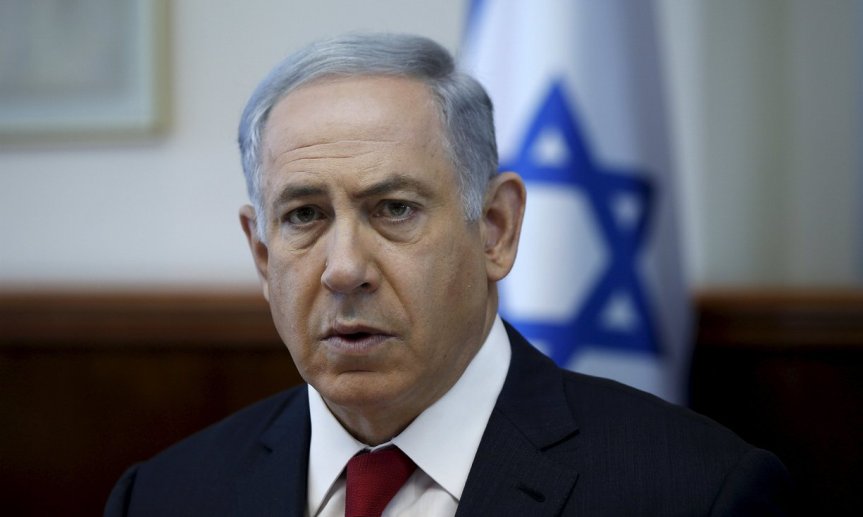
There you have it: the “sparring” between Israel and the U.S. is about whether Israel will get a huge chunk of America aid, or a gargantuan chunk of aid. Meanwhile, the U.S. government seems to have no influence over the Israeli government. Netanyahu does pretty much what he wants to do, even as he thumbs his nose at Obama.
The “punishment” for Netanyahu’s intractability – well, there is none. As a punch-drunk American heavyweight boxer staggers about the ring, a sneering Israeli lightweight launches punch after punch, taunt after taunt. And after absorbing the punishment the heavyweight simply throws in the towel and agrees to the lightweight’s terms.
Of course, none of this will change under President Hillary Clinton. If anything, Clinton will pursue the Afghan War with more vigor and ladle even more “aid” to Israel. Under President Trump, who knows? All bets are truly off since Trump changes his positions as often as most men change their underwear. (For example, Trump first affirmed neutrality in negotiating between the Israelis and Palestinians, then pledged one-sided support for Israel in a speech to AIPAC.)
Well, my dad always said, the more things change, the more they remain the same. In these two cases, he was right – yet again.
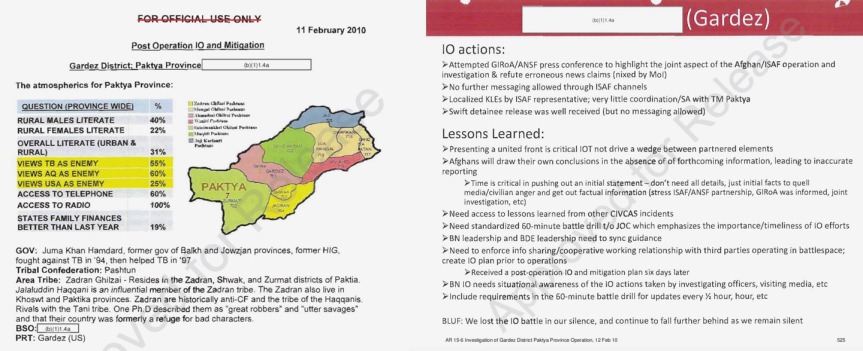
In a notorious night raid near Gardez in Afghanistan in February 2010, a US Special Ops team apparently hit the wrong suspect’s house, resulting in the deaths of innocents to include pregnant women. It was further alleged that US troops dug bullets out of the bodies of these women. Jeremy Scahill’s recent article at The Intercept reviews the US military’s investigation into these allegations, an investigation that cleared the troops involved of any wrongdoing. Scahill’s article is here and warrants careful reading.
I want to focus on a piece of evidence that Scahill obtained: the U.S. military’s evaluation of the Afghan province and its after-action report about the failure of its IO (information operations) “battle.” Here is the document in question:
First, I want to focus on the BLUF at the bottom right. In the Army, it stands for bottom line up front. Most senior commanders will read this first; in some cases, the BLUF will be all they read (and remember). What does the BLUF conclude?
It says the US military “lost the IO battle in our silence,” and that it’s only getting worse as the military remains silent. It sounds vaguely reassuring: at least the military realizes it bungled the “information operations” job. But it’s a bureaucratic message in bureaucratic language. It reduces the objective to winning the “information” war, which the military says it’s not winning because of poor coordination with Afghan and other forces, lack of responsiveness, and so on.
How about some honesty? Here’s my BLUF: The US military is losing because it often misidentifies the enemy and misunderstands the culture, leading to the deaths of innocents and the estrangement of even those Afghans who are initially open to American influence. And no matter how hard you try to spin those facts, you can’t hide that cold truth from the Afghan people. (You can hide it from the American people, but that’s another story.)
As General Stanley McChrystal himself said about Afghanistan in 2010: “We have shot an amazing number of [Afghan] people [often at checkpoints], but to my knowledge, none has ever proven to be a threat.”
Tell me again how you win “information operations” by shooting “an amazing number” of innocent people?
I want to focus on a second aspect of the US military’s document from Scahill’s article: the illusion of data substituting for real knowledge. Here’s the document again:
Look at the left column. It has “atmospherics” for the province, to include percentages for literacy, support for the Taliban and Al Qaeda (as if those are fixed in place), access to radio and telephone, and so on. Is this knowledge? Or a masquerade for it?
Interestingly, a quarter of the people are viewed as hostile to the USA. One assumes this percentage went up significantly after the raid in question.
My point is these maps and charts and slides give an illusion of data-driven competence, but when you read Scahill’s article, you realize American forces were totally ignorant of basic Afghan customs, such as rituals to prepare bodies for burial. That ignorance seems to have driven the initial confused and inaccurate account of honor killings of females, an account that was repeated widely (and wrongly) in the Western media.
Another minor yet telling point: An unnamed Ph.D. describes some of the Afghan peoples of the region as “great robbers” and “utter savages.” Think about how that description would color the attitudes of US troops assigned to the region. “Here we go, men. Time to kill us some robbers and savages.”
Scahill’s article and the document he provides is a microcosm of the wider failure of US operations in Afghanistan. The war, already in its 15th year, promises to be never-ending unless and until the US finally withdraws. In a profile not of courage but of pusillanimity, Obama has punted the decision to the next president, which doubtless means another 2-4 years of war, mistakes and misunderstandings and more deaths of innocents included.
The United States is addicted to war — and to war-spending. That’s the message of Bill Hartung’s latest article at TomDispatch.com. Hartung, the director of the Arms and Security Project at the Center for International Policy, writes:
The more that’s spent on “defense”… the less the Pentagon wants us to know about how those mountains of money are actually being used. As the only major federal agency that can’t pass an audit, the Department of Defense (DoD) is the poster child for irresponsible budgeting.
It’s not just that its books don’t add up, however. The DoD is taking active measures to disguise how it is spending the hundreds of billions of taxpayer dollars it receives every year — from using the separate “war budget” as a slush fund to pay for pet projects that have nothing to do with fighting wars to keeping the cost of its new nuclear bomber a secret. Add in dozens of other secret projects hidden in the department’s budget and the Pentagon’s poorly documented military aid programs, and it’s clear that the DoD believes it has something to hide.
Having served in the military and DoD for twenty years and having read about it for twenty more, none of this surprises me.
Here’s the thing: In the Pentagon and the wider military, there’s absolutely no incentive to save money. Indeed, the incentive is to spend as much as possible, because that is the best way to increase next year’s budgetary allotment. The military is filled with “Type A” officers whose job it is to spend, spend, spend, while fighting sister services for a bigger slice of the budgetary pie. The more money you get for your program and service, the more likely you’ll get pats on the back, a medal or two, and a glowing promotion recommendation.
Next, Members of Congress. Their incentive is also to spend — to bring home the pork to their districts. And the most lucrative source of pork is “defense” spending, which has the added benefit of being easily spun as “patriotic” and in “support” of the troops.
Finally, the President. His incentive is also to spend. That’s the best way to avoid being charged as being “weak” on defense. It’s also about the only leverage the US has left in foreign policy. Just look at President Obama’s recent trip to Vietnam. The headlines have focused on the US ending its 50-year arms embargo with Vietnam, as if that’s a wonderful thing for Americans and the Vietnamese. As Peter Van Buren noted, normalizing relations with Vietnam by selling them lethal weapons is truly an exercise in cynicism by a declining American empire.
Whether it’s the Pentagon, the Congress, or the president, the whole defense wars and weapons complex is structured to spend the maximum amount of money possible while engorging and enlarging itself. Small wonder it’s never passed an audit!
Making matters worse is how the Pentagon uses various shady practices (e.g. secret budgets) to hamstrung reformers seeking to corral the system’s excesses. After detailing the Byzantine complexity of the budgetary process, Hartung concludes that:
If your head is spinning after this brief tour of the Pentagon’s budget labyrinth, it should be. That’s just what the Pentagon wants its painfully complicated budget practices to do: leave Congress, any administration, and the public too confused and exhausted to actually hold it accountable for how our tax dollars are being spent. So far, they’re getting away with it.
Put succinctly, the US National Security State may be losing its overseas wars, yet losing equates to winning when it comes to increased budgetary authority abetted by a Congress that prefers enablement to oversight. And as any military officer knows, authority without responsibility is a recipe for serious abuse.