America’s Militarized Profession of Faith

what
The Church of the Pentagon

W.J. Astore

I grew up in the Catholic Church, where I professed my faith weekly at every mass I attended.  I also grew up a fan of the U.S. military, even as I read many books critical of its performance in the Vietnam War.  Thankfully, I didn’t have to profess my faith in that military, but if I had, what would such a “profession” have looked like?  This is the subject of my latest article at TomDispatch.com, which you can read about here.

Here’s what I believe America’s profession of faith would look like at this moment in our militarized history:

* We believe in wars. We may no longer believe in formal declarations of war (not since December 1941 has Congress made one in our name), but that sure hasn’t stopped us from waging them. From Korea to Vietnam, Afghanistan to Iraq, the Cold War to the War on Terror, and so many military interventions in between, including Grenada, Panama, and Somalia, Americans are always fighting somewhere as if we saw great utility in thumbing our noses at the Prince of Peace. (That’s Jesus Christ, if I remember my Catholic catechism correctly.)

* We believe in weaponry, the more expensive the better. The underperforming F-35 stealth fighter may cost $1.45 trillion over its lifetime. An updated nuclear triad (land-based missiles, nuclear submarines, and strategic bombers) may cost that already mentioned $1.7 trillion. New (and malfunctioning) aircraft carriers cost us more than $10 billion each. And all such weaponry requests get funded, with few questions asked, despite a history of their redundancy, ridiculously high price, regular cost overruns, and mediocre performance. Meanwhile, Americans squabble bitterly over a few hundred million dollars for the arts and humanities.

* We believe in weapons of mass destruction. We believe in them so strongly that we’re jealous of anyone nibbling at our near monopoly. As a result, we work overtime to ensure that infidels and atheists (that is, the Iranians and North Koreans, among others) don’t get them. In historical terms, no country has devoted more research or money to deadly nuclear, biological, and chemical weaponry than the United States. In that sense, we’ve truly put our money where our mouths are (and where a devastating future might be).

* We believe with missionary zeal in our military and seek to establish our “faith” everywhere. Hence, our global network of perhaps 800 overseas military bases. We don’t hesitate to deploy our elite missionaries, our equivalent to the Jesuits, the Special Operations forces to more than 130 countries annually. Similarly, the foundation for what we like to call foreign assistance is often military training and foreign military sales. Our present supreme leader, Pope Trump I, boasts of military sales across the globe, most notably to the infidel Saudis. Even when Congress makes what, until recently, was the rarest of attempts to rein in this deadly trade in arms, Pope Trump vetoes it. His rationale: weapons and profits should rule all.

* We believe in our college of cardinals, otherwise known as America’s generals and admirals. We sometimes appoint them (or anoint them?) to the highest positions in the land. While Trump’s generals — Michael Flynn, James Mattis, H.R. McMaster, and John Kelly — have fallen from grace at the White House, America’s generals and admirals continue to rule globally. They inhabit proconsul-like positions in sweeping geographical commands that (at least theoretically) cover the planet and similarly lead commands aimed at dominating the digital-computer realm and special operations. One of them will head a new force meant to dominate space through time eternal. A “strategic” command (the successor to the Strategic Air Command, or SAC, so memorably satirized in Stanley Kubrick’s Dr. Strangelove) continues to ensure that, at some future moment, the U.S. will be able to commit mass genocide by quite literally destroying the world with nuclear weapons. Indeed, Pope Trump recently boasted that he could end America’s Afghan War in a week, apparently through the mass nuclear genocide of (his figure) 10 million Afghans. Even as he then blandly dismissed the idea of wiping that country “off the face of the earth,” he openly reflected the more private megalomania of those military professionals funded by the rest of us to think about “the unthinkable.” In sum, everything is — theoretically at least — under the thumbs of our unelected college of cardinals. Their overblown term for it is “full-spectrum dominance,” which, in translation, means they grant themselves god-like powers over our lives and that of our planet (though the largely undefeated enemies in their various wars don’t seem to have acknowledged this reality).

* We believe that freedom comes through obedience. Those who break ranks from our militarized church and protest, like Chelsea Manning, are treated as heretics and literally tortured.

* We believe military spending brings wealth and jobs galore, even when it measurably doesn’t. Military production is both increasingly automated and increasingly outsourced, leading to far fewer good-paying American jobs compared to spending on education, infrastructure repairs of and improvements in roads, bridges, levees, and the like, or just about anything else for that matter.

* We believe, and our most senior leaders profess to believe, that our military represents the very best of us, that we have the “finest” one in human history.

* We believe in planning for a future marked by endless wars, whether against terrorism or “godless” states like China and Russia, which means our military church must be forever strengthened in the cause of winning ultimate victory.

* Finally, we believe our religion is the one true faith. (Just as I used to be taught that the Catholic Church was the one true church and that salvation outside it was unattainable.) More pacific “religions” are dismissed as weak, misguided, and exploitative. Consider, for example, the denunciation of NATO countries that refuse to spend more money on their militaries. Such a path to the future is heretical; therefore, they must be punished.

Please read the rest of my article here at TomDispatch.com.  And please comment.  Did I miss anything in my version of America’s militarized profession of faith?

Trump is a Trump Supremacist

download
He soars over all of us

W.J. Astore

Over at ABC News, an article asks whether Donald Trump is a white supremacist.  Bernie Sanders thinks so.  Elizabeth Warren does too.

I’m not so sure.  Trump sounds like a white supremacist.  His rhetoric encourages white supremacists.  He has a long history of bigotry and racism.  QED?

I’m hesitant to say it’s proven, but I know one thing is certain: Trump is a Trump supremacist.

A self-confessed “very stable genius.”  A man without a racist bone in his body.  The least racist person you’ll ever meet, according to Trump himself.  A president who ranks himself as roughly equal to Abraham Lincoln, considered by most historians to have been America’s finest president.

Vanity, thy name is Trump.  And because Trump is a white male, ipso facto white men are supreme; they must be, because Trump is one of them, indeed the finest example of them, at least in his own mind.

So, I think it’s tempting yet too simplistic to say Trump is a white supremacist.  Trump is a Trump supremacist.  Everyone else is inferior to Trump, some more so than others.  The less you look like Trump, or act like Trump, the less he thinks of you.  Thus it’s no surprise he surrounds himself with mostly white men, many with dubious pasts of sexism or racism.  To Trump, these are not disqualifiers.  How could they be?  He’s sexist and racist, so how can that ultimately be a bad thing?

From his lofty perch as the greatest human in all of history, Trump looks down on all of us.  He just sneers a bit more if you’re brown or black or less than 100% boorishly male.

Mass Shootings and American Carnage

mass-shooting

W.J. Astore

What can you say about mass shootings in America that hasn’t already been said?  El Paso and Dayton (not Toledo, Mr. Trump) are the most recent in a seemingly unending series of shootings in America.  A grim statistic:

“Dayton was the 22nd mass killing in America this year, according to an AP/USA Today/Northeastern University mass murder database, which tracks all attacks involving four or more people killed.”

Or, alternatively: “The shooting in Ohio marked the 31st deadly mass shooting in America this year, defined as those where at least three people are killed by gun violence in a single episode.”

Or, alternatively:

“As of today (Aug. 4), we are 216 days into 2019. In the US over that time, more than 1,300 people have been injured or killed in mass shootings, according to data collected by the Gun Violence Archive.

QUARTZ
Injuries and deaths related to mass shootings.

The nonprofit organization, which is based in Washington, DC, defines a mass shooting as an event in which at least four people were shot. By its calculations, that means there have been some 292 mass shootings in the US since the year began.”

In a prepared statement this morning, President Trump came out against white supremacy, racism, and bigotry, but tragically this is a clear case of “Do what I say, not what I do” for Trump.  He compounded his hypocrisy by ignoring the ready availability of assault weapons, blaming instead mental illness and violent video games, among other factors.

Firstly, the mentally ill are more likely to be the victims of violence than the perpetrators of it.  Secondly, violent video games are a global phenomenon, but I’m not reading about dozens of mass shootings each year in Japan or Korea or Sweden.

Trump’s weak-willed words were thoroughly predictable; he’s closely aligned with the National Rifle Association and its total fixation on gun rights to the exclusion of all others.  He’s not alone in this.  When I taught in rural Pennsylvania, my students knew all about the Second Amendment.  But their knowledge of the First, Fourth, and Fifth Amendments was far weaker.  Yes, for many Americans guns really do trump free speech, freedom of the press, and similar rights.

Predictably, Americans search for a magic bullet (pun intended) after these horrifying massacres to put a stop to them.  How about better background checks?  Eliminating extended magazines for the millions of assault rifles that are already in the hands of Americans?  Better databases to track the mentally ill and the criminally violent?  And so on.  And we should have better background checks before you can buy a gun; we should stop selling military-style hardware; we should keep better track of dangerous people.  But steps such as these will only stem the violence (if that).  They won’t put an end to it.

Our culture is suffused with violence.  At the same time, powerful forces are at play (stoked by our very own president) to divide us, to inflame our passions, to turn us against them, where “them” is some category of “other,” as with the El Paso shooter, who targeted immigrants “invading” America.

To stop mass shootings, we must change our culture of violence.  This is made much more difficult by men like Trump, who’ve embraced violent rhetoric for their own selfish purposes.  But we must change it nonetheless, else witness more carnage across America.

Note to readers: This is not the first time I’ve written about violence and guns in America.  Here are links to a few articles on this subject at Bracing Views:

God, Country, Guns

Guns and Grievances

“People Who Cherish the Second Amendment”

America: Submerged in a Violent Cesspool

Lockdown America and School Shootings

Trump’s True Treason

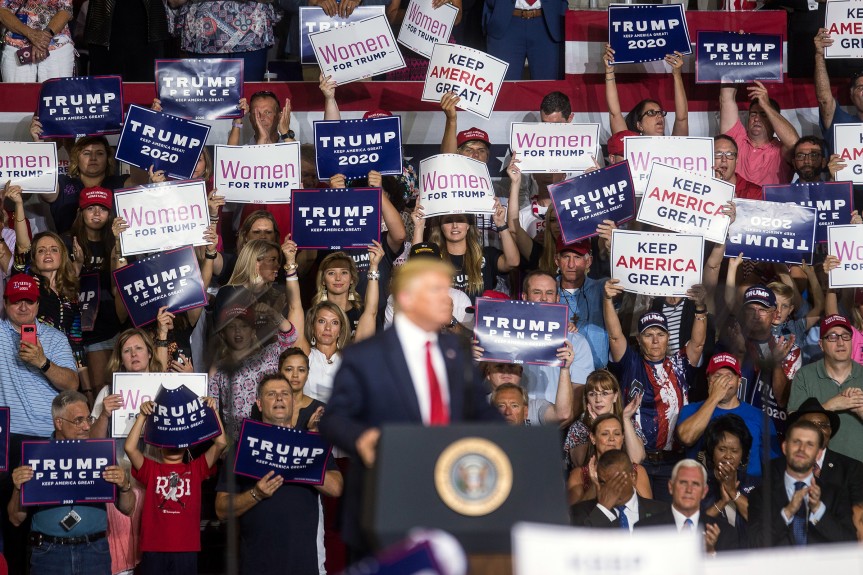
Donald Trump Holds "Keep America Great" Rally In Greenville, NC
As long as enough Americans keep cheering, Trump will keep ruling through denunciation, disdain, and divisiveness (but note the guy next to Pence, covering his face with his hand, hopefully in disgust)

W.J. Astore

Robert Mueller testified before Congress today (7/24), the big takeaway being that his report didn’t exonerate Trump of, well, something.

From what I’ve seen, there’s no evidence that proves Trump colluded with Russia to influence the presidential election in 2016.  There is evidence Trump tried to obstruct Mueller’s inquiry, but his own subordinates disobeyed or ignored him, thereby protecting him from his own stupidity.

So, Trump didn’t collude with Russia and Mueller was able to complete his investigation, therefore Trump is essentially in the clear, especially on the damning charge of treason.  Right?

Not so fast.  I recently read Sebastian Junger’s fine book, Tribe: On Homecoming and Belonging (2016), and the following passage resonated:

“politicians occasionally accuse rivals of deliberately trying to harm their own country–a charge so disruptive to group unity that most past societies would probably have just punished it as a form of treason.  It’s complete madness, and the veterans know this.  In combat, soldiers all but ignore differences of race, religion, and politics within their platoon.  It’s no wonder many of them get so depressed when they come home.”

Junger nails it.  Accusing your political rivals of deliberately trying to harm America, which Trump routinely does when he denounces Democrats at his rallies, could be construed as a form of treason.  Seeking to divide Americans on the basis of race, religion, and other qualities, which Trump also routinely does, is another behavior that could be construed as treasonous to American ideals and treacherous to our ability to come together and govern ourselves.

superman

Trump’s treason (if you want to call it that) is in plain sight.  It’s in the way he divides Americans and denounces his opponents as putting America (and Israel!) in danger.  His treachery is blatant.  The problem is that roughly 40% of Americans seem willing either to follow Trump or to look the other way as he rules through denunciation, disdain, and divisiveness.

Trump will use any tactic to protect his power and privilege.  He is an unprincipled and rank opportunist who works for his own self-aggrandizement.

Perhaps that’s not the legal definition of treason, but it is the defining characteristic of a man who should be voted out of office in 2020.

Yes, Trump is a Racist

Donald Trump Makes Announcement At Trump Tower
Trump on the down escalator toward American carnage, 2015

W.J. Astore

Yes, Donald Trump is a racist.  His attacks on four Democratic Congresswomen of color are only the most recent illustration of this.  Trump, of course, is also an opportunist.  A conniver.  An exploiter.  Unless it backfires, he’ll keep using racism.  It fires up his “base” and distracts from the looting his family and administration are actively engaged in.

Trump intuitively grasped a painful reality that Norman Mailer wrote about in 1968.  Inspired by Richard Nixon’s campaign, Mailer wrote that “political power of the most frightening sort was obviously waiting for the first demagogue who would smash the obsession and free the white man of his guilt [of slavery and racism and their legacies].  Torrents of energy would be loosed, yes, those same torrents which Hitler had freed in the Germans when he exploded their ten-year obsession with whether they had lost the war [World War I] through betrayal or through material weakness.  Through betrayal, Hitler had told them: Germans were actually strong and good.  The consequences would never be counted.”

Immediately after writing this, Mailer said:

“Now if suburban America was not waiting for Georgie Wallace, it might still be waiting for Super-Wallace.”

Enter Candidate Trump on his escalator, railing against Mexicans as rapists and killers.  Stoking fear and bigotry against people of color.  He did it, guiltlessly, because it worked.  And it proved a balm to so many in his base, who could now vent their racism because a rich White man like Trump had given them cover, permission, even a mandate.

Recall Mailer’s words: “The consequences [of unleashing guilt-free racism in America] would never be counted.”  We’ve been experiencing these consequences since Trump rode that escalator down and unleashed his own brand of American carnage.  We will continue to experience them even when Trump is finally out of office and long dead.  Because Trump isn’t guilty alone.  He needs followers willing to embrace his lies, his vitriol, his hateful speech.

Isn’t it time we rejected Trump, and all his words and works, and all his empty promises?

Stop Exporting Violence, America

quote-only-americans-can-hurt-america-dwight-d-eisenhower-8-76-03

W.J. Astore

The USA is a violent land.  And perhaps that might be OK, if we limited the violence to us. But we’ve become the world’s leading exporter of deadly weaponry, a fact I was reminded of this morning as I read William Hartung’s latest article on the military-industrial complex at TomDispatch.com. In detailing the ever-growing power of the Complex, Hartung had this telling sentence:

When pressed, Raytheon officials argue that, in enabling mass slaughter, they are simply following U.S. government policy.

Tragic as that statement is, it’s also true.  As I’ve written about before, weapons ‘r’ us.  Our so-called peacetime economy is geared to war, homeland security, surveillance, and other forms of violent and coercive technologies and products.  Even as America seeks to prevent other countries from acquiring weapons of mass destruction (WMD), we’re actively seeking to sell WMD to others, as long as those weapons are Made in the USA and go to “allies” that pay promptly, like the Saudis.

Being the world’s leading purveyor of violence can only lead to America’s spiritual death, as Martin Luther King Jr. argued so eloquently a half-century ago.  As MLK’s words show, this tragic reality is nothing new in America.  As Senator J. William Fulbright noted in 1970, the U.S. emerged after World War II to become “the world’s major salesman of armaments.”  Fulbright went further and quoted Marine Corps General David M. Shoup, a Medal of Honor recipient, and Shoup’s conclusion that “America has become a militaristic and aggressive nation.”  Remember, this was fifty years ago, when the U.S. at least faced a real threat from Communism, no matter how much we inflated it.  We face no equivalent threat today, no matter how much the Pentagon hyperventilates about China and Russia.

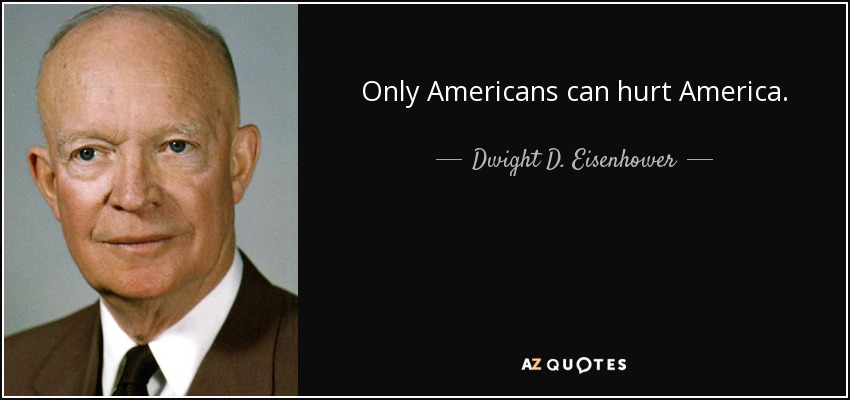
Returning to Hartung’s article, I like his title: “Eisenhower’s Worst Nightmare.”  Indeed it is, in the sense that the military-industrial complex is, ultimately, an American complex.  Which makes me think of another Eisenhower sentiment: that only Americans can truly hurt America.  That our biggest enemy is within our borders: our own violence, aggression, fear, and hatred, especially of others.

Ike was right about the Complex, and he was right about how America would truly be hurt and defeated.  The enemy is not from without.  No walls will keep him out.  No — the enemy is within.  And it won’t — indeed, it can’t — be defeated by weapons and violence.  Indeed, more weapons and violence only make it stronger.

Be an indispensable nation, America.  Be exceptional.  Be great.  As Melania Trump might say, Be Best.  How?  Stop exporting violence.  And stop the hurt within.

The Language of Politics: Aristotle, Ronald Reagan, and Bernie Sanders

190612-bernie-sanders-al-1454_ed53be4ed4391f456a626d6ab00bd281.fit-2000w
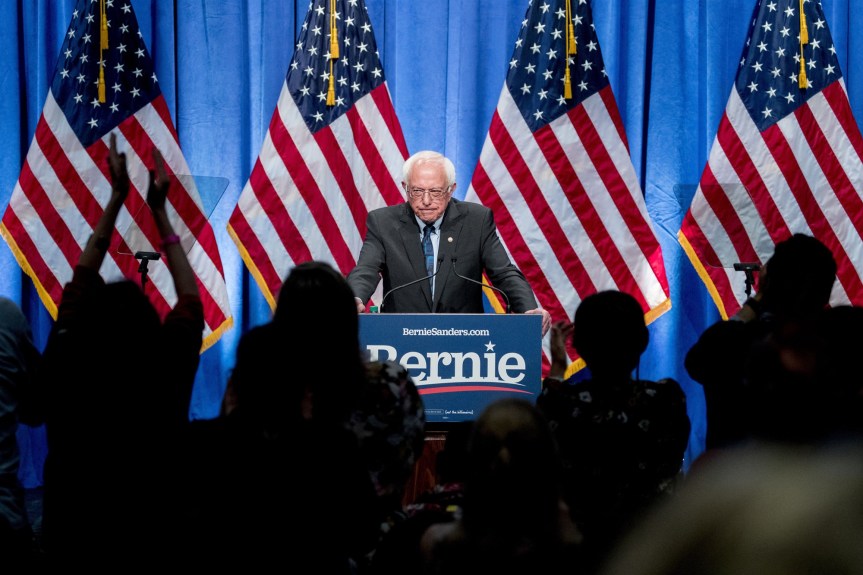
Bernie Sanders at George Washington University: Reshaping America’s political language

M. Davout

In his book, The Politics, Aristotle expressed a famous claim that political science textbooks have been quoting for generations: man is by nature a political animal. Less appreciated has been Aristotle’s follow-up assertion that “man is the only animal that nature has endowed with the gift of speech, [which gift] is intended to set forth the advantageous and disadvantageous, the just and the unjust.”

With these claims Aristotle is reminding us that speech counts for a lot in politics. One need only consider how the language of politics in the post-New Deal, post-Great Society U.S. shifted so that it became a matter of course for millions of modest income Americans to vote for politicians who promised to cut, eliminate, or privatize government programs (e.g., Social Security, Medicare, Medicaid) that have kept so many vulnerable Americans from going under. Foundations such as the American Enterprise Institute, Heritage Foundation, Richard Mellon Scaife Foundation provided financial support for scholars and pundits willing to make the libertarian argument for an every-man-for-himself society for which, to paraphrase Ronald Reagan in his first inaugural address, government is the problem, not the solution.

Funded by wealthy interests and individuals, these foundations and think tanks developed the rhetoric (e.g., “death tax” instead of “estate tax”) and ideas (e.g., cutting taxes increases government revenues) that would be picked up and propagated by conservative politicians across the country. Reagan himself, who began his national political career on the pundit side of conservative politics as a paid spokesman of General Electric giving speeches at GE plants across the country, paid homage to the decades-long conservative struggle to change the political conversation when he said, “The American Enterprise Institute stands at the center of a revolution of ideas of which I too have been a part…”

While it is too early confidently to guess which of the democratic contenders for the presidential nomination will face off against Trump, it is not too early to appreciate how much the speech of a certain senator from Vermont has changed the national conversation. Every time Bernie Sanders appears in public and speaks, whether at a televised debate, on a union picket line, on the stump in Iowa or New Hampshire, or on a college campus, his words serve to enlarge and invigorate the space of political discourse in this country. His relentlessly on-message campaign in 2016 for a $15-dollar-minimum (“living”) wage, Medicare-for-All, tuition-free public colleges and universities, highlighting global warming as an existential threat, a political revolution against a corrupt system, had discernible impacts in local, state and national races in 2018.  Consider as well the leftward policy positioning of several of his fellow candidates for the 2020 nomination; their language and positions often echo those of Sanders.

And while it is also too early to tell whether his recent speech at George Washington University successfully immunized the word, socialism, from the taboo status it has labored under in American political culture since at least the post-World War One Red Scare, Bernie Sanders’ evocation of FDR’s “Economic Bill of Rights” and his enlargement of the notion of being free to encompass having adequate health insurance, for example, or having access to a college education without sinking into paralyzing debt continues his crucial efforts to change the language of U.S. politics.

In helping to reshape the language of American politics, Bernie Sanders may go down in U.S. history as the presidential candidate who did not need to win to get his most important work done.

M. Davout, a professor of political science, teaches in the American South.

American Militarism Is Riding High

W.J. Astore

In my latest article for TomDispatch.com, I again turn to the Pentagon and the military-industrial complex, inspired by a critique written by J. William Fulbright almost a half-century ago.  Given the murderous and disastrous war in Southeast Asia of Fulbright’s time, many Americans back then were willing to be highly critical of the military, especially with a draft still in force.  (A draft that privileged men like Dick Cheney, Bill Clinton, and Donald Trump managed to avoid.)  Nowadays, of course, Americans are encouraged to venerate the military, to salute “our” troops, to applaud as various warplanes soar overhead, as they did during Donald Trump’s recent militaristic July 4th ceremony.  What we’re not encouraged to do is to criticize or even to question America’s vast military establishment and its enormous power, even though President Dwight D. Eisenhower warned us about that establishment in his famous farewell speech in 1961.

It’s high time we Americans listened to Ike as well as to J.W. Fulbright.  Let’s give the latter a close listen, shall we?

download
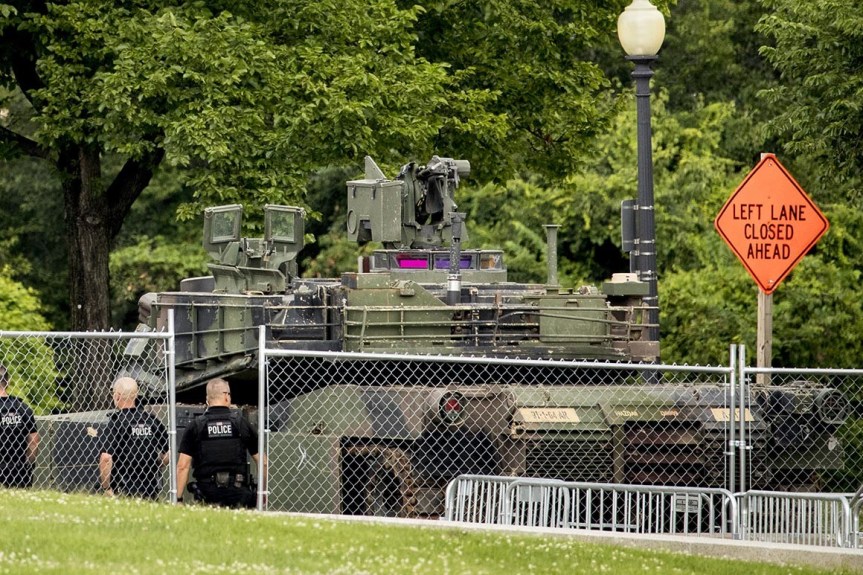
Because nothing says “America” like tanks, fences, barriers, police, and a sign saying the way is closed to the “left”

A while back … I stumbled across Senator J. William Fulbright’s 1970 book The Pentagon Propaganda Machine and, out of curiosity, bought it for the princely sum of five dollars. Now, talk about creepy. Fulbright, who left the Senate in 1974 and died in 1995, noted a phenomenon then that should ring a distinct bell today. Americans, he wrote, “have grown distressingly used to war.” He then added a line that still couldn’t be more up to date: “Violence is our most important product.” Congress, he complained (and this, too, should ring a distinct bell in 2019), was shoveling money at the Pentagon “with virtually no questions asked,” while costly weapons systems were seen mainly “as a means of prosperity,” especially for the weapons makers of the military-industrial complex. “Militarism has been creeping up on us,” he warned, and the American public, conditioned by endless crises and warnings of war, had grown numb, leaving “few, other than the young, [to] protest against what is happening.”

Back then, of course, the bogeyman that kept the process going was Communism. America’s exaggerated fear of Communism then (and terrorism now) strengthened militarism at home in a myriad of ways while, as Fulbright put it, “undermining democratic procedure and values.” And doesn’t that ring a few bells, too? Complicit in all this was the Pentagon’s own propaganda machine, which worked hard “to persuade the American people that the military is good for you.”

Perhaps my favorite passage from that book was a message the senator received from a citizen who had attended a Pentagon rah-rah “informational seminar.”  Writing to Fulbright, he suggested that “the greatest threat to American national security is the American Military Establishment and the no-holds-barred type of logic it uses to justify its zillion-dollar existence.”

In a rousing conclusion on the “dangers of the military sell” that seems no less apt nearly a half-century later, Fulbright warned that America’s “chronic state of war” was generating a “monster [military] bureaucracy.” Citing the My Lai massacre in Vietnam, he noted how “the mindless violence of war” was eroding America’s moral values and ended by emphasizing that dealing with the growth of immoral militarism was vitally important to the country’s future.

“The best defense against militarism is peace; the next best thing is the vigorous practice of democracy,” he noted, citing the dissenters of his day who opposed America’s murderous war in Southeast Asia. And he added a warning no less applicable today: Americans shouldn’t put their faith in senior military men whose “parochial talents” were too narrow “to equip them with the balance of judgment needed to play the political role they now hold in our society.”

Reading Fulbright today, I couldn’t help but recall one of my dad’s favorite sayings, translated from the French: the more things change, the more they stay the same. Sure, the weaponry may be upgraded (drones with Hellfire missiles rather than bombers dropping napalm); the names of the countries may be different (Afghanistan, Iraq, and Somalia rather than Vietnam, Laos, and Cambodia); even the stated purpose of the wars of the moment may have altered (fighting terrorism rather than defeating Communism); but over the last 50 years, the most fundamental things have remained remarkably consistent: militarism, violence, the endless feeding of the military-industrial complex, the growth of the national security state, and wars, ever more wars, always purportedly waged in the name of peace.

Sometimes when you buy a used book, it comes with a bonus. This one held between its pages a yellowed clipping of a contemporary New York Times review with the telling title, “O What a Lovely Pentagon.” In agreeing with Fulbright, the reviewer, Herbert Mitgang, himself a veteran of World War II, wrote:

“To keep up the [Pentagon] budgets, all three services compete for bigger and better armaments in coordination with the publicity salesmen from the major corporations — for whom retired generals and admirals serve as front men. Thousands of uniformed men and millions of dollars are involved in hard-selling the Pentagon way of life.”

Change “millions” to “billions” and Mitgang’s point remains as on target as ever.

Citing another book under review, which critiqued U.S. military procurement practices, Mitgang concluded: “What emerges here is a permanent floating crap game with the taxpayer as loser and Congress as banker, shelling out for Pentagon and peace profiteers with an ineptitude that would bankrupt any other business.”

Spot on, Herb Mitgang, who perhaps played his share of craps during his Army service!

As I read Fulbright’s almost 50-year-old polemic and Mitgang’s hard-hitting review, I asked myself, how did the American people come to forget, or perhaps never truly absorb, such lessons? How did we stop worrying about war and come to love the all-volunteer military quite so much? (Thank you for your service!) So much so that, today, we engorge the Pentagon and the rest of the national security state with well more than a trillion taxpayer dollars annually — and the power to match…

Read more of my essay here at TomDispatch.com.

Addendum: Along with Abrams tanks and Bradley Fighting Vehicles, Trump’s July 4th ceremony turned into a military air show of sorts.  When you read the Declaration of Independence from 1776, you’re reminded that the colonists wanted to be free of the King’s wars and their high costs.  Now, on Independence Day, we celebrate our military weaponry without mentioning the high costs, even as we ignore our unending wars.

It’s time for another political revolution against the king’s wars and their high costs.  It’s time to throw off the heavy yoke of militarism in America.

Made in China

donald

W.J. Astore

Is it a good idea to get in a trade war with China when they make all our stuff?

I thought of that again this morning as I looked at the outfit I’m wearing.  LL Bean shorts?  Made in China.  Frye boat shoes?  Made in China.  Polo shirt made from organic cotton?  Made in China.  Brooks running shoes that I put on for my stretching routine?  Made in China.  My underwear?  Made in Thailand.  Aha!  So not everything comes from China.  I also note my Citizen Eco-Drive watch has a Japanese movement, but it’s unclear where final assembly took place.  Any chance it might also be in China?

I just want to state the obvious here: I’m a thoroughgoing Asian man, representing China, Thailand, and Japan.  Even when I don my most American-sounding brands like “True Grit,” they are most often made in China.

So, while it’s nice to hear that President Trump is calling a temporary trade and tariff truce with China, I have to say the Chinese already own us, and in more ways than one, since they also own trillions of our national debt.  Meanwhile, Trump’s “tough” tactic of raising tariffs to “punish” the Chinese just passes higher costs to American consumers, so who’s really being punished?

Sadly, as I’ve said before, the only American products I routinely hear about in the news as major money-making exports are weapons of war.  Bombs, missiles, guns, warplanes, and the like.  America used to be the world’s merchant for all kinds of products; now we’re better known as the world’s leading merchant of death.  We’re not the “arsenal of democracy,” as we were in World War II.  Now we’re just an arsenal.

Isn’t it time we converted our forever war economy into one that produces products that we can wear and enjoy in everyday life?

Or am I forever fated to be a statement of Asian sartorial excellence?

A Surprise Winner in the Democratic Presidential Debates for 2020

ticket
Bernie and Tulsi: the only candidates willing to call out the military-industrial complex

W.J. Astore

I watched the two Democratic debates this week.  Media outlets treat them as a horse race, announcing winners and losers.  So perhaps you heard Kamala Harris scored big-time against Joe Biden.  Or perhaps you heard Elizabeth Warren did well, or that Tulsi Gabbard generated lots of post-debate interest (Google searches and the like).  I will say that Beto O’Rourke was clearly unprepared (or over-prepared) and unable to speak clearly and meaningfully, so count him as a “loser.”

All that said, the clear winner wasn’t on the stage; it wasn’t even among the 20 debate participants.  The name of that clear winner: America’s military-industrial complex and its perpetual wars.

Sure, there was some criticism of the Afghan and Iraq wars, especially by candidates like Bernie Sanders and Tulsi Gabbard.  But there was no criticism of enormous “defense” budgets ($750 billion and rising, with true outlays exceeding a trillion a year), and virtually no mention of Saudi Arabia and the war in Yemen.  (Tulsi briefly mentioned the Saudis and was shut down; Bernie mentioned the war in Yemen and was ignored.)

The only direct mention of the military-industrial complex that I recall hearing was by Bernie Sanders.  Otherwise, the tacit assumption was that soaring defense budgets are appropriate and, at least in these debates, unassailable.

Bernie and Tulsi also mentioned the threat of nuclear war, with Bernie making a passing reference to the estimated cost of nuclear forces modernization (possibly as high as $1.7 trillion).  Again, he had no time to follow up on this point.

NBC’s talking heads asked the questions, so blame them in part for no questions on the MI Complex and the enormous costs of building world-ending nuclear weapons.  Indeed, the talking heads were much more concerned with “gotcha” questions against Bernie, which attempted to paint him as a tax-and-spend socialist who doesn’t care about diversity.  Yes, that really was NBC’s agenda.

Always, Democrats are asked, “How will you pay for that?”  You know: “extravagances” like more affordable education, better health care, a tax cut that helps workers, or investments in job training programs and infrastructure.  But when it comes to wars and weapons, there are never any questions about money.  The sky’s the limit.

A reminder to Democrats: Donald Trump won in 2016 in part because he was willing to denounce America’s wasteful wars and to challenge defense spending (even though he’s done nothing as president to back up his campaign critique).  We need true Peace Democrats with spine, so I remain bullish on candidates like Bernie Sanders and Tulsi Gabbard.

Hopefully, in future debates Bernie, Tulsi, and others will call for major reforms of our military and major cuts to our bloated Pentagon budget.  But don’t count on that issue being raised by the mainstream media’s talking heads.

Bonus Winner: I can’t recall a single mention of Israel and the Palestinians, not even in the context of framing a peace plan.  No mention of America’s role in Venezuela either.  The imperial and aggressive neo-con agenda on foreign policy went almost unchallenged, but kudos to Tulsi Gabbard for calling out the “chickenhawks” (her word, and the right one) in the Trump administration.