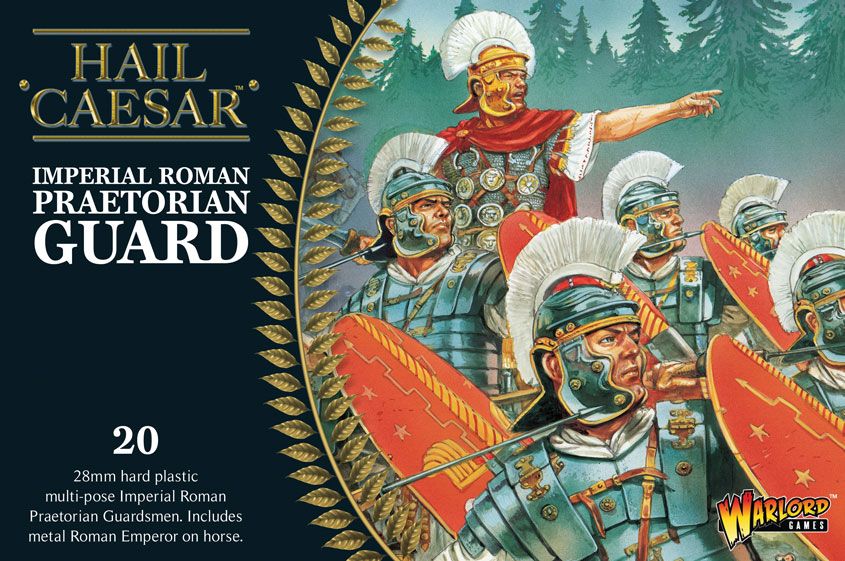
Trump Talks About the Military as if It’s His Praetorian Guard

WGH-IR-03_PraetorianGuard
Hail Trump? Includes wannabe American Emperor in Golf Cart.

W.J. Astore

President Donald Trump has a disturbing way of talking about the U.S. military.  Consider the following Trump quotation about the recent attack on U.S. troops in Niger:

“I have generals that are great generals,” Trump said. “I gave them authority to do what’s right so that we win. My generals and my military, they have decision-making ability. As far as the incident that we’re talking about [in Niger], I’ve been seeing it just like you’ve been seeing it. I’ve been getting reports.” [emphasis added]

For Trump, it’s not the American people’s military, it’s “my” military.  Generals are not Congressionally-appointed officers, they’re “my” generals.  Trump has a fundamental misunderstanding of his role as commander-in-chief, as well as the role of the U.S. military.  He sees himself as the big boss of “his” military, with generals as his personal employees whom he can order around and fire at will.

And by “order around,” I mean the issuance of orders regardless of their legality, a point Trump made back in March of 2016, in response to a debate question by Bret Baier:

BAIER: Mr. Trump, just yesterday, almost 100 foreign policy experts signed on to an open letter refusing to support you, saying your embracing expansive use of torture is inexcusable. General Michael Hayden, former CIA director, NSA director, and other experts have said that when you asked the U.S. military to carry out some of your campaign promises, specifically targeting terrorists’ families, and also the use of interrogation methods more extreme than waterboarding, the military will refuse because they’ve been trained to turn down and refuse illegal orders.

So what would you do, as commander-in-chief, if the U.S. military refused to carry out those orders?

TRUMP: They won’t refuse. They’re not going to refuse me. Believe me.

BAIER: But they’re illegal.

TRUMP: And — and — and — I’m a leader. I’m a leader. I’ve always been a leader. I’ve never had any problem leading people. If I say do it, they’re going to do it. That’s what leadership is all about.

As I wrote then, Trump’s fundamental misunderstanding of leadership, and especially his boasts about the military obeying his orders irrespective of their legality, disqualified him as a presidential candidate.  Of course, Trump’s dictatorial statements didn’t deter his determined fans. Indeed, they elected him because they wanted a Strong Man, not because they feared one.

So here we are, with a dictator wannabe as president, treating the U.S. military as if it’s his personal Praetorian Guard.  If the Republic isn’t dead, its heartbeat is fading fast.  Meanwhile, the sordid and corrupt Empire of Trump – just by its endurance – grows ever stronger.

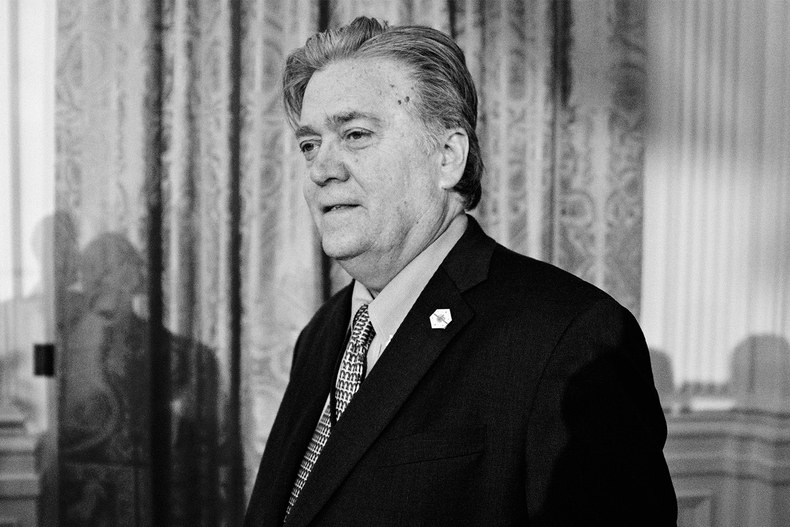
The Dangerous Sophistry of Steve Bannon

steve-bannon-interview-on-donald-trump
Bannon Wormtongue: Hiding behind the troops

W.J. Astore

After Republican Bob Corker had the guts to criticize President Trump for his bellicose rhetoric and incompetent management of U.S. foreign policy, Steve Bannon issued the following riposte:

“Bob Corker has trashed the commander in chief of our armed forces while we have young men and women in harm’s way.”

The indecency of Bannon’s argument is obvious.  According to Bannon, Corker’s criticism of Trump is tantamount to treason, because an attack on Trump is an attack on “our” troops “in harm’s way.”

If Bannon had his way, no one would be allowed to criticize Trump about foreign policy while U.S. troops are in harm’s way.  Since U.S. troops are deployed to more than 800 bases overseas and to more than 130 countries while incessantly fighting wars in places like Afghanistan, they are, in essence, always in harm’s way.  Thus, no criticism of our Great Leader would ever be allowed, which is convenient for Trump and Bannon Wormtongue.

It’s infuriating how men like Bannon attempt to squelch criticism of the president by hiding behind the troops.  Judging by his rhetoric, Bannon doesn’t want to live in a democracy; he’d much prefer a dictatorship.  Meanwhile, Trump’s riposte to Bob Corker focused on his height.  (Corker is roughly six inches shorter than Trump.)

Mr. Bannon, Trump is more mocker-in-chief than a commander.  And, in defending our chief mocker, your sophistic attempt to hide behind the troops was more than shameful.  It’s grotesque.

The Myths We Tell Ourselves

4266
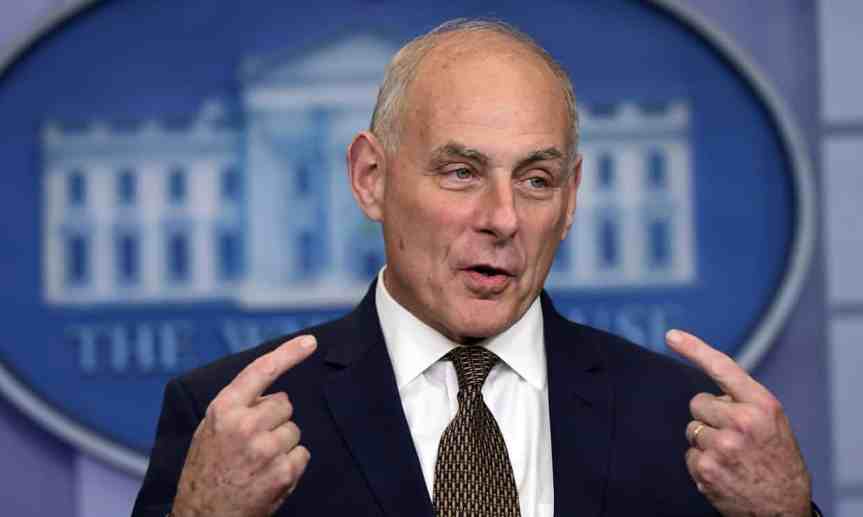
General John Kelly

W.J. Astore

John Kelly, President Trump’s chief of staff and a retired Marine Corps general, held a press conference on Thursday to deny he’s quitting or that he’s about to be fired.  In passing, he referred to two common myths in America that go almost completely unexamined.  (By “myth” I mean a defining belief, held in common, and usually without question.)

The first myth: That the United States has “the greatest military on the planet.”  The second myth: That the U.S. military’s value is its “deterrent factor.”

The U.S. certainly has a powerful military, one that costs roughly a trillion dollars a year, when all national security expenses are tallied (e.g. Homeland Security, intelligence, nuclear weapons, and interest on the national debt associated with these expenditures, among other costs).  But is it “the greatest”?  More importantly, why should a democracy and a people allegedly dedicated to peace and freedom be so proud of possessing “the greatest military on the planet”?

There was a time when Americans were proud of having a small standing military.  There was a time when Americans were proud of protesting arms sales around the world by “merchants of death.”  Those days ended with the Cold War.  Now, America leads the world in military spending and arms exports; no other country comes close.  Is this something to boast about?

How about General Kelly’s claim of the military’s “deterrent factor”?  The U.S. military has 800 bases around the world, with U.S. special operations forces involved in more than 130 countries.  Is this all about “deterrence”?  Is the U.S. deterring or preventing wars in Libya, Yemen, Syria, Iraq, and Afghanistan, among other places throughout the greater Middle East and Africa?  That hardly seems to fit the facts on the ground.

Of course, the media focused on Kelly’s message that he isn’t being fired and that President Trump is both “thoughtful” and a “man of action.”  His claims about the “world’s greatest military” and its strong deterrent value went unreported and unquestioned.  Such claims are now as “American” as baseball, hot dogs, apple pie, and Chevrolet.

And so it goes …

The Atrocious Nature of the Vietnam War

Helicopter_Poster_promoV2

W.J. Astore

“It’s their [South Vietnam’s] war to win. We can help them … but in the final analysis, it’s their people and their government who have to win or lose this struggle.”  President Kennedy in September 1963

“We are not about to send American boys nine or ten thousand miles from home [to fight in Vietnam] to do what Asian boys ought to be doing for themselves.”  President Johnson in 1964

I’ve now watched all ten episodes of the Burns/Novick series on the Vietnam War.  I’ve written about it twice already (here and here), and I won’t repeat those arguments.  Critical reviews by Nick Turse, Peter Van Buren, Andrew Bacevich, and Thomas Bass are also well worth reading.

I now know the main message of the series: the Vietnam war was an “irredeemable tragedy,” with American suffering being featured in the foreground.  The ending is revealing.  Feel-good moments of reconciliation between U.S. veterans and their Vietnamese counterparts are juxtaposed with Tim O’Brien reading solemnly from his book on the things American troops carried in Vietnam.  The Vietnamese death toll of three million people is briefly mentioned; so too are the bitter legacies of Agent Orange and unexploded ordnance; regional impacts of the war to Laos and Cambodia are briefly examined.  But the lion’s share of the emphasis is on the American experience, with the last episode focusing on subjects like PTSD and the controversy surrounding the Vietnam War Memorial in Washington, D.C.

The series is well made and often powerful.  Its fault is what’s missing.  Little is said about the war being a crime, about the war being immoral and unjust; again, the war is presented as a tragedy, perhaps an avoidable one if only U.S. leaders had been wiser and better informed, or so the series suggests.  No apologies are made for the war; indeed, the only apology featured is by an antiwar protester near the end (she’s sorry today for the harsh words she said decades ago to returning veterans).

The lack of apologies for wide-scale killing and wanton destruction, the lack of serious consideration of the war as a crime, as an immoral act, as unjust, reveals a peculiarly American bias about the war, which Burns/Novick only amplify.  The series presents atrocities like My Lai as aberrations, even though Neil Sheehan is allowed a quick rejoinder about how, if you include massive civilian casualties from U.S. artillery and bombing strikes, My Lai was not aberrational at all.  Not in the sense of killing large numbers of innocent civilians indiscriminately.  Such killing was policy; it was routine.  Sheehan’s powerful observation is not pursued, however.

What the Burns/Novick series truly needed was a two-hour segment devoted exclusively to the destruction inflicted on Southeast Asia and the suffering of Vietnamese, Laotian, and Cambodian peoples.  Such a segment would have been truly eye-opening to Americans.  Again, the series does mention napalm, Agent Orange, massive bombing, and the millions of innocents killed by the war.  But images of civilian suffering are as fleeting as they are powerful.  The emphasis is on getting to know the veterans, especially American ones, of that war.  By comparison, the series neglects the profound suffering of Vietnamese, Laotians, and Cambodians.

In short, the series elides the atrocious nature of the war.  This is not to say that atrocities aren’t mentioned.  My Lai isn’t ignored.  But it’s juxtaposed with communist atrocities, such as the massacre of approximately 2500 prisoners after the Battle of Hue during the Tet Offensive, a war crime committed by retreating North Vietnamese Army (NVA) and National Liberation Front (NLF) forces.

Yet in terms of scale and frequency the worst crimes were committed by U.S. forces, again because they relied so heavily on massive firepower and indiscriminate bombing.  I’ve written about this before, citing Nick Turse’s book, Kill Anything That Moves, as well as the writings of Bernard Fall, who said that indiscriminate bombing attacks showed the U.S. was not “able to see the Vietnamese as people against whom crimes can be committed.  This is the ultimate impersonalization of war.”

Why did many Americans come to kill “anything that moves” in Vietnam?  Why, in the words of Fall, did U.S. officialdom fail to see the peoples of Southeast Asia as, well, people?  Fellow human beings?

The Burns/Novick series itself provides evidence to tackle this question, as follows:

  1. At the ground level, U.S. troops couldn’t identify friend from foe, breeding confusion, frustration, and a desire for revenge after units took casualties. It’s said several times in the series that U.S. troops thought they were “chasing ghosts,” “phantoms,” a “shadowy” enemy that almost always had the initiative.  In American eyes, it wasn’t a fair fight, so massive firepower became the equalizer for the U.S.—and a means to get even.
  2. Racism, depersonalization, and alienation.  U.S. troops routinely referred to the enemy by various racist names: gooks, dinks, slopes, and so on. (Interestingly, communist forces seem to have referred to Americans as “bandits” or “criminals,” negative terms but not ones dripping with racism.)  Many U.S. troops also came to hate the countryside (the “stinky” rice paddies, the alien jungle) as well.  Racism, fear, and hatred bred atrocity.
  3. Body count: U.S. troops were pushed and rewarded for high body counts. A notorious example was U.S. Army Lieutenant General Julian Ewell.  The commanding general of the 9th Infantry Division, Ewell became known as the “Butcher of the Delta.”  Douglas Kinnard, an American general serving in Vietnam under Ewell, recounted his impressions of him (in “Adventures in Two Worlds: Vietnam General and Vermont Professor”).  Ewell, recalled Kinnard, “constantly pressed his units to increase their ‘body count’ of enemy soldiers.  This had become a way of measuring the success of a unit since Vietnam was [for the U.S. Army] a war of attrition, not a linear war with an advancing front line.  In the 9th [infantry division] he had required all his commanders to carry 3” x 5” cards with body count tallies for their units by date, by week, and by month.  Woe unto any commander who did not have a consistently high count.”

The Burns/Novick series covers General Ewell’s “Speedy Express” operation, in which U.S. forces claimed a kill ratio of 45:1 (45 Vietnamese enemy killed for each U.S. soldier lost).  The series notes that an Army Inspector General investigation of “Speedy Express” concluded that at least 5000 innocent civilians were included as “enemy” in Ewell’s inflated body count—but no punishment was forthcoming.  Indeed, Ewell was promoted.

Ewell was not the only U.S. leader who drove his troops to generate high body counts while punishing those “slackers” who didn’t kill enough of the enemy.  Small wonder Vietnam became a breeding ground for atrocity.

  1. Helicopters.  As one soldier put it, a helicopter gave you a god’s eye view of the battlefield.  It gave you distance from the enemy, enabling easier kills (If farmers are running, they’re VC, it was assumed, so shoot to kill).  Helicopters facilitated a war based on mobility, firepower, and kill ratios, rather than a war based on territorial acquisition and interaction with the people.  In short, U.S. troops were often in and out, flitting about the Vietnamese countryside, isolated from the land and the people—while shooting lots and lots of ammo.
  2. What are we fighting for? For the grunt on the ground, the war made no sense.  Bernard Fall noted that, after talking to many Americans in Vietnam, he hadn’t “found anyone who seems to have a clear idea of the end – of the ‘war aims’ – and if the end is not clearly defined, are we justified to use any means to attain it?”

The lack of clear and defensible war aims, aims that could have served to limit atrocities, is vitally important in understanding the Vietnam war.  Consider the quotations from Presidents Kennedy and Johnson that lead this article.  JFK claimed it wasn’t America’s war to win — it was South Vietnam’s.  LBJ claimed he wasn’t going to send U.S. troops to Vietnam to fight; he was going to leave that to Asian boys.  Yet JFK committed America to winning in South Vietnam, and LBJ sent more than half a million U.S. “boys” to wage and win that war.

Alienated as they were from the land and its peoples, U.S. troops were also alienated from their own leaders, who committed them to a war that, according to the proclamations of those same leaders, wasn’t theirs to win.  They were then rewarded for producing high body counts.  And when atrocities followed, massacres such as My Lai, U.S. leaders like Richard Nixon conspired to cover them up.

In short, atrocities were not aberrational.  They were driven by the policy; they were a product of a war fought under false pretenses.  This is not tragedy.  It’s criminal.

Failing to face fully the horrific results of U.S. policy in Southeast Asia is the fatal flaw of the Burns/Novick series.  To that I would add one other major flaw*: the failure to investigate war profiteering by the military-industrial complex, which President Eisenhower famously warned the American people about as he left office in 1961.  Burns/Novick choose not to discuss which corporations profited from the war, even as they show how the U.S. created a massive “false” economy in Saigon, riven with corruption, crime, and profiteering.

As the U.S. pursued Vietnamization under Nixon, a policy known as “yellowing the bodies” by their French predecessors, the U.S. provided an enormous amount of weaponry to South Vietnam, including tanks, artillery pieces, APCs, and aircraft.  Yet, as the series notes in passing, ARVN (the South Vietnamese army) didn’t have enough bullets and artillery shells to use their American-provided weaponry effectively, nor could they fly many of the planes provided by U.S. aid.  Who profited from all these weapons deals? Burns/Novick remain silent on this question—and silent on the issue of war profiteering and the business side of war.

The Vietnam War, as Tim O’Brien notes in the series, was “senseless, purposeless, and without direction.”  U.S. troops fought and died to take hills that were then quickly abandoned.  They died in a war that JKF, Johnson, and Nixon admitted couldn’t be won.  They were the losers, but they weren’t the biggest ones.  Consider the words of North Vietnamese soldier, Bao Ninh, who says in the series that the real tragedy of the war was that the Vietnamese people killed each other.  American intervention aggravated a brutal struggle for independence, one that could have been resolved way back in the 1950s after the French defeat at Dien Bien Phu.

But U.S. leaders chose to intervene, raining destruction on Southeast Asia for another twenty years, leading to a murderous death toll of at least three million.  That was and is something more than a tragedy.

*A Note: Another failing of the Burns/Novick series is the lack of critical examination about why the war was fought and for what reasons, i.e. the series takes at face value the Cold War dynamic of falling dominoes, containment, and the like.  It doesn’t examine radical critiques, such as Noam Chomsky’s point that the U.S. did achieve its aims in the war, which was the prevention of Vietnamese socialism/communism emerging as a viable and independent model for economic development in the 1950s and 1960s.  In other words, a debilitating war that devastated Vietnam delayed by several decades that people’s emergence as an economic rival to the U.S., even as it sent a message to other, smaller, powers that the U.S. would take ruthless action to sustain its economic hegemony across the world.  This line of reasoning demanded a hearing in the series, but it’s contrary to the war-as-tragedy narrative adopted by Burns/Novick.

For Chomsky, America didn’t accidentally or inadvertently or ham-fistedly destroy the Vietnamese village to save it; the village was destroyed precisely to destroy it, thereby strengthening capitalism and U.S. economic hegemony throughout the developing world.  Accurate or not, this critique deserves consideration.

The American Religion of War

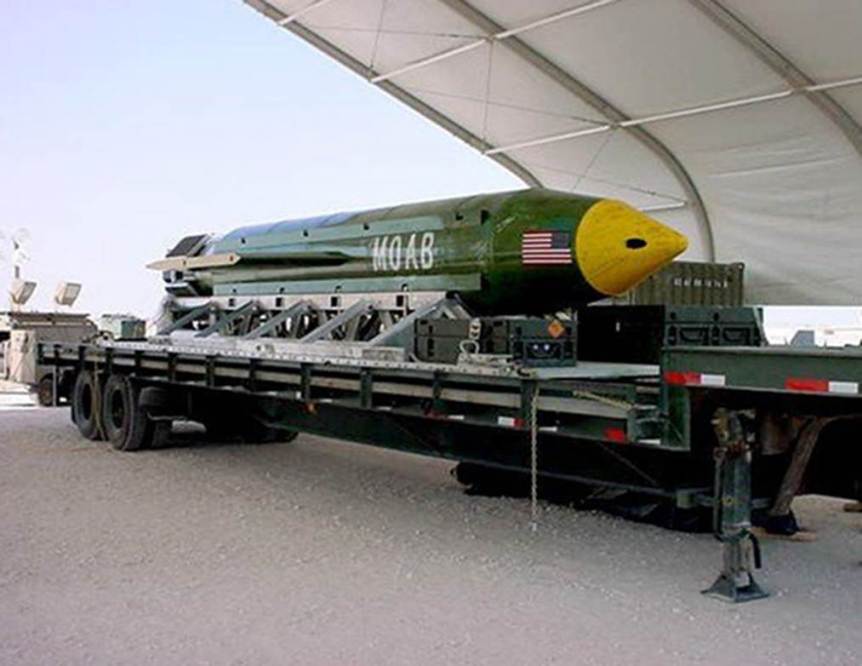
moab
The Holy Mother of All Bombs?

A few thoughts on violence and military idolatry in America

W.J. Astore

If you believe the polls, America is a nation of believers.  A nation of faith.  But is our faith truly in a pacific god of love?  Or do we instead worship a god of war?  Current and past events suggest that too often Americans place their faith in war and the military.  We continue to believe despite the evidence our belief is both wrongheaded and destructive.

We have a cult-like affection for war and the military.  It drives what we see — what we perceive.  Believing is seeing.  The military confesses to believe in “progress” in Iraq and Afghanistan, for example, so we invent metrics that show how we’re winning (which is exactly what we did fifty years ago in Vietnam).

We are not a rational society.  We are a faith-based society.  And our temples and crosses are military bases and weaponry, which we export globally.  The U.S. has 800 overseas bases, and America dominates the international trade in arms.  Meanwhile, our missionaries are our Special Ops troops, which we send to 130 countries, spreading the American gospel.  The gospel of war and the gun.

The icons of American militarism are our weapons. Our warplanes, our drones, big bombs (the MOAB), the list goes on. They have become the iconic symbols of an idolatry of destruction.

A xenophobic form of patriotism exacerbates a religion of violence.  Exclusive rather than inclusive, it sets the boundaries of “us” versus “them.”  Critics and dissenters are cast out and exiled.

Meanwhile, in far-off foreign lands, we reject the reality of ruins and rubble.  We couch it instead in terms of salvation: “we had to destroy the village to save it.”  It’s another aspect of our evangelical approach to war.  It’s like being born again.  You must tear yourself down before you’re born again in the spirit of Christ.  We seem to believe cities must be ruined before we can declare victory over the enemy.

Consider 9/11/2001.  An inward-looking people may have kept the ruins of 9/11 as a monument to the victims.  But not us.  That’s expensive real estate, and on those ruins we were born again, building Freedom Tower, exactly 1776 feet in height.  Thus our fall was reinterpreted as rebirth, our defeat as victory, tragedy as triumph.  Even 9/11 itself is now celebrated as a day of patriotism.

Yes, we can reconstruct our own rubble, as we did after 9/11.  But will foreign rubble ever be reconstructed?  Cities like Mosul?  Well, who cares?  They are not of the body.  They are not us.  They are outcasts.  Let them survive in what’s left of their blasted buildings and homes.

Our TV shows reinforce our belief in violence and militarism.  New ones include “The Brave” on NBC, which begins by focusing on a pretty White female doctor kidnapped by Muslim terrorists and “brave” efforts to rescue her; “Valor” on the CW channel, featuring lots of helicopters and flags and automatic weapons; and the rather obvious “SEAL Team” on CBS, with elite Navy SEALs standing in for the superheroes of the past.  If you get tired of watching military heroics on TV, there’s always military-themed “shooter” video games.  Indeed, the military experience is everywhere, even in Madden football, where in “story mode” you can play against quarterback Dan Marino on an Army base in Iraq.  (The field is surrounded by a fortified fence, rocky hills, and a helicopter pad, among other exotic military features.)

America is being consumed by a religion of violence and mayhem.  We’re trapped in a dark maelstrom of death and destruction.  Yet how can we repudiate our god of war when we are so busy feeding him?  When we talk of “thoughts and prayers” after each tragedy, do we truly know which god we’re calling upon?

The Vietnam War: A Tragic Mistake?

Helicopter_Poster_promoV2

W.J. Astore

I’ve watched the first three episodes of the Ken Burns/Lynn Novick series on the Vietnam War, which take us from the French colonial period beginning in the 19th century to the end of 1965 and a mushrooming U.S. military commitment.  The narrative thread, it seems to me, is the notion of the war as a tragic mistake, most especially for the United States.

The series begins with a voice-over that suggests the war was begun in good faith by America, even as other American voices in the series suggest otherwise.  I kept a notebook handy and jotted down the following notes and thoughts as the series progressed:

  1. There were divisions among the Vietnamese people, but they were more or less united by one idea: resist the foreign invaders/occupiers, whether that foreign presence was French, Japanese, the French again, American, or (both earlier and later) Chinese.  And there’s no doubt Ho Chi Minh would have won a democratic election, as promised at Geneva.  Which is exactly why that election never came.
  2. As one American admitted, the U.S. totally misread the situation in Indochina after the French defeat in 1954.  The Cold War and Falling Dominoes dominated the thoughts of Americans, obscuring the reality of a powerful and popular anti-colonial and nationalist revolt that tapped Vietnamese patriotism.
  3. When not fearing Falling Dominoes, U.S. officials were far more concerned about their own prestige (or political fortunes) than they were with the Vietnamese people.
  4. U.S. officials recognized South Vietnam was a fiction, a puppet government propped up by American money and power, and that they had “backed the wrong horse.” But they came to believe it was the only horse they had in the race against communism.
  5. U.S. presidents, stuck with a losing horse of their own creation, began to lie. As president, Kennedy said he hadn’t sent combat troops; he had.  As president, Johnson tried to obscure both the size and intent of the U.S. military’s commitment. These lies were not done to deceive the enemy — they were done to deceive the American people.
  6. After backing the wrong horse (Diem and his family), American leaders conspired to eliminate him in a coup.  When Diem was assassinated, matters only grew worse. Left with no horse in the race and a “turnstile” government in South Vietnam, the U.S. began to bomb North Vietnam and committed combat units beginning in March of 1965.
  7. More duplicity by U.S. officials: Battles such as Ap Bac and Binh Gia, which revealed the “miserable performance” of the South Vietnamese army (ARVN), were reinterpreted and sold as victories by senior U.S. military leaders.
  8. Both JFK and LBJ had serious reservations about going to war in Vietnam. However, domestic political concerns, together with concerns about containing the spread of communism, always came up trumps.  For example, the series quotes Kennedy as saying he believed America couldn’t win in Vietnam, but that he couldn’t win the 1964 presidential election if he withdrew U.S. advisors from Vietnam. LBJ was similarly skeptical but took a tough line with the Gulf of Tonkin resolution, which saw his approval rating on Vietnam soar from 42% to 72%, ensuring his electoral victory over Goldwater in 1964.

One of the more compelling sound bites comes from then-Major Charles Beckwith, who is at pains to praise the fighting quality of Viet Cong/NLF forces, their total commitment to the struggle.  If only he had (Vietnamese) troops like them to work with, says Beckwith.

To summarize: the series provides evidence of U.S. dishonesty and duplicity and showcases the mistakes generated by hubris when aggravated by ignorance.  Yet, the overall message is one of sadness about a “tragic mistake” committed by decent men who were overwhelmed by fears of international communism.

Final points: As we watch the series, we follow individual Americans, and hear American commentators, far more than we hear Vietnamese voices.  Also, while the series shows U.S. bombing from afar and mentions Agent Orange, the effects of this destruction haven’t yet been shown in detail.  (A telling exception: a young Vietnamese women joins the communist resistance after U.S. bombing destroys a center for senior citizens near her home.)

In short, the Burns/Novick series privileges the American experience, suggesting that U.S. troops of that era fought courageously as a new “greatest generation,” even as senior U.S. leaders spoke privately of an unwinnable war.

Is killing millions of people in a lost cause merely a tragic mistake?  Or is it something far worse?  More to come as the series continues to air on PBS.

The American Military Uncontained

Ike
Ike had it right: Beware the military-industrial complex

W.J. Astore

In my latest article for TomDispatch.com, I detail how the U.S. military is out everywhere but winning nowhere.  What I mean by not winning is the military’s failure to end wars on terms remotely favorable to national security and the interests of democracy.  I hesitate to be a cynic, but perpetual war does mean perpetual high “defense” budgets and prolonged and prodigious power for generals (and retired generals). Peace would mean smaller defense budgets and far less influence for these men.

What chance of peace with President Trump in charge surrounded by the generals of all these losing wars?  Indeed, generals continue to speak of generational wars, so much so that I’m tempted to make a play on words: generational wars generated by generals.  It’s not entirely fair, nor is it entirely unfair.

Anyway, here’s an excerpt from my article.  You can read it in its entirety at TomDispatch.com.

When it comes to the “world’s greatest military,” the news has been shocking. Two fast US Navy ships colliding with slow-moving commercial vessels with tragic loss of life. An Air Force that has been in the air continuously for years and yet doesn’t have enough pilots to fly its combat jets. Ground troops who find themselves fighting “rebels” in Syria previously armed and trained by the CIA. Already overstretched Special Operations forces facing growing demands as their rates of mental distress and suicide rise. Proxy armies in Iraq and Afghanistan that are unreliable, often delivering American-provided weaponry to black markets and into the hands of various enemies. All of this and more coming at a time when defense spending is once again soaring and the national security state is awash in funds to the tune of nearly a trillion dollars a year.

What gives? Why are highly maneuverable and sophisticated naval ships colliding with lumbering cargo vessels? Why is an Air Force that exists to fly and fight short 1,200 pilots? Why are US Special Operations forces deployed everywhere and winning nowhere? Why, in short, is the US military fighting itself — and losing?

It’s the Ops Tempo, Stupid

After 16 years of a never-ending, ever-spreading global war on terror, alarms are going off in Asia from the Koreas and Afghanistan to the Philippines, while across the Greater Middle East and Africa the globe’s “last superpower” is in a never-ending set of conflicts with a range of minor enemies few can even keep straight. As a result, America’s can-do military, committed piecemeal to a bewildering array of missions, has increasingly become a can’t-do one.

Too few ships are being deployed for too long. Too few pilots are being worn out by incessant patrols and mushrooming drone and bombing missions. Special Operations forces (the “commandos of everywhere,” as Nick Turse calls them) are being deployed to far too many countries — more than two-thirds of the nations on the planet already this year — and are involved in conflicts that hold little promise of ending on terms favorable to Washington. Meanwhile, insiders like retired Gen. David Petraeus speak calmly about “generational struggles” that will essentially never end. To paraphrase an old slogan from ABC’s Wide World of Sports, as the US military spans the globe, it’s regularly experiencing the agony of defeat rather than the thrill of victory.

To President Donald Trump (and so many other politicians in Washington), this unsavory reality suggests an obvious solution: boost military fundingbuild more navy ships; train more pilots and give them more incentive pay to stay in the military; rely more on drones and other technological “force multipliers” to compensate for tired troops; cajole allies like the Germans and Japanese to spend more on their militaries; and pressure proxy armies like the Iraqi and Afghan security forces to cut corruption and improve combat performance.

One option — the most logical — is never seriously considered in Washington: to make deep cuts in the military’s operational tempo by decreasing defense spending and downsizing the global mission, by bringing troops home and keeping them there. This is not an isolationist plea. The United States certainly faces challenges, notably from Russia (still a major nuclear power) and China (a global economic power bolstering its regional militarily strength). North Korea is, as ever, posturing with missile and nuclear tests in provocative ways. Terrorist organizations strive to destabilize American allies and cause trouble even in “the homeland.”

Such challenges require vigilance. What they don’t require is more ships in the sea lanes, pilots in the air and boots on the ground. Indeed, 16 years after the 9/11 attacks it should be obvious that more of the same is likely to produce yet more of what we’ve grown all too accustomed to: increasing instability across significant swaths of the planet, as well as the rise of new terror groups or new iterations of older ones, which means yet more opportunities for failed US military interventions …

The Greatest Self-Defeating Force in History?

Incessant warfare represents the end of democracy. I didn’t say that, James Madison did.

I firmly believe, though, in words borrowed from President Dwight D. Eisenhower, that “only Americans can hurt America.” So how can we lessen the hurt? By beginning to rein in the military. A standing military exists — or rather should exist — to support and defend the Constitution and our country against immediate threats to our survival. Endless attacks against inchoate foes in the backlands of the planet hardly promote that mission. Indeed, the more such attacks wear on the military, the more they imperil national security.

A friend of mine, a captain in the Air Force, once quipped to me: you study long, you study wrong. It’s a sentiment that’s especially cutting when applied to war: you wage war long, you wage it wrong. Yet as debilitating as they may be to militaries, long wars are even more devastating to democracies. The longer our military wages war, the more our country is militarized, shedding its democratic values and ideals.

Back in the Cold War era, the regions in which the US military is now slogging it out were once largely considered “the shadows” where John le Carré-style secret agents from the two superpowers matched wits in a set of shadowy conflicts. Post-9/11, “taking the gloves off” and seeking knockout blows, the US military entered those same shadows in a big way and there, not surprisingly, it often couldn’t sort friend from foe.

A new strategy for America should involve getting out of those shadowy regions of no-win war. Instead, an expanding US military establishment continues to compound the strategic mistakes of the last 16 years. Seeking to dominate everywhere but winning decisively nowhere, it may yet go down as the greatest self-defeating force in history.

Ken Burns and the Vietnam War: Ten Items to Watch For

Helicopter_Poster_promoV2

W.J. Astore

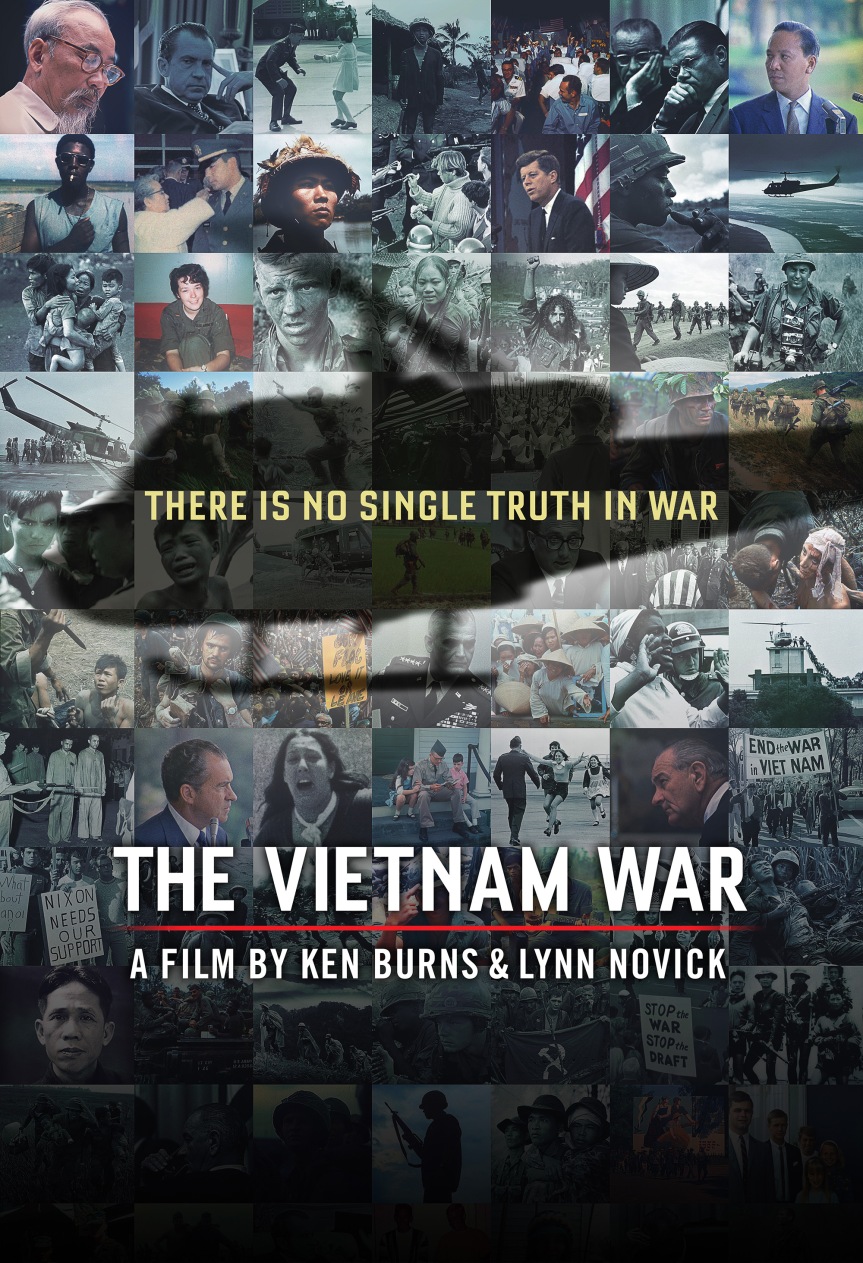
On September 17th, a new TV documentary series on the Vietnam War by Ken Burns (famous for past series on the U.S. Civil War, Baseball, and Jazz, among others) and Lynn Novick begins its run on PBS.  Airing in ten parts over 18 hours, the series promises a comprehensive look at the war from all sides, with the catchphrase “There is no single truth in war” serving as a guiding light.  Initial excerpts suggest the series isn’t looking to provide definitive answers, perhaps as a way of avoiding political controversy in the Age of Trump.

I’ll be watching the series, but I have ten points of my own to make about America’s war in Vietnam.  As a preamble, the Vietnam War (American version) was both mistake and crime. What’s disconcerting in the U.S. media is the emphasis on the war as an American tragedy, when it was truly a horrific tragedy inflicted upon the peoples of Southeast Asia (Vietnamese, Laotians, Cambodians). Yes, American troops suffered and died in large numbers, yet Southeast Asian casualties were perhaps 50 times as great. Along with wanton killing came the poisoning of the environment with defoliants like Agent Orange; meanwhile, mines and unexploded ordnance from the war continue to kill people today in Southeast Asia. In a sense, the killing from that war still isn’t over.

With the caveat that we should reserve judgment until we’ve seen the series, let’s keep these ten points in mind as we watch:

1. To most Americans, Vietnam is a war. And war is a distorting and limiting lens through which to view cultures and peoples. Will Burns recognize this distortion?

2. The series talks about hearing voices from all sides of the conflict. But will the Vietnamese people, together with Laotians and Cambodians, really have as much say as Americans?

3. The U.S. suffered nearly 60,000 troops killed. But Vietnamese killed numbered in the millions. And the destruction to SE Asia — the spread of the war to Laos and Cambodia — was on a scale that rivaled or surpassed the destruction to the American South during the U.S. Civil War. Will that destruction be thoroughly documented and explained?

4. Whose point of view will prevail in the documentary? What will be the main thread of the narrative? Will the war be presented as a tragedy? A misunderstanding? A mistake? A crime? Will the “noble cause” and “stabbed in the back” myths (the ideas that the U.S. fought for freedom and democracy and against communism, and that the U.S. military could have won but was prevented from doing so by unpatriotic forces at home) be given equal time in the interests of a “fair and balanced” presentation? Will these myths be presented as alternative truths of the war?

5. Which American war in Vietnam will be presented? Even when we talk of the American part of the Vietnam War, there were at least four wars. The U.S. Army under General William Westmoreland fought a conventional, search and destroy, war. The Air Force wanted to prove that airpower alone, specifically bombing, could win the war. The Marines were more interested in counterinsurgency and pacification. The CIA and special ops types were engaged in psychological warfare, assassinations, torture, and god-knows-what-else.

6. The American presence in Vietnam became so overwhelming that by 1967-68 the Vietnamese economy was completely distorted. We brought American materialism and profligacy to a nation that was, by comparison, impoverished and “backwards” (from our perspective, of course). Material superiority bred and fed cockiness.

Consider Meredith Lair’s book, “Armed with Abundance: Consumerism and Soldiering in the Vietnam War” (2011).  It details the non-combat experiences of U.S. troops in Vietnam.  Here’s a telling book blurb written by historian Christian Appy: “Meredith Lair’s fascinating analysis of rear-echelon life among American G.I.s dramatically challenges our most common conceptions of U.S. military experiences in Vietnam. From steaks to steambaths, swimming pools to giant PXs, the amenities provided on large bases not only belie conventional images of that war, but also stand as dramatic testimony to the desperate and unsuccessful effort of American officials to bolster flagging troop morale as the war lurched toward its final failure.”

Will this orgy of American-driven materialism be documented?

7. Anti-war protests and serious unrest within the U.S. military led to the end of the draft and the creation of an “all-volunteer” military. Has this decision contributed to a more imperial U.S. foreign policy facilitated by a much more tractable military of “volunteers”?

8. Short of nuclear weapons, the U.S. military used virtually every weapon in its arsenal in SE Asia. The region became a test/proving ground for all sorts of weapons and concepts, from “smart” weapons and electronic fences and sensors to horrendous pounding by conventional bombs to war on the environment using defoliants and massive bulldozers to … well … everything. All sorts of pacification theories were tested as well, along with COIN and “small wars” and unconventional tactics to search and destroy to Vietnamization to … well … again, everything. SE Asia became a laboratory and its peoples became lab rats. Will this reality be fully documented?

9. It’s essential that people realize President Richard Nixon and his National Security Adviser, Henry Kissinger, knew the war was a lost cause no later than 1969. (Their conversations on tape prove this.) All they were looking for was a “decent interval” between a peace treaty (“peace with honor”) and what they saw as the inevitable collapse. They got that (in)decent interval of roughly 2.5 years. The Congressional decision to cut off funding to South Vietnam was convenient for the Nixon/Kissinger acolytes, since it allowed them to shift the blame for South Vietnam’s collapse in 1975 to Congress as well as to the usual “suspect” elements in American society, i.e. the peace movement.

Will the duplicity and hypocrisy of Nixon/Kissinger be adequately documented?

10. Finally, an important aspect of the Vietnam War was the breakdown in discipline within the U.S. military, which helped to drive the eventual elimination of the draft. Part of this breakdown was driven by drugs, a trade in which the CIA was implicated. At The Intercept, Jeremy Scahill interviewed Alfred McCoy, who wrote the book on this drug trade. Here’s an excerpt from their recent interview:

Alfred McCoy: And in 1970 and ’71, there were rumors that started coming back from Vietnam, particularly 1971, that heroin was spreading rapidly in the ranks of the U.S. forces fighting in South Vietnam. And in later research, done by the White House, [it was] determined that in 1971, 34 percent, one-third of all the American combat troops fighting in South Vietnam were heavy heroin users. There were, if that statistic is accurate, more addicts in the ranks of the U.S. Army in South Vietnam than there were in the United States.

And so what I did was I set out to investigate: Where was the opium coming from? Where was the heroin coming from? Who was trafficking it? How is it getting to the troops in their barracks and bunkers across the length and breadth of South Vietnam? Nobody was asking this question. Everyone was reporting on the high level of abuse, but nobody was figuring out where and who.

So I started interviewing. I went to Paris. I interviewed the head of the French equivalent of the CIA in Indochina, who was then head of a major French helicopter manufacturing company, and he explained to me how during the French Indochina war from 1946 to 1954, they were short of money for covert operations, so the hill tribes in Laos produced the opium, the aircraft picked it up, they turned it over to the netherworld, the gangsters that controlled Saigon and secured it for the French and that paid for their covert operations. And I said, “What about now?” And he said, “Well I don’t think the pattern’s changed. I think it’s still there. You should go and look.”

So I did. I went to Saigon. I got some top sources in the Vietnamese military. I went to Laos. I hiked into the mountains. I was ambushed by CIA mercenaries and what I discovered was that the CIA’s contract airline, Air America, was flying into the villages of the Hmong people in Northern Laos, whose main cash crop was opium and they were picking up the opium and flying it out of the hills and there were heroin labs — one of the heroin labs, the biggest heroin lab in the world, was run by the commander-in-chief of the Royal Laotian Army, a man whose military budget came entirely from the United States. And they were transforming, in those labs, the opium into heroin. It was being smuggled into South Vietnam by three cliques controlled by the president, the vice president, and the premier of South Vietnam, and their military allies and distributed to U.S. forces in South Vietnam.

And the CIA wasn’t directly involved, but they turned a blind eye to the role of their allies’ involvement in the traffic. And so this heroin epidemic swept the U.S. Army in Vietnam. The Defense Department invented mass urine analysis testing, so when those troops left they were tested and given treatment. And what I discovered was the complexities, the complicity, of the CIA in this traffic and that was a pattern that was repeated in Central America when the Contras became involved in the traffic.

These ten items highlight just some of the complexities of the Vietnam War and its effects throughout Southeast Asia.  How many of these will be tackled honestly in Ken Burns’s new series?  We shall see, beginning in two weeks.

With the Pentagon, Trump Has Morphed Into Hillary Clinton

trump-clinton
More alike than we knew?

W.J. Astore

Candidate Trump occasionally said unconventional things about the Pentagon and America’s wars.  He attacked the Pentagon for wasteful spending; cost overruns on the F-35 jet fighter were a favorite target.  He attacked the Iraq and Afghan wars as wasteful, asserting they’d cost trillions of dollars without aiding the U.S. in any measurable way.  He argued for friendlier relations with Russia, a détente of sort compared to the policies followed by the Obama administration.  Naturally, even as he declaimed against America’s wasteful wars and costly weaponry, he promised to fund the military generously.  Finally, he wasn’t afraid to take America’s generals to task, asserting he knew more than they did about war and foreign policy.

President Trump is a different man.  “His” generals have brought him under control.  Criticism of the F-35 has gone away.  Trump, even if reluctantly, has embraced the Afghan war and the Pentagon’s open-ended commitment to it.  Russian détente has taken a back seat to tough talk and sanctions (not that Trump had much of a choice, considering his campaign is under investigation for possible collusion with Russia).  More than anything, Trump has tacitly admitted “his” generals know far more than he does.  Mattis controls the Pentagon and the National Security State.  Kelly, as White House Chief of Staff, does his best to control Trump.  McMaster, as National Security Adviser, increasingly controls what Trump knows and when he knows it with respect to security policy.

In short, the generals have won.  Consider the fates of Steve Bannon, Sebastian Gorka, and John Bolton.  Bannon was eased out; Gorka was fired; and Bolton, according to today’s FP: Foreign Policy report, “has been shut out of the White House under the new leadership of chief of staff John Kelly. FP’s Dan De Luce writes that several sources confirm Bolton’s regular meetings with Trump are a thing of the past, and he has been unable to deliver a plan he devised to get Washington out of the deal it signed with Tehran to halt that country’s nuclear program.”

I’m no fan of Bannon-Gorka-Bolton, but they did represent a challenge to the U.S. military and the neo-con orthodoxy that rules Washington.

Trump is now firmly under the U.S. military’s control, even as he continues to feed the beast with more money and influence.  His only way out is to starve the beast — to cut its funding by cutting its mission.  Fat chance of that happening anytime soon, with generals like Mattis, Kelly, and McMaster in charge.

Most in the mainstream media see this in a positive light.  We read about how Trump’s generals are the adults in the room, a moderating influence on Trump’s ill-informed impetuosity.  There may even be some truth to this.  But here’s the rub: President Trump, at least on national security policy, has ironically morphed into Hillary Clinton.  He’s become a conventional hawk with no new ideas, when as a candidate he had the temerity to criticize America’s wasteful weaponry and disastrous imperial policies.

As Trump himself might tweet, “Sad.”

Trump’s Afghan War Speech: More of the Same, With More Killing

download
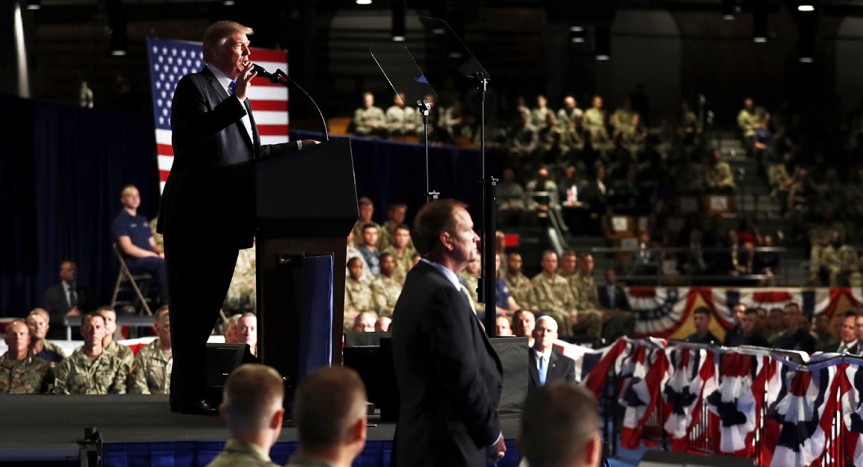
Trump, surrounded by troops and patriotic bunting, defines his “new” Afghan strategy (Carolyn Kaster/AP)

W.J. Astore

As a private citizen and presidential candidate, Donald Trump railed against the Afghan war.  A waste, he said.  Americans should withdraw, he said.  But in last night’s speech, Trump went against his own instincts (so he said) and went with the failed policies of his predecessors.  The war will continue, no timetable set, no troop levels determined, with conditions on the ground dictating America’s actions, according to the president.

What caught my attention, beyond the usual paeans of praise to America’s “warriors” and “warfighters,” was the specious reasoning to justify the continuation of the war.  Trump gave three reasons, so let’s take them one at a time:

  1. “First, our nation must seek an honorable and enduring outcome worthy of the tremendous sacrifices that have been made, especially the sacrifices of lives …”

It’s piss-poor reasoning to argue that, because a lot of people have sacrificed and died in a war, the war should continue (with more people dying) to justify those previous sacrifices.  By this logic, the more who die, the more we should keep fighting, meaning more dead, meaning more fighting, and so on.  Where is the honor and “worthy” outcome here?

  1. “Second, the consequences of a rapid exit are both predictable and unacceptable. 9/11, the worst terrorist attack in our history, was planned and directed from Afghanistan because that country was ruled by a government that gave comfort and shelter to terrorists. A hasty withdrawal would create a vacuum that terrorists, including ISIS and al Qaeda, would instantly fill, just as happened before September 11th.”

Actually, the consequences of an American withdrawal are both unpredictable and (most probably) acceptable.  Sure, terrorist organizations may gain impetus from an American withdrawal.  It’s also possible that a notoriously corrupt Afghan government might finally negotiate with the Taliban and other organizations, and that regional power brokers like Pakistan and Iran, who have their own interests in regional stability, might broker a settlement that Americans could live with.

Trump further argued that a rapid U.S. withdrawal from Iraq in 2011 led to “hard-won gains slip[ping] back into the hands of terrorist enemies. Our soldiers watched as cities they had fought for, and bled to liberate, and won, were occupied by a terrorist group called ISIS.”  The truth is far more complex.  The prolonged U.S. occupation of Iraq helped to create ISIS in the first place, and failed American efforts to create and train reliable Iraqi security forces contributed to easy ISIS victories after U.S. forces left in 2011.

  1. “Third and finally, I concluded that the security threats we face in Afghanistan and the broader region are immense. Today, 20 U.S.-designated foreign terrorist organizations are active in Afghanistan and Pakistan — the highest concentration in any region anywhere in the world.”

Isn’t it remarkable that, after sixteen years of sustained effort by the U.S. military, the Af-Pak region is now home to 20+ terrorist organizations?  The “highest concentration” in the world?  Is this not an admission of the utter failure of U.S. policy and actions since 2001?  How is this failure to be rectified by yet more U.S. attacks?

Trump said the new American goal is to kill terrorists.  This is not a strategy.  It’s a perpetual and deadly game of Whac-A-Mole.  That’s what Trump’s vaunted new strategy boils down to, despite the talk of economic pressure and working with Pakistan and India and other regional powers.

On Afghanistan, Trump should have listened to his instincts and withdrawn.  Instead, he listened to “his” generals.  With Trump, the generals won this round.  What they can’t win, however, is the war.