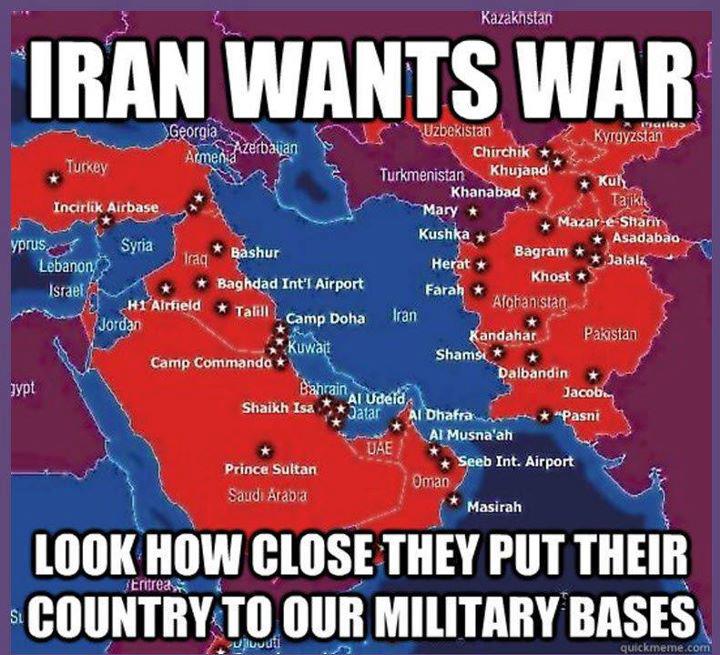
You won’t see this illustration in the mainstream media:
If the Iranians really wanted peace, they’d move their country.
In all seriousness, U.S. media talking heads, many of them retired military officers, are constantly talking about the aggression of others and their weapons of mass destruction (WMD). Never do these “experts” speak of U.S. aggression and the WMD we have in our possession. Indeed, the U.S. maintains an earth-busting arsenal of nuclear weapons, and we remain the only country to have used atomic bombs for real (at Hiroshima and Nagasaki in 1945). Yet we’re the ones who have to worry about Iranian nuclear weapons that don’t yet exist (and probably never will)?
Tom Engelhardt has a great new article at TomDispatch.com on how the U.S. always sees itself as the victim, as the aggrieved party, as the one who’s being threatened. Here’s an excerpt:
So here’s the strange thing, on a planet on which, in 2017, U.S. Special Operations forces deployed to 149 countries, or approximately 75% of all nations; on which the U.S. has perhaps 800 military garrisons outside its own territory; on which the U.S. Navy patrols most of its oceans and seas; on which U.S. unmanned aerial drones conduct assassination strikes across a surprising range of countries; and on which the U.S. has been fighting wars, as well as more minor conflicts, for years on end from Afghanistan to Libya, Syria to Yemen, Iraq to Niger in a century in which it chose to launch full-scale invasions of two countries (Afghanistan and Iraq), is it truly reasonable never to identify the U.S. as an “aggressor” anywhere?
What you might say about the United States is that, as the self-proclaimed leading proponent of democracy and human rights (even if its president is now having a set of love affairs with autocrats and dictators), Americans consider ourselves at home just about anywhere we care to be on planet Earth. It matters little how we may be armed and what we might do. Consequently, wherever Americans are bothered, harassed, threatened, attacked, we are always the ones being provoked and aggressed upon, never provoking and aggressing. I mean, how can you be the aggressor in your own house, even if that house happens to be temporarily located in Afghanistan, Iraq, or perhaps soon enough in Iran?
The U.S. as an aggressor? Impossible! Our military installations, our weaponry, even our wars are all about keeping the peace. Right?
There was a time, almost 250 years ago, when Americans successfully fought for their independence (though quite a few “loyalists” preferred compromise with the British crown). There was a time, 75 years ago, when Americans landed on the beaches of Normandy to defeat Nazi aggression. But when you look at America’s long history of wars, precious few of them can be said to have been defensive in nature. Indeed, most were acts of aggression, e.g. the Mexican-American War, the Spanish-American War, the long bloody wars against Native Americans, the Vietnam War, and more recent, undeclared, wars in Iraq and Afghanistan.
Dare I state the obvious? Americans are generally not shy, diffident, passive people. Ask most foreigners about Americans and you’ll hear words like pushy, outspoken, loud, and, yes, aggressive. (Of course. not all Americans fit this description, but think of recent representatives like Trump, Pompeo, and Bolton or Bush, Cheney, and Rumsfeld.) Yet, with all our aggressiveness, with all our violent tendencies, why do we continue to see others as the pushy ones, the headstrong ones, the ones who want war?
A little empathy, America? Forget about it! Come on, Iran. It’s time to move. And since the U.S. dominates this planet, I have the perfect destination for you. How about Mars?
But wait: NASA wants to launch a manned mission there! And since Mars is named after the god of war, it’s a natural for us. Red and fiery in the sky — how long until we build our first military base there?
Bernie and Tulsi: the only candidates willing to call out the military-industrial complex
W.J. Astore
I watched the two Democratic debates this week. Media outlets treat them as a horse race, announcing winners and losers. So perhaps you heard Kamala Harris scored big-time against Joe Biden. Or perhaps you heard Elizabeth Warren did well, or that Tulsi Gabbard generated lots of post-debate interest (Google searches and the like). I will say that Beto O’Rourke was clearly unprepared (or over-prepared) and unable to speak clearly and meaningfully, so count him as a “loser.”
All that said, the clear winner wasn’t on the stage; it wasn’t even among the 20 debate participants. The name of that clear winner: America’s military-industrial complex and its perpetual wars.
Sure, there was some criticism of the Afghan and Iraq wars, especially by candidates like Bernie Sanders and Tulsi Gabbard. But there was no criticism of enormous “defense” budgets ($750 billion and rising, with true outlays exceeding a trillion a year), and virtually no mention of Saudi Arabia and the war in Yemen. (Tulsi briefly mentioned the Saudis and was shut down; Bernie mentioned the war in Yemen and was ignored.)
The only direct mention of the military-industrial complex that I recall hearing was by Bernie Sanders. Otherwise, the tacit assumption was that soaring defense budgets are appropriate and, at least in these debates, unassailable.
Bernie and Tulsi also mentioned the threat of nuclear war, with Bernie making a passing reference to the estimated cost of nuclear forces modernization (possibly as high as $1.7 trillion). Again, he had no time to follow up on this point.
NBC’s talking heads asked the questions, so blame them in part for no questions on the MI Complex and the enormous costs of building world-ending nuclear weapons. Indeed, the talking heads were much more concerned with “gotcha” questions against Bernie, which attempted to paint him as a tax-and-spend socialist who doesn’t care about diversity. Yes, that really was NBC’s agenda.
Always, Democrats are asked, “How will you pay for that?” You know: “extravagances” like more affordable education, better health care, a tax cut that helps workers, or investments in job training programs and infrastructure. But when it comes to wars and weapons, there are never any questions about money. The sky’s the limit.
A reminder to Democrats: Donald Trump won in 2016 in part because he was willing to denounce America’s wasteful wars and to challenge defense spending (even though he’s done nothing as president to back up his campaign critique). We need true Peace Democrats with spine, so I remain bullish on candidates like Bernie Sanders and Tulsi Gabbard.
Hopefully, in future debates Bernie, Tulsi, and others will call for major reforms of our military and major cuts to our bloated Pentagon budget. But don’t count on that issue being raised by the mainstream media’s talking heads.
Bonus Winner: I can’t recall a single mention of Israel and the Palestinians, not even in the context of framing a peace plan. No mention of America’s role in Venezuela either. The imperial and aggressive neo-con agenda on foreign policy went almost unchallenged, but kudos to Tulsi Gabbard for calling out the “chickenhawks” (her word, and the right one) in the Trump administration.
Ten years ago, I gave a talk on the ideal of citizen-soldiers and how and why America had drifted from that ideal. As war looms on the horizon yet again, this time with Iran, we’d be well advised to ask critical questions about our military, such as why we idolize it, how it no longer reflects our country demographically, its reliance on for-profit mercenaries, and the generally mediocre record of its senior leaders.
My talk consisted of notes that I hope are clear enough, but if they aren’t, please ask me to elaborate and I will in the comments section. Thanks.
Today [2009] I want to discuss the ideal of the citizen-soldier and how I believe we have drifted from that ideal.
The Ideal: Dick Winters in Band of Brothers; E.B. Sledge in With the Old Breed; Jimmy Stewart. Until recent times, the American military was justly proud of being a force of citizen-soldiers. It didn’t matter whether you were talking about those famed Revolutionary War Minutemen, courageous Civil War volunteers, or the “Greatest Generation” conscripts of World War II.
Americans have a long tradition of being distrustful of the very idea of a large, permanent army, as well as of giving potentially disruptive authority to generals.
How have we drifted from that ideal? In six ways, I think:
Burden-sharing and lack of class equity
Historian David M. Kennedy in October 2005: “No American is now obligated to military service, few will ever serve in uniform, even fewer will actually taste battle …. Americans with no risk whatsoever of exposure to military service have, in effect, hired some of the least advantaged of their fellow countrymen to do some of their most dangerous business while the majority goes on with their own affairs unbloodied and undistracted.”
Are we a true citizen-military if we call on only a portion of our citizens to make sacrifices?
All-Volunteer Military, or All-Recruited Military? Our military targets the working classes, the rural poor, young men (mostly men) who are out of work, or high school dropouts, for enlistments. (Officer corps is recruited somewhat differently.)
With few exceptions, societal elites not targeted by recruiters.
Anecdote: NYT article by Kenneth Harbaugh on exclusion of ROTC from Ivy-League college campuses
“At Yale, which has supplied more than its share of senators and presidents, almost none of my former classmates or students ever noticed the absence of uniforms on campus. In a nation at war, this is a disgrace. But it also shows how dangerously out of touch the elites who shape our national policy have become with the men and women they send to war.
Toward the end of the semester, I took my class to West Point. None of my students had ever seen a military base, and only one had a friend his age in uniform.”
“Support Our Troops” – But who are our troops? Why are they not drawn from across our class/demographic spectrum?
Estrangement of Progressives and Growing Conservatism/Evangelicalism of the Military
If the operating equation is military = bad, are we not effectively excusing ourselves or our children from any obligation to serve — even any obligation simply to engage with the military? Indeed, are we even patting ourselves on the back for the wisdom of our non-choice and our non-participation? Rarely has a failure to sacrifice or even to engage come at a more self-ennobling price — or a more self-destructive one for progressive agendas.
Example: Evangelicalism at the Air Force Academy versus separation of church and state.
Is our professional military a society within our larger society?
Many “troops” are no longer U.S. military: They’re private contractors. Instead of citizen-soldiers, they’re (in some cases) non-citizen mercenaries and non-citizen contractors.
Blackwater (Xe), Triple Canopy, Dyncorp, KBR: there are more contractor personnel in Iraq than U.S. military, and many contractors are providing security and doing tasks that our military used to do, like KP, for a lot more money.
Profit incentive: privatizing military is like privatizing prisons. You create a profit motive for extending military commitments, and perhaps wars as well.
In other words, citizen-soldiers like Sledge and Winters want to come home. Private mercenaries/contractors want to stay, as long as they’re making good money.
Cult of the warrior: Reference to American troops as “warfighters.” This is contrary to our American tradition of “Minutemen.” It’s a disturbing change in terminology.
I first noticed the term “warfighter” in 2002. Like many a field-grade staff officer, I spent a lot of time crafting PowerPoint briefings, trying to sell senior officers and the Pentagon on my particular unit’s importance to the President’s new Global War on Terrorism. The more briefings I saw, the more often I came across references to “serving the warfighter.” It was, I suppose, an obvious selling point, once we were at war in Afghanistan and gearing up for “regime-change” in Iraq. And I was probably typical in that I, too, grabbed the term for my briefings. After all, who wants to be left behind when it comes to supporting the troops “at the pointy end of the spear” (to borrow another military trope)?
But I wasn’t comfortable with the term then, and today it tastes bitter in my mouth.
We must not be “warriors” – we must be citizen-soldiers. And note how the word “citizen” comes first.
Aside: Warriors may commit more atrocities precisely because they see themselves as different from, and superior to, civilians.
Deference of civilians to military experts, instead of vice-versa. Why I wrote my first piece for TomDispatch. Idea that President George W. Bush couldn’t make the final decision on the Surge in Iraq until we heard from General David Petraeus.
In a country founded on civilian control of the military, it’s disturbing indeed that, as a New York Times/CBS poll indicated recently (2007), Americans trust their generals three times as much as Congress and 13 times as much as the President.
Also, abdication of responsibility by U.S. Congress. Our country is founded on civilian control of the military. But Congress afraid of being charged with hurting or abandoning our troops.
Georges Clemenceau: “War is too important to be left to generals.” Why? “Can-do” spirit to our military, no matter how dumb the war. And militaries seek military solutions.
So, “supporting our troops” must not mean putting blind faith in our military:
In “A Failure in Generalship,” which appeared in Armed Forces Journal in May 2007, Lieutenant Colonel Paul Yingling argues that, prior to the invasion of Iraq in 2003, our generals “refused to prepare the Army to fight unconventional wars” and thereafter failed to “provide Congress and the public with an accurate assessment of the conflict in Iraq.” Put bluntly, he accuses them of dereliction of duty. Bewailing a lack of accountability for such failures in the military itself, Yingling memorably concludes that “a private who loses a rifle suffers far greater consequences than a general who loses a war.”
Oath of Office: Supporting the Constitution of the U.S. against all enemies, foreign and domestic. Oath of allegiance is to the Constitution and to the ideas and ideals we cherish as Americans. But how are the “long wars” in Iraq and Afghanistan advancing these ideals? Are they consistent with our defense and our ideas/ideals of citizenship?
Breaking News: President Obama just decided to send another 17,000 American troops to Afghanistan. Meanwhile, today in the NYT, U.S. generals are already predicting that 50K+ U.S. troops may need to stay in Afghanistan for the next five years. In other words, this is not a temporary surge. [How true! Ten years later, we’re still in Afghanistan with no end in sight.]
So, how do we reverse these trends and reassert our ideal of a citizen-military?
Not with a draft, but perhaps with National Service (AmeriCorps, Green Corps, Peace Corps, Military).
Renewed commitment by Progressives to engage with the military. To understand the military, its rank structure, its ethos.
Reduce/eliminate dependence on mercenaries/private contractors, even if it costs us more.
Eliminate the “cult of the warrior.” Replace warfighter rhetoric with citizen-soldier ideal.
Deference to military experts for tactical/battlefield advice is sensible, but ultimately our military is commanded by the president and wars are authorized by the Congress, i.e. our elected representatives
Oath of office: Every time we deploy troops, we must ask: How is this advancing our national ideals as embodied in our Constitution? How are we defending ourselves?
Permit me to quote a passage from James Madison, the principal architect of the U.S. Constitution. He noted in 1795 that:
“Of all the enemies of public liberty, war is perhaps the most to be dreaded, because it comprises and develops the germ of every other. War is the parent of armies. From these proceed debts and taxes. And armies, debts and taxes are the known instruments for bringing the many under the dominion of the few… [There is also an] inequality of fortunes, and the opportunities of fraud, growing out of a state of war, and … degeneracy of manners and of morals… No nation could preserve its freedom in the midst of continual warfare.”
And Madison’s idea of continual warfare = our military’s “Long War” = Forever War? What is our exit strategy? Do we even have one?
In the interview, Scott and I talk about war, military service, America’s intoxication with violence and power, and how we can chart a new way forward.
Thanks so much for giving it a listen. And check out Scott’s other podcasts. He’s done amazing work.
Doing some housecleaning of the mind, so to speak:
I recently read a book that argued the U.S. military loses its wars due to poor strategy and lack of understanding of “limited” war. It was a sophisticated book that cited the usual suspects in classical military theory, like Clausewitz. And it got me to thinking. I don’t think the U.S. loses wars because of poor military theory or improper applications thereof. And I don’t think the U.S. can win wars by better/smarter theory. Rather, the wars the U.S. has been fighting since Korea should never have been started or joined to begin with. Whether it’s Vietnam in the 1960s or Afghanistan and Iraq today, these are and never were “winnable” wars. Why? Because they were unnecessary to U.S. national security. And the only way to “win” such wars is to end them.
Unnecessary wars persist for many reasons. A big one is profit, as in Ike’s military-industrial complex. Perhaps as well these wars are sustained by a belief the U.S. military could win them if only the generals hit on the right strategy. But there is no smarter way to win dumb wars. You win them when you end them.
War criminals. There’s been talk lately of President Trump wanting to pardon war criminals and how this would jeopardize order and discipline within the U.S. military. But let’s leave aside low-level offenders (your sergeants and captains) and talk about high-ranking war criminals. Indeed, what about the men who chose to go to war under false pretenses in the first place? If you choose not to prosecute men like Bush/Cheney/Rumsfeld, why pursue and prosecute the little guys?
I once read that the guilt for war crimes is greater the further you are from the crimes you effectively ordered. Adolf Eichmann didn’t dirty his own hands; he was a deskbound murderer. And perhaps that’s the worst kind.
Historically, we recognize the moral and legal culpability of high-ranking murderers like Eichmann. Should America’s top leaders be held responsible for the murderous results of wars that they launched?
Lady Liberty Locked and Loaded. The U.S. routinely brags of having the best military ever while leading the world in weapons sales while professing to be an exceptional bastion of liberty. And most Americans see no contradiction here. Simultaneously, men like Trump continue to vilify brown-skinned immigrants as bringing violence to America. Lady Liberty, in short, no longer lights her torch for the huddled masses. If we (or the French?) were making her today, she’d carry a .44 magnum (or an assault rifle?) in place of a torch. Do you feel lucky, immigrant punks?
Coincidence: A friend just sent me the Global Peace Index for the world’s 163 countries. The USA ranks #128. (Iceland is #1, followed by New Zealand at #2.) USA! USA! USA!
A friend of mine sent along a campaign ad for a woman running for Congress in Texas. Kim Olson is her name, and she has some good ideas. But the ad itself is telling for different reasons. A retired Air Force colonel, Olson appears in her military-issue flight jacket, complete with her rank, wings, and command patch, as she talks about being a “warrior.”
I have nothing against Colonel (retired) Olson. She’s gutsy and committed to public service. But enough of the “warrior” talk and enough with the military uniforms! You didn’t see Ike campaigning for president while wearing a jacket with five stars on it.
Readers of this blog may know that I taught at the Air Force Academy for six years. Impressive? Not according to the Secretary of the Air Force. In her words: “We are now boarding and recommending people for instructor duty and you’re not going to be able to do it unless you’re the best of the best. Historically, we didn’t value instructor duty. If you taught at Lackland or at the Air Force Academy or ROTC…that was kind of because you couldn’t get a better position and it was kind of a dead end. So now we’ve flipped that.”
I’ve changed my call sign to William “Dead End” Astore. It has a nice ring to it.
In all seriousness, the military has always favored doers over thinkers. Nowadays, you’re supposed to be a warrior, constantly doing…well…something. So we’ve been doing something, usually the same thing, repeatedly, in Iraq and Afghanistan, regardless of results. And history? Who cares? America’s military members barely know their own history, let alone the history of foreign peoples and cultures.
Incredibly, the military’s push for better education (defined as “intellectual overmatch,” I kid you not) is couched in terms of out-thinking the Russians and Chinese. In other words, we’re doomed.
As I put it to a friend, “The services need to develop senior officers with depth and breadth of vision, but the system is designed to produce narrow-minded true believers. It’s a little like trying to reform the Catholic church and its hierarchy of conservative, insular, cardinals and bishops.”
Or, as one of my Air Force friends put it, waxing satirically: “But you know, the problem really is that we don’t award enough ribbons, haven’t changed the uniform in a few years, and are allowing transgendered to serve while violating the rights of commanders by not allowing them to share [with subordinates] their [conservative Christian] faith.”
That’s enough random thoughts for this Thursday. What say you, readers?
What America’s National Security State Got Wrong in Its Wars of Choice and How to Deconstruct the War State
I’m a Washington outsider/non-careerist who worked seven years as a civilian advisor in our country’s Wars of Choice in Iraq and Afghanistan. Earlier in my life, I served in and worked for the military-industrial complex. I have lived, worked and traveled throughout Europe and the Greater Middle East. Given this background, I’ve written a book (Will We Ever Learn?) recounting from personal knowledge how our nation’s interventionist foreign policy and military adventurism has transformed the military-industrial complex that President Eisenhower warned us about in 1961 into today’s unimaginable $1.25 trillion/year national security establishment. This enterprise operates as a de facto shadow government apart from our representative democracy. It perpetuates a bipartisan war culture driven by defense industry lobbyists and special interests. Our burgeoning multi-agency “War State” is the primary reason for Congress’ $1-trillion-plus/year budget deficits and our country’s $22 trillion in national debt.
As I document in my book, $7.5 trillion of the $12 trillion increase in our national debt since 9/11 is attributable to increases in defense spending mainly related to the War on Terror. I can attest that the trillions spent on these idiotic wars was a waste of taxpayers’ money. Much worse, they created over 6,000 Gold Star parents and tens of thousands of maimed and PTSD-stricken brave patriots. Yet, overspending on our military goes on – even as War on Terror proponents admit Americans are less safe today. Most political leaders responsible for our recent wars and their funding – and the pundits who advocated for them – are still around as esteemed figures in Washington. No four-star generals – company men one and all — were held accountable for the DoD’s egregious mistakes in warfighting strategy and tactics that I document in my book.
The swamp creatures who rule over Washington’s war culture know they must maintain our War State as an expanding $1.25 trillion/year enterprise (including what I estimate to be $250 billion/year for nuclear-war deterrence) to stay in power – regardless of how much national debt they run up and how many Gold Star parents, maimed soldiers, and PTSD cases result from their military adventurism. Congressional leadership supports the War State because both parties receive massive campaign funding to maintain the status quo from corporate lobbyists and big donors. This insiders’ money game is not the America my Uncle Norb – who I never knew because he was killed storming the beach at Eniwetok Atoll as a 19-year-old Marine in 1944 – died fighting to preserve as member of our nation’s greatest generation.
In my book (and this essay), I identify specific changes in foreign and military policy and $500 billion/year in defense spending cuts which, if made, would make America and the world safer. These sensible and practical actions recognize the instability and trepidation that Washington’s bullying and war culture are causing around the world.
My remedies include restricting the development and proliferation of conventional weapons and eliminating all nuclear weapons from the world under a United Nations Treaty ratified in 2017 by 123 countries. This U.N. initiative followed a 2007 Wall Street Journalcommentary titled “A World Free of Nuclear Weapons,” by Henry Kissinger, George Shultz, William Perry and Sam Nunn — hardly naïve isolationists. President Obama also persuasively advocated for a no-nuke world in a speech he gave in Prague in 2009. Under my plan to scale-back U.S. militarism, our country would still spend twice as much on national security as our two presumed military adversaries combined: Russia with its crumbling economy and China with its growing dissident problems. If our national security state officials can’t keep America safe with a 2:1 spending advantage over these two troubled countries, they all should be fired.
Senator Bernie Sanders is the only 2020 presidential candidate who has pledged to take on the military-industry complex and cut defense spending. But in a Vox interview, Sanders admitted that, given the power the national security state’s shadow government exerts over Congress, defense spending cuts are a nonstarter the way Congress now works — no matter who is president.
What’s a solution to this predicament that engenders our idiotic wars and is driving our country off a fiscal cliff? Simple: Empower — and require – all members of Congress, as our directly elected representatives, to make up-or-down floor votes on specific spending “tradeoffs” as a follow-on step to the current Congressional appropriations process. For example, the Democratic caucus in the House could require a tradeoff vote on cancelling funding in the DoD’s approved appropriations bill for the $1.5-trillion life-time-costs F-35 fighter program (the late Senator John McCain – hardly an anti-military pacifist — called the F-35 program “a scandal and a tragedy” at a 2016 Senate hearing ); or spending the same amount over the same timeframe for better health care, free college tuition, student debt forgiveness, and similar programs.
If a specific tradeoff challenge vote passes both Houses of Congress, it would go the President to accept or reject. A challenge could fail. But each member of Congress who voted “no” in this example would have to explain at reelection time why he or she thinks our military needs over 2,000 F-35s when Russia has zero Su-57s in service; and why he or she believes the money spent on unneeded F-35’s could not be better used to reduce the federal budget deficit (also an option in my plan) — or make college affordable for all our citizens as the tradeoff vote in this example.
These changes can all happen if voters bring up these reform initiatives at candidate forums and obtain pledges from candidates for federal office to commit to fixing Congress so it serves the interests of individual citizens — not corporate lobbyists and special interests. Getting these changes adopted may yet prevent our democracy from going down the low road to perdition.
What golden idols are we making and worshiping today?
W.J. Astore
Even as Congress fights over a few billion dollars for the 9/11 first responders, there’s no shortage of money for warplanes. This week the Pentagon announced the largest military procurement deal in history: $34 billion for 478 F-35 warplanes. This decision comes despite the less-than-stellar performance of the F-35.
How can we forget the suffering of 9/11 first responders yet continue to buy overpriced jets at mind-boggling prices? Sometimes I think we worship weapons as a golden idol. People get so excited about them – almost as if they “own” their own personal F-35. What can these warplanes do for us except blow things up? Who’s going to attack the U.S. with a vast air fleet such that we need all these planes for “defense”?
The other day, I was reading old reporting from World War II (in the Library of America series). There was an article on war rationing and how Americans were fighting for more gasoline for their personal cars. And a war ration board member referenced the amount of gas a bomber needed just to warm up its engines as the reason why ordinary Americans had to ration gas.
Imagine if Americans today had to ration gas so that our F-35s and stealth bombers could fly. Imagine if you couldn’t go on your summer vacation because you couldn’t get the gas due to the war on terror or the gas-guzzling appetites of B-52s and Navy jets operating near Iran.
Americans might actually pay attention to our foreign wars! They might begin to question why they couldn’t get gas for their cars, trucks, boats, and campers because of Iran deployments or Afghan operations or what-have-you.
But unlike in World War II, today we are asked to make no sacrifices. None. Only our tax dollars — and our collective futures.
It’s an odd thing to see a pagan warrior of ancient Greece used as a symbol of Christianity, but what matters here is the idea Christianity is synonymous with warrior violence
W.J. Astore
It’s amazing how often America’s politicians dismiss proposals that would benefit workers as “too expensive” (such as a higher minimum wage, or more affordable college education, or single-payer health care) versus how much they’re willing to approve for new weapons and wars. With little debate, this year’s “defense” budget will be roughly $750 billion, although the real number exceeds a trillion dollars, as Bill Hartung notes here for TomDispatch. Meanwhile, spending on education, infrastructure improvements, and so on withers.
It’s almost as if the impoverishment of America’s workers is deliberate (some would say it is). Four decades ago, I remember reading Crane Brinton’s “The Anatomy of Revolution” in AP Modern European History. Brinton noted how rising expectations among the lower orders can lead to revolutionary fervor. But if you keep people down, keep them busy working two or three jobs, keep them distracted with “circuses” like unending sports coverage and Trump’s every twitch and tweet, you can control them.
Thus the establishment sees a true populist politician like Bernie Sanders as the real enemy. Bernie raises hopes; he wants to help workers; but that’s not the point of the American system. So, Bernie must be dismissed as “crazy,” or marginalized as a dangerous socialist, even though he’s just an old-fashioned New Dealer who wants government to work for the people.
Related to keeping people under control (by keeping them divided, distracted, and downtrodden) is to keep them fearful. A foreign bogeyman is always helpful here, hence the demonization of Vladimir Putin. An old friend of mine sent me an article this past weekend about Putin’s strategy in reviving Russia. I confess I don’t follow Russia and Putin that closely. But it strikes me that Putin has played a weak hand well, whereas U.S. leaders have played a strong hand poorly.
In the article I noted the following quote by Putin:
[we] need to build our home and make it strong and well protected … The wolf knows how to eat … and is not about to listen to anyone … How quickly all the pathos of the need to fight for human rights and democracy is laid aside the moment the need to realize one’s own interests come to the fore.
Putin’s words are from a decade ago, when the U.S. still talked about fighting for “human rights and democracy.” Under Trump, “one’s own interests” are naked again in U.S. foreign policy under men like John Bolton and Mike Pompeo. Is this progress?
Overall, Russia has learned (or been forced) to limit its foreign burdens, whereas the U.S. is continuing to expand its “global reach.” Russia learned from the Cold War and is spending far less on its military, whereas the U.S. continues to spend more and more. It’s ironic indeed if Russia is the country cashing in on its peace dividend, even as the U.S. still seems to believe that peace is impossible and that war pays.
I wonder if Russia (joined by China) spends just enough on its military to present a threat to the U.S. for those who are so eager to see and exaggerate it. For example, China builds an aircraft carrier, or Russia builds a nuclear cruise missile, not because they’re planning unprovoked attacks against the U.S., but as a stimulus to America’s military-industrial complex. Because America’s reaction is always eminently predictable. The national security state seizes on any move by China or Russia as dangerous, destabilizing, and as justification for yet more military spending. The result is a hollowing out of the U.S. (poorer education, fewer factories, weaker economy, collapsing infrastructure), even as China and Russia grow comparatively stronger by spending more money in non-military sectors.
There are complicated forces at work here. Of course, Ike’s military-industrial-Congressional complex is always involved. But there’s also a weird addiction to militarism and violence in the USA. War, gun violence, and other forms of killing have become the background noise to our lives, so much so that we barely perceive the latest mass killing, or the latest overseas bombing gone wrong. (I’d also add here the violence we’re doing to our environment, our earth, our true “homeland.”)
I mentioned violence to my old friend, and he sent me this note:
On violence and American cultural DNA one place to start is Richard Slotkin’s trilogy, Regeneration Through Violence, The Fatal Environment, and Gunfighter Nation… The gist of what I have gotten about Slotkin’s thesis is that America’s frontier past trained settlers to think of violence (against natives and against each other) as forms of rebirth both for the individual and for the community.
My friend’s comment about violence and rebirth made me think of the film “Birth of a Nation” (1915) and the infamous scene of the KKK riding to the rescue. We in America have this notion that, in one form or another, a heavily armed cavalry will ride to the rescue and save us (from savage Indians, violent immigrants, etc.). In a strange way, Trump’s campaign tapped this notion of rebirth through violence. Think of his threats against immigrants – and his promises to build a wall to keep them out – and his threats to torture terrorists and even to kill their families.
Trump tapped a rich seam of redemption through violence in the USA, this yearning for some sort of violent apocalypse followed by a “second coming,” notably in conservative evangelical circles. For when you look at “end times” scenarios in evangelical settings, peaceful bliss is not the focus. Suffering of the unredeemed is what it’s all about. Christ is not bringing peace but a sword to smite all the evildoers.
For people who suffer toil and trouble daily, such apocalyptic visions are a powerful distraction and may serve as a potent reactionary tonic. Why fight for Bernie’s political revolution when Christ’s return is imminent?
That’s enough musing for one Monday morning. Readers, what say you?
In my latest article for TomDispatch.com, I tackle America’s cult of bombing overseas, most recently in the Middle East, Central Asia, and portions of Africa, and the darker facets of air power in general. Air power may not be “unthinkable” like nuclear war, but most Americans nevertheless choose not to think about it since the bombing, the destruction, the killing are happening elsewhere to people other than us. Indeed, occasionally America’s politicians talk about bombing as if it’s a joke (consider John McCain’s little ditty about bombing Iran, or Ted Cruz’s reference to carpet bombing ISIS and making the sand “glow”).
Treating air power and bombing so cavalierly is a big mistake. Much like mass shootings in the “homeland,” it’s become the background noise to our lives. But it’s a deadly reality to others — and since violence often begets more violence, it may very well prove a prescription for permanent war.
Ten Cautionary Tenets About Air Power
1. Just because U.S. warplanes and drones can strike almost anywhere on the globe with relative impunity doesn’t mean that they should. Given the history of air power since World War II, ease of access should never be mistaken for efficacious results.
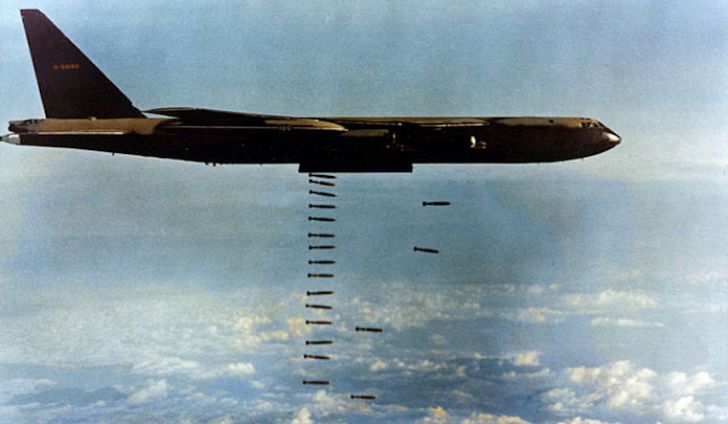
2. Bombing alone will never be the key to victory. If that were true, the U.S. would have easily won in Korea and Vietnam, as well as in Afghanistan and Iraq. American air power pulverized both North Korea and Vietnam (not to speak of neighboring Laos and Cambodia), yet the Korean War ended in a stalemate and the Vietnam War in defeat. (It tells you the world about such thinking that air power enthusiasts, reconsidering the Vietnam debacle, tend to argue the U.S. should have bombed even more — lots more.) Despite total air supremacy, the recent Iraq War was a disaster even as the Afghan War staggers on into its 18th catastrophic year.
3. No matter how much it’s advertised as “precise,” “discriminate,” and “measured,” bombing (or using missiles like the Tomahawk) rarely is. The deaths of innocents are guaranteed. Air power and those deaths are joined at the hip, while such killings only generate anger and blowback, thereby prolonging the wars they are meant to end.
Consider, for instance, the “decapitation” strikes launched against Iraqi autocrat Saddam Hussein and his top officials in the opening moments of the Bush administration’s invasion of 2003. Despite the hype about that being the beginning of the most precise air campaign in all of history, 50 of those attacks, supposedly based on the best intelligence around, failed to take out Saddam or a single one of his targeted officials. They did, however, cause “dozens” of civilian deaths. Think of it as a monstrous repeat of the precision air attacks launched on Belgrade in 1999 against Slobodan Milosevic and his regime that hit the Chinese embassy instead, killing three journalists.
Here, then, is the question of the day: Why is it that, despite all the “precision” talk about it, air power so regularly proves at best a blunt instrument of destruction? As a start, intelligence is often faulty. Then bombs and missiles, even “smart” ones, do go astray. And even when U.S. forces actually kill high-value targets (HVTs), there are always more HVTs out there. A paradox emerges from almost 18 years of the war on terror: the imprecision of air power only leads to repetitious cycles of violence and, even when air strikes prove precise, there always turn out to be fresh targets, fresh terrorists, fresh insurgents to strike.
4. Using air power to send political messages about resolve or seriousness rarely works. If it did, the U.S. would have swept to victory in Vietnam. In Lyndon Johnson’s presidency, for instance, Operation Rolling Thunder (1965-1968), a graduated campaign of bombing, was meant to, but didn’t, convince the North Vietnamese to give up their goal of expelling the foreign invaders — us — from South Vietnam. Fast-forward to our era and consider recent signals sent to North Korea and Iran by the Trump administration via B-52 bomber deployments, among other military “messages.” There’s no evidence that either country modified its behavior significantly in the face of the menace of those baby-boomer-era airplanes.
5. Air power is enormously expensive. Spending on aircraft, helicopters, and their munitions accounted for roughly half the cost of the Vietnam War. Similarly, in the present moment, making operational and then maintaining Lockheed Martin’s boondoggle of a jet fighter, the F-35, is expected to cost at least $1.45 trillion over its lifetime. The new B-21 stealth bomber will cost more than $100 billion simply to buy. Naval air wings on aircraft carriers cost billions each year to maintain and operate. These days, when the sky’s the limit for the Pentagon budget, such costs may be (barely) tolerable. When the money finally begins to run out, however, the military will likely suffer a serious hangover from its wildly extravagant spending on air power.
6. Aerial surveillance (as with drones), while useful, can also be misleading. Command of the high ground is not synonymous with god-like “total situational awareness.” It can instead prove to be a kind of delusion, while war practiced in its spirit often becomes little more than an exercise in destruction. You simply can’t negotiate a truce or take prisoners or foster other options when you’re high above a potential battlefield and your main recourse is blowing up people and things.
7. Air power is inherently offensive. That means it’s more consistent with imperial power projection than with national defense. As such, it fuels imperial ventures, while fostering the kind of “global reach, global power” thinking that has in these years had Air Force generals in its grip.
8. Despite the fantasies of those sending out the planes, air power often lengthens wars rather than shortening them. Consider Vietnam again. In the early 1960s, the Air Force argued that it alone could resolve that conflict at the lowest cost (mainly in American bodies). With enough bombs, napalm, and defoliants, victory was a sure thing and U.S. ground troops a kind of afterthought. (Initially, they were sent in mainly to protect the airfields from which those planes took off.) But bombing solved nothing and then the Army and the Marines decided that, if the Air Force couldn’t win, they sure as hell could. The result was escalation and disaster that left in the dust the original vision of a war won quickly and on the cheap due to American air supremacy.
9. Air power, even of the shock-and-awe variety, loses its impact over time. The enemy, lacking it, nonetheless learns to adapt by developing countermeasures — both active (like missiles) and passive (like camouflage and dispersion), even as those being bombed become more resilient and resolute.
10. Pounding peasants from two miles up is not exactly an ideal way to occupy the moral high ground in war.
The Road to Perdition
If I had to reduce these tenets to a single maxim, it would be this: all the happy talk about the techno-wonders of modern air power obscures its darker facets, especially its ability to lock America into what are effectively one-way wars with dead-end results…
In reality, this country might do better to simply ground its many fighter planes, bombers, and drones. Paradoxically, instead of gaining the high ground, they are keeping us on a low road to perdition.
This week a good friend sent me the image below from Mad Magazine.
Coincidentally, I’ve been reading Senator J.W. Fulbright’s book, “The Pentagon Propaganda Machine” (1970) and came across this footnote on page 57:
“Promotion of the display of the National Flag is one of the Navy’s service-wide public affairs projects. It is laudable enough if it remains unconnected with the current campaign of superpatriots that equates the display of flag decals on automobile windows with love of country and unlimited support for the war in Vietnam.”
And then I came across a photograph by Diane Arbus, “Boy with a Straw Hat Waiting to March in a Pro-War Parade, NYC, 1967.”
It’s a fascinating photo. “Support Our Boys” is now rendered as “Support Our Troops.” Also, today’s flags are a lot bigger. The “Bomb Hanoi” pin speaks for itself.
All of this got me thinking about how “super” patriotism is linked to fanatical support for war, which draws from hatred of “the other,” whether that “other” is foreigners or various alleged enemies within (like those “liberals” and “pacifists” mentioned in the Mad Magazine cartoon).
As the Trump administration appears to promise more wars in the future (consider Mike Pence’s recent bellicose speech at West Point), perhaps in Venezuela or Iran, we need to be on guard against this idea that supporting wars is patriotic. Indeed, the opposite is usually true. “I’m already against the next war” is a good rule of thumb to live by.
How did “super” patriotism become synonymous with blanket support for destructive wars? One thing is certain: it’s nothing new in America.












 Bracing Views