As a retired Air Force officer and military historian, I’m familiar with all kinds of euphemisms about killing, e.g. “precision bombing” and “collateral damage.” Just as it’s easier to kill at a distance, it’s easier to kill when we use words that provide distance from the act. Words that facilitate detachment. Words that befuddle and confuse our minds.
When writing honestly about war, it’s best to use bullet-hits-the-bone words: atrocity, murder, war crime, slaughter. Rape, pillage, burn are “old” words associated with war, and these words often most fittingly describe war and its likely effects and outcomes.
Powerful, blunt, and accurate words should remind us that war is inherently horrible and also profoundly anti-democratic. War is consistent with authoritarianism and lack of freedom, yet Americans nowadays seem to think war (and words about war) is conducive to democracy and freedom, e.g. Afghanistan, Iraq, and now Ukraine.
We used to know better. Military people are fond of the saying, “freedom isn’t free,” but neither is war. Indeed, war and its various manifestations are costing this nation more than a trillion dollars a year while weakening democracy and our constitutional freedoms. And that is a very high price to pay to keep the factories of the merchants of death humming and the generals and admirals happy.
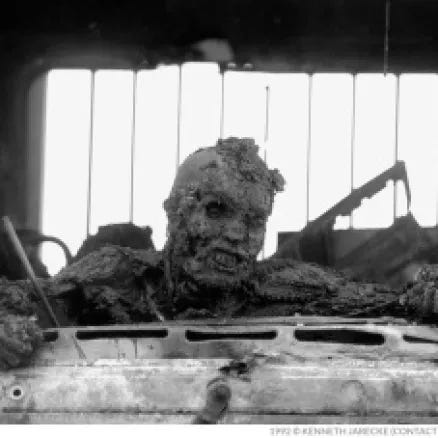
Grisly images like this one (of a dead Iraqi soldier) were censored in America. Language is censored as well.
Fortunately, there’s a new guide and website available that alerts us to the importance of language and war. The website is wordsaboutwar.org, from which you can read and download suggestions on how best to use words to convey the horrors and costs of war to people everywhere. I urge you to visit the site and peruse the guide. (Full disclosure: I was an advisor to this effort, which was ably led by David Vine.)
Here’s a sample of a few comments I made in passing to the group:
A war on terror is truly a war of terror because war itself is terrible.
Friendly fire is being killed by one’s own, often due to the chaos of war, the sheer waste of it all, exacerbated by incompetence. “Fire” is always unfriendly.
Very few troops are “heroes,” and indeed most aren’t, because heroes are rare in all walks of life.
The word “casualty” is too benign. I much prefer killed and wounded: the victims of war.
What are “enemy noncombatants”? They are usually innocent civilians.
With respect to the “War on Terror” that the U.S. has prosecuted for 22 years and counting, I noted that:
We (the U.S.) manifested a Manichean world view; as George W. Bush said soon after 9/11, you’re either for America (and all its violence) or you’re for the terrorists (with their violence). If you wanted a non-violent approach, you were dismissed as naive or “for them.” It was good versus evil, thus the infamous “axis of evil” the U.S. allegedly faced.
This is, of course, a problem with all discourse related to war. Subtlety and nuance are thrown out the window. Language is greatly simplified. The U.S. is “doubleplusgood” and the enemy must be the opposite while simultaneously being dehumanized. We kill “cowardly” enemy troops or terrorists (by drone they’re “bugsplat”) yet our “heroic” troops “fall” in battle and are revered as “the fallen.” Violent combat is disguised as “kinetic action” in U.S. military communiques.
In my view, the dishonesty of this language captures the dishonesty of America’s wars.
General William T. Sherman (U.S. Civil War) famously said that “War is all hell.” Sherman knew the hellish and harsh realities of war; he knew, as he wrote, that “war is cruelty, and you cannot refine it.” Too many people today are using and manipulating words to refine war. They’re camouflaging war’s harshest realities. Writers should write plainly and honestly, as General Sherman did, to capture war’s hellish nature. By choosing honest words, we also help to create a better future in which the threat of war recedes precisely because we recognize more clearly its horrific nature and terrifying costs.
Other high-ranking military officers, like General Smedley Butler, for example, also wrote plainly about war. As Butler famously said, war is a racket, and he described himself as a gangster for capitalism. Now that was plain speaking about war!
The chief intent of speaking and writing plainly about war is to discourage war and save lives. Some might see it as patriotic—saving the lives of U.S. troops by helping to prevent bloody awful wars—but more broadly the goal is humanistic—to save the lives of all those on the receiving end of bullets and bombs.
Interestingly, U.S. troops at lower levels are generally blunt about what war is about. Talk to sergeants at the front and you’ll hear visceral truths, probably enhanced by choice expletives. I’ve heard U.S. Marines shout “Kill!” at graduation ceremonies. Killing, after all, is what war enables. Mass killing leads to atrocities like My Lai in Vietnam. This fact should never be sugarcoated.
Few people, however, truly want to confront war’s horrors. Gazing upon the face of war is profoundly disturbing, which is why we’re encouraged to look away. And so the face of war is airbrushed and camouflaged with euphemisms and buried under a blizzard of acronyms.
If we are to end war and prevent atrocity, we must seek to name things accurately while calling up mental images (no matter how disturbing) appropriate to the horrors of war. The guide at wordsaboutwar.org is an important step in that direction.
Update: I went on Podcast by George today to talk about all this:
As the Ukrainian counteroffensive against Russia grinds on (or falters?), as U.S. disaster relief for Hawaii is tied to more military aid for Ukraine, as depleted uranium shells join cluster munitions as America’s latest gift to a blasted war zone, as calls for diplomacy continue to be muted when they’re not actively discouraged and dismissed, I was reminded of the alchemy of war.
Alchemists of the early modern period were sophisticated experimenters driven by an often quasi-religious quest for perfection. We tend to remember only the most craven part of their experiments: the attempt to transmute lead into gold. This transmutation could not be effected, but alchemy itself transmuted into chemistry as its practitioners, through trial and error, developed a better understanding of the nature of the elements, reflected in part by today’s Periodic Table.
Seeking a divine spark
Yet the business of war succeeded where alchemists failed. In their alchemy, the merchants of death turned bullet lead into corporate gold. And what gold! Yearly war budgets continue to soar in the United States toward the trillion dollar mark. Weapons shipments to Ukraine continue at a pace that promises many more shattered and blasted bodies, Ukrainian and Russian.
In a sense, dead bodies are also being transmuted into corporate gold.
Transmutation, I was taught as a Catholic, is a miracle. The Word became flesh and dwelt among us (Jesus Christ, the Son of God, of course). We have made the miraculous the mundane, and indeed the profane. We take lead and spill blood which becomes gold. And some even celebrate this as good for business in the United States.
All these weapons: they’re job-creators! So we crucify the Word and elevate the life-takers and widow-makers as gods.
We are far more deluded than the alchemists of the past.
Fourteen years ago, I wrote the following article for TomDispatch. A colleague wrote to me today saying he had saved the article, had re-read it, and still found it useful, which is just about the highest compliment you can pay an author. I continue to believe, as I wrote in 2009, that America is experiencing a form of militarism on steroids. It’s a peculiar form of militarism, since the Pentagon works hard to obscure the costs and realities of war (see the recent book by Norman Solomon, War Made Invisible), but camouflaged or not, it persists.
Gary Cooper in “High Noon”
[Written in August 2009]
I have a few confessions to make: After almost eight years of off-and-on war in Afghanistan and after more than six years of mayhem and death since “Mission Accomplished” was declared in Operation Iraqi Freedom, I’m tired of seeing simple-minded magnetic ribbons on vehicles telling me, a 20-year military veteran, to support or pray for our troops. As a Christian, I find it presumptuous to see ribbons shaped like fish, with an American flag as a tail, informing me that God blesses our troops. I’m underwhelmed by gigantic American flags — up to 100 feet by 300 feet — repeatedly being unfurled in our sports arenas, as if our love of country is greater when our flags are bigger. I’m disturbed by nuclear-strike bombers soaring over stadiums filled with children, as one did in July just as the National Anthem ended during this year’s Major League Baseball All Star game. Instead of oohing and aahing at our destructive might, I was quietly horrified at its looming presence during a family event.
We’ve recently come through the steroid era in baseball with all those muscled-up players and jacked-up stats. Now that players are tested randomly, home runs are down and muscles don’t stretch uniforms quite as tightly. Yet while ending the steroid era in baseball proved reasonably straightforward once the will to act was present, we as a country have yet to face, no less curtail, our ongoing steroidal celebrations of pumped-up patriotism.
It’s high time we ended the post-Vietnam obsession with Rambo’s rippling pecs as well as the jaw-dropping technological firepower of the recent cinematic version of G.I. Joe and return to the resolute, undemonstrative strength that Gary Cooper showed in movies like High Noon.
In the HBO series “The Sopranos,” Tony (played by James Gandolfini) struggles with his own vulnerability — panic attacks caused by stress that his Mafia rivals would interpret as fatal signs of weakness. Lamenting his emotional frailty, Tony asks, “What ever happened to Gary Cooper?” What ever happened, in other words, to quiet, unemotive Americans who went about their business without fanfare, without swagger, but with firmness and no lack of controlled anger at the right time?
Tony’s question is a good one, but I’d like to spin it differently: Why did we allow lanky American citizen-soldiers and true heroes like World War I Sgt. Alvin York(played, at York’s insistence, by Gary Cooper) and World War II Sgt. (later, 1st Lt.) Audie Murphy(played in the film “To Hell and Back,” famously, by himself) to be replaced by all those post-Vietnam pumped-up Hollywood “warriors,” with Sylvester Stallone and Arnold Schwarzenegger-style abs and egos to match?
And far more important than how we got here, how can we end our enduring fascination with a puffed-up, comic book-style militarism that seems to have stepped directly out of screen fantasy and into our all-too-real lives?
A seven-step recovery program
As a society, we’ve become so addicted to militarism that we don’t even notice the way it surrounds us or the spasms of societal ‘roid rage that go with it. The fact is, we need a detox program. At the risk of incurring some of that ‘roid rage myself, let me suggest a seven-step program that could help return us to the saner days of Gary Cooper:
1. Baseball players on steroids swing for the fences. So does a steroidal country. When you have an immense military establishment, your answer to trouble is likely to be overwhelming force, including sending troops into harm’s way. To rein in our steroidal version of militarism, we should stop bulking up our military ranks, as is now happening, and shrink them instead. Our military needs not more muscle supplements (or the budgetary version of the same), but far fewer.
2. It’s time to stop deferring to our generals, and even to their commander in chief. They’re ours, after all; we’re not theirs. When President Obama says Afghanistan is not a war of choice but of necessity, we shouldn’t hesitate to point out that the emperor has no clothes. Yet when it comes to tough questioning of the president’s generals, Congress now seems eternally supine. Senators and representatives are invariably too busy falling all over themselves praising our troops and their commanders, too worried that “tough” questioning will appear unpatriotic to the folks back home, or too connected to military contractors in their districts, or some combination of the three.
Here’s something we should all keep in mind: Generals have no monopoly on military insight. What they have a monopoly on is a no-lose situation. If things go well, they get credit; if they go badly, we do. Retired five-star Gen. Omar Bradley was typical when he visited Vietnam in 1967 and declared: “I am convinced that this is a war at the right place, at the right time and with the right enemy — the Communists.” North Vietnam’s only hope for victory, he insisted, was “to hang on in the expectation that the American public, inadequately informed about the true situation and sickened by the loss in lives and money, will force the United States to give up and pull out.”
There we have it: A classic statement of the belief that when our military loses a war, it’s always the fault of “we the people.” Paradoxically, such insidious myths gain credibility not because we the people are too forceful in our criticism of the military, but because we are too deferential.
3. It’s time to redefine what “support our troops” really means. We console ourselves with the belief that all our troops are volunteers, who freely signed on for repeated tours of duty in forever wars. But are our troops truly volunteers? Didn’t we recruit them using multimillion-dollar ad campaigns and lures of every sort? Are we not, in effect, running a poverty and recession draft? Isolated in middle- or upper-class comfort, detached from our wars and their burdens, have we not, in a sense, recruited a “foreign legion” to do our bidding?
If you’re looking for a clear sign of a militarized society — which few Americans are — a good place to start is with troop veneration. The cult of the soldier often covers up a variety of sins. It helps, among other things, hide the true costs of, and often the futility of, the wars being fought. At an extreme, as the war began to turn dramatically against Nazi Germany in 1943, Germans who attempted to protest Hitler’s failed strategy and the catastrophic costs of his war were accused of (and usually executed for) betraying the troops at the front.
The United States is not a totalitarian state, so surely we can hazard criticisms of our wars and even occasionally of the behavior of some of our troops, without facing charges of stabbing our troops in the back and aiding the enemy. Or can we?
4. Let’s see the military for what it is: a blunt instrument of force. It’s neither surgical nor precise nor predictable. What Shakespeare wrote 400 years ago remains true: when wars start, havoc is unleashed, and the dogs of war run wild — in our case, not just the professional but the “mercenary” dogs of war, those private contractors to the Pentagon that thrive on the rich spoils of modern warfare in distant lands. It’s time to recognize that we rely ever more massively to prosecute our wars on companies that profit ever more handsomely the longer they last.
5. Let’s not blindly venerate the serving soldier, while forgetting our veterans when they doff their spiffy uniforms for the last time. It’s easy to celebrate our clean-cut men and women in uniform when they’re thousands of miles from home, far tougher to lend a hand to scruffier, embittered veterans suffering from the physical and emotional trauma of the battle zones to which they were consigned, usually for multiple tours of duty.
6. I like air shows, but how about — as a first tiny step toward demilitarizing civilian life — banning all flyovers of sporting events by modern combat aircraft? War is not a sport, and it shouldn’t be a thrill.
7. I love our flag. I keep my father’s casket flag in a special display case next to the very desk on which I’m writing this piece. It reminds me of his decades of service as a soldier and firefighter. But I don’t need humongous stadium flags or, for that matter, tiny flag lapel pins to prove my patriotism — and neither should you. In fact, doesn’t the endless post-9/11 public proliferation of flags in every size imaginable suggest a certain fanaticism bordering on desperation? If we saw such displays in other countries, our descriptions wouldn’t be kindly.
Of course, none of this is likely to be easy as long as this country garrisons the planet and fights open-ended wars on its global frontiers. The largest step, the eighth one, would be to begin seriously downsizing that mission. In the meantime, we shouldn’t need reminding that this country was originally founded as a civilian society, not a militarized one. Indeed, the revolt of the 13 colonies against the King of England was sparked, in part, by the perceived tyranny of forced quartering of British troops in colonial homes, the heavy hand of an “occupation” army, and taxation that we were told went for our own defense, whether we wanted to be defended or not.
If Americans are going to continue to hold so-called tea parties, shouldn’t some of them be directed against the militarization of our country and an enormous tax burden fed in part by our wasteful, trillion-dollar wars?
Modest as it may seem, my seven-step recovery program won’t be easy for many of us to follow. After all, let’s face it, we’ve come to enjoy our peculiar brand of muscular patriotism and the macho militarism that goes with it. In fact, we revel in it. Outwardly, the result is quite an impressive show. We look confident and ripped and strong. But it’s increasingly clear that our outward swagger conceals an inner desperation. If we’re so strong, one might ask, why do we need so much steroidal piety, so many in-your-face patriotic props, and so much parade-ground conformity?
Forget Rambo and action-picture G.I. Joes: Give me the steady hand, the undemonstrative strength, and the quiet humility of Alvin York, Audie Murphy — and Gary Cooper.
The Most Fundamental Problem with the U.S. Military
“Integrity First” is the fundamental core value of the U.S. Air Force. Two other core values speak to “service before self” and “excellence in all we do.” But integrity remains the wellspring, and it’s the U.S. military’s stunning lack of integrity that has cost the American people and indeed the world so dearly over the last half-century.
Tonkin Gulf. My Lai. The Pentagon Papers. WMD in Iraq. Abu Ghraib. The Afghan War Papers. So many instances of “official” lies and distortions. So many lost wars where no senior officers were ever held accountable. Put up, shut up, fuck up, cover up, move up, seems to be the operating manual for success.
Last September, I wrote an article for TomDispatch: “Something is rotten in the U.S. military.” I suggested that integrity was now optional in that military, that lies and dishonor plagued America’s war machine. Evidently, those lies, that dishonor, is working just fine for the Pentagon as its budget continues to soar.
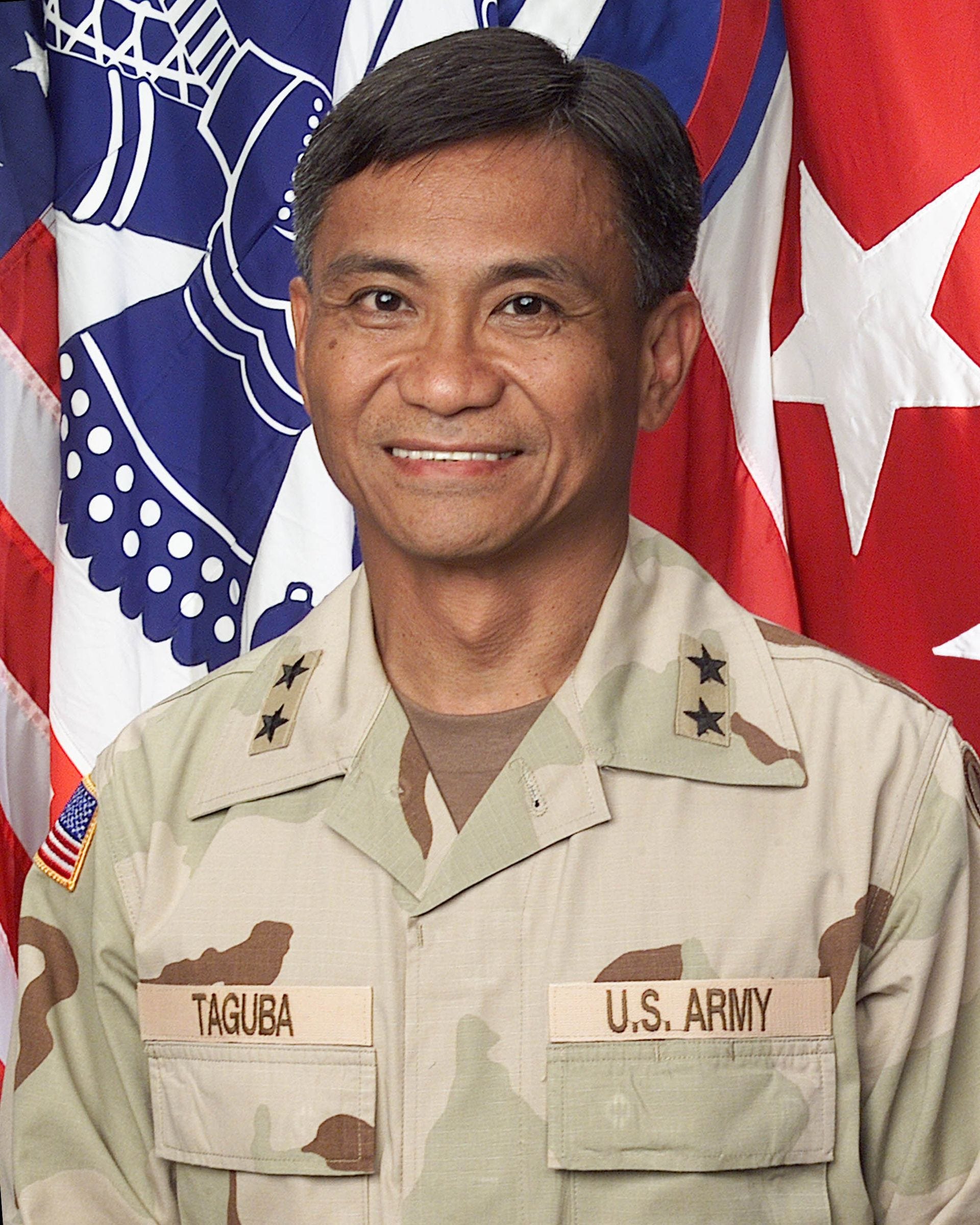
These thoughts occurred to me yet again as I read Seymour Hersh’s retrospective account of Major General Antonio (Tony) Taguba’s withering investigation of torture of prisoners at Abu Ghraib in Iraq. Taguba, a man of integrity, conducted an official—and honest—investigation of torture and mistreatment at Abu Ghraib; his reward for his honesty, his service, his excellence was not a commendation and promotion but threats, ostracism, and the death of his career as an Army officer.
General Antonio Taguba, man of integrity, service, and excellence
Sy Hersh’s article captures the rot at the core of the Pentagon and the U.S. government. Here Hersh speaks recently to Taguba:
[Taguba] “I was not a whistleblower. I knew I was in trouble when I was given the assignment [to investigate abuse at Abu Ghraib], but when you see those photos what can you do? I was a dead man walking.
“The kids were trained as traffic cops and then were told to transport [Iraqi] detainees. That’s how they got to Abu Ghraib. They weren’t trained for that but they had vehicles and rifles, just undisciplined kids with incompetent leadership and they were on the list to go home. They had all their equipment packed in Kuwait and ready to be shipped. And then they were told to stay behind.”
I [Hersh] asked: Would he do it again? “Sure,” Tony [Taguba] said, “I was hamstrung by the thirty days I had to investigate. I do not think I fulfilled my mission. [Secretary of Defense Donald] Rumsfeld was blaming the soldiers, but underneath they had no operational plan” for dealing with the prisoners.
“In hindsight, there was nothing I did to compromise my integrity. But integrity in the military and elsewhere is a bumper sticker. There is no reward for telling the truth.” [Emphasis added]
“There is no reward for telling the truth” in the U.S. military. That statement by retired General Taguba should move all Americans to take action against a military that has so clearly and tragically lost its way.
One suggestion: Cut the Pentagon budget in half and insist that it must pass a financial audit else forfeit all taxpayer funding. That might wake up a few generals and admirals.
In today’s New York Times send out, I saw the following story:
Ukraine’s Forces and Firepower Are Misallocated, U.S. Officials Say
American strategists say Ukraine’s troops are too spread out and need to concentrate along the counteroffensive’s main front in the south.
Listen to the U.S. military, Ukraine! Don’t be casualty-averse! Concentrate your forces. Take the fight to the Russian enemy. Use all those cluster munitions we’ve sent you. Commit your armored reserve and punch a hole in the Russian lines. Break through, break out, and drive toward Crimea. You know: just like Americans would do in your place.
One might forgive Ukrainians if they asked, When was the last war you “experts” won for America? Afghanistan? Iraq? Vietnam? Korea? What about ongoing military commitments to Syria and Somalia? If you’re so good at winning wars, how come the U.S. military didn’t win in Afghanistan, Iraq, and Vietnam where you had overwhelming materiel and firepower superiority?
With respect to why Ukraine has its forces “too spread out”: perhaps Ukraine needs to garrison its lines so that it can fend off Russian counterattacks? If Ukraine concentrates its strategic reserve and uses it in a big counteroffensive that stalls, what’s to stop Russia from a decisive riposte? Think of Kursk for Nazi Germany in 1943. Once that huge offensive failed for Germany, using up its strategic reserve, the Red Army seized the initiative on the eastern front and never lost it.
At Kursk in 1943, the Germans committed their reserves in a desperate gamble to seize the initiative from the Soviet Union. When the offensive failed, the Red Army counterattacked and proved unstoppable.
Headlines like the one posted above from the New York Times are intended to be exculpatory for the U.S. If the war turns worse for Ukraine, U.S. “experts” can point to articles like this, casting blame on the Ukrainians for not following sage American advice.
If “we” win in Ukraine, it will be because of generous U.S. aid and especially vaunted U.S. and NATO weaponry; but if they (the Ukrainians) lose, it’s all their fault for not following the advice of America’s master strategists. And, obviously, even if Ukraine loses, plenty of weapons manufacturers in the U.S. are winning and will continue to win. Indeed, a Russian victory could be just the thing to propel even more weapons spending by NATO countries as well as even larger and more monstrous Pentagon budgets.
The Future Meets the Past as War and Militarism Thrive in America
Barbara Ehrenreich was a remarkable writer and thinker. Her book, Blood Rites: Origins and History of the Passions of War (1997), is one of the most original and thoughtful studies of war and its nature. She traced humanity’s affinity to war, our predilection for it, not to our vaunted status as predators but to our vulnerable status as prey to other predators in the wild. Our early human ancestors were fearful creatures, and for good reason. Humans learned to band together as a way of conquering other predators and controlling their fear; once those predators were mostly banished to fleeting memories and occasional nightmares, we could turn on each other, becoming predators (and prey) to ourselves.
If you haven’t read her book, I urge you to check it out. Stimulating it is. And so too is an afterword she wrote to the paperback edition of the book, available at TomDispatch and which I read last night. Once again, Ehrenreich doesn’t disappoint.
While she wrote about the possibility of robot war in the future, a war largely devoid of human “boots on the ground,” she also made mention of atavistic war. By atavistic war, she meant a return to the past, to the primitive, to the reassuring (reassuring to America’s conventional big-battalion military, that is). Thus the U.S. suffers a major terrorist strike launched by a relatively small band of non-state actors, and the response of the war department in Washington was to launch invasions of Afghanistan and Iraq while talking about re-creating both countries with quasi-Marshall Plans, as if we had returned to the 1940s.
Even as America today pursues AI and increasingly sophisticated robot drones and the like, there’s a desire, a yen, to return to older models as certainties. Already in Ukraine, we’re witnessing a return to the trench warfare of Word War I as the New York Times reports that Ukraine and Russia have suffered half a million killed and wounded over the last 18 months. At the same time, the U.S. and NATO seem to believe that with weaponry like tanks and fighter jets and better training, Ukraine can break through Russian defenses in a quasi-Blitzkrieg like World War II, defeating Russian forces and forcing their leader to beg for peace. Erwin Rommel’s rapid advances in France in 1940 and North Africa in 1942 might serve as models for a decisive Ukrainian counteroffensive, a friend suggested to me, despite the costly slog and disappointing results of this year’s “spring” offensive.
Speaking of atavism, U.S. leaders of the military-industrial-congressional complex have a hankering for a new Cold War, not only with Russia but with China too. It includes the re-nuclearization of America, with new ICBMs, bombers, and submarines at a cost of $2 trillion over the next thirty years. Perhaps we’ll even see new bomb shelters, new “duck and cover” drills, maybe even a new nuclear crisis akin to the Cuban Missile Crisis in 1962.
The one future America’s self-styled warriors can’t seem to imagine is one largely free of war. We Americans remain prey, this time to our “leaders” and their passions and pursuit of profit and power through violent dominance.
Ehrenreich would understand. Our very own “blood rites” remain very much in force in our lives. The prey—that’s us—remain predators that are prey to the passions of war with all its fear, destruction, and death.
Something tells me the robots and robotic war will not free us from our blood rites. For how can creations liberate their creators?
From Boots on the Ground to Robot Assassins in the Sky
I’m proud to say I’ve been writing for TomDispatch since 2007, posting more than 100 original articles at the site. Among the many features of that remarkable site, run by Tom Engelhardt, this generation’s I.F. Stone, is its reach across political spectrums, across America, and indeed across the globe. My most recent article, for example, was translated into Portuguese (for a Brazilian site) and Swedish. Tom and I usually aren’t contacted for permission; these translations and postings just happen.
Briefly in 2010, a few of my “tomgrams” broke through to the mainstream media, being reposted by CBS News. What follows is one of them, “Seven Reasons Why We Can’t Stop Making War,” in which I refer to a disaster of that day, the BP Deepwater Horizon oil spill.
Sadly, despite a little boost from CBS News, my critique went unheeded. Surprise! America is still making war (with certain entities profiting greatly from this), now with yet more robots even as U.S. boots on ground in direct combat are far fewer. It’s a formula for “low-cost” forever war that of course comes at a very high cost indeed, starting with a Pentagon budget soaring toward $900 billion a year, not including more than $120 billion already provided or promised to Ukraine for its war effort.
From CBS News in 2010, my article on why the U.S. can’t stop making war. The original title was “Operation Enduring War” at TomDispatch in July 2010.
If one quality characterizes our wars today, it’s their endurance. They never seem to end.
Though war itself may not be an American inevitability, these days many factors combine to make constant war an American near certainty. Put metaphorically, our nation’s pursuit of war taps so many wellsprings of our behavior that a concerted effort to cap itwould dwarfBP’s efforts in the Gulf of Mexico.
Our political leaders, the media, and the military interpret enduring war as a measure of our national fitness, our global power, our grit in the face of eternal danger, and our seriousness. A desire to de-escalate and withdraw, on the other hand, is invariably seen as cut-and-run appeasement and discounted as weakness. Withdrawal options are, in a pet phrase of Washington elites, invariably “off the table” when global policy is at stake, as was true during the Obama administration’s full-scale reconsideration of the Afghan war in the fall of 2009. Viewed in this light, the president’s ultimate decision to surge in Afghanistan was not only predictable, but the only course considered suitable for an American war leader. Rather than the tough choice, it was the path of least resistance.
Why do our elites so readily and regularly give war, not peace, a chance? What exactly are the wellsprings of Washington’s (and America’s) behavior when it comes to war and preparations for more of the same?
Consider these seven:
1. We wage war because we think we’re good at it — and because, at a gut level, we’ve come to believe that American wars can bring good to others (hence our feel-good names for them, like Operations Enduring Freedom and Iraqi Freedom). Most Americans are not only convinced we have the best troops, the best training, and the most advanced weapons, but also the purest motives. Unlike the bad guys and the barbarians out there in the global marketplace of death, our warriors and warfightersare seen as gift-givers and freedom-bringers, not as death-dealers and resource-exploiters. Our illusions about the military we “support” serve as catalyst for, and apology for, the persistent war-making we condone.
2. We wage war because we’ve already devoted so many of our resources to it. It’s what we’re most prepared to do. More than half of discretionary federal spending goes to fund our military and its war making or war preparations. The military-industrial complex is a well-oiled, extremely profitable machine and the armed forces, our favorite child, the one we’ve lavished the most resources and praise upon. It’s natural to give your favorite child free rein.
3. We’ve managed to isolate war’s physical and emotional costs, leaving them on the shoulders of a tiny minority of Americans. By eliminating the draft and relying ever more on for-profit private military contractors, we’ve made war a distant abstractionfor most Americans, who can choose to consume it as spectacle or simply tune it out as so much background noise.
4. While war and its costs have, to date, been kept at arm’s length, American society has been militarizing fast. Our media outlets, intelligence agencies, politicians, foreign policy establishment, and “homeland security” bureaucracy are so intertwined with military priorities and agendas as to be inseparable from them. In militarized America, griping about soft-hearted tactics or the outspokenness of a certain general may be tolerated, but forceful criticism of our military or our wars is still treated as deviant and “un-American.”
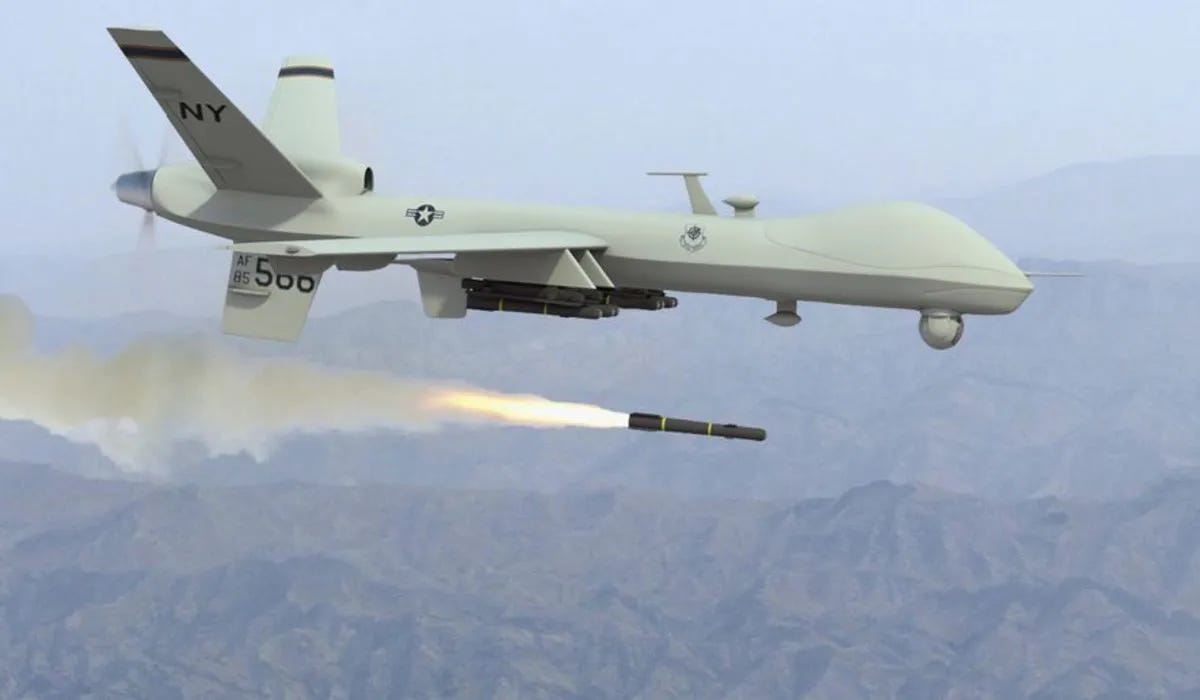
5. Our profligate, high-tech approach to war, including those Predator and Reaper drones armed with Hellfire missiles, has served to limit American casualties — and so has limited the anger over, and harsh questioning of, our wars that might go with them. While the U.S. has had more than 1,000 troops killed in Afghanistan, over a similar period in Vietnam we lost more than 58,000 troops. Improved medical evacuation and trauma care, greater reliance on standoff precision weaponry and similar “force multipliers,” stronger emphasis on “force protection” within American military units: all these and more have helped tamp down concern about the immeasurable and soaring costs of our wars.
It all seems so easy—even “clean”—from the sky. Not even a single U.S. pilot at risk.
6. As we incessantly develop those force-multiplying weapons to give us our “edge” (though never an edge that leads to victory), it’s hardly surprising that the U.S. has come to dominate, if not quite monopolize, the global arms trade. In these years, as American jobs were outsourced or simply disappeared in the Great Recession, armaments have been one of our few growth industries. Endless war has proven endlessly profitable — not perhaps for all of us, but certainly for those in the business of war.
7. And don’t forget the seductive power of beyond-worse-case, doomsday scenarios, of the prophecies of pundits and so-called experts, who regularly tell us that, bad as our wars may be, doing anything to end them would be far worse. A typical scenario goes like this: If we withdraw from Afghanistan, the government of Hamid Karzai will collapse, the Taliban will surge to victory, al-Qaeda will pour into Afghan safe havens, and Pakistan will be further destabilized, its atomic bombs falling into the hands of terrorists out to destroy Peoria and Orlando.
Such fevered nightmares, impossible to disprove, may be conjured at any moment to scare critics into silence. They are a convenient bogeyman, leaving us cowering as we send our superman military out to save us (and the world as well), while preserving our right to visit the mall and travel to Disney World without being nuked.
The truth is that no one really knows what would happen if the U.S. disengaged from Afghanistan. But we do know what’s happening now, with us fully engaged: we’re pursuing a war that’s costing us nearly $7 billion a month that we’re not winning (and that’s arguably unwinnable), a war that may be increasing the chances of another 9/11, rather than decreasing them.
Capping the Wellsprings of War
Each one of these seven wellsprings feeding our enduring wars must be capped. So here are seven suggestions for the sort of “caps” — hopefully more effective than BP’s flailing improvisations — we need to install:
1. Let’s reject the idea that war is either admirable or good — and in the process, remind ourselves that others often see us as “the foreign fighters” and profligate war consumers who kill innocents (despite our efforts to apply deadly force in surgically precise ways reflecting “courageous restraint“).
2. Let’s cut defense spending now, and reduce the global “mission” that goes with it. Set a reasonable goal — a 6-8% reduction annually for the next 10 years, until levels of defense spending are at least back to where they were before 9/11 — and then stick to it.
3. Let’s stop privatizing war. Creating ever more profitable incentives for war was always a ludicrous idea. It’s time to make war a non-profit, last-resort activity. And let’s revive national service (including elective military service) for all young adults. What we need is a revived civilian conservation corps, not a new civilian “expeditionary” force.
4. Let’s reverse the militarization of so many dimensions of our society. To cite one example, it’s time to empower truly independent (non-embedded) journalists to cover our wars, and stop relying on retired generals and admirals who led our previous wars to be our media guides. Men who are beholden to their former service branch or the current defense contractor who employs them can hardly be trusted to be critical and unbiased guides to future conflicts.
5. Let’s recognize that expensive high-tech weapons systems are not war-winners. They’ve kept us in the game without yielding decisive results — unless you measure “results” in terms of cost overruns and burgeoning federal budget deficits.
6. Let’s retool our economy and reinvest our money, moving it out of the military-industrial complex and into strengthening our anemic system of mass transit, our crumbling infrastructure, and alternative energy technology. We need high-speed rail, safer roads and bridges, and more wind turbines, not more overpriced jet fighters.
7. Finally, let’s banish nightmare scenarios from our minds. The world is scary enough without forever imagining smoking guns morphing into mushroom clouds.
There you have it: my seven “caps” to contain our gushing support for permanent war.
No one said it would be easy. Just ask BP how easy it is to cap one out-of-control gusher.
Nonetheless, if we as a society aren’t willing to work hard for actual change — indeed, to demand it — we’ll be on that military escalatory curve until we implode. And that way madness lies.
The opinions expressed in this commentary are solely those of the author.
By William J. Astore (2010)
Bonus Lesson (2023): “Enduring war” is not consistent with “enduring freedom.” Who knew? And we do seem as a society to be closer to implosion, a prediction I very much hope I’m ultimately proven wrong about.
In his message to the troops prior to the July 4th weekend, Secretary of Defense Lloyd Austin offered high praise indeed. “We have the greatest fighting force in human history,” he tweeted, connecting that claim to the U.S. having patriots of all colors, creeds, and backgrounds “who bravely volunteer to defend our country and our values.”
As a retired Air Force lieutenant colonel from a working-class background who volunteered to serve more than four decades ago, who am I to argue with Austin? Shouldn’t I just bask in the glow of his praise for today’s troops, reflecting on my own honorable service near the end of what now must be thought of as the First Cold War?
Yet I confess to having doubts. I’ve heard it all before. The hype. The hyperbole. I still remember how, soon after the 9/11 attacks, President George W. Bush boasted that this country had “the greatest force for human liberation the world has ever known.” I also remember how, in a pep talk given to U.S. troops in Afghanistan in 2010, President Barack Obama declared them “the finest fighting force that the world has ever known.” And yet, 15 years ago at TomDispatch, I was already wondering when Americans had first become so proud of, and insistent upon, declaring our military the world’s absolute best, a force beyond compare, and what that meant for a republic that once had viewed large standing armies and constant warfare as anathemas to freedom.
In retrospect, the answer is all too straightforward: we need something to boast about, don’t we? In the once-upon-a-time “exceptional nation,” what else is there to praise to the skies or consider our pride and joy these days except our heroes? After all, this country can no longer boast of having anything like the world’s best educational outcomes, or healthcare system, or the most advanced and safest infrastructure, or the best democratic politics, so we better damn well be able to boast about having “the greatest fighting force” ever.
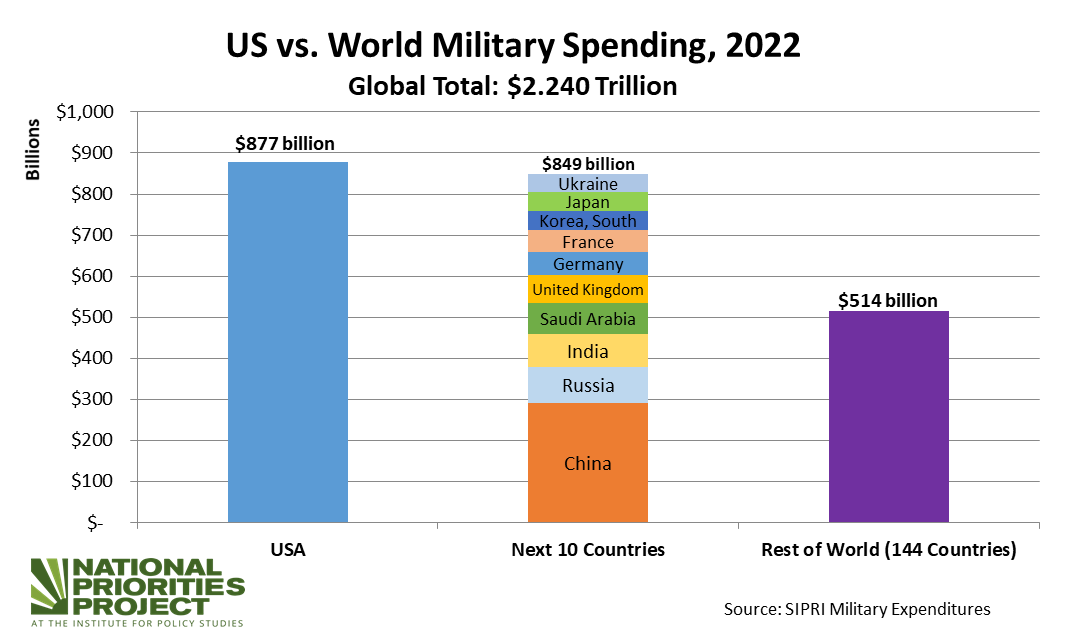
Leaving that boast aside, Americans could certainly brag about one thing this country has beyond compare: the most expensive military around and possibly ever. No country even comes close to our commitment of funds to wars, weapons (including nuclear ones at the Department of Energy), and global dominance. Indeed, the Pentagon’s budget for “defense” in 2023 exceeds that of the next 10 countries (mostly allies!) combined.
And from all of this, it seems to me, two questions arise: Are we truly getting what we pay so dearly for — the bestest, finest, most exceptional military ever? And even if we are, should a self-proclaimed democracy really want such a thing?
The answer to both those questions is, of course, no. After all, America hasn’t won a war in a convincing fashion since 1945. If this country keeps losing wars routinely and often enough catastrophically, as it has in places like Vietnam, Afghanistan, and Iraq, how can we honestly say that we possess the world’s greatest fighting force? And if we nevertheless persist in such a boast, doesn’t that echo the rhetoric of militaristic empires of the past? (Remember when we used to think that only unhinged dictators like Adolf Hitler boasted of having peerless warriors in a megalomaniacal pursuit of global domination?)
Actually, I do believe the United States has the most exceptional military, just not in the way its boosters and cheerleaders like Austin, Bush, and Obama claimed. How is the U.S. military truly “exceptional”? Let me count the ways.
Yes, the Pentagon budget, enormous and still growing, is as large as the next ten countries in the world combined. We’re #1 in wars and weapons!
The Pentagon as a Budgetary Black Hole
In so many ways, the U.S. military is indeed exceptional. Let’s begin with its budget. At this very moment, Congress is debating a colossal “defense” budget of $886 billion for FY2024 (and all the debate is about issues that have little to do with the military). That defense spending bill, you may recall, was “only” $740 billion when President Joe Biden took office three years ago. In 2021, Biden withdrew U.S. forces from the disastrous war in Afghanistan, theoretically saving the taxpayer nearly $50 billion a year. Yet, in place of any sort of peace dividend, American taxpayers simply got an even higher bill as the Pentagon budget continued to soar.
Recall that, in his four years in office, Donald Trump increased military spending by 20%. Biden is now poised to achieve a similar 20% increase in just three years in office. And that increase largely doesn’t even include the cost of supporting Ukraine in its war with Russia — so far, somewhere between $120 billion and $200 billion and still rising.
Colossal budgets for weapons and war enjoy broad bipartisan support in Washington. It’s almost as if there were a military-industrial-congressional complex at work here! Where, in fact, did I ever hear a president warning us about that? Oh, perhaps I’m thinking of a certain farewell address by Dwight D. Eisenhower in 1961.
In all seriousness, there’s now a huge pentagonal-shaped black hole on the Potomac that’s devouring more than half of the federal discretionary budget annually. Even when Congress and the Pentagon allegedly try to enforce fiscal discipline, if not austerity elsewhere, the crushing gravitational pull of that hole just continues to suck in more money. Bet on that continuing as the Pentagon issues ever more warnings about a new cold war with China and Russia.
Given its money-sucking nature, perhaps you won’t be surprised to learn that the Pentagon is remarkably exceptional when it comes to failing fiscal audits — five of them in a row (the fifth failure being a “teachable moment,” according to its chief financial officer) — as its budget only continued to soar. Whether you’re talking about lost wars or failed audits, the Pentagon is eternally rewarded for its failures. Try running a “Mom and Pop” store on that basis and see how long you last.
Speaking of all those failed wars, perhaps you won’t be surprised to learn that they haven’t come cheaply. According to the Costs of War Project at Brown University, roughly 937,000 people have died since 9/11/2001 thanks to direct violence in this country’s “Global War on Terror” in Afghanistan, Iraq, Libya, and elsewhere. (And the deaths of another 3.6 to 3.7 million people may be indirectly attributable to those same post-9/11 conflicts.) The financial cost to the American taxpayer has been roughly $8 trillion and rising even as the U.S. military continues its counterterror preparations and activities in 85 countries.
No other nation in the world sees its military as (to borrow from a short-lived Navy slogan) “a global force for good.” No other nation divides the whole world into military commands like AFRICOM for Africa and CENTCOM for the Middle East and parts of Central and South Asia, headed up by four-star generals and admirals. No other nation has a network of 750 foreign bases scattered across the globe. No other nation strives for full-spectrum dominance through “all-domain operations,” meaning not only the control of traditional “domains” of combat — the land, sea, and air — but also of space and cyberspace. While other countries are focused mainly on national defense (or regional aggressions of one sort or another), the U.S. military strives for total global and spatial dominance. Truly exceptional!
Strangely, in this never-ending, unbounded pursuit of dominance, results simply don’t matter. The Afghan War? Bungled, botched, and lost. The Iraq War? Built on lies and lost. Libya? We came, we saw, Libya’s leader (and so many innocents) died. Yet no one at the Pentagon was punished for any of those failures. In fact, to this day, it remains an accountability-free zone, exempt from meaningful oversight. If you’re a “modern major general,” why not pursue wars when you know you’ll never be punished for losing them?
Indeed, the few “exceptions” within the military-industrial-congressional complex who stood up for accountability, people of principle like Daniel Hale, Chelsea Manning, and Edward Snowden, were imprisoned or exiled. In fact, the U.S. government has even conspired to imprison a foreign publisher and transparency activist, Julian Assange, who published the truth about the American war on terror, by using a World War I-era espionage clause that only applies to American citizens.
And the record is even grimmer than that. In our post-9/11 years at war, as President Barack Obama admitted, “We tortured some folks” — and the only person punished for that was another whistleblower, John Kiriakou, who did his best to bring those war crimes to our attention.
And speaking of war crimes, isn’t it “exceptional” that the U.S. military plans to spend upwards of $2 trillion in the coming decades on a new generation of genocidal nuclear weapons? Those include new stealth bombers and new intercontinental ballistic missiles (ICBMs) for the Air Force, as well as new nuclear-missile-firing submarines for the Navy. Worse yet, the U.S. continues to reserve the right to use nuclear weapons first, presumably in the name of protecting life, liberty, and the pursuit of happiness. And of course, despite the countries — nine! — that now possess nukes, the U.S. remains the only one to have used them in wartime, in the atomic bombings of Hiroshima and Nagasaki.
Finally, it turns out that the military is even immune from Supreme Court decisions! When SCOTUS recently overturned affirmative action for college admission, it carved out an exception for the military academies. Schools like West Point and Annapolis can still consider the race of their applicants, presumably to promote unit cohesionthrough proportional representation of minorities within the officer ranks, but our society at large apparently does not require racial equity for its cohesion.
A Most Exceptional Military Makes Its Wars and Their Ugliness Disappear
Here’s one of my favorite lines from the movie The Usual Suspects: “The greatest trick the devil ever pulled was convincing the world he did not exist.” The greatest trick the U.S. military ever pulled was essentially convincing us that its wars never existed. As Norman Solomon notes in his revealing book, War Made Invisible, the military-industrial-congressional complex has excelled at camouflaging the atrocious realitiesof war, rendering them almost entirely invisible to the American people. Call it the new American isolationism, only this time we’re isolated from the harrowing and horrific costs of war itself.
America is a nation perpetually at war, yet most of us live our lives with little or no perception of this. There is no longer a military draft. There are no war bond drives. You aren’t asked to make direct and personal sacrifices. You aren’t even asked to pay attention, let alone pay (except for those nearly trillion-dollar-a-year budgets and interest payments on a ballooning national debt, of course). You certainly aren’t asked for your permission for this country to fight its wars, as the Constitution demands. As President George W. Bush suggested after the 9/11 attacks, go visit Disneyworld! Enjoy life! Let America’s “best and brightest” handle the brutality, the degradation, and the ugliness of war, bright minds like former Vice President Dick (“So?”) Cheney and former Secretary of Defense Donald (“I don’t do quagmires”) Rumsfeld.
Did you hear something about the U.S. military being in Syria? In Somalia? Did you hear about the U.S. military supporting the Saudis in a brutal war of repression in Yemen? Did you notice how this country’s military interventions around the world kill, wound, and displace so many people of color, so much so that observers speak of the systemic racism of America’s wars? Is it truly progress that a more diverse military in terms of “color, creed, and background,” to use Secretary of Defense Austin’s words, has killed and is killing so many non-white peoples around the globe?
Praising the all-female-crewed flyover at the last Super Bowl or painting rainbow flags of inclusivity (or even blue and yellow flags for Ukraine) on cluster munitionswon’t soften the blows or quiet the screams. As one reader of my blog Bracing Viewsso aptly put it: “The diversity the war parties [Democrats and Republicans] will not tolerate is diversity of thought.”
Of course, the U.S. military isn’t solely to blame here. Senior officers will claim their duty is not to make policy at all but to salute smartly as the president and Congress order them about. The reality, however, is different. The military is, in fact, at the core of America’s shadow government with enormous influence over policymaking. It’s not merely an instrument of power; it is power — and exceptionally powerful at that. And that form of power simply isn’t conducive to liberty and freedom, whether inside America’s borders or beyond them.
Wait! What am I saying? Stop thinking about all that! America is, after all, the exceptional nation and its military, a band of freedom fighters. In Iraq, where war and sanctions killed untold numbers of Iraqi children in the 1990s, the sacrifice was “worth it,” as former Secretary of State Madeleine Albright once reassured Americans on 60 Minutes.
Even when government actions kill children, lots of children, it’s for the greater good. If this troubles you, go to Disney and take your kids with you. You don’t like Disney? Then, hark back to that old marching song of World War I and “pack up your troubles in your old kit-bag, and smile, smile, smile.” Remember, America’s troops are freedom-delivering heroes and your job is to smile and support them without question.
Have I made my point? I hope so. And yes, the U.S. military is indeed exceptional and being so, being #1 (or claiming you are anyway) means never having to say you’re sorry, no matter how many innocents you kill or maim, how many lives you disrupt and destroy, how many lies you tell.
I must admit, though, that, despite the endless celebration of our military’s exceptionalism and “greatness,” a fragment of scripture from my Catholic upbringing haunts me still: Pride goeth before destruction and a haughty spirit before a fall.
The U.S. Mainstream Media Is Almost Always Pro-War
In the “liberal” New York Times today, I saw an article on “Putin’s forever war” that has the following short synopsis: “Vladimir Putin wants to lead Russians into a civilizational conflict with the West far larger than Ukraine. Will they follow him?”
Is this true? Does Putin truly seek a “civilizational conflict” with the West? One that’s “far larger” than the Ukraine war? It doesn’t seem likely. Russian forces have struggled in Ukraine. Already embroiled in a destructive regional war that’s become somewhat of a quagmire, why would Putin seek to widen it? Is Putin always the aggressor, the bad guy, and the West always the aggrieved party, the good guys, holding back a “red storm rising”? I thought the West won the Cold War more than 30 years ago.
It’s remarkable how easy it is to get alarmist articles about Russia or China published in the U.S. mainstream media (MSM). Wars and rumors of war dominate. The West is always portrayed as the defender of democracy; other countries such as China and Russia are portrayed as threats to civilization and its “rules-based order.” Strictly speaking, this is simplistic, one-sided, propaganda.
Back in 2017, I wrote about how difficult it is in the MSM to read honest accounts of war. In the runup to the Iraq War in 2003, critical voices were actively suppressed and punished. Back then, I focused my article on MSNBC, which like the New York Times is allegedly “liberal.” At “liberal” newspapers and networks, shouldn’t America expect at least a few critical critiques of war narratives? The answer here is “no,” as I wrote here:
Jesse Ventura, former governor of Minnesota (1999-2003), was a hot media commodity as the Bush/Cheney administration was preparing for its invasion of Iraq in 2003. Ventura, a U.S. Navy veteran who gained notoriety as a professional wrestler before he entered politics, was both popular and outspoken. MSNBC won the bidding war for his services in 2003, signing him to a lucrative three-year contract to create his own show – until, that is, the network learned he was against the Iraq war. Ventura’s show quickly went away, even as the network paid him for three years to do nothing.
I heard this revealing story from a new podcast, the TARFU Report, hosted by Matt Taibbi and Alex Pareene. By his own account, Jesse Ventura was bought off by the network, which back then was owned by General Electric, a major defense contractor that was due to make billions of dollars off the war.
Of course, Ventura was hardly the only war critic to run afoul of GE/NBC. Phil Donahue, the famous talk show host, saw his highly rated show cancelled when he gave dissenters and anti-war voices a fair hearing. Ashleigh Banfield, a reporter who covered the Iraq war, gave a speech in late April 2003 that criticized the antiseptic coverage of the war (extracts to follow below). For her perceptiveness and her honesty, she was reassigned and marginalized, demoted and silenced.
So much for freedom of speech, as well as the press.
As Phil Donahue said, his show “wasn’t good for business.” NBC didn’t want to lose ratings by being associated with “unpatriotic” elements when the other networks were waving the flag in support of the Iraq war. In sidelining Ventura and Donahue, NBC acted to squelch any serious dissent from the push for war, and punished Ashleigh Banfield in the immediate aftermath of the war for her honesty in criticizing the coverage shown (and constructed) by the mainstream media, coverage that was facilitated by the U.S. military and rubber-stamped by corporate ownership.
Speaking of Banfield’s critique, here are some excerpts from her speech on Iraq war coverage in April 2003. Note that her critique remains telling for all U.S. media war coverage since then:
That said, what didn’t you see [in U.S. media coverage of the Iraq war]? You didn’t see where those bullets landed. You didn’t see what happened when the mortar landed. A puff of smoke is not what a mortar looks like when it explodes, believe me. There are horrors that were completely left out of this war. So was this journalism or was this coverage? There is a grand difference between journalism and coverage, and getting access does not mean you’re getting the story, it just means you’re getting one more arm or leg of the story. And that’s what we got, and it was a glorious, wonderful picture that had a lot of people watching and a lot of advertisers excited about cable news. But it wasn’t journalism, because I’m not so sure that we in America are hesitant to do this again, to fight another war, because it looked like a glorious and courageous and so successful terrific endeavor, and we got rid of a horrible leader: We got rid of a dictator, we got rid of a monster, but we didn’t see what it took to do that.
With admirable honesty, Banfield spoke of the horrific face of war at Kansas State Univ. in 2003. Soon after her speech, she was demoted (Image courtesy of KSU)
I can’t tell you how bad the civilian casualties were. I saw a couple of pictures. I saw French television pictures, I saw a few things here and there, but to truly understand what war is all about you’ve got to be on both sides…
Some of the soldiers, according to our embeds had never seen a dead body throughout the entire three-week campaign. It was like Game Boy. I think that’s amazing in two different ways. It makes you a far more successful warrior because you can just barrel right along but it takes away a lot of what war is all about, which is what I mentioned earlier. The TV technology took that away too. We couldn’t see where the bullets landed. Nobody could see the horrors of this so that we seriously revisit the concept of warfare the next time we have to deal with it.
I think there were a lot of dissenting voices before this war about the horrors of war, but I’m very concerned about this three-week TV show and how it may have changed people’s opinions. It was very sanitized.
This TV show [Iraq invasion coverage] that we just gave you was extraordinarily entertaining, and I really hope that the legacy that it leaves behind is not one that shows war as glorious, because there’s nothing more dangerous than a democracy that thinks this is a glorious thing to do.
War is ugly and it’s dangerous, and in this world the way we are discussed on the Arab street, it feeds and fuels their hatred and their desire to kill themselves to take out Americans. It’s a dangerous thing to propagate…
I’m hoping that I will have a future in news in cable, but not the way some cable news operators wrap themselves in the American flag and patriotism and go after a certain target demographic, which is very lucrative. You can already see the effects, you can already see the big hires on other networks, right wing hires to chase after this effect, and you can already see that flag waving in the corners of those cable news stations where they have exciting American music to go along with their war coverage.
Nothing has changed since Banfield’s powerful critique. Indeed, the networks have only hired more retired generals and admirals to give “unbiased” coverage of America’s military actions. And reporters and “journalists” like Brian Williams have learned too. Recall how Williams cheered the “beautiful” U.S. Tomahawk cruise missiles as they were launched against Syria earlier this year [2017].
It’s not just that U.S. media coverage actively suppresses dissent of America’s wars: it passively does so as well, which is arguably more insidious. Any young journalist with smarts recognizes the way to get ahead is to be a cheerleader for U.S. military action, a stenographer to the powerful. Being a critic leads to getting fired (like Donahue); demoted and exiled (like Banfield); and, in Ventura’s case, if you can’t be fired or demoted or otherwise punished, you can simply be denied air time.
When you consider that billions and billions of dollars are at stake, whether in weapons sales or in advertising revenue tied to ratings, none of this is that surprising. What’s surprising is that so few Americans know about how pro-authority and uncritical U.S. media coverage of war and its makers is. If anything, the narrative is often that the U.S. media is too critical of the military to the detriment of the generals. Talk about false narratives and alternative facts!
America’s greed-wars persist for many reasons, but certainly a big one is the lack of critical voices in the mainstream media. Today’s journalists, thinking about their career prospects and their salaries (and who is ultimately their boss at corporate HQ), learn to censor themselves, assuming they have any radical thoughts to begin with. Some, like Brian Williams, even learn how to stop worrying and love the beautiful bombs.
[After I wrote this in 2017, I added this comment at the site.]
One thing that troubles me is the mindset that criticism of America’s wars undermines the troops. That it could even be a form of betrayal. This mindset is very dangerous. It not only protects the decisions and actions of those at the highest levels of the military and government. It acts to prolong wars and to endanger the lives of the troops (and of their “enemies” as well).
During the Iraq war, I recall instances of U.S. troops speaking clearly and frankly against the war. Their voices were heard, yet their advice was not taken. Instead, generals like David Petraeus were trotted out to assure the American people that the war was being won, even if the gains were characterized by weasel words like “fragile” and “reversible.” And so those gains have proved — even so, Petraeus remains in demand, and is still trotted out, now in mufti, to explain how we must stay the course and continue to defer to the military.
There’s a powerful book to be written here, and it should focus in part on the silencing or marginalization of anti-war voices (even those that wear or wore the uniform), even as pro-war elements are given the main stage as the voices of probity and sanity.
If you can’t beat him at the polls, beat him in court
If you’re like me, you’ve lost track of the number of charges against former President Donald Trump. He’s facing at least 78 criminal charges stemming from three indictments: the Stormy Daniels case, the classified documents one, and now the January 6th riots/”insurrection.”
Readers of Bracing Views know I’m not a Trump supporter. In fact, in March of 2016, I wrote an article stating unequivocally that Trump had disqualified himself from running as president (he’d stated troops should follow his orders even if those orders were unconstitutional). That article was the most popular one I’ve ever written in terms of “hits,” but of course Trump prevailed as many Americans concluded that Hillary Clinton would be even worse of a president than a narcissistic and clueless con man.
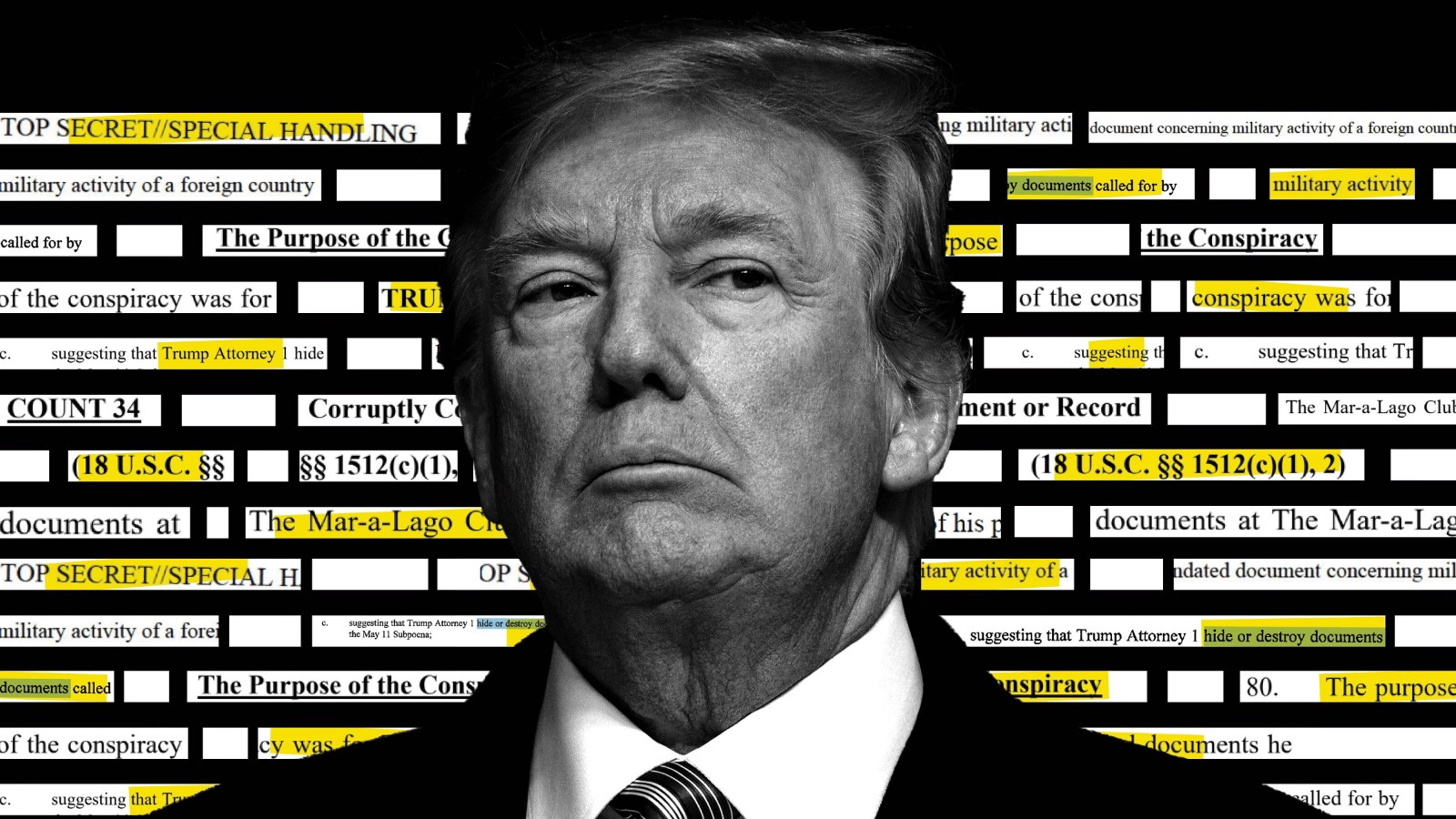
Interesting image from CNN that superimposes Trump on the charges against him stemming from the classified docs case He sure looks guilty, right?
Democrats seem to think the way to “kill” Trump is death by a thousand paper cuts inflicted by all these legal charges and indictments. I don’t think so. I think most Americans know what Trump is. They know he’s a rogue and a scoundrel. They know he paid off Stormy Daniels in a dodgy, probably illegal, way; they know he shouldn’t have had all those classified documents around; they know he’s a sore loser who lashed out in petulant and dangerous ways on January 6th; but they also know Democrats aren’t offering much of an alternative except four more years of Biden/Harris. Their motto might be: More of the same, only more!
The way to beat Trump is to offer real changes of substance that will help Americans who are struggling across our country. But we’re not going to get that from Biden/Harris. Just look back to all those campaign promises, vintage 2020, that haven’t come through, such as a $15 federal minimum wage, substantial student debt relief, a single-payer option for health care, and a ban on oil and gas drilling on federal lands.
Democrats always have excuses here, someone else to blame, like Joe Manchin or the Senate parliamentarian or the conservative Supreme Court. But what matters to voters is results, and Biden/Harris haven’t succeeded in producing results consistently. Truth is, Biden is an aging president, a stumbling figurehead rather than a strong leader, and Harris is deeply unpopular. It’s not exactly the “dream team” the Democrats are running in 2024.
In these increasingly Dickensian times, the Democrats keep shoveling billions of dollars to the Pentagon and to Ukraine while offering a new Cold War with Russia and China. Main Street USA may wish to declare war on those two countries, if only to get money from Congress.
Alternatives exist for the Democrats, of course, such as Marianne Williamson and Robert F. Kennedy Jr. Yet the Democratic establishment is too busy mocking or smearing them to listen to their ideas for substantive changes.
The Democratic establishment, it seems, is content to roll the dice in 2024 with Biden/Harris, preferring even to lose to Trump than to win with more progressive and dynamic candidates. Perhaps they truly believe they can “kill” Trump through all those indictments and charges, the equivalent to death by 1000 cuts.







 Bracing Views