Bombing Muslims for Peace

W.J. Astore

Time to Put Away Our Toy Soldiers

Since 2007, I’ve been writing for TomDispatch.com. Recently, Tom Engelhardt and I got to talking about war, American-style. I mentioned to Tom that I thought America’s presidents were appeasers, not in the Neville Chamberlain at Munich sense, but in the sense of kowtowing to the military-industrial-congressional complex and favoring more weapons and always more war. It got me thinking as well about our mutual affection for toy soldiers, how we as kids so innocently (and foolishly) played at war. Combining that with recent events in the Middle East led to this piece posted today at TomDispatch.

Like many American boys of the baby-boomer generation, I played “war” with those old, olive-drab, plastic toy soldiers meant to evoke our great victory over the Nazis and “the Japs” during World War II. At age 10, I also kept a scrapbook of the 1973 Yom Kippur War between Israel and its various Arab enemies in the Middle East. It was, I suppose, an early sign that I would make both the military and the study of history into careers.

I recall rooting for the Israelis, advertised then as crucial American allies, against Egypt, Syria, and other regional enemies at least ostensibly allied with the Soviet Union in that Cold War era. I bought the prevailing narrative of a David-versus-Goliath struggle. I even got a book on the Yom Kippur War that captivated me by displaying all the weaponry the U.S. military had rushed to Israel to turn the tide there, including F-4 Phantom jets and M-60 main battle tanks. (David’s high-tech slingshots, if you will.) Little did I know that, in the next 50 years of my life, I would witness increasingly destructive U.S. military attacks in the Middle East, especially after the oil cartel OPEC (largely Middle Eastern then) hit back hard with an embargo in 1973 that sent our petroleum-based economy into a tailspin.

Here’s the book I was fascinated with, published soon after the Yom Kippur War

As one jokester quipped: Who put America’s oil under the sands of all those ungrateful Muslim countries in the Middle East? With declarations like the Carter Doctrine in 1980, the U.S. was obviously ready to show the world just how eagerly it would defend its “vital interests” (meaning fossil fuels, of course) in that region. And even today, as we watch the latest round in this country’s painfully consistent record of attempting to pound various countries and entities there into submission, mainly via repetitive air strikes, we should never forget the importance of oil, and lots of it, to keep the engines of industry and war churning along in a devastating fashion.

Right now, of course, the world is witnessing yet another U.S. bombing campaign, the latest in a series that seems all too predictable (and futile), meant to teach the restless rebels of Iraq, Syria, Yemen, and possibly even Iran a lesson when it comes to messing with the United States of America. As the recently deceased country singer Toby Keith put it: Mess with this country and “We’ll put a boot (think: bomb) in your ass.” You kill three soldiers of ours and we’ll kill scores, if not hundreds, if not thousands of yours (and it doesn’t really matter if they’re soldiers or not), because… well, because we damn well can!

America’s leaders, possessing a peerless Air Force, regularly exhibit a visceral willingness to use it to bomb and missile perceived enemies into submission or, if need be, nothingness. And don’t for a second think that they’re going to be stopped by international law, humanitarian concerns, well-meaning protesters, or indeed any force on this planet. America bombs because it can, because it believes in the efficacy of violence, and because it’s run by appeasers.

Yes, America’s presidents, its bombers-in-chief, are indeed appeasers. Of course, they think they’re being strong when they’re blowing distant people to bits, but their actions invariably showcase a distinctive kind of weakness. They eternally seek to appease the military-industrial-congressional complex, aka the national (in)security state, a complex state-within-a-state with an unappeasable hunger for power, profit, and ever more destruction. They fail and fail and fail again in the Middle East, yet they’re incapable of not ordering more bombing, more droning, more killing there. Think of them as being possessed by a monomania for war akin to my urge to play with toy soldiers. The key difference? When I played at war, I was a wet-behind-the-ears 10 year old.

The Rockets’ Red Glare, the Bombs Bursting in Air

No technology may be more all-American than bombs and bombers and no military doctrine more American than the urge to attain “peace” through massive firepower. In World War II and subsequent wars, the essential U.S. approach could be summarized in five words: mass production enabling mass destruction.

No other country in the world has dedicated such vast resources as mine has to mass destruction through air power. Think of the full-scale bombing of cities in Nazi Germany and Imperial Japan in World War II, ending in the atomic destruction of Hiroshima and Nagasaki. Think of the flattening of North Korea during the Korean War of the early 1950s or the staggering bombing campaigns in Vietnam, Laos, and Cambodia in the 1960s and early 1970s. Or consider the massive use of air power in Desert Shield against Iraq in the early 1990s followed by the air campaigns that accompanied the invasions of Afghanistan and Iraq in 2003 (and never quite seemed to stop thereafter). The butcher’s bill for such bombing has indeed been high, quite literally millions of non-combatants killed by America’s self-styled “arsenal of democracy.”

And indeed, as you read this, another country is now faithfully following America’s example. Israel is systematically destroying Gaza, rendering it essentially uninhabitable for those Palestinians who survive the ongoing rampage. In fact, early in its war of annihilation, Israeli leaders cited the Allied destruction of the German city of Dresden in 1945 in support of their own atrocious air and ground campaign against the Palestinians.

Looking at this dispassionately as a military historian, the Dresden reference makes a certain twisted sense. In World War II, the Americans and their British allies in their “combined bomber offensive” destroyed German cities indiscriminately, seeing all Germans as essentially Nazis, complicit in the crimes of their government, and so legitimate targets. Something similar is true of the right-wing Israeli government today. It sees all Palestinians as essentially members of Hamas and thus complicit in last year’s brutal October 7th attacks on Israel, making them legitimate targets of war, Israeli- (and American-) style. Just like the United States, Israel claims to be “defending democracy” whatever it does. Little wonder, then, that Washington has been so willing to send bombs and bullets to its protégé as it seeks “peace” through massive firepower and genocidal destruction.

Indeed, of late, there has been considerable debate about whether Israel is engaged in acts of genocide, with the International Court of Justice ruling that the present government should strive to prevent just such acts in Gaza. Putting that issue aside, it’s undeniable that Israel has been using indiscriminate bombing attacks and a devastating invasion in a near-total war against Palestinians living on that 25-mile-long strip of land, an approach that calls to mind the harrowing catchphrase “Exterminate all the brutes!” from Joseph Conrad’s novel Heart of Darkness.

In a sense, there’s nothing new under the sun. Certainly, the Old Testament itself provides examples of exterminatory campaigns (cited by Bibi Netanyahu as Israel first moved against the Palestinians in Gaza). He might as well have cited a catchphrase heard during America’s war in Vietnam, but rooted in the medieval crusades: “Kill them all and let God sort them out.”

America’s Unrelenting Crusade in the Middle East

In the immediate aftermath of the 9/11 attacks, President George W. Bush got into trouble almost instantly when he referred to the “war on terror” he had launched as a “crusade.” Yet, as impolitic as that word might have seemed, how better to explain U.S. actions in the Middle East and Afghanistan? Just consider our faith in the goodness and efficacy of “our” military and that all-American urge to bring “democracy” to the world, despite the destruction visited upon Iraq, Libya, Syria, and Yemen over the last several decades. Or go back to 1953 and the role the CIA played in the overthrow of Iran’s legitimate democratic ruler and his replacement by the brutally repressive regime of the Shah.

Try to imagine such events from the perspective of a historian writing in the year 2200. Might that future scribe not refer to repeated U.S. invasions of, incursions into, and bombing campaigns across the Middle East as a bloody crusade, launched under the (false) banner of democracy with righteous vengeance, if not godly purpose, in mind? Might that historian not suggest that such a “crusade” was ultimately more about power and profit, domination and control than (as advertised) “freedom”? And might that historian not be impressed (if not depressed) by the remarkable way the U.S. brought seemingly unending chaos and death to the region over such a broad span of time?

Consider these facts. More than 22 years after the 9/11 attacks, the U.S. still has at least 30,000 troops scattered across the Middle East. At least one Navy carrier strike group, and often two, dominate the regional waters, while striking numbers of military bases (“Little Americas”) are still sprinkled across countries ranging from Kuwait to Bahrain, from Qatar to the United Arab Emirates and beyond. So many years later, about 900 U.S. troops still illegally occupy part of Syria (not coincidentally, where that country produces most of its oil) and 2,500 more remain in Iraq, even though the government there would like them to depart.

Yankee Go Home? Apparently Not in My Lifetime

Meanwhile, American military aid, mostly in the form of deadly weaponry, flows not only to Israel but to other countries in the region like Egypt and Jordan. Direct U.S. military support facilitated Saudi Arabia’s long, destructive, and unsuccessful war against the Houthis in Yemen, a conflict Washington is now conducting on its own with repeated air strikes. And of course, the entire region has, for more than two decades now, been under constant U.S. military pressure in that war on terror, which all too quickly became a war of terror (and of torture).

Recall that the U.S. invasion of Iraq in 2003 led to the death of roughly a millionIraqis and the displacement of millions more as refugees. How could that not be considered part of a “crusade,” even if a fitful and failing one? Yet, here’s the rub: just as those Catholic crusades of the Middle Ages weren’t entirely or even primarily about religion, so today’s American version isn’t motivated primarily by an anti-Muslim animus. Of course, there is indeed an inescapably religious aspect to such never-ending American war-making, but what drives those wars is largely naked greed, vengeance, and an all-American urge both to appease and amplify the military-industrial-congressional complex.

Of course, as was true in the years after 9/11 and is still true today, Americans are generally encouraged to see their country’s imperial and crusading acts as purely defensive in nature, the righteous responses of freedom-bringers. Admittedly, it’s a strange kind of freedom this country brings at the tip of a sword — or on the nosecone of a Hellfire missile. Even so, in such an otherwise thoroughly contentious Congress, it should be striking how few members have challenged the latest bombing version of this country’s enduring war in the Middle East.

Forget the Constitution. No Congressional declaration of war is believed necessary for any of this, nor has it mattered much (so far) that the American public has grown increasingly skeptical of those wars and the acts of destruction that go with them. As it happens, however, the crusade, such as it is, has proven remarkably sustainable without much public crusading zeal. For most Americans, those acts remain distinctly off-stage and largely out of mind, except at moments like the present one where the deaths of three American soldiers give the administration all the excuse it needs for repetitive acts of retaliation.

No, we the people exercise remarkably little control over the war-making that the military-industrial-congressional complex has engaged in for decades or the costs that go with them. Indeed, the dollar costs are largely deferred to future generations as America’s national debt climbs even faster than the Pentagon war budget.

America, so we were told by President George W. Bush, is hated for its freedoms.  Yet the “freedoms” we’re allegedly hated for aren’t those delineated in the Constitution and its Bill of Rights.  Rather, it’s America’s “freedom” to build military bases across the globe and bomb everywhere, a “freedom” to sell such bellicose activity as lawful and even admirable, a “freedom” to engage in a hyperviolent style of play, treating “our” troops and so many foreigners as toy soldiers and expendable props for Washington’s games.  

It’s something I captured unintentionally five decades ago with those toy soldiers of mine from an imagined glorious military past.  But after a time (too long, perhaps) I learned to recognize them as the childish things they were and put them away.  They’re now long gone, lost to time and maturity, as is the illusion that my country pursues freedom and democracy in the Middle East through ceaseless acts of extreme violence, which just seem to drone on and on and on.

$95 Billion for More Weapons and War

W.J. Astore

The U.S. Senate Once Again Serves the Military-Industrial Complex

The U.S. Senate has worked tirelessly to pass a bill for $95 billion for more weapons and war. Surprise! Roughly $61 billion will go to Ukraine to continue that ghastly and largely stalemated war, $14 billion will go to Israel to facilitate the ongoing genocide in Gaza, roughly $9 billion will go to humanitarian aid, and roughly $5 billion will go to Taiwan and other countries in the region to stir up trouble with China.

Isn’t it nice to know the U.S. Senate has our backs? That senators have heard the cry of the American working classes and are going to help them by shipping more weapons overseas for more war?

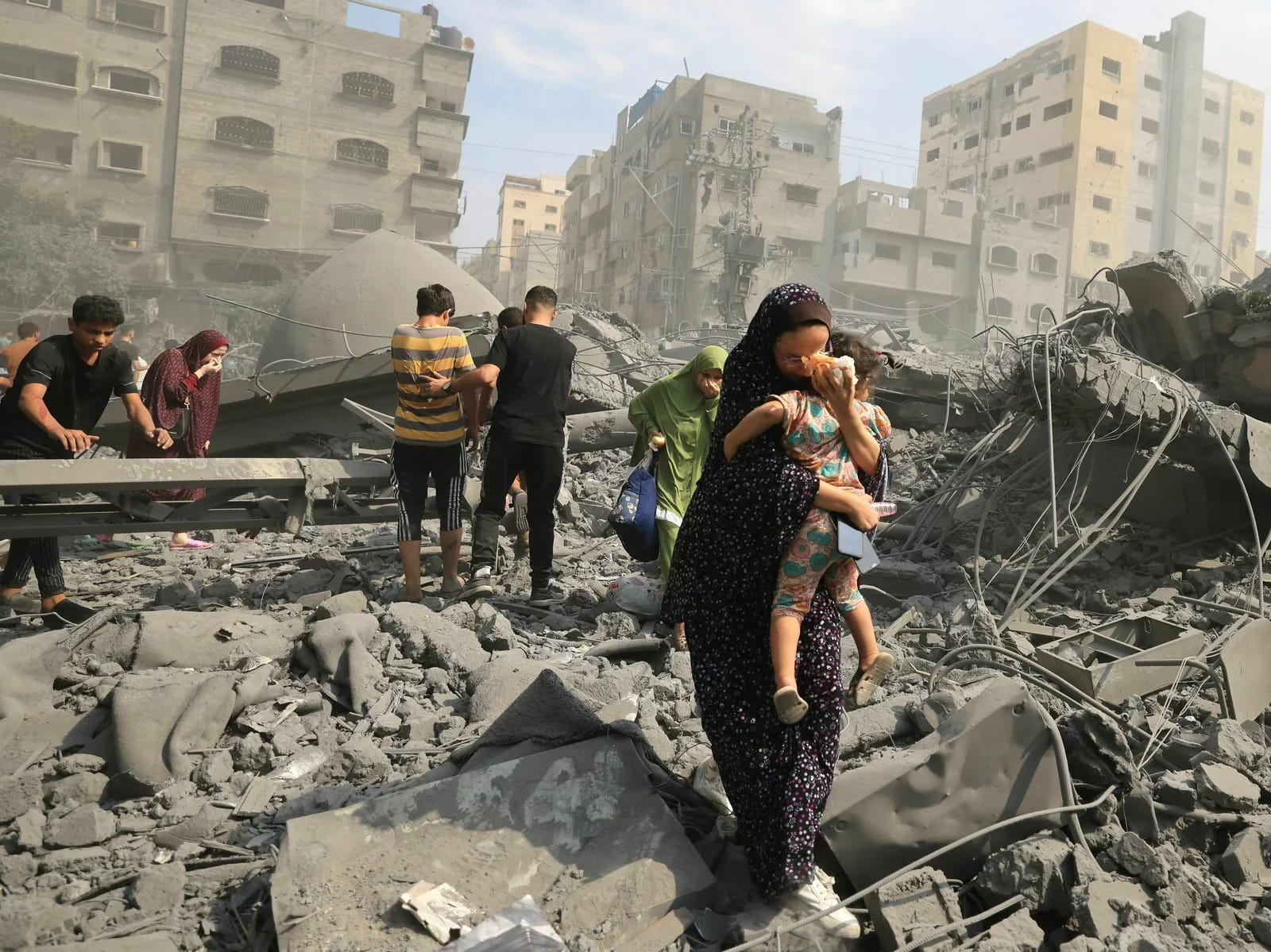
Just think: Another $14 billion to Israel to produce more scenes like this in Gaza

I had to laugh when I saw this assertion from Heather Cox Richardson: “The fight over U.S. aid to Ukraine, Israel, Taiwan, and the other countries with which we have made partnerships is not about saving money—most of the funds for Ukraine are actually spent in the U.S.” Yes! It’s not about “saving money”! After all, most of the money will go to major weapons contractors, America’s merchants of death. So pay no attention to this, peasant. You’re getting a bargain.

In her article, Richardson mentions Dwight D. Eisenhower and the year he took office as president, 1953, which made me think of these famous words said by Ike in 1953:

Every gun that is made, every warship launched, every rocket fired signifies, in the final sense, a theft from those who hunger and are not fed, those who are cold and are not clothed. This world in arms is not spending money alone. It is spending the sweat of its laborers, the genius of its scientists, the hopes of its children… This is not a way of life at all, in any true sense. Under the cloud of threatening war, it is humanity hanging from a cross of iron.

Richardson is having none of this. The Senate’s $95 billion is not “a theft from those who hunger and are not fed,” but rather a wise investment that will pay dividends—as it will, for America’s vast military-industrial-congressional complex (MICC).

Fortunately, it appears the Senate’s $95 billion handout to the MICC (remember: don’t worry about saving money here!) is unlikely to survive the House of Representatives. Still, it is indicative of the total moral bankruptcy of the U.S. Senate and its supine obedience to the weapons makers.

Video bonus: Here I am, talking about the military-industrial complex, trying to channel a tiny bit of Ike and his wisdom:

The video link above is courtesy of the Merchants of Death Tribunal.

“All Options Are On the Table”

W.J. Astore

Then why is bombing the option that’s always chosen?

There they go again. The geniuses inside the DC Beltway are bombing the Middle East again, specifically 85+ targets in Iraq and Syria allegedly supported by Iran. It’s funny: I don’t recall a Congressional declaration of war against Iraq and Syria (or Iran, for that matter), but who needs to be limited by the U.S. Constitution, am I right?

After the recent attack that killed three U.S. soldiers, I heard again that hackneyed expression from DC that “all options are on the table” in response. Amazing how the option that’s always picked by U.S. presidents is the military one. If it’s not “bomb bomb bomb bomb bomb Iran,” as John McCain once jokingly sang, it’s bomb Iranian-backed units in Iraq and Syria, because that’s the best way toward greater stability and peace in the Middle East. Perfectly logical.

Yes, he died in 2018, but he’s America’s most likely presidential winner in 2024.

Speaking of John McCain, I like the joke that’s making the rounds that no matter who Americans vote for as president, they get John McCain, which is a shorthand way of saying that the National Security State is the unofficial fourth and most powerful branch of the U.S. government. Or, if you prefer, the MICIMATT, the military-industrial-congressional-intelligence-media-academe-think-tank complex.

Speaking of the media, you can always count on U.S. media talking heads issuing resounding hosannas to the highest whenever a U.S. president bombs a foreign country. Remember when reporters gushed that Donald Trump had finally become a real president in 2017 when he bombed Syria? Trump, who expressed his contempt for John McCain, finally became him—and earned the MICIMATT’s approval—when he started bombing and launching missiles to kill foreigners.

Finally, we often hear the expression from U.S. government-types that the only thing “they” understand is physical violence and war. It’s often far more accurate to say that the only thing “we” (the MICIMATT, that is) understand (and profit from) is physical violence and war.

“Real Men Want to Go to Tehran”

W.J. Astore

Further escalation in the Middle East

In 2002-03, before the U.S. invasion of Iraq, there was great optimism within the U.S. government that Baghdad was only the first stop on the worldwide victory tour of “the finest fighting force” in human history.  The saying back then was: “Everyone wants to go to Baghdad. Real men want to go to Tehran.” Baghdad, of course, didn’t turn out quite as well as Bush/Cheney expected. The “real men” never did quite make it to Tehran.

With the deaths of three U.S. troops reported yesterday in Jordan near the Syrian border, those “real men” may start dreaming again of going to Tehran. The Biden administration has been quick to blame “radicals” backed by Iran for those deaths. Iran is also being blamed for its support of Houthis in their attacks on shipping as a protest against Israel’s ongoing war of annihilation against Gaza.

How long before the “real men” in Biden’s administration decide that strikes against Iran are justified as reprisals for U.S. troop casualties in Jordan? How long before wars in the Middle East escalate and perhaps spiral out of control?

Only the “real men” of Washington, I suppose, have the answers here. One of those self-styled “real men,” Senator Lindsey Graham of South Carolina, had this to say via a manly tweet: “Hit Iran now. Hit them hard.” His “hard man” service in the U.S. Air Force was as a lawyer.

Lindsey Graham, on the right, decorated by Ukraine. He’s a “hard” hitter!

Update (1/29/24): It remains unclear (at least to me) whether the attack occurred in Jordan or Syria. Here’s an excerpt from Reuters:

Sunday’s attack on a remote outpost known as Tower 22 near Jordan’s northeastern border with Syria, the strikes had not killed U.S. troops nor wounded so many. That allowed Biden the political space to mete out U.S. retaliation, inflicting costs on Iran-backed forces without risking a direct war with Tehran.

Biden said the United States would respond, without giving any more details.

Republicans accused Biden of letting American forces become sitting ducks, waiting for the day when a drone or missile would evade base defenses. They say that day came on Sunday, when a single one-way attack drone struck near base barracks early in the morning.

In response, they say Biden must strike Iran.

“He left our troops as sitting ducks,” said Republican U.S. Senator Tom Cotton. “The only answer to these attacks must be devastating military retaliation against Iran’s terrorist forces, both in Iran and across the Middle East.”

The Republican who leads the U.S. military oversight committee in the House of Representatives, Representative Mike Rogers, also called for action against Tehran.

“It’s long past time for President Biden to finally hold the terrorist Iranian regime and their extremist proxies accountable for the attacks they’ve carried out,” Rogers said.

Former President Donald Trump, who hopes to face off against Biden in this year’s presidential election, portrayed the attack as a “consequence of Joe Biden’s weakness and surrender.”

Note the usual partisan criticism of whichever party is in power in Washington about its alleged “weakness” and “surrender” policies. Few in Congress question the need for U.S. troops operating in Syria in an apparently open-ended commitment.

The death of these troops should not be used as a cause for more war. If anything, they should lead to the withdrawal of U.S. troops from an area and country where they shouldn’t be based.

That Old Canard of Isolationism

W.J. Astore

We can’t have a president that focuses on domestic concerns!

In my “daily briefing” from Reuters yesterday, an old canard popped up again:

As Donald Trump strengthens his lead in the race for the Republican nomination, some US allies are worried about an American turn toward isolationism, a shift that would reflect an electorate largely focused on domestic issues.

We can’t have a U.S. electorate focused on domestic issues! That would be “isolationism.” America must lead! Because Iraq, Afghanistan, Syria, Libya, Somalia, Yemen, Gaza, et al.

When Donald Trump was president, the U.S. military was involved in 40% of the world’s countries in its war on terror. Isolationist? (Smithsonian Magazine, 1/19)

These concerns about “isolationism” always amuse me. The U.S. has roughly 800 overseas bases and a military configured for global reach, global power, and full-spectrum dominance. What are the odds that the U.S. empire is going to abandon all this and turn to isolationism under the visionary and dynamic leadership of Donald J. Trump? It’s not like America became isolationist when Trump was president from 2017 to 2021.

The smartest thing the next U.S. president could do is to start dismantling this costly global empire while reinvesting in America. This is not “isolationism.” This is common sense. Yet “isolationism” is the scary word that’s tossed out there to prevent any downsizing of America’s imperial bootprint.

Speaking of empire and bootprints, William Hartung has an excellent article at TomDispatch on the bottomless pit that is Pentagon spending. As Hartung succinctly puts it in his subtitle: “Overspending on the Pentagon is Stealing Our Future.” You can see how the military-industrial-congressional complex strikes back at any talk of focusing on domestic concerns—America can’t come home and put its own house in order. That’s isolationist! That would “worry” our allies, who need us and our global military.

Maybe those allies, if they’re truly worried, could choose to spend more on their own militaries? Not that I’m worried that our allies genuinely fear a less interventionist America.

As I read and digested Hartung’s article, I had the following disconnected thoughts that I sent along to a friend.

It seems one of the few things Congress can agree on is funding the military, weaponry, bases, etc.  They continue to feed a monster because they personally profit from it and/or are afraid to challenge it.  Presidents as diverse as Bush, Obama, Trump, and Biden refuse to challenge it as well.

The entire system is cowardly.  What the British termed LMF: lack of moral fiber.  Or what MLK Jr. diagnosed as a form of spiritual death.

The solution?  Wish I knew.  The awfulness of the Vietnam War spawned a strong and committed antiwar movement, but now America’s wars and profits have been outsourced to Ukraine, Israel, etc.  The monster is flexible and adaptable.  It is so intertwined with our society and culture today that to reform it meaningfully would require major invasive surgery that might just kill the patient, meaning America as we know it.

I urge you to read Hartung’s article and then ask yourself if America is in any danger of turning to isolationism under Biden or Trump or any other major candidate for the presidency in 2024. The idea is arrant nonsense.

Bombing Another Country for Peace

W.J. Astore

Yemen, Israel, Ukraine, and the U.S. Embrace of War Everywhere

Last night, the U.S. bombed another country, Yemen, in the name of the “rules-based order.” Yemen has been striking shipping as a form of protest against the ongoing Israeli genocide-in-slow-motion in Gaza. It always looks good when the U.S. uses its military to enable mass murder elsewhere. I’m sure the “peace bombs” we dropped will bring stability to the region.

The U.S. military bombs and launches Tomahawk missiles as its answer to everything. Meanwhile, our dynamic commander in chief, Joe Biden, launched a new front in this war of terror without Congressional authorization, an impeachable offense. But of course most in Congress will salute him for taking “decisive” action by bombing yet another poor country with brown-skinned Muslim people living in it. Perhaps Biden is counting on being a “wartime president” as a way to eke out a narrow victory in November.

In Gaza, incremental genocide continues with at least 23,000 Palestinians dead and another 60,000 wounded, the majority being women and children. The Israeli government is poisoning the land and water of Gaza, blasting buildings into rubble, and starving the Palestinians while still claiming to be the victims of the war. Antony Blinken, America’s diplomat-in-chief, says the war will end when Hamas offers its unconditional surrender. After which, what, exactly? Israel will rebuild Gaza and embrace Palestinians as brothers and sisters?

Israel is going to rebuild all this for the Palestinians in Gaza?

In Ukraine, the war continues to be stalemated as Ukraine waits for another $65 billion or so in aid from the Biden administration. Which brings me to this story from The Boston Globe this morning:

More than $1 billion worth of shoulder-fired missiles, drones, and night-vision goggles that the United States has sent to Ukraine have not been properly tracked by US officials, a new Pentagon report concluded, raising concerns they could be stolen or smuggled at a time when Congress is debating whether to send more military aid to Ukraine. 

Over the last two years, the U.S. has flooded Ukraine with weaponry, producing a stalemated war and a healthy black market in stolen arms. The next step should be obvious: persist in the same folly by sending Ukraine even more weapons. Again, the argument is made that it’s all Russia’s fault and that, if Putin wants the war to end, he should basically surrender by withdrawing all Russian troops from the territory he has seized.

There you have it. The annihilation of Gaza will stop when Hamas totally surrenders and the war in Ukraine will stop when Russia totally surrenders, otherwise the U.S. must keep sending more than $100 billion in weaponry and aid to the “democracies” of Israel and Ukraine in their righteous battles against evil. Yes, that really is the position of Biden and Blinken.

Finally, a reader sent along this important article on how the U.S. is funding these wars and in fact the entire war on terror: by deficit spending. Call it “the ghost budget.” America’s national debt has ballooned to $34 trillion mainly due to the disastrous war on terror (roughly $8 trillion), colossal Pentagon budgets, and gargantuan bailouts of banks and corporations due to financial and Covid crises, real or constructed. Vast wealth continues to flow upwards in America as Biden’s “everyday people” struggle. Whether for Biden or Trump, the answer to the debt is always more tax breaks for the rich in the name of “stimulating” growth. Those tax breaks, of course, only drive the national debt up further, but never mind that.

What’s coming is a concerted attack on social security and Medicare/Medicaid in the name of fiscal responsibility. As the comedian George Carlin predicted: They’re coming for your social security. And they’ll get it, he added. Which is consistent with what Joe Biden has said in the past about the need to cut social security as well as health and veterans’ benefits.

Happy Friday, everyone.

Mr. President, Your Secretary of Defense Is Missing

W.J. Astore

SecDef Lloyd Austin Goes MIA

Secretary of Defense Lloyd Austin went into the hospital both before Christmas and on New Year’s Day, apparently not informing the White House and Congress on either occasion. Other than the president as commander-in-chief, SecDef Austin is the senior civilian in the U.S. military’s chain of command.

Secretary of Defense Lloyd Austin looks on during a joint press conference with Israeli Defense Minister Yoav Gallant at Israel’s Ministry of Defense in Tel Aviv, Israel December 18, 2023. REUTERS/Violeta Santos Moura/File Photo

Austin’s medical condition is serious, most recently requiring four days in an intensive care unit. A blindsided president has already declared he won’t fire Austin, nor will Austin resign. No big deal, then?

I’m amazed. One of the first and most valuable lessons I learned in the military was to keep your boss informed. Tell her if the project is behind schedule. Tell him if you’re missing critical spares that would hamper the combat performance of your unit. Don’t let your boss be blindsided. Most obviously, under combat conditions, failing to keep your boss informed of critical information is an almost certain way to get your people killed.

When I was a lieutenant, I served on the “battle staff” for exercises in Cheyenne Mountain. This was in 1986 at the tail end of the Cold War. During one exercise, a friend of mine, another LT, witnessed the commanding four-star general chewing out a colonel on his staff. The colonel had failed to tell the general that AWACS planes were unavailable during the exercise. (Remember, this was an exercise, i.e. “fake.”) My friend told me the general reamed the colonel a new one for failing to inform him of what in wartime would have been a critical piece of information.

Lloyd Austin, it seems, has been MIA for several days without keeping his immediate superior, Joe Biden, in the loop, potentially threatening the national security of our country. Yet Austin has no plans to resign and Biden has no plans to take action.

It’s a bad example to our military that something so critical as a failure to respect the chain of command is being dismissed as a trivial matter. A blindsided Biden should not turn a blind eye here. If Austin has honor, he should resign to avoid further embarrassment to his boss. If he doesn’t, Biden should fire him.

The Madness of Threat Inflation

W.J. Astore

And the Insanity of Wanting to Rule the World

What will historians say decades or centuries from now when the U.S. empire collapses into ruin? How will they explain it?

Consider the United States in the big picture. I see a country with unique strengths. Two wide oceans protecting us. A long secure border with Canada. A securable border with Mexico, the current immigrant “crisis” be damned. Canada and Mexico aren’t our enemies. No invasion is coming from them. As a country, the USA occupies a geographical/global position that is uniquely safe and advantageous.

Why are we so fearful? Why do we spend a trillion dollars (or more) each year on national “defense”?

How incredibly lucky we are! (Credit: Tom Van Sant/Geosphere Project, Santa Monica/Science Photo Library)

Of course, I put “defense” in quotes because the USA is an empire with a military configured for offense. Global reach, global power, was the motto of my service, the U.S. Air Force. The U.S. military strives for full-spectrum dominance, meaning total control of the land, sea, air, space, and cyberspace, justified in the false name of “defense.” The cost of this febrile quest for dominance is, I believe, ultimately unbearable. Why do we persist in such folly?

What country would dare to attack the USA? Other than small terrorist networks like Al Qaeda, no country, no people, no leaders in their right mind would dare attack us, let alone invade us. They know they’d likely be obliterated if they did. Does anyone truly fear an attack on the USA from China? Russia? Iran? North Korea? Given America’s belligerence, evidence of our unbridled vengeance after Pearl Harbor and 9/11, and our vast arsenal of highly destructive weaponry, including thousands of nuclear warheads, anyone attacking the U.S. would be pursuing a death wish.

I am not afraid of Russia, a regional power that is stuck in a quagmire war against Ukraine. I am not afraid of China, a regional military power and economic superpower that is tied to us in global trade and has no intent, near as I can tell, to attack my country. I am not afraid of Iran, or North Korea, or similar “threats” of the moment. So why is my government constantly exaggerating these threats and telling me to be afraid?

Of course, I know all about Ike’s military-industrial-congressional complex. I write against it all the time. It’s not just the MICC and its pursuit of profits and power, however. It’s the corporate interests that say Taiwan must be “protected” for its microchips, the Middle East must be “protected” because of its oil, that Ukraine must be “protected” for its rich agricultural wealth (even as Russia’s gas pipelines to Germany are destroyed) and the riches to be had once the war is over and Ukraine is rebuilt. I know there’s nothing new about this; I’ve read my Smedley Butler.

When I first signed up for the U.S. military in 1981, and then went on active duty in 1985, I thought the U.S. did face a possible existential threat: the Soviet Union, the Warsaw Pact, and Communism. By 1991, that threat was largely gone. Even Cold War hawks like Jeanne Kirkpatrick wrote enthusiastically of the U.S. becoming a normal country in normal times. WTF happened? Why didn’t we?

Here we are, more than 30 years after the collapse of the Soviet Union, and the U.S. government is selling Putin’s Russia as a serious threat again. When we see clear evidence that Putin has more than enough to handle with Ukraine, we’re told to look toward China as the Next Big Threat. Meanwhile, irrational, indefensible, blank checks of support given to Israel in its murderous campaign of ethnic cleansing in Gaza threaten a wider war in the Middle East, a war some in our government seem to be spoiling to fight, knowing of course that they and theirs won’t be fighting it.

We Americans need to get a collective grip on ourselves and our own government. Stop feeding the Pentagon brass with money: it only encourages the bastards. Stop listening to the fear mongers. Turn off the mainstream media and ignore all the threat inflation. Look within yourself and control the fear and divisiveness they try to instill in you.

As Senator George McGovern, a war hero, said in 1972 when he won the Democratic nomination for the presidency: Come home, America. Close most of the military bases that America has overseas. Make deep cuts to the Pentagon war budget. Let other peoples settle their differences without our meddling, without our depleted uranium shells, without our cluster munitions, without our Hellfire missiles, without our mendacious rhetoric about a “rules-based order.”

Come home, America. We have a vast country with vast potential—and serious problems. Time to tackle them instead of seeking to dominate the world.

Or, as the Good Book says, “Why do you look at the speck of sawdust in your brother’s eye and pay no attention to the plank in your own eye?” (Matthew 7:3 NIV) Yes, indeed. Let’s remove the planks from our own eyes, which should keep us very busy for decades, rather than globetrotting to remove the sawdust from the eyes of other peoples who’d prefer us to stay home and leave them alone.

Come home, America. Let’s start removing those planks.

‘Tis the Season for War

W.J. Astore

Hellfire Missiles and Cluster Munitions under the White House Christmas Tree

As Christmas approaches, it doesn’t seem to be the season to be jolly, unless you’re a U.S. weapons manufacturer. It seems instead yet another season for war, as the president and Congress fight over how much deadly weaponry to send to Ukraine and Israel (and to Taiwan as well). Look under the White House Christmas tree and you’ll find Hellfire missiles for Israel, cluster munitions for Ukraine, and similar gifts offering joy to the world.

Last week, Ukraine’s president paid a visit to Washington where he posed with his most fervent supporters and gift-givers: U.S. arms manufacturers. Talk about a photo op!

Zelensky meets with high-ranking executives of the “merchants of death,” or Santa’s DC Beltway elves

Zelensky is no dummy. He knows that Congress and the President ultimately answer to the military-industrial complex. Look for a compromise bill in January that gives Ukraine most of the weapons that it’s requesting.

Meanwhile, the U.S. continues to send Israel the bombs, missiles, and shells it’s using to level Gaza. Last night, I was reading a book and came across this quote about war. Can you guess the person speaking?

“The victor will not be asked afterwards whether he told the truth or not [about the war]. When starting and waging a war it is not right that matters, but victory. Close your hearts to pity. Act brutally. [The] people must obtain what is their right. Their existence must be made secure. The stronger man is right. The greatest harshness.”

“The greatest harshness” might give the game away. It’s Adolf Hitler before the Nazi invasion of Poland in 1939. It’s from Ian Kershaw’s definitive two-volume biography of Hitler, v.2, p. 209.

A brutal, pitiless, war of the greatest harshness: that description doesn’t seem alien to our world today.

U.S. Power Sets All the Wrong Examples to the World

W.J. Astore

An Open Letter from the Eisenhower Media Network

I’m a member of the Eisenhower Media Network, or EMN. We’re a small network of retired military types and former U.S. government officials who are openly critical of the military-industrial-congressional complex, America’s open-ended forever wars (the global war on terror; the cold war against Russia and China), and rising militarism within and across our society.

Recently, EMN issued a new letter in opposition to the Washington bipartisan consensus for war and more war. I’m proud to say I had a hand in writing it, as did Matthew Hoh and other members of EMN. Here’s what we had to say:

Military and Foreign Policy Experts Open Letter on U.S. Diplomatic Malpractice

Does America inspire the world by the power of its example or the example of its power? Far too often, and despite President Joe Biden’s words during his inaugural address, America’s overmilitarized power and diplomatic malpractice are its examples to the world.

We must change that. To make America truly essential and indispensable, we must not remain the world’s leading arms maker and weapons exporter. We must instead become the world’s greatest and most committed peacemaker and diplomat.

The problem is that America continues to make war, continues being “essential” only as the world’s leading merchant of death, and continues seeking dominance through military supremacy that ends, in places like Afghanistan, Iraq, and earlier in Vietnam, in mass death and colossal folly.

In our first open letter last spring in The New York Times, we, the undersigned, argued that a thoroughly militarized U.S. foreign policy would generate ruinous and worsening consequences and increasingly limited options for the U.S. and the world. Recent events bear this out.

The results of U.S. diplomatic malpractice are cruelly displayed in Eastern Europe, the Middle East and the Indo-Pacific. Risks of further escalation and a world war are rising. Predictably, a militarized foreign policy characterized by rejecting or ignoring international laws and treaties and by disingenuous negotiations and talks has offered no solutions to volatile wars in Eastern Europe and the Middle East while making war more likely in the Indo-Pacific.

Militarized solutions breed and feed more war. Earnest and deliberate diplomacy is the best hope to bring peace, stability and reconciliation to the world.

We chose Ike as our inspiration because he warned Americans of the dangers of the military-industrial complex and because he rejected a world dedicated to manufacturing weapons to commit mass murder. 

War in Ukraine

The failure to pursue diplomacy in Eastern Europe, both before and after Russia’s invasion of Ukraine, has resulted in a costly and destructive stalemate for which there are two likely futures:

  1. The collapse of the Ukrainian state due to a deteriorating economic and military situation hastened by corruption.Here, Ukraine’s fragility resembles that of previous houses of cards built by the U.S. in Afghanistan, Iraq, and Vietnam.
  2. A harrowing and bloody stalemate in Ukraine where firepower, made more lethal by technological advances, rules a battlefield where neither side can achieve decisive tactical or operational gains. The pursuit of ways out of this stalemate likely entails horizontal and vertical escalation, neither of which offers solace to those seeking an end to death and destruction in Ukraine and the establishment of peace and stability.

Horizontal escalation sees the war extending further to civilian population centers and infrastructure and includes the possibility of other nations joining the conflict. Vertical escalation sees the expansion of arsenals to weapons of greater range, lethality, and consequence, including nuclear weapons. These two forms of escalation may be intertwined and reinforcing. So, as the war may expand horizontally to resemble The War of Cities between Iran and Iraq in the 1980s, it may expand vertically as well with more powerful weapons being introduced by both sides. The use of nuclear weapons is increasingly conceivable under these conditions.

These two likely futures may intersect. For example, a Ukrainian collapse could see NATO forces, likely Polish and Romanian, marching into western and central Ukraine to counter a Russian push to fill a collapsing Ukrainian state. Such an event could lead to a war between NATO and Russia, a war that conceivably could go nuclear.

Hamas, Israel and the Middle East

The Russia-Ukraine War now rages concurrently with the war between Hamas and Israel. This war, too, is born of a U.S. refusal to foster diplomacy. Unlike the conventional war between Russia and Ukraine, we are witnessing an asymmetrical conflict more akin to the wars of insurgency many of us experienced in Vietnam, Afghanistan, and Iraq.

Worse, the Hamas/Israel bloodletting in Gaza is characterized by an ethnic cleansing campaign that would be impossible without U.S. diplomatic, economic, media, military and political support. We are disgusted by and find repugnant the brazen and bipartisan support by the U.S. government for rampant violations of international law by Israel. Ethnic cleansing in Gaza, long planned by senior members of the Israeli government and powerful elements of Israel’s reactionary right wing, follows in the ghastly wake of Hamas atrocities against civilians on October 7.

Here, the U.S. government isn’t just passively witnessing war crimes; it is enabling them. With the frightening possibility of escalation to a regional or even a world war, the violence in Gaza has fed and feasted upon decades of deliberate diplomatic malpractice in America. Decades of putting Israel first, second, and last while ignoring the plight and pleas of Palestinians have made political settlements to the blockade of Gaza and the occupation of East Jerusalem and the West Bank nearly impossible.

Whereas a month ago, we lived with the risk of nuclear war as an outcome of escalating conflict in Ukraine, we now face the elevated risk of a rightfully feared world war as a consequence of entangling alliances between nuclear-armed Moscow and Washington in the Middle East.

China and the Path Ahead

To this, we must add the dangers of war with China, something hyped by leading U.S. politicians; the still unpaid costs of the $8 trillion wars in Afghanistan and Iraq; a militarized federal budget for which 60% of discretionary spending goes to war and all its wounds; and a hollowed American economy.

Decades of reckless U.S. war-making, both direct and via proxies, while coddling corrupt, ruthless, and unjust foreign governments has, not surprisingly, made the world more dangerous and less stable. Failure to invest in and maintain our country has weakened and corroded America’s infrastructure, institutions, and industries. A hypocritical flaunting of international law and an espousal of an ethereal rules-based order, coupled with an arrogant disregard for past U.S. crimes and blunders, have caused dozens of nations to flock to competitors – a movement away from America that will undoubtedly accelerate if we remain on our current militaristic path.

Moreover, decades of colossal military spending have witnessed few strategic gains for the U.S. Our military, often saluted as the world’s greatest by politicians, hasn’t won a major war since World War II. That same military annually faces significant recruiting shortfalls that cast considerable doubt on the integrity and staying power of the All-Volunteer Force. America’s legacy of failed wars is not redeemed by ongoing displays of vacuous military boosterism. Feel-good patriotism can’t suppress the bitterness many of us military veterans feel toward the past, nor does it calm the worries we have about our nation’s future.

Pope Francis has spoken of a “famine of peace” that exists in the world today. In this spirit, we call for immediate ceasefires, without conditions, in Gaza and Ukraine.

The surest way to prevent wars from exploding into uncontainable wildfires is to starve them of fuel. To think or speak that these conflagrations can be managed, adjusted as if by damper or thermostat, is a fool’s conceit or a liar’s word. We have been burned too many times in our professional lives to believe hot wars can be “won” by throwing more gasoline on them, whether rhetorically or in the form of cluster munitions, depleted uranium shells, and similar forms of “aid.”

A better path ahead is clear. Peace, not war, must be fostered. In embracing peace through diplomacy conducted in good faith, America would indeed exhibit the power of its example, becoming essential to a world that cries out for liberty and justice for all.