The U.S. Military’s Alleged Recruiting Crisis Isn’t the Problem

W.J. Astore

America Must Reignite Its Distrust of Large Standing Militaries

recent article by Major General (ret.) Dennis Laich and Colonel (ret.) Lawrence Wilkerson notes a crisis in military recruitment in America. Here’s how their article begins:

The U.S. military’s all-volunteer force (AVF) model is an abject failure. Last year, the active Army fell 15,000 recruits short of its goal. This year, it was 10,000, and the Army Reserve fell 40% short of its goal. This year, the active Navy fell 7,000 short, and the Navy Reserve was 33% short. Finally, the active Air Force fell 3,000 recruits short, and the Air Force Reserve and Air National Guard each fell 30% short of their goals. 

There is no reason to believe these trends won’t continue, and even less reason to believe they will not get worse. In the past 10 years, the propensity to serve has fallen from 15% to 9%, and the portion of the recruiting-age population qualified to serve has dropped from 30 % to 23%. The number of children 5 and under in the United States is 12% smaller than the 15- to 25-year-old cohort, presenting a grim demographic reality.  

Our national security crisis is part of a broader civic rot that plagues our democracy. Ultimately, the AVF’s failure could lead to war if the U.S. appears weak to a potential adversary.

Laich and Wilkerson would like to see a return of a lottery-based military draft for young men and women in America. I respect these men; we are part of the same organization, the Eisenhower Media Network. Yet I see this issue in a different light.

In essence, young Americans are voting with their feet by not joining the military in the numbers the AVF desires. This is not a bad thing. The U.S. military, if it was focused truly on national defense, would and should be considerably smaller. What enlarges our military (and its recruitment quotas) is imperial sprawl. Does the U.S. truly need to garrison roughly 800 military bases overseas? Does the U.S. Army truly need big brigades and battalions to fight conventional wars in Asia? Why does the Air Force need so many people? Why must the Navy have so many ships? Why do we need a growing Space Force?

A recruiting crisis even with Tom Cruise making two-hour commercials for the U.S. Navy? (Cruise attends the London premiere of “Top Gun: Maverick.” Karwai Tang | Wireimage | Getty Image)

I don’t see America appearing “weak” to potential adversaries. If anything, potential adversaries look at the U.S. as an overly strong and often unpredictable bully. Every country in the world knows the U.S. puts its military first, that the U.S. is the only nation to have used nuclear weapons in war, that the U.S. never met a war it didn’t like, even though it hasn’t won a major war since World War II. Military weakness is not a problem America is ever likely to have. Even when the empire eventually collapses, the military will still be the last American institution that will be fully funded. (Indeed, huge sums of money spent on the military is contributing to that collapse.)

We don’t need a revival of the draft. We need a revival of sanity. We need a foreign policy in which we mind our own business. In which we don’t dispatch military forces to every hotspot in the world. In which we don’t pummel other countries into submission, as we attempted to do with countries like Vietnam, Laos, and Cambodia. (The death of Henry Kissinger the Pummeler at age 100 shows that only the good die young.)

A smaller military might mean fewer foreign entanglements for America as well as far less global destruction (think of Southeast Asia as well as Iraq, Afghanistan, Libya, Syria, Somalia, and so on). That wouldn’t be a bad thing.

Of course, the U.S. military’s answer to its alleged recruiting crisis is to hire an expensive advertising agency, giving it more than $450 million in taxpayer money to craft new ways of enticing young Americans to join the AVF. It just goes to show how much money the Pentagon has to throw (or throw away) at perceived problems.

If America faced a true and immediate threat (a clear and present danger, as the saying goes) to its national security, I don’t doubt young Americans would step up. But I see no foreign enemy seeking the military conquest of Topeka or Tampa or Tucson, nor do I see a pressing need for a super-sized military that still retains a Cold War mentality of full-spectrum dominance against the Reds (China and Russia remain the bogeymen for most in the U.S. military and Congress as well.)

As one major general once told me, less money for the U.S. military, along with fewer troops, might have the salutary effect of forcing the brass to think for once before invading another country or threatening yet another war. Wouldn’t that be something.

Throughout most of our history, America had a profound distrust of large standing militaries and the mayhem and mischief they so often cause. It’s time to reignite that distrust.

America, Land of Innocents

W.J. Astore

I’m sure glad atrocity never happened here

It’s depressingly true that no nations or peoples are immune from committing atrocities. History is filled with them. Atrocities, that is.

Did Hamas commit atrocities, most notably on 10/7? Yes. Has Israel committed atrocities in Gaza since those terror attacks? Yes.

Any sane human is outraged by atrocious behavior. What is particularly galling about Israel’s atrocities is that the U.S. government is enabling them while claiming Israel and the U.S. are the good guys—and that, however many innocents die due to U.S. and Israeli bombs, bullets, and missiles, it’s all the fault of Hamas.

Even serial killers sometimes know they are monsters. We fancy ourselves as innocents.

Why? Because America is a “good” country. Good thing we never promoted slavery and participated in massacres of Native Americans.  Or the mass imprisonment of Japanese-Americans in concentration camps during World War II.  Or widespread misogyny. (Remember that women weren’t even allowed to vote in presidential elections until 1920.). Good thing we’ve always embraced Jews, never discriminating against them or turning desperate Jews away during the Holocaust.

Americans should know from our own history that “good” people can do horrific things because as a country we’ve done them ourselves.

Most Americans see Israel as an ally, a modern democracy akin to the U.S. That doesn’t mean Israel is immune from atrocious behavior; again, our own history shows that America is well capable of slaughtering millions in the name of “manifest destiny.” Back in the day, most Americans agreed we had our own “human animals,” our own savages, and that “the only good Indian is a dead one.” So, in the name of destiny, even of God, we killed the brave.

My dog-eared copy

The other day, as a distraction from current events, I started reading again from Schopenhauer’s essays and aphorisms. As a European living when slavery was very much alive in antebellum America, Schopenhauer had this to say about the “pitilessness” and “cruelty” in “slave-owning states of the North American Union”:

No one can read [accounts of slavery in antebellum America] without horror, and few will not be reduced to tears: for whatever the reader of it may have heard or imagined or dreamed of the unhappy condition of the slaves, indeed of human harshness and cruelty in general, will fade into insignificance when he reads how these devils in human form, these bigoted, church-going, Sabbath-keeping scoundrels, especially the Anglican parsons among them, treat their innocent black brothers whom force and injustice have delivered into their devilish clutches. This book [on slavery in the USA] rouses one’s human feelings to such a degree of indignation that one could preach a crusade for the subjugation and punishment of the slave-owning states of North America. They are a blot on mankind.

Schopenhauer was pulling no punches, and rightly so. Yet there are still those in America who make the argument that slavery wasn’t all bad, that some slaves learned useful skills. Though I don’t hear such apologists volunteering to be slaves themselves.

If a curriculum in Florida can still put a happy face on the deep iniquity of slavery, which the U.S. eliminated (at least by law) in 1865, are we at all surprised that many can put a happy face on whatever Israel is doing in Gaza?

Ethnic cleansing? Genocide? Been there, done that. But that’s OK: “they” were savages. “We” the chosen ones had no choice. Or did we?

The New Merchants of Death

W.J. Astore

America Remains Number One in Selling Deadly Weaponry Worldwide

This weekend, the Merchants of Death Tribunal kicks off on Sunday at 8PM EST. You can register for the event by following this link:

The intent of this “tribunal” is to draw attention to America’s overwhelming dominance of the world’s trade in deadly weaponry and the cost we all pay when “weapons ‘r’ us.” How did the U.S. come to embrace this deadly trade, to the point of boasting of our market dominance as a sign of America’s health and fitness? How did we come to equate arsenals with democracy? And isn’t it high time we denounced this trade in death, as the U.S. Senate did back in the 1930s with the Nye Commission?

Back in 2012, I wrote an article for TomDispatch, “Confessions of a Recovering Weapons Addict,” in which I admitted my own childish enthusiasm for weaponry and all things that go “bang”—and kill. It’s reposted today at TomDispatch and also here below.

To learn more about the Merchants of Death effort, go to https://merchantsofdeath.org.

Weapons ‘R’ Us (2012)

BY WILLIAM J. ASTORE

Perhaps you’ve heard of “Makin’ Thunderbirds,” a hard-bitten rock & roll song by Bob Seger that I listened to 30 years ago while in college. It’s about auto workers back in 1955 who were “young and proud” to be making Ford Thunderbirds. But in the early 1980s, Seger sings, “the plants have changed and you’re lucky if you work.” Seger caught the reality of an American manufacturing infrastructure that was seriously eroding as skilled and good-paying union jobs were cut or sent overseas, rarely to be seen again in these parts.

If the U.S. auto industry has recently shown sparks of new life (though we’re not making T-Birds or Mercuries or Oldsmobiles or Pontiacs or Saturns anymore), there is one form of manufacturing in which America is still dominant. When it comes to weaponry, to paraphrase Seger, we’re still young and proud and makin’ Predators and Reapers (as in unmanned aerial vehicles, or drones) and Eagles and Fighting Falcons (as in F-15 and F-16 combat jets), and outfitting them with the deadliest of weapons. In this market niche, we’re still the envy of the world.

Yes, we’re the world’s foremost “merchants of death,” the title of a best-selling exposé of the international arms trade published to acclaim in the U.S. in 1934. Back then, most Americans saw themselves as war-avoiders rather than as war-profiteers. The evil war-profiteers were mainly European arms makers like Germany’s Krupp, France’s Schneider, or Britain’s Vickers.

Not that America didn’t have its own arms merchants. As the authors of Merchants of Death noted, early on our country demonstrated a “Yankee propensity for extracting novel death-dealing knickknacks from [our] peddler’s pack.” Amazingly, the Nye Committee in the U.S. Senate devoted 93 hearings from 1934 to 1936 to exposing America’s own “greedy munitions interests.” Even in those desperate depression days, a desire for profit and jobs was balanced by a strong sense of unease at this deadly trade, an unease reinforced by the horrors of and hecatombs of dead from the First World War.

We are uneasy no more. Today we take great pride (or at least have no shame) in being by far the world’s number one arms-exporting nation. A few statistics bear this out. From 2006 to 2010, the U.S. accounted for nearly one-third of the world’s arms exports, easily surpassing a resurgent Russia in the “Lords of War” race. Despite a decline in global arms sales in 2010 due to recessionary pressures, the U.S. increased its market share, accounting for a whopping 53% of the trade that year. Last year saw the U.S. on pace to deliver more than $46 billion in foreign arms sales. Who says America isn’t number one anymore?

For a shopping list of our arms trades, try searching the Stockholm International Peace Research Institute database for arms exports and imports. It reveals that, in 2010, the U.S. exported “major conventional weapons” to 62 countries, from Afghanistan to Yemen, and weapons platforms ranging from F-15, F-16, and F-18 combat jets to M1 Abrams main battle tanks to Cobra attack helicopters (sent to our Pakistani comrades) to guided missiles in all flavors, colors, and sizes: AAMs, PGMs, SAMs, TOWs — a veritable alphabet soup of missile acronyms. Never mind their specific meaning: they’re all designed to blow things up; they’re all designed to kill.

Rarely debated in Congress or in U.S. media outlets is the wisdom or morality of these arms deals. During the quiet last days of December 2011, in separate announcements whose timing could not have been accidental, the Obama Administration expressed its intent to sell nearly $11 billion in arms to Iraq, including Abrams tanks and F-16 fighter-bombers, and nearly $30 billion in F-15 fighter jets to Saudi Arabia, part of a larger, $60 billion arms package for the Saudis. Few in Congress oppose such arms deals since defense contractors provide jobs in their districts — and ready donationsto Congressional campaigns.

Let’s pause to consider what such a weapons deal implies for Iraq. Firstly, Iraq only “needs” advanced tanks and fighter jets because we destroyed their previous generation of the same, whether in 1991 during Desert Shield/Storm or in 2003 during Operation Iraqi Freedom. Secondly, Iraq “needs” such powerful conventional weaponry ostensibly to deter an invasion by Iran, yet the current government in Baghdad is closely aligned with Iran, courtesy of our invasion in 2003 and the botched occupation that followed. Thirdly, despite its “needs,” the Iraqi military is nowhere near ready to field and maintain such advanced weaponry, at least without sustained training and logistical support provided by the U.S. military.

As one U.S. Air Force officer who served as an advisor to the fledging Iraqi Air Force, or IqAF, recently worried:

“Will the IqAF be able to refuel its own aircraft? Can the Iraqi military offer adequate force protection and security for its bases? Can the IqAF provide airfield management services at its bases as they return to Iraqi control after eight years under US direction? Can the IqAF ensure simple power generation to keep facilities operating? Will the IqAF be able to develop and retain its airmen?… Only time will tell if we left [Iraq] too early; nevertheless, even without a renewed security agreement, the USAF can continue to stand alongside the IqAF.”

Put bluntly: We doubt the Iraqis are ready to field and fly American-built F-16s, but we’re going to sell them to them anyway. And if past history is a guide, if the Iraqis ever turn these planes against us, we’ll blow them up or shoot them down — and then (hopefully) sell them some more.

Our Best Arms Customer

Let’s face it: the weapons we sell to others pale in comparison to the weapons we sell to ourselves. In the market for deadly weapons, we are our own best customer. Americans have a love affair with them, the more high-tech and expensive, the better. I should know. After all, I’m a recovering weapons addict.

Well into my teen years, I was fascinated by military hardware. I built models of what were then the latest U.S. warplanes: the A-10, the F-4, the F-14, -15, and -16, the B-1, and many others. I read Aviation Week and Space Technology at my local library to keep track of the newest developments in military technology. Not surprisingly, perhaps, I went on to major in mechanical engineering in college and entered the Air Force as a developmental engineer.

Enamored as I was by roaring afterburners and sleek weaponry, I also began to read books like James Fallows’s National Defense (1981) among other early critiques of the Carter and Reagan defense buildup, as well as the slyly subversive and always insightful Augustine’s Laws (1986) by Norman Augustine, later the CEO of Martin Marietta and Lockheed Martin. That and my own experience in the Air Force alerted me to the billions of dollars we were devoting to high-tech weaponry with ever-ballooning price tags but questionable utility.

Perhaps the best example of the persistence of this phenomenon is the F-35 Lightning II. Produced by Lockheed Martin, the F-35 was intended to be an “affordable” fighter-bomber (at roughly $50 million per copy), a perfect complement to the much more expensive F-22 “air superiority” Raptor. But the usual delays, cost overruns, technical glitches, and changes in requirements have driven the price tag of the F-35 up to $160 million per plane, assuming the U.S. military persists in its plans to buy 2,400 of them. (If the Pentagon decides to buy fewer, the cost-per-plane will soar into the F-22 range.) By recent estimates the F-35 will now cost U.S. taxpayers (you and me, that is) at least $382 billion for its development and production run. Such a sum for a single weapons system is vast enough to be hard to fathom. It would, for instance, easily fund all federal government spending on education for the next five years.

The escalating cost of the F-35 recalls the most famous of Norman Augustine’s irreverent laws: “In the year 2054,” he wrote back in the early 1980s, “the entire defense budget will [suffice to] purchase just one aircraft.” But the deeper question is whether our military even needs the F-35, a question that’s rarely asked and never seriously entertained, at least by Congress, whose philosophy on weaponry is much like King Lear’s: “O, reason not the need.”

But let’s reason the need in purely military terms. These days, the Air Force is turning increasingly to unmanned drones. Meanwhile, plenty of perfectly good and serviceable “platforms” remain for attack and close air support missions, from F-16s and F-18s in the Air Force and Navy to Apache helicopters in the Army. And while many of our existing combat jets may be nearing the limits of airframe integrity, there’s nothing stopping the U.S. military from producing updated versions of the same. Heck, this is precisely what we’re hawking to the Saudis — updated versions of the F-15, developed in the 1970s.

Because of sheer cost, it’s likely we’ll buy fewer F-35s than our military wants but many more than we actually need. We’ll do so because Weapons ‘R’ Us. Because building ultra-expensive combat jets is one of the few high-tech industries we haven’t exported (due to national security and secrecy concerns), and thus one of the few industries in the U.S. that still supports high-paying manufacturing jobs with decent employee benefits. And who can argue with that?

The Ultimate Cost of Our Merchandise of Death

Clearly, the U.S. has grabbed the brass ring of the global arms trade. When it comes to investing in militaries and weaponry, no country can match us. We are supreme. And despite talk of modest cuts to the Pentagon budget over the next decade, it will, according to President Obama, continue to grow, which means that in weapons terms the future remains bright. After all, Pentagon spending on research and development stands at $81.4 billion, accounting for an astonishing 55% of all federal spending on R&D and leaving plenty of opportunity to develop our next generation of wonder weapons.

But at what cost to ourselves and the rest of the world? We’ve become the suppliers of weaponry to the planet’s hotspots. And those weapons deliveries (and the training and support missions that go with them) tend to make those spots hotter still — as in hot lead.

As a country, we seem to have a teenager’s fascination with military hardware, an addiction that’s driving us to bust our own national budgetary allowance. At the same time, we sell weapons the way teenage punks sell fireworks to younger kids: for profit and with little regard for how they might be used.

Sixty years ago, it was said that what’s good for General Motors is good for America. In 1955, as Bob Seger sang, we were young and strong and makin’ Thunderbirds. But today we’re playing a new tune with new lyrics: what’s good for Lockheed Martin or Boeing or [insert major-defense-contractor-of-your-choice here] is good for America.

How far we’ve come since the 1950s!

Israel, America, and Going “Massive”

W.J. Astore

Using Terror Attacks as an Excuse to Kill Indiscriminately

In the immediate aftermath of the 9/11 attacks on America in 2001, Secretary of Defense Donald Rumsfeld knew exactly what to do: “go massive.” Al Qaeda’s “shock and awe” attacks were an opportunity for the Bush/Cheney administration not only to strike against “terror” but against Saddam Hussein and Iraq, possibly even Iran, even though those countries had no role in 9/11. Here’s how Rumsfeld put it:

“Hard to get good case [against Iraq]. Need to move swiftly. Near term target needs – go massive – sweep it all up, things related and not.”

Going “massive” had another benefit: it distracted Americans from the colossal failure of Bush/Cheney/Rumsfeld to keep America safe, to anticipate and prevent the Al Qaeda attacks. Americans rallied around the flag and asked few questions as Congress gave the president a blank check to wage a “global war on terror.”

Something similar is happening in Israel today. The Hamas terror attacks are giving Bibi Netanyahu and the hard right in Israel an opportunity to “go massive,” to “sweep it all up, things related and not.” This has the added virtue of distracting Israelis from the colossal failure of Netanyahu in anticipating and preventing the Hamas attacks. Like their American counterparts, Israelis are tending to rally around the flag as their government is given a blank check (supported by the USA) to wage a war on terror in Gaza.

Of course, a war on terror is a war of terror, which is what we’re witnessing in Gaza. Massive Israeli bombing. Deaths that will soon exceed ten thousand. Widespread hunger, thirst, and suffering. Massive displacement of Palestinians from their homes. All justified because Israel was attacked, and not just attacked but embarrassed, as America was embarrassed on 9/11.

Consider these satellite images from Gaza showing massive destruction from Israeli bombing.

Broadly speaking, the USA and Israel share a conceit of being God’s chosen people and also of having the world’s finest and best military forces. These conceits were challenged respectively by the success of the Al Qaeda and Hamas terror attacks. Embarrassment coupled with anger and revenge leads to going “massive,” irrespective of wisdom or legality (or morality). Going “massive” is also a great CYA exercise, as in covering your ass.

Now is the time, these failed leaders decide, to punish “evildoers,” innocent people be damned. What matters is violence, action, vengeance, settling scores, irrespective of human rights and the so-called rules-based international order. It’s time to kill.

If history doesn’t quite repeat itself, it surely does echo as Israel, much like the USA after 9/11, goes “massive” and kills innocents while claiming it’s all in the cause of self-defense and justice.

The Rambo Mystique

W.J. Astore

Forgotten Lessons from “First Blood”

I remember seeing the first Rambo flick (“First Blood”) in a movie theater in 1982 when I was nineteen and rooting for Sly Stallone’s character against the police and national guardsmen who are sent to kill him.  The police think it’ll be easy to subdue one man, but we the viewers know better.  As Colonel Trautman, Rambo’s former commanding officer, says in the movie: In war, it’s wise to have “a good supply of body bags” on hand, a telling reminder about the harsh reality of combat.

In “First Blood,” military clothing and the flag offer no protection to John Rambo, who’s treated as a lowlife by the local sheriff 

Yet, there’s a deeper meaning to “First Blood” captured near the end of the movie, when John Rambo, having improbably acted as a one-man invincible army (a true “Army of One”), bitterly reflects on his own post-Vietnam experiences.  Rambo, breaking down, admits he can’t adapt to regular civilian life.  A loner, he feels himself to be a loser, even though he was decorated for heroism in war with the Medal of Honor.  Wounded and haunted by war, his soul seared by violence, he surrenders to Colonel Trautman.

The original Rambo movie wasn’t necessarily deep, but it did remind us that soldiers like Rambo carried hidden wounds of war; it also highlighted a societal suspicion, whether just or unjust, of military veterans.  The sheriff in “First Blood” has no respect for Rambo as a military “hero”; he sees him as a disreputable and dangerous outsider and just wants to be rid of him, one way or another.

Subsequent Rambo films would portray him as a virtually unstoppable killing machine. In the first sequel, Rambo is sent back to Vietnam to rescue American POWs betrayed and abandoned by the U.S. government.  Perhaps the most famous line from that movie is when Rambo asks Colonel Trautman whether, in returning to Vietnam, the government will finally allow U.S. soldiers to win this time.  It was a concise statement of the stab-in-the-back myth, the idea the U.S. military would have won the war in Vietnam if only it hadn’t been betrayed by a duplicitous and spineless government.

“Do we get to win this time?”  That’s a question that should haunt all Americans, since we haven’t won a war since 1945.  But who is to blame for not winning?  And have the wars America has fought since World War II really been worth fighting to begin with?

Update (9/2923): A lot has changed in forty years, as a couple of my friends pointed out in response to this article. We could imagine at least two scenarios for a revised Rambo made in 2023:

Version 1: In 2023, the sheriff wouldn’t have to call in the National Guard.  All his deputies would gear up with assault rifles, sniper rifles, body armor, and MRAPs donated by the Pentagon as excess gear and the local SWAT team would be mobilized and deployed to find and kill Rambo.

Version 2: Perhaps the most likely one: Rambo would be wearing a “blue lives matter” flag, the sheriff’s patrol car would be festooned with “support our troops” stickers, and they’d call a town meeting to give Rambo the keys to the town as a Medal of Honor winner.

Imagining a Progressive Pentagon

W.J. Astore

13 Tasks and 3 Maxims for a Very Different Pentagon

Also at TomDispatch.com.

A progressive Pentagon? Talk about an oxymoron! The Pentagon continues to grow and surge with ever larger budgets, ever more expansive missions (for example, a Space Force to dominate the heavens and yet more bases in the Pacific to encircle China), and ever greater ambitions to dominate everywhere, including if necessary through global thermonuclear warfare. No wonder it’s so hard, to the point of absurdity, to imagine a Pentagon that would humbly and faithfully serve only the interests of “national defense.”

Yet, as a thought experiment, why not imagine it? What would a progressive Pentagon look like? I’m not talking about a “woke” Pentagon that touts and celebrates its “diversity,” including its belated acceptance of LGBTQ+ members. I’m glad the Pentagon is arguably more diverse and tolerant now than when I served in the Air Force beginning in the early 1980s. Yet, as a popular meme has it, painting “Black Lives Matter” and rainbow flags on B-52 bombers doesn’t make the bombs dropped any less destructive. To be specific: Was it really a progressive milestone that the combat aircraft in last year’s Super Bowl flyover were operated and maintained entirely by female crews? Put differently, are the bullets and bombs of trans Black G.I. Jane somehow more tolerant and less deadly than cis White G.I. Joe’s?

A progressive military shouldn’t stop with “more Black faces in high places,” more female generals “leaning in” around conference tables, and similar so-called triumphs for diversity. Consider Lloyd Austin, the first Black secretary of defense, whose views and actions have been little different from those of former Defense Secretaries James Mattis or Donald Rumsfeld, and whose background as a retired Army four-star general and well-paid former board member of Raytheon makes him the very stereotype of Dwight D. Eisenhower’s military-industrial complex.

No, all-female air crews aren’t nearly enough. Indeed, they are, I’d argue, a form of “woke” camouflage for a predatory military leopard that refuses to change its spots — or curb its appetite.

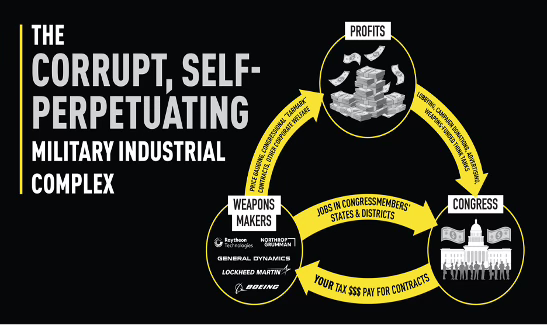
A truly progressive military should start with the fundamentals. All service members swear an oath to support and defend the Constitution, the system of laws that defines and enshrines our vital rights and freedoms (speech, a free press, the right to assemble, privacy, and so on); in short, the right to live untrammeled by domineering forces. Yet, almost by definition, that right is threatened, if not violated, by a massive military-industrial-congressional complex that penetrates nearly every domain of American life. That complex, after all, is anti-democratic, shrouded in secrecy, and jealous of its power, as well as fundamentally and profoundly anti-progressive. Indeed, it’s fundamentally and profoundly anti-truth.

Consider these hard facts. All too many Americans didn’t know how badly they’d been lied to about the Vietnam War until the Pentagon Papers emerged near the end of that disastrous conflict. All too many Americans didn’t know how badly they’d been lied to about the Afghan War until the Afghan War Papers emerged near the end of that disastrous conflict. All too many Americans didn’t know how badly they’d been lied to about the Iraq War until the myth of Saddam Hussein’s weapons of mass destruction (which had been part of the bogus rationale for invading that country) crumbled; nor did they know how badly they continued to be lied to until the myth of the American “surge” there collapsed when the Islamic State forces triumphed all too easily over an American-built Iraqi security structure that collapsed like a rotten house of cards. Perhaps some of them didn’t truly know until a loudmouthed Republican candidate for president, Donald J. Trump, dared to say that the Iraq War had been an unmitigated disaster, or, in Trump-speak, “a big fat mistake.” That burst of honesty helped him win the presidency in 2016. (His rival in that election, Hillary Clinton, remained essentially the chief spokesperson for the Pentagon.)

Yet despite the horrendous failures (and war crimes) of Vietnam, Afghanistan, Iraq, and other U.S. military ventures of this century, no one is ever punished! Sure, you could point to Donald Rumsfeld being cashiered as secretary of defense amid the rubble of “the Global War on Terror,” a belated admission by the administration of President George W. Bush and Vice President Dick Cheney that the Iraq War was going poorly indeed. Still, all those cracks were later papered over with the myth of “the surge” and when Rumsfeld died in 2021, he would receive remarkably glowing tributes in obituaries, as well as bipartisan salutes for his “service” to America rather than condemnation for his numerous crimes and blunders.

The Pentagon’s rampant culture of dishonesty, a cancer that above all infects the brass, led one serving Army officer, Lieutenant Colonel Paul Yingling, to write a now-renowned (or, if you’re part of the Pentagon, infamous) paper for Armed Forces Journal in 2007 on America’s failure of generalship. As he memorably noted, a U.S. Army private suffered far more dearly for losing a rifle than America’s generals did for losing a war. The Army’s response was — no surprise — to change nothing, leading Yingling to retire early.

13 Tasks for a Progressive Pentagon

Venturing into the Pentagon’s innermost corridors of power, one might be excused for recalling Obi-Wan Kenobi’s warning to Luke Skywalker in Star Wars as they approached the spaceport of Mos Eisley: “You will never find a more wretched hive of scum and villainy. We must be cautious.”

How does one possibly reform such a top-heavy, self-serving, and dishonest institution along progressive lines? A moment in Greek mythology comes to mind: Hercules and the Augean Stables. Let me nevertheless press ahead with this all too herculean task.

Dreaming is free, as Blondie once sang, so why not dream a little dream with me? Here’s a list — a baker’s dozen, in fact — of ways a progressive Pentagon would both exist and act far differently from America’s current regressive (and very, very aggressive) version of the same.

A progressive Pentagon would:

* Take the lead in working to eliminate all nuclear weapons everywhere — that is, total nuclear disarmament — rather than investing vast sums in the coming decades in the U.S. nuclear arsenal. It would disavow using nuclear weapons first (“no first use”) in any conflict. It would cancel all plans to “modernize” the current nuclear triad of missiles, planes, and submarines at an estimated cost of $2 trillion. It would also immediately eliminate obsolete and vulnerable land-based Intercontinental Ballistic Missiles, or ICBMs, and cancel as redundant the Air Force’s new B-21 stealth bomber.

* Oppose sending any more of those devastating cluster munitions or depleted uranium tank shells to Ukraine; indeed, it would take the lead in eliminating such awful weaponry.

* Stop inflating threats and end all talk of a “new Cold War” with China and Russia.

* Celebrate the insights of Generals Smedley Butler and Dwight D. Eisenhower that war is fundamentally a racket (Butler) and that the military-industrial-congressional complex poses the severest of threats to freedom and democracy in America (President Eisenhower).

* Reject the language of militarism, including describing its troops as “warriors” and “warfighters,” as profoundly undemocratic and un-American.

* Recognize the costs of wars already fought to those troops and ensure full funding of the Department of Veterans Affairs, including for post-traumatic stress disorder (PTSD), traumatic brain injury (TBI), and moral injuries, among the other wounds of war.

* End the war on terror, launched just after the attacks of September 11, 2001, and urge Congress to repeal the open-ended war authorization it passed then with but a single dissenting vote, because war itself is terror.

* Refuse to go to war unless there’s a formal congressional declaration of the same as the Constitution demands. If the United States had followed that rule, the last war we would have fought was World War II.

* Reject its present culture of secrecy as profoundly counterproductive to success not just in war but in general. That doesn’t mean, of course, sharing specific battle plans (of which there should be far fewer) or detailed information about weaponry with potential enemies. It does mean a willingness to speak truth to the American people, whose support would be needed to prosecute any genuinely necessary war, assuming there even is such a thing.

* Embrace honor and integrity including a willingness of the U.S. military to fall on its own sword — that is, take genuine responsibility for both its deeds and its misdeeds.

* Recognize that one cannot serve both a republic and an empire, that a choice must be made, and that a Pentagon of the present kind in a genuine republic would voluntarily downsize itself, while largely dismantling its imperial infrastructure of perhaps 800 overseas bases.

* Lead the way in demilitarizing space, including eliminating America’s fledgling Space Force and its “guardians.”

* Clearly acknowledge that large, standing militaries and constant wars, as well as preparations for more of the same, are corrosive to democracy, liberty, and the Constitution, as America’s founders recognized.

Imagine that! A progressive Pentagon of peace rather than a regressive one of power and unending warfare. You may say I’m a dreamer, but I’m not the only one.

What was $550 billion down the crapper in 2014 is approaching $900 billion a decade later

Three Maxims for a Progressive Pentagon

Careful readers won’t be surprised to learn that I was an early Star Wars fan. Naturally, I rooted for the underdog rebels against the evil empire and its henchman, Darth Vader. I saw myself as a potential Jedi Knight, wielding an elegant weapon, a protector of freedom and the republic. (In my defense, I was 14 years old in 1977 when I first saw Star Wars.)

Then, in 1980, I watched The Empire Strikes Back, just as I was pursuing an Air Force ROTC scholarship for college. I heard Yoda, the Jedi master, declare to Luke that “wars not make one great.” That pearl of wisdom floored me then and continues to inform my life.

I’ve read my share of “heavy” philosophy and have the academic credentials to pose as a “serious” enough thinker. Yet I come back to the homespun wisdom captured in certain movies and TV shows that still carries weight for me. Let me share bits of such wisdom with you.

The first is from Kung Fu, the 1970s TV series starring David Carradine. As a young Kwai Chang Caine meets Master Po for the first time, he is astonished to discover that his master is blind. He takes pity on Po, suggesting that his life must be one of endless darkness. Master Po instantly corrects him. “Fear,” he says, “is the only darkness.”

The second is from The Outlaw Josey Wales, a classic western starring Clint Eastwood, also from the 1970s. Josey Wales is a renegade, a wanted man who leaves dead bodies in his wake wherever he travels. Yet he’s also tired of killing, a man in search of peace. In a moving scene, he negotiates just such a peace with Ten Bears, a Comanche chief, saying that there must be a way for people to live together without butchering one another, without constant bloodletting, without race-based hatreds.

A progressive Pentagon would recognize the deep truth of those three maxims: that wars not make one great, that fear is the only darkness, and that there’s a better way for people to live together than constantly butchering one another.

As a Catholic youth, I was taught that the beginning of wisdom is the fear of God. Today, I’d put that differently. The beginning of wisdom is the quest to master one’s fear, the urge to turn away from fear-driven hatreds, to find better, more pacific, more loving ways.

At the core of the original Star Wars trilogy, George Lucas implanted a message that anger, fear, aggression, and violence — the “dark side” of the Force, as he put it — should be resisted. As Darth Vader confesses to Luke, the power of that dark side is nearly irresistible. Fear and related negative emotions, eerily seductive as they are, can consume our minds (and, as it turns out, given the Pentagon budget, our taxpayer dollars as well).

Too many Americans are prey to the dark side, allowing fear to be the mind-killer. It’s not entirely our fault. From the end of World War II until this very moment, we’ve been told time and again to fear — and fear some more. Fear the communists in Korea and Vietnam. Fear Saddam Hussein and his weapons of mass destruction in Iraq. Fear Russia and its Hitleresque leader, Vladimir Putin. Fear China and its growing authoritarian power. Closer to home, we’re even now regularly told to fear our neighbors, MAGA or “woke,” depending on your “blue” or “red” team allegiance.

In truth, though, fear is the true darkness. You shouldn’t have to be a Jedi master to know that wars not make one great, that the darkness of fear (and arming ourselves against it) is a path to hell, and that people could indeed live together without eternally slaughtering one another. Those, then, would be my three maxims for a newly progressive Pentagon.

To echo the words of Steven Tyler of Aerosmith: Dream until your dreams come true.

Talking and Writing Honestly About War

W.J. Astore

Because words about war matter

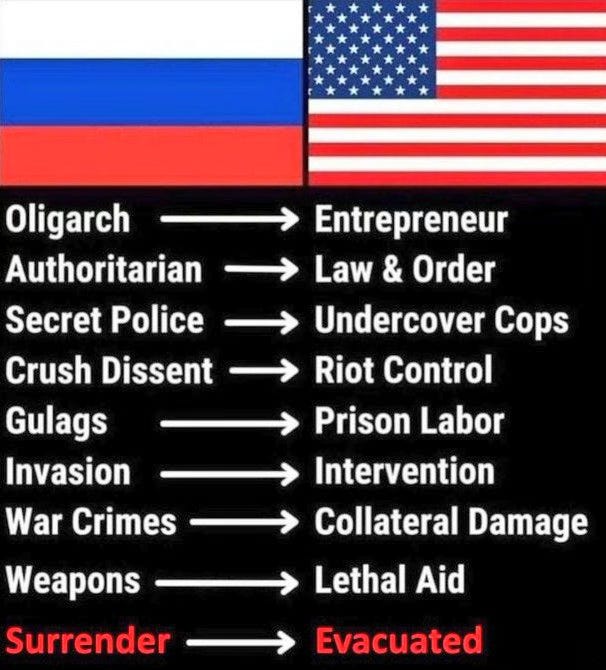
As a retired Air Force officer and military historian, I’m familiar with all kinds of euphemisms about killing, e.g. “precision bombing” and “collateral damage.”  Just as it’s easier to kill at a distance, it’s easier to kill when we use words that provide distance from the act.  Words that facilitate detachment. Words that befuddle and confuse our minds.

When writing honestly about war, it’s best to use bullet-hits-the-bone words: atrocity, murder, war crime, slaughter. Rape, pillage, burn are “old” words associated with war, and these words often most fittingly describe war and its likely effects and outcomes.

Powerful, blunt, and accurate words should remind us that war is inherently horrible and also profoundly anti-democratic.  War is consistent with authoritarianism and lack of freedom, yet Americans nowadays seem to think war (and words about war) is conducive to democracy and freedom, e.g. Afghanistan, Iraq, and now Ukraine.

We used to know better.  Military people are fond of the saying, “freedom isn’t free,” but neither is war.  Indeed, war and its various manifestations are costing this nation more than a trillion dollars a year while weakening democracy and our constitutional freedoms.  And that is a very high price to pay to keep the factories of the merchants of death humming and the generals and admirals happy.

Grisly images like this one (of a dead Iraqi soldier) were censored in America. Language is censored as well.

Fortunately, there’s a new guide and website available that alerts us to the importance of language and war. The website is wordsaboutwar.org, from which you can read and download suggestions on how best to use words to convey the horrors and costs of war to people everywhere. I urge you to visit the site and peruse the guide. (Full disclosure: I was an advisor to this effort, which was ably led by David Vine.)

Here’s a sample of a few comments I made in passing to the group:

A war on terror is truly a war of terror because war itself is terrible.

Friendly fire is being killed by one’s own, often due to the chaos of war, the sheer waste of it all, exacerbated by incompetence.  “Fire” is always unfriendly.

Very few troops are “heroes,” and indeed most aren’t, because heroes are rare in all walks of life.

The word “casualty” is too benign.  I much prefer killed and wounded: the victims of war.

What are “enemy noncombatants”?  They are usually innocent civilians.

With respect to the “War on Terror” that the U.S. has prosecuted for 22 years and counting, I noted that:

We (the U.S.) manifested a Manichean world view; as George W. Bush said soon after 9/11, you’re either for America (and all its violence) or you’re for the terrorists (with their violence).  If you wanted a non-violent approach, you were dismissed as naive or “for them.”  It was good versus evil, thus the infamous “axis of evil” the U.S. allegedly faced.

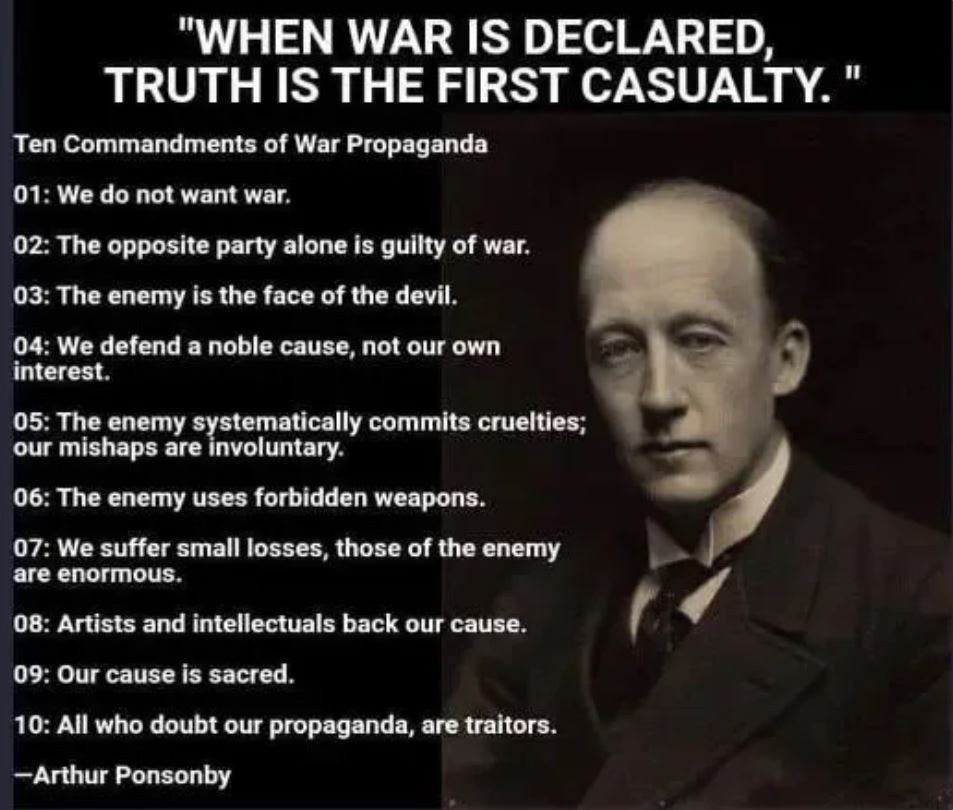
This is, of course, a problem with all discourse related to war.  Subtlety and nuance are thrown out the window.  Language is greatly simplified.  The U.S. is “doubleplusgood” and the enemy must be the opposite while simultaneously being dehumanized.  We kill “cowardly” enemy troops or terrorists (by drone they’re “bugsplat”) yet our “heroic” troops “fall” in battle and are revered as “the fallen.”  Violent combat is disguised as “kinetic action” in U.S. military communiques.

In my view, the dishonesty of this language captures the dishonesty of America’s wars.

General William T. Sherman (U.S. Civil War) famously said that “War is all hell.” Sherman knew the hellish and harsh realities of war; he knew, as he wrote, that “war is cruelty, and you cannot refine it.”  Too many people today are using and manipulating words to refine war.  They’re camouflaging war’s harshest realities.  Writers should write plainly and honestly, as General Sherman did, to capture war’s hellish nature.  By choosing honest words, we also help to create a better future in which the threat of war recedes precisely because we recognize more clearly its horrific nature and terrifying costs.

Other high-ranking military officers, like General Smedley Butler, for example, also wrote plainly about war.  As Butler famously said, war is a racket, and he described himself as a gangster for capitalism.  Now that was plain speaking about war!

The chief intent of speaking and writing plainly about war is to discourage war and save lives.  Some might see it as patriotic—saving the lives of U.S. troops by helping to prevent bloody awful wars—but more broadly the goal is humanistic—to save the lives of all those on the receiving end of bullets and bombs.

Interestingly, U.S. troops at lower levels are generally blunt about what war is about. Talk to sergeants at the front and you’ll hear visceral truths, probably enhanced by choice expletives.  I’ve heard U.S. Marines shout “Kill!” at graduation ceremonies.  Killing, after all, is what war enables. Mass killing leads to atrocities like My Lai in Vietnam. This fact should never be sugarcoated.

Few people, however, truly want to confront war’s horrors. Gazing upon the face of war is profoundly disturbing, which is why we’re encouraged to look away.  And so the face of war is airbrushed and camouflaged with euphemisms and buried under a blizzard of acronyms.

If we are to end war and prevent atrocity, we must seek to name things accurately while calling up mental images (no matter how disturbing) appropriate to the horrors of war. The guide at wordsaboutwar.org is an important step in that direction.

Update: I went on Podcast by George today to talk about all this:

The Bitter Alchemy of War

W.J. Astore

Turning Bullet Lead into Corporate Gold

As the Ukrainian counteroffensive against Russia grinds on (or falters?), as U.S. disaster relief for Hawaii is tied to more military aid for Ukraine, as depleted uranium shells join cluster munitions as America’s latest gift to a blasted war zone, as calls for diplomacy continue to be muted when they’re not actively discouraged and dismissed, I was reminded of the alchemy of war.

Alchemists of the early modern period were sophisticated experimenters driven by an often quasi-religious quest for perfection. We tend to remember only the most craven part of their experiments: the attempt to transmute lead into gold. This transmutation could not be effected, but alchemy itself transmuted into chemistry as its practitioners, through trial and error, developed a better understanding of the nature of the elements, reflected in part by today’s Periodic Table.

Seeking a divine spark

Yet the business of war succeeded where alchemists failed. In their alchemy, the merchants of death turned bullet lead into corporate gold. And what gold! Yearly war budgets continue to soar in the United States toward the trillion dollar mark. Weapons shipments to Ukraine continue at a pace that promises many more shattered and blasted bodies, Ukrainian and Russian. 

In a sense, dead bodies are also being transmuted into corporate gold.

Transmutation, I was taught as a Catholic, is a miracle. The Word became flesh and dwelt among us (Jesus Christ, the Son of God, of course). We have made the miraculous the mundane, and indeed the profane. We take lead and spill blood which becomes gold. And some even celebrate this as good for business in the United States.

All these weapons: they’re job-creators! So we crucify the Word and elevate the life-takers and widow-makers as gods.

We are far more deluded than the alchemists of the past.

What Ever Happened to Gary Cooper?

W.J. Astore

On Ending Militarism in America

Fourteen years ago, I wrote the following article for TomDispatch. A colleague wrote to me today saying he had saved the article, had re-read it, and still found it useful, which is just about the highest compliment you can pay an author. I continue to believe, as I wrote in 2009, that America is experiencing a form of militarism on steroids. It’s a peculiar form of militarism, since the Pentagon works hard to obscure the costs and realities of war (see the recent book by Norman Solomon, War Made Invisible), but camouflaged or not, it persists.

Gary Cooper in "High Noon"

Gary Cooper in “High Noon”

[Written in August 2009]

I have a few confessions to make: After almost eight years of off-and-on war in Afghanistan and after more than six years of mayhem and death since “Mission Accomplished” was declared in Operation Iraqi Freedom, I’m tired of seeing simple-minded magnetic ribbons on vehicles telling me, a 20-year military veteran, to support or pray for our troops. As a Christian, I find it presumptuous to see ribbons shaped like fish, with an American flag as a tail, informing me that God blesses our troops. I’m underwhelmed by gigantic American flags — up to 100 feet by 300 feet — repeatedly being unfurled in our sports arenas, as if our love of country is greater when our flags are bigger. I’m disturbed by nuclear-strike bombers soaring over stadiums filled with children, as one did in July just as the National Anthem ended during this year’s Major League Baseball All Star game. Instead of oohing and aahing at our destructive might, I was quietly horrified at its looming presence during a family event.

We’ve recently come through the steroid era in baseball with all those muscled-up players and jacked-up stats. Now that players are tested randomly, home runs are down and muscles don’t stretch uniforms quite as tightly. Yet while ending the steroid era in baseball proved reasonably straightforward once the will to act was present, we as a country have yet to face, no less curtail, our ongoing steroidal celebrations of pumped-up patriotism.

It’s high time we ended the post-Vietnam obsession with Rambo’s rippling pecs as well as the jaw-dropping technological firepower of the recent cinematic version of G.I. Joe and return to the resolute, undemonstrative strength that Gary Cooper showed in movies like High Noon.

In the HBO series “The Sopranos,” Tony (played by James Gandolfini) struggles with his own vulnerability — panic attacks caused by stress that his Mafia rivals would interpret as fatal signs of weakness. Lamenting his emotional frailty, Tony asks, “What ever happened to Gary Cooper?” What ever happened, in other words, to quiet, unemotive Americans who went about their business without fanfare, without swagger, but with firmness and no lack of controlled anger at the right time?

Tony’s question is a good one, but I’d like to spin it differently: Why did we allow lanky American citizen-soldiers and true heroes like World War I Sgt. Alvin York(played, at York’s insistence, by Gary Cooper) and World War II Sgt. (later, 1st Lt.) Audie Murphy(played in the film “To Hell and Back,” famously, by himself) to be replaced by all those post-Vietnam pumped-up Hollywood “warriors,” with Sylvester Stallone and Arnold Schwarzenegger-style abs and egos to match?

And far more important than how we got here, how can we end our enduring fascination with a puffed-up, comic book-style militarism that seems to have stepped directly out of screen fantasy and into our all-too-real lives?

A seven-step recovery program

As a society, we’ve become so addicted to militarism that we don’t even notice the way it surrounds us or the spasms of societal ‘roid rage that go with it. The fact is, we need a detox program. At the risk of incurring some of that ‘roid rage myself, let me suggest a seven-step program that could help return us to the saner days of Gary Cooper:

1. Baseball players on steroids swing for the fences. So does a steroidal country. When you have an immense military establishment, your answer to trouble is likely to be overwhelming force, including sending troops into harm’s way. To rein in our steroidal version of militarism, we should stop bulking up our military ranks, as is now happening, and shrink them instead. Our military needs not more muscle supplements (or the budgetary version of the same), but far fewer.

2. It’s time to stop deferring to our generals, and even to their commander in chief. They’re ours, after all; we’re not theirs. When President Obama says Afghanistan is not a war of choice but of necessity, we shouldn’t hesitate to point out that the emperor has no clothes. Yet when it comes to tough questioning of the president’s generals, Congress now seems eternally supine. Senators and representatives are invariably too busy falling all over themselves praising our troops and their commanders, too worried that “tough” questioning will appear unpatriotic to the folks back home, or too connected to military contractors in their districts, or some combination of the three.

Here’s something we should all keep in mind: Generals have no monopoly on military insight. What they have a monopoly on is a no-lose situation. If things go well, they get credit; if they go badly, we do. Retired five-star Gen. Omar Bradley was typical when he visited Vietnam in 1967 and declared: “I am convinced that this is a war at the right place, at the right time and with the right enemy — the Communists.” North Vietnam’s only hope for victory, he insisted, was “to hang on in the expectation that the American public, inadequately informed about the true situation and sickened by the loss in lives and money, will force the United States to give up and pull out.”

There we have it: A classic statement of the belief that when our military loses a war, it’s always the fault of “we the people.” Paradoxically, such insidious myths gain credibility not because we the people are too forceful in our criticism of the military, but because we are too deferential.

3. It’s time to redefine what “support our troops” really means. We console ourselves with the belief that all our troops are volunteers, who freely signed on for repeated tours of duty in forever wars. But are our troops truly volunteers? Didn’t we recruit them using multimillion-dollar ad campaigns and lures of every sort? Are we not, in effect, running a poverty and recession draft? Isolated in middle- or upper-class comfort, detached from our wars and their burdens, have we not, in a sense, recruited a “foreign legion” to do our bidding?

If you’re looking for a clear sign of a militarized society — which few Americans are — a good place to start is with troop veneration. The cult of the soldier often covers up a variety of sins. It helps, among other things, hide the true costs of, and often the futility of, the wars being fought. At an extreme, as the war began to turn dramatically against Nazi Germany in 1943, Germans who attempted to protest Hitler’s failed strategy and the catastrophic costs of his war were accused of (and usually executed for) betraying the troops at the front.

The United States is not a totalitarian state, so surely we can hazard criticisms of our wars and even occasionally of the behavior of some of our troops, without facing charges of stabbing our troops in the back and aiding the enemy. Or can we?

4. Let’s see the military for what it is: a blunt instrument of force. It’s neither surgical nor precise nor predictable. What Shakespeare wrote 400 years ago remains true: when wars start, havoc is unleashed, and the dogs of war run wild — in our case, not just the professional but the “mercenary” dogs of war, those private contractors to the Pentagon that thrive on the rich spoils of modern warfare in distant lands. It’s time to recognize that we rely ever more massively to prosecute our wars on companies that profit ever more handsomely the longer they last.

5. Let’s not blindly venerate the serving soldier, while forgetting our veterans when they doff their spiffy uniforms for the last time. It’s easy to celebrate our clean-cut men and women in uniform when they’re thousands of miles from home, far tougher to lend a hand to scruffier, embittered veterans suffering from the physical and emotional trauma of the battle zones to which they were consigned, usually for multiple tours of duty.

6. I like air shows, but how about — as a first tiny step toward demilitarizing civilian life — banning all flyovers of sporting events by modern combat aircraft? War is not a sport, and it shouldn’t be a thrill.

7. I love our flag. I keep my father’s casket flag in a special display case next to the very desk on which I’m writing this piece. It reminds me of his decades of service as a soldier and firefighter. But I don’t need humongous stadium flags or, for that matter, tiny flag lapel pins to prove my patriotism — and neither should you. In fact, doesn’t the endless post-9/11 public proliferation of flags in every size imaginable suggest a certain fanaticism bordering on desperation? If we saw such displays in other countries, our descriptions wouldn’t be kindly.

Of course, none of this is likely to be easy as long as this country garrisons the planet and fights open-ended wars on its global frontiers. The largest step, the eighth one, would be to begin seriously downsizing that mission. In the meantime, we shouldn’t need reminding that this country was originally founded as a civilian society, not a militarized one. Indeed, the revolt of the 13 colonies against the King of England was sparked, in part, by the perceived tyranny of forced quartering of British troops in colonial homes, the heavy hand of an “occupation” army, and taxation that we were told went for our own defense, whether we wanted to be defended or not.

If Americans are going to continue to hold so-called tea parties, shouldn’t some of them be directed against the militarization of our country and an enormous tax burden fed in part by our wasteful, trillion-dollar wars?

Modest as it may seem, my seven-step recovery program won’t be easy for many of us to follow. After all, let’s face it, we’ve come to enjoy our peculiar brand of muscular patriotism and the macho militarism that goes with it. In fact, we revel in it. Outwardly, the result is quite an impressive show. We look confident and ripped and strong. But it’s increasingly clear that our outward swagger conceals an inner desperation. If we’re so strong, one might ask, why do we need so much steroidal piety, so many in-your-face patriotic props, and so much parade-ground conformity?

Forget Rambo and action-picture G.I. Joes: Give me the steady hand, the undemonstrative strength, and the quiet humility of Alvin York, Audie Murphy — and Gary Cooper.

Integrity Last

W.J. Astore

The Most Fundamental Problem with the U.S. Military

“Integrity First” is the fundamental core value of the U.S. Air Force. Two other core values speak to “service before self” and “excellence in all we do.” But integrity remains the wellspring, and it’s the U.S. military’s stunning lack of integrity that has cost the American people and indeed the world so dearly over the last half-century.

Tonkin Gulf. My Lai. The Pentagon Papers. WMD in Iraq. Abu Ghraib. The Afghan War Papers. So many instances of “official” lies and distortions. So many lost wars where no senior officers were ever held accountable. Put up, shut up, fuck up, cover up, move up, seems to be the operating manual for success.

Last September, I wrote an article for TomDispatch: “Something is rotten in the U.S. military.” I suggested that integrity was now optional in that military, that lies and dishonor plagued America’s war machine. Evidently, those lies, that dishonor, is working just fine for the Pentagon as its budget continues to soar.

These thoughts occurred to me yet again as I read Seymour Hersh’s retrospective account of Major General Antonio (Tony) Taguba’s withering investigation of torture of prisoners at Abu Ghraib in Iraq. Taguba, a man of integrity, conducted an official—and honest—investigation of torture and mistreatment at Abu Ghraib; his reward for his honesty, his service, his excellence was not a commendation and promotion but threats, ostracism, and the death of his career as an Army officer.

General Antonio Taguba, man of integrity, service, and excellence

Sy Hersh’s article captures the rot at the core of the Pentagon and the U.S. government. Here Hersh speaks recently to Taguba:

[Taguba] “I was not a whistleblower. I knew I was in trouble when I was given the assignment [to investigate abuse at Abu Ghraib], but when you see those photos what can you do? I was a dead man walking.

“The kids were trained as traffic cops and then were told to transport [Iraqi] detainees. That’s how they got to Abu Ghraib. They weren’t trained for that but they had vehicles and rifles, just undisciplined kids with incompetent leadership and they were on the list to go home. They had all their equipment packed in Kuwait and ready to be shipped. And then they were told to stay behind.”

I [Hersh] asked: Would he do it again? “Sure,” Tony [Taguba] said, “I was hamstrung by the thirty days I had to investigate. I do not think I fulfilled my mission. [Secretary of Defense Donald] Rumsfeld was blaming the soldiers, but underneath they had no operational plan” for dealing with the prisoners.

“In hindsight, there was nothing I did to compromise my integrity. But integrity in the military and elsewhere is a bumper sticker. There is no reward for telling the truth.” [Emphasis added]

“There is no reward for telling the truth” in the U.S. military. That statement by retired General Taguba should move all Americans to take action against a military that has so clearly and tragically lost its way.

One suggestion: Cut the Pentagon budget in half and insist that it must pass a financial audit else forfeit all taxpayer funding. That might wake up a few generals and admirals.