Doing some housecleaning of the mind, so to speak:
I recently read a book that argued the U.S. military loses its wars due to poor strategy and lack of understanding of “limited” war. It was a sophisticated book that cited the usual suspects in classical military theory, like Clausewitz. And it got me to thinking. I don’t think the U.S. loses wars because of poor military theory or improper applications thereof. And I don’t think the U.S. can win wars by better/smarter theory. Rather, the wars the U.S. has been fighting since Korea should never have been started or joined to begin with. Whether it’s Vietnam in the 1960s or Afghanistan and Iraq today, these are and never were “winnable” wars. Why? Because they were unnecessary to U.S. national security. And the only way to “win” such wars is to end them.
Unnecessary wars persist for many reasons. A big one is profit, as in Ike’s military-industrial complex. Perhaps as well these wars are sustained by a belief the U.S. military could win them if only the generals hit on the right strategy. But there is no smarter way to win dumb wars. You win them when you end them.
War criminals. There’s been talk lately of President Trump wanting to pardon war criminals and how this would jeopardize order and discipline within the U.S. military. But let’s leave aside low-level offenders (your sergeants and captains) and talk about high-ranking war criminals. Indeed, what about the men who chose to go to war under false pretenses in the first place? If you choose not to prosecute men like Bush/Cheney/Rumsfeld, why pursue and prosecute the little guys?
I once read that the guilt for war crimes is greater the further you are from the crimes you effectively ordered. Adolf Eichmann didn’t dirty his own hands; he was a deskbound murderer. And perhaps that’s the worst kind.
Historically, we recognize the moral and legal culpability of high-ranking murderers like Eichmann. Should America’s top leaders be held responsible for the murderous results of wars that they launched?
Lady Liberty Locked and Loaded. The U.S. routinely brags of having the best military ever while leading the world in weapons sales while professing to be an exceptional bastion of liberty. And most Americans see no contradiction here. Simultaneously, men like Trump continue to vilify brown-skinned immigrants as bringing violence to America. Lady Liberty, in short, no longer lights her torch for the huddled masses. If we (or the French?) were making her today, she’d carry a .44 magnum (or an assault rifle?) in place of a torch. Do you feel lucky, immigrant punks?
Coincidence: A friend just sent me the Global Peace Index for the world’s 163 countries. The USA ranks #128. (Iceland is #1, followed by New Zealand at #2.) USA! USA! USA!
A friend of mine sent along a campaign ad for a woman running for Congress in Texas. Kim Olson is her name, and she has some good ideas. But the ad itself is telling for different reasons. A retired Air Force colonel, Olson appears in her military-issue flight jacket, complete with her rank, wings, and command patch, as she talks about being a “warrior.”
I have nothing against Colonel (retired) Olson. She’s gutsy and committed to public service. But enough of the “warrior” talk and enough with the military uniforms! You didn’t see Ike campaigning for president while wearing a jacket with five stars on it.
Readers of this blog may know that I taught at the Air Force Academy for six years. Impressive? Not according to the Secretary of the Air Force. In her words: “We are now boarding and recommending people for instructor duty and you’re not going to be able to do it unless you’re the best of the best. Historically, we didn’t value instructor duty. If you taught at Lackland or at the Air Force Academy or ROTC…that was kind of because you couldn’t get a better position and it was kind of a dead end. So now we’ve flipped that.”
I’ve changed my call sign to William “Dead End” Astore. It has a nice ring to it.
In all seriousness, the military has always favored doers over thinkers. Nowadays, you’re supposed to be a warrior, constantly doing…well…something. So we’ve been doing something, usually the same thing, repeatedly, in Iraq and Afghanistan, regardless of results. And history? Who cares? America’s military members barely know their own history, let alone the history of foreign peoples and cultures.
Incredibly, the military’s push for better education (defined as “intellectual overmatch,” I kid you not) is couched in terms of out-thinking the Russians and Chinese. In other words, we’re doomed.
As I put it to a friend, “The services need to develop senior officers with depth and breadth of vision, but the system is designed to produce narrow-minded true believers. It’s a little like trying to reform the Catholic church and its hierarchy of conservative, insular, cardinals and bishops.”
Or, as one of my Air Force friends put it, waxing satirically: “But you know, the problem really is that we don’t award enough ribbons, haven’t changed the uniform in a few years, and are allowing transgendered to serve while violating the rights of commanders by not allowing them to share [with subordinates] their [conservative Christian] faith.”
That’s enough random thoughts for this Thursday. What say you, readers?
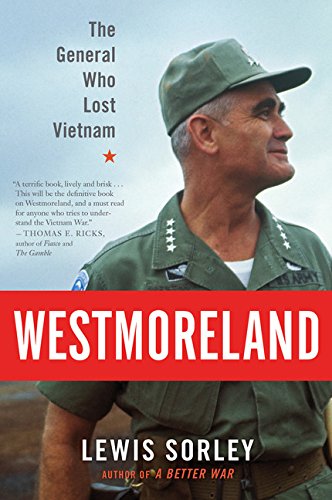
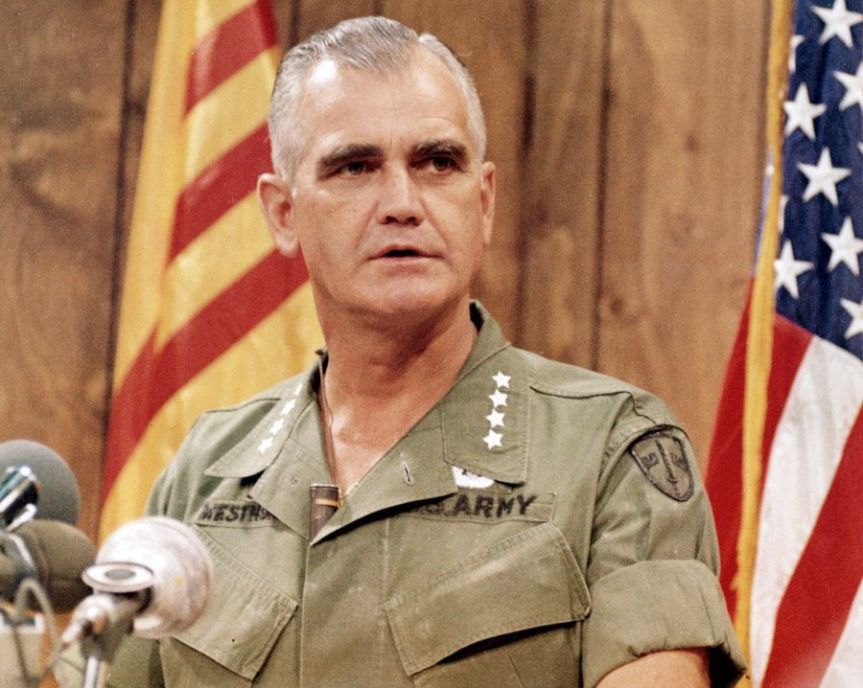
William Westmoreland (“Westy”) looked like a general should, and that was part of the problem. Tall, handsome, square-jawed, he carried himself rigidly; there was no slouching for Westy. A go-getter, a hard-charger, he did everything necessary to get promoted. He was a product of the Army, a product of a system that began at West Point during World War II and ended with four stars and command in Vietnam during the most critical years of that war (1965-68). His unimaginative and mediocre performance in a losing effort said (and says) much about that system.
I had these thoughts as I read Lewis Sorley’s devastating biography of Westy, recommended to me by a good friend. (Thanks, Paul!) Before tackling the big stuff about Westy, the Army, and Vietnam, I’d like to focus on little things that stayed with me as I read the book.
Visiting West Point as the Army’s Chief of Staff, Westy met the new First Captain, the highest-ranking cadet. Westy thought this cadet wasn’t quite tall enough to be First Captain. It made me wonder whether Napoleon might have won Waterloo if he’d been as tall as Westy.
Westy loved uniforms and awards. Sporting an impressive array of ribbons, badges, devices, and the like, his busy uniform was consistent with his concern for outward show, for image and action over substance and meaning.
Westy tended to focus on the trivial. He’d visit lower commands and ask junior officers whether the troops were getting their mail (vital for morale, he thought). He’d ask narrow technical questions about mortars versus artillery performance. He was a details man in a position that required a much broader sweep of mind.
Westy liked to doodle, including drawing the rank of a five-star general. He arguably saw himself as destined to this rank, following in the hallowed steps of Douglas MacArthur, Dwight Eisenhower, and Omar Bradley.
Westy never attended professional military education (PME), such as the Army War College, and he showed little interest in books. He was incurious and rather proud of it.
Interestingly, Sorley cites another general who argued Westy’s career should have ended as a regimental colonel. Others believed he served adequately as a major general in command of a division. Above this rank, Westy was, some of his fellow officers agreed, out his depth.
Sorley depicts Westy as an unoriginal and conventional thinker for a war that was unconventional and complex. Bewildered by Vietnam, Westy fell back to what he (and the Army) knew best: massive firepower, search and destroy tactics, and made-up metrics like “body count” as measures of “success.” He tried to win a revolutionary war using a strategy of attrition, paying little attention to political dimensions. For example, he shunted the South Vietnamese military (ARVN) to the side while giving them inferior weaponry to boot.
Another personal weakness: Westy didn’t respond well to criticism. When General Douglas Kinnard published his classic study of the Vietnam War, “The War Managers,” which surveyed senior officers who’d served in Vietnam, Westy wanted him to tattle on those officers who’d objected to his pursuit of body count. (Kinnard refused.)
Sorley identifies Westmoreland as the general who lost Vietnam, and there’s truth in that. Deeply flawed, Westy’s strategy was fated to fail. Yet even the most skilled American general may have lost in Vietnam. Consider here the words of President Lyndon B. Johnson in the middle of 1964. He told McGeorge Bundy “It looks to me like we’re getting’ into another Korea…I don’t think it’s worth fightin’ for and I don’t think we can get out. It’s just the biggest damn mess…What the hell is Vietnam worth to me?…What is it worth to this country?” [Quoted in Robert Dallek, “Three New Revelations About LBJ,” The Atlantic, April 1998]
McGeorge Bundy himself, LBJ’s National Security Adviser, said to Defense Secretary Robert McNamara that committing large numbers of U.S. troops to Vietnam was “rash to the point of folly.” In October 1964 his brother William Bundy, then the Assistant Secretary of State for Far Eastern Affairs, said in a confidential memorandum that Vietnam was “A bad colonial heritage of long standing…a nationalist movement taken over by Communism ruling in the other half of an ethnically and historically united country, the Communist side inheriting much the better military force and far more than its share of the talent—these are the facts that dog us today.”
Not worth fighting for, rash to the point of folly: Why did the U.S. go to war in Vietnam when the cause was arguably lost before the troops were committed? Traditional answers include the containment of communism, the domino theory, American overconfidence, and so forth, but perhaps there was a larger purpose to the “folly.”
What was that larger purpose? I recall a “letter to the editor” that I clipped from a newspaper years ago. Echoing a critique made by Noam Chomsky,** this letter argued America’s true strategic aim in Vietnam was to prevent Vietnam’s independent social and economic development; to subjugate and/or subordinate Vietnam and its resources to the whims of Western corporations and investors. Winning on the battlefield was less important than winning in the global marketplace. Vietnam would send a loud signal to other countries that, if you tried to chart your own course independent of American interests, you’d end up like Vietnam, a battlefield, a wasteland.
For sure, Westy lost on the battlefield. But did U.S. economic interests triumph globally due to his punishment of Vietnam and the intimidation it established? How compelling, how coercive, were such interests? Think of Venezuela today as it attempts to chart an independent course. Think of U.S. interest in subordinating Venezuela and its reserves of oil to the agendas of Western investors and corporations. There are trillions of dollars to be made here, not just from oil, but by preserving the strength of the petrodollar. (The U.S. dollar’s value is propped up by global oil sales done in dollars, as vouchsafed by leading oil producers like Saudi Arabia. Venezuela has acted against the petrodollar standard.)
Westy was the wrong man for Vietnam, but he was also a fall guy for a doomed war. He and the U.S. military did succeed, however, in visiting a level of destruction on that country that sent a message to those who contemplated resisting Western economic demands. Westy may have been a lousy general, but perhaps he was the perfect message boy for economic interests that prospered more by destruction and intimidation than by traditional victory of arms.
**For Chomsky, America didn’t accidentally or inadvertently or ham-fistedly destroy the Vietnamese village to save it; the village was destroyed precisely to destroy it, thereby strengthening capitalism and U.S. economic hegemony throughout the developing world. As General Smedley Butler said, sometimes generals are economic hit men, even when they don’t know it.
As a general rule, it’s a lot easier in U.S. politics to sell a war as containing or defeating communist aggression (or radical Islamic terrorism in the case of Iran, or ruthless dictators in the cases of Iraq and Libya) than it is for economic interests and the profits of powerful multinational corporations. For the average grunt, “Remember Exxon-Mobil!” isn’t much of a battle-cry.
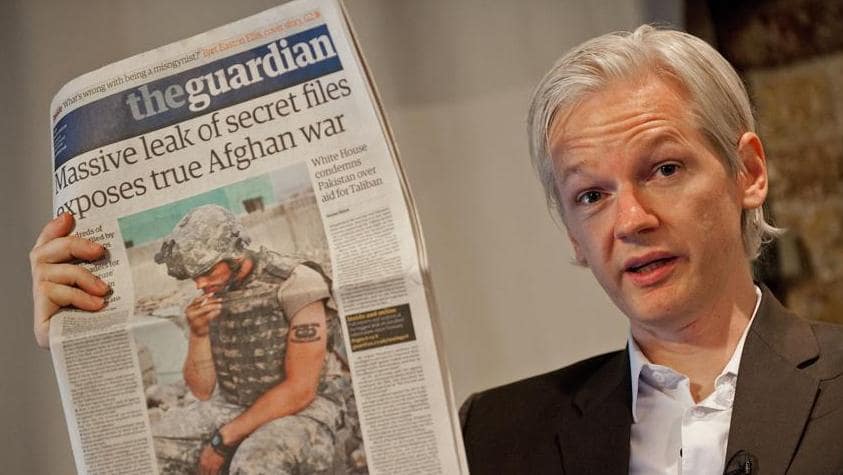
With the recent arrest of Julian Assange in London with the goal of extraditing him to the U.S. to face charges, I thought I’d revive this article that I wrote back in 2010. Assange and Chelsea Manning helped to reveal war crimes by the U.S. as well as a pattern of boorish, imperious, “in your face” behavior by its officials and diplomats.
George W. Bush claimed that the terrorists hated us for our freedoms — but maybe they simply hate us for our behavior? If we ride roughshod over the “little people,” they might just remember — and bite back.
Anyway, the main sin of Assange and Manning was embarrassing the powerful while shedding light on their behavior. And the powerful know how to hang on to a grudge…
Written in 2010:
Boorish, “in your face” behavior is everywhere. Most of the time, I’m able to avoid it, or walk away from it. Nevertheless, afoot in America is an astonishing sense of imperious entitlement. People are told they can have it all – heck, that they deserve it all – and to hell with anyone who raises an objection. Rugged individualism is not enough; roughshod individualism is the new American ethos.
Now, what has this to say about WikiLeaks? Take a close look at many of the State Department cables and tell me how you would feel to be on the receiving end of roughshod American imperiousness. So what if we kidnap the wrong German citizen and torture him? Not only do we have no need to apologize: We’ll even bully the German government into silence. And we can bully Spain too, if need be, to inhibit Spanish attempts to prosecute Americans for torture or murder. Need more information about the United Nations and its diplomats? Let’s not only spy on them in traditional ways, but let’s steal their passwords, their biometric data: Heck, let’s even take DNA samples from them. If they complain, too bad: They shouldn’t have taken a drink from the cup we offered them. And the list goes on: We’ll even strike secret deals with Britain to hide our cluster bombs.
In these memos, it never seems to be America’s fault. Being a loud and boorish and imperious American means never having contritely to say you’re sorry.
Are we oblivious? Do we just don’t care? Neither question will matter if the resentments we breed overseas find their way to America’s homeland.
Professor Astore writes regularly for TomDispatch.com.
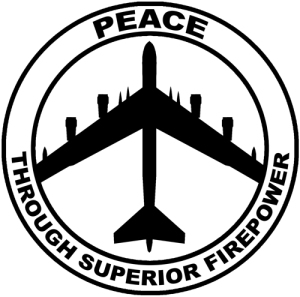
This is supposed to be a funny and “wise” symbol, but only if you’re talking about the “peace” of the grave. We must put an end to these forever wars.
W.J. Astore
In my latest for TomDispatch.com, I examine the price of America’s wars and why senior U.S. military men learn all the wrong lessons from them. Here’s an extract from my article:
“Veni, Vidi, Vici,” boasted Julius Caesar, one of history’s great military captains. “I came, I saw, I conquered.”
Then-Secretary of State Hillary Clinton echoed that famed saying when summing up the Obama administration’s military intervention in Libya in 2011 — with a small alteration. “We came, we saw, he died,” she said with a laugh about the killing of Muammar Gaddafi, that country’s autocratic leader. Note what she left out, though: the “vici” or victory part. And how right she was to do so, since Washington’s invasions, occupations, and interventions in Afghanistan, Iraq, Libya, and elsewhere in this century have never produced anything faintly like a single decisive and lasting victory.
“Failure is not an option” was the stirring 1995 movie catchphrase for the dramatic 1970 rescue of the Apollo 13 moon mission and crew, but were such a movie to be made about America’s wars and their less-than-vici-esque results today, the phrase would have to be corrected in Clintonian fashion to read “We came, we saw, we failed.”
Wars are risky, destructive, unpredictable endeavors, so it would hardly be surprising if America’s military and civilian leaders failed occasionally in their endless martial endeavors, despite the overwhelming superiority in firepower of “the world’s greatest military.” Here’s the question, though: Why have all the American wars of this century gone down in flames and what in the world have those leaders learned from such repetitive failures?
The evidence before our eyes suggests that, when it comes to our senior military leaders at least, the answer would be: nothing at all.
Let’s begin with General David Petraeus, he of “the surge” fame in the Iraq War. Of course, he would briefly fall from grace in 2012, while director of the CIA, thanks to an affair with his biographer with whom he inappropriately shared highly classified information. When riding high in Iraq in 2007, however, “King David” (as he was then dubbed) was widely considered an example of America’s best and brightest. He was a soldier-scholar with a doctorate from Princeton, an “insurgent” general with the perfect way — a revival of Vietnam-era counterinsurgency techniques — to stabilize invaded and occupied Iraq. He was the man to snatch victory from the jaws of looming defeat. (Talk about a fable not worthy of Aesop!)
Though retired from the military since 2011, Petraeus somehow remains a bellwether for conventional thinking about America’s wars at the Pentagon, as well as inside the Washington Beltway. And despite the quagmire in Afghanistan (that he had a significant hand in deepening), despite the widespread destruction in Iraq (for which he would hold some responsibility), despite the failed-state chaos in Libya, he continues to relentlessly plug the idea of pursuing a “sustainable” forever war against global terrorism; in other words, yet more of the same.
“I would contend that the fight against Islamist extremists is not one that we’re going to see the end of in our lifetimes probably. I think this is a generational struggle, which requires you to have a sustained commitment. But of course you can only sustain it if it’s sustainable in terms of the expenditure of blood and treasure.”
His comment brings to mind a World War II quip about General George S. Patton, also known as “old blood and guts.” Some of his troops responded to that nickname this way: yes, his guts, but our blood. When men like Petraeus measure the supposed sustainability of their wars in terms of blood and treasure, the first question should be: Whose blood, whose treasure?
When it comes to Washington’s Afghan War, now in its 18th year and looking ever more like a demoralizing defeat, Petraeus admits that U.S. forces “never had an exit strategy.” What they did have, he claims, “was a strategy to allow us to continue to achieve our objectives… with the reduced expenditure in blood and treasure.”
Think of this formulation as an upside-down version of the notorious “body count” of the Vietnam War. Instead of attempting to maximize enemy dead, as General William Westmoreland sought to do from 1965 to 1968, Petraeus is suggesting that the U.S. seek to keep the American body count to a minimum (translating into minimal attention back home), while minimizing the “treasure” spent. By keeping American bucks and body bags down (Afghans be damned), the war, he insists, can be sustained not just for a few more years but generationally. (He cites 70-year troop commitments to NATO and South Korea as reasonable models.)
Talk about lacking an exit strategy! And he also speaks of a persistent “industrial-strength” Afghan insurgency without noting that U.S. military actions, including drone strikes and an increasing relianceon air power, result in ever more dead civilians, which only feed that same insurgency. For him, Afghanistan is little more than a “platform” for regional counterterror operations and so anything must be done to prevent the greatest horror of all: withdrawing American troops too quickly.
In fact, he suggests that American-trained and supplied Iraqi forces collapsed in 2014, when attacked by relatively small groups of ISIS militants, exactly because U.S. troops had been withdrawn too quickly. The same, he has no doubt, will happen if President Trump repeats this “mistake” in Afghanistan. (Poor showings by U.S.-trained forces are never, of course, evidence of a bankrupt approach in Washington, but of the need to “stay the course.”)
Petraeus’s critique is, in fact, a subtle version of the stab-in-the-back myth. Its underlying premise: that the U.S. military is always on the generational cusp of success, whether in Vietnam in 1971, Iraq in 2011, or Afghanistan in 2019, if only the rug weren’t pulled out from under the U.S. military by irresolute commanders-in-chief.
Of course, this is all nonsense. Commanded by none other than General David Petraeus, the Afghan surge of 2009-2010 proved a dismal failure as, in the end, had his Iraq surge of 2007. U.S. efforts to train reliable indigenous forces (no matter where in the embattled Greater Middle East and Africa) have also consistently failed. Yet Petraeus’s answer is always more of the same: more U.S. troops and advisers, training, bombing, and killing, all to be repeated at “sustainable” levels for generations to come.
The alternative, he suggests, is too awful to contemplate:
“You have to do something about [Islamic extremism] because otherwise they’re going to spew violence, extremism, instability, and a tsunami of refugees not just into neighboring countries but… into our western European allies, undermining their domestic political situations.”
No mention here of how the U.S. invasions of Afghanistan and Iraq spread destruction and, in the end, a “tsunami of refugees” throughout the region. No mention of how U.S. interventions and bombing in Libya, Syria, Somalia, and elsewhere help “spew” violence and generate a series of failed states.
And amazingly enough, despite his lack of “vici” moments, the American media still sees King David as the go-to guy for advice on how to fight and win the wars he’s had such a hand in losing. And just in case you want to start worrying a little, he’s now offering such advice on even more dangerous matters. He’s started to comment on the new “cold war” that now has Washington abuzz, a coming era — as he puts it — of “renewed great power rivalries” with China and Russia, an era, in fact, of “multi-domain warfare” that could prove far more challenging than “the asymmetric abilities of the terrorists and extremists and insurgents that we’ve countered in Iraq and Syria and Afghanistan and a variety of other places, particularly since 9/11.”
For Petraeus, even if Islamic terrorism disappeared tomorrow and not generations from now, the U.S. military would still be engaged with the supercharged threat of China and Russia. I can already hear Pentagon cash registers going ka-ching!
And here, in the end, is what’s most striking about Petraeus’s war lessons: no concept of peace even exists in his version of the future. Instead, whether via Islamic terrorism or rival great powers, America faces intractable threats into a distant future. Give him credit for one thing: if adopted, his vision could keep the national security state funded in the staggering fashion it’s come to expect for generations, or at least until the money runs out and the U.S. empire collapses.
Please read the rest of my article here at TomDispatch.com.
After calling for all U.S. troops to be pulled out of Syria, President Trump is now in favor of keeping a “small…stabilizing force” there. What a shame. Trump is the ultimate flip-flopper, bowing to the neo-cons and the Washington establishment whenever it’s expedient for him to do so.
What, exactly, is America’s national security interest in Syria? Trump says these U.S. troops will help to prevent a resurgence of ISIS, but surely Syria, Turkey, Russia, and other countries in the region have more incentive — and far more capability — to keep the Islamic State down and out. But let’s say the Islamic State did make a comeback in Syria after all U.S. troops left. In that case, couldn’t U.S. troops just redeploy there? Why are “boots on the ground” needed in perpetuity in Syria to monitor the dead carcass of ISIS?
Once the U.S. commits troops to a region or country, they seem to linger — and linger. In rare cases when troops finally are withdrawn and something bad happens, you instantly hear how it’s the fault of those who called for troop withdrawals, as if U.S. troops bring stability wherever they go.
It’s a strange belief. The U.S. celebrates its troops as warriors, trains them in kinetic operations, outfits them with the most destructive technologies, and then deploys them to bring stability and peace to regions those troops barely understand. For a different vision of the “stability” American troops bring, one might ask the peoples of Afghanistan, Iraq, and Libya, to name only three recent examples.
It’s high time, America, that we bring the troops home. Our national defense is not advanced by worldwide troop deployments in the name of “stability.” Trump once seemed to recognize this, however fleetingly, as a candidate. As president, however, he’s become yet another pawn of U.S. military interventionists and neo-cons. As Trump would say, sad.
This week Trump is off to Vietnam to meet with Kim Jong-un, the leader of North Korea. Revealingly, the bar is already being set very low for what may be accomplished at this meeting. Trump’s original goal was denuclearization, meaning that North Korea would have to give up its nuclear weapons program and remove whatever atomic bombs or warheads it has. But North Korea isn’t stupid. They know what happened to Qaddafi when he got rid of his weapons of mass destruction (WMD) in Libya. For North Korea, nuclear WMD is a sort of insurance policy — a rational arsenal to deter the U.S. from launching a regime-change war.
Coming out of the last summit in Singapore between these men, Trump essentially declared “peace in our time,” even though North Korea has yet to make any significant changes in its nuclear weapons program. Again, why should North Korea surrender its weapons?
If Ronald Reagan’s motto was “trust — but verify” with the Soviet Union, Trump’s motto with North Korea is simply “trust.” It’s encouraging that Trump is no longer threatening to bring nuclear fire and fury to the North Koreans, and that Kim Jong-un is no longer approving launches of missiles in the general direction of Hawaii. But is there any treaty being negotiated with substantive details of verification? Do the North Koreans truly have any intent to give up their nuclear weapons? I’d say the answer to both questions is no.
Interestingly, at the request of the Trump administration, the Japanese government has nominated Trump for a Nobel Peace Prize for his attempted rapprochement with North Korea. Perhaps Trump’s peculiar brand of diplomacy may ease tensions with North Korea. Detente may be followed by a negotiated settlement and an end to the rancor produced by the Korean War. Such an ending would indeed be prize-worthy.
Trump’s quixotic efforts seem more vanity project than a well-considered project for peace. Yet perhaps a vain wannabe dictator like Trump has an edge in understanding a vain and very real dictator like Kim Jong-un. Trump, after all, did speak of a special bond he has with Kim, one that’s akin to falling in love. And doesn’t love conquer all?
Trump, sadly, is probably being played by North Korea. But who cares if lives are saved? Facing possible famine, the North Korean people could surely use food and other aid. Let’s hope the U.S. is able to give them some in exchange for promises, however vague, of denuclearization, however defined.
At this point, I’m tired of thinking of countries and national egos. I’d rather think of saving lives. Why not start in North Korea?
Stephanie Savell, Costs of War Project, originally published in the February issue of Smithsonian magazine
W.J. Astore
Most Americans would say we have a military for national defense and security. But our military is not a defensive force. Defense is not its ethos, nor is it how our military is structured. Our military is a power-projection force. It is an offensive force. It is designed to take the fight to the enemy. To strike first, usually justified as “preemptive” or “preventive” action. It’s a military that believes “the best defense is a good offense,” with leaders who believe in “full-spectrum dominance,” i.e. quick and overwhelming victories, enabled by superior technology and firepower, whether on the ground, on the seas, in the air, or even in space or cyberspace.
Thus the “global war on terror” wasn’t a misnomer, or at least the word “global” wasn’t. Consider the article below today at TomDispatch.com by Stephanie Savell. Our military is involved in at least 80 countries in this global war, with no downsizing of the mission evident in the immediate future (perhaps, perhaps, a slow withdrawal from Syria; perhaps, perhaps, a winding down of the Afghan War; meanwhile, we hear rumblings of possible military interventions in Venezuela and Iran).
Here’s a sad reality: U.S. military troops and military contractors/weapons dealers have become America’s chief missionaries, our ambassadors, our diplomats, our aid workers, even our “peace” corps, if by “peace” you mean more weaponry and combat training in the name of greater “stability.”
We’ve become a one-dimensional country. All military all the time. W.J. Astore
Mapping the American War on Terror Now in 80 Countries, It Couldn’t Be More Global
By Stephanie Savell
In September 2001, the Bush administration launched the “Global War on Terror.” Though “global” has long since been dropped from the name, as it turns out, they weren’t kidding.
When I first set out to map all the places in the world where the United States is still fighting terrorism so many years later, I didn’t think it would be that hard to do. This was before the 2017 incident in Niger in which four American soldiers were killed on a counterterror mission and Americans were given an inkling of how far-reaching the war on terrorism might really be. I imagined a map that would highlight Afghanistan, Iraq, Pakistan, and Syria — the places many Americans automatically think of in association with the war on terror — as well as perhaps a dozen less-noticed countries like the Philippines and Somalia. I had no idea that I was embarking on a research odyssey that would, in its second annual update, map U.S. counterterror missions in 80 countries in 2017 and 2018, or 40% of the nations on this planet (a map first featured in Smithsonian magazine).
As co-director of the Costs of War Project at Brown University’s Watson Institute for International and Public Affairs, I’m all too aware of the costs that accompany such a sprawling overseas presence. Our project’s research shows that, since 2001, the U.S. war on terror has resulted in the loss — conservatively estimated — of almost half a million lives in Iraq, Afghanistan, and Pakistan alone. By the end of 2019, we also estimate that Washington’s global war will cost American taxpayers no less than $5.9 trillion already spent and in commitments to caring for veterans of the war throughout their lifetimes.
In general, the American public has largely ignored these post-9/11 wars and their costs. But the vastness of Washington’s counterterror activities suggests, now more than ever, that it’s time to pay attention. Recently, the Trump administration has been talking of withdrawing from Syria and negotiating peace with the Taliban in Afghanistan. Yet, unbeknownst to many Americans, the war on terror reaches far beyond such lands and under Trump is actually ramping up in a number of places. That our counterterror missions are so extensive and their costs so staggeringly high should prompt Americans to demand answers to a few obvious and urgent questions: Is this global war truly making Americans safer? Is it reducing violence against civilians in the U.S. and other places? If, as I believe, the answer to both those questions is no, then isn’t there a more effective way to accomplish such goals?
Combat or “Training” and “Assisting”?
The major obstacle to creating our database, my research team would discover, was that the U.S. government is often so secretive about its war on terror. The Constitution gives Congress the right and responsibility to declare war, offering the citizens of this country, at least in theory, some means of input. And yet, in the name of operational security, the military classifies most information about its counterterror activities abroad.
This is particularly true of missions in which there are American boots on the ground engaging in direct action against militants, a reality, my team and I found, in 14 different countries in the last two years. The list includes Afghanistan and Syria, of course, but also some lesser known and unexpected places like Libya, Tunisia, Somalia, Mali, and Kenya. Officially, many of these are labeled “train, advise, and assist” missions, in which the U.S. military ostensibly works to support local militaries fighting groups that Washington labels terrorist organizations. Unofficially, the line between “assistance” and combat turns out to be, at best, blurry.
Some outstanding investigative journalists have documented the way this shadow war has been playing out, predominantly in Africa. In Niger in October 2017, as journalists subsequently revealed, what was officially a training mission proved to be a “kill or capture” operation directed at a suspected terrorist.
Such missions occur regularly. In Kenya, for instance, American service members are actively hunting the militants of al-Shabaab, a US-designated terrorist group. In Tunisia, there was at least one outright battle between joint U.S.-Tunisian forces and al-Qaeda militants. Indeed, two U.S. service members were later awarded medals of valor for their actions there, a clue that led journalists to discover that there had been a battle in the first place.
In yet other African countries, U.S. Special Operations forces have planned and controlled missions, operating in “cooperation with” — but actually in charge of — their African counterparts. In creating our database, we erred on the side of caution, only documenting combat in countries where we had at least two credible sources of proof, and checking in with experts and journalists who could provide us with additional information. In other words, American troops have undoubtedly been engaged in combat in even more places than we’ve been able to document.
Another striking finding in our research was just how many countries there were — 65 in all — in which the U.S. “trains” and/or “assists” local security forces in counterterrorism. While the military does much of this training, the State Department is also surprisingly heavily involved, funding and training police, military, and border patrol agents in many countries. It also donates equipment, including vehicle X-ray detection machines and contraband inspection kits. In addition, it develops programs it labels “Countering Violent Extremism,” which represent a soft-power approach, focusing on public education and other tools to “counter terrorist safe havens and recruitment.”
Such training and assistance occurs across the Middle East and Africa, as well as in some places in Asia and Latin America. American “law enforcement entities” trained security forces in Brazil to monitor terrorist threats in advance of the 2016 Summer Olympics, for example (and continued the partnership in 2017). Similarly, U.S. border patrol agents worked with their counterparts in Argentina to crack down on suspected money laundering by terrorist groups in the illicit marketplaces of the tri-border region that lies between Argentina, Brazil, and Paraguay.
To many Americans, all of this may sound relatively innocuous — like little more than generous, neighborly help with policing or a sensibly self-interested fighting-them-over-there-before-they-get-here set of policies. But shouldn’t we know better after all these years of hearing such claims in places like Iraq and Afghanistan where the results were anything but harmless or effective?
Such training has often fed into, or been used for, the grimmest of purposes in the many countries involved. In Nigeria, for instance, the U.S. military continues to work closely with local security forces which have used torture and committed extrajudicial killings, as well as engaging in sexual exploitation and abuse. In the Philippines, it has conducted large-scale joint military exercises in cooperation with President Rodrigo Duterte’s military, even as the police at his command continue to inflict horrific violence on that country’s citizenry.
The government of Djibouti, which for years has hosted the largest U.S. military base in Africa, Camp Lemonnier, also uses its anti-terrorism laws to prosecute internal dissidents. The State Department has not attempted to hide the way its own training programs have fed into a larger kind of repression in that country (and others). According to its 2017 Country Reports on Terrorism, a document that annually provides Congress with an overview of terrorism and anti-terror cooperation with the United States in a designated set of countries, in Djibouti, “the government continued to use counterterrorism legislation to suppress criticism by detaining and prosecuting opposition figures and other activists.”
In that country and many other allied nations, Washington’s terror-training programs feed into or reinforce human-rights abuses by local forces as authoritarian governments adopt “anti-terrorism” as the latest excuse for repressive practices of all sorts.
A Vast Military Footprint
As we were trying to document those 65 training-and-assistance locations of the U.S. military, the State Department reports proved an important source of information, even if they were often ambiguous about what was really going on. They regularly relied on loose terms like “security forces,” while failing to directly address the role played by our military in each of those countries.
Sometimes, as I read them and tried to figure out what was happening in distant lands, I had a nagging feeling that what the American military was doing, rather than coming into focus, was eternally receding from view. In the end, we felt certain in identifying those 14 countries in which American military personnel have seen combat in the war on terror in 2017-2018. We also found it relatively easy to document the seven countries in which, in the last two years, the U.S. has launched drone or other air strikes against what the government labels terrorist targets (but which regularly kill civilians as well): Afghanistan, Iraq, Libya, Pakistan, Somalia, Syria, and Yemen. These were the highest-intensity elements of that U.S. global war. However, this still represented a relatively small portion of the 80 countries we ended up including on our map.
In part, that was because I realized that the U.S. military tends to advertise — or at least not hide — many of the military exercises it directs or takes part in abroad. After all, these are intended to display the country’s global military might, deter enemies (in this case, terrorists), and bolster alliances with strategically chosen allies. Such exercises, which we documented as being explicitly focused on counterterrorism in 26 countries, along with lands which host American bases or smaller military outposts also involved in anti-terrorist activities, provide a sense of the armed forces’ behemoth footprint in the war on terror.
Although there are more than 800 American military bases around the world, we included in our map only those 40 countries in which such bases are directly involved in the counterterror war, including Germany and other European nations that are important staging areas for American operations in the Middle East and Africa.
To sum up: our completed map indicates that, in 2017 and 2018, seven countries were targeted by U.S. air strikes; double that number were sites where American military personnel engaged directly in ground combat; 26 countries were locations for joint military exercises; 40 hosted bases involved in the war on terror; and in 65, local military and security forces received counterterrorism-oriented “training and assistance.”
A Better Grand Plan
How often in the last 17 years has Congress or the American public debated the expansion of the war on terror to such a staggering range of places? The answer is: seldom indeed.
After so many years of silence and inactivity here at home, recent media and congressional attention to American wars in Afghanistan, Syria, and Yemen represents a new trend. Members of Congress have finally begun calling for discussion of parts of the war on terror. Last Wednesday, for instance, the House of Representatives voted to end U.S. support for the Saudi-led war in Yemen, and the Senate has passed legislation requiring Congress to vote on the same issue sometime in the coming months.
On February 6th, the House Armed Services Committee finally held a hearing on the Pentagon’s “counterterrorism approach” — a subject Congress as a whole has notdebated since, several days after the 9/11 attacks, it passed the Authorization for the Use of Military Force that Presidents George W. Bush, Barack Obama, and now Donald Trump have all used to wage the ongoing global war. Congress has not debated or voted on the sprawling expansion of that effort in all the years since. And judging from the befuddled reactions of several members of Congress to the deaths of those four soldiers in Niger in 2017, most of them were (and many probably still are) largely ignorant of how far the global war they’ve seldom bothered to discuss now reaches.
With potential shifts afoot in Trump administration policy on Syria and Afghanistan, isn’t it finally time to assess in the broadest possible way the necessity and efficacy of extending the war on terror to so many different places? Research has shown that using war to address terror tactics is a fruitless approach. Quite the opposite of achieving this country’s goals, from Libya to Syria, Niger to Afghanistan, the U.S. military presence abroad has often only fueled intense resentment of America. It has helped to both spread terror movements and provide yet more recruits to extremist Islamist groups, which have multiplied substantially since 9/11.
In the name of the war on terror in countries like Somalia, diplomatic activities, aid, and support for human rights have dwindled in favor of an ever more militarized American stance. Yet research shows that, in the long term, it is far more effective and sustainable to address the underlying grievances that fuel terrorist violence than to answer them on the battlefield.
All told, it should be clear that another kind of grand plan is needed to deal with the threat of terrorism both globally and to Americans — one that relies on a far smaller U.S. military footprint and costs far less blood and treasure. It’s also high time to put this threat in context and acknowledge that other developments, like climate change, may pose a far greater danger to our country.
The ongoing absurdity of America’s Afghan War was captured in two headlines today from my New York Times feed. Here’s the first:
NEWS ANALYSIS Taliban Talks Raise Question of What U.S. Withdrawal From Afghanistan Could Mean By MARK LANDLER, HELENE COOPER and ERIC SCHMITT A hasty American withdrawal, experts said, would erode the authority and legitimacy of the Afghan government, raising the risk that the Taliban could recapture control.
Think about this. What kind of “authority” and “legitimacy” does an Afghan government have if that authority and legitimacy can be fatally undermined by a “quick” withdrawal of U.S. troops over 18 months? The Taliban, meanwhile, does not pose a serious threat to the United States, and anyway who are we to say which group should rule in Afghanistan?
Here is the second headline:
To Slow U.S. Exit, Afghan Leader Offers Trump a Cost Reduction By MUJIB MASHAL A letter from President Ashraf Ghani of Afghanistan to President Trump is among the strongest signs yet that Mr. Ghani is worried about an American withdrawal.
So, all of a sudden, faced with the prospect the U.S. military may finally end its quagmire war and the $40 billion or so it spends in Afghanistan each year, Afghan governmental leaders are finally suggesting ways to reduce the cost of the U.S. occupation. Shouldn’t that tell us something about the nature of U.S. efforts there, as well as the motives of America’s putative allies?
No matter how grim the news, no matter how high the price, America’s foreign policy experts favor forever war rather than a negotiated settlement. That’s my grim conclusion from these headlines today.
Speaking of grim news: I just received some data from SIGAR, the Special Inspector General for Afghan Reconstruction. These data points suggest no real American progress in Afghanistan. Indeed, the Taliban is stronger, the Afghan government is weaker, corruption is increasing, and so too is the drug trade, even as the U.S. military drops more and more bombs and missiles. And we should keep doing this?
From the SIGAR report (RS is Resolute Support, ostensibly a NATO mission to support the Afghan government, but of course commanded and driven by the U.S.):
— The Afghan government’s control or influence over the population declined this quarter. According to RS, as of October 31, 2018, 63.5% of the population lived in areas under Afghan government control or influence, down 1.7% from the previous quarter. The insurgency slightly increased its control or influence over areas where 10.8% of the population lives. The population living in contested areas increased to 25.6% of the population.
— According to Resolute Support, as of October 31, 2018, the Afghan government controlled or influenced 53.8% of the total number of districts. This represents a decrease of seven government-controlled or influenced districts compared to last quarter and eight since the same period of 2017. 12.3% of Afghanistan’s districts are now reportedly under insurgent control or influence. 33.9% of districts are contested.
— USFOR-A reported that the assigned (actual) personnel strength of the ANDSF [government defense/security forces] as October 31, 2018, was 308,693 personnel – or 87.7% strength. ANDSF strength decreased by 3,635 personnel since last quarter and is at the lowest it has been since the RS mission began in January 2015.
— According to U.S. Air Forces Central Command (AFCENT), U.S. air assets in Afghanistan dropped 6,823 munitions in the first 11 months of 2018. This year’s figure was already 56% higher than the total number of munitions released in 2017 (4,361), and is more than five times the total in 2016.
— The Department of Justice (DOJ) reports that the Afghan government has made insufficient progress to investigate and prosecute corruption cases. DOJ also reported that the Afghan government has not yet demonstrated sufficient motivation or action to deter future corrupt actors, or to convince the Afghan people that the government is serious about combating corruption.
— Narcotics trafficking remains a widespread problem, with CSTC-A observing senior Afghan security force leaders and civilian provincial authorities often controlling narcotics trafficking networks in the western, southwestern, and northern regions.
Can anyone see a light at the end of the Afghan tunnel?
In my latest article for TomDispatch.com, I discuss how and why the U.S. military has a sustained record of turning victory (however fleeting) into defeat. What follows is an excerpt from my article.
A Sustained Record of Losing
During World War II, British civilians called the “Yanks” who would form the backbone of the Normandy invasion in June 1944 (the one that contributed to Nazi Germany’s unconditional surrender less than a year later) “overpaid, oversexed, and over here.” What can be said of today’s Yanks? Perhaps that they’re overfunded, overhyped, and always over there — “there” being unpromising places like Iraq, Syria, Afghanistan, and Somalia.
Let’s start with always over there. As Nick Turse recently reported for TomDispatch, U.S. forces remain deployed on approximately 800 foreign bases across the globe. (No one knows the exact number, Turse notes, possibly not even the Pentagon.) The cost: somewhere to the north of $100 billion a year simply to sustain that global “footprint.” At the same time, U.S. forces are engaged in an open-ended war on terror in 80 countries, a sprawling commitment that has cost nearly $6 trillion since the 9/11 attacks (as documented by the Costs of War Project at Brown University). This prodigious and prodigal global presence has not been lost on America’s Tweeter-in-Chief, who opined that the country’s military “cannot continue to be the policeman of the world.” Showing his usual sensitivity to others, he noted as well that “we are in countries most people haven’t even heard about. Frankly, it’s ridiculous.”
Yet Trump’s inconsistent calls to downsize Washington’s foreign commitments, including vows to withdraw all U.S. troops from Syria and halve the number in Afghanistan, have encountered serious pushback from Washington’s bevy of war hawks like Republican Senator Lindsey Graham and his own national security advisor, John Bolton. Contrary to the president’s tweets, U.S. troops in Syria are now destined to remain there for at least months, if not years, according to Bolton. Meanwhile, Trump-promised troop withdrawals from Afghanistan may be delayed considerably in the (lost) cause of keeping the Taliban — clearly winning and having nothing but time — off-balance. What matters most, as retired General David Petraeus argued in 2017, is showing resolve, no matter how disappointing the results. For him, as for so many in the Pentagon high command, it’s perfectly acceptable for Americans to face a “generational struggle” in Afghanistan (and elsewhere) that could, he hinted, persist for as long as America’s ongoing commitment to South Korea — that is, almost 70 years.
Turning to overfunded, the unofficial motto of the Pentagon budgetary process might be “aim high” and in this they have succeeded admirably. For example, President Trump denounced a proposed Pentagon budget of $733 billion for fiscal year 2020 as “crazy” high. Then he demonstrated his art-of-the-deal skills by suggesting a modest cut to $700 billion, only to compromise with his national security chiefs on a new figure: $750 billion. That eternal flood of money into the Pentagon’s coffers — no matter the political party in power — ensures one thing: that no one in that five-sided building needs to think hard about the disastrous direction of U.S. strategy or the grim results of its wars. The only hard thinking is devoted to how to spend the gigabucks pouring in (and keep more coming).
Instead of getting the most bang for the buck, the Pentagon now gets the most bucks for the least bang. To justify them, America’s defense experts are placing their bets not only on their failing generational war on terror, but also on a revived cold war (now uncapitalized) with China and Russia. Such rivals are no longer simply to be “deterred,” to use a commonplace word from the old (capitalized) Cold War; they must now be “overmatched,” a new Pentagon buzzword that translates into unquestionable military superiority (including newly “usable” nuclear weapons) that may well bring the world closer to annihilation.
Finally, there’s overhyped. Washington leaders of all stripes love to boast of a military that’s “second to none,” of a fighting force that’s the “finest” in history. Recently, Vice President Mike Pence reminded the troops that they are “the best of us.” Indeed you could argue that “support our troops” has become a new American mantra, a national motto as ubiquitous as (and synonymous with) “In God we trust.” But if America’s military truly is the finest fighting force since forever, someone should explain just why it’s failed to produce clear and enduring victories of any significance since World War II.
Despite endless deployments, bottomless funding, and breathless hype, the U.S. military loses — it’s politely called a “stalemate” — with remarkable consistency. America’s privates and lieutenants, the grunts at the bottom, are hardly to blame. The fish, as they say, rots from the head, which in this case means America’s most senior officers. Yet, according to them, often in testimony before Congress, whether in Iraq, Afghanistan, or elsewhere, that military is always making progress. Victory, so they claim, is invariably around the next corner, which they’re constantly turning or getting ready to turn.
America’s post-9/11 crop of generals like Mattis, H.R. McMaster, John Kelly, and especially Stanley McChrystal and David Petraeus have been much celebrated here in the mainstream media. And in their dress uniforms shimmering with colorful ribbons, badges, and medals, they certainly looked the part of victors.
Indeed, when three of them were still in Donald Trump’s administration, the pro-war mainstream media unabashedly saluted them as the “adults in the room,” allegedly curbing the worst of the president’s mad impulses. Yet consider the withering critique of veteran reporter William Arkin who recently resigned from NBC News to protest the media’s reflexive support of America’s wars and the warriors who have overseen them. “I find it disheartening,” he wrote, “that we do not report the failures of the generals and national security leaders. I find it shocking that we essentially condone continued American bumbling in the Middle East and now Africa through our ho-hum reporting.” NBC News, he concluded in his letter of resignation, has been “emulating the national security state itself — busy and profitable. No wars won but the ball is kept in play.”
Arkin couldn’t be more on target. Moreover, self-styled triumphalist warriors and a cheeringly complicit media are hardly the ideal tools with which to fix a tottering republic, one allegedly founded on the principle of rule by informed citizens, not the national security state.
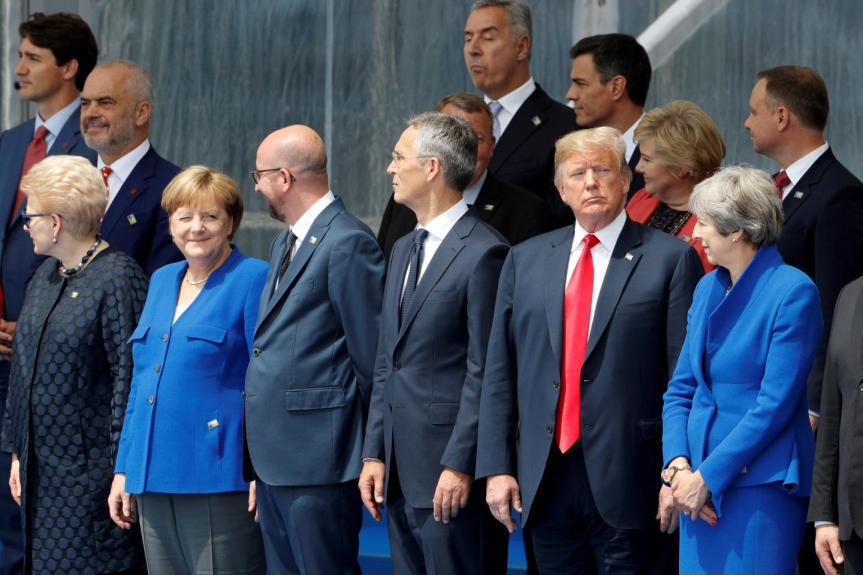
Trump at a NATO meeting. Looking to go his own way?
W.J. Astore
News that President Trump has considered withdrawing from the North Atlantic Treaty Organization (NATO) has drawn great consternation and criticism in the mainstream media. According to the New York Times, “Mr. Trump’s national security team, including Jim Mattis, then the defense secretary, and John R. Bolton, the national security adviser, scrambled to keep American strategy on track without mention of a withdrawal that would drastically reduce Washington’s influence in Europe and could embolden Russia for decades.” On NBC News today, an op-ed suggests that “Trump’s reported desire to leave NATO is a belated Christmas present for Putin.” In both cases, there’s more than a hint that Trump is favoring Russia and Putin while possibly endangering European allies.
Twenty years ago, I was a major at the Air Force Academy, and we hosted a symposium on coalition warfare during which the future of NATO was discussed. This was a few years after the collapse of the Soviet Union and the Warsaw Pact. There were quite a few senior officers at that symposium who, like Trump today, were willing to question the continued relevance of NATO. One of the “roundtables” specifically addressed the future of NATO. Its chair was retired General James P. McCarthy, USAF, and its panel consisted of retired Generals Andrew L. Goodpaster, USA; Sir Anthony Farrar-Hockley; and John A. Shaud, USAF.
With another officer, I wrote an “executive summary” of this symposium and what these retired generals said about NATO back in 1998. Here’s what I wrote two decades ago:
The value of America’s most successful and most enduring alliance, NATO, has been called into question since the end of the Cold War, a confrontation many credit it with winning. But, like many successful alliances after the common foe has been vanquished, NATO’s long-time raison d’être has seemingly evaporated. That the alliance has managed not just to survive but thrive has baffled many observers. The four former high-ranking NATO generals who made up this panel shared a common view of the continued high value of the alliance to America’s foreign policy interests. However, their views diverged on several key issues that face NATO in the years ahead.
General McCarthy opened the discussion … [suggesting] that advancing the causes of peace, prosperity, and security remain NATO’s central task, made more difficult today because of the expansion of NATO’s membership. Yet NATO continues to be important on the continent to discourage temptations to revert to old insecurities. General Shaud echoed Goodpaster’s view of NATO’s essential role, saying if NATO did not exist, we would have to invent it.
On the effects of expansion, Shaud stated that NATO needed to expand, both in membership to include Eastern Europe and in mission to include conflict prevention and “out of area” operations. Goodpaster quoted the late Secretary General Manfred Woerner, “It’s either out of area or out of business.” He then raised a provocative question: Should NATO’s mission expand to include not just nations but peoples? General Farrar-Hockley expanded on NATO’s continuing value, noting that during the Cold War, member countries came not to seek advantage for themselves over other members but came to put alliance interests and views first.
The sensitive issue of the effects of NATO’s expansion on Russia brought out disagreement among the panel members. Farrar-Hockley took the position that to forego expansion because of Russian concerns would be to grant Russia a continuing fiefdom in Eastern Europe. Russia has nothing to fear from NATO, and besides, it can do nothing to prevent expansion. If the Soviet Union was an anemic tiger, Russia is more like a circus tiger that may growl but won’t bite. Goodpaster suggested that NATO could have followed a different path that would not have antagonized Russia. In the early post-Cold War years, the Soviet Union may have been open to an “overarching relationship” encompassing peaceful relations. But as NATO developed partnerships with Eastern European countries, it chose not to pursue this approach with Russia. Partnership for Peace itself could have been done differently by providing a more equal forum analogous to the new European-Atlantic Partnership Council. Goodpaster asked rhetorically if NATO is a defensive alliance or a collective security alliance, but answered that NATO is what the times require. It is ultimately a forum for solidarity in Europe, an organization in which different peoples have come to respect and trust one another. Shaud took a middle view, saying NATO should ensure Russia does not become isolated; continuing dialogue is necessary. He noted that earlier panels had pointed out Russia’s historical concerns about encirclement, suggesting that Russia’s views on expansion are not ephemeral concerns but rather enduring issues.
Policy Implications
One of the more pressing questions NATO faces today is expansion, the possible inclusion of former Soviet states. Russian leaders believe, perhaps with some justification, that NATO is directed at them. It is not that NATO has aggressive intentions, but that former Soviet satellites seek security in NATO’s orbit, thereby tending further to isolate Russia from the West. The possibilities are ominous—the rise of a new demagogue in Russia in the absence of effective leadership, or alternatively chaos resulting from the implosion of an ungovernable, ineffective state. How should the United States and NATO manage this sensitive relationship? Can Russia be brought back from the brink on which it now stands through inclusion in Western institutions? Or should NATO gather the flock against the impending storm, expanding to Russia’s very doorstep to take in all states desiring inclusion? If NATO continues to expand, what will become of the cohesion that has been the hallmark of the most successful alliance in modern history? If NATO stops expanding, what will become of non-members if crisis erupts in regions formerly controlled by the Soviet Union? Whatever course of action NATO adopts, communication and openness must be its bywords; secrecy and exclusion will reap only suspicion and mistrust.
Again, this was written 20 years ago. But I’d like to make a few points about this discussion:
With the collapse of the Soviet Union, NATO was no longer needed in Europe in the sense of its original purpose.
Senior leaders disagreed on whether NATO expansion would serve the peace in Europe. Like General Goodpaster, some believed expansion would isolate and perhaps antagonize Russia, while others believed this was a risk worth taking in efforts to contain possible Russian aggression or turmoil.
There was consensus that NATO was worth preserving in some form, but at other times during the symposium, concerns were expressed about equity, i.e. burden-sharing, and the perceived unfairness of the U.S. paying much more that its fair share to keep the alliance functioning.
In short, a generation ago military experts questioned whether NATO had outlived its purpose. They asked whether the U.S. was paying too high a price, and they wondered whether NATO expansion would alienate Russia. These were reasonable questions then, and they remain reasonable today.
Trump is not some “Russian agent” or Putin stooge for questioning whether the U.S. still needs to be in NATO. In this case, he’s shown a willingness to think outside the NATO box. After all, how long should NATO last? Don’t all alliances eventually come to an end? Or is NATO to exist forever?
Personally, I don’t think a precipitous withdrawal from NATO would be in the best interests of the U.S. But surely there’s something to be said for building a new agreement or alliance in Europe that would be less driven by military concerns, less dependent on American money and weaponry and troops, and more inclusive toward Russia.





 Bracing Views