Today, I’d like to revive an article I wrote in July of 2010 about America’s folly in continuing its war in Afghanistan. Here we are, a decade later, and the Biden administration is contemplating continuing that war. Stupidity is obviously unbounded.
Anyway, as Julian Assange rots in prison for the crime of doing journalism, it behooves us to recall that WikiLeaks provided convincing evidence of America’s Afghan folly. Obviously, Assange the messenger must be shot, or at least punished severely for daring to air America’s dirty laundry.
Here’s my post from 2010. Does it make any sense in any universe to keep this going?
What WikiLeaks Reveals: We’re Playing the Fool in Afghanistan
07/27/2010
Perhaps the most predictable, as well as the most maddening, headline to emerge from the latest WikiLeaks controversy is this one from the Washington Post: “WikiLeaks Disclosures Unlikely to Change Course of Afghanistan War.”
Doubtless this “stay the course” approach will be spun as a sign of American resolve and tenacity. Of course, it was Albert Einstein who defined insanity as doing the same thing over and over again and expecting different results.
Naturally, there’ll be some who’ll say that Obama and General Petraeus have new cards up their sleeves, so perhaps they’re not “insane.” But they (and we) sure are looking more and more like fools.
Partly this is because President Obama and his advisors are still looking at Afghanistan as a problem to be solved, a war to be won, a situation to be handled. Or they see it as a high-stakes poker match, a deadly game of raises and bluffs, of gambling at long odds, but a match we can ultimately win as long as we keep playing and pumping in more chips.
But what if Afghanistan is none of these? What if we’re playing the fool?
Recall how proud we were, in the 1980s, at providing arms and aid to the Afghan “freedom fighters” who were then fighting the Soviets. It was the Soviet Union’s own Vietnam, we said, the final nail in the coffin of Soviet communism, and we congratulated ourselves on our own cleverness.
Fast forward two decades, and now we’re the ones bogged down in Afghanistan, yet we still think we can “surge” or escalate or otherwise rescue a faltering and untenable war effort.
Faltering? Untenable? Few people will dispute the following facts, many of which are now further supported by the WikiLeaks documents:
1. We’ve already spent $300 billion on our war in Afghanistan with very little to show for it.
3. We’ve almost completely eliminated Al Qaeda in Afghanistan, the immediate cause of our intervention in 2001, yet we continue to send more troops and more money there.
4. We’ve allied ourselves with a corrupt government and leaders who are enriching themselves at our expense.
5. We pay bribes to protect our convoys, and some of this money ends up in the hands of the Taliban.
6. We’re working with a regional ally, Pakistan, whose interests are often contrary to our own, and yet whose allegiance we attempt to buy with more military aid.
7. In trying to win the hearts and minds of ordinary Afghans, we’ve largely looked the other way with respect to the opium and heroin trade. The result? A drug-based Afghan economy.
8. In fighting an American-style war, we’ve relied on massive firepower, often from the air, that inevitably results in civilian casualties that undermine our counterinsurgency efforts.
9. At a time when we’re still trying to create jobs and pull ourselves out of a Great Recession, we continue to dedicate tens of billions of dollars to a seemingly endless war, with Congress currently preparing to approve yet another $33.5 billion for Afghanistan.
10. While largely ignoring civilian casualties in Afghanistan, we also downplay the cost of constant warfare to our troops, not just those who are killed or wounded in action (horrible as that price is), but to those who are brutalized by war, those whose families are destroyed or damaged by constant deployments, by domestic violence, and by suicides. Yet we reassure ourselves this price is bearable since our troops are “all volunteers.”
These are hard facts, and the WikiLeaks evidence has only made them harder. Only a fool refuses to face facts, and hardheaded Americans are not fools.
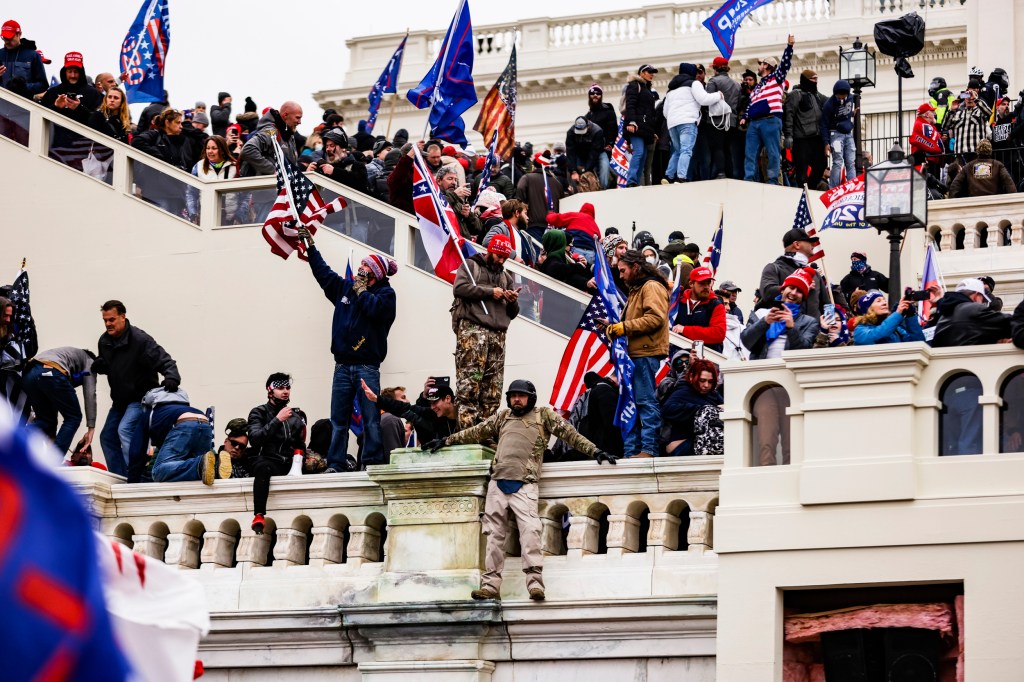
Pro-Trump supporters storm the U.S. Capitol, January 6, 2021 (Photo by Samuel Corum/Getty Images)
W.J. Astore
When I taught the core course in military history at the U.S. Air Force Academy, it focused on “major” wars. A review of my syllabus from 20 years ago confirms that we spent most of our time teaching military cadets about the American Revolutionary War, the U.S. Civil War, World Wars I and II, Korea and the Cold War, and Vietnam. There were special lessons that focused on airpower history and strategic thinkers like Clausewitz and Jomini, but the main focus was on “conventional” wars. I was OK with this, since mastering the course material was my main challenge, not challenging subjects within the course.
An astute student of U.S. military history would quickly note what’s missing. Genocidal wars against Native Americans were rarely mentioned. There were no specific lessons devoted to the Mexican-American War, the Spanish-American War, the Filipino Insurrection, or any of America’s frequent regime-change wars in Latin America. American imperialism wasn’t specifically addressed. Critiques of American imperialism by critics like Mark Twain and General Smedley Butler were rarely (if ever) heard.
What that means is this: America’s young officers go out into the world with little knowledge of America’s military interventions beyond the victories (more or less) in World Wars I and II, stalemate in Korea, and a misbegotten war in Vietnam that America could (and perhaps should) have won with better tactics and/or less civilian interference, or so they are often taught. Small wonder that disasters like Iraq, Afghanistan, Libya, and others occur and persist, though I wouldn’t put the blame for these simply on a lack of critical teaching about America’s various for-profit cock-ups and screw-ups.
This was on my mind as I read Kevin Tillman’s recent article at TomDispatch.com. As Tillman notes, America’s regime-change wars and propensity for foreign coups came home to our own country on January 6th with the storming of the Capitol. That such an action so deeply shocked Americans is a sign of our collective amnesia when it comes to remembering the totality of our military history.
Here’s an except from his article, which I encourage you to read in its entirety at TomDispatch:
Kevin Tillman, Capitol Blowback
Just about everyone was shocked by what happened at the Capitol building on January 6th. But as a former soldier in America’s forever wars, horrifying as the scenes were, I also found what happened strangely familiar, almost inevitable. I thought that, if only we had taken our country’s imperial history seriously, none of us would have found that day either shocking or unprecedented.
Honestly, it could only seem that way if you imagined our domestic politics as completely separate from our foreign policy. But if we’re to learn anything from that maladroit attempt at a government-toppling coup, it should be that they are anything but separate. The question isn’t whether then-President Donald Trump incited the assault on the Capitol — of course he did. It is rather: Since when have we cared if an American president lies to incite an illegal insurrection? In all honesty, our commanders-in-chief have been doing so abroad for generations with complete impunity. It was only a matter of time before the moral rot finally made its way home.
Back in 2007, I actually met Nancy Pelosi whom those insurrectionists were going after — “Tell Pelosi we’re coming for that b**ch. Tell f***ing Pelosi we’re coming for her!” — in that very Capitol building. That day, my family was testifying before the House Committee on Oversight and Reform concerning the U.S. government’s disinformation campaign about how, three years earlier, my brother Pat Tillman had died in Afghanistan (as a result of “friendly,” not enemy, fire). We would testify alongside former soldier Jessica Lynch who had suffered a similar disinformation fate in the wake of a tragic ambush of her convoy in Nasiriyah, Iraq, where soldiers died and she was taken prisoner. After the hearing, we discussed the case with Pelosi, who then took us on a brief personal tour of the halls of the building. Given the circumstances, it was a thoughtful gesture and a humbling experience.
So, it was personally quite unsettling to watch that rabid mob of insurrectionists storm our Capitol, some actively seeking to kill the woman who had walked our family through those same halls, wearing her signature green business suit. To see people desecrating that building over grievances rooted in demonstrable and absurd untruths manufactured by President Trump was both grotesque and shameful.
And yet, however surreal, disappointing, disqualifying, even treasonous that assault and the 57-43 Senate acquittal of the president would be, what took place should, in another sense, not have been a shock to anyone. The idea that January 6th was something new for this country and so a unique affront to the American idea of democracy, not to speak of common decency, was simply wrong. After all, ever since 1945, this country has regularly intervened in elections all over the globe and done far worse as well. What’s disorienting, I suppose, is that this time we did it to ourselves.
Around the Globe, Generation after Generation
My own limited experience with American interventionism involves the occupations of Afghanistan and Iraq. After the September 11th attacks, I enlisted in the U.S. Army with Pat. We would be assigned to the 75th Ranger Regiment and our unit would in March 2003 be sent into Iraq, one of so many tools in the Bush administration’s war of aggression there. We would help remove Iraqi leader Saddam Hussein by force. It was hardly the mission I had in mind when I signed up, but I was naive when it came to foreign policy. Being part of illegal invasions, however, leaves lasting impressions.
That particular intervention in Iraq began with a barrage of administration lies about Saddam’s supposed supply of weapons of mass destruction, his reputed links to al-Qaeda, and the idea that we were liberating the Iraqi people. Some of us actually were assigned to run around Baghdad, “east, west, south, and north somewhat,” looking for those nonexistent weapons of mass destruction. The whole invasion would prove catastrophic, of course, resulting in the destruction of Iraqi society, the deaths of hundreds of thousands of Iraqis and thousands of American soldiers, even as that country’s leadership was removed and its military disbanded (mission accomplished!). Of course, neither President George W. Bush, nor the rest of the top officials of his administration were held responsible for what happened.
So, when I watched the January 6th insurrection unfold, my mind was immediately drawn to the period leading up to the Iraq war — except this time, the drumbeat of lies had to do with massive voter fraud, voting irregularities, “dead voters,” rigged software, and other fabrications. Obviously, the two events were drastically different in scale, complexity, and destructiveness. Still, they seemed to share common fundamental threads.
Examples of American interference in the governance of foreign countries via coups, regime change, and other ploys are commonplaces of our modern history. Among the best known would be the replacing of a number of democratically elected leaders like Iranian Prime Minister Mohammad Mosaddegh with the Shah (1953), Guatemalan President Jacobo Arbenz with Colonel Carlos Castillo Armas (1954), Chilean President Salvador Allende with General Augusto Pinochet (1973), or Honduran President Manuel Zelaya in a U.S.-backed coup (2009). In other words, we’re not talking about a few one-off mistakes or a couple of dumb wars.
In truth, there has been an endless supply of such U.S. interventions around the globe: invasions, military coups, soft coups, economic sanctions, secretly funding candidates of Washington’s choice, the fueling of existing conflicts, you name it and it’s probably happened.
Take for example our neighbors in South America, Central America, and the Caribbean. I honestly don’t know if there is a single nation in Latin America that hasn’t fallen victim to a U.S. intervention of some sort: Argentina (1976), Bolivia (1971), Brazil (1964), Cuba (1961), El Salvador (the 1980s), Grenada (1983), Haiti (2004), Honduras (1980 and 2009), Panama (1989), Paraguay (1962), Peru (1968), Suriname (the 1980s), Uruguay (1973), Venezuela (the present moment). Maybe Costa Rica was spared?
Please read the rest of Kevin Tillman’s article here at TomDispatch.com.
Who was the last U.S. president with a reputation for peace?
By bombing Syria this week, Joe Biden has become yet another “wartime” president. Apparently Iranian-backed militias from Iraq operating inside Syria were the intended target of the bombs. Perhaps as many as 22 “militants” were killed in these attacks. Using language that would make Big Brother blush, the Biden administration claimed the attacks aimed “to de-escalate the overall situation in both Eastern Syria and Iraq.”
I’ve heard of precision bombing, but this is the first time I’ve heard of de-escalatory bombing. Naturally, Congress wasn’t consulted.
Along with this provocative and needless act of aggression, the Biden administration is currently weighing its options in Afghanistan. Three options seem to be on the table: withdrawing all U.S. troops and ending the war; prolonging the war indefinitely; and continued “negotiations” with modest increases of those troops. The last option is considered the sober sensible one by Beltway sages. Complete withdrawal after twenty years of turmoil and death is predictably seen as too risky, whereas a wholehearted commitment to generational war in Afghanistan, a la General Petraeus, is seen as politically unpopular, even if the end result of the sober sensible option is exactly that: more war fought in the (false) name of (eventual) peace.
So, under Joe Biden, we have bombing for de-escalation and more war for peace. Again, Biden deserves praise when he promised that nothing would fundamentally change under his administration.
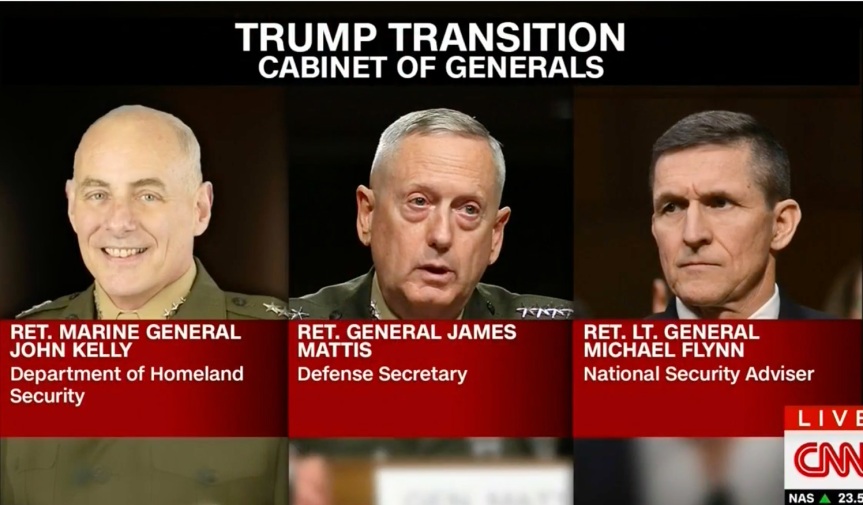
Trump’s motto: In generals I trust. It didn’t work out so well for him. Or the country.
W.J. Astore
As the Senate prepares to acquit Donald Trump in his second impeachment trial, I thought it would be a good time for a quick look at his legacy on war and militarism. Trump’s fans like to say he started no new wars. But he was hardly a man of peace, and his legacy on war and militarism is almost entirely negative. Here, in no particular order, are my quick thoughts on this subject:
He boosted military spending and weapons sales. Trump basically bought off the military-industrial-congressional complex by throwing scores of billions of dollars its way while selling weapons around the world. It’s an old formula for U.S. presidents and it worked.
He boosted a militant nationalism vis-a-vis rivals and even traditional allies. Trump was no friend to Russia and aggravated relations with China. Relations with NATO allies were also aggravated as he pressured them to spend more on weapons and wars.
He boosted militarism at home and specifically with police forces. Trump supported and encouraged violent police crackdowns of BLM activists. He called for the deployment of active duty military in the streets of Washington, DC. He even called for a massive military parade (which never happened).
He boosted overseas bombing and drone strikes. Recall the use of MOAB in Afghanistan, or Trump’s missile strike against Syria, and increased bombing in Afghanistan.
He boosted tensions with Iran nearly to the breaking point. Trump’s drone strike against Iranian general Qasem Soleimani was an act of war; harsh economic sanctions and withdrawal from the Obama-era nuclear treaty with Iran also heightened tensions.
He boosted the chances of nuclear war in the future. Trump was a fan of nuclear weapons; he seems to think of them simply as bigger, mightier bombs. His pursuit of “smaller” tactical nuclear warheads and their deployment on Trident-class nuclear submarines increase the possibility of nuclear war in the future.
He boosted economic sanctions against Venezuela while pursuing a coup. Trump knows Venezuela has vast oil reserves. Why not overthrow their government and take their oil? That was Trump’s policy, more or less. (It doesn’t appear to have changed under Joe Biden.)
Creation of a Space Force. Yet another military competitor for U.S. taxpayer dollars, even as space itself becomes another sphere for the U.S. military to “dominate.”
Failure to end wars that he promised to end. Trump was talked out of ending the war in Afghanistan by generals like James Mattis and H.R. McMaster. Ending such wars was a promise Trump foolishly abandoned.
Reliance on Generals as wise men. Trump, overall a weak and vainglorious man, surrounded himself with generals like Mattis, McMaster, John Kelly, and (briefly) Michael Flynn. Thus he got narrow-minded war-mongering advice.
Seeing the world as a zero-sum game of winners and losers and debasing the art of diplomacy. Putting Mike Pompeo in charge of the State Department was a new low in the pursuit of peace through diplomacy.
Aiding genocide in Yemen while kowtowing to Israel and Saudi Arabia: Trump was a willing participant to genocide in Yemen while pursuing a “peace” plan with Israel that was totally one-sided vis-a-vis the status and rights of Palestinians.
Off the top of my head, that’s my top twelve of Trump’s legacies in this arena. What do you think, readers? Can you think of others? And will any of this really change under Joe Biden?
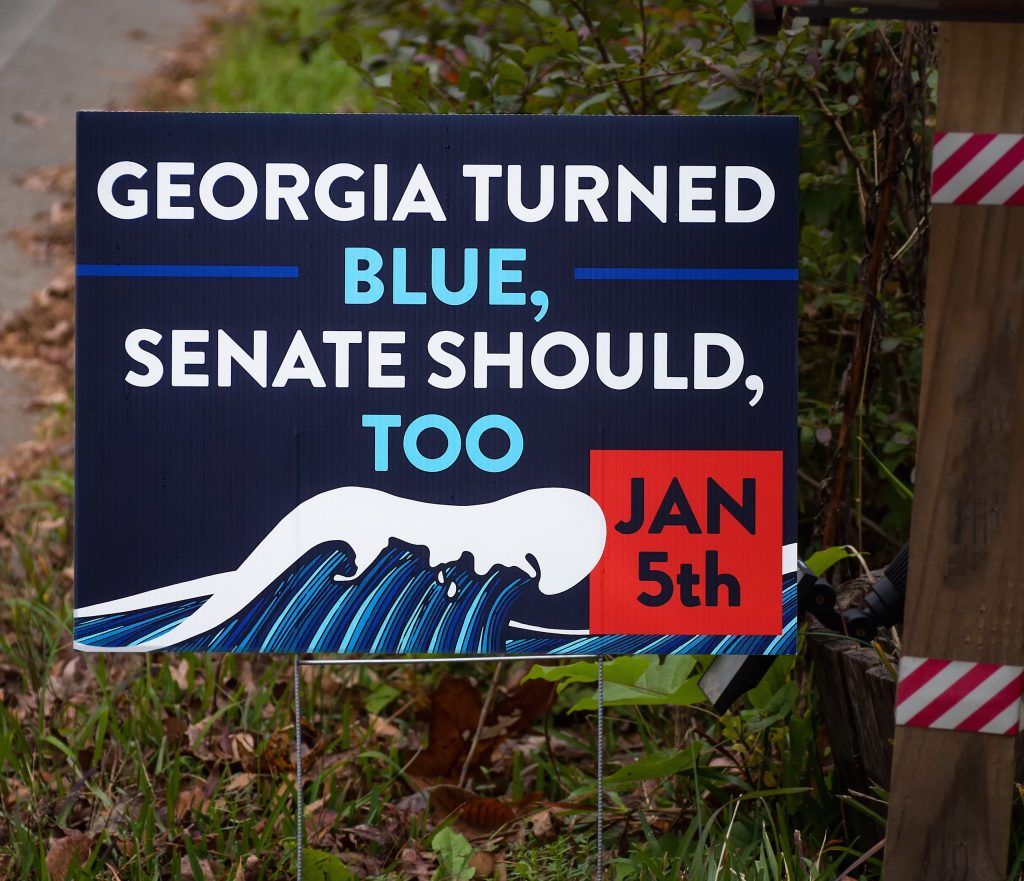
The Democrats have carried both Senate seats in Georgia, meaning the Senate is now effectively tied at 50-50, eliminating Mitch McConnell as Senate majority leader and leaving it to Vice President-elect Kamala Harris to be the Senate’s tiebreaking vote.
The question is: What will Democrats do with this (very weak) majority? Or, as Greg Laxer put it here, “BUT…do the Dems have sufficient internal discipline to pass any legislation remotely progressive or to seat a SCOTUS nominee deemed controversial?” Good question.
Of course, it’s not just about “internal discipline.” Joe Biden, a mealy-mouthed corporatist, is on the record as saying that nothing will fundamentally change under his administration. I don’t see him or Nancy Pelosi or Chuck Schumer pushing for a progressive agenda. These “leaders” are DINOs, Democrats in name only, and it will be interesting to see if Biden & Co. even come through on their promise to elevate relief checks from $600 to $2000.
I’m glad Democrats won in Georgia, but not because I expect great things and transformative change from them now. Just look at what Obama/Biden produced in 2009 with a “supermajority” in Congress: a bailout for banks and corporations and Romneycare without a public option, later rebranded as Obamacare. Obama/Biden also saw the failed Afghan surge, the Libyan disaster, and a major escalation in drone strikes, among other warmongering acts.
So, why am I glad about Georgia? Because now Biden and Pelosi and Co. can’t blame Mitch McConnell for blocking all their “noble” efforts in the Senate. Now we’ll really see the priorities of Biden/Pelosi laid bare. And they both have very long and strong records of serving elite interests at the expense of regular people.
It’s good to see awful Republican candidates lose in Georgia; even better to see Mitch McConnell removed from his position of power and obstruction. Now what, Democrats? Care to help the poor while ending war? Or will you continue to serve the rich while making war?
These next two years will be interesting indeed. If Democrats don’t go big, they will go home, as in losing both houses of Congress in 2022. If past performance is indicative of future gains and losses, I’m not bullish on Biden/Pelosi producing big gains for Main Street USA. But I’d be happy to be proven wrong.
We need McGovern-size cuts to America’s bloated war budget
W.J. Astore
This week, Congress will attempt to override President Trump’s veto of the NDAA, the national defense authorization act, which in 2021 provides $740 billion to the Pentagon and its wars. As usual, there is strong bipartisan support for this massive war budget. Democrats will join Republicans in bowing and scraping before the military-industrial complex, even as they frame it in terms of “supporting” the troops and defending America. In short, Trump’s veto will not stand.
I’m so fed up with Democrats serving the war party, denying health care to all Americans, and so on that I finally changed my political party designation in my home state. I am now a no-party independent instead of a registered Democrat. (My wife joined me as she’s no fan of “handsy” Joe Biden and the refusal of “centrist” Democrats to help people in meaningful ways.)
Perhaps that’s what we all need to do. Reject the Republican and Democratic parties and fight for a political establishment that would put people first rather than billionaires and corporations. Short of revolution, I don’t see other options that promise meaningful change.
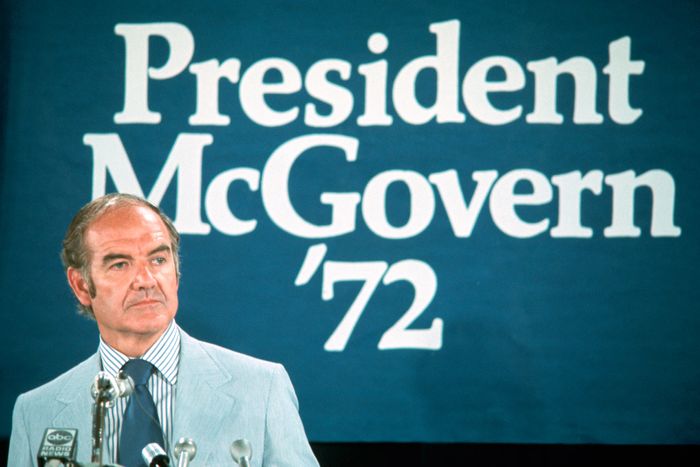
To my knowledge, the last major party presidential candidate who called for meaningful reductions in war spending was George McGovern. For example, McGovern called for a defense budget in 1975 of $54.8 billion, roughly $32 billion less than what the Nixon administration had proposed. McGovern, of course, had to couch this in terms of America still being a superpower with a nuclear arsenal that would be second to none, but at least he had the courage to talk of peace and of new approaches to foreign policy that would put diplomacy first instead of weaponry and war. What a loser he was, right?
If we applied a McGovern-size cut to today’s NDAA, we’d be talking about a “defense” budget of roughly $470 billion a year, still plenty of money, one would think, for the Pentagon to defend America. The $270 billion in savings could and should be applied to stimulus checks for Americans desperate for help in these Covid-disturbed times.
Imagine Americans getting a check from the government — a rebate of sorts — as a peace dividend! What would Americans rather have: a bunch of expensive F-35 jet fighters; ultra-expensive newer nuclear weapons on top of the ultra-expensive older ones; or some cash in pocket to buy groceries and pay their rent? I don’t know about you, but more F-35s and more nuclear bombers and missiles are not helping my bottom line.
To return to my changed political party affiliation: When a Democratic president-elect nominates a retired general and board member of Raytheon as the best person to exercise civilian oversight over the Pentagon, you know the Democratic party is a toady to the military-industrial complex and devoid of integrity as well as fresh ideas.
War? What is it good for? Absolutely nothing. Time for some peace dividends, America.
Why will this man be happy when Trump vetoes the NDAA?
W.J. Astore
President Trump says he will veto the NDAA that funds the Pentagon at $740 billion for FY 2021. Congress appears to have the votes to override his veto.
What caught my eye was part of Trump’s rationale for the veto: China. China will apparently be outraged when Trump vetoes the bill. Here’s the report (from the Guardian):
Trump says he will veto defense bill
Donald Trump once again said he intends to veto the annual defense authorization bill, setting up a potential veto override by Congress.
“I will Veto the Defense Bill, which will make China very unhappy,” the president said in a tweet. “They love it. Must have Section 230 termination, protect our National Monuments and allow for removal of military from far away, and very unappreciative, lands. Thank you!”
We just witnessed four years of red-baiting by the Democrats against the Republicans and Trump (“Moscow Mitch”?) with Russia as the Bad Red Guy. Prepare for four years of red-baiting by Republicans against the Democrats and Biden (“Hunter, Made in China”?) with China as the Bad Red Guy. The winner: the military-industrial complex. The loser: the American people, and perhaps the world.
Actually, Trump has a point about the NDAA inhibiting his ability to pull troops out of Iraq and Afghanistan. It’s too bad he didn’t focus on that and the issue of bipartisan support of endless wars.
But he had to hit the China gong, and it will resound loudly in the coming years. You know what they say about payback, Democrats …
An old friend and faithful reader sent me this query: Biden’s Defense/National Security Team looks like a tired Obama 2.0 retread. Iran nuclear deal back? Middle East entanglements/deployments suddenly fashionable again? Drone strikes? Russia fixation? Averting eyes from China?
He’s right about the retread. As Biden himself promised to his corporate sponsors, nothing would fundamentally change under his administration. Think about that for a moment. He’s been running for president off and on for 30+ years, and yet when he finally wins, he’s got no vision. None. He just wants to occupy the Oval Office and change nothing.
What’s the point of running for president and being a leader if you want to do nothing? I don’t see the point, but I understand Biden’s corporate sponsors who profit from the status quo. They like America and the way rich people are gaining even more money and power — why change a good thing?
We see this with America’s military-industrial-Congressional complex. A retired general who works for Raytheon is announced as the next “civilian” defense secretary. Men who were for the Iraq war, a disastrous decision that you’d think would be disqualifying, are those who get high positions as national security advisers or as secretary of state. Not a single progressive or skeptical voice against war gets hired, even though the last 20 years of endless wars have been disastrous.
The “defense” budget at $740 billion remains untouchable. It recently passed with strong, veto-proof, bipartisan support in Congress. The main American enemy of the moment is Covid-19 and the collateral damage of deaths, loss of jobs, bankruptcies, and forthcoming evictions and foreclosures, yet Congress can’t pass a stimulus bill to help the working classes. Yet a stimulus bill for weapons makers is easily passed — we just happen to call it the NDAA, or the national defense authorization act.
Remember when there were serious Congressional debates about guns and butter? We settled those in favor of the guns. Domestic issues take a back seat to the need to fund the Pentagon and its global network of bases and installations. We’re so busy exporting money and violence that we don’t even see how we’ve become our own worst enemies.
Biden didn’t have much of a slogan when he ran for president. It was something like “build back better.” It really should have been “same as it ever was,” as in the same “legalized” corruption, the same misguided priorities, and the same stale ideas.
Imagine running for president with no new ideas … forgive me for repeating myself, but how sad is that?
Recently, I had a long conversation with Major (retired) Danny Sjursen on our responses to the Iraq and Afghan Wars. The entire conversation is at TomDispatch.com; what follows is an excerpt.
Bill (that’s me!): In the summer of 2007, I was increasingly disgusted by the way the administration of President George W. Bush and Vice President Dick Cheney was hiding behind the bemedaled chest of Iraq commander General David Petraeus. Our civilian commander-in-chief, George W., was avoiding responsibility for the disastrous Iraq War by sending Petraeus, then known as the “surge” general, before Congress to testify that some sort of victory was still possible, even as he hedged his talk of progress with words like “fragile” and “reversible.”
So I got off my butt and wrote an article that argued we needed to end the Iraq War and our folly of “spilling blood and treasure with such reckless abandon.” I submitted it to newspapers like the New York Times with no success. Fortunately, a friend told me about TomDispatch, where Tom Engelhardt had been publishing critical articles by retired Colonel Andrew Bacevich. Luckily for me, Tom liked my piece and published it as “Saving the Military from Itself” in October of that same year.
That article put me on the path of dissent from America’s forever wars, even if I wasn’t so much antiwar as anti-dumb-war then. As I asked at the time, how do you win someone else’s civil war? Being a Star Trek fan, I referred to the Kobayashi Maru, a “no-win” scenario introduced in the second Star Trek movie. I saw our troops, young lieutenants like yourself in Iraq, being stuck in a no-win situation and I was already convinced that, no matter how much Petraeus talked about “metrics” and “progress,” it wasn’t going to happen, that “winning” really meant leaving, and we haven’t won yet since, god help us, we’re still there.
Of course, the so-called surge in Iraq back then did what it was actually meant to do. It provided an illusion of progress and stability even while proving just as fragile and reversible as the weaselly Petraeus said it would be. Worse yet, the myth of that Iraqi surge would lead disastrously to the Afghan version of the same under Barack Obama and — yet again — Petraeus who would prove to be a general for all presidents.
Lucky you! You were on the ground in both surges, weren’t you?
Danny: I sure was! Believe it or not, a colonel once told me I was lucky to have done “line duty” in both of them — platoon and company command, Iraq and Afghanistan, Baghdad and Kandahar. To be honest, Bill, I knew something was fishy even before you retired or I graduated from West Point and headed for those wars.
In fact, it’s funny that you should mention Bacevich. I was first introduced to his work in the winter of 2004 as a West Point senior by then-Lieutenant Colonel Ty Seidule. Back then, for a guy like me, Bacevich had what could only be called bracing antiwar views (a wink-nod to your Bracing Views blog, Bill) for a classroom of burgeoning neocons just about certain to head for Iraq. Frankly, most of us couldn’t wait to go.
And we wouldn’t have that long to wait either. The first of our classmates to die, Emily Perez, was killed in Iraq by a roadside bomb in September 2006 within 18 months of graduation (and five more were to die in the years to come). I took a scout platoon to southeast Baghdad a month later and we didn’t leave — most of us, that is — for 15 months.
My partly Bacevich-bred sneaking suspicions about America’s no-longer distant wars were, of course, all confirmed. It turned out that policing an ethno-religious-sectarian conflict, mostly of our own country’s making, while dodging counter-counterinsurgent attacks aimed at expelling us occupiers from that country was as tough as stateside invasion opponents had predicted.
On lonely outpost mornings, I had a nasty daily habit of reading the names of our announced dead. Midway through my tour, one of those countless attacks killed 1st Lt. Andrew J. Bacevich. When I saw that name, I realized instantly that he must be the son of the man whose book I had read two years earlier, the man who is now our colleague. The moment remains painfully crystal clear in my memory.
By the way, Bill, your Iraq War take was dead on. During my own tour there, I came to the same realization. Embarrassingly enough, though, it took me seven years to say the same things publicly in my first book, fittingly subtitled “The Myth of the Surge.” By then, of course, ISIS — the Frankenstein’s monster of America’s misadventure — was already streaming across Syria’s synthetic borders and conquering swaths of northern and western Iraq, which made an anti-Iraq War screed seem quaint indeed, at least in establishment circles.
But Bill, do go on.
Bill: It was also back in 2007 when something John McCain said on PBS really ticked me off. In essence, he warned that if the U.S. military lost in Iraq, it wouldn’t be the generals’ fault. No, it would be ours, those of us who had questioned the war and its conduct and so had broken faith with that very military. In response, I wrote a piece at TomDispatch with the sarcastic title, “If We Lose Iraq, You’re to Blame,” because I already found such “stab-in-the-back” lies pernicious beyond words. As Andy Bacevich noted recently when it came to such lies about an earlier American military disaster: we didn’t lose the Vietnam War in 1975 when Saigon fell, we lost it in 1965 when President Johnson committed American troops to winning a civil war that South Vietnam had already lost.
Something similar is true for the Iraq and Afghan wars today. We won’t lose those conflicts when we finally pull all U.S. troops out and the situation goes south (as it most likely will). No, we lost the Afghan War in 2002 when we decided to turn a strike against the Taliban and al-Qaeda into an occupation of that country; and we lost the Iraq War the moment we invaded in 2003 and found none of the weapons of mass destruction that Bush and his top officials had sworn were there. Those were wars of choice, not of necessity, and we could only “win” them by finally choosing to end them. We lose them — and maybe our democracy as well — by choosing to keep on waging them in the false cause of “stability” or “counterterrorism,” or you-name-it.
Early in 2009, I had an epiphany of sorts while walking around a cemetery. With those constant deployments to Iraq, Afghanistan, and dozens of other countries globally, the U.S. military, I thought, was becoming a foreign legion, almost like the quintessential French version of the same, increasingly separated from the people, and increasingly recruited from “foreign” elements, including recent immigrants to this country looking for a fast-track to citizenship.
Danny: Bill, one of my own soldiers fit the mold you just mentioned. Private First Class Gustavo Rios-Ordonez, a married father of two and a Colombian national. Partly seeking citizenship through service, he was the last trooper to join my command just before we shipped out and the first killed when, on June 20, 2011, he stepped on an improvised explosive device within sight of the Afghan outpost I then commanded. Typing this now, I stare at a framed dusty unit guidon, the pennant that once flew over that isolated sandbagged base of ours and was gifted to me by my soldiers.
Sorry, Bill, last interruption… scout’s honor!
Surges to Nowhere
Bill: So I wrote an article that asked if our military was morphing into an imperial police force. As I put it then: “Foreign as in being constantly deployed overseas on imperial errands; foreign as in being ever more reliant on private military contractors; foreign as in being increasingly segregated from the elites that profit most from its actions, yet serve the least in its ranks.” And I added, “Now would be a good time to ask exactly why, and for whom, our troops are currently fighting and dying in the urban jungles of Iraq and the hostile hills of Afghanistan.”
A few people torched me for writing that. They thought I was saying that the troops themselves were somehow foreign, that I was attacking the rank-and-file, but my intent was to attack those who were misusing the military for their own purposes and agendas and all the other Americans who were acquiescing in the misuse of our troops. It’s a strange dynamic in this country, the way we’re cajoled into supporting our troops without ourselves having to serve or even pay attention to what they’re doing.
Indeed, under George W. Bush, we were even discouraged from commemorating the honored dead, denied seeing footage of returning flag-draped caskets. We were to celebrate our troops, while they (especially the dead and wounded) were kept out of sight — literally behind curtains, by Bush administration order — and so mostly out of mind.
I was against the Afghan surge, Danny, because I knew it would be both futile and unsustainable. In arguing that case, I reached back to the writings of two outspoken opponents of the Vietnam War, Norman Mailer and Mary McCarthy. As President Obama deliberated on whether to surge or not, I suggested that he should confer with broadminded critics outside the government, tough-minded freethinkers cut from the cloth of Mailer and McCarthy.
Mailer, for example, had argued that the Vietnamese were “faceless” to Americans (just as the Iraqis and Afghans have been all these years), that we knew little about them as a people and cared even less. He saw American intervention in “heart of darkness” terms. McCarthy was even blunter, condemning as “wicked” the government’s technocentric and hegemonic form of warfare with its “absolute indifference to the cost in human lives.” Predictably, Obama listened to conventional wisdom and surged again, first under General Stanley McChrystal and then, of course, under Petraeus.
Danny: Well, Bill, paltry as it may now sound, I truly thank you for your post-service service to sensibility and decency — even if those efforts didn’t quite spare me the displeasure of a second stint in a second theater with Petraeus as my supreme commander for a second time.
By the way, I ran into King David (as he came to be known) last year in a long line for the urinals at Newark airport. Like you, I’ve been tearing the guy’s philosophy and policies up for years. Still, I decided decorum mattered, so I introduced myself and mentioned that we’d met once at a Baghdad base in 2007. But before I could even kid him about how his staff had insisted that we stock ample kiwi slices because he loved to devour them, Petraeus suddenly walked off without even making it to the stall! I found it confusing behavior until I glimpsed myself in the mirror and remembered that I was wearing an “Iraq Veterans Against the War” t-shirt.
Okay, here’s a more instructive anecdote: Have I ever mentioned to you that my Afghan outpost, “Pashmul South” as it was then known, featured prominently in the late journalist Michael Hasting’s classic book, The Operators (which inspired the Netflix original movie War Machine)? At one point, Hastings describes how Petraeus’s predecessor in Afghanistan, Stanley McChrystal, visited an isolated base full of war-weary and war-exasperated infantrymen. In one of the resident platoons, all but seven of its 25 original members had “been killed, wounded, or lost their minds.” And yes, that was the “palace” I took over a couple of years later, an outpost the Taliban was then attacking almost daily.
By the time I took up the cause of “Enduring Freedom” (as the Afghan operation had been dubbed by the Pentagon), I had already resigned myself to being one of those foreign legionnaires you’ve talked about, if not an outright mercenary. During the Afghan surge, I fought for pay, healthcare, a future West Point faculty slot, and lack of a better alternative (or alternate identity). My principles then were simple enough: patrol as little as possible, kill as few locals as you can, and make sure that one day you’ll walk (as many of my scouts literally did) out of that valley called Arghandab.
I was in a dark headspace then. I didn’t believe a damn thing my own side said, held out not an ounce of hope for victory, and couldn’t even be bothered to hate my “enemy.” On the 10th anniversary of the 9/11 attacks, staff officers at brigade headquarters sent a Reuters reporter deep into the boonies to profile the only commander around from the New York City area and I told him just what I thought, or close enough in any case. Suffice it to say that my colonels were less than pleased when Captain Sjursen was quoted as saying that “the war was anything but personal” and that he never “thought about 9/11 at all” or when he described the Taliban this way: “It’s farm-boys picking up guns. How do you hate that?”
Rereading that article now, I feel a certain sadness for that long-gone self of mine, so lost in fatalism, hopelessness, and near-nihilism. Then I catch myself and think: imagine how the Afghans felt, especially since they didn’t have a distant home to scurry off to sooner or later.
Anyway, I never forgot that it was Obama — from whom I’d sought Iraq War salvation — who ordered my troops on that even more absurd Afghan surge to nowhere (and I’m not sure I’ve forgiven him either). Still, if there was a silver lining in all that senselessness, perhaps it was that such a bipartisan betrayal widened both the breadth and depth of my future dissent.
Please read the rest of our conversation here, and our conclusion that, when it comes to resisting America’s disastrous wars, our motto has to be: No retreat, no surrender.
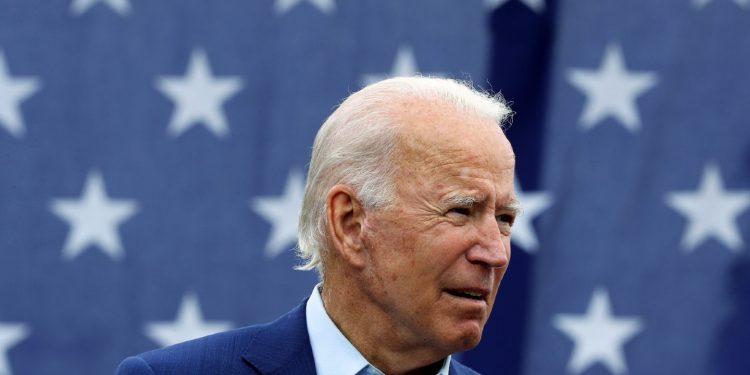
Surprise! President-elect Joe Biden isn’t listening to progressive voices in his party. Instead, he’s been rounding up the usual suspects for his cabinet and staff. Turns out, progressives, that if you give your support and vote to a Democratic establishment tool like Biden without making firm demands, you won’t get anything in return. Who knew?
Here are a few good articles on Biden’s staff and cabinet:
At TomDispatch.com, Danny Sjursen gives a sharp-eyed summary of the typical Biden operative in the realm of military and foreign affairs. Here’s what Sjursen has to say:
In fact, the national security bio of the archetypal Biden bro (or sis) would go something like this: she (he) sprang from an Ivy League school, became a congressional staffer, got appointed to a mid-tier role on Barack Obama’s national security council, consulted for WestExec Advisors (an Obama alumni-founded outfit linking tech firms and the Department of Defense), was a fellow at the Center for New American Security (CNAS), had some defense contractor ties, and married someone who’s also in the game.
It helps as well to follow the money. In other words, how did the Biden bunch make it and who pays the outfits that have been paying them in the Trump years? None of this is a secret: their two most common think-tank homes — CNAS and the Center for Strategic and International Studies (CSIS) — are the second- and sixth-highest recipients, respectively, of U.S. government and defense-contractor funding. The top donors to CNAS are Northrop Grumman, Boeing, and the Department of Defense. Most CSIS largesse comes from Northrop Grumman, Lockheed Martin, Boeing, and Raytheon.
With the news that Tony Blinken will be Biden’s Secretary of State, Caitlin Johnstone makes the following salient point:
Blinken is a liberal interventionist who has supported all of the most disgusting acts of US mass military slaughter this millennium, including the Iraq invasion which killed over a million people and ushered in an unprecedented era of military expansionism in the Middle East. So needless to say he will fly through the confirmation process.
Meanwhile, Julia Rock and Andrew Perez note the incestuous nature of this process, or how the national security revolving door keeps spinning:
On Sunday, Bloomberg reported that Biden has chosen his longtime aide, Tony Blinken, to serve as Secretary of State and will name Jake Sullivan, his senior advisor and a former Hillary Clinton aide, national security adviser. Former Obama Defense Department official Michèle Flournoy is considered the favorite to be Secretary of Defense.
After leaving the Obama administration, Blinken and Flournoy founded WestExec Advisors, a secretive consulting firm whose motto has been: “Bringing the Situation Room to the board room.” Flournoy and Sullivan have both held roles at think tanks raking in money from defense contractors and U.S. government intelligence and defense agencies.
Biden has been facing calls [Ha! Ha!] from Democratic lawmakers and progressive advocacy groups to end the revolving door between government and the defense industry. One-third of the members of Biden transition’s Department of Defense agency review team were most recently employed by “organizations, think tanks or companies that either directly receive money from the weapons industry, or are part of this industry,” according to reporting from In These Times.
Meanwhile, defense executives have been boasting about their close relationship with Biden and expressing confidence that there will not be much change in Pentagon policy.
Please forgive the “Ha! Ha!” parenthetical, but all this was predictable based on Biden’s record and his statement that nothing would fundamentally change in his administration.
Progressives have essentially no power in the Democratic Party. Look at who the Speaker of the House is! Nancy Pelosi, once again, the ultimate swamp creature.
Expect no new ideas from this bunch, meaning grim times are ahead. Isn’t it high time that progressives take the plunge and start their own party? They are voiceless and powerless within the Democratic Party. Failing that, they had better discover their spines and model themselves on the Tea Party in outspokenness, else they will remain utterly irrelevant.
Bernie Sanders who? Elizabeth Warren who? Progressive reforms? Not with the usual suspects that Joe Biden is selecting and empowering.