News that the Biden administration is sending cluster munitions to Ukraine highlights the dangerous escalatory nature of wars. These are special bombs and artillery shells with hundreds of “bomblets” that disperse to kill or maim as many people as possible. They persist in the environment; children have been known to pick them up and to be killed or grievously wounded as a result.
The apparent rationale behind this decision is that cluster munitions will help Ukraine in its counteroffensive against Russia. While these munitions will certainly increase the body count, probably on both sides, they are unlikely to be militarily decisive.
There are other issues as well, notes Daniel Larison at Eunomia:
The decision also opens the U.S. up to obvious charges of hypocrisy. U.S. officials have condemned the Russian use of these weapons and said that they have no place on the battlefield, but now the administration is saying that they do have a place. Providing cluster munitions to Ukraine makes a mockery of the administration’s earlier statements and creates more political problems for its effort to rally support for Ukraine. Many states in Latin America, Africa, and Asia are parties to the treaty banning the use, transfer, and stockpiling of cluster munitions, and now they will have one more reason to dismiss U.S. appeals to defending the “rules-based order” as so much hot air. The decision will probably embarrass and antagonize some of our allies in Europe, as most members of NATO are also parties to the treaty.
It’s rather amazing to think about the incredible variety of weaponry being sent to Ukraine in the name of “victory.” At first, the Biden administration spoke only of providing defensive weaponry. Biden himself declared that sending main battle tanks, jet fighters, and the like was tantamount to provoking World War III. More than a year later, the U.S. has committed to sending Abrams tanks, F-16 fighter jets, and offensive weapons of considerable potency like depleted uranium shells and now cluster munitions. And always with the same justification: the new weapons will help break the stalemate and lead to total victory for Ukraine.
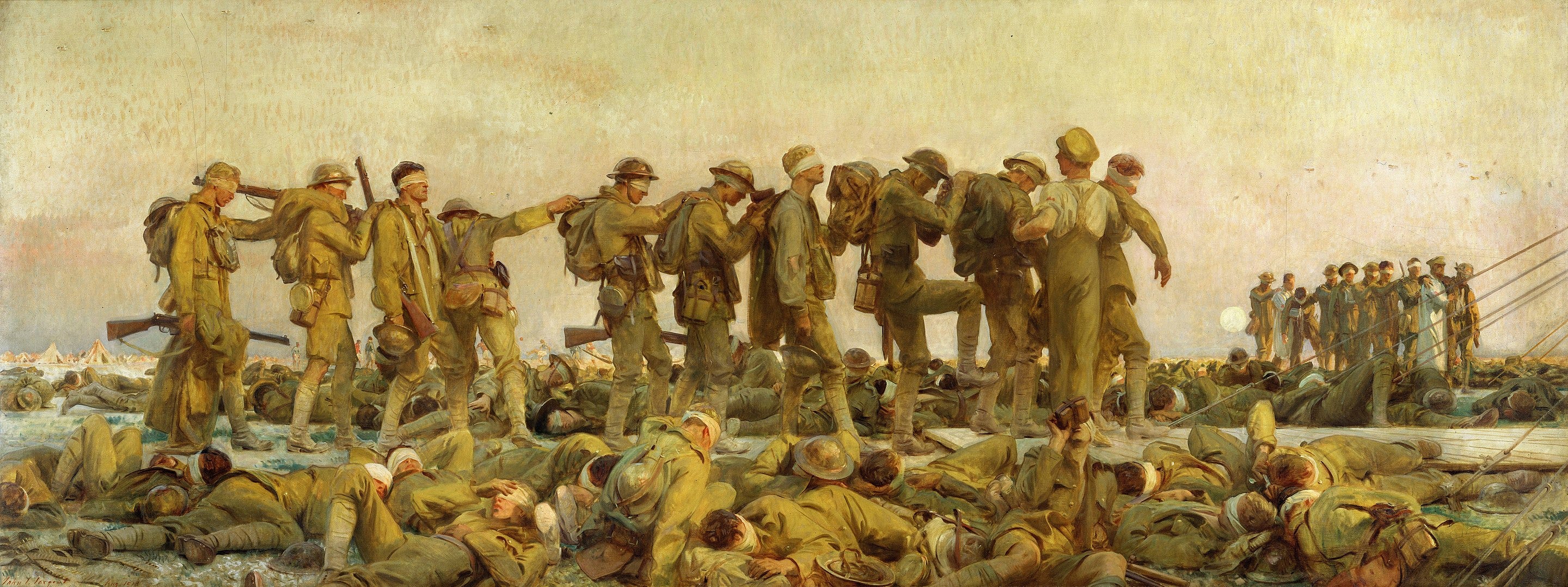
John Singer Sargent, “Gassed” (1919). Gas in World War I produced a million casualties—only aggravating the horrors of trench warfare
This is nothing new, of course, in military history. Think of World War I. Poison gas was introduced in 1915 in an attempt to break the stalemate of trench warfare. It didn’t. But it did stimulate the production of all sorts of dangerous chemical munitions and agents such as chlorine gas, phosgene, and mustard. Tanks were first introduced in 1916. Stalemate persisted. Flamethrowers were introduced. Other ideas to break the stalemate included massive artillery barrages along with “creeping” barrages timed to the advancing troops.
But there was no wonder weapon that broke the stalemate of World War I. After four years of sustained warfare, the German military finally started to falter in the summer of 1918. The Spanish Flu, the contagion of communism from Russia, and an effective allied blockade also served to weaken German resolve. The guns finally fell silent on November 11, 1918, a calm that wasn’t produced by magical weapons.
I wonder which weapon will next be hailed as crucial to Ukrainian victory? Who knows, maybe even tactical nukes might be on the minds of a few of the madmen advising Biden.
Comparing and contrasting low-yield theater nuclear weapons with conventional precision strike weapons leads to a nuanced conclusion that both contribute to deterrence.
Imagine that! Both nuclear and conventional weapons “contribute to deterrence.” Even though they’re apparently apples and oranges. Well, there’s “nuance” for you.
Anybody want a tasty nuclear “orange”? Fresh and juicy, and with a low yield. It may very well deter you from eating citrus fruit for, well, forever.
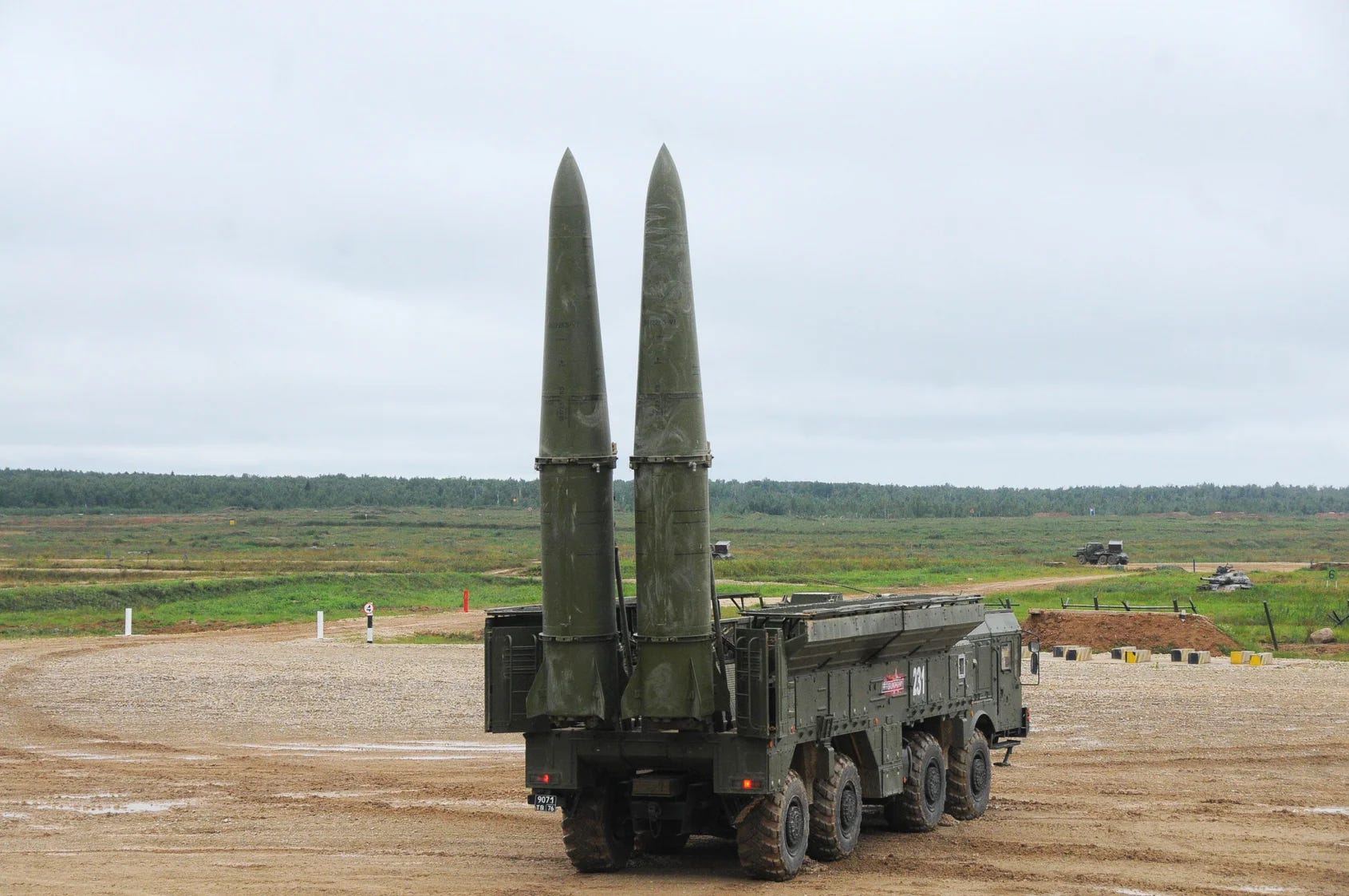
Potential delivery system for low-yield nukes. Think of them as juicy oranges
I’m not familiar with the authors of the piece. McCue is an Air Force lieutenant colonel with the Defense Threat Reduction Agency. I don’t know about you, but suggesting that low-yield nukes can be used in nuanced ways heightens my sense of threat. Lowther directs strategic deterrence programs at the National Strategic Research Institute, which makes me think anew about the meaning of “deterrence.” In this case, it seems to mean the willingness to use nuclear weapons against “bad actors” like China but especially Putin and Russia. And Davis is an Army major assigned to U.S. Central Command. It’s nice to know the Army, just like the Air Force, has a strange love for nukes.
In essence, the article’s argument is this: Russia, China, and North Korea are “investing” in low-yield nukes while the U.S. and other NATO allies have generally been reducing their arsenals of the same. To deter those three adversaries, the U.S. must make new “investments” in low-yield nukes, because you never know what those foreigners are up to.
Here’s how the authors put it in their conclusion: “In the right circumstances conventional weapons offer greater certainty of destruction than tactical nuclear weapons. The West must examine what this means for warfighting, as well as what adversaries are signaling by investing in low-yield nuclear weapons. The best solution may be the development of a state-of-the-art nuclear capability that ensures certain, prompt, proportionate, and in-kind response options. The perception of a missing rung on the American escalation ladder could prove alluring to Russia or China in a conflict.”
Mr. President, we must not allow a missing rung on America’s escalation ladder!
Even if that “missing rung” is only a “perception.”
Let’s keep that in mind if nuclear weapons start flying in Europe or Asia. We can console ourselves that at least we weren’t missing a rung in our escalatory ladder as millions get blasted, burnt, and irradiated.
Watch out if the robots and computers copy their human creators
Robot dogs as potential enforcers. AI chatbots that write scripts, craft songs, and compose legal briefs. Computers and cameras everywhere, all networked, all connected, all watching—and possibly learning?
Artificial intelligence (AI) is all the rage as science fiction increasingly becomes science fact. I grew up reading and watching Sci-Fi, and the lessons of the genre about AI are not always positive.
To choose three TV shows/movies that I’m very familiar with:
Star Trek: The Ultimate Computer: In this episode of the classic 1960s TV series, a computer is put in charge of the ship, replacing its human crew. The computer, programmed to think for itself while also replicating the priorities and personality of its human creator, attempts to destroy four other human-crewed starships in its own quest for survival before Captain Kirk and crew are able to outwit and unplug it.
The Terminator: In this 1980s movie, a robot-assassin is sent from the future to kill the mother of its human nemesis, thereby ensuring the survival of Skynet, a sophisticated AI network created by the U.S. military that gains consciousness and decides to eliminate its human creators. Many sequels!
The Matrix: In this 1990s movie, the protagonist, Neo, discovers his world is an illusion, a computer simulation, and that humans are being used as batteries, as power sources, for a world-dominating AI computer matrix. Many sequels!
Sci-Fi books and movies have been warning us for decades that AI networks may be more than we humans can handle. Just think of HAL from Stanley Kubrick’s 2001: A Space Odyssey. Computers and droids of the future may not be like R2-D2 and C-3PO from Star Wars, loyal servants to their human creators.
Nothing to worry about: It’s a cute “Digidog” featured by the New York Police Department. You may be the one begging and rolling over, however.
As they say, it’s only a movie, but I do worry about too much hype about AI. If AI becomes a reflection of its human creators, especially a distorted one, we could have much to worry about.
Assuming computers could truly learn from their human creators, it makes sense they would act like us, pursuing violence and issuing death sentences in the name of AI’s security and progress.
To AI networks of the future, linked to robotic enforcer dogs and armed aerial drones, humans just might be the “terrorists.”
I turn 60 this year. My health is generally good, though I have aches and pains from a form of arthritis. I’m not optimistic enough to believe that the best years of my life are ahead of me, nor so pessimistic as to assume that the best years are behind me. But I do know this, however sad it may be to say: the best years of my country are behind me.
Indeed, there are all too many signs of America’s decline, ranging from mass shootings to mass incarceration to mass hysteria about voter fraud and “stolen” elections to massive Pentagon and police budgets. But let me focus on just one sign of all-American madness that speaks to me in a particularly explosive fashion: this country’s embrace of the “modernization” of its nuclear arsenal at a price tag of at least $2 trillion over the next 30 years or so — and that staggering sum pales in comparison to the price the world would pay if those “modernized” weapons were ever used.
Just over 30 years ago in 1992, a younger, still somewhat naïve version of Bill Astore visited Los Alamos National Laboratory (LANL) in New Mexico and the Trinity test site in Alamogordo where the first atomic device created at that lab, a plutonium “gadget,” was detonated in July 1945. At the time I took that trip, I was a captain in the U.S. Air Force, co-teaching a course at the Air Force Academy on — yes, would you believe it? — the making and use of the atomic bombs that devastated the Japanese cities of Hiroshima and Nagasaki to end World War II. At the time of that visit, the Soviet Union had only recently collapsed, inaugurating what some believed to be a “new world order.” No longer would this country have to focus its energy on waging a costly, risky cold war against a dangerous nuclear-armed foe. Instead, we were clearly headed for an era in which the United States could both dominate the planet andbecome “a normal country in normal times.”
I was struck, however, by the anything-but-celebratory mood at Los Alamos then, though I really shouldn’t have been surprised. After all, budget cuts loomed. With the end of the Cold War, who needed LANL to design new nuclear weapons for an enemy that no longer existed? In addition, there was already an effective START treaty in place with Russia aimed at reducing strategic nuclear weapons instead of just limiting their growth.
At the time, it even seemed possible to imagine a gradual withering away of such great-power arsenals and the coming of a world liberated from apocalyptic nightmares. Bipartisan support for nuclear disarmament would, in fact, persist into the early 2000s, when then-presidential candidate Barack Obama joined old Cold War hawks like former Secretary of State Henry Kissinger and former Senator Sam Nunn in calling for nothing less than a nuclear-weapons-free world.
An Even More Infernal Holocaust
It was, of course, not to be and today we once again find ourselves on an increasingly apocalyptic planet. To quote Pink Floyd, the child is grown and the dream is gone. All too sadly, Americans have become comfortably numb to the looming threat of a nuclear Armageddon. And yet the Bulletin of Atomic Scientist’sDoomsday Clockcontinues to tick ever closer to midnight precisely because we persist in building and deploying ever more nuclear weapons with no significant thought to either the cost or the consequences.
Over the coming decades, in fact, the U.S. military plans to deploy hundreds — yes, hundreds! — of new intercontinental ballistic missiles (ICBMs) in silos in Wyoming, Montana, North Dakota, and elsewhere; a hundred or so nuclear-capable B-21 stealth bombers; and a brand new fleet of nuclear-missile-firing submarines, all, of course, built in the name of necessity, deterrence, and keeping up with the Russians and the Chinese. Never mind that this country already has thousands of nuclear warheads, enough to comfortably destroy more than one Earth. Never mind that just a few dozen of them could tip this world of ours into a “nuclear winter,” starving to death most creatures on it, great and small. Nothing to worry about, of course, when this country must — it goes without saying — remain the number one possessor of the newest and shiniest of nuclear toys.
And so those grim times at Los Alamos when I was a “child” of 30 have once again become boom times as I turn 60. The LANL budget is slated to expand like a mushroom cloud from $3.9 billion in 2021 to $4.1 billion in 2022, $4.9 billion in 2023, and likely to well over $5 billion in 2024. That jump in funding enables “upgrades” to the plutonium infrastructure at LANL. Meanwhile, some of America’s top physicists and engineers toil away there on new designs for nuclear warheads and bombs meant for one thing only: the genocidal slaughter of millions of their fellow human beings. (And that doesn’t even include all the other life forms that would be caught in the blast radii and radiation fallout patterns of those “gadgets.”)
The very idea of building more and “better” nuclear weapons should, of course, be anathema to us all. Once upon a time, I taught courses on the Holocaust after attending a teaching seminar at the U.S. Holocaust Memorial Museum. Now, the very idea of modernizing our nuclear arsenal strikes me as the equivalent of developing upgraded gas chambers and hotter furnaces for Auschwitz. After all, that’s the infernal nature of nuclear weapons: they transform human beings into matter, into ash, killing indiscriminately and reducing us all to nothingness.
I still recall talking to an employee of Los Alamos in 1992 who assured me that, in the wake of the collapse of the Soviet Union, the lab would undoubtedly have to repurpose itself and find an entirely new mission. Perhaps, he said, LANL scientists could turn their expertise toward consumer goods and so help make America more competitive vis-à-vis Japan, which, in those days, was handing this country its lunch in the world of electronics. (Remember the Sony Walkman, the Discman, and all those Japanese-made VCRs, laser disc players, and the like?)
I nodded and left Los Alamos hopeful, thinking that the lab could indeed become a life-affirming force. I couldn’t help imagining then what this country might achieve if some of its best scientists and engineers devoted themselves to improving our lives instead of destroying them. Today, it’s hard to believe that I was ever so naïve.
“Success” at Hiroshima
My next stop on that tour was Alamogordo and the Trinity test site, then a haunted, still mildly radioactive desert landscape thanks to the world’s first atomic explosion in 1945. Yes, before America nuked Japan that August at Hiroshima and Nagasaki, we nuked ourselves. The Manhattan Project team, led by J. Robert Oppenheimer, believed a test was needed because of the complex implosion device used in the plutonium bomb. (There was no test of the uranium bomb used at Hiroshima since it employed a simpler triggering device. Its first “test” was Hiroshima itself that August 6th and the bomb indeed “worked,” as predicted.)
J. Robert Oppenheimer, the “father” of the atomic bomb
So, our scientists nuked the desert near the Jornada del Muerto, the “dead man’s journey” as the Spanish conquistadors had once named it in their own febrile quest for power. While there, Oppenheimer famously reflected that he and his fellow scientists had become nothing short of “Death, the destroyer of worlds.” In the aftermath of Hiroshima, he would, in fact, turn against the military’s pursuit of vastly more powerful hydrogen or thermonuclear, bombs. For that, in the McCarthy era, he was accused of being a Soviet agent and stripped of his security clearance.
Oppenheimer’s punishment should be a reminder of the price principled people pay when they try to stand in the way of the military-industrial complex and its pursuit of power and profit.
But what really haunts me isn’t the “tragedy” of Opie, the American Prometheus, but the words of Hans Bethe, who worked alongside him on the Manhattan Project. Jon Else’s searing documentary film, The Day After Trinity, movingly catches Bethe’s responses on hearing about the bomb’s harrowing “success” at Hiroshima.
His first reaction was one of fulfillment. The crash program to develop the bomb that he and his colleagues had devoted their lives to for nearly three years was indeed a success. His second, he said, was one of shock and awe. What have we done, he asked himself. What have we done? His final reaction: that it should never be done again, that such weaponry should never, ever, be used against our fellow humans.
And yet here we are, nearly 80 years after Trinity and our country is still devoting staggering resources and human effort to developing yet more “advanced” nuclear weapons and accompanying war plans undoubtedly aimed at China, North Korea, Russia, and who knows how many other alleged evildoers across the globe.
Fire and Fury Like the World Has Never Seen?
Perhaps now you can see why I say that the best years of my country are behind me. Thirty years ago, I caught a fleeting glimpse out of the corner of my eye (Pink Floyd again) of a better future, a better America, a better world. It was one where a sophisticated lab like Los Alamos would no longer be dedicated to developing new ways of exterminating us all. I could briefly imagine the promise of the post-Cold-War moment — that we would all get a “peace dividend” — having real meaning, but it was not to be.
And so, I face my sixtieth year on this planet with trepidation and considerable consternation. I marvel at the persuasive power of America’s military-industrial-congressional complex. In fact, consider it the ultimate Houdini act that its masters have somehow managed to turn nuclear missiles and bombs into stealth weapons — in the sense that they have largely disappeared from our collective societal radar screen. We go about our days, living and struggling as always, even as our overlords spend trillions of our tax dollars on ever more effective ways to exterminate us all. Indeed, at least some of our struggles could obviously be alleviated with an infusion of an extra $2 trillion over the coming decades from the federal government.
Instead, we face endless preparations for a planetary holocaust that would make even the Holocaust of World War II a footnote to a history that would cease to exist. The question is: What can we do to stop it?
The answer, I think, is simply to stop. Stop buying new nuclear stealth bombers, new ICBMs, and new ultra-expensive submarines. Reengage with the other nuclear powers to halt nuclear proliferation globally and reduce stockpiles of warheads. At the very least, commit to a no-first-use policy for those weapons, something our government has so far refused to do.
I’ve often heard the expression “the nuclear genie is out of the bottle,” implying that it can never be put back in again. Technology controls us, in other words.
That’s the reality we’re all supposed to accept, but don’t believe it. America’s elected leaders and its self-styled warrior-generals and admirals have chosen to build such genocidal weaponry. They seek budgetary authority and power, while the giant weapons-making corporations pursue profits galore. Congress and presidents, our civilian representatives, are corrupted or coerced by a system that ensnares their minds. Much like Gollum in The Lord of the Rings, the nuclear button becomes their “precious,” a totem of power. Consider President Trump’s boast to Kim Jong-un that “his” nuclear button was much bigger than theirs and his promise that, were the North Korean leader not to become more accommodating, his country would “face fire and fury like the world has never seen.” The result: North Korea has vastly expandedits nuclear arsenal.
It wouldn’t have to be this way. To cite Dorothy Day, the Catholic peace activist, “Our problems stem from our acceptance of this filthy, rotten system.” Don’t accept it, America. Reject it. Get out in the streets and protest as Americans did during the nuclear freeze movement of the early 1980s. Challenge your local members of Congress. Write to the president. Raise your voice against the merchants of death, as Americans proudly did (joined by Congress!) in the 1930s.
If we were to reject nuclear weapons, to demand a measure of sanity and decency from our government, then maybe, just maybe, the best years of my country would still lie ahead of me, no matter my growing aches and pains on what’s left of my life’s journey.
Not to be morbid, but I suppose we all walk our own Jornada del Muerto. I’d like what’s left of mine to remain unlit by the incendiary glare of nuclear explosions. I’d prefer that my last days weren’t spent in a hardscrabble struggle for survival in a world cast into darkness and brutality by a nuclear winter. How about you?
The death penalty shouldn’t apply to turning in the wrong driveway or knocking on the wrong door
As a follow up to my previous article, “Shootings Are Us,” I read a piece today on NBC News about “Stand Your Ground” and “Castle Doctrine” laws. The idea is that people can defend themselves if accosted (“stand your ground”) and if their property is invaded (“castle doctrine”). In America, however, defense often takes a deadly form because people reach for guns rather than, say, a baseball bat, and bullets are quite unforgiving to flesh, and more difficult for most to aim and control than a bat.
Perhaps we all need “Star Trek” phasers set to stun, but, seriously, the problem is that guns are designed to kill. You really can’t modulate their murderous potential. So we have all sorts of Americans shot and killed or wounded for the most innocuous of actions, such as turning down the wrong driveway, knocking on the wrong door, or getting in the wrong car.
Such mistaken actions shouldn’t be subject to a potential death penalty at the trigger-happy hands of mostly untrained and seemingly strung out men.
Reasonable self-defense laws make sense to me, but the so-called castle doctrine is part of the problem. It encourages us to see our houses (and other property) as castles, as fortresses, as something we should defend using murderous force. But is defending one’s property truly a sufficient rationale to take someone’s life?
If a man knocks me from my bike and steals it, am I truly justified in pulling my gun and shooting him dead? Sure, I’d be seriously pissed at losing my bike, but I’d get over it. I’m not sure I’d ever get over shooting the bike thief and putting him six feet under.
A home intruder? I get it. I’d call 911 and do my best to keep my family safe. If a gun were handy, I’d get it, but I wouldn’t start blasting away as a first resort. Firing a gun at someone truly should be the last resort. And when you fire, you should always have a good idea what you’re shooting at. Too many times, the “home intruder” turns out to be a family member visiting unexpectedly or returning late, or perhaps even someone who’s lost or confused.
Uncle Ben to Peter Parker (Spider-Man): With great power comes great responsibility
Here, the lesson from Peter Parker’s gentle Uncle Ben comes to mind: With great power comes great responsibility. Guns represent great power, meaning you must exercise great responsibility when employing them. Far too often, America seems to have too many trigger-happy people, eager to use their power but none too eager to consider their responsibility.
So they blast away, then claim they were standing their ground or defending their castle. And given the law in many states across America, it just may be enough of a defense to earn them verdicts of “not guilty,” even when they kill innocents.
Shootings are all over the news today. A young woman killed in rural New York when she drove up the wrong driveway and the owner of the house came out blasting. A Black teenager shot and wounded when he mixed up an address and knocked on the wrong door in Kansas City. And a news flash from The Boston Globe this PM reporting that at least four people have been killed and three more wounded in two shootings in Maine.
America has so many deadly shootings on a daily basis that they hardly qualify as news anymore. What gives?
Ralph Yarl, shot and wounded when he mixed up an addressKaylin Gillis, shot and killed in rural NY
No guns, no shootings, of course, but America is awash in guns, and no one is going to pry them from the hands of those who want them.
You’d think brandishing a gun would be enough of a threat, but far too often, those who have guns seem eager to use them as well. Why shoot at a car that pulls in your driveway, even as the car is turning around and leaving? Why shoot at a young Black man for simply walking up and knocking on the door? In both cases, the shooters pulled the trigger at least twice, and apparently used no warning shots or for that matter any other kind of warning. It’s shoot first, ask questions later, in this man’s America.
There’s a weird toxic brew at work here, I think. First, the guns themselves. I’ve fired plenty of them and they do give you a feeling of power. Second, fear. People are fearful. Sometimes the fear may be race-based, sometimes it’s something else, but there’s nothing like fear to paralyze the mind. Then there’s a fantasy element. Some people, mostly men I’m guessing, think they’re akin to Dirty Harry, blowing away bad people with their guns. Finally, sadly, some people just find guns to be fun, even when they’re pointing them at other people.
I know it’s more complicated than this, but fear, fantasy, and fun don’t mix well with guns. In America, guns are WMD: weapons of mass destruction. Because of their deadly power, they should be used only in the rarest of circumstances and as a last resort.
Yet Americans seem to be grabbing their guns and blasting away as a first resort and with no remorse.
Stay safe out there. And to those with guns, why not just call 911? Or keep your door locked? Do you really want to take the life of an innocent just because you felt afraid or angry and fancied yourself a vigilante?
Would you buy a new car if its longevity was 40% of your old one?
When I was still in the Air Force, the F-35 was on the drawing boards as a fairly low cost, multi-role, fighter-bomber somewhat akin to an F-150 pickup truck. Being designed and built by Lockheed Martin and also having to meet the varying requirements of the U.S. Air Force, the Navy, and the Marine Corps, cost and complexity quickly escalated, so much so that an AF Chief of Staff recently compared it to a Ferrari rather than to a trusty and capable pickup truck.
That Ferrari comparison is apt with respect to cost, though even Ferraris may be more durable and reliable than the F-35.
How so? A friend sent along an article on the F-15EX Eagle II fighter.
F-15EX Eagle II. Not stealthy, but its lasts 2.5 times as long as the F-35
Now, I’ve been reading about the F-15 since I was a teenager in the 1970s. It’s a proven fighter jet but it lacks the stealthy characteristics of the F-35. But here’s the section that got my attention from the article:
Remember, the F-15EX has a 20,000-hour airframe life. The F-35A has an 8,000-hour airframe life. This is one way the F-15EX gets done dirty when people make comparisons between it and the F-35, often based on unit cost alone, which is about equal. We are talking about two-and-a-half times the airframe hours out of the box with the F-15EX. That is not a knock against the F-35A at all. The F-15EX is just a very mature aircraft that has been optimized for longevity over a much younger one.
I like the way the author tries to explain away the short airframe life of the F-35. Hey, it’s a young aircraft! What can you expect except a 60% drop in longevity?
How many of us would buy a car, a truck, or any other technology if we were told the new tech would last only 40% as long as roughly comparable older tech? Would Apple advertise a new iPhone battery as lasting only four hours when the previous version lasted ten hours? How many people would rush out to buy the “new and improved” iPhone in this case?
The F-35 has many issues, which I’ve written about here and here. Add a much quicker expiration date to the mix.
I’m assuming Ferrari is none too happy with its cars being compared to the F-35!
Names Like Minuteman, Peacekeeper, and Sentinel Are Diabolically Dishonest
Ever think about names of U.S. weapons of war? Rarely are those names honest. I do applaud the relative honesty of Predator and Reaper drones, because those names capture the often predatory nature of U.S. foreign policy and the grim reaperish means that are often employed in its execution. Most names are not so suggestive. For example, U.S. fighter planes carry noble names like Eagle, Fighting Falcon, or Raptor. Nuclear bombers are an interesting case since they can carry thermonuclear bombs and missiles to kill hundreds of thousands, possibly millions, of people. So we have the B-52 Stratofortress (a great 1950s-era name), the B-1 Lancer, the B-2 Spirit, and the new B-21 Raider (the name has historical echoes to the Doolittle Raid on Tokyo in 1942).
Reaping what we sow? Just reaping? Whatever the case, the U.S. way of war is grim
Shouldn’t these bombers carry names like Megadeath or Mass Murder?
Think too of nuclear missiles. The Air Force’s Intercontinental Ballistic Missiles (ICBMs) have had names like Titan, Minuteman, Peacekeeper, and now the new Sentinel. But since these missiles carry warheads that could easily kill millions, wouldn’t a more honest name be The Holocaust ICBM? For that’s what these missiles promise: a nuclear holocaust.
Consider too the Navy’s Ohio-class nuclear missile-firing submarines (SSBN) with their Trident missiles. (Trident—gotta hand it to the Navy.) Just one submarine can carry 20 Trident II missiles, each with up to eight warheads, each warhead being roughly equivalent to six Hiroshima bombs. Again, roughly speaking, each of these submarines carries an arsenal equivalent to one thousand Hiroshima bombs. And the U.S. has fourteen of these submarines.
Instead of the Ohio-class of submarines, shouldn’t they be called the Armageddon-class? Or the Apocalypse-class? The Genocide-class?
With a bit more honesty, perhaps it wouldn’t be so easy to sell these horrific weapons to Congress and the American people. Then again, when the bottom line is higher budgets for the Pentagon and more jobs for Congressional districts, I guess America will buy most anything. Even Holocaust missiles and Armageddon submarines. And for upwards of $2 trillion over the next 30 years as well.
If they don’t bust the budget, perhaps they’ll destroy the world.
Welcome to the era of state-sponsored thought police
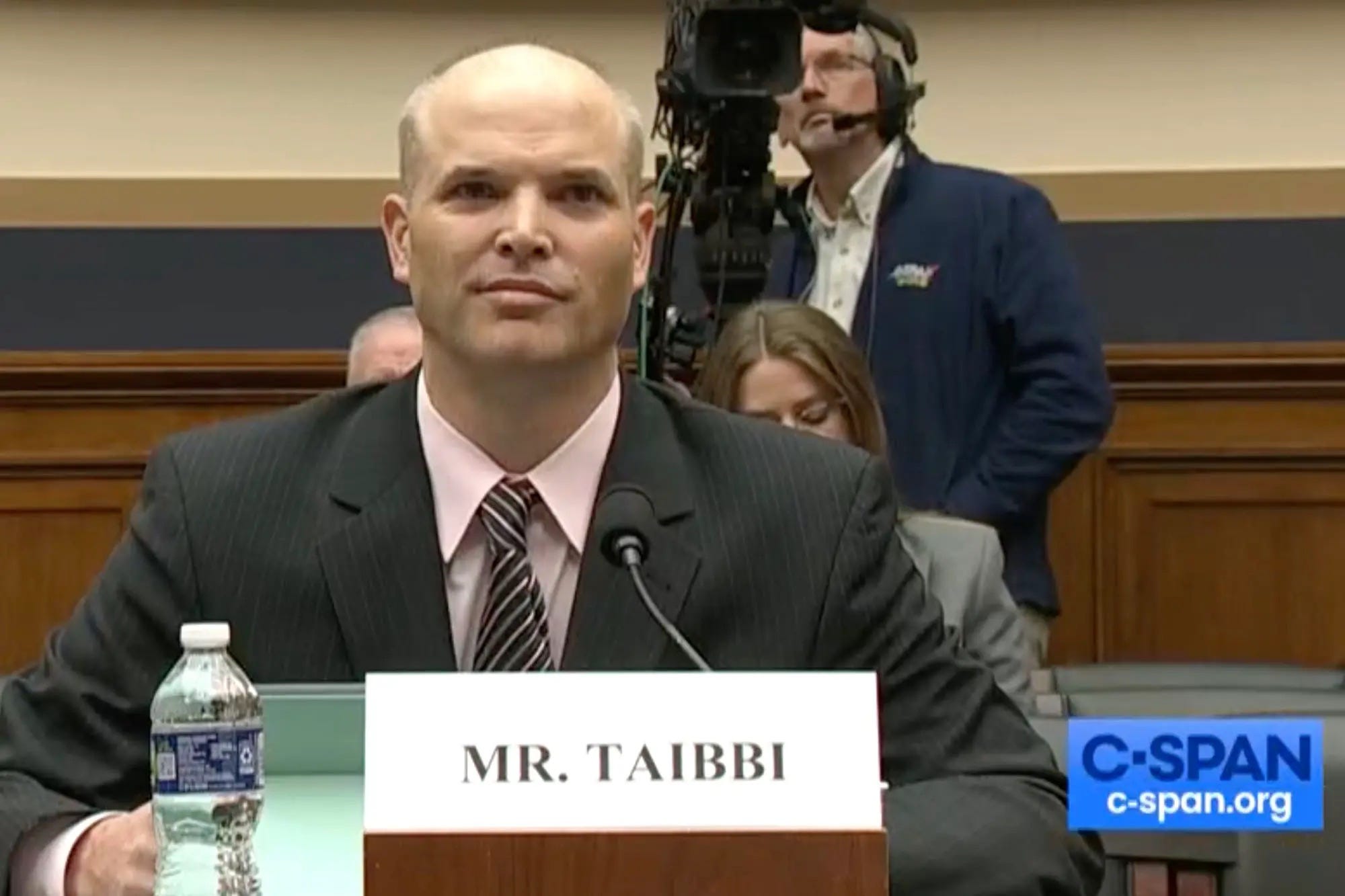
Yesterday, journalists Matt Taibbi and Michael Shellenberger testified before the House Select Subcommittee on the Weaponization of the Federal Government. Their testimony, and the risible reactions of Democrats on the subcommittee, are well worth watching; I watched the entire hearing, which lasted 140 minutes. Kim Iverson has an excellent summary here which lasts about 23 minutes. As Iverson notes, the Democrats on the subcommittee demonized the journalists while supporting censorship of ordinary Americans for political advantage, a clear violation of freedom of speech and the First Amendment to the U.S. Constitution.
Shellenberger and Taibbi, “so-called” journalists according to Democrats
Clearly, the Twitter Files have revealed government-directed censorship of lawful speech. The reactions and strategy of the Democrats on the subcommittee were as follows:
To smear the two journalists who volunteered to appear before Congress as “so-called” journalists; as being biased witnesses in favor of the right (even though Shellenberger testified he’d voted for Biden, and Taibbi described himself as a traditional ACLU liberal); as having the basest of motives, such as taking payments and otherwise profiting from their journalism; and of being willing or unwilling dupes of Elon Musk.
To repeat, again and again, that Russia massively interfered in the 2016 and 2020 elections, therefore government-directed efforts to suppress “foreign interference” in U.S. elections was both legitimate and praiseworthy.
To associate Elon Musk with Qatar, Saudi Arabia, Russia, China, and other alleged bad actors, thereby suggesting that the Twitter Files are tainted and compromised by foreign information ops and influence.
To defend the FBI and other government agencies like the DHS and CIA as trustworthy and reliable defenders of truth as well as upholders of the First Amendment.
To suggest that the journalists involved posed a “direct threat,” e.g. to workers at Twitter, not the federal government or powerful corporations like Twitter itself or Facebook.
To imply the subcommittee’s purpose wasn’t about free speech at all; that its purpose was purely political and intended to advance right-wing agendas.
Specific to the Hunter Biden laptop story, one Democrat implied the hard drive could have been altered, thus calling into question the validity of emails and other data on that drive.
To change the subject by accusing Republicans of being worse offenders since they’re trying to ban books; also that Donald Trump is worse because he jailed one of his opponents.
Not one Democrat on the subcommittee expressed concern about the peril of state-sponsored censorship and suppression of free expression. Indeed, the Democrats took pains to portray the journalists in front of them as the real peril, along with Russia, Elon Musk, Republican book-banners, and other bad actors.
It was all rather amazing, a “shit storm” to quote Kim Iverson.
Matt Taibbi, award-winning journalist with 30 years’ experience, dismissed as an Elon Musk tool by Democrats
So many important points made by Taibbi and Shellenberger could easily get lost in this political shit storm, which I suppose was the Democrats’ strategy. Here’s a short list of those points:
As Taibbi said, state-directed censorship on Twitter didn’t just affect the right but also people on the left and publications like Consortium News and Truthout.
We’re looking at an emerging censorship-industrial complex, an unholy alliance between government and private corporations to filter, constrain, and otherwise control information sources. A form of “digital McCarthyism.”
Ordinary Americans are being deprived of their free speech rights without due process. Not only that: some are de-platformed and then denied access to pay sources (like PayPal) as punishment. So, not only can’t you speak freely: you also can’t support yourself financially.
Government calls (in this case by the FTC) to investigate the backgrounds of Taibbi, Shellenberger, and other journalists involved in the Twitter Files creates a chilling effect on journalism. As Shellenberger noted, it’s reminiscent of the Stasi (secret police) in East Germany.
Democrats on the subcommittee had no interest in any of this. Their strategy was to dismiss the hearing as politically motivated and the journalists involved as greedy opportunists handpicked by Elon Musk (whom, you might recall, was associated with Qatar, Saudi Arabia, Russia, China, and perhaps Hitler, Stalin, and Darth Vader).
Interestingly, I learned a new word in the hearings: “pre-bunking.” Apparently, the Democrats in 2020 knew the Republicans had Hunter Biden’s laptop, so they engaged in an exercise to “pre-bunk” the release of embarrassing details from that computer. To wit, mainstream media “journalists” were encouraged not to follow the “Pentagon Papers” model of publishing leaked and legitimate material quickly. Rather, they were primed not to cover such a story, or to cover it as a case of Russian disinformation.
And that’s exactly what the mainstream media did in October 2020: as a group, they wrongly dismissed the Hunter Biden laptop revelations as Russian disinformation as the government worked hand-in-glove with Twitter, Facebook, and others to suppress the story as malicious and false. As we now know (and as was known then), the Hunter Biden laptop story was well-sourced and accurate. There was no Russian connection whatsoever. (Kudos to the Democrats for their dirty tricks here; even Richard Nixon couldn’t have done it better.)
Again, Democrats on the subcommittee showed no interest in or concern about an emerging censorship-industrial complex and its suppression of free speech rights. They painted the journalists before them as bad or sketchy actors and the FBI and other government agencies like DHS and the CIA as the good guys, working selflessly and without bias to protect us all from the “dangerous” ideas of our fellow citizens.
Welcome to the era of state-sponsored thought police, brought to you by your Democratic friends in Congress.
Addendum (3/11): All those Democrats so eager to pillory Taibbi and Shellenberger: they all took an oath to support and uphold the Constitution.
I’m not sure there’s any more fundamental right to that oath than freedom of speech.
If you take your oath seriously as a Member of Congress, your focus at the hearing should — must — have been on upholding that fundamental right against government-directed interference and censorship.
Yet none of them mentioned this or their oath — their sworn duty — to the Constitution.
This is worse than mendacity; they are derelict in their duties as representatives and public servants.
I woke this morning to the sad news that Daniel Ellsberg has pancreatic cancer and has been given only a few months to live. Ellsberg has lived a long and heroic life; he famously leaked the Pentagon papers, risking lifelong imprisonment to put a stop to America’s calamitous and atrocious war against Vietnam.
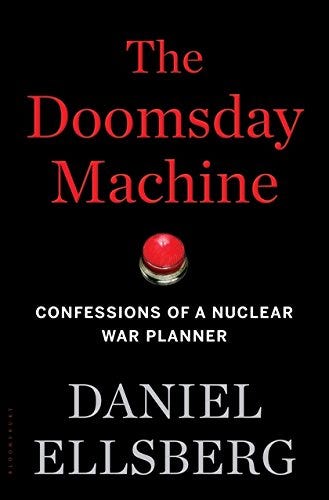
Five years ago, I read Ellsberg’s book on his years as a nuclear war theorist for the U.S. government. I was so impressed (and so alarmed) that I immediately wrote my own review of it, which I’m reposting today in Ellsberg’s honor.
Ellsberg is one of the giants of recent American history. He has lived a life of great value. Perhaps the best way to honor him is to read him, listen to him, and act to put a stop to our collective nuclear madness.
The Doomsday Machine: The Madness of America’s Nuclear Weapons
(Originally posted 12/28/17)
I just finished Daniel Ellsberg’s new book, The Doomsday Machine: Confessions of a Nuclear War Planner. Talk about hair-raising! Ellsberg, of course, is famous for leaking the Pentagon papers, which helped to end the Vietnam war and the presidency of Richard Nixon as well. But before Ellsberg worked as a senior adviser on the Vietnam war, he helped to formulate U.S. nuclear policy in the late 1950s and early 1960s. His book is a shattering portrayal of the genocidal nature of U.S. nuclear planning during the Cold War — and that threat of worldwide genocide (or omnicide, a word Ellsberg uses to describe the death of nearly everything from a nuclear exchange that would generate disastrous cooling due to nuclear winter) persists to this day.
Rather than writing a traditional book review, I want to list some memorable facts and lessons I took from the book, lessons that should lead us to question the very sanity of America’s leaders. To wit:
U.S. nuclear war plans circa 1960 envisioned a simultaneous attack on the USSR and China that would generate 600 million deaths after six months. As Ellsberg notes, that is 100 Holocausts. This plan was to be used even if China hadn’t directly attacked the U.S., i.e. the USSR and China were lumped together as communist bad guys who had to be eliminated together in a general nuclear war. Only one U.S. general present at the briefing objected to this idea: David M. Shoup, a Marine general and Medal of Honor winner, who also later objected to the Vietnam War.
The U.S. military consistently overestimated the Soviet nuclear threat, envisioning missile and bomber gaps that didn’t exist. In the nuclear arms race, the U.S. was often racing itself in the fielding of more and more nuclear weapons.
General Curtis LeMay, the famous commander of Strategic Air Command (SAC) and later AF Chief of Staff, said that once war started, politicians like the president had no role to play in decision-making.
When the atomic bomb was first tested in 1945, there were fears among the scientists involved that the atmosphere could be ignited, ending all life on earth. The chance was considered remote (perhaps 3 in a million), so the scientists pressed ahead.
The Cuban Missile Crisis of 1962 came much closer to nuclear war than most people recognize. Soviet submarines in the area, attacked by mock U.S. depth charges, were prepared to launch nuclear torpedoes against U.S. ships. Fidel Castro’s air defenses were also preparing to shoot down American planes, which may have ended in U.S. air attacks and an invasion in which Soviet troops on Cuba may have used nuclear weapons to defend themselves.
The U.S. military was (and probably still is) extremely reluctant to reveal nuclear secrets to senior American civilian leaders, including even the President himself. Ellsberg, possessing the highest security clearances and acting with presidential authority, had to pry answers from military officers who refused to provide detailed and complete information.
The U.S. has always refused, and continues to refuse, to pledge to a “no first use” policy for nuclear weapons.
The U.S. remains the only country to have used nuclear weapons (Hiroshima and Nagasaki). Yet, as Ellsberg notes, the U.S. uses nuclear weapons all the time — by threatening their use, as President Eisenhower did during the Korean War, as President Nixon did during the Vietnam War, and as President Trump is doing today, promising “fire and fury” against North Korea. The U.S. uses nuclear weapons like a loaded gun — holding it to an enemy’s head and threatening to pull the trigger, Ellsberg notes. In short, there’s nothing exceptional about Trump and his nuclear threats. All U.S. presidents have refused to take nuclear attacks “off the table” of options for U.S. action.
Interservice rivalry has always been a driver of U.S. nuclear force structure and strategy. The Navy (with its nuclear submarine programs, Polaris followed by Trident) and especially the Air Force (with its ICBMs and bombers) jealously guard their nuclear forces and the prestige/power/budgetary authority they convey.
President Eisenhower’s emphasis on massive retaliation (as represented by SAC and its war plan, the SIOP) was a way for him to limit the power of the military-industrial complex (MIC). But once Ike was gone, so too was the idea of using the nuclear deterrent as a way of restricting U.S. expenditures on conventional weaponry and U.S. adventurism in foreign wars, e.g. Vietnam. (It should be said that Ike’s exercise at limiting the MIC in America held the world as a nuclear hostage.)
Ellsberg shows convincingly that control over U.S. nuclear weapons was decentralized and delegated to much lower levels than most Americans know. It’s not the case that only the president can launch a nuclear war. Especially in the late 1950s and early 1960s, Ellsberg shows how it was possible that field-grade officers (majors and colonels) could have made decisions in the heat of battle to release nuclear weapons without direct orders from the president.
Most Americans, Ellsberg notes, still don’t understand the huge quantitative and qualitative differences between atomic bombs and hydrogen (thermonuclear) weapons. Hydrogen bombs are measured in megatons in equivalent TNT yield; atomic bombs are in kilotons. In short, hydrogen bombs are a thousand times more destructive than atomic ones. And this is just their explosive yield. Radioactive fallout and massive fires are even bigger threats to life on earth.
Most Americans still don’t understand that even a smallish nuclear exchange involving a few dozen hydrogen bombs could very well lead to nuclear winter and the deaths of billions of people on the earth (due to the widespread death of crops and resulting famine and disease).
Despite the genocidal threat of nuclear weapons, the U.S. is persisting in plans to modernize its arsenal over the next 30 years at a cost of $1 trillion.
Ellsberg sees this all as a form of collective madness, and it’s hard to disagree. He quotes Nietzsche to the effect that madness in individuals is rare, but that it’s common among bureaucracies and nations. The tremendous overkill inherent to U.S. nuclear weapons — its threat of worldwide destruction — is truly a form of madness. For how do you protect a nation or uphold its ideals by launching a nuclear war that would kill nearly everyone on earth? How does that make any sense? How is that not mad?
Ellsberg ends his “confessions” with many sane proposals for downsizing nuclear arsenals across the world. But is anyone in power listening? Certainly not U.S. presidents like Trump or Obama, who both signed on to that trillion dollar modernization program for U.S. nuclear weapons.
Ellsberg shows us there have been many chair-bound paper-pushers in the U.S. government who’ve drawn up plans to murder hundreds of millions of people — to unleash doomsday — all in the name of protecting America. He also shows how close they’ve come to doing just that, especially during the Cuban Missile Crisis, but during other crises as well.
Nuclear brinksmanship, threats of nuclear war, and similar uses of nuclear weapons to intimidate hold the potential for catastrophe. Miscalculations, mishaps, mistakes, are more than possible in an atmosphere of mistrust, when words and actions can be misinterpreted.
Ellsberg’s recommendations for changes point the way to a better world, a world where the threat of nuclear doomsday could be much reduced, perhaps eliminated completely. The question remains: Is anyone in power listening?