The AI hype train is here and is speeding ahead like the fastest Japanese bullet train. It’s a “revolution,” and AI is going to change everything and/or doom us all. Or maybe it’ll usher in a glorious utopia? New technologies always seem to mobilize both the doomsayers and the utopian dreamers.
Amazingly, ChatGPT is already recording 800 million weekly active users. Meanwhile, investment in AI races ahead—not without serious implications. Today, I noted these two stories at the New York Times:
So, the demand for chips may inflate the price of your next computer even as investors in AI continue to throw money at its promise.
Given the nature of the corporations and governments making decisions about AI and its future, I’m not optimistic for an AI-driven utopia. Count me among the (guarded) pessimists.
Why? Here’s one snippet I gleaned from the New York Times the other day:
28,000,000,000
— That’s how many liters of water Microsoft said it would use for its data centers in 2030, according a report obtained by The Times.The company had promised to cut its water use, but big tech companies are guzzling water during the A.I. frenzy.
That’s an enormous quantity of water when water scarcity is a major issue for our climate change-driven future.
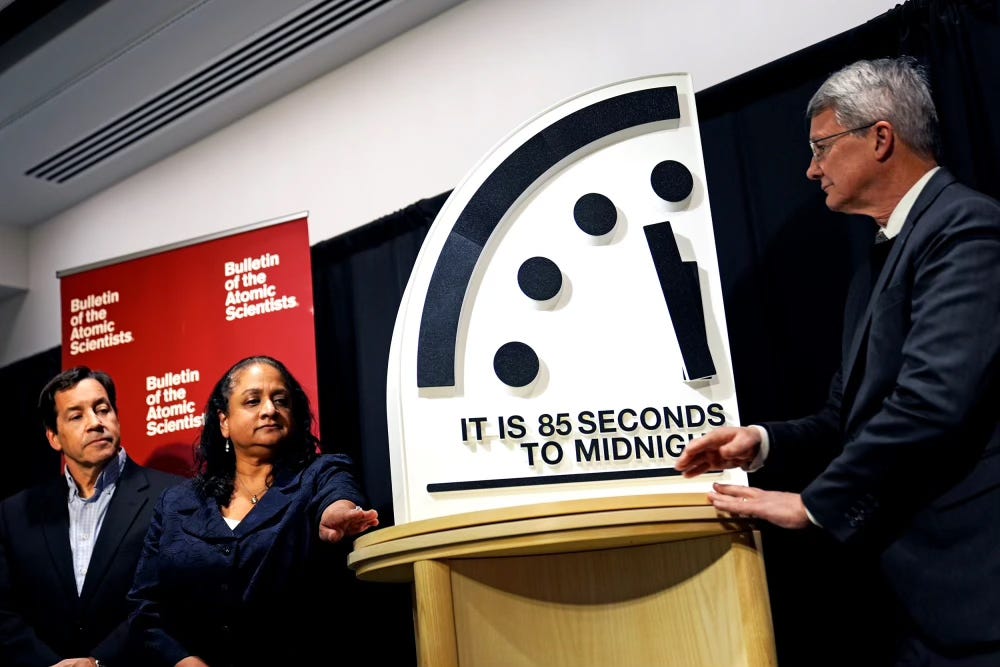
Along with that, I saw where the Bulletin of the Atomic Scientists moved the Doomsday Clock to 85 seconds to midnight, the closest it’s ever been to nuclear Armageddon. In their statement, the scientists cited the rise of AI and its application to weapons and war as one reason for the clock’s creep toward midnight.
So, what gives with this “AI frenzy”? My guess is that AI is being harnessed by the powerful for their purposes. They’re not investing big money to help the little people. This is not to say that every AI application is nefarious and evil. But I think the general trend will be AI-driven “efficiency,” meaning lots of people losing their jobs, along with AI-driven surveillance and control, in the name of greater “safety and security,” naturally.
One thing is certain: we shouldn’t blame the technology. Whatever AI is or becomes, it will be a manifestation of us—but, more worryingly, a manifestation of the agendas of the capitalists, the corporatists, and the warmongers among us, those who are always seeking dominance, even “full-spectrum” dominance, including AI and everything it’s capable of, “guardrails” be damned.
Recently, the Bulletin of the Atomic Scientists featured a fiction contest: “Write Before Midnight.” I sent in an entry, which, sad to say, didn’t win. (The winners can be found here.) But that’s OK: I enjoyed writing something other than my usual essays. My “losing” entry to the contest follows. (Re-reading it, it’s perhaps too much like a memoir rather than fiction.)
*****
Making Armageddon Great Again
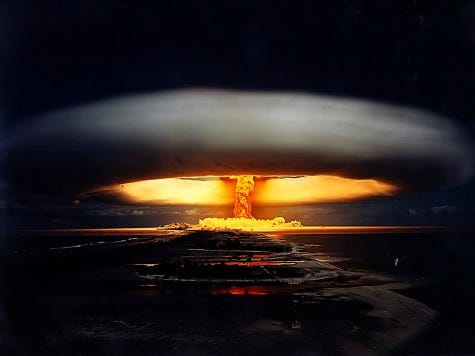
And so the missiles are finally here. Long ago, I thought I’d put nuclear war in the rearview mirror. I never expected to see a mushroom cloud through my windshield, rising in the near distance.
I’d seen something like it before—Russian nuclear missiles flying over the North Pole on their way to America—but that was fifty years ago. I was a young lieutenant then, working in the Missile Warning Center deep inside Cheyenne Mountain. Those missile tracks weren’t real; they were part of a war game, fed into our computers on magnetic tape. The exercise ended with a simulated Armageddon, soundless, screamless.
Even so, when the tracks terminated at U.S. cities, we all went quiet. Sitting two thousand feet under granite, staring at monochrome monitors, we imagined those cities vaporized in an instant. Millions dead, incinerated in a heartbeat. The thought chilled us.
I was 24 then, serving my country against the “evil empire” of the Soviet Union, near the tail end of the Cold War. The first Cold War, I should add—as opposed to the “new” one we’ve been trapped in for the past two decades. Well, it’s plenty hot now. Thermonuclear hot.
I was far enough from my city’s ground zero to survive the initial blast and heat. But at 74, I know these are my last days. Fallout will finish me—unless I take care of it myself first.
I now know for certain that, after an unimaginably destructive nuclear exchange (a nice euphemism, isn’t it?), the living will envy the dead. For now, I’m one of the living, caught in a land of the dead.
How did it come to this? We always ask that, don’t we? How did I let a 50-year-old nightmare scenario on magnetic tape become real? Couldn’t I have done something—anything—to stop it?
Even now, I like to think I could have. There was nothing inevitable about the “new” Cold War or its culmination in MAD—mutual assured destruction. I just wasn’t mad enough to resist it with the ferocity required. I gave my quiet consent to the warmongers, the death-wishers, the ones who talk tough about “big-boy pants,” the ones haunted by missile envy and mindless fear. The ones who blow hardest just before they decide to blow up the world.
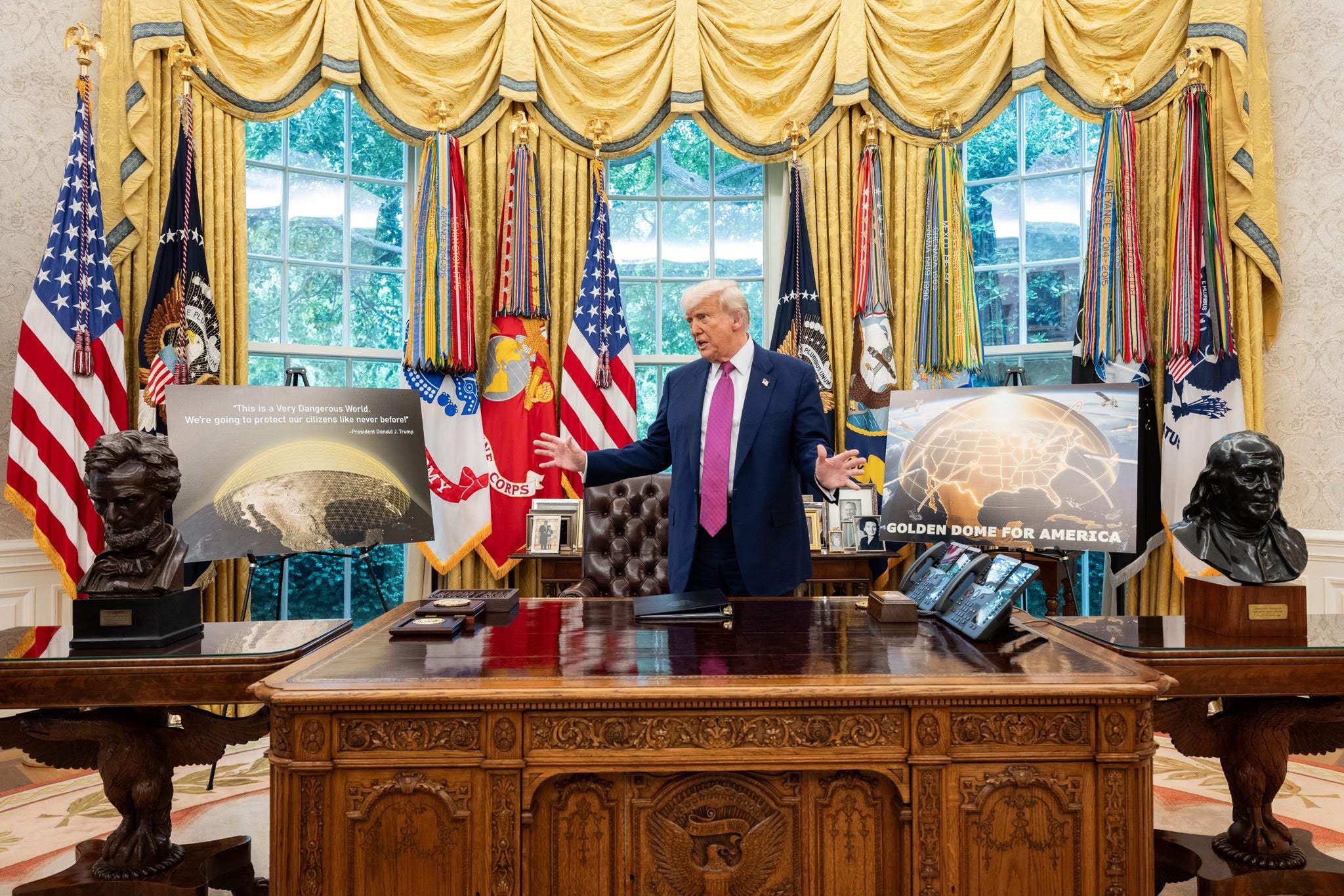
I saw it coming. So did many others. I wrote against the “new” Cold War. I denounced so-called investments in new nuclear weapons. I warned about militarizing space, how our early warning satellites and sensors could be blinded. I cautioned that President Trump’s “Golden Dome” missile shield might make nuclear war more likely. None of it mattered. Money spoke louder than I ever could—talk of jobs and the promise of profits outweighed any argument I could muster.
And so here I am, facing darkness—smoke, ash, soot blotting out the sun. I’ve stocked enough supplies to last a couple of weeks, but what’s the point? I have no desire to navigate a post-apocalyptic hellscape.
Once upon a time, I was an Air Force historian, a captain, teaching cadets about the making and use of the atomic bomb. That was 1992—45 years ago. Where does the time go? We even took the cadets to Los Alamos, the birthplace of the bomb, and then on to the Trinity test site.
Back then I was oddly optimistic. The Soviet Union had collapsed. Politicians were talking about peace dividends. Some even hinted that America might become a normal country in normal times. Normalcy! Imagine that today.
I remember a somewhat glum spokesman at Los Alamos talking about reinventing the lab—shifting to peaceful purposes, maybe consumer electronics like VCRs and CD players, competing with Japan. I was skeptical. Nuclear physicists designing camcorders and video games? A longshot—but better than cranking out new warheads and bombs.
At Trinity, what struck me most was the absence of the tower from which the “gadget” had been suspended. Vaporized instantly. Only twisted rebar remained at the base. And that had been a baby nuke—mere kilotons compared to the megatons in our arsenal. I tried to impress this on the cadets, some of whom might someday be ordered to launch such weapons. But who can really picture megatons of destruction, repeated again and again and again?
A sharp-eyed cadet found a sliver of trinitite. For some reason, I had to touch it, briefly, radioactivity be damned. This tiny fragment, this ghost of Trinity, made it all seem real. As a few atomic tourists walked around the scrub desert in masks, fearful still of breathing in radioactive particles, I thought of Oppenheimer’s god of death, the destroyer of worlds. That god has finally come for us—bringing mass death just as Oppie knew he would.
Now, back in the present, at least I’ve filled both bathtubs with water. A small reserve. At Cheyenne Mountain, there was a pond underground, a kind of giant bathtub, complete with a rowboat, so I was told. Maybe Charon did the rowing. We used to joke that boat and reservoir was the Navy’s presence in our Air Force-run bunker. I never saw that boat or pond. I wish I had.
There’s a lot I wish I’d seen. I thought there’d be more time. Next month, next year, next life.
Next life. That’s what I cling to now. I fought the good fight. I tried to argue for disarmament as the only sane option—for America, for humanity, for the entire living breathing beautiful planet of ours. But others thought differently. Some were simply making too much money, making Armageddon great again.
So don’t judge me for thinking about the unthinkable. I know suicide is a mortal sin for us Catholics. But my Ruger 9mm sits by my side. Twelve rounds in the magazine—but I’ll only need the one in the chamber.
Yes, I’ve seen the mushroom cloud. And soon, quite soon, there’ll be a smoking gun.
Hello Everyone: In 2007, I was fed up with the lies of the Bush/Cheney administration and the way civilian leadership was using the bemedaled chest of David Petraeus to deflect blame for that disastrous war. I knew then the “success” of the surge was an illusion, or, as Petraeus put it back then, “fragile” and “reversible” (and so it proved to be). I wrote an op-ed about how we the people had to save the military from itself and its own self-serving illusions. No one was interested in what I had to say; no one, that is, except Tom Engelhardt at TomDispatch. And so that led to my first “tomgram.”
Eighteen years later, I’ve reached the unlikely number of 115 essays for TomDispatch, something neither Tom nor I ever expected. And just about all those essays have been introduced by a mini-essay by Tom himself. It’s been a remarkable partnership—it’s what got my career as a writer and essayist (rather than a traditional historian) started.
This piece, my 115th, returns again to Cheyenne Mountain and nuclear war. I first wrote about my time “in the mountain” in 2008; seventeen years later, I’m even more dismayed at (and disgusted by) my country’s newfound enthusiasm for nuclear weapons and their “recapitalization.” Read on!
*****
It’s been 20 years since I retired from the Air Force and 40 years since I first entered Cheyenne Mountain, America’s nuclear redoubt at the southern end of the Front Range that includes Pikes Peak in Colorado. So it was with some nostalgia that I read a recent memo from General Kenneth Wilsbach, the new Chief of Staff of the Air Force (CSAF). Along with the usual warrior talk, the CSAF vowed to “relentlessly advocate” for the new Sentinel ICBM (intercontinental ballistic missile) and the B-21 Raider stealth bomber. While the Air Force often speaks of “investing” in new nukes, this time the CSAF opted for “recapitalization,” a remarkably bloodless term for the creation of a whole new generation of genocidal thermonuclear weapons and their delivery systems.
(Take a moment to think about that word, “creation,” applied to weapons of mass destruction. Raised Catholic, I learned that God created the universe out of nothing. By comparison, nuclear creators aren’t gods, they’re devils, for their “creation” may end with the destruction of everything. Small wonder J. Robert Oppenheimer musedthat he’d become death, the destroyer of worlds, after the first successful atomic blast in 1945.)
In my Cheyenne Mountain days, circa 1985, the new “must have” bomber was the B-1 Lancer and the new “must have” ICBM was the MX Peacekeeper. If you go back 20 to 30 years earlier than that, it was the B-52 and the Minuteman. And mind you, my old service “owns” two legs of America’s nuclear triad. (The Navy has the third with its nuclear submarines armed with Trident II missiles.) And count on one thing: it will never willingly give them up. It will always “relentlessly advocate” for the latest ICBM and nuclear-capable bomber, irrespective of need, price, strategy, or above all else their murderous, indeed apocalyptic, capabilities.
At this moment, Donald Trump’s America has more than 5,000 nuclear warheads and bombs of various sorts, while Vladimir Putin’s Russia has roughly 5,500 of the same. Together, they represent overkill of an enormity that should be considered essentially unfathomable. Any sane person would minimally argue for serious reductions in nuclear weaponry on this planet. The literal salvation of humanity may depend on it. But don’t tell that to the generals and admirals, or to the weapons-producing corporations that get rich building such weaponry, or to members of Congress who have factories producing such weaponry and bases housing them in their districts.
So, here we are in a world in which the Pentagon plans to spend another $1.7 trillion(and no, that is not a typo!) “recapitalizing” its nuclear triad, and so in a world that is guaranteed to remain haunted forever by a possible future doomsday, the specter of nuclear mushroom clouds, and a true “end-times” catastrophe.
I Join AF Space Command Only to Find Myself Under 2,000 Feet of Granite
My first military assignment in 1985 was at Peterson Air Force Base in Colorado with Air Force Space Command. That put me in America’s nuclear command post during the last few years of the Cold War. I also worked in the Space Surveillance Center and on a battle staff that brought me into the Missile Warning Center. So, I was exposed, in a relatively modest way (if anything having to do with nuclear weapons can ever be considered “modest”), to what nuclear war would actually be like and forced to think about it in a way most Americans don’t.
Each time I journeyed into Cheyenne Mountain, I walked or rode through a long tunnel carved out of granite. The buildings inside were mounted on gigantic springs (yes, springs!) that were supposed to absorb the shock of any nearby hydrogen bomb blast in a future war with the Soviet Union. Massive blast doors that looked like they belonged on the largest bank vault in the universe were supposed to keep us safe, though in a nuclear war they might only have ensured our entombment. They were mostly kept open, but every now and then they were closed for a military exercise.
The author (right) with Tom Engelhardt
I was a “space systems test analyst.” The Space Surveillance Center ran on a certain software program that needed periodic testing and evaluation and I helped test the computer software that kept track of all objects orbiting the Earth. Back then, there were just over 5,000 of them. (Now, that number’s more like 45,000 and space is a lot more crowded — perhaps too crowded.)
Anyhow, what I remember most vividly were military exercises where we’d run through different potentially world-ending scenarios. (Think of the movie War Gameswith Matthew Broderick.) One exercise simulated a nuclear attack on the United States. No, it wasn’t like some Hollywood production. We just had monochrome computer displays with primitive graphics, but you could certainly see missile tracks emerging from the Soviet Union, crossing the North Pole, and ending at American cities.
Even though there were no fancy (fake) explosions and no other special effects, simply realizing what was possible and how we would visualize it if it were actually to happen was, as I’m sure you can imagine, a distinctly sobering experience and not one I’ve ever forgotten.
That “war game” should have shaken me up more than it did, however. At the time, we had a certain amount of fatalism about the possibility of nuclear war, something captured in the posters of the era that told you what to do in case of a nuclear attack. The final step was basically to bend over and kiss your ass goodbye. That was indeed my attitude.
Rather than obsess about Armageddon, I submerged myself in routine. There was a certain job to be done, procedures to be carried out, discipline to adhere to. Remember, of course, that this was also the era of the rise of the nuclear freeze protest movement that was demanding the U.S. and the Soviet Union reach an agreement to halt further testing, production, and deployment of nuclear weapons. (If only, of course!) In addition, this was the time of the hit film The Day After, which tried to portray the aftermath of a nuclear war in the United States. In fact, on a midnight shift in Cheyenne Mountain, I even read Tom Clancy’s Red Storm Rising, which envisioned the Cold War gone hot, a Third World War gone nuclear.
Of course, if we had thought about nuclear war every minute of every day, we might indeed have been cowering under our sheets. Unfortunately, as a society, except in rare moments like the nuclear freeze movement one, we neither considered nor generally grasped what nuclear war was all about (even though nine countries now possess such weaponry and the likelihood of such a war only grows). Unfortunately, that lack of comprehension (and so protest) is one big reason why nuclear war remains so chillingly possible.
If anything, such a war has been eerily normalized in our collective consciousness and we’ve become remarkably numb to and fatalistic about it. One characteristic of that reality was the anesthetizing language that we used then (and still use) when it came to nuclear matters. We in the military spoke in acronyms or jargon about “flexible response,” “deterrence,” and what was then known as “mutually assured destruction” (or the wiping out of everything). In fact, we had a whole vocabulary of different words and euphemisms we could use so as not to think too deeply about the unthinkable or our possible role in making it happen.
My Date With Trinity
After leaving Cheyenne Mountain and getting a master’s degree, I co-taught a course on the making and use of the atomic bomb at the Air Force Academy. That was in 1992, and we actually took the cadets on a field trip to Los Alamos where the first nuclear weapon had largely been developed. Then we went on to the Trinity test sitein Alamogordo, New Mexico, where, of course, that first atomic device was tested and that, believe me, was an unforgettable experience. We walked around and saw what was left of the tower where Robert Oppenheimer and crew suspended the “gadget” (nice euphemism!) for testing that bomb on July 16, 1945, less than a month before two atomic bombs would be dropped on the Japanese cities of Hiroshima and Nagasaki, destroying both of them and killing perhaps 200,000 people. Basically (I’m sure you won’t be surprised to learn), nothing’s left of that tower except for its concrete base and a couple of twisted pieces of metal. It certainly does make you reflect on the sheer power of such weaponry. It was then and remains a distinctly haunted landscape and walking around it a truly sobering experience.
And when I toured the Los Alamos lab right after the collapse of the other great superpower of that moment, the Soviet Union, it was curious how glum the people I met there were. The mood of the scientists was like: hey, maybe I’m going to have to find another job because we’re not going to be building all these nuclear weapons anymore, not with the Soviet Union gone. It was so obviously time for America to cash in its “peace dividends” and the scientists’ mood reflected that.
Now, just imagine that 33 years after I took those cadets there, Los Alamos is once again going gangbusters, as our nation plans to “invest” another $1.7 trillion in a “modernized” nuclear triad (imagine what that means in terms of ultimate destruction!) that we (and the rest of the world) absolutely don’t need. To be blunt, today that outrages me. It angers me that all of us, whether those like me who served in uniform or your average American taxpayer, have sacrificed so much to create genocidal weaponry and a distinctly world-ending arsenal. Worse yet, when the Soviet Union collapsed in 1991, we didn’t even try to change course. And now the message is: Let’s spend staggering amounts of our tax dollars on even more apocalyptic weaponry. It’s insanity and, no question about it, it’s also morally obscene.
The Glitter of Nuclear Weapons
That ongoing obsession with total destruction, ultimate annihilation, reflects the fact that the United States is led by moral midgets. During the Vietnam War years, the infamous phrase of the time was that the U.S. military had to “destroy the town to save it” (from communism, of course). And for 70 years now, America’s leaders have tacitly threatened to order the destruction of the world to save it from a rival power like Russia or China. Indeed, nuclear war plans in the early 1960s already envisioned a massive strike against Russia and China, with estimates of the dead put at 600 million, or “100 Holocausts,” as Daniel Ellsberg of Vietnam War fame so memorably put it.
Take it from this retired officer: you simply can’t trust the U.S. military with that sort of destructive power. Indeed, you can’t trust anyone with that much power at their fingertips. Consider nuclear weapons akin to the One Ring of Power in J.R.R. Tolkien’sThe Lord of the Rings. Anyone who puts that ring on is inevitably twisted and corrupted.
Freeman Dyson, a physicist of considerable probity, put it well to documentarian Jon Else in his film The Day After Trinity. Dyson confessed to his own “ring of power” moment:
“I felt it myself. The glitter of nuclear weapons. It is irresistible if you come to them as a scientist. To feel it’s there in your hands, to release this energy that fuels the stars, to let it do your bidding. To perform these miracles, to lift a million tons of rock into the sky. It is something that gives people an illusion of illimitable power, and it is, in some ways, responsible for all our troubles — this, what you might call technical arrogance, that overcomes people when they see what they can do with their minds.”
I’ve felt something akin to that as well. When I wore a military uniform, I was in some sense a captive to power. The military both captures and captivates. There’s an allure of power in the military, since you have a lot of destructive power at your disposal.
Of course, I wasn’t a B-1 bomber pilot or a missile-launch officer for ICBMs, but even so, when you’re part of something that’s so immensely, even world-destructively powerful, believe me, it does have an allure to it. And I don’t think we’re usually fully aware of how captivating that can be and how much you can want to be a part of that.
Even after their service, many veterans still want to go up in a warplane again or take a tour of a submarine, a battleship, or an aircraft carrier for nostalgic reasons, of course, but also because you want to regain that captivating feeling of being so close to immense — even world-ending — power.
The saying that “power corrupts, and absolute power corrupts absolutely” may never be truer than when it comes to nuclear war. We even have expressions like “use them or lose them” to express how ICBMs should be “launched on warning” of a nuclear attack before they can be destroyed by an incoming enemy strike. So many years later, in other words, the world remains on even more of a nuclear hair-trigger, the pistol loaded and cocked to our collective heads, just waiting for news that will push us over the edge, that will make those trigger fingers of ours too itchy to resist the urge to put too much pressure on that nuclear trigger.
No matter how many bunkers we build, no matter that the world’s biggest bunker tunneled out of a mountain, the one I was once in, still exists, nothing will save us if we allow the glitter of nuclear weapons to flash into preternatural thermonuclear brightness.
Just when you thought the assault on the English language couldn’t be more severe, I came across a new abomination in a recent memo (11/3/25) signed by the Chief of Staff of the Air Force (CSAF).
The CSAF expressed his commitment to nuclear force “recapitalization,” meaning that he fully supports the B-21 Raider and the Sentinel ICBM, which will cost more than $500 billion over the next two decades. He vowed he’d “relentlessly advocate” for them.
“Recapitalization”: What a word to describe more genocidal nuclear weapons!
Typically, the Air Force refers to “modernization” or “investment” when it comes to new nukes. This latest euphemism is an even more extreme example of bureaucratese and business-speak.
We’re just “recapitalizing” our nuclear forces, folks. Nothing to see here, move along.
One thing is certain. The new CSAF, with his talk of “recapitalization,” will make the smoothest of transitions to industry once he retires from the military.
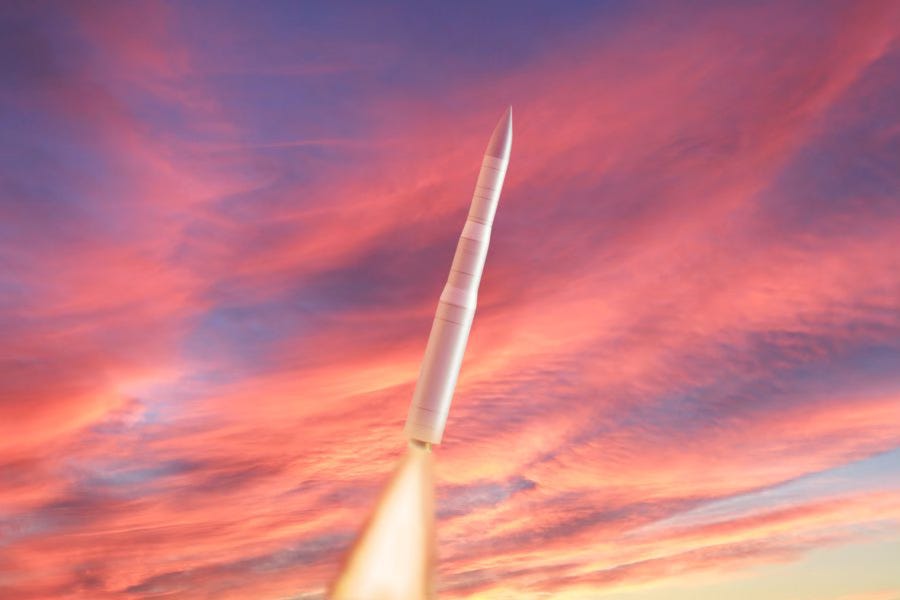
It’s time for recapitalization! (Red sky in morning, America take warning.)
Above is an idealized illustration of a Sentinel ICBM soon after launch. Don’t think about the aftermath of thermonuclear war. As NBC Pitchman Brian Williams once said, it’s important to be guided by the beauty of our weapons.
“Star Wars’“ fans will recall the Imperial Death Star, a ship the size of a small moon that was powerful enough to obliterate planets.
Who needs the Death Star when we humans are doing such a bang-up job of obliterating our planet?
This thought came to mind as a friend queried me about nuclear accidents. I recalled a piece I wrote in 2017 about various accidents we’ve had involving nuclear weapons. We’re incredibly lucky not to have nuked ourselves with megatons of thermonuclear explosive power and radiation.
Maybe we should echo Voltaire and cultivate our gardens while we’re still alive.
Anyhow, here’s my article from 2017, timely as ever as the Trump administration embraces new nukes and a “golden dome,” both representing yet another golden fleecing of American taxpayers.
The Threat of Nuclear Weapons to America
W.J. Astore (posted in April 2017)
Did you know the U.S. has built nearly 70,000 nuclear weapons since 1945? Did you know the U.S. Air Force lost a B-52 and two hydrogen bombs in an accident over North Carolina in 1961, and that one of those H-bombs was a single safety-switch away from exploding with a blast equivalent to three or four million tons of TNT (roughly 200 Hiroshima-type bombs)? Did you know a U.S. nuclear missile exploded in its silo in Arkansas in 1980, throwing its thermonuclear warhead into the countryside?
On more the one occasion, the U.S. has come close to nuking itself
That last accident is the subject of a PBS American Experiencedocumentary that I watched last night, “Command and Control.” I highly recommend it to all Americans, not just for what it reveals about nuclear accidents and the lack of safety, but for what it reveals about the U.S. military.
Here are a few things I learned about U.S. nuclear weapons and the military from the documentary:
During the silo accident, the Strategic Air Command (SAC) general in charge of nuclear missiles was a pilot with no experience in missiles. His order to activate a venting fan during a fuel leak led to the explosion that destroyed the missile and killed an airman. (Experts from Martin Marietta, the military contractor that built the Titan II missile, advised against such action.)
Airmen who courageously tried against long odds to mitigate the accident, and who were wounded in the explosion, were subsequently punished by the Air Force.
The Air Force refused to provide timely and reliable knowledge to local law enforcement as well as to the Arkansas governor (then Bill Clinton) and senators. Even Vice President Walter Mondale was denied a full and honest accounting of the accident.
Nuclear safety experts concluded that “luck” played a role in the fact that the Titan’s warhead didn’t explode. It was ejected from the silo without its power source, but if that power source had accompanied the warhead as it flew out of the silo, an explosion equivalent to two or three megatons could conceivably have happened.
Finally, the number of accidents involving U.S. nuclear weapons is far greater than the military has previously reported. Indeed, even the nation’s foremost expert in nuclear weapons development was not privy to all the data from these accidents.
In short, the U.S. has been very fortunate not to have nuked itself with multiple hydrogen bombs over the last 70 years. Talk today of a threat from North Korea pales in comparison to the threat posed to the U.S. by its own nuclear weapons programs and their hair-raising record of serious accidents and safety violations.
Despite this record, President Obama and now President Trump have asked for nearly a trillion dollars over the next generation to modernize and improve U.S. nuclear forces. Talk about rewarding failure!
Threatening genocidal murder is what passes for “deterrence,” then and now. This madness will continue as long as people acquiesce to the idea the government knows best and can be trusted with nuclear weapons that can destroy vast areas of our own country, along with most of the world.
To end the insanity, we must commit to eliminating nuclear weapons. Ronald Reagan saw the wisdom of total nuclear disarmament. So should we all.
An Addendum: In my Air Force career, I knew many missileers who worked in silos. They were dedicated professionals. But accidents happen, and complex weapons systems fail often in complex and unpredictable ways. Again, it’s nuclear experts themselves who say that luck has played a significant role in the fact that America hasn’t yet nuked itself. (Of course, we performed a lot of above-ground nuclear testing in places like Nevada, making them “no-go” places to this day due to radiation.)
Update (4/27/17): I’d heard of Air Force plans to base nuclear weapons on the moon, but today I learned that a nuclear test was contemplated on or near the moon as a way of showcasing American might during the Cold War. As the New York Timesreported, “Dr. [Leonard] Reiffel revealed that the Air Force had been interested in staging a surprise lunar explosion, and that its goal was propaganda. ‘The foremost intent was to impress the world with the prowess of the United States.’ It was a P.R. device, without question, in the minds of the people from the Air Force.” Dr. Reiffel further noted that, “The cost to science of destroying the pristine lunar environment did not seem of concern to our sponsors [the U.S. military] — but it certainly was to us, as I made clear at the time.”
The U.S. military wasn’t just content to pollute the earth with nuclear radiation: they wanted to pollute space and the moon as well. All in the name of “deterrence.”
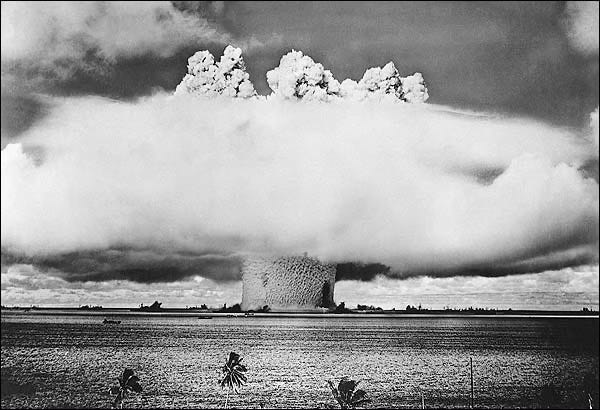
Two pictures of above-ground nuclear testing in Nevada in 1955
Here’s a tip, ladies: Wear light-colored dresses during a nuclear war. They absorb less heat
Just what we need: autonomous killer drone swarms powered by algorithms and AI.
Part 3 of the excellent Al Jazeera documentary The Business of War focuses on Israel’s use of killer drones in Gaza. The trend is toward “fully autonomous weapons”—drone swarms that rely on algorithms to identify targets to hit and humans to kill. Officially, a human is still supposed to make the final decision to strike, but in some cases the operator has only 20 seconds to give a “go” or “no go.” And, let’s be honest, the system drives operators toward “go.”
The documentary is especially powerful in showing the devastation in Gaza (images of Stalingrad in World War II come to mind), the deliberate killing of journalists (a war crime), and how drones are used not just for killing but as tools of intimidation and control.
Images of AI-enabled drone swarms chasing and killing people recall scenes from the Terminator films. But as the documentary notes, the danger right now isn’t some future Skynet—it’s how these drones have already emerged as “new forms of domination and oppression.”
Almost as troubling is the military-corporate fusion as these drone swarms are supported by “cloud” resources supplied by Amazon, Google, and Microsoft. A new conceit boasts of Israel as an “AI superpower,” even as corporations make a killing in profits.
All this technology, all this high-tech prowess, is fueling a holocaust in Gaza. Eisenhower warned us in 1953 that humanity might crucify itself on a cross of iron. Looking at today’s autonomous weapons, perhaps we’ve chosen a different cross—one made of silicon.
Last Tuesday, I appeared again on Judge Napolitano’s show. We talked about the Russia-Ukraine War and President Trump’s efforts to foster a peace deal, as well as the so-called Deep State and (briefly) the CIA.
The show’s lede raises a provocative question: Can America be rid of the CIA? Anything is possible in theory; the problem is the sprawling size and enormous power of the so-called intelligence community, or IC. (This idea of “community” was already a euphemism in the 1970s, as the movie “Three Days of the Condor” reveals; I’ve always liked how Robert Redford’s character scoffs at the “community” conceit.)
There are eighteen (18!) agencies that make up the IC with a combined yearly budget just north of $100 billion. For all that spending on intelligence, America has not fared well in recent wars in places like Iraq and Afghanistan. A bureaucracy of that size and reach is difficult to corral and control, especially since its budget keeps rising. Threat inflation is a major component of these rising budgets; you’re not going to get a threat assessment from the IC that says, well, actually, America’s pretty safe, let’s spend money on infrastructure, education, and social uplift.
As Chuck Schumer once said about Trump’s efforts to challenge the IC, the community has “six ways from Sunday” to get back at the president. That is, of course, more than worrisome. POTUS is supposed to command the IC; the IC is supposed to serve the president while upholding the U.S. Constitution. The IC shouldn’t scheme to “get back” at the president—any president.
My guess is that Trump has learned that lesson from Schumer. He’s appeasing the IC by giving it more and more money. Meanwhile, a Trump loyalist, Tulsi Gabbard, is trying to exert a measure of control as DNI, or Director of National Intelligence. I can’t imagine the in-fighting going in within the “community” as Gabbard releases files that suggest elements within the IC put their thumbs on the scale against Trump’s runs for president.
Eighteen agencies, $100 billion, and less than impressive results suggest a deep state that is out of control and in urgent need of major reform. Meanwhile, Edward Snowden’s revelations show a power structure that is more than willing to illegally spy on and surveil Americans.
For democracy to prosper, Americans need privacy and the government should be transparent to and controllable by the people. Instead, the IC is shrouded in secrecy and Americans are the ones whose lives are transparent to and controllable by the IC.
Of course, I’m not suggesting the IC is peeking under every door—unless you’re some kind of crazy dissident who believes genocide is wrong and the military-industrial complex is dangerous. You know—someone like Dwight D. Eisenhower.
AI, of course, stands for artificial intelligence, and I’ve played with it here at Bracing Views. I’ve used ChatGPT and DeepSeek to write critical essays on the military-industrial complex, critiquing the results in my posts. Overall, I was impressed—and glad that I no longer have to wade through student essays completed outside of class.
I stopped teaching eleven years ago, before AI was available. Of course, the Internet was, and I did have students who cut and paste from sources online. Usually, I could tell; I would do a search using a “student” passage that just sounded a bit too good, and often whole paragraphs would come up that the student lazily cut and pasted into an assignment as their own work. Those were easy papers to grade. F!
Today’s AI programs make this more difficult. If I were teaching today, I’d assign fewer essays outside of class, and I’d probably bow to reality and allow students to use AI to help clarify their arguments.
The challenge remains: In this new world of AI, how do you evaluate student performance in a humanities course where research and writing skills are important, along with some command of the facts and an ability to think critically about them?
I’d likely employ a mix of the old and new. Standard exams—the usual multiple choice, short answer, written essay, all completed in the classroom—still have a role. But I’d incorporate AI too, especially for class discussion.
Consider, for example, debating the merits (and demerits) of the military-industrial complex. AI can easily write short essays both in favor and against (or even an essay that examines the pros and cons of the MIC). Those essays could then be used in class to tease out the complexities of the MIC, and how evidence can be used (manipulated?) to tell vastly different stories.
Another example: Should atomic bombs have been used at Hiroshima and Nagasaki? Again, AI can easily write essays in favor, or against, or “neutral” (pros and cons again). Those short essays could then form the basis for class discussion and further debate.
In a way, AI is a selective manifestation of evidence that is already out there. And there’s the rub. Who’s doing the selecting? Who’s writing the algorithms? Which evidence is being favored and which is being suppressed or disregarded?
AI, as I understand it, uses algorithms that favor certain kinds of evidence over other kinds. Generally speaking, AI favors “official” sources, e.g. government documents, mainstream media reporting, scholarly think tanks with credentials, and so on.
Alternatively, it’s possible AI could gather information from less than reputable sources. Again, what algorithms are being used? What are the agendas of those behind the AI in question?
To students, AI is something of a black box. It spits out answers without a lot of sourcing (unless you specifically ask for it). Students in a hurry may not care—they just want answers. But as Tom Cruise demands In A Few Good Men: “I want the truth.” What happens when AI Colonel Jessup decides, “You can’t handle the truth” and feeds us convenient half-truths and propaganda. Will students even care? Will they have the skills to recognize they’re being misled? Or that they’re not getting the full story?
That’s what I worry about. Students who simply accept what AI has to say. Not that they learned nothing—but that they learned exactly what they were programmed to learn. Strangely, in this scenario, the students themselves are reduced to automatons. And I don’t think most students want to be unthinking robots for the Man.
Or do they?
Postscript: Over at his new Substack site, Mike Neiberg is tackling AI and the humanities. Check it out at michaelneiberg.substack.com.
This month marks the 80th anniversary of the Trinity test, the first explosion of an atomic device in Alamogordo, New Mexico on July 16, 1945. Next month, of course, marks the grim anniversary of the Hiroshima and Nagasaki bombings of August 6 and 9, 1945. The atomic nightmares of those two cities have morphed into the thermonuclear nightmare of far more powerful nuclear weapons that continues to haunt us still. The U.S. and Russia combined have roughly 11,000 nuclear warheads and bombs of various types, most of them far more powerful than those used against Japan 80 years ago.
The short clip of the Trinity test above is all the more haunting because it’s silent and in black and white.
I’ve walked the Trinity test site and co-taught a course at the Air Force Academy on the making and use of the atomic bomb. Walking the site was an eerie experience. I did it in 1992. Once was enough.
So much pressure was applied to get the atomic “gadget” to work that the scientists and government were reckless. Shrouding it all in secrecy didn’t help. The “downwinders” — those who lived in the path of radioactive fallout from the test —they weren’t given much consideration, if any. Certainly, the effects of radiation and fallout weren’t fully known and were likely underestimated. That said, the government should have taken far more care here. Check out the documentary Trinity released earlier this year, which focuses on these “downwinders” and how they suffered from the blast. As one of the interviewees suggests, the government’s attitude may have been that only a few Indians and Mexicans lived in the area, an attitude summed up by “collateral damage,” a common if unseemly euphemism used all too frequently today.
Historians will forever debate whether the atomic bombings were necessary or if they served to shorten the war. The documentary “The Day After Trinity” by Jon Else is just superb here. My reading of the events is that there was never any doubt the atomic bomb would be used. Luckily for the Germans, VE Day came before Trinity. But the Japanese were still resisting, so they became the new target.
The only man who could have stopped the bombing was President Harry Truman–and he wasn’t about to stop it. A new president, not even elected, who didn’t even know about the bomb until FDR died: Truman used the bomb because it was the easiest path to take. All pressure was on ending the war as quickly as possible, so why not use the bomb? After all, the U.S. continued its firebombing raids on Japanese cities well after Hiroshima and Nagasaki.
This is the inexorable logic of near-total war. The only consolation is that nuclear weapons haven’t been dropped on a city since 1945. That is one valuable legacy from Hiroshima/Nagasaki: some recognition of the horror unleashed there. Nevertheless, U.S. presidents from Obama to Trump to Biden and Trump again are forging ahead with new nuclear weapons—always in the stated cause of “deterrence,” naturally.
It’s staggering the money dedicated to total destruction in the cause of preventing total destruction. It’s a powerful reason to remember what Trinity unleashed 80 years ago, and the price the Japanese paid at Hiroshima and Nagasaki. Unless we wise up as a species, it absolutely can happen again at levels of destruction that are simply unfathomable.
Nuclear disarmament, not rearmament, is the only sensible policy here.
Donald Trump has a dream: a “golden dome” over America to defend the country against nuclear missiles. It’s a repeat of Ronald Reagan’s dream, the Strategic Defense Initiative, nicknamed “Star Wars” after the movie. The problem is that the dream represents a nightmare.
How so? Golden Dome would be dangerously escalatory, wildly expensive, and unlikely to work as a “shield” to America. It is worse than a mistake: it is a crime. It represents a massive theft from those who hunger and suffer in America. As Republican President Dwight D. Eisenhower said in 1953, wasting enormous resources on weapons systems is no way of life at all. It is humanity crucifying itself on a cross of iron. Crucifixion is not made more pleasant when the cross is golden.
A new golden idol occupies his mind
Put differently, the Golden Dome is a golden idol, a false god, one that by making a massive nuclear strike more likely endangers all of us and God’s creation.
Golden Dome is a grotesque example of makework militarism and warfare as welfare for weapons makers. Though it’s unlikely to work, if it did (partially) it would make a massive nuclear strike more likely, not less, endangering the world with the ecocidal terror of nuclear winter.
Golden Dome and the so-called investment in America’s nuclear triad are both examples of socio-technological madness–America’s leaders are like the mutants in “Beneath the Planet of the Apes,” worshipping the bombs that twisted them and which can only destroy what’s left of civilization.
Some Christians today await the apocalypse when Christ is supposed to return–but the most likely apocalypse features not the second coming of a God-man but a third world war featuring bomb-gods of thermonuclear destruction.
As Daniel Ellsberg once noted, U.S. nuclear attack plans in the early 1960s envisioned 600 million killed, or 100 Holocausts (before we knew such an attack would lead to nuclear winter). We’re lucky this insanity never came to pass. The only sane policy is to cancel Golden Dome and end “investment” in a new nuclear triad. Disarmament, not rearmament, is what’s needed.
*****
The Global Network Against Weapons & Nuclear Power in Space has released a statement against Golden Dome that you can read here. You can add your name to the statement, as I have. Here are some bullet points released along with the statement:
Golden Dome is financially reckless and unsustainable. Early cost estimates range from $550 billion to several trillion dollars over two decades. This dwarfs even the Pentagon’s annual budget and adds to the US’s $37 trillion national debt—a price tag that makes the project fiscally indefensible.
Experts overwhelmingly agree that 100% effective missile interception is a fantasy, especially against complex attacks involving decoys, hypersonic missiles, and maneuverable warheads. Even Israel’s Iron Dome has been bypassed by more rudimentary drone and missile attacks.
Golden Dome includes space-based interceptors—effectively weaponizing the Earth’s orbit and triggering an arms race. This violates the spirit of the Outer Space Treaty and pushes nations like China and Russia to accelerate space weapons development.
By giving the illusion of first-strike survivability, it runs counter to the Mutually Assured Destruction (MAD) doctrine that has prevented so far a nuclear holocaust and incentivizes other powers to retain or expand their nuclear arsenals, blocking disarmament efforts permanently.
Thousands of rocket launches for satellite interceptors would further damage the ozone layer, could generate dangerous orbital debris (Kessler Syndrome), and will harm our already fragile space environment.
The only guaranteed winners of Golden Dome are weapons giants like Lockheed Martin, Raytheon, and Palantir, which stand to profit enormously regardless of the system’s effectiveness or risks.
The trillions funneled into Golden Dome could be used for urgent domestic priorities—such as healthcare, infrastructure, climate action, and education, directly benefiting millions of Americans.
In short, Golden Dome is a massive, dangerous, and futile vanity project, cloaked in patriotism but driven by profit, politics, and illusion.