I caught this snippet from Mark Zuckerberg, guru of Facebook:
There’s this stat that I always think is crazy. The average American, I think has, I think it’s fewer than three friends, three people that they’d consider friends and the average person has demand for meaningfully more. I think it’s like 15 friends or something.
If you’re familiar with Facebook, every personal contact you make on there is categorized as a “friend.” When you want to add someone to your Facebook page, you “friend” them. Alternatively, when you want to get rid of someone, you “unfriend” them.
Now, the typical Facebook user has roughly 200-300 “friends.” What Zuckerberg is unintentionally revealing in that snippet above is that Facebook “friends” aren’t real friends. They’re mostly acquaintances. People we’ve met once or twice, maybe even people we’ve never met. They’re not close friends, intimate friends, “real” friends.
So why call them “friends,” Facebook? For obvious reasons. Just about anyone would like more friends, and indeed I know people with over 2000 “friends” on Facebook. But, again, how many close or intimate friends can you really have?
That’s where Zuckerberg comes in, yet again, riding to the rescue with AI “friends.” Yes, he’s suggesting that the solution to loneliness in America, our lack of intimacy, is AI programs that will be your “friend,” a little bit like the movie “Her” with Joaquin Phoenix and Scarlett Johansson.
So, I suppose you’ll soon be able to buy AI “friends” from Mark Zuckerberg or someone like him. Or perhaps they’ll be offered for “free,” as Facebook is, with your most intimate data being sold to the highest bidder.
I really don’t want AI “friends.” I have a few real friends, people I’ve known for decades, people I do feel close to, and I’m lucky to have them. Two quick lessons come to mind. First, of course, friends aren’t perfect. They can be annoying, frustrating, maddening. (Guess what? I can be too.) Part of being a friend and keeping one is tolerance, acceptance, patience. The second lesson: To have a friend you have to be a friend. If you want people to be there when you need them, it’s a good idea to be there when they need you.
Sorry, Zuckerberg: I don’t think AI “friends” are the answer here. But thanks for debunking the whole idea of “friends” on Facebook.
During World War II, the Nazi system of extermination camps was fairly efficient. Relatively small death camps like Belzec, Sobibor, and Treblinka killed an astonishing number of people, more than 1.6 million and nearly all Jews, quickly and efficiently. If there were a Nazi DOGE, I suppose these death camps may have won “efficiency” awards from it. They stripped the incoming victims of all their valuables and then killed virtually all of them. The loot stolen by the SS was then distributed, again fairly efficiently.
Yet, conducting a genocide, a mass murder, a horrendous atrocity, efficiently is nothing to praise. Right?
Today, America doesn’t need a government that wages wars more efficiently around the globe. We don’t need more efficient genocidal nuclear ICBMs. We don’t need more efficient weapons delivery to Israel so that Gaza can be leveled and its people murdered or displaced from their land.
What we need is an effective government that does the right thing.
The DOGE associated with Elon Musk can’t seem to recognize that you can’t do a wrong thing the right way. If you’re doing a wrong thing, you must stop doing it. Period.
Genocidal nuclear missiles are wrong. Stop building them.
Genocide in Gaza is wrong. Stop supplying Israel with weapons.
Waging war for peace is wrong. Stop doing it.
That said, efficiency does have some relevance. Consider the Pentagon. It has failed seven audits in a row. It is grossly inefficient even as it continues to be ineffective. How do you rein in a vast government bureaucracy that lacks both efficiency and effectiveness?
You don’t do it by rewarding it with more money. But that’s exactly what President Trump, Elon Musk, and Congress are doing. They all seek a trillion dollar war budget. They all want the Pentagon to grow and then grow some more.
If a sprawling bureaucracy is out of control, you must cut its budget in a big way, forcing it to confront its own waste, fraud, abuse, and related forms of corruption. That said, efficiency is again less important than effectiveness. Is the Pentagon effectively defending America? If not, how do you make it more effective?
Pentagon misadventures around the world are making Americans less safe. Incessant warfare is strengthening authoritarianism and militarism in America while weakening democracy and hollowing out infrastructure and finances.
A more effective Pentagon is one that would focus strictly on defending America proper while upholding the U.S. Constitution and the rule of law. After achieving that, one could then focus on efficiency. A Pentagon budget cut roughly in half would lead to a more effective defense of America. A much smaller Pentagon budget could then be more easily audited, leading to greater efficiency.
Committing murderous wrongs in an efficient way is nothing to celebrate. Didn’t the Nazis already provide us with the most horrifying example of this?
A Pilot in the Cockpit Is a Major Win for My Old Service
Recent Air Force projects have not been entirely successful, to put it gently. The F-22 Raptor was never built in the quantities the Air Force desired, nor was the B-2 stealth bomber. The F-35 has proven to be a disappointment, an overpriced “Ferrari” by the Air Force’s own admission that spends too much time in the shop even as its price over time continues to soar. The less said about the KC-46 tanker the better, as its future remains very much up in the air (or stuck on the ground, leaking fuel).
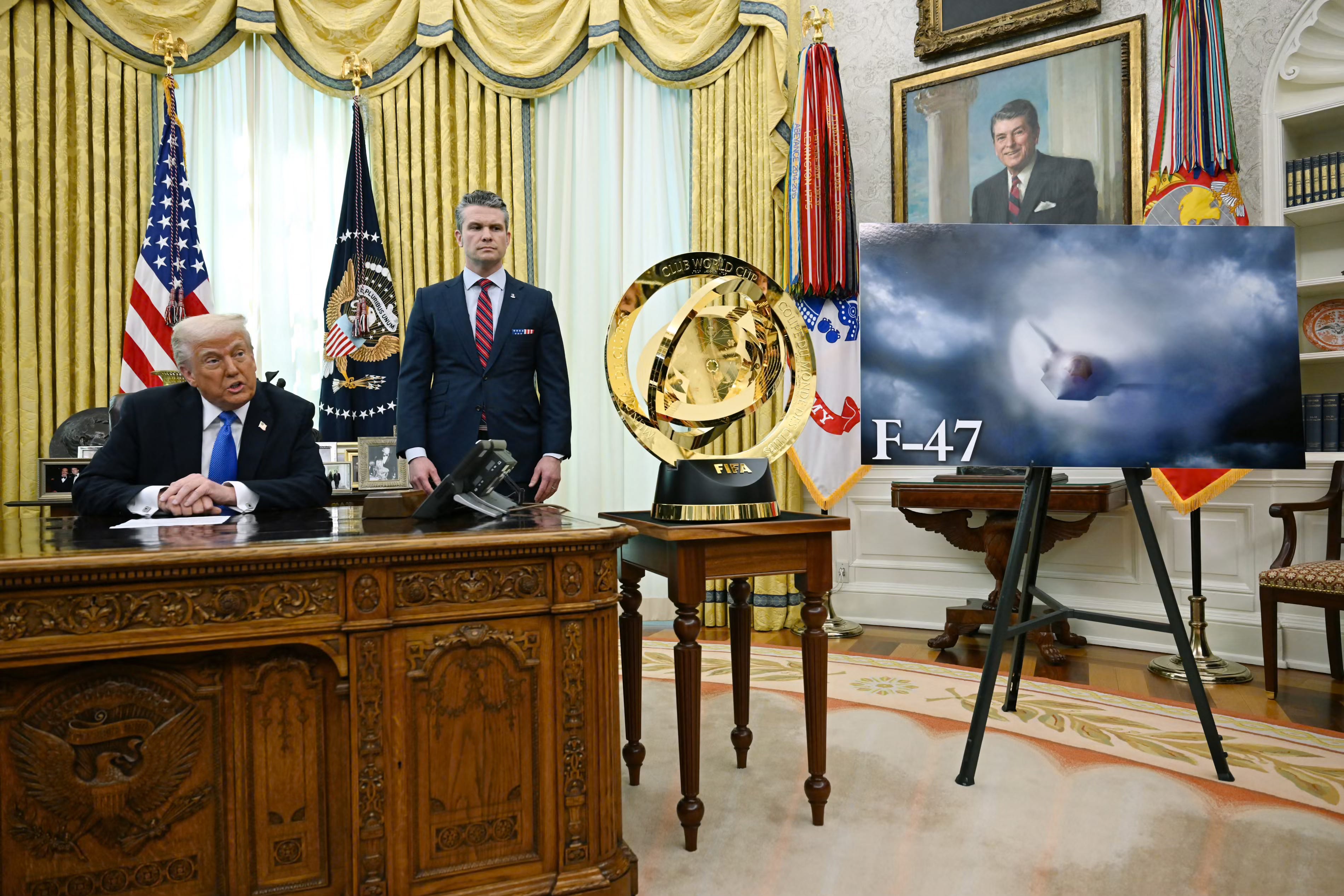
No worries. The Air Force and Boeing have been rewarded for their stellar performance with a new jet announced by President Trump yesterday, the F-47. (I don’t know what happened to the F-36 through 46 models.)
Look how badass that F-47 “bird” looks in that artist’s depiction!
Its key attribute, besides the usual hype about stealth and ultra-powerful engines and super-sensors and the like, is that it’s got a human pilot in the cockpit. This wasn’t a foregone conclusion, given Elon Musk’s belief in drones, whether fully automated or flown by pilots on the ground, at a distance. Keeping men and women in the cockpit was, is, and will always remain the most important goal of the Air Force, built as it is around the allure of pilots as masters of the air.
An interesting feature of this “6th generation” program is that the pilot will allegedly be able to control autonomous drones acting as “loyal wingmen” to the piloted F-47. That complexity should add scores of billions to the eventual price tag.
Trump always likes to boast that stealth planes like the proposed F-47, which have a low RCS, or radar cross section, will literally be invisible. The enemy will never see the F-47 coming, Trump said, jumping on board the hype train. Meanwhile, Boeing, the main contractor for the F-47, is already reaping rewards as its stock price has climbed at Mach 2 in the aftermath of Trump’s announcement.
The initial budget request of $20 billion will soon rocket skyward as the usual cost overruns kick in their afterburners. The Air Force promises the F-47 will cost less than the F-22 per unit, but if you believe that, take a look at the rising costs of the B-2, or the F-35, or the KC-46.
America may be a shitstorm today, but no other country burns through money for needless warplanes than the great USA. You may have stellar bullet trains, China, but do you have invisible 6th generation air supremacy jets? I thought not. USA! USA!
I recently ordered a few items from Amazon. Random stuff like a shower caddy, an iPhone case, and lamp sockets. It won’t surprise you to learn they were all “Made in China.”
I ordered some clothes from a fancy online retailer. The clothes said “Designed in California” but they were, of course, Made in China.
What is America making? What are we sending overseas? Bombs and bulldozers for the devastation and dismantlement of Gaza and other Palestinian Territories. Consider this article from Ken Klippenstein (excerpt follows), which details roughly $10 billion in “foreign aid” to Israel.
Here’s what Klippenstein had to say:
*****
While the entire news media is focused on Trump’s suspension of arms for Ukraine, the administration is arming Israel to the teeth. The nature of the bombs being sold indicates Israel’s military is preparing to continue its bombing campaigns in Gaza, Lebanon, Syria, and Yemen; as well as preparing for possible war with Iran.
Included in the sales are tens of thousands of controversial 2,000 lb. bombs so heavily criticized during the Gaza war for their destructive capacity, and thousands of “Hellfire” missiles that are used for targeted killings.
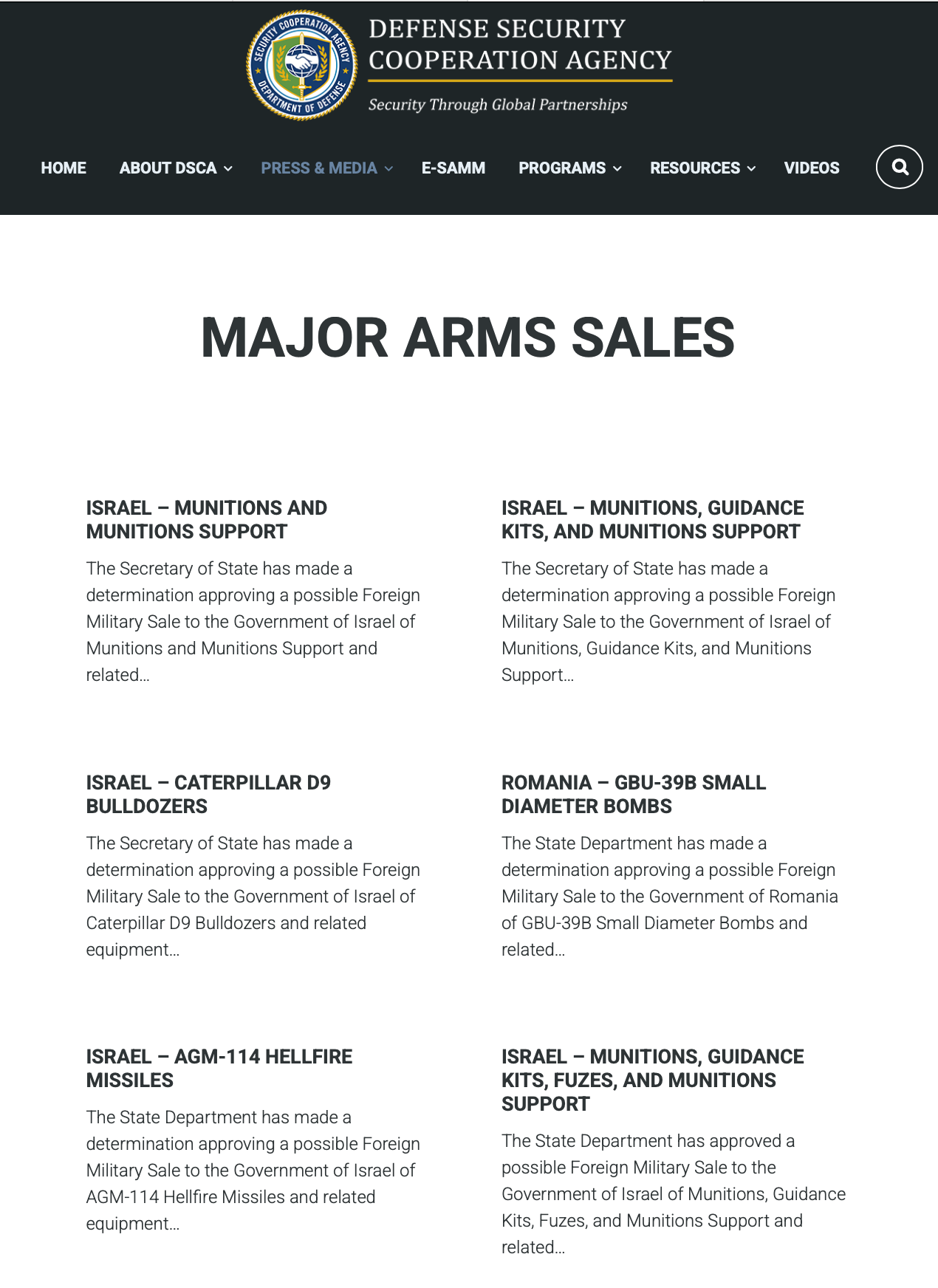
When I visited the Defense Security Cooperation Agency website’s section for major arms sales to see a breakdown of the weapons, I was immediately struck by the fact that five of the last six sales were to Israel.
Screenshot of DSCA’’s “Major Arms Sales” landing page
The U.S. bombs and missiles being sent to Israel, almost all made by Boeing, are included in:
2,166 GBU-39/B 250-pound Small Diameter Bombs (SDB) Increment 1.
2,800 MK 82 General Purpose, 500-pound bomb bomb bodies.
13,000 KMU-556 JDAM Guidance Kits to attach to MK-84 (2,000-pound) bomb bodies.
3,475 KMU-557 JDAM Guidance Kits to attach to BLU-109 (2,000-pound) bomb bodies.
1,004 KMU JDAM Guidance Kits to attach to 500-pound GBU-38v1 bomb bodies.
17,475 FMU-152A/B multi-function fuzes for bombs.
*****
Holy shit! Nearly thirty-six thousand 2000-pound bombs! That is 36 kilotons, roughly the equivalent of the two atomic bombs dropped on Hiroshima and Nagasaki in 1945. And that’s not including the assorted 1000- and 500-pound bombs tossed into the mix.
This is an astonishing amount of ordnance for Israel to continue its ethnic cleansing campaign in Gaza and the West Bank.
President Trump, of course, has the full support of most Democrats in sending this stockpile of destruction to Israel. Call it bipartisan genocidal enablement.
America sure is an “exceptional” nation. No nation is better at bombing others—or supplying the bombs for others like Israel to do so—then flattening what remains with “Made in USA” bulldozers.
Honestly, I wish my country made shower caddies, iPhone cases, and lamp sockets instead of bombs and bulldozers. Don’t you?
Isn’t it high time we “augment” our nuclear force “posture”? Shouldn’t we fight to achieve peace through nuclear “strength” and “deterrence”? Isn’t it smart to “refurbish, rebuild, and modernize” the nuclear triad? What a great “investment” that is! And a “job-creator” too!
These are some of the buzz words thrown about by the nuclear “elites” in America. They want to sell us on new ICBMs (the Sentinel), a new stealth bomber (the B-21 Raider), and new nuclear SLBMs (on Columbia-class submarines). All this thermonuclear stupidity is projected to cost roughly $2 trillion over the next 30 years. Quite the “investment,” right?
What the “experts” don’t talk about is the genocidal and exterminatory nature of these thermonuclear bombs and missiles. They don’t talk about the destruction of most life forms on our planet due to thermonuclear winter. They don’t talk about the enormous and rapidly mushrooming cost of these weapons. (For example, the B-21 has already climbed from $550 million per plane to $750 million; much like a missile, Sentinel costs have rocketed upward even more rapidly.) And they sure as hell don’t talk about the immorality of mass murder.
Why does this idiocy, this madness, this insanity, persist? We know why. A few quick and obvious reasons:
1. Threat inflation: Oh my God, China is building some silos! Oh my God, Russia still has nukes! And Putin! Even though America has over 5000 nuclear bombs and warheads and the world’s most accurate and survivable nuclear force, the military-industrial complex is more than willing to hype and inflate new threats.
2. Lobbyists: There are outrageous sums of money to be made building genocidal weaponry, and a small army of lobbyists deployed to Washington by companies like Northrop Grumman to ensure the money keeps flowing to the weapons makers.
3. Jobs: Of course, any program that spends $2 trillion is going to create a few jobs, even earth-destroying bombs and missiles. But the jobs argument remains compelling for states like Montana, New Mexico, North Dakota, Utah, and Wyoming that profit from nuclear largesse. Senators and representatives from these states generally couldn’t care less about the nature of the “pork” they bring home—even irradiated pork in the form of nuclear weapons—as long as they can claim it’s creating good-paying jobs for the folks back home.
4. The Pentagon: Insatiable generals and admirals always want MORE. More nuclear bombers and missiles. More submarines. More of everything. No service will ever voluntarily give up a weapon system, no matter how old and dumb it is—or dangerous.
5. Lack of a unified movement against these weapons: In the early 1980s, the nuclear freeze movement put millions of people in the street to protest against new nukes like the American Pershing II and GLCMs. Then-President Ronald Reagan worked with Soviet Premier Mikhail Gorbachev to reduce—even to eliminate—nuclear weapons. Elimination wasn’t to be, but the U.S. and USSR did work to reduce nuclear weapons. That spirit of cooperation through diplomacy is dead. Meanwhile, Americans post-9/11 have grown accustomed to endless war and mushrooming Pentagon budgets. America itself has become more segmented, more stovepiped, more supine. That said, so many problems bedevil us that nuclear annihilation, as apocalyptic as that is, seems both remote and unsolvable.
To that last point: The nuclear threat is both near and solvable. Instead of our “elites”stressing about the survivability of the nuclear triad, we need to focus on the survivability of humanity. President Trump allegedly seeks a Nobel Peace Prize. He also seemingly has a genuine fear of nuclear war. Americans need to push him—as well as representatives in Congress—to seek nuclear disarmament through diplomacy rather than further nuclear escalation with new weaponry.
The problem, as one Congressman put it, is that money is the crack cocaine of politics. And nuclear weapons makers have plenty of money to hook our so-called representatives on the thermonuclear crack they’re selling.
We need an intervention to get America off its addiction to thermonuclear crack. Of course, it’s never easy overcoming a nuclear addiction—all I can say is our very survival depends on it.
Yesterday at a local barber shop, I spied some old Life magazines from the 1940s, 1950s, and 1960s. Two covers caught my eye:
The first cover celebrated the newish B-52 nuclear bomber that circumnavigated the globe in record time (for the year 1957). Incredibly, the Air Force still relies on updated B-52s today for global bombing missions. Note how the cover mentions nothing about the B-52’s purpose, which was (and remains) to carry nuclear payloads with yields in the megatons of explosive force, anywhere on the globe.
The second cover celebrated fallout shelters. Check this out!
This gives new meaning to living under bridges in America. If only we had built all these fallout shelters—the homeless would have places to live in America today. It sure looks communal and fun in that cutaway view: women holding babies, people reading newspapers and books, even group discussions featuring people dressed like Ward and June Cleaver.
This, I submit to you, is propaganda, the intent of which was to normalize nuclear weapons, perhaps even nuclear war. (Just calmly walk or drive to the nearest shelter if our B-52s have to nuke Moscow.)
It persists today, of course. Now when the Pentagon speaks of nuclear weapons, they frame it as “investing” and “modernization.” Invest in ICBMs! Promised to soar upward like a rocket! Modernize your portfolio with some new B-21 Raider bombers—only $750 million per plane!
If the risk of nuclear war comes up, the suggestion is made that all these new nukes will serve to deter, even to prevent, nuclear Armageddon. Nothing deters war and killing like more genocidal weapons.
Those Life covers from 1957 and 1962 may look quaint—even silly—until you realize nothing really has changed in America in 70 years. We’re still normalizing nuclear weapons and even nuclear war itself. And there’s nothing quaint or silly about that.
Yesterday, I posted the following comment to a fine article that addressed America’s nuclear triad and the reality that we really only need the Navy’s nuclear submarine force for deterrence:
My old service, the Air Force, will fight for new ICBMs and new “stealth” bombers just because they always want MORE. More money, more bases, more planes, more power. Doesn’t matter if America needs them or not. Doesn’t matter if new nuclear weapons may end the world. What matters is dominance, especially Air Force dominance over the U.S. Navy and Army.
“Nothing can stop the U.S. Air Force” in its budgetary battles at the Pentagon.
Honestly, this is self-evident to me. The Air Force always wants more planes, especially offensive aircraft like fighters and bombers. The Army always wants more divisions, more equipment, a bigger Army. The Navy always wants more ships.
Who cares if it costs $700 million per plane? Or even a billion? It’s a bomber and the Air Force wants it! (The B-21 Raider)
Within the armed services, there are special interests. So, for example, the Navy carrier enthusiasts fight for their hegemony while the submariners fight to keep their slice of the budgetary pie. Within the “old” Army, the combat branches (infantry, armor, artillery) fought to ensure their continued relevance (and money). Now there’s an entire special ops and forces community, a military within the military, along with a new Space Force, a cyber command, various intelligence “communities,” all fighting for more budgetary authority and power.
Everyone always wants MORE. Victory in the U.S. military is measured by who wins the Pentagon budgetary battles, not who wins in Vietnam or Iraq or Afghanistan.
Service parochialism is encouraged at the highest levels and is instilled by the service academies. A friend of mine’s daughter recently received her acceptance letter to West Point. The letter stressed the proud tradition of the Army, and though it mentioned service, it said nothing about the Constitution and the oath of office. Each service academy stresses loyalty to service branch. Duty, honor, country takes a back seat to bleeding Air Force blue or Army green.
Pride in service isn’t necessarily a bad thing, but it can be blinding on issues like building new ICBMs and stealth bombers. The default Air Force position is to support more missiles and bombers “just because.” Because they’re “our” toys, part of “our” mission, bringing with them bases, command billets, influence, and all the rest.
Service parochialism ensures a military that is wasteful, overly conservative, and dysfunctional. Too much bleeding of Army green or Air Force blue has led to too much real bleeding of red.
It’s always the right time to stop building more weapons of mass destruction
William Astore and Matthew Hoh
[Note to readers: Back in early September, Congressman Mike Turner penned an op-ed for the “liberal” New York Times supporting a massive “investment” in new nuclear weapons. Matt Hoh and I quickly submitted letters to the Times to protest this op-ed and its arguments; the Times ignored them. We then wrote our own op-ed below, shopping it to various mainstream media outlets without success. Here it finally appears for the first time.]
*****
Representative Mike Turner’s essay on nuclear weapons in The New York Times (We Must Invest in Our Aging Nuclear Arsenal, September 6, 2024) is dangerously loyal to counterproductive US national security policies and narratives.
Turner’s lamentation over foreign nuclear weapons programs ignores destabilizing US arms control choices this century. The US spends more on nuclear weapons than the rest of the world combined. Its $1.7 trillion modernization program (the Sentinel ICBM; the B-21 Raider bomber; Columbia-class nuclear submarines) has done little more than upset the decades-long nuclear deterrence balance among nations.
In his essay, Turner neglects to mention the US government’s unilateral withdrawal from multiple arms control treaties. Then-Senator Joe Biden rightly predicted the effects of George W. Bush’s abandonment of the Anti-Ballistic Missile (ABM) Treaty: “A year ago [in 2000], it was widely reported that our intelligence community had concluded that pulling out of ABM would prompt the Chinese to increase their nuclear arsenal tenfold.” The Chinese are now clearly headed in that escalatory direction.
To prevent the apocalyptic consequences of yet another nuclear arms race, the US should act to decrease “investments” in new weapons while cutting current arsenals by negotiating and enacting new arms reduction treaties. Together, the US and Russia already possess ten thousand nuclear warheads, enough to destroy life on earth and several other earth-sized planets. We need desperately to divest from nuclear weapons, not “invest” in them.
Consider as well that America’s current nuclear triad, especially the Navy’s Trident submarine force, is potent, survivable, and more than sufficient to deter any conceivable adversary.
Simply put, the US must stop building genocidal nuclear weapons. It must instead renew international efforts and treaties to downsize these dreadful and dangerous arsenals. Spending yet more trillions on more world-shattering nukes is worse than a mistake—it’s a crime against humanity.
Here we are haunted by the words of Hans Bethe, who worked on the Manhattan Project that created the atomic bomb during World War II. The first reaction Bethe said he’d had after Hiroshima was one of fulfillment—that the project they had worked on for so long had succeeded. The second reaction, he said, was one of shock and awe: “What have we done? What have we done,” he repeated. And the third reaction: It should never be done again.
That is the imperative here. The US must act so that future Hiroshimas will never happen.
It’s not America’s fate alone that’s at stake here, but the fate of humanity itself, and indeed most life on earth, as only a few dozen thermonuclear warheads exploding would likely produce nuclear winter and an eventual “body count” in the billions.
During the First Cold War, one heard it said: “Better dead than red.” That mentality remains, even as the “reds” today are more capitalist than communist. Meanwhile, the weapons makers for the military-industrial-congressional complex (MICC), in their greed, are the adversary within. From Israel and events in Gaza, we’ve learned the MICC will literally empower a people to commit mass murder. With more and newer thermonuclear weapons, the MICC may yet kill the world.
Higher quarterly profits will mean little when everybody is dead.
During the Vietnam War, a US Army major was heard to say: “We had to destroy the town to save it [from communism].” If America can destroy towns in Vietnam to “save” them from communism, if it can facilitate the destruction of Gaza to “save” it from Hamas, it can similarly destroy the earth to “save” it from China, or Russia, or some other “threat.” That is the indefensible (il)logic of building yet more weapons of mass destruction.
Contra Congressman Turner, there is no logical, sensible, defensible reason for America’s proposed “investment” in new nuclear weapons. But there are nearly two trillion reasons why it’s going forward, because that’s the projected total cost of modernizing America’s nuclear triad. Money talks—loudly, explosively, perhaps catastrophically.
Today, more than half of US federal discretionary spending is devoted to war and weapons. Americans, in essence, live both in a permanent war state and a persistent state of war. As bad as that reality is, a state of nuclear war is unimaginable and must not be allowed to happen.
At the height of the Cold War, one of us served in Cheyenne Mountain, America’s nuclear command center, and witnessed a simulated nuclear attack on the US. Even on the primitive monitors the Air Force had back in 1986, seeing Soviet missile tracks crossing the North Pole and terminating at American cities was unforgettable.
A generation earlier, Robert Oppenheimer, the “father of the atomic bomb,” tragically noted in 1965 that it was 20 years too late to control nuclear arms. Those efforts, he said, should have been started “the day after Trinity” in July of 1945.
Let’s not make it 80 years too late. Congressman Turner is exactly wrong here. We must cut America’s nuclear arsenal and pursue new nuclear disarmament treaties. Never should our children be haunted as we were (and still are) by the darkness and doom of radioactive mushroom clouds.
William Astore, a retired lieutenant colonel (USAF) and historian, is a senior fellow at the Eisenhower Media Network.
Matthew Hoh, a former Marine Corps captain and State Department official, resigned in protest in 2009 against America’s ill-conceived war in Afghanistan. He is Associate Director at the Eisenhower Media Network.
The Stupidity of the Sentinel ICBM and the B-21 Raider Bomber
My fellow Americans, your government wants to spend nearly $2 trillion over the next 30 years to “modernize” its nuclear arsenal. Modernization, of course, is a euphemism. And the Pentagon actually uses the word “invest” rather than “spend.” The dividends on this “investment” go to the weapons makers, obviously, not to the American people.
Let’s first consider the Sentinel ICBM; the military wants to buy 400+ of these and stuff them in fixed silos in places like Wyoming and North Dakota. Land-based ICBMs were (among other things) obsolete by the 1970s; that’s why the MX was developed as a mobile system under President Jimmy Carter. Fortunately, the shell-game idea of moving nuclear missiles around by truck or rail was too dear and dumb even for the government. You don’t “modernize” that which is obsolete and redundant (and escalatory due to its inherent vulnerability). The smart move here is to eliminate land-based ICBMs.
Speaking as a retired Air Force officer, my old service will always want more of everything, including that which is obsolete. It’s all about budgetary share. No enemy is more to be dominated than the other services, who are also competing for money.
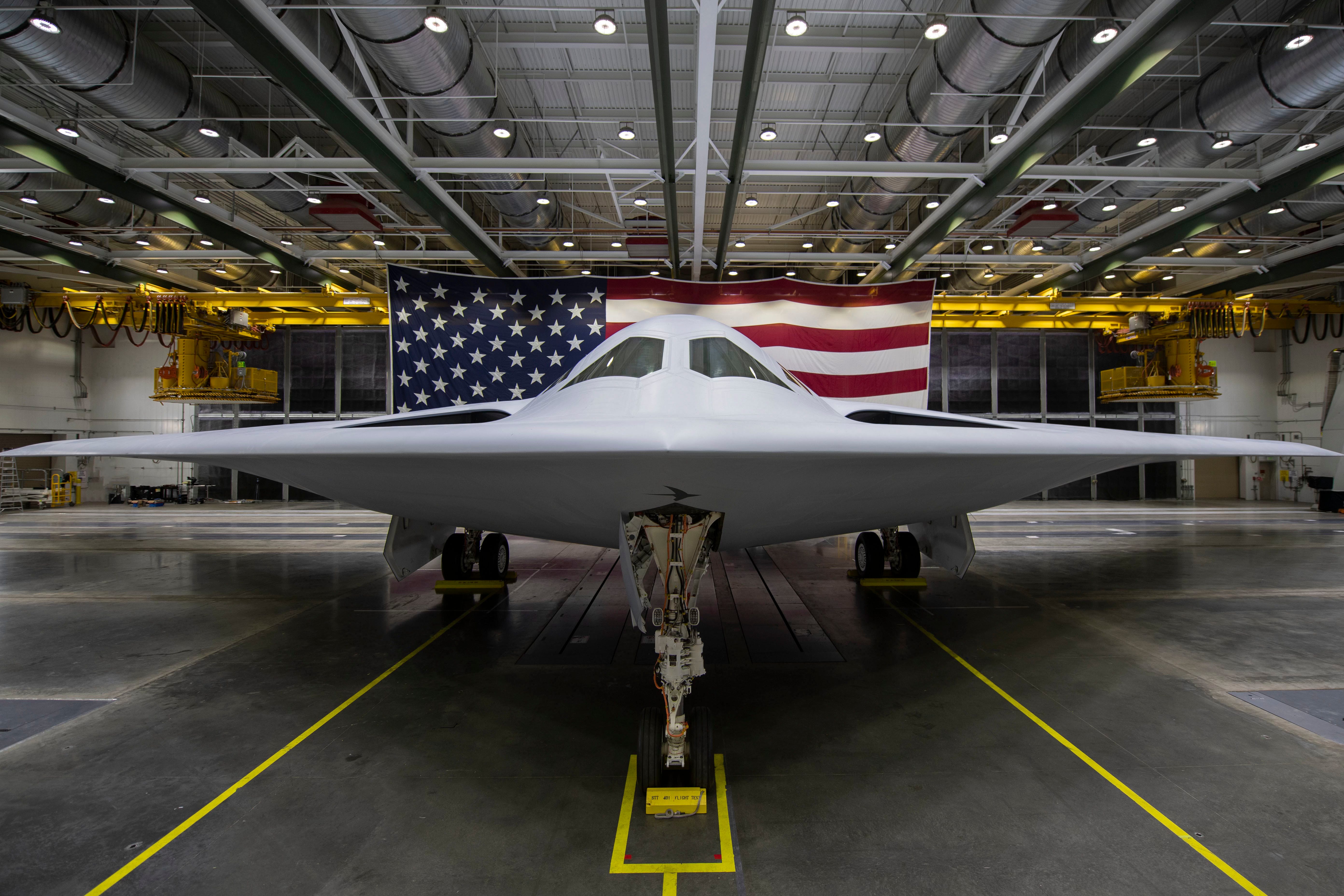
The B-21 Raider, with American flag (Northrop Grumman photo)
Similarly, strategic bombers to drop nuclear bombs (or even to launch cruise missiles) are not needed for nuclear deterrence. The whole idea of “penetrating” strategic bombers was obsolete by the late 1970s, which is why President Carter cancelled the B-1 bomber (it was revived by Ronald Reagan). We simply don’t need more strategic nuclear bombers–but the AF will always want them. If pilots can fly it (even if they have to do it remotely, as with drones), the AF wants it. Who cares if the B-21 will cost roughly $1 billion per plane when it’s finally fielded?
There is no need for the Sentinel or Raider. But the Air Force will fight until doomsday to protect its budgetary authority and the pilot and command billets that come with nuke missile fields and planes.
Let’s never forget the power of the industrial side of the military-industrial complex as well. There are hundreds—even thousands— of billions of dollars at stake here, so of course industry will fight to the end (of all of us) for the money. Weapons makers will spend millions on lobbyists, and millions more to buy politicians, to make billions in return. The profit margin here is better than crypto or most anything, actually.
They say alchemists were wrong that lead could be turned into gold, but every day the lead of bullets is sold, earning gold for the weapons makers, so alchemy is real after all. Now America’s weapons makers are turning radioactive uranium and plutonium into nearly $2 trillion in gold (or paper money, at least), the ultimate alchemical trick.
President Joe Biden has authorized Ukraine to use powerful long-range US weapons deep inside Russia.
Why now? Biden is a lame duck president, shuffling out the door, and now he decides to allow Ukraine to use American ATACMS missiles, with a range of roughly 190 miles, inside Russia. It’s also expected that these and similar longer-range missiles provided by the French and British will have no decisive impact on the war. They may kill and wound more Russians and inspire responses in kind by Russia against Ukraine, but their use won’t contribute to “victory” for Ukraine. So what’s the point?
My wife put it well when she learned of the decision: “stupid” and “ridiculous” were her words of choice. It’s amazing how well our “experts” feed the obscenity of war.
How dare you handcuff our missiles!
I take my title from a comment made by President-elect Trump’s nominee for National Security Adviser, Mike Waltz, who said we should take the handcuffs off of U.S. missiles in Ukraine, as if those missiles were people being held prisoner.
Whether in the Biden or Trump administrations, the advisers at the top are moral midgets, murderously so. I wonder how they’d feel being targeted by ATACMS. Hey, we just took the handcuffs off, Mr. Waltz. Enjoy your time being bombarded by these liberated missiles.
At the end of September, I noted how Vladimir Putin had redefined Russian nuclear policy to include a possible nuclear response to the use of “tactical” missiles like ATACMS. Here’s what I wrote then:
Vladimir Putin is redefining Russian policy for the use of nuclear weapons. He’s sending a clear warning that Ukraine’s use of U.S. and Franco-British missiles like ATACMS and Storm Shadow deep within Russia could draw a nuclear response. To my knowledge, the U.S. has not yet approved of the use of ATACMS deep within Russia, though Ukraine is pushing for it.
It seems many brain-dead, zombie-like advisers and “experts” insist that Russia is bluffing. They’re willing to bet the health and safety of the world that Russia won’t respond with nuclear weapons. And for what? ATACMS and Storm Shadow missiles aren’t war-winning weapons. The Russia-Ukraine War is a slog, an attritional struggle, featuring trenches and artillery and high casualties, a situation akin to World War I. It’s not going to be won by conventional tactical missile strikes.
Yet certain “experts” seemingly want it to escalate to World War III with nukes.
Just about 80 years ago, we humans entered the atomic age at the Trinity test site in July of 1945. We still haven’t come to grips with how the world changed when the first atomic “gadget” exploded in the desert in New Mexico. We had better hurry up and grow up before we all burn.
So, Putin has warned that deep strikes within Russia could draw a nuclear response, and Biden has now approved said strikes just before he leaves the White House. “Stupid” and “ridiculous” are indeed good descriptors here.
The obscenity of war knows no handcuffs in America.