Five years ago, I remember talking about lockdown drills (or “active shooter drills”) with colleagues at Penn College. Such drills were voluntary. Basically, the drill involved locking the classroom door, moving students to the back of the classroom, and having them hunker down, away from windows, while keeping silent so as to avoid detection by a shooter roaming the halls.
I was against these drills. I thought they added to the fear, and I chose not to do them. But maybe I would do them today.
After one shooting massacre (I can’t recall if it was Virginia Tech in 2007 or Sandy Hook in 2012), locks were added to the classroom doors. In theory, if I heard gunshots, I or one of my students could jump up and lock the door before a shooter got in. But what if a determined shooter shot the lock out?
What a world we Americans live in. Locked classrooms, lockdown drills for active shooters, and now the proposal to turn teachers into so many Harry Callahans (Clint Eastwood’s Dirty Harry) and our schools into “hardened” targets by arming teachers with pistols. Perhaps we should keep an AR-15 in each classroom (alongside the fire extinguisher), with a sign that reads, “In case of emergency, break glass – then lock and load.”
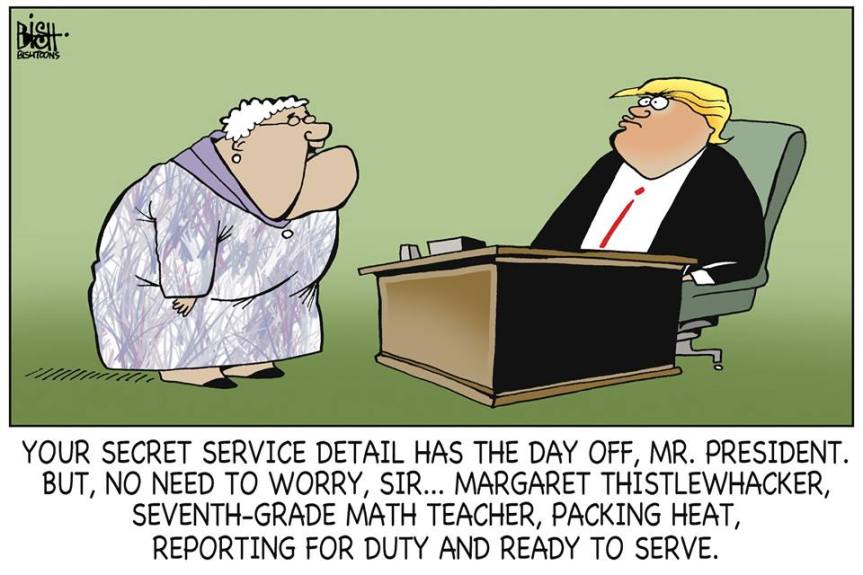
President Trump has argued that select teachers be armed – following the NRA’s theory that a good man with a gun is the best insurance against a bad man with a gun. It’s a crazy idea, but we live in a crazy country. Among the worst parts of Trump’s proposal was his stingy suggestion that armed and trained teachers might earn “a little bit” of a bonus. How generous of our brave commander-in-chief.
Think about that for a moment. There is an active shooter (or shooters) in a school, armed with military-style assault weapons and perhaps protected by body armor. Young people are running and screaming, bullets are flying, and in this bloody chaos, we place our faith in a teacher, perhaps armed with a 9mm pistol, thoroughly trained in shooting under combat conditions, willing to risk it all “for a little bit of a bonus.”
It’s a powerful fantasy: the cold bold Harry Callahan-like teacher, taking aim with his or her pistol and blowing away school intruders with perfect head shots. And that’s exactly what it is: a fantasy. As Belle Chesler, a teacher, put it at TomDispatch.com, “We are not warriors, we are teachers. We are not heroes, we are teachers.”
It’s one thing to shoot at paper targets on a gun range; it’s another thing entirely to fire accurately in combat when you’re outgunned and someone is firing back at you. What if, during the chaos of shooting, a teacher accidentally shoots a few students? So-called friendly fire incidents happen frequently in combat, despite the most careful troop training.
If you want more security guards in America’s schools, hire them. Don’t try to turn teachers into cheap cut-rate guards. Yet “a little bit of a bonus” for armed teachers is the best idea our stingy billionaire of a president can come up with.
As we saw in Parkland, Florida, even armed and trained deputies may hesitate before confronting a heavily-armed shooter. How is your average teacher going to react? At least we know Trump will rush in, heel spurs and all, whether he’s armed or unarmed, to save the day. Or so he says.
Most people, even when armed, will not rush toward the sound of gunfire. We tend instinctively to freeze, to take cover, or to run. It takes a combination of training, willpower, and courage to rush toward danger, often strengthened by teamwork and inspired by one or more leaders who set the example. The problem is not as simple as “give a teacher a gun, and he or she will blow the bad guy away.”
In a country awash in weapons, there are no easy answers. One model is to turn our schools into fortresses, complete with surveillance cameras and panic buttons and smoke ejectors in hallways, as in this “safe” school in Indiana. Trump’s model is to arm select teachers for a tiny bonus. Limited efforts at gun control, such as raising the age to purchase an assault rifle from 18 to 21, are like putting a Band-Aid on a sucking chest wound. One thing is certain: better law enforcement is crucial, e.g. there were many warnings about the Parkland shooter that were dismissed or ignored.
Again, there are no easy answers. And so Lockdown America is now our reality.
Update (3/9/18): In the wake of the Parkland shootings, Florida legislators have approved guns for teachers in the classroom, as well as more spending on school security. Assault weapons, however, are not to be banned. So the solution to bad men with guns is indeed good men with guns, according to Florida. The NRA wins again.
How long before a teacher, teacher’s aide, or coach with a gun accidentally or intentionally hurts a student with a gun? How long before the inevitable lawsuits result from this, the multi-million dollar settlements? Will school districts be required to carry expensive insurance against gun shootings by educators? Are taxpayers ready to pony up a lot more money to cover the costs of insurance premiums and lawsuits?
Painting of Everett Dirksen, a thrifty Republican. Remember those?
W.J. Astore
Though it’s unconfirmed that Congressman Everett M. Dirksen ever uttered perhaps the most famous words attributed to him: “A billion here, a billion there, and pretty soon you’re talking real money,” the sentiment surely needs to be updated for America’s profligate military moment. Replace “billion” with “trillion” and you have the perfect catchphrase for today’s Pentagon.
Consider the following facts:
The F-35 jet fighter is projected to cost $1.45 trillion over the life of the program.
Modernization of the U.S. nuclear arsenal is projected to cost $1.2 trillion, though some estimates suggest $1.7 trillion as the more likely sum.
America’s Afghan War has already cost $1 trillion. Add to that another $45+ billion to support war ops for this year, and perhaps the same amount of spending each year for the next decade.
A low-ball estimate for America’s Iraq War is $1 trillion, but when one adds in veterans health care and similar long-term issues, the cost rises into the $2-3 trillion range.
Each year, spending on the Pentagon, Homeland Security, wars, nuclear weapons, the VA, and interest on the national debt associated with previous military spending approaches $1 trillion.
We’re talking about real money, right?
Yet all this spending is scarcely debated within Congress. Together with the Trump administration, Congress is a rubber stamp for the Pentagon. Meanwhile, Congress will fight tooth and nail over a few million dollars to support the arts, humanities, and similar “wasteful” programs. Planned Parenthood is always under attack, despite the paltry sum they receive (roughly half a billion) to provide vital functions for women’s health. Even the $200 billion promised by Trump to support infrastructure improvements is a trickle of money compared to the gusher of funds dedicated to the Pentagon and all of its exotic WMD.
People laughed at Bernie Sanders when he proposed health care for all and free education in state colleges. That socialist fool! America can’t afford that! Indeed, much better for people to go into debt as they struggle to pay for health care or college. That’s private enterprise and “freedom” for you. Own the debt and you can own the world.
No — Bernie Sanders wasn’t crazy. America could easily afford universal health care and virtually free education at state colleges and universities. Our elites simply choose not to consider these proposals, let alone fund them. But more nukes? More wars? More jets and subs and tanks? Right this way, my boy!
All these trillions for weapons and wars — one thing is certain: “freedom,” as they say, sure isn’t free.
Update (2/27/18): At TomDispatch.com, Bill Hartung goes into greater detail on the Pentagon’s massive budget for 2018 and 2019. As he notes: “The figures contained in the recent budget deal that kept Congress open, as well as in President Trump’s budget proposal for 2019, are a case in point: $700 billion for the Pentagon and related programs in 2018 and $716 billion the following year. Remarkably, such numbers far exceeded even the Pentagon’s own expansive expectations. According to Donald Trump, admittedly not the most reliable source in all cases, Secretary of Defense Jim Mattis reportedly said, ‘Wow, I can’t believe we got everything we wanted’ — a rare admission from the head of an organization whose only response to virtually any budget proposal is to ask for more.”
The title of Hartung’s article sums it up: The Pentagon Budget as Corporate Welfare for Weapons Makers.
Put succinctly, it’s warfare as welfare — and wealth-care — for the military-industrial complex.
I’ve never gotten excited about or interested in a particular sports team, whether professional or amateur. I don’t care whether a particular team wins or loses and I go out of my way not to watch games on TV or listen to a radio broadcast.
Prior to this year’s Super Bowl game, I listened to people chant, on the phone or in person, “Go Patriots” or “Go Eagles.” Even a Catholic priest at the end of a mass I attended recently couldn’t leave the altar before letting the parishioners know he was a Patriots fan.
Spectator sports have always been a secular religion in most developed countries but with no promise of any form of salvation, afterlife, or reincarnation. The most you can really expect from your team is winning a bet on the game. But spectator sports is a distraction with negative consequences, ultimately, to society and the individual sports fan—such as having no understanding of the actions of political parties.
And because each season of the year has its athletic contests there is no letup. A fan is deluged all year round with games as well as incessant commentaries on athletes and the points they score or might score. Athletic contests and players, even on the high school level, are a major topic of conversation, especially among adult males I view such conversations as not only boring but irrelevant to my own life, to what I would call meaningful concerns.
In fact, I would argue spectator sports discussions have no lasting therapeutic value in dealing with the real “slings and arrows of outrageous fortune.” Political philosopher Noam Chomsky recently said, probably somewhat sarcastically, that if as much mental energy was expended in solving the social and economic problems of the world as is expended in trying to explain why a given team wins or loses a game, much socially and politically induced suffering and death could be eliminated.
Eavesdrop on virtually any conversation, especially at World Series, Super Bowl, or NBA playoff times, and you’ll hear conversations that would make you believe you were in a think-tank rivaling the Institute for Advanced Study at Princeton.
Now, as a sociologist, I realize the important function of sports in society. That function, of course, is a distraction from life’s existential problems and dilemmas. Death, loss of loved ones, nuclear war, global warming are certainly among those problems. And, most assuredly, being a spectator sports fanatic is a far better alternative than being a drug addict or engaging in anti-social behavior. I also admit spectator sports have a limited psycho-therapeutic effect on some people.
My quarrel is with the level of energy spent watching and then discussing sports events. Even expressing one’s preference for one team or another I find disturbing, mainly because I feel there are more worthwhile causes to champion. Agonizing, so it seems, over the prowess of individual players and their team’s chances of winning playoffs or championships is a waste of time and energy. Simply put, I cannot empathize in the slightest with the sports fan. In that respect I guess I’m a type of sociopath since sociopaths can’t empathize with other human beings in general.
Arguably, spectator sports also contribute to the “us” versus “them” perspective toward social life, the belief that life is not interesting or worthwhile unless “us” is always trying to defeat “them,” whether “them” be a rival team or country–in other words, not “us.”
The great (former) coach of the Green Bay Packers, Vince Lombardi once proclaimed, “Winning isn’t everything; it’s the only thing.” Could Lombardi’s philosophy be applied to our current president who is also an ardent sports fan? Could Donald Trump’s insistence on America becoming “great again,” with all the dire consequences to minority groups and the underclass, not to mention the world in general, be the by-product of his obsessive interest in spectator sports? At one time our president wanted to be owner of an NFL team. What does that tell us?
Two psychological processes seem to account for the prevalence of the typical sports fan. These are vicarious identification and reification. Vicarious identification is thinking that one “IS” actually the team he or she is watching. The team’s victory or defeat is his/her victory or defeat. Being able to enjoy plays, movies, and novels entails the same process; for the moment, one is a character in a work of fiction. The ability of consciousness (mind, soul, brain, spirit, if you prefer) to immerse itself in a story or situation that is fictitious is, for sure, one of the great joys of life. From time to time I’ve watched certain films or videos multiple times and can still fool myself into thinking that I don’t really know the outcome. Perhaps spectator sports allow male fans in particular to be the macho male, the alpha male they’re not in everyday life, without having to perform in any way. No need to resort to violent behavior if one vicariously identifies with a football team or professional wrestlers.
Reification is psychologically treating an abstract concept or mental construct as if it were real, as if it were empirical or tangible reality. Semanticists will say “the word is not the thing” or “the map is not the territory.” Nations, states, cities do not exist as realities (sui generis); they are only abstract concepts, in other words, words. People exist, athletes exist, and games are played, but the sports fan wants his/her “team” to win because the name of the team itself is regarded as if it were a live person or group of people.
It doesn’t matter, usually, who the real life players are or even if there are any real life players. It’s the “team” itself—the word is the thing. I once asked my students who were fans of the Pittsburgh Steelers whether they would still want the Steelers to defeat the Dallas Cowboys if the teams’ executives exchanged players and coaches. The Steelers fans said they would still support or root for the Steelers over the Cowboys. I tried to point out the error in their thinking, that there is no such reality as the “Steelers” or the “Cowboys,” that only players and their coaches exist. No, the Steelers fans would remain Steelers fans and want the team to win because they are “The Steelers.”
Existence precedes essence, say the existentialists. Existence is what is tangibly real, for example, what could physically maim, hurt, kill. Essence refers to words, ideas, concepts. (For example, essence would be the “thoughts and prayers” for gun victims–what we hear so much these days from our politicians in the wake of shooting violence.) Scoring a touchdown is “existence.” The team that fans roots for is “essence,” in other words, nothing but an idea with no more substance than the number “5.” When one regards spectator sports existentially it becomes difficult to be a fan, although one may enjoy viewing brilliantly executed plays on the field or in the arena.
My argument here, then, is that the serious spectator sports fan is likely to be distracted from engaging in philosophical, political, aesthetic, critical thinking or reflection. Now, I have no doubt that one could be a sports fan, even a fanatical sports fan, and be a social activist, an artist, a scholar, a reflective person capable of deep meditation. I just see spectator sports as tending to obstruct or preclude intellectual and aesthetic development in the general population of a given country.
Professional and collegiate athletic events do benefit our economic system by creating all kinds of jobs and careers, and not just for the players. But spectator sports may also stand in the way of the fan being exposed to and contemplating the vital social and political issues of the times. It is reasonable to ask whether being a serious sports fan erodes participation in the democratic process. Why are most universities known for their teams and not for what their faculties teach? What’s the first thing an American thinks of when he or she thinks of “Ohio State” or “Notre Dame” or “Penn State”? Is it higher learning? Or football?
Richard Sahn teaches sociology at a college in Pennsylvania.
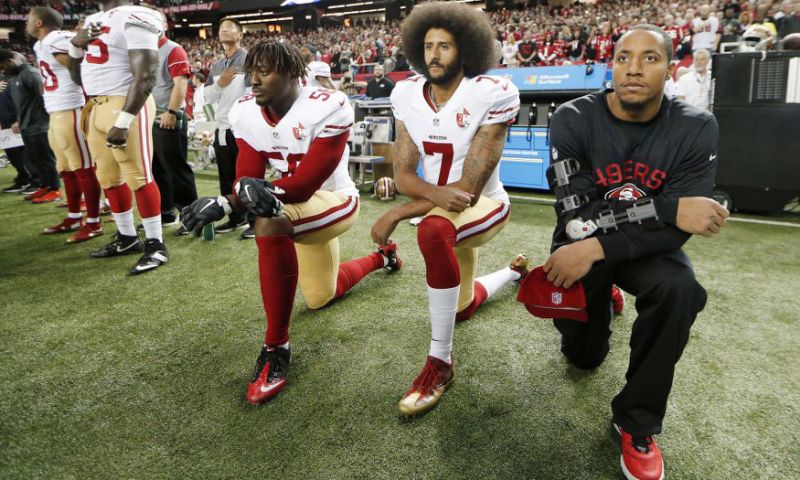
A week after Super Bowl Sunday, I was reading Frederick Douglass’s “Fourth of July Address,” given by the intrepid abolitionist and eminent public intellectual on July 5, 1852 to several hundred spectators in Rochester, New York. It struck me then how contemporary Douglass’s antebellum insights into the nature of patriotism in America seemed, especially in the wake of an NFL season steeped in controversy over football players (mostly African-American) taking a knee during the national anthem. Their symbolic protest, dismissed by some, notably including a tweeting president, as unpatriotic, was intended to highlight how police encounters with people of color in this country all too often and disproportionately end in unjustified uses of deadly force.
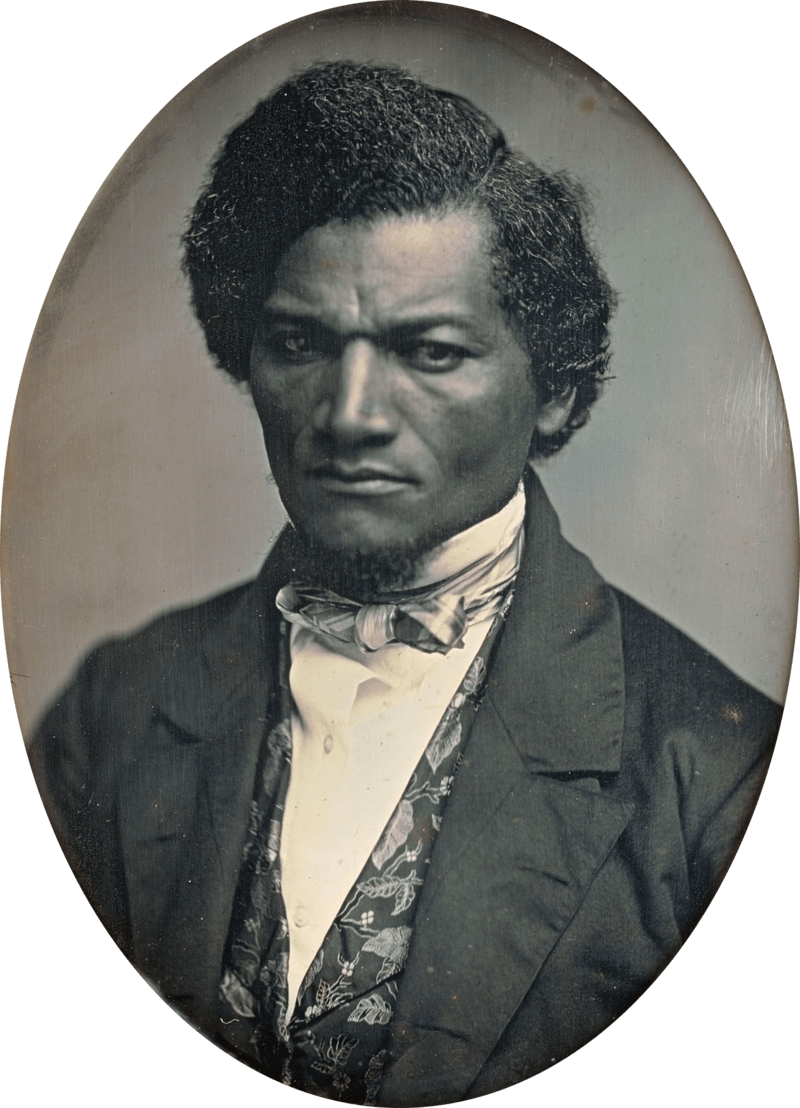
Frederick Douglass near the time of the Rochester Speech, given on the 5th of July 1852
At the time of his Fourth of July Address, Douglass was about fifteen years removed from a state of enslavement he managed, against steep odds, to escape and had become an orator of note in abolitionist circles. Attesting to a sense of trepidation in accepting an invitation to speak before such a large audience on their august day of national celebration, Douglass praised the generation of 1776 (“your fathers,” he calls them) for “lov[ing] their country better than their own private interests” and for their “solid manhood” in “preferr[ing] revolution to peaceful submission to bondage.”
Douglass then reminded his audience that, while it is easy in present times to celebrate the founders for resisting British oppression, “to pronounce against England, and in favor of the cause of the colonies” in the 1770s meant being pilloried and browbeaten as “plotters of mischief, agitators and rebels, dangerous men.” Moving beyond this critique of the easy and self-congratulatory patriotism of his contemporaries, Douglass raised the prospect that the founders’ great deeds might even be evoked by men of tyrannical intent: “The cause of liberty may be stabbed by the men who glory in the deeds of your fathers.”
Douglass went on to warn his listeners, and free citizens of the American republic generally, against shirking their own responsibility for carrying on the emancipatory tradition celebrated each Fourth of July–“You have no right to wear out and waste the hard-earned fame of your fathers to cover your indolence.”
While there is much more to Douglass’s powerful address, his opening discourse on the patriotic meaning of the Fourth of July provides a way of dousing the “fire and fury” that has been generated by the right-wing media around the symbolic protest started by Colin Kaepernick in 2016 and seeing the significance of that protest with a quiet clarity.
Douglass’s Fourth of July Address warns against the self-serving belief that routinized, programmed patriotic gesture is equivalent to a true love of liberty. He daringly calls out those who would abuse patriotic gesture in order to control others. His words remind us that the struggle for freedom is always a work in progress and that it is too easy to celebrate its provisional achievement after the hard and risk-laden work is done by others.
Douglass’s speech is part of a tradition of exposing empty patriotic gesture and challenging citizens to live up to the emancipatory demands of true patriotism, a tradition which Colin Kaepernick and his emulators can be seen as stalwartly embracing. His speech serves as a powerful rejoinder to those who would, like Donald J. Trump, attempt to shame NFL player-protesters into anthem-standing conformity with transparently cynical references to the sacrifices of US veterans and members of the armed forces.
M. Davout (pseudonym) is a professor of political science who teaches in the Deep South.
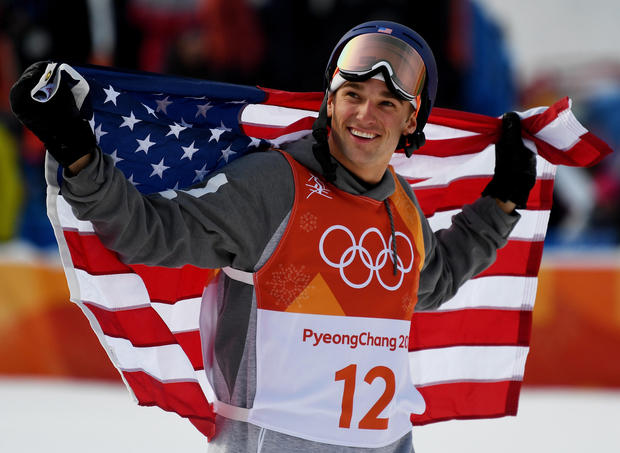
As soon as American athletes win an Olympic medal, it’s seemingly obligatory for someone to give them a flag so they can wrap themselves in it. Here’s Nick Goepper, who won a silver medal in skiing:
I’ve seen athletes from a few other countries do this, but not with the uniformity and urgency of U.S. athletes. Maybe American athletes just love their country more?
I vaguely recall “wrapping oneself in the flag” moments from previous Olympics that seemed spontaneous. What gets me today is how routine these moments have become. The American snowboarder Shaun White, for example, wrapped himself in the flag for his photo op, after which he dragged it on the snowy ground as he walked away, a transgression for which he apologized afterwards.
I understand athletes are proud to represent their countries, and understandably pumped after winning a medal. But do all U.S. medal-winners now have to pose with a flag draped about them?
The official medal ceremony features the flags of the medal winners, with the national anthem being played for the winner of the gold. I always thought that ceremony was more than sufficient as a patriotic display, and more consistent with the idea of the Olympics as an international event of diverse athletes.
What would happen if athletes, after winning their respective medals, wrapped themselves not in the flag of their respective countries, but in the Olympic flag showing the five interlocked rings? Would heads explode?
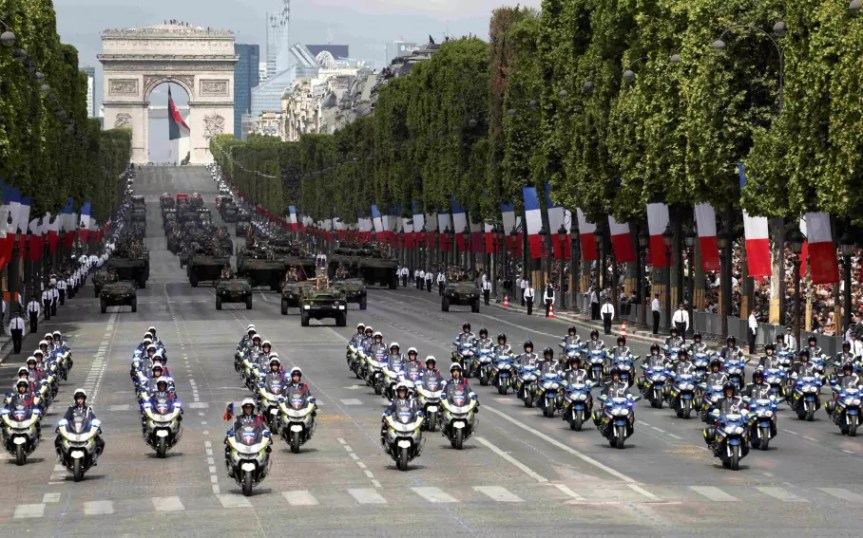
Trump, inspired by the French, wants his own military parade
W.J. Astore
News that President Trump favors a military parade in Washington D.C., perhaps to coincide with Veterans Day in November, has drawn criticism, and rightly so. The president has a juvenile fascination with parades and other forms of pomp and circumstance, but more than anything I’m guessing he relishes the thought of posing as “The Leader,” reviewing and saluting “his” troops and generals as they pass in review. If only “Cadet Bone Spurs,” the telling nickname that Tammy Duckworth has pegged him with, could don a military uniform for the occasion — his fantasy would be complete.
The idea of a military parade down Pennsylvania Avenue, complete with tanks and jets (and maybe some big missiles and bombs too?), sounds radical. But is it really that different from other militarized celebrations that America has been witnessing and applauding since 9/11?
Consider this year’s Super Bowl. It was played in a domed stadium, yet there was the obligatory military flyover (featuring A-10 attack planes, which the Air Force ironically wants to get rid of). Fifteen Medal of Honor recipients were celebrated on the field, with one (a Marine) performing the coin toss for the game. A video link showed U.S. troops watching from overseas. In past years, troops featured were usually in combat zones like Iraq and Afghanistan. This year the troops were in South Korea, perhaps because NBC wanted a link to the forthcoming Olympic games, hopefully not because the Trump administration is foreshadowing a “bloody nose” strike against North Korea that would turn that region into a combat zone.
Such patriotic (read: militarized) hoopla has become standard, not just at the Super Bowl and other NFL events, but at many other sporting events. At last year’s U.S. Open tennis tournament in New York, prior to the men’s final played on 9/10, there was a ceremony to mark the 9/11 attacks, complete with the usual jumbo-sized U.S. flag, with uniformed troops joined by officer cadets from West Point, climaxed by a military flyover. The ceremony was timed for maximum TV exposure.
As a retired military officer, I can’t tell you how many times I’ve saluted the colors and sung the National Anthem. I have no objection to military color guards and proud renditions of our anthem. It’s all the other hoopla — the flyovers, the video links, the gigantic flags, the increasing size of military contingents on playing fields and tennis courts and elsewhere — that I find so exaggerated. It’s as if I sat down to watch a football game or a tennis match and a military parade broke out instead.
Give President Trump his due: he knows his audience. His supporters will revel in a military parade in Washington. So too will Trump. The rest of us? Why should we complain: we’ve been watching over-the-top military celebrations for nearly two decades. A big parade down Pennsylvania Avenue is the logical culmination of all this, especially with Trump in charge.
Like many other aspects of American culture, Trump is just bringing our love of the military into higher relief. Don’t blame him (or only him) if you don’t like what you see.
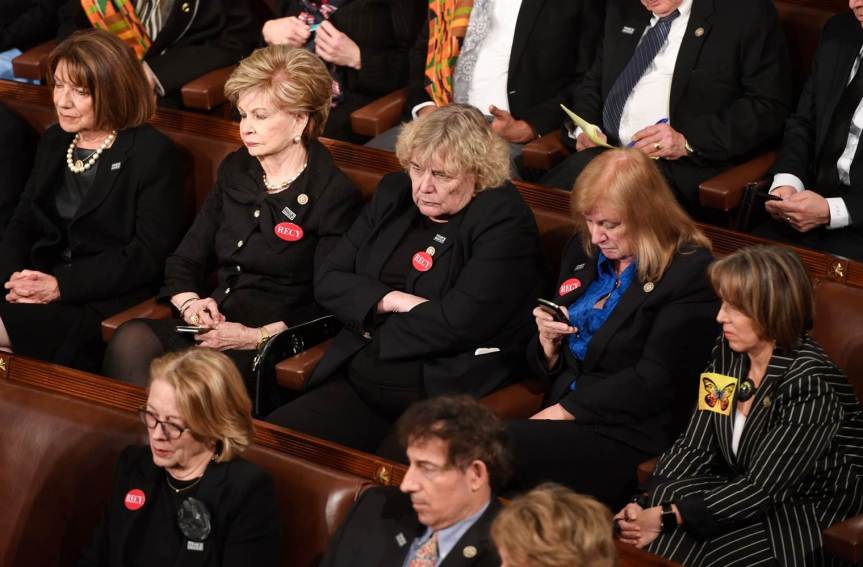
Last night’s State of the Union address was disturbing on many levels. Republicans applauded when President Trump touted the elimination of the individual mandate for purchasing health care insurance — so it’s a good thing people have no health insurance? Wait until they go to the emergency room for an appendectomy and leave with a bill for $20,000. Republicans applauded as well when Trump touted the American prison at Guantanamo Bay in Cuba. So it’s a good thing our President is vowing to send more “terrorists” to an offshore U.S. military prison?
I could go on and on, but what was most disturbing to me was the use of people in the audience as props for Trump’s positions. A brave soldier who won the Bronze Star for valor was celebrated to support America’s wars overseas. Parents whose daughters were killed by illegal immigrants were used to support Trump’s policies on immigration. A family whose son suffered grievous, ultimately deadly, wounds in North Korea was used to support Trump’s bellicose policies toward Kim Jong-un and his regime, as was a courageous North Korean defector.
It reminded me of the Don Henley song, “Dirty Laundry” and its lines: Can we film the operation?/Is the head dead yet?/You know the boys in the newsroom got a running bet/get the widow on the set/we need dirty laundry.
The shameless exploitation of other people’s grief is something I can’t stand. It’s sordid and cynical and dirty. There are many other things I could say about Trump’s State of the Union address, but my overall feeling was one of exploitation. After his speech, I felt dirty.
Today I saw this bulletin from FP: Foreign Policy:
OUTSIDE THE WIRE: Several years after pulling back, American troops will head outside the wire to battle the Taliban and turn up the air war, FP’s Paul McLeary and Dan De Luce report.
America’s wars never end. So much for Armistice Day of 99 years ago. In place of Woodrow Wilson’s eternal peace, we now have eternal war. It doesn’t have to be this way. We have a choice, as this article, that I wrote for Veterans Day in 2009, suggests.
Thirty years ago, I attended Boys State. Run by the American Legion, Boys State introduces high school students to civics and government in a climate that bears a passing resemblance to military basic training. Arranged in “companies,” we students did our share of hurrying up, lining up, and waiting (sound preparation, in fact, for my career in the military). I recall that one morning a “company” of students got to eat first because they launched into a lusty rendition of the Marine Corps hymn. I wasn’t angry at them: I was angry at myself for not thinking of the ruse first.
Today, most of my Boys State experience is a blur, but one event looms large: the remarks made by a grizzled veteran to us assembled boys. Standing humbly before us, he confessed that he hoped organizations like the American Legion and Veterans of Foreign Wars would soon wither away. And he said that he hoped none of us would ever become a member of his post.
At first, we didn’t get it. Didn’t he like us? Weren’t we tough enough? (Indeed, I recall that one of our adolescent complaints was that the name “Boys State” didn’t seem manly enough.)
Then it dawned on us what the withering away of organizations like the American Legion and the VFW would mean. That in our future young Americans would no longer be fighting and dying in foreign wars. That our world would be both saner and safer, and only members of an “old guard” like this unnamed veteran would be able to swap true war stories. Our role would simply be to listen with unmeasured awe and undisguised thanks, grateful that our own sons and daughters no longer had to risk life or limb to enemy bullets and bombs.
It pains me that we as a country have allowed this veteran’s dream to die. We as a country continue to enlarge our military, expand our foreign commitments, and fight seemingly endless wars, whether in Iraq, Afghanistan, or in other far-off realms of less-than-vital interest to us.
As a result of these wars, we continue to churn out so many new veterans, including so many wounded veterans, not forgetting those who never made it back.
Collectively, we Americans tend to suppress whatever doubts we have about the wisdom of our wars with unequivocal statements of support for our troops. And on days like Veteran’s Day, we honor those who served, and especially those who paid the ultimate price on the battlefield.
Yet, wouldn’t the best support for our troops be the achievement of the dream of that grizzled vet who cut through a young man’s fog thirty years ago?
Shouldn’t we be working to achieve a new age in which the rosters of our local VFWs and Legion posts are no longer renewed with the broken bodies and shattered minds of American combat veterans?
Sadly, as we raise more troops and fight more wars, we seem committed to the opposite. Our military just enjoyed its best recruiting class in years. This “success” is not entirely surprising. It’s no longer that difficult to fill our military’s expanding ranks because many of our young men and women simply have little choice but to enlist, whether for economic opportunity, money for college, or benefits like free health care.
Many of course enlist for patriotic reasons as well. Yet the ease of expanding our military ranks during a shooting war is also a painful reminder of the impoverishment of opportunities for young, able-bodied Americans – the bitter fruit of manufacturing jobs sent overseas, of farming jobs eliminated by our own version of corporate collectivization, of a real national unemployment rate that is approaching twenty percent.
On this Veteran’s Day, what if we began to measure our national success and power, not by our military arsenal or by the number of new recruits in the ranks, but rather by the gradual shrinking of our military ranks, the decline of our spending on defense, perhaps even by the growing quiet of our legion posts and VFW halls?
Wouldn’t that be a truer measure of national success: fewer American combat veterans?
Wouldn’t that give us something to celebrate this Veteran’s Day?
I know one old grizzled veteran who would quietly nod his agreement.
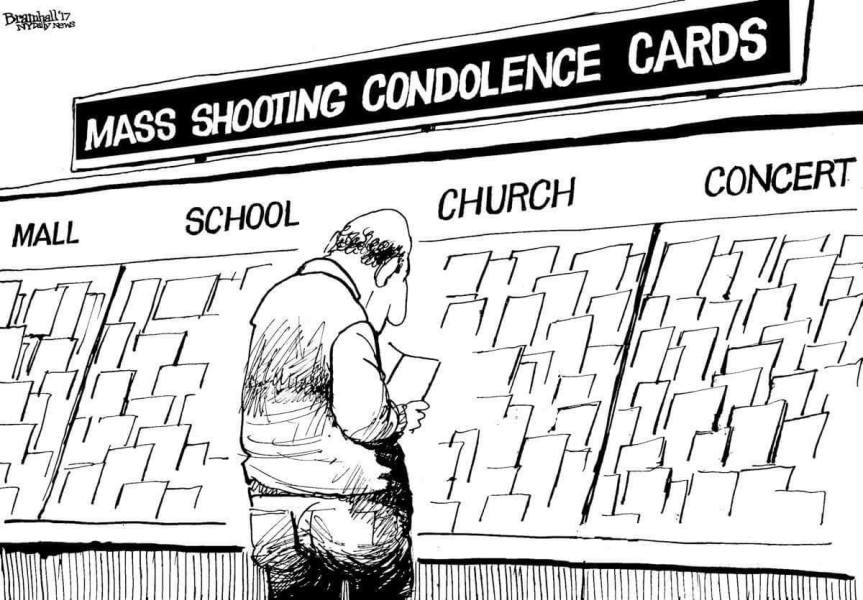
Yesterday, I saw a sticker on a pickup truck that read “God, Country, Guns.” To me, that sticker made as much sense as “God, Country, Hammers” or “God, Country, Bicycles.” A gun is just that: a tool, an object, like a hammer or a bicycle, only much more dangerous in the wrong hands.
But many Americans don’t look at guns as tools, as objects, as a deadly technology that requires great care and also strict regulations. They identify it with God and Country. They see it as representing certain values, such as freedom and liberty and individuality. For some men, guns are synonymous with masculinity. They are symbols of potency. Of agency. They are worthy of protection, indeed of a lifelong vow, ’til death do us part. Hence the catchphrase, “you can have my gun when you pry it from my cold, dead hands.”
This sacralization of the gun, its elevation as a totem of strength and virility, its hugely symbolic presence in American life, is an important reason why gun control efforts largely fail, even in the aftermath of horrendous mass shootings. Reasoned and reasonable efforts to limit mass shootings, e.g. by banning military-style assault weapons, high-capacity clips, and bump stocks, are no match for people’s emotional — I daresay religious or spiritual — attachment to guns.
I’ve owned guns myself and have enjoyed firing everything from a pellet rifle to a .45-70 and from a .22 pistol to a .44 magnum. As a historian of technology, I appreciate the history of guns as well as their aesthetic beauty. (If you go to a gun show or hang around gun owners, you’ll often hear guns described as “beautiful.”) But my appreciation for guns doesn’t translate to an affection for them. And in the cause of greater public safety and a reduction in mass shootings, I’d like to see stricter regulations for certain guns and related accessories.
Again, here are three reasonable changes I’d like to see:
No military-style assault or high-caliber sniper rifles.
No high-capacity clips.
No bump stocks or other devices to increase rate of fire.
Yet, no matter how reasonable these changes seem to most, organizations like the National Rifle Association will oppose them,* as will those who associate guns with God and Country and freedom and similar values.
Growing up in the 1970s, I remember reading “Field and Stream” and “Outdoor Life” (and an occasional “American Rifleman” too). In the early ’80s, I wrote a paper on the history of hunting in America prior to the U.S. Civil War. Until fairly recently, gun owners focused mainly on hunting and personal protection, using weapons like bolt-action or lever-action rifles, shotguns, and revolvers. Rifles that I recall friends talking about or owning were .30-06 or .30-30. Nobody talked about owning an AR-15 or AK-47 or similar military-style assault rifles with “banana” (high-capacity) clips and bump stocks.
America, of course, is a land of extremes, and one example is today’s gun-rights crowd, which attacks all regulations or restrictions as an assault on their “rights” or “way of life” as articulated in the Second Amendment. But it didn’t use to be this way. Indeed, it wasn’t this way when I was a teenager. How did guns become so venerated, so cherished, so worshiped, in American culture? So much so that people ride around today with stickers equating gun ownership with God and Country?
As long as our society continues to worship the gun, the more likely it is that we’ll suffer more mass shootings — and indeed shootings in general.
*Yes, in the aftermath of the Vegas Massacre, it’s true the NRA said it wouldn’t oppose “additional regulations” on bump stocks. Note, however, that no ban is forthcoming from Congress. The NRA are a savvy bunch…
Critical thinking? Forget that. Obey! (Inspired by the movie, “They Live”)
W.J. Astore
When I was still teaching college, I’d tell my students that a major goal of their education was developing a bullshit meter. This BS meter, I said, would help them to discriminate between fact and fiction, between informed views and misinformed ones, between respectable opinions and disreputable propaganda. Become critical thinkers, I told them. And that included being critical of my teaching, for every professor has biases and makes choices about what to include and what to exclude, what to stress and what to elide.
Critical thinking skills are what is being elided and excluded in much of education today. This is obviously convenient to those in power, for they do not wish to be questioned. In the name of economic competitiveness, of teaching job skills, of STEM (science, technology, engineering, and math), students are encouraged to focus on getting ahead, on making a high salary after graduation, the better to repay student loans and contribute back to the college as alumni. On their web sites and marketing brochures, colleges often feature prominently how much their students can be expected to make in salary after graduation. The almighty dollar sign: It’s the key metric of success.
A narrow utilitarianism, based on money, has come to define education. Much like war, education is becoming just another racket (think here of Trump University!). Eight years ago, when I was still teaching away in the classroom, I wrote the following article for TomDispatch.com. I’ve decided to share it here today, because I don’t think much has changed since 2009. Indeed, education in America has only worsened as Donald Trump and Company have taken a hatchet to educational funding. But stupid is as stupid does. (Then again, Trump isn’t so stupid; as he himself enthused after the Nevada caucuses in 2016, “I love the poorly educated!” Yes, hmm, yes.)
Hardly a week goes by without dire headlines about the failure of the American education system. Our students don’t perform well in math and science. The high-school dropout rate is too high. Minority students are falling behind. Teachers are depicted as either overpaid drones protected by tenure or underpaid saints at the mercy of deskbound administrators and pushy parents.
Unfortunately, all such headlines collectively fail to address a fundamental question: What is education for? At so many of today’s so-called institutions of higher learning, students are offered a straightforward answer: For a better job, higher salary, more marketable skills, and more impressive credentials. All the more so in today’s collapsing job market.
Based on a decidedly non-bohemian life — 20 years’ service in the military and 10 years teaching at the college level — I’m convinced that American education, even in the worst of times, even recognizing the desperate need of most college students to land jobs, is far too utilitarian, vocational, and narrow. It’s simply not enough to prepare students for a job: We need to prepare them for life, while challenging them to think beyond the confines of their often parochial and provincial upbringings. (As a child of the working class from a provincial background, I speak from experience.)
And here’s one compelling lesson all of us, students and teachers alike, need to relearn constantly: If you view education in purely instrumental terms as a way to a higher-paying job — if it’s merely a mechanism for mass customization within a marketplace of ephemeral consumer goods — you’ve effectively given a free pass to the prevailing machinery of power and those who run it.
Three Myths of Higher Ed
Three myths serve to restrict our education to the narrowly utilitarian and practical. The first, particularly pervasive among conservative-minded critics, is that our system of higher education is way too liberal, as well as thoroughly dominated by anti-free-market radicals and refugee Marxists from the 1960s who, like so many Ward Churchills, are indoctrinating our youth in how to hate America.
Nonsense.
Today’s college students are being indoctrinated in the idea that they need to earn “degrees that work” (the official motto of the technically-oriented college where I teach). They’re being taught to measure their self-worth by their post-college paycheck. They’re being urged to be lifelong learners, not because learning is transformative or even enjoyable, but because to “keep current” is to “stay competitive in the global marketplace.” (Never mind that keeping current is hardly a guarantee that your job won’t be outsourced to the lowest bidder.)
And here’s a second, more pervasive myth from the world of technology: technical skills are the key to success as well as life itself, and those who find themselves on the wrong side of the digital divide are doomed to lives of misery. From this it necessarily follows that computers are a panacea, that putting the right technology into the classroom and into the hands of students and faculty solves all problems. The keys to success, in other words, are interactive SMART boards, not smart teachers interacting with curious students. Instead, canned lessons are offered with PowerPoint efficiency, and students respond robotically, trying to copy everything on the slides, or clamoring for all presentations to be posted on the local server.
One “bonus” from this approach is that colleges can more easily measure (or “assess,” as they like to say) how many networked classrooms they have, how many on-line classes they teach, even how much money their professors bring in for their institutions. With these and similar metrics in hand, parents and students can be recruited or retained with authoritative-looking data: job placement rates, average starting salaries of graduates, even alumni satisfaction rates (usually best measured when the football team is winning).
A third pervasive myth — one that’s found its way from the military and business worlds into higher education — is: If it’s not quantifiable, it’s not important. With this mindset, the old-fashioned idea that education is about molding character, forming a moral and ethical identity, or even becoming a more self-aware person, heads down the drain. After all, how could you quantify such elusive traits as assessable goals, or showcase such non-measurements in the glossy marketing brochures, glowing press releases, and gushing DVDs that compete to entice prospective students and their anxiety-ridden parents to hand over ever larger sums of money to ensure a lucrative future?
Three Realities of Higher Ed
What do torture, a major recession, and two debilitating wars have to do with our educational system? My guess: plenty. These are the three most immediate realities of a system that fails to challenge, or even critique, authority in any meaningful way. They are bills that are now long overdue thanks, in part, to that system’s technocratic bias and pedagogical shortfalls — thanks, that is, to what we are taught to see and not see, regard and disregard, value and dismiss.
Over the last two decades, higher education, like the housing market, enjoyed its own growth bubble, characterized by rising enrollments, fancier high-tech facilities, and ballooning endowments. Americans invested heavily in these derivative products as part of an educational surge that may prove at least as expensive and one-dimensional as our military surges in Iraq and Afghanistan.
As usual, the humanities were allowed to wither. Don’t know much about history? Go ahead and authorize waterboarding, even though the U.S. prosecuted it as a war crime after World War II. Don’t know much about geography? Go ahead and send our troops into mountainous Afghanistan, that “graveyard of empires,” and allow them to be swallowed up by the terrain as they fight a seemingly endless war.
Perhaps I’m biased because I teach history, but here’s a fact to consider: Unless a cadet at the Air Force Academy (where I once taught) decides to major in the subject, he or she is never required to take a U.S. history course. Cadets are, however, required to take a mind-boggling array of required courses in various engineering and scientific disciplines as well as calculus. Or civilians, chew on this: At the Pennsylvania College of Technology, where I currently teach, of the roughly 6,600 students currently enrolled, only 30 took a course this semester on U.S. history since the Civil War, and only three were programmatically required to do so.
We don’t have to worry about our college graduates forgetting the lessons of history — not when they never learned them to begin with.
Donning New Sunglasses
One attitude pervading higher education today is: students are customers who need to be kept happy by service-oriented professors and administrators. That’s a big reason why, at my college at least, the hottest topics debated by the Student Council are not government wars, torture, or bail-outs but a lack of parking and the quality of cafeteria food.
It’s a large claim to make, but as long as we continue to treat students as customers and education as a commodity, our hopes for truly substantive changes in our country’s direction are likely to be dashed. As long as education is driven by technocratic imperatives and the tyranny of the practical, our students will fail to acknowledge that precious goal of Socrates: To know thyself — and so your own limits and those of your country as well.
To know how to get by or get ahead is one thing, but to know yourself is to struggle to recognize your own limitations as well as illusions. Such knowledge is disorienting, even dangerous — kind of like those sunglasses donned by Roddy Piper in the slyly subversive “B” movie They Live (1988). In Piper’s case, they revealed a black-and-white nightmare, a world in which a rapacious alien elite pulls the levers of power while sheep-like humans graze passively, shackled by slogans to conform, consume, watch, marry, and reproduce.
Like those sunglasses, education should help us to see ourselves and our world in fresh, even disturbing, ways. If we were properly educated as a nation, the only torturing going on might be in our own hearts and minds — a struggle against accepting the world as it’s being packaged and sold to us by the pragmatists, the technocrats, and those who think education is nothing but a potential passport to material success.