Competition can be a good thing. Think of sports, for example. Would victory have any meaning without competition? If we just randomly selected a winner each year of the Super Bowl or the World Series, who would care?
Competing is completing—a way to motivate oneself, to better oneself. That said, “victory” is more than just lifting a trophy in triumph. How you got there—how you treated your fellow competitors along the way—matters too.
I remember a saying—If you’re not enough before the gold medal, you won’t be enough with it. Competing honorably, giving your very best, is really what it’s about, not just shiny medals and trophies. If your soul is empty, if your heart is cold, the glow from even the highest accolade will fade—and quickly.
Too often in our society, competition is embraced for the sake of dominance. For some, winning has no meaning unless others suffer by losing. A real winner, however, lifts up others even as she or he is competing to be the very best.
This is a lengthy prelude to an article I thought I would write about Americans competing for everything. Cooperation? Fuhgeddaboudit! Competition for everything, always, calls to mind a cutthroat world in which only the fittest—or the most ruthless, the nastiest—survive and thrive.
Far too often, competition in America is further expressed through materialism, buying, and display. Competitive consumption, if you will. Over-the-top displays of dominance: having the biggest yacht, the loudest stereo system, the largest truck, the most expensive SUV, the most exotic pets, you name it.
America, let us say, is not a country known for its restraint. But as I thought about consumption as a national pastime, I recalled the great monologue on America by comedian George Carlin, who in less than eleven minutes dissected the American way with more power and wit than just about anyone else I’ve heard. His lessons were grim, but Carlin spoke from his heart and warned us we were losing our way in mindless consumption.
Every now and then, I rewatch the 11-minute clip below to give myself a cold slap of reality. Believe me, there’s a lot in his monologue to digest. And a lot of profanity as well—consider yourself warned.
The NFL draft started last night, in prime time. I’m fascinated, flabbergasted, and horrified by all the ink spilled and money spent on the draft–what a spectacle it’s become! Even before the draft, there are literally thousands of “mock” drafts, including those that attempt to predict all seven rounds of the draft, like this example. It’s insane! Why go through these exercises when you can simply wait for the draft results? I guess articles like this get clicks, but still …
After the obligatory national anthem and a military flyover featuring four helicopters (A flyover? For the draft?), the commissioner got down to business, Somewhere in the neighborhood of 200,000 people were in attendance outside of Lambeau Field in Green Bay, Wisconsin. There’s one tradition I do like: lusty boos for the commish (the commissioner). It’s all in good fun.
Anyhow, many people have noted the spectacle of mostly Black players being “selected” by mostly white owners. Echoes of the slave auctions of the past? I don’t go there, since the players selected in the 1st round become instant millionaires — they’re not slaves, obviously — but there’s something to the comparison.
When a player is selected, networks like ABC, ESPN, and the NFL Network show instant video highlights, over which “experts” intone whether the pick was wise or unwise, an overpay or a steal, and so on. Each player has a “tale of the tape” with all the player’s stats, including height, weight, arm length, speed in the 40-yard dash, even wrist size! The coverage is exhaustive—and exhausting, especially if you’re not a fan.
If only America took its wars as seriously as it took NFL football. If only events in Gaza were covered with the same objectivity and attention to detail as the draft. Given the media resources expended on it, you’d think the NFL draft was the lifeblood of America, the linchpin of our democracy. Perhaps it is?
With legalized betting, you can now bet on when a player will be drafted. Again, those odds are carefully calculated and supported with reams of data. NFL owners love all this legal betting—it puts a ton of money in their pockets. Just don’t read all the fine print about how America has more gambling addicts than ever.
Football remains #1 in America (along with the Pentagon, I suppose). At so many colleges and universities, the most richly compensated and often most powerful person is the football coach. A fortunate professor with tenure might make $100,000 a year as the football coach takes home several million dollars. Who says America’s students aren’t learning the right lessons at college?
Everything about major American sports like the NFL has been corporatized and monetized. Despite that, I still enjoy following “my” team, don’t ask me why, even as I marvel at the excess of America’s new national pastime of football. Call it a guilty pleasure, something that gets my mind off atrocities and all the other violent excesses of America. I’m just another member of the hoi polloi in the Colosseum, waiting for my bread and circuses. Next up: the Lions take on the Bears as the Eagles fight the Seahawks. Let the games begin!
Bears against the Lions—Bring it on! (AI-generated image)
I was reading a memoir by a combat veteran today who served in Afghanistan and he had this to say:
“I remember watching the movie Saving Private Ryan with him [my dad] and all I wanted after that was to be a soldier.”
Perhaps you’ve seen Saving Private Ryan. The opening sequence is harrowing–a visceral depiction of war (the bloody U.S. landing at Omaha Beach on D-Day, June 6, 1944)–followed by a “feel-good” Spielberg gloss that follows a band of heroes that “rescues” Private Ryan.
This is the problem with war films, even visceral ones. Boys and teenagers watch them and think they’re cool; they seek the deadliest of challenges, even war, guided and motivated as they are by BS pro-war government/Hollywood propaganda.
It’s very difficult to depict war without valorizing it. The director Samuel Fuller, who served in World War II and made the movie The Big Red One, noted how movies don’t depict combat realistically, even ones like Saving Private Ryan. In his words: “You can’t see anything in actual combat. To do it right, you’d have to blind the [movie] audience with smoke, deafen them with noise, then shoot one of them in the shoulder to scare the rest to death. That would give the idea [of real war], but then not many people would come to the movies.”*
I love that description of a “real” immersive war movie. Now, who wants to volunteer to be the one who gets shot in the shoulder?
Obviously, you’ll rarely see “real” war in the mainstream media or in Hollywood movies because ratings and profits matter. Those movies that truly show the very worst aspects of war, without glorifying war in any way, are rare indeed. Perhaps one of these is Johnny Got His Gun (1971).
The scene featuring Donald Sutherland as Jesus Christ—his howl at the end on the train of death—is unforgettable.
Another incredibly harrowing war film that I’ve never forgotten is Come and See (1985). Set on the Russian Front during World War II, it is a shattering depiction of the utter brutality of war.
One more war film that is perhaps prettier than it should be but which captures the sadness and loss of innocence of the World War I generation is Testament of Youth (2014). The scene near the end where Alicia Vikander calls for an end to killing—an end to war—is heartrending.
Readers, what “war” movies have you seen that truly made you want to reject war in all its sheer bloody awfulness and waste?
*Quoted in “Reel War vs Real War,” article by Peter Maslowski, MHQ: Military History Quarterly, Summer 1998 issue.
It seems like forever and a day, but I finally published my dad’s journal with my notes and photos at Amazon. Here’s the link.
It’s available for $10 in paperback, $5 on Kindle, or free if you have Kindle unlimited.
Here’s my description of the book:
Before he died, my father wrote a journal about his life. Born in 1917, he lived through the Great Depression, served in the Civilian Conservation Corps (mainly in Oregon) in the 1930s, survived working in factories and in the U.S. Army during World War II, and eventually became a firefighter for the City of Brockton (MA), serving for over 30 years.
Though he never finished high school, he read philosophy, loved classical music, and was an avid opera fan. The son of Italian immigrants, his story is the story of America, the story of a young man who worked hard and who in the process acquired a lot of wisdom from life’s setbacks.
This journal recounts many episodes in his life and the lessons he learned from them. It is one remarkable note in a fanfare for the common man.
*****
I started transcribing my dad’s journal soon after he died in 2003, but it took me two decades to put it all together in book form. If you find time to read it and you like it, perhaps you can bop on over to Amazon and write a review of it.
Thanks so much to all my readers. I hope you enjoy my book about my dad.
And reflecting on notes I made in the margins forty years ago
In college, I majored in mechanical engineering but also took courses in U.S. history and philosophy. I kept most of my college textbooks for a couple of decades, books on statics, dynamics, strength of materials, fluid mechanics and dynamics, thermodynamics, heat transfer, vibrations, along with calculus, physics, chemistry, and the like. But there came a time when these books seemed not only obsolete but a burden of sorts, so I brought them to various used bookstores for trade.
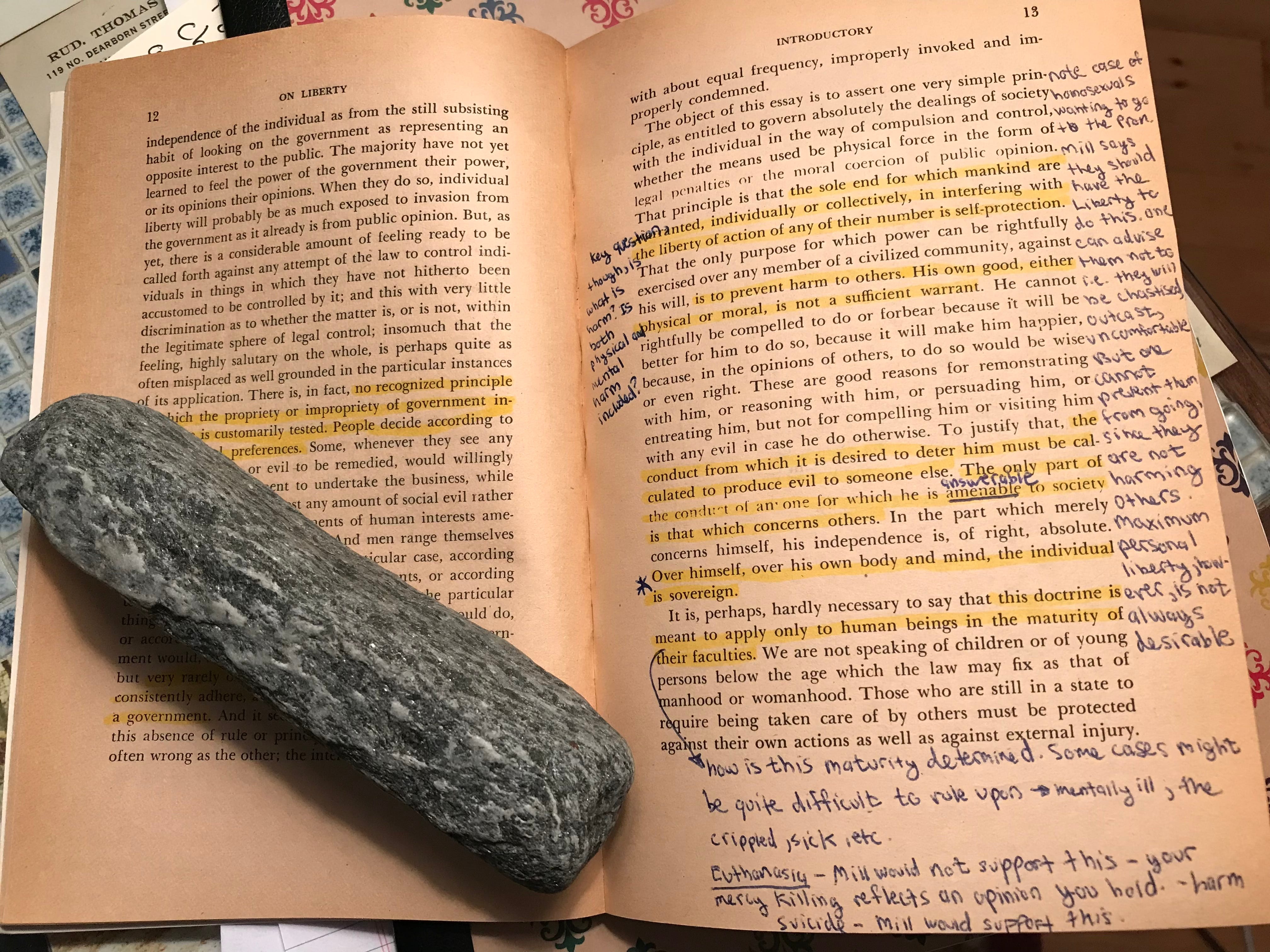
One book I didn’t trade in was a slim volume: John Stuart Mill’s “On Liberty.” It cost me the princely sum of $5.75 in 1983, and I read it for a course in political philosophy. The theme of liberty seemed timeless to me, always pertinent and worth pondering, so I kept the book.
Yesterday, I was shifting some books around and spied my copy among my small collection on philosophy. I opened it and came across a long passage I wrote in the margins back when I first read it in college in 1983. This “marginalia” struck me as a somewhat interesting window into America in 1983 and what I was thinking about as I tried to apply Mill’s insights to American culture.
My college copy of Mill’s “On Liberty” with my marginalia
My marginal comment came as Mill discussed liberty and when people are warranted “in interfering with the liberty of action of any of their number.” Self-protection, Mill wrote, was the only purpose sufficiently compelling here to exercise power to abridge liberty. Preventing harm. It’s insufficient and wrong, Mill added, to act to abridge someone’s liberty because you think it would be better for them, wiser for them, as well as being better for society at large. If the person isn’t harming others, if their actions aren’t “calculated to produce evil to someone else,” those actions shouldn’t be interfered with.
Now, here’s the example that popped into my head back in 1983, which I wrote in the margin:
Note [the] case of homosexuals wanting to go to the prom. Mill says they should have the liberty to do this. One can advise them not to [go], i.e. they will be chastised, outcast, uncomfortable. But one cannot prevent them from going, since they are not harming others.
Back in 1983, before LGBTQ+, in the era of the Reagan revolution in which real men didn’t eat quiche, the idea of homosexuals taking same-sex (or non-binary) dates to the high school prom was more than controversial. It must have been “in the news” for that example to have popped into my head.
It’s interesting how times have changed in forty years. Personal liberty for the LGBTQ+ communities is, I think, far less restricted by the “tyranny of the majority” than it used to be. We have Pride month, Pride celebrations, rainbow flags, and the like. I assume it’s now unremarkable when LGBTQ+ members attend proms with same-sex (or non-binary) dates. And that reflects greater diversity and tolerance within our society along with more liberty, which John Stuart Mill would applaud.
Mill’s message is a good one. We should strive as a society and culture to maximize personal liberty. We should be very careful indeed in exercising power to abridge liberty, especially in the cause of “helping” the other person. As Mill writes, quite powerfully, “Over himself, over his own body and mind, the individual is sovereign.”
Which, to put it in non-gendered language: Over themselves, over their own bodies and minds, individuals are sovereign.
Sometimes, old college textbooks are worth keeping around.
Readers, is there an old high school or college textbook you’ve never parted with, and why?
When I was in the U.S. military, I learned a saying (often wrongly attributed to the Greek philosopher Plato) that only the dead have seen the end of war. Its persistence through history to this very moment should indeed be sobering. What would it take for us humans to stop killing each other with such vigor and in such numbers?
Song lyrics tell me to be proud to be an American, yet war and profligate preparations for more of the same are omnipresent here. My government spends more on its military than the next 10 countries combined (and most of them are allies). In this century, our leaders have twice warned of an “axis of evil” intent on harming us, whether the fantasy troika of Iraq, Iran, and North Korea cited by President George W. Bush early in 2002 or a new one — China, Russia, and North Korea — in the Indo-Pacific today. Predictably given that sort of threat inflation, this country is now closing in on a trillion dollars a year in “defense spending,” or close to two-thirds of federal discretionary spending, in the name of having a military machine capable of defeating “evil” troikas (as well as combatting global terrorism). A significant part of that huge sum is reserved for producing a new generation of nuclear weapons that will be quite capable of destroying this planet with missiles and warheads to spare.
My country, to be blunt, has long been addicted to war, killing, violence, and massive preparations for more of the same. We need an intervention. We need to confront our addiction. Yet when it comes to war and preparations for future conflicts, our leaders aren’t even close to hitting rock bottom. They remain in remarkable denial and see no reason to change their ways.
To cite two recent examples: Just before Easter weekend this year, President Biden swore he was personally devastated by Palestinian suffering in Gaza. At the same time, his administration insisted that a United Nations Security Council resolution for a ceasefire in Gaza that it allowed to pass was “non-binding” and, perhaps to make that very point, reportedly shipped 1,800 MK84 2,000-pound bombs and 500 MK82 500-pound bombs off to Israel, assumedly to be used in — yes! — Gaza.
The Biden administration refuses to see the slightest contradiction in such a stance. Men like Joe Biden and his chief diplomat Antony Blinken confess to being disturbed, even shocked, by the devastation our bombs deliver. Who knew Israel would use them to kill or wound more than 100,000 Palestinians? Who knew that they’d reduce significant parts of Gaza to rubble? Who knew that a blank check of support for Israel would enable that country to — it’s hard not to use the phrase — offer a final solution to the Gaza question?
Not to be outdone by the Democrats, Republican Congressman Tim Walberg of Michigan recently cited the examples of Hiroshima and Nagasaki in seeking a “quick” end to the conflict in Gaza (before walking his comments back somewhat). For him, Israel remains America’s greatest ally, whatever its actions, even as he argues that Palestinians in Gaza merit no humanitarian aid from the United States whatsoever.
With that horrifying spectacle — and given the TV news and social media, it truly has been a spectacle! — of genocide in Gaza, America’s leaders have embraced the very worst of Machiavelli, preferring to be feared rather than loved, while putting power first and principle last. Former National Security Adviser and Secretary of State Henry Kissinger, recently deceased, rightly vilified for pursuing a Bismarckian Realpolitik, and deeply involved in the devastation of Vietnam, Cambodia, and Laos, might even have blanched at the full-throttled support for war (and weapons sales) now being pursued by this country’s leaders. Dividing the world into armed camps based on fear seems basic to our foreign policy, a reality now echoed in domestic politics as well, as the Democratic blue team and the MAGA Republican red team attack each other as “fascistic” or worse. In this all-American world of ours, all is conflict, all is war.
When asked about such an addiction to war, your average government official will likely claim it’s not our fault. “Freedom isn’t free,” so the bumper sticker says, meaning in practice that this country stands prepared to kill others without mercy to ensure its “way of life,” which also in practice means unbridled consumption by an ever-shrinking portion of Americans and unapologetic profiteering by the richest and greediest of us. Call it the “moderate” bipartisan consensus within the Washington Beltway. Only an “extremist” would dare call for restraint, tolerance, diplomacy, and peace.
A Common Cause to Unify Humanity
Short of an attack on Earth by aliens, it’s hard to imagine the U.S. today making common cause with “enemies” like China, Iran, North Korea, or Russia. What gives? Isn’t there a better way and, if so, how would we get there?
In fact, there is a common foe — or perhaps a common cause — that should unite us all as humans. That cause is Earth, the health of our planet and all the life forms on it. And that foe, to state the obvious (even if it regularly goes unsaid), is war, which is unhealthy in the extreme not just for us but for our planet, too.
War turns people into killers — of our fellow humans, of course, but also of all forms of life within our (often very large) blast radii. In addition, war is a mass distraction from what should truly matter to us: the sacredness of life and the continued viability of our planet and its ecology. Call it a cliché but there’s no way to deny it: there is indeed only one Spaceship Earth. As far as we know now, our planet is the sole body in the universe teeming with life. Of course, the universe is incomprehensibly vast and there could well be other forms of life out there, but we don’t know that, not with certainty anyway.
Imagine, in a dystopic future, America’s “best and brightest” (or the “best and brightest” of another country) acting in a nuclear fury, employing the very weaponry that continues to proliferate but hasn’t been used since the destruction of two Japanese cities on August 6 and 9, 1945, and so crippling Spaceship Earth. Imagine also that our planet is truly the universe’s one magnificent and magical spot of life. Wouldn’t it be hard then to imagine a worse crime, not just against humanity, but life itself cosmically? There would be no recompense, no forgiveness, no redemption — and possibly no recovery either.
Of course, I don’t know if God (or gods) exists. Though I was raised a Catholic, I find myself essentially an agnostic today. Yet I do believe in the sacredness of life in all its diversity. And as tenacious as life may be, given our constant pursuit of war, I fear the worst.
Earthrise from the Apollo 8 mission
If you’re of a certain age, you may recall when the astronauts on Apollo 8 witnessed earthrise as their spaceship orbited the moon in 1968. The crew read from Genesis, though in truth it could have been from any creation story we humans have ever imagined to account for how we and our world came to be. Specific religions or creeds didn’t truly matter at that moment, nor should they now. What mattered was the sense of awe we felt as we first viewed the Earth from space in its full glory but also all its fragility.
For make no mistake, this planet is fragile. Its ecosystems can be destroyed. Not for nothing did the inventor of the atomic bomb, J. Robert Oppenheimer, turn to the Hindu scriptures to intone, “Now I am become death, the destroyer of worlds,” when he saw the first atomic device explode and expand into a mushroom cloud during the Trinity test in New Mexico in July 1945.
In the febrile postwar climate of anti-communism that would all too soon follow, America’s leaders would decide that atomic bombs weren’t faintly destructive enough. What they needed were thermonuclear bombs, 1,000 times more destructive, to fight World War III against the “big fat commie rat.” Now nine (9!) nations have nuclear weapons, with more undoubtedly hankering to join the club. So how long before mushroom clouds soar toward the stratosphere again? How long before we experience some version of planetary ecocide via a nuclear exchange and the nuclear winter that could follow it?
Genocide and Ecocide on a Planetary Scale
The genocide happening in Gaza today may foreshadow one possible future for this planet. The world’s lone superpower, its self-styled beacon of freedom, now dismisses U.N. Security Council resolutions to stop the killing as “non-binding.” Meanwhile, Israel, whose founding was a response to a Holocaust inflicted during World War II and whose people collectively said Never Again, is now killing, starving, and displacing hundreds of thousands of Palestinians in the name of righteous vengeance for Hamas’s October 7th attack.
If the U.S. and Israel can spin mass murder in Palestine as not just defensible, but even positive (“defeating Hamas terrorists”), what hope do we have as a species? Is this the future we have to look forward to, an endless echoing of our murderous past?
I refuse to believe it. It truly should be possible to imagine and work toward something better. Yet, in all honesty, it’s hard to imagine new paths being blazed by such fossilized thinkers as Joe Biden and Donald Trump.
“Don’t trust anyone over thirty” was a telling catchphrase of the 1960s. Now, we’re being told as Americans that we’ll have to place our trust in one of two men almost at or exceeding 80 years of age. Entrusting and empowering political dinosaurs, however, represents an almost surefire path toward future extinction-level events.
Let me turn instead to a 25-year-old who did imagine a better future, even as he protested in the most extreme way imaginable the genocide in Gaza. This February, fellow airman Aaron Bushnell lit himself on fire outside the Israeli embassy in Washington, D.C. He sacrificed his life in a most public way to challenge us to do something, anything, to stop genocide. America’s “leaders” answered him by ignoring his sacrifice and sending more bombs, thousands of them, to Israel.
Aaron Bushnell did, however, imagine a better world. As he explained last year in a private post:
“I’ve realized that a lot of the difference between me and my less radical friends is that they are less capable of imagining a better world than I am. I follow YouTubers like Andrewism that fill my head with concrete images of free, post-scarcity communities and it makes me so much more prepared to reject things about the current world, because I’ve imagined how things could be and that helps me see how extremely bullshit things are right now.
“What I’m trying to say is, it’s so important to imagine a better world. Let your thoughts run wild with idealistic dreams of what the world should look like and let the pain and anger at how it’s not that way flow through you. Let it free your mind and fuel your rage against the machine.
“It’s not too late for you or anyone. We can have the world of our dreams tomorrow, but we have to be willing to fight today.”
His all-too-public suicide was a fiery cry of despair, but also a plea for a better future, one free of mass murder.
Earlier this week, millions of people across America witnessed a total eclipse of the sun. It’s awe-inspiring, even a bit alarming, to see the sun disappear in the middle of the day. Those watching took comfort in knowing that it would reappear from behind the moon in a matter of seconds or minutes and so gloried in that fleeting moment of preternatural darkness.
But imagine if the moon and sun were somehow to become permanently stuck in place. Imagine that darkness was our future — our only future. Sadly enough, however, it’s not the moon but we humans who can potentially cast the Earth into lasting darkness. Via the nuclear winter that could result from a nuclear conflict on this planet, we could indeed cast a shadow between the sun and life itself, a power of destruction that, tragically, may far exceed our current level of wisdom.
We know from history that it’s far easier to destroy than to create, far easier to kill than to preserve. Yet when countries make genocide or ecocide (from nuclear winter) possible and defensible (as a sign of uncompromising “toughness” and perhaps the defense of “freedom”), you know that their leaders are, in some sense, morally obtuse monsters. And who or what are we if we choose to follow such monsters?
As human populations rise, as vital resources like water, food, and fuel shrink, as this planet grows ever hotter thanks to our intervention and our excesses, we’ll need to cooperate more than ever to ensure our mutual survival. Far too often, however, America’s strategic thinkers dismiss cooperation through diplomacy or otherwise as naïve, unreliable, and impractical. “Competition” through zero-sum games, war, or other hyperviolent urges seems so much more “reasonable,” so much more “human.”
To the victor goes the spoils, so it’s said. But a planet despoiled by thermonuclear war, cast into darkness, ravaged by radiation, disease, and death, would, of course, offer no victory to anyone. Unless we put our efforts into ending war, rather than continuing to war on one another, such conflicts will, sooner or later, undoubtedly put an end to us.
In reality, our worst enemy isn’t some “axis” or other combination of imagined foes from without, it’s within. We remain the world’s most dangerous species, the one capable of wiping out most or all of the rest, not to speak of ourselves, with our folly. So, as Aaron Bushnell wrote, free your mind. Collectively, there must be a better way for all creatures, great and small, on this fragile spaceship of ours.
This morning, an article on Diana Rigg caught my eye. I loved her in “The Avengers,” which I watched in reruns in the 1970s. She was sexy, smart, vivacious, and tough, and I saw where Vanessa Redgrave said that Rigg was ahead of her time, that she was sexy and smart when women as actors were supposed to be either/or, not both.
Rigg as Emma Peel in “The Avengers,” 1968
This snippet caught my eye: “I spoke out when I was doing the Avengers and learned I was earning less than the cameraman. I was called ‘money grabbing.’”
Rigg was an absolute star of that show, yet she earned less than a crew member. While the cameraman probably deserved a raise, Rigg deserved to be paid what her male costar, Patrick Macnee, earned. She was as good as gold and better.
The article on Rigg references her painful battle with cancer and how she wished to die with dignity. Death with dignity is something I fully support. I see no reason why people should suffer and die in agony when drugs are available to prevent this. But of course the idea of assisted suicide raises all kinds of ethical and legal questions. And our inhibitions about talking about death and dying contribute to a status quo in which people are expected to “rage against the dying of the light,” no matter how much pain they’re in and no matter how fruitless the raging.
Diana Rigg with costar Patrick Macnee in “The Avengers”
Diana Rigg was a fighter. She wasn’t afraid to speak out for what she believed in. I hope her example inspires others to fight for equity and for dignity in all aspects of life, even death.
Too many Church positions trouble me, as does the awful legacy of sexual abuse
I was raised Catholic and attended church well into my twenties until I began to lose interest in the ritual and repetition. Still, I did my master’s thesis on American Catholic responses to evolution, polygenism, and geology in the 19th century, a version of which was published when I was in my early thirties. To this day, I continue to read the New Testament and am still inspired by the teachings of Jesus Christ. As a popular ad campaign puts it, He (Jesus Christ) gets us. Or at least he gets me, or I get him.
Yet I am seriously out of step with today’s Catholic church. I believe priests should be able to marry if they so choose. I believe women who have a calling should be ordained as priests. I believe the Church’s position on abortion is absolutist and wrong. More than anything, I believe the Church is too concerned with itself and its own survival and therefore is alienated from the true spirit of Christ, a spirit of compassion and love.
Yes, I still have a rosary
Scandals involving the Church contributed to my loss of commitment to the Church and especially its patriarchal hierarchy, which was so intimately involved in the coverups of crimes committed against innocents. The betrayal struck close to home. In my hometown, the Church assigned a known predatory priest. His name was Robert F. Daly. He abused minors and was eventually defrocked by the Church, but far too late and more than thirty years after his abusive behavior.
Fortunately, I was never abused. I had a scheduled meeting with him, alone, when I was about fifteen, but fortunately it was cancelled at the last minute. So many other children and teens were not so fortunate. To be blunt, I remain thoroughly disgusted by the moral cowardice exhibited by the Church in confronting fully its painful legacy of failing to protect vulnerable children against predatory priests. Shame on the Church.
The Bible says that all sins may be forgiven except those against the Holy Spirit. This is supposed to refer to a stubborn form of blasphemy. Yet I truly can’t think of a worse sin committed by the Church than to allow innocent children to suffer at the hands of predators disguised as “fathers.”
I have written to the Church and have heard from prominent leaders that the Church takes these crimes seriously and can now police itself in the matter of predatory priests. I’m sure these officials are sincere, but the idea of a self-policing church is a self-serving one.
As I wrote to one Catholic bishop, who assured me the Church now “gets it”:
Skeptics would reply that it took a huge scandal with major financial implications to force the Church to do the right thing.
For too long, the Church tolerated these crimes. The Church is hardly unique here. Think of sexual assaults within the military (notably during basic training), or think of the Sandusky scandal at Penn State, where Joe Paterno clearly knew of (some) of Sandusky’s abuse yet chose not to take adequate action. (I was at Penn College when that scandal broke.)
The challenge, as you know, is that the Church is supposed to be a role model, an exemplar of virtue. Priests hold a special place of trust within communities and are therefore held in especially high regard.
As my brother-in-law, who’s now 76, explained to me, if a young boy or girl accused a priest of assault in the 1950s or 1960s, few if any people would have believed them. Indeed, the youngster was likely to be slapped by a parent for defaming a priest. That moral authority, that respect, was earned by so many priests who had done the right thing, set the right example. It was ruined by a minority of priests who became predators and a Church hierarchy that largely looked the other way, swept it under the rug, or otherwise failed to act quickly and decisively.
As you say, the Church has learned. It is now better at policing itself. The shame of it all is that it took so much suffering by innocents, and the revelations of the same and the moral outrage that followed, to get the Church to change.
I’m encouraged by the example set by Pope Francis and especially his commitment to peace, but I don’t believe I will ever be a practicing Catholic again. Too many church policies still trouble me, as does the awful legacy of the sexual abuse scandal.
One of the sayings my dad taught me was “don’t get too big for your britches.” It’s sound advice. Too many people are too quick to try to punch above their weight, to push and boast and to try to take charge when they shouldn’t. It’s a lesson my friends and I used to quote from the movie “Magnum Force,” where Inspector Harry Callahan, played to perfection by Clint Eastwood, reminds those around him that “a man’s got to know his limitations.”
You’re in the CCC now. My dad is on the far left, seated in front.
Recently, I was reading my father’s journal that recounts his days in the CCC, or Civilian Conservation Corps, during the 1930s at the height of the Great Depression. My father had ringside seats to a boxing match that didn’t end well for a fighter who most definitely didn’t know his limitations and got too big for his britches. But I’ll let my dad recount the story:
James Strollo was a misfit and a welterweight boxer on our team. About 5’6” tall, he was a “no mercy” fighter. A tall Irish boy who was a lightweight sparred with him but later refused to box with him. Jimmy would try to knock out anyone he trained with. But a bantamweight boxer, Jimmy Souza who fought professionally was a good friend of Jimmy Strollo—about the only feller he wouldn’t try to hurt while sparring.
Well, Al Gelinas was a pro boxer from Holyoke, Mass., who agreed to help our CCC boxing team. He was a ranking welterweight and a real nice guy. He agreed to fight an exhibition match with Jimmy Strollo. The show was put on for all the CCC camp members.
The bell rang for the first and only round of the Gelinas/Strollo fight. I was standing next to the ring and had a good view of the match. Well, Strollo made a big mistake. Instead of just boxing and putting on a good show, he started to pressure Al and tried to knock him out. Well, two left jabs, a left hook, and a beautiful straight right and Strollo was K.O. right in front of me. What a sight. Strollo went glassy eye from the punches and collapsed on the canvas. All the fight was taken out of him. Nobody blamed Al Gelinas for the K.O. of Strollo. I hope Strollo learnt a lesson.
Willie, most fighters are the nicest people you can meet.
Be careful picking your fights — and be very careful fighting against someone more skilled than you. Push too hard and you’re likely to be knocked on your britches.
It was only a few years ago that I learned I’m a “cis white male.” As such, I guess I’m a dime a dozen. Ordinary. Not representative of “diversity.”
I get it. I’m a historian so I know something about how various peoples have suffered extreme, even murderous, prejudice and exploitation over time. I’ve taught about slavery, the Holocaust, and various forms of discrimination against women and minorities, among other groups and peoples. The list goes on and on. The recent shootings in Colorado Springs where the LGBTQ community was targeted reminds us that too many people see diversity as a threat.
If only we could see ourselves just as human beings in all the richness that term describes. We are all part of the human community. We contain multitudes, as Walt Whitman said.
These people aren’t diverse. Where are the unhappy people? Seriously, this stock image is supposed to represent diversity, but I don’t see any blue-collar workers. Where’s the cleaning crew? Is everyone in this company lean and fit? Too often, even “diversity” images lack diversity.
Nevertheless, I understand how various people and organizations want to exhibit diversity by hiring or showcasing more women, or more Blacks, or more members of the LGBTQ community, and so on. It seems as if guys like me have ruled the world (or we act as if we have) for so long that we need to be taken down a peg or two. Or three.
What happens, sadly, is that in some cases what we get is what my wife likes to term “optical” diversity. Think about the U.S. government. You get a Black female (think Condi Rice) in a position of power, but she basically thinks and acts the same as a cis white male neo-conservative. You get a Black male (think Lloyd Austin) in a position of power, but he’s basically a card-carrying member of the military-industrial complex. You get “Mayor” Pete Buttigieg in a position of power, but he’s just another government technocrat spouting bromides in the pursuit of power.
Optical diversity shouldn’t be the main goal. What we’re striving for, or should be striving for, is diversity of perspectives, of life experiences, along with an openness to new ideas and viewpoints. A willingness to listen, to learn, to come together based on mutual respect, a shared commitment to work toward justice.
What about me? Am I just another aging cis white male? Just another out-of-touch white guy? Okay, Boomer!
I hope not. I was taught by my parents not to judge a book by its cover. So how do I represent diversity? If you were looking for “diversity,” would I fit the bill (no pun intended)? Here are ten reasons why I might be a “diverse” human:
I’m politically independent. In my life I’ve voted Republican, Democrat, and Green. I’m generally “progressive,” though I find labels reductive.
I’m a military veteran who’s written a lot of articles that are highly critical of the U.S. military.
I’m from a blue-collar family and I’m the first in my family to finish college.
I was educated as a mechanical engineer before I turned to history, where I specialized in the history of science, technology, and religion.
Speaking of religion, I was raised Catholic but now consider myself to be agnostic. I did my master’s thesis on Catholics and science; for my doctorate, I turned to evangelicals and science. I have a keen interest in both science and religion, respecting both of them as ways of knowing, ways of making sense of the world and ourselves.
I love the outdoors and consider myself to be pro-environment. So, for example, I am against fracking because of its demonstrable harm to our planet.
I lived and studied overseas in England for three years and have traveled to Italy, Germany, Scotland, and Wales. I gained a new perspective on America by being away from it.
I’m an introvert. (Do you want your team or organization to be all extroverts?)
I’m a science fiction fan. My favorite character on “Star Trek” is Mr. Spock. Yes, I can be a bit of a geek.
I like sports. Being from New England, I’m a fan of the Red Sox, Patriots, etc. I probably spend too much time watching “my” teams compete. My wife and I broke out bottles of champagne to celebrate the Red Sox winning the World Series.
Here’s my real point: All of you, everyone reading this, could make a similar list to showcase your (and our) diversity. In fact, if you’re reading this and would like to comment and share, please put a couple of things below that mark you as a “diverse” person. Because we all contain multitudes. Thanks so much.










 Bracing Views