Monument to Elihu Burritt in New Marlboro, Mass. (author’s photo)The Plaque in Honor of Burritt (author’s photo)
Being Catholic, I’m a big fan of the Sermon on the Mount and Christ’s teaching that “blessed are the peacemakers.” Yet in American history it seems that “forgotten are the peacemakers” would be a more accurate lesson. We’re much more likely to remember “great” generals, even vainglorious ones like George S. Patton or Douglas MacArthur, than to recognize those who’ve fought hard against long odds for peace.
Elihu Burritt was one such peacemaker. Known in his day as “The Learned Blacksmith,” Burritt fought for peace and against slavery in the decades before the Civil War in the United States. He rose from humble roots to international significance, presiding over The League of Universal Brotherhood in the 1840s and 1850s while authoring many books on humanitarian subjects.
Interestingly, peacemakers like Burritt were often motivated by evangelical Christianity. They saw murder as a sin and murderous warfare as an especially grievous manifestation of man’s sinfulness. Many evangelicals of his day were also inspired by their religious beliefs to oppose slavery as a vile and reprehensible practice.
Christian peacemakers like Burritt may not have had much success, but they deserve to be remembered and honored as much as our nation’s most accomplished generals. That we neglect to honor men and women like Burritt says much about America’s character.
For if we truly are a peace-loving people, why do we fail to honor our most accomplished advocates for peace?
US Postage issue, 1894, $2 (Photo credit: Wikipedia)
Today’s title is from James Madison, architect of our Constitution. Madison famously wrote against the perils of forever war. In other words, he wrote about the perils we face today in our ongoing, seemingly unending, war on terror.
Here is what Madison warned us about:
Of all the enemies of true liberty, war is, perhaps, the most to be dreaded, because it comprises and develops the germ of every other. War is the parent of armies; from these proceed debt and taxes; and armies, and debts, and taxes are the known instruments for bringing the many under the domination of the few. In war, too, the discretionary power of the Executive is extended; its influence in dealing out offices, honors and emoluments is multiplied; and all the means of seducing the minds, are added to those of subduing the force, of the people. The same malignant aspect in republicanism may be traced in the inequality of fortunes, and the opportunities of fraud, growing out of a state of war, and in the degeneracy of manner and of morals, engendered in both. No nation can preserve its freedom in the midst of continual warfare …
Strong words — and words to ponder as we continue to maintain an enormous defense and homeland security complex with bases and commitments around the world.
How, indeed, do you maintain personal liberties and individual freedoms in a garrison state? The short answer: you can’t. Just read Madison.
It’s impossible for Washington to think outside of the Pentagonal Box
Andrew Bacevich, a retired U.S. Army colonel and professor of international relations, writing in January 2009 as Barack Obama took office as president, made the following cogent observation about the need for true “change” in Washington:
When it comes to national security, the standard navigational charts used to guide the ship of state are obsolete. The assumptions, doctrines, habits, and routines falling under the rubric of “national security policy” have outlived their usefulness. The antidote to the disappointments and failures of the Bush years, illustrated most vividly in the never-ending wars in Iraq and Afghanistan, is not to try harder, but to think differently. Only then will it become possible to avoid the patently self-destructive behavior that today finds Americans facing the prospect of perpetual conflict that neither our army nor our economy can sustain.
Of course, Obama promised “change,” but with respect to national security policy, the sum total of the last five years of his watch has simply been more of the same.
Admittedly, the war in Iraq finally ended (for U.S. troops, not for the Iraqi people), but that was only because the Iraqis themselves refused to countenance the eternal presence of our troops there (of course, our boondoggle of an embassy in Baghdad survives). Obama didn’t get us out of Iraq; he acquiesced to a deal Bush had already struck with the Iraqis.
Meanwhile, the U.S. remains ensnared in Afghanistan, squandering lives and resources to the tune of $100 billion a year. Vague promises are made of an American withdrawal in 2014, but with an “enduring presence” (God help us) for another ten years after that. Under Obama, drone strikes have expanded and continue; the national security state remains fat as it ever was, garrisoning the globe and spying on the world (including, as we recently learned, American citizens); and various tough-talking “experts” in Congress continue to call for new military interventions in places like Iran and Syria.
Why has this happened? One reason is that Obama and his team wanted to be reelected in 2012, so they embraced the Bush neo-conservative approach of a hyper-kinetic, interventionist, foreign policy. Fresh thinking was nowhere to be found, since any downsizing of American military commitments or its national security apparatus would have exposed Obama to charges of being “soft” on (Muslim) terror.
With respect to a bloated national security apparatus and wasteful military interventions, change didn’t come in 2008. It was a case, as The Who song says, of “Meet the new boss. Same as the old boss.” Nor is change coming, seemingly, in the future. Americans remain wedded to a colossal national security state that neither the president nor the Congress appears willing to challenge, let alone change.
Fresh thinking is the one thing you can’t buy in Washington because it’s priceless. And for the lack of it, we’re paying a very high price indeed.
Next Article: Some fresh thinking on where we should be headed.
Confederate dead at Antietam, 1862, photo by Alexander Gardner (National Park Service)
In our media and our culture today, there’s an unfortunate tendency to see military service as uniquely efficacious and ennobling, and to see war as necessary and even to view it as antiseptic (notably our so-called “surgical” drone strikes).
But real war is dirty. It’s as likely to infect us, to spread sepsis through our bodies and souls, as it is to ennoble us by calling forth sacrifice.
This dark reality is captured in this quotation by the cultural critic Louis Menand:
War is specially terrible not because it destroys human beings, who can be destroyed in plenty of other ways, but because it turns human beings into destroyers.
Think here of Staff Sergeant Robert Bales in Afghanistan, who plead guilty to the premeditated murder of sixteen Afghan civilians. Think here of the atrocities committed by American troops in Vietnam, harrowingly documented in Nick Turse’s recent book, Kill Anything that Moves: The Real American War in Vietnam (2013).
The point is not to condemn American troops, who generally serve honorably under challenging, even horrendous, conditions. The point is to condemn war.
War warps. War corrupts. War murders. It warps men’s souls, corrupts their morals, murders their innocence.
Just posted a new article to Huffington Post. Here’s the link and the article (pasted below):
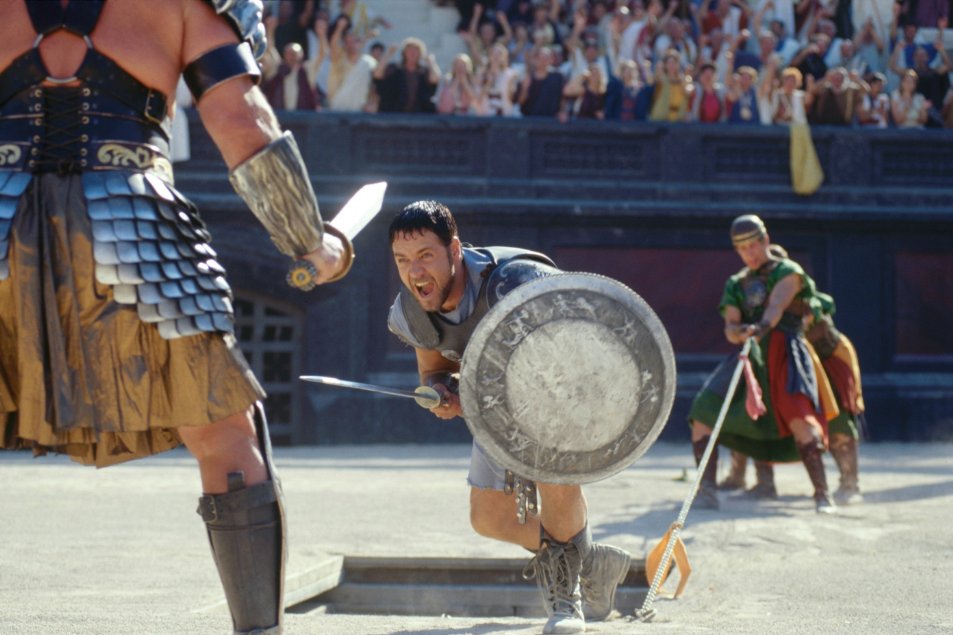
The expression “bread and circuses” captures a certain cynical political view that the masses can be kept happy with fast food (think Cartman’s “Cheesy Poofs” on South Park) and faster entertainment (NASCAR races, NFL games, and the like). In the Roman Empire, it was bread and chariot races and gladiatorial games that filled the belly and distracted the mind, allowing emperors to rule as they saw fit.
There’s truth to the view that people can be kept tractable as long as you fill their bellies and give them violent spectacles to fill their free time. Heck, Americans are meekly compliant even when their government invades their privacy and spies upon them. But there’s a deeper, more ominous, sense to bread and circuses that is rarely mentioned in American discourse. It was pointed out to me by Amy Scanlon.
In her words:
Basically ancient Rome was a society that completely revolved around war, and where compassion was considered a vice rather than a virtue… [The] Romans saw gladiatorial contests not as a form of decadence but as a cure for decadence. And decadence to the Romans had little to do with sexual behavior or lack of a decent work ethic, but a lack of military-style honor and soldierly virtues. To a Roman compassion was a detestable vice, which was considered both decadent and feminine. Watching people and animals slaughtered brutally [in the arena] was seen as a way to keep the civilian population from this ‘weakness’ because they didn’t see combat…
Scanlon then provocatively asks, “Could our society be sliding towards those Roman attitudes in a bizarre sort of way?”
I often think that America suffers from an empathy gap. We are simply not encouraged to put ourselves in the place of others. For example, how many Americans fancy the idea of a foreign power operating drones in our sovereign skies, launching missiles at gun-toting Americans suspected by this foreign power of being “militants“? Yet we operate drones in places like Afghanistan, Pakistan, and Yemen, killing suspected militants with total impunity. Even when innocent women and children are killed, our emperors and our media don’t encourage us to have compassion for them. We are basically told to think of them as collateral damage, regrettable, perhaps, but otherwise inconsequential.
Certainly, our military in the last two decades has put new stress on American troops as “warriors” and “warfighters,” a view more consistent with the hardened professionals of the Roman Empire than with the citizen-soldiers of the Roman Republic. Without thinking too much about it, we’ve come to see our troops as an imperial guard, ever active on the ramparts of our empire. War, meanwhile, is seen not as a last course of defense but as a first course to preempt the evil designs of the many hidden enemies of America. Our troops, therefore, are our protectors, our heroes, the defenders of America, even though that “defense” treats the entire globe as a potential killing field.
Scanlon’s view of the Roman use of bread and circuses — as a way to kill compassion to ensure the brutalization of Roman civilians and thus their compliance (or at least their complacency) vis-à-vis Imperial expansion and domestic policing — is powerful and sobering.
At the same time, the Obama administration is increasingly couching violent military intervention in humanitarian terms. Deploying troops and tipping wars in our favor is done in the name of defeating petty tyrants (e.g. Khadafy in Libya; Is Assad of Syria next?). Think of it as our latest expression of “compassion.”
All things considered, perhaps our new national motto should be: When in America, do as the Roman Empire would do. Eat to your fill of food and violence, cheer on the warfighters, and dismiss expressions of doubt or dismay about military interventions and drone killings as “feminine” and “weak.”
At least we can applaud ourselves that we no longer torture and kill animals in the arena like the Romans did. See how civilized we’ve become?
A recent article at NBC News is unusual in that it highlights the awfulness of war even when the killing is “surgical” and done by drones. Brandon Bryant, a former drone operator for the Air Force, suffers from PTSD and feels that killing by drone caused him to lose respect for life, that he became like a sociopath. Especially upsetting to Bryant was when his commander gave him a “diploma” (most likely an award citation) that stated he had contributed to the deaths of 1,626 people.
Drone strikes are basically extra-judicial death sentences from the sky. For Americans, they seem unproblematic because we’re not exposed to them and because our government tells us only “militants” and evil-doers are being killed.
But the temptations of drone warfare are considerable, as I wrote in an article for Truthout in August 2012. Here’s what I said back then:
What happens when we decouple war’s terrible nature from its intoxicating force? What happens when one side can kill with impunity in complete safety? General Robert E. Lee’s words suggest that a nation that decouples war from its terrors will likely grow too fond of it. The temptation to use deadly force will no longer be restrained by knowledge of the horrors unleashed by the same.
Such thoughts darken the reality of America’s growing fondness for drone warfare. Ourland-based drone pilots patrol the skies of foreign lands like Afghanistan in complete safety. They unleash appropriately named Hellfire missiles to smite our enemies. The pilots see a video feed of the carnage they inflict; the American people see and experience nothing. In rare cases when ordinary Americans see drone footage on television, what they witness is something akin to a “Call of Duty” video game combined with a snuff film. War porn, if you will.
Many Americans seem happy that we can smite foreign “militants” at no risk to ourselves. They trust that our military (and the CIA) rarely misidentifies a terrorist, and that “collateral damage,” that mind-numbing euphemism that obscures the reality of innocent men, women, and children obliterated by missiles, is the regrettable price of keeping America safe.
But the reality is that sloppy intelligence and the fog and friction of war combine to make seemingly antiseptic drone warfare much like all other forms of war: bloody, wasteful, and terrible. Terrible, that is, for those on the receiving end of American firepower. Not terrible for us.
There is a real danger that today’s drone warfare has become the equivalent to the Dark Side of the Force as described by Yoda in The Empire Strikes Back: a quicker, easier, more seductive form of terror. It is indeed seductive to deploy the technological equivalent of Darth Vader’s throat-constricting powers at a safe distance. We may even applaud ourselves for our prowess while doing so. We tell ourselves that we are killing only the bad people, and that the few innocents caught in the crosshairs constitute an accidental but nonetheless unavoidable price of keeping America safe.
The business of wars and weapons sales is booming, with the United States leading the pack as the world’s foremost “merchant of death,” as Michael Klare notes in this article on the global arms trade for TomDispatch.com.
But why should we be surprised? War has always been a racket. And if you don’t believe me that forever war is forever profitable – for some, I recommend that you read War Is A Racket (1935), a classic polemic written by U.S. Marine Corps General Smedley D. Butler. Twice awarded the Medal of Honor, Major General Butler turned against military adventurism in the 1930s as he saw how his efforts and those of his men were exploited by elites to expand corporate wealth and power, even as they exempted themselves from the hardships and dangers of combat.
Plaque in Philly in Honor of Smedley Butler. Photo by author.
As Butler put it in War Is A Racket:
“How many of the war millionaires shouldered a rifle [during World War I]? How many of them dug a trench? How many of them knew what it meant to go hungry in a rat-infested dug-out? How many of them spent sleepless, frightened nights, ducking shells and shrapnel and machine gun bullets? How many of them parried a bayonet thrust of an enemy? How many of them were wounded or killed in battle?”
Not many. Butler knew who really paid war’s high bills:
“Yes, the soldier pays the greater part of the bill. His family pays too. They pay it in the same heart-break that he does. As he suffers, they suffer. At nights, as he lay in the trenches and watched shrapnel burst about him, they lay home in their beds and tossed sleeplessly … And even now the families of the wounded men and of the mentally broken and those who never were able to readjust themselves are still suffering and still paying.”
And Butler knew how best to put an end to the racket of war. He was blunt – and right:
“We must take the profit out of war.”
“We must permit the youth of the land who would bear arms to decide whether or not there should be war.”
“We must limit our military forces to home defense purposes.”
Tragically, since the end of World War II Butler’s sage advice has been completely ignored. War is more profitable now than ever. We permit our youth to have no say in whether there should be a war. (Congress hasn’t issued a formal declaration of war since 1941.) And today as a country we equate “home defense” with the world’s strongest military, configured for global reach, global power, boasting of “full-spectrum dominance.”
Unless we heed Butler’s advice, debilitating wars will continue. They will continue because perpetual war is simply too profitable. In the racket of war, the chief racketeers are easy to identify. As Butler knew, just follow the money.
Long May It Wave. Photo by the author in Maine, 2006
Heading north from the Beltway via Highway 1 to the centers of US power in Washington, DC you’ll pass through trendy Alexandria, Virginia, before encountering scrappier neighborhoods closer in. But don’t worry, because within just a few miles, the glint of ultra-modern office buildings appears on the horizon. Behold America’s own Emerald City, appropriately named Crystal City, Virginia!
The nameplates on the buildings there reveal powerful governmental (the Federal Bureau of Investigation) and corporate (Boeing, Lockheed Martin, and other major defense contractors) entities. Walking into the lobby of any of these defense industry titans reveals a level of swankiness that would not be out of place in a five-star luxury hotel. Conference rooms outfitted with the very latest technology enfold you in plush comfortable chairs. One can’t help but to conclude that business is going very well here. It’s crystal clear that you’ve arrived among the winners of America’s imperial moment.
A quick detour to the Pentagon, just on the outskirts of Crystal City, confirms that forever war continues to be forever profitable — for some. Just look at the constellations of stars — generals’ and admirals’ stars, that is — in the Pentagon’s corridors of power. Since September 2001, Congressional authorizations of flag-rank, three- and four-star levels “have increased twice as fast as one- and two-star generals,” notes Dina Rasor, citing Congressional testimony from Ben Freeman of the Project on Government Oversight.
Small wonder that governmental and corporate facilities in military-budget-fueled Crystal City shine so brightly. The US military budget was $861 billionin fiscal year 2011, representing 58 percent of the federal discretionary budget. By comparison, federal spending on education usually consumes a paltry four percent of that same budget. And despite the so-called sequester “cuts” to the defense budget, America’s projected yearly defense budgets under President Obama continue to be larger than the projected military spending of the next ten highest-spending nations… combined.
Every gun that is made, every warship launched, every rocket fired signifies, in the final sense, a theft from those who hunger and are not fed, those who are cold and are not clothed. This world in arms is not spending money alone. It is spending the sweat of its laborers, the genius of its scientists, the hopes of its children …. This is not a way of life at all, in any true sense. Under the cloud of threatening war, it is humanity hanging from a cross of iron.
Ike in 1959
Ike, a retired five-star general, was right. We must reverse an ethos in this country that sees cuts in war spending as emasculating. We must embrace the idea of a “peace dividend” that facilitates investment in our citizens and our communities. It sure beats payola to major corporations for their inflated weaponry.
For a nation hooked on warriors and warfighters and weapons, such a change in ethos won’t be easy. But we need to make it. Because if we continue on our present path of blockbuster defense budgets and unending global military commitments, we know who loses – and it’s not the major defense contractors or the Pentagon brass.
Memorial Day reminds us who loses; we visit their graves, mourn their deaths, and vow to end the madness of war.
William J. Astore is a retired lieutenant colonel (USAF) and a regular contributor to TomDispatch.com, Huffington Post, History News Network, and Truthout, among other sites.