Our Enemy, Ourselves

W.J. Astore

In my latest article for TomDispatch.com, I suggest how America can pursue a wiser, more peaceful, course.  This is exactly what our leaders are not doing (and haven’t been doing for decades), as I document in the first half of my article, which I’m sharing here.  Bottom line: perpetual war doesn’t produce perpetual peace.  Nor does it make us safer.

Whether the rationale is the need to wage a war on terror involving 76 countries or renewed preparations for a struggle against peer competitors Russia and China (as Defense Secretary James Mattis suggested recently while introducing America’s new National Defense Strategy), the U.S. military is engaged globally.  A network of 800 military bases spread across 172 countries helps enable its wars and interventions.  By the count of the Pentagon, at the end of the last fiscal year about 291,000 personnel (including reserves and Department of Defense civilians) were deployed in 183 countries worldwide, which is the functional definition of a military uncontained.  Lady Liberty may temporarily close when the U.S. government grinds to a halt, but the country’s foreign military commitments, especially its wars, just keep humming along.

As a student of history, I was warned to avoid the notion of inevitability.  Still, given such data points and others like them, is there anything more predictable in this country’s future than incessant warfare without a true victory in sight?  Indeed, the last clear-cut American victory, the last true “mission accomplished” moment in a war of any significance, came in 1945 with the end of World War II.

Yet the lack of clear victories since then seems to faze no one in Washington.  In this century, presidents have regularly boasted that the U.S. military is the finest fighting force in human history, while no less regularly demanding that the most powerful military in today’s world be “rebuilt” and funded at ever more staggering levels.  Indeed, while on the campaign trail, Donald Trump promised he’d invest so much in the military that it would become “so big and so strong and so great, and it will be so powerful that I don’t think we’re ever going to have to use it.”

As soon as he took office, however, he promptly appointed a set of generals to key positions in his government, stored the mothballs, and went back to war.  Here, then, is a brief rundown of the first year of his presidency in war terms.

In 2017, Afghanistan saw a mini-surge of roughly 4,000 additional U.S. troops (with more to come), a major spike in air strikes, and an onslaught of munitions of all sorts, including MOAB (the mother of all bombs), the never-before-used largest non-nuclear bomb in the U.S. arsenal, as well as precision weapons fired by B-52s against suspected Taliban drug laboratories.  By the Air Force’s own count, 4,361 weapons were “released” in Afghanistan in 2017 compared to 1,337 in 2016.  Despite this commitment of warriors and weapons, the Afghan war remains — according to American commanders putting the best possible light on the situation — “stalemated,” with that country’s capital Kabul currently under siege.

How about Operation Inherent Resolve against the Islamic State?  U.S.-led coalition forces have launched more than 10,000 airstrikes in Iraq and Syria since Donald Trump became president, unleashing 39,577 weapons in 2017. (The figure for 2016 was 30,743.)  The “caliphate” is now gone and ISIS deflated but not defeated, since you can’t extinguish an ideology solely with bombs.  Meanwhile, along the Syrian-Turkish border a new conflict seems to be heating up between American-backed Kurdish forces and NATO ally Turkey.

Yet another strife-riven country, Yemen, witnessed a sixfold increase in U.S. airstrikes against al-Qaeda on the Arabian Peninsula (from 21 in 2016 to more than 131 in 2017).  In Somalia, which has also seen a rise in such strikes against al-Shabaab militants, U.S. forces on the ground have reached numbers not seen since the Black Hawk Down incident of 1993.  In each of these countries, there are yet more ruins, yet more civilian casualties, and yet more displaced people.

Finally, we come to North Korea.  Though no real shots have yet been fired, rhetorical shots by two less-than-stable leaders, “Little Rocket Man” Kim Jong-un and “dotard” Donald Trump, raise the possibility of a regional bloodbath.  Trump, seemingly favoring military solutions to North Korea’s nuclear program even as his administration touts a new generation of more usable nuclear warheads, has been remarkably successful in moving the world’s doomsday clock ever closer to midnight.

Clearly, his “great” and “powerful” military has hardly been standing idly on the sidelines looking “big” and “strong.”  More than ever, in fact, it seems to be lashing out across the Greater Middle East and Africa.  Seventeen years after the 9/11 attacks began the Global War on Terror, all of this represents an eerily familiar attempt by the U.S. military to kill its way to victory, whether against the Taliban, ISIS, or other terrorist organizations.

This kinetic reality should surprise no one.  Once you invest so much in your military — not just financially but also culturally (by continually celebrating it in a fashion which has come to seem like a quasi-faith) — it’s natural to want to put it to use.  This has been true of all recent administrations, Democratic and Republican alike, as reflected in the infamous question Madeleine Albright posed to Chairman of the Joint Chiefs Colin Powell in 1992: “What’s the point of having this superb military you’re always talking about if we can’t use it?”

With the very word “peace” rarely in Washington’s political vocabulary, America’s never-ending version of war seems as inevitable as anything is likely to be in history.  Significant contingents of U.S. troops and contractors remain an enduring presence in Iraq and there are now 2,000 U.S. Special Operations forces and other personnel in Syria for the long haul.  They are ostensibly engaged in training and stability operations.  In Washington, however, the urge for regime change in both Syria and Iran remains strong — in the case of Iran implacably so.  If past is prologue, then considering previous regime-change operations in Afghanistan, Iraq, and Libya, the future looks grim indeed.

Despite the dismal record of the last decade and a half, our civilian leaders continue to insist that this country must have a military not only second to none but globally dominant.  And few here wonder what such a quest for total dominance, the desire for absolute power, could do to this country.  Two centuries ago, however, writing to Thomas Jefferson, John Adams couldn’t have been clearer on the subject.  Power, he said, “must never be trusted without a check.”

The question today for the American people: How is the dominant military power of which U.S. leaders so casually boast to be checked? How is the country’s almost total reliance on the military in foreign affairs to be reined in? How can the plans of the profiteers and arms makers to keep the good times rolling be brought under control?

As a start, consider one of Donald Trump’s favorite generals, Douglas MacArthur, speaking to the Sperry Rand Corporation in 1957:

“Our swollen budgets constantly have been misrepresented to the public. Our government has kept us in a perpetual state of fear — kept us in a continuous stampede of patriotic fervor — with the cry of grave national emergency. Always there has been some terrible evil at home or some monstrous foreign power that was going to gobble us up if we did not blindly rally behind it by furnishing the exorbitant funds demanded. Yet, in retrospect, these disasters seem never to have happened, seem never to have been quite real.”

No peacenik MacArthur.  Other famed generals like Smedley Butler and Dwight D. Eisenhower spoke out with far more vigor against the corruptions of war and the perils to a democracy of an ever more powerful military, though such sentiments are seldom heard in this country today.  Instead, America’s leaders insist that other people judge us by our words, our stated good intentions, not our murderous deeds and their results.

For ten suggestions (plus a bonus) on how the U.S. can pursue a wiser, and far less bellicose, course, please read the rest of my article here at TomDispatch.com. 

America’s Cascading Disaster in Afghanistan

the Oval Offrice ...
A U.S. government promotional photo.  Pamela notes, “Look closely at the expressions on the faces of the Afghans.”

By Pamela

Editor’s Intro: I asked Pamela if I could highlight a recent comment she made at this site about the U.S. military’s approach to Afghanistan.  Not only did she give me her permission: she elaborated on her point in an email.  Pamela, a former aid worker with a decade’s worth of on-the-ground experience in Afghanistan, worked with the Afghan people in relationships characterized by trust and friendship.  Her words should be read by all Americans, especially our foreign policy “experts.” W.J. Astore

Cascading disaster is an apt term for the U.S. military’s strategy in Afghanistan, which involves the indiscriminate killing of terrorist leaders, whether Taliban, Al Qaeda, ISIS or whatever else.

In addition to heavily underreported civilian casualties, U.S. military strikes increase the ferocity of those terrorist outfits. Not just because those outfits want to show the world how strong they are.  There is another element which arguably is even worse, as it is virtually impossible to reverse. Each “neutralized” leader leaves a power void within his organization and a number of usually younger and more ruthless members start fighting among each other to take over — with cruelty and spectacular attacks obviously being stronger “election” arguments than a “softy” willingness and capacity for peaceful dialogue.

Thus in Afghanistan the original Taliban – the ones who were ousted in 2001 – probably could have been convinced to take part in negotiations. They were an unsavory lot to have as a government, with medieval habits, but they were not terrorists like the ones nowadays. Few people know that in 2000 the British charity Christianaid (yes, with such a provocative name) had an office there, run by a female Australian doctor with her husband and little Sam, their six-month-old son. They enjoyed it very much and the Taliban had no objection against a foreign woman providing medical care to women and children, despite the obvious need for careful diplomacy.

Since then, however, there have been so many cascading series of eliminations of Taliban leaders at all levels – all for the purpose of PR spin rather than any coherent strategy – that we now have the umptiest generation, which has lost whatever dignity and humanity their predecessors may have had.

Furthermore, we knew the original Taliban leaders, and they were relatively predictable.  Each new batch needs to be infiltrated, investigated and analyzed from scratch, after which we kill those too. What a waste of energy and knowledge! But President Trump believes that the evident lack of success is caused by too little rather than too much bombing/eliminating, so this vicious cascade can be expected to go on and on until doomsday.

This “destroy the Taliban by assassination” strategy has one more layer: the eroding authority of their original leaders.  By continuously eliminating (often after several failed attempts in which civilians are killed instead) successive leaders at all levels — from village to nation-wide – the U.S. has shattered the Taliban into different splinter factions, each with its own power structure & power struggles.  This has increased pressure and violence at the village level, as people who during the day were already pressured by coalition armies and at night by the Taliban, ended up with several competing “Taliban” factions all pressuring them to join. Some of these factions were foreign, as Afghan friends would tell me, meaning they were from some other part of Afghanistan, not necessarily from a different country, which made it even harder to negotiate with them.  Multiple terrorist factions contributed to anarchy in which common criminality has flourished.

At the same time, as this cascading fracturing continued, successive local “terrorist” leaders became increasingly detached from central top leadership and therefore any negotiations with Mullah Omar or any other grey eminence might not translate into concrete changes in the field.

Negotiations should have been conducted in 2002, when the Taliban had been wiped out, which then was no major feat as the vast majority of its followers had been coerced into joining and were only too happy to have been delivered from this burden and being able to return home.

So few true believers were left in 2002 that the Taliban was in a very weak bargaining position, a perfect starting point for negotiations.

Systematic demonizing by the U.S., however, and the ludicrous strategy of killing them one by one — which is as absurd as believing that the best way to eliminate ants is by crushing them one at a time as they appear at our sugar bowl — have led to what we have now: a thoroughly opaque playing field with regularly shifting alliances and competition, which makes it even harder to keep track of who’s who, with whom, against whom.   This increasingly chaotic situation makes counter-terror operations even more complicated (spectacular attacks may have more centralized backing, but smaller attacks are often initiated by local splinter factions).

The addition of ISIS further complicated the situation, as the Taliban have been fiercely fighting them — Afghans generally do not like Arabs nor any other foreigners who want to impose their ways — and thus the absurd situation developed in which everyone is fighting everyone — Taliban, ISIS, Haqqani et al, the Afghan army & police, coalition-supported local militias and coalition armies themselves.  A bit like the present proxy-wars in the Middle East in a nutshell.

We also tend to forget that the Taliban — for all their senseless cruelty and often medieval ideas — were welcomed in 1996 with a huge sigh of relief when they cleaned up the murderous chaos of the civil war and restored law and order.  When asking Afghan friends what part of their experiences since 1979 was the worst, they all would name the civil war.  Unfortunately power corrupts and soon this relief was replaced with a different kind of horror. The Taliban regime was loathed but at least was relatively predictable.  One could somehow adapt to its rules.

I am convinced that given a bit more time, the Afghans would have gotten rid of that regime themselves and the ensuing civil war would have been relatively short-lived as then they all were thoroughly fed-up with fighting.

Today, the chaos and corruption in Afghanistan is being hidden further, as the U.S.-led coalition acts to suppress information, specifically the reports of SIGAR, the Special Inspector General for Afghanistan Reconstruction.  John Sopko, the head of SIGAR, has always been a hero of mine, shining a bright light on the mess that otherwise was swept under the carpet.

Now even that light is being switched off.

Two Notes on the U.S. Military

napalm strike
Napalm Strike

W.J. Astore

One of the joys of blogging is hearing from insightful readers.  Today, I’d like to share two notes that highlight vitally important issues within the military — and that touch on larger problems within American society.

The first note comes from a senior non-commissioned officer in the U.S. Navy.  This NCO highlights the tendency for “green” (new) officers to want to prove themselves as “warfighters,” instead of doing the hard work of learning their jobs, which entails listening to their NCOs with a measure of humility while working together as a team.  It further highlights the arrogance of some officers who are full of themselves after graduating from military academies, where they are often told to “take charge” because they are “the very best.”

Here’s the note:

As a Chief Hull Technician, I ran the damage control and repair shop.  My shop was responsible for hull, piping, water, sewage repairs and damage control equipment on our ship.  The officer in charge of “R” Division is always a first assignment for new ensigns reporting to their first ship.  I was a senior enlisted with 16 years in the Navy,  working for a 22 year old (ensign) with either 4 years at the academy or nine weeks of OCS (officer commissioning school) and a year of SWO (surface warfare) school.  All the new officers want to be war fighters.  None want to know the nuts and bolts of actually running the ship. During my tour I had 3 (Naval) academy and one OCS ensign.  The ensigns from the (Naval) academy were horrible.  Not just bad officers, but lousy people.  I understand the cluelessness of a 22 year old, but the desire to achieve with no regard for the people who will make you great was appalling.  They did not realize their crew would make them great.  They thought they were so brilliant, they could do it on their own.  My job was to save them from themselves.  My Chief Engineer would get mad at me when they made asses of themselves.  My OCS ensign was a good officer. He wasn’t full of the Naval Academy education… Breaking traditions is hard in the military.  The fact we have presidents with no military leadership is contributing to letting the Generals run wild.  Instead of realizing the civilians control the military, not the other way.  I would have fired or (forced) early retirements of all flag officers who supported the Iraq war.  Who needs people around who give bad advice?

This senior NCO makes an excellent point at the end of his letter.  Why not fire or early retire generals and admirals who offer bad advice?  But rarely in the military is any senior officer held to account for offering bad advice.  As LTC Paul Yingling noted in 2007, a private who loses a rifle is punished far more severely than a general who loses a war.  Citing Yingling, military historian Thomas E. Ricks noted in an article at The Atlantic in 2012 that “In the wars of the past decade, hundreds of Army generals were deployed to the field, and the available evidence indicates that not one was relieved by the military brass for combat ineffectiveness.”

Since 1945 decisive victories by the U.S. military have been few but everyone nevertheless gets a trophy.

The second note I received is as brief as it is powerful:

My father is a retired lieutenant colonel (USAF), he flew both Korea & Vietnam, had the time of his young hot shot fighter pilot life in Korea, but had grave misgivings in Vietnam, and in fact was passed over for a Wing & a promotion to General, because as he said to me on 1969 after his return; “There is something fundamentally wrong with dropping napalm on little old men in rice paddies, and going back to (the) Officers Club to drink it up, and do it all over again the next day.” 

Yes, there is something wrong with dropping murderous weaponry on often innocent people, then returning the next day to do it again (and again), without experiencing any doubts or moral qualms. There is also something wrong with a military that promotes amoral true believers over those officers who possess a moral spine.

The issue of killing innocent civilians is yet again in the news as casualties rise during the Trump administration.  According to The Independent:

More than three-quarters of the civilians killed during the four-year war against Isis in Iraq and Syria occurred during Donald Trump’s presidency, new figures show. 

A total of 831 civilians have been “unintentionally killed” over the period, according to the US military’s own figures. 

And the official figures offered by the U.S. military significantly underestimate civilian deaths, notes a recent study by Anand Gopal and Azmat Khan.  Yet moral qualms about the deaths of innocents are rarely heard today.

I’d like to thank again readers who share their insights and experiences with me, whether by email or in comments at this site.  This is how we learn from each other — it is one small way we can work toward making the world a better, more just, place.

The “War on Terror”: The Globalization of Perpetual War

W.J. Astore

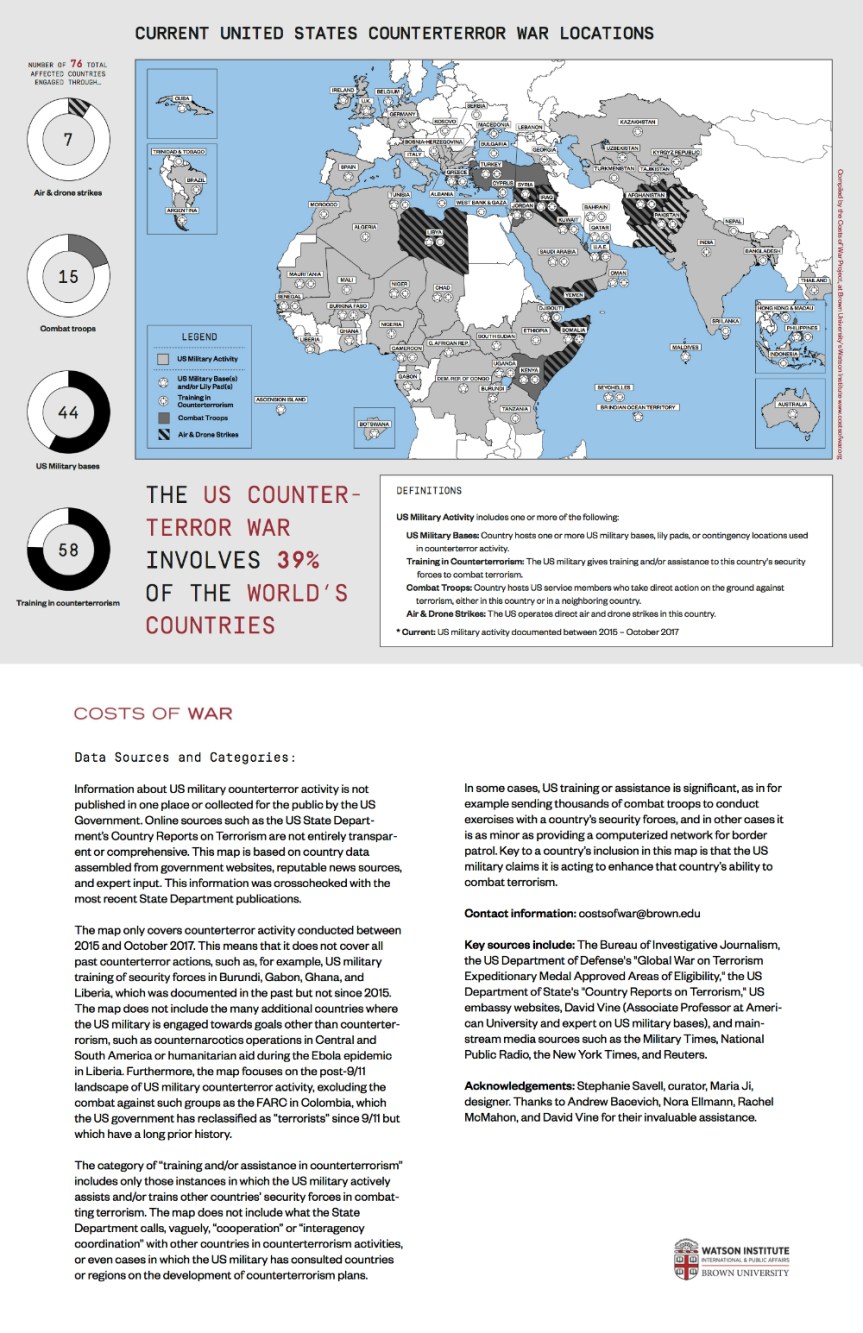
At TomDispatch.com, Tom Engelhardt has a revealing article on the truly global nature of America’s war on terror, accompanied by a unique map put together by the Costs of War Project at Brown University’s Watson Institute for International and Public Affairs.  The map reveals that America’s war on terror has spread to 76 countries, as shown below:

costofwar_projectmap_large1

This metastasizing of “counterterror” efforts is truly paradoxical: the more the U.S. military works to stop terror, the more terror spreads.  “Progress” is measured only by the growth of efforts to stem terror networks in more and more countries.  But the notion of “progress” is absurd: That 76 countries are involved in some way in this war on terror is a sign of regress, not progress.  After 16 years and a few trillion dollars, you’d think terror networks and efforts to eradicate them would be decreasing, not increasing.  But the war on terror has become its own cancer, or, in social-media-speak, it’s gone viral, infecting more and more regions.

A metaphor I like to use is from Charles Darwin.  Consider the face of nature — or of terrorism — as a series of tightly interlinked wedges.  Now, consider the U.S. military and its kinetic strikes (as well as weapons sales and military assistance) as hammer blows.  Those hammer blows disturb and contort the face of nature, fracturing it in unpredictable ways, propagating faults and creating conditions for further disturbances.

By hammering away at the complex ecologies of regions, the U.S. is feeding and complicating terrorism with its own violence.  Yet new fracture lines are cited as evidence of the further growth of terrorism, thus necessitating more hammer blows (and yet more military spending).  And the cycle of violence repeats as well as grows.

A sensible approach: Stop hammering away with missiles and bombs and drones.  Stop feeding the terrorist wolf with more blood and violence.

But the U.S. government is caught up in a seemingly endless cycle of violence and war, as Engelhardt notes here:

Let me repeat this mantra: once, almost seventeen years ago, there was one [country, Afghanistan, the U.S. targeted]; now, the count is 76 and rising.  Meanwhile, great cities have been turned into rubble; tens of millions of human beings have been displaced from their homes; refugees by the millions continue to cross borders, unsettling ever more lands; terror groups have become brand names across significant parts of the planet; and our American world continues to be militarized

This should be thought of as an entirely new kind of perpetual global war.  So take one more look at that map.  Click on it and then enlarge it to consider the map in full-screen mode.  It’s important to try to imagine what’s been happening visually, since we’re facing a new kind of disaster, a planetary militarization of a sort we’ve never truly seen before.  No matter the “successes” in Washington’s war, ranging from that invasion of Afghanistan in 2001 to the taking of Baghdad in 2003 to the recent destruction of the Islamic State’s “caliphate” in Syria and Iraq (or most of it anyway, since at this moment American planes are still dropping bombs and firing missiles in parts of Syria), the conflicts only seem to morph and tumble on.

A new kind of perpetual global war: Engelhardt nails it.  To end it, we need to stop feeding it.  But as the map above indicates, it seems likely that U.S. hammer blows will continue and even accelerate, with results as violently unpredictable as they are counterproductive.

America’s Cowardly Prison in Cuba

W.J. Astore

The U.S. government still keeps 41 prisoners at the Guantánamo Bay Detention Camp in Cuba.  Incredibly, some of these so-called alien enemy combatants have been imprisoned for up to 15 years without benefit of trial; indeed, without even being charged with a crime.  How is this possible in a democracy?  What does it say about our country?

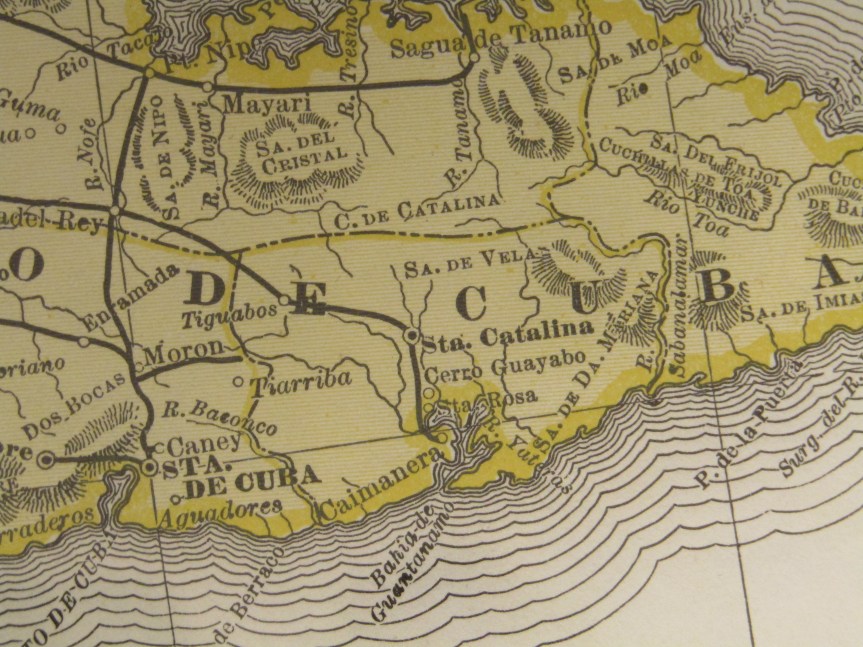
I happen to own an old map of Cuba from 1897 that shows Guantánamo Bay, which is along the southeastern coast of Cuba.  Here’s a photo of a segment of my old map that shows the Bahia de Guantánamo:

IMG_1575

Who could have predicted that when our government, in an imperial land grab, “leased” this base from Cuba in 1903, it would become a century later the site of a loathsome prison for Muslim men snatched mostly from central Asia in a “global war on terror”?

In the immediate aftermath of 9/11, the U.S. government needed a place to send prisoners gathered in the chaotic roundup of suspects in the war’s opening stages.  Among other locations they chose the U.S. naval base at Guantánamo, considered a “safe” spot since it’s both isolated and not in the USA while also being far from the eyes of the media.  What was an expedient, a temporary holding facility, became permanent.  President Obama vowed to close it and failed; President Trump has vowed to expand it with fresh batches of prisoners.

In a remarkable piece at TomDispatch.com, Erin Thompson reminds us that the prisoners at Guantánamo are human beings.  She did (and does) this by curating and displaying their art works.  Their paintings, ship models, and other creations remind us that they exist, that they create, that they hope, that they dream.  The U.S. government has responded by asserting ownership rights over their art.

America’s prison at Guantánamo Bay has been a spectacular fail.  Its very existence amounts to a huge propaganda victory for terrorists and would-be terrorists everywhere.  It’s a stain on our democracy (what’s left of it).  In the eyes of much of the world, it reveals the USA itself to be a terrorist.

The persistence of this prison shows America is losing its own “war on terror.”  Our government lacks the courage to try these men because of fear a few might go free and perhaps spearhead future attacks, despite a national security complex that spends roughly three quarters of a trillion dollars to predict and prevent such attacks.

To paraphrase Shakespeare in Julius Caesar: Cowards die a thousand deaths; a hero dies but once. By keeping this prison open, and by refusing to offer justice to its occupants out of fear of what they might do if released, we are dying a thousand deaths.

U.S. Air Strikes and Civilian Deaths in the War on Terror

mosul-destroyed
Mosul, Iraq: Destroying the City to Save It?

W.J. Astore

U.S. and Coalition forces have seriously undercounted the number of civilians killed in air attacks against ISIS.  That is the key finding of an 18-month-long investigation led by Azmat Khan and Anand Gopal and published this week in the New York Times Magazine.  Khan/Gopal surveyed 103 sites of air strikes in northern Iraq, extrapolating from these attacks into other regions in which the Coalition launched air attacks against ISIS since 2014.  They conclude that between 8000 and 10,000 civilians have been killed in these attacks, far higher than the U.S. government’s estimate of roughly 500 civilians killed (or the 3000 civilian deaths estimated by Airwars.org over this same period).

Does it matter to Americans if the true count of civilian deaths is closer to 10,000 than 500?  To most Americans, sadly, I’m not sure it matters.  Not if these air strikes are described and defended as saving American and Coalition lives as well as killing terrorists.

Airwars.org keeps a running tally of U.S. and Coalition airstrikes in Iraq and Syria.  Their website today (11/19/17) records 28,380 strikes over an almost four-year period, using 102,082 bombs and missiles.  It would be remarkable if only a few hundred innocents were killed by such an astonishing number of bombs and missiles, and indeed they estimate that nearly 6000 civilians have been killed in these attacks.

Why are U.S./Coalition figures so much lower than those estimated by Khan/Gopal and Airwars.org?

In March 2013, I wrote an article for TomDispatch in which I explained that airpower and bombing missions are neither cheap nor surgical nor decisive.  More recently, I lamented the horrific euphemism of “collateral damage,” a term often used to elide the realities of death by bombing.  There are good reasons why officialdom in Washington is content to undercount the number of civilians killed in bombing and drone attacks overseas.  Some are obvious; others perhaps less so:

  1. It’s not in the best interests of the U.S. military to give a full and honest accounting of civilian casualties, so they don’t.
  2. A full and honest accounting requires direct investigations (boots on the ground) like the ones conducted by Khan/Gopal. These are not generally done, partly because they would expose U.S. troops to considerable risk.
  3. A full and honest accounting might suggest that air attacks are too costly, murderously so.  The Coalition and the U.S. military prefer to advertise airpower as a “precise” and “decisive” weapon, and of course the Coalition relies on airpower to keep their casualties limited.
  4. Related to (3), as airpower is sold as “surgical” and decisive, there are billions and billions of dollars riding on this image.  Think of the hundreds of billions of dollars invested in warplanes, drones, and munitions.  Is the U.S. willing to suggest that this approach is often not that effective in the “war on terror”?  Even worse, that it results in the death and grievous wounding of thousands of innocent men, women, and children? That it may, in fact, exacerbate terrorism and intensify the war?
  5. Another possible angle: Do you want to tell pilots and other crew members that their bombs and missiles often kill innocents rather than the enemy? What would that do to morale?

When civilian deaths are mentioned in the U.S. media, they are often explained, or explained away, as the byproduct of ISIS/ISIL using innocents as human shields, or of the messiness and unpredictability of urban warfare in densely packed cities like Mosul.  But the Khan/Gopal study notes that civilian deaths from the air war are often due to poor intelligence – a failure of process, the result of insufficient resources and inadequate understanding of events on the ground.  In a word, negligence.

Again, do Americans care about civilian casualties in Iraq or Syria or other faraway places?  We seem to have a blasé attitude toward foreign peoples being killed at a distance in air strikes.  I suppose this is so because those killings are termed “accidental” by military spokesmen even as they’re attributed to a nefarious enemy or to technological errors.  It’s also so because these deaths have been both undercounted and underreported in America.

In showing that the U.S. government seriously undercounts civilian casualties and by highlighting systemic flaws in intelligence-gathering and targeting, the Khan/Gopal study makes a major contribution to our understanding of the true costs of America’s endless war on terror.

Trump’s Afghan War Speech: More of the Same, With More Killing

download
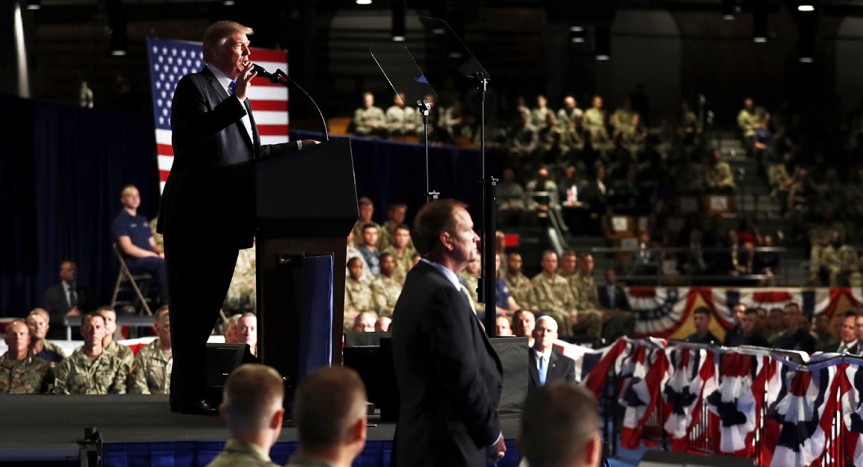
Trump, surrounded by troops and patriotic bunting, defines his “new” Afghan strategy (Carolyn Kaster/AP)

W.J. Astore

As a private citizen and presidential candidate, Donald Trump railed against the Afghan war.  A waste, he said.  Americans should withdraw, he said.  But in last night’s speech, Trump went against his own instincts (so he said) and went with the failed policies of his predecessors.  The war will continue, no timetable set, no troop levels determined, with conditions on the ground dictating America’s actions, according to the president.

What caught my attention, beyond the usual paeans of praise to America’s “warriors” and “warfighters,” was the specious reasoning to justify the continuation of the war.  Trump gave three reasons, so let’s take them one at a time:

  1. “First, our nation must seek an honorable and enduring outcome worthy of the tremendous sacrifices that have been made, especially the sacrifices of lives …”

It’s piss-poor reasoning to argue that, because a lot of people have sacrificed and died in a war, the war should continue (with more people dying) to justify those previous sacrifices.  By this logic, the more who die, the more we should keep fighting, meaning more dead, meaning more fighting, and so on.  Where is the honor and “worthy” outcome here?

  1. “Second, the consequences of a rapid exit are both predictable and unacceptable. 9/11, the worst terrorist attack in our history, was planned and directed from Afghanistan because that country was ruled by a government that gave comfort and shelter to terrorists. A hasty withdrawal would create a vacuum that terrorists, including ISIS and al Qaeda, would instantly fill, just as happened before September 11th.”

Actually, the consequences of an American withdrawal are both unpredictable and (most probably) acceptable.  Sure, terrorist organizations may gain impetus from an American withdrawal.  It’s also possible that a notoriously corrupt Afghan government might finally negotiate with the Taliban and other organizations, and that regional power brokers like Pakistan and Iran, who have their own interests in regional stability, might broker a settlement that Americans could live with.

Trump further argued that a rapid U.S. withdrawal from Iraq in 2011 led to “hard-won gains slip[ping] back into the hands of terrorist enemies. Our soldiers watched as cities they had fought for, and bled to liberate, and won, were occupied by a terrorist group called ISIS.”  The truth is far more complex.  The prolonged U.S. occupation of Iraq helped to create ISIS in the first place, and failed American efforts to create and train reliable Iraqi security forces contributed to easy ISIS victories after U.S. forces left in 2011.

  1. “Third and finally, I concluded that the security threats we face in Afghanistan and the broader region are immense. Today, 20 U.S.-designated foreign terrorist organizations are active in Afghanistan and Pakistan — the highest concentration in any region anywhere in the world.”

Isn’t it remarkable that, after sixteen years of sustained effort by the U.S. military, the Af-Pak region is now home to 20+ terrorist organizations?  The “highest concentration” in the world?  Is this not an admission of the utter failure of U.S. policy and actions since 2001?  How is this failure to be rectified by yet more U.S. attacks?

Trump said the new American goal is to kill terrorists.  This is not a strategy.  It’s a perpetual and deadly game of Whac-A-Mole.  That’s what Trump’s vaunted new strategy boils down to, despite the talk of economic pressure and working with Pakistan and India and other regional powers.

On Afghanistan, Trump should have listened to his instincts and withdrawn.  Instead, he listened to “his” generals.  With Trump, the generals won this round.  What they can’t win, however, is the war.

Happy 4th of July! And a Global War on Something

sunset july 2014 061
Author’s photo.

W.J. Astore

I live in a fairly posh area of America.  A place where people have vacation “cottages” with pools, a “destination” place for some, especially in July and August.  July 4th is hopping in these parts, with parties and parades and fireworks and trips to the beach and barbecues.  It’s summer, it’s warm and sunny, it’s time to relax with family and friends and enjoy life.

And then I read headlines like this today (from FP: Foreign Policy): “U.S. Troops in the Thick of it in Mosul and Raqqa.”  And this story about U.S. Marines deploying yet again to Helmand Province in Afghanistan:

Helmand. The commander of 300 Marines newly deployed to Helmand province recently told FP’s Paul McLeary he already has the full authority to get his troops out and about with Afghan troops in the fight. “So far we really haven’t seen much of a need to do it,” said U.S. Marine Corps Brig. Gen. Roger Turner, “but if there’s a need to be somewhere we have the authority and capability and capacity to be where we need to be.” 

He also advocated for a larger American footprint, in keeping with reported Pentagon plans to add 3,000 to 5,000 more troops in the coming months. “With a little bit larger force over here we would be in a position to have more flexibility” to do some of the advising he believes would help the Afghan forces push back against two years of Taliban offensives. 

And I think of that “Groundhog Day” movie with Bill Murray in which he repeats the same day, again and again, with only minor changes.  If you’ve seen the movie, Murray finally breaks out of what appears to be an infinite loop only when he changes his ways, his approach to life, his mentality.  He becomes a better person and even gets the girl.

When is the USA going to break out of its infinite loop of war?  Only when we change our culture, our mentality.

A “war on terror” is a forever war, an infinite loop, in which the same place names and similar actions crop up again and again.  Names like Mosul and Helmand province. Actions like reprisals and war crimes and the deaths of innocents, because that is the face of war.

Speaking of war crimes, another report today from FP: Foreign Policy:

[A] new Human Rights Watch report signals trouble ahead: witnesses in Mosul say that “Iraqi forces beat unarmed men and boys fleeing the fighting within the last seven days, and said they also obtained information about Iraqi forces executing unarmed men during this time period.”

When will it end?  Freedom includes freedom from forever war.  Yet Americans continue to be told that the price of freedom is having U.S. troops deployed everywhere — the projection of power in 100+ countries.  And some consider it patriotic to support those commitments without question, since to question it is seen as not supporting the troops. Which is nonsense, since our troops fight, at least in theory, to support and defend the U.S. Constitution, which, among other rights, enshrines freedom of speech and the right to dissent.

Can we contemplate a future Fourth of July in which American troops are no longer stuck in an infinite loop, fighting yet again in the blasted streets of Mosul or on the dusty plains of Helmand province?  A day of independence from war?

That would truly be a day to celebrate with parades, parties, and fireworks.

Memories of War

the-vietnam-memorial
Memories of War: So powerful yet often so fragmentary

W.J. Astore

Memories of war are powerful and fragmentary.  At a national level, we do best at remembering our own war dead while scarcely recognizing the damage to others.  This is one cost of nationalism.  Nationalism is violent, bigoted, and discriminatory.  It elevates a few at the expense of the many.  It fails fully to recognize common human experience, even one as shattering as war.

One example.  I’ve visited the Vietnam War Memorial in Washington, D.C.  In seeing all those names of American dead on the wall, I was moved to tears.  It’s a remarkable memorial, but what it fails to capture is any sense of the magnitude of death from that war visited upon Vietnam, Laos, and Cambodia.  As I wrote for Alternet, to visualize the extent of death from America’s war in Southeast Asia, the Vietnamese would need a wall that would be roughly 20 to 50 times as long as ours.

Think about that for a moment.  A wall perhaps 50 times as long as our Vietnam memorial wall.  It’s a staggering mental image.  Sadly, today in America the only wall garnering much media interest is Trump’s wall along our border with Mexico, yet another manifestation of nationalist bigotry and bias.

John Dower challenges us to think differently.  To explore our common humanity.  To remember the war dead of other nations and peoples, and to record the true cost of America’s wars, both to others and to ourselves.  His latest article at TomDispatch.com explores how Americans both remember and forget their wars.  Here’s an excerpt:

While it is natural for people and nations to focus on their own sacrifice and suffering rather than the death and destruction they themselves inflict, in the case of the United States such cognitive astigmatism is backlighted by the country’s abiding sense of being exceptional, not just in power but also in virtue. In paeans to “American exceptionalism,” it is an article of faith that the highest values of Western and Judeo-Christian civilization guide the nation’s conduct — to which Americans add their country’s purportedly unique embrace of democracy, respect for each and every individual, and stalwart defense of a “rules-based” international order.

Such self-congratulation requires and reinforces selective memory. “Terror,” for instance, has become a word applied to others, never to oneself. And yet during World War II, U.S. and British strategic-bombing planners explicitly regarded their firebombing of enemy cities as terror bombing, and identified destroying the morale of noncombatants in enemy territory as necessary and morally acceptable. Shortly after the Allied devastation of the German city of Dresden in February 1945, Winston Churchill, whose bust circulates in and out of the presidential Oval Office in Washington (it is currently in), referred to the “bombing of German cities simply for the sake of increasing the terror, though under other pretexts.”

Too often, Americans believe they’re waging a war on terror, forgetting that war itself is terror.  That war itself is evil.  That doesn’t mean that war is never justified, as it was, I believe, in the struggle against Nazi tyranny in World War II.  Even in justifiable wars, however, we need to recognize that war breeds corruption; that war, in essence, is corruption, a corruption of the human spirit, of a humanity which should be held in common and nourished, but which during war is degraded if not destroyed.

John Dower recognizes this.  It’s a theme he explores in his new book, The Violent American Century: War and Terror Since World War Two.  Consider it a primer on war’s many corruptions, and a precis of America’s tendency toward a nationalism of callous indifference when it comes to the damages we inflict on others.  It’s not happy reading, but then again wars shouldn’t be a subject for happiness.

71ebqVLTrbL
A remarkable primer and meditation on America’s endless wars

Wars and rumors of war seem always to be with us.  Some would say they’re an inevitable part of the human condition.  Our historical record seems to support that grim conclusion.  Yet there is another way, a more pacific path, a path toward peace.  But to walk that path, we must first fully recognize the tangled undergrowth of war that imperils our every footstep.  Dower’s latest book helps us to do just that.

The Only Way to Win America’s Wars Is to End Them

W.J. Astore

Today, I saw another article on why America is losing its wars in places like Iraq, Afghanistan, and elsewhere.  The gist of this and similar articles is that America’s wars are winnable.  That is, if we bomb more, or send more troops, or change our strategy, or alter our ROE (rules of engagement), or give more latitude to the generals, or use all the weapons at our disposal (to include nukes?), and so on, these wars will prove tractable and even winnable.  This jibes with President Trump’s promises about America winning again, everywhere, especially in wars.

vstory.bush.banner.afp
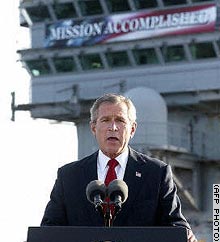
Sorry: The Missions Are Never Going to be “Accomplished”

Nonsense.  The U.S. military hasn’t won these wars since the wars themselves are unwinnable by U.S. military action.  Indeed, U.S. military action only makes them worse.

Consider Iraq.  Our invasion in 2003 and our toppling of Saddam kicked off a regional, religious, ethnic, and otherwise complicated civil war that is simply unwinnable by American troops.  Indeed, the presence of (and blunders made by) American troops in Iraq helped to produce ISIS, much-hyped as the current bane of American existence.

Consider Afghanistan.  Our invasion in 2001 toppled the Taliban, at least for a moment, but did not produce peace as various Afghan factions and tribes jostled for power.  Over time, the U.S. and NATO presence in the country produced instability rather than stability even as the Taliban proved both resilient and resurgent.  U.S. and NATO forces have simply become yet another faction in the Afghan power game, but unless we want to stay there permanently, we are not going to “win” by any reasonable definition of that word.

You could say the same of the U.S. military’s involvement in similar conflicts like Yemen or Syria (look at the mess we made of Libya).  We can kill a lot of “terrorists” and drop a lot of bombs, spreading our share of chaos, but we aren’t going to win, not in the sense of these wars ending on terms that enhance U.S. national security.

This hard reality is one that the U.S. military explains away by using jargon.  Military men talk of generational wars, of long wars, of fourth generation warfare, of gray zones, of military operations other than war (which has its own acronym, MOOTW), and so on. A friend of mine, an Air Force captain, once quipped: “You study long, you study wrong.” You can say something similar of war: “You wage war for long, you wage it wrong.”  This is especially true for a democracy.

America’s wars today are unwinnable.  They are unwinnable not only because they are not ours to win: they aren’t even ours.   We refuse to take ownership of them.  At the most fundamental level, we recognize they are not vital to us, since we don’t bother to unify as a country to declare war and to wage it.  Most Americans ignore them because we can ignore them.  The Afghans, the Iraqis, the Syrians, and so on don’t have the luxury of ignoring them.

Trump, with all his talk of winning, isn’t going to change this.  The more he expands the U.S. military, the more he leans on “his” generals for advice, the more he’s going to fail. Our new commander-in-chief needs to learn one lesson: The only way to win America’s wars is to end them.