In May 1968, nine Catholic activists set fire to draft records in Catonsville, Maryland, in a deliberate act of sabotage and protest against the Vietnam War. For the crime of destroying government property, a crime they freely admitted, they were tried in federal court in Baltimore and found guilty. I’ve been reading the edited trial transcript (with commentary) by Daniel Berrigan, one of the Catonsville Nine and a Catholic priest. What unified these nine people was their moral opposition to the Vietnam War, a moral revulsion to the acts their country was committing in Vietnam, a revulsion that drove them to burn draft records with a weak brew of homemade napalm so as to gain the attention of their fellow citizens.
On this Easter Weekend, I would like to focus on a few of the statements made by the Catonsville Nine, as recorded by Daniel Berrigan in “The Trial of the Catonsville Nine.”
Statement by Philip Berrigan
We have been accused of arrogance
But what of the fantastic arrogance … of our leaders
What of their crimes against the people … the poor and powerless
Still no court will try them … no jail will receive them
They live in righteousness … They will die in honor
For them we have one message … for those
in whose manicured hands … the power of the land lies
We say to them
Lead us … Lead us in justice
and there will be no need to break the law
Let the President do … what his predecessors failed to do
Let him obey the rich less … and the people more
Let him think less of the privileged
and more of the poor
Less of America and more of the world
Let lawmakers … judges … and lawyers
think less of the law … more of justice
less of legal ritual … more of human rights …
Statement by Thomas Lewis
We were speaking as Americans
We were proud to be Americans
Yet we have representatives in Vietnam
who do terrible things in our name
We were saying to the military
This is wrong … This is immoral … This is illegal
And their response to this was
they were only obeying orders
Question from the Judge: But they did respond to you, did they not?
Thomas Lewis: It was an atrocious response.
Statement by Marjorie Melville
I know that burning draft files
is not an effective way
to stop a war … but
who has found a way
of stopping this war
I have racked my brain
I have talked to all kinds of people
What can you do
They say yes … yes
But there is no answer
no stopping it
the horror continues
Statement by Thomas Melville
I hear our president … confuse greatness with strength
riches with goodness … fear with respect
hopelessness and passivity with peace
The clichés of our leaders
pay tribute to property … and indifference to suffering
We long for a hand of friendship and succor
and that hand
clenches into a fist
I wonder how long we can endure
Statement by George Mische
We were not out to destroy life
There is a higher law we are commanded to obey
It takes precedence over human laws
My intent was to follow the higher law
My intent was to save lives … Vietnamese lives
North and South American lives
To stop the madness
That was the intent
Statement of Daniel Berrigan
Question from the Judge: You say your intention was to save these children, of the jury, of myself, when you burned the [draft] records? That is what I heard you say. I ask if you meant that.
Daniel Berrigan:
I meant that
of course I mean that
or I would not say it
The great sinfulness
of modern war is
that it renders concrete things abstract
I do not want to talk
about Americans in general ….
I poured napalm [on the draft records]
on behalf of the prosecutor’s
and the jury’s children
Closing Statement by Daniel Berrigan
When at what point will you say no to this war?
We have chosen to say
with the gift of our liberty
if necessary our lives:
the violence stops here
the death stops here
the suppression of truth stops here
this war stops here
Redeem the times!
The times are inexpressibly evil
Christians pay conscious … indeed religious tribute
to Caesar and Mars
by the approval of overkill tactics … by brinksmanship
by nuclear liturgies … by racism … by support of genocide
They embrace their society with all their heart
and abandon the cross
They pay lip service to Christ
and military service to the powers of death
And yet … and yet … the times are inexhaustibly good
solaced by the courage and hope of many
The truth rules … Christ is not forsaken …
At the end of the trial, as all nine defendants were found guilty, a “member of the audience” cried, “Members of the jury, you have just found Jesus Christ guilty.”
That last statement, and the words of the Catonsville Nine, give us much to ponder on this Easter Weekend.
In October 2005, during the Iraq War, historian David M. Kennedy noted that “No American is now obligated to military service, few will ever serve in uniform, even fewer will actually taste battle …. Americans with no risk whatsoever of exposure to military service have, in effect, hired some of the least advantaged of their fellow countrymen to do some of their most dangerous business while the majority goes on with their own affairs unbloodied and undistracted.”
We have, in essence, a post-democratic military in the U.S. today, which is the subject of my latest article for TomDispatch.com. You can read the entire article here; what follows is the first section on how our citizen-soldier tradition morphed into a professional force of volunteer-warriors augmented by privatized forces of mercenaries and corporations.
In the decades since the draft ended in 1973, a strange new military has emerged in the United States. Think of it, if you will, as a post-democratic force that prides itself on its warrior ethos rather than the old-fashioned citizen-soldier ideal. As such, it’s a military increasingly divorced from the people, with a way of life ever more foreign to most Americans (adulatory as they may feel toward its troops). Abroad, it’s now regularly put to purposes foreign to any traditional idea of national defense. In Washington, it has become a force unto itself, following its own priorities, pursuing its own agendas, increasingly unaccountable to either the president or Congress.
Three areas highlight the post-democratic transformation of this military with striking clarity: the blending of military professionals with privatized mercenaries in prosecuting unending “limited” wars; the way senior military commanders are cashing in on retirement; and finally the emergence of U.S. Special Operations Command (SOCOM) as a quasi-missionary imperial force with a presence in at least 135 countries a year (and counting).
The All-Volunteer Military and Mercenaries: An Undemocratic Amalgam
I’m a product of the all-volunteer military. In 1973, the Nixon administration ended the draft, which also marked the end of a citizen-soldier tradition that had served the nation for two centuries. At the time, neither the top brass nor the president wanted to face a future in which, in the style of the Vietnam era just then winding up, a force of citizen-soldiers could vote with their feet and their mouths in the kinds of protest that had only recently left the Army in significant disarray. The new military was to be all volunteers and a thoroughly professional force. (Think: no dissenters, no protesters, no antiwar sentiments; in short, no repeats of what had just happened.) And so it has remained for more than 40 years.
Most Americans were happy to see the draft abolished. (Although young men still register for selective service at age 18, there are neither popular calls for its return, nor serious plans to revive it.) Yet its end was not celebrated by all. At the time, some military men advised against it, convinced that what, in fact, did happen would happen: that an all-volunteer force would become more prone to military adventurism enabled by civilian leaders who no longer had to consider the sort of opposition draft call-ups might create for undeclared and unpopular wars.
In 1982, historian Joseph Ellis summed up such sentiments in a prophetic passage in an essay titled “Learning Military Lessons from Vietnam” (from the book Men at War):
“[V]irtually all studies of the all-volunteer army have indicated that it is likely to be less representative of and responsive to popular opinion, more expensive, more jealous of its own prerogatives, more xenophobic — in other words, more likely to repeat some of the most grievous mistakes of Vietnam … Perhaps the most worrisome feature of the all-volunteer army is that it encourages soldiers to insulate themselves from civilian society and allows them to cling tenaciously to outmoded visions of the profession of arms. It certainly puts an increased burden of responsibility on civilian officials to impose restraints on military operations, restraints which the soldiers will surely perceive as unjustified.”
Ellis wrote this more than 30 years ago — before Desert Storm, the invasions of Afghanistan and Iraq, or the launching of the War on Terror. These wars (and other U.S. military interventions of the last decades) have provided vivid evidence that civilian officials have felt emboldened in wielding a military freed from the constraints of the old citizen army. Indeed, it says something of our twenty-first-century moment that military officers have from time to time felt the need to restrain civilian officials rather than vice versa. Consider, for instance, Army Chief of Staff General Eric Shinseki’s warning early in 2003 that a post-invasion Iraq would need to be occupied by “several hundred thousand” troops. Shinseki clearly hoped that his (all-too-realistic) estimate would tamp down the heady optimism of top Bush administration officials that any such war would be a “cakewalk,” that the Iraqis would strew “bouquets” of flowers in the path of the invaders, and that the U.S. would be able to garrison an American-style Iraq in the fashion of South Korea until hell froze over. Prophetic Shinseki was, but not successful. His advice was dismissed out of hand, as was he.
Events since Desert Storm in 1991 suggest that the all-volunteer military has been more curse than blessing. Partially to blame: a new dynamic in modern American history, the creation of a massive military force that is not of the people, by the people, or for the people. It is, of course, a dynamic hardly new to history. Writing in the eighteenth century about the decline and fall of Rome, the historian Edward Gibbon noted that:
“In the purer ages of the commonwealth [of Rome], the use of arms was reserved for those ranks of citizens who had a country to love, a property to defend, and some share in enacting those laws, which it was their interest, as well as duty, to maintain. But in proportion as the public freedom was lost in extent of conquest, war was gradually improved into an art, and degraded into a trade.”
As the U.S. has become more authoritarian and more expansive, its military has come to serve the needs of others, among them elites driven by dreams of profit and power. Some will argue that this is nothing new. I’ve read my Smedley Butler and I’m well aware that historically the U.S. military was often used in un-democratic ways to protect and advance various business interests. In General Butler’s day, however, that military was a small quasi-professional force with a limited reach. Today’s version is enormous, garrisoning roughly 800 foreign bases across the globe, capable of sending its Hellfire missile-armed drones on killing missions into country after country across the Greater Middle East and Africa, and possessing a vision of what it likes to call “full-spectrum dominance” meant to facilitate “global reach, global power.” In sum, the U.S. military is far more powerful, far less accountable — and far more dangerous.
As a post-democratic military has arisen in this country, so have a set of “warrior corporations” — that is, private, for-profit mercenary outfits that now regularly accompany American forces in essentially equal numbers into any war zone. In the invasion and occupation of Iraq, Blackwater was the most notorious of these, but other mercenary outfits like Triple Canopy and DynCorp were also deeply involved. This rise of privatized militaries and mercenaries naturally contributes to actions that are inherently un-democratic and divorced from the will and wishes of the people. It is also inherently a less accountable form of war, since no one even bothers to count the for-profit dead, nor do their bodies come home in flag-draped coffins for solemn burial in military cemeteries; and Americans don’t approach such mercenaries to thank them for their service. All of which allows for the further development of a significantly under-the-radar form of war making.
The phrase “limited war,” applied to European conflicts from the close of the Thirty Years’ War in 1648 to the French Revolution in 1789, and later to conventional wars in the nuclear age, has fresh meaning in twenty-first-century America. These days, the limits of limited war, such as they are, fall less on the warriors and more on the American people who are increasingly cut out of the process. They are, for instance, purposely never mobilized for battle, but encouraged to act as though they were living in a war-less land. American war efforts, which invariably take place in distant lands, are not supposed to interfere with business as usual in the “homeland,” which, of course, means consumerism and consumption. You will find no rationing in today’s America, nor calls for common sacrifice of any sort. If anything, wars have simply become another consumable item on the American menu. They consume fuel and resources, money, and intellect, all in staggering amounts. In a sense, they are themselves a for-profit consumable, often with tie-ins to video games, movies, and other forms of entertainment.
In the rush for money and in the name of patriotism, the horrors of wars, faced squarely by many Americans in the Vietnam War era, are now largely disregarded. One question that this election season has raised: What if our post-democratic military is driven by an autocrat who insists that it must obey his whims in the cause of “making America great again”?
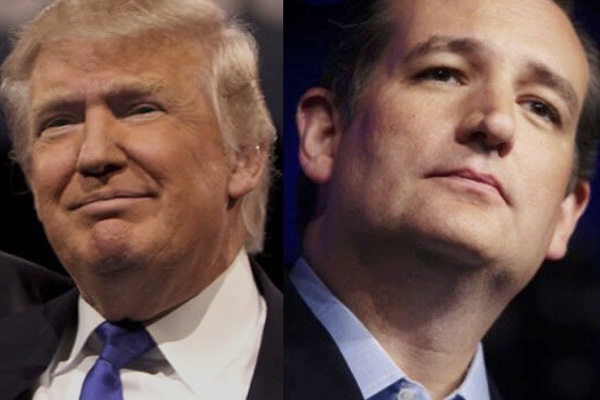
To hear Republican candidates like Donald Trump and Ted Cruz talk, almost any act of violence is justifiable to defeat the enemy. Trump talks of torture, far worse than waterboarding, and total destruction. Cruz ups the ante, speaking of carpet bombing and making the sand glow, apparently via nuclear weapons. Both appear to treat the enemy as inhuman.
Sadly, for America this is nothing new. Just read Bernard Fall on America’s war against Vietnam. In an article for Ramparts (“This Isn’t Munich, It’s Spain”), Fall wrote late in 1965 that the American military strategy in Vietnam was based on massive killing through overwhelming firepower:
The new mix of air war and of land and seaborne firepower in Vietnam is one of technological counter-insurgency — if you keep up the kill rate you will eventually run out of enemies. Or at least armed enemies. Of course, the whole country will hate you, but at least they won’t resist you. What you will get is simply a cessation of resistance — an acquiescence in one’s fate rather than a belief that your side and your ideas have really prevailed.
In other words, America sought to bludgeon the Vietnamese into compliance, rather than winning their hearts and minds through ideas or ideals.
“But what I really fear most,” Fall continued, “is the creation of new ethics to match new warfare. Indications are that a new ethic is already being created, and such influential men as former Secretary of State Dean Acheson have begun to provide its intellectual underpinning.”
Fall cited a speech at Amherst College in 1965 in which Acheson declared:
The end sought by our foreign policy . . . is, as I have said, to preserve and foster an environment in which free societies may exist and flourish. Our policies and actions must be decided by whether they contribute to or detract from achievement of this end. They need no other justification or moral or ethical embellishment. . .
To keep the free world free, America was justified to do anything it desired, irrespective of ethics and morality. Acheson’s words in 1965 have become the essence of U.S. foreign policy today as advanced by men like Trump and Cruz. In short, the end (a “free” society) justifies any means (torture, carpet bombing, perhaps even nuclear weapons) to preserve it.
Fall went on to cite a Pastoral Letter from French Cardinal Feltin in 1960 during France’s war with Algeria. In that letter to French military chaplains, Cardinal Feltin noted:
There cannot be a morality which justifies efficacy by all means, if those means are in formal contradiction with Natural Law and Divine Law. Efficacy, in that case, goes against the very aim it seeks to achieve. There can be exceptional laws for exceptional situations. . . there cannot exist an exceptional morality which somehow takes leave of Natural Law and Divine Law.
Too often in the past as well as today, U.S. foreign policy has taken leave of natural and divine law. The ends do not and should not justify the means, especially when the means (torture, carpet bombing, and the like) contravene the end (a “free” society based on ethical and moral principles).
Rather than posing as protectors of the free world, people like Trump and Cruz should admit their own amorality. They should admit they see the world as a brutal place, occupied by brutes, and that only by slaying those brutes in a brutish way can America preserve its dominant position as chief brute.
Doubtless many of their followers would still salute them for this view. But more reflective souls would see the honesty of Pogo’s famous insight that “We have met the enemy and he is us.”
I was on active duty in the military for twenty years. My experience: It’s very difficult to see the big picture in the military. The everyday pressures of the mission keep you focused on the short term. I recall writing many WARs (weekly activity reports) and being focused on the immediate. Even the yearly budgetary process tends to keep you focused on the short term. Assignments for officers and enlisted rarely last longer than three years, with combat tours typically much shorter. Personnel are constantly changing: for one acquisition project I worked on, four program managers (colonels) rotated in and out in three years.
Along with being focused on the immediate, you are actively discouraged from criticizing the system in any fundamental way. Of course, you’re not supposed to criticize the commander-in-chief, you’re not supposed to be insubordinate to your chain of command, you’re not supposed to undermine morale. At the same time, one mistake can be deadly to a career. People in the military therefore tend to play it safe. Doubters tend to conform. They shut their mouths. Or they vote with their feet by leaving the military.
Critics with the best of intentions often get squashed. Consider the Air Force pilot who found a problem with the F-22 Raptor’s cockpit oxygen supply system. This was a top priority, safety of flight, issue, but the Air Force played down the problem so as to protect procurement for the Raptor. The pilot eventually complained to CBS “60 Minutes” and saw his career stall as a result. Or consider General Eric Shinseki, who as Army Chief of Staff had the temerity to disagree with the Bush Administration’s rosy talk of low troop requirements in the wake of the invasion of Iraq in 2003. Shinseki was shunted aside by a system that had no room for well-informed dissent.
Pressures to conform and short-term planning and personnel cycles combine to produce mediocrity and to reproduce the past. John Paul Vann, an expert on the Vietnam War who died in that war, noted the U.S. military didn’t have 12 years’ experience in Vietnam: it had one years’ experience repeated 12 times over. Something similar is true in Afghanistan today: the U.S. doesn’t have 14 years’ experience fighting the Taliban and building Afghan security forces, but rather one years’ experience repeated 14 times.
U.S. military actions are sequential rather than synergistic. It’s just one damn thing after another. The reality of this is often seen more clearly by people who are outside of the military. Outsiders aren’t caught up in everyday pressures or limited by conformism. They’re not caught in a Pentagonal box in which misguided tactics and mistaken goals are accepted by insiders as SOP – standard operating procedure.
But perhaps “box” is the wrong image for the Pentagon and its unreflective busyness; ant farm might be better. If you’re of a certain age, you may remember those old ant farms advertised in the back pages of comic books. You could send away for a see-through container with sand and ants that allowed you to watch as your crew of ants busily worked away in your “farm.”
Today’s Pentagon reminds me of those old ant farms. The ants work busily within it. Anyone watching wouldn’t question their dedication. Yet as you’re standing outside the farm, watching them, you can see how tightly their world is delimited and circumscribed. What is obvious to you is simply beyond them. The ants keep digging in and rolling along.
It’s well worth asking why the U.S. military puts so much pride on working to the point of exhaustion. A friend of mine worked at the Pentagon. He worked hard during his normal shift – but he left on-time to go home. His co-workers, noses to the grindstone, would hassle him about leaving “early.” He’d reply: I can leave on-time because I didn’t spend hours rotating between the coffee maker and the gym.
A mindless emphasis on over-caffeinated work and fitness, as another friend suggested, may be a post-Vietnam War reaction to the McNamara “managerial” culture of the 1960s. As he put it, “One easy way of showing one has the right stuff is to be an exercise nut, and the penumbras of that mind-set have really distorted the allocation of effort in our military.” Recall that General David Petraeus made a moral fetish out of personal fitness and how that indirectly cost him his career (he made his initial connection to his mistress/biographer while running together). Recall that General Stanley McChrystal was celebrated for his fitness regimen, which didn’t convey the smarts to rein in the insubordinate behavior of his men.
One more anecdote about incessant “army ant” work. A Vietnam veteran told me this story about mindless work for the sake of show:
“One feature of my first Vietnam unit epitomized all this to me: the trucks in our motor pool were perfectly lined up. I don’t know how they did it. Must have had squads of soldiers pushing them to just the right spot then stuck chocks under the wheels to keep them there. The 4-star-corps commander used to drive by our motor pool frequently to go to USARV HQ. He never stopped to see if the trucks were drivable. They were not. Almost all deadlined.”
Lots of busy-work down on the ant farm may look good from a distance, but it does not produce victory.
Today’s U.S. military has its enemies outgunned. There’s little wrong with its work ethic. What the U.S. military hasn’t done is to outthink its enemies. Indeed, the military’s actions often conspire to create new ones. To admit this is not to place the blame entirely on the military. Its civilian leaders have to shoulder blame as well. But ultimately it’s the military that advises the president and Congress, and I haven’t witnessed senior military officers resigning because their advice hasn’t been followed.
If the U.S. military is to be reformed, you can’t look to the ants to do it. They’re too busy keeping the system running. We must look beyond the farm, to outsiders who are able and willing to think freely. Yet the military too needs to act, if for no other reason than to end a miserable run of defeats (or pyrrhic victories, if that sounds less harsh). Rather than simply promoting loyal and hardworking ants, it needs to foster seers and thinkers – people willing to buck the system.
It won’t be easy – but it’s sure better than losing.
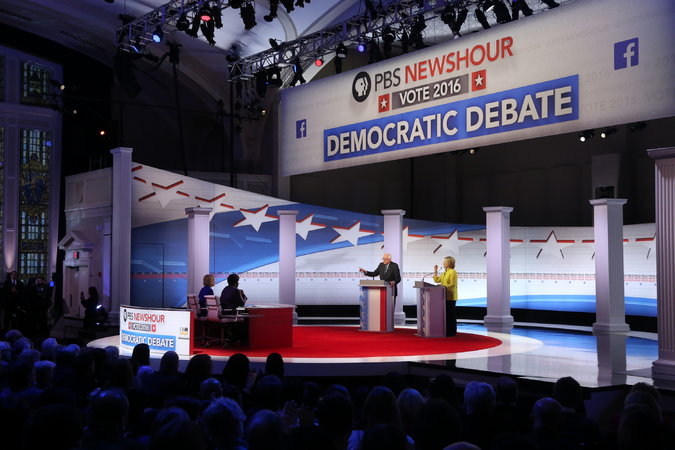
Bernie and Hillary at last night’s debate (Source: NYT)
W.J. Astore
Last night’s Democratic debate between Hillary Clinton and Bernie Sanders in Milwaukee hit the usual notes for these two candidates (the transcript is here). Clinton is all about competence and being ready on “day one” in the Oval office, whereas Bernie seeks a political revolution to galvanize the people. But a few telling items came up, mostly toward the end of the debate.
1. Hillary accused Bernie of being too critical of President Obama, of not supporting him, of suggesting he was “weak,” and of not respecting Obama’s legacy of results, especially the Affordable Care Act. This was a “low blow” for Bernie, who explained that he fully supported Obama, considered him to be a friend, and that he did indeed respect the president’s accomplishments. Besides that, Bernie noted, “one of us ran against Barack Obama [in 2008]. I was not that candidate.”
2. Bernie actually dared to suggest the Defense Department’s budget had to be given careful scrutiny, noting that the DoD has yet to pass an audit. In these days of issuing blank checks to the Pentagon, it was a significant moment.
3. Bernie took Hillary to task, successfully I believe, for her cozy relationship with Henry Kissinger. In my view, this was the most important moment of the night. With respect to U.S. foreign policy, Hillary promises continuity with neo-conservative principles of American interventionism and preemptive war. Bernie, even as he promises to crush the Islamic State, is far less enamored with neo-con agendas and peace through aggression.
Here is what Bernie had to say about Kissinger:
“I happen to believe that Henry Kissinger was one of the most destructive secretaries of state in the modern history of this country. I am proud to say that Henry Kissinger is not my friend. I will not take advice from Henry Kissinger. And in fact, Kissinger’s actions in Cambodia, when the United States bombed that country, overthrew Prince Sihanouk, created the instability for Pol Pot and the Khmer Rouge to come in, who then butchered some 3 million innocent people, one of the worst genocides in the history of the world. So count me in as somebody who will not be listening to Henry Kissinger…”
“Kissinger was one of those people during the Vietnam era who talked about the domino theory. Not everybody remembers that. You do. I do. The domino theory, you know, if Vietnam goes, China, da, da, da, da, da, da, da. That’s what he talked about, the great threat of China.”
“And then, after the war, this is the guy who, in fact, yes, you’re right, he opened up relations with China, and now pushed various type of trade agreements, resulting in American workers losing their jobs as corporations moved to China.”
“The terrible, authoritarian, Communist dictatorship he warned us about, now he’s urging companies to shut down and move to China. Not my kind of guy.”
Hillary defended her relationship with Kissinger, just as she defended herself from suggestions she’d be influenced by big money donors. In both cases, she came across as the establishment candidate, one who is most comfortable in the corridors of power, schmoozing with other power brokers and players.
In sum, even as Hillary attempts to appropriate some of Bernie’s anti-establishment rhetoric, her actions demonstrate how much she’s ensconced within the establishment camp, especially when it comes to U.S. foreign policy.
For voters looking for change in November, Hillary promises only an amped up version of more of the same.
Francis Bacon is famous for the aphorism, “Knowledge is power.” Yet the reverse aphorism is not true. The United States is the most powerful nation in the world, yet its knowledge base is notably weak in spite of all that power. Of course, many factors contribute to this weakness. Our public educational systems are underfunded and driven by meaningless standardized test results. Our politicians pander to the lowest common denominator. Our mainstream media is corporate-owned and in the business of providing info-tainment when they’re not stoking fear. Our elites are in the business of keeping the American people divided, distracted, and downtrodden, conditions that do not favor critical thinking, which is precisely the point of their efforts.
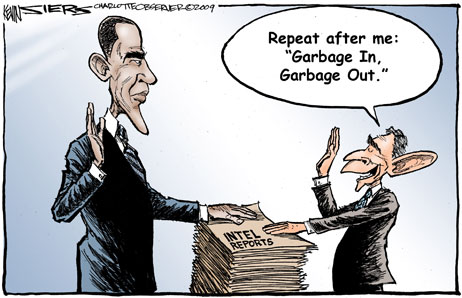
All that is true. But even when the U.S. actively seeks knowledge, we get little in return for our investment. U.S. intelligence agencies (the CIA, NSA, DIA, and so on) aggregate an enormous amount of data, then try to convert this to knowledge, which is then used to inform action. But these agencies end up drowning in minutiae. Worse, competing agencies within a tangled bureaucracy (that truly deserves the label of “Byzantine”) end up spinning the data for their own benefit. The result is not “knowledge” but disinformation and self-serving propaganda.
When our various intelligence agencies are not drowning in minutiae or choking on their own “spin,” they’re getting lost in the process of converting data to knowledge. Indeed, so much attention is put on process, with so many agencies being involved in that process, that the end product – accurate and actionable knowledge – gets lost. Yet, as long as the system keeps running, few involved seem to mind, even when the result is marginal — or disastrous.
Consider the Vietnam War. Massive amounts of “intelligence” data took the place of knowledge. Data like enemy body counts, truck counts, aircraft sorties, bomb tonnages, acres defoliated, number of villages pacified, and on and on. Amassing this data took an enormous amount of time; attempting to interpret this data took more time; and reaching conclusions from the (often inaccurate and mostly irrelevant) data became an exercise in false optimism and self-delusion. Somehow, all that data suggested to US officialdom that they were winning the war, a war in which US troops were allegedly making measurable and sustained progress. But events proved such “knowledge” to be false.
Of course, there’s an acronym for this: GIGO, or garbage (data) in, garbage (knowledge) out.
In this case, real knowledge was represented by the wisdom of Marine Corps General (and Medal of Honor recipient) David M. Shoup, who said in 1966 that:
I don’t think the whole of Southeast Asia, as related to the present and future safety and freedom of the people of this country, is worth the life or limb of a single American [and] I believe that if we had and would keep our dirty bloody dollar-crooked fingers out of the business of these nations so full of depressed, exploited people, they will arrive at a solution of their own design and want, that they fight and work for. And if, unfortunately, their revolution must be of the violent type…at least what they get will be their own and not the American style, which they don’t want…crammed down their throat.
But few wanted to hear Shoup and his brand of hard-won knowledge, even if he’d been handpicked by President Kennedy to serve as the Commandant of the Marine Corps exactly because Shoup had a reputation for sound and independent thinking.
Consider as well our rebuilding efforts in Iraq after 2003. As documented by Peter Van Buren in his book “We Meant Well,” those efforts were often inept and counterproductive. Yet the bureaucracy engaged in those efforts was determined to spin them as successes. They may even have come to believe their own spin. When Van Buren had the clarity and audacity to say, We’re fooling no one with our Kabuki dance in Iraq except the American people we’re sworn to serve, he was dismissed and punished by the State Department.
Why? Because you’re not supposed to share knowledge, real knowledge, with the American people. Instead, you’re supposed to baffle them with BS. But Van Buren was having none of that. His tell-all book (you can read an excerpt here) captured the Potemkin village-like atmosphere of US rebuilding efforts in Iraq. His accurate knowledge had real power, and for sharing it with the American people he was slapped down.
Tell the truth – share real knowledge with the American people – and you get punished. Massage the data to create false “knowledge,” in these cases narratives of success, and you get a pat on the back and a promotion. Small wonder that so many recent wars have gone so poorly for America.
What the United States desperately needs is insight. Honesty. A level of knowledge that reflects mastery. But what we’re getting is manufactured information, or disinformation, or BS. Lies, in plainspeak, like the lie that Iraq had in 2002 a large and active program in developing WMD that could be used against the United States. (Remember how we were told we had to invade Iraq quickly before the “smoking gun” became a “mushroom cloud”?)
If knowledge is power, what is false knowledge? False knowledge is a form of power as well, but a twisted one. For when you mistake the facade you’re constructing as the real deal, when you manufacture your own myths and then forget they’re myths as you consume them, you may find yourself hopelessly confused, even as the very myths you created consume you.
So, a corollary to Francis Bacon: Knowledge is power, but as the United States has discovered in Vietnam, Iraq, and elsewhere, power is no substitute for knowledge.
Agent Orange victims Nguyen and Hung Vuong Pham, ages 14 and 15, as captured by Brian Driscoll, photographer, in 2008.(Huffington Post, 2013, see link in article)
W.J. Astore
If you’re in the U.S. military or you’re a veteran, you probably know casualty figures, especially deaths, from America’s wars. To cite one example, America lost more than 58,000 men in the Vietnam War. Their names are inscribed on the “The Wall” in DC. I’ve been there. Seeing all those names is a devastating experience.
But “The Wall” undercounts the number of American dead from that war. Just the other day, I was talking to a veteran, a graduate of West Point, about Vietnam. He told me he had two classmates who became pilots and who worked with Agent Orange, a toxic chemical defoliant, in Vietnam. They both died later of brain tumors from their exposure to the chemical. Their names are not on The Wall.
I shared this story with a colleague, and he wrote back that his father’s best friend flew Agent Orange around in the Pacific, relocating it after the war. After being exposed to it day after day, he died of cancer in his early thirties. His name is also not on The Wall.
Wars are not over for our veterans after the U.S. government says they are. Consider the surge in veteran suicides, especially for those in their fifties and sixties. Estimates vary as to how many Vietnam veterans have taken their own lives, but the number may be as high as 100,000. PTSD, chronic pain, depression, alcohol and drug addiction, and many other conditions linked to war ultimately become an unbearable load for many of our veterans.
My point is this: As a country, we just don’t recognize fully the true costs of our wars. It’s not enough to add up the billions spent or the number of combat deaths. We need to reckon with the aftermath of our wars, the way that veterans keep suffering and dying from wounds they suffered, many of them hidden from view, but no less real for that reason. And we need to reckon with the destruction we inflict on other peoples and countries, for the “American way of war” is profligate with firepower, from high explosive and napalm and cluster munitions to Willy Peter (white phosphorous) and depleted uranium.
And maybe, just maybe, if we ever truly reckon with the cost of war to ourselves and others, we’ll strive harder to avoid war in the future.
A coda: Can we ban forever the term “surgical strike”? Can we ban forever the term “collateral damage”? Can we ban these and similar weasel words that diminish the horrifying and murderous nature of war?
Judging by my local newspaper and email stream, Memorial Day is about sales and selling, a reminder that the business of America is business. But of course Memorial Day is truly about honoring the dead in America’s wars, the veterans who died defending freedom. Sadly, far too often wars are not fought for high ideals, but that is not the fault of the veteran.
As we remember American veterans this weekend, those who died in the name of defending our country and Constitution, we would do well to ask whether our sympathy for the dead should be limited only to those who fought under the U.S. flag, or whether we should extend it to “the enemy.” In other words, to all those who suffer and die in wars.
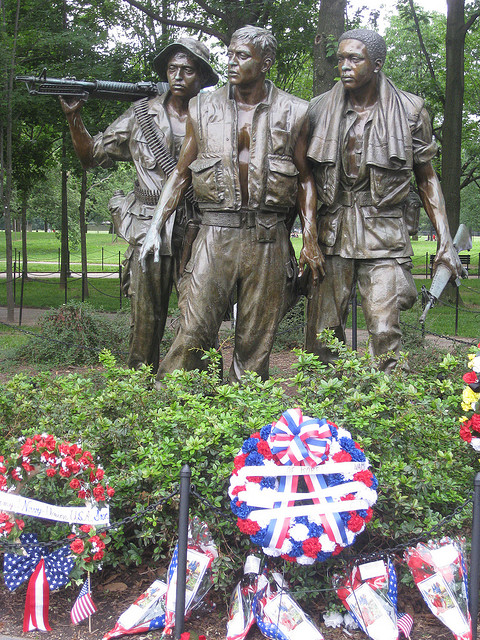
Consider the Vietnam War, a war the USA could and should have avoided. But we didn’t, and that war was prosecuted with a ruthlessness that was often barbaric. America lost more than 58,000 in that war, and their names are on the wall in Washington, D.C. We visit that wall and weep for our dead.
But what about the Vietnamese dead? Estimates vary, but Vietnam lost roughly three million people in that war, with some figures approaching four million. The war in Southeast Asia spread to Laos and Cambodia as well, leading to genocide and the “killing fields” of Cambodia. Do we weep for their dead?
Vietnam today has friendly relations with the USA. The enemy of the 1960s is, if not an ally, at least a trade partner. There are warm friendships shared between our peoples, nurtured by cultural exchanges between the U.S. and Vietnam.
So, in the case of the Vietnam War, as we remember the American Vietnam veteran, should we not make room in our hearts to remember the Vietnamese veteran as well?
Ultimately, our fellow human beings are not the enemy. War is the enemy. A will to destruction is the enemy. And those caught up in war–the innocent victims on all sides–are worthy of being memorialized.
Far too often, national flags become little more than tribal symbols, much like bikers’ gangs and their colors. Wear the wrong color, belong to a rival gang, and violence, even a mass shooting, is the result.
Are we fated to keep saluting our own colors while reviling the colors of others? Are we fated to keep marching off to war under the American flag while killing those who fly a different flag?
Yes, there are necessary wars. I for one wouldn’t want to live under the Nazi Swastika. But history shows that necessary and just wars are rare. For every past war fought for a “just” cause, so many more have been fought for loot, money, power, territory, radical ideologies of one sort or another, dynastic advantage, prestige, and on and on. The one constant is the troops on all sides who march and die.
A memorial day that remembers the “enemy” dead as well as our own would, perhaps, be a small step toward a memorial day in the future with far fewer war dead to memorialize.
Christian G. Appy, professor of history at U-Mass Amherst, has written a new and telling book on the Vietnam War: American Reckoning: The Vietnam War and Our National Identity (New York, Viking Press). Reading his book made me realize a key reason why the U.S. lost the war: for U.S. leaders it was never about Vietnam and the Vietnamese people. Rather, for these men the war was always about something else, a “something else” that constantly shifted and changed. Whereas for North Vietnam and its leaders, the goal was simple and unchanging: expel the foreign intruder, whether it was the Japanese or the French or the Americans, and unify Vietnam, no matter the cost.
Appy’s account is outstanding in showing the shifting goals of U.S. foreign policy vis-à-vis Vietnam. In the aftermath of World War II, the U.S. first supported the French in their attempts to reassert control over their former colony. When the French failed, the U.S. saw Vietnam through a thoroughly red-tinted lens. The “fall” of a newly created South Vietnam was seen as the first domino in a series of potential Communist victories in Asia. Vietnam itself meant little economically to American interests, but U.S. leaders were concerned about Malaysia and Indonesia and their resources. So to stop that first domino from falling, the U.S. intervened to prop up a “democratic” government in South Vietnam that was never democratic, a client state whose staying power rested entirely on U.S. “advisers” (troops) and weapons and aid.
Again, as Appy convincingly demonstrates, for U.S. leaders the war was never about Vietnam. Under Eisenhower, it was about stopping the first domino from falling; under Kennedy, it was a test case for U.S. military counterinsurgency tactics and Flexible Response; under Johnson, it was a test of American resolve and credibility and “balls”; and under Nixon, it was the pursuit of “peace with honor” (honor, that is, for the Nixon Administration). And this remained true even after South Vietnam collapsed in 1975. Then the Vietnam War, as Appy shows, was reinterpreted as a uniquely American tragedy. Rather than a full accounting of the war and America’s mistakes and crimes in it, the focus was on recovering American pride, to be accomplished in part by righting an alleged betrayal of America’s Vietnam veterans.
In the Reagan years, as Appy writes, American veterans, not the Vietnamese people, were:
portrayed as the primary victims of the Vietnam War. The long, complex history of the war was typically reduced to a set of stock images that highlighted the hardships faced by U.S. combat soldiers—snake-infested jungles, terrifying ambushes, elusive guerrillas, inscrutable civilians, invisible booby traps, hostile antiwar activists. Few reports informed readers that at least four of five American troops in Vietnam carried out noncombat duties on large bases far away from those snake-infested jungles. Nor did they focus sustained attention on the Vietnamese victims of U.S. warfare. By the 1980s, mainstream culture and politics promoted the idea that the deepest shame related to the Vietnam War was not the war itself, but America’s failure to embrace its military veterans.” (p. 241)
Again, the Vietnam War for U.S. leaders was never truly about Vietnam. It was about them. This is powerfully shown by LBJ’s crude comments and gestures about the war. Johnson acted to protect his Great Society initiatives; he didn’t want to suffer the political consequences of having been seen as having “lost” Vietnam to communism; but he also saw Vietnam as a straightforward test of his manhood. When asked by reporters why he continued to wage war in Vietnam, what it was really all about, LBJ unzipped his pants, pulled out his penis, and declared, “This is why!” (p. 82).
Withdrawal, of course, was never an option. As Appy insightfully notes,
LBJ and most of the other key Vietnam policymakers never imagined that withdrawal from Vietnam would be an act of courage. In one sense this moral blindness is baffling because these same men prided themselves on their pragmatic, hardheaded realism, their ability to cut through sentiment and softhearted idealism to face the most difficult realities of foreign affairs. They could see that the war was failing. But they could not pull out. A deeper set of values trumped their most coherent understandings of the war. They simply could not accept being viewed as losers. A ‘manly man’ must always keep fighting.” (p. 84)
A few pages later, Appy cites Nixon’s speech on the bombing of Cambodia, when Nixon insisted the U.S. must not stand by “like a pitiful, helpless giant,” as further evidence of this “primal” fear of presidential impotence and defeat.
Even when defeat stared American leaders in the face, they blinked, then closed their eyes and denied what they had seen. Beginning with Gerald Ford in 1975, America shifted the blame for defeat onto the South Vietnamese, with some responsibility being assigned to allegedly traitorous elements on the homefront, such as “Hanoi Jane” (Fonda). As Appy writes, “Instead of calling for a great national reckoning of U.S. responsibility in Vietnam, Ford called for a ‘great national reconciliation.’ It was really a call for a national forgetting, a willful amnesia.” (p. 224)
As a result of this “willful amnesia,” most Americans never fully faced the murderous legacies of the Vietnam War, especially the cost to the peoples of Vietnam, Laos, and Cambodia. Instead, our leaders and government encouraged us to focus on America’s suffering. They told us to look forward, not backward, while keeping faith in America as the exceptional nation.
Appy notes in his introduction that America needs “an honest accounting of our history” if we are “to reject—fully and finally—the stubborn insistence that our nation has been a unique and unrivaled force for good in the world.” (p. xix) American Reckoning provides such an honest accounting. But are Americans truly ready and willing to put aside national pride, nurtured by a willed amnesia and government propaganda, to confront the limits as well as the horrors of American power as it is exercised in foreign lands?
Evidence from recent wars and military interventions in Iraq, Afghanistan, and elsewhere still suggests that Americans prefer amnesia, or to see other peoples through a tightly restricted field of view. Far too often, that field of view is a thoroughly militarized one, most recently captured in the crosshairs of an American sniper’s scope. Appy challenges us to broaden that view while removing those crosshairs.
On April 4, 1967, Martin Luther King Jr. gave a powerful speech (“Beyond Vietnam – A Time to Break Silence”) that condemned America’s war in Vietnam. Exactly one year later, he was assassinated in Memphis.
What follows are excerpts from MLK’s speech. I urge you to read it in its entirety, but I’d like to highlight this line:
A nation that continues year after year to spend more money on military defense than on programs of social uplift is approaching spiritual death.
MLK called for a revolution of values in America. In his address, he noted that:
There is nothing except a tragic death wish to prevent us from reordering our priorities so that the pursuit of peace will take precedence over the pursuit of war.
MLK didn’t just have a dream of racial equality. He had a dream for justice around the world, a dream of a world committed to peace, a world in which America would lead a reordering of values in the direction of universal brotherhood.
Both of MLK’s dreams remain elusive. Racial inequalities and biases remain, though America is better now than it was in the 1960s in regards to racial equity. And what of a commitment to peace? Sadly, America remains dedicated to war, spending nearly a trillion dollars yearly on defense, Homeland Security, nuclear weapons, and “overseas contingency operations,” i.e. wars.
America has failed to dream the dreams of Martin Luther King, Jr., and we are the worse for it. W.J. Astore
Excerpts from MLK’s Speech on Vietnam, April 4, 1967
At this point I should make it clear that while I have tried in these last few minutes to give a voice to the voiceless in Vietnam and to understand the arguments of those who are called “enemy,” I am as deeply concerned about our own troops there as anything else. For it occurs to me that what we are submitting them to in Vietnam is not simply the brutalizing process that goes on in any war where armies face each other and seek to destroy. We are adding cynicism to the process of death, for they must know after a short period there that none of the things we claim to be fighting for are really involved. Before long they must know that their government has sent them into a struggle among Vietnamese, and the more sophisticated surely realize that we are on the side of the wealthy, and the secure, while we create a hell for the poor.
Somehow this madness must cease. We must stop now. I speak as a child of God and brother to the suffering poor of Vietnam. I speak for those whose land is being laid waste, whose homes are being destroyed, whose culture is being subverted. I speak of the — for the poor of America who are paying the double price of smashed hopes at home, and death and corruption in Vietnam. I speak as a citizen of the world, for the world as it stands aghast at the path we have taken. I speak as one who loves America, to the leaders of our own nation: The great initiative in this war is ours; the initiative to stop it must be ours…
If we continue, there will be no doubt in my mind and in the mind of the world that we have no honorable intentions in Vietnam. If we do not stop our war against the people of Vietnam immediately, the world will be left with no other alternative than to see this as some horrible, clumsy, and deadly game we have decided to play. The world now demands a maturity of America that we may not be able to achieve. It demands that we admit that we have been wrong from the beginning of our adventure in Vietnam, that we have been detrimental to the life of the Vietnamese people. The situation is one in which we must be ready to turn sharply from our present ways. In order to atone for our sins and errors in Vietnam, we should take the initiative in bringing a halt to this tragic war…
It is with such activity in mind that the words of the late John F. Kennedy come back to haunt us. Five years ago he said, “Those who make peaceful revolution impossible will make violent revolution inevitable.” Increasingly, by choice or by accident, this is the role our nation has taken, the role of those who make peaceful revolution impossible by refusing to give up the privileges and the pleasures that come from the immense profits of overseas investments. I am convinced that if we are to get on the right side of the world revolution, we as a nation must undergo a radical revolution of values. We must rapidly begin…we must rapidly begin the shift from a thing-oriented society to a person-oriented society. When machines and computers, profit motives and property rights, are considered more important than people, the giant triplets of racism, extreme materialism, and militarism are incapable of being conquered.
A true revolution of values will soon cause us to question the fairness and justice of many of our past and present policies. On the one hand, we are called to play the Good Samaritan on life’s roadside, but that will be only an initial act. One day we must come to see that the whole Jericho Road must be transformed so that men and women will not be constantly beaten and robbed as they make their journey on life’s highway. True compassion is more than flinging a coin to a beggar. It comes to see that an edifice which produces beggars needs restructuring.
A true revolution of values will soon look uneasily on the glaring contrast of poverty and wealth. With righteous indignation, it will look across the seas and see individual capitalists of the West investing huge sums of money in Asia, Africa, and South America, only to take the profits out with no concern for the social betterment of the countries, and say, “This is not just.” It will look at our alliance with the landed gentry of South America and say, “This is not just.” The Western arrogance of feeling that it has everything to teach others and nothing to learn from them is not just.
A true revolution of values will lay hand on the world order and say of war, “This way of settling differences is not just.” This business of burning human beings with napalm, of filling our nation’s homes with orphans and widows, of injecting poisonous drugs of hate into the veins of peoples normally humane, of sending men home from dark and bloody battlefields physically handicapped and psychologically deranged, cannot be reconciled with wisdom, justice, and love. A nation that continues year after year to spend more money on military defense than on programs of social uplift is approaching spiritual death.
America, the richest and most powerful nation in the world, can well lead the way in this revolution of values. There is nothing except a tragic death wish to prevent us from reordering our priorities so that the pursuit of peace will take precedence over the pursuit of war. There is nothing to keep us from molding a recalcitrant status quo with bruised hands until we have fashioned it into a brotherhood.