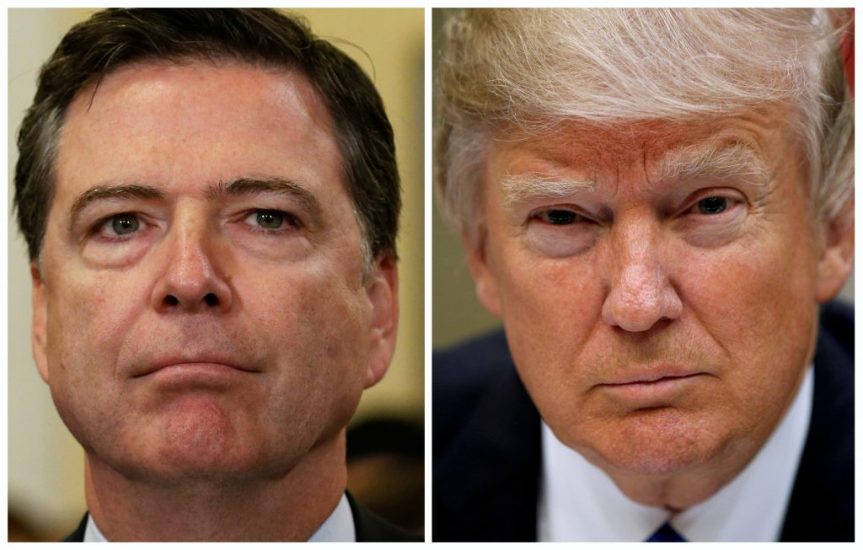
An astute Bracing Views reader described the Trump-Comey-Russia hearings as “the audio version of a glittering disco ball,” which captures the moment. Sure, there’s lots of flash there, but the real problems of the USA are being very much ignored. Put differently, it’s hard to hear any real news when the thump-thump-thump of Trump-Comey-Russia drowns out all other voices.
I’ve already said my piece (at TomDispatch.com) about some of the big problems that face our country, so indulge me for a moment as I consider the disco inferno of Trump-Comey.
My take: Trump wanted loyalty, Comey didn’t promise that, nor should he have. Trump, it seems, also felt upstaged by Comey (not only because the former FBI Director is taller than Trump and more vigorous). Comey, in short, was uncooperative, not one of Trump’s guys, so he fired him. As president, Trump has that power.
Was it a smart move? No. Does it look bad? Yes, especially the timing. Is it obstruction of justice? Apparently not, since the various Russia-Trump investigations are progressing. (To my knowledge, there are at least three of them ongoing.)
More than anything, Comey’s testimony makes Trump look like a dick (to use a technical term). But we already knew that. Trump’s been posing (it didn’t require acting) as a dick for years on TV, taking great relish in saying, “You’re fired!” to a range of has-been celebrities. Should we really be surprised that Trump is acting like a dick as president? Even his followers knew he was a dick; they just thought he was their dick.
Did Trump collude with Russia? Of course he did! He admitted it himself. Remember when Trump called for the Russians to hack Hillary Clinton — to find her “thirty thousand” missing emails, ha ha! That may not be the legal definition of collusion, but if you heard that and refused to consider that Candidate Trump’s encouragement of hacking by a foreign power in an election for his benefit was wrongful, well, so be it. Those Americans who voted for Trump were apparently untroubled by it.
I’m not defending Trump. The man is a menace to the world, with his denial of global warming/climate change, his embrace of nuclear weapons, his cocksureness fed by his ignorance, the list goes on. But, based on the evidence that’s been presented so far, he’s done nothing that reaches an impeachable offense. Major league dick status, yes. Impeachment? Not yet. Or Nyet.
The biggest problem with Trump is not that he’s a Russian stooge. It’s that he’s not presidential. He doesn’t understand public service. It’s utterly foreign to him, not just because he has no experience of it but because it’s contrary to his egocentric personality.
Look at his priorities as president. (They are the same as they were when he was a real estate developer.) #1 for Trump is Trump. #2 for Trump is his immediate family, joined by a few trusted lackeys, toadies, and sycophants. #3 for Trump is his money, his position in society, and his reputation among his peers and fellow billionaires, those “masters of the universe,” to use Tom Wolfe’s phrase.
Make America great again? That’s never been Trump’s priority. Make Trump greater and greater? That’s more like it.
Trump is fulfilling his version of the American dream. Too bad it’s a nightmare for America.
Another day, another Trump scandal, this one stemming from a memo written by the former FBI director, James Comey, in the aftermath of a private conversation he had with the President. According to the Comey memo, the president urged him to drop the FBI’s investigation into Michael Flynn’s ties to Russia, using these words: “I hope you can see your way clear to letting this go, to letting Flynn go. He is a good guy. I hope you can let this go.”
Obstruction of justice? Impeachable offense? That’s debatable. But the alleged conversation obviously takes on heightened meaning after Trump fired Comey, in part because of frustration with the FBI’s investigation into alleged collusion between the Trump campaign and Russia during the election.
It’s unclear if any crimes were committed here. What is clear is that Trump is a poor manager of himself as well as his staff. Flynn, with his dodgy record, should never have been hired. Furthermore, the president should not have gone out on a limb to defend him, cajoling the FBI director, in so many words, to go easy on my guy.
Perhaps Trump’s biggest flaw is his combination of boastfulness, lack of judgment, and his ego-driven need to take charge. He reminds me of an Air Force saying: “He’s all Mach and no compass heading.” He’ll break the sound barrier while moving in the opposite direction to sound governance.
I wrote back in March of 2016 that candidate Trump had disqualified himself from the presidency by boasting about how America’s generals would follow his orders irrespective of their legality. My main point was that Trump had no understanding of his Constitutional responsibilities, nor did he seem to care much about learning them. If Comey’s memo is accurate, I think it’s another instance of Trump either not knowing or not caring about propriety, about the rule of law.
Trump’s experience in life is as a CEO of a family business. Everyone has always worked for him; in essence, he’s been King Trump. Even though he’s now president, he still acts like a king, making up his own rules as he goes along, not knowing a rule book already exists.
Will Trump survive his first term? As Yoda might say, Difficult to see — always in motion the future. One thing is certain: Trump continues to consume all the oxygen in Washington, extinguishing any hope of real progress or effective governance at the federal level.
Seven years ago, I wrote an article for TomDispatch.com on American kleptocracy. At the time, it seemed a bit of a stretch. Sure, America was (and is) plutocratic. But kleptocratic? Like a third-world dictatorship in which family members of the ruler enrich themselves while being appointed to government offices for which they’re eminently unqualified? Surely not! But here we are, in 2017, with Trump as president and his son-in-law Jared Kushner seemingly running everything and with daughter Ivanka the “First Daughter” and pseudo-First Lady. I didn’t see that one coming.
Jared and Ivanka: Good at looking good
Anyway, here’s my original article, unedited, from 2010.
American Kleptocracy
How Fears of Socialism and Fascism Hide Naked Theft
By William J. Astore
Kleptocracy — now, there’s a word I was taught to associate with corrupt and exploitative governments that steal ruthlessly and relentlessly from the people. It’s a word, in fact, that’s usually applied to flawed or failed governments in Africa, Latin America, or the nether regions of Asia. Such governments are typically led by autocratic strong men who shower themselves and their cronies with all the fruits of extracted wealth, whether stolen from the people or squeezed from their country’s natural resources. It’s not a word you’re likely to see associated with a mature republic like the United States led by disinterested public servants and regulated by more-or-less transparent principles and processes.
In fact, when Americans today wish to critique or condemn their government, the typical epithets used are “socialism” or “fascism.” When my conservative friends are upset, they send me emails with links to material about “ObamaCare” and the like. These generally warn of a future socialist takeover of the private realm by an intrusive, power-hungry government. When my progressive friends are upset, they send me emails with links pointing to an incipient fascist takeover of our public and private realms, led by that same intrusive, power-hungry government (and, I admit it, I’m hardly innocent when it comes to such “what if” scenarios).
What if, however, instead of looking at where our government might be headed, we took a closer look at where we are — at the power-brokers who run or influence our government, at those who are profiting and prospering from it? These are, after all, the “winners” in our American world in terms of the power they wield and the wealth they acquire. And shouldn’t we be looking as well at those Americans who are losing — their jobs, their money, their homes, their healthcare, their access to a better way of life — and asking why?
If we were to take an honest look at America’s blasted landscape of “losers” and the far shinier, spiffier world of “winners,” we’d have to admit that it wasn’t signs of onrushing socialism or fascism that stood out, but of staggeringly self-aggrandizing greed and theft right in the here and now. We’d notice our public coffers being emptied to benefit major corporations and financial institutions working in close alliance with, and passing on remarkable sums of money to, the representatives of “the people.” We’d see, in a word, kleptocracy on a scale to dazzle. We would suddenly see an almost magical disappearing act being performed, largely without comment, right before our eyes.
Of Red Herrings and Missing Pallets of Money
Think of socialism and fascism as the red herrings of this moment or, if you’re an old time movie fan, as Hitchcockian MacGuffins — in other words, riveting distractions. Conservatives and tea partiers fear invasive government regulation and excessive taxation, while railing against government takeovers — even as corporate lobbyists write our public healthcare bills to favor private interests. Similarly, progressives rail against an emergent proto-fascist corps of private guns-for-hire, warrantless wiretapping, and the potential government-approved assassination of U.S. citizens, all sanctioned by a perpetual, and apparently open-ended, state of war.
Yet, if this is socialism, why are private health insurers the government’s go-to guys for healthcare coverage? If this is fascism, why haven’t the secret police rounded up tea partiers and progressive critics as well and sent them to the lager or the gulag?
Consider this: America is not now, nor has it often been, a hotbed of political radicalism. We have no substantial socialist or workers’ party. (Unless you’re deluded, please don’t count the corporate-friendly “Democrat” party here.) We have no substantial fascist party. (Unless you’re deluded, please don’t count the cartoonish “tea partiers” here; these predominantly white, graying, and fairly affluent Americans seem most worried that the jackbooted thugs will be coming for them.)
What drives America today is, in fact, business — just as was true in the days of Calvin Coolidge. But it’s not the fair-minded “free enterprise” system touted in those freshly revised Texas guidelines for American history textbooks; rather, it’s a rigged system of crony capitalism that increasingly ends in what, if we were looking at some other country, we would recognize as an unabashed kleptocracy.
Recall, if you care to, those pallets stacked with hundreds of millions of dollars that the Bush administration sent to Iraq and which, Houdini-like, simply disappeared. Think of the ever-rising cost of our wars in Iraq and Afghanistan, now in excess of a trillion dollars, and just whose pockets are full, thanks to them.
If you want to know the true state of our government and where it’s heading, follow the money (if you can) and remain vigilant: our kleptocratic Houdinis are hard at work, seeking to make yet more money vanish from your pockets — and reappear in theirs.
From Each According to His Gullibility — To Each According to His Greed
Never has the old adage my father used to repeat to me — “the rich get richer and the poor poorer” — seemed fresher or truer. If you want confirmation of just where we are today, for instance, consider this passage from a recent piece by Tony Judt:
In 2005, 21.2 percent of U.S. national income accrued to just 1 percent of earners. Contrast 1968, when the CEO of General Motors took home, in pay and benefits, about sixty-six times the amount paid to a typical GM worker. Today the CEO of Wal-Mart earns nine hundred times the wages of his average employee. Indeed, the wealth of the Wal-Mart founder’s family in 2005 was estimated at about the same ($90 billion) as that of the bottom 40 percent of the U.S. population: 120 million people.
Wealth concentration is only one aspect of our increasingly kleptocratic system. War profiteering by corporations (however well disguised as heartfelt support for our heroic warfighters) is another. Meanwhile, retired senior military officers typically line up to cash in on the kleptocratic equivalent of welfare, peddling their “expertise” in return for impressive corporate and Pentagon payouts that supplement their six-figure pensions. Even that putative champion of the Carhartt-wearing common folk, Sarah Palin, pocketed a cool $12 million last year without putting the slightest dent in her populist bona fides.
Based on such stories, now legion, perhaps we should rewrite George Orwell’s famous tagline from Animal Farm as: All animals are equal, but a few are so much more equal than others.
And who are those “more equal” citizens? Certainly, major corporations, which now enjoy a kind of political citizenship and the largesse of a federal government eager to rescue them from their financial mistakes, especially when they’re judged “too big to fail.” In raiding the U.S. Treasury, big banks and investment firms, shamelessly ready to jack up executive pay and bonuses even after accepting billions in taxpayer-funded bailouts, arguably outgun militarized multinationals in the conquest of the public realm and the extraction of our wealth for their benefit.
Such kleptocratic outfits are, of course, abetted by thousands of lobbyists and by politicians who thrive off corporate campaign contributions. Indeed, many of our more prominent public servants have proved expert at spinning through the revolving door into the private sector. Even ex-politicians who prefer to be seen as sympathetic to the little guy like former House Majority Leader Dick Gephardt eagerly cash in.
I’m Shocked, Shocked, to Find Profiteering Going on Here
An old Roman maxim enjoins us to “let justice be done, though the heavens fall.” Within our kleptocracy, the prevailing attitude is an insouciant “We’ll get ours, though the heavens fall.” This mindset marks the decline of our polity. A spirit of shared sacrifice, dismissed as hopelessly naïve, has been replaced by a form of tribalized privatization in which insiders find ways to profit no matter what.
Is it any surprise then that, in seeking to export our form of government to Iraq and Afghanistan, we’ve produced not two model democracies, but two emerging kleptocracies, fueled respectively by oil and opium?
When we confront corruption in Iraq or Afghanistan, are we not like the police chief in the classic movie Casablanca who is shocked, shocked to find gambling going on at Rick’s Café, even as he accepts his winnings?
Why then do we bother to feign shock when Iraqi and Afghan elites, a tiny minority, seek to enrich themselves at the expense of the majority?
Shouldn’t we be flattered? Imitation, after all, is the sincerest form of flattery. Isn’t it?
As the end of Trump’s first 100 days in office approaches, we can already see the novice commander-in-chief’s approach to military action. The approach is to empower “his” generals. And the results? A triumph of image over substance. “Spin it to win it” is the byword for Trump’s military “strategy.”
A few examples:
The disastrous raid on Yemen that led to the death of a Navy SEAL as well as many civilians, including children, was spun by the Trump administration as a great success. At the same time, Trump pinned the death of the SEAL on his generals, saying “they” lost him.
The launch of 59 expensive cruise missiles against a Syrian airfield did little to change the actions of the Assad government. Nor did it knockout the airfield. Yet it was spun by Trump as a remarkable victory. In his words, “We’ve just fired 59 missiles, all of which hit, by the way, unbelievable, from, you know, hundreds of miles away, all of which hit, amazing. It’s so incredible. It’s brilliant. It’s genius. Our technology, our equipment, is better than anybody by a factor of five. I mean look, we have, in terms of technology, nobody can even come close to competing.”
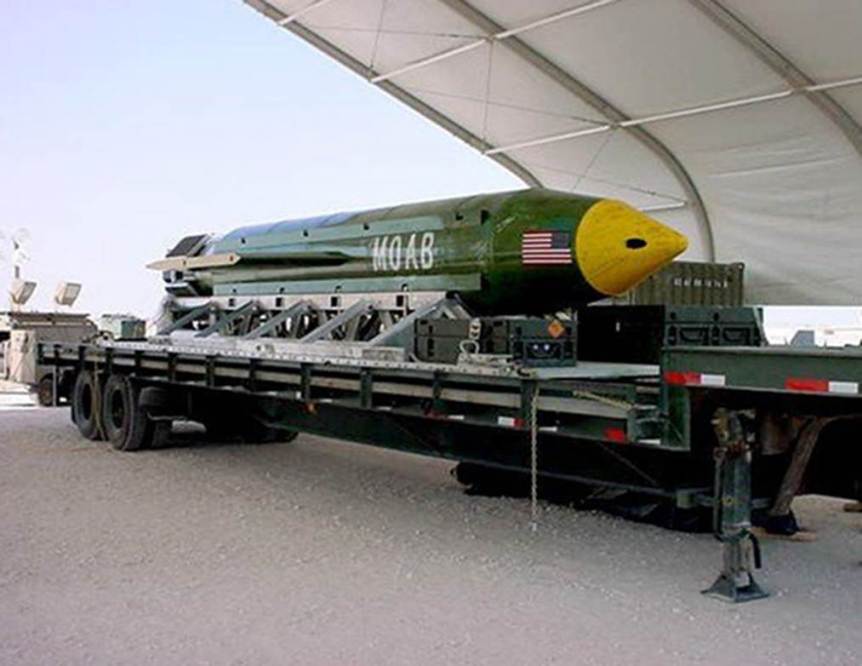
The use of the “mother of all bombs” (MOAB) in Afghanistan was seized upon by Trump as an example of his toughness and decisiveness vis-à-vis the Obama administration’s use of force. Yet Trump didn’t even know about the bomb until after it was used. Nevertheless, he boasted “If you look at what’s happened over the last eight weeks [of my administration] and compare that really to what’s happened over the past eight years, you’ll see there’s a tremendous difference, tremendous difference.” Dropping MOAB, Trump claimed on scant evidence, “was another very, very successful mission.”
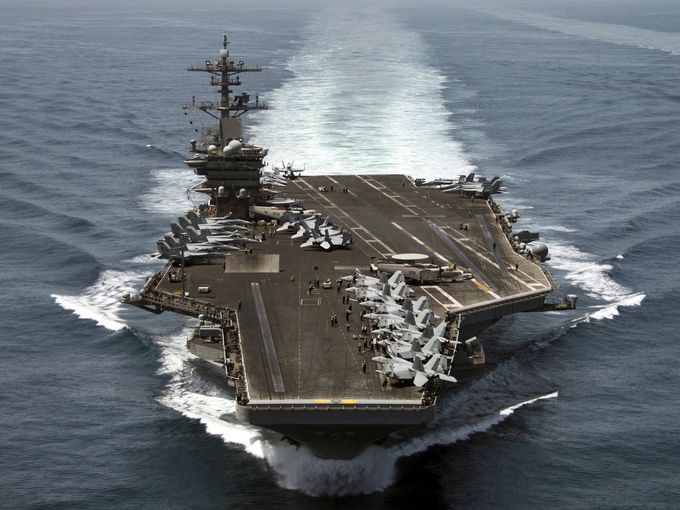
The Trump administration lost track of an aircraft carrier battle group, saying it was on its way as a show of force against North Korea even as it was headed in the opposite direction. This blunder was chalked up to a miscommunication between the White House and Pentagon, even as allies such as South Korea and Japan expressed concern about the credibility of U.S. support at a time of rising tensions.
As Tom Engelhardt notes in his latest must-read piece at TomDispatch.com:
President Trump did one thing decisively. He empowered a set of generals or retired generals — James “Mad Dog” Mattis as secretary of defense, H.R. McMaster as national security adviser, and John Kelly as secretary of homeland security — men already deeply implicated in America’s failing wars across the Greater Middle East. Not being a details guy himself, he’s then left them to do their damnedest. “What I do is I authorize my military,” he told reporters recently. “We have given them total authorization and that’s what they’re doing and, frankly, that’s why they’ve been so successful lately.”
Have the generals really been “so successful lately,” President Trump? The facts suggest otherwise. Meanwhile, Trump has not yet learned that generals always want more – they believe they can win if they just get more troops, more money, more weaponry. They’ll support Trump as long as he keeps funneling more of everything their way – and as long as he keeps spinning their blunders and missteps as victories.
Is this the face of “success” in Yemen? A little girl dead?
For the moment, Trump’s generals may love him for his “spin it to win it” boosterism and his blank checks of support. But beware, men wearing stars. Trump has already shown he prefers to delegate responsibility as well as authority when things go bad (recall the failed raid on Yemen and the dead SEAL).
Trump may not be a micro-manager, but that’s because he doesn’t know anything. He just wants to spin military action as a win – for Trump. If the generals keep losing, Trump will turn on them. The question is, will they turn on him?
More disturbing still: When failed military actions are spun as alt-fact “victories,” the violence isn’t done simply to facts: it’s done to innocent people around the world. It’s no game when innocent children die in the false name of “winning.”
In my latest article for TomDispatch.com, I investigate what an “America first” foreign policy actually means in practice. What follows is an extract from the article in which I consider whether the U.S. military has morphed from a deterrent force (at least in its own eyes) to a doomsday machine. This idea is inspired in part by an article that Dennis Showalter, a fine historian and an even better friend, wrote back in 2000 about the German military prior to World War I. Excerpt follows:
Deterring Our Way to Doomsday
Who put America’s oil under all those Middle Eastern deserts? That was the question antiwar demonstrators asked with a certain grim humor before the invasion of Iraq. In Trump’s oft-stated opinion, the U.S. should indeed have just taken Iraq’s oil after the 2003 invasion. If nothing else, he said plainly what many Americans believed, and what various multinational oil companies were essentially seeking to do.
Consider here the plight of President Jimmy Carter.Nearly 40 years ago, Carter urged Americans to scale back their appetites, start conserving energy, and free themselves from a crippling dependency on foreign oil and the unbridled consumption of material goods. After critics termed it his “malaise” speech, Carter did an about-face, boosting military spending and establishing the Carter Doctrine to protect Persian Gulf oil as a vital U.S. national interest. The American people responded by electing Ronald Reagan anyway. As Americans continue to enjoy a consumption-driven lifestyle that gobbles up roughly 25% of the world’s production of fossil fuels (while representing only 3% of the world’s population), the smart money in the White House is working feverishly to open ever more fuel taps globally. Trillions of dollars are at stake.
Small wonder that, on becoming president, Trump acted quickly to speed the building of new pipelines delayed or nixed by President Obama while ripping up environmental protections related to fossil fuel production. Accelerated domestic production, along with cooperation from the Saudis — Trump’s recent Muslim bans carefully skipped targeting the one country that provided 15 of the 19 terrorists in the 9/11 attacks — should keep fuel flowing, profits growing, and world sea levels rising.
One data point here: The U.S. military alone guzzles more fossil fuel than the entire country of Sweden. When it comes to energy consumption, our armed forces are truly second to none.
With its massive oil reserves, the Middle East remains a hotbed in the world’s ongoing resource wars, as well as its religious and ethnic conflicts, exacerbated by terrorism and the destabilizing attacks of the U.S. military. Under the circumstances, when it comes to future global disaster, it’s not that hard to imagine that today’s Middle East could serve as the equivalent of the Balkans of World War I infamy.
If Gavrilo Princip, a Serbian “Black Hand” terrorist operating in a war-torn and much-disputed region, could set the world aflame in 1914, why not an ISIS terrorist just over a century later? Consider the many fault lines today in that region and the forces involved, including Russia, Turkey, Iran, Israel, Saudi Arabia, and the United States, all ostensibly working together to combat terrorism even as they position themselves to maximize their own advantage and take down one another. Under such circumstances, a political temblor followed by a geo-political earthquake seems unbearably possible. And if not an ISIS temblor followed by major quake in the Middle East, there’s no shortage of other possible global fault lines in an increasingly edgy world — from saber-rattling contests with North Korea to jousting over Chinese-built artificial islands in the South China Sea.
As an historian, I’ve spent much time studying the twentieth-century German military. In the years leading up to World War I, Germany was emerging as the superpower of its day, yet paradoxically it imagined itself as increasingly hemmed in by enemies, a nation surrounded and oppressed. Its leaders especially feared a surging Russia. This fear drove them to launch a preemptive war against that country. (Admittedly, they attacked France first in 1914, but that’s another story.) That incredibly risky and costly war, sparked in the Balkans, failed disastrously and yet it would only be repeated on an even more horrific level 25 years later. The result: tens of millions of dead across the planet and a total defeat that finally put an end to German designs for global dominance. The German military, praised as the “world’s best” by its leaders and sold to its people as a deterrent force, morphed during those two world wars into a doomsday machine that bled the country white, while ensuring the destruction of significant swaths of the planet.
Today, the U.S. military similarly praises itself as the “world’s best,” even as it imagines itself surrounded by powerful threats (China, Russia, a nuclear North Korea, and global terrorism, to start a list). Sold to the American people during the Cold War as a deterrent force, a pillar of stability against communist domino-tippers, that military has by now morphed into a potential tipping force all its own.
Recall here that the Trump administration has reaffirmed America’s quest for overwhelming nuclear supremacy. It has called for a “new approach” to North Korea and its nuclear weapons program. (Whatever that may mean, it’s not a reference to diplomacy.) Even as nuclear buildups and brinksmanship loom, Washington continues to spread weaponry — it’s the greatest arms merchant of the twenty-first century by a wide mark — and chaos around the planet, spinning its efforts as a “war on terror” and selling them as the only way to “win.”
In May 1945, when the curtain fell on Germany’s last gasp for global dominance, the world was fortunately still innocent of nuclear weapons. It’s different now. Today’s planet is, if anything, over-endowed with potential doomsday machines — from those nukes to the greenhouse gas emissions that cause global warming.
That’s why it’s vitally important to recognize that President Trump’s “America-first” policies are anything but isolationist in the old twentieth century meaning of the term; that his talk of finally winning again is a recipe for prolonging wars guaranteed to create more chaos and more failed states in the Greater Middle East and possibly beyond; and that an already dangerous Cold War policy of “deterrence,” whether against conventional or nuclear attacks, may now have become a machine for perpetual war that could, given Trump’s bellicosity, explode into some version of doomsday.
Or, to put the matter another way, consider this question: Is North Korea’s Kim Jong-un the only unstable leader with unhinged nuclear ambitions currently at work on the world stage?
Steve Bannon, self-professed student of the Art of War (Getty Images)
W.J. Astore
A favorite book of Steve Bannon’s is Sun Tzu’s The Art of War. A classic of military strategy, The Art of War was compiled during the Warring States period (403-221 BCE) in ancient Chinese history. It was a time of intense civil warfare in China, a time when a cessation in fighting was merely a pause between the next round of battles among warlords. It’s still widely read today for its insights into war, its clever stratagems and tactics, and its lessons into human nature and behavior.
Bannon, who served in the U.S. Navy, is an armchair strategist with an affinity for military history books. He appears to believe in inevitable conflict between the Judeo-Christian West, which he favors due to its “enlightened” values, and the World of Islam, which he sees as retrograde and barbaric when compared to the West. He sees the world as already being in a “warring states” period writ large, a realm of conflict marked by “holy war” to be mastered by warrior/scholars like himself.
Joining him in this belief is Donald Trump, who took great pains to recite the phrase “radical Islamic terrorism” in his speech before Congress, as if using these words were a mark of personal courage on his part. Trump has boasted about winning the “next” war, as if war during his presidency is inevitable. And I suppose it is, with Trump at the helm and advisers like Bannon, Sebastian Gorka, and Stephen Miller pursuing a bellicose hardline against Islam.
Be careful what you wish for, Trump and cronies, and be especially careful about declaring victory in wars before you’ve even fought them. Here Sun Tzu has much to teach our “warriors” in the White House.
For one thing, Sun Tzu writes that a battle is best won without fighting at all. Said Sun Tzu: “Fighting and winning a hundred wars is not the greatest good. Winning without having to fight is.” In other words, you set the stage so carefully that the enemy must surrender or face obliteration before the curtain is even raised on war.
Secondly, Sun Tzu warns about the folly of protracted wars, how they deplete the national budget and weaken a state, especially when support among the people is tepid. Warfare, notes Sun Tzu, must be treated with the greatest caution, even as it is waged with great cunning. Best of all is to outsmart the enemy; next best is to form alliances, to build a much bigger army than the enemy, which may force them to capitulate. Worst of all is to get bogged down in long wars, especially in cities, which require expensive sieges that wear on both sides (just ask the Germans at Stalingrad about this).
Ultimately, Sun Tzu writes that by understanding oneself and one’s enemy, a skilled leader can engage in a hundred battles without ever being in serious danger. But an unskilled leader who does not truly know his own nature or that of his enemies is one who is fated always to lose. Trump, who fancies himself a great leader and who is ignorant of foreign nations and peoples, does not inspire confidence here, even as he promises the American people that we’re going to win so much, we’ll get bored with winning.
Sun Tzu puts great emphasis on careful planning and sober deliberation before launching attacks. If the recent Yemen raid is any indicator, Trump is neither a careful planner nor a sober deliberator. Indeed, Trump’s personal qualities expose him to being manipulated by a cunning enemy. In listing the personal traits that are dangerous in a commander, Sun Tzu mentions “quick to anger” as well as “self-consciousness” or vanity. One who’s quick to anger can be goaded by insults into making poor decisions; one who’s vain and self-conscious can be humiliated or manipulated into rash action.
Trump promises an American military that is so big and so strong that no country will dare attack us. Yet Trump himself, surrounded by his “warrior” advisers, isn’t content to build a huge military while not using it. Indeed, Trump is already using it, notably in Yemen, pursuing policies that are fated to perpetuate warfare around the globe. And it’s hardly encouraging that, after the failed Yemen raid, Trump shifted the blame to his generals rather than taking it himself.
Remember what Sun Tzu warned about vanity as well as perpetual warfare, especially when your own people are increasingly divided? Something tells me this lesson is lost on Trump, Bannon, and crew. Embracing the stratagems of The Art of War, its emphasis on surprise, subterfuge, deception, and quick strikes, is not enough. You must seek the wisdom at its core, which is very much against war except as a last resort.
Know thyself, said Sun Tzu, echoing the Greek philosopher Socrates. Face yourself squarely, recognize your flaws, your vanity (“All is vanity,” say the Christian Bible, a book Trump professes to treasure), and be careful indeed in unleashing war.
Do Trump, Bannon, and company know themselves, admit to their flaws and vanities, and recognize that war, in all its perils and costs, should be a course of last resort? So far, evidence is wanting.
Update (8/12/17): Bannon has said his concern about a civilizational conflict with Islam dates from his time in the Navy and a visit to Pakistan. Apparently, however, his ship visited Hong Kong rather than Pakistan. Bannon also recalls specific details of Iran — its resemblance to a “primeval” wasteland — that he apparently was not privy to. All this is revealed in an article at The Intercept. Either Bannon’s memory is faulty or he is an esteemed member of the “alternative fact” club, where you just make things up to fit your preconceived notions.
As Peter Maass at The Intercept notes: “It turns out that Bannon, who has drawn a large amount of criticism for his exclusionary stances on race, religion, and immigration, has also inaccurately described his military service, simultaneously creating an erroneous narrative of how he came to an incendiary anti-Muslim worldview that helps shape White House policy.”
He can read from a teleprompter without barking: presidential?
W.J. Astore
One word defines Trump and his cronies: cynicism. His cabinet picks illustrate this; many of them are against the very agencies’ missions that they’re supposed to uphold, like public education, environmental protection, and decent health care. He hires billionaires for his cabinet in the name of draining the swamp and championing the cause of the working classes. Meanwhile, even as Trump poses as commander-in-chief, he ducks responsibility for the failed raid on Yemen, shifting it to “his” generals, whom he otherwise praises as super-capable and deeply respected.
Under Trump, Americans are witnessing the negation of idealism. Some might say that America’s ideals such as liberty and freedom and democracy have been observed more in the breach than in practice (consider slavery, for example, or the treatment of Native Americans), but at least we had ideals. They were imperfectly practiced, but with Trump ideals no longer matter. It’s just cynicism, a naked grab for wealth and power.
Cynics don’t believe in much of anything, except perhaps their own perspicacity in seeing the world “as it is.” If you don’t believe in anything, you can lash out at anything, without guilt. And Trump is a lasher. He attacks everything: “failed” generals, “murderous” Mexicans, “terrorist” Muslims, the “lying” press, unfair judges, even Rosie O’Donnell , beauty queens, and Nordstrom (!). Anyone and everything can be attacked and vilified when you’re a cynic with no core beliefs other than your own rectitude.
Trump is not a leader, he’s a cynic. A negator of meaning. What’s amazing to me is that some in the media recently suggested he looked presidential just because he read a speech written by others off a teleprompter without barking or snarling. Of course, cynicism is not unique to Trump; Hillary and the Democrats have their share, as Chris Hedges has noted. Recall, for example, the silencing of anti-war protesters at the Democratic National Convention in July. Trump just has less class, even trotting out a war widow while passing the buck on taking responsibility for her grief.
Why is cynicism so dangerous? I recall watching a documentary on the Holocaust in which a witness to a massacre described the horrific events. He ended with a cry against cynicism. The negation of human life he’d witnessed had, at its core, the cynical belief that human life simply didn’t matter. That people were just so much matter, just things to be exploited or disposed of as their “masters” decreed.
Cynicism, a denial of idealism, of higher meaning, and of humanity, was a propellant to, an accelerant of, the Holocaust. We see cynicism in Trump’s reference to the dead Navy SEAL in the Yemen raid. His service and death is celebrated as uniquely heroic and noble (“etched in eternity”), whereas the many Yemeni people killed, including several children, are forgotten. They simply don’t count; they are beneath being noticed.
Cynicism is spreading in America, with Jewish tombstones being toppled over, with darker-skinned immigrants being shot and killed in the name of “taking back one’s country,” of certain Muslims being excluded solely on their country of origin. Policies are being driven by cynicism – a cold calculus of profit and power.
To a cynic, all facts are “alternative,” which is to say a lie is judged the same way truth is, by the criterion of whether it advances one’s agenda and one’s power. What’s “true” is what’s expedient. To a cynic, facts are unimportant. All that matters is what you can get people to believe, how you can manipulate them and get them to act to fulfill your agenda.
Cynicism is the enemy of idealism, of truth, of humanity. Where it ends I truly hesitate to say.
Trump’s latest press conference is worrisome for so many reasons. He seems to live in his own reality (e.g. his administration is “a fine-tuned machine“). He’s still obsessed with Hillary Clinton and the margin of his victory. He seems only recently to have learned how serious the prospects of a nuclear holocaust could and would be. He continues to defend General Michael Flynn, saying that even though Flynn undermined the Obama administration and lied to Vice President Mike Pence, his rapprochement to Russia was laudable (with Trump suggesting that, even though he hadn’t approved Flynn’s actions, he might have). He even tasked a Black reporter to set up a meeting with the Congressional Black Caucus for him!
What to make of The Donald? Trump seems to thrive on creating animosity, then exploiting it. Special targets for him include the U.S. intelligence community and the media, both of which he sees as implacable enemies. But is animosity and chaos any way to run a country or to represent a people?
I can see how calling out your perceived enemies might work in business, especially a personal one, though Trump’s bankruptcies suggest otherwise. But Trump is no longer a free-wheeling real estate tycoon. He’s president now, a symbol (like it or not) of America. Generating animosity and discord as a public servant is divisive, fractious, selfish, and unwise.
A united America is much stronger than a disunited America, but since Trump thrives on division, his personal style is weakening our country. You might say he’s the opposite of Abraham Lincoln, who appealed to the better angels of our nature in a noble but ultimately failed attempt to unite a disunited country. Whatever else Trump is about, it’s not better angels.
Instead of making America great again, Trump is making it divided and uncivil again.
Mister President: Please stop blaming the media, or Hillary, or the intelligence community, or judges, or anyone else for that matter. Get on with the job of being a public servant. America needs inspired leadership, not self-serving rhetoric. We need a uniter, not a divider.
Rise above the pettiness, Mister President. For the nation’s sake, don’t be the pettiness.
Nora al-Awlaki, 8 years old, killed in the Yemen raid
W.J. Astore
The Trump administration’s first “kinetic” military action, last weekend’s raid on Yemen that killed a Navy SEAL as well as fifteen women and children, was an operational failure. Aggravating that failure has been the aggressive propaganda spin applied by the White House. According to White House spokesman Sean Spicer, the operation was a major success:
“Knowing that we killed an estimated 14 AQAP [Al Qaeda in the Arabian Peninsula] members and that we gathered an unbelievable amount of intelligence that will prevent the potential deaths or attacks on American soil – is something that I think most service members understand, that that’s why they joined the service.”
Later, Spicer doubled down, accusing Senator John McCain (and other critics of the raid) of defaming the dead Navy SEAL when he suggested the raid had been something less than a towering success. McCain, Spicer said, owed the dead SEAL an apology.
Trump himself then joined the fray, accusing John McCain in a tweet of emboldening the enemy and suggesting he’d “been losing so long he doesn’t know how to win anymore.”
Yet, by Spicer’s logic, President Trump himself owes an apology to all U.S. troops killed in the Iraq and Afghan wars, since Trump has criticized these wars as either unnecessary or botched in execution. Recall here that Trump said he was against the Iraq invasion in 2003, but once the U.S. invaded, he said the U.S. government botched it by not taking Iraq’s oil, which, he claimed, would have prevented the rise of ISIS.
The Iraq war, Trump has said, was a mistake, a failure, a loss. He promised to show America how to “win” again. Is the recent Yemen raid what he meant by a “win”?
Nearly everything went wrong in the Yemen raid. Surprise wasn’t achieved. U.S. troops were killed and wounded. Far too many non-combatants (innocent civilians) were killed, including an eight-year-old girl. A $75 million Osprey malfunctioned and had to be destroyed.
To hazard a guess, this raid probably cost the U.S. in the neighborhood of $250 million while failing to achieve its main objective. Meanwhile, the enemy put up fierce resistance with weaponry, mainly small arms and explosives, that probably cost less than $100,000.
In brief, the U.S. raid on Yemen was prodigal in cost, profligate in resources, and unproductive in results.
Of course, I can’t say for certain that the raid didn’t secure vital intelligence. According to Spicer, an “unbelievable” amount of intelligence was seized. But early signs are unpromising. The U.S. military chose to share, in the immediate aftermath of the raid, a video of bomb-making training by al-Qaeda (apparently from a seized laptop), only to remove it when they learned the training video was a decade old and readily available on YouTube. Some intelligence coup!
The Trump administration is promising to launch more raids, featuring an “easier approval cycle” than witnessed under President Obama. Indeed, some reports suggest President Trump was goaded into approving the Yemen raid by being told his predecessor wouldn’t have approved it.
If the Yemen raid is the new face of “winning” under Trump, America may yet long for the days of “losing” under previous presidents.
Show me your budget and I’ll tell you what you value. Under the Trump administration, what is valued is spending on military weaponry and wars. The Pentagon is due to get a major boost under Trump, as reported by the Associated Press and FP: Foreign Policy:
Money train. It’s looking like it might be Christmas in February for the U.S. defense industry. The Pentagon has delivered a $30 billion wish list to Congress that would fund more ships, planes, helicopters, drones, and missiles, the AP reports.
And that might only be the beginning.
President Trump has already ordered the Pentagon to draft a “supplemental” budget for 2017 that would include billions more for the U.S. military on top of the $600 billion the Obama administration budgeted for…
As FP’s Paul McLeary and Dan De Luce recently reported, there are proposals floating around for a defense budget as high as $640 billion for 2018, which would bust through congressionally-mandated spending caps that Democrats — and many Republicans — are happy to keep in place. Defense Secretary Jim Mattis has been tasked with completing the supplemental request by March 1.
The Pentagon, which has never passed a financial audit and which has wasted more than two trillion dollars over the years (this figure came in 2001, when Donald Rumsfeld was Secretary of Defense under Bush/Cheney), is due to be given even more money to spend, irrespective of past performance or future need.
Naturally, each military service is already posturing and clamoring for the extra money promised by Trump. Consider the U.S. Navy, which, according to Vice Chief of Naval Operations Admiral William Moran, will be “Just Flat Out Out Of Money” without this supplemental funding boost from Congress.
According to the Navy and Marine Corps:
Five attack submarines would see their maintenance availabilities canceled this year and be put at risk of being decertified if no supplemental were passed out of Congress, Moran added, in addition to similar cuts to surface ship maintenance availabilities.
Assistant Commandant Gen. Glenn Walters said “we would stop flying in about July” without a supplemental. He clarified that forward forces would continue to operate, but for units training at home, “all training would cease without a supplemental, and that includes the parts money and the flying hour money.”
Even if the supplemental – which could total between $30 and $40 billion for all the armed services – is passed in a timely manner, the Navy and Marine Corps still face massive readiness issues that money can’t immediately address.
That last part is disturbing indeed. Even with billions in additional funding, the Navy still faces “massive readiness issues.”
Well, here are a few radical suggestions for Trump and the Pentagon:
If money is tight, why not re-prioritize? If readiness is compromised, why not scale back the mission?
Before boosting funding, why not force the Pentagon to pass a financial audit?
If trillions of dollars have gone “missing” over the last decades (remember, a Republican Secretary of Defense made this claim), why not launch missions to find that money before spending billions of new money?
You don’t reform a bureaucracy that wastes money by giving them more money. It’s like reforming an addict on drugs by giving him more money to spend on drugs. Until the Pentagon can account for its spending, its budget needs to be flatlined or cut.
The only way to force the Pentagon to think about “defense” spending is to limit its budget. Throwing money at the Pentagon just ensures more of the same, only more: as in more weaponry, more wars, and more fraud, waste, and abuse.
Given the Pentagon’s track record over the last half-century, does anyone truly think that more money is a solution to anything?