“Invest” in New Nuclear Weapons? No Thanks

 It’s always the right time to stop building more weapons of mass destruction

William Astore and Matthew Hoh

[Note to readers: Back in early September, Congressman Mike Turner penned an op-ed for the “liberal” New York Times supporting a massive “investment” in new nuclear weapons. Matt Hoh and I quickly submitted letters to the Times to protest this op-ed and its arguments; the Times ignored them. We then wrote our own op-ed below, shopping it to various mainstream media outlets without success. Here it finally appears for the first time.]

*****

Representative Mike Turner’s essay on nuclear weapons in The New York Times (We Must Invest in Our Aging Nuclear Arsenal, September 6, 2024) is dangerously loyal to counterproductive US national security policies and narratives.

Turner’s lamentation over foreign nuclear weapons programs ignores destabilizing US arms control choices this century. The US spends more on nuclear weapons than the rest of the world combined. Its $1.7 trillion modernization program (the Sentinel ICBM; the B-21 Raider bomber; Columbia-class nuclear submarines) has done little more than upset the decades-long nuclear deterrence balance among nations.

In his essay, Turner neglects to mention the US government’s unilateral withdrawal from multiple arms control treaties. Then-Senator Joe Biden rightly predicted the effects of George W. Bush’s abandonment of the Anti-Ballistic Missile (ABM) Treaty: “A year ago [in 2000], it was widely reported that our intelligence community had concluded that pulling out of ABM would prompt the Chinese to increase their nuclear arsenal tenfold.” The Chinese are now clearly headed in that escalatory direction.

To prevent the apocalyptic consequences of yet another nuclear arms race, the US should act to decrease “investments” in new weapons while cutting current arsenals by negotiating and enacting new arms reduction treaties. Together, the US and Russia already possess ten thousand nuclear warheads, enough to destroy life on earth and several other earth-sized planets. We need desperately to divest from nuclear weapons, not “invest” in them.

Consider as well that America’s current nuclear triad, especially the Navy’s Trident submarine force, is potent, survivable, and more than sufficient to deter any conceivable adversary.

Simply put, the US must stop building genocidal nuclear weapons. It must instead renew international efforts and treaties to downsize these dreadful and dangerous arsenals. Spending yet more trillions on more world-shattering nukes is worse than a mistake—it’s a crime against humanity.

Here we are haunted by the words of Hans Bethe, who worked on the Manhattan Project that created the atomic bomb during World War II. The first reaction Bethe said he’d had after Hiroshima was one of fulfillment—that the project they had worked on for so long had succeeded. The second reaction, he said, was one of shock and awe: “What have we done? What have we done,” he repeated. And the third reaction: It should never be done again.

That is the imperative here. The US must act so that future Hiroshimas will never happen.

It’s not America’s fate alone that’s at stake here, but the fate of humanity itself, and indeed most life on earth, as only a few dozen thermonuclear warheads exploding would likely produce nuclear winter and an eventual “body count” in the billions.

During the First Cold War, one heard it said: “Better dead than red.” That mentality remains, even as the “reds” today are more capitalist than communist. Meanwhile, the weapons makers for the military-industrial-congressional complex (MICC), in their greed, are the adversary within. From Israel and events in Gaza, we’ve learned the MICC will literally empower a people to commit mass murder. With more and newer thermonuclear weapons, the MICC may yet kill the world.

Higher quarterly profits will mean little when everybody is dead.

During the Vietnam War, a US Army major was heard to say: “We had to destroy the town to save it [from communism].” If America can destroy towns in Vietnam to “save” them from communism, if it can facilitate the destruction of Gaza to “save” it from Hamas, it can similarly destroy the earth to “save” it from China, or Russia, or some other “threat.” That is the indefensible (il)logic of building yet more weapons of mass destruction.

Contra Congressman Turner, there is no logical, sensible, defensible reason for America’s proposed “investment” in new nuclear weapons. But there are nearly two trillion reasons why it’s going forward, because that’s the projected total cost of modernizing America’s nuclear triad. Money talks—loudly, explosively, perhaps catastrophically.

Today, more than half of US federal discretionary spending is devoted to war and weapons. Americans, in essence, live both in a permanent war state and a persistent state of war. As bad as that reality is, a state of nuclear war is unimaginable and must not be allowed to happen.

At the height of the Cold War, one of us served in Cheyenne Mountain, America’s nuclear command center, and witnessed a simulated nuclear attack on the US. Even on the primitive monitors the Air Force had back in 1986, seeing Soviet missile tracks crossing the North Pole and terminating at American cities was unforgettable.

A generation earlier, Robert Oppenheimer, the “father of the atomic bomb,” tragically noted in 1965 that it was 20 years too late to control nuclear arms. Those efforts, he said, should have been started “the day after Trinity” in July of 1945.

Let’s not make it 80 years too late. Congressman Turner is exactly wrong here. We must cut America’s nuclear arsenal and pursue new nuclear disarmament treaties. Never should our children be haunted as we were (and still are) by the darkness and doom of radioactive mushroom clouds.

William Astore, a retired lieutenant colonel (USAF) and historian, is a senior fellow at the Eisenhower Media Network.

Matthew Hoh, a former Marine Corps captain and State Department official, resigned in protest in 2009 against America’s ill-conceived war in Afghanistan. He is Associate Director at the Eisenhower Media Network.

How About A Winnable Nuclear Exchange, America?

W.J. Astore

Sure, we might get our hair mussed …

Like too many people, I sometimes make the mistake of talking about nuclear war, when it’s really annihilation and genocide we’re talking about.

Wars have winners and losers. In nuclear “war,” everyone loses. The planet loses. Life loses and death triumphs on a scale we simply can’t imagine.

Language is so important here. I grew up learning about nuclear exchanges. EXCHANGES! The U.S. military talks of nuclear modernization and “investing” in nukes when the only dividend of this “investment” is mass death.

One of the few honest acronyms is MAD, or mutually assured destruction. Lately, it’s an acronym that’s largely disappeared from American discourse.

More than anything, though, realistic images of a nuclear attack are perhaps the most compelling evidence against building more nukes, as in this powerful and unforgettable scene from Terminator 2:

To me, nothing beats that scene.  That is nuclear “war.”

The U.S. has over 5000 nuclear weapons; the Russians close to 6000. That’s more than enough to destroy the earth and a few other earth-sized planets. Imagine the scene above repeated eleven thousand times on our planet.

The insanity, the immorality of spending another $2 trillion on new nukes … well, it boggles my mind. We’ve become like the mutants in Beneath the Planet of the Apes, worshipping the bomb, acolytes of death and destruction.

If we all don’t end up killing ourselves and the planet in “an exchange,” we’ll likely degenerate into utter barbarism, as depicted in Cormac McCarthy’s The Road. And even that grim novel has a life-affirming ending that is most unlikely.

Amazingly, after I wrote the above passages about nuclear “war” and “exchanges,” I came across Admiral TR Buchanan’s recent keynote address at the Center for Strategic and International Studies (CSIS), where he uses the word “exchange” in a remarkably banal (and frightening!) way.

Here’s an excerpt from the transcript (available at https://www.stratcom.mil/Media/Speeches/Article/3976019/project-atom-2024-csis-poni-keynote/) with emphasis added.

BUCHANAN: Yeah, so it’s certainly complex because we go down a lot of different avenues to talk about what is the condition of the United States in a post-nuclear exchange environment. And that is a place that’s a place we’d like to avoid, right? And so when we talk about non-nuclear and nuclear capabilities, we certainly don’t want to have an exchange, right?

I think everybody would agree if we have to have an exchange, then we want to do it in terms that are most acceptable to the United States. So it’s terms that are most acceptable to the United States that puts us in a position to continue to lead the world, right? So we’re largely viewed as the world leader.

And do we lead the world in an area where we’ve considered loss? The answer is no, right? And so it would be to a point where we would maintain sufficient – we’d have to have sufficient capability.

We’d have to have reserve capacity. You wouldn’t expend all of your resources to gain winning, right? Because then you have nothing to deter from at that point.

So very complex problem, of course. And as I think many people understand, nuclear weapons are political weapons. I think Susan Rice said that at one point.

The motto of Admiral Buchanan might be: We had to destroy the world in order to lead it. Buchanan here is less sane than General Buck Turgidson in Dr. Strangelove.

This admiral thinks we might have to have “an exchange” with Russia, and that, if we do, we could do so “in terms that are most acceptable to the United States,” and that even after “an exchange,” the U.S. can still “continue to lead the world.”

Truly this is the banality of evil. I like how even after “the exchange,” we need to have a “reserve capacity” so that we can nuke the world again.

This is madness–sheer madness–but it’s received as probity and sane “strategic” thinking by the national security blob.

This guy was promoted to admiral precisely because he thinks this way. He thinks without thinking. With no humanity.

Well, as General Turgidson says in Dr. Strangelove, we might just get our hair mussed during a nuclear “exchange,” but does it really matter as long as we can kill more of them than us?

Playing Russian Roulette–With Russia

W.J. Astore

Reckless and Stupid

What is the point of playing Russian roulette—with Russia?

As the Biden administration fades into oblivion, among its last decisions has been to allow Ukraine to strike deep into Russia with U.S.-made ATACMS, a missile with a range of 300 kilometers (190 miles). Ukraine’s recent use of these missiles brought a worrisome response from Russia: hypersonic intermediate-range missiles. If Ukraine persists in striking deeper into Russia with U.S., British, and French missiles, the Russian response will be proportionately greater, and possibly escalatory against NATO.

Here’s the thing: These missiles are too few in number to have a decisive impact on the course of the war. Ukraine isn’t going to “win” by launching ATACMS and similar tactical missiles. Yes, they can inflict more pain on Russia, hitting targets like ammunition dumps, military bases, and the like. But nobody is pretending these are war-winning weapons. All they promise is more dead bodies on both sides.

In World War I, new weapons were often introduced because it was believed they would prove decisive on the battlefield, weapons such as poison gas (1915) and tanks (1916). Of course, the other side adapted fairly quickly and the war dragged on, but at least there was a sincere belief that new weapons might break the awful stalemate of trench warfare.

There is no such sincere belief today. The main objective seems to be to complicate matters for the incoming Trump administration and its stated goal to end the Russia-Ukraine War. To that end, the Biden administration is using all means at its disposal to send the remaining $6 billion or so in weapons and related aid to Ukraine before Trump’s inauguration in January. Even anti-personnel mines are included in the mix.

Here’s how Antony Blinken put it:

President Biden is committed to making sure that every dollar we have at our disposal will be pushed out the door between now and January 20. 

We’re making sure that Ukraine has the air defenses it needs, that it has the artillery it needs, that it has the armored vehicles it needs.

If only the Biden administration had been so committed to helping Americans in need.

In playing Russian roulette with Russia, Biden and Blinken have demonstrated unconscionable levels of recklessness and stupidity.

An incredibly reckless and stupid “game”

Yet Another Smear Piece on Tulsi Gabbard

W.J. Astore

Where else but the New York Times

In my morning news feed from the New York Times came this article on Tulsi Gabbard:

How Tulsi Gabbard Became a Favorite of Russia’s State Media

President-elect Donald J. Trump’s pick to be the director of national intelligence has raised alarms among national security officials.

Here’s the key paragraph from the article, which, of course, is delayed until the sixth paragraph:

No evidence has emerged that she has ever collaborated in any way with Russia’s intelligence agencies. Instead, according to analysts and former officials, Ms. Gabbard seems to simply share the Kremlin’s geopolitical views, especially when it comes to the exercise of American military power. [Emphasis added]

Did you get that? NO EVIDENCE. Tulsi has never collaborated with Russia in any way. The problem is that she’s a critic of unnecessary and disastrous wars like Iraq and Afghanistan. She’s a critic of massive U.S. military aid to Ukraine. And since those criticisms are vaguely useful to Russia, she must therefore be a “Russian asset,” a dupe of Putin, according to Hillary Clinton and now the New York Times.

Within the so-called intelligence community (IC), you are allowed to be a cheerleader, a booster, even a selective critic in the sense that you may call for more money for the IC because of certain limitations or oversights, but you are not allowed to question America’s disastrously wasteful imperial foreign policy.

No matter how poorly the IC performs (consider the colossal failure of 9/11, or the total obliviousness about the impending collapse of the Soviet Union in the late 1980s, or recent disastrous wars in Afghanistan, Iraq, and Libya), no one is ever held accountable, even as the IC gets more money and authority.

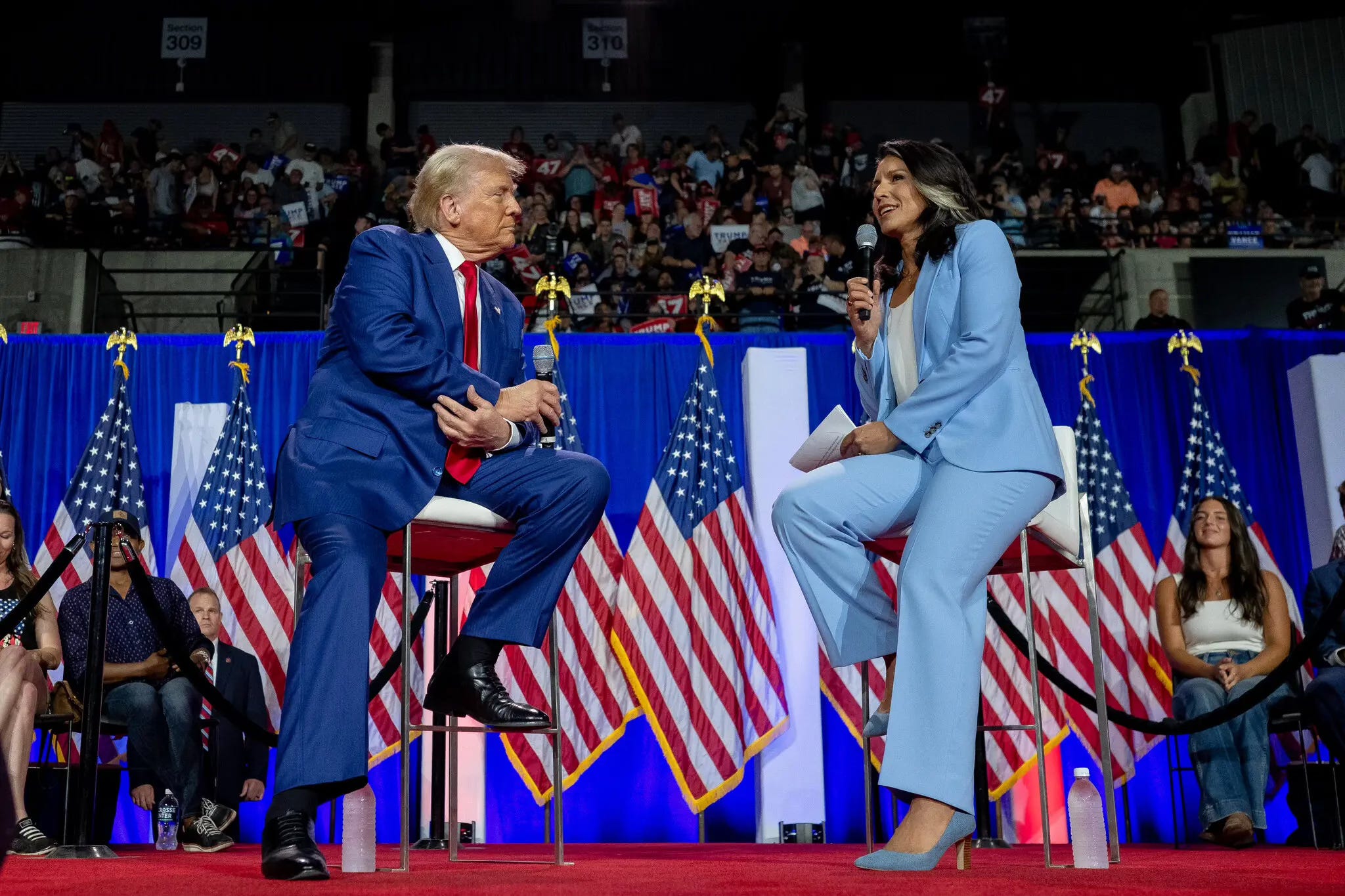
Tulsi Gabbard with President-elect Trump. (Jim Vondruska for the NYT)

Tulsi Gabbard promises to be a game-changer. Skeptical of the blatant misuse of American military power, she’s been an articulate critic of forever wars. She is especially sensitive to deploying U.S. troops in harm’s way for purposes other than the defense of the United States.

The “liberal” New York Times is having none of that. Consider this remarkable paragraph:

“Nominating Gabbard for director of national intelligence is the way to Putin’s heart, and it tells the world that America under Trump will be the Kremlin’s ally rather than an adversary,” Ruth Ben-Ghiat, a professor of history at New York University and the author of “Strongmen,” a 2020 book about authoritarian leaders, wrote on Friday. “And so we would have a national security official who would potentially compromise our national security.” [Emphasis added]

Who knew that “Putin’s heart” could be won so easily? And note the weasel wording that Tulsi could “potentially compromise” U.S. national security. Again, no evidence is presented. 

Well, we certainly don’t want the U.S. to have a rapprochement with Putin. He must always be our adversary, am I right? How dare that Trump and Gabbard might, just might, pursue a policy that is less antagonistic toward the Kremlin? Don’t you enjoy teetering on the brink of a world-ending nuclear exchange? I much prefer that to listening and negotiation.

In making enemies of Hillary Clinton and now the New York Times, Tulsi Gabbard has demonstrated she has what it takes to serve as director of national intelligence.

“Taking the Handcuffs Off” U.S. Missiles in Ukraine

W.J. Astore

Feeding the Obscenity of War

I woke to this disconcerting story from CNN:

President Joe Biden has authorized Ukraine to use powerful long-range US weapons deep inside Russia.

Why now? Biden is a lame duck president, shuffling out the door, and now he decides to allow Ukraine to use American ATACMS missiles, with a range of roughly 190 miles, inside Russia. It’s also expected that these and similar longer-range missiles provided by the French and British will have no decisive impact on the war. They may kill and wound more Russians and inspire responses in kind by Russia against Ukraine, but their use won’t contribute to “victory” for Ukraine. So what’s the point?

My wife put it well when she learned of the decision: “stupid” and “ridiculous” were her words of choice. It’s amazing how well our “experts” feed the obscenity of war.

How dare you handcuff our missiles!

I take my title from a comment made by President-elect Trump’s nominee for National Security Adviser, Mike Waltz, who said we should take the handcuffs off of U.S. missiles in Ukraine, as if those missiles were people being held prisoner.

Whether in the Biden or Trump administrations, the advisers at the top are moral midgets, murderously so. I wonder how they’d feel being targeted by ATACMS. Hey, we just took the handcuffs off, Mr. Waltz. Enjoy your time being bombarded by these liberated missiles.

At the end of September, I noted how Vladimir Putin had redefined Russian nuclear policy to include a possible nuclear response to the use of “tactical” missiles like ATACMS. Here’s what I wrote then:

Vladimir Putin is redefining Russian policy for the use of nuclear weapons. He’s sending a clear warning that Ukraine’s use of U.S. and Franco-British missiles like ATACMS and Storm Shadow deep within Russia could draw a nuclear response. To my knowledge, the U.S. has not yet approved of the use of ATACMS deep within Russia, though Ukraine is pushing for it.

It seems many brain-dead, zombie-like advisers and “experts” insist that Russia is bluffing. They’re willing to bet the health and safety of the world that Russia won’t respond with nuclear weapons. And for what? ATACMS and Storm Shadow missiles aren’t war-winning weapons. The Russia-Ukraine War is a slog, an attritional struggle, featuring trenches and artillery and high casualties, a situation akin to World War I. It’s not going to be won by conventional tactical missile strikes.

Yet certain “experts” seemingly want it to escalate to World War III with nukes.

Just about 80 years ago, we humans entered the atomic age at the Trinity test site in July of 1945. We still haven’t come to grips with how the world changed when the first atomic “gadget” exploded in the desert in New Mexico. We had better hurry up and grow up before we all burn.

So, Putin has warned that deep strikes within Russia could draw a nuclear response, and Biden has now approved said strikes just before he leaves the White House. “Stupid” and “ridiculous” are indeed good descriptors here.

The obscenity of war knows no handcuffs in America.

“Peace” Seems to Be the Hardest Word

W.J. Astore

Bipartisan Support in America for More War

With apologies to Elton John and Bernie Taupin, “peace” seems to be the hardest word, for both Democrats and Republicans.

This is hardly surprising. The National Security State is the unofficial fourth branch of government and arguably the most powerful. Presidents and Congress serve it, and the SCOTUS carves out special exceptions for it. Back in the days of a bit more honesty, it was called the Department of War. And so it remains.

Let’s say you’re like me and you see war as humanity’s greatest failing. We kill and maim each other, we scorch and kill every living thing in the path of our weapons, we destroy the environment, we even have the capacity to destroy life on earth via nuclear weapons. War—it really is good for absolutely nothin’, unless, of course, you profit from it.

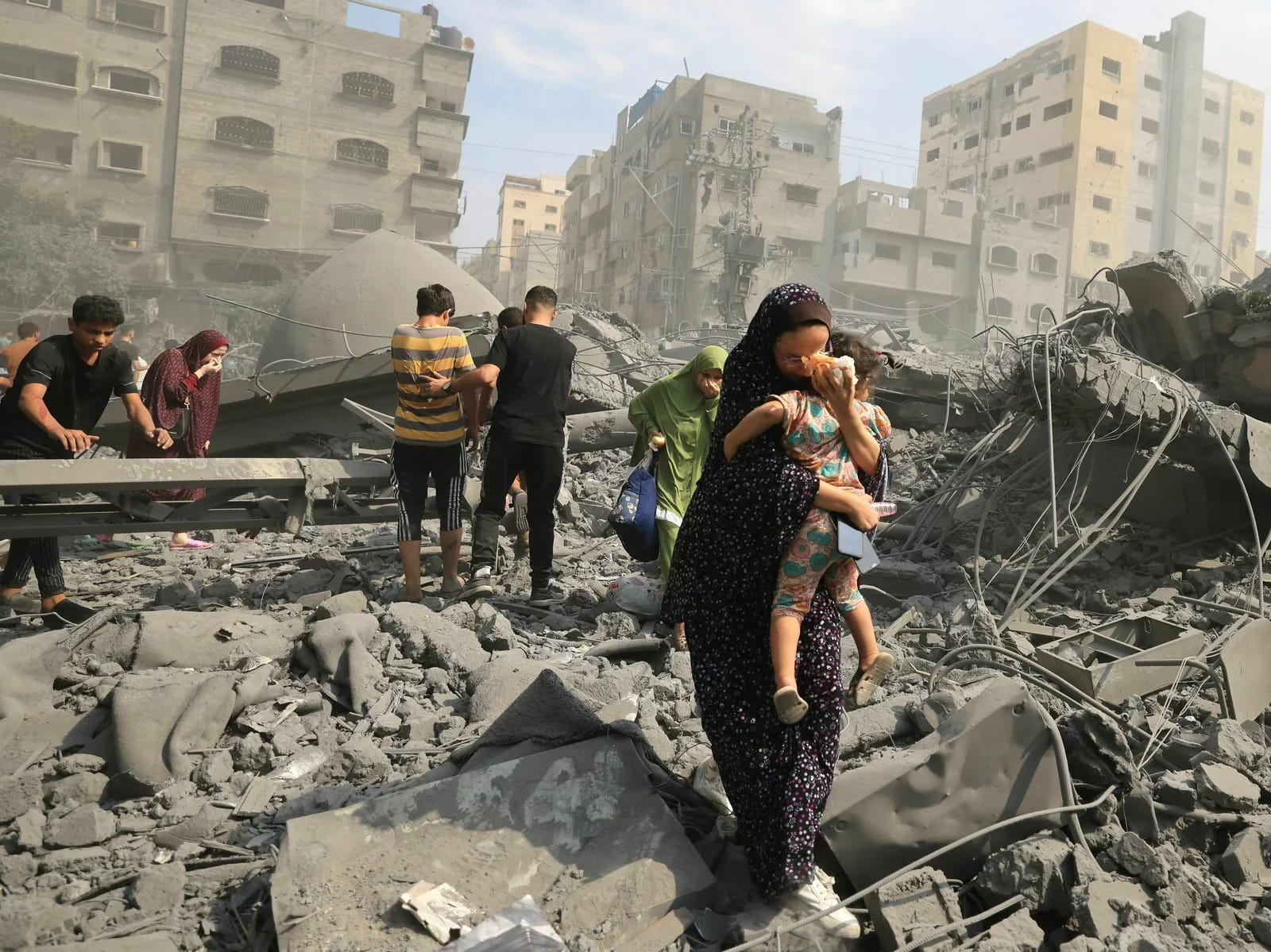
Gaza after an Israeli bombing attack. Anyone want more war?

So, who are you going to vote for in America who sees the awfulness of war and who’s willing to pursue diplomacy and peace instead? Democrats? Republicans?

Generally speaking, Democrats are fixated on war with Russia. They support massive aid to Ukraine and are against negotiations. They also support massive aid to Israel in its ongoing genocide against Palestinians in Gaza. And they fully support the military-industrial-congressional complex (MICC) and soaring spending on weapons and war, including “investing” in new nuclear weapons.

Republicans are much the same, except they tend to see China rather than Russia as the main threat, e.g. Donald Trump and J.D. Vance are willing to negotiate an end to the Russia-Ukraine War. But, in the main, Republicans fervently support Israel in its genocide, are outspoken critics of Iran (Got to punch them hard, Vance recently said), are willing enablers of the MICC, and also vote for massive spending on weaponry and war, including nuclear weapons.

Neither major U.S. political party, the red or blue teams, is pro-peace. Both are pro-aggression and pro-empire. They just occasionally choose different targets for their ire, even as they accuse the other team of “weakness,” of being “Putin puppets” or “Manchurian candidates.” 

As I’ve said before, the only word or sentiment apparently forbidden among the red and blue teams is “peace.” If you want an antiwar candidate in America, you have to go outside the two main parties to the Greens or similar fringe parties.

In America, “antiwar” is defined by America’s propaganda machine, otherwise known as the corporate media, as weak and unAmerican, because “the health of the state” is war.  Every election, whether the red or blue team prevails, the National Security State, the old War Department, wins. And humanity loses. 

The last mainstream candidate for the presidency who spoke consistently of peace was George McGovern in 1972. Unless we the people demand peace, we will continue to get war. In fact, in a bizarrely Orwellian way, colossal military spending and incessant wars are sold to us as keeping America safe. “War is peace” is quite literally the message of the National Security State and its Ministry of Truth, the corporate-owned media.

What is the solution? Here’s one possible approach: Whenever America deploys troops overseas, those troops most immediately in harm’s way must be drawn from the ranks of America’s most privileged and their children. So, corporate CEOs, Members of Congress, lawyers at White Shoe firms, private equity billionaires and millionaires and their progeny, Hollywood celebrities and America’s best-known sports stars: those Americans who prosper and profit the most from empire should be the first to serve it. And that service must be made mandatory, no exceptions, no way to buy your way out or plead that you have “higher” priorities.

Those who want war should serve in war, leaving the rest of us alone. This rule, more than any other, might just keep the chickenhawks from screeching for more war with Russia, or China, or Iran, or North Korea, or Syria, or somebody. A few minutes at the front, facing bullets and shells and cluster munitions while hearing the screams of the dying, might just cure these wannabe “warriors” of their fever.

Want a war? Go to war. And leave the rest of us in peace.

Ukraine, Gaza, and Elsewhere

W.J. Astore

There Will Be Wars and Rumors of Wars

Checking my daily email from Reuters this past Thursday revealed these two stories:

“Diplomacy falters” is one of the sub-headings, which is assuredly the case, assuming diplomacy was even tried.

The BLUF, or bottom-line upfront, to use an Army acronym, is more death, dying, and destruction in Ukraine and Gaza.

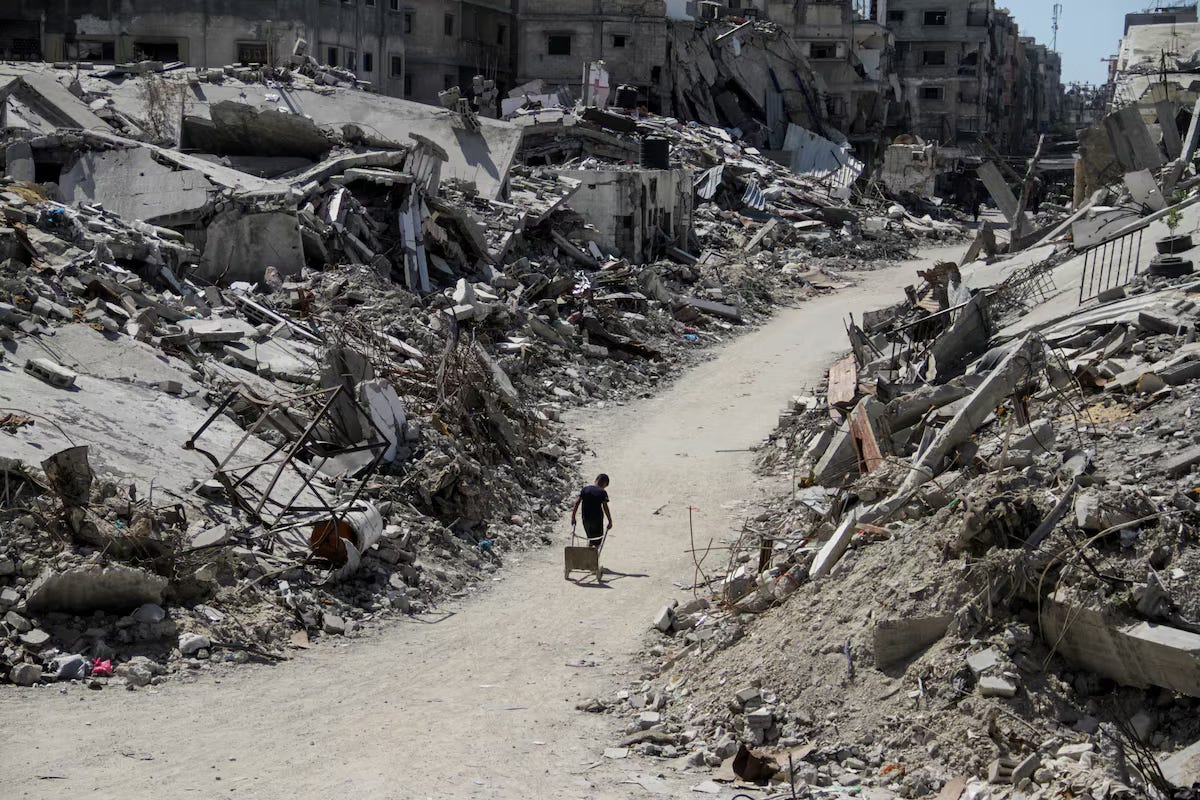
Reuters still refers to Israeli ethnic cleaning in Gaza as the “Gaza war,” but only one side has tanks, combat aircraft, 2000-pound bombs, heavy artillery, bulldozers, and even nuclear weapons. It’s not exactly a fair fight, is it? The Israeli government says it’s out to destroy Hamas, but what it’s really after is the destruction of Gaza and the forced relocation of Palestinians there, after which Gaza will be annexed and assimilated into Israel.

What Israel has done and is doing to Gaza

Turning to the Ukraine War, the longer it lasts, the greater the suffering, and the higher the risk of further escalation. Yet the focus is always on deterring Russia and defeating Putin, as if it’s 1938 yet again, with Putin as Hitler and Ukraine as Czechoslovakia. Any diplomatic settlement with Russia will be the equivalent of appeasement, another Munich Agreement, so the war must go on, I guess until one side or the other collapses from the strain. Perhaps 1918 and the chaotic end of World War I is a better year to think about than 1938.

Meanwhile, Reuters tells me there are “challenges” in Africa and that China must be corralled and contained. Poor Africa. European nations (and the United States) are always offering answers to Africa’s “challenges,” but those answers address the interests of the West, not of African peoples. The U.S. has a whole military command, AFRICOM, to address those “challenges,” mainly in the form of U.S. weapons sales and “security assistance.”

Finally, resurrecting the racist “yellow peril” trope with regards to China is only driving that country into closer contact with Russia, which has the added benefit of justifying immense Pentagon spending due to the dual threat of Russia-China. (Democrats tend to stress Russia as the big threat; Republicans prefer China.). Thus we hear of a new Cold War, which of course necessitates colossal military spending, because do you want China and Russia to rule the world?

There will be wars and rumors of wars: And so it goes with U.S. foreign relations, in perpetuity, seemingly.

War of the Words

W.J. Astore

Language as a Weapon

When Barack Obama took over as president in 2009, the global war on terror, or GWOT, just didn’t seem to fit the tenor of his “hope” and “change” message. So wars in Iraq and Afghanistan were rebranded as “overseas contingency operations.” Talk about the banality of evil! Even Orwell’s Big Brother might be impressed by OCOs as a substitute for invasion and war.

A euphemistic word Obama didn’t banish was “surge.” The “surge” in Iraq allegedly had worked under General David Petraeus, even though its gains proved as “fragile” and “reversible” as Petraeus hinted they would be. So Obama conducted his own surge in Afghanistan, the so-called good or smart war after the Bush/Cheney disaster in Iraq. And of course the “gains” in Afghanistan also proved both fragile and reversible, though no one was held to account for the miserable failure of the Afghan War. Whoops. I mean the Afghan contingency operation for democracy and enduring freedom.

Showing that he too could learn from America’s folly, Vladimir Putin termed his invasion of Ukraine a “special military operation.” U.S. leaders laughed at this, criticizing Putin for his propagandistic euphemism, even as they persisted in using terms like “overseas contingency operation” for America’s “kinetic” military actions. The eye of the beholder, I guess.

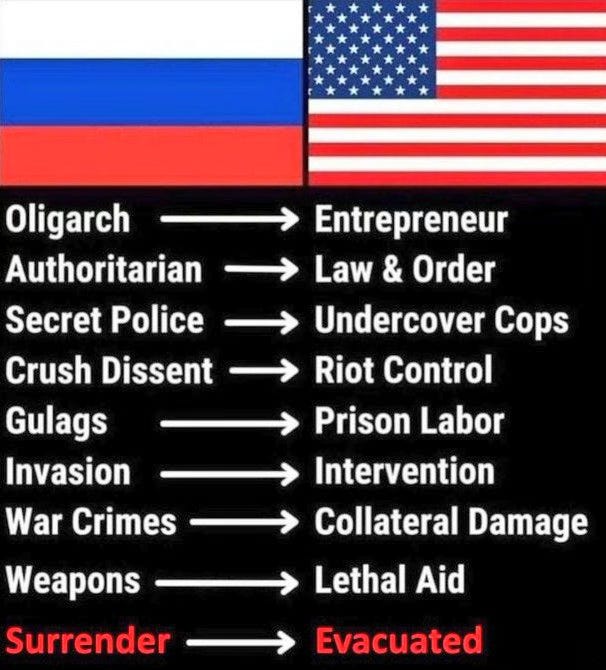
These thoughts came to mind as I perused my Twitter/X feed yesterday and spied this illustration posted by Chay Bowes:

Though the Russian flag is on the left, it could be the flag of China, Iran, North Korea, or any other alleged evildoer. The Russians invade, we intervene (for the sake of democracy, naturally). The Russians commit war crimes, we have unfortunate instances of collateral damage. In the war of the words, the U.S. military is clearly rather clever in a self-aggrandizing and self-exculpatory way.

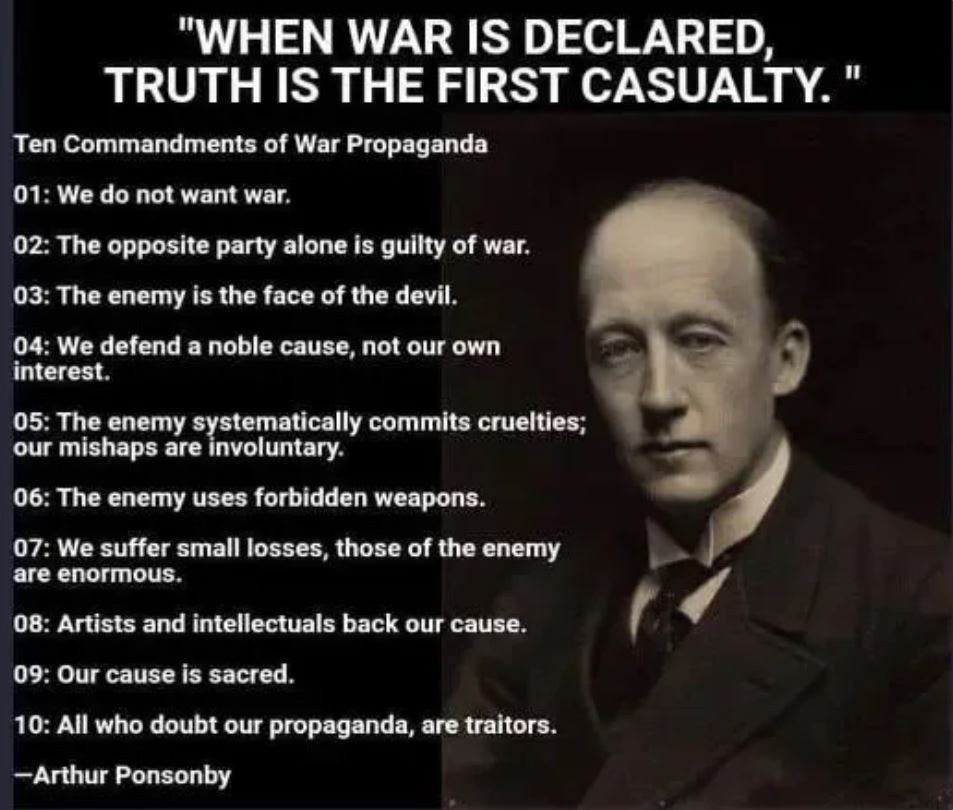
Looking at comments from this Twitter feed, I came across another useful illustration of manipulating language and information in the cause of war. Take a gander:

I confess I’d never heard of Arthur Ponsonby and his book, Falsehood in War-Time. I need to check it out. 

This may prove a handy list to keep around as America’s national (in)security state acts to gin up the next war.

U.S. Power Sets All the Wrong Examples to the World

W.J. Astore

An Open Letter from the Eisenhower Media Network

I’m a member of the Eisenhower Media Network, or EMN. We’re a small network of retired military types and former U.S. government officials who are openly critical of the military-industrial-congressional complex, America’s open-ended forever wars (the global war on terror; the cold war against Russia and China), and rising militarism within and across our society.

Recently, EMN issued a new letter in opposition to the Washington bipartisan consensus for war and more war. I’m proud to say I had a hand in writing it, as did Matthew Hoh and other members of EMN. Here’s what we had to say:

Military and Foreign Policy Experts Open Letter on U.S. Diplomatic Malpractice

Does America inspire the world by the power of its example or the example of its power? Far too often, and despite President Joe Biden’s words during his inaugural address, America’s overmilitarized power and diplomatic malpractice are its examples to the world.

We must change that. To make America truly essential and indispensable, we must not remain the world’s leading arms maker and weapons exporter. We must instead become the world’s greatest and most committed peacemaker and diplomat.

The problem is that America continues to make war, continues being “essential” only as the world’s leading merchant of death, and continues seeking dominance through military supremacy that ends, in places like Afghanistan, Iraq, and earlier in Vietnam, in mass death and colossal folly.

In our first open letter last spring in The New York Times, we, the undersigned, argued that a thoroughly militarized U.S. foreign policy would generate ruinous and worsening consequences and increasingly limited options for the U.S. and the world. Recent events bear this out.

The results of U.S. diplomatic malpractice are cruelly displayed in Eastern Europe, the Middle East and the Indo-Pacific. Risks of further escalation and a world war are rising. Predictably, a militarized foreign policy characterized by rejecting or ignoring international laws and treaties and by disingenuous negotiations and talks has offered no solutions to volatile wars in Eastern Europe and the Middle East while making war more likely in the Indo-Pacific.

Militarized solutions breed and feed more war. Earnest and deliberate diplomacy is the best hope to bring peace, stability and reconciliation to the world.

We chose Ike as our inspiration because he warned Americans of the dangers of the military-industrial complex and because he rejected a world dedicated to manufacturing weapons to commit mass murder. 

War in Ukraine

The failure to pursue diplomacy in Eastern Europe, both before and after Russia’s invasion of Ukraine, has resulted in a costly and destructive stalemate for which there are two likely futures:

  1. The collapse of the Ukrainian state due to a deteriorating economic and military situation hastened by corruption.Here, Ukraine’s fragility resembles that of previous houses of cards built by the U.S. in Afghanistan, Iraq, and Vietnam.
  2. A harrowing and bloody stalemate in Ukraine where firepower, made more lethal by technological advances, rules a battlefield where neither side can achieve decisive tactical or operational gains. The pursuit of ways out of this stalemate likely entails horizontal and vertical escalation, neither of which offers solace to those seeking an end to death and destruction in Ukraine and the establishment of peace and stability.

Horizontal escalation sees the war extending further to civilian population centers and infrastructure and includes the possibility of other nations joining the conflict. Vertical escalation sees the expansion of arsenals to weapons of greater range, lethality, and consequence, including nuclear weapons. These two forms of escalation may be intertwined and reinforcing. So, as the war may expand horizontally to resemble The War of Cities between Iran and Iraq in the 1980s, it may expand vertically as well with more powerful weapons being introduced by both sides. The use of nuclear weapons is increasingly conceivable under these conditions.

These two likely futures may intersect. For example, a Ukrainian collapse could see NATO forces, likely Polish and Romanian, marching into western and central Ukraine to counter a Russian push to fill a collapsing Ukrainian state. Such an event could lead to a war between NATO and Russia, a war that conceivably could go nuclear.

Hamas, Israel and the Middle East

The Russia-Ukraine War now rages concurrently with the war between Hamas and Israel. This war, too, is born of a U.S. refusal to foster diplomacy. Unlike the conventional war between Russia and Ukraine, we are witnessing an asymmetrical conflict more akin to the wars of insurgency many of us experienced in Vietnam, Afghanistan, and Iraq.

Worse, the Hamas/Israel bloodletting in Gaza is characterized by an ethnic cleansing campaign that would be impossible without U.S. diplomatic, economic, media, military and political support. We are disgusted by and find repugnant the brazen and bipartisan support by the U.S. government for rampant violations of international law by Israel. Ethnic cleansing in Gaza, long planned by senior members of the Israeli government and powerful elements of Israel’s reactionary right wing, follows in the ghastly wake of Hamas atrocities against civilians on October 7.

Here, the U.S. government isn’t just passively witnessing war crimes; it is enabling them. With the frightening possibility of escalation to a regional or even a world war, the violence in Gaza has fed and feasted upon decades of deliberate diplomatic malpractice in America. Decades of putting Israel first, second, and last while ignoring the plight and pleas of Palestinians have made political settlements to the blockade of Gaza and the occupation of East Jerusalem and the West Bank nearly impossible.

Whereas a month ago, we lived with the risk of nuclear war as an outcome of escalating conflict in Ukraine, we now face the elevated risk of a rightfully feared world war as a consequence of entangling alliances between nuclear-armed Moscow and Washington in the Middle East.

China and the Path Ahead

To this, we must add the dangers of war with China, something hyped by leading U.S. politicians; the still unpaid costs of the $8 trillion wars in Afghanistan and Iraq; a militarized federal budget for which 60% of discretionary spending goes to war and all its wounds; and a hollowed American economy.

Decades of reckless U.S. war-making, both direct and via proxies, while coddling corrupt, ruthless, and unjust foreign governments has, not surprisingly, made the world more dangerous and less stable. Failure to invest in and maintain our country has weakened and corroded America’s infrastructure, institutions, and industries. A hypocritical flaunting of international law and an espousal of an ethereal rules-based order, coupled with an arrogant disregard for past U.S. crimes and blunders, have caused dozens of nations to flock to competitors – a movement away from America that will undoubtedly accelerate if we remain on our current militaristic path.

Moreover, decades of colossal military spending have witnessed few strategic gains for the U.S. Our military, often saluted as the world’s greatest by politicians, hasn’t won a major war since World War II. That same military annually faces significant recruiting shortfalls that cast considerable doubt on the integrity and staying power of the All-Volunteer Force. America’s legacy of failed wars is not redeemed by ongoing displays of vacuous military boosterism. Feel-good patriotism can’t suppress the bitterness many of us military veterans feel toward the past, nor does it calm the worries we have about our nation’s future.

Pope Francis has spoken of a “famine of peace” that exists in the world today. In this spirit, we call for immediate ceasefires, without conditions, in Gaza and Ukraine.

The surest way to prevent wars from exploding into uncontainable wildfires is to starve them of fuel. To think or speak that these conflagrations can be managed, adjusted as if by damper or thermostat, is a fool’s conceit or a liar’s word. We have been burned too many times in our professional lives to believe hot wars can be “won” by throwing more gasoline on them, whether rhetorically or in the form of cluster munitions, depleted uranium shells, and similar forms of “aid.”

A better path ahead is clear. Peace, not war, must be fostered. In embracing peace through diplomacy conducted in good faith, America would indeed exhibit the power of its example, becoming essential to a world that cries out for liberty and justice for all.

Mobsters of the Mind

W.J. Astore

Of “Legal” Drug Ads and Anti-Russia Messaging

Mobsters are known for breaking kneecaps to bend people to their will. Marketers break into heads with repetitive and manipulative advertising, images, and narratives. Mobsters of the mind, they are.

I thought of this after watching all those repetitive (and largely interchangeable) ads for “legal” prescription drugs. Rarely do they show the often serious conditions they allegedly treat. Instead it’s image after image of people enjoying life, whether at amusement parks, the beach, dancing, or what-have-you. It’s as if drug companies are selling happiness pills whose only side effect is experiencing the best day of your life. Meanwhile, as images spill into your head of eternal bliss, a narrator quietly intones about potential serious side effects, even possible death in the case of one drug I’ve seen advertised.

Excuse me while I pop a few pills and denounce Russia—or China

Drug ads are the worst. People wonder why Americans take so many illegal drugs and why we have so many drug addictions — well, just look at all the ads for legal drugs, and how they’re advertised as making people incandescently happy. It’s all about the messaging: the repetition of powerful feel-good imagery, with drugs as panaceas.

Speaking of repetition, something similar is true of political manipulation. To cite one example: Russia. Has there ever been a worse “drug” with more serious side effects than Russia? Russia keeps hacking our elections! Russia is led by war criminals! Russia is raping Ukraine! Over and over again, the mainstream media encourages us to hate Russia and Vladimir Putin. Is this truly all we need to know about Russia? As Sting sang, don’t the Russians love their children too? (Back in the 1980s, the media didn’t go easy on Sting for his alleged naïveté and pro-Russian sentiments.)

Whether it’s drug advertisers, the mainstream media, or the U.S. government for that matter, America is infested with various “ministries of truth” that are driven by a mobster-like mentality. They may not break your kneecaps, but they nevertheless find ways to break into your mind.

Now you’ll excuse me while I pop a few pills while denouncing Russia. And China too, perhaps?